Mohammed J. Kadhim* | Sally M. Abd | Mohammad Z. Yousif
© 2026 The authors. This article is published by IIETA and is licensed under the CC BY 4.0 license (http://creativecommons.org/licenses/by/4.0/).
OPEN ACCESS
The pressing environmental issues linked to the production of Portland cement have spurred efforts to create eco-friendly cement-based materials with improved engineering properties. Silica fume is widely acknowledged for its beneficial impact on cementitious composites due to its potent pozzolanic activity and ability to enhance the inner structure of such materials. This research delved into how the behavior of cement mortar is influenced by the particle size and dispersion technique of compacted silica fume. Micro-dense silica fume (MDSF) was utilized as a substitute for 10% of the cement, while nano-dense silica fume (NDSF) was added at different levels (1%, 3%, 5%, and 7% of the cement mass). To ensure even distribution and prevent clumping, the nano-sized material was administered as a pre-mixed water-based suspension. The water/binder ratio was kept at 0.33 for all the mortar mixes, while the content of binder was fixed at 1000 kg/m³. The results showed that the performance of both MDSF- and NDSF-added mortar was better than the base mortar. The NDSF, however, provided more significant improvements in strength and water absorption resistance because of its increased surface activity and pore refinement properties. The mortar formulation having 3% NDSF showed the best results with noticeably better compression strength of about 41.3% and flexural strength of about 35.8% after 91 days’ curing. The study highlights the importance of particle size and the degree of dispersion on the effectiveness of silica fume in cement applications. Moreover, it highlights the potential use of NDSF in dispersion to develop high-performance and eco-friendly cementitious composites.
nano-dense silica fume, micro-dense silica fume, cement mortar, dispersion method, mechanical properties, sustainable cementitious materials
Concrete technology has evolved over the last decades from normal strength concrete to more advanced cementitious systems with superior engineering properties. At the beginning of modern construction, conventional concrete was widely used for ordinary structural applications due to its mechanical strength and acceptable durability [1]. These mixtures were usually composed of a moderate amount of cement, conventional aggregates, and a relatively balanced mix of water, along with a limited number of chemical admixtures [2]. According to the study, green ultra-high-performance concrete (UHPC)’s enhanced mechanical performance is a result of its dense microstructure and strong component bonding [3]. This made the development of high-strength concrete (HSC) possible, which was specially developed for its superior mechanical capacity and better structural reliability. To produce HSC, the mixture design parameters had to be significantly modified, such as reducing the water-to-cement (W/C) ratio, optimizing the aggregate grading, enhancing the efficiency of the binder, and using higher quality water-reducing admixtures for maintaining workability [4]. At the same time, there was a trend to use ultrafine mineral and other cementitious material additives to additionally improve the lifetime durability and microstructure of cement-based composites. Components such as metakaolin, fly ash, nano-silica and other pozzolanic materials have proven to have a high capacity to control the pore structure, promote the hydration reactions and improve the performance of the cementitious matrices [5, 6]. The study indicates that silica fume particles directly influence the properties of Portland slag cement, with the 30% silica fume content yielding the greatest improvement in mechanical strength and durability compared to the other proportions [7]. Several microstructural characterization tools, such as scanning electron microscopy (SEM), are commonly used to explain these improvements, along with other analytical techniques. Recent studies indicate that the incorporation of micro silica in concrete had a significant effect on enhancing the mechanical properties of the concrete, including compressive strength in compression [8]. The large specific surface area of nano silica particles can be used as a micro filler and as a binding agent between the aggregate and cement paste to regulate the internal structure and accelerate the early-age strength development of cement [9]. Nano silica particles are very small and reactive, with high pozzolanic activity, which can fill the voids in the cement matrix, particularly in the interfacial transition zone (ITZ) and greatly reduce the porosity of the composite, thus resulting in a denser and stronger composite [10]. The effect of nano silica stimulates increased calcium silicate hydrate (C-S-H) production at early ages, while simultaneously consuming portlandite (Ca(OH)₂) through pozzolanic reactions, leading to lower portlandite content and a more cohesive microstructure. These mechanisms together explain how nano silica contributed to improving the concrete durability as well as strength. The high pozzolanic activity of silica fume contributes to the densification of the cementitious microstructure and enhances resistance to water penetration, making it a highly effective material for the production of durable and long-lasting concrete structures [11]. Consequently, silica fume is considered an important material for developing sustainable cement-based composites due to its performance and environmental advantage [12]. The performance of cementation materials is governed by their constituent proportions and curing conditions, which directly influence hydration kinetics, pore structure, and load-bearing capacity [13]. In this study, the effect of micro-and colloidal nano-dense silica fume (NDSF) on the characteristics of cement mortar has been studied. 10% of the cement was replaced by micro-dense silica fume (MDSF), and 1%, 3%, 5% and 7% of the cement replacement was 20% colloidal NDSF. Workability, apparent density, water absorption, compressive strength of compression and flexural strength were studied. Comparisons between the two particle scales were carried out under the same conditions and their effectiveness in improving the properties of sustainable cement-based materials was evaluated.
2.1 Cement
Ordinary Portland Cement (type I), manufactured in Iraq, was used in this study. The cement complied with the requirements of ASTM C150-04 [14] regarding its chemical composition and physical properties, as presented in Table 1.
Table 1. Chemical composition of cement
|
Oxide |
Content (%) |
|
CaO |
64.44 |
|
SiO2 |
16.4 |
|
Al2O3 |
4.9 |
|
Fe2O3 |
2.7 |
|
MgO |
4.3 |
|
K2O |
1.4 |
|
Na2O |
0.06 |
|
SiO3 |
2.1 |
|
L.O.I. (Loss of Ignition) |
3.7 |
2.2 Fine aggregate
The natural sand was sieved using the standard sieve series shown in Table 2. The particle size 1.36 mm was used for the research. This sand meets the requirements of Zone 2 in accordance with ASTM C33-03 [15]. The fine aggregate meets the specifications required for use in a cement mix, such as those laid out in ASTM C778, because it is easily handled, has an optimum density for packing, and is distributed uniformly throughout the cement mix.
Table 2. Fine aggregate gradation data
|
Sieving Size (mm) |
Cumulative Passing (%) |
ASTM Limit (%) |
|
10 |
100 |
100 |
|
4.75 |
91.8 |
90–100 |
|
2.36 |
79.6 |
75–100 |
|
1.18 |
69.5 |
55–90 |
|
600 µm |
53.7 |
35–59 |
|
300 µm |
22.3 |
8–30 |
|
150 µm |
2.7 |
0–10 |
2.3 Nanomaterials of dense silica fume
Silica fume is a by-product from the production of silicon and silicon-based alloys in electrically heated furnaces. It is a process of reducing quartzite at a high temperature to form silicon monoxide (SiO) vapor, which is further oxidized and condensed to silica fume at a lower temperature. A planetary ball mill (PBM) was used for this study to produce nanoscale dense silica fume (DSF). Under normal atmospheric conditions, the milling operation is conducted for 6 hours at a speed of 300 rpm and the ball-to-powder ratio is 10:1. These parameters were selected to obtain finer particles and better dispersion of these in the cement matrix. Then, SEM analysis was carried out to investigate the particle size and shape of the product. Table 3 gives a detailed chemical composition of the manufactured material: MDSF.
Table 3. The main composition of dense silica fume (DSF)
|
Oxide |
Content, % |
|
SiO2 |
89.63 |
|
Al2O3 |
0.32 |
|
Fe2O3 |
0.83 |
|
MgO |
0.69 |
|
K2O |
1.13 |
|
Na2O |
0.18 |
|
SO3 |
3.6 |
|
L.O.I. (Loss of Ignition) |
0.7 |
|
Sum |
Σ = 100% |
2.4 Nano-materials
NDSF was produced by mechanically milling dense silica fume (DSF) using a PBM. The effectiveness of the milling process was assessed by SEM, which was used to examine particle size and surface morphology. The physicochemical characteristics of the resulting nano-sized material are summarized in Table 4.
Table 4. Nano-dense silica fume (NDSF) particles specification
|
Specification |
Scaling |
|
Title of product |
NDSF |
|
The size of particles, nm |
25–50 |
|
The purity of product, % |
98.5 |
|
Color |
gray |
|
SSA (specific surface area), m²/g |
150–300 |
|
Bulk density, g/cm³ |
2.1–2.25 |
2.5 Superplasticizer
All cementitious mixtures were made using a Class F high-range water-reducing admixture which met the requirements of ASTM C494/C494M-05 [16].
2.6 Mixing design and sample preparation
In this investigation, all mixes were produced at a 1000 kg/m³ binder content. The ratio of water to the binder used was 0.33, and the amount of superplasticizer used was 1.5% of the cement weight for the preparation of the reference mix (M0), to achieve consistent homogeneity and a target value of 100 ± 5%. NDSF was dispersed in water before mixing with the ultrasonic bath (KQ-500DE) operated at 500 W, 40 kHz and room temperature for 10 minutes. This approach was taken to reduce agglomeration of the particles and provide less variation in the distribution of the nanoparticles in the mortar compositions. The prepared suspension was then mixed with cement and sand in the ratio 1:2.75 and the mixtures formed were termed mortar mixes. Subsequently, partial replacement of cement was done in the mixtures with NDSF, which resulted in DSF1 (1% NDSF), DSF3 (3% NDSF), DSF5 (5% NDSF), and DSF7 (7% NDSF); the mix proportions are presented in Table 5. All specimens were carefully cast into molds and stored under those molds for 24 h before demolding them and then water-cured for 7, 28 and 91 days to ensure good hydration and strength development.
Table 5. Mixing design
|
Mix Design |
Cement, kg/m³ |
Sand, kg/m³ |
SF, kg/m³ |
NSF, kg/m³ |
W/B |
SP, % |
|
M0 |
1000 |
2750 |
- |
- |
0.33 |
1.0 |
|
MDSF |
900 |
2750 |
10 |
- |
0.33 |
1.2 |
|
NDSF 1% |
990 |
2750 |
- |
10.0 |
0.33 |
1.2 |
|
NDSF 3% |
970 |
2750 |
- |
30.0 |
0.33 |
1.3 |
|
NDSF 5% |
950 |
2750 |
- |
50.0 |
0.33 |
1.4 |
|
NDSF 7% |
930 |
2750 |
- |
70.0 |
0.33 |
1.5 |
3.1 Workability test
The flow test was conducted to evaluate the horizontal spread of cement mortar under repeated dynamic impacts, in accordance with ASTM C1437-07 [17]. The flow value was determined as the mean of two orthogonal diameters of the spread mortar disc.
3.2 The apparent density
This test was conducted in accordance with ASTM C642-97 [18] to determine the density of 50 × 50 mm specimens after 28 days of curing. The reported density value represents the average of three tested specimens.
3.3 Water absorption
Water absorption was determined using 100 mm cubic specimens after 18 days of curing, in accordance with ASTM C642 [18]. The reported values correspond to the average of three tested specimens, and the water absorption was calculated using the standard equation specified in the method.
WA (%) = (Ww-Wd/Wd) × 100% (1)
where,
Ww: The wet of saturated surface in gm.
Wd: The dry weight by oven in gm.
3.4 Compression test
This test was carried out using 50 × 50 × 50 mm cubes with curing ages of 7 and 28 days, respectively, with respect to ASTM C109/C109M-05 [19]. The strength value of the mixture design was obtained by averaging the three sets of cubic samples that were utilized.
3.5 The flexural strength test
Flexural strength was evaluated using mortar prisms measuring 40 × 40 × 160 mm in accordance with ASTM C293-02 [20]. The specimens were tested under simple support conditions, and the reported flexural strength values represent the average of three specimens tested at 7 and 28 days. The tests were performed using a flexural/tensile testing machine with a load capacity of 100 kN. The modulus of rupture was calculated using the standard expression.
$f_r=\frac{2 P L}{3 b d^2}$ (2)
where,
fr: is the flexural strength represented in MPa.
P: The maximum load in kN.
L: The length of the middle span in mm.
b: The width of the span in mm.
d: The depth of the specimen in mm.
4.1 The workability test
The workability of the various cement mortar mixtures was evaluated through the flow test and the obtained results were summarized in Table 5. A W/C ratio of 0.33 and a flow of 100 ± 5 mm with an M0 were achieved by using superplasticizer. The replacement of cement with MDSF reduced flowability because of the high S.A. of silica fume, which also requires a higher dosage of superplasticizer. As the amount of NDSF in the cementitious mixes increased from 1% to 7% replacement of cement, the flow of the mixes also increased, requiring greater amounts of both water and superplasticizer to achieve the desired flow. Selected samples were analyzed by SEM, and it was found that both DSF and NDSF sharpened the cement matrix, decreased the size of calcium hydroxide crystals and created multiple nucleation sites for hydration products. This makes it easier to form C-S-H, resulting in a denser and more uniform microstructure. Because of its small particle size and high surface area, NDSF can help to reduce porosity and thus enhance mechanical performance. This results in an increase in the strength of the mortar yet a slight reduction in workability because of the increase in packing density and internal friction. Then, the incorporation of NDSF in it enhances the density, homogeneity and durability, and it affects the flow behavior. It is important to strategically modify the content of the nanoparticles and superplasticizer dosage to ensure the balance of workability and mechanical and durability properties, which shows that the NDSF is an effective high-performance cement additive [3, 10].
4.2 Apparent density
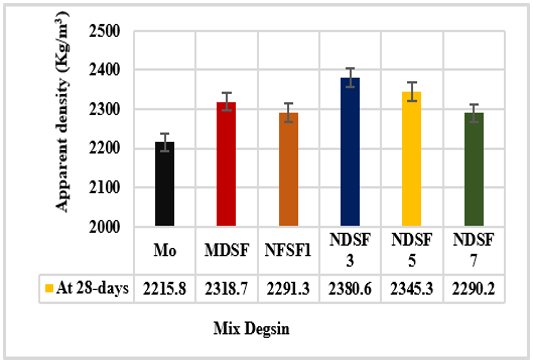
The apparent density of all the cement mortar mixes after 28 days of curing is shown in Figure 1, which includes the M0 mix with 10% MDSF and mixes that have been added with 1%, 3%, 5% and 7% of NDSF. The densities varied from 2200 to 2380.6 kg/m³ and increased as the DSF and NDSF content increased. The density of the MDSF mixture with 10% DSF increased to 2318.7 kg/m³, which was increased by 4.6% from the control mixture. The use of NDSF further increased the apparent density by about 3.40%, 7.43%, 5.84%, and 3.35% for NDSF1, NDSF3, NDSF5, and NDSF7, respectively, indicating that the nanoscale particles have a significant effect. The densities of the overall compositions were found to be 2215.8, 2318.7, 2291.3, 2318.5, 2345.3 and 2390.2 kg/m³, indicating that the densification effect occurred throughout the replacement levels.
The observed increment in density is mainly due to the small size of NDSF particles and high surface area that leads to a very compacted microstructure. These nanoparticles, which are reactive sites for cement hydration as well as physical filler, help to fill the microstructural voids and promote the growth of more C-S-H. This dual action decreases porosity, increases particle packing and increases interparticle bonding. Therefore, the cement paste has better uniformity, higher matrix density and better integrity, which are all reflections of the synergistic effect of NDSF in the microstructural and macrostructural properties of cement mortar [9, 12]. The rise in apparent density could be attributed to the nano-size particles being able to occupy very fine spaces inside the cement matrix. This effect helped to decrease the internal pores and increase the compactness of the hardened mortar.
4.3 Initial and final setting time
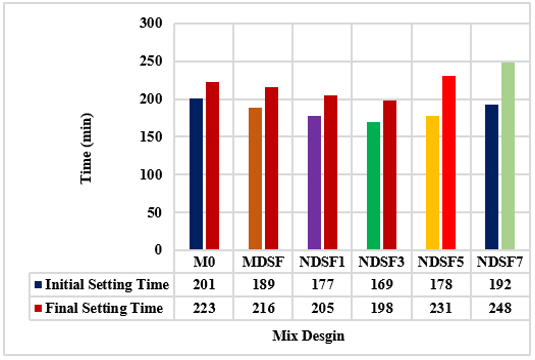
Nano silica fume is mainly utilized as an efficient nucleation agent in the initial stage of cement hydration when it is used at a low replacement level (1%). The very fine particle size and high specific surface area tend to encourage the early production of hydration products, especially C-S-H. This causes the setting to start early, but without having any major impact on the water requirement or rheological performance, which is evident from Figure 2, and thus leads to slightly decreased initial and final setting times for the reference mortar.
With the addition of 3% nano silica fume, the nucleation effect and the pozzolanic reactivity are increased. This stage results in higher consumption of calcium hydroxide and subsequently a higher amount of C-S-H gel at early ages. The better packing of the particles and faster development of the microstructure leads to a more cohesive matrix, with a significant reduction in initial and final setting times. This is the optimal amount of chemical reactivity and workability. The positive acceleration effect starts to decrease at a rate of replacement equal to 5%. The total surface area increases significantly, which results in high water adsorption and high paste viscosity. Of these factors, a limitation on the mobility of free water and a slower diffusion rate toward cement particles offset the hydration-accelerating effect of nano silica fume. This leads to a slight decrease in setting time and in some instances the setting behavior is similar to that of the control mixture. High doses like 7% rule out the hydration process and the physical effects take over. Fine aggregation of the nanoparticles and oversaturation with water adversely affect workability and water distribution in the paste. Although the pozzolanic properties of nano silica fume are good, the negative rheological properties of mixtures containing high contents of nano silica fume reduce the efficiency of early hydration and cause stabilization or slight delay in initial and final setting times [9].
4.4 Water absorption
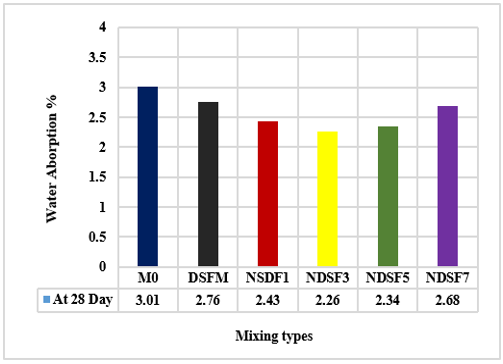
The water absorption values of all the cement mortar mixtures were carefully checked after 28 days of curing and the experimental results are summarized in Figure 3. The partial replacement of cement with 10% MDSF resulted in a significant reduction in water absorption of about 8.30% when compared with M0. This reduction signifies a significant cementation of the cement matrix, which results in a denser cement matrix with fewer capillary pores. The water absorption of the concrete with the addition of NDSF at replacement levels of 1%, 3%, 5% and 7% was found to progressively decrease to 19.26%, 24.91%, 22.25% and 10.96%, respectively.
The results show that the matrix permeability is highly dependent on the content of nanoscale silica. The improved performance is due to the very high specific surface area of NDSF that helps achieve fast pozzolanic reactions and rapid cement hydration rates [21, 22]. The production of more C-S-H gels during hydration further fills in the microstructural voids/capillaries that restrict water flow paths. In addition, the nano-sized particles increase the ITZ between cement paste and aggregates, a weak zone where moisture can easily penetrate through. The reinforcement of these zones increases the homogeneity and continuity of the microstructure, giving rise to enhanced durability and lowered water absorption. The electrostatic interactions and nanoscale of the particles also ensure a uniform dispersion in the matrix, thereby avoiding any local porosity or agglomeration that occurs with conventional silica fume incorporation [23, 24].
Nevertheless, this water absorption reduction is not just a "filler effect" but the combined impact of microstructural refinement, improved hydration kinetics and chemical pozzolanic activity. The results clearly show that the impermeability of cement mortars can be greatly enhanced even with a relatively low percentage of NDSF (1–7%). Furthermore, there is a near-linear relationship between NDSF content and water absorption up to about 7% content, which indicates that precise control of the number of nanoparticles is essential to achieve optimal performance without sacrificing workability. The results obtained are consistent with those recently reported and underscore the high effectiveness of NDSF in enhancing the microstructural density and durability of cement-based materials [25]. A decrease in water absorption is an indication of denser microstructures, which have less connectivity. However, further increases in nano silica fume content may cause the dispersion efficiency to drop and have a negative impact on the pore refinement effect.
4.5 Compression test results
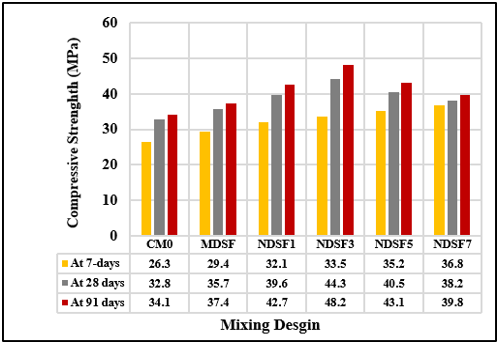
The strengths of all the mortar mixtures were systematically investigated at 7, 28 and 91 days curing ages, and the results are shown in Figure 4. The use of 10% MDSF as a partial replacement of cement resulted in a significant improvement in 28-day compressive strength of around 21.4% as compared to the control mixture (M0).
This is due to both the pozzolanic activity of DSF and its physical filler effect; the extremely fine particles fill the capillary pores and harden the microstructure. The observed improvements with NDSF (1%, 3%, 5% and 7% replacements of cement mass) were 20.7%, 35.06%, 23.4% and 16.4%, respectively, for 28 days and 35.2%, 41.3%, 26.4% and 16.7%, respectively, for 91 days. The compressive strength of this mixture at 7, 28 and 91 days was found to be 33.5, 44.3 MPa and 46.3 MPa, respectively, with a marked early-age strength gain.
The enhancement of compressive strength may be attributed to the effects of NDSF on the hydration behavior and internal structure of the cement mortar. The fine particles interacted with the calcium hydroxide generated during the hydration process and helped to form further C-S-H gel, which helped to create a denser and more cohesive matrix. The extremely fine particle size of NDSF also gave more surfaces for hydration product precipitation, leading to early microstructural development during the early hydration period.
The chemical contribution, along with the nano dimensions, provided an enhanced physical structure of the mortar through filling of fine internal pores and reducing the continuity of the pores present in the mortar matrix. This effect reduced the number of micro voids and increased the resistance of the hardened mortar under compression. The results were supported by the SEM observations, with the mixtures containing NDSF having a more compact and uniform microstructure than the M0. The mixture that performed best among the mixtures investigated was the mortar with 3% NDSF. This replacement ratio resulted in an improvement in compressive strength, while maintaining good densification of the matrix and no significant instability in the fresh or hardened properties of the mortar.
4.6 The flexural test results
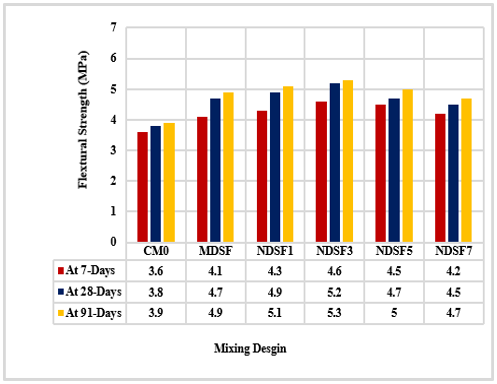
The flexural strength of all the cement mortar mixtures at various curing ages is given in Figure 5. The results show that the flexural strength was improved at early and late ages with partial replacement of cement with 10% MDSF. The flexural strength of the modified mixture with DSF was compared with that of the M0 at 28 days, which was found to be approximately 20.51% higher than that of the M0. The positive effect of DSF on the flexural strength of the mortar was found at 28 days. With the addition of NDSF as a cement replacement, a greater improvement in flexural properties was noticed. The flexural strength exhibited a systematic increase with the increase of NDSF content from 1% to 7%, which shows that NDSF does have a strong dependency effect on flexural strength. The flexural strength values obtained at 28 and 91 days for the NDSF1, NDSF3, NDSF5, and NDSF7 mixtures were approximately 4.9 MPa, 5.2 MPa, 4.7 MPa, and 4.5 MPa, respectively. Compared with the control mixture, these values correspond to improvements of about 25.64%, 33.34%, 20.05%, and 15.38% at 28 days, and 30.7%, 35.8%, 28.2% and 20.5% at 91 days, respectively.
The higher flexural characteristics of the NDSF-containing mixtures may be due to both physical and chemical reasons. On a microstructural level, the ultra-fine NDSF particles are excellent fillers that fill the interstitial voids in the cementitious matrix and narrow the pore structure.
The densification helps to minimize stress concentration areas and increases crack bridging strength under flexural loading. The amorphous nature of nano-silica accelerates its pozzolanic reaction with calcium oxide and calcium hydroxide, promoting the formation of additional C–S–H gel.
The combined filler and pozzolanic effects increase the solid volume fraction and improve interfacial bonding, thereby enhancing the resistance of the mortar to bending stresses. These findings are consistent with previous studies reporting significant gains in flexural strength when nano-silica or nano-metakaolin is used as a partial cement replacement, owing to matrix densification and enhanced hydration kinetics [26-28]. The results confirm that NDSF is more effective than conventional DSF in improving the flexural performance of cement-based composites, particularly at higher replacement levels.
4.7 Characterization examination
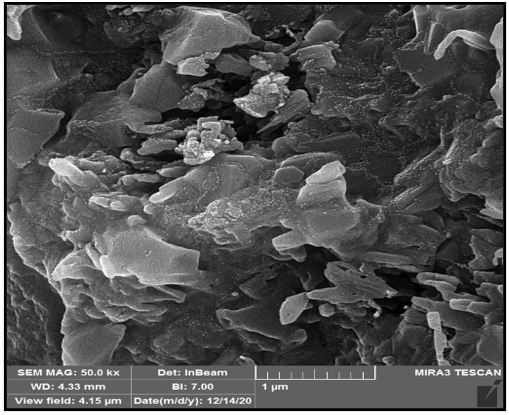
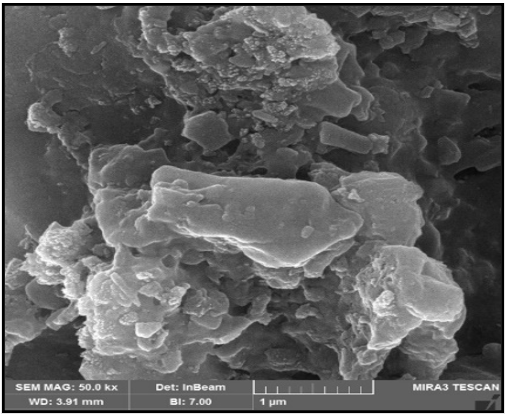
To study the effect of micro- and nano-scale replacement agents on the composition and basic structure of cement mortar, three samples were chosen from the multi-component mixtures. The SEM results shown in Figures 6-8 proved that the mortar's microstructure was significantly changed upon the addition of NDSF. The SEM images indicated that the NDSF mixtures exhibited a more compact and clearer microstructure than the reference mortar did. The decrease in visible pores and calcium hydroxide crystals indicates a more effective hydration process and internal bonding structure of the matrix. The addition of NDSF particles caused the size of the Ca(OH)₂ calcium hydroxide crystals to be smaller than that of the control sample, resulting in a high matrix density and low capillary porosity. Moreover, NDSF served as a large number of nucleation sites for the formation of hydration products, thereby accelerating the hydration process and promoting the formation of additional C-S-H.
Figure 7. Scanning electron microscopy (SEM) image of reference mix (M0) after 91 days of curing
Figure 8. Scanning electron microscopy (SEM) image of 7% nano-dense silica fume (NDSF) mixtures after 91 days of curing
This increased chemical activity helps to increase the bond between the matrix and improve mechanical properties. NDSF particles have an extremely high specific surface area, which is good for filling the microstructural voids, thereby improving packing density and uniformity in the cement paste. This results in a more compact structure of the resulting microstructure, which decreases porosity and increases the overall durability and strength of the mortar. The use of NDSF also contributes to the bonding between the cement paste and aggregates, which is generally the weakest region of cementitious materials.
The reinforcement of these regions decreases the formation and propagation of microcracks, which increases compressive and flexural strength. Additionally, the physical filling along with the pozzolanic reactivity provides a dual action in improving performance. A combination of physical filling of voids with nano-sized particles and chemical production of C-S-H yields denser and more uniform microstructures [28].
The NDSF-containing mortars showed lower permeability and higher mechanical stability than the M0, indicating the synergistic effect of chemical and physical effects of nanoparticles. Furthermore, the uniform dispersion of NDSF prevents agglomeration, which allows uniformity and consistent microstructural enhancement in the matrix. Given this, it can be found that adding NDSF into cement mortar at a low replacement rate (1–3%) is an effective method to improve the mechanical properties, microstructural density, and durability of cement mortar while maintaining good workability. The results obtained support the efficiency of NDSF as an admixture in high-performance cement-based materials and correspond to those reported in recent studies [29]. The results presented show that the effectiveness of NDSF is highly dependent on its dispersion in the cement matrix. Moderate replacement levels gave the best hydration and microstructural densification, while greater levels could lead to an increased risk of agglomeration.
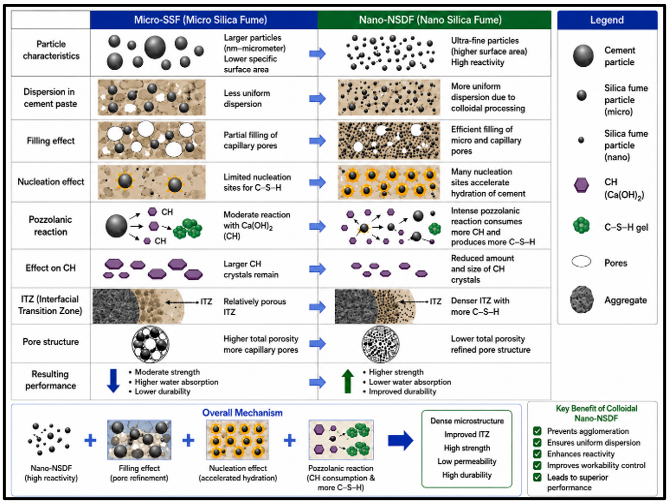
Figure 9 shows a proposed model of the behavior of colloidally dispersed nanoscale silica fume in the cement matrix as compared with the micro-scale silica fume.
After undergoing colloidal dispersion, the schematic illustrates that the nano-sized particles are more evenly distributed throughout the cement paste, reducing particle aggregation and increasing their penetration into microvoids and capillary pores. This uniform distribution increases the particle packing and helps to develop a more continuous internal structure.
The figure also shows that the nanoparticles create more active surfaces for hydration reactions, leading to the formation of C-S-H earlier and lessening calcium hydroxide crystal accumulation. Concurrently, the improvement of the pore structure and the enhanced ITZ result in a denser and more stable cementitious matrix. The synergistic effects lead to a decrease in permeability, water absorption and mechanical properties of nano-NDSF-added mortar mixes.
Figure 9. Proposed behavior of colloidally dispersed nano-dense silica fume (NDSF) within the cement matrix compared with conventional micro-scale silica fume
From the results of the experiments, the following conclusions can be drawn:
[1] Crainic, N., Marques, A.T. (2002). Nanocomposites: A state-of-the-art review. Key Engineering Materials, 230-232: 656-661. https://doi.org/10.4028/www.scientific.net/KEM.230-232.656
[2] Mehta, P.K., Monteiro, P.J.M. (2014). Concrete: Microstructure, Properties, and Materials. McGraw-Hill Education, New York, USA.
[3] Zhao, S.J., Sun, W. (2014). Nano-mechanical behavior of green ultra-high-performance concrete. Construction and Building Materials, 63: 150-160. https://doi.org/10.1016/j.conbuildmat.2014.04.029
[4] Wang, C., Yang, C.H., Liu, F., Wan, C.J., Pu, X.C. (2012). Preparation of ultra-high-performance concrete with common technology and materials. Cement and Concrete Composites, 34(4): 538-544. https://doi.org/10.1016/j.cemconcomp.2011.11.005
[5] Güneyisi, E., Gesoğlu, M., Karaoğlu, S., Mermerdaş, K. (2012). Strength, permeability and shrinkage cracking of silica fume and metakaolin concretes. Construction and Building Materials, 34: 120-130. https://doi.org/10.1016/j.conbuildmat.2012.02.017
[6] Han, B.G., Ding, S.Q., Wang, J.L., Ou, J.P. (2019). Current progress of nano-engineered cementitious composites. In Nano-Engineered Cementitious Composites, pp. 97-398. https://doi.org/10.1007/978-981-13-7078-6_2
[7] Xu, J., Li, Y.L., Su, H.T., Xu, H.C., Li, L.B., Lu, L.C. (2025). Evaluating the impact of nano-silica particle size on pozzolanic reaction kinetics, mechanical strength and durability of Portland slag cement. Construction and Building Materials, 472: 140784. https://doi.org/10.1016/j.conbuildmat.2025.140784
[8] Tran, H.B., Phan, V.T.A. (2022). The effects of Nano SiO₂ and Silica Fume on the properties of concrete. Archives of Civil Engineering, 68(2): 391-407. https://doi.org/10.24425/ace.2022.140649
[9] Reches, Y. (2018). Nanoparticles as concrete additives: Review and perspectives. Construction and Building Materials, 175: 483-495. https://doi.org/10.1016/j.conbuildmat.2018.04.214
[10] Sharkawi, A.M., Abd-Elaty, M.A., Khalifa, O.H. (2018). Synergistic influence of micro-nano silica mixture on durability performance of cementitious materials. Construction and Building Materials, 164: 579-588. https://doi.org/10.1016/j.conbuildmat.2018.01.013
[11] Su, Y., Li, J., Wu, C., Wu, P., Li, Z.X. (2016). Influences of nanoparticles on dynamic strength of ultra-high-performance concrete. Composites Part B: Engineering, 91: 595-609. https://doi.org/10.1016/j.compositesb.2016.01.044
[12] Li, L.G., Huang, Z.H., Zhu, J., Kwan, A.K.H., Chen, H.Y. (2017). Synergistic effects of micro-silica and nano-silica on strength and microstructure of mortar. Construction and Building Materials, 140: 229-238. https://doi.org/10.1016/j.conbuildmat.2017.02.115
[13] Kargari, A., Eskandari-Naddaf, H., Kazemi, R. (2019). Effect of cement strength class on the generalization of Abrams’ law. Structural Concrete, 20(1): 493-505. https://doi.org/10.1002/suco.201700275
[14] ASTM C150-04. (2017). Standard specification for portland cement. ASTM International, West Conshohocken, PA, USA. https://doi.org/10.1520/C0150-04
[15] ASTM C33-03. (2010). Standard specification for concrete aggregates. ASTM International, West Conshohocken, PA, USA. https://doi.org/10.1520/C0033-03
[16] ASTM C494/C494M-05. (2017). Standard specification for chemical admixtures for concrete. ASTM International, West Conshohocken, PA, USA. https://doi.org/10.1520/C0494_C0494M-05
[17] ASTM C1437-07. (2013). Standard test method for flow of hydraulic cement mortar. ASTM International, West Conshohocken, PA, USA. https://doi.org/10.1520/C1437-07
[18] ASTM C642-97. (2017). Standard test method for density, absorption, and voids in hardened concrete. ASTM International, West Conshohocken, PA, USA. https://doi.org/10.1520/C0642-97
[19] ASTM C109/C109M-05. (2017). Standard test method for compressive strength of hydraulic cement mortars (using 2-in. or [50-mm] cube specimens). ASTM International, West Conshohocken, PA, USA. https://doi.org/10.1520/C0109_C0109M-05
[20] ASTM C293-02. (2017). Standard test method for flexural strength of concrete (using simple beam with center-point loading). ASTM International, West Conshohocken, PA, USA. https://doi.org/10.1520/C0293-02
[21] Hamada, H.M., Shi, J.Y., Yousif, S.T., Al Jawahery, M., Tayeh, B., Jokhio, G. (2023). Use of nano-silica in cement-based materials–A comprehensive review. Journal of Sustainable Cement-Based Materials, 12(10): 1286-1306. https://doi.org/10.1080/21650373.2023.2214146
[22] Tabish, M., Zaheer, M.M., Baqi, A. (2022). Effect of nano-silica on mechanical, microstructural and durability properties of cement-based materials: A review. Journal of Building Engineering, 65: 105676. https://doi.org/10.1016/j.jobe.2022.105676
[23] Kadhim, M.J., Kamal, H.M., Jabbar, F.H. (2025). Synergistic influence of micro-and nano-reactive additives on cement mortar performance. Revue des Composites et des Matériaux Avancés-Journal of Composite and Advanced Materials, 35(6): 1091-1097. https://doi.org/10.18280/rcma.350609
[24] Kadhim, M.J., Kamal, H.M. (2019). Effect of dispersion method for nano-materials on some mechanical properties of cement mortar. Diyala Journal of Engineering Sciences, 12(4): 9-32. https://doi.org/10.24237/djes.2019.12402
[25] Abo-El-Enein, S.A., Amin, M.S., El-Hosiny, F.I., Hanafi, S., Hazem, M.M. (2014). Pozzolanic and hydraulic activity of nano-metakaolin. HBRC Journal, 10(1): 64-72. https://doi.org/10.1016/j.hbrcj.2013.09.006
[26] Supit, S.W.M., Rumbayan, R., Ticoalu, A. (2017). Mechanical properties of cement concrete composites containing nano-metakaolin. AIP Conference Proceedings, 1903(1): 050001. https://doi.org/10.1063/1.5011540
[27] Al-Wahab Ali, M.A., Kadhim, M.J., Nasser, I.F. (2021). Some properties of cement mortar incorporating micro and nano-metakaolin materials. Materials Science Forum, 1021: 231-240. https://doi.org/10.4028/www.scientific.net/MSF.1021.231
[28] Wang, S.Z., Baxter, L., Fonseca, F. (2008). Biomass fly ash in concrete: SEM, EDX and ESEM analysis. Fuel, 87(3): 372-379. https://doi.org/10.1016/j.fuel.2007.05.024
[29] Hamada, H.M., Abed, F., Katman, H.Y.B., et al. (2023). Effect of silica fume on the properties of sustainable cement concrete. Journal of Materials Research and Technology, 24: 8887-8908. https://doi.org/10.1016/j.jmrt.2023.05.147