Effect of Nominal Fiber Volume Fraction on the Mechanical and Sound Absorption Properties of Calathea lutea Fiber/Epoxy Composite Panels

Akbar Zulkarnain* | Heri Wibowo | Willy Artha Wirawan | Ayan Sabitah | Asniawaty Kusno | Mukhlis Muslimin
© 2026 The authors. This article is published by IIETA and is licensed under the CC BY 4.0 license (http://creativecommons.org/licenses/by/4.0/).
OPEN ACCESS
This study investigates the impact of fiber volume fraction on the mechanical and acoustic behavior of epoxy matrix composites reinforced with Calathea lutea fiber (CLF). Randomly oriented discontinuous fibers were incorporated into the composite, with fiber-to-matrix volume fractions of 40:60 vol% and 60:40 vol%, using the conventional hand lay-up method. The mechanical properties of the composites were evaluated through tensile tests, three-point bending tests, Shore D hardness tests, and Charpy impact tests. Acoustic properties were analyzed using a two-microphone impedance tube method. Acoustic measurements were conducted over a frequency range of 100–1600 Hz, and the results were analyzed across three frequency bands: low frequency (100–500 Hz), mid frequency (500–1000 Hz), and upper-mid frequency (1000–1600 Hz). The results revealed that composites with a higher fiber volume fraction exhibited superior mechanical properties, including tensile strength of 38.270 ± 3.47 MPa, flexural strength of 60.08 ± 7.10 MPa, Shore D hardness of 75.33 ± 1.15 HD, and impact strength of 9.90 ± 1.53 J/mm². Similarly, the upper-mid-frequency sound absorption coefficient increased from 0.170 in the 40:60 vol% composite to 0.364 in the 60:40 vol% composite. An increase in the fiber volume fraction led to a substantial enhancement in sound damping capability in the upper-mid-frequency band because the random fiber arrangement enhanced the interaction between sound waves and the fiber lumen and increased material tortuosity.
Calathea lutea fiber, epoxy composite, impedance tube, nominal fiber volume fraction, sound absorption coefficient, impact strength
Natural fiber-reinforced polymer composites have attracted increasing attention because renewable fibers can reduce material weight and environmental impact while maintaining acceptable mechanical performance [1, 2]. Commonly investigated natural fiber reinforcements include jute, hemp, sisal, kenaf, bamboo, and coir; however, the performance of these composites is strongly influenced by fiber morphology, fiber treatment, matrix type, fiber orientation, and processing method [3-7]. Although natural fiber composites have been widely explored for automotive components, construction panels, and other non-structural applications, less common locally available fibers remain comparatively underexplored. Calathea lutea is one such potential fiber source, and its suitability as a reinforcement for epoxy composites requires systematic evaluation of both mechanical and acoustic properties.
Several studies have examined both the mechanical and acoustic properties of natural fiber-based composites, resulting in measurable sound absorption coefficients over specific frequency ranges. Classical fibrous-absorber studies and recent polymer composite research indicate that porous fiber networks and composite panels can provide measurable acoustic responses over specific frequency ranges [8, 9]. Coconut coir fiber, which has also been widely explored, proves effective as a sound dampening material at high frequencies, with a sound absorption coefficient exceeding 0.5 in the frequency range of 1500–5000 Hz. Additionally, increasing the thickness of coir fiber-based panels can improve sound absorption at low frequencies (600–2400 Hz), with an absorption coefficient of 0.6 at a thickness of 40 mm [10]. Other studies reveal that polylactic acid composites reinforced with ramie fiber demonstrate good acoustic performance, with a sound absorption coefficient of around 0.6 in the frequency range of 1000–4000 Hz, making them effective for sound dampening applications at mid- and high frequencies [11]. Meanwhile, natural fiber–based acoustic materials such as bamboo/polypropylene and kenaf-based absorbers have shown promising sound absorption performance. Bamboo/polypropylene nonwoven materials exhibited higher sound absorption coefficients than banana/polypropylene and jute/polypropylene nonwovens across the tested frequency range, although the reported peak coefficient was approximately 0.2. Kenaf fiber absorbers, particularly at sufficient thickness, can achieve sound absorption coefficients of around 0.7 or higher in the mid-to-high frequency range. Furthermore, bamboo fiber materials have been reported to exhibit acoustic properties comparable to conventional glass wool in sound absorption applications [12-16].
Overall, natural fiber-based composites, such as coir fiber, kenaf, bamboo, and kapok, show significant potential in sound dampening applications, with sound absorption coefficients varying depending on fiber type, matrix used, and structural parameters such as panel thickness. One important factor influencing the mechanical and acoustic properties of natural fiber-based composites is the fiber-to-matrix volume fraction. The fiber-to-matrix volume fraction is another important factor that governs the balance between mechanical reinforcement and acoustic dissipation. Higher fiber fractions can improve tensile and flexural strength when load transfer and fiber–matrix bonding are sufficient; however, excessive fiber loading may reduce impregnation quality, increase void formation, and decrease stiffness or the consistency of energy absorption [13, 14, 17]. Conversely, higher matrix fractions can improve fiber wetting and dimensional stability, but they may also reduce the effective reinforcing phase. Therefore, fiber-to-matrix volume fraction should be treated as a key design variable. In hand lay-up composites, this fraction should be reported as nominal unless the cured fiber volume fraction and void content are directly measured.
Based on these considerations, the present study investigates Calathea lutea fiber (CLF)/epoxy composites with two nominal fiber-to-epoxy volume fractions, namely 40:60 and 60:40 vol%. The novelty of this work lies in the combined evaluation of mechanical properties and impedance-tube sound absorption behavior of CLF/epoxy panels, rather than in fiber-volume variation alone. This study aims to determine how nominal fiber loading affects tensile, flexural, hardness, impact, and sound-absorption responses within the measured frequency range of 100–1600 Hz. The findings provide an initial dataset for CLF/epoxy composite panels and highlight experimental limitations that should be addressed in future optimization studies.
2.1 Materials
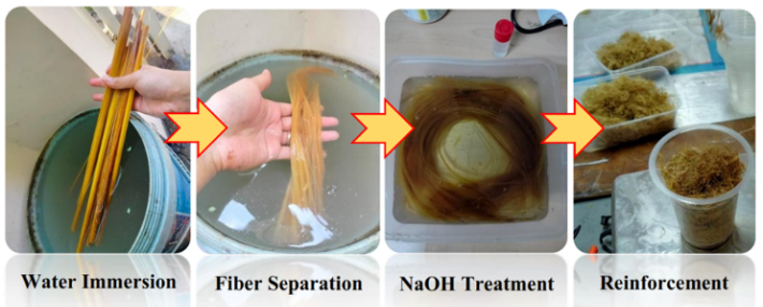
The CLF used in this study was sourced from local farmers in the Madiun region of East Java, Indonesia. Plant stems approximately 20 mm in diameter and 300 mm in length were selected at an age of around two years. The stems were soaked in water for 60 days to promote retting and fiber separation. The extracted fibers were cleaned and air-dried at room temperature for approximately 12 days. The CLF was then treated with a 5 wt% sodium hydroxide (NaOH) solution at room temperature (approximately 27 ℃) for 2 h [18, 19]. After alkaline treatment, the fibers were rinsed with running water until a neutral pH (pH = 7) was achieved, air-dried, and cut to a 10 mm length. The overall CLF preparation and alkaline treatment process is illustrated in Figure 1. The epoxy resin and hardener were obtained from PT Justus Kimia Raya, Surabaya, Indonesia.
Figure 1. Fiber extraction
2.2 Composite fabrication
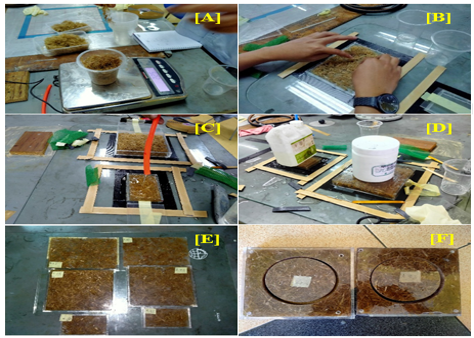
Composite panels were fabricated by open molding using the hand lay-up method, as presented in Figure 2. The fiber-to-resin ratios of 40:60 and 60:40 vol% are reported as nominal volume fractions because the cured fiber volume fraction and void content were not directly measured after processing. The fibers were randomly distributed in the mold, and the mixed epoxy resin was poured until the fibers were completely covered. The panels were then cured at room temperature, approximately 25 ℃, for 48 h. No post-curing treatment was applied. Each nominal composition was fabricated in triplicate to support repeated testing.
Figure 2. Fabrication process of the composite panels: (a) material weighing based on the designed volume fraction, (b) fiber placement in the mold, (c) hand lay-up, (d) in-mold drying, (e) demolding and curing, and (f) specimen cutting according to the acoustic testing standard
2.3 Tensile strength and flexural strength test
Tensile and flexural properties were evaluated using a Universal Testing Machine (TARNO GROCKI UPH-100 kN). Tensile specimens were prepared in accordance with ASTM D3039, with dimensions of 250 mm × 25 mm × 3 mm, and were tested at a crosshead speed of 0.5 mm/s at room temperature, approximately 32 ℃. Flexural testing was performed using the three-point bending method in accordance with ASTM D790. The flexural specimens had dimensions of 152 mm × 25.4 mm × 5 mm and were tested at a crosshead speed of 2 mm/s with a support span of 60 mm. Similar mechanical testing protocols have been reported in previous composite studies [20-23].
2.4 Shore D hardness test
Shore D hardness testing was conducted in accordance with ASTM D2240 using composite specimens with dimensions of 35 mm × 15 mm × 3 mm. The test was performed at approximately 25 ℃ using a GS-720N Teclock durometer (Japan) with a penetration force of 5 kg (49 N). For each specimen, hardness values were recorded at 10 different points, with readings taken at 1 s and 15 s intervals. The reported Shore D hardness value was calculated as the average of these measurements.
2.5 Impact test
Impact testing was conducted to evaluate the ability of the composite to absorb impact energy prior to fracture. The test was performed using the Charpy method in accordance with ASTM E23-05, with specimens measuring 55 mm × 10 mm × 10 mm. Each specimen was positioned horizontally with the V-notch facing away from the striker and was then impacted by an 8.3 kg pendulum. Similar impact testing approaches for natural fiber/polymer composites have been reported in related studies [21, 23].
2.6 Acoustical properties
Acoustic characterization was performed using the two-microphone impedance tube method to determine the sound absorption coefficient of the composite samples in accordance with ISO 10534-2. This method enables accurate evaluation of the acoustic properties of small specimens by analyzing the sound pressure response inside the tube [24, 25]. The composite samples were prepared as circular specimens with a diameter of 100 mm and placed at one end of the impedance tube. A sound signal generated by a computer speaker was amplified and directed axially into the tube. Two microphones positioned at specified locations along the tube recorded the sound pressure response resulting from the interaction between the incident sound waves and the sample surface. The microphone signals were then processed using PULSE LabShop software, version 16.1, to obtain the transfer function between the two microphones, which was subsequently used to calculate the sound absorption coefficient over the frequency range of 100–1600 Hz.
The measured absorption coefficient values for each fiber volume fraction were further processed and plotted as absorption curves using KaleidaGraph software. A schematic of the measurement system is shown in Figure 3.
Figure 3. Impedance tube setup for testing sound absorption
3.1 Tensile strength
Tensile properties, including tensile strength, tensile modulus, and elongation at break, are critical parameters for determining a material's ability to withstand mechanical loads in structural applications. These parameters not only define the performance efficiency of composite materials but also serve as indicators of their reliability under long-term operational conditions. In this study, a comparison between two composite configurations was conducted to highlight how fiber content influences the mechanical behavior of the composite material.
The results of the tensile strength tests indicate that the composite with a higher fiber volume fraction of 60:40 vol% performs substantially better compared to the 40:60 vol% composite. The 60:40 vol% composite achieved an average tensile strength of 38.270 MPa with a standard deviation of ±3.47 MPa, whereas the 40:60 vol% composite reached an average tensile strength of only 14.427 MPa with a standard deviation of ±7.36 MPa. This considerable difference emphasizes the dominant role of the reinforcing fibers in determining tensile performance. A higher fiber content improves the efficiency of load transfer from the matrix to the fibers, which are naturally stiffer and stronger, thereby enhancing the overall load-bearing capacity. Additionally, the smaller standard deviation in the 60:40 vol% composite indicates more consistent and homogeneous mechanical behavior, likely due to better fiber distribution and stronger fiber-matrix interfacial bonding.
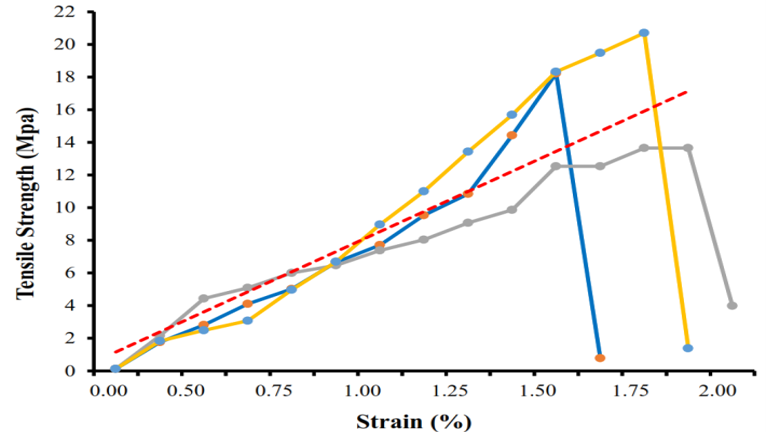
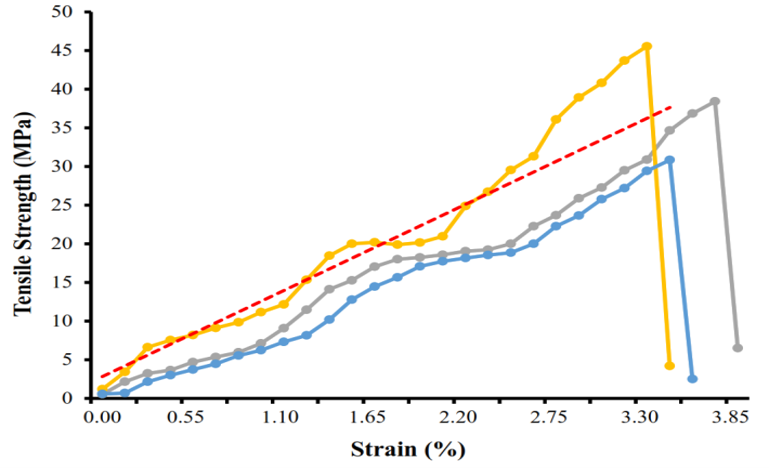
The stress-strain curve visualization in Figure 4 clearly shows the difference in mechanical responses between composites with fiber volume fractions of 40:60 vol% and 60:40 vol%. The curve for the 60:40 vol% configuration demonstrates a more consistent and progressive increase in stress, followed by a peak strength around 45 MPa and a higher elongation of approximately 0.036 (3.6%). This pattern indicates that composites with higher fiber content not only exhibit greater strength and stiffness but also a wider deformation capacity before failure occurs. No sharp decrease or brittle failure is observed early in the strain, suggesting that the failure mode is more semi-ductile, with high energy absorption. These findings suggest that increased fiber content provides the dual benefits of reinforcement and improved deformability. This can be attributed to better fiber-matrix interactions, more uniform fiber distribution, and potentially the role of microstructural mechanisms that prevent localized stress concentrations, slowing crack initiation and allowing for further strain before fracture [20-23, 26]. In contrast, the curve for the 40:60 vol% composite shows a more rapid but unstable increase in stress, with the peak stress reached at lower strains. Several curves even show a sharp decline after reaching the maximum strength, indicating brittle failure in some specimens. This is consistent with the lower average elongation of 0.017 or 1.7%, as well as the higher variation in tensile strength (±7.36 MPa), suggesting uneven load distribution or inhomogeneity in the internal structure.
The tensile modulus, which reflects the material's stiffness, further supports the superior performance of the 60:40 vol% composite, with a value of 1074.170 MPa compared to 856.804 MPa for the 40:60 vol% composite. The higher modulus indicates that the 60:40 composite is stiffer, due to the dominance of the stiffer fiber phase. The lower modulus variation (±195.59 MPa) in the 60:40 sample compared to the 40:60 composite (±295.37 MPa) also suggests more reliable mechanical behavior. This consistency indicates that higher fiber content allows for more uniform stress distribution, thereby reducing local deformation or premature damage due to structural irregularities, such as voids or weak fiber-matrix interfacial bonding [20-23, 26]. Figure 4 provides a closer view of the strain-to-failure behavior and clarifies these differences in deformation response. The 60:40 vol% composite shows higher tensile strength and greater elongation before fracture, indicating improved reinforcement efficiency and deformation capacity. In contrast, the 40:60 vol% composite reaches a lower peak stress at a lower strain and exhibits a more unstable post-peak response. Therefore, within the tested composition range, the 60:40 vol% configuration is more suitable for applications requiring higher stiffness and load-bearing capacity, while the 40:60 vol% configuration is less favorable for tensile performance.
(a)
(b)
Figure 4. Stress-strain curves for (a) 40:60 vol% and (b) 60:40 vol%
The summary of the mechanical properties presented in Table 1 reinforces the narrative derived from the stress-strain curve analysis. The tensile strength, modulus, and elongation data show that no classical trade-off between strength and ductility was observed within the tested range. Instead, the 60:40 vol% composition improved strength, stiffness, and elongation compared with the 40:60 vol% composition. These findings align with theoretical models and experimental results from the composite literature, which highlight the importance of fiber volume fraction adjustment in designing composites with mechanical properties suited to specific applications [27]. The higher variability observed in the 40:60 vol% configuration, both in tensile strength and modulus, may be attributed to suboptimal fiber distribution and weaker interfacial bonding between the fibers and matrix. These microstructural imperfections can create stress concentration points that lead to premature failure and inconsistent mechanical behavior. In contrast, the denser fiber distribution and stronger bonding in the 60:40 vol% composite enable more efficient load transfer, enhancing both the average strength and stiffness values as well as the reproducibility of mechanical properties across samples. In engineering practice, these findings are highly relevant. For lightweight non-structural applications requiring higher load-bearing capacity, stiffness, surface hardness, and impact resistance, such as automotive interior panels, acoustic panels, and lightweight building components, the 60:40 vol% composite offers a clearer advantage. Therefore, material selection should be carefully tailored to the specific needs and service conditions of the application.
Table 1. Comparison of tensile strength values for composites
|
Fiber Volume Fraction |
Tensile Strength (MPa) |
Tensile Modulus (MPa) |
Elongation (%) |
|
40:60 vol% |
14.427 ± 7.36 |
856.804 ± 295.37 |
1.7 ± 0.3 |
|
60:40 vol% |
38.270 ± 3.47 |
1074.170 ± 195.59 |
3.6 ± 1.1 |
3.2 Flexural strength
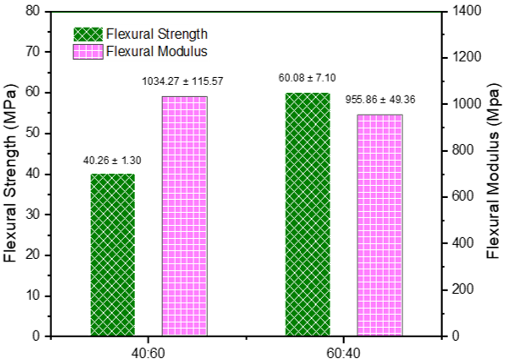
Figure 5 presents the flexural strength and flexural modulus data for two types of composites with varying fiber and matrix volume fractions of 40:60 vol% and 60:40 vol%. For the composite with a fiber volume fraction of 40:60 vol%, the flexural strength was recorded at 40.26 ± 1.30 MPa, while the flexural modulus was 1034.37 ± 115.57 MPa. In contrast, the composite with a fiber volume fraction of 60:40 vol% showed a substantial increase in flexural strength to 60.08 ± 7.10 MPa, but this was accompanied by a decrease in flexural modulus to 955.86 ± 49.36 MPa. This comparison indicates that an increase in fiber content directly enhances the flexural strength of the composite by approximately 49.3%, but it also results in a 7.6% reduction in stiffness.
Figure 5. Flexural strength and flexural modulus
An increase in fiber content within the composite directly enhances its flexural strength because the fibers act as the primary reinforcing elements, bearing tensile loads on the bottom side of the specimen during the flexural test. Fibers have superior mechanical properties compared to the polymer matrix, particularly in withstanding tensile stress. Therefore, as the fiber volume fraction increases, the stress distribution within the composite becomes more efficient, with a larger portion of the load being carried by the fibers. Consequently, the flexural strength increases as the material becomes more resistant to plastic deformation and early cracking, which typically initiates from the matrix [28].
However, the decrease in flexural modulus at higher fiber volume fractions may occur due to several structural factors. First, at higher fiber volume fractions, there is an increased risk of fiber agglomeration and irregular fiber orientation, which leads to inhomogeneous load distribution. Second, an increase in fiber content reduces the amount of matrix material, which serves as the initial load-bearing medium and bonding agent between the fibers [29, 30]. When the matrix is insufficient to adequately wrap and bond the fibers, the interaction between the components becomes ineffective, leading to a reduction in stiffness or flexural modulus. Additionally, under high fiber content conditions, there is a higher likelihood of void formation due to difficulties in achieving complete resin impregnation into the gaps between the fibers. These voids can become structural weak points, reducing the contribution to the overall elastic deformation of the composite, thus causing a decrease in flexural modulus, even though the maximum strength improves [31].
3.3 Hardness and impact resistance
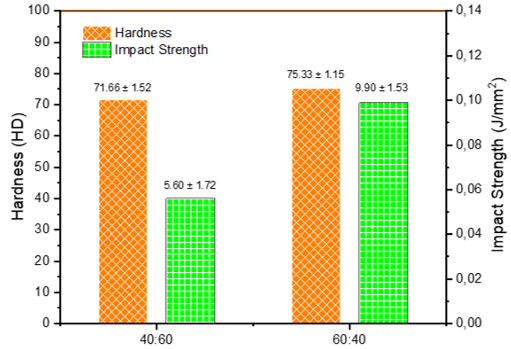
The results of hardness and impact strength testing for composites with varying fiber volume fractions, shown in Figure 6 and Table 2, indicate a clear upward trend in both mechanical properties. For the 40:60 vol% fiber volume fraction, the Shore D hardness (HD) was recorded at 71.66 ± 1.52, while the impact strength (J/mm²) was 5.60 ± 1.72, with an energy absorption value of 0.056 ± 0.017 Joule. In contrast, for the 60:40 vol% fiber volume fraction, hardness increased to 75.33 ± 1.15 HD, impact strength increased to 9.90 ± 1.53 J/mm², and energy absorption was higher at 0.099 ± 0.015 Joule. These results demonstrate that an increase in fiber volume fraction contributes to enhanced hardness and improved energy absorption capacity during impact loading. The fibers act as reinforcing elements that strengthen the composite structure, reduce local deformation, and improve stress distribution. As the fiber fraction increases, a more uniform fiber distribution occurs, improving the bond between the fibers and the matrix, and increasing energy transfer efficiency. Consequently, composites with a higher fiber volume fraction exhibit better impact resistance, as the fibers help slow crack propagation and support energy absorption through mechanisms such as fiber pull-out and crack bridging [25, 29]. Therefore, increasing the fiber volume fraction not only improves surface hardness but also enhances the material's resistance to damage caused by dynamic loads.
Figure 6. Hardness and impact strength
The increase in hardness and impact strength of the composites with higher fiber fractions is consistent with findings from numerous studies on the use of natural fibers as reinforcing materials in composite matrices. According to Apriliani et al. [23], the addition of carbon in composites can enhance hardness and impact resistance due to improved material density and better homogeneity. This is also supported by Sulistyo et al. [22], who reported that chemically modified natural fibers, such as those treated with alkali or silane agents, improve the mechanical strength of composites, particularly in surface hardness and impact resistance. The increase in hardness observed in the 60:40 composite in this study indicates that more uniformly distributed fibers within the matrix can fill the voids between the fibers and the matrix, enhancing the interfacial bonding between the phases, thereby strengthening the surface hardness.
Table 2. Hardness and impact strength values
|
Fiber Volume Fraction |
Shore D (HD) |
Impact Strength (J/mm2) |
Energy (Joule) |
|
40:60 vol% |
71.66 ± 1.52 |
5.60 ± 1.72 |
0.056 ± 0.017 |
|
60:40 vol% |
75.33 ± 1.15 |
9.90 ± 1.53 |
0.099 ± 0.015 |
Furthermore, the increase in impact strength suggests that these composites are more capable of absorbing energy without suffering structural damage, consistent with previous composite studies [20-23, 29-31]. However, some studies also indicate that excessive fiber content could have a negative effect on impact resistance [20, 21, 29, 30]. An excessive amount of fiber can lead to imperfections in matrix impregnation, ultimately reducing the composite's ability to absorb energy.
The enhancement of composite mechanical properties, such as hardness and impact strength, resulting from the addition of natural fibers, shows great potential for replacing synthetic fibers in various industrial applications. This improvement can be explained by the stronger interactions between the fibers and the matrix, which are enhanced by surface modification techniques such as alkali treatment and silane agent addition [28]. These surface modifications have been shown to increase the compatibility between the fibers and matrix, thus improving the mechanical strength of the composite. With improved hardness and impact resistance, natural fiber-based composites have the potential for use in the automotive, construction, and manufacturing sectors for products requiring abrasion and impact resistance. The increase in fiber volume fraction, which is relatively simple and easily controlled, can yield higher-performing materials without significantly increasing material costs, making it an attractive option for applications in vehicle interior panels, protective components, and lightweight building structures [19, 27]. However, it is important to note that excessive fiber content may lead to performance reductions in other areas, such as thermal stability and moisture resistance. Therefore, further research on the optimal fiber volume fraction and its impact on other physical properties, such as resistance to temperature and humidity, is essential to optimize the application of natural fiber-based composites in industry.
3.4 Sound absorption coefficient
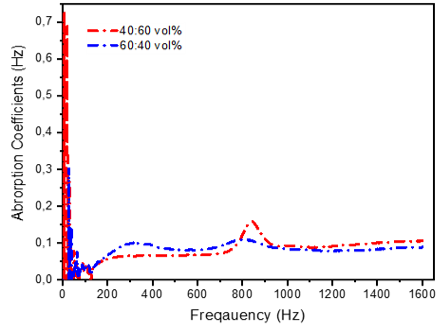
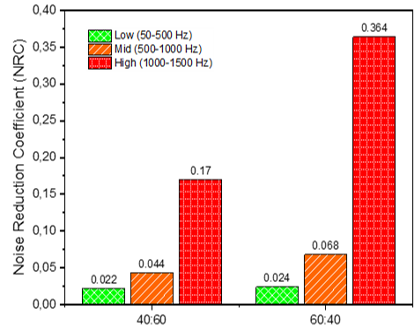
Based on the impedance tube testing results, the sound absorption coefficients for the composites with varying fiber-to-matrix ratios show clear differences. As shown in Figure 7(a), the CLF composite with a 60:40 vol% composition demonstrates a consistent increase in sound absorption coefficients across the mid-frequency range, with a peak just below 0.7 around 800 Hz. In contrast, the composite with a 40:60 vol% composition follows a similar trend but with greater fluctuations, peaking at around 850 Hz. These results indicate that the 60:40 vol% composite performs more efficiently in sound absorption across the frequency range. Moreover, at high frequencies, the 60:40 vol% CLF composite outperforms the 40:60 vol% composite, with a sound absorption coefficient of 0.364, substantially higher than the 0.170 achieved by the 40:60 vol% composite.
(a)
(b)
Figure 7. (a) Sound absorption coefficient and (b) band-averaged absorption indicator
At low frequency, both compositions showed similar absorption values (0.022 for 40:60 vol% and 0.024 for 60:40 vol%), while at mid frequency the 60:40 vol% composite showed a higher value (0.068) than the 40:60 vol% composite (0.044). These differences further highlight the impact of fiber-to-matrix ratio on the material's ability to absorb sound across various frequency bands.
Figure 7(b) and Table 3 present the band-averaged sound absorption performance of the CLF composite boards across the low-, mid-, and upper-mid-frequency ranges. At low and mid frequencies, the variation in fiber volume fraction produced only marginal differences in the absorption response, indicating that the fiber-to-matrix ratio had a limited influence on the absorption performance within these frequency bands. However, at high frequencies, the fiber volume fraction has a substantial impact on increasing the band-averaged absorption coefficient for the CLF composite boards. Sound absorption at low and mid frequencies is influenced by the pore structure, particularly the lumen within the fibers, which lengthens the sound wave path and allows more sound energy to be dissipated. At upper-mid frequencies, the response is more strongly governed by fiber distribution, lumen accessibility, and material tortuosity [24, 25, 32].
Table 3. Band-averaged sound absorption coefficients and band-average absorption indicator
|
Band/Indicator |
40:60 vol% |
60:40 vol% |
|
Low alpha (100–500 Hz) |
0.022 |
0.024 |
|
Mid alpha (500–1000 Hz) |
0.044 |
0.068 |
|
Upper-mid alpha (1000–1600 Hz) |
0.170 |
0.364 |
|
Band-average indicator |
0.079 |
0.152 |
The random fiber distribution and higher fiber fraction allow sound waves to interact more intensively with the fiber lumen, thereby enhancing the sound absorption coefficient. Additionally, the random fiber distribution and higher fiber fraction help sound waves spread more effectively and be absorbed to a greater extent, while more regular fiber patterns or rigid resin may hinder sound wave movement [24, 25]. This is also reflected in coir fibers, where a higher fiber content contributes to increased sound absorption, especially at high frequencies [10]. These findings align with previous studies indicating that natural fiber-based composites with higher fiber content are generally more effective at absorbing sound at high frequencies. The increased surface area and porosity due to higher fiber content enhance the material's ability to absorb sound wave energy, particularly at high frequencies. Furthermore, porous materials tend to be more efficient at absorbing sound within specific frequency ranges based on their pore structure. Other factors, such as the arrangement and orientation of fibers within the composite material, can also improve its acoustic properties by optimizing the material's ability to trap sound waves. Specifically, cross and star configurations exhibit greater fluctuations in sound absorption coefficients, particularly at low frequencies. The arrangement of fibers in these configurations can result in less efficient sound wave propagation, leading to irregular absorption patterns, which in turn affects the sound absorption performance. Additionally, increasing the thickness of the composite material can improve sound absorption performance, particularly at low frequencies. This trend is consistent with literature that suggests thicker materials are more efficient at absorbing low frequencies due to longer paths for sound waves to interact with the material's pores. Composites with greater thickness show better absorption at low frequencies compared to thinner samples [33, 34].
This study aims to evaluate the effect of fiber volume fraction on the mechanical and acoustic properties of CLF-based composites with an epoxy matrix. Key findings indicate that increasing the fiber volume fraction from 40:60 to 60:40 vol% substantially enhances mechanical performance, including tensile strength reaching 38.270 ± 3.47 MPa, flexural strength of 60.08 ± 7.10 MPa, Shore D hardness of 75.33 ± 1.15 HD, and impact strength of 9.90 ± 1.53 J/mm². This improvement reflects the dominant role of fibers in reinforcing the composite structure and improving load transfer efficiency, thereby improving the composite's load-bearing capability. From an acoustic perspective, the increase in fiber fraction leads to a substantial improvement in the upper-mid-frequency sound absorption indicator. The higher upper-mid-frequency absorption can be attributed to the combined effects of the higher fiber fraction, random fiber arrangement, and increased tortuosity. To achieve a better balance between mechanical and acoustic properties, further exploration of fiber surface modifications or material hybridization is recommended.
The authors would like to express their sincere gratitude to the institutions and individuals who contributed to this research. Special thanks to Universitas Negeri Yogyakarta for providing the necessary facilities and support, and to the Department of Mechanical Engineering for their continued guidance. We also thank the collaborating institutions, including Universitas Negeri Surabaya, Politeknik Negeri Banjarmasin, Universitas Khairun, and Universitas Hasanuddin, for their invaluable insights and assistance. The authors gratefully acknowledge the financial support provided through the Hibah BIMA Kemendiktisainstek 2026 program (No. 231.55/DST/UN34.9/T/PT.01.03/2026), which greatly contributed to the completion of this research. Additionally, the financial support and encouragement from various research groups are deeply appreciated.
[1] Norfarhana, A.S., Azriena, H.A.A., Hawanis, H.S.N., Ilyas, R.A., et al. (2026). Nanocellulose for functional and future materials: Opportunities, limitations, and outcomes. In Nanocellulose: Harnessing Sustainability from Biomass to Biocomposites, pp. 445-472. https://doi.org/10.1016/B978-0-443-41469-5.00013-X
[2] Muslimin, M., Wirawan, W.A., Harbelubun, M.M., Mujawal, A.R., Ilyas, R.A., Norrrahim, M.N.F., Knight, V.F. (2025). Enhancement of Sansevieria Trifasciata Laurentii fiber properties with liquid smoke treatment. Journal of Natural Fibers, 22(1): 2453482. https://doi.org/10.1080/15440478.2025.2453482
[3] Azadi, M., Sayar, H., Ghasemi-Ghalebahman, A., Jafari, S.M. (2019). Tensile loading rate effect on mechanical properties and failure mechanisms in open-hole carbon fiber reinforced polymer composites by acoustic emission approach. Composites Part B: Engineering, 158: 448-458. https://doi.org/10.1016/J.COMPOSITESB.2018.09.103
[4] Azriena, H.A.A., Kaur, K., Ilyas, R.A., Kamaruddin, Z.H., et al. (2025). Recent developments in lignocellulosic banana (Musa spp.) fiber-based biocomposites and their potential industrial applications: A comprehensive review. International Journal of Biological Macromolecules, 323(Part 2): 147180. https://doi.org/10.1016/j.ijbiomac.2025.147180
[5] Sari, N.H., Wardana, I.N.G., Irawan, Y.S., Siswanto, E. (2017). Corn husk fiber-polyester composites as sound absorber: Nonacoustical and acoustical properties. Advances in Acoustics and Vibration, 2017(1): 4319389. https://doi.org/10.1155/2017/4319389
[6] Choudhary, S., Haloi, J., Kumar Sain, M., Saraswat, P., Kumar, V. (2026). Systematic literature review on thermal and acoustic characteristics of natural fibre polymer composites for automobile applications. Materials Today: Proceedings, 118: 97-104. https://doi.org/10.1016/J.MATPR.2023.01.349
[7] Widodo, E., Mulyadi, Garside, A.K., Wirawan, W.A., Mat Yaakob, N.H. (2025). Enhancing adhesivity and mechanical performance of Sansevieria fiber-reinforced composites through alkali treatment. South African Journal of Chemical Engineering, 54: 167-178. https://doi.org/10.1016/j.sajce.2025.07.007
[8] Delany, M.E., Bazley, E.N. (1970). Acoustical properties of fibrous absorbent materials. Applied Acoustics, 3(2): 105-116. https://doi.org/10.1016/0003-682X(70)90031-9
[9] Reddy, R.K.K., Veerappan, A.R., George, N. (2024). Vibro-acoustic characterization of functionally graded multiwalled carbon nanotube composite cylindrical panels: An experimental approach. Composites Part A: Applied Science and Manufacturing, 187: 108518. https://doi.org/10.1016/j.compositesa.2024.108518
[10] Zulkifli, R., Zulkarnain, Nor, M.J.M. (2010). Noise control using coconut coir fiber sound absorber with porous layer backing and perforated panel. American Journal of Applied Sciences, 7(2): 260-264. https://doi.org/10.3844/ajassp.2010.260.264
[11] Chen, D., Li, J., Ren, J. (2010). Study on sound absorption property of ramie fiber reinforced poly(l-lactic acid) composites: Morphology and properties. Composites Part A: Applied Science and Manufacturing, 41(8): 1012-1018. https://doi.org/10.1016/j.compositesa.2010.04.007
[12] Thilagavathi, G., Pradeep, E., Kannaian, T., Sasikala, L. (2010). Development of natural fiber nonwovens for application as car interiors for noise control. Journal of Industrial Textiles, 39(3): 267-278. https://doi.org/10.1177/1528083709347124
[13] Mohammadi, M., Ishak, M.R., Sultan, M.T.H., Che Din, N.B., Putra, A., Berardi, U. (2024). Recent progress in natural fiber reinforced composite as sound absorber material. Journal of Building Engineering, 84: 108514. https://doi.org/10.1016/j.jobe.2024.108514
[14] Hao, A., Zhao, H., Chen, J.Y. (2013). Kenaf/polypropylene nonwoven composites: The influence of manufacturing conditions on mechanical, thermal, and acoustical performance. Composites Part B: Engineering, 54: 44-51. https://doi.org/10.1016/j.compositesb.2013.04.065
[15] Taban, E., Soltani, P., Berardi, U., Putra, A., et al. (2020). Measurement, modeling, and optimization of sound absorption performance of Kenaf fibers for building applications. Building and Environment, 180: 107087. https://doi.org/10.1016/j.buildenv.2020.107087
[16] Koizumi, T., Tsujiuchi, N., Adachi, A. (2002). The development of sound absorbing materials using natural bamboo fibers. WIT Transactions on the Built Environment, 59: 157-166. https://doi.org/10.2495/HPS020161
[17] Senthilrajan, S., Venkateshwaran, N., Giri, R., Ismail, S.O., et al. (2024). Mechanical, vibration damping and acoustics characteristics of hybrid aloe vera/jute/polyester composites. Journal of Materials Research and Technology, 31: 2402-2413. https://doi.org/10.1016/j.jmrt.2024.06.158
[18] Zulkarnain, A., Wibowo, H., Artha, W. (2025). Enhancement of the chemical, physical, mechanical and thermal properties of NaOH-treated natural cellulosic fibers from Calathea lutea. Cleaner Waste Systems, 12: 100427. https://doi.org/10.1016/j.clwas.2025.100427
[19] Zulkarnain, A., Wibowo, H., Wirawan, W.A. (2026). Effect of alkali treatment on the physicochemical and thermal properties of Calathea lutea fibers for composite reinforcement. Next Materials, 12: 102087. https://doi.org/10.1016/j.nxmate.2026.102087
[20] Sulistyo, A.B., Wirawan, W.A. (2024). Evaluation of tensile strength and flexural strength of GFRP composites in different types of matrix polymers. Journal of Achievements in Materials and Manufacturing Engineering, 123(2): 49-57. https://doi.org/10.5604/01.3001.0054.6847
[21] Kurniasih, P., Wirawan, W.A., Narto, A., Pribadi, O.S., et al. (2023). Flammability and morphology of Agel leaf fibre-epoxy composite modified with carbon powder for fishing boat applications. Archives of Materials Science and Engineering, 122(1): 13-21. https://doi.org/10.5604/01.3001.0053.8842
[22] Sulistyo, A.B., Wirawan, W.A., Muslimin, M. (2024). Evaluation of mechanical and morphological properties composite of Agel leaf fiber (ALF)-epoxy modified with carbon powder. EUREKA: Physics and Engineering, 1: 144-153. https://doi.org/10.21303/2461-4262.2024.002974
[23] Apriliani, N.F., Wirawan, W.A., Muslimin, M., Ilyas, R.A., Rahma, M.A., Agus Salim, A.T. (2024). Improving wear performance, physical, and mechanical properties of iron sand/epoxy composite modified with carbon powder. Results in Materials, 21: 100532. https://doi.org/10.1016/j.rinma.2024.100532
[24] Duan, Y.Y., Chen, X.Y., Xia, H.Y., Liu, Y.Y., You, F., Jiang, X.L., Ren, L., Zhou, D.F. (2025). Fabrication, structural regulation and future applications of acoustic polymer materials: A review. Applied Materials Today, 44: 102709. https://doi.org/10.1016/J.APMT.2025.102709
[25] Kusno, A., Ishak, M.T., Rahim, R., Hamzah, B., Mulyadi, R., Jamala, N., Anggraeni, R. (2020). Coconut leaf midribs as an acoustical panel-feasibility study through impedance tube method. IOP Conference Series: Materials Science and Engineering, 875(1): 012007. https://doi.org/10.1088/1757-899X/875/1/012007
[26] Muslimin, M., Wirawan, W.A., Tjiroso, B., Suyono, T., Seng, A., Harbelubun, M.M. (2025). The effect of liquid smoke treatment on Sansevieria Trifasciata Laurentii fibers on the mechanical properties of composite fiber materials. Revue des Composites et des Matériaux Avancés, 35(4): 663-670. https://doi.org/10.18280/rcma.350408
[27] Selvaraj, V.K., Subramanian, J., Suyambulingam, I., Viswanath, S., Jayamani, E., Siengchin, S. (2024). Influence of bio-based kenaf polymer composites on mechanical and acoustic properties for futuristic applications: An initiative towards net-zero carbon emissions. Polymer Testing, 134: 108409. https://doi.org/10.1016/J.POLYMERTESTING.2024.108409
[28] del Angel-Monroy, M., Escobar-Barrios, V., Peña-Juarez, M.G., Lugo-Uribe, L.E., Navarrete-Damian, J., Perez, E., Gonzalez-Calderon, J.A. (2023). Effect of coconut fibers chemically modified with alkoxysilanes on the crystallization, thermal, and dynamic mechanical properties of poly(lactic acid) composites. Polymer Bulletin, 81(1): 843-870. https://doi.org/10.1007/s00289-023-04740-6
[29] Rajpurohit, A., Joannès, S., Singery, V., Sanial, P., Laiarinandrasana, L. (2020). Hybrid effect in in-plane loading of carbon/glass fibre based inter-and intraply hybrid composites. Journal of Composites Science, 4(1): 1-20. https://doi.org/10.3390/jcs4010006
[30] Rajesh, M., Singh, S.P., Pitchaimani, J. (2018). Mechanical behavior of woven natural fiber fabric composites: Effect of weaving architecture, intra-ply hybridization and stacking sequence of fabrics. Journal of Industrial Textiles, 47(5): 938-959. https://doi.org/10.1177/1528083716679157
[31] Khalaf, A.A., Mahan, H.M., Al-Shamary, A.K.J., Hanon, M.M. (2022). Effect of hybrid materials configuration on the mechanical properties of composites. Journal of Applied Science and Engineering, 25(5): 873-880. https://doi.org/10.6180/jase.202210_25(5).0018
[32] Saravanan, N., Ganeshan, P., Prabu, B., Yamunadevi, V., NagarajaGanesh, B., Raja, K. (2022). Physical, chemical, thermal and surface characterization of cellulose fibers derived from Vachellia Nilotica Ssp. Indica tree barks. Journal of Natural Fibers, 19(13): 6934-6946. https://doi.org/10.1080/15440478.2021.1941482
[33] Sari, N.H., Wardana, I.N.G., Irawan, Y.S., Siswanto, E. (2016). Physical and acoustical properties of corn husk fiber panels. Advances in Acoustics and Vibration, 2016(1): 5971814. https://doi.org/10.1155/2016/5971814
[34] Cheng, B., Gao, N., Huang, Y., Hou, H. (2022). Broadening perfect sound absorption by composite absorber filled with porous material at low frequency. Journal of Vibration and Control, 28(3-4): 410-424. https://doi.org/10.1177/1077546320980214