Tahar Tioua* | Djamel Djeghader
© 2025 The authors. This article is published by IIETA and is licensed under the CC BY 4.0 license (http://creativecommons.org/licenses/by/4.0/).
OPEN ACCESS
In this work, the composites studied consist of a polyester resin matrix reinforced with 40% by mass of natural jute fibers arranged bidirectionally. Their elaboration was carried out by the contact molding method. The specimens obtained were then subjected to aging in natural seawater for different immersion times (90, 180, and 270 days). The evaluation of the mechanical properties was carried out through static bending tests, allowing to determine the breaking stress, subsequently used as a reference for the cyclic fatigue tests in three-point bending. The results obtained, analyzed using the linear Wöhler curve, highlighted a progressive decrease in the endurance limit of jute fiber reinforced polyester (JFRP) composites with the increase in marine aging time. This degradation of performance is mainly linked to the absorption of chloride and sodium ions, causing modifications in the chemical structure as well as an alteration in the composition of the material.
endurance limit, fatigue test, jute fiber, polyester resin, marine aging, immersion
Nowadays, car insulation panels and parts like rear trunks, skid plates, and door and side trim are made from thermosetting matrix materials reinforced using natural fibers like jute. In numerous instances, the mutation has already occurred successfully. Reliability is becoming more and more important in applications, but this will only be feasible if composite materials' resilience is better understood. This lack of knowledge is partly linked to the complexity of mechanical damage mechanisms in different environments. However, these materials remain much less reliable than metallic materials, especially when subjected to cyclic stresses such as fatigue. In addition, the anisotropy of composite materials directly influences the fatigue strength and stiffness and gives very complex failure mechanisms under cyclic loading [1, 2].
Additionally, the mechanical performance of composite materials under repeated stresses is significantly influenced by their current anisotropy. Their overall rigidity, which varies greatly depending on the applied stress, is likewise governed by this anisotropy, which also conditions their fatigue resistance by modifying the fracture propagation according to the fiber directions [3]. At the macroscopic scale, the mechanical properties can undergo a variation disproportional to the fatigue load due to microstructural changes in the material. In addition, fatigue causes a gradual weakening of the material due to constantly applied loads [4]. The gradual and localized structural loss leads to residual damage [5]. This damage mainly depends on the nature of the different components, the breaking mechanisms, and the fiber/matrix interface. Bensadoun et al. [6] evaluated and characterized the behavior of a flax epoxy composite under cyclic tensile loading for several reinforcement architectures. The results showed that the different flax fiber architectures behaved differently, but the variation in lifetime was less important for low-magnitude stresses. Alia et al. [7] analyzed the fatigue response of a polyester composite reinforced with jute fibers using two lamination orientations (0° and 45°). At lower stress, matrix cracking dominated, whereas at higher stress, fiber breakage became the major contributor. Three types of events were also noted: matrix cracking, fiber/matrix separation, and finally fiber breakage.
Aging in a marine environment for a long time may cause chemical degradation of the various constituents, accompanied by matrix swelling, which is associated with plasticization and fiber/matrix interface debonding [8-10]. The phenomenon of chemical degradation mainly concerns the hydrolysis of the matrix and the interface. During the aging of composites, the hydrolysis products accumulate in the voids and defects inside the thermosetting matrix. Over time, these voids, already filled with water, are then under osmotic pressure [11]. This pressure subsequently leads to delamination and degradation of the properties of the aged material. Furthermore, the matrix plays a particularly important role because it protects the reinforcements from the external environment. Its chemical structure determines its hydrolysis rate and its degradation kinetics [12, 13]. Polyester resins are the most widely used resins in shipbuilding due to their low cost and good mechanical properties.
When polyester resins are exposed to marine environments for an extended period of time, an important physicochemical phenomenon occurs: saline water molecules gradually penetrate into the polymer matrix. The polar groups of polyester chains specifically, the electronegative oxygen atoms of the ester and hydroxyl functions and the water molecules are able to create intense intermolecular hydrogen bonds as a result of this intrusion [14]. This promotes the creation of aggregates (sets of solid particles that adhere to each other) or clusters [15]. Visco et al. [16] confirmed that increasing the duration of immersion in seawater up to 10 months contributed to the degradation of flexural and shear modulus as well as the maximum bending stress of polyester resins. (isophthalic and orthophthalic).
Several studies have been conducted regarding the degradation mechanisms of polyester resin composites aged in seawater [17-19]. They observed that exposing thermoset composites in seawater causes plasticization of the polymer matrix, which manifests itself in a decrease in rigidity and an increase in the deformability of the material. At the same time, the hydrolysis of the ester bonds contained in the polyester resin is accelerated by the presence of dissolved salts and by the slightly alkaline nature of saltwater. Plasticization and hydrolysis enhance molecular mobility and induce modifications in the polymer microstructure, thereby facilitating the continuous ingress of water into the network. Poor adhesion between the fibers and the matrix produces voids around the fibers in natural fiber composites that lead to higher water intake [20]. Cellulose fibers, which are highly hydrophilic, allow water absorption and significant weight gain [21-23]. In addition, the mechanical characteristics of the aged material are inevitably changed by water absorption. Indeed, after 2736 hours in seawater, a jute/polyester composite's interlaminar shear strength decreased by almost 62% [24]. This drop in resistance is mainly due to the penetration of water between the layers of the material and the degradation of the jute/polyester interface. Moreover, the diffusion of water inside the voids and microcracks of a composite is strongly linked to the nature of the surrounding medium. Akil et al. [25] confirmed that the diffusion coefficient of a jute/polyester composite immersed in seawater is less important than in distilled and acidic water. Seawater salts (especially sodium chloride) exert a significant influence on the diffusive behavior of composite materials. The presence of these ions tends to slow the penetration of water into the polymer matrix, which results in a reduction of the kinetic parameters associated with the absorption process [26]. The mechanical properties of composite materials (in particular, the flexural strength and flexural modulus of elasticity) decreased with increasing immersion time in seawater. This is due to the high absorption capacity of the jute fiber after exposure to an aqueous environment [27]. Furthermore, the maximum bending deformation increases as the length of time immersed in seawater increases. This phenomenon can be attributed to the reduction in cellulose proportion of jute fibers within the composites, a direct consequence of the moisture uptake, but it also results in the fibers becoming more flexible after the material's plasticization effect [28].
This experimental work aims to investigate the influence of marine aging on the fatigue resistance of polyester matrix composites reinforced with jute fibers by applying the cyclic test in three-point bending. The objective is to better understand the durability of this type of material when exposed to marine environments, given the growing interest in natural fibers as an environmentally friendly alternative to synthetic fibers. This material was fabricated by the manual lay-up technique with a fiber mass content of approximately 40%. The fatigue curves were established by using Wöhler's linear equation, which makes it possible to deduce the lifetime of the materials tested for several periods of immersion in seawater.
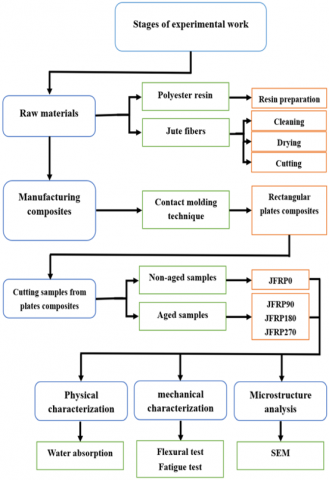
Figure 1 shows a flowchart illustrating the steps taken in the experimental process of this study. The contact molding technique was used to manufacture JFRP composites. Rectangular plates with a nominal thickness of 4 ± 0.2 mm can be manufactured via this method, using three layers of bidirectional jute fibers impregnated with polyester matrix resin (Polylite 420-852), with a fiber volume percentage of roughly 40%. The reinforcement used, made of jute fibers, has distinct mechanical and physical characteristics. Its specific gravity, a key measurement for thin-layer materials such as textiles, is 0.88 kg/m². Regarding its intrinsic density, this displays an average value of 1300 kg/m³. Mechanically, this natural fiber reinforcement is characterized by a modulus of elasticity of approximately 50 GPa, indicating significant rigidity. In addition, its capacity to deform before breaking is limited, with an elongation at break of only 1.6% [19, 20]. As for the polymer matrix chosen to constitute the composite, it is a polyester resin. This has a density of 1110 kg/m³, slightly lower than that of water. Its modulus of elasticity, reflecting its inherent rigidity as a solid material, is significantly lower than that of jute fibres, at 2350 MPa. Finally, the intrinsic mechanical strength of this resin is approximately 72 MPa [21].
Figure 1. Flowchart of the experimental process
In order to assess durability in the marine environment, the samples are subjected to an accelerated ageing process by prolonged immersion. They are placed individually in a bath of natural seawater, taken specifically from the Annaba coastal area, located on the Algerian east coast, to ensure representative environmental conditions. Three distinct exposure durations are studied: 90, 180 and 270 days. When each specific immersion period expires, the corresponding samples are carefully removed from the marine bath. Immediately after their extraction, any surface moisture is removed by careful wiping. The samples are then subjected to a thorough drying phase using blotting paper, continued until weight stabilization is reached, indicating the complete elimination of residual free water. At the same time, it is imperative to maintain the biological and chemical activity of the marine environment; To do this, the seawater in the bath is renewed periodically throughout the experiment. The weight gain is then determined for each aging duration by evaluating the difference between the final dry mass and the initial mass of the sample, according to the calculation defined by Eq. (1). An average of five identical test specimens, subjected to the same conditions, is used for each interval (90, 180, 270 days), thus ensuring the statistical reliability of the reported results.
$\mu=\left[\left(W_f-W_i\right) / W_f\right] \times 100 \%$ (1)
where, Wi represents the specimen’s pre-immersion mass, Wf is the specimens denotes its stabilized dry mass after a given period in seawater, and μ is the weight gain.
The following symbols will be used for the composites under study for ease of presentation, clarity, and comprehension: JFRP0: jute fiber reinforced polyester in the unaged state; JFRP90: jute fiber reinforced polyester subjected to 90 days of environmental conditioning; JFRP180: 180-day aged jute fiber reinforced polyester; JFRP270: jute fiber reinforced polyester after 270 days of aging.
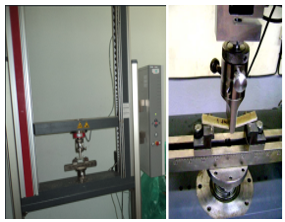
Using the Zwick/Roell universal machine (Figure 2), unaged prismatic JFRP specimens with dimensions of a length of 80 mm, a width of 15mm, and a thickness of 4mm are subjected to the static flexural test (three-point) and the repeated load test (fatigue) in conformity with ASTM D-790-17 standard [29]. The error rate of the test is 1%. The load is applied in the middle of the specimen until failure, the distance between the two supports being L=64mm.
Figure 2. Machine used in 3-point bending and cyclic fatigue
Every sample used in the cycle fatigue test was loaded and unloaded at various stresses using a sine wave signal, and the stress ratio R, which measures the ratio of minimum stress to maximum cycling stress, was set to zero. Both aged and unaged JFRP composite materials were examined in the samples. Using a loading/unloading frequency of 1.25 Hz, the JFRP0, JFRP90, JFRP180, and JFRP270 composite samples subjected to varying percentages of maximum load of the static breaking stress value: 80%, 70%, 60%, 55%, 45%, 35%, and 25% of the static breaking stress value in the three-point bending test. By using a low frequency, any secondary effects that may arise from the material's heating can be avoided. The average relative humidity during the fatigue testing was between 60 and 70%, and the ambient temperature was around 25˚C. For every loading level, at least six specimens were examined.
3.1 Moisture uptake
When JFRP specimens are submerged in seawater, water diffuses and penetrates the material through a process known as capillarity action, which may result in weight increase. However, in terms of limiting saturation and the deterioration of the different material constituents, the aging time controls the kinetics of water absorption. The weight gain µ (%) for the various aging times may be calculated using Eq. (1) because all of the samples aged in seawater have the same size and dimensions.
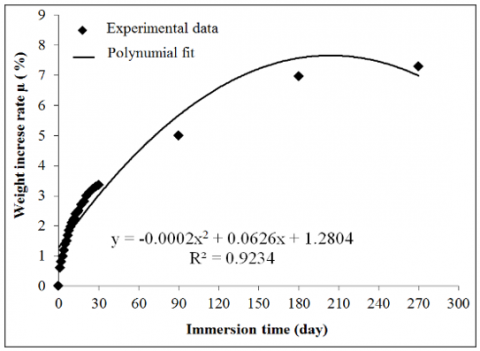
Figure 3 highlights a notable mass gain of the samples as a function of the duration of immersion in natural seawater, confirming a positive temporal relationship between exposure to the corrosive environment and mass absorption. The change in weight of the sample at this stage is evidently shown in this figure where the weight gain could be seen at the early days of seawater exposure and significantly increased to day 30, indicating that the moisture diffusion and quick water penetration had occurred in the materials. But water absorption did not contribute much in the final 90 days.
This is probably because the seawater's big salt molecules, predominantly NaCl, which slow down the diffusion process in the matrix of the composite materials, resulting in lower kinetic absorption parameters. This tendency may be associated with the hydrolysis mechanism of jute fiber cellulose.
Figure 3. Weight gain curve for JFRP immersed in water
In seawater, cellulose hydrolysis tends to happen much more noticeably than in unsalted water. Moreover, in seawater, the electronegativity of the solution significantly impacts how diffusion process, leading to the swelling of jute fibers, which then carry a notably positive charge [30]. It appears that the jute fiber's increased swelling in seawater can be linked to the interaction between its cellulose chains and the hydroxide groups (OH-). High concentrations of these OH- ions within the jute fibers may can cause swelling stresses due to overdistension and subsequently rupture the fibers [31].
As noted in previous paragraph, this variation of behavior is best fitted through a second-order polynomial curve, which is depicted in Figure 3. The best-fit curve is described with the formula: $y=-0.0002 x^2+0.0626 x+1.2804$, with a correlation coefficient of 0.96.
3.2 Bending properties of the no-aged specimens
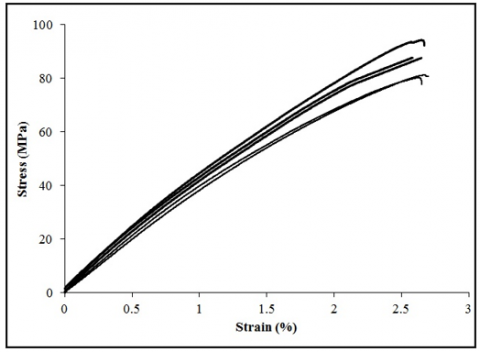
The breaking strength, maximum deformation, and modulus of elasticity are measured in the three-point bending test, which improves comprehension of the behavior and response of the composite material under static loading. The JFRP bidirectional composite's stress-strain curves are displayed in Figure 4. It is evident from these graphs that the tested samples experienced deformation up to rupture that was proportionate to the applied bending load. This observed linear correlation between the applied stress and the resulting deformation characterizes the elastic characteristic of the material, where the mechanical response rigorously follows Hooke's law. However, the slope of the curves decreases progressively with the increase in the bending load due to the beginning and development of the damage, which appears as microcracks at the level of the polyester matrix and which can move in any direction in the composite matrix. Then, the microcracks and the damage develop with increasing the intensity of the load, leading to an accumulation of damage that ultimately causes the sudden rupture of the tested sample. The breaking point corresponds to the stress and the maximum bending strain.
The use of stress-strain curves generated during mechanical tests on JFRP composites leads to the calculation of average flexural properties, in particular the:
Ultimate bending strength: σr = 85 MPa
Elasticity module: E = 4650 MPa
Figure 4. S-S curve of non-aged JFRP material
3.3 Fatigue failure behavior
The cyclic fatigue test in three-point bending was used to determine the service life under various environmental circumstances to determine the effect of seawater on the mechanical properties of the test specimens manufactured from jute polyester composite material. Because of their high hydrophilia, jute fibers can absorb a lot of moisture while aging in seawater. Indeed, the fiber content, which is around 40% in the material, studied JFRP having a weight of 5%, 7%, and 7.3% for seawater immersion times of 90 days (JFRP90), 180 days (JFRP180) and 270 days (JFRP270), respectively.
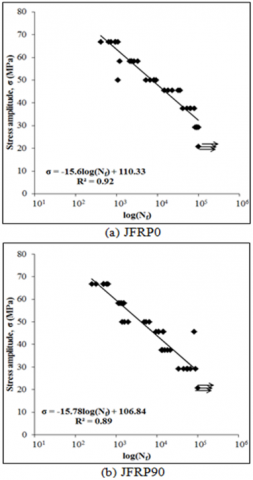
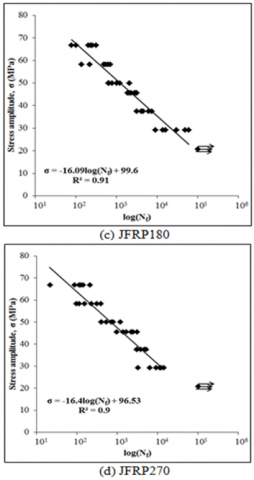
Using Wöhler's linear equation $\sigma=A-B \log \left(N_f\right)$, the endurance curve of experimental test results for all specimens tested in cyclic fatigue for varying age durations in seawater may be plotted (Figure 5), where Nf is the accumulated cycles to rupture, A and B correspond to material-specific constants, and σ is the highest stress applied in cyclic fatigue. For each of the aged polyester jute composite materials, the values of the endurance curve's two coefficients, A and B, could be determined using a linear regression calculation. The laboratory endurance limit was determined at 105 cycles for practical reasons. Table 1 compiles the values of the correlation coefficient R and the coefficients A and B for each material aged in seawater. The specimens' rate of degradation during cyclic fatigue testing is displayed by the A/B.
Table 1. Parameters A and B of the Wöhler (S-N) curves
|
Material |
JFRP0 |
JFRP90 |
JFRP180 |
JFRP270 |
|
B |
110.33 |
106.84 |
99.60 |
96.53 |
|
A |
15.60 |
15.78 |
16.09 |
16.40 |
|
R |
0.96 |
0.94 |
0.95 |
0.95 |
|
A/B |
0.14 |
0.15 |
0.16 |
0.17 |
It is evident from Figure 5 that the cyclic fatigue test experimental points are widely distributed throughout all tested composites. The non-uniform distribution of fibers in the specimens and defects in the material (pores, manufacturing flaws, machining, and demolding) are the primary causes of this dispersion. However, the endurance limit of a JFRP composite decreases with increasing aging time in a marine environment. The weakest slope of the Wöhler curve is that of the unaged composite (JFRP0), with a degradation rate of around 14.14% (Table 1).
Figure 5. S-N curve of jute/polyester composites after exposure to seawater
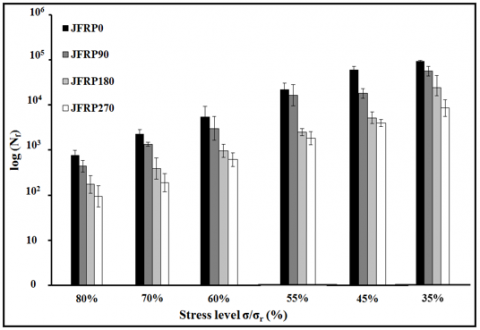
Figure 6. Endurance limit depending on JFRP composite loading level
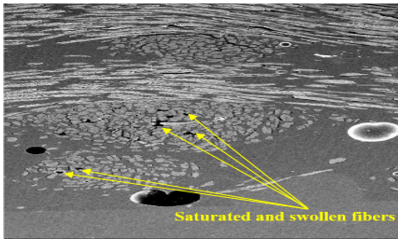
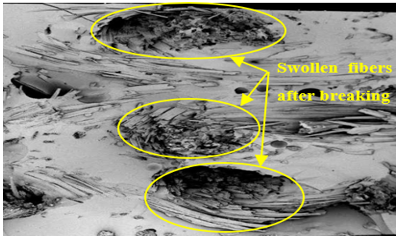
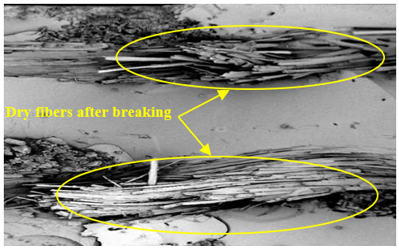
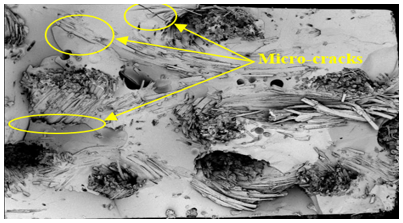
Increasing the aging period in seawater causes this rate to rise. Indeed, within the first ninety days, the aged composite material (JFRP90) exhibits a fatigue life reduction rate of 2% to 11% in comparison to the unaged composite JFRP0, and for all loading levels in cyclic fatigue (Figure 6). Furthermore, when compared to the unaged composite JFRP0, the JFRP180 composite exhibits a total decrease rate of 11% to 22% over the period of 180 days of marine aging. Finally, the aged composite JFRP270 exhibits the most notable decrease rate, ranging from 21% to 32% over 270 days. Therefore, even though the applied stresses are insignificant, the fatigue life degradation rate gradually increases with increasing immersion time in seawater. The presence of seawater in the material may certainly modify the fibers' and polyester matrix's properties as well as the interface between the two, which might occur in a deterioration of the material's mechanical properties when it is being utilized [28]. Additionally, the humidity expansion coefficients of the jute fiber and the polyester matrix differ, which leads to a dissociation of the interfacial region between fiber and matrix and eventually results in a reduction in fatigue resistance (Figure 7) [32].
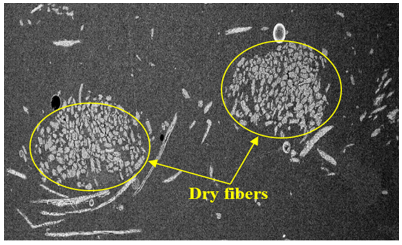
(a) Dry fibers of JFRP0
(b) Swollen fibers after saturation of JFRP270
(c) Fiber after fracture of JFRP270
(d) Fiber after fracture of JFRP0
(e) Damaged interface and delamination of JFRP270
Figure 7. Scanning electron microscope micrographs of the tested composite material (jute/polyester)
Water diffusion in composites is influenced by salinity, water temperature, manufacturing processes, and environmental factors such as humidity and temperature. The amount of salt present in seawater's structure, especially sodium chloride, has a significant impact on how water is absorbed and diffused. Physical and chemical aging occur when the jute/polyester composite material (JFRP) is submerged in seawater. Structural relaxation or solvent absorption are examples of changes in the spatial arrangement of macromolecular networks that cause physical aging without changing their chemical makeup. Chemical aging results from a chemical attack that may change the molecules' chemical composition and damage the composite's different components by dividing polymer chains, which in turn causes cracks and microcracks in the material. Furthermore, a chemical attack on the resin's ester bonds, the reactive groups mostly responsible for the degradation and leaching that occur in polyester resins, occurs concurrently with chemical aging brought on by extended contact with water [33]. Following saturation, the polyester resin typically degrades chemically and physically, exhibiting non-Fickian behavior, notably loss of cohesion fiber/matrix and matrix microcracks (Figure 7(e)) [34].
In addition, by accelerating the creep deformation and stress relaxation, the seawater in the jute/polyester composite can result in residual stresses and influence the mechanical fields. The bonding region between fiber and matrix is also affected by hydrolysis (Figure 7(a), (b)), and the chemical attack results in osmotic pressure, which damages the jute fibers and the fiber-matrix bond. As a result, the aged composite material (JFRP270), which is destroyed, has shorter jute fibers and yarns before failure than the unaged composite material (JFRP0) (Figures 7(c) and (d)). It is essential to highlight that the main cause of hydrolytic breakdown in composites is water diffusion within the material, which results in humidity absorption and, perhaps, increasing molecular mobility, and decreasing the stiffness of the polyester resin.
The density and direction of the fibers and microcracks, which seem to be influenced by both the loading and the conditioning states of the specimens, are typically combined to define the state of fatigue damage. The mechanisms of matrix microcracking, debonding at the interface region between the jute fiber and polyester matrix, and fiber loosening and fracture are the main causes of the onset and accumulation of damage in composites (see Figure 7(e)). The speed and progression of this damage are highly dependent on the material's microstructure and the applied loading mode. According to numerous studies, the different phases of damage under cyclic loading are similar to those observed under static loading, although they differ in terms of timing and intensity. Material degradation begins with the first fatigue cycles and gradually intensifies until it ultimately fails. Furthermore, the concept of "total destruction" no longer seems sufficient to characterize the failure criterion in these materials. Combining acoustic emission methods with real-time microscopic monitoring techniques would allow for better identification of the key mechanisms of fatigue damage. This would help to define a more relevant failure criterion and to reduce the dispersion of experimental data on the lifetime of composites.
The immersion of a JFRP polyester jute composite material in seawater results in progressive water absorption, which is accompanied by volumetric expansion and swelling of the specimens and a significant increase in their mass over the immersion time. The resulting phenomenon is mostly caused by water molecules diffusing across the fiber/matrix interface and within the polymer matrix. However, the existence of salt ions, such as sodium (Na⁺), chloride (Cl⁻), magnesium (Mg²⁺), sulfate (SO₄²⁻), calcium (Ca²⁺), and potassium (K⁺), slows down the absorption of water by the studied composite, which prevents the immersed composite from reaching the saturation limit during immersion in seawater of 270 days. Furthermore, the diffusion process is significantly impacted by the electrochemical properties of the saline solution in saltwater, specifically its high electrolyticity (the presence of highly mobile dissolved ions).
The static three-point bending test makes it possible to characterize the JFRP composite material by extracting and plotting the stress-strain curves. These curves exhibit linear behavior until rupture, reflecting the fragile and elastic nature of this material. However, the slope of the curves gradually decreases with increasing bending load. This is mainly attributed to the creation of internal damage, which leads to the appearance and development of microcracks in the polyester matrix. The primary cause of these microcracks is the difference in swelling between the fibers and the matrix (the jute fibers swell more because of their hydrophilic character, while the matrix absorbs water and expands).
Marine aging of a JFRP composite leads to a reduction in cyclic fatigue life. Indeed, the composite aged in seawater for 270 days (JFRP270) presents a rate of degradation of the endurance limit of up to 33%, compared to the unaged composite material JFRP0. This degradation is essentially due to the presence of salts, which affect the different compositions of the jute/polyester composite by cutting the chains connecting the reinforcement and the matrix and, consequently, creating defects and microcracks in the material.
The introduction of salt water in the polyester resin and jute fiber composite is not limited to a simple absorption phenomenon: it can also completely modify the state of internal stresses within the composite material. By penetrating the matrix and the fibers, the water induces a differential swelling between the two constituents (polyester matrix and jute fibers), which generates localized residual stresses within the fiber/matrix interface. These stresses are added to the mechanical stresses applied externally, thus modifying the distribution of mechanical fields in the composite.
[1] Salman, F.T., Hassoun, E.O., Ahmed, M.K. (2025). Fatigue behavior under constant load of CFRP sheets compared to their performance under static load. Revue des Composites et des Matériaux Avancés-Journal of Composite and Advanced Materials, 35(1): 143-154. https://doi.org/10.18280/rcma.350117
[2] Dou, X., Liwu, J., Song, J., Wang, D. (2023). Exploring low cycle fatigue anisotropy and the failure mechanism of the DD412 single crystal alloy for aeroengines. International Journal of Fatigue, 169: 107487. https://doi.org/10.1016/j.ijfatigue.2022.107487
[3] Harizi, W., Chaki, S., Bourse, G., Ourak, M. (2022). Damage mechanisms assessment of glass fiber-reinforced polymer (GFRP) composites using multivariable analysis methods applied to acoustic emission data. Composite Structures, 289: 115470. https://doi.org/10.1016/j.compstruct.2022.115470
[4] Zhao, H., Huang, W., Wen, S., Yu, B., Wang, W., Ning, N., Tian, M. (2023). Fatigue life and failure mechanism of nylon 66 cord/rubber composites under wide temperature range. Polymer, 283: 126253. https://doi.org/10.1016/j.polymer.2023.126253
[5] Venkatesh, A.P., Padmanabhan, S., Allen Rufus, C., Mohammed Lukmaan, H., Abdul Rahman, A.R. (2021). Exploration of fatigue and modal analysis on mono leaf suspension made by natural composite materials. Materials Today: Proceedings, 47: 4262-4267. https://doi.org/10.1016/j.matpr.2021.04.568
[6] Bensadoun, F., Vallons, K.A.M., Lessard, L.B., Verpoest, I., Van Vuure. A.W. (2016). Fatigue behaviour assessment of flax-epoxy composites. Composites Part A: Applied Science and Manufacturing, 82: 253-266. https://doi.org/10.1016/j.compositesa.2015.11.003
[7] Alia, A., Fantozzi, G., Godin, N., Adrien, J., Osmani, H., Pascal, R. (2023). Multi-instrumented analysis of fatigue behavior and damage mechanisms in jute fiber-reinforced polyester composites. International Journal of Fatigue, 167: 107306. https://doi.org/10.1016/j.ijfatigue.2022.107306
[8] Pradhan, D.D., Chakraverty, A.P., Dash, S., Beura, S., Mohanty, U.K. (2023). Thermo-mechanical characterization of sea water immersed GO based GRE hybrid composite. Materials Today: Proceedings, 91: 88-94. https://doi.org/10.1016/j.matpr.2023.05.422
[9] Davies, P., Le Gall, M., Niu, Z., Catarino, A.I., De Witte, Y., Everaert, G., Dhakal, H., Park, C.H., Demeyer, E. (2023). Recycling and ecotoxicity of flax/PLA composites: Influence of seawater aging. Composites Part C: Open Access, 12: 100379. https://doi.org/10.1016/j.jcomc.2023.100379
[10] Massou, M., Babu, N., Xian, G. (2023). Experimental study on the mechanical properties of CFRP/epoxy composite plates under seawater immersion. In Structures. Elsevier, 54: 48-57. https://doi.org/10.1016/j.istruc.2023.05.042
[11] Hussnain, S.M., Shah, S.Z.H., Megat-Yusoff, P.S.M., Hussain, M.Z. (2023). Degradation and mechanical performance of fibre-reinforced polymer composites under marine environments: A review of recent advancements. Polymer Degradation and Stability, 215: 110452. https://doi.org/10.1016/j.polymdegradstab.2023.110452
[12] Shrivastava, S.M., Ramarao, G., Buragohain, M.K., Selvaraj, N. (2023). Effect of seawater exposure on tensile and flexural properties of glass/epoxy composite. Materials Today: Proceedings, 82: 314-321. https://doi.org/10.1016/j.matpr.2023.02.143
[13] Sahiner, N., Yildiz, S., Sahiner, M., Issa, Z.A., Al-Lohedan, H. (2015). Macroporous cryogel metal nanoparticle composites for H2 generation from NaBH4 hydrolysis in seawater. Applied Surface Science, 354: 388-396. https://doi.org/10.1016/j.apsusc.2015.04.183
[14] Visco, A.M., Brancato, V., Campo, N. (2012). Degradation effects in polyester and vinyl ester resins induced by accelerated aging in seawater. Journal of Composite Materials, 46(17): 2025-2040. https://doi.org/10.1177/0021998311428533
[15] José-Trujillo, E., Rubio-González, C., Rodríguez-González, J.A. (2019). Seawater ageing effect on the mechanical properties of composites with different fiber and matrix types. Journal of Composite Materials, 53(23): 3229-3241. https://doi.org/10.1177/0021998318811514
[16] Visco, A.M., Calabrese, L., Cianciafara, P. (2008). Modification of polyester resin based composites induced by seawater absorption. Composites Part A: Applied Science and Manufacturing, 39(5): 805-814. https://doi.org/10.1016/j.compositesa.2008.01.008
[17] Muthukumar, T., Aravinthan, A., Lakshm, K., Venkatesan, R., Vedaprakash, L., Doble, M. (2011). Fouling and stability of polymers and composites in marine environment. International Biodeterioration and Biodegradation, 65(2): 276-284. https://doi.org/10.1016/j.ibiod.2010.11.012
[18] Poodts, E., Minak, G., Zucchelli, A. (2013). Impact of sea-water on the quasi static and fatigue flexural properties of GFRP. Composite Structures, 97: 222-230. https://doi.org/10.1016/j.compstruct.2012.10.021
[19] Pani, P.R., Nayak, R.K., Routara, B.C., Sekhar, P.C. (2019). Flexural and specific wear rate of seawater aged bamboo, jute and glass fiber reinforced polymer hybrid composites. Materials Today: Proceedings, 18: 3409-3414. https://doi.org/10.1016/j.matpr.2019.07.268
[20] Azwa, Z.N., Yousif, B.F., Manalo, A.C., Karunasena, W. (2013). A review on the degradability of polymeric composites based on natural fibres. Materials and Design, 47: 424-442. https://doi.org/10.1016/j.matdes.2012.11.025
[21] Le Duigou, A., Davies, P., Baley, C. (2009). Seawater ageing of flax/poly (lactic acid) biocomposites. Polymer Degradation and Stability, 94(7): 1151-1162. https://doi.org/10.1016/j.polymdegradstab.2009.03.025
[22] Chelali, H., Meghezzi, A., Berkouk, A., Soltani, M.T., Winning, G. (2021). Mechanical, curing parameters and water absorption of hybrid date palm leaf-orange peel fibers reinforced unsaturated polyester composites. Journal of Composite and Advanced Materials/Revue des Composites et des Matériaux Avancés, 31(3): 139-144. https://doi.org/10.18280/rcma.310304
[23] Gunturu, B., Vemulapalli, C., Malkapuram, R., Konduru, N. (2020). Investigation on mechanical, thermal and water absorption properties of banana/coir reinforced polypropylene hybrid composites. Revue des Composites et des Matériaux Avancés-Journal of Composite and Advanced Materials, 30(3-4): 123-131. https://doi.org/10.18280/rcma.303-402
[24] Sen, I., Aral, A., Seki, Y., Sarikanat, M., Sever, K. (2012). Variations of mechanical properties of jute/polyester composite aged in various media. Journal of Composite Materials, 46(18): 2219-2225. https://doi.org/10.1177/0021998311430866
[25] Akil, H.M., Cheng, L.W., Ishak, Z.M., Bakar, A.A., Abd Rahman, M.A. (2009). Water absorption study on pultruded jute fibre reinforced unsaturated polyester composites. Composites Science and Technology, 69(11-12): 1942-1948. https://doi.org/10.1016/j.compscitech.2009.04.014
[26] Ben Daly, H., Ben Brahim H., Hfaied, N., Harchay, M., Boukhili, R. (2007). Investigation of water absorption in pultruded composites containing fillers and low-profile additives. Polymers Composites, 28(3): 355-364. https://doi.org/10.1002/pc.20243
[27] Newman, G.V., Newman, R.A., Sengupta, A.K. (2011). Comparative assessment of light-cured resin-modified glass ionomer and composite resin adhesives: In vitro study of a new adhesive system. American Journal of Orthodontics and Dentofacial Orthopedics, 119(3): 256-262. https://doi.org/10.1067/mod.2001.111552
[28] Dhakal, H.N., Zhang, Z.A., Richardson, M.O. (2007). Effect of water absorption on the mechanical properties of hemp fibre reinforced unsaturated polyester composites. Composites Science and Technology, 67(7-8): 1674-1683. https://doi.org/10.1016/j.compscitech.2006.06.019
[29] ASTM International. (2017). ASTM D790-17: Standard test methods for flexural properties of unreinforced and reinforced plastics and electrical insulating materials. https://doi.org/10.1520/D0790-17
[30] Zamri, M.H., Akil, H.M., Bakar, A.A., Ishak, Z.A.M., Cheng, L.W. (2012). Effect of water absorption on pultruded jute/glass fiber-reinforced unsaturated polyester hybrid composites. Journal of Composite Materials, 46(1): 51-61. https://doi.org/10.1177/0021998311410488
[31] Nosbi, N., Akil, H.M., Ishak, Z.M., Bakar, A.A. (2011). Behavior of kenaf fibers after immersion in several water conditions. BioResources, 6(2): 950-960.
[32] Evangelista, R.P., Barbosa, V.A.S., Reis, L.R., dos Reis Jr, P.M., França Jr, C.A., Leão, M.A., César, S.F. (2021). Humidity diffusion on jute/polyester laminated composites and its effects on mechanical properties. Journal of Materials Science and Engineering B, 11(4): 138-143. https://doi.org/10.17265/2161-6221/2021.10-12.002
[33] Apicella, A., Migliaresi, C., Nicolais, L., Iaccarino, L., Roccotelli, S. (1983). The water ageing of unsaturated polyester-based composites: Influence of resin chemical structure. Composites, 14: 387-392. https://doi.org/10.1016/0010-4361(83)90160-X
[34] Hallansonnex, A., Casalinho, J., Perré, P. (2019). Non-Fickian diffusion in biosourced materials: Experimental determination of the memory function using minute samples. Construction and Building Materials, 224:560-571. https://doi.org/10.1016/j.conbuildmat.2019.07.013