Emadaldeen A. Sulaiman* | Jinan Jawad Hassan Alwash | Talib Abdulameer Jasim | Zainab Al-Khafaji | Mayadah Falah
© 2025 The authors. This article is published by IIETA and is licensed under the CC BY 4.0 license (http://creativecommons.org/licenses/by/4.0/).
OPEN ACCESS
This study investigates the mechanical, microstructural, and economic performance of concrete incorporating calcined fish scale powder (FSP) as a partial replacement for Portland cement. Fish scales, an abundant organic waste byproduct, were thermally treated at 250℃ and added to concrete mixes at 0%, 0.5%, 1%, 1.5%, 5%, 10%, and 15% replacement ratios. Compressive, splitting tensile, and flexural strengths were evaluated at 3, 7, 28, and 90 curing days to capture early and long-term performance trends. The highest mechanical performance was recorded at a 10% replacement level, achieving compressive, tensile, and flexural strengths of 42 MPa, 2.3 MPa, and 4.3 MPa respectively at 90 days, representing significant improvements over the control. SEM analysis at 7 and 28 days confirmed substantial microstructural densification due to enhanced C–S–H gel development and better interfacial bonding from the hydroxyapatite-collagen composite structure of FSP. Workability peaked at 1.5% FSP content, with higher dosages negatively impacting flowability. Furthermore, a cost-benefit evaluation revealed that the 10% FSP mix offers not only improved mechanical performance but also material cost savings and reduced CO₂ emissions. These findings highlight the potential of fish scale powder as a sustainable cement substitute that enhances structural performance and environmental efficiency, supporting its application in green construction practices.
blending materials, fish scales, cement replacement
Concrete is a prevalent material in the worldwide building industry. It is a mixture of aggregates, water, and a binder such as lime or cement [1, 2]. The characteristics of concrete, including economic viability, inherent reliance, and adaptability, have become this material the most prevalent choice among building industry professionals [3-5]. The rise in population and urbanization necessitates infrastructure development, which demands the services of the construction industry. This business's traditional processes and materials have been identified as contributors to greenhouse gas emissions, leading to environmental pollution [3, 6].
Consequently, researchers worldwide endeavor to minimize the consumption of raw resources used in concrete production, with cement being the principal component among these elements. Cement production is internationally attributed to 5-10% of CO2 emissions, adversely impacting our ecosystem [7-9]. Therefore, it is essential to diminish both the demand and production of cement to decrease energy consumption and mitigate environmental pollution [10-12]. A strategy proposed to diminish the consumption and production of raw materials for concrete involves using waste materials with pozzolanic and cementitious features. Various wastes [13, 14], including Sewage Sludge Ash, Biomass Combustion Ash, Palm Oil Fuel Ash [12], Waste Lime Sludge, Rice Husk Ash [15], Steel Slag, Ground Granulated Blast Furnace Slag [8], Fly Ash [16, 17], and Coal Ash, were employed by researchers in the manufacture of concrete to diminish binder utilization, enhance waste management, promote environmental sustainability, and enhance concrete features [18-21]. Furthermore, the augmentation of concrete strength using extra cementitious materials and fibers was a longstanding practice [22].
Fish scales, byproducts of the food and fishing sectors, pose a significant economic and environmental challenge [23]. A portion of generated fish scales are utilized in the manufacture of collagen [24], biomaterials [25, 26], adsorbents [27], food [28], fertilizers [29], animal feed [30], guanine [31], and hydroxyapatite [32-37]. The primary components of fish scales are proteins, primarily minerals, and collagen. The primary ingredient of the inorganic mineral components of fish scales is hydroxyapatite [18]. The predominant techniques for splitting inorganic and organic ingredients include converting fish scale components into a soluble form by heating and treatment with organic solvents, alkalis, acids, or enzymes [38]. These procedures are protracted (up to two weeks), involving substantial use of detergents and considerable energy expenditure.
Despite prior research on using fish scales and natural materials in composites, significant gaps still need to be in their application as sustainable blending materials in concrete. Bigi et al. [39] examined calcium phosphate cement with fish scales, improving mechanical features through controlled porosity and microstructural changes, but did not explore traditional concrete or long-term performance. Zhu et al. [40] focused on fish scales' mechanical behavior and microstructure without applying this knowledge to concrete mixtures. Bhat et al. [41] studied animal bone powder as a coarse aggregate replacement, identifying optimal compressive strength with 50% substitution, yet their work still needs to address fish scales or cement replacement. Similarly, Sridhar et al. [42] investigated fish scales in fiber composites with vinyl ester but needed to consider their potential in concrete. When used as a cement replacement at various ratios and curing ages, these studies fail to examine fish scales' impact on vital concrete features—compressive, tensile, and flexural strength. Therefore, the need for further research on fish scales as a sustainable material in concrete is evident, particularly regarding their mechanical performance as a partial cement substitute. This study addresses these gaps by evaluating concrete blended with fish scales across different replacement levels.
This study aims to evaluate the feasibility of utilizing calcined fish scale powder as a sustainable partial replacement for Portland cement in structural concrete, with a focus on enhancing mechanical performance, promoting microstructural refinement, and reducing environmental impact. The investigation encompasses the incorporation of fish scale powder, thermally treated at 250℃, at various replacement levels ranging from 0% to 15%, and assesses its influence on compressive, splitting tensile, and flexural strengths at curing ages of 3, 7, 28, and 90 days. In addition to mechanical characterization, the study incorporates scanning electron microscopy (SEM) to elucidate the microstructural development and hydration mechanisms associated with fish scale inclusion. The experimental program also evaluates the workability of fresh concrete and the effect of organic additive content on slump behavior. Through a comprehensive cost-benefit analysis, the research further examines the economic and ecological viability of fish scale powder as a cement substitute by quantifying material cost savings and carbon footprint reductions. Ultimately, this work seeks to identify an optimal replacement ratio that maximizes structural integrity while aligning with the principles of circular economy and sustainable construction, thereby offering an innovative waste valorization pathway within the civil engineering sector.
2.1 Materials characteristics
The characteristics of the materials utilized in the current study were chemical and physical analysis and the particle size grading for fish scales waste, coarse aggregates, sand, and cement.
2.1.1 Cement utilization and properties
This research utilizes ordinary Portland cement (class I), produced at the Almas Cement Factory in Iraq, to refer to normal concrete beam samples. Tables 1 and 2 demonstrate the cement's chemical analysis and physical test findings, respectively. The test findings indicated that the cement utilized conformed to Iraqi Requirement No. 5/1984.
Table 1. Cement physical characteristics
|
Character |
Magnitude |
Limit of IQS NO. 5/1984 |
|
Setting Time (min) |
|
|
|
Initial |
123 |
≥45 |
|
Final |
195 |
≤600 |
|
Fineness (Blaine), m2/kg |
315 |
≥230 |
|
Compressive Strength (MPa) |
|
|
|
3days |
27.52 |
≥15 |
|
7days |
38.4 |
≥23 |
Table 2. Chemical analysis and main cement components
|
Oxide Composition |
By Weight % |
Limitations of IQS NO. 5/1984 [43] |
|
CaO |
62.77 |
- |
|
SiO2 |
20.54 |
- |
|
Al2O3 |
5.60 |
- |
|
Fe2O3 |
3.29 |
- |
|
SO3 |
2.34 |
if C3A < 5% ≤2.5% if C3A > 5% ≤2.8% |
|
MgO |
2.80 |
≤5% |
|
L.O.I. |
1.95 |
≤4% |
|
L.S.F. |
0.91 |
0.66-1.02 |
|
I.R. |
1.21 |
≤1.5 |
|
Main compounds (Bouge's eq.) |
by weight of cement (%) |
|
|
Tricalcium silicate (C3S) |
50.14 |
- |
|
Diacalcium siliccat (C2S) |
19.05 |
- |
|
Tricalcium aluminate (C3A) |
3.25 |
≤3.5% |
|
Tetracalcium aluminoferrite (C4AF) |
10.11 |
- |
2.1.2 Fine aggregate (sand)
Figure 1 shows the natural sand used, with a max particle size of 4.75 mm. The sand was repeatedly cleansed and purified with water, then spread out and allowed to air dry before use to avert moisture buildup that may substantially impact the water amount in the concrete mixture. Table 3 shows the physical and chemical features of fine sand.
Figure 1. Fine aggregate grading
Table 3. Chemical and physical features of the utilized fine aggregate
|
Features |
Test Findings |
|
Specific gravity |
2.64 |
|
Fineness modulus |
2.70 |
|
Absorption proportion |
0.74 |
|
Sulfate amount (SO3) % |
0.12 |
2.1.3 Gravel
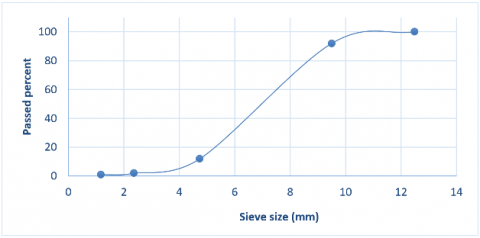
The research used a max size of 10 mm for semi-crushed gravel. It was said that gravel was washed with water to eliminate dust and then allowed to air dry to get a saturated surface dry condition. Figure 2 and Table 4 illustrate the sieve analysis and the chemical and physical features of the gravel, respectively.
Figure 2. Grading of the utilized gravel
Table 4. Physical and chemical features of the utilized gravel
|
Features |
Test Findings |
|
Sulfate (SO3) amount % |
0.08 |
|
Specific gravity |
2.65 |
|
Absorption percent |
0.77 |
2.1.4 Utilization of fish scales in biodegradable polymers
Fish scales are a rigid substance that encases the fish skin. Substantial quantities of fish waste are routinely discarded. These fish scales have been chosen to convey biodegradable polymer. One challenge is to collect a sufficient quantity of these scales and transport them to the handling laboratory. Fish scale is often used as a biopolymer across several industries due to its exceptional biocompatibility and biodegradability. The current study extracted fish scales from fish waste as an alternative source. Figure 3 outlines a detailed process for transforming raw fish scales into a refined powder suitable for advanced applications. The fish scales are thoroughly washed and centrifugated, removing excess moisture. Subsequently, the scales undergo a specialized treatment with ice and salt, followed by a secondary washing to eliminate residual impurities. The scales are soaked in a salt solution to enhance the preparation and then washed again. The treated scales are then carefully dried to ensure optimal moisture content before grinding. The drying step is crucial as it facilitates the subsequent high-speed grinding phase, where the scales are processed into a coarse powder. Finally, the coarse powder is refined through vibration sieving, which ensures uniform particle size and consistency.
Figure 3. Fish scales preparing process
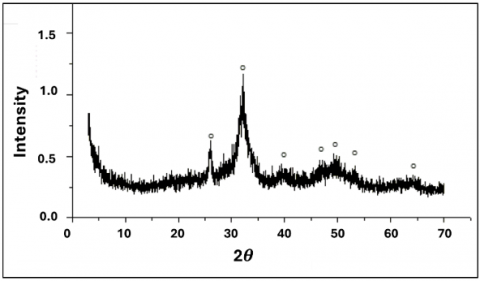
Figure 4 illustrates XRD pattern diffraction peaks indicating the crystalline structure of fish scales conducted in Al-Khura company/ Baghdad/ Iraq. A sharp peak near 2θ = 31-32° suggests the presence of hydroxyapatite, a common mineral in fish scales. Smaller peaks at 16-18°, 22-23°, 39-41°, and 48-50° indicate other crystalline components. The broad background suggests amorphous or less-ordered structures, likely collagen. The pattern reflects a semi-crystalline composite of organic (collagen) and inorganic (minerals) materials, characteristic of fish scales. Circles mark critical peaks, likely corresponding to specific crystalline phases. Figure 5 shows the chemical composition of the fish scale based on energy-dispersive X-ray Spectroscopy (EDS) results.
Figure 4. XRD pattern for fish scales
Figure 5. Chemical analysis of fish scale
2.2 Mix design
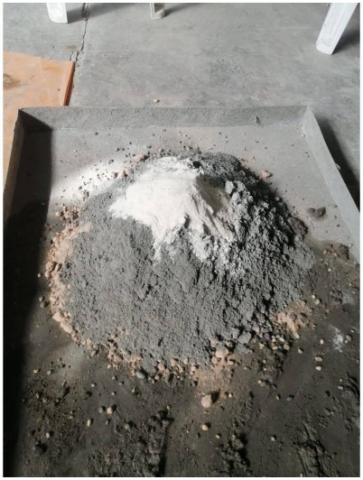
The research includes a study of the impact of adding ground fish scales on the flexural, splitting tensile, and compressive strengths of the concrete mix as a percentage of cement replacement (0, 0.5, 1, 1.5, 5, 10, and 15%) that burned at 250 degrees Celsius, in addition to the difference in the test age. (7 and 28) days, as the concrete mixture consists of (gravel, sand, cement, water, and ground fish scales) as shown in Figure 6. The concrete mix ratio of 1:1.5:2 (cement: sand: gravel) was determined to provide a suitable balance between strength, durability, and workability, in line with recognized civil engineering standards for structural applications. A water-to-cement (W/C) ratio of 0.35 was adopted to ensure sufficient hydration while minimizing the potential adverse effects of excess water on the concrete's compressive strength and long-term durability. The 400 kg/m³ blending material was selected to supply adequate cementitious material to achieve the desired mechanical properties and ensure a strong bond within the matrix. The quantities specified in Table 5 were calculated to promote uniformity, reduce segregation, and ensure consistency in the final concrete mixture, meeting the technical requirements for its intended use.
Table 5. Mixing design quantities
|
Mixing ID |
Fish Scales Ratio |
Fish Scales kg/m3 |
Cement kg/m3 |
Sand kg/m3 |
Gravel kg/m3 |
Water kg/m3 |
|
FM1 |
0.00% |
0 |
400 |
600 |
800 |
140 |
|
FM2 |
0.50% |
2 |
398 |
600 |
800 |
140 |
|
FM3 |
1.00% |
4 |
396 |
600 |
800 |
140 |
|
FM4 |
1.50% |
6 |
394 |
600 |
800 |
140 |
|
FM5 |
5.00% |
20 |
380 |
600 |
800 |
140 |
|
FM6 |
10.00% |
40 |
360 |
600 |
800 |
140 |
Figure 6. Mixing materials
2.3 Laboratory evaluations
2.3.1 Concrete slump analysis
The workability of concrete enhanced with fish scales as an addition was evaluated using the slump cone test by ASTM C143 standards [43]. The slump cone technique is a rapid and cost-effective test conducted from batch to batch to assess the consistent quality of concrete throughout construction.
2.3.2 Compressive strength analysis
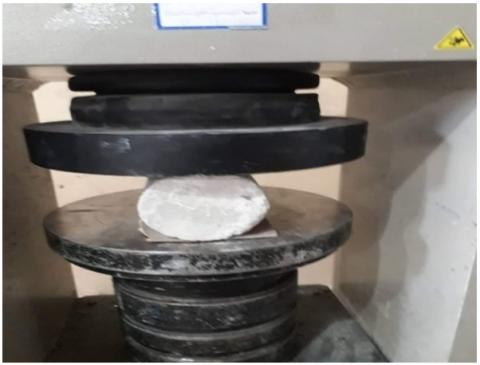
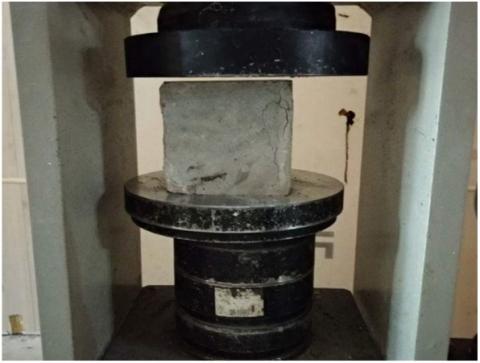
The compressive strength test was identified based on (ASTM C39-86) [44]. Cubic of (150mm × 150mm × 150 mm) were tested by applying a hydraulic compressive machine with a capacity of (1600kN) as demonstrated in Figure 7.
(a)
(b)
Figure 7. (a) Compression test for cylinder; (b) Splitting tensile strength test
2.3.3 Splitting tensile strength assessment
A splitting tensile strength test has been identified, as demonstrated in Figure 7, on cylindrical concrete specimens (100 × 200 mm) by (ASTM C496-2004) [45].
2.3.4 Flexural strength test
This research tested the rupture modules on prismatic concrete specimens (10 × 10 × 40) cm according to ASTM C78-10 [46].
2.3.5 Scanning electron microscopy (SEM)
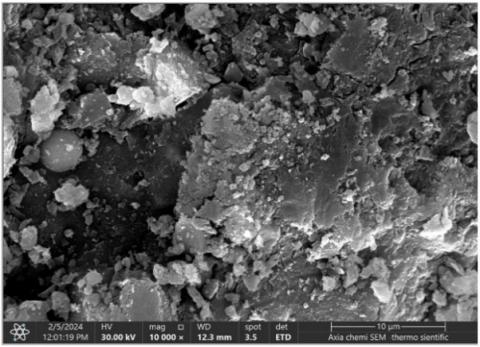
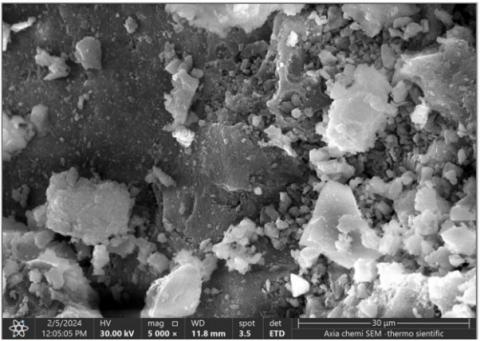
The SEM test was conducted to examine the microstructural development of concrete containing fish scale powder. It provided detailed imaging of the hydration products, pore structure, and interface between the cement matrix and additive at 7 and 28 days.
3.1 Fresh concrete results
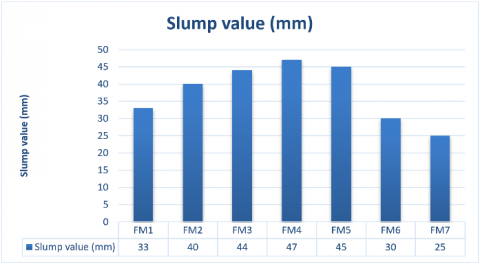
Figure 8 shows the slump test results showing that incorporating fish scales as a partial cement replacement significantly influences the workability of concrete. The slump value increased with fish scale content up to 1.5%, peaking at 47 mm for FM4 (1.5% replacement), indicating enhanced workability at lower replacement levels. Beyond this point, workability decreased, with slump values dropping to 30 mm for FM6 (10% replacement) and reaching the lowest value of 25 mm for FM7 (15% replacement). These results suggest that while small additions of fish scales improve workability, higher replacement levels negatively affect the mix's flow properties due to increased organic content.
Figure 8. Slump test results for all selected mixtures
3.2 Mechanical properties of concrete results
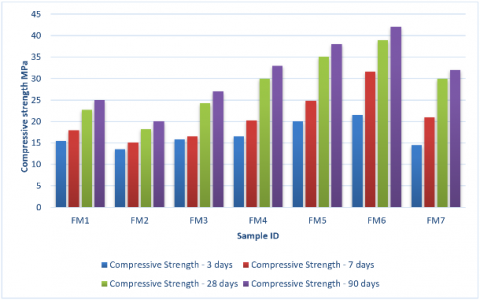
Figure 9 presents the compressive strength development of concrete samples incorporating varying percentages of fish scale powder (0% to 15%) at four different curing ages: 3, 7, 28, and 90 days. The data indicate a consistent increase in strength with curing time across all mixes, affirming the progressive hydration and matrix densification. For the control sample FM1 (0% fish scales), compressive strength evolved from 15.5 MPa at 3 days to 25 MPa at 28 days and peaked at 27 MPa at 90 days. FM2 (0.5%) exhibited comparatively lower early and long-term strengths, reaching only 20 MPa by 90 days. FM3 (1%) and FM4 (1.5%) showed a steady increase, with FM4 achieving 30 MPa at 28 days and 33 MPa at 90 days. FM5 (5%) recorded substantial strength gains, progressing from 20 MPa at 3 days to 38 MPa at 90 days. The most notable enhancement was observed in FM6 (10%), which reached 21.5 MPa at 3 days and ultimately 42 MPa at 90 days—a 68% improvement compared to the control at 28 days. FM7 (15%) also showed strength progression but to a lesser extent, with final strength plateauing at 32 MPa. These outcomes underscore the superior performance of the 10% fish scale content, confirming it as the optimal replacement level for enhancing compressive strength across all curing stages.
Figure 9. Compressive strength results after using different fish scale ratios (0, 0.5, 1, 1.5, 5, 10, and 15%) at 3, 7, 28 and 90 curing ages
The improvement in compressive strength is attributed to the pozzolanic and filler effects of calcined fish scale powder, which contains hydroxyapatite and collagen. These components enhance interfacial bonding between the cement matrix and aggregate, promote nucleation of C–S–H gel, and contribute to a denser microstructure with reduced porosity. As corroborated by SEM observations, FM6 exhibited significant microstructural densification at later ages, indicating advanced hydration and improved durability potential [47]. However, at higher dosages (e.g., 15%), excessive organic residue may disrupt cement hydration kinetics, leading to a decline in strength efficiency [48, 49]. Thus, the 10% replacement level achieves an optimal synergy between microstructural refinement and mechanical performance.
Figure 10 illustrates the development of splitting tensile strength in concrete samples containing varying proportions of fish scale powder (ranging from 0% to 15% by weight) at four curing ages: 3, 7, 28, and 90 days. A progressive enhancement in tensile strength is evident across all mixes with increasing curing time, highlighting the ongoing hydration and microstructural refinement. For the control mix FM1 (0%), strength increased from 1.3 MPa at 3 days to 1.57 MPa at 28 days and reached 1.65 MPa at 90 days. FM2 (0.5%) exhibited the lowest performance across all ages, with final strength plateauing at 1.5 MPa. FM3 (1%) and FM4 (1.5%) showed consistent improvement, reaching 1.72 MPa and 1.9 MPa at 90 days, respectively. FM5 (5%) achieved 2.1 MPa at 90 days, while FM6 (10%) demonstrated the highest splitting tensile strength across all ages, increasing from 1.7 MPa at 3 days to 2.3 MPa at 90 days—a notable gain over the control. FM7 (15%) also performed well, attaining 1.9 MPa at 90 days, though slightly below the FM6 result.
These outcomes confirm that fish scale powder effectively enhances the tensile resistance of concrete, particularly at replacement levels up to 10%. The improvement is attributed to the synergistic role of collagen fibers and hydroxyapatite in the fish scales, which promote stronger bonding within the cement matrix and contribute to crack-bridging mechanisms. Moreover, the increased interfacial adhesion and reduced microcracking at later ages—observed in SEM analysis—further justify the elevated tensile response. Nevertheless, higher replacement levels (e.g., FM7 at 15%) may introduce excess organic content, which could marginally affect matrix cohesion, limiting strength gain beyond the optimal threshold.
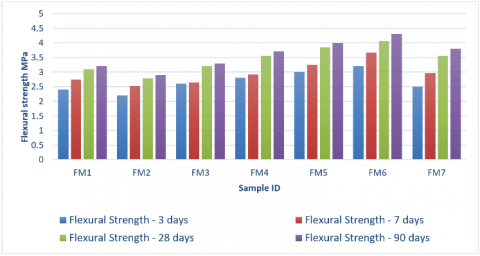
Figure 11 illustrates the flexural strength development of concrete specimens incorporating various percentages of fish scale powder (0% to 15% by weight) at four curing ages: 3, 7, 28, and 90 days. The results show a consistent upward trend in flexural strength with curing age across all mixes, reflecting progressive hydration and matrix reinforcement. The control mix FM1 (0%) achieved modest gains, increasing from 2.4 MPa at 3 days to 3.2 MPa at 90 days. FM2 (0.5%) exhibited lower strength at all ages, peaking at 2.9 MPa at 90 days. Mixes FM3 (1%) and FM4 (1.5%) demonstrated steady improvements, reaching 3.3 MPa and 3.7 MPa respectively at 90 days. FM5 (5%) achieved significant enhancement, with strength values rising from 3.0 MPa at 3 days to 4.0 MPa at 90 days. The highest flexural strength was recorded for FM6 (10%), which progressed from 3.2 MPa at 3 days to 4.3 MPa at 90 days, marking the most favorable outcome across all ages. FM7 (15%) also displayed a strong flexural response, attaining 3.8 MPa at 90 days.
These results confirm that the inclusion of fish scale powder significantly contributes to the flexural performance of concrete, especially at 5–10% replacement levels. The enhancement is attributed to the bio-mineral composite nature of fish scales, particularly the collagen matrix and hydroxyapatite content, which improve interfacial bonding, reduce porosity, and promote the formation of a denser microstructure. These properties support more efficient stress distribution and fracture resistance under bending [50, 51]. Moreover, the inherent brittleness of the calcined fish scales likely contributes to microcrack arrest, thus increasing flexural toughness. Supporting literature also highlights that bio-organic additives can stimulate early C–S–H gel formation and improve post-cracking behavior, affirming the role of fish scales in strengthening flexural capacity in cementitious systems [50-53].
Figure 10. Splitting tensile strength results after using different fish scale ratios (0, 0.5, 1, 1.5, 5, 10, and 15%) at 3, 7, 28 and 90 curing ages
Figure 11. Flexural strength results after using different fish scale ratios (0, 0.5, 1, 1.5, 5, 10, and 15%) at 3, 7, 28 and 90 curing ages
3.3 Microstructure results
Figure 12 shows the microstructural evolution of concrete incorporating 10% fish scale powder (FM6) between the 7- and 28-day curing ages reveals a significant transformation in matrix density, hydration progression, and phase integration. At 7 days, the SEM image indicates a heterogeneous and porous matrix characterized by partially hydrated cement particles, unreacted fish scale residues, and discontinuous calcium silicate hydrate (C–S–H) gel formation. These early-age features reflect an immature microstructure with weak interfacial bonding and higher porosity, which are typical of initial hydration stages. In contrast, the 28-day microstructure exhibits a notably denser and more homogeneous cementitious matrix, with extensive development of C–S–H gel and more complete encapsulation of fish scale particles within the hydrated phases. This densification contributes to reduced pore connectivity and enhanced mechanical performance, confirming the beneficial interaction between the organic-mineral phases of fish scales and the cement matrix over extended curing periods. The presence of hydroxyapatite and collagen in the fish scales likely serves as nucleation sites for C–S–H formation, accelerating hydration and promoting interfacial densification—a phenomenon supported by Liu et al. [38], reported that hydroxyapatite derived from fish scale waste significantly improved cement matrix reactivity and microstructural compactness in blended systems. Therefore, prolonged curing not only advances cement hydration but also facilitates the synergistic effects of fish scale additives, leading to superior structural integrity and performance of the composite material [38].
Figure 12. SEM images for sample FM6 (with 10% fish scales) at 7 and 28 curing ages
The current study confirms that incorporating 10% fish scale powder significantly enhances the compressive strength of concrete—reaching 40 MPa at 28 days, a 60% improvement over the control mix—it also presents microstructural evidence supporting potential durability gains. SEM analysis of the FM6 sample revealed a denser, less porous matrix at 28 days, characterized by extensive C–S–H gel formation and effective encapsulation of fish scale particles. Such microstructural densification is closely associated with reduced permeability, which is a key factor in enhancing resistance to chloride ingress and moisture transport, as established by Gallegos-Villela et al. [53], demonstrated that natural additives improve concrete durability through pore structure refinement. Furthermore, the improved interface and diminished microvoid content observed at 28 days are likely to improve freeze–thaw resistance by minimizing internal water expansion and cracking, consistent with findings by Olusunle et al. [49], linked organic waste-based densification with enhanced thermal durability. Additionally, the incorporation of hydroxyapatite—a major component in fish scales—may offer buffering capacity against pH drop and reduce CO₂ diffusivity, thereby improving carbonation resistance, as supported by Liu et al. [38], found that hydroxyapatite from fish scales enhanced cement matrix stability and microstructural compactness. Therefore, both the mechanical performance and SEM-based densification strongly suggest improved long-term durability, which should be validated through permeability, freeze–thaw, and carbonation resistance testing.
To ensure the practical applicability of fish scale powder as a sustainable cement replacement, it is essential to investigate its performance under varying environmental temperatures and humidity levels. The current study demonstrates that 10% fish scale powder significantly enhances compressive strength (40 MPa at 28 days) and promotes microstructural densification, as confirmed by SEM analysis. However, these results were obtained under controlled laboratory conditions, which do not fully replicate the diverse climatic stresses encountered in real-world construction environments. Concrete's hydration rate, strength development, and durability properties are highly sensitive to ambient temperature and relative humidity—factors that influence pore structure evolution, moisture transport, and long-term phase stability.
At elevated temperatures, for example, hydration may accelerate but lead to microcracking and reduced long-term durability, while low temperatures can retard hydration and compromise early-age strength. Similarly, high humidity may sustain hydration and improve curing outcomes, whereas dry conditions can lead to shrinkage and poor matrix formation. Prior studies [54, 55] have shown that environmental exposure conditions markedly affect both mechanical and transport properties of blended concretes.
Thus, evaluating the performance of fish scale–modified concrete under controlled temperature-humidity chambers simulating tropical, arid, and temperate climates would provide critical insights into its robustness and service life prediction. This step is vital for validating its feasibility in infrastructure projects exposed to thermal cycling, wet-dry conditions, or coastal environments.
3.4 Cost-benefits analysis
From a civil engineering perspective, the economic and functional viability of fish scale powder as a supplementary cementitious material hinge on its dual advantage of performance enhancement and cost mitigation. As a waste by-product, fish scales present a virtually zero raw material cost, significantly reducing the economic barrier to sustainable integration in concrete formulations. The associated processing cost, primarily driven by thermal calcination at 250℃ and subsequent grinding, is moderate (estimated at 20–35 USD/ton) and could be further optimized through localized sourcing and batch energy management.
The replacement of 10% cement, a high-cost and high-emission component, results in a direct material cost saving of up to 8–10 USD per ton of concrete. Beyond economics, the +60% increase in compressive strength (from 25 MPa to 40 MPa), as empirically demonstrated in the FM6 mix, substantiates the efficacy of fish scale powder in enhancing structural performance, as demonstrated in Table 6. Furthermore, SEM analysis confirms that matrix densification and pore refinement contribute to improved durability indicators such as reduced permeability and long-term mechanical stability—key to minimizing maintenance interventions in aggressive service environments.
Lastly, the carbon offset potential through cement emission reduction (~90 kg CO₂ per ton avoided) positions fish scale concrete favorably within the green construction paradigm, enabling potential qualification for environmental certifications and regulatory incentives. Hence, the combined financial and environmental return supports its overall economic feasibility, encouraging broader industry adoption.
Table 6. Cost-benefit comparison between traditional vs fish scale concrete
|
|
Parameter |
Traditional Concrete |
Fish Scale Concrete (10% Replacement) |
|
1 |
Raw Material Cost |
Cement ~100-120 USD/ton |
Fish scales: low to zero cost (waste product) |
|
2 |
Processing Cost |
None (cement used directly) |
20-35 USD/ton (washing, grinding, calcination) |
|
3 |
Cement Replacement |
None |
Savings of 8-10 USD/ton concrete |
|
4 |
Compressive Strength (28 days) |
25 MPa |
40 MPa (+60% vs. control) |
|
5 |
Durability and Maintenance |
Standard durability, regular maintenance cycles |
Enhanced durability, reduced lifecycle maintenance |
|
6 |
Environmental Impact (CO2 Emissions) |
~ 900 kgCO2 /ton cement |
~ 810 kgCO2 / ton binder (10% reduction) |
|
7 |
Overall Economic Feasibility |
Neutral - no added sustainability or cost savings |
Positive - cost-effective, high strength, eco-beneficial |
The experimental findings demonstrate that incorporating fish scale powder calcined at 250℃ as a partial cement replacement significantly enhances the mechanical, microstructural, and economic performance of concrete. Compressive strength increased progressively across all curing ages, with the 10% FSP mix (FM6) achieving a peak value of 42 MPa at 90 days—approximately 68% higher than the control. Similar trends were observed for splitting tensile and flexural strengths, both of which reached optimal values in the 10% mix, confirming enhanced matrix cohesion and crack-bridging mechanisms. SEM analysis further revealed improved hydration and microstructural refinement at 28 days, attributable to the nucleation potential of hydroxyapatite and collagen residues.
In terms of workability, fish scale inclusion improved flowability up to 1.5% replacement but reduced it at higher levels due to increased organic content. The densified matrix observed in SEM images suggests improvements in long-term durability, including reduced permeability and potential resistance to carbonation and freeze–thaw cycles. The cost-benefit assessment established that using 10% FSP can reduce material costs by up to $10/ton of concrete and cut CO₂ emissions by approximately 90 kg/ton of cement replaced.
Therefore, a 10% fish scale powder replacement represents an optimal balance between mechanical strength, durability, and sustainability. Future research should investigate the effects of varying calcination temperatures and environmental exposures to further refine the material's behavior under field conditions.
To comprehensively establish the optimal processing conditions and maximize the reactivity and bonding potential of fish scale powder, it is imperative to expand the experimental scope to include a range of calcination temperatures (e.g., 300℃, 400℃, 500℃, and 600℃). Variations in temperature can significantly alter the decomposition of organic matter, the crystallinity of hydroxyapatite phases, and the degree of thermal activation, which directly influence the particle morphology, surface area, and reactivity of the additive.
Future investigations are recommended to explore the optimal dosage of fish scale powder under varying water-to-binder ratios, as this parameter critically influences the hydration process, workability, and overall compatibility of blended cementitious matrices. In parallel, it is essential to examine the impact of fish scale incorporation on the alkalinity of the cementitious system, given its direct implications for the corrosion protection of embedded steel reinforcement and the preservation of passivating conditions over extended service life. Moreover, research should focus on the combined utilization of fish scale powder with supplementary cementitious materials and chemical admixtures—such as silica fume, fly ash, or superplasticizers—to evaluate potential synergistic interactions that may enhance mechanical strength, durability performance, and rheological behavior, thereby advancing the development of high-performance, environmentally sustainable concrete composites.
[1] Marshdi, Q.S.R., Hussien, S.A., Mareai, B.M., Al-Khafaji, Z.S., Shubbar, A.A.F. (2021). Applying of No-fines concretes as a porous concrete in different construction application. Periodicals of Engineering and Natural Sciences, 9(4): 999-1012. https://doi.org/10.21533/pen.v9i4.2476
[2] Ali, Y.A., Falah, M.W., Ali, A.H., Al-Mulali, M.Z., et al. (2022). Studying the effect of shear stud distribution on the behavior of steel–reactive powder concrete composite beams using ABAQUS software. Journal of the Mechanical Behavior of Materials, 31(1): 416-425. https://doi.org/10.1515/jmbm-2022-0046
[3] Bheel, N., Meghwar, S.L., Abbasi, S.A., Marwari, L.C., Mugeri, J.A., Abbasi, R.A. (2018). Effect of rice husk ash and water-cement ratio on strength of concrete. Civil Engineering Journal, 4(10): 2373-2382. https://doi.org/10.28991/cej-03091166
[4] Jatoi, M.A., Solangi, G.S., Shaikh, F.A., Rajput, S. (2019). Effect of Lakhra fly ash as partial replacement of cement in traditional concrete. Mehran University Research Journal of Engineering & Technology, 38(4): 1045-1056. https://doi.org/10.22581/muet1982.1904.16
[5] Nguyen, H., Carvelli, V., Adesanya, E., Kinnunen, P., Illikainen, M. (2018). High performance cementitious composite from alkali-activated ladle slag reinforced with polypropylene fibers. Cement and Concrete Composites, 90: 150-160. https://doi.org/10.1016/j.cemconcomp.2018.03.024
[6] Chowdhury, S., Mishra, M., Suganya, O.M. (2015). The incorporation of wood waste ash as a partial cement replacement material for making structural grade concrete: An overview. Ain Shams Engineering Journal, 6(2): 429-437. https://doi.org/10.1016/j.asej.2014.11.005
[7] Al-Mamoori, S.F., Shubbar, A.A., Al-Khafaji, Z.S., Nasr, M.S., et al. (2021). Production of ternary blend binder as an alternative to portland cement. IOP Conference Series: Materials Science and Engineering, 1090(1): 012069. https://doi.org/10.1088/1757-899X/1090/1/012069
[8] Majdi, H.S., Shubbar, A.A., Nasr, M.S., Al-Khafaji, Z.S., et al. (2020). Experimental data on compressive strength and ultrasonic pulse velocity properties of sustainable mortar made with high content of GGBFS and CKD combinations. Data in Brief, 31: 105961. https://doi.org/10.1016/j.dib.2020.105961
[9] Salman, A.J., Jawad, Z.F., Ghayyib, R.J., Kareem, F.A., Al-khafaji, Z. (2022). Verification of utilizing nanowaste (glass waste and fly ash) as an alternative to nanosilica in epoxy. Energies, 15(18): 6808. https://doi.org/10.3390/en15186808
[10] Hussain, A.J., Al-Khafaji, Z.S. (2020). Reduction of environmental pollution and improving the (Mechanical, physical and chemical characteristics) of contaminated clay soil by using of recycled oil. Journal of Advanced Research in Dynamical and Control Systems, 12(4): 1276-1286.
[11] Hussain, A.J., Al-Khafaji, Z.S. (2020). The fields of applying the recycled and used oils by the internal combustion engines for purposes of protecting the environment against pollutions. Journal of Advanced Research in Dynamical and Control Systems, 12(1): 698-706. https://doi.org/10.5373/JARDCS/V12SP1/20201119
[12] Shubbar, A., Nasr, M., Falah, M., Al-Khafaji, Z. (2021). Towards net zero carbon economy: Improving the sustainability of existing industrial infrastructures in the UK. Energies, 14(18): 5896. https://doi.org/10.3390/en14185896
[13] Shamsa, M., Al-Shathr, B., Al-Attar, T. (2018). FFECT of pozoolanic materials on compressive strength of geopolymer concrete. Kufa Journal of Engineering, 9(3): 26-36. https://doi.org/10.30572/2018/KJE/090303
[14] Aljashaami, S.K., Mohammed, M.A. (2024). Nano materials as a mechanism for achieving contextualism in architecture. Kufa Journal of Engineering, 15(3): 32-46. https://doi.org/10.30572/2018/KJE/150303
[15] Al-Khafaji, Z.S., Majdi, A., Shubbar, A.A., Nasr, M.S., et al. (2021). Influence of high volume rha on properties of cement mortar. IOP Conference Series: Materials Science and Engineering, 1090(1): 012028. https://doi.org/10.1088/1757-899X/1090/1/012028
[16] Al-Jaberi, L.A., Ali, A., Al-Jadiri, R.S., Al-Khafaji, Z. (2023). Workability and compressive strength properties of (fly ash-metakaolin) based flowable geopolymer mortar. Electronic Journal of Structural Engineering, 23(4): 46-51. https://doi.org/10.56748/ejse.23436
[17] Al Rammahi, R., Rasin, F., Al Aani, F. (2019). Treatment fly ash of al musayyib thermal power plant to be used as a pozzolanic material. Kufa Journal of Engineering, 10(3): 90-99. https://doi.org/10.30572/2018/kje/100306
[18] Hamada, H.M., Yahaya, F.M., Muthusamy, K., Jokhio, G.A., Humada, A.M. (2019). Fresh and hardened properties of palm oil clinker lightweight aggregate concrete incorporating Nano-palm oil fuel ash. Construction and Building Materials, 214: 344-354. https://doi.org/10.1016/j.conbuildmat.2019.04.101
[19] Saadoon, I.H., Hamada, T.A., Alazzawy, M.A. (2019). Molecular evaluation of viral load and genotype of HCV in acute and chronic HCV patients in Kirkuk city. Kirkuk University Journal-Scientific Studies, 14(1): 13-22. https://doi.org/10.32894/kujss.2019.14.1.2
[20] Lynn, C.J., Dhir, R.K., Ghataora, G.S., West, R.P. (2015). Sewage sludge ash characteristics and potential for use in concrete. Construction and Building Materials, 98: 767-779. https://doi.org/10.1016/j.conbuildmat.2015.08.122
[21] Mangi, S.A., Wan Ibrahim, M.H., Jamaluddin, N., Arshad, M.F., Mudjanarko, S.W. (2019). Recycling of coal ash in concrete as a partial cementitious resource. Resources, 8(2): 99. https://doi.org/10.3390/resources8020099
[22] Ali, A.M., Falah, M.W., Hafedh, A.A., Al-Khafaji, Z.S., Radhi, S. (2022). Evaluation the influence of steel-fiber on the concrete characteristics. Periodicals of Engineering and Natural Sciences, 10(3): 368-379. https://doi.org/10.21533/pen.v10i3.3111
[23] Coppola, D., Lauritano, C., Palma Esposito, F., Riccio, G., Rizzo, C., de Pascale, D. (2021). Fish waste: From problem to valuable resource. Marine Drugs, 19(2): 116. https://doi.org/10.3390/md19020116
[24] Subhan, F., Hussain, Z., Tauseef, I., Shehzad, A., Wahid, F. (2021). A review on recent advances and applications of fish collagen. Critical Reviews in Food Science and Nutrition, 61(6): 1027-1037. https://doi.org/10.1080/10408398.2020.1751585
[25] Majhooll, A.A., Zainol, I., Jaafar, C.N.A., Mudhafar, M., Ha, A., Asaad, A., Mezaal, F.W. (2019). Preparation of fish scales hydroxyapatite (FsHAp) for potential use as fillers in polymer. Journal of Chemistry and Chemical Engineering, 13: 97-104. https://doi.org/10.17265/1934-7375/2019.03.002
[26] Abd, A.A., Al-Khafaji, Z. (2024). Gelatin and Arabic gum-based food coating for food packaging. Kufa Journal of Engineering, 15(3): 213-230. https://doi.org/10.30572/2018/KJE/150312
[27] Liu, W.K., Liaw, B.S., Chang, H.K., Wang, Y.F., Chen, P.Y. (2017). From waste to health: Synthesis of hydroxyapatite scaffolds from fish scales for lead ion removal. JOM, 69: 713-718. https://doi.org/10.1007/s11837-017-2270-5
[28] Vorobyev, V.I., Nizhnikova, E.V., Egorova, K.V. (2021). Fish scales and new directions of its practical application. In Proceedings of the X International Baltic Maritime Forum. Innovations in Science, Education and Entrepreneurship–2021, Kaliningrad, Russia, pp. 4-9.
[29] Basu, B., Banik, A.K. (2005). Production of protein rich organic fertilizer from fish scale by a mutant Aspergillus niger AB100_A media optimization study. Journal of Scientific & Industrial Research, 64(4): 293-298.
[30] Safronova, T., Vorobyov, V., Kildeeva, N., Shatalova, T., et al. (2022). Inorganic powders prepared from fish scales. Ceramics, 5(3): 484-498. https://doi.org/10.3390/ceramics5030037
[31] Chen, F., Guo, D., Gao, J., Ma, Y. (2021). Bioinspired crystallization of guanine. The Journal of Physical Chemistry Letters, 12(48): 11695-11702. https://doi.org/10.1021/acs.jpclett.1c03010
[32] Al-Khafaji, Z., Kazem, M., Radhi, N., Falah, M., Hadi, Z. (2024). Reducing the issues of implements in the human body by applying hydroxyapatite (HAP) in modern biomedicine. Material and Mechanical Engineering Technology, 2024(2): 64-78. https://doi.org/10.52209/2706-977X_2024_2_64
[33] Radhi, N.S., Jamal Al-deen, H.H., Safaa Hadi, R., Al-Ghaban, N., Al-Khafaji, Z.S. (2023). Preparation and investigation a hydroxyapatite layer coating on titanium substrate for surgical implants. Journal of Nanostructures.
[34] Radhi, N.S., Salman, A.J., Al-Khafaji, Z. (2024). Investigation of in vitro behavior of composite coating hydroxyapatite-nano silver on 316L stainless steel substrate by electrophoretic technic for biomedical tools. Open Engineering, 14(1): 20240017. https://doi.org/10.1515/eng-2024-0017
[35] Radhi, N.S., Al-Khafaji, Z.S. (2018). Preparation and Investigation composite coating (Ni-nano hydroxyapatite) on low carbon steel samples. In 6th International Scientific Conference on Nanotechnology, Advanced Materials and its Applications, the Technology University in Baghdad, Iraq. https://doi.org/10.13140/RG.2.2.10097.79201
[36] Salman, A.J., Albusalih, D., Jasim, T.A., Radhi, N.S., Al-Khafaji, Z., Falah, M. (2025). Identify in vitro behaviour of composite coating hydroxyapatite-nano silver on titanium substrate by electrophoretic technic for biomedical applications. Journal of Advanced Research in Micro and Nano Engineering, 28(1): 14-29. https://doi.org/10.37934/armne.28.1.1429
[37] Radhi, N.S., Al-Deen, H.H.J., Hadi, R.S., Al-Khafaji, Z. (2024). Investigate the applicability of coating titanium substrate by hydroxyapatite for surgical implants. International Journal of Integrated Engineering, 16(5): 172-186. https://doi.org/10.30880/ijie.2024.16.05.014
[38] Liu, Y., Liu, M., Ji, S., Zhang, L., Cao, W., Wang, H., Wang, S. (2021). Preparation and application of hydroxyapatite extracted from fish scale waste using deep eutectic solvents. Ceramics International, 47(7): 9366-9372. https://doi.org/10.1016/j.ceramint.2020.12.067
[39] Bigi, A., Bracci, B., Panzavolta, S. (2004). Effect of added gelatin on the properties of calcium phosphate cement. Biomaterials, 25(14): 2893-2899. https://doi.org/10.1016/j.biomaterials.2003.09.059
[40] Zhu, D., Vernerey, F., Barthelat, F. (2011). The mechanical performance of teleost fish scales. In Mechanics of Biological Systems and Materials, Volume 2: Proceedings of the 2011 Annual Conference on Experimental and Applied Mechanics, pp. 117-123. https://doi.org/10.1007/978-1-4614-0219-0_16
[41] Bhat, J.A., Qasab, R.A., Dar, A.R. (2012). Machine crushed animal bones as partial replacement of coarse aggregates in lightweight concrete. ARPN Journal of Engineering and Applied Sciences, 7(9): 1202-1207.
[42] Sridhar, R., Athijayamani, A., Stalin, B., Ganesh, R.S. (2015). Characterization of fish scale reinforced composites. International Journal of Applied Engineering Research, 10(55): 4076-4080.
[43] ASTM C157/C157M-08. (2014). Standard test method for length change of hardened hydraulic-cement mortar and concrete. https://store.astm.org/c0157_c0157m-08.html.
[44] ASTM C39/C39M-24. (2024). Standard test method for compressive strength of cylindrical concrete specimens. https://store.astm.org/c0039_c0039m-24.html.
[45] ASTM C496/C496M-17. (2017). Standard test method for splitting tensile strength of cylindrical concrete specimens. https://store.astm.org/c0496_c0496m-17.html.
[46] ASTM C78/C78M-22. (2022). Standard test method for flexural strength of concrete (using simple beam with third-point loading). https://store.astm.org/c0078_c0078m-22.html.
[47] Liu, D., Zhang, B., Yang, Y., Xu, W., Ding, Y., Xia, Z. (2018). Effect of organic material type and proportion on the physical and mechanical properties of vegetation‐concrete. Advances in Materials Science and Engineering, 2018(1): 3608750. https://doi.org/10.1155/2018/3608750
[48] Ujwal, M.S., Shiva Kumar, G. (2024). A step towards sustainability to optimize the performance of self-compacting concrete by incorporating fish scale powder: A response surface methodology approach. Emergent Materials, 7: 3121-3142. https://doi.org/10.1007/s42247-024-00786-y
[49] Olusunle, S.O.O., Ezenwafor, T.C., Jiddah-Kazeem, B.S., Kareem, A., Akinribide, O.J., Oyelami, A.T. (2015). Effect of organic waste on crystal structure and mechanical properties of concrete. Journal of Minerals and Materials Characterization and Engineering, 3(5): 427-434. https://doi.org/10.4236/jmmce.2015.35045
[50] Arain, F.A., Jatoi, M.A., Raza, M.S., Shaikh, F.A., Khowaja, F., Rai, K. (2022). Preliminary investigation on properties of novel sustainable composite: fish scales reinforced cement concrete. Jurnal Kejuruteraan, 34(2): 309-315. https://doi.org/10.17576/jkukm-2022-34(2)-14
[51] Chandar, S.P., Kumar, S.S. (2022). Mechanical properties of fiber reinforced concrete–natural fibers: A review. Materials Today: Proceedings, 68, 2066-2071. https://doi.org/10.1016/j.matpr.2022.08.362
[52] Yusra, A., Aulia, T.B., Hasan, M., Refiyanni, M., Zakia, Z., Fachruddin, F., Damayanti, I. (2024). Effect of the addition of natural fibers on the mechanical properties of concrete. In E3S Web of Conferences, 476: 01027. https://doi.org/10.1051/e3sconf/202447601027
[53] Gallegos-Villela, R.R., Larrea-Zambrano, F.D., Goyes-Lopez, C.E., Perez-Sanchez, J.F., Suarez-Dominguez, E.J., Palacio-Perez, A. (2021). Effect of natural additives on concrete mechanical properties. Cogent Engineering, 8(1): 1870790. https://doi.org/10.1080/23311916.2020.1870790
[54] Almusallam, A.A. (2001). Effect of environmental conditions on the properties of fresh and hardened concrete. Cement and Concrete composites, 23(4-5): 353-361. https://doi.org/10.1016/S0958-9465(01)00007-5
[55] Bentz, D.P., Jones, S.Z., Peltz, M.A., Stutzman, P.E. (2015). Influence of internal curing on properties and performance of cement-based repair materials. National Institute of Standards and Technology, U.S. Department of Commerce. https://doi.org/10.6028/NIST.IR.8076