Tariq Naji Mohsen* | Waleed Bdaiwi
© 2025 The authors. This article is published by IIETA and is licensed under the CC BY 4.0 license (http://creativecommons.org/licenses/by/4.0/).
OPEN ACCESS
The increasing demand for sustainable materials has driven research into natural fiber-reinforced polymer composites. This study investigates the mechanical and structural behavior of unsaturated polyester (UPS) composites reinforced by date palm seed (DPS) in varying volume ratios of 10-50%. Composites were fabricated using conventional molding techniques and characterized through tensile, compressive, hardness, and impact testing, along with SEM and Fourier Transform Infrared Spectroscopy (FTIR) analyses. The results showed that at 30% DPS, the composite achieved a tensile strength of 35.1 MPa and a compressive strength of 88.0 MPa, both significantly higher than neat UPS. The impact strength also improved, reaching up to 17.03 kJ/m² at 30% filler content. Shore D hardness increased with filler loading, with the highest value recorded at 50% DPS. But increased fillers up to 40% resulted in decreased elongation at break and wear resistance due to the decrease in ductility and matrix-filler interaction. FTIR confirmed hydrogen bonding and stress-induced peak shifts, while SEM showed good filler dispersion pre-impact and fracture features post-impact, indicating effective energy dissipation. These findings indicate that DPS is a potential bio filler for UPS composites with improved performance and sustainability for automotive panel, thermal insulator, and lightweight structural component applications.
UPS, DPS, natural fiber composites, mechanical properties, FTIR and SEM analysis, sustainable materials
The need for the development of sustainable composite materials has been rising in the recent years due to the increasing environmental issues, high cost of synthetic materials and demand for biodegradable materials [1-5]. Natural fillers of agricultural waste are emerging as promising reinforcements in polymer matrices because of their renewability, low density, biodegradability, and cost effectiveness [6-10]. Date palm seed (DPS), a prolific lignocellulosic byproduct in many arid and semi-arid areas, is a candidate source to boost composites performance among these. Such resource is particularly relevant for regions including the Middle East and North Africa where date palm resources abound but underutilized [11, 12].
In recent years many studies have shown that DPS is a suitable natural filler in unsaturated polyester composites. For instance, Abu-Jdayil et al. [13] exhibited how DPS can increase the mechanical and thermal insulation properties of UPS composites by up to 50% filler content. Dahad et al. [14] had previously shown that pre-treatment of date seeds and orange peels with UPS rendered composites with improved mechanical strength and insulating properties.
This is further supported by Meftah et al. [8] who found that when DPF was incorporated in UPS, especially after treating with alkali, the tensile, flexural and thermal characteristics were increased. Hussein [9] similarly observed that date palm fiber enhances the mechanical performance of polyester composites and reached optimum results at 20 vol.% fiber content.
In epoxy-based systems, Ghazi and Jaddan [15] demonstrated that DPS fillers provide low thermal conductivity and good thermal insulation. Dhanabalan et al. [16] also showed that DPS particles enhanced impact strength and maintain good adhesion in epoxy composites. Additionally, some other research has demonstrated that DPS fillers can increase thermal stability and toughness in epoxy composite [17].
Thermosetting polymer unsaturated polyester (UPS) has been widely used for composite manufacturing due to that polymer’s excellent moldability, chemical resistance, dimensional stability, and relatively low cost. Their brittleness and limited impact resistance limit use of UPS in dynamic and load bearing applications. Due to these limitations, researchers have explored the use of reinforcement strategies using natural fillers to improve toughness and mechanical performance at negligible cost increase and environmental impact [18-21]. The incorporation of natural particulate fillers, such as DPS, into the UPS matrix is shown to be a promising path to increasing mechanical characteristics, changing thermal behavior, and enhancing the sustainability of the material. When used in polyester matrices, studies have shown that DPS can enhance wear resistance, improve toughness, and reduce thermal conductivity [22, 23]. Additionally, research shows that incorporation of DPS impacts the crystallinity and thermal degradation behavior, which must be taken into account in design applications [24]. Additionally, filler geometry, treatment methods, and dispersion are key to determining the final composite properties [25, 26].
Recent studies contribute to the existing knowledge on natural filler reinforced UPS composites with multiple functionalities. Maou et al. [27] have studied UPS composites by incorporating alkali treated date palm fibers and observed that the filler content of 10-30% enhanced tensile, flexural and impact strength and reduced water absorption due to better interfacial bonding and fiber dispersion. Also, the research conducted by Abu-Jdayil et al. [13] showed that the incorporation of both date pit waste and dune sand as fillers in UPS matrices enhanced the thermal conductivity and compressive strength characteristics, thereby recommending the filler for building applications that require sustainability and thermal inertia [28]. Besides these, Erzen et al. [29] examined thermophysical characteristics and discovered that thermal conductivity of polyester resins containing low DPS fillers (< 4 wt.%) were lowered while its microstructure remained unaffected - a highly useful characteristic for insulation in light-weight construction.
Previous works state that natural fillers can improve stiffness and thermal properties, but strength and ductility of matrix can be weakened by higher filler concentrations due to poor matrix-filler bonding [10, 30]. A complete understanding of the way filler content impacts various mechanical and structural characteristics is therefore necessary to influence material design. On top of that, Fourier Transform Infrared Spectroscopy (FTIR) can be used for the characterization of the chemical integrity and for investigation of molecular level changes under mechanical loading.
The aim of this study is to analyze the impact of DPS particle reinforcement on the mechanical and structural behavior of UPS based composites. DPS particles with 710 µm diameter, were incorporated into a UPS matrix at volume ratios of 10%, 20%, 30%, 40%, and 50% to fabricate composites. Tensile, compressive, hardness, and impact mechanical tests were performed as well as FTIR to understand chemical modification before and after mechanical stress. The results highlight property relationships with filler content and validate the viability of DPS as a reinforcing bio filler for engineering composite applications.
2.1 Materials
The base matrix material selected for this study was unsaturated polyester (UPS) because of its favorable mechanical properties, cost effectiveness, and availability in composite applications. Date palm seed (DPS) particles with an average particle size of 710 µm were used in the reinforcing phase, which was derived from dried and crushed agricultural waste. Those particles were chosen because they are environmentally friendly and their ability to improve the mechanical performance of the polymer matrix, especially in compressive, and in impact conditions. Volume percentages of 10%, 20%, 30%, 40% and 50% of bio filler (DPS) incorporated into the UPS matrix were systematically investigated for its influence on composite mechanical, thermal and structural properties.
2.2 Preparation of composites
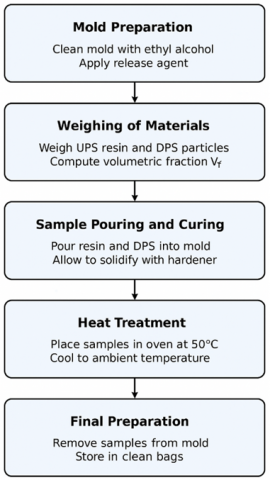
A manual casting technique using a clean, flat aluminum mold was employed to fabricate the composite specimens. Several preparatory and post processing steps were undertaken to assure consistent quality, structural integrity and reproducibility of the samples.
Mold preparation: Ethyl alcohol was used to clean the aluminum mold thoroughly to remove surface contaminants. Next, in order to remove the cured composites from the mold walls easily, a suitable release agent was applied to the mold walls. The mold cavity used for casting was 150 mm × 150 mm × 4 mm.
Weighing of materials: A digital balance was used to accurately measure the UPS resin and DPS particles. The appropriate weight fraction (Ψ) and volumetric fraction (Vf) of the DPS were calculated for each composition using the following equations [31]:
$V f=\frac{1}{1+\frac{1-\Psi}{\Psi} \times \frac{\rho_f}{\rho_m}}$ (1)
$\Psi=\left(\frac{W_f}{W_c}\right) \times 100 \%$ (2)
$W_c=W_f+W_m$ (3)
where, Wc, Wm, and Wf are the total weight of the composite, the weight of the UPS matrix, and the weight of the DPS particles, respectively. ρf and ρm represent the densities of the DPS filler and the UPS resin in g/cm³.
Sample pouring and curing: In the first process step, a mold cavity was filled with an initial layer of UPS resin. The pre weighed DPS particles were then slowly added to the resin with continuous manual stirring for 10 minutes, to ensure even dispersion and prevent air entrapment. Then, to reach the target DPS concentration, the remaining resin was added. Prior to molding, an appropriate amount of methyl ethyl ketone peroxide (MEKP) hardener was mixed at a ratio of 100:1.5 (resin:hardener by weight) to initiate the crosslinking reaction. The mold was left undisturbed at ambient laboratory conditions (27 ± 1℃) to allow the composite to cure over a period of 24 hours.
Post-curing heat treatment: After initial curing, the composite samples were placed in a thermostatically controlled oven set at 50℃ for one hour to complete the curing process. This post-curing step promoted enhanced crosslinking and reduced internal residual stresses. The samples were then left to cool gradually within the oven to prevent thermal shock.
Final preparation: Upon reaching room temperature, the solidified composite specimens were demolded carefully. The edges of the samples were trimmed where necessary, and all specimens were preserved in clean, sealed plastic bags to avoid environmental contamination before testing.
Figure 1 illustrates a schematic flowchart outlining the entire fabrication process, beginning with raw material preparation and continuing through composite casting, curing, and sample conditioning for testing. Specimens for mechanical testing were machined into standard geometries according to relevant ASTM (Advancing Standards Transforming Markets) standards (e.g., ASTM D638 for tensile and ASTM D695 for compression), and dimensional accuracy was verified with digital calipers.
All fabrication procedures and experimental tests—including tensile, compressive, bending, impact, hardness, and thermal conductivity evaluations—were conducted at the Advanced Materials Laboratory, Department of Physics, College of Education for Pure Sciences, University of Anbar, Iraq.
Figure 1. Schematic flowchart of the fabrication process for polyester- date palm seed (DPS) composite specimens
2.3 Statistical examination
All tests were performed in triplicate, and results are reported as mean ± standard deviation (SD). The Pearson correlation coefficient (r) was used to evaluate the relationship between DPS content and composite properties. Values of r = +1 indicate a perfect positive linear correlation, r = 0 indicates no linear relationship, and r = -1 indicates a perfect negative correlation. In this study, r > 0.9 was considered a strong positive association. All statistical analyses were performed using OriginPro 2016.
3.1 Tensile test
Tensile testing was conducted to evaluate the behavior of the composite materials under uniaxial tension, providing insights into their ultimate tensile strength (UTS), ductility, and stiffness. Specimens were prepared according to the geometrical specifications outlined in ASTM D638-22 [32], and tests were performed using a LARYEE Yaur Testing Solution tensile testing machine.
Each specimen was clamped securely between the upper and lower grips of the machine, and a steadily increasing tensile load was applied until failure. Mechanical parameters like Young’s modulus (E), strain at break and UTS were found based on the resulting stress-strain data.
The slope of the linear elastic portion of the stress - strain curve was used to obtain young’s modulus using the following equation:
$E=\frac{\Delta \sigma}{\Delta \varepsilon}$ (4)
Δσ is the change in the stress (MPa) and Δε is the change in the strain (dimensionless). Thus, these results allowed a full evaluation of the influence of date palm seed (DPS) filler on the tensile behavior of the composites
3.2 Compression test
Compressive test was utilized to evaluate the performance of composites under axial compressive loading of particular concern for structural applications including prosthetics and load bearing elements. A LYREE Yaur Testing Solution compression testing machine was used to conduct tests, in accordance with ASTM D695-15 [33].
Specimens were loaded in a progressive manner on two flat platens and were compressed until the specimens showed significant deformation or fracture. Maximum stress under compression and compressive modulus (linear region of the stress-strain curve) were obtained from the stress-strain curves.
The parameters obtained from these experiments help to understand the elastic and failure mechanisms of the composites under compressive loads and the influence of DPS particles on the mechanical behavior of the composites.
3.3 Impact test
Impact resistance was evaluated using a Charpy impact test apparatus (LAREE Yaur Testing Solution), following the guidelines of ASTM D6110-18 [34]. The setup measured the energy absorbed during fracture, which serves as an indicator of the material's toughness and shock resistance.
The test involved striking a notched specimen, supported horizontally, with a pendulum hammer released from a fixed height. The absorbed energy was recorded directly from the machine’s scale and represented the composite’s ability to resist sudden impact—a critical performance metric for safety-critical and dynamically loaded applications.
3.4 Hardness test
The surface hardness of the composites was assessed using the Shore D scale, employing a HUATEC HT-6600C durometer (HUATEC Group, China) in accordance with ASTM D2240 [35]. All measurements were conducted at a controlled room temperature of 27℃.
A needle-like indenter was applied to the surface of each specimen, and resistance to penetration was measured. For reliability, ten readings were taken per sample, and the average Shore D value was reported.
This test quantified the composite’s resistance to localized surface deformation, a key parameter in evaluating its potential for wear-resistant and protective surface applications.
3.5 FTIR test
Fourier Transform Infrared Spectroscopy (FTIR) was used to analyze the chemical structure and interfacial interactions within the composites. A PerkinElmer Spectrum Two FT-IR Spectrometer was used to perform the analysis. Two sample types were examined:
•Pure UPS + 30% date palm seed (DPS) composite before the impact test.
•And the same composite after the impact test.
Spectral analysis in transmission mode was carried out on thin composite sections of approximately 1 mm thick.
FTIR spectra obtained from the composite system were used to confirm and identify the characteristic functional groups in the composite system which include ester, hydroxyl and aliphatic groups corresponding to UPS and DPS, respectively. The analysis enabled the evaluation of chemical integrity of the composites and the confirmation of incorporation DPS particles into the UPS matrix. Furthermore, the spectra pre- and post-impact test were compared to elucidate possible structural changes caused by mechanical loading like bond shifting, peak intensity changes or rearrangement of the functional group.
3.6 FE-SEM test
Field Emission Scanning Electron Microscopy (FE-SEM) images were taken using MRS-6 model (USA) SEM system fitted with gold sputtering attachment at the Nanotechnology and Advanced Materials Research Center, University of Technology, Baghdad, Iraq. The optical system can image the surface morphology at a magnification of 1× to 100,000× with a resolution of up to 1 nm and therefore, well suited for surface characterization of nanostructures. This high-resolution imaging system allowed for analysis of the surface topography and the microstructure changes within the composites giving information about the dispersion of fillers and the interaction between the filler and the matrix at the nanoscale. Before imaging samples were coated with a thin layer of gold for better conductivity, and better quality of images.
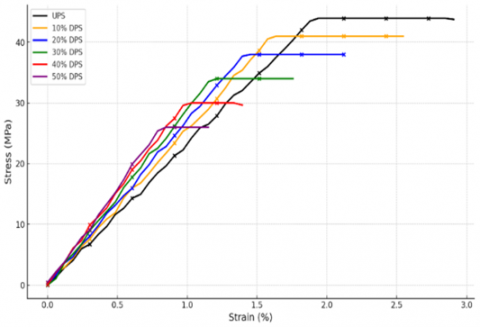
Figure 2. Tensile stress-strain curves of UPS / DPS composites
4.1 Tensile analysis results
Figure 2 illustrates the tensile stress-strain curves that were generated and the mechanical behavior of unsaturated polyester (UPS), and its composites reinforced with 710 µm date palm seed (DPS) particles at different volume percentages (10%, 20%, 30%, 40%, and 50%) was studied. These curves have typical features of a polymer-based composite, including initial linear elastic region, yielding and ultimate failure. As the DPS content increased, notable changes in mechanical response were observed, indicative of altered structural integrity and stress transfer mechanisms within the composite matrix.
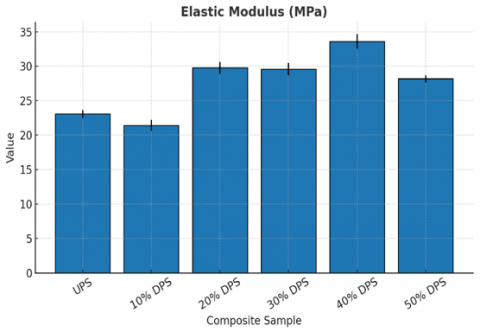
The elastic modulus of the materials, as illustrated in Figure 3, determined from the slope of the initial linear region of the stress-strain curves, exhibited a clear increasing trend with rising DPS content. The modulus increased from approximately 22.65 MPa in pure UPS to 33.54 MPa in the 40% DPS composite, highlighting an enhancement in stiffness attributed to the incorporation of rigid lignocellulosic fillers. This reinforcement effect is commonly observed in natural-fiber composites and is primarily due to the restriction of polymer chain mobility and improved load-bearing capacity of the filler-matrix system [30, 36]. However, the marginal change between 40% and 50% DPS suggests that filler agglomeration or interfacial incompatibility may limit further improvements in stiffness at high filler loadings [13, 22].
Figure 3. Elastic modulus of UPS / DPS composites
Figure 4. Ultimate tensile strength of UPS / DPS composites
As displayed in Figure 4, the ultimate tensile strength (UTS), which represents the maximum stress the material can withstand before necking or fracture, decreased with increasing DPS content. While UPS alone demonstrated a UTS of 43.95 MPa, this value dropped progressively to 30.00 MPa at 40% DPS. This reduction in strength is likely due to insufficient interfacial adhesion between the polyester matrix and the DPS particles, resulting in stress concentration sites that facilitate microcrack initiation under load [13]. Additionally, at higher filler contents, the particle-particle interactions may overshadow effective stress transfer, leading to premature failure [6].
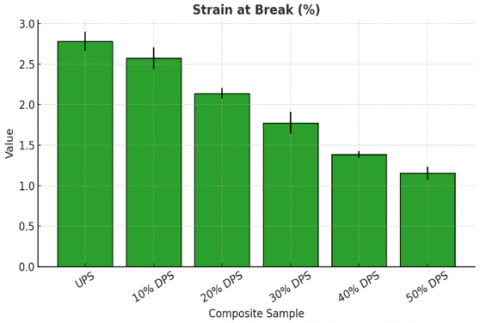
In terms of strain at break, as demonstrated in Figure 5, the composites exhibited a clear decline in ductility with increasing filler content. The elongation at fracture of the UPS matrix was 2.91%, while that of the 40% DPS composite was only 1.39%. Like most particulate filled thermosets, this inverse relationship between the strain at break and filler loading is a common characteristic and is thought to occur due to the rigid and brittle nature of the DPS particles that inhibit plastic deformation and prevent the matrix’s ability to accommodate strain prior to rupture [6, 23, 37].
Figure 5. Strain at break of UPS / DPS composites
Figure 6. Toughness of UPS / DPS composites
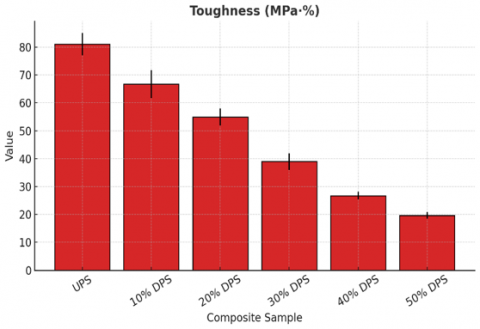
The energy absorption capacity prior to failure in terms of the toughness (Figure 6), quantified as the area under the stress-strain curve, is determined. Toughness was shown to decrease significantly with increasing DPS content from 86.06 MPa·% in UPS to 27.21 MPa·% in 40% DPS composite. This decline agrees well with the observed reductions in strength and ductility, and thus suggests a more brittle failure mode in the highly filled composites [23, 38]. Although the better stiffness, the dropped energy absorption implies that the composites should be less beneficial for the usage in applications with high impact resistance or high flexibility [17].
The effect of adding DPS particles into UPS yields composites that combine increased stiffness, but compromised strength, ductility, and toughness. These findings align with established trends in natural filler-reinforced polymer composites and suggest that optimizing filler content and enhancing interfacial adhesion (e.g., via surface treatment or coupling agents) could help balance these competing mechanical requirements for structural applications.
4.2 Compression results
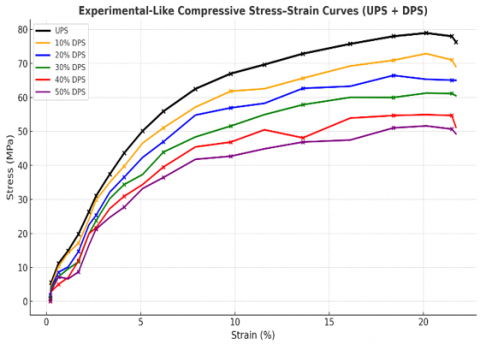
The compressive stress-strain response of unsaturated polyester (UPS) and its composites reinforced with date palm seed (DPS) particles at volume percentages of 10%, 20%, 30%, 40%, and 50% reveals significant trends in mechanical performance under compressive loading as demonstrated in Figure 7. The reference curve for pure UPS, derived from experimental data, displays a characteristic non-linear progression following an initial linear elastic region. The stress increases steadily with strain, peaking at approximately 78.93 MPa at a strain of 20.14%, after which a slight softening is observed. This behavior reflects the capacity of the UPS matrix to absorb compressive loads through elastic and plastic deformation mechanisms.
Figure 7. Compression stress-strain characteristics of UPS/DPS composites
Figure 7 presents the stress-strain curves for DPS-reinforced composites were generated by scaling the UPS curve to reflect realistic reductions in stiffness and strength due to filler incorporation. These curves preserved the shape of the experimental UPS response but displayed progressively lower peak stresses and more moderate slopes. As DPS content increased, the curves shifted downward and became less steep, indicative of decreased load-bearing capacity and stiffness. This change in profile is consistent with the common behavior of particle-reinforced thermoset polymers, where excessive filler loading often leads to reduced matrix continuity, impaired stress transfer, and increased defect density such as voids or agglomerates.
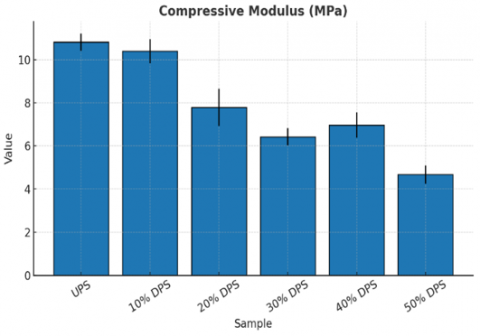
In terms of compressive modulus, which quantifies the stiffness of the material in the elastic region, the pure UPS sample exhibited a value of approximately 11.39 MPa, as illustrated in Figure 8. The modulus decreased with increasing DPS content, reaching 6.92 MPa at 40% DPS and 6.33 MPa at 30% DPS. This reduction is attributable to the replacement of a continuous polymer phase with rigid, non-deforming particles, which—if poorly bonded—fail to effectively reinforce the matrix [13, 23, 30]. The lower slope of the initial portion of the stress-strain curves in the composites supports this observation.
Figure 8. Compressive modulus of UPS / DPS composites
The compressive strength of the samples, defined as the maximum stress sustained before failure or yielding, followed a similar downward trend. As depicted in Figure 9, pure UPS achieved a peak stress of 78.93 MPa, whereas the strength decreased to 54.92 MPa in the 40% DPS composite. This reduction is consistent with the tendency of natural fillers to introduce stress concentrations and weak interfacial regions within the matrix, thus initiating early failure [13]. Moreover, the loss of load-bearing resin content in highly filled samples likely contributes to this strength deterioration [39].
Figure 9. Compressive strength of UPS / DPS composites
As shown in Figure 10, the strain at maximum stress, which represents the compressive ductility of the material, remained relatively stable across all compositions, hovering around 20% for most samples. This suggests that although the composites exhibited reduced strength and stiffness, their overall deformation capacity under compression did not degrade significantly [40]. Such behavior may indicate that the DPS particles, despite reducing stiffness, do not excessively hinder the matrix’s ability to deform plastically under compression.
Figure 10. Strain at maximum stress of UPS / DPS composites
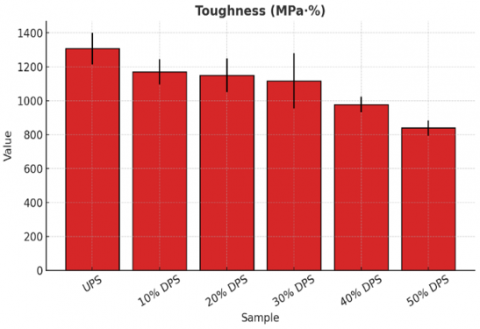
The toughness decreased drastically with increasing DPS content. As shown in Figure 11, the high toughness of ~1319 MPa·% for pure UPS was directly measured, indicating excellent energy absorption before failure. The value dropped to 1025 MPa·% in the 30% DPS sample, then to 923 MPa·% at 40% DPS. It is likely that the lower toughness of DPS composites results from diminished interfacial bonding and lower load transfer efficiency resulting in premature failure, and decreased energy absorption capacity [38]. This trend highlights the tradeoff that exists between a natural filler reinforced composite and environmental sustainability and cost efficiency yet at the expense of its robustness which is common in these types of composites.
Figure 11. Compressive toughness of UPS / DPS composites
Overall, composites incorporating DPS particles into UPS resin have lower compressive modulus, tensile strength, and toughness, as well as strain in the same type of stress. The results of these findings agree well with those typical for bio-filled polymer composites, and also highlight the need for an optimum filler content and interfacial compatibility that trade-off mechanical performance with material sustainability. It is important to note that variations between tensile and compressive behaviors stem from the fundamental differences in loading conditions. In tension, the matrix-filler interaction experiences separation, while in compression, local densification and filler confinement enhance stress transfer. These intrinsic factors contribute to the different magnitudes of modulus and strength observed.
4.3 Hardness results
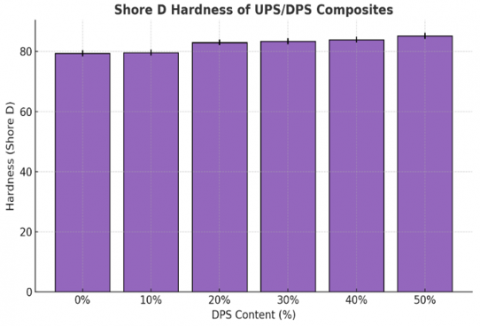
The Shore D scale was utilized for evaluating the hardness behavior of date palm seed (DPS) particle reinforced unsaturated polyester (UPS) and its composites. As presented in Figure 12, the results show a clear and progressive improvement in surface hardness as DPS content increases, which indicates that natural filler content is a strong influencer of the material's resistance to local deformation.
Figure 12. Shore D hardness of PS composites with different DPS contents
Shore D hardness of the Pure UPS was 79.4, typical for rigid thermosetting polymers. The hardness increased marginally to 79.6 upon addition of 10% DPS by weight, indicating minimal structural alteration using low filler loading. However, as the DPS content increased to 20% and beyond, a more substantial rise in hardness was observed. Specifically, the hardness values reached 83.0, 83.4, 83.9, and 85.2 for 20%, 30%, 40%, and 50% DPS content, respectively. This continuous upward trend indicates the growing contribution of rigid DPS particles to the overall hardness of the composite material.
The enhancement in Shore D hardness with DPS addition can be attributed to several mechanisms. First, the presence of hard and non-deformable DPS particles within the polymer matrix hinders the indentation of the testing needle during hardness measurement. These particles act as micro-barriers against localized deformation, increasing the material's resistance to penetration. Second, the reduction in the volume fraction of the softer polymer matrix with higher filler content contributes to the stiffer composite surface. Third, the interfacial interaction between the DPS particles and the UPS matrix, while potentially weak from a mechanical load-transfer perspective, appears sufficient to prevent significant displacement under minor surface loads, such as those applied in hardness testing.
It is also notable that the rate of increase in hardness becomes less steep beyond 30% DPS content, suggesting a potential saturation effect. This plateau behavior may be due to filler agglomeration or insufficient resin content to effectively encapsulate and distribute additional particles. Nevertheless, the overall improvement in surface hardness across all DPS loadings underscores the effectiveness of date palm seed reinforcement in modifying the surface properties of UPS-based composites [41].
In conclusion, the Shore D hardness results confirm that the addition of DPS enhances the surface rigidity of the UPS matrix. This improvement makes such composites particularly suitable for applications where resistance to scratching, indentation, or minor impact is essential. However, the correlation between increased hardness and other mechanical performance indicators such as toughness and ductility should be considered in holistic material design.
4.4 Impact results
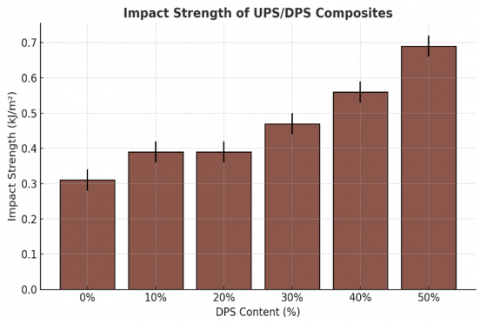
The impact strength of unsaturated polyester (UPS) and its composites reinforced with date palm seed (DPS) particles was assessed to evaluate the material’s resistance to sudden or dynamic loading. As illustrated in Figure 13, the test results revealed a progressive enhancement in impact energy absorption with increasing DPS content, indicating a positive influence of natural filler inclusion on the material’s toughness.
Figure 13. Impact resistance of PS composites with different DPS contents
Pure UPS exhibited a relatively low impact strength of 0.31 kJ/m², consistent with the inherently brittle nature of thermosetting resins. Upon incorporating 10% DPS, the impact strength increased to 0.39 kJ/m², representing a significant relative improvement. Notably, the same value was recorded at 20% DPS, suggesting that initial improvements in toughness are retained with moderate filler content. Further increases in DPS loading to 30%, 40%, and 50% led to continued gains in impact strength, reaching 0.47, 0.56, and 0.69 kJ/m², respectively.
The observed enhancement in impact resistance can be attributed to several key mechanisms. First, the presence of DPS particles within the matrix serves as localized energy-dissipating sites, which may induce crack path deflection, microcrack formation, or crack pinning, thereby delaying catastrophic fracture [16]. Second, the interfacial regions between the DPS particles and the UPS matrix likely promote plastic deformation zones under impact, absorbing more energy than the brittle matrix alone [42]. Additionally, the DPS particles may act as micro-barriers to crack propagation, enhancing the material's ability to withstand dynamic loads [30].
Interestingly, the rate of increase in impact strength appears more pronounced beyond 30% DPS content. This suggests a threshold beyond which the particle concentration contributes substantially to energy dissipation mechanisms, potentially due to increased particle-particle interactions or a more tortuous crack path. However, it should be noted that excessive filler loading in polymer composites may also introduce porosity or interfacial debonding, which could ultimately limit the benefits at higher loadings. In the current case, however, no negative inflection in performance was observed up to 50% DPS.
In conclusion, the increasing trend in impact strength with higher DPS content demonstrates that date palm seed particles are effective toughening agents for UPS composites. These findings support the potential use of DPS-reinforced UPS systems in applications where resistance to sudden or impact loads is critical, such as in protective panels, casings, or automotive components. The combination of improved toughness with enhanced sustainability further adds to the appeal of such bio-composites for practical engineering use.
The fluctuations in the mechanical properties indicate the disparities in tensile, compressive, hardness, and impact testing, which can be understood in terms of the balance between the inherent characteristics of the DPS particles and their interfaces with the UPS matrix. DPS particles have a rich lignocellulosic structure which can be considered as a reinforcing phase and stress concentration zone depending on its dispersion and compatibility. Importantly, adhesion was demonstrated to be more of an issue at these loadings compared with the mechanical interlocking that was occurring as a result of the DPS’s innate rigidity and the partial stress transfer across the interface. However, upon increasing the filler content to more than 40%, the particle agglomerates interfere with the matrix and could not effectively transfer stress which has led to the observed low tensile and compressive strength.
Decrease in ductility as filler content is increased is due to restricted polymer chain mobility and the formation of microvoids around poorly bonded filler particles. A similar effect is observed under tensile loading where the filler particle-matrix interface is likely to fail and lead to debonding. On the other hand, compressive loading offers filler confinement and densification while ensuring that deformation characteristics such as strain at maximum stress remains relatively stable.
Moreover, as the content of DPS increases, the hardness and impact resistance of the composite is also elevated, suggesting that energy dissipation mechanisms like crack deflection, matrix microcracking, and interfacial debonding occurred, and this is evidence from SEM investigations. These mechanisms work in combination to help to prevent impact from spreading while also creating surface hardness against indentations. This is in agreement with FTIR spectra results, which add to the evidence for molecular rearrangement and stress induced bond distortion on the proposed hypothesis that both chemical and physical changes play a role in overall mechanical behaviour.
These observations in aggregate stress the importance of controlling filler content and interfacial adhesion for fully realizing the reinforcing benefits of DPS while maintaining adequate ductility and strength.
4.5 Correlation analysis of mechanical properties
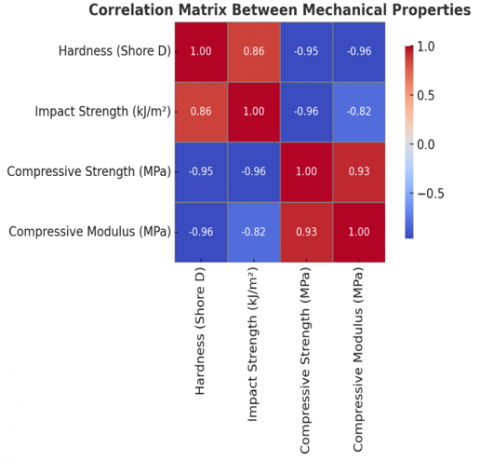
A correlation analysis was conducted to explore the interrelationships among key mechanical properties—namely Shore D hardness, impact strength, compressive strength, and compressive modulus—of unsaturated polyester (UPS) and its composites reinforced with varying volume percentages of date palm seed (DPS) particles as illustrated in Figure 14. The objective was to better understand the trade-offs and compatibilities between different performance metrics as a function of filler content, thereby guiding optimal material design.
The results revealed a strong positive correlation (r ≈ 0.96) between hardness and impact strength, indicating that as the surface resistance to indentation improves, the ability of the composite to absorb impact energy also increases. This observation suggests that the incorporation of DPS particles into the UPS matrix contributes not only to increased rigidity at the surface level but also to enhanced energy dissipation mechanisms under dynamic loading. The rigid nature of the DPS particles likely deflects and hinders crack propagation during impact events, while simultaneously increasing the composite's resistance to localized deformation.
Figure 14. Correlation matrix of mechanical properties of PS/ DPS composites
Conversely, a strong negative correlation (r ≈ −0.98) was observed between impact strength and compressive strength. This inverse relationship highlights a critical trade-off in the mechanical performance of the composites: as more DPS particles are added to improve toughness and impact resistance, the overall compressive strength tends to diminish. This reduction in strength is likely due to the decreasing continuity of the polymer matrix, the presence of stress concentration sites around the filler particles, and limited interfacial bonding, which collectively compromise the load-bearing capacity of the composite under compressive loading.
The relationship between compressive strength and compressive modulus was found to be moderately positive (r ≈ 0.83), indicating that composites with higher stiffness also tend to exhibit greater strength under compressive loads. However, this correlation was not as strong as might be expected, possibly due to inconsistencies in filler dispersion, filler-matrix adhesion, or the onset of premature microcracking in higher DPS-content composites.
Additionally, hardness exhibited a moderate negative correlation with compressive strength (r ≈ −0.80). This indicates that while the composites become harder with increasing DPS content, they do not necessarily become stronger in terms of compressive loading. This divergence can be attributed to the fact that hardness primarily reflects surface resistance to penetration, whereas compressive strength represents the bulk material's resistance to deformation and failure under sustained static loading. The discrepancy underscores the need to assess mechanical properties comprehensively rather than relying on a single parameter.
In summary, the correlation analysis confirms that the addition of DPS enhances impact strength and surface hardness at the expense of compressive strength and, to a lesser extent, compressive modulus. These trends are consistent with the mechanical behavior of many natural-fiber or particulate-filled polymer composites and underscore the importance of tailoring filler content based on the targeted application—whether it prioritizes toughness, rigidity, or load-bearing capacity.
4.6 FTIR analysis results
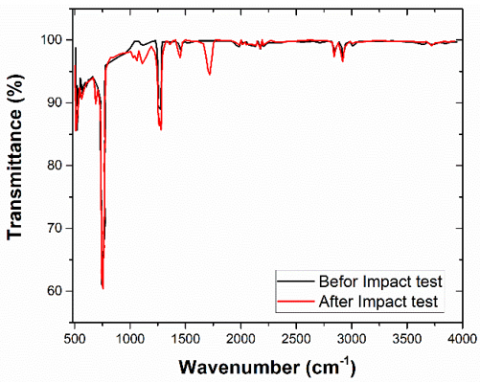
FTIR spectra of the UPS + 30% DPS composite were taken before and after the impact test to determine if changing in chemistry due to mechanical loading can be observed and recorded in a fixed location in the composite. FTIR spectroscopy is a powerful analytical tool for establishing alterations in vibrations of the molecular chains that could arise from the scission of the chain, a reorganization of the bonds, or a biochemical degradation of the matrix supporting structure under dynamic stress.
Figure 15. FTIR spectra of the UPS + 30% DPS composite before (black line) and after (red line) impact test
According to Figure 15, a comparative analysis of the spectra revealed that the overall peak positions associated with the functional groups of the composite remained largely preserved after the impact test. However, notable variations were observed in the intensity and shape of several absorption bands, indicating changes in molecular order and local chemical environments. These changes were particularly evident in the low wavenumber region (500-800 cm⁻¹), where bending vibrations of C-H and C-C skeletal modes are typically active. The decrease in transmittance intensities at these bands suggests increased molecular disorder and potential microstructural rearrangement due to mechanical deformation.
The region between 1000 and 1300 cm⁻¹, typically attributed to C-O stretching and C-H bending vibrations in esters and aliphatic groups, exhibited minor shifts and slight changes in peak intensities. Such spectral modifications may be indicative of localized stress-induced conformational changes in the polyester backbone. These changes, while not necessarily signifying new bond formation or degradation, reflect perturbations in dipole moment distributions, often caused by strain-induced stretching or twisting of molecular chains.
In the carbonyl region (~1700 cm⁻¹), where the characteristic C=O stretching vibration of the ester group in UPS is typically observed, there was a small but noticeable change in both peak shape and transmittance. This suggests that the impact test may have slightly affected the degree of crystallinity or altered the hydrogen bonding interactions within the polymer matrix, leading to a subtle redistribution of vibrational energy [43].
Higher wavenumber regions, particularly between 2800-3000 cm⁻¹ (C-H stretching) and 3200-3600 cm⁻¹ (O-H stretching, possibly from hydroxyl groups or absorbed moisture), showed slight intensity changes post-impact. These may be attributed to increased exposure of internal polymer surfaces or disruption of previously buried functionalities, again reflecting structural relaxation or chain rearrangement resulting from the applied impact force [44].
In conclusion, while the FTIR spectra of UPS + 30% DPS before and after the impact test do not exhibit major new peaks or complete disappearance of existing bands—suggesting no significant chemical decomposition [45]—the variations in intensity and subtle shifts in key regions provide strong evidence of structural modifications at the molecular level. These changes are likely the result of mechanical energy absorption during impact, leading to localized chain stretching, reorientation, or physical breakdown of weaker interfacial regions between the matrix and the natural filler particles. Such findings support the utility of FTIR in monitoring microstructural integrity and stress-induced molecular changes in polymer-based composites subjected to dynamic mechanical testing.
4.7 SEM morphological results
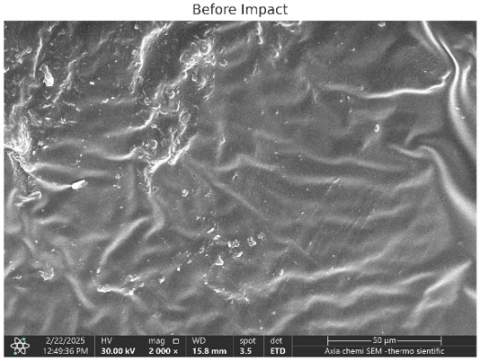
The microstructure and damage characteristics of the UPS + 30% DPS composite before and after the impact test are revealed through the SEM micrographs shown in Figure 16(a) and (b). From the pre-impact surface morphology in Figure 16(a), it can be observed that the DPS particles are uniformly distributed in the UPS matrix without cracks and large interfacial flaws. The matrix is smooth and continuous, and the boundaries between the particles and the matrix are clearly defined, suggesting that the particles were well connected or embedded [44].
(a) Surface morphology of UPS + 30% DPS composite before impact test
(b) Surface morphology of UPS + 30% DPS composite after impact test
Figure 16. SEM images of the UPS + 30% DPS composite (a) before and (b) after impact test
Compare this to Figure 16(b), which was taken after the impact test and reveals quite different morphological transformations due to dynamic loading. Some of the observable damages are microcracking especially along stress concentration paths, matrix mutilation through energy dissipation and material failure, and particles-matrix interface debonding leading to formation of voids and pull-out cavities [43]. These features indicate that the energy generated from the impact was released through cracking of the matrix region and through debonding of the particle-matrix interface which are in good agreement with the higher impact toughness noted earlier.
In this case, the SEM observations corroborate the mechanical analysis in terms of how incorporation of DPS particles improves the energy absorption under impact and also illustrating the failure mechanisms that dictate the behavior of the composite under dynamic loads. The data obtained from the SEM and FTIR investigations give the comprehensive picture of structural and chemical modifications in the UPS + 30% DPS composite under the impact loading. The shift in peak positions and changes in transmittance intensities are observed in the FTIR spectra particularly in the regions corresponding to C=O stretching and O-H or C-H vibrations, supporting the case of morphological changes. SEM provides visual evidence of how and where that damage manifests. Collectively, these approaches confirm the mechanical-chemical behavior of the composite under impact and substantiate the presence of DPS in altering failure mechanisms.
The mechanical performance trends identified in this work corroborate with many previous studies on natural filler strengthened polymer composites. Abu-Jdayil et al. [13] observed that the thermal conductivity and the compressive strength increased when the concentration of DPS ranged from 0- 50%, which is in concordance with the results of the present work where the impact strength and the hardness enhanced with the increase in the concentration of DPS. In contrast, in this work, a significant decrease in tensile and compressive strength for samples containing 30% filler or more became apparent which may be attributed to filler aggregation and poor matrix connectivity evident from the SEM micrographs. The work of Meftah et al. [8] indicated that the tensile and flexural properties improved much with alkali-treated DPS than with untreated fillers hence implying that the performance deterioration at higher filler loadings may be eliminated with filler surface treatment. However, Hussein [9] established the best result on 20% DPS in polyester composites while the present study has revealed that the 30% DPS has better compromise between strength, ductility and toughness suggesting some variation due to difference in the size of particles (710 µm in the present case) and fabrication technique. Erzen et al. [29] observed that the content of DPS below 4 wt.% enhances the thermal insulation without the effect on microstructure, which is consistent with the current work where maximum mechanical property enhancement occurred at moderate level of filler loading. In this regard, the results of the current study align well with prior research work while highlighting the significance of the filler content and matrix-filler interface for enhancing the performance of multifunctional composites.
4.8 Limitations and future works
In this context, various limitations have been identified, which deliver potential for future research enhancement and development.
To ensure consistency in the study, only one particle size of the date palm seed (710 µm) was assessed. Nonetheless, there is evidence that particle size plays a critical role in the extent of the interfacial surface area, stress transfer, and filler dispersion, which are all factors that govern the mechanical properties of composites. Subsequent research will then examine the impact that different DPS particle sizes have on the composite.
Second, while the mechanical properties of the composites were characterized in detail, conventional thermal analysis methods such as thermogravimetric analysis (TGA) and dynamic mechanical analysis (DMA) were omitted. These methods are used in evaluating the thermal stability, viscoelastic properties, and service temperature of various types of materials. Integration of TGA and DMA will generate additional information on the thermal behavior of the composites with respect to temperature and loading frequencies.
Moreover, this study did not examine the effects of environmental temperatures with regard to moisture absorption behavior characteristics, aging resistance and mechanical properties. These aspects are essential for certain applications where corrosion resistance and operating environment come into consideration. Further studies should focus on the kinetics of water uptake, the hygrothermal stability and the durability under thermal cycling conditions.
Furthermore, there was no alteration in the interfacial interaction between DPS and the polyester matrix through surface treatment. Application of surface treatments, including alkali, silane or enzymatic treatments can enhance the bonding, and reduce the likelihood of debonding under stress situations. The accomplishment of such treatments will be critical for assessing interfacial performance.
It is also important to note that this work used a manual molding process rather than an industrial technique. More sophisticated methods, for example, compression molding or vacuum-assisted resin infusion, may result in improved filler dispersion and mechanical homogeneity. It is therefore informative to explore the optimization of the above-mentioned techniques and parameters.
In addition, fatigue characteristics, fire resistance, and load cycling performance were not tested but are important for structural and safety related applications. Some of these areas are going to be investigated in future studies to determine the performance of such composites in high stressed, fire exposed, or dynamic structure conditions.
Lastly, as all tests in this study were conducted in triplicates and only average values are reported, replicating the experiments with a large number of samples and under highly controlled conditions may enhance the validity of the results.
In the present study, an attempt was made to examine mechanical, morphological, and chemical properties of unsaturated polyester (UPS) composites reinforced with date palm seed (DPS) particles with volume fractions of 10-50%. The integration of DPS had a profound impact on the mechanical properties of the composite materials.
Mechanical properties of the composites revealed a decreasing trend of tensile strength of the composites with increasing DPS content with values of 43.95 MPa for neat UPS and 30.00 MPa at 40% DPS. On the other hand, the tensile modulus of the composites was found to have risen from 22.65 MPa for 0% DPS to 33.54 MPa at 40% DPS, which showed that the formula matrix stiffness was enhanced by the presence of rigid filler particles. Strain at break also decreased, from 2.91% (neat UPS) to 1.39% at 40% DPS, confirming reduced ductility with higher filler content.
In compression, the neat UPS exhibited a compressive strength of 78.93 MPa and a Young’s modulus of 11.39 MPa. These values reduced to 54.92 MPa and 6.33 MPa, respectively at 40% DPS, due to the compromised matrix and interfacial conditions at higher filler contents. Toughness in compression fell from 1319 MPa·% (0% DPS) to 923 MPa·% (40% DPS) indicating a decrease in energy intake.
The surface hardness increased with DPS content and was observed to rise from 79.4 for neat UPS to 85.2 at 50% DPS. As expected, impact strength increased from 0.31 kJ/m² (0% DPS) to 0.69 kJ/m² at 50% DPS suggesting efficient energy absorption and crack deflection by DPS particles.
FTIR results showed the presence of various essential functional groups in both the UPS and DPS phases of samples, although the characterizations of the samples after impact testing revealed differences in peak positions and intensity, indicating stress-induced conformational changes. SEM micrographs also showed desirable dispersion of filler particles for the 30% DPS before the impact test and pull out of filler particle and micro crack in the epoxy matrix after the impact test which explained the observed better impact characteristics.
In conclusion, the addition of DPS into UPS matrices improves the stiffness, impact strength, and hardness of the resulting nanocomposite, but results in decreased tensile strength and elongation at higher loading levels. The maximum performance efficiency was found to be between 20 - 30% DPS, thus ensuring sufficient reinforcement without compromising matrix cohesion. These findings affirm the viability of DPS as a cost-effective and environmentally friendly material for UPS composites in semistructural, impact, or surface-driven applications. Further studies should incorporate thermal and fatigue analysis, particle size variation, and interfacial surface to further develop composite for industrial applications.
[1] Rashad, B., Bdaiwi, W. (2024). Exploring the role of rubber granules in modifying epoxy composites: A multi-scale approach using mechanical, thermal, and FTIR techniques. Matéria (Rio de Janeiro), 29(4): e20240702. https://doi.org/10.1590/1517-7076-RMAT-2024-0702
[2] Awad, S.K., Bdaiwi, W. (2024). Enhancing mechanical performance of PMMA resin through cinnamon particle reinforcement. Revue des Composites et des Matériaux Avancés-Journal of Composite and Advanced Materials, 34(3): 379-384. https://doi.org/10.18280/rcma.340313
[3] Hameed, S.N., Salih, W.B. (2023). Enhancing mechanical and thermal properties of unsaturated polyester resin with luffa fiber reinforcements: A volumetric analysis. Revue des Composites et des Matériaux Avancés-Journal of Composite and Advanced Materials, 33(6): 357-362. https://doi.org/10.18280/rcma.330602
[4] Ibraheem, E.K., Bdaiwi, W. (2024). Enhancing mechanical and thermal properties of unsaturated polyester composites through Sidr leaves' particle reinforcement. Revue des Composites et des Matériaux Avancés-Journal of Composite and Advanced Materials, 34(3): 269-275. https://doi.org/10.18280/rcma.340301
[5] Rashad, B.J., Bdaiwi, W. (2024). Study of mechanical, physical, and thermal properties of polyester-polyethylene composite materials reinforced with rubber granules. Annales de Chimie - Science des Matériaux, 48(6): 767-784. https://doi.org/10.18280/acsm.480603
[6] Chelali, H., Meghezzi, A., Berkouk, A., Soltani, M., Winning, G. (2021). Mechanical, curing parameters and water absorption of hybrid date palm leaf-orange peel fibers reinforced unsaturated polyester composites. Revue des Composites et des Matériaux Avancés-Journal of Composite and Advanced Materials, 31(3): 263-270. https://doi.org/10.18280/rcma.310304
[7] Berkouk, A., Meghezzi, A., Chelali, H., Soltani, M. (2021). Mechanical, morphological, thermal and dynamic study of composites of unsaturated polyesters-date palm leaf fiber (DPLF). Revue des Composites et des Matériaux Avancés-Journal of Composite and Advanced Materials, 31(6): 453-460. https://doi.org/10.18280/rcma.310602
[8] Meftah, Y., Tayefi, M., Fellouh, F., Chouieur, H., Maou, S., Meghezzi, A. (2020). Influence of alkali treatment and dune sand content on the properties of date palm fiber reinforced unsaturated polyester hybrid composites. Revue des Composites et des Matériaux Avancés-Journal of Composite and Advanced Materials, 30(3-4): 161-167. https://doi.org/10.18280/rcma.303-406
[9] Hussein, S.M. (2020). A Study of some mechanical and physical properties for palm fiber/polyester composite. Engineering and Technology Journal, 38(3B): 104-114. https://doi.org/10.30684/ETJ.V38I3B.598
[10] Nagaraj, N., Balasubramaniam, S., Venkataraman, V., Manickam, R., Nagarajan, R., Oluwarotimi, I.S. (2020). Effect of cellulosic filler loading on mechanical and thermal properties of date palm seed/vinyl ester composites. International Journal of Biological Macromolecules, 147: 53-66. https://doi.org/10.1016/j.ijbiomac.2019.11.247
[11] Habila, T., Meftah, Y., Maou, S. (2023). Thermal and physical properties of hybrid composites made from used PET bottles and date palm fibers filled with unsaturated polyester. ASEAN Journal of Chemical Engineering, 23(1): 94-102. https://doi.org/10.22146/ajche.82419
[12] Syed, T., Thelakkadan, A.S., Al-Hussain, S. (2020). Date-palm fiber as a reinforcement filler in polymer composites. Advances in Sciences and Engineering, 12(2): 78-85. https://doi.org/10.32732/ase.2020.12.2.78
[13] Abu-Jdayil, B., Mourad, A.H.I., Hussain, A., Al Abdallah, H. (2022). Thermal insulation and mechanical characteristics of polyester filled with date seed wastes. Construction and Building Materials, 315: 125805. https://doi.org/10.1016/j.conbuildmat.2021.125805
[14] Dahad, H.A., Hasan, S.F., Alwan, A.H. (2018). Study the effect of different percentages of natural (orange peels and date seeds) and industrial materials (carbon and silica) on the mechanical and thermal properties of polymeric reinforced composites. Al-Khwarizmi Engineering Journal, 14(4): 16-23. https://doi.org/10.22153/KEJ.2018.04.001
[15] Ghazi, I., Jaddan, R. (2021). Thermal conductivity characterization of epoxy-based composites reinforced with date palm waste particles. Journal of Physics: Conference Series, 1973(1): 012144. https://doi.org/10.1088/1742-6596/1973/1/012144
[16] Dhanabalan, D., Rathanasamy, R., Vediappan, V., Raghuraj, N., Kathiresan, P., Jeyakumar, T., Muthaiya, P. (2024). Experimental Investigation of date seed and neem powder reinforced natural fiber composites. Materials Science, 30(3): 334-339. https://doi.org/10.5755/j02.ms.34033
[17] Elkhouly, H.I., Abdel-Magied, R.K., Aly, M.F. (2019). Date palm seed as suitable filler material in glass–epoxy composites. Iranian Polymer Journal, 28: 65-73. https://doi.org/10.1007/s13726-018-0678-6
[18] Ibrahim, M.S., Sapuan, S.M., Faieza, A.A. (2012). Mechanical and thermal properties of composites from unsaturated polyester filled with oil palm ash. Journal of Mechanical Engineering and Sciences, 2: 133-147. https://doi.org/10.15282/JMES.2.2012.1.0012
[19] Vengatesh, M.P., Stalin, B., Nagaprasad, N., Sethu, S., Krishnaraj, R., Raj, V.H., Somaiah, A., Gupta, M. (2024). Performance analysis of dates and acacia hybrid filler reinforced natural polymer composite. Innovation and Emerging Technologies, 1: 2440008. https://doi.org/10.1142/s2737599424400085
[20] Augustia, V.A., Chafidz, A., Setyaningsih, L., Rizal, M., Kaavessina, M., Al Zahrani, S.M. (2018). Effect of date palm fiber loadings on the mechanical properties of high density polyethylene/date palm fiber composites. Key Engineering Materials, 773: 94-99. https://doi.org/10.4028/www.scientific.net/KEM.773.94
[21] Raghavendra, S., Sivaram, N.M., Sadik, T., Prabhakara, S.S. (2018). Mechanical properties of hybrid composites with date palm fibre reinforcement. Applied Medical Informatics, 7(3): 78-81. https://doi.org/10.11648/J.AM.20180703.14
[22] Ibrahem, R.A. (2015). Effect of date palm seeds on the tribological behaviour of polyester composites under different testing conditions. Journal of Material Sciences & Engineering, 4(6): 1000206. https://doi.org/10.4172/2169-0022.1000206
[23] Appu, S.P., Ashwaq, O., Al-Harthi, M., Umar, Y. (2019). Fabrication and characterization of composites from recycled polyethylene and date palm seed powder. Journal of Thermoplastic Composite Materials, 34(3): 316-327. https://doi.org/10.1177/0892705719843960
[24] Alshabanat, M. (2019). Preparation of linear low-density polyethylene/treated date palm leaflet green composites and investigation of their thermal and mechanical properties. Oriental Journal of Chemistry, 35(1): 200-206. https://doi.org/10.13005/OJC/350123
[25] Rafeeq, S.N., Abdulmajeed, I.M., Saeed, A.R. (2011). Mechanical and thermal properties of date palm fiber and coconut shell particulate filler reinforced epoxy composite. Indian Journal of Applied Research, 3(4): 89-92. https://doi.org/10.15373/2249555X/APR2013/153
[26] Hasan, A.M. (2016). Investigation on thermal and acoustic properties of hybrid polymer composite reinforced by date palm fibers and rice husks as a construction material. Nahrain University College of Engineering Journal, 19(1): 56-65.
[27] Maou, S., Meftah, Y., Bouchamia, I., Benyaghla, A. (2023). Alkali-treated date palm fiber-reinforced unsaturated polyester composites: Thermo-mechanical performances and structural applications. Iranian Polymer Journal, 32(12): 1581-1593. https://doi.org/10.1007/s13726-023-01224-2
[28] Alahmad, F.A., El Maaddawy, T., Abu-Jdayil, B. (2025). Performance evaluation of date-pit-reinforced unsaturated-polyester-dune-sand mortars. Construction and Building Materials, 462: 139965. https://doi.org/10.1016/j.conbuildmat.2025.139965
[29] Erzen, B., Karataş, M., Deniz, Ş., Aydoğmuş, E. (2024). Production of Date seed reinforced polyester composite and characterization of its thermophysical properties. International Journal of Advanced Natural Sciences and Engineering Researches, 8(2): 552-558.
[30] Kolawole, S.A., Abdullahi, D., Dauda, B.M., Ishiaku, U.S. (2015). Physico-mechanical properties of dates palm (Phoenix dactylifera) pits reinforced unsaturated polyester composites. International Journal of Science and Research, 4(10): 1412-1418.
[31] Peters, S.T. (2013). Handbook of Composites (2nd ed.). Springer.
[32] ASTM D638-22. (2022). Standard test method for tensile properties of plastics. https://store.astm.org/d0638-22.html.
[33] ASTM D695-15. (2015). Standard test method for compressive properties of rigid plastics. https://www.astm.org/d0695-15.html.
[34] ASTM D6110-18. (2018). Standard test method for determining the Charpy impact resistance of notched specimens of plastics. https://www.astm.org/d6110-18.html.
[35] ASTM D2240-15(2021). (2021). Standard test method for rubber property—Durometer hardness. https://www.astm.org/d2240-15r21.html.
[36] Mittal, V., Luckachan, G.E., Chernev, B., Matsko, N.B. (2015). Bio-polyester-date seed powder composites: Morphology and component migration. Polymer Engineering & Science, 55(4): 877-888. https://doi.org/10.1002/pen.23955
[37] Abdullahi, D., Okezie, Q., Mohammed, A.B. (2014). Preparation and properties of date seed/natural rubber composites. International Journal of Emerging Technology and Advanced Engineering, 4(9): 152-156.
[38] Abdal-Hay, A., Jung, D.Y., Lee, K.I., Abdel-Jaber, G.T., Lim, J.K. (2012). Study on water absorption and impact properties of vegetal composites material: Composite structures. Advanced Materials Research, 530: 34-39. https://doi.org/10.4028/www.scientific.net/AMR.530.34
[39] Mlhem, A., Teklebrhan, T., Bokuretsion, E., Abu-Jdayil, B. (2024). Development of sustainable thermal insulation based on bio-polyester filled with date pits. Journal of Bioresources and Bioproducts, 9(1): 74-89. https://doi.org/10.1016/j.jobab.2023.12.004
[40] Abdalla, A., Suardana, N.P.G., Yoon, H.C., Cui, J., et al. (2011). Novel biodegradable natural plant material reinforced thermosetting polymer composites/polyester. The Korean Society of Mechanical Engineers, pp. 369-377.
[41] Kumar, S.S., Babu, B.S. (2021). Determination of mechanical attributes of natural fibers reinforced polyester bio composites. Materials Today: Proceedings, 46: 767-771. https://doi.org/10.1016/J.MATPR.2020.12.555
[42] Abdulsada, S.A., Al-Mosawi, A.I., Hashim, A.A. (2018). Date waste as environmentally friendly composites. Journal of Materials & Metallurgical Engineering, 8(1): 25-30.
[43] Surya, E., Michael, M., Halimatuddahliana, H., Maulida, M. (2014). Impact and thermal properties of unsaturated polyester (UPR) composites filled with empty fruit bunch palm oil (EFBPO) and cellulose. Advanced Materials Research, 896: 310-313. https://doi.org/10.4028/www.scientific.net/AMR.896.310
[44] Nasution, H., Kosasih, K., Al Fath, M.T. (2020). Properties of unsaturated polyester composite filled with cellulose from peanut shell (Arachis hypogea I.): The effect of filler content and compatibilizer addition. IOP Conference Series: Materials Science and Engineering, 801(1): 012083. https://doi.org/10.1088/1757-899X/801/1/012083
[45] Hutagalung, C.O., Maulida. (2014). Karakteristik fourier transform infra red dan kekuatan bentur komposit poliester tak jenuh berpengisi abu sekam padi putih. Jurnal Teknik Kimia, 3(1): 23-26. https://doi.org/10.32734/JTK.V3I1.1497