Hwazen Salam Fadhil* | Jawad Kadhim Oleiwi | Qahtan Adnan Hamad
© 2025 The authors. This article is published by IIETA and is licensed under the CC BY 4.0 license (http://creativecommons.org/licenses/by/4.0/).
OPEN ACCESS
Compared with human cortical bone, traditional metals such as titanium used for bone plate fixation may cause stress shielding. Therefore, the utilization of bio-based (biopolymer) composites has recently increased in popularity due to the fact that these polymers reduce the stress shielding effect and do not release harmful substances. This paper aims to fabricate a high-strength biocompatible bio-composite material and proposes its use for bone plate fixation, particularly for the femur bone. For making these bio-composite bone plates, bio-epoxy is used as a matrix reinforced with pumpkin particles at a fixed fraction (2%) and different layers of flax or Ultra High Molecular Weight Polyethylene (UHMWPE) fibers, in addition to carbon and glass fiber reinforcements as a hybrid lamination composite. The material is produced by the hand lay-up molding method. We measured the percentages of elongation, tensile modulus, and tensile strength, and using SEM, the morphological behavior of fractured tensile samples was examined. The findings of this study illustrated that the type and number of reinforcing layers significantly altered mechanical properties. Hence, the findings indicated that the bio-composite consisting of 4 layers of UHMWPE fiber and 2 layers of carbon fiber was the best laminated composite specimen, where tensile strength and modulus of elasticity reached 134 MPa and 4.7 GPa, respectively. The experimental test results demonstrated that orthopedic bone fracture plates can be made using this hybrid bio-composite.
bio-composite, bone plate, laminate, morphological, SEM, tensile test
Materials used in structural and other applications have evolved significantly throughout the recent decades [1-6]. In recent years, natural and hybrid composite materials have gained attention for mechanical and industrial uses in addition to medical applications of bone plate fixation [7, 8]. The integration of natural fibers with synthetic reinforcements in polymer matrices has led to the development of bio-composites that offer desirable mechanical properties and improved biocompatibility. In the context of orthopedic applications, bio composites provide an advantage by reducing stress shielding which enhances bioactivity, and mimics the mechanical behavior of natural bone more closely than traditional metallic implants [9, 10]. However, challenges remain in achieving consistent interfacial bonding that optimize fiber-matrix compatibility, and ensure long-term stability in physiological environments.
Long bone fractures can be effectively treated with internal fixation utilizing plates and screws. Metals like titanium and its alloys, cobalt-chromium alloys, and stainless steel are the primary materials used in bone plates. Nevertheless, stress shielding caused by the use of metal plates with a high elastic modulus for rigid fixation can result in refractures, bone atrophy, and osteopenia, particularly beneath the plates. Furthermore, biomaterials must exhibit superior bio functionality and biocompatibility; metal plates are not bioactive and are not the ideal materials for internal fixation. Thus, a variety of biomaterials, particularly polymers, have been studied for use as bone plates [11, 12]. The goal of this study was to develop a new bio composite bone plate with suitable biomechanical strength and high bioactivity. Bio-epoxy, known for its excellent mechanical and tribological properties, high chemical resistance, and biocompatibility, is widely used in medical applications. To enhance its tribological response and mechanical behavior, fillers or reinforcements are added to the polymer. Research has focused on developing polymer-based composite materials using both synthetic and natural reinforcements for bone implants-composites with elastic moduli close to that of cortical bone and slightly higher strength-as promising candidates for long bone fracture treatment.
Recently, Kim et al. investigated the effectiveness of flexible composite bone plates made of carbon fiber/epoxy and glass fiber/polypropylene applied to tibial bones with diaphyseal oblique fractures [13]. Bagheri et al. [14] fabricated CF/flax/epoxy composite plates for bone fracture fixation and found that the carbon fiber/flax fiber/epoxy composite demonstrated comparable cell survival to medical-grade stainless steel, with no adverse effects on gene expression involved in bone formation. Manteghi et al. [15] proposed flax fiber/glass fiber/epoxy sandwich hybrid composites for bone fracture fixation plates. Soundhar and Jayakrishna [16] demonstrated that the inclusion of chitosan particles into epoxy improved its mechanical properties for bone fracture applications. Zhao et al. [17] developed a nano-hydroxyapatite/polyamide 66/glass fiber composite, and histological studies confirmed that new bone formed at the n-HA/PA66/GF interface, integrating with native tissue. The composite plate also maintained radiographic transparency and fracture stability without breaking. Sarwar et al. [18] created a novel Kevlar/flax/epoxy hybrid sandwich composite for bone plate use. Their results showed significant improvement in torsion, tension, and compression strength, as well as reduced moisture absorption due to Kevlar hybridization. Compared to human cortical bone (tensile strength: 107–146 MPa; modulus: 11.4–19.1 GPa), the KFE hybrid composites demonstrated superior tensile strength (201.5–335.7 MPa) and modulus (15.3–30.5 GPa), indicating their ability to withstand greater loads and reduce stress shielding effects. Kabiri et al. [19] fabricated glass fiber/polypropylene composites reinforced with three fiber types and evaluated the influence of fiber type, orientation, and volume fraction on the tensile, flexural, compression, shear, and impact properties of the resulting fixation plates.
Liquid bio-epoxy resins with an equivalent weight of 182–192 g/eq and a density of 1.16 g/cm³ (supplied by Dow Chemical Company, China) were used as matrix materials. Pumpkin powder (with an average particle size of 1.5 µm), woven flax, UHMWPE, carbon, and glass fibers were used as reinforcement materials in this research for the fabrication of bone plate fixation samples. A mold made of glass with dimensions of 25 cm × 25 cm × 0.4 cm was prepared. The mold required a flat and smooth surface to obtain straight laminates. The inner surface of the mold was covered with a layer of nylon thermal paper instead of Vaseline to prevent adhesion of the resin to the mold. A digital precision weighing device was used to measure the required amounts of resin, hardener, and pumpkin powder based on the specified weight fractions. All woven fibers used in this study were cut to 25 × 25 cm using special fiber-cutting scissors, with dimensions measured using a digital Vernier caliper.
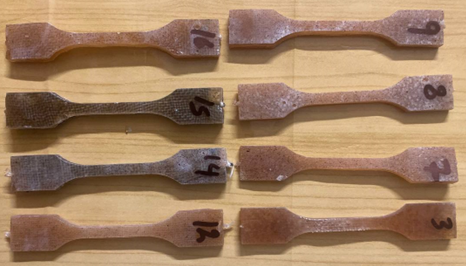
The hand lay-up technique was used to produce the laminated composite material. The matrix resin was first mixed with the prepared pumpkin powder at a weight fraction of 2%, and stirred thoroughly before adding the hardener to avoid agglomeration. The hardener was then added at a mixing ratio of 100:43 (resin:hardener). A thin layer of the blend was poured gradually into the mold and manually distributed over its entire surface. Then, the first fiber layer was added, followed by pouring and manually spreading the matrix again. This process was repeated—layer by layer—until the required number of fiber layers was achieved, as shown in Figure 1. The final composite specimens are shown in Figure 2. Each laminate was left to cure for 48 hours. After curing, the laminates were cut into standard specimen sizes using a water jet machine for precision. Table 1 lists the prepared laminated composite materials, with the standard specimen consisting of bio-epoxy reinforced with 2 wt% pumpkin powder.
Figure 1. Fabrication process of bio-composite materials for bone plate fixation
Figure 2. Bio composites specimen for tensile test
Table 1. Descriptions of the fabricated composite laminates
|
No. of Laminations |
Total No. of Layers |
Layers' Symbol |
Lamination Layup Procedures |
|
laminate (1) |
Bio epoxy + pumpkin powder + flax fibres |
2%P+1 Flax (1F) |
- |
|
laminate (2) |
2%P+2 Flax (2F) |
- |
|
|
laminate (3) |
2%P+3 Flax (3F) |
- |
|
|
laminate (4) |
2%P+4 Flax (4F) |
- |
|
|
laminate (5) |
Bio epoxy + pumpkin powder+ flax fibers+ carbon fiber |
2%P+4 flax (4F) +1 Carbon(1C) |
2F+ 1C+ 2F |
|
laminate (6) |
2%P+4 flax (4F) +2 Carbon(2C) |
2F+ 2C+ 2F |
|
|
laminate (7) |
Bio epoxy + pumpkin powder + flax fibers+ glass fiber |
2%P+4 flax (4F) +1 Glass(1G) |
2F+ 1G+ 2F |
|
laminate (8) |
2%P+4 flax (4F) +2 Glass(2G) |
2F+ 2G+ 2F |
|
|
laminate (9) |
Bio epoxy + pumpkin powder+ UHMWPE fibers |
2%P+1 UHMWPE (1U) |
- |
|
laminate (10) |
2%P+2 UHMWPE (2U) |
- |
|
|
laminate (11) |
2%P+3 UHMWPE (3U) |
- |
|
|
laminate (12) |
2%P+4 UHMWPE (4U) |
- |
|
|
laminate (13) |
Bio epoxy + pumpkin powder+ UHMWPE fibers+ carbon fiber |
2%P+4 UHMWPE (4U) + 1 Carbon(1C) |
2U+1C+2U |
|
laminate (14) |
2%P+4 UHMWPE (4U) + Carbon(2C) |
2U+2C+2U |
|
|
laminate (15) |
Bio epoxy + pumpkin powder+ UHMWPE fibers+ glass fiber |
2%P+4 UHMWPE (4U) + 1 Glass(1G) |
2U+1G+2U |
|
laminate (16) |
2%P+4 UHMWPE (4U) + 2 Glass(2G) |
2U+2G+2U |
Table 2. Preparation parameters and material composition for the bio-composite laminates
|
Component |
Description / Specification |
Quantity / Ratio |
|
Bio-epoxy resin |
Liquid resin (Dow Chemical, China) |
100 parts by weight |
|
Hardener |
Based on supplier recommendation |
43 parts by weight (mixing ratio 100:43) |
|
Pumpkin powder |
Natural filler, avg. particle size = 1.5 µm |
2 wt.% relative to epoxy |
|
Flax fiber (woven) |
Natural fiber reinforcement |
1 to 4 layers (per laminate type) |
|
UHMWPE fiber |
Synthetic fiber reinforcement |
1 to 4 layers (per laminate type) |
|
Carbon fiber |
Hybrid reinforcement |
1 or 2 layers (in combination with base fibers) |
|
Glass fiber |
Hybrid reinforcement |
1 or 2 layers (in combination with base fibers) |
|
Molding method |
Hand lay-up technique |
Manual layering with gradual resin pouring |
|
Mold dimensions |
Flat glass mold with nylon-coated inner surface |
25 cm × 25 cm × 0.4 cm |
|
Curing conditions |
Ambient temperature curing |
48 hours at ~25 ℃ ± 2 ℃ |
Table 3. Physicochemical properties of bio-epoxy and pumpkin powder
|
Property |
Bio-Epoxy Resin |
Pumpkin Powder Filler |
|
Density (g/cm³) |
1.16 |
~0.95–1.00 |
|
Equivalent weight (g/eq) |
182–192 |
– |
|
Viscosity at 25 ℃ (Pa·s) |
~12–14 |
– |
|
Thermal stability |
High (up to 180–200 ℃) |
Decomposes above 150 ℃ |
|
Functional groups |
Epoxy (–CH–CH₂–O–), reactive with amines |
Cellulose, hemicellulose, lignin |
|
Particle size (µm) |
– |
1.5 µm (measured) |
|
Moisture absorption tendency |
Low |
Moderate to high (hydrophilic) |
|
Color/appearance |
Clear to pale yellow liquid |
Light brown fine powder |
Table 2 summarizes the detailed preparation parameters, material compositions, and ratios used during the fabrication of each laminate to support reproducibility. Furthermore, Table 3 presents the physicochemical properties of the base matrix and natural filler used in this study, which are critical to understanding composite behavior.
2.1 Mechanical properties of bio-composite bone plate
To determine the modulus of elasticity (E), ultimate tensile strength (UTS), and elongation (%), a tensile test was conducted. The test followed the ASTM D638-03 standard and was carried out using a universal tensile testing machine (LARYEE) with a load capacity of 50 kN. A strain rate of 5 mm/min was applied, and the load was increased gradually until the specimen fractured. Each reported tensile property represents the average value obtained from five specimens, and corresponding stress-strain curves were recorded. The tests were conducted at a controlled temperature of 25±2℃ (room temperature) [20, 21].
The laboratory environment maintained a relative humidity of 50±5%. All tensile tests were repeated on five identical specimens for each laminate type to verify repeatability. No external pressure control was applied during curing, as the hand lay-up technique relies on ambient atmospheric pressure.
2.2 Scanning Electron Microscopy (SEM)
A scanning electron microscope (SEM) model Inspect S50, manufactured by FEI (Netherlands), was used to investigate the surface morphology of fractured composite laminates. Prior to SEM analysis, the laminated composites were coated with gold under high vacuum conditions using a sputtering device for ten minutes. The SEM test was performed on nine samples, including:
3.1 Tensile properties
Figures 3 and 4 illustrate the UTS of biocomposites and hybrid biocomposites. The figures show that tensile strength increases as the number of reinforcement fiber layers increases within the bio-epoxy matrix. This improvement is attributed to the fiber-matrix bonding nature and the increased load-bearing capacity provided by the fibers, which allow for more efficient load transfer from the matrix to the fibers [22].
Figure 3. Tensile strength of flax-based and hybrid laminate composites with varying reinforcement layers
Figure 4. Tensile strength of UHMWPE-based and hybrid laminate composites with varying reinforcement layers
Furthermore, it is evident that the tensile strength is more significantly enhanced by hybrid reinforcement using carbon and glass fibers, compared to using flax or UHMWPE fibers alone. Laminates that combine synthetic reinforcements demonstrated higher tensile strength values than those reinforced solely with natural or synthetic fibers. Among them, carbon fiber-reinforced composites yielded better results than those reinforced with glass fibers. This is due to the superior mechanical properties of carbon fibers which include higher stiffness and strength compared to flax and UHMWPE fibers [23, 24].
Figures also demonstrate that as the number of layers increases, the tensile strength of UHMWPE-based hybrid laminates exceeds that of flax-based ones. This difference is due to the inherently higher tensile strength of UHMWPE fibers, which enables them to better withstand the majority of the external stress applied to the composite specimens [25, 26]. Among all the tested groups, the UHMWPE-based hybrid biocomposite exhibited the highest tensile strength, reaching 134 MPa for the (2%P + 4UHMWPE + 2CF) laminate. In contrast, the control specimen (bio-epoxy with 2% pumpkin powder only) had a tensile strength of 41 MPa.
Figures 5 and 6 demonstrate the tensile modulus values of the laminated composite materials for each specimen group produced in this study. The figures show that the modulus of elasticity increases as the number of reinforcement fibre layers—either flax or UHMWPE—increases. This can be attributed to the enhanced bonding strength and reinforcement effect, which provide a strong interface between the matrix and the reinforcing elements, thereby improving the efficiency of force transfer from the matrix to the fibers. These findings are consistent with previous research [27, 28].
Figure 5. Tensile modulus of flax-based and hybrid laminate composites with varying reinforcement layers
Figure 6. Tensile modulus of UHMWPE-based and hybrid laminate composites with varying reinforcement layers
When woven carbon or glass fibers are added to the fiber layers, the tensile modulus of the composite specimens further improves, with carbon fiber reinforcement showing better performance than glass fiber reinforcement. This is because hybrid laminated composite specimens are able to withstand higher loads, as carbon and glass fibers possess a higher modulus of elasticity and greater resistance to crack propagation compared to the matrix [29].
Laminates reinforced with UHMWPE fibers exhibited higher modulus of elasticity values than those reinforced with flax fibers. This is due to the inherently higher Young’s modulus of UHMWPE, particularly in the regions of the specimen that are subjected to the majority of the externally applied stress [26]. Among all the laminates, the specimens reinforced with flax fibers displayed the lowest tensile modulus. Conversely, the laminated composite specimens with four layers of UHMWPE fibers and two layers of carbon fibers achieved the highest modulus of elasticity, reaching 4.7 GPa. In comparison, the control specimen had the lowest tensile modulus value of 2.01 GPa.
The elongation percentage values of the laminated composite materials for each specimen group investigated in this study are shown in Figures 7 and 8. It can be observed from the figures that as the number of reinforcement fiber layers—whether flax or UHMWPE—increases, the elongation percentage of the specimens decreases. This is because the laminated composite becomes mechanically constrained by the higher stiffness of the fibers compared to the matrix.
Figure 7. Elongation percentage of flax-based and hybrid laminate composites with varying reinforcement layers
Figure 8. Elongation percentage of UHMWPE-based and hybrid laminate composites with varying reinforcement layers
Additionally, natural fibers (flax) exhibit greater elongation at break than synthetic fibers (UHMWPE), which is considered an important characteristic in polymer engineering composites [30]. In hybrid laminates composed of UHMWPE or flax fibers combined with glass or carbon fibers, the elongation initially increases when the flax or UHMWPE fiber content remains constant at four layers.
Furthermore, it is observed that hybrid laminated composites made of flax or UHMWPE fibers combined with carbon fiber exhibit lower elongation values than those combined with glass fiber. This suggests that while carbon fiber is more rigid than glass fiber, it is also less ductile; in contrast, glass fiber provides higher elongation at break. Elongation percentage decreases as the composite becomes more brittle, which aligns with previous findings in the literature [31, 32].
3.2 Scanning Electron Microscopy (SEM) Results
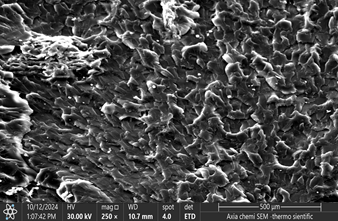
SEM was utilized to correlate the mechanical behavior of polymeric composite samples with the morphology of their fracture surfaces, focusing on different fiber types (flax, UHMWPE, glass, and carbon) and varying numbers of reinforcement layers. SEM micrographs were obtained from fractured surfaces of bio-composite samples subjected to tensile testing at 250× magnification, as shown in Figure 9.
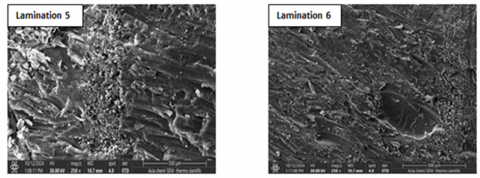
Figure 9(a) shows the fractured surface morphology of the standard specimen (bio-epoxy + 2 wt% pumpkin powder). The micrograph reveals a homogeneous morphology, where most of the pumpkin powder is well-integrated into the bio-epoxy matrix. The particles appear to be uniformly distributed within the polymer matrix, indicating a good combination between particles and matrix material, and suggesting superior interfacial adhesion [33, 34]. Figure 9(b) presents the fracture surface of a hybrid bio composite consisting of bio-epoxy, pumpkin powder, flax fibers, and carbon fibers. The SEM image indicates a heterogeneous fracture surface, where most flax and carbon fibers are embedded into the matrix. This suggests strong interfacial adhesion between the fibers and the matrix. The visibility of both flax and carbon fibers in the lamination (5), as marked by red arrows, supports this observation. The addition of carbon fibers improved the mechanical properties of the composite material [35, 36].
(a) Bio epoxy composite reinforced by 2% pumpkin powder
(b) Composite reinforced by 2% p + 4 layer flax fibers + 1&2 layers carbon fiber
(c) Composite reinforced by 2% p+ 4 layer flax fibers+1&2 layers glass fibers
(d) Composite reinforced by2% p+4 layer UHMWPE fibers+ 1&2 layers carbon fiber
(e) Composite reinforced by 2% p +4 layer UHMWPE fibers+ 1&2 layers glass fibers
Figure 9. SEM Image of fractured surface morphology of different bio composite laminations at magnifications (250×)
Figure 9(c) displays the fracture morphology of lamination (7), which appears brittle and discontinuous, showing fiber debonding and lower fiber/matrix adhesion. In contrast, the fracture surface of lamination (8) reveals a smoother, more continuous, and homogeneous interface between fiber and matrix. The fibers in this configuration are well embedded in the matrix, indicating enhanced interfacial adhesion between components [37, 38]. Figures 9(d) represent laminations (13 and 14), which correspond to hybrid composites reinforced with 4 layers of UHMWPE + 1 carbon fiber and 4 UHMWPE + 2 carbon fibers, respectively. These SEM micrographs show smoother fracture surface morphologies. Most of the carbon and UHMWPE fibers are embedded within the matrix, suggesting excellent interfacial bonding. These findings confirm that the addition of carbon fiber enhances the composite’s mechanical performance by strengthening the fiber-matrix interface [39, 40].
Figure 9(e) compares laminations (15) and (16). Lamination (15), reinforced with 4 UHMWPE + 1 glass fiber, exhibits a brittle fracture surface with signs of fiber debonding, indicating weak fiber/matrix adhesion. In contrast, lamination (16), reinforced with 4 UHMWPE + 2 glass fibers, reveals a smooth, continuous, and homogeneous surface with well-incorporated fibers. This morphology suggests that the glass fibers formed a strong bond with the bio-epoxy matrix. Overall, the fracture surface morphologies varied significantly depending on fiber type and layering. Each composite type displayed distinct surface features, and the fracture morphology consistently reflected the degree of interfacial bonding and mechanical behavior of the bio composites.
A comparative analysis of the mechanical properties across all composite specimens reveals significant variations depending on the type and configuration of fiber reinforcements. The control specimen (bio-epoxy + 2% pumpkin powder) exhibited the lowest tensile strength and modulus values, recorded at 41 MPa and 2.01 GPa, respectively. In contrast, the hybrid laminate reinforced with 4 layers of UHMWPE and 2 layers of carbon fiber achieved the highest tensile strength of 134 MPa and the highest modulus of elasticity at 4.7 GPa, indicating an improvement of over 226 percent in strength and 134% in stiffness compared to the control.
The UHMWPE-based hybrids consistently outperformed flax-based hybrids. For instance, the tensile modulus of UHMWPE + 2 CF laminates reached 4.7 GPa, while flax + 2 CF laminates reached 3.1 GPa. Similarly, elongation percentages showed an inverse relationship with stiffness. Flax-based laminates exhibited higher elongation, peaking at 6.5% in the 4F + 1GF configuration, while the most rigid carbon fiber-reinforced UHMWPE hybrid had a lower elongation of 3.1%, confirming that increased stiffness results in reduced ductility. The UHMWPE + 2 GF sample recorded a modulus of 4.1 GPa and a tensile strength of 121 MPa, while its elongation stood at 3.8% which is representing of a more balanced stiffness-ductility tradeoff compared to the carbon counterpart.
In conclusion, this study has demonstrated the mechanical viability of bio-based hybrid composites for use in bone plate fixation, particularly by utilizing a combination of natural and synthetic fibers with bio epoxy matrix and pumpkin powder. The following key findings were observed:
The authors would like to thank the University of Technology- Iraq for the use of their labs during this work.
[1] Al-Haddad, L.A., Jaber, A.A., Dhahir, M.K., Nagim, H.Y., Algburi, Z.I. (2024). Characterization and prediction of femtosecond laser induced tracks in silver-containing zinc phosphate glass. CEUR Workshop Proceedings, pp. 10-19.
[2] Samylingam, I. (2024). Nanomaterials for solar sustainability: Advancing green energy solutions. Terra Joule Journal, 1(1): 5.
[3] Al-Haddad, L.A., Kahachi, H.A., Ur Rehman, H.Z., Al-Zubaidi, A.A., Al-Karkhi, M.I., Al-Oubaidi, B. (2024). Advancing sustainability in buildings using an integrated aerodynamic façade: Potential of artificial intelligence. Terra Joule Journal, 1(1): 1.
[4] Abdul-Zahra, A.S., Ghane, E., Kamali, A., Farhan Ogaili, A.A. (2024). Power forecasting in continuous extrusion of pure titanium using naïve bayes algorithm. Terra Joule Journal, 1(1): 2.
[5] Al-Haddad, L.A., Jaber, A.A., Giernacki, W., Khan, Z.H., Ali, K.M., Tawafik, M.A., Humaidi, A.J. (2024). Quadcopter unmanned aerial vehicle structural design using an integrated approach of topology optimization and additive manufacturing. Designs, 8(3): 58. https://doi.org/10.3390/designs8030058
[6] Ogaili, A.A.F., Basem, A., Kadhim, M.S., Al-Sharify, Z.T., Jaber, A.A., Njim, E.K., Al-Ameen, E.S. (2024). The effect of chopped carbon fibers on the mechanical properties and fracture toughness of 3D-printed PLA parts: An experimental and simulation study. Journal of Composites Science, 8(7): 273. https://doi.org/10.3390/jcs8070273
[7] Dündar, M.A., Gunoz, A., Kepir, Y., Kara, M., Avcı, A., Arbağ, H. (2025). Comparative biomechanical analysis of titanium fixation plates and NiTi shape memory staples for mandibular fracture treatment using finite element method. Biomedical Signal Processing and Control, 103: 107501. https://doi.org/10.1016/j.bspc.2025.107501
[8] Hockmann, J.P., Heck, V., Theißen, N., Prescher, A., Leschinger, T., Müller, L.P., Hackl, M. (2025). Bone graft augmentation of comminuted radial neck fractures improves the initial stability of plate fixation. A biomechanical study. Journal of Shoulder and Elbow Surgery. https://doi.org/10.1016/j.jse.2025.01.032
[9] Calem, D., Weintraub, M., Vosbikian, M., Ahmed, I. (2025). Radiographic outcomes of dorsal spanning plate with and without volar plate fixation for comminuted intraarticular distal radius fractures. Journal of Clinical Orthopaedics & Trauma, 64: 102949. https://doi.org/10.1016/j.jcot.2025.102949
[10] Sondur, S., Bhat, A.K. (2025). Clinical and radiographic outcomes of gap osteotomy versus dorsal opening wedge osteotomy for extra-articular distal radius malunion and internal fixation using a volar locking plate without bone graft. Journal of Hand Surgery Global Online, 7(1): 14-22. https://doi.org/10.1016/j.jhsg.2024.09.001
[11] Li, J., Qin, L., Yang, K., Ma, Z., Wang, Y., Cheng, L., Zhao, D. (2020). Materials evolution of bone plates for internal fixation of bone fractures: A review. Journal of Materials Science & Technology, 36: 190-208. https://doi.org/10.1016/j.jmst.2019.07.024
[12] Qiao, B., Li, J., Zhu, Q., Guo, S., Qi, X., Li, W., Jiang, D. (2014). Bone plate composed of a ternary nano-hydroxyapatite/polyamide 66/glass fiber composite: Biomechanical properties and biocompatibility. International Journal of Nanomedicine, 9(1): 1423-1432. https://doi.org/10.2147/IJN.S57353
[13] Kim, H.J., Kim, S.H., Chang, S.H. (2011). Bio-mechanical analysis of a fractured tibia with composite bone plates according to the diaphyseal oblique fracture angle. Composites Part B: Engineering, 42(4): 666-674. https://doi.org/10.1016/j.compositesb.2011.02.009
[14] Bagheri, Z.S., Giles, E., El Sawi, I., Amleh, A., Schemitsch, E.H., Zdero, R., Bougherara, H. (2015). Osteogenesis and cytotoxicity of a new Carbon Fiber/Flax/Epoxy composite material for bone fracture plate applications. Materials Science and Engineering: C, 46: 435-442. https://doi.org/10.1016/j.msec.2014.10.042
[15] Manteghi, S., Mahboob, Z., Fawaz, Z., Bougherara, H. (2017). Investigation of the mechanical properties and failure modes of hybrid natural fiber composites for potential bone fracture fixation plates. Journal of the Mechanical Behavior of Biomedical Materials, 65: 306-316. https://doi.org/10.1016/j.jmbbm.2016.08.035
[16] Soundhar, A., Jayakrishna, K. (2019). Investigations on mechanical and morphological characterization of chitosan reinforced polymer nanocomposites. Materials Research Express, 6(7): 075301. https://doi.org/10.1088/2053-1591/ab1288
[17] Zhao, W., He, B., Zhou, A., Li, Y., Chen, X., Yang, Q., Jiang, D. (2019). D-RADA16-RGD-reinforced nano-hydroxyapatite/polyamide 66 ternary biomaterial for bone formation. Tissue Engineering and Regenerative Medicine, 16: 177-189. https://doi.org/10.1007/s13770-018-0171-5
[18] Sarwar, A., Mahboob, Z., Zdero, R., Bougherara, H. (2020). Mechanical characterization of a new Kevlar/Flax/epoxy hybrid composite in a sandwich structure. Polymer Testing, 90: 106680. https://doi.org/10.1016/j.polymertesting.2020.106680
[19] Kabiri, A., Liaghat, G., Alavi, F., Saidpour, H., Hedayati, S.K., Ansari, M., Chizari, M. (2020). Glass fiber/polypropylene composites with potential of bone fracture fixation plates: Manufacturing process and mechanical characterization. Journal of Composite Materials, 54(30): 4903-4919. https://doi.org/10.1177/0021998320940367
[20] Oleiwi, J.K., Hadi, R.S. (2022). Study of polymeric composite reinforced with natural particles: Measurement and evaluation. Instrumentation Mesure Métrologie, 21(3): 113-117. https://doi.org/10.18280/i2m.210304
[21] Barbero, E.J. (2010). Introduction to composite materials design. CRC Press. Boca Raton, FL, USA. https://doi.org/10.1201/9781439894132
[22] Elanchezhian, C., Ramnath, B.V., Hemalatha, J. (2014). Mechanical behaviour of glass and carbon fibre reinforced composites at varying strain rates and temperatures. Procedia Materials Science, 6: 1405-1418. https://doi.org/10.1016/j.mspro.2014.07.120
[23] Shalaan, M.M., AL-Falahi, A.H., AL-Dabagh, B.M. (2021). Study of mechanical properties and thermal conductivity of polymeric blend [Epoxy and polysulfide rubber (EP+ PSR)] reinforced by nano ceramic powder ZrO2. Journal of Physics: Conference Series, 1829(1): 012013. https://doi.org/10.1088/1742-6596/1829/1/012013
[24] Abdel-Rahim, R.H., Attallah, M.S., Mohammed, R.A. (2022). Investigation the effect of nano silica dioxide additives on the properties of epoxy resin for using in industrial applications. In Materials Science Forum, 1050: 103-113. https://doi.org/10.4028/www.scientific.net/MSF.1050.103
[25] Faizal, M.A., Beng, Y.K., Dalimin, M.N. (2006). Tensile property of hand lay-up plain-weave woven e-glass/polyester composite: Curing pressure and Ply arrangement effect. Borneo Science, 19: 27-34.
[26] Rowell, R.M., Rowell, J. (1996). Paper and composites from agro-based resources. CRC Lewis Publishers, Boca Raton, FL, USA.
[27] Al-Mosawi, A.I. (2009). Study of some mechanical properties for polymeric composite material reinforced by fibers. Al-Qadisiyah Journal for Engineering Sciences, 2(1). https://doi.org/10.6084/m9.figshare.12573983
[28] Hamad, Q.A., Abdulrahman, S.A., Issa, R.A.H. (2022). Investigation some characteristics of biocomposites coating for biomedical implants. Key Engineering Materials, 936: 3-11. https://doi.org/10.4028/p-nt9b2f
[29] Kumar, K.D., Kothandaraman, B. (2008). Modification of (DGEBA) epoxy resin with maleated depolymerised natural rubber. Express Polymer Letters, 2(4): 302-311. https://doi.org/10.3144/expresspolymlett.2008.36
[30] Hamad, Q.A., Oleiwi, J.K., Abdulrahman, S.A. (2023). Tensile properties of laminated composite prosthetic socket reinforced by different fibers. Materials Today: Proceedings, 80: 2353-2359. https://doi.org/10.1016/j.matpr.2021.06.348
[31] Ozsoy, I., Demirkol, A., Mimaroglu, A., Unal, H., Demir, Z. (2015). The influence of micro-and nano-filler content on the mechanical properties of epoxy composites. Strojniski Vestnik/Journal of Mechanical Engineering, 61(10): 601–609. https://doi.org/10.5545/sv-jme.2015.2632
[32] Abdulrahman, S.A., Mohammed, A.A., Abed, M.S. (2024). Modification of glass fiber/epoxy composites by Polyvinyl Alcohol (PVA) electrospun nanofibers. Annales de Chimie - Science des Matériaux, 48(6): 805-812. https://doi.org/10.18280/acsm.480606
[33] Hamad, Q.A., Faheed, N.K., Issa, R.A.H. (2024). Wettability, morphological, miscibility characterization of alginate, and chitosan-based bio composite coatings. Surface Engineering, 40(5), 629-647. https://doi.org/10.1177/02670844241274436
[34] Altemmey, M.A., Muhieldeen, M.W., Yu, L.J., Hassan, C.S., Jaber, H.A. (2024). Characterization of the mechanical and morphological properties of hybrid composites from date palm fiber/glass wool reinforced by unsaturated polyester. International Journal of Computational Materials Science and Engineering, 12(3): 309-321. https://doi.org/10.18280/ijcmem.120311
[35] Senthil Maharaj, P.S.R., Vasanthanathan, A. (2023). An insight into the mechanical and tribological behavior of carbon-flax reinforced bioepoxy hybrid composite bone plates for orthopedic applications. Polymers and Polymer Composites, 31: 09673911231178444. https://doi.org/10.1177/09673911231178444
[36] Attallah, M.S., Mohammed, R.A., Abdel-Rahim, R.H. (2023). Characterization of unsaturated polyester filled with waste coconut shells, walnut shells, and carbon fibers. Fluid Dynamics & Materials Processing, 19(10): 2449-2469. https://doi.org/10.32604/fdmp.2023.027750
[37] Al-Kaisy, H.A., Al-Tamimi, B.H., Hamad, Q.A., Abed, M.S. (2024). Investigation of roughness, morphology, and wettability characteristics of biopolymer composite coating on SS 316L for biomedical applications. International Journal of Biomaterials, 2024(1): 5568047. https://doi.org/10.1155/2024/5568047
[38] Mohammed, M., Oleiwi, J.K., Mohammed, A.M., Jawad, A.J.A.M., Osman, A.F., Adam, T., Gopinath, S.C. (2024). A review on the advancement of renewable natural fiber hybrid composites: Prospects, challenges, and industrial applications. Journal of Renewable Materials, 12(7): 1237-1290. https://doi.org/10.32604/jrm.2024.051201
[39] Kadhim, Z.J., Al-Hasani, F.J., Al-Hassani, E.S. (2024). Preparation and characterization of hybrid composite material for maxillary sinus augmentation. Silicon, 16(2): 891-907. https://doi.org/10.1007/s12633-023-02726-7
[40] Rassiah, K., Ahmad, M.M., Ali, A., Tamizi, M.M. (2015). The thickness of Gigantochloa scortechinii bamboo strips on mechanical performance of unsaturated polyester composites. Life Science Journal, 12(2): 182–188.