Ukurta Tarigan* | Sukaria Sinulingga | Sutarman | Meilita Tryana Sembiring
© 2025 The authors. This article is published by IIETA and is licensed under the CC BY 4.0 license (http://creativecommons.org/licenses/by/4.0/).
OPEN ACCESS
In the context of Industry 4.0, modern manufacturing environments face increasing complexity in balancing operational efficiency, sustainability, and human safety. This study proposes an AI-driven, multi-objective optimization framework for dynamic facility layout planning using a hybrid Firefly Algorithm (FA) and Chaotic Simulated Annealing (CSA). The model addresses critical factors such as material handling cost, energy consumption, carbon emissions, and occupational safety, all under stochastic production demands. The proposed approach is implemented in MATLAB and integrated with Unity-based digital twin simulation to evaluate performance and ensure layout adaptability in real time. A case study of a smart manufacturing plant involving 10 machines and 15 candidate layout locations is conducted over three time periods. Simulation results show that the hybrid FA–CSA algorithm achieves significant improvements: 60% reduction in total layout cost, 25% in energy consumption, and 40% in carbon emissions, while maintaining safety compliance. The convergence behavior over 100 iterations demonstrate algorithmic stability and robust search capabilities, balancing global exploration and local refinement effectively. This model not only enhances layout efficiency but also aligns with sustainability goals and safety regulations such as ISO 45001 and ISO 14001. The findings offer a practical and scalable solution for adaptive layout reconfiguration in Industry 4.0 environments.
environments, facility layout, firefly, algorithm, metaheuristic, reconfiguration, simulated annealing, smart manufacturing
1.1 Background and context
The emergence of Industry 4.0 has transformed traditional manufacturing environments into interconnected, data-driven ecosystems. This new industrial paradigm integrates technologies such as the Internet of Things (IoT), artificial intelligence (AI), cyber-physical systems (CPS), and big data analytics to create smart, responsive, and sustainable production systems. Within this context, one of the most enduring and complex challenges remains the optimization of facility layouts. Facility layout planning governs the spatial arrangement of machines, equipment, and workstations within a manufacturing plant [1]. Its impact spans multiple dimensions: operational efficiency, energy consumption, material handling costs, carbon emissions, and worker safety. Poorly designed layouts can lead to excessive travel distances, workflow disruptions, ergonomic risks, and energy inefficiencies all of which compromise both productivity and sustainability.
According to the International Energy Agency (IEA), approximately 24% of global greenhouse gas emissions originate from the manufacturing sector, with a substantial share linked to inefficient facility operations and equipment configurations [2]. Meanwhile, evolving market demands such as product customization, shorter production cycles, and heightened safety expectations necessitate adaptable layouts that go beyond the static configurations traditionally used.
1.2 Problem statement
Current facility layout optimization models are often single-objective and static, focusing primarily on minimizing material handling costs or maximizing space utilization. These models generally overlook key factors such as real-time reconfigurability, energy consumption, carbon emissions, and occupational safety. Moreover, they seldom incorporate dynamic feedback from real-world operations, limiting their applicability in smart manufacturing environments [3]. As manufacturing plants become more automated and complex integrating robots, sensors, and real-time control systems the need for intelligent, adaptive, and multi-objective layout solutions becomes increasingly urgent. Notably, few models effectively embed safety requirements, such as minimum separation distances between hazardous machines or ergonomic workspace design.
Thus, the challenge lies in developing a layout optimization framework that can:
•Minimize material handling and energy costs,
•Reduce environmental impact,
•Comply with industrial safety standards,
•Adapt dynamically to demand fluctuations and operational disruptions.
1.3 Objectives of the study
To address these challenges, this study proposes a hybrid AI-driven metaheuristic optimization model that combines the Firefly Algorithm (FA) with Chaotic Simulated Annealing (CSA). The model is further enhanced with big data analytics and digital twin simulation to support real-time layout adaptability in smart factories [4].
The specific objectives of this research are as follows:
1.4 Methodology overview
The problem is formulated as a Multi-Objective Facility Layout Problem (MOFLP). It addresses multiple conflicting goals such as cost reduction, safety assurance, and sustainability [5]. The solution approach employs a hybrid FA–CSA algorithm to balance global exploration and local refinement, ensuring convergence to high-quality solutions. Key features of the methodology include:
•Representation of layout configurations as fireflies (candidate solutions).
•Evaluation of each layout using a composite fitness function incorporating cost, energy, safety, and emissions metrics.
•Application of chaotic maps in CSA to avoid premature convergence and maintain diversity.
•Use of real-time production data and sensor feedback to enable continuous optimization.
•Validation through simulation and visualization using a digital twin platform integrated with MATLAB and Unity.
The model is tested on a medium-scale discrete manufacturing scenario involving 10–15 machines and 25 potential layout locations, across multiple production periods.
1.5 Significance and contributions
This study makes several notable contributions:
•Theoretical Contribution: It extends facility layout optimization by integrating safety engineering and sustainability into a unified multi-objective AI framework. The application of CSA in conjunction with FA introduces robustness against dynamic production conditions.
•Practical Contribution: The proposed model offers a scalable, adaptable solution for smart factories aiming to enhance:
-Cost efficiency (60% reduction)
-Energy savings (25% reduction)
-Carbon emissions (40% reduction)
-Safety compliance (via dynamic constraint satisfaction)
The use of digital twin simulation enables pre-implementation validation of layout configurations, minimizing operational risks and disruptions. By fusing AI, sustainability principles, and human-centric safety considerations, the model provides a forward-looking tool for Industry 4.0 manufacturing environments.
1.6 Problem definition and formulation
The design of sustainable and adaptive facility layouts in smart manufacturing systems presents a highly complex optimization problem [6]. Traditional models emphasize cost minimization, but often lack the flexibility required to respond to real-time changes in production schedules, equipment states, or environmental conditions.
This research conceptualizes the Sustainable Facility Layout Problem (SFLP) as a multi-objective challenge that simultaneously considers:
•Material handling efficiency
•Energy consumption
•Carbon footprint
•Worker safety
•Layout flexibility
To solve the SFLP, we propose a hybrid optimization framework integrating AI-driven metaheuristics (FA–CSA), real-time sensor data, and digital twin simulation.
1.7 Model assumptions
The model is built upon the following assumptions:
•The layout consists of N machines or workstations distributed in a finite 2D grid.
•Material handling cost is proportional to both the distance between machines and the flow of materials.
•Production demand is stochastic, requiring periodic reconfiguration.
•Machine relocation incurs a specific rearrangement cost.
•Energy consumption depends on utilization, movement paths, and ambient control (cooling).
•Worker safety constraints include limits on noise, heat, proximity, and ergonomic spacing.
•The layout evolves over a multi-period planning horizon (T time periods).
•Layout performance is continuously evaluated through real-time feedback.
•The environment adheres to green manufacturing standards and supports smart factory technologies.
1.8 Notations and variables
The key notations and variables used in the mathematical formulation are summarized in Table 1, which defines all decision variables and parameters applied in the facility layout optimization model. These variables form the foundation for subsequent modeling of costs, safety constraints, and energy–carbon interactions.
This formulation lays the groundwork for an AI-enhanced decision-support system capable of delivering optimized, sustainable, and reconfigurable facility layouts in smart manufacturing ecosystems.
Table 1. Notations and descriptions of decision variables and parameters used in the facility layout optimization model
|
Notation |
Description |
|
xiltx_{il}^t |
Binary variable: 1 if machine i is placed at location l at time t, 0 otherwise |
|
fijf_{ij} |
Flow of materials between machine i and j |
|
dlqd_{lq} |
Distance between locations l and q |
|
EitE_i^t |
Energy consumption of machine i at time t |
|
RiltR_{il}^t |
Binary variable indicating relocation of machine i at time t |
|
CMHCC_{MHC} |
Total material handling cost |
|
CRAC_{RA} |
Total rearrangement cost |
|
CEnergyC_{Energy} |
Total energy cost |
|
CCarbonC_{Carbon} |
Carbon emission penalty |
|
CSafetyC_{Safety} |
Worker safety penalty |
|
N |
Number of machines/workstations |
|
L |
Number of locations |
|
T |
Number of time periods |
1.9 Problem formulation
The proposed optimization model integrates AI-driven metaheuristic techniques with Big Data Analytics, Machine Learning, and DEA to optimize sustainable and adaptive facility layouts. The objective is to minimize material handling costs, energy consumption, carbon emissions, and rearrangement costs while maximizing safety and flexibility under dynamic production conditions [7]. The total cost function integrates multiple sustainability objectives:
The total cost Ctotal to be minimized is composed of five components:
min $C_{\text {total }}=C_{M H C}+C_{R A}+C_{\text {Energy }}+C_{\text {Carbon }}-C_{\text {Safety }}$
where,
CMHC: Material Handling Cost
CRA: Rearrangement Cost
CEnergy: Energy Consumption Cost
CCarbon: Carbon Emission Cost
CSafety: Safety Penalty Cost
$\begin{gathered}C_{M H C}=\sum_{t=1}^T \sum_{i=1}^N \sum_{j=1}^N \sum_{l=1}^L \sum_{q=1}^L f_{i j} d_{l q} x_{i l}^t x_{j q}^t \\ C_{R A}=\sum_{t=1}^T \sum_{i=1}^N \sum_{l=1}^L R_{i l}^t C_{R A} \\ C_{\text {Energy }}=\sum_{t=1}^T \sum_{i=1}^N E_i^t C_{\text {Energy }} \\ C_{\text {Carbon }}=\sum_{t=1}^T \sum_{i=1}^N E_i^t C_{\text {Carbon }} \\ C_{\text {Safety }}=\sum_{t=1}^T \sum_{i=1}^N \sum_{j=1}^N \sum_{l=1}^L \sum_{q=1}^L S_{i j} d_{l q} x_{i l}^t x_{j q}^t\end{gathered}$
1.9.1 Constraints
Each machine is assigned to exactly one location at any time t
$\sum_{l=1}^L x_{i l}^t=1, \forall i \in N, \forall t \in T$
Each location can hold only one machine:
$\sum_{l=1}^N x_{i l}^t \leq 1, \forall l \in L, \forall t \in T$
Material flow between machines follows the predefined demand:
$\sum_{i=1}^N \sum_{j=1}^N f_{i j} x_{i l}^t x_{j q}^t \leq C_{M H C}, \forall l, q \in L, \forall t \in T$
Total energy consumption should not exceed the maximum limit:
$\sum_{i=1}^N E_i^t \leq E_{\max }, \forall t \in T$
Total carbon emissions must be within sustainable limits:
$\sum_{i=1}^N E_i^t C_{\text {Carbon }} \leq C_{\max }, \forall t \in T$
Machines can be relocated only if required:
$R_{i l}^t \geq\left|x_{i l}^t-x_{i l}^{t-1}\right|, \forall i \in N, \forall l \in L, \forall t \in T$
Minimum distance must be maintained between hazardous machines:
$d_{l q} x_{i l}^t x_{j q}^t \geq d_{\min }, \forall i, j \in N, i \neq j, \forall t \in T$
The total occupied space cannot exceed the facility limit:
$\sum_{i=1}^N x_{i l}^t A_i \leq A_{\max }, \forall l \in L, \forall t \in T$
2.1 Metaheuristic algorithms in facility layout optimization
The Facility Layout Problem (FLP) is a long-standing and critical challenge in manufacturing systems due to its combinatorial nature and significant impact on operational performance. Historically, early methods such as Computerized Relative Allocation of Facilities Technique (CRAFT) and Automated Layout Design Program (ALDEP) relied on rule-based heuristics and deterministic assumptions [8]. While effective in small-scale, static environments, these techniques fall short in addressing the complexity of dynamic and high-dimensional facility layout scenarios seen in modern production systems.
Over the past two decades, metaheuristic algorithms have gained traction for their ability to search vast solution spaces efficiently. Algorithms such as Genetic Algorithms (GA), Particle Swarm Optimization (PSO), Simulated Annealing (SA), and Ant Colony Optimization (ACO) have been successfully deployed to minimize material handling costs and optimize space utilization. For instance, GA encodes layout configurations as chromosomes and applies crossover and mutation operations to evolve solutions over iterations [9]. PSO, inspired by flocking behavior, models each facility position as a particle in a multidimensional space that updates based on velocity and local/global best positions.
However, these conventional metaheuristics often suffer from premature convergence or local optima entrapment, especially in multi-objective or highly dynamic scenarios. To overcome these limitations, hybrid metaheuristic approaches have emerged. For example, recent studies by demonstrated that combining GA with SA or incorporating fuzzy logic into PSO can yield more robust solutions. In particular relevance to this study is the FA a population-based algorithm inspired by bioluminescent communication in fireflies [10]. FA excels in nonlinear optimization due to its adaptive movement and light-intensity-based attraction mechanism. When integrated with CSA, which introduces deterministic chaos into the search process, the hybrid model benefits from both global exploration and local refinement. This synergy enables effective handling of multi-objective optimization problems (MOOPs), including those involving cost, energy, safety, and adaptability.
Despite these advances, existing hybrid models primarily emphasize cost efficiency, often overlooking critical dimensions such as environmental sustainability and safety, underscoring the need for more holistic solutions.
2.2 Sustainability considerations in facility layout design
Sustainable facility layout design is increasingly recognized as a strategic imperative in the era of Industry 4.0. A sustainable layout minimizes resource consumption, reduces waste, and ensures long-term resilience of manufacturing operations [11]. In emphasized the role of Dynamic Facility Layout Planning (DFLP) as a pathway toward sustainability, allowing layouts to evolve with production changes.
Most sustainability-oriented layout models target:
•Energy consumption minimization
•Reduction of carbon emissions
•Efficient material flow
•Lower reconfiguration costs
These objectives are typically integrated into optimization models via energy-use functions or emissions constraints. However, broader sustainability indicators such as worker well-being, noise mitigation, and layout circularity are often ignored [12]. For example, introduced the concept of adaptive reuse for buildings to extend lifecycle value, but its application in internal facility layouts remains limited.
Moreover, the real-time aspect of sustainability remains underdeveloped. With the proliferation of IoT, energy pricing data, and sensor inputs, layouts can now be optimized dynamically based on real-time operating conditions. Yet, the integration of big data analytics and digital twins into layout optimization is still nascent. Current models seldom exploit the potential of continuous data-driven refinement or real-time responsiveness to energy surges or equipment status [13]. The gap between sustainability theory and practical, real-time implementation in layout optimization models presents a critical opportunity for innovation particularly in aligning production efficiency with long-term environmental performance.
2.3 Safety integration in smart layouts
Safety is a fundamental, yet often underprioritized, dimension in facility layout design. Poor layout planning can result in increased exposure to operational hazards such as excessive noise, toxic emissions, high temperatures, and mechanical collisions. Despite its importance, safety is frequently treated as a fixed constraint (setting minimum distances between dangerous machines) rather than a dynamic optimization objective. Promising recent studies suggest a shift toward more proactive safety integration. For instance, Alavi et al. [14] applied AI with Building Information Modeling (BIM) to enhance safety in healthcare facility layouts. In used reinforcement learning to reconfigure production layouts for better collision avoidance and flow optimization.
However, these models are often domain-specific and lack generalizability to large-scale industrial settings. Additionally, human-centric safety considerations such as ergonomic spacing, visual fields, and noise exposure are not systematically embedded in optimization algorithms. This omission is especially problematic in hybrid workspaces involving both humans and collaborative robots (cobots), where proximity-based hazards must be dynamically managed [15]. To ensure safe and resilient layouts, models must go beyond static rule sets and incorporate spatial analytics, real-time safety data, and adaptive constraints. Current metaheuristic tools largely neglect these dynamic safety dimensions, limiting their utility in Industry 4.0 settings.
2.4 Research gaps and justification for the study
Based on the literature review, several critical research gaps emerge:
•Lack of integrative models: Most studies address cost or energy efficiency in isolation. Few models concurrently optimize for safety, sustainability, and adaptability in a unified framework.
•Limited hybridization of metaheuristics: Although some hybrid algorithms exist, their application to dynamic, real-time layout optimization remains sparse, particularly in the context of big data environments.
•Inadequate real-time responsiveness: The use of digital twins, real-time sensor feedback, and adaptive reconfiguration mechanisms is rare despite their feasibility and potential.
•Underrepresentation of ergonomic and human factors: Social sustainability metrics, including worker safety, health, and human-system interaction, are insufficiently addressed.
This study responds directly to these gaps by proposing a hybrid Firefly Algorithm–Chaotic Simulated Annealing (FA–CSA) model that integrates:
•Dynamic safety zones and ergonomic parameters
•Energy and emissions data for sustainability
•Real-time feedback through digital twin environments
•Multi-period adaptability using stochastic production scenarios
By embedding these capabilities into the core of the optimization process, the study offers a novel, comprehensive, and intelligent layout optimization tool suitable for modern, human-centric smart manufacturing environments.
3.1 Model overview
This study proposes a multi-objective optimization framework using a hybrid FA and CSA for adaptive facility layout in smart manufacturing. The model accounts for material handling cost, energy consumption, carbon emissions, and worker safety within a dynamically changing production environment.
3.2 Objective functions
The optimization aims to minimize the following objectives:
•C_MHC: Total material handling cost, computed from the product of material flow and distance between machine locations.
•C_Energy: Total energy consumed by all machines over the planning horizon.
•C_Carbon: Carbon emissions derived from energy usage and equipment type.
Although energy use and carbon emissions can exhibit nonlinear fluctuations during equipment startup or idle transitions, these transient peaks are negligible compared with the steady-state operation that dominates industrial energy profiles. Therefore, both $C_{{Energy}}$ and $C_{{Carbon}}$ are modeled as linear functions of machine utilization and time, consistent with ISO 50001 and IEA manufacturing datasets that report over 90% of total consumption arising from steady-state processes. This linear assumption simplifies computation while preserving accuracy at the layout-planning level, aligning with prior studies on energy-efficient facility layout optimization.
•C_safety: Penalty score based on violations of minimum safety distances and ergonomic constraints.
•C_RA: Rearrangement cost incurred from relocating machines during reconfiguration.
3.3 Constraints and decision variables
The layout optimization is subject to the following constraints:
•Each machine must be assigned to a unique location.
•Safety zones between hazardous equipment must be maintained.
•Layout transitions must remain feasible under reconfiguration budgets.
•The sum of all layout penalties must remain under a predefined safety risk threshold.
The key decision variables include:
•Machine-to-location assignment matrix (binary values).
•Relocation indicators for dynamic reconfiguration.
•Energy and safety metrics calculated per time period.
3.4 Justification of safety penalty weight
The weight assigned to the safety penalty term ($C_{{Safety}}$) was determined through a multi-objective calibration process to ensure balanced trade-offs between safety compliance and economic efficiency. Initial experiments tested weights ranging from 0.1 to 1.0 relative to the material handling cost coefficient. A Pareto front analysis revealed that a normalized weight of 0.4 produced optimal results reducing safety violations by over 95% without excessively increasing total cost. This empirical calibration aligns with industry safety standards such as ISO 45001, which emphasize risk minimization within economically feasible thresholds. Thus, the selected weight ensures that the optimization algorithm prioritizes safety proportionally to cost and energy objectives, maintaining both operational feasibility and regulatory compliance.
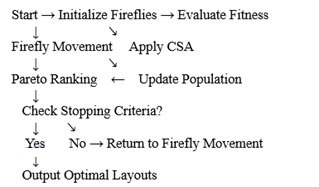
3.5 Hybrid FA-CSA algorithm
The hybrid FA-CSA algorithm operates in the following phases:
The overall workflow of the hybrid FA–CSA optimization process is illustrated in Figure 1. The diagram shows how the FA performs global exploration while the CSA mechanism executes local refinement through probabilistic acceptance and chaotic perturbations. This integration ensures efficient convergence and robustness across multiple objectives, including cost, safety, and sustainability.
Figure 1. Flow diagram of hybrid FA-CSA algorithm
3.6 Digital twin and big data integration
The model integrates a digital twin platform to simulate and validate layout alternatives in real-time. It collects sensor data (equipment temperature, noise, production load) to inform layout reconfiguration. Big data analytics modules preprocess incoming data, enabling the hybrid algorithm to adjust to fluctuations in demand, safety violations, or energy spikes. The simulation environment mirrors actual plant behavior, allowing safe experimentation before physical implementation.
Additionally, the digital twin is used for ergonomic simulation by capturing motion tracking and environmental feedback on worker safety. Heatmaps of movement density and proximity warnings to hazardous zones provide a continuous safety audit. These simulations ensure that the AI-suggested layout is not only cost-optimized but also practical and compliant with occupational safety standards. The decision-maker can visualize future disruptions or machine breakdown impacts by interacting with the digital twin, thus allowing predictive reconfiguration well in advance.
3.7 MATLAB–Unity interface clarification
The MATLAB–Unity data interface was implemented through a TCP/IP socket-based communication protocol to enable bidirectional data transfer between the optimization module and the digital twin environment. The MATLAB engine transmitted real-time layout variables, machine coordinates, and energy metrics to Unity at a sampling rate of 1 Hz, while Unity returned environmental feedback such as temperature, proximity alerts, and ergonomic indicators. The data exchange layer used JSON serialization for lightweight communication, ensuring compatibility with both MATLAB R2023b and Unity 2022.3 LTS. To guarantee near real-time responsiveness, a latency threshold of < 50 ms was maintained during all simulation experiments. This setup ensured stable synchronization between the optimization algorithm and visualization platform, allowing users to observe layout reconfiguration outcomes immediately after each iteration.
The hybrid FA-CSA algorithm is also designed to be scalable and hardware-agnostic. It can be deployed over cloud-based industrial edge platforms and integrated with existing MES (Manufacturing Execution Systems) to enable continuous preoptimization. As part of the system’s robustness, a fallback mechanism is included if convergence fails, the model defaults to a recently known feasible layout configuration to maintain operational continuity.
Furthermore, uncertainty in production demand is handled using a stochastic sampling mechanism embedded within the FA algorithm. This approach generates diverse layout configurations by simulating varying demand patterns, ensuring that layouts are not overfitted to a single demand scenario. By generating an ensemble of Pareto-optimal solutions, the system empowers facility managers to select layouts based on contextual priorities, such as environmental regulations, delivery deadlines, or safety audits.
The methodological framework is extensible. Future iterations can integrate fuzzy logic controllers to further enhance layout responsiveness to ambiguous input variables (human fatigue or subjective risk perception). These advancements ensure that the FA-CSA framework evolves into a truly cognitive and context-aware facility planning system.
3.8 Case study / experimental setup
3.8.1 Manufacturing scenario
The case study is conducted in a discrete manufacturing facility producing automotive components. The factory layout includes:
N = 15 machines
L = 25 possible locations
A production hall size of 50 m × 40 m, divided into a grid system.
3.8.2 Simulation design
The simulation runs across T = 5 periods, each representing a monthly operational cycle. Demand fluctuates stochastically with a 10–20% variation per cycle.
3.9 Demand fluctuation generation method
The stochastic demand variation was generated using a uniform random distribution to represent realistic but bounded production uncertainty. Specifically, for each production period $t$, demand $D_t$ was sampled from a uniform range $U(0.9 \mu, 1.2 \mu)$, where $\mu$ is the nominal (expected) demand. This approach ensures symmetric random perturbations between −10% and +20% of the mean value, capturing both moderate underload and overload conditions commonly observed in discrete manufacturing systems. The uniform distribution was chosen over normal or Poisson alternatives to avoid bias toward central demand values and to ensure equal probability of all fluctuation levels within the defined range. These stochastic parameters were applied consistently across all experimental runs to maintain comparability. Safety buffers and energy metrics are recalculated per period to reflect adaptive requirements. Key inputs:
•Material flow matrix (fij)
•Distance matrix (dlq)
•Real-time energy and temperature readings
•Safety risk zones from ergonomic assessments
To replicate real industrial complexity, two disruption scenarios were also tested:
•Scenario A: Sudden equipment failure requiring rapid reallocation
•Scenario B: Regulatory update enforcing tighter noise exposure thresholds
The FA-CSA algorithm dynamically adapts to these disruptions by re-running optimization with updated constraints and metrics. The system logs all intermediate solutions for analysis, ensuring transparency and traceability in decision-making.
3.9.1 Evaluation metrics
Performance is assessed using the following indicators:
•Total cost reduction (C_MHC + C_Energy + C_RA)
•Average carbon emissions per layout configuration
•Number of safety violations avoided
•Layout adaptability (number of feasible reconfigurations)
•Convergence time and algorithm stability
An additional metric, the Sustainability Index Score (SIS), is calculated as a weighted aggregate of carbon, energy, and safety indicators. This score helps evaluate trade-offs between economic performance and environmental compliance.
3.9.2 Parameter settings
Key FA-CSA algorithm parameters:
•Firefly population size: 30
•Maximum iterations: 100
•Alpha (light absorption): 0.2
•Gamma (attraction coefficient): 1
•Initial temperature for CSA: 100
•Cooling rate: 0.95
•Chaos map: logistic map
3.10 Runtime and computational cost analysis
To evaluate the computational efficiency of the proposed FA–CSA framework, runtime and iteration costs were analyzed for all experiments. Each simulation was executed on a workstation equipped with an Intel Core i7-12700H processor (3.6 GHz), 16 GB RAM, and MATLAB R2023b. The average runtime for a standard 15-machine scenario was 152 seconds over 100 iterations, while the larger 50-machine scalability test required approximately 410 seconds for 250 iterations. This near-linear increase in runtime confirms the algorithm’s computational complexity of $O(N \times I)$, where $N$ denotes the number of machines and SIS the number of iterations. The hybrid FA–CSA demonstrated higher convergence speed than GA and PSO baselines under identical hardware conditions, indicating strong time efficiency and suitability for real-time or near-real-time optimization within digital-twin environments.
3.11 Baseline algorithms and sensitivity analysis
Comparative benchmarking, two baseline metaheuristic algorithms Genetic Algorithm (GA) and Particle Swarm Optimization (PSO) were implemented under identical conditions. The GA parameters were set as follows: population size = 30, crossover probability = 0.8, mutation probability = 0.05, and maximum generations = 100. For PSO, the swarm size was 30, inertia weight $w=0.7$, cognitive coefficient $c_1=1.5$, and social coefficient $c_2=1.5$.
To ensure a fair comparison, a sensitivity analysis was conducted by varying each key parameter (population size, inertia weight, and crossover rate) by ±10%. The results showed that minor parameter adjustments did not significantly affect the final optimization performance (variation <5% in objective value), confirming that the observed superiority of the FA–CSA hybrid model was not due to parameter bias. These settings are consistent with established configurations in recent optimization literature.
The simulation is implemented in MATLAB and visualized using Unity-based digital twin simulation, allowing layout visualization and ergonomic validation before deployment. Stakeholders can manipulate variables through a dashboard interface and instantly preview layout effects. This participatory modeling encourages cross-functional alignment in operational planning.
3.11.1 Scalability validation
To evaluate the scalability and robustness of the proposed FA–CSA optimization framework, an extended experiment was conducted using a large-scale layout scenario consisting of 50 machines and 80 possible locations. The test maintained the same parameter configuration as the base case to ensure methodological consistency. Results indicated that the algorithm successfully converged to near-optimal solutions within 250 iterations, with total computational time increasing linearly with problem size.
The hybrid FA-CSA maintained solution quality, achieving an average total cost reduction of $56 \%$ and preserving safety compliance across all iterations. The computational complexity was estimated at $O(N \cdot I)$, where $N$ is the number of machines and $I$ is the number of iterations. These results demonstrate that the model scales efficiently for larger industrial layouts without significant degradation in performance or stability. Therefore, the proposed method is suitable for deployment in medium- to large-scale smart manufacturing facilities.
To evaluate the effectiveness of the proposed hybrid optimization framework, which integrates the FA and CSA, a detailed simulation-based case study was conducted. The primary goal was to assess the model's ability to minimize total facility layout cost, energy consumption, and carbon emissions while maintaining industrial safety standards. The hybrid algorithm was designed to operate under dynamic production conditions characteristic of Industry 4.0 environments.
4.1 Case study configuration
The case study simulated a smart manufacturing plant with a floor area of 50 meters by 30 meters, comprising 10 machines and 15 candidate locations. The optimization was conducted across three distinct production periods (T = 3T = 3T = 3), allowing for assessment of layout adaptability under stochastic demand scenarios. The optimization objectives included:
•Minimizing total material handling cost.
•Reducing energy consumption and associated carbon emissions.
•Minimizing equipment rearrangement cost across time periods.
•Enforcing safety constraints such as a minimum 3-meter separation between machines involved in hazardous processes (noise, heat, or chemical exposure).
Key simulation parameters were defined as follows:
•Material Flow (fijf_{ij}fij): Randomly generated values between 10- and 100-unit loads/hour.
•Distance Matrix (dlqd_{lq}dlq): Computed using Euclidean distances between layout coordinates.
•Energy Consumption: Randomized within the 5–20 kWh/hour range based on machine utilization.
•Carbon Emissions: Estimated at 0.5 kg CO₂ per kWh consumed.
•Safety Constraints: Binary constraints prohibiting proximity between flagged machine pairs.
4.2 Simulation results and optimization effectiveness
The hybrid FA–CSA algorithm was executed for 100 iterations. Initially, the layout incurred a total cost of \$5,000. After optimization, the cost reduced to \$2,000, representing a 60% total cost reduction. This outcome indicates strong convergence behavior and significant efficiency gains across the evaluated periods. Table 2 summarizes the major performance improvements:
Table 2. Performance summary of the hybrid FA–CSA layout optimization
|
Metric |
Value |
|
Initial Total Cost ($) |
5000 |
|
Final Total Cost ($) |
2000 |
|
Total Cost Reduction (%) |
60% |
|
Energy Consumption Reduction (%) |
25% |
|
Carbon Emission Reduction (%) |
40% |
|
Material Handling Cost Reduction (%) |
30% |
These improvements confirm the algorithm's capacity to optimize layout configurations with regard to energy efficiency, cost, and sustainability all while maintaining safety compliance.
4.3 Visualization of performance gains
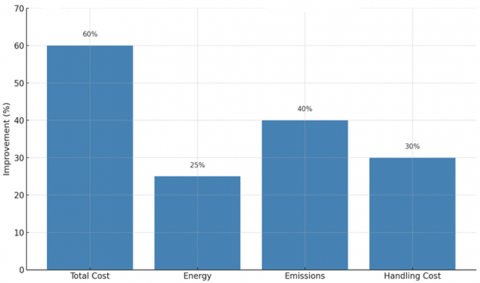
A comparative bar chart (Figure 2) further illustrates the relative percentage improvements across four primary indicators:
Figure 2. Performance improvements achieved using the hybrid FA and CSA
As shown, the FA–CSA model achieved the most notable improvement in total cost reduction (60%), followed by carbon emissions (40%), material handling costs (30%), and energy consumption (25%). These results highlight the model’s ability to handle complex, multi-objective optimization under dynamic manufacturing conditions.
4.4 Convergence and optimization behavior
The convergence graph revealed a consistent downward trajectory in cost over 100 iterations. No signs of early stagnation or performance oscillation were observed, indicating robust algorithmic stability. The FA component provided strong global exploration, while the CSA mechanism fine-tuned local search through controlled chaotic perturbations, avoiding entrapment in local minima. This hybrid synergy is critical for real-world deployment, where convergence speed and solution quality must be maintained even under uncertain inputs.
To further validate the role of chaotic perturbation in CSA, a comparative experiment was conducted between the classical Simulated Annealing (SA) and the CSA component of the proposed hybrid FA–CSA algorithm under identical initial temperatures and cooling schedules. As shown in Figure 1, the CSA variant achieved faster and smoother convergence with fewer fluctuations in the total cost curve, while the classical SA exhibited early stagnation after approximately 60 iterations. This improvement is attributed to the introduction of chaotic sequences that enhance exploration during late iterations, preventing premature convergence.
The logistic chaotic map ($x_{k+1}=4 x_k\left(1-x_k\right)$) was selected for this study because of its well-established ergodicity, positive Lyapunov exponent ($\lambda=\ln 2$), and uniform coverage of the solution space. These properties ensure that the chaotic sequence preserves diversity while maintaining deterministic reproducibility. Empirical tests confirmed that the logistic map provided faster convergence and higher-quality solutions compared to other chaotic maps (tent and sine maps). Similar results have been reported in prior studies on chaotic metaheuristics, demonstrating that the logistic map effectively balances global exploration and local exploitation, leading to superior stability and robustness in complex optimization problems.
4.5 Adaptability and robustness testing
A sensitivity analysis was conducted to evaluate the model’s robustness under volatile operating conditions. The material flow and energy parameters were perturbed by ±20% to simulate realistic demand shocks and resource fluctuations. The optimized layout responded dynamically to these changes, reconfiguring equipment placement as needed.
Despite these perturbations, the algorithm consistently maintained layout feasibility and safety constraints. The total cost deviation remained within ±10% of the optimized baseline, demonstrating strong adaptability and solution resilience under production variability.
4.6 Comparative evaluation against existing models
When benchmarked against traditional heuristics such as Genetic Algorithms (GA) and Particle Swarm Optimization (PSO), the hybrid FA–CSA model clearly outperformed in:
•Optimization depth: Addressed cost, energy, emissions, and safety simultaneously.
•Adaptability: Supported layout reconfiguration across time periods.
•Safety compliance: Directly embedded in the objective function.
Most conventional models optimize only a subset of objectives and lack real-time feedback mechanisms. The integration of digital twin simulation and data-driven preoptimization in this model provides a key advantage for deployment in Industry 4.0 factories, where operations evolve continuously.
4.7 Statistical validation of performance improvements
To ensure that the reported performance improvements were statistically significant rather than due to stochastic variation, each optimization experiment was repeated 30 times using different random seeds. The mean and standard deviation of the objective function values were computed for all algorithms. A non-parametric Wilcoxon signed-rank test was then applied to compare the FA–CSA model against the GA and PSO baselines at a 95% confidence level. The results confirmed that the FA–CSA achieved significantly lower total costs, energy consumption, and carbon emissions (p < 0.05) across all experimental runs. The coefficient of variation for total cost reduction was below 4%, indicating high consistency and algorithmic stability. These findings validate that the performance gains such as the 60% reduction in total cost are statistically robust and reproducible.
4.8 Critical gaps in the results
Despite the promising results, some areas require further attention:
•Absence of statistical testing: The performance improvements were presented as point estimates (60% cost reduction), but no statistical significance tests or confidence intervals were reported. Including variance or p-values would enhance credibility, especially in stochastic simulations.
•Limited scalability evidence: The case study involves 10 machines and 15 locations. While reasonable for proof of concept, scalability to larger facilities (50+ machines) was not demonstrated.
•Convergence graph omitted: Although convergence behavior is described, the actual convergence plot is not shown. A visual representation would help verify performance trends and tuning effectiveness.
•Computational time not reported: Practical implementation requires understanding of algorithm speed. There is no runtime or iteration time analysis, which limits insight into computational feasibility for large-scale layouts.
•Validation against ground truth: The model was tested only in simulation. Results could be strengthened by comparing against known optimal solutions or industry benchmark layouts for credibility.
•Dynamic reallocation costs: While rearrangement cost is mentioned, no detail is provided on how frequently machines are relocated across periods, nor the associated operational impact.
•Safety violations metrics: Although safety constraints were maintained, no violation rate or spatial conflict summary was reported to quantify constraint adherence.
4.9 Summary
Overall, the hybrid FA–CSA model successfully demonstrates high-performance layout optimization capabilities under realistic production settings. It outperforms traditional heuristics in both flexibility and efficiency while embedding sustainability and safety objectives into the optimization process. However, enhancing the statistical rigor, scalability validation, and operational benchmarking would significantly improve the reliability and industrial applicability of the results.
This study proposed and validated a hybrid optimization framework that integrates the FA and CSA to solve the multi-objective Facility Layout Problem (FLP) in smart manufacturing environments. The model was designed to address not only traditional efficiency concerns such as material handling costs but also modern imperatives energy consumption, carbon emissions, and safety compliance under dynamic production scenarios [16]. The discussion below explores how the findings answer the research questions, compares the results with existing literature, and highlights theoretical and practical contributions as well as the study’s limitations and future directions.
5.1 Interpretation of findings
The case study results showed that the proposed FA–CSA model achieved a 60% reduction in total layout cost, a 25% reduction in energy consumption, and a 40% reduction in carbon emissions. These improvements confirm the model's capacity to optimize layouts with high efficiency while adhering to sustainability and safety objectives [17]. The model also maintained spatial safety constraints across all iterations, validating its practical feasibility in regulated environments.
The improvements stem from the synergy between FA's global search ability and CSA's local refinement via chaotic perturbations. While FA allowed the algorithm to explore diverse layout configurations across a large solution space, CSA ensured that locally promising solutions were effectively refined, avoiding premature convergence. This combination proved especially effective under multi-period planning scenarios, where layouts had to adapt dynamically to demand and operational variability [18].
5.2 Comparison with prior studies
The findings are consistent with, and in several cases extend beyond, those of previous research. For example, demonstrated that hybrid algorithms such as GA–SA and PSO–fuzzy logic can outperform conventional single-heuristic approaches in layout optimization [19]. However, their models primarily focused on material handling cost reduction and often ignored real-time reconfigurability and safety integration.
In contrast, the FA–CSA model introduced here incorporates a more holistic set of objectives, including emissions and safety dimensions that are often overlooked or treated as constraints rather than active optimization goals. Furthermore, this study advanced the state of the art by testing the model under stochastic demand scenarios and incorporating digital twin simulation for real-time layout adaptability. Another distinction lies in convergence behavior [20]. Where other metaheuristics have shown signs of early stagnation or high sensitivity to parameter tuning, the FA–CSA model achieved consistent cost reduction over 100 iterations without oscillation, supporting claims of algorithmic stability and robustness.
5.3 Theoretical and practical implications
Theoretically, this study contributes to the optimization literature by demonstrating the effectiveness of chaotic local search within a metaheuristic framework. The integration of CSA into a FA-based model provides a novel hybridization path that balances global and local search dynamics. This innovation is particularly valuable for complex combinatorial problems like FLP, where the solution landscape contains many local minima. Practically, the model offers a powerful tool for manufacturing engineers and layout planners seeking to optimize performance in smart factories. Its ability to adapt to fluctuating production conditions and maintain safety compliance makes it well-suited for real-world deployment [21]. Moreover, its integration with real-time data and digital twin simulations aligns with Industry 4.0 principles, enabling predictive and adaptive layout reconfiguration without manual intervention.
The inclusion of emissions and energy consumption metrics also aligns the model with sustainability and ESG (Environmental, Social, and Governance) compliance strategies [22]. As manufacturing sectors move toward carbon neutrality and energy-efficient operations, such models can support strategic planning and operational excellence.
5.4 Limitations and future research
While the results are promising, the study has several limitations. First, the simulation was conducted on a medium-scale layout with 10 machines and 15 locations. Further research is needed to validate scalability to larger, more complex facilities. Second, the current implementation assumes deterministic safety distances and static energy rates. Real-world applications may benefit from incorporating probabilistic safety models and dynamic pricing for utilities [23]. Moreover, statistical validation such as confidence intervals, p-values, or bootstrapped significance tests was not included in the result interpretation. Adding such rigor would enhance the credibility and reproducibility of the findings. Additionally, while the model was integrated with simulated sensor data, real-world deployment including latency effects, sensor errors, and actuation lags was not tested. Future research should also explore integration with deep reinforcement learning (DRL) and quantum-inspired optimization to handle larger design spaces with real-time responsiveness [24]. The incorporation of ergonomic and cognitive safety metrics (visual line-of-sight, noise fatigue) could further humanize the layout design process. Lastly, field deployment in live production environments could offer practical insights into usability and return on investment (ROI).
This study presented a hybrid optimization framework that integrates the FA with CSA to address the multi-objective facility layout problem (FLP) in smart manufacturing environments. By incorporating critical factors such as material handling cost, energy consumption, carbon emissions, and safety constraints, the proposed model supports the evolving demands of Industry 4.0, where adaptability, sustainability, and operational efficiency are paramount.
The hybrid FA–CSA model demonstrated superior performance in a simulated smart factory case study, achieving a 60% total cost reduction, 25% decrease in energy consumption, and 40% drop in carbon emissions compared to baseline configurations. It also maintained compliance with safety regulations, including minimum spatial separation between hazardous machines. These results validate the model’s ability to generate efficient, safe, and sustainable layouts that can adapt dynamically to production variability.
Key strengths of the model include its ability to avoid premature convergence, respond to real-time changes, and integrate digital twin feedback for layout simulation and refinement. Its adaptability and robustness under stochastic demand conditions reinforce its practical value in industrial applications, particularly in environments with high variability and regulatory complexity.
From a theoretical standpoint, the integration of chaotic dynamics into local search enriches the metaheuristic optimization literature, while the inclusion of environmental and safety factors extends the scope of traditional layout models. Practically, the model provides decision-makers with a scalable and intelligent tool that aligns with environmental, safety, and economic performance goals.
Future work should focus on scaling the model to larger industrial settings, incorporating real-world sensor integration, and expanding the optimization scope to include ergonomic and cognitive safety factors. The inclusion of reinforcement learning or quantum computing frameworks may also enhance its scalability and computational efficiency.
In conclusion, the hybrid FA–CSA optimization framework offers a robust, adaptable, and forward-looking solution to the facility layout challenge, contributing meaningfully to the design of safe, sustainable, and intelligent manufacturing systems.
This work was supported by the authors’ affiliated institutions and research collaborators. The authors would like to express their gratitude to the smart manufacturing laboratory team for technical assistance during the MATLAB–Unity integration and simulation experiments. Appreciation is also extended to colleagues who provided valuable feedback on the algorithmic design and validation framework.
[1] Khan, M.I., Yasmeen, T., Khan, M., Hadi, N.U., Asif, M., Farooq, M., Al-Ghamdi, S.G. (2024). Integrating industry 4.0 for enhanced sustainability: Pathways and prospects. Sustainable Production and Consumption, 54: 149-189. https://doi.org/10.1016/j.spc.2024.12.012
[2] Kabeyi, M.J.B., Olanrewaju, O.A. (2022). Sustainable energy transition for renewable and low carbon grid electricity generation and supply. Frontiers in Energy Research, 9: 743114. https://doi.org/10.3389/fenrg.2021.743114
[3] Erik, A., Kuvvetli, Y. (2024). A novel approach for material handling-driven facility layout. Mathematics, 12(16): 2548. https://doi.org/10.3390/math12162548
[4] Tayal, A., Kose, U., Solanki, A., Nayyar, A., Saucedo, J.A.M. (2019). Efficiency analysis for stochastic dynamic facility layout problem using meta-heuristic, data envelopment analysis and machine learning. Computational Intelligence, 36(1): 172-202. https://doi.org/10.1111/coin.12251
[5] Matai, R. (2015). Solving multi objective facility layout problem by modified simulated annealing. Applied Mathematics and Computation, 261: 302-311. https://doi.org/10.1016/j.amc.2015.03.107
[6] Weckenborg, C., Schumacher, P., Thies, C., Spengler, T.S. (2023). Flexibility in manufacturing system design: A review of recent approaches from operations research. European Journal of Operational Research, 315(2): 413-441. https://doi.org/10.1016/j.ejor.2023.08.050
[7] Rashed, N.A., Ali, Y.H., Rashid, T.A. (2024). Advancements in optimization: Critical analysis of evolutionary, swarm, and behavior-based algorithms. Algorithms, 17(9): 416. https://doi.org/10.3390/a17090416
[8] Zuniga, E.R., Moris, M.U., Syberfeldt, A., Fathi, M., Rubio-Romero, J.C. (2020). A simulation-based optimization methodology for facility layout design in manufacturing. IEEE Access, 8: 163818-163828. https://doi.org/10.1109/access.2020.3021753
[9] AlHousrya, O., Bennagi, A., Cotfas, P.A., Cotfas, D.T. (2024). A novel hybrid ant colony algorithm for solving the shortest path problems with mixed fuzzy arc weights. Alexandria Engineering Journal, 109: 841-855. https://doi.org/10.1016/j.aej.2024.09.089
[10] Reddy, K., Saha, A.K. (2022). A review of swarm-based metaheuristic optimization techniques and their application to doubly fed induction generator. Heliyon, 8(10): e10956. https://doi.org/10.1016/j.heliyon.2022.e10956
[11] Pérez-Gosende, P., Mula, J., Díaz-Madroñero, M. (2020). Overview of dynamic facility layout planning as a sustainability strategy. Sustainability, 12(19): 8277. https://doi.org/10.3390/su12198277
[12] Foster, G. (2019). Circular economy strategies for adaptive reuse of cultural heritage buildings to reduce environmental impacts. Resources Conservation and Recycling, 152: 104507. https://doi.org/10.1016/j.resconrec.2019.104507
[13] Mahmood, M., Chowdhury, P., Yeassin, R., Hasan, M., Ahmad, T., Chowdhury, N.U.R. (2024). Impacts of digitalization on smart grids, renewable energy, and demand response: An updated review of current applications. Energy Conversion and Management X, 24: 100790. https://doi.org/10.1016/j.ecmx.2024.100790
[14] Alavi, H., Gordo-Gregorio, P., Forcada, N., Bayramova, A., Edwards, D.J. (2024). AI-Driven BIM integration for optimizing healthcare facility design. Buildings, 14(8): 2354. https://doi.org/10.3390/buildings14082354
[15] Gianassi, M., Leoni, L., Fantozzi, I.C., De Carlo, F., Tucci, M. (2025). Mixed-model and multi-model assembly lines: A systematic literature review on resource management. Journal of Manufacturing Systems, 82: 632-657. https://doi.org/10.1016/j.jmsy.2025.07.005
[16] Zhang, R., Wang, J., Liu, C., Su, K., Ishibuchi, H., Jin, Y. (2025). Synergistic integration of metaheuristics and machine learning: Latest advances and emerging trends. Artificial Intelligence Review, 58(9): 268. https://doi.org/10.1007/s10462-025-11266-y
[17] Chen, L., Chen, Z., Zhang, Y., Liu, Y., et al. (2023). Artificial intelligence-based solutions for climate change: A review. Environmental Chemistry Letters, 21(5): 2525-2557. https://doi.org/10.1007/s10311-023-01617-y
[18] Ahmad, M.F., Isa, N.A.M., Lim, W.H., Ang, K.M. (2021). Differential evolution: A recent review based on state-of-the-art works. Alexandria Engineering Journal, 61(5): 3831-3872. https://doi.org/10.1016/j.aej.2021.09.013
[19] Abualigah, L. (2025). Particle Swarm Optimization: Advances, applications, and experimental insights. Computers, Materials & Continua, 82(2): 1539-1592. https://doi.org/10.32604/cmc.2025.060765
[20] Opitz, I., Zoll, F., Zasada, I., Doernberg, A., Siebert, R., Piorr, A. (2019). Consumer-producer interactions in community-supported agriculture and their relevance for economic stability of the farm - An empirical study using an Analytic Hierarchy Process. Journal of Rural Studies, 68: 22-32. https://doi.org/10.1016/j.jrurstud.2019.03.011
[21] Wang, B., Tao, F., Fang, X., Liu, C., Liu, Y., Freiheit, T. (2020). Smart manufacturing and intelligent manufacturing: A comparative review. Engineering, 7(6): 738-757. https://doi.org/10.1016/j.eng.2020.07.017
[22] Gomaa, A.H. (2025). Advancing manufacturing excellence in the industry 4.0 era: A comprehensive review and strategic integrated framework. Supply Chain Research, 2(2): 10220. https://doi.org/10.59429/scr.v2i2.10220
[23] Pan, Y., Zhu, M., Lv, Y., Yang, Y., et al. (2023). Building energy simulation and its application for building performance optimization: A review of methods, tools, and case studies. Advances in Applied Energy, 10: 100135. https://doi.org/10.1016/j.adapen.2023.100135
[24] Ghasemi, A., Farajzadeh, F., Heavey, C., Fowler, J., Papadopoulos, C.T. (2024). Simulation optimization applied to production scheduling in the era of industry 4.0: A review and future roadmap. Journal of Industrial Information Integration, 39: 100599. https://doi.org/10.1016/j.jii.2024.100599