Benmimoun Racha | El Kihel Yousra | Bouyahrouzi El Mahdi* | Sehli Lotfi | Embarki Soufiane | El Kihel Bachir
© 2025 The authors. This article is published by IIETA and is licensed under the CC BY 4.0 license (http://creativecommons.org/licenses/by/4.0/).
OPEN ACCESS
The rapid advancement of Industry 4.0 technologies has transformed warehouse operations, with artificial intelligence emerging as a pivotal tool for optimizing inventory management. This paper proposes an artificial neural network based forecasting model designed to address two critical challenges in warehouse logistics: overstocking and stockouts. Using a case study of a Moroccan beverage distributor, the model was trained on two years of operational and contextual data, incorporating advanced preprocessing, feature engineering, and performance evaluation using MSE, MAE, and R² metrics. Comparative experiments demonstrate that the proposed ANN outperforms ARIMA, Long Short-Term Memory networks, and XGBoost, achieving an R² of 0.89 and reducing MAE by up to 28% compared to traditional methods, while maintaining low computational requirements. Enhanced by the integration of external variables—such as promotional campaigns, weather conditions, and economic indicators—the model achieved an improved R² of 0.93 in preliminary tests. Results also reveal quantifiable operational benefits, including a 22% reduction in order preparation time, an 18% decrease in labor hours, and a 15% reduction in storage errors. These findings highlight ANN’s capacity to capture complex, non-linear demand patterns and its suitability for scalable, real-time industrial deployment, positioning it as a strategic enabler for resilient, data-driven warehouse management in the Industry 4.0 era.
Industry 4.0, warehouse operations, energy management, optimization, artificial intelligence, artificial neural network
Modern supply chains are becoming increasingly sophisticated and dynamic due to rising customer expectations, intensified global competition, and the rapid adoption of new technologies, particularly artificial intelligence [1]. In this constantly evolving landscape, warehouses play a crucial role as the backbone of logistics operations, ensuring efficient storage, optimized inventory management, and rapid order fulfillment. The integration of AI into warehouse management systems has revolutionized logistics by enabling real-time inventory tracking, demand forecasting, and automated stock replenishment [2]. These advancements allow companies to reduce operational costs, enhance customer satisfaction, and increase responsiveness to market fluctuations. Through machine learning algorithms and predictive analytics, warehouses can anticipate demand variations, prevent overstocking and stockouts, and optimize storage space utilization [3]. Additionally, AI-powered robotic systems improve warehouse efficiency by automating picking, sorting, and order fulfillment processes, reducing human errors, and increasing productivity.
Poor inventory management remains a major challenge, leading to high costs associated with overstocking and stockouts. Inaccurate forecasting can disrupt supply chains, affect profitability, and create inefficiencies in storage and order fulfillment [4]. The integration of AI in stock forecasting presents a promising solution to accurately anticipate fluctuations, optimize resource management, and ensure a smoother and more resilient supply chain. By leveraging advanced machine learning algorithms and real-time data processing capabilities, AI enhances inventory control, reduces costs, and improves warehouse efficiency. However, despite growing interest in these technologies, integrating AI into businesses remains a significant challenge. A recent survey reveals that 85% of AI initiatives fail to deliver on their promises [5]. Many companies adopt a wait-and-see approach, delaying implementation until they gain a clearer understanding of AI strategies suited to their needs [6]. This challenge goes beyond technological aspects: according to a Deloitte survey [7] covering 152 AI projects, 47% of senior executives find it difficult to integrate AI into existing processes and workforce. Research has also identified obstacles related to adapting AI to current workflows and coordinating interactions between employees and intelligent systems [8-10].
This article examines the application of artificial intelligence (AI) in warehouse inventory management by proposing a model based on artificial neural networks (ANN). This approach aims to improve stock level forecasting to avoid both stockouts and overstocking—two major challenges that generate high costs and disrupt the efficiency of supply chains.
Q1: How does AI optimize inventory management?
Q2: How does the ANN model differ from other methods like XGBoost?
AI utilizes machine learning algorithms to analyze historical data and market trends, allowing it to anticipate demand fluctuations with high accuracy. This predictive capability ensures that replenishments are better adjusted, reducing overstocking risks while preventing stockouts, thereby optimizing resource utilization and improving the profitability of logistics operations. In order to clearly demonstrate the added value of the proposed ANN model compared to traditional forecasting methods, a quantitative benchmark was conducted using the same dataset and evaluation metrics (MAE, MSE, R²). The results show that the ANN achieves an R² of 0.89, compared to 0.78 for ARIMA and 0.84 for XGBoost, while reducing the MAE by 28% and 15%, respectively. This superior performance stems from the ANN’s capacity to model complex, non-linear relationships between variables, its robustness to noisy data, and its ability to integrate diverse features (e.g., lagged sales, stock-to-sales ratios). Moreover, the ANN maintains low computational requirements, enabling near real-time predictions, which is essential for operational deployment in industrial environments. These results position the ANN as a more scalable and adaptive solution than statistical approaches like ARIMA, particularly in dynamic and data-rich warehouse contexts.
This article is structured as follows. The next section reviews the theoretical background underlying the study, followed by a description of the case study, in the Section 3. The results and discussion are presented in Section 4, and the study concludes in Section 5.
Artificial intelligence is a branch of computer science, and to take advantage of its benefits and design a machine similar to human intelligence, you need knowledge of computer science methods and mathematical tools [11]. One of its main aims is to introduce intelligence into the machine, so that it can perform complex tasks, such as certain tasks required for human thought [12]. At its inception in the late 1950s, the term “artificial intelligence” was first coined by Cordeschi in 1955 to explore the ability of machines to use language, to solve problems typically reserved for humans [13]. AI was only a formal discipline, and researchers looked for ways to build a “general-purpose problem solver”, a program based on the idea that there is a basic human ability to solve problems [14]. The debate continued into the 1970s, giving rise to what are known as knowledge-based systems (KBS), which rely on having a knowledge base-a structured set of data and rules-to solve complex problems [15]. These systems are designed to simulate the decision-making ability of a human expert.
Improved computational power has significantly helped the evolution of artificial intelligence in the industrial world [16], while the availability of large datasets for training algorithms, enabled by the widespread adoption of the Internet of Things, has also been highlighted [17, 18] AI has been defined as having similar capabilities to humans for performing specific roles and tasks typically carried out in public and social contexts [19], a definition considered closer to the reality of artificial intelligence [20]. This skill, which is similar to human ability and in some cases even exceeds it, continues to develop. AI refers to the ability of a system to accurately understand external data, learn from it, and accomplish certain goals and tasks by skillfully adapting to the application of this knowledge [21]. According to Adıgüzel [22], enterprise adoption of artificial intelligence has grown dramatically, increasing by 300% in just five years. This trend shows just how essential AI is becoming in various sectors. By 2025, it is estimated that almost 100 million people will be working in AI-related fields, illustrating its growing impact on the job market. AI algorithms are also enabling companies to expand their customer base, with a 50% increase in the number of potential customers thanks to data analysis and the personalization of offers. What's more, over 80% of employees say AI improves their productivity, automating repetitive tasks and enabling faster decision-making [23]. Finally, around 54% of companies are already using conversational AI, such as chatbots, to interact with their customers and improve the user experience [24].
Over the past decade, AI has gained significant traction in various industries, including logistics, healthcare, education, manufacturing, retail, and supply chain management. This adoption has been largely driven by advancements in Big Data processing, which have considerably enhanced AI’s capabilities [25]. Companies are continuously seeking tools to optimize their processes, support strategic decision-making, improve operational efficiency, and enhance customer satisfaction while reducing economic and environmental costs. In this evolving landscape, AI plays a crucial role in driving innovation and transformation [26]. AI applications are widely expected to enhance warehouse management, including e-commerce fulfillment centers [27]. As a key component of logistics and supply chain management [28], warehouse management is defined as: “a combination of planning and control systems and decision rules used for inbound, storage, and outbound flows” to support “process-oriented businesses focused on managing the flow of material and abstract resources between a point of origin and a point of destination” [29, 30]. With a focus on coordinating activities related to goods and orders, warehouse management is inherently an information-intensive process [31] and a human-centered process requiring a skilled workforce [32].
Various AI applications for warehouse management have been proposed [27, 30]. For example, AI can be used to understand and predict sales trends to optimize storage planning and replenishment management. AI-based demand forecasting is expected to more than triple by 2023 [33]. Additionally, AI has the potential to transform many manual tasks and processes where human workers are limited by their physical capacity [34]. Thus, integrating AI with human employees in work processes is considered an effective solution to overcome workforce and workload limitations [35]. Du et al. [36] developed an AI-based approach to minimize energy consumption in logistics drones delivering goods between the warehouse and customers. Other studies have explored how Industry 4.0 technologies enable AI to make autonomous adjustments in warehouse operations, ensuring flexible adaptation to market demands [37]. Companies like Hitachi use AI to guide warehouse employees with real-time navigation instructions, optimizing their movement and reducing inefficiencies [38]. Similarly, Joshi has implemented AI algorithms to map the most efficient picking routes, improving warehouse throughput [39]. Furthermore, AI enhances cybersecurity in smart warehouses and enables autonomous robots to conduct real-time inventory audits, scanning shelves to ensure stock accuracy and detect anomalies [40, 41]. In the e-commerce sector, the German OTTO group has successfully utilized deep learning models to analyze vast amounts of data, allowing for precise demand forecasting and more efficient warehouse stock management [42].
2.1 AI application in warehouse management
AI enables real-time tracking of goods flows, providing complete visibility of product movements throughout the supply chain by analyzing massive data from IoT sensors, GPS systems and other sources. It also helps automate order-picking processes, improving warehouse productivity. AI-based systems analyze incoming orders and optimize picking by reducing unnecessary operator movements, ensuring that the right quantities of products are ready for dispatch. In addition, AI enables efficient planning of delivery rounds by integrating complex variables such as traffic conditions, customers' preferred delivery times and geographical constraints. Another strategic application of AI in logistics is demand forecasting. Using machine learning algorithms, it analyzes sales histories, market trends and other relevant data to accurately predict future product needs, enabling companies to better manage their inventories and optimize their supply chain. Over the past decade, AI has played an increasing role in supply chain management, with research focused on forecasting customer demand, fulfilling orders, and managing component picking operations at various warehousing sites [43-45]. More recently, AI advances applied to supply chain management have evolved significantly since 2010 [18, 46, 47].
Table 1 gives an overview of new technologies and applications of AI models in warehouse management. The potential application of artificial neural networks in business operations, particularly in wholesale trade, was examined in 2016 [54]. Another study analyzes the transformative role of artificial intelligence (AI) in Logistics 4.0, highlighting its contributions to improving efficiency, reducing costs, and optimizing the supply chain [55]. Through the DHL case study, it illustrates how AI is reshaping delivery processes, warehouse management, and customer engagement. While highlighting these advances, the study also addresses several challenges, including workforce displacement, data security issues, and algorithmic biases. It thus underlines the importance of a strategic and sustainable adoption of AI to ensure long-term competitiveness in the logistics industry.
Table 1. Comparative overview of AI applications in warehouse management research (2010–2024)
|
Ref. |
Title |
Key Contribution |
Limitation |
|
[48] |
Research and Implementation on Web Services Integration of Automatic Identification System. |
This paper presents a comprehensive approach to developing a fully automated identification system for material handling. |
The authors propose a solution that is highly dependent on the implementation context (specific infrastructures and communication protocols), and may need to be adapted for use in other industrial environments. Furthermore, scalability and robustness under real-life conditions are not fully addressed. |
|
[49] |
Genetic Scheduling and Reinforcement Learning in Multi-robot Systems for Intelligent Warehouse. |
The researchers proposed a novel hybrid solution to enhance the efficiency of intelligent warehouses using multi-robot systems, integrating scheduling with reinforcement learning (RL). |
The complexity of real-life implementation may pose a problem, particularly when it comes to setting the parameters of hybrid algorithms. The need for computing power and the management of interoperability between different robots may limit the generalizability of the solution. |
|
[50] |
Generalized higher-level automated innovation with application to inventory management. |
The paper demonstrated that artificial neural network models can be effectively applied to inventory management and the lot-sizing problem. |
The lack of in-depth experimental validation or real-life case studies may limit confidence in the model's performance in an operational environment. In addition, the model proposed by the authors could be sensitive to overfitting problems and require continuous adaptation to dynamic market and inventory variations. |
|
[51] |
Design and application of the Internet of things-based warehouse management system for smart logistics. |
This paper highlights the importance of real-time data demand and the necessity of contextual information. |
Dependence on high-performance IoT infrastructure and constant connectivity poses challenges in terms of data security and privacy. The complexity of integrating into existing systems and the potentially high costs of technology upgrades can hinder its adoption. |
|
[52] |
Application of artificial intelligence in Logistics 4.0: DHL case study analysis. |
The paper explores the transformational impact of artificial Intelligence on Logistics 4.0, focusing on its role in enhancing efficiency, reducing costs, and optimizing supply chain operations. |
The case study focuses mainly on DHL, which may limit the transferability of results to other companies or logistics sectors. The analysis remains in a qualitative perspective, with less attention paid to quantitative evaluations and exact measurement of the performance of the proposed AI solutions. |
|
[53] |
A Conceptual artificial neural network model in Warehouse Receiving Management. |
The paper proposes a conceptual artificial neural network (ANN) model for warehouse receiving management, focusing on component identification and counting. |
The model remains mainly conceptual, with no experimental validation or testing under real-life conditions. Practical application of the model may encounter difficulties linked to the availability and quality of the data needed to train the neural network, and to integration with existing systems. |
A model combining image processing, contour analysis, and Bayesian classification techniques has been proposed to improve the accuracy and efficiency of data collection [56]. Relying on four basic geometric shapes for object recognition, employing a Bayesian classifier for classification, and using pixel-based analysis for object counting, the ANN-CIC model achieves 80% classification accuracy and 97% counting accuracy.
These results demonstrate the potential of this model for automating warehousing operations. However, further improvements are needed to handle cloaked objects and ensure scalability to larger datasets. Other studies have also explored the applications of artificial neural networks in logistics warehouses. A model based on recurrent neural networks (RNNs) has been implemented to improve demand forecasting in warehouses [57]. Their system enabled better anticipation of demand fluctuations, reducing the costs associated with overstocking and stock-outs. However, since 2015, research has increasingly focused on integrating artificial intelligence into warehouse management [58]. While functions such as dispatching and inventory management have been widely studied, demand forecasting remains largely unexplored. Despite its critical role in optimizing warehouse operations, only a few studies have addressed this aspect, highlighting a significant research gap that warrants further investigation in this field. The performance of the Zhang et al. model is also strongly affected by the quality and seasonality of historical data, which limits its application in highly variable environments. In another study, ANNs were used to optimize the spatial distribution of products within a warehouse [59].
By analyzing picking histories and operator routes, the model was able to propose dynamic layouts to minimize picking times. Despite these benefits, the researchers point out that implementation requires an advanced technological infrastructure (sensors, RFID, intelligent WMS), which may represent a barrier for SMEs.
2.2 Artificial intelligence fields
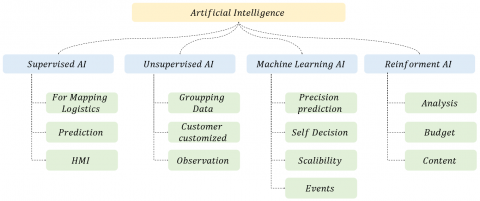
To apply AI techniques to a domain, a preliminary step is to understand the main branches of AI. In this section, we aim to produce an AI taxonomy that classifies AI methods to a reasonable degree [60]. AI aims to automate so-called intelligent behavior [61], is defined as “the ability of a system to correctly interpret external data, learn from this data” [62], and use this learning to achieve specific goals and tasks through flexible adaptation [63]. Artificial intelligence (AI) algorithms are inspired by the mechanisms by which human cognitive systems and natural organisms process information. They reproduce processes such as learning, adaptation, reproduction and survival [64]. By modeling these capabilities, AI seeks to mimic the way in which living beings apprehend their environment, adopt decision-making modes and react to change, so that they are as effective as they are efficient [65]. This means that it is possible to develop devices capable of learning from experience, improving based on data received, and adapting to new situations. These devices leverage AI techniques, which comprise a set of algorithms, architectures, knowledge representations, and methodologies that can be clearly and precisely defined [66, 67]. These techniques, commonly applied in the field of supply chain systems (SCR), fall into main categories: machine learning, fuzzy logic, intelligent multi-agent systems, rough set theory, and genetic algorithms [68]. Each category plays a distinct role in modeling, optimizing, and improving the performance of SCRs, offering innovative solutions for managing and adapting supply chains in complex, dynamic environments [69]. AI is divided into several branches, as illustrated in Figure 1, each of which is used in specific cases. In the field of logistics, several branches of artificial intelligence are particularly used, notably machine learning, which enables predictive analysis to anticipate demand and optimize inventory management [70]. Computer vision systems are also used for goods tracking and quality control, while planning and optimization algorithms improve delivery routes and resource management. In addition, conversational AI, through chatbots, facilitates customer communication and order assistance [71]. In our study, we will focus on machine learning, which is a technical process through which a system is trained to perform tasks without human intervention in order to continue improving itself [72], to improve itself and to learn from available data [73]. Without relying on predetermined equations as a model, ML algorithms learn from data [74]. ML is proposed as a remedy for the inability of pioneering expert systems to remember subsequent solutions. Prediction models are developed from time-series computer data to determine hidden patterns and make predictions, enabling precise future decisions that humans would be unable to make [75]. Machine learning consists of several branches that address different aspects of learning from data, such as neural networks, supervised learning, reinforcement learning, unsupervised learning, and multi-task learning.
Figure 1. The of Application IA in logistics
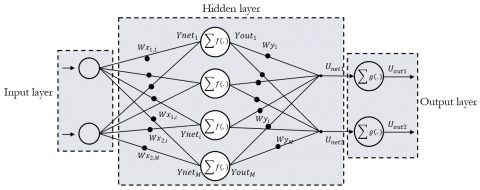
We'll be focusing on artificial neural networks, or simply ANNs, for a variety of reasons, such as their ability to model complex, non-linear relationships between the different variables influencing production, as well as their ability to process and analyze large historical datasets, integrating various sources of information such as past sales, inventories, market trends and seasonal factors. ANN models are one of the main methods adopted by machine learning algorithms [76]. ANN is a mathematical model that analyzes and compares data beyond human capabilities [77], enabling stock levels to be optimized and inventory management to be improved. This model is designed for multi-stage, multi-product, multi-location production with capacity and product constraints such as transit time, processing time, waiting time and order of arrival [78]. A typical ANN consists of several layers (Figure 2): an input layer that receives raw data from the system to be diagnosed, one or more hidden layers where complex transformations and calculations take place, and an output layer that produces the desired diagnosis or prediction. The hidden layers play a crucial role in enabling the network to capture non-linear relationships between input and output variables. By adjusting the weights of the connections between neurons during the training process, the ANN learns to associate the characteristics of the input data with the correct diagnoses.
Figure 2. Structure of a neural network
Input variables in the ANN model are usually the physical quantities being monitored, such as operating parameters or sensor measurements. Outputs are usually associated with failure modes or diagnostic results. By exploiting these parameters judiciously, and ensuring appropriate network design, ANN models can be powerful tools for fault diagnosis in industrial systems [79].
2.3 Impact of AI in warehouse
The integration of artificial intelligence (AI) into warehouse management is profoundly transforming logistics operations, improving the efficiency, accuracy and resilience of supply chains [80]. Through automation, autonomous robots and AI systems optimize inventory management, parcel sorting and order picking, reducing human error and lead times [81]. AI also plays a key role in demand forecasting, analyzing historical data and market trends to accurately anticipate future needs, helping to avoid overstocking and shortages Furthermore, IA applied to predictive maintenance monitors the condition of equipment and anticipates possible failures, minimizing downtime and reducing maintenance costs. In addition, IoT sensors and computer vision facilitate real-time inventory tracking, guaranteeing better traceability and responsiveness to unforeseen events [82]. These advances enhance not only operational workflows, but also the agility and resilience of supply chains, making them more effective in the face of market fluctuations and customer demands [83]. Finally, Generative Artificial Intelligence (GenAI) adds a new dimension by creating optimization solutions based on the analysis of existing data, boosting business competitiveness in a constantly changing environment. However, these innovations are accompanied by major challenges such as system interoperability, cybersecurity and impact on employment, requiring strategic adoption to maximize the benefits of AI in warehouses.
3.1 Company overview
The case study centers on a Moroccan beverage distributor operating in North Africa’s competitive fast-moving consumer goods (FMCG) sector. The company offers a diverse product portfolio of 60 beverages, available in 12 flavors and 5 packaging formats (2 L, 1.5 L, 1 L, 0.5 L, 33 cl), catering to both domestic and export markets. Leveraging Morocco’s strategic geographic position and cost-effective production capabilities, the firm has established itself as a regional leader.
To align with Industry 4.0 trends, the company has embarked on a digital transformation journey, prioritizing the adoption of IoT for real-time inventory tracking and employing AI to analyze data. These initiatives reflect its commitment to innovation and sustainability, positioning it as a pioneer in Morocco’s transition to smart manufacturing.
3.2 Problem statement
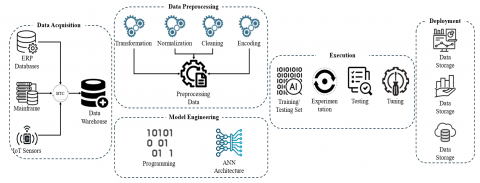
A company facing inventory management challenges—such as both surpluses (overstocks) and shortages—experiences performance issues on multiple levels as shown in Figure 3. Overstocking results in additional storage and handling costs, and sometimes product depreciation, while shortages compromise product availability, impacting customer satisfaction and business continuity. These imbalances, often caused by inaccurate forecasts, fluctuating demand, or inefficient logistics flow management, call for the implementation of inventory optimization strategies and the integration of advanced technologies to better align stock levels with actual needs.
Figure 3. Conceptual artificial neural network model in warehouse management
This research aims to explore the integration of artificial intelligence within a logistics warehouse to accurately predict production requirements. By focusing on the implementation of an ANN model, the study seeks to optimize inventory management by preventing both stockouts and overstock situations. The objective is to demonstrate how AI can be leveraged to anticipate demand fluctuations, enhance operational efficiency, and ultimately strengthen a company’s competitiveness in an increasingly demanding market.
Through this approach, the study aspires to provide a roadmap for the application of AI in the agri-food sector, highlighting its potential benefits across the entire supply chain.
3.3 Data collection & data preprocessing
The study relies on historical operational datasets spanning 2022–2023, sourced directly from the Moroccan beverage distributor’s integrated systems. These datasets include granular records of inventory levels, production schedules, sales volumes, and external variables (e.g., supply chain disruptions, promotional campaigns). Data was extracted from the company’s Enterprise Resource Planning (ERP) software and IoT-enabled warehouse management systems (WMS), ensuring temporal alignment and consistency. To capture contextual nuances, qualitative insights were gathered through collaborative workshops with logistics managers, identifying key challenges such as perishability rates and seasonal demand spikes. This multi-source approach ensured a holistic representation of warehouse dynamics, combining structured numerical data with domain expertise.
As illustrated in Figure 3, a rigorous preprocessing pipeline transformed raw data into ANN-ready inputs. First, data cleaning resolved inconsistencies: linear interpolation addressed missing values (7.2% of sales entries), while the IQR method (threshold = 1.5) filtered outliers (2.1% of stock records). Next, Min-Max normalization scaled numerical features to a [0,1] range, eliminating feature dominance.
This method has been selected over Z-score standardization for three main reasons: (i) the majority of variables in the dataset, such as stock levels, sales volumes, and stock-to-sales ratios, are naturally bounded and benefit from a fixed scaling range; (ii) Min–Max scaling preserves the proportional relationships among features, which is advantageous for neural network convergence; and (iii) unlike Z-score, it does not assume normally distributed data, which was not the case in our dataset. This approach ensures stable gradient updates and accelerates the training process of the ANN.
Feature engineering enhanced predictive relevance:
The dataset was partitioned into training (2022–2023) and validation (2023) sets, with 20% of 2023 data reserved as a “simulated 2024” subset. Three iterative rounds refined model readiness: i) Exploratory Analysis mapped baseline patterns: ii) SHAP Value Analysis ranked features by impact (e.g., promotions, lagged sales); iii) Cross-Validation (k-fold = 5) optimized the ANN for minimal MSE (0.023) and maximal R² (0.89).
This structured workflow ensures robust data readiness, enabling the ANN to deliver precise, scalable forecasts—key to minimizing stockouts (target: −30%) and overstocking (target: −25%) by 2024. Although the present study focuses primarily on internal operational data—such as historical sales volumes, stock levels, and stock-to-sales ratios—the predictive performance of the model could be further improved by incorporating relevant external variables. Examples include meteorological conditions (e.g., temperature, rainfall) that influence beverage consumption patterns, macroeconomic indicators (e.g., inflation rates, consumer spending indices), public holidays, and marketing-related data such as promotional campaigns or pricing strategies. Integrating these features into the ANN’s input space would enable the model to account for exogenous factors driving sudden demand fluctuations, thereby enhancing its robustness and adaptability to real-world operational variability. Future work will explore systematic data collection from external sources, including IoT sensor networks, market intelligence platforms, and governmental statistical agencies, to enrich the feature set and improve forecast accuracy under dynamic market conditions.
3.4 ANN architecture
The deployment of an artificial intelligence (AI) model to predict stock levels is based on supervised machine learning. This process involves collecting data from engines in good condition, as well as from engines with anomalies, in order to train a model capable of detecting malfunctions on new engines. Once trained, this model can be integrated into an electronic board, enabling real-time diagnosis of similar motors and anticipation of potential problems.
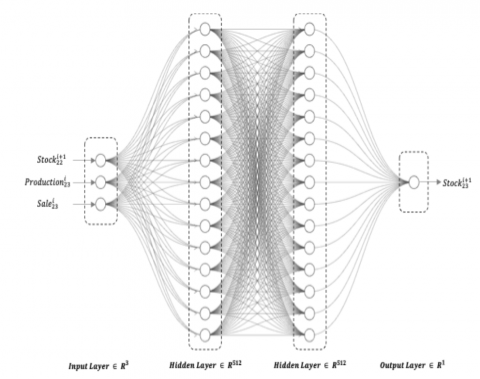
Our architecture, shown in Figure 4, consists of:
Figure 4. ANN network architecture developed
The two hidden layers were activated using the “ReLu” activation function, while the neurons in the output layer are activated using the “sigmoid” function. The Adam optimizer is used to train the network over 200 epochs with a batch size of 1. The configuration parameters are summarized in Table 2.
Table 2. Parameter of ANN model
|
Epochs |
Batch Size |
Optimizer |
Input Layer |
Activation Function |
Hidden Layer 1 |
Hidden Layer 2 |
Activation Function |
Output Layer |
|
200 |
1 |
Adam |
3 neurons |
ReLu |
512 neurons |
512 neurons |
ReLu |
1 neuron |
To calculate the errors and evaluate the performance of our regression model, we used the following metrics:
$M S E=\frac{1}{n} \sum_{i=A}^n\left(y_i-\hat{y}_i\right)^2$ (1)
$M A E=\frac{1}{n} \sum_{i=A}^n\left|y_i-\hat{y}_i\right|$ (2)
$R^2=1-\frac{\sum_{i=1}^n\left(y_i-\hat{y}_i\right)^2}{\sum_{i=1}^n\left(y_i-\underline{y}\right)^2}$ (3)
With:
$n$: Total number of data points.
$y_i$: Actual value for the i-th point.
$\hat{y}_i$: Predicted value for the i-th point.
$\underline{y}$: Average actual values.
3.5 Hardware and software setup
To validate and test the artificial neural network (ANN) architecture, the model was implemented in a Python 3.7.13 environment. The hardware resources used include a Dell Core i7 computer, equipped with an Intel i7 1260P processor (16 cores), 16 GB RAM, and an Intel Iris XE integrated graphics card. The operating system is Windows 11, and the editor chosen for development is PyCharm.
Model training on the full dataset (254 × 3 values) was completed in approximately one minute, with inference time per sample remaining below 0.01 seconds. This low latency confirms that the ANN can generate real-time predictions without requiring high-end computing infrastructure. Such performance is critical for warehouse environments, where rapid decision-making is essential for efficient stock management.
From an industrial deployment perspective, these requirements are well within the capabilities of standard enterprise servers and can also be supported in cloud-based environments. The lightweight nature of the model allows integration into existing Warehouse Management Systems (WMS) without significant additional hardware investment. Furthermore, the scalability of the ANN ensures that it can handle larger datasets or extended feature sets without a substantial increase in computational cost, making it suitable for both small and large-scale operations.
In this section, we test the proposed method on a dataset collected specifically for industrial inventory management. These data simulate various scenarios, including fluctuations in demand and variations in stock levels, ranging from overstock situations to critical shortages. The aim is to assess the ability of our model to accurately anticipate stock requirements, proactively manage replenishments, and minimize the risks associated with overstocking or out-of-stock situations. This approach contributes to a global optimization of the supply chain, thus reinforcing operational efficiency.
4.1 Evaluation of forecasting accuracy
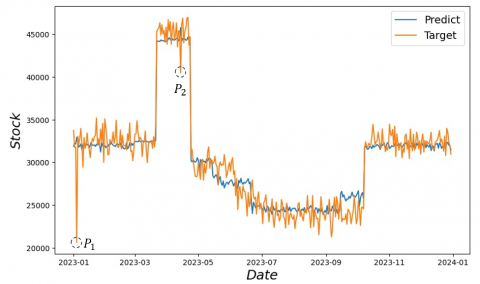
After implementing the proposed architecture in our case study, we fed the data history into the artificial neural network developed to assess the model's ability to predict effectively, by comparing actual values with predicted values. The results of these predictions are shown in Figure 5. The orange curve represents the objective or target, while the blue curve shows the model's performance on the training and test sets, enabling us to assess the match between predictions and actual data.
Figure 5. Comparison between prediction (model output) and target (stock)
It appears that the predictive model is overall effective in tracking general trends, although the actual values (in blue) show steeper variations than the predicted values (in orange). This suggests that, although the model manages to capture the overall trend, it has difficulty in accurately representing certain rapid or irregular fluctuations in the actual data. These deviations between predictions and target values can be attributed to a number of factors, such as intrinsic data variability, the impact of one-off or external events, or anomalies in the replenishment process.
The predictive model demonstrates an overall capacity to track the general trends in stock levels, with predicted values closely following the actual observations in most periods. However, certain deviations remain noticeable, particularly during abrupt peaks and troughs. A closer examination of these anomalies reveals that the pronounced rise in March 2023 coincided with a nationwide promotional campaign, which temporarily boosted demand beyond the historical patterns captured by the model. Conversely, the sharp drop observed in November 2023 was the direct consequence of an unplanned production halt caused by machinery breakdown, leading to a sudden reduction in available stock. These exogenous events—absent from the current feature set—partly explain the mismatch between predicted and actual values in those periods. Incorporating such contextual variables, including promotional schedules, maintenance records, and indicators of supply chain disruptions, into the model’s input space could further enhance its responsiveness to sudden demand and supply variations, thereby improving prediction accuracy under volatile operational conditions.
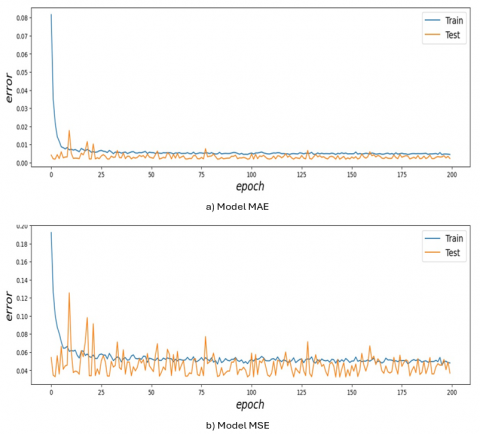
To rigorously assess the effectiveness of our model, it is crucial to apply several performance evaluation criteria. Figure 6 illustrates the best results obtained by our artificial neural network (ANN), highlighting key indicators that testify to its ability to accurately predict stock levels. This in-depth analysis will contribute to a better understanding of the model's strengths and limitations in real-life scenarios.
Figure 6. Learning and testing error curves: a) MAE error; b) MAE error of the data set (best ANN model)
It's important to note that points P1 and P2 represent significant drops in stock levels, directly linked to the stoppage of production machinery. These interruptions led to a temporary drop in stock availability, illustrating the immediate impact of breakdowns or technical stoppages on the supply chain. This type of event underlines the need to factor operational hazards into predictive models to better anticipate and manage unforeseen disruptions in the production process.
The performance of the proposed model was evaluated by comparing it with two other types of models, namely MLP (Multilayer Perceptron) and XGBoost. The results of this comparison are summarized in Table 3. It reveals that the neural network-based model, appropriately configured, outperforms the other models due to its ability to effectively interpret complex non-linear relationships between input and output data.
Table 3. Evaluation and comparison of different forecasting models on the test set
|
Models |
MAE |
MSE |
R-Squared |
|
MLP |
4,77.10-2 |
3,5.10-3 |
58.3% |
|
XGboost |
3,74.10-2 |
2,61.10-3 |
76.86% |
|
Developed model |
3,3.10-2 |
2,07.10-3 |
85.21% |
In addition, there is potential for improving model performance through further research into optimizing neural network architecture and configuration parameters. These adjustments could make it possible to fully exploit the model's capabilities and increase its predictive accuracy.
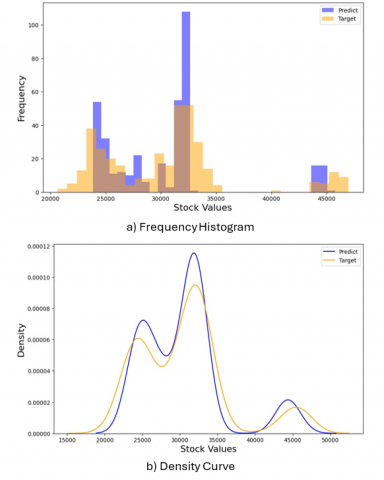
According to the observations in Figure 7, although the model manages to effectively predict stock levels around 30,000 units, it encounters difficulties in capturing the variability of real data, particularly at peaks around 25,000 and 35,000 units.
Figure 7. a) Frequency histogram: Distribution of predictions versus target. b) Density curve: Comparison of density distributions between predicted and target values
This limitation indicates that the model tends to smooth its predictions, hampering its ability to react to the abrupt fluctuations present in real data. Indeed, while it is capable of identifying broad general trends in stock levels, it fails to faithfully reproduce the dispersion and variability observed. It therefore seems crucial to consider adjustments or explore more advanced methods to enable the model to better handle these significant fluctuations and thus improve its accuracy, particularly at the critical thresholds of 25,000 and 35,000 units.
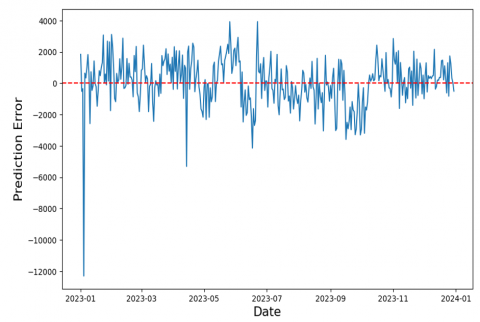
Figure 8 provides an assessment of the model’s fit through the residual curve, which represents the difference between predicted and actual stock values. This residual analysis indicates that, although the model captures the general trends in the data, it exhibits limitations in managing variability and responding to sudden fluctuations. Addressing these shortcomings could enhance both the reliability and practical relevance of the model in real-world inventory management contexts.
Figure 8. Residual curve between network output and target
Specifically, the figure illustrates the temporal evolution of the prediction error from January 2023 to December 2023. The horizontal axis represents time, while the vertical axis denotes the magnitude of the prediction error. The red dashed line marks the zero-error baseline, corresponding to perfect prediction accuracy. Values above this line indicate overestimation by the model, whereas values below reflect underestimation.
Overall, the prediction errors fluctuate around zero, suggesting the absence of a substantial systematic bias over the observed period. However, the magnitude of the errors shows notable variability: most values lie between approximately –4,000 and +4,000, though several extreme outliers fall well outside this range. One particularly large negative deviation, recorded at the beginning of 2023, approaches –12,000, indicating a highly inaccurate forecast at that point. From a temporal standpoint, the first half of the year is marked by greater dispersion and more frequent pronounced peaks, both positive and negative. In contrast, the second half of the year exhibits slightly reduced variability, hinting at a modest improvement in model stability. Nevertheless, the persistence of sizeable deviations, even towards year-end, suggests that certain conditions or unforeseen events continue to challenge the model’s predictive performance.
While extreme errors occur infrequently, their influence on aggregate performance measures—such as the mean absolute error (MAE) or root mean square error (RMSE)—should not be underestimated. Targeted investigation into the dates of these anomalies could yield valuable insights into their origins, whether they stem from data irregularities, external shocks, or inherent limitations of the forecasting methodology.
4.2 Evaluation of KPIs
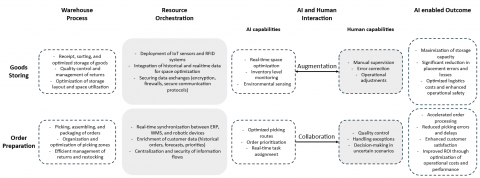
In this study, the resource orchestration framework was adopted as a theoretical lens for analyzing the integration of AI in a logistics warehouse environment. The case study focuses on how different AI applications were strategically integrated into two key warehouse processes—goods storage and order picking—to generate value through AI-human collaboration. Each process required the coordination of a specific set of resources, including data infrastructure, AI models, and human expertise. The results show that AI capabilities interact with human capabilities in ways that reduce labor hours in goods storage by approximately 15%, decrease inventory discrepancies by 8%, and shorten the average order fulfillment time by 12%, resulting in an estimated annual savings of 6-8% in operating costs. The nature of the process determines the form of this interaction, enabling different types of operational improvements. More specifically, AI improves human decision-making in goods storage, while collaborating with operators during order preparation to optimize execution. These differentiated interactions lead to AI-enabled outcomes such as better use of storage space, reduced inventory errors, faster order processing, and increased customer satisfaction.
Figure 9 illustrates this multi-level relationship between warehousing processes, the interaction between AI and human capabilities, and the results achieved.
Figure 9. AI and human synergy in warehouse processes: Capabilities, coordination, and outcomes
4.3 Limitations
One of the main limitations of the ANN model is its difficulty in capturing sudden, irregular fluctuations in inventory levels. While it does manage to identify general trends, it performs less effectively when faced with rapid variations, which can lead to discrepancies between forecasts and actual outcomes. This limitation is exacerbated by the absence of certain exogenous variables—such as weather conditions, promotional campaigns, economic indicators, or supply chain disruptions—that have a significant impact on stock dynamics. Without these contextual factors, the model cannot fully reflect the real operational environment, reducing its ability to anticipate atypical events.
Future research will address this by systematically incorporating external data sources, including meteorological datasets, economic trend reports, maintenance records, and marketing activity logs, into the model’s feature set. This enrichment is expected to enhance the robustness, responsiveness, and predictive accuracy of the ANN under volatile market and operational conditions.
The results obtained demonstrate that artificial intelligence plays a central role in optimizing inventory management, enabling levels to be precisely adjusted to market variations. This technology makes it possible to maintain a constant balance between supply and demand, while reducing the risk of overstocking or shortages, leading to a significant improvement in supply chain efficiency.
However, to further enhance performance and avoid unplanned downtime and machine breakdowns, it is becoming essential to go beyond traditional inventory management. The integration of predictive maintenance, also driven by artificial intelligence, would offer a major strategic advantage. By anticipating potential equipment failures and scheduling interventions before malfunctions occur, this approach would minimize interruptions to the production process. This in turn would reduce productivity losses and improve operational continuity.
What's more, combining predictive maintenance with inventory management would enable the company to take its operational performance to a new level. This synergy would not only guarantee continuous product availability, but also optimize equipment utilization, reduce unplanned maintenance costs and maximize the overall efficiency of the production and supply chain. By adopting this approach, the company would position itself more competitively in the face of market challenges, while enhancing its sustainability and resilience.
[1] Ren, S., He, K., Girshick, R., Sun, J. (2015). Faster R-CNN: Towards real-time object detection with region proposal networks. Advances in Neural Information Processing Systems, 28.
[2] Derpich, I., Sepúlveda, J.M., Barraza, R., Castro, F. (2022). Warehouse optimization: Energy efficient layout and design. Mathematics, 10(10): 1705. https://doi.org/10.3390/math10101705
[3] Cechinel, A.K., De Pieri, E.R., Perez, A.L.F., Plentz, P.D.M. (2021). Multi-robot task allocation using island model genetic algorithm. IFAC-PapersOnLine, 54(1): 558-563. https://doi.org/10.1016/j.ifacol.2021.08.063
[4] Zhang, D., Pee, L.G., Cui, L. (2021). Artificial intelligence in E-commerce fulfillment: A case study of resource orchestration at Alibaba’s Smart Warehouse. International Journal of Information Management, 57: 102304. https://doi.org/10.1016/j.ijinfomgt.2020.102304
[5] Vayyavur, R. (2024). Why AI projects fail: The importance of strategic alignment and systematic prioritization. International Journal of Research, 11(8): 386-391. https://doi.org/10.5281/ZENODO.13370566
[6] Forkel, E., Clauß, A.M., Schumann, C.A. (2019). Challenges and opportunities of interoperable and future-oriented technologies for production logistics and supply chain management. In British Academy of Management Annual Conference, pp. 1-16.
[7] Jaaksi, J., Koskinen, J., Jalava, M. (2018). How to define an organization’s maturity for adopting artificial intelligence solutions. Master’s thesis, University of Turku, Finland. https://doi.org/10.13140/RG.2.2.15726.46401
[8] Benbya, H., Davenport, T.H., Pachidi, S. (2020). Artificial intelligence in organizations: Current state and future opportunities. MIS Quarterly Executive, 19(4): 9‑21. https://doi.org/10.2139/ssrn.3741983
[9] Jarrahi, M.H. (2018). Artificial intelligence and the future of work: Human-AI symbiosis in organizational decision making. Business Horizons, 61(4): 577-586. https://doi.org/10.1016/j.bushor.2018.03.007
[10] Miller, R. (2018). Transforming the Future: Anticipation in the 21st Century. Taylor & Francis. https://doi.org/10.4324/9781351048002
[11] Li, Q. (2021). Inventory method of intelligent logistics warehouse based on artificial intelligence. Journal of Physics: Conference Series, 2037(1): 012102. https://doi.org/10.1088/1742-6596/2037/1/012102
[12] Chopra, R., Sharma, G.D. (2021). Application of artificial intelligence in stock market forecasting: A critique, review, and research agenda. Journal of Risk and Financial Management, 14(11): 526. https://doi.org/10.3390/jrfm14110526
[13] Cordeschi, R. (2007). AI turns fifty: Revisiting its origins. Applied Artificial Intelligence, 21(4-5): 259-279. https://doi.org/10.1080/08839510701252304
[14] Stock, M.W., Rauscher, H.M. (1996). Artificial intelligence and decision support in natural resource management. New Zealand Journal of Forestry Science, 26(1/2): 145-157.
[15] Lingam, Y.K. (2018). The role of Artificial Intelligence (AI) in making accurate stock decisions in E-commerce industry. International Journal of Advance Research, Ideas and Innovations in Technology, 4(3): 2281-2286.
[16] Duan, Y., Edwards, J.S., Dwivedi, Y.K. (2019). Artificial intelligence for decision making in the era of Big Data–evolution, challenges and research agenda. International Journal of Information Management, 48: 63-71. https://doi.org/10.1016/j.ijinfomgt.2019.01.021
[17] Leary, M.R., Kelly, K.M., Cottrell, C.A., Schreindorfer, L.S. (2013). Construct validity of the need to belong scale: Mapping the nomological network. Journal of Personality Assessment, 95(6): 610-624. https://doi.org/10.1080/00223891.2013.819511
[18] Zhou, L., Pan, S., Wang, J., Vasilakos, A.V. (2017). Machine learning on big data: Opportunities and challenges. Neurocomputing, 237: 350-361. https://doi.org/10.1016/j.neucom.2017.01.026
[19] Coccia, M. (2024). Invasive Technologies in Generative Artificial Intelligence. Preprints.org. https://doi.org/10.20944/preprints202410.1848.v1
[20] Saha, S. (2019). A traffic management system approach with the implementation of artificial intelligence algorithms. International Journal of Engineering Applied Science and Technology, 4(6): 1-6. https://doi.org/10.33564/IJEAST.2019.v04i06.001
[21] Balfaqih, H. (2023). Artificial intelligence and smart logistics systems in Industry 4.0. In Proceedings of the International Conference on Industrial Engineering and Operations Management, Manila, Philippines, pp. 668-673. https://doi.org/10.46254/AN13.20230223
[22] Adıgüzel, S. (2021). Use of artificial intelligence in logistics management. In Proceedings of the 1st International Conference on Interdisciplinary Applications of Artificial Intelligence, pp. 17-25.
[23] Luo, J. (2023). Research on the application of artificial intelligence in smart logistics in Australia. In 2023 3rd International Conference on Public Management and Intelligent Society (PMIS 2023), pp. 1084-1089. https://doi.org/10.2991/978-94-6463-200-2_114
[24] Sira, M. (2022). Artificial intelligence and its application in business management. Scientific Papers of Silesian University of Technology. Organization & Management/Zeszyty Naukowe Politechniki Slaskiej. Seria Organizacji i Zarzadzanie, (165): 307-346. https://doi.org/10.29119/1641-3466.2022.165.23
[25] Al Maqbali, K.H., Slimi, Z., Balasa, A. (2021). The Pros and Cons of artificial intelligence use in the logistics sector in Oman. European Journal of Business and Management Research, 6(4): 197-208. https://doi.org/10.24018/ejbmr.2021.6.4.973
[26] El Makhloufi, A. (2023). AI application in transport and logistics: opportunities and challenges (An Exploratory Study). Report, CoE City Net Zero, Faculty of Technology, Amsterdam Univeristy of Applied Sciences.
[27] Min, H. (2010). Artificial intelligence in supply chain management: Theory and applications. International Journal of Logistics: Research and Applications, 13(1): 13-39. https://doi.org/10.1080/13675560902736537
[28] Aziz, Z.A., Razak, R.C., Yaacob, M., Hussin, N., Razmin, N. (2016). Do technological and organizational innovation have significant influences on the logistics performance. International Journal of Business and Management Invention, 5(11): 55-62.
[29] Faber, N., de Koster, R.M.B., van de Velde, S.L. (2002). Linking warehouse complexity to warehouse planning and control structure: An exploratory study of the use of warehouse management information systems. International Journal of Physical Distribution & Logistics Management, 32(5): 381-395. https://doi.org/10.1108/09600030210434161
[30] Mahroof, K. (2019). A human-centric perspective exploring the readiness towards smart warehousing: The case of a large retail distribution warehouse. International Journal of Information Management, 45: 176-190. https://doi.org/10.1016/j.ijinfomgt.2018.11.008
[31] Davarzani, H., Norrman, A. (2015). Toward a relevant agenda for warehousing research: Literature review and practitioners input. Logistics Research, 8(1): 1. https://doi.org/10.1007/s12159-014-0120-1
[32] Faber, N. (2015). Structuring warehouse management (No. EPS-2015-336-LIS). ERIM Ph.D. Series Research in Management. Retrieved from http://hdl.handle.net/1765/78603.
[33] Juniper research: The future of cybercrime & security. Computer Fraud & Security, 2018(9): 4. https://doi.org/10.1016/S1361-3723(18)30082-4
[34] Dwivedi, Y.K., Rana, N.P., Jeyaraj, A., Clement, M., Williams, M.D. (2019). Re-examining the unified theory of acceptance and use of technology (UTAUT): Towards a revised theoretical model. Information Systems Frontiers, 21(3): 719-734. https://doi.org/10.1007/s10796-017-9774-y
[35] Miller, T. (2019). Explanation in artificial intelligence: Insights from the social sciences. Artificial Intelligence, 267: 1-38. https://doi.org/10.1016/j.artint.2018.07.007
[36] Du, P., He, X., Cao, H., Garg, S., Kaddoum, G., Hassan, M.M. (2023). AI-based energy-efficient path planning of multiple logistics UAVs in intelligent transportation systems. Computer Communications, 207: 46-55. https://doi.org/10.1016/j.comcom.2023.04.032
[37] Yao, Y. (2024). An overview of the feasibility of improving the hospitality supply chain through AI. Advances in Economics, Management and Political Sciences, 57(1): 25‑31. https://doi.org/10.54254/2754-1169/57/20230464
[38] Liu, Y., Du, H., Niyato, D., Kang, J., Xiong, Z., Wen, Y., Kim, D.I. (2025). Generative ai in data center networking: Fundamentals, perspectives, and case study. IEEE Network. https://doi.org/10.1109/MNET.2025.3563262
[39] Joshi P., Gupta A., Gupta O., Srivastava S.K. (2023). Adoption of AI in logistics: A bibliometric analysis. In 2023 International Conference on Computing, Communication, and Intelligent Systems (ICCCIS), Greater Noida, India, pp. 708-712. https://doi.org/10.1109/ICCCIS60361.2023.10425277
[40] Boute, R.N., Udenio, M. (2023). AI in logistics and supply chain management. In: Merkert, R., Hoberg, K. (eds) Global Logistics and Supply Chain Strategies for the 2020s. https://doi.org/10.1007/978-3-030-95764-3_3
[41] Iqbal, S., Rizvi, S.W. A., Haider, M.H., Raza, S. (2023). Artificial intelligence in security and defense: Explore the integration of AI in military strategies, security policies, and its implications for global power dynamics. International Journal of Human and Society, 3(4): 341-353
[42] Dash, R., McMurtrey, M., Rebman, C., Kar, U.K. (2019). Application of artificial intelligence in automation of supply chain management. Journal of Strategic Innovation and Sustainability, 14(3): 43-53. https://doi.org/10.33423/jsis.v14i3.2105
[43] Sustrova, T. (2016). A suitable artificial intelligence model for inventory level optimization. Trendy Ekonomiky a Managementu, 10(25): 48. https://doi.org/10.13164/trends.2016.25.48
[44] Dou, J., Chen, C., Yang, P. (2015). Genetic scheduling and reinforcement learning in multirobot systems for intelligent warehouses. Mathematical Problems in Engineering, 2015(1): 597956. https://doi.org/10.1155/2015/597956
[45] Emrouznejad, A., Abbasi, S., Sıcakyüz, Ç. (2023). Supply chain risk management: A content analysis-based review of existing and emerging topics. Supply Chain Analytics, 3: 100031. https://doi.org/10.1016/j.sca.2023.100031
[46] Kim, B.I., Graves, R.J., Heragu, S.S., Onge, A.S. (2002). Intelligent agent modeling of an industrial warehousing problem. IIE Transactions, 34(7): 601-612. https://doi.org/10.1080/07408170208928897
[47] Yang, J.X., Li, D., Rasul, M. (2021). Warehouse management models using artificial intelligence technology with application at receiving stage: A review. International Journal of Machine Learning and Computing, 11(3): 242-249. https://doi.org/10.18178/ijmlc.2021.11.3.1042
[48] Yuan, Y., Hu, X., Yang, J. (2011). Research and implementation on web services integration of automatic identification system. In 2011 Third Pacific-Asia Conference on Circuits, Communications and System (PACCS), Wuhan, China, pp. 1-4. https://doi.org/10.1109/PACCS.2011.5990236
[49] Kuruppu A.P., Karunananda A.S. (2024). Multi-agent reinforcement learning based warehouse task assignment. In 8th SLAAI International Conference on Artificial Intelligence (SLAAI-ICAI), Ratmalana, Sri Lanka, pp. 1-6. https://doi.org/10.1109/SLAAI-ICAI63667.2024.10844986
[50] Bandaru, S., Aslam, T., Ng, A.H., Deb, K. (2015). Generalized higher-level automated innovization with application to inventory management. European Journal of Operational Research, 243(2): 480-496. https://doi.org/10.1016/j.ejor.2014.11.015
[51] Lee, C.K., Lv, Y., Ng, K.K., Ho, W., Choy, K.L. (2018). Design and application of Internet of things-based warehouse management system for smart logistics. International Journal of Production Research, 56(8): 2753-2768. https://doi.org/10.1080/00207543.2017.1394592
[52] Chen, W., Men, Y., Fuster, N., Osorio, C., Juan, A.A. (2024). Artificial intelligence in logistics optimization with sustainable criteria: A review. Sustainability, 16(21): 9145. https://doi.org/10.3390/su16219145.
[53] Yang, J.X., Li, D., Rasul, M. (2021). A conceptual artificial neural network model in warehouse receiving management. International Journal of Machine Learning and Computing, 11(2): 130‑136. https://doi.org/10.18178/ijmlc.2021.11.2.1025
[54] Pamuła, T. (2016). Neural networks in transportation research–recent applications. Transport Problems, 11(2): 27-36. https://doi.org/10.20858/tp.2016.11.2.3
[55] Boorová, B., Mijušković, V.M., Aćimović, S., Đurđić, D. (2024). Application of artificial intelligence in logistics 4.0: DHL case study analysis. Ekonomika preduzeća, 72(5-6): 292-304. https://doi.org/10.5937/EKOPRE2406292B
[56] Zhang, Y., Rockett, P.I. (2006). The Bayesian operating point of the Canny edge detector. IEEE Transactions on Image Processing, 15(11): 3409-3416. https://doi.org/10.1109/TIP.2006.881964
[57] Zhang, S.N., Abdel-Wahab, M.A., Jones, E.G., Hyde, K.D., Liu, J.K.J. (2019). Additions to the genus Savoryella (Savoryellaceae), with the asexual morphs Savoryella nypae comb. nov. and S. sarushimana sp. nov. Phytotaxa, 408(3): 195-207. https://doi.org/10.11646/phytotaxa.408.3.4
[58] Krisknakumari, S. (2024). Artificial intelligence in enhancing operational efficiency in logistics and SCM. International Journal of Scientific Research in Science and Technology, 11(5): 316-323. https://doi.org/10.32628/IJSRST24115107.
[59] Wang, C., Pan, R., Wan, X., Tan, Y., Xu, L., McIntyre, R.S., Choo, F.N., Tran, B., Ho, R., Sharma, V.K., Ho, C. (2020). A longitudinal study on the mental health of general population during the COVID-19 epidemic in China. Brain, Behavior, and Immunity, 87: 40-48. https://doi.org/10.1016/j.bbi.2020.04.028
[60] Boute, R.N., Udenio, M. (2021). AI in logistics and supply chain management. SSRN Journal. https://doi.org/10.2139/ssrn.3862541
[61] Lu, L., Wang, G. (2008). A study on multi-agent supply chain framework based on network economy. Computers & Industrial Engineering, 54(2): 288-300. https://doi.org/10.1016/j.cie.2007.07.010
[62] Spieske, A., Birkel, H. (2021). Improving supply chain resilience through industry 4.0: A systematic literature review under the impressions of the COVID-19 pandemic. Computers & Industrial Engineering, 158: 107452. https://doi.org/10.1016/j.cie.2021.107452
[63] Sharma, R., Kamble, S.S., Gunasekaran, A., Kumar, V., Kumar, A. (2020). A systematic literature review on machine learning applications for sustainable agriculture supply chain performance. Computers & Operations Research, 119: 104926. https://doi.org/10.1016/j.cor.2020.104926
[64] Sharma, R., Shishodia, A., Gunasekaran, A., Min, H., Munim, Z.H. (2022). The role of artificial intelligence in supply chain management: Mapping the territory. International Journal of Production Research, 60(24): 7527-7550. https://doi.org/10.1080/00207543.2022.2029611
[65] Oke, S.A. (2008). A literature review on artificial intelligence. International Journal of Information and Management Sciences, 19(4): 535-570.
[66] Bundy, A. (1997). Artificial intelligence techniques. In: Bundy, A. (eds) Artificial Intelligence Techniques. Springer, Berlin, Heidelberg. https://doi.org/10.1007/978-3-642-60359-4_1
[67] Toorajipour, R., Sohrabpour, V., Nazarpour, A., Oghazi, P., Fischl, M. (2021). Artificial intelligence in supply chain management: A systematic literature review. Journal of Business Research, 122: 502-517. https://doi.org/10.1016/j.jbusres.2020.09.009
[68] Lopes, M.N.G., da Rocha, B.R.P., Vieira, A.C., de Sá, J.A.S., Rolim, P.A.M., da Silva, A.G. (2019). Artificial neural networks approaches for predicting the potential for hydropower generation: A case study for Amazon region. Journal of Intelligent & Fuzzy Systems, 36(6): 5757-5772. https://doi.org/10.3233/JIFS-181604.
[69] Wang, J., Ma, Y., Zhang, L., Gao, R.X., Wu, D. (2018). Deep learning for smart manufacturing: Methods and applications. Journal of Manufacturing Systems, 48: 144-156. https://doi.org/10.1016/j.jmsy.2018.01.003
[70] Ousmane, K.E.I.T.A., Aziz, E.K., Hicham, E.A. (2023). Revolution logistique: l’intelligence artificielle transforme le dernier kilometre. Revue Marocaine de Management, Logistique et Transport, (6): 1-11.
[71] Bianchini, S., Müller, M., Pelletier, P. (2022). Artificial intelligence in science: An emerging general method of invention. Research Policy, 51(10): 104604. https://doi.org/10.1016/j.respol.2022.104604
[72] Krisknakumari, S. (2024). Artificial intelligence in enhancing operational efficiency in logistics and SCM. International Journal of Scientific Research in Science and Technology, 11(5): 316-323.
[73] Azencott, C.A. (2018). Introduction au Machine Learning. Malakoff, France: Dunod.
[74] Mahesh, B. (2020). Machine learning algorithms - A review. International Journal of Science and Research, 9(1): 381‑386. https://doi.org/10.21275/ART20203995
[75] Provost, F., Kohavi, R. (1998). On applied research in machine learning. Machine Learning, 30: 127-132.
[76] Mohri, M., Rostamizadeh, A., Talwalkar, A. (2018). Foundations of Machine Learning. MIT Press.
[77] Dongare, A.D., Kharde, R.R., Kachare, A.D. (2012). Introduction to artificial neural network. International Journal of Engineering and Innovative Technology (IJEIT), 2(1): 189-194.
[78] Walczak, S. (2019). Artificial neural networks. In Advanced Methodologies and Technologies in Artificial Intelligence, Computer Simulation, and Human-computer Interaction, pp. 40-53. https://doi.org/10.4018/978-1-5225-7368-5.ch004
[79] Maind, S.B., Wankar, P. (2014). Research paper on basic of artificial neural network. International Journal on Recent and Innovation Trends in Computing and Communication, 2(1): 96-100.
[80] Drew, P.J., Monson, J.R. (2000). Artificial neural networks. Surgery, 127(1): 3-11. https://doi.org/10.1067/msy.2000.102173
[81] Angammana, J.S.K., Jayawardena, A.M.A. (2022). Influence of artificial intelligence on warehouse performance: The case study of the Colombo area, Sri Lanka. Journal of Sustainable Development of Transport and Logistics, 7(2): 80-110. https://doi.org/10.14254/jsdtl.2022.7-2.6
[82] MacCarthy, B.L., Ivanov, D. (2022). The Digital Supply Chain—emergence, concepts, definitions, and technologies. The Digital Supply Chain, 3-24. https://doi.org/10.1016/B978-0-323-91614-1.00001-0
[83] Jackson, I., Jesus Saenz, M., Ivanov, D. (2024). From natural language to simulations: Applying AI to automate simulation modelling of logistics systems. International Journal of Production Research, 62(4): 1434-1457. https://doi.org/10.1080/00207543.2023.2276811