Sayni Nasrah* | Rosmala Dewi | Arif Rahman | Arga Abdi Rafiud Darajat Lubis
© 2026 The authors. This article is published by IIETA and is licensed under the CC BY 4.0 license (http://creativecommons.org/licenses/by/4.0/).
OPEN ACCESS
This study develops and validates an Adaptive Training Management (ATM) model to strengthen teachers’ AI capability and support sustainable AI-integrated teaching in a peripheral-city context in Indonesia. Using a Research and Development design, the model was developed through five phases: needs assessment, prototype specification, expert validation, field trial, and final revision. The study was conducted in public junior high schools in Lhokseumawe, involving 50 teachers selected through proportional field testing. Data were collected using an expert-validation sheet, a post-intervention teacher questionnaire, an implementation fidelity observation sheet, and a pre–post AI competence assessment for participants with complete paired data. Expert validation indicated that the ATM prototype was highly valid (overall validation score = 88.10%). Field-trial feasibility evidence showed that the model was highly implementable across management phases, with an overall feasibility score of 81.67%. Descriptive pre–post effectiveness evidence based on 34 complete paired cases showed improvement from medium N-Gain in the limited trial (g = 0.36) to high descriptive N-Gain after revision (g = 0.91). To contextualize deployment constraints, workload pressure was examined using student–teacher ratio (STR) and tertile segmentation across Mandailing Natal subunits as contextual benchmarking rather than intervention evidence. The findings suggest that ATM offers a feasible and operational training-management framework that aligns needs diagnosis, differentiated learning pathways, coaching, monitoring, and follow-up with heterogeneous teacher readiness and workload contexts in peripheral education systems.
Adaptive Training Management, teacher AI capability, model development, peripheral-city, student–teacher ratio, Indonesia
The rapid expansion of artificial intelligence (AI) in education is reshaping teachers’ roles from content delivery toward data-informed learning management. Exploratory evidence in AI in education positions “power to the teachers” as a central issue, because successful implementation depends strongly on teachers’ readiness and the institutional design of AI use in schools [1-3]. This shift implies that the core challenge is not the presence of AI tools, but whether schools can build teacher capacity and governance structures that support instructional decision-making at scale.
In classroom practice, AI is not merely an automation tool; it influences how teachers assess learning, generate feedback, and make instructional decisions under time and resource constraints [4-6]. As AI becomes embedded in everyday teaching workflows, implementation quality increasingly depends on teachers’ ability to interpret outputs, recognize limitations, and align AI use with pedagogical intent. This makes capacity building a necessary prerequisite for meaningful and responsible integration [7].
One prominent pathway for AI-supported instruction is adaptive learning, where learning trajectories and content are adjusted based on user needs. Systematic mappings show that AI-enabled adaptive learning has grown rapidly, yet implementation remains constrained by design complexity, system integration challenges, and uneven user readiness [8-10]. These constraints highlight that the effectiveness of adaptive systems is inseparable from the preparedness of users and the operational readiness of schools [11].
Comparative research further cautions that AI-enabled adaptation does not automatically outperform teacher-guided learning; in several conditions, teacher-led instruction remains superior. This suggests that AI should strengthen pedagogy rather than replace it, and that schools require managerial mechanisms to ensure that AI use supports instructional goals instead of displacing essential teacher practices [12-14]. The policy-relevant implication is that the unit of change is not only the technology, but also the training and management system that determines how teachers use it.
At the same time, AI introduces both promise and risk for teachers, including new workload demands, ethical concerns, and ambiguity in professional accountability. Reviews emphasize that institutional support is necessary so teachers can understand opportunities and limitations while avoiding unintended harms in classroom practice, particularly when tools are introduced faster than professional norms can adapt [15]. These tensions become more visible with generative AI, which raises practical questions about what educators should regulate, what they should ask of AI systems, and what they should teach students to ensure responsible use [16, 17].
Teacher readiness is consistently identified as a decisive condition for AI integration in K–12 contexts. Empirical work shows that readiness and intention to teach or use AI are often not high by default, making training relevance and institutional support critical for adoption [18]. Acceptance also varies across educator groups, indicating that training designs must account for heterogeneous starting points rather than assuming a uniform baseline [19, 20].
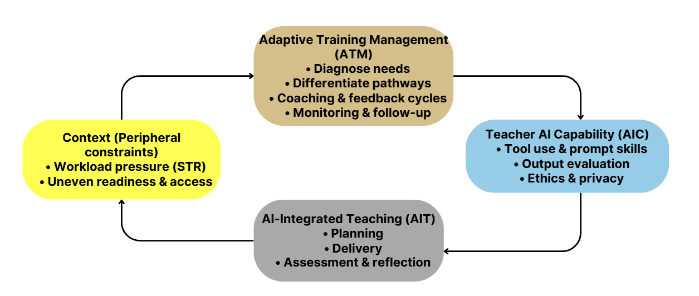
Beyond readiness, engagement shapes whether AI initiatives become sustained practice or remain short-lived pilots. Studies on AI adoption in schools identify organizational support, communication, and facilitation as key drivers of teacher engagement, reinforcing that implementation must be managed as an organizational change process rather than an individual skill upgrade [21, 22]. To make the study logic explicit prior to model development, the conceptual linkage among peripheral constraints, Adaptive Training Management (ATM) mechanisms, and instructional outcomes is summarized in Figure 1 [23].
Figure 1. Conceptual framework (pre-development model)
The teacher professional development (TPD) literature reinforces that AI-related training requires systematic design, reflective practice, and sustained support rather than one-off workshops. Recent reviews highlight that competency development depends on coherent training curricula, coaching strategies, and structured evaluation processes [24, 25]. Evidence also argues that capacity building should begin at pre-service stages to ensure education quality keeps pace with rapid AI developments and to address acceptance differences early in teacher formation [26-28].
Institutional AI capability may also relate to student psychological outcomes and learning performance, suggesting that organizational readiness and teacher capacity must be strengthened simultaneously. Evidence from higher education indicates that institutional AI capability can influence self-efficacy, creativity, and learning performance, implying that capability is partly systemic rather than purely individual [29]. For school systems, this strengthens the case for training models that embed monitoring, follow-up, and institutional routines to stabilize practice change over time.
These challenges are amplified in peripheral-city contexts, where training access, school readiness, and teachers’ technology experience often vary substantially. Studies on context and constraints emphasize that implementation success is shaped by local conditions, making uniform solutions inappropriate across regions and increasing the risk of uneven benefits across schools and teachers [30]. Against this backdrop, the present study develops and validates an ATM to support sustainable AI-integrated teaching in a peripheral-city context in Indonesia.
The novelty of this study lies in the development of an ATM that integrates teacher AI capability-building with school-level implementation management. Unlike general AI training programs that usually emphasize tool familiarization or short-term skill acquisition, ATM structures training as a managed cycle consisting of needs diagnosis, differentiated learning pathways, coaching intensity adjustment, implementation monitoring, and follow-up routines. The model also differs from generic instructional design models such as ADDIE because its adaptive logic is not limited to content design; it extends to training governance, readiness-based support, and workload-sensitive deployment in peripheral school systems. Therefore, the contribution of this study is not merely the introduction of another AI training label, but the operationalization of specific adaptive mechanisms that can help schools allocate professional development support according to teacher readiness and contextual burden.
Accordingly, this article addresses the following research questions:
2.1 Research design
This study adopted a Research and Development design because the main objective was to produce, validate, revise, and field-test a training-management model rather than to test causal effects through an experimental design. The R&D process consisted of five sequential phases: needs assessment, prototype specification, expert validation, field trial, and final revision. The needs assessment identified teacher readiness and contextual constraints; prototype specification translated these findings into the ATM structure; expert validation examined conceptual and operational validity; field testing assessed feasibility and descriptive field-trial evidence; and final revision refined the model based on expert comments and field-trial evidence.
The validation involved five experts selected purposively based on their relevance to TPD, educational management, educational technology, curriculum and instructional design, and AI-integrated instruction. The expert panel consisted of two professors in educational technology and TPD, one curriculum and instructional design specialist, one school-based training practitioner, and one AI-assisted learning practitioner.
The expert validation instrument used a five-point Likert scale ranging from 1 = very inappropriate to 5 = very appropriate. The validation dimensions included: (1) conceptual relevance of the model, (2) clarity of training syntax and management phases, (3) suitability of adaptive mechanisms for heterogeneous teacher readiness, (4) feasibility of implementation in public junior high schools, (5) adequacy of monitoring and follow-up procedures, and (6) clarity of supporting instruments. Expert scores were converted into percentage values using the formula: validity percentage = obtained score / maximum possible score × 100. The interpretation criteria were: 0–20% = very invalid, 21–40% = invalid, 41–60% = moderately valid, 61–80% = valid, and 81–100% = highly valid.
Qualitative comments from the experts were also analyzed to guide model revision. Feedback was grouped into three revision categories: conceptual refinement, operational clarification, and instrument improvement. These comments informed the final revision of the model before wider field testing.
2.2 Setting and participants
The field trial involved 50 teachers selected proportionally from public junior high schools in Lhokseumawe. All 50 participants completed the post-intervention teacher questionnaire used for feasibility assessment. Implementation fidelity was assessed through observation during the field trial. However, the pre–post AI competence assessment required complete paired data. Of the 50 participating teachers, 34 completed both the pre-test and post-test competence assessment and were therefore included in the N-Gain and pre–post effectiveness analysis. The remaining 16 participants were excluded from the paired effectiveness analysis because their pre-test or post-test data were incomplete. Thus, feasibility evidence was based on the field-trial participants who completed the questionnaire, while effectiveness evidence was based only on the complete paired dataset (n = 34).
2.3 Data sources and instruments
Three primary instruments were used:
For peripheral comparison, secondary administrative data from Mandailing Natal were used to compute workload indicators (student–teacher ratio (STR)) and classify subdistricts into burden segments.
2.4 Variables and operational definitions
The variables and their operational definitions are summarized in Table 1.
Table 1. Operational definitions and measurement
|
Variable |
Operational Definition |
Measurement Examples |
Scale |
|
Adaptive Training Management (ATM) |
Extent to which training is planned, delivered, and monitored using adaptive mechanisms aligned with teachers’ needs |
needs diagnosis, differentiated pathways/materials, coaching, feedback cycle, monitoring |
Likert 1–5 |
|
Teacher AI Capability (AIC) |
Teachers’ functional competence to use AI responsibly for instructional tasks |
tool selection, prompt formulation, output evaluation, ethics/privacy, lesson integration |
Likert 1–5 |
|
AI-Integrated Teaching (AIT) |
Teachers’ readiness/practice in integrating AI into planning, delivery, and assessment |
AI use in planning, instruction, assessment, reflection |
Likert 1–5 |
|
Workload context (student–teacher ratio (STR)) |
Contextual burden expressed by student–teacher ratio (STR) |
STR = total students / total teachers |
Ratio |
2.5 Data analysis
Analyses were conducted in four steps. First, descriptive statistics summarized participant characteristics and construct-level distributions (mean, SD). Second, workload segmentation computed STR values and classified subdistricts/schools into low/medium/high burden using tertile cut-offs (P33, P66) to identify dispersion in workload pressure for peripheral comparison. Third, model effectiveness was evaluated descriptively using pre–post change where complete paired AI competence assessment data were available. Improvement was summarized using normalized gain (N-Gain). Because the study was positioned as a Research and Development field-validation study and did not include a control group, no inferential significance testing was conducted. Therefore, the effectiveness evidence is interpreted as descriptive field-trial evidence pre–post improvement associated with the revised ATM model.
Expert validation and model feasibility scores were converted into percentages using the obtained score divided by the maximum possible score multiplied by 100. The results were then interpreted using predetermined validity and feasibility categories. Qualitative expert comments and field-readiness feedback were analyzed thematically to identify revision implications for the ATM prototype.
2.6 Ethical considerations
Permission was obtained from relevant education authorities and school leadership prior to data collection. Participation was voluntary with informed consent. Data were anonymized using coded identifiers and stored on access-restricted devices. Reporting was conducted in aggregate form only, and participants could withdraw at any stage without penalty.
3.1 Baseline condition and training need
Baseline diagnostics indicated heterogeneous teacher AI capability, with a meaningful share of teachers falling into low-capability categories. This pattern supports the need for training that differentiates content, pacing, and support intensity rather than applying a uniform package across participants.
3.2 Final product: Adaptive Training Management model
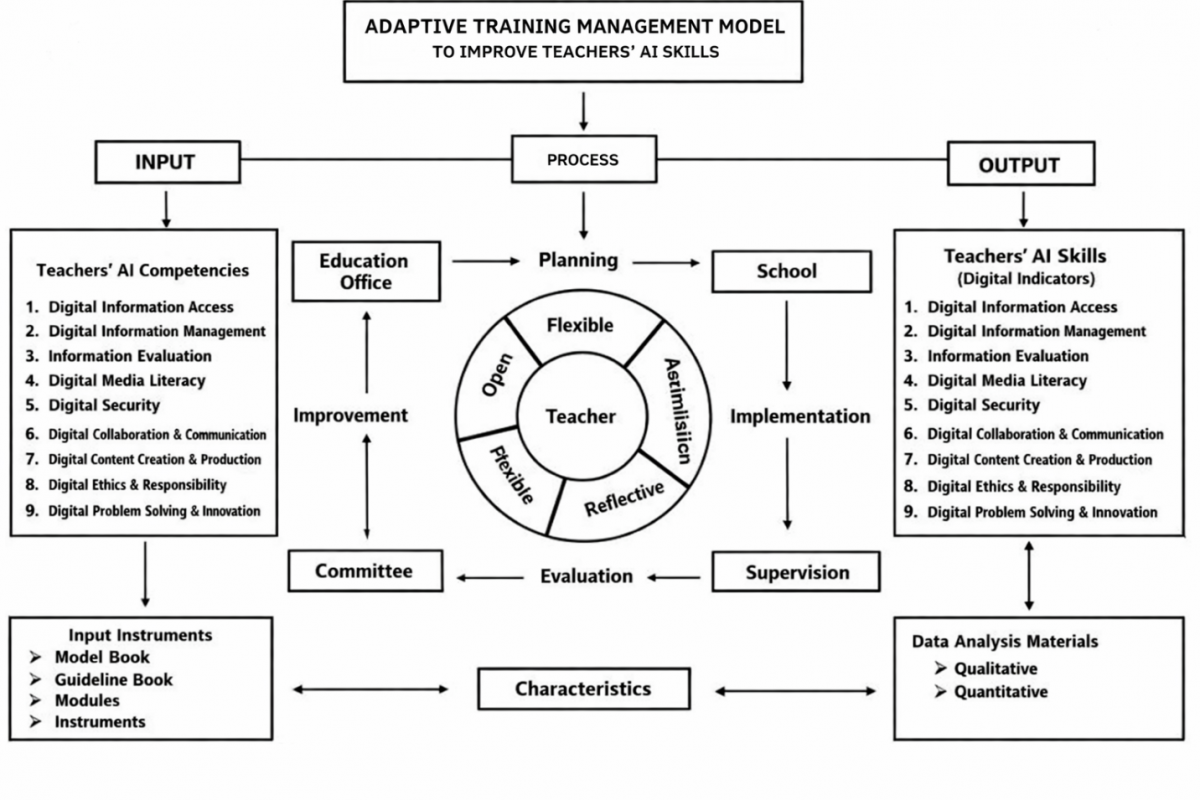
The study produced a finalized ATM that operationalizes training as a managed cycle: adaptive planning → adaptive implementation → adaptive evaluation and follow-up, supported by continuous refinement based on feedback and observed constraints during field application. The model architecture is presented in Figure 2.
Figure 2. Adaptive Training Management (ATM) model
3.3 Expert validation of the Adaptive Training Management prototype
The prototype of the ATM was validated by five experts before field implementation. The expert panel consisted of two professors in educational technology and TPD, one curriculum and instructional design specialist, one school-based training practitioner, and one AI-assisted learning practitioner. The validation was intended to ensure that the model was not only theoretically relevant but also operationally feasible for TPD in a peripheral-city school context.
The experts reviewed six main validation dimensions: conceptual relevance of the model, clarity of training syntax, suitability of adaptive mechanisms, feasibility for school implementation, monitoring and follow-up procedures, and supporting instruments. Validation was conducted using a structured expert-judgement sheet with a five-point rating scale. The scores were converted into percentages and interpreted using the following criteria: 81–100% = highly valid, 61–80% = valid, 41–60% = moderately valid, 21–40% = less valid, and 0–20% = invalid. Expert comments were also analyzed qualitatively to identify the specific parts of the prototype requiring revision before the field trial.
Table 2 presents the expert validation results.
Table 2. Expert validation results of the Adaptive Training Management (ATM) prototype
|
Validation Dimension |
Mean Score (%) |
Category |
Main Revision Implication |
|
Conceptual relevance of the model |
92.40 |
Highly valid |
The theoretical foundation of adaptive teacher training was retained, with minor refinement in the explanation of the relationship between AI competence, differentiated training, and professional development needs. |
|
Clarity of training syntax |
88.60 |
Highly valid |
The training sequence was clarified by making the stages of diagnosis, adaptive grouping, guided practice, coaching, reflection, and follow-up more explicit. |
|
Suitability of adaptive mechanisms |
86.80 |
Highly valid |
The adaptive pathway was strengthened by differentiating teacher support based on readiness level, technological competence, and instructional implementation capacity. |
|
Feasibility for school implementation |
84.20 |
Highly valid |
The model was adjusted to accommodate teachers with limited technological adaptation, especially those still accustomed to conventional teaching methods. |
|
Monitoring and follow-up procedures |
89.40 |
Highly valid |
The monitoring mechanism was refined through lesson-plan review, implementation reflection, peer feedback, and post-training coaching cycles. |
|
Supporting instruments |
87.20 |
Highly valid |
The observation sheets, reflection forms, and AI competence assessment instruments were revised to improve clarity, usability, and alignment with the training objectives. |
|
Overall validation score |
88.10 |
Highly valid |
The ATM prototype was considered highly valid and appropriate for field testing after minor operational revisions. |
The overall validation result indicated that the ATM prototype was highly valid for field testing. The strongest validation score was found in the conceptual relevance of the model, indicating that the experts considered the ATM prototype to have a strong theoretical basis and clear relevance to TPD. The monitoring and follow-up procedures also received a high score, showing that the experts regarded the model as having a systematic mechanism for tracking teacher progress after training.
Expert comments emphasized several important points. First, the sequence of adaptive diagnosis needed to be made more explicit so that teachers could be mapped according to their initial AI competence and readiness level. Second, the differentiation of training pathways needed to be strengthened because not all teachers had the same technological capability. Third, the follow-up mechanism needed to be operationalized more clearly to ensure that the training did not stop at workshop participation but continued into classroom implementation.
These expert comments were consistent with the descriptive field-trial evidence involving 50 teachers. Approximately 80% of the teachers perceived the monitoring and evaluation design as good and applicable. However, around 20% indicated that technology adaptation remained a significant obstacle, especially because some teachers were still accustomed to conventional teaching methods and required more time to understand how AI could be integrated into teaching practice. This finding did not weaken the validity of the model; rather, it confirmed the need for adaptive differentiation within the training design.
In response to the expert validation and field-readiness feedback, the revised ATM model added clearer procedures for initial teacher capability mapping, differentiated training support based on readiness levels, structured coaching cycles, and post-training monitoring through lesson-plan review and implementation reflection. These revisions strengthened the operational logic of the model and ensured that the prototype was sufficiently valid, feasible, and context-sensitive before being tested with teachers in public junior high schools.
3.4 Model feasibility and appropriateness
After expert validation and prototype revision, the feasibility of the ATM was assessed through the field-trial participants’ responses. Feasibility was evaluated to determine whether the model could be implemented practically in public junior high schools in a peripheral-city context. The assessment focused on three management phases: adaptive planning, adaptive implementation, and evaluation and follow-up.
Table 3 presents the feasibility results of the ATM model.
Table 3. Feasibility of the Adaptive Training Management (ATM) model by management phase
|
Model Phase |
Mean Feasibility (%) |
Category |
|
Adaptive planning |
78.45 |
Feasible |
|
Adaptive implementation |
83.74 |
Highly feasible |
|
Evaluation and follow-up |
84.85 |
Highly feasible |
|
Overall feasibility |
81.67 |
Highly feasible |
The feasibility findings also indicate that ATM was not perceived merely as a conceptual model but as an implementable training-management procedure. The high scores in implementation and evaluation/follow-up suggest that the model’s strongest operational value lies in its ability to structure training delivery, feedback, and post-training monitoring. This is important in peripheral school contexts, where training outcomes may decline when follow-up mechanisms are weak or when teacher readiness differs substantially across schools.
The overall feasibility score of 81.67% indicates that the ATM model was considered highly feasible for implementation. Among the three management phases, evaluation and follow-up received the highest score, followed by adaptive implementation and adaptive planning. This pattern suggests that teachers and implementers perceived the model as particularly useful in supporting post-training monitoring, feedback, and continuous improvement.
The relatively lower score in adaptive planning does not indicate model weakness, but rather reflects the additional preparation required to diagnose teacher readiness, classify training needs, and design differentiated support pathways. This finding is consistent with the adaptive nature of the model, because effective implementation depends on careful initial mapping of teacher capability and contextual constraints. Overall, the feasibility evidence supports the use of ATM as a practical training-management model for AI-integrated TPD in peripheral school settings.
3.5 Effectiveness in improving teacher AI capability
The effectiveness of the ATM was evaluated descriptively using N-Gain based on complete paired pre-test and post-test AI competence data. Although 50 teachers participated in the field trial, only 34 teachers completed both the pre-test and post-test AI competence assessment. Therefore, the N-Gain analysis was conducted only on these 34 complete paired cases. The full field-trial sample was retained for feasibility-related evidence, while the effectiveness analysis was restricted to participants with valid paired competence data.
N-Gain was used because this study was designed as a Research and Development study focused on model development, refinement, and descriptive field-trial evidence. In this context, N-Gain provides a descriptive index of improvement by comparing the actual gain achieved by participants with the maximum possible gain that could be obtained. The formula used was:
g = (Post-test score − Pre-test score) / (Maximum possible score − Pre-test score)
The N-Gain value was interpreted as high if g ≥ 0.70, medium if 0.30 ≤ g < 0.70, and low if g < 0.30. In the limited trial, the mean N-Gain was 0.36, indicating medium improvement. This finding was used to guide model revision, particularly by clarifying the training sequence, strengthening practice-based AI tasks, and adding more structured coaching and feedback procedures. After revision, the final field trial produced a mean N-Gain of 0.91, indicating high descriptive improvement in teacher AI capability.
To avoid confusion between raw competence scores and N-Gain values, Table 4 separates the descriptive competence score from the N-Gain interpretation. The value of 24.56 represents the mean post-test competence score, not the N-Gain index.
These results suggest that teachers who completed the paired assessment demonstrated substantial descriptive improvement in AI competence after participating in the revised ATM field trial. However, because this study did not include a control group and did not conduct inferential significance testing, the findings should be interpreted as descriptive pre–post improvement associated with the intervention rather than definitive causal evidence. The result provides descriptive field-trial effectiveness evidence appropriate for the field-validation stage of an R&D study, while future studies should employ quasi-experimental or comparative designs to test the model’s effectiveness more rigorously.
Table 4. Descriptive pre–post effectiveness evidence based on complete paired cases
|
Metric |
Value |
|
Field-trial participants |
50 |
|
Valid paired cases for N-Gain analysis |
34 |
|
Mean post-test competence score |
24.56 |
|
SD of post-test competence score |
1.710 |
|
Minimum post-test score |
20 |
|
Maximum post-test score |
27 |
|
Mean pre–post improvement |
13.18 |
|
Mean normalized gain (N-Gain) |
0.91 |
|
N-Gain interpretation |
High descriptive improvement |
3.6 Contextual workload benchmarking using student–teacher ratio
The workload analysis was not intended to serve as intervention evidence. The ATM intervention was conducted only in public junior high schools in Lhokseumawe. Mandailing Natal was included as a contextual comparator because it represents another peripheral education context in North Sumatra with administrative teacher–student data available at the subdistrict level. The purpose of this comparison was to illustrate how aggregate STR values can conceal internal workload dispersion across peripheral subunits. Therefore, Mandailing Natal data were used only to support workload-sensitive deployment logic, not to infer the effectiveness of ATM in Mandailing Natal.
Peripheral education systems often operate under uneven staffing patterns and access constraints. Workload context was therefore formalized using the STR as a parsimonious indicator of instructional pressure.
3.6.1 Metrics and formulae
$S T R=\frac{\text { Total students }}{\text { Total teachers }}$
To support cross-context interpretation, a Relative Burden Index (RBI) was computed against a benchmark:
$R B I=\frac{S T R_{\text {context }}}{S T R_{\text {benchmark }}}$
The benchmark used was the OECD average lower-secondary STR (≈13 students per teacher).
3.6.2 Aggregated comparison (Mandailing Natal vs Lhokseumawe and external benchmarks)
Mandailing Natal aggregated administrative data indicated 14,514 students and 1,702 teachers:
$S T R_{\text {Mandailing }}=\frac{14514}{1702}=8.53$
For Lhokseumawe (SMP, 2017/2018), 7,835 students and 737 teachers were reported:
$S T R_{\text {Lhokseumawe }}=\frac{7835}{737}=10.63$
External benchmarking indicated Vietnam’s lower-secondary pupil–teacher ratio of 17.55 (2018) and an OECD lower-secondary average of approximately 13 (Table 5).
Table 5. Aggregated student–teacher ratio (STR) and relative burden across contexts
|
Context |
Level |
Students |
Teachers |
STR |
RBI vs OECD (13) |
|
Mandailing Natal (Indonesia) |
Peripheral regency |
14,514 |
1,702 |
8.53 |
0.66 |
|
Lhokseumawe (Indonesia) |
Peripheral city |
7,835 |
737 |
10.63 |
0.82 |
|
Vietnam |
National (lower secondary) |
— |
— |
17.55 |
1.35 |
|
OECD average |
Cross-country |
— |
— |
~13.00 |
1.00 |
Note: STR = Student–Teacher Ratio, RBI = Relative Burden Index.
3.6.3 Internal workload segmentation (Mandailing Natal, distributional evidence)
Beyond the aggregate STR, Mandailing Natal showed meaningful dispersion across 24 subunits. Using tertile cut-offs on subunit STR values, segments were defined as:
•Low burden: STR ≤ 6.81
•Medium burden: 6.81 < STR ≤ 8.95
•High burden: STR > 8.95
The distribution was: P33 = 6.81, P66 = 8.95, mean STR = 7.93, median STR = 8.11, range = 2.21–12.06. Segment counts were balanced: low = 8, medium = 8, high = 8. The segmentation summary is visualized in Figure 3.
Figure 3. Student–teacher ratio (STR) distribution summary (Mandailing Natal, tertile segmentation)
3.6.4 Implications for model deployment
The comparative evidence indicates that Lhokseumawe operates at a higher aggregate STR than Mandailing Natal, while both remain below the OECD benchmark and substantially below Vietnam’s reported ratio. More importantly, the Mandailing Natal segmentation demonstrates that moderate aggregate STR can mask substantial internal dispersion. This distributional pattern implies that uniform training packages may under-serve high-burden subunits and over-invest in low-burden subunits. The ATM directly addresses this challenge by enabling calibration of pacing, coaching intensity, and follow-up mechanisms according to workload context.
3.7 Discussion
The findings provide field-validation evidence that the ATM is valid, feasible, and supported by descriptive pre–post improvement in teacher AI capability. The expert validation score of 88.10% indicates that the model had strong conceptual and operational acceptability before field implementation. This is important because AI-oriented teacher development requires more than tool familiarization; it requires a coherent structure that links AI literacy, pedagogical use, ethical awareness, and professional learning routines [20, 23]. The feasibility score of 81.67% further indicates that the model could be implemented practically in public junior high schools in a peripheral-city context.
The improvement from medium N-Gain in the limited trial to high descriptive N-Gain after revision should still be interpreted within the scope of an R&D field-validation design. Since this study did not use a control group and did not conduct inferential significance testing, the findings should not be read as definitive causal attribution. Nevertheless, the pattern of improvement provides meaningful field-trial evidence that the revised model strengthened teacher AI capability through its adaptive management logic, including initial diagnosis, differentiated learning activities, guided practice, coaching, feedback, and follow-up. This interpretation aligns with previous studies showing that teachers’ AI adoption depends on readiness, behavioral intention, perceived usefulness, and structured professional development support [18, 22, 24, 25]. It is also consistent with professional development literature emphasizing coherent content, active learning, implementation support, and sustained follow-up as important conditions for teacher learning and practice change [31, 32].
The conceptual contribution of ATM lies in its integration of adaptive training design and educational management logic. Existing TPD frameworks emphasize content focus, active learning, coherence, duration, and collective participation, while AI teacher training studies commonly focus on readiness, acceptance, AI literacy, and tool-related competence [20, 23, 31]. ATM extends these perspectives by converting AI capability-building into an institutional management cycle. Its adaptive character is expressed through four operational mechanisms: initial diagnosis of teacher AI capability, differentiated training pathways based on readiness, calibrated coaching intensity during implementation, and structured follow-up to stabilize classroom transfer. Therefore, the novelty of ATM does not rest merely on the term “adaptive,” but on the operational linkage between readiness diagnosis, differentiated support, implementation monitoring, and workload-sensitive deployment.
The contextual workload benchmarking further supports the need for adaptive deployment. The Mandailing Natal data were not used as intervention evidence, but they illustrate that aggregate STR values can conceal internal workload dispersion across peripheral subunits. This has practical implications for AI-oriented professional development. Teachers in higher-burden contexts may have less time to experiment with AI-supported lesson design, complete reflective assignments, or participate in extended coaching cycles. For this reason, training intensity, coaching frequency, asynchronous support, and follow-up routines should be calibrated according to teacher readiness and contextual workload conditions.
From an implementation perspective, ATM may help education offices and school leaders move from one-off AI workshops toward a more sustainable professional development system. The model can be institutionalized as a standard operating cycle: diagnose teacher readiness, differentiate training pathways, provide guided practice, monitor implementation, and conduct structured follow-up. This cycle is important because program outcomes are strongly influenced by implementation quality and continuity of support. In practical terms, schools should formalize post-training follow-up through peer sharing, AI-integrated lesson try-outs, review of lesson plans, and short reflective audits. These mechanisms can help protect implementation fidelity and reduce the risk that AI training remains only a short-term intervention without classroom transfer.
The study developed and validated an ATM to strengthen teachers’ AI capability and support sustainable AI-integrated teaching in a peripheral-city context. The findings indicate that the model is practically implementable and functions as an operational training cycle that links needs diagnosis, differentiated learning pathways, coaching and feedback routines, and structured monitoring to descriptive pre–post improvement in teacher AI capability. By framing training as a managed and adaptive process rather than a one-off program, the model provides a feasible mechanism for reducing uneven training benefits that often emerge under heterogeneous readiness and peripheral constraints, while also offering a replicable structure for governance-aligned AI integration at the school level.
Based on these results, education offices and school leaders should institutionalize ATM as a standard operating cycle for AI-oriented professional development, with support intensity calibrated to workload context and readiness differences. Implementation should prioritize sustained follow-up—such as peer coaching, lesson try-outs, and brief audits of AI-integrated lesson plans—to preserve fidelity and translate capability gains into classroom practice. For future research, the model should be tested in wider regions and compared across different workload segments, and evaluation should extend beyond teacher capability gains to include downstream indicators such as instructional quality, assessment integrity, and student learning outcomes to establish broader effectiveness and scalability.
Another limitation is that the study did not include a control group and did not conduct inferential significance testing. Therefore, the reported N-Gain should be interpreted as descriptive field-trial evidence rather than definitive causal evidence. In addition, the effectiveness analysis was based on 34 complete paired cases out of 50 field-trial participants, which may limit the generalizability of the pre–post improvement results.
The authors thank Universitas Negeri Medan and Universitas Malikussaleh for institutional support and facilitation of this doctoral study. The doctoral candidate is Sayni Nasrah, supervised by Rosmala Dewi and Arif Rahman. A collaborator from Universitas Sumatera Utara contributed only by compiling comparative workload datasets (Mandailing Natal and Vietnam) for contextual benchmarking Arga Abdi Rafiud Darajat Lubis.
[1] Lameras, P., Arnab, S. (2021). Power to the teachers: An exploratory review on artificial intelligence in education. Information, 13(1): 14. https://doi.org/10.3390/info13010014
[2] Celik, I., Dindar, M., Muukkonen, H., Järvelä, S. (2022). The promises and challenges of artificial intelligence for teachers: A systematic review of research. TechTrends, 66(4): 616-630. https://doi.org/10.1007/s11528-022-00715-y
[3] Chounta, I.A., Bardone, E., Raudsep, A., Pedaste, M. (2022). Exploring teachers’ perceptions of artificial intelligence as a tool to support their practice in Estonian K-12 education. International Journal of Artificial Intelligence in Education, 32(3): 725-755. https://doi.org/10.1007/s40593-021-00243-5
[4] Swiecki, Z., Khosravi, H., Chen, G., et al. (2022). Assessment in the age of artificial intelligence. Computers and Education: Artificial Intelligence, 3: 100075. https://doi.org/10.1016/j.caeai.2022.100075
[5] Rospigliosi, P.A. (2023). Artificial intelligence in teaching and learning: What questions should we ask of ChatGPT? Interactive Learning Environments, 31(1): 1-3. https://doi.org/10.1080/10494820.2023.2180191
[6] Zhang, J. (2024). Application of artificial intelligence tools in educational assessment: Enhancing teaching and learning management in Beijing Junior High Schools. Eurasian Journal of Educational Research, 112: 301-320. https://doi.org/10.14689/ejer.2024.112.017
[7] O’Hara, S., Naicker, S. (2022). Local commitment and global reach: Advancing sustainable capacity building in higher education. World, 3(4): 783-801. https://doi.org/10.3390/world3040044
[8] Kabudi, T., Pappas, I., Olsen, D.H. (2021). AI-enabled adaptive learning systems: A systematic mapping of the literature. Computers and Education: Artificial Intelligence, 2: 100017. https://doi.org/10.1016/j.caeai.2021.100017
[9] Mirata, V., Hirt, F., Bergamin, P., van der Westhuizen, C. (2020). Challenges and contexts in establishing adaptive learning in higher education: Findings from a Delphi study. International Journal of Educational Technology in Higher Education, 17(1): 32. https://doi.org/10.1186/s41239-020-00209-y
[10] Gligorea, I., Cioca, M., Oancea, R., Gorski, A.T., Gorski, H., Tudorache, P. (2023). Adaptive learning using artificial intelligence in e-learning: A literature review. Education Sciences, 13(12): 1216. https://doi.org/10.3390/educsci13121216
[11] Zgheib, G., Al Daia, R., Serhan, M. (2023). A contextual approach for exploring faculty readiness to teach online. Heliyon, 9(10): e20491. https://doi.org/10.1016/j.heliyon.2023.e20491
[12] Alam, A. (2022). Employing adaptive learning and intelligent tutoring robots for virtual classrooms and smart campuses: Reforming education in the age of artificial intelligence. In Lecture Notes in Electrical Engineering, pp. 395-406. https://doi.org/10.1007/978-981-19-2980-9_32
[13] Wang, S., Christensen, C., Cui, W., et al. (2023). When adaptive learning is effective learning: Comparison of an adaptive learning system to teacher-led instruction. Interactive Learning Environments, 31(2): 793-803. https://doi.org/10.1080/10494820.2020.1808794
[14] Demartini, C.G., Sciascia, L., Bosso, A., Manuri, F. (2024). Artificial intelligence bringing improvements to adaptive learning in education: A case study. Sustainability, 16(3): 1347. https://doi.org/10.3390/su16031347
[15] McGrath, C., Pargman, T.C., Juth, N., Palmgren, P.J. (2023). University teachers' perceptions of responsibility and artificial intelligence in higher education - An experimental philosophical study. Computers and Education: Artificial Intelligence, 4: 100139. https://doi.org/10.1016/j.caeai.2023.100139
[16] Holmes, W., Miao, F. (2023). Guidance for Generative AI in Education and Research. UNESCO Publishing.
[17] Hockly, N. (2023). Artificial intelligence in English language teaching: The good, the bad and the ugly. RELC Journal, 54(2): 445-451. https://doi.org/10.1177/00336882231168504
[18] Ayanwale, M.A., Sanusi, I.T., Adelana, O.P., Aruleba, K.D., Oyelere, S.S. (2022). Teachers’ readiness and intention to teach artificial intelligence in schools. Computers and Education: Artificial Intelligence, 3: 100099. https://doi.org/10.1016/j.caeai.2022.100099
[19] Salas-Pilco, S.Z., Xiao, K., Hu, X. (2022). Artificial intelligence and learning analytics in teacher education: A systematic review. Education Sciences, 12(8): 569. https://doi.org/10.3390/educsci12080569
[20] Long, D., Magerko, B. (2020). What is AI literacy? Competencies and design considerations. In Proceedings of the 2020 CHI Conference on Human Factors in Computing Systems, Honolulu, HI, USA, pp. 1-16. https://doi.org/10.1145/3313831.3376727
[21] Cukurova, M., Miao, X., Brooker, R. (2023). Adoption of artificial intelligence in schools: Unveiling factors influencing teachers’ engagement. In International Conference on Artificial Intelligence in Education, pp. 151-163. https://doi.org/10.1007/978-3-031-36272-9_13
[22] An, X., Chai, C.S., Li, Y., et al. (2023). Modeling English teachers’ behavioral intention to use artificial intelligence in middle schools. Education and Information Technologies, 28(5): 5187-5208. https://doi.org/10.1007/s10639-022-11286-z
[23] Miao, F., Cukurova, M. (2024). AI Competency Framework for Teachers. UNESCO Publishing. https://doi.org/10.54675/ZJTE2084
[24] Nurtanto, M., Nawanksari, S., Sutrisno, V.L.P., et al. (2025). Determinants of behavioral intentions and their impact on student performance in the use of AI technology in higher education in Indonesia: A SEM-PLS analysis based on TPB, UTAUT, and TAM frameworks. Social Sciences & Humanities Open, 11: 101638. https://doi.org/10.1016/j.ssaho.2025.101638
[25] Harsanti, H.R., Sudibjo, N., Riady, S., Yu, P. (2025). Exploring Indonesian teachers’ intention to use artificial intelligence in schools: The impact of digital leadership, digital readiness, and perceived usefulness. Cogent Social Sciences, 11(1): 2593596. https://doi.org/10.1080/23311886.2025.2593596
[26] Altinay, Z., Altinay, F., Sharma, R.C., et al. (2024). Capacity building for student teachers in learning, teaching artificial intelligence for quality of education. Societies, 14(8): 148. https://doi.org/10.3390/soc14080148
[27] Al Darayseh, A. (2023). Acceptance of artificial intelligence in teaching science: Science teachers' perspective. Computers and Education: Artificial Intelligence, 4: 100132. https://doi.org/10.1016/j.caeai.2023.100132
[28] Zhang, C., Schießl, J., Plößl, L., Hofmann, F., Gläser-Zikuda, M. (2023). Acceptance of artificial intelligence among pre-service teachers: A multigroup analysis. International Journal of Educational Technology in Higher Education, 20(1): 49. https://doi.org/10.1186/s41239-023-00420-7
[29] Wang, S., Sun, Z., Chen, Y. (2023). Effects of higher education institutes’ artificial intelligence capability on students' self-efficacy, creativity and learning performance. Education and Information Technologies, 28(5): 4919-4939. https://doi.org/10.1007/s10639-022-11338-4
[30] Morze, N., Varchenko-Trotsenko, L., Terletska, T., Smyrnova-Trybulska, E. (2021). Implementation of adaptive learning at higher education institutions by means of Moodle LMS. Journal of Physics: Conference Series, 1840(1): 012062. https://doi.org/10.1088/1742-6596/1840/1/012062
[31] Desimone, L.M. (2009). Improving impact studies of teachers’ professional development: Toward better conceptualizations and measures. Educational Researcher, 38(3): 181-199. https://doi.org/10.3102/0013189X08331140
[32] Guskey, T.R. (2002). Professional development and teacher change. Teachers and Teaching, 8(3): 381-391. https://doi.org/10.1080/135406002100000512