Eko Purwanto* | Mirza Shahreza | Lenni
© 2026 The authors. This article is published by IIETA and is licensed under the CC BY 4.0 license (http://creativecommons.org/licenses/by/4.0/).
OPEN ACCESS
Achieving sustainable food security remains a major challenge in developing countries amid climate change, population growth, and degrading agricultural resources. This study examines how Collaborative Development Communication (CDC) empowers millennial farmers through smart farming, using a qualitative single-case study design in Garut Regency, Indonesia. Data were collected over two rounds of fieldwork between 11 and 22 May 2026 through nine semi-structured interview sessions with eight purposively selected informants across government, community, and business stakeholder categories, participatory observation at five sites, and a documentary corpus of fourteen sources, analysed using reflexive thematic analysis. Four themes were developed: Pentahelix collaborative communication as the institutional foundation of smart farming; millennial farmers as communication bridge actors connecting digital technologies with local knowledge; intergenerational collaborative communication between senior and millennial farmers; and communication outcomes for productivity, regeneration, and green economy practices. Two contrasting cases, in which technology arrived without a collaborative communication structure, delimit these patterns. The study proposes the CDC Model, positioning communication as the institutional infrastructure of agricultural transformation. Because one millennial farmer was interviewed and the media and academic dimensions rest on documents, the model is an analytically generalisable proposition requiring multi-site testing.
Collaborative Development Communication, food security, intergenerational communication, millennial farmers, Pentahelix, smart farming
Sustainable food security is among the most pressing challenges facing developing countries amid accelerating climate change, population growth, and degradation of agricultural resources [1-3]. Conventional farming systems increasingly cannot ensure long-term food availability [4, 5]. Achieving Sustainable Development Goal (SDG) 2 (Zero Hunger) requires not only technological innovation but communication capable of strengthening farmers’ capacities and fostering multi-stakeholder collaboration [6-8].
Smart farming integrates the Internet of Things (IoT), sensors, artificial intelligence, and data analytics to improve agricultural efficiency [9-11]. Its implementation in developing countries, however, faces limited digital literacy, inadequate infrastructure, and insufficient communication among development actors [12-14], suggesting that digital transformation depends as much on communication as on technology [15, 16].
Previous studies have focused on technological innovation, productivity, and adoption, with little attention to how development communication connects government, universities, the private sector, farmer communities, and media. Work on collaborative governance similarly emphasises institutional arrangements over the communication processes enabling trust-building and joint decision-making.
In Indonesia, millennial farmers (aged 19–39) are recognised as strategic actors in agricultural regeneration [17, 18], yet their empowerment remains constrained by limited access to technology, capital, and market information, and by communication that remains top-down rather than participatory [19, 20].
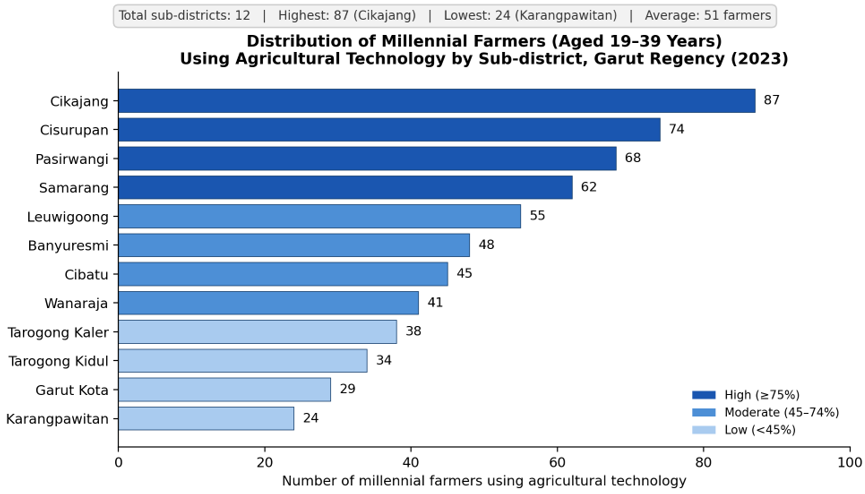
This is particularly evident in Garut Regency, a leading horticultural production centre implementing smart farming. The 2023 Agricultural Census shows considerable variation in millennial farmers’ technology use across sub-districts (Figure 1) [21]. These census data are descriptive and do not identify the sources of that variation; communication arrangements are one plausible contributing factor alongside infrastructure, capital, and agro-ecological conditions [22-24]. Rather than treating the pattern as evidence of a communication effect, this study takes it as the starting point for qualitative examination and formulates the relationship as a proposition for future comparative research (Section 5.4).
This study therefore analyses how Collaborative Development Communication (CDC) supports the empowerment of millennial farmers through smart farming in Garut Regency. Three questions guide the analysis: how communication is organised among stakeholders; what communicative roles millennial and senior farmers perform; and under what conditions collaborative communication translates into food security outcomes. The study proposes a CDC Model integrating participatory communication, collaborative governance, and the Pentahelix approach, extending linear diffusion perspectives by positioning communication as a process of dialogue, trust-building, co-learning, and collaboration. As a model derived from a single case, it is advanced as a proposition open to testing rather than a validated framework [25].
2.1 From Diffusion of Innovations to collaborative governance
Development communication has evolved from linear diffusion toward dialogic, collaborative models. Rogers’ Diffusion of Innovations theory conceptualised communication as linear transmission through sequential stages [26], but was criticised for privileging one-way transfer over dialogue and local knowledge [27]. Freire [28] reconceptualised communication as dialogic, positioning communities as active knowledge-creators, while Servaes [29] emphasised cultural diversity and mutual learning over technology transfer. These developments gave rise to CDC, which treats communication as a process facilitating dialogue, collective learning, trust-building, and shared decision-making [30]. Collaborative governance adds an institutional lens for addressing complex public problems through cross-sector collaboration [31, 32]: communication is the mechanism through which government, academic, private, and community actors exchange knowledge, negotiate objectives, and coordinate resources.
2.2 The Pentahelix model and the conceptual foundation of the Collaborative Development Communication Model
In Indonesia, collaborative development increasingly follows the Pentahelix model, integrating government, academia, business, community, and media [33, 34]: government provides policy direction; universities contribute scientific knowledge; the private sector supplies technology; farmer communities contribute local knowledge; and media strengthens public awareness. These perspectives indicate that sustainable agricultural transformation cannot be explained by technology diffusion alone — participatory communication highlights dialogue and empowerment, collaborative governance emphasises institutional coordination, and the Pentahelix approach explains multi-actor roles — yet they have rarely been integrated to explain communication processes in smart farming.
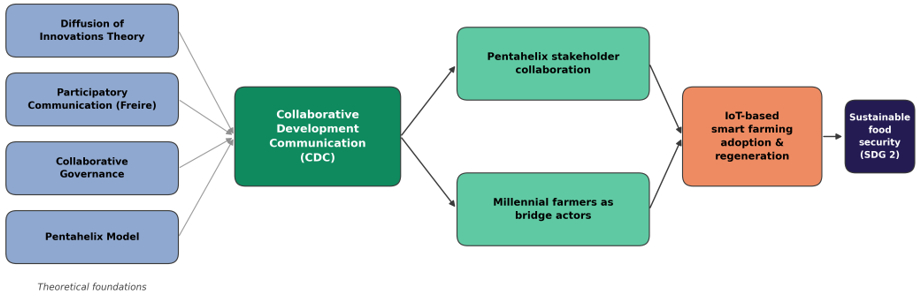
This study develops an integrated conceptual foundation examining how communication facilitates collaboration among these five actors in empowering millennial farmers, conceptualising communication as dialogue, trust-building, knowledge co-creation, and collective decision-making. It is refined through empirical findings into the CDC Model, and summarised in Figure 2.
Figure 2. Conceptual framework: A Collaborative Development Communication (CDC) Model for sustainable smart farming, empowering millennial farmers for food security
3.1 Research design
This study employed a qualitative single-case study design to examine CDC in empowering millennial farmers through smart farming in Garut Regency, Indonesia [34]. The case is defined as the smart farming ecosystem of the regency, examined through five embedded sub-units. Garut was purposively selected as a leading horticultural centre implementing smart farming with government, university, farmer-organisation, and agritech involvement. A single-case design was selected because the study seeks analytical rather than statistical generalisation: the objective is a transferable conceptual model of communication processes, not an estimate of their distribution across villages [25, 35].
3.2 Research participants
Informants were selected purposively on the basis of direct involvement in smart farming implementation, representing Pentahelix stakeholder groups. Selection required at least six months’ involvement, representation of a stakeholder category, and willingness to provide detailed information. At the time of fieldwork, one millennial farmer met the inclusion criteria as an active smart farming practitioner in the primary case site; the consequences for the strength of the evidence are addressed in Sections 3.6, 4.2, and 6.
Sample size was governed by information power rather than a numerical saturation threshold [36]. Four conditions increase the information power of this sample: a narrow aim (communication processes within one bounded ecosystem); informants occupying specific and highly relevant institutional positions rather than drawn from a general population; an established supporting theory; and dialogue-rich, extended interviews, one of them repeated. Consistent with critiques of saturation as a rationale within reflexive thematic analysis [35], no claim is made that the full range of possible themes has been exhausted. The narrower claim is that, within this bounded case, later interviews and the documentary corpus generated no new analytic categories relevant to the research questions, while additional stakeholder groups — particularly media and university actors — would in all likelihood generate further themes.
3.3 Data collection
Fieldwork was conducted across six field days in two rounds, 11–13 May and 18–22 May 2026, using three complementary strategies. First, nine semi-structured interview sessions were held with the eight informants in Table 1 (45–90 minutes each, in Bahasa Indonesia, audio-recorded with informed consent and transcribed verbatim); KP1 was interviewed twice to follow up on the operational status of the smart greenhouse. Second, participatory observation was undertaken at the five sites in Table 2, including walk-throughs of greenhouse control panels, sensor arrays, and sprinkler systems. Third, a documentary corpus of fourteen items was analysed: the 2023 Agricultural Census tabulations [21]; the village–university partnership agreement with village programme and cooperative records; a state-enterprise release on IoT smart farming in three sub-districts [37]; a ministry award citation [38]; a peer-reviewed study on digital extension service adoption [39]; regional press on agricultural modernisation [40]; and national media profiles of Garut millennial farmers [41]. Because no media practitioner was interviewed, this corpus is the study’s only empirical access to the media dimension and is interpreted accordingly. Triangulation was conducted across interviews, observation, and documents.
Table 1. Research informant profile (purposive sampling)
|
No. |
Participant Code |
Stakeholder Category |
Location |
Relevance to Research |
|
1 |
HD |
Village government representative |
Kec. Cibatu |
Smart farming policy maker & Pentahelix initiator at village level |
|
2 |
PM1 |
Millennial farmer (smart farming practitioner) |
Desa Karya Mukti |
Primary smart farming practitioner; TikTok/Facebook content creator |
|
3 |
KT1 |
Senior farmer group representative |
RW 3 & 4, Kec. Cibatu |
Senior farmer; intergenerational knowledge transfer agent |
|
4 |
KP1 |
Technology Transfer Station representative |
Desa Cikandang, Kec. Cikajang |
Smart greenhouse manager; multi-stakeholder collaboration hub |
|
5 |
DP1 |
District government representative (agriculture) |
Garut Regency |
Government actor; agricultural digitalization policy & regulation |
|
6 |
DP2 |
District government representative (infrastructure) |
Garut Regency |
Technology infrastructure & extension coordination |
|
7 |
KT2 |
Farmer group representative |
Kec. Banyuresmi |
Semi-smart greenhouse recipient; adoption process informant |
|
8 |
PK1 |
Technology field supervisor |
Kec. Wanaraja |
Technology operations; practical barriers to IoT implementation |
Table 2. Research sites and data collection overview
|
Research Site |
Sub-district |
Program/Focus |
Stakeholders Involved |
Data Collection Method |
|
Desa Karya Mukti |
Cibatu |
IoT-based smart farming & cooperative (KDMP) |
Village govt, UIN Sunan Kalijaga, private sector, farmer groups, KWT |
In-depth interview, observation, document analysis |
|
TTP Cikandang |
Cikajang |
Smart greenhouse, precision agriculture, seed production |
Gapoktan, BBSDLP, BRIN, Universitas Garut, private pesticide companies |
In-depth interview, field observation |
|
Smart GH Dangdeur |
Banyuresmi |
Semi-smart greenhouse (government-assisted) |
Dinas Pertanian, farmer groups |
In-depth interview |
|
Smart GH Wanaraja |
Wanaraja |
Smart greenhouse supervision & monitoring |
Private sector, Dinas Pertanian |
In-depth interview, observation |
|
Dinas Pertanian Kab. Garut |
Garut City |
Agricultural policy, drone program, digitalization |
Kementan, BRIN, 42 sub-districts, extension workers |
In-depth interview, document analysis |
3.4 Data analysis
Data were analysed using Braun and Clarke’s reflexive thematic analysis [42], combining inductive and deductive strategies through familiarisation, initial coding, theme searching, reviewing, defining, and reporting. Coding proceeded through three levels: open coding identified initial concepts; axial coding organised these into categories describing communication patterns, stakeholder collaboration, and technology adoption; and selective coding integrated relationships among themes to develop the CDC Model. A deliberate search for disconfirming evidence was also conducted: sites and accounts that did not fit the emerging pattern were retained and analysed as negative cases (Section 4.5).
3.5 Trustworthiness and research ethics
Trustworthiness was strengthened through source and methodological triangulation, peer debriefing between the first and second authors on coding consistency, member checking of key episodes with HD, PM1, and KP1, negative-case analysis, and an audit trail linking each claim to transcripts, field notes, or documents. Interview extracts in Section 4 were translated from Bahasa Indonesia by the authors and back-checked against the original transcripts; informant codes accompany each extract. Participants provided informed consent, confidentiality was protected through research codes, and data were used exclusively for academic purposes [43].
3.6 Scope of stakeholder coverage
The Pentahelix framework specifies five stakeholder categories. The interview sample covers government (HD, DP1, DP2), community (PM1, KT1, KT2), and, partially, business — through PK1, who supervises a privately financed smart greenhouse, and KP1, whose station hosts collaborations with agritech and agro-input firms. Two categories are not represented by direct informants.
No media practitioner (journalist, editor, or content producer) was interviewed. The media dimension is examined only through documentary traces — press reporting on village smart farming and national awards [38, 40], a state-enterprise release [37], and media profiles of millennial farmers [41] — together with informants’ accounts of their own media exposure and social media practice. Similarly, no university representative was interviewed; the academic dimension is reconstructed from the partnership agreement, informants’ accounts of university mentoring and student placements, and comparison with documented patterns of digital extension service adoption among smallholder farmers [39]. Statements about media and academic actors therefore describe how other stakeholders mobilise and experience them, not how those actors understand their own roles. The findings, the CDC Model, and the conclusions are narrowed accordingly, and direct engagement with these groups is the primary priority for subsequent research (Section 6).
The findings derive from reflexive thematic analysis of data collected through nine interview sessions, participatory observation, and documentary analysis across smart farming sites in Garut Regency: Desa Karya Mukti (Cibatu), the Cikajang Technology Transfer Station (TTP), a government-assisted semi-smart greenhouse in Banyuresmi, a privately financed smart greenhouse in Wanaraja, and the Garut Regency Agriculture Office. Interview extracts are reported verbatim in translation and identified by informant code.
The analysis generated four interrelated themes explaining how CDC facilitates the empowerment of millennial farmers: (1) Pentahelix collaborative communication as the institutional foundation of smart farming; (2) millennial farmers as bridge actors linking digital technologies with local agricultural knowledge; (3) intergenerational collaborative communication between senior and millennial farmers; and (4) communication outcomes contributing to sustainable food security, agricultural regeneration, and green economy practices. Section 4.5 then presents two contrasting cases in which technology was introduced without a collaborative communication structure; these are treated as negative cases delimiting the scope of the four themes.
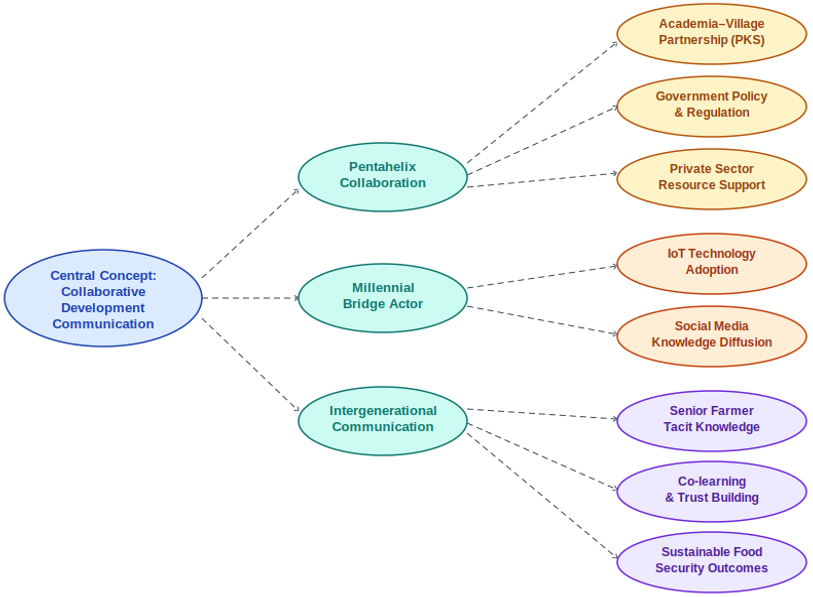
As illustrated in Figure 3, axial coding identified communication — specifically dialogue, trust-building, and farmer empowerment — as the mechanism connecting multi-stakeholder collaboration, technology adoption, collective learning, and sustainable agricultural outcomes across participant groups. These interrelationships provided the analytical basis for the proposed CDC Model.
Figure 3. Axial coding diagram showing relationships among themes and categories underpinning the Collaborative Development Communication (CDC) Model for smart farming and sustainable food security
4.1 Pentahelix collaborative communication as the foundation of smart farming
Thematic analysis identified Pentahelix collaborative communication as the institutional foundation of smart farming implementation. In Desa Karya Mukti, adoption emerged from structured collaboration among village government, universities, private companies, farmer groups, and district agencies. Communication within this framework extends beyond information transfer to institutional trust-building and joint problem-solving, in which each actor performs a complementary role.
According to HD:
HD located the village’s transformation in an explicit collaborative principle rather than in the technology itself:
“We brought in academics, because our principle is Pentahelix: we have to collaborate with academics, entrepreneurs, government, and community leaders. … The knowledge sits with the academics; what we have is application in the field.” (HD)
This principle was institutionalised through a Partnership Agreement (PKS) with a university concluded in 2019 and renewed in 2024, covering technology transfer, mentoring, and capacity-building for IoT-based irrigation. It was complemented by private-sector input support and by policy support and technical supervision from the Garut Regency Agriculture Office. HD framed the rationale in fiscal rather than technological terms: “my principle is that village funds are not simply handed out; they must be sustainable and generate the village’s own revenue” (HD).
A similar collaborative communication pattern emerged at the Cikajang Technology Transfer Station (TTP), which functions as an innovation hub integrating government agencies, universities, agritech companies, and farmer organizations [44]. As explained by KP1:
KP1 described the station’s function in explicitly communicative terms, as an intermediary structure created to close a gap between research and practice:
“In the past there were many researchers and many findings, but not one of them reached the farmers, because there was nothing to connect them. Researchers had nowhere to put their results, and farmers had no access to researchers. … So our role is more that of an intermediary.” (KP1)
“We are open to government, universities, students, and also private companies such as agro-input firms. … They supply their products free of charge and we trial them; if the results are positive, we disseminate them to the farmers we mentor.” (KP1)
KP1 also reported annually revised standard operating procedures developed through on-site demonstration plots, and formal cooperation with vocational schools and a local university, indicating that the station’s collaborative function extends beyond equipment to procedural and educational knowledge [44, 45].
Field observations confirmed continuous dialogue, joint experimentation, and collaborative evaluation at the TTP, reinforced by the PERURI IoT-based smart farming programme [37] and comparable regional digital extension initiatives [39] — evidence that the Pentahelix communication framework is transferable and scalable beyond individual villages.
4.2 Millennial farmers as bridge actors linking digital technology and local agricultural knowledge
Thematic analysis identified millennial farmers as strategic communication bridge actors translating digital technologies into locally usable practice. At the Cikajang TTP, senior farmers found the smart greenhouse interface cumbersome while younger farmers adapted readily and became its de facto operators; the station therefore shifted towards enabling access rather than mandating participation, and constituted a separate young farmers’ group of 25–30 members. PM1, introduced to smart farming through a university community-service programme and by the village head, adopted the technology selectively:
“The difference compared with manual work turned out to be enormous — far easier and more efficient. … Weeding and clearing are still done by hand, but for watering we use smart farming. We can multitask: farm and do other things at the same time.” (PM1)
Technology mediation is therefore discretionary and task-specific rather than wholesale [46, 47].
Digital knowledge brokerage was evident in PM1’s use of TikTok and Facebook to circulate short educational content on fertilisation and cultivation technique:
“TikTok and Facebook. The content is educational — about fertilising and how to farm. My followers are still few, but I have posted quite a lot. … The benefits are many: my knowledge has grown, things I did not know I now know, and it is more profitable and efficient. The constraints are that equipment is still lacking, and not all of my friends understand the technology yet.” (PM1)
These accounts suggest that millennial farmers occupy a communication position between formal innovation systems and everyday practice, translating external input into locally adapted routines [48-50].
This bridging role is fragile when infrastructure fails. The sensor and irrigation-control system at the Cikajang TTP was disabled by a lightning strike and remained inoperative for about five months at the follow-up interview, because the supplying institution had not responded and no local technician had the necessary expertise:
“When there is a problem we stop for a month or two, because the technician has to come from Bandung or Jakarta. … It was struck by lightning. We have contacted the party concerned several times and there is still no response, and until there is we cannot repair it. Local technicians do not understand it either, and the device is not even sold online.” (KP1)
“A farmer cannot be an operator and the custodian of the system at the same time — it is not possible. Even with training, it is difficult, because that is specialised knowledge. … If digital technology is to be enjoyed by farmers and to be sustained, whoever installs the technology must supply the specialist alongside it.” (KP1)
Millennial farmers thus function as system operators rather than maintainers, dependent on external specialists [51] — a structural dependency that collaborative communication alone cannot resolve without technical-support infrastructure [52].
Two qualifications delimit this theme. First, only one millennial farmer was interviewed directly. The bridging role is corroborated across four further stakeholder accounts and documentary sources — HD’s allocation of technology and media tasks to young farmers, KP1’s judgement that “none of the successful digitalisation cases involve senior farmers; they are all millennials” (KP1), KT1’s account of receiving digital relays through younger intermediaries, PK1’s report that the control interface at his site is operated by a young administrator, and a regional extension scheme mobilising young farmers to support digital extension service adoption [8, 39, 41]. The claim is therefore presented as a pattern in how stakeholders in this case organise communicative labour, not as a generalisation about Indonesian millennial farmers, for which a substantially larger sample would be required.
Second, the bridging role does not follow automatically from age. At the Wanaraja site the interface is operated by young staff, yet no brokerage to the surrounding community occurs (Section 4.5). Age supplies the aptitude; it is the surrounding communicative structure — mentoring relationships, group meetings, assigned roles, and an audience to translate for — that converts aptitude into a bridging function.
4.3 Intergenerational collaborative communication between senior and millennial farmers
A recurring pattern was the deliberate pairing of millennial and senior farmers as a communication strategy: HD allocated technology and media tasks to millennial farmers while entrusting senior farmers with agronomic technique, framing this division as a precondition for smart farming rather than a by-product [53]:
“The farmer group members are elderly, so there have to be millennial farmers who are not technologically illiterate. Otherwise, with a mobile phone, all they can do is make a call. The farmer group brings experience — the seniors know the ground. So the young hold the technology and the media, and the seniors hold the technique and the farming experience.” (HD)
This is exemplified by KT1, a senior farmer-group leader responsible for roughly 400 members across two neighbourhood units, who has farmed since the age of twelve and does not operate a smartphone independently:
“I have farmed since I was twelve; I am going on sixty-six now. … Honestly I cannot read WhatsApp myself, so I ask my child to read it out to me. And I never take a phone into the fields — five of them have already gone into the irrigation canal.” (KT1)
The collaborative structure accommodates this constraint rather than treating it as a deficit: coordination combines twice-monthly group meetings with farmer-group WhatsApp updates relayed through family intermediaries, so participation does not depend on individual device literacy [53].
Knowledge exchange is bidirectional. KT1 adopted a non-chemical pest-control formulation suggested by a younger relative, tested it, and incorporated it into his own mentoring:
“For chilli we tried a non-chemical approach — garlic, turmeric, and a fermented milk drink, blended ourselves, to deal with anthracnose. It worked. I learned it from my younger sibling, who said to try the fermented drink; I tried it straight away, and it was effective.” (KT1)
KT1 described his mentoring as deliberately informal — “relaxed, joking, not too serious” (KT1) — and framed smart farming as an extension of senior farmers’ standing rather than a threat:
“It has had a real impact. What the community was waiting for is exactly this: you have land but you do not need much labour if you use the technology. Young people are starting to look at farming in a new way. And seniors like me are pleased too — our farming knowledge is not lost; it is combined with the young people’s technology.” (KT1)
These findings indicate that co-learning operates through a durable division of communicative labour — millennial farmers anchor the technological interface while senior farmers retain agronomic authority — so that adoption reconfigured rather than displaced senior farmers’ roles [53, 54].
4.4 Collaborative communication outcomes for sustainable food security, agricultural regeneration, and green economy practices
At the household level, the Harum Madu programme constituted an early, low-technology form of communication-based empowerment preceding IoT adoption [55]:
“It began with Harum Madu — an acronym for productive and integrated home yards. We were still entirely manual then. We ran the nursery in a greenhouse and distributed the seedlings to the community: chilli, shallots, tomato, water spinach, pak choi — at least five varieties per household. Nearly 10,000 polybags, with a village fund allocation of around 70 million rupiah, including technical guidance. A control team went round collecting the harvest, selling it and buying seedlings again, so that the programme would keep going.” (HD)
At the production level, smart farming has been sequenced around locally viable commodities: a grape pilot, planned melon expansion, and a coffee sector (over 200 tonnes per harvest) and elephant ginger (up to 500 tonnes) still sold unprocessed — “unfortunately the farmers still sell it as raw cherry; there is no roasting yet” (HD) — an explicit opportunity for downstream value addition.
At the institutional level, the Koperasi Desa Karya Mukti (KDMP) Cooperative (established May 2025, approximately 500 members) trades in staples while pursuing financing to become a coffee processing and marketing hub supplying the national Free Nutritious Meal programme, translating raw output into stabilised income [56-59]:
“The plan is for the cooperative to become the business hub: take in the farmers’ coffee, roast it, package it, and sell it to cafés and supermarkets. We have already partnered with the MBG programme for food supply.” (HD)
At the regional level, these outcomes sit within a Garut Regency context of approximately 307,710 hectares in which, according to DP1, central government irrigation investment raised production by around 12%. District officials identified downstream digitalisation and the participatory stage of programme communication as persistent weaknesses:
“One of our weak points is digitalisation — digitalisation of products, and downstream processing. We do already have some digitalisation for marketing, but in practice it is difficult. That is precisely our weak point.” (DP1)
“Of the 42 sub-districts, only 14 have drones so far, so it is certainly not yet optimal. … Internally within the office, the socialisation stage is done. But the stage that involves the other parties, including farmers and farmer groups — not yet.” (DP1)
This is analytically significant: the regency’s digitalisation agenda has advanced technically while the participatory communication stage has not begun, positioning the village-level model as a response to a gap that district actors themselves acknowledge [40, 60].
4.5 Contrasting cases: Technology transfer without collaborative communication
Two sites in the sample did not follow the pattern described above and are reported here as negative cases, because they specify the conditions under which collaborative communication is present or absent.
The first is a smart greenhouse in Wanaraja, operational for about seven years and producing melons for export through a national distributor. It is privately owned and financed, and its communication structure is vertical and enclosed: a single manager trains six to eight local staff recruited through the village youth organisation. According to PK1 there is no extension officer, no farmer group, and no operational relationship with the district agriculture office. Technically the installation succeeds; communicatively it does not diffuse:
“With the smart greenhouse there has been no transfer of knowledge, because it is not yet understood. … Only the people who work inside are involved. … There is no farmer group here. … The millennial farmer programme itself never actually ran.” (PK1)
The comparison within this single site is instructive. The high-technology system remained enclosed, while a low-technology practice learned at the same site did diffuse, because it travelled through existing social relationships: PK1 recorded the organic fertiliser technique, tested it on an adjacent rice plot, and passed it to the village youth organisation and a farmer group, using five kilograms of urea where local practice would have used roughly 73, at a comparable yield. Transferability tracked the availability of a communication pathway rather than the sophistication of the technology.
The second case is a government-assisted semi-smart greenhouse in Banyuresmi. Sprinkler equipment supplied through a company trial was abandoned after uneven water distribution caused nursery losses, and the group reverted to manual irrigation. KT2 attributed this to the absence of sustained accompaniment:
“The sprinkler is not used — it was not effective, because the watering was not even. Some places were wet, others were not, and there were many losses in the nursery, so we went back to manual and it has been safe. … If we only get extension and a launch, and then we are not accompanied, it is useless. It will fail anyway.” (KT2)
KT2 further explained why capital-intensive protected cultivation is rarely adopted independently: “rather than build a greenhouse for 100 or 200 million rupiah, farmers would rather add more land — that adds to their assets” (KT2). Neither private capital nor public subsidy is sufficient alone. Where technology arrives without an accompanying communication structure — mentoring relationships, a receiving collective, and a maintenance pathway — adoption either remains enclaved within a firm or is reversed at the first operational failure. The CDC Model therefore describes the conditions under which smart farming becomes collectively beneficial, not an outcome of technology deployment as such.
Table 3 summarises the evidence base for the four themes.
Table 3. Thematic analysis: Representative evidence, stakeholders, and contributions to sustainable food security, including the contrasting cases
|
Theme |
Analytical Category |
Representative Evidence |
Key Stakeholders |
Contribution to Sustainable Food Security |
|
Theme 1. Pentahelix Collaborative Communication |
Institutional Leadership; Knowledge Co-creation; Private-sector Resource Mobilization |
Pentahelix as guiding principle (HD, 2026); PKS partnership (2019, renewed 2024); agricultural input support via PERURI's IoT programme. |
Village Government, Universities, PERURI, Private Companies, Farmer Groups, BRIN, BBSDLP |
Strengthens institutional coordination, technology transfer, and technology accessibility. |
|
Theme 2. Millennial Farmers as Bridge Actors |
Technology Mediation; Digital Knowledge Brokerage; Institutional Capacity Constraints |
Efficiency gain vs manual farming (PM1, 2026); TikTok/Facebook knowledge dissemination; need for specialist support (KP1, 2026). |
Millennial Farmers, Village Government, Online Farming Communities, TTP, Extension Workers, BRMP |
Accelerates IoT adoption, expands digital literacy, and highlights need for continuous technical assistance. |
|
Theme 3. Intergenerational Collaborative Communication |
Local Knowledge Integration; Intergenerational Communication Mechanisms |
Organic pest management integrated with IoT farming; regular meetings and WhatsApp coordination. |
Senior Farmers, Millennial Farmers, Farmer Groups, Families, Extension Workers |
Combines indigenous knowledge with digital innovation and sustains community resilience. |
|
Theme 4. Communication Outcomes for Sustainable Food Security |
Household Food Resilience; Technology-enabled Productivity; Institutionalization of Green Economy |
Harum Madu Program (~10,000 polybags); healthier, higher-yield seedlings (KP1, 2026); KDMP Cooperative and MBG market partnerships. |
Village Government, Women's Farmer Groups (KWT), TTP, Farmer Groups, BBSDLP, Cooperative, MBG, Media |
Enhances household food availability, improves productivity, and strengthens value chains and farmer income. |
|
Contrasting cases (Section 4.5) |
Absent Communication Structure; Enclave Adoption; Reversal After Operational Failure |
Private smart greenhouse with no farmer group, extension officer, or knowledge transfer (PK1, 2026); subsidised sprinkler abandoned after losses and withdrawn accompaniment (KT2, 2026); low-technology organic practice diffused through existing social ties (PK1, 2026). |
Private Company, Village Youth Organisation, Farmer Group, Dinas Pertanian |
Delimits the model: technology without an accompanying communication structure remains enclaved or is reversed, yielding limited community benefit. |
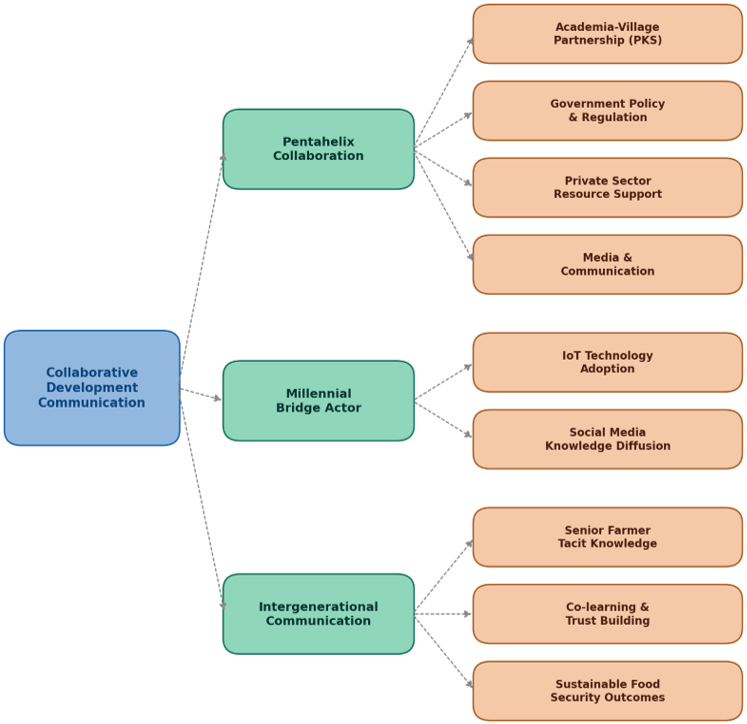
Building on the relationships identified through coding and thematic synthesis, the CDC Model (Figure 4) positions communication as the connective infrastructure linking Pentahelix collaboration, millennial bridging, intergenerational co-learning, and food security outcomes.
Figure 4. Integrated Collaborative Development Communication (CDC) Model illustrating the relationships among communication processes, stakeholder collaboration, smart farming adoption, millennial farmer empowerment, and sustainable food security
Rather than functioning merely as an instrument for disseminating innovations, communication in this case constituted the institutional and social infrastructure through which agricultural transformation was initiated, implemented, and sustained — the premise underlying the CDC Model [61].
5.1 Beyond technology diffusion: The communicative foundations of smart farming
Classical Diffusion of Innovations theory attributes adoption primarily to innovation characteristics and communication channels [26], and has been criticised for underestimating dialogue and local knowledge [27, 62]. This study indicates that adoption depended less on the technology itself than on the communication structure surrounding it.
The Cikajang TTP illustrates the limits of technology-centred approaches: a greenhouse remained non-operational for five months because no local actor could maintain it and the supplier did not respond, showing that adoption requires sustained communication with technical providers [51, 52].
Banyuresmi makes the same point from the opposite direction: subsidised equipment was abandoned after one unsuccessful season, attributed by the recipient to extension without accompaniment (Section 4.5). Both are consistent with evidence that adoption in the Global South depends less on device availability than on the continuity of advisory relationships [24, 52].
5.2 The Pentahelix as a collaborative communication architecture
The Pentahelix model functions not merely as a governance arrangement but as a collaborative communication architecture in which trust and shared meaning are produced through sustained interaction [31, 32, 63].
Unlike studies treating the Pentahelix mainly as institutional governance [33, 34, 64], this study shows its operation depends on communication quality: formal agreements alone did not produce adoption, whereas continuous dialogue and joint problem-solving did [65, 66].
This claim about the media dimension requires qualification. Media presence is documented through press reporting, a state-enterprise release, and informants’ accounts of coverage and platform use [37, 38, 40, 41]; no media practitioner was interviewed. The analysis establishes that media functioned as a channel of visibility and legitimation, but cannot speak to editorial logics, source relationships, or the intentions of media organisations. The media component is consequently the least well evidenced element of the model and is retained as a theorised rather than empirically examined dimension.
5.3 Millennial farmers as communication agents of change
A key theoretical contribution is identifying millennial farmers as communication agents of change rather than passive adopters, mediating between technological systems and local knowledge and extending diffusion perspectives toward relational models [49, 50].
However, advanced systems at the Cikajang TTP required dedicated specialists whose expertise could not be substituted by farmer training [51], indicating that empowerment requires institutional support beyond capacity-building alone.
Two boundary conditions follow from the negative cases. First, the agent-of-change role is not conferred by generation: young operators at Wanaraja perform no brokerage in the absence of a receiving collective. Second, the role rests here on a single millennial practitioner interview, so it is offered as a case-specific communicative pattern requiring confirmation with a larger sample [49, 52].
5.4 Collaborative communication, smart farming, and sustainable food security
The relationship between collaborative communication, smart farming, and food security operates systemically rather than linearly: communication enables collaboration, collaboration enables adoption, and adoption contributes to availability, access, and stability [60, 67].
The census pattern in Figure 1 is consistent with, but does not demonstrate, a relationship between communication arrangements and technology use, since descriptive data cannot separate communication effects from infrastructure, capital, market access, and agro-ecological conditions. The qualitative evidence supports the narrower proposition that, within the sites examined, differences in extension continuity and mentoring corresponded to differences in whether technology remained in use. This is advanced as a hypothesis for subsequent testing — ideally through a multi-site design combining sub-district indicators of extension intensity with adoption outcomes — rather than an established finding [24, 66].
More broadly, these findings reinforce SDG 2 by showing that food security depends on communication systems enabling collaboration, learning, and institutional coordination, not on technology alone.
5.5 Scope conditions and limitations
Three limitations qualify these claims. First, the study rests on a single regency and five embedded sites; its contribution is analytical generalisation to theory, and the CDC Model is a proposition derived from one case rather than a validated framework [25, 35]. Second, the interview base is small (eight informants, nine sessions) and includes one millennial farmer, the principal evidential constraint on Theme 2. Third, media and university actors were not interviewed, so those dimensions rest on documentary evidence (Section 3.6). A further caution applies generally: informants with institutional roles have an interest in presenting their programmes favourably, mitigated through triangulation and negative-case analysis but not eliminated.
This study provides case-based evidence that CDC constituted the institutional foundation of smart farming and food security outcomes in the sites examined. The following conclusions apply to this case and are offered as analytically generalisable propositions.
First, smart farming is fundamentally enabled by a Pentahelix collaborative communication architecture integrating government, academia, private sector, farmer communities, and media, generating the trust and collaborative capacity necessary for sustainable innovation.
Second, millennial farmers functioned as communication bridge actors, mediating between digital technologies and established agricultural knowledge while serving as peer educators and digital content creators. Because this was corroborated across stakeholder accounts but observed directly with one millennial practitioner, and because young operators at a contrasting site performed no comparable brokerage, the bridging role is contingent on an enabling communicative structure rather than an attribute of generation.
Third, intergenerational collaborative communication integrating senior farmers' experiential knowledge with millennial farmers' digital competencies generates innovations neither generation could produce independently, representing an effective strategy for agricultural regeneration.
Fourth, this study proposes the CDC Model, integrating participatory communication, collaborative governance, and the Pentahelix approach into a comprehensive framework for sustainable agricultural transformation.
The study contributes to development communication scholarship by introducing the CDC Model, by showing that communication can function as institutional infrastructure for agricultural innovation, and by identifying millennial farmers as communication agents whose role is structurally rather than generationally produced.
The study is limited to a single case, a small interview base including one millennial farmer, and documentary rather than interview-based access to the media and academic dimensions (Section 5.5). The CDC Model therefore provides a transferable framework to be tested rather than a validated one. Three priorities follow: comparative multi-site studies; direct engagement with media and university actors; and a larger sample of millennial farmers, combined with sub-district indicators, to test whether communication quality accounts for part of the variation in technology use observed in census data.
From a policy perspective, agricultural transformation investments should extend beyond digital technologies to strengthen communication ecosystems through extension reform, digital literacy enhancement, and formal Pentahelix coordination mechanisms essential for resilient agricultural systems and food security.
The authors gratefully acknowledge the valuable participation and support of the Village Government of Desa Karya Mukti, the Cikajang Technology Transfer Station (TTP), and farmer group leaders involved in this research, and thank the Department of Communication Studies, Universitas Muhammadiyah Tangerang, for supporting this research.
[1] Onyeaka, H., Nwauzoma, U.M., Akinsemolu, A.A., et al. (2024). The ripple effects of climate change on agricultural sustainability and food security in Africa. Food and Energy Security, 13(5): e567. https://doi.org/10.1002/fes3.567
[2] Zhu, X.H., Zhang, Y., Zhu, Y.Y., Li, Y.R., Cui, J.X., Yu, B.H. (2025). Multidimensional deconstruction and workable solutions for addressing China's food security issues: From the perspective of sustainable diets. Land Use Policy, 148: 107401. https://doi.org/10.1016/j.landusepol.2024.107401
[3] Chauhan, J., Solanki, S., Yadav, M. (2025). Global food security and sustainable development: An overview. In Forage Crops in the Bioenergy Revolution, Springer, Singapore, pp. 3-14. https://doi.org/10.1007/978-981-96-2536-9_1
[4] Purwanto, E., Riyantini, R., Oktarina, S., et al. (2024). Komunikasi Pembangunan Berkelanjutan. Minhaj Pustaka, Indonesia. https://doi.org/10.71457/593191
[5] Ikudayisi, A.A., Adejumo, O. (2025). Urban food security perspective towards sustainable development goal 2: A bibliometric analysis. Sustainable Futures, 9: 100654. https://doi.org/10.1016/j.sftr.2025.100654
[6] Oktarina, S., Purwanto, E., Basit, A., Shahreza, M. (2023). Communication media types for optimising yards in achieving family food security. Jurnal Studi Komunikasi, 7(3): 879-890. https://doi.org/10.25139/jsk.v7i3.6605
[7] Amakye, K.G. (2024). Evaluating the contribution of development communication on the sustainable shea value project in Garu-Tempane District, Ghana. E-Journal of Humanities, Arts and Social Sciences, 5(11): 1891-1905. https://doi.org/10.38159/ehass.202451121
[8] Lyu, Z., Jing, Z.F., Yang, X.L. (2025). Bridging the digital divide for sustainable agriculture: How digital adoption strengthens farmer livelihood resilience. Frontiers in Sustainable Food Systems, 9: 1628588. https://doi.org/10.3389/fsufs.2025.1628588
[9] Rasyid, H., Mumpuni Ningsih, G. (2024). The role of digital technology in the transformation of agriculture toward smart farming. Journal of World Science, 3(1): 1-7. https://doi.org/10.58344/jws.v3i1.523
[10] Bhardwaj, M., Kumar, P., Singh, A. (2026). Bibliometric review of digital transformation in agriculture: Innovations, trends and sustainable futures. Journal of Agribusiness in Developing and Emerging Economies, 16(4): 826-850. https://doi.org/10.1108/JADEE-02-2025-0083
[11] Sargani, G.R., Wang, B., Leghari, S.J., Ruan, J. (2025). Is digital transformation the key to agricultural strength? A novel approach to productivity and supply chain resilience. Smart Agricultural Technology, 10: 100838. https://doi.org/10.1016/j.atech.2025.100838
[12] Batra, I., Sharma, C., Malik, A., Sharma, S., Kaswan, M.S., Garza-Reyes, J.A. (2025). Industrial revolution and smart farming: A critical analysis of research components in Industry 4.0. The TQM Journal, 37(6): 1497-1525. https://doi.org/10.1108/TQM-10-2023-0317
[13] Wang, S., Yang, Y.L., Yin, H.Y., et al. (2025). Towards digital transformation of agriculture for sustainable development in China: Experience and lessons learned. Sustainability, 17(8): 3756. https://doi.org/10.3390/su17083756
[14] Khaspuria, G., Khandelwal, A., Agarwal, M., Bafna, M., Yadav, R., Yadav, A. (2024). Adoption of precision agriculture technologies among farmers: A comprehensive review. Journal of Scientific Research and Reports, 30(7): 671-686. https://doi.org/10.9734/jsrr/2024/v30i72180
[15] Basit, A., Purwanto, E., Kristian, A., et al. (2022). Teknologi komunikasi smartphone pada interaksi sosial. LONTAR: Jurnal Ilmu Komunikasi, 10(1): 1-12. https://doi.org/10.30656/lontar.v10i1.3254
[16] Erlinnawati, A., Purwanto, E. (2024). Peran teknologi dan komunikasi dalam manajemen pembangunan berkelanjutan. Jurnal Bisnis dan Komunikasi Digital, 1(4): 1-11. https://doi.org/10.47134/jbkd.v1i4.3034
[17] Rustandi, Y., Farid, A. (2024). Involvement of millennial farmers in the implementation of integrated agriculture in Trenggalek District, East Java, Indonesia. Anuário do Instituto de Geociências, Rio de Janeiro, BR, 47: 1-14. https://doi.org/10.11137/1982-3908_2024_47_60967
[18] Qonita, R.R.A., Masyhuri, M., Jamhari, J., Perwitasari, H. (2025). Social environmental support in encouraging entrepreneurial behavior of millennial farmers in the special region of Yogyakarta, Indonesia: An effort to realize sustainable agriculture. Caraka Tani: Journal of Sustainable Agriculture, 40(1): 64-83. https://doi.org/10.20961/carakatani.v40i1.92724
[19] Surgawati, I., Chalik, A.A., Sarofah, R., Muchariman, R. (2024). Human resource development for millennial farmers in increasing local economic development in rural areas. In Proceedings of the 8th International Conference on Accounting, Management, and Economics (ICAME 2023), pp. 338-355. https://doi.org/10.2991/978-94-6463-400-6_25
[20] Wulandari, A.M., Utami, Y.S., Fariszy, R., Kusumo, Y.W. (2025). Persuasive communication model attracts youth interest in becoming millennial farmers in Bantul. SHS Web of Conferences, 212: 02007. https://doi.org/10.1051/shsconf/202521202007
[21] BPS Kabupaten Garut. (2023). Booklet, Complete Enumeration Results of the 2023 Census of Agriculture - Edition 1 Garut Regency. https://garutkab.bps.go.id/en/publication/2023/12/04/1ab57b8f8a5a4422018bc54c/buklet-hasil-pencacahan-lengkap-sensus-pertanian-2023-tahap-i-kabupaten-garut.html, accessed on May 20, 2026.
[22] Shahreza, M., Imaniah, I., Purwanto, E. (2025). Communication strategies of environmental activists in conducting sustainable environmental awareness campaigns. BIO Web of Conferences, 173: 03017. https://doi.org/10.1051/bioconf/202517303017
[23] Purwanto, E., Shahreza, M., Rahmah, A. (2025). Development communication for collaborative governance: Empowering women farmers in food independent villages. International Journal of Innovative Research and Scientific Studies, 8(7): 1-11. https://doi.org/10.53894/ijirss.v8i7.10396
[24] Khan, R.P., Gupta, S., Daum, T., Birner, R., Ringler, C. (2024). Levelling the field: A review of the ICT revolution and agricultural extension in the Global South. Journal of International Development, 37(1): 1-21. https://doi.org/10.1002/jid.3949
[25] Flyvbjerg, B. (2006). Five misunderstandings about case-study research. Qualitative Inquiry, 12(2): 219-245. https://doi.org/10.1177/1077800405284363
[26] Rogers, E.M. (2003). Diffusion of Innovations (5th ed.). Free Press, New York. https://www.amazon.com/Diffusion-Innovations-5th-Everett-Rogers/dp/0743222091.
[27] Melkote, S.R., Steeves, H.L. (2001). Communication for Development in the Third World: Theory and Practice for Empowerment. SAGE Publications India Pvt Ltd.
[28] Freire, P. (1970). Pedagogy of the Oppressed. Continuum, New York. https://www.amazon.com/Pedagogy-Oppressed-Anniversary-Paulo-Freire/dp/0826412769.
[29] Servaes, J. (1999). Communication for Development: One World, Multiple Cultures. Hampton Press, Cresskill. https://doi.org/10.13140/RG.2.1.2113.7120
[30] Innes, J.E., Booher, D.E. (2010). Planning with Complexity: An Introduction to Collaborative Rationality for Public Policy. Routledge, London. https://doi.org/10.4324/9780203864302
[31] Ansell, C., Gash, A. (2008). Collaborative governance in theory and practice. Journal of Public Administration Research and Theory, 18(4): 543-571. https://doi.org/10.1093/jopart/mum032
[32] Emerson, K., Nabatchi, T. (2015). Collaborative Governance Regimes. Georgetown University Press, Washington DC. https://www.jstor.org/stable/j.ctt19dzcvf.
[33] Wulandjani, H., Hamdani, Widiyahseno, B., et al. (2025). Collaborative Governance. Minhaj Pustaka, Tangerang, Indonesia. https://minhajpustaka.id/product/collaborative-governance/.
[34] Yin, R.K. (2017). Case Study Research and Applications: Design and Methods (6th ed.). Sage Publications, Thousand Oaks. https://www.sagepub.com/shop/buy-a-book/case-study-research-and-applications-6-250150.
[35] Braun, V., Clarke, V. (2021). To saturate or not to saturate? Questioning data saturation as a useful concept for thematic analysis and sample-size rationales. Qualitative Research in Sport, Exercise and Health, 13(2): 201-216. https://doi.org/10.1080/2159676X.2019.1704846
[36] Malterud, K., Siersma, V.D., Guassora, A.D. (2016). Sample size in qualitative interview studies: Guided by information power. Qualitative Health Research, 26(13): 1753-1760. https://doi.org/10.1177/1049732315617444
[37] PERURI. (2025). PERURI terapkan teknologi smart farming dan Internet of Things (IoT) untuk dongkrak produktivitas petani di Garut. https://www.peruri.co.id/article/peruri-terapkan-teknologi-smart-farming-dan-internet-of-things-iot-untuk-dongkrak-produktivitas-petani-di-garut, accessed on May 20, 2026.
[38] Erfan, M. (2025). Smart farming dikembangkan desa di Garut, raih penghargaan Mandaya Award. Radar Garut. https://radargarut.id/2025/10/18/smart-farming-dikembangkan-desa-di-garut-raih-penghargaan-mandaya-award/, accessed on May 20, 2026.
[39] Thi Hoa Sen, L., Chou, P., Dacuyan, F.B., Nyberg, Y., Wetterlind, J. (2024). Barriers and enablers of digital extension services’ adoption among smallholder farmers: the case of Cambodia, the Philippines and Vietnam. International Journal of Agricultural Sustainability, 22(1), 2368351. https://doi.org/10.1080/14735903.2024.2368351
[40] Baihaqi, H. (2026). Modernisasi pertanian Garut kadung digaungkan, tetapi peta lahan belum disiapkan. https://bandung.bisnis.com/read/20260518/549/1974561/modernisasi-pertanian-garut-kadung-digaungkan-tetapi-peta-lahan-belum-disiapkan, accessed on May 20, 2026.
[41] Rochmannudin, N. (2025). Petani milenial Garut ini buktikan bertani bisa jadi profesi modern. Rakyat Merdeka. https://rm.id/baca-berita/ekonomi-bisnis/280397/petani-milenial-garut-ini-buktikan-bertani-bisa-jadi-profesi-modern, accessed on May 20, 2026.
[42] Braun, V., Clarke, V. (2021). Thematic Analysis: A Practical Guide. SAGE Publications Ltd. https://www.amazon.com/Thematic-Analysis-Practical-Virginia-Braun/dp/1473953235.
[43] Lincoln, Y.S., Guba, E. (1985). Naturalistic Inquiry. SAGE Publications. https://www.amazon.com/Naturalistic-Inquiry-Yvonna-S-Lincoln/dp/0803924313.
[44] Klerkx, L., Jakku, E., Labarthe, P. (2019). A review of social science on digital agriculture, smart farming and agriculture 4.0: New contributions and a future research agenda. NJAS: Wageningen Journal of Life Sciences, 90-91(1): 1-16. https://doi.org/10.1016/j.njas.2019.100315
[45] Wang, G.L., Lu, Q., Capareda, S.C. (2020). Social network and extension service in farmers' agricultural technology adoption efficiency. PLoS ONE, 15(7): e0235927. https://doi.org/10.1371/journal.pone.0235927
[46] Bai, Q.Y., Chen, H.P., Zhou, J., et al. (2023). Digital literacy and farmers' entrepreneurial behavior-empirical analysis based on CHFS2019 micro data. PLoS ONE, 18(7): e0288245. https://doi.org/10.1371/journal.pone.0288245
[47] Cheng, C.M., Gao, Q., Ju, K.X., Ma, Y.T. (2024). How digital skills affect farmers' agricultural entrepreneurship? An explanation from factor availability. Journal of Innovation & Knowledge, 9(2): 100477. https://doi.org/10.1016/j.jik.2024.100477
[48] Poti, S., Joy, S. (2022). Digital platforms for connecting actors in the agtech space: Insights on platform development from participatory action research on KisanMitr. Journal of Indian Business Research, 14(1): 65-83. https://doi.org/10.1108/JIBR-04-2021-0145
[49] Mollel, M., Quiroz, L.F., Varley, C., et al. (2025). Digital technologies to accelerate the impact of climate smart agriculture by next-generation farmers in Africa. Frontiers in Sustainable Food Systems, 9: 1462328. https://doi.org/10.3389/fsufs.2025.1462328
[50] Arslan, C., Wollni, M., Oduol, J., Hughes, K. (2022). Who communicates the information matters for technology adoption. World Development, 158: 106015. https://doi.org/10.1016/j.worlddev.2022.106015
[51] Hundal, G.S., Laux, C.M., Buckmaster, D., Sutton, M.J., Langemeier, M. (2023). Exploring barriers to the adoption of Internet of Things-based precision agriculture practices. Agriculture, 13(1): 163. https://doi.org/10.3390/agriculture13010163
[52] Uy, T.C., Limnirankul, B., Kramol, P., Gia, H.H., Thi, D.T.N. (2024). Digital technology adoption among smallholder farmers in Vietnam: Implications for digital agricultural extension strategies. Journal of International Development, 37(2): 351-370. https://doi.org/10.1002/jid.3904
[53] Widiyanti, E., Karsidi, R., Wijaya, M., Utari, P. (2023). How intergenerational farmers negotiate their identity in the era of Agriculture 4.0: A multiple-case study in Indonesia. Open Agriculture, 8(1): 20220219. https://doi.org/10.1515/opag-2022-0219
[54] Permana, I., Yudistira, F. (2025). Strengthening collaborative governance based on local wisdom: A study on disaster risk reduction in the indigenous communities of the Kulawi Tribe. Journal of Cultural Analysis and Social Change, 10(2): 4150-4161. https://doi.org/10.64753/jcasc.v10i2.2239
[55] Mobarok, M.H., Skevas, T., Thompson, W. (2021). Women's empowerment in agriculture and productivity change: The case of Bangladesh rice farms. PLoS ONE, 16(8): e0255589. https://doi.org/10.1371/journal.pone.0255589
[56] Liang, Q., Ma, K.W., Liu, W.H. (2023). The role of farmer cooperatives in promoting environmentally sustainable agricultural development in China: A review. Annals of Public and Cooperative Economics, 94(3): 741-759. https://doi.org/10.1111/apce.12444
[57] Susilowati, A.P.E., Rachmawati, R., Rijanta, R. (2025). Smart village concept in Indonesia: ICT as determining factor. Heliyon, 11(1): e41657. https://doi.org/10.1016/j.heliyon.2025.e41657
[58] Rauw, W.M., Gomez-Raya, L., Star, L., et al. (2022). Sustainable development in circular agriculture: An illustrative bee-legume-poultry example. Sustainable Development, 31(2): 639-648. https://doi.org/10.1002/sd.2435
[59] Mwalupaso, G.E., Geng, X.H., Yasin, S.I. (2025). Financial inclusion for sustainable agriculture: Pathways among smallholder women farmers in rural Zambia. PLoS ONE, 20(7): e0326980. https://doi.org/10.1371/journal.pone.0326980
[60] Tilahun, G., Bantider, A., Yayeh, D. (2023). Impact of adoption of climate-smart agriculture on food security in the tropical moist montane ecosystem: The case of Geshy watershed, Southwest Ethiopia. Heliyon, 9(12): e22620. https://doi.org/10.1016/j.heliyon.2023.e22620
[61] Wang, X.L., Huang, X.Y. (2025). Strategic participatory communication and development: Engagement and empowerment. Community Development Journal, bsaf034. https://doi.org/10.1093/cdj/bsaf034
[62] Schnebelin, É., Labarthe, P., Touzard, J.M. (2021). How digitalisation interacts with ecologisation? Perspectives from actors of the French Agricultural Innovation System. Journal of Rural Studies, 86: 599-610. https://doi.org/10.1016/j.jrurstud.2021.07.023
[63] Bryson, J.M., Crosby, B.C., Stone, M.M. (2006). The design and implementation of cross-sector collaborations: Propositions from the literature. Public Administration Review, 66(s1): 44-55. https://doi.org/10.1111/j.1540-6210.2006.00665.x
[64] Ghimire, R., Khatri-Chhetri, A., Chhetri, N. (2022). Institutional innovations for climate smart agriculture: Assessment of climate-smart village approach in Nepal. Frontiers in Sustainable Food Systems, 6: 734319. https://doi.org/10.3389/fsufs.2022.734319
[65] Imaniah, I., Shahreza, M., Purwanto, E. (2024). Effective development communication strategies for enhancing MSME empowerment in the Cikadu Tourism Village, Tanjung Lesung. E3S Web of Conferences, 592: 06013. https://doi.org/10.1051/e3sconf/202459206013
[66] Koutridi, E., Christopoulou, O. (2023). The importance of integrating smart farming technologies into rural policies (aiming at sustainable rural development)- stakeholders’ views. Smart Agricultural Technology, 4: 100206. https://doi.org/10.1016/j.atech.2023.100206
[67] Jena, P.R., Tanti, P.C., Maharjan, K.L. (2023). Determinants of adoption of climate resilient practices and their impact on yield and household income. Journal of Agriculture and Food Research, 14: 100659. https://doi.org/10.1016/j.jafr.2023.100659