I Gusti Lanang Putu Tantra* | Ngurah Wisnu Murthi | I Made Sara
© 2026 The authors. This article is published by IIETA and is licensed under the CC BY 4.0 license (http://creativecommons.org/licenses/by/4.0/).
OPEN ACCESS
The digitalization of village governance (DPDS) and Village-Owned Enterprises (VOEs) has emerged as a strategic catalyst for economic recovery in Bali's coastal tourism villages following the COVID-19 pandemic. This study evaluates how these digital initiatives influence inclusive growth across eight regencies and one city in Bali during the 2023–2024 period. Utilizing a mixed-methods approach, the research combines descriptive qualitative analysis with advanced econometrics, specifically the Spatial Lag Model (SLM), to account for regional interdependencies. The findings reveal that digital infrastructure and governance significantly boost inclusive growth, with an R-squared of 0.94, indicating that 94% of growth variations are explained by digital variables. A critical discovery is the Spatial Lag effect (p = 0.46), proving that digital progress in one village creates a positive "spillover effect" on its neighbors. While southern Bali (Badung and Denpasar) leads in digital adoption, significant gaps remain in eastern and northern regions. This research concludes that integrating digital governance with digitalized entrepreneurship, supported by robust spatial connectivity, is essential for achieving equitable and sustainable welfare in tourism-dependent economies.
digitalization, Village-Owned Enterprises, inclusive growth, coastal tourism, Spatial Lag Model, Bali economic recovery
The COVID-19 pandemic significantly disrupted both the global and national economies, with Bali, a tourism-dependent province, experiencing a severe contraction before entering a recovery phase in early 2024 [1]. While economic growth has returned to positive territory, achieving long-term resilience through inclusive and sustainable development remains a central challenge for regional planners [2]. Post-pandemic trends indicate a fundamental shift in tourist behavior, necessitating a transition toward green and sustainable tourism that balances global standards with locally embedded wisdom [3].
In this recovery context, the digitalization of village government (DPDS) and the rural economy—particularly through Village-Owned Enterprises (VOEs)—has emerged as a critical infrastructure requirement for improving government effectiveness [4]. In terms of local governance, digitalization facilitates big data integration and enhances financial transparency, both of which are essential for sustainable planning [5]. Simultaneously, the digitalization of VOEs enables micro, small, and medium enterprises (MSMEs) to improve their competitiveness through online platforms and digital payment systems [6]. Although previous studies in emerging economies such as India and China have explored rural digital infrastructure [7, 8], they often overlook the synergy between local governance digitalization and inclusive growth, particularly in tourism-dependent coastal areas.
Inclusive growth extends beyond increases in per capita income; it also encompasses poverty reduction and the provision of equal opportunities for marginalized populations [9, 10]. Effective regional planning must ensure that digital transformation does not widen the urban–rural divide but instead fosters a “spillover effect” that benefits neighboring communities [11]. This alignment between locally embedded digital initiatives and global sustainability goals is particularly important for coastal villages, which face unique environmental and economic pressures [12].
However, a significant knowledge gap remains regarding how the dual digital transformation of government and VOEs contributes to inclusive growth in Bali’s coastal villages during the 2023–2024 recovery period. This study addresses this gap by evaluating the implementation of digitalization and analyzing its spatial effects on village inclusiveness. By integrating locally embedded wisdom with digital innovation, this research offers a strategic framework for achieving the Sustainable Development Goals (SDGs) at the grassroots level [13].
Based on the identified gaps, this study addresses three primary questions: (1) How are DPDS and the digitalization of VOEs (DBUM) implemented in Bali’s coastal tourism villages? (2) How do DPDS and DBUM individually affect inclusive growth in these areas? (3) How do these variables simultaneously influence inclusive growth during Bali’s economic recovery phase?
To address these questions, this study integrates perspectives from development economics and tourism through a mixed-methods empirical approach. It employs descriptive qualitative analysis alongside quantitative econometric models, specifically multiple regression and spatial lag regression. The Spatial Lag Model (SLM) is particularly important, as it accounts for regional interdependencies in which growth in one village is influenced by developments in neighboring areas [11, 13, 14].
The novelty of this research lies in its specific temporal context: the post-pandemic recovery period of 2023–2024. While previous studies in emerging economies such as China and India have examined rural infrastructure in general [3, 7, 8], they often treat digitalization as a generic utility rather than as a strategic synergy between local governance and enterprise-driven inclusive growth. By focusing on coastal villages, this study demonstrates how locally embedded digital initiatives can mitigate the economic decline caused by the COVID-19 pandemic [15].
This study further demonstrates how the utilization of Information and Communication Technology (ICT) at the grassroots level transforms coastal village economies. Unlike traditional growth models, this approach emphasizes inclusive growth by ensuring that digital transformation creates equal opportunities for the poor, reduces unemployment, and improves life expectancy through sustainable tourism [9, 16]. By integrating Bali’s locally embedded wisdom with global digital standards, this research provides a timely framework for supporting the SDGs through inclusive, green, and digitally empowered tourism [11, 17].
2.1 Inclusive growth
Inclusive growth is defined as an economic trajectory that mandates the active participation of all stakeholders in creating and sustaining economic expansion. This concept emphasizes that as the economy grows, there must be a simultaneous reduction in poverty, inequality, and unemployment [8, 9]. Furthermore, inclusive growth does not merely focus on creating new economic opportunities but prioritizes ensuring equal access to these opportunities for all societal segments, particularly the marginalized [10, 18]. Consequently, growth is deemed inclusive only when it successfully integrates poverty alleviation, equitable income distribution, and increased labor absorption into its core development framework [19].
2.2 Digitalization of village government, Village-Owned Enterprises and inclusive growth
In the modern era, ICT serves as an essential catalyst for enhancing governance and business services. Digitalization allows organizations to foster innovation, creating more efficient and effective products and services that align with consumer needs [13, 20]. Within the Indonesian context, where the village government represents the foundational administrative tier, digitalization referred to as DPDS is vital for optimizing internal processes [21]. This includes the diffusion of computerized systems for routine administration, transparent communication with the community, and data-driven decision-making [22].
Furthermore, the digitalization of VOEs, or DBUM (Digitalization of BUMDes), acts as a strategic driver for the rural economy. By leveraging digital technology, VOEs can increase operational efficiency, expand market reach beyond geographical boundaries, and foster broader community involvement in village-led economic activities [3]. The synergy between DPDS and DBUM creates a robust ecosystem that supports sustainable development. This locally embedded digital transformation ensures that coastal villages remain globally connected while maintaining their indigenous wisdom, ultimately leading to inclusive growth that aligns with SDGs [4, 17].
3.1 Research design and spatial scope
This study employs a mixed-methods approach to evaluate DPDS and DBUM and their impact on inclusive growth during Bali's 2023–2024 recovery phase. While the first and second research objectives are addressed through descriptive qualitative analysis, the third objective requires inferential statistics to test regional interdependencies [11, 23], which was conducted across eight regencies and one city in Bali Province. The selection of eight specific coastal villages (Table 1) as research sites is based on their status as strategic tourism hubs that experienced significant economic contraction during the COVID-19 pandemic [22, 24]. These villages serve as representative models for evaluating how digital transformation mitigates economic shocks in coastal ecosystems.
Table 1. Number of respondent samples based on the proportion of job types
|
Regency/City |
Coastal Village |
Beach Tourism Objects |
Number of Respondent Samples * |
|
Jembrana |
Gilimanuk Village |
Creative village |
8 |
|
Tabanan |
Beraban Village |
Tanah Lot |
8 |
|
Badung |
Kutuh Village |
Pandawa Beach |
8 |
|
Buleleng |
Kalibukbuk Village |
Lovina Beach |
8 |
|
Gianyar |
Sukawati Village |
Purnama Beach |
8 |
|
Klungkung |
Pesinggahan Village |
Goa Lawah Beach |
8 |
|
Karangasem |
Tulamben Village |
Tulamben Beach |
8 |
|
Denpasar |
Sanur Village |
Sanur Beach |
8 |
|
|
|
Total |
64 |
The types of data used are secondary data and primary data. Secondary data comes from several agencies, including the Central Statistics Agency (BPS) of Bali Province and Regency/City, Bank Indonesia (BI), the Tourism and Creative Economy Office, the Directorate General of Fiscal Balance (DJPK) of the Ministry of Finance, and the Financial Services Authority (OJK). University Library. While primary data comes from research respondents selected from sample coastal villages in each Regency/City in Bali
3.2 Measuring the Inclusive Growth Composite Index
To measure inclusive growth, this study adopts IGCI framework developed by the study [18]. The index integrates four weighted dimensions:
The final IGCI score ranges from 1 to 10, where 1–3 indicates unsatisfactory progress, 4–7 satisfactory, and 8–10 superior progress. Data normalization is performed using the minimum-maximum method to ensure comparability across indicators [18].
3.3 Econometric modeling and spatial analysis
To analyze the simultaneous influence of digitalization on the Inclusive Growth Index (IGI), we first employ a standard Ordinary Least Squares (OLS) regression:
$I G I=\beta 0+\beta 1 T V B+\beta 2 L F P+\beta 3 I C T+\beta 4 R P E+\varepsilon$
However, considering that coastal villages are geographically connected, economic growth in one village often creates a "spillover effect" on its neighbors. To capture this, the study implements a SLM:
$I G I=\rho W I G I+\beta 1 T V B+\beta 2 L F P+\beta 3 I C T+\beta 4 R P E+\varepsilon$
Key Spatial Concepts for Non-Specialists:
The model parameters are estimated using the Maximum Likelihood (ML) method, with the Likelihood Ratio (LR) and Lagrange Multiplier (LM) tests used to confirm the superiority of the spatial model over the non-spatial OLS [25].
4.1 Development of village government digitalization and Village-Owned Enterprises digitalization Bali's recovery era
4.1.1 Strategic policy and infrastructure context
Infrastructure serves as a foundational pillar for achieving inclusive growth and poverty reduction. Efficient infrastructure expands access to vital services and broadens economic opportunities for marginalized populations [26]. In the digital era, ICT infrastructure acts as a primary instrument for inclusiveness. As explained by evolutionary growth theory, economic expansion results from the co-evolution of technology, firm structures, and supporting governance institutions [27]. In Bali, radical innovation in digital ICT has become essential for bridging the gap between urban and rural economic development.
Infrastructure development is also a critical metric of government performance [28]. Theoretically, infrastructure encompasses the physical facilities and organizational structures—such as roads, education, and ICT—that stimulate regional trade by affecting both supply and demand [29]. To address the previously low ICT Development Index (4.99 in 2017), the Indonesian government has prioritized digital service quality and human resource efficiency to eradicate the digital divide [30].
Implementation in Bali: From Hard to Soft Infrastructure. The transition toward a digital economy in Bali is evidenced by the integration of both hard and soft infrastructure. Digital ICT not only improves the quality of life but also drives global competitiveness [20]. In the context of Bali's economic recovery, the provincial government has focused on several key digital pillars:
DPDS and DBUM ensures that this technological progress is "locally embedded." By using e-commerce and digital marketplaces, VOEs can promote local craft, fashion, and culinary products to a global audience, thereby fostering inclusive growth at the grassroots level.
4.1.2 Digital adoption and connectivity gaps across regencies
The adoption of digital devices—including mobile phones, laptops, and tablets—among households in Bali has shown a significant upward trend from the pre-pandemic period in 2019 to the recovery era in 2023. This surge is particularly evident in the increased utilization of IoT services and various ICT platforms such as WhatsApp, Facebook, and other social media for economic activities [33].
As illustrated in Figure 1, the percentage of the population aged five years and above accessing ICT services has consistently improved over the 2021–2023 period. However, a detailed spatial analysis reveals a persistent "digital divide" between regencies. In 2023, internet penetration was highest in Denpasar City and Badung Regency, while Karangasem Regency recorded the lowest access levels [33].
Specifically, five regions reported internet access levels above the provincial average: Denpasar, Badung, Gianyar, Tabanan, and Jembrana. Conversely, four regencies—Bangli, Karangasem, Buleleng, and Klungkung—remained below the average. Denpasar's leading position is attributed to its role as the administrative and commercial hub of Bali. As a "Smart City," Denpasar benefits from superior telecommunications infrastructure, high-quality signal coverage, and close proximity to critical gateways such as the international airport and toll roads [20, 31].

Figure 1. Percentage of population aged 5 years and above accessing ICT in the last 3 months
This spatial disparity indicates that while Bali is moving toward a digital transformation, the benefits are concentrated in southern urban and tourism centers. For coastal villages in underdeveloped regencies like Karangasem or Bangli, the lack of high-quality internet access remains a significant barrier to achieving inclusive growth [11]. Although regions like Klungkung and Buleleng are showing progress, strategic intervention in digital infrastructure is required to ensure that the spillover effects of Bali's economic recovery reach all administrative borders equitably [17].

Figure 2. Percentage of population aged 5 years and over accessing the internet in the last 3 months
The significant surge in internet access across Klungkung, Bangli, Buleleng, and Karangasem in 2023, compared to 2019 levels, underscores a structural shift in digital behavior triggered by the COVID-19 pandemic in Figure 2. During the crisis, mobility restrictions mandated a transition to ICT for educational, commercial, and administrative activities [1, 34]. This "forced digitalization" has evolved into a persistent habit in the recovery era, where the community continues to utilize the internet for health services, digital finance, and marketing MSME products through e-commerce [17].
To sustain this momentum, the Bali Provincial Government initiated a strategic infrastructure expansion in 2023 by installing free public Wi-Fi at 2,307 locations across all nine regencies/cities [32]. This initiative, coupled with the "Smart City" development in Denpasar, aims to minimize the digital divide and provide equitable access to information [20, 31]. For coastal tourism villages, this connectivity is a vital prerequisite for the implementation of DPDS and digitalized DBUM, which are the primary engines for achieving inclusive growth at the grassroots level.
4.1.3 ICT infrastructure and 4G/LTE signal coverage
The expansion of internet access in Bali is heavily supported by the robust development of 4G/LTE cellular infrastructure. As of 2023, almost all regencies have achieved near-total coverage across their villages. Figure 3 illustrates that 4G/LTE services have reached a high level of stability in most areas, with Klungkung Regency showing the most significant progress. Although Klungkung was previously below the provincial average, its coverage spiked from 67% in 2019 to approximately 78% in 2023 [33]. This infrastructure readiness is a critical prerequisite for the implementation of digital governance at the village level.

Figure 3. Percentage of villages/sub-districts and internet signal reception – 4G/LTE mobile phones
4.1.4 Digitalization of coastal tourism villages
Infrastructure and Rural Empowerment The acceleration of VOEs requires a synergy between entrepreneurial human resources and adequate infrastructure. Beyond physical facilities, non-physical infrastructure specifically ICT and internet connectivity is vital for driving the village economy [28].
In addition to digital infrastructure, access to financing through banking institutions remains a key pillar in driving non-oil and gas economic sectors, including tourism and the creative industry in rural areas. Consistent with the findings [35], the strategic role of banks in providing liquidity and financing support is a key factor influencing economic performance across various sectors in Indonesia.
The "Internet Enters Villages" program, initiated by both central and regional governments, aims to bridge the digital divide and empower marginalized communities through information symmetry [22, 36]. This initiative aligns with Law No. 6 of 2014 concerning Villages, which mandates that villages have the right to access information through Village Information Systems (SID).
In response, the Bali Provincial Government launched a province-wide free Wi-Fi program in 2019, while Badung Regency expanded this connectivity to public schools, traditional community halls (Banjar), and VOE offices [32, 37]. Such connectivity is not merely about access; it is a strategic tool for poverty alleviation and sustainable rural development [8, 38].
In the post-pandemic "new era," VOE managers must adapt to rapid ICT advancements to maintain competitiveness. Digitalization referred to as DBUM (Digitalization of BUMDes) allows for greater operational efficiency and market expansion [38]. For entrepreneurs, ICT acts as a motivational catalyst to innovate and solve complex logistical challenges [13].
Case Studies: Leading Digital Villages in Bali Coastal villages in Bali, stretching from Gilimanuk to Karangasem, increasingly relying on digital ecosystems to manage tourism demand. Notable examples include:
These cases demonstrate that digital-based tourism is no longer optional but a necessity for increasing the effectiveness of business processes and ensuring the sustainability of Bali's coastal economy [41].
4.2 Analysis of the influence of DPDS and DBUM on Bali's Inclusive Growth Index
4.2.1 Descriptive analysis of inclusive growth
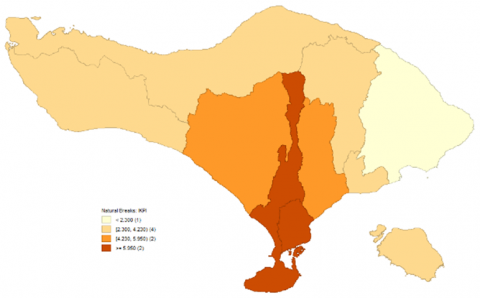
To visualize the distribution of the Composite Index of Inclusive Growth (CIIG) across Bali's coastal tourism villages, this study employs thematic mapping. The analysis excludes Bangli Regency as it lacks a coastal area. The villages sampled represent the diverse economic landscapes of Bali's coastlines, from Gilimanuk (Jembrana) in the west to Sanur (Denpasar) and Tulamben (Karangasem) in the east.
As shown in Figure 4, there is a clear spatial clustering pattern in Bali's inclusive growth. High CIIG values are concentrated in the southern region, particularly in Badung Regency and Denpasar City (shown in dark shading), which serve as the province's primary economic engines. In contrast, regencies such as Tabanan, Gianyar, Jembrana, Buleleng, and Klungkung exhibit moderate CIIG levels, while Karangasem Regency remains in the low category. This pattern suggests that inclusive growth in Bali is geographically dependent, where prosperous regions tend to be adjacent to other high-performing areas [11, 42].
Figure 4. Distribution pattern of inclusive growth of coastal tourism villages in Bali Province in 2023
The use of thematic mapping in this study to categorize the inclusive growth index aligns with the framework proposed by Hsu et al. [43], who emphasized that spatial mapping is a vital tool for monitoring the targets of Sustainable Development Goal 11 (Sustainable Cities and Communities). By visualizing spatial data, local governments can better understand the complex relationship between regional infrastructure and sustainable urban-rural development.
4.2.2 Spatial weighting matrix analysis (Queen Contiguity)
To empirically test these spatial relationships, a Queen Contiguity weighting matrix (W) was constructed. For non-specialist readers, this matrix defines "neighborhood" based on shared boundaries or vertices (corners). If two regencies share any geographical point, they are assigned a value of Wij = 1; otherwise, the value is 0 [14].
Given Bali's nine administrative regions, the matrix is a 9 × 9 system. To ensure the results are comparable across regions with varying numbers of neighbors, the matrix is row-standardized, meaning the weights for each neighbor are averaged (standardized to 1). For example, if a region has two neighbors, each is given a weight of 1/2. This mathematical step allows the model to capture the "spillover effect," where digital transformation in one village impacts the inclusive growth of its neighboring coastal communities.
Adjusted for Bali Province, which has 9 districts and cities, the Queen Matrix decline is shown as follows:
$W_{Queen}=\left[\begin{array}{cccccccc}0 & 1 & 1 & \ldots & \ldots & 0 & 0 & 0 \\ 1 & 0 & 1 & \ldots & \ldots & 0 & 0 & 0 \\ 1 & 1 & 0 & \ldots & \ldots & 0 & 0 & 0 \\ 0 & 0 & 1 & \ldots & \ldots & 0 & 0 & 0 \\ 0 & 0 & 1 & \ldots & \ldots & 0 & 0 & 0 \\ 0 & 0 & 0 & \ldots & \ldots & 0 & 0 & 0 \\ 0 & 1 & 0 & \ldots & \ldots & 0 & 0 & 0 \\ 0 & 0 & 0 & \ldots & \ldots & 0 & 0 & 0 \\ 0 & 1 & 0 & \ldots & \ldots & 0 & 0 & 0\end{array}\right]$
Meanwhile, below is a matrix that has been standardized:
$W_{{Queen }}=\left[\begin{array}{llllllll}0 & 1 / 2 & 1 / 2 & \ldots & \ldots & 0 & 0 & 0 \\ 1 / 4 & 0 & 1 / 4 & \ldots & \ldots & 0 & 0 & 0 \\ 1 / 4 & 1 / 4 & 0 & \ldots & \ldots & 0 & 0 & 0 \\ 0 & 0 & 1 / 4 & \ldots & \ldots & 0 & 0 & 0 \\ 0 & 0 & 1 / 3 & \ldots & \ldots & 0 & 0 & 0 \\ 0 & 0 & 0 & \ldots & \ldots & 0 & 0 & 0 \\ 0 & 1 / 5 & 0 & \ldots & \ldots & 0 & 0 & 0 \\ 0 & 0 / 0 & 0 & \ldots & \ldots & 0 & 0 & 0 \\ 0 & 1 / 3 & 0 & \ldots & \ldots & 0 & 0 & 0\end{array}\right]$
4.2.3 Development of the Composite Index of Inclusive Growth in coastal tourism villages
The inclusive growth conditions in Bali's coastal villages (CTVABP) for 2023 show a composite index range between 2.01 and 7.25 (Figure 5). This significant disparity highlights the uneven distribution of progress in income, education, and health dimensions across the province. The disparity in inclusive growth across Bali’s regencies is also driven by the uneven distribution of tourism investment. As noted by the study [44], tourism growth and investment in the 2023 recovery era show a strong spatial correlation, where southern regions continue to dominate due to superior infrastructure readiness, further influencing the CIIG in these areas.
Based on the categories established by the study [18], while Bali has seen progress, no regency or city has yet achieved the "Superior" category (score 8–10). Most regions fall within the "Satisfactory" category (score 4–7), including the high-performing hubs of Badung and Denpasar. However, the low score in Karangasem (approximately 2.01) underscores a critical gap in regional development. This finding aligns with national trends where most Indonesian provinces achieve satisfactory progress but struggle to achieve superior inclusiveness due to persistent infrastructure and human capability gaps [18, 19].

Figure 5. CIIG of coastal tourism villages in Bali Province in 2023 and the average in 2023
Variations in achieving inclusive growth across Bali's coastal areas reflect the interregional digital divide. As explained by Glebova et al. [45], the regional digital divide can be identified as a potential growth point for increasing a region's digital maturity. In this regard, regions with lagging technological infrastructure in Bali have the opportunity to accelerate their digital maturity through targeted policy interventions, thereby narrowing economic disparities and strengthening digital market integration.
4.2.4 Global spatial autocorrelation analysis
To determine the presence of spatial dependence across Bali's coastal tourism villages, this study employs the Moran's I test. This test measures whether the Inclusive Growth Index (IGI) in one regency is significantly influenced by the index values of its neighboring regencies [11].
The statistical analysis yielded a Moran's I value of 0.10 with a pseudo p-value of 0.92. Since the p-value is significantly greater than the 5% alpha level (p > 0.05), the null hypothesis of random spatial distribution cannot be rejected. Statistically, this suggests a weak or negative spatial autocorrelation pattern in 2023.
In practical terms, this result implies that inclusive growth in Bali's coastal villages does not follow a simple "clustering" of high-growth areas. Instead, it indicates a dynamic where villages with lower inclusive growth scores may benefit from being surrounded by high-growth "hubs," such as Badung or Denpasar, yet the spillover effect has not reached a point of statistical uniformity. This disparity reinforces the necessity of using the SLM to further investigate how digital infrastructure in neighboring regions specifically influences local inclusivity [14].
4.2.5 Spatial lag regression analysis
To identify the most robust econometric model for this study, we conducted LM and Robust Lagrange Multiplier (RLM) tests. These tests determine whether the spatial dependence in the data is better captured through the "Error" (random shocks) or the "Lag" (direct spillover) [11].
Table 2. Output of spatial dependence test results
|
No |
Spatial Dependence Test |
Mark |
P-Value |
|
1 |
LM-Error |
0.16 |
0.48 |
|
2 |
LM-Lag |
3.93 |
0.07* |
|
3 |
RLM-Error |
2.26 |
0.09 |
|
4 |
RLM-Lag |
6.03 |
0.01* |
|
5 |
Moran’I |
0.28 |
0.92 |
As shown in Table 2, the RLM-Lag test is highly significant (p = 0.01), whereas the LM-Error is not. This statistic confirms that the SLM, also known as the Spatial Autoregressive (SAR) model, is the superior choice for analyzing inclusive growth in Bali [11, 25]. The estimation results of the SLM are presented below:
$\begin{gathered}\mathrm{CIIG}_{\mathrm{i}}=0.46 \sum_{i=1 ; i \neq j}^9 { wij.IKPIj }+0.19+ 0.01 \mathrm{DPDS}_{\mathrm{i}}^{* *}+0.04 \mathrm{DBUM}_{\mathrm{i}}^*\end{gathered}$ (1)
Table 3. Output coefficients, z-values and significance of test results
|
Variables |
Coefficient |
Std. Error |
Z-Value |
Prob. |
|
W_CIIG (Spatial Lag) |
0.46 |
0.15 |
3.05 |
0.00 |
|
Constant |
0.19 |
0.59 |
0.33 |
0.74 |
|
DPDS (Gov. Dig.) |
0.01 |
0.01 |
1.87 |
0.06** |
|
DBUM (VOE Dig.) |
0.03 |
0.01 |
4.31 |
0.00* |
|
R-square |
|
|
0.94 |
|
|
F |
|
|
22.05 |
0.00 |
In Table 3, the model achieves an R-squared of 0.94, indicating that 94% of the variation in inclusive growth across Bali's coastal villages can be explained by DPDS and DBUM.
Interpretation of Findings:
The simultaneous influence of DPDS and DBUM is statistically significant (F = 22.05, p < 0.05), validating that the synergy between digital governance and digitalized enterprises is a potent driver for inclusive economic recovery in Bali.
4.3 The influence of village government digitalization on inclusive growth
The empirical results confirm that DPDS significantly impacts inclusive growth in Bali's coastal tourism villages. The strength of DPDS is primarily driven by three indicators: the Village Information System (SID), the Village Financial System (Siskeudes), and digital-based MSME development. On the other hand, inclusive growth is most visibly reflected in increased workforce participation, followed by cellular/internet penetration and improved life expectancy.
Theoretical and Global Context: These findings reinforce the Resource-Based View (RBV) theory, which posits that internal digital capabilities serve as strategic assets that enhance organizational performance in this case, the efficiency of village governments [46, 47]. By treating digital infrastructure as a "resource," village authorities can optimize public services [36], including health information, financial transparency, and waste management systems [36].
This study aligns with global trends observed in rural China and India, where infrastructure development particularly ICT has been proven to bridge the gap between rural and urban economic outcomes [3, 8]. However, this study adds a unique perspective by highlighting how digital governance in a tourism-dependent economy like Bali acts as a catalyst for "onboarding" MSMEs into the global market.
Specific Insights for Bali's Coastal Villages: While the potential of ICT is vast, the practical implementation in Bali reveals a generational and functional divide. This study identifies specific actionable insights for stakeholders:
Policy Implications: To achieve superior inclusive growth, the Bali Provincial Government and Village Ministries must go beyond providing hardware. Investment should focus on:
Future research should consider the Technology Acceptance Model (TAM) to explore why certain village communities adopt these digital tools faster than others, treating "perceived usefulness" as a potential moderator for inclusive growth [49].
4.4 The influence of Village-Owned Enterprises digitalization on inclusive growth
The statistical analysis confirms that the digitalization of DBUM is a robust driver of inclusive growth in Bali's coastal tourism villages. The DBUM construct is primarily anchored by three key indicators: integrated VOE information systems, digital financial management, and online marketing platforms for local MSME products. Consistent with the previous discussion, inclusive growth is predominantly manifested through increased workforce participation and digital connectivity (internet and mobile usage) [37].
Theoretical Integration: Innovation Diffusion and Social Capital: The findings of this study provide empirical support for the integration of Innovation Diffusion Theory [50] and Social Capital Theory [51]. In the context of Bali's coastal villages, digital technology acts as an innovation that diffuses through local communication channels and social networks.
The success of DBUM depends not only on the technology itself but also on the strength of social capital, such as trust, norms, and networks within the village community. When VOEs utilize digital platforms for marketing, they strengthen social networks by connecting local producers directly to global consumers, thereby reducing intermediation costs and ensuring a more equitable distribution of wealth [3, 8].
Strategic Impact on the Village Economy: The strategic role of BUMD in managing local potential in Bali's coastal tourism villages aligns with the model of rural economic transformation through community-based tourism. As demonstrated by the research [38] in case studies of several villages in Indonesia, BUMDes serve as key catalysts in integrating community resources to create inclusive economic value. In the context of digitalization, the role of BUMDes in Bali becomes even more crucial in connecting this local potential to a broader market through digital platforms. Digitalization empowers VOEs to transition from traditional administrative entities into dynamic market players. By using websites and social media, VOEs in villages like Kutuh and Tibubeneng have successfully expanded their market reach, allowing for higher labor absorption from the local community.
However, the impact of DBUM is not neutral; its effectiveness is contingent upon how technology is embedded in social interactions. Digitalization that fosters transparency and inclusiveness tends to strengthen village social capital. Conversely, if access is restricted to certain elites, it may weaken the communal bond. Therefore, the implementation of VOE information systems must be accompanied by community-wide digital literacy programs to ensure that the "onboarding" process involves all levels of the rural workforce [21, 41, 52].
Conclusion of Empirical Findings: In summary, the digitalization of VOEs in Bali represents a critical shift towards a "people-centered" digital economy. By leveraging digital financial systems and online marketplaces, VOEs act as intermediaries that bridge the gap between local resources and global tourism demand. This synergy ensures that economic growth remains inclusive, sustainable, and resilient against future external shocks [8, 18].
Based on the empirical analysis and discussion, this study draws four fundamental conclusions regarding the role of digital transformation in fostering inclusive growth within Bali's coastal tourism villages:
6.1 Policy and practical implications
The findings of this study offer critical insights for DPDS and DBUM. For policymakers, the significant spatial spillover effect (p = 0.46) implies that digital transformation should not be managed in silos. Instead, a "Cluster-Based Digitalization" approach is recommended, where high-performing villages (e.g., Kutuh or Sanur) act as digital hubs to mentor neighboring coastal villages. This ensures that the benefits of Bali's economic recovery are distributed equitably, fulfilling the criteria of inclusive and sustainable coastal.
6.2 Limitations
This study acknowledges several limitations that should be considered when interpreting the results:
6.3 Suggestions for future research
To build upon these findings, future studies should consider the following:
[1] BPS Bali. (2024). Bali Province in figures 2024. Central Statistics Agency of Bali Province.
[2] Alibašić, H. (2018). Sustainability and Resilience Planning for Local Governments. The Quadruple Bottom Line Strategy. Springer Cham. https://doi.org/10.1007/978-3-319-72568-0
[3] Murthi, N.W., Utama, M.S., Saskara, I.A.N., Marhaeni, A.A.I.N. (2023). The role of government and digitalization (ICT) in fostering equitable growth at the coastal village of Badung, Bali. Tuijin Jishu/Journal of Propulsion Technology, 44(4): 7044-7054. https://doi.org/10.52783/tjjpt.v44.i4.2538
[4] Wandaogo, A. (2022). Does digitalization improve government effectiveness? Evidence from developing and developed countries. Applied Economics, 54(33): 3840-3860. https://doi.org/10.1080/00036846.2021.2016590
[5] Sara, I.M., Jayawarsa, A.A.K., Saputra, K.A.K. (2021). Rural assets administration and establishment of village-owned enterprises for the enhancement of rural economy. Jurnal Bina Praja, 13(1): 81-91. https://doi.org/10.21787/jbp.13.2021.81-91
[6] Heriani, H., Purnama, R. (2025). Green tourism: New economic opportunities in the sustainable era in Ubud Bali. Electronic Journal of Education, Social Economics and Technology, 6(1): 187-195. https://doi.org/10.33122/ejeset.v6i1.211
[7] Bhatt, S. (2020). Digitalization of rural India: Digital village. VISION: Journal of Indian Taxation, 7(1): 83-93. https://doi.org/10.17492/vision.v7i1.195413
[8] Jiang, A.C., Chen, C., Ao, Y.B., Zhou, W.M. (2022). Measuring the inclusive growth of rural areas in China. Applied Economics, 54(32): 3695-3708. https://doi.org/10.1080/00036846.2021.1923640
[9] Ali, I., Son, H.H. (2007). Measuring inclusive growth. Asian Development Review, 24(1): 11-31. https://doi.org/10.1142/S0116110507000024
[10] Anand, R., Mishra, S., Peiris, S.J. (2013). Inclusive Growth: Measurement and Determinants. IMF Working Papers.
[11] Anselin, L. (1988). Spatial Econometrics: Methods and Models. Springer Dordrecht. https://doi.org/10.1007/978-94-015-7799-1
[12] Koralagama, D., Gupta, J., Pouw, N. (2017). Inclusive development from a gender perspective in small scale fisheries. Current Opinion in Environmental Sustainability, 24: 1-6. https://doi.org/10.1016/j.cosust.2016.09.002
[13] Si, S., Hall, J., Suddaby, R., Ahlstrom, D., Wei, J. (2023). Technology, entrepreneurship, innovation and social change in digital economics. Technovation, 119: 102484. https://doi.org/10.1016/j.technovation.2022.102484
[14] LeSage, J., Pace, R.K. (2009). Introduction to Spatial Econometrics: CRC press. https://doi.org/10.1201/9781420064254
[15] Menpan.go.id. (2023). Sinergi Kementerian PANRB dan UID Bali Perkuat Pemerintahan Digital. https://www.menpan.go.id/site/berita-terkini/sinergi-kementerian-panrb-dan-uid-bali-perkuat-pemerintahan-digital.
[16] Kjøller-Hansen, A.O., Lindbjerg Sperling, L. (2020). Measuring inclusive growth experiences: Five criteria for productive employment. Review of Development Economics, 24(4): 1413-1429. https://doi.org/10.1111/rode.12689
[17] Prastyadewi, M.I., Tantra, I.G.L.P., Pramandari, P.Y. (2023). Digitization and prediction of the number of tourist visits in the Bali Province. Jurnal Ekonomi dan Bisnis Jagaditha, 10(1): 89-97. https://doi.org/10.22225/jj.10.1.2023.89-97
[18] McKinley, T. (2010). Inclusive growth criteria and indicators: An inclusive growth index for diagnosis of country progress. Asian Development Bank. https://www.adb.org/sites/default/files/publication/28493/adb-wp14-inclusive-growth-criteria.pdf.
[19] Nalle, F.W. (2018). Analisis pertumbuhan ekonomi inklusif di Kabupaten Timor Tengah Utara. Jurnal Agrimor, 3(3): 47-51. https://www.researchgate.net/publication/329036644_Analisis_Pertumbuhan_Ekonomi_Inklusif_di_Kabupaten_Timor_Tengah_Utara.
[20] Atkinson, R.D., Castro, D. (2008). Digital quality of life: Understanding the personal and social benefits of the information technology revolution. https://doi.org/10.2139/ssrn.1278185
[21] Antlöv, H., Wetterberg, A., Dharmawan, L. (2016). Village governance, community life, and the 2014 village law in Indonesia. Bulletin of Indonesian Economic Studies, 52(2): 161-183. https://doi.org/10.1080/00074918.2015.1129047
[22] Hoque, M.R., Sorwar, G. (2017). ICT based e-government services for rural development: A study of Union Information and Service Center (UISC) in Bangladesh. Information Development, 31(2): 112-125. https://doi.org/10.1002/j.1681-4835.2015.tb00517.x
[23] Darwin, M., Mamondol, M.R., Sormin, S. A., (2021). Review Buku: Metode penelitian pendekatan kuantitatif. Media Sains Indonesia. https://repository.unas.ac.id/id/eprint/4015/.
[24] Pramana, S., Paramartha, D.Y., Ermawan, G.Y., Deli, N.F., Srimulyani, W. (2022). Impact of COVID-19 pandemic on tourism in Indonesia. Current Issues in Tourism, 25(15): 2422-2442. https://doi.org/10.1080/13683500.2021.1968803
[25] Florax, R.J.G.M., Folmer, H., Rey, S.J. (2003). Specification searches in spatial econometrics: The relevance of Hendry’s methodology. Regional Science and Urban Economics, 33(5): 557-579. https://doi.org/10.1016/S0166-0462(03)00002-4
[26] ADB. (2012). Infrastructure for Supporting Inclusive Growth and Poverty Reduction in Asia. Asian Development Bank.
[27] Nelson, R.R. (2008). What enables rapid economic progress: What are the needed institutions? Research policy, 37(1): 1-11. https://doi.org/10.1016/j.respol.2007.10.008
[28] Oyedele, O.A. (2012). Public-Private Partnership (PPP) and infrastructure provision in Nigeria. In AARCHES 2012 Biennial General Meeting and Annual Conference.
[29] Sullivan, A., Sheffrin, S.M. (2003). Economics: Principles in Action. Pearson Prentice Hall, Upper Saddle River. https://www.scirp.org/reference/referencespapers?referenceid=1288167.
[30] BPS. (2023). Indeks Pembangunan Teknologi Informasi dan Komunikasi 2022. https://www.bps.go.id/id/publication/2023/09/29/cfa3a7c9e8b2397799ec6bb3/indeks-pembangunan-teknologi-informasi-dan-komunikasi-2022.html.
[31] Rahayu, E.M. (2019). Aplikasi Tabanan Menuju Smart City. https://Swa.Co.Id/Read/223561/Aplikasi-Tabanan-Menuju-Smart-City.
[32] Panrb. (2023). Bali Digital Festival II 2023. https://menpan.go.id/site/berita-foto/bali-digital-festival-ii-2023.
[33] BPS Bali. (2025). Bali province in figures 2025. BPS-Statistics Indonesia Bali Province.
[34] Ullah, A., Pinglu, C., Ullah, S., Abbas, H.S.M., Khan, S. (2021). The role of e-governance in combating COVID-19 and promoting sustainable development: A comparative study of China and Pakistan. Chinese Political Science Review, 6: 86-118. https://doi.org/10.1007/s41111-020-00167-w
[35] Kurniawan, C.W., Budhi, K.S., Setiawina, N.D., Djayastra, K. (2017). State owned foreign exchange banks analysis to import loans of non-oil and gas sectors in Indonesia 2010–2015. International Journal of Applied Business and Economic Research, 15(19): 111-124. https://serialsjournals.com/abstract/54935_9.pdf.
[36] Voronov, O., Kurnosenko, L., Bezena, I., Petryshyn, N., Korniievskyi, S., Ilychok, B. (2023). Public administration of planning for the sustainable development of the region in the context of total digitalization. International Journal of Sustainable Development and Planning, 18(1): 61-67. https://doi.org/10.18280/ijsdp.180106
[37] Darma, Y.D., Parulian. (2021). Peningkatan tata kelola desa dan pemberdayaan ekonomi kreatif berbasis digital di masa pandemi Covid-19. Central Community Development Journal, 1(2): 11-13. http://journal.privietlab.org/index.php/CCDJ/article/view/145.
[38] Tarlani, T., Daria, A.R., Rani, A.M. (2022). Transforming rural economy through community-based tourism with village-owned enterprise (BUMDES, Badan Usaha Milik Desa) - A case study: Cibiru Wetan, Pagerwangi and Cipamekar Villages, Indonesia. International Journal of Sustainable Development and Planning, 17(5): 1535-1542. https://doi.org/10.18280/ijsdp.170517
[39] Luthfiani, N. (2019). Desa Kutuh ciptakan sistem pemerintahan modern serba digital. https://www.Viva.Co.Id/Kemendesa/1168468-Desa-Kutuh-Ciptakan-Sistem-Pemerintahan-Modern-Serba-Digital.
[40] Utama, I.G.B.R., Prasiasa, D.P.O., Widari, D.A.D.S. (2024). New orientation strategy into domestic market for Bali tourism destination after the COVID-19 pandemic. International Journal of Sustainable Development and Planning, 19(3): 931-938. https://doi.org/10.18280/ijsdp.190311
[41] Kirillova, E., Otcheskiy, I., Ivanova, S., Verkhovod, A., Stepanova, D., Karlibaeva, R., Sekerin, V. (2023). Developing methods for assessing the introduction of smart technologies into the socio-economic sphere within the framework of open innovation. International Journal of Sustainable Development and Planning, 18(3): 693-702. https://doi.org/10.18280/ijsdp.180305
[42] Cahyadi, N.M.A.K., Sasongko, S., Saputra, P.M.A. (2018). Inclusive growth and leading sector in Bali. Economic Journal of Emerging Markets, 10(1): 99-110.
[43] Hsu, A., Chakraborty, T., Thomas, R., Manya, D., et al. (2020). Measuring what matters, where it matters: A spatially explicit urban environment and social inclusion index for the sustainable development goals. Frontiers in Sustainable Cities, 2: 556484. https://doi.org/10.3389/frsc.2020.556484
[44] Tantra, I.G.L.P., Murthi, N.W. (2025). Tourism growth and investment in Bali's inclusive economic recovery in 2023: A spatial and econometric approach. Central Community Development Journal, 5(2): 96-118. https://doi.org/10.55942/ccdj.v5i2.1399
[45] Glebova, I., Berman, S., Khafizova, L., Biktimirova, A., Alhasov, Z. (2023). Digital divide of regions: Possible growth points for their digital maturity. International Journal of Sustainable Development and Planning, 18(5): 1457-1465. https://doi.org/10.18280/ijsdp.180516
[46] Barney, J. (1991). Firm resources and sustained competitive advantage. Journal of Management, 17(1): 99-120. https://josephmahoney.web.illinois.edu/BA545_Fall%202022/Barney%20(1991).pdf.
[47] Wade, M., Hulland, J. (2004). The resource-based view and information systems research: Review, extensions, and suggestions for future research. MIS Quarterly, 28(1): 107-142. https://doi.org/10.2307/25148626
[48] Watto, W.A. (2024). From lifestyle to creative economy: Consumer choices, services capes, and digital drivers in Pakistan's coffee market. Central Community Development Journal, 4(1): 21-28. https://doi.org/10.55942/ccdj.v4i1.798
[49] Davis, F.D. (1989). Perceived usefulness, perceived ease of use, and user acceptance of information technology. MIS Quarterly, 13(3): 319-340. https://doi.org/10.2307/249008
[50] Rogers, E.M. (2003). Diffusion of Innovations (5th ed.). Free Press.
[51] Putnam, R.D. (2000). Bowling Alone: The Collapse and Revival of American Community. Simon & Schuster. https://doi.org/10.1145/358916.361990
[52] Tantra, I.G.L.P., Susilowati, I., Iskandar, D.D., Waridin, W. (2020). Prospect and strategy “from vulnerability to viability (V2V)” for special coastal ecosystem development for fishermen of Buleleng Bali Indonesia. Journal of Advanced Research in Dynamical and Control Systems, 12(5): 169-175. https://doi.org/10.5373/JARDCS/V12I5/20201701