Sayugo Adi Purwanto* | Amiurti Kusumaningtyas | Abdul Halik
© 2025 The authors. This article is published by IIETA and is licensed under the CC BY 4.0 license (http://creativecommons.org/licenses/by/4.0/).
OPEN ACCESS
This study examines how strategic agility, environmental innovation, and digital capability shape organizational performance through the mediating roles of innovation capability and competitive advantage. Focusing on Village-Owned Enterprises (BUMK) in Berau Regency, East Kalimantan (Indonesia), we employ a quantitative cross-sectional design. Data were collected using proportional sampling and analyzed using structural equation modeling (SEM–PLS) via SmartPLS. The results indicate that strategic agility, environmental innovation, and digital capability exert positive and significant effects on innovation capability. Innovation capability, in turn, strengthens competitive advantage and directly enhances organizational performance, and competitive advantage further improves performance. Mediation tests confirmed that innovation capability and competitive advantage serve as significant transmission mechanisms linking higher-order capabilities to performance outcomes.
strategic agility, environmental innovation, digital capability, innovation capability, competitive advantage
Economic development remains the backbone of national progress because it propels, reinforces, and interlocks with other sectors to achieve collective objectives. It is also central to narrowing the prosperity gaps with peer nations. A salient marker of success is sustained growth, along with falling unemployment. In Indonesia, pro-growth policy extends from cities to villages; in rural areas, the state has promoted Village-Owned Enterprises (BUMDes) and Village/Kampung-Owned Enterprises (BUMK) to support local administration and expand welfare through grassroots economic activity. However, many BUMDes/BUMK underperform limited managerial capability among village officials constrains governance and the translation of enterprise initiatives into tangible welfare gains. Therefore, investigating the organizational performance of BUMDes/BUMK is both timely and necessary.
High-performing organizations reduce unemployment, strengthen competitiveness, and enhance their long-run viability. Realizing these outcomes requires coherent strategies and practices that increase efficiency and productivity. The resource-based view (RBV) argues that firms secure competitive advantages by mobilizing valuable, rare, inimitable, and non-substitutable resources, such as tangible assets, technological know-how, and organizational processes. One capability emphasized in this study is strategic agility, which is the capacity to sense external change, rapidly reconfigure resources, and commit to decisive responses [1]. Evidence indicates that greater agility accelerates product, service, and business model innovation and supports growth [2], and that strategic agility significantly and positively affects innovation capability, functioning as a key precondition for it [1].
The second capability is environmental innovation, which is defined as the development and deployment of creative solutions that reduce ecological harm and advance sustainability. External stakeholders increasingly regard such initiatives as sources of competitive advantage, and firms that integrate environmental innovation into their core strategy are better positioned to build that advantage [3]. The third is digital capability, which is the ability of individuals and organizations to understand, use, and adapt digital technologies at pace. As digitalization permeates processes and markets, digital capability and digital orientation positively affect digital innovation [4], while building digital capabilities is critical to generating innovation and, through technological capability as a mediator, improving firm performance [5].
Together, strategic agility, environmental innovation, and digital capability should strengthen innovation capability, that is, the capacity to generate, adopt, and implement new ideas and practices that create value. Empirical work shows that digitally capable firms innovate more [4] and that innovative firms outperform their rivals [6]. Innovation capability improves organizational performance [7]. From an RBV perspective, competitive advantage arises when resources meet the Valuable, Rare, Inimitable, Non-substitutable (VRIN) / Valuable, Rare, Inimitable, Organized (VRIO) criteria [8]. Prior studies link innovation capability to both performance and competitive advantage [9] and find a significant effect of innovation capability on competitive advantage [10]. Competitive advantage then translates into superior performance: managers can raise outcomes by crafting strategies that leverage identified competitive strengths [11], and competitiveness has a significant positive effect on performance [10]. Complementary findings across contexts reinforce these links: competitive advantage improves business performance [12], relates positively to the financial performance of SMEs in Hanoi [13], and significantly affects marketing performance [14].
Building on this literature and the RBV, this study proposes a modified replication-based conceptual model that integrates strategic agility, environmental innovation, digital capability, innovation capability, competitive advantage, and organizational performance, synthesizing insights from Heredia et al. [5], Skordoulis et al. [3], and AlTaweel and Al-Hawary [1]. We test the model among BUMK in Berau, East Kalimantan, Indonesia, a pertinent setting given BUMK’s mandate to strengthen village economies and social cohesion in line with local needs and potential. The salience of BUMK performance is evident in provincial recognition of top performers, for example, in 2022 BUMK Surya Jaya Abadi (Labanan Makarti, Teluk Bayur) was awarded for innovation and BUMK Batu Bual Sejahtera (Pegat Bukur, Sambaliung) for finance and assets (dpmpd.kaltimprov.go.id). This study asks whether the observable successes of Berau’s BUMK can be explained by the theorized capabilities and advantages of BUMK. By situating capability building within Indonesia’s village enterprise ecosystem, this study offers a forward-looking account of how rural organizations can convert agility, sustainability-oriented innovation, and digital prowess into durable competitive advantages and superior performance.
2.1 Theoretical review
RBV explains how firms marshal and leverage resource bundles to shape performance, often under conditions of causal ambiguity that make replication difficult [15]. From this perspective, human resources can underpin sustained competitive advantage by cultivating firm-specific skills and an organizational culture that rivals cannot easily imitate, combining heterogeneity (enhanced knowledge and skills) with immobility (enduring work norms) to preserve advantage [15]. RBV emphasizes that resources are valuable, rare, inimitable, and non-substitutable, valuable in supporting strategic actions, rare because few firms possess them, shielded from imitation, and not replaceable by equivalent alternatives [16]. Thus, sustained advantage rests on unique historical paths, causal ambiguity, and complex social systems that impede imitation [16].
Dynamic capabilities extend the RBV by focusing on how firms renew and reconfigure their resource bases. They comprise the abilities to integrate, reconfigure, acquire, and release resources so that the firm can respond quickly to new opportunities and, where feasible, reshape markets through innovation as an adaptive response to external change [17]. In line with Teece, Pisano, and Shuen, dynamic capabilities reflect the capacity to combine, develop, and reconfigure internal and external competencies under rapid environmental shifts [18, 19]. Three components are often highlighted: absorptive capability, the processing and internal integration of external information to deliver market-fit offerings; adaptive capability, the coordination and reconfiguration of resources so the firm can endure and outperform amid change; and innovation capability, the mobilization of technology and organizational creativity to convert opportunities into new products and processes [19].
Within this capability logic, strategic agility captures an organization’s capacity to commit decisively while remaining flexible, enabling transformation, reinvention, and survival in turbulent contexts [20]. Agility embodies high quality, short delivery times, flexibility, responsiveness to innovation, and cost efficiency as levers of competitive success [21]. It denotes a proactive, rapid, and effective response to shocks inside and outside the business environment, turning threats into opportunities through vigilant sensing, knowledge management, and the swift recombination of resources, processes, and strategies [22]. Agile organizations succeed through responsiveness, competencies, flexibility, and speed, securing a market advantage [23]. In practice, strategic agility aligns the intended with the realized strategy as conditions shift; it rests on client knowledge, capability knowledge, clarity of vision, shared leadership, competitor insight, judicious target selection, and decisive action, and it bears an entrepreneurial character [24]. Foundational meta-capabilities—strategic sensitivity, leadership unity, and resource fluidity—support fast, politics-light decisions and the rapid redeployment of assets via adaptable processes, HR approaches, and collaboration mechanisms that accelerate business-model transformation [20]. Empirically, agility appears as consumer agility (detecting market shifts via customer insight), partner agility (leveraging partner assets and knowledge), and operational agility (executing internal processes with speed, accuracy, and low cost) [25].
A complementary stream focuses on environmental innovation or eco-innovation, which aims to reduce the ecological footprint of products and processes while sustaining customer and business value [26]. It spans energy-saving technologies, pollution prevention, waste recycling, green product design, and corporate environmental management, and includes green product, process, and managerial innovations that can bolster innovation performance and competitive advantage, particularly in SMEs [22]. Conceptually, environmental innovation involves producing or exploiting new goods, services, production methods, organizational structures, or managerial practices that reduce environmental risks, pollution, and resource intensity relative to alternatives [10, 27]. It functions as a sustainability-led business approach that can unlock new markets, raise productivity, attract investment, improve value chain profitability, and sustain regulatory readiness [6]. Classifications distinguish greener production–consumption systems, control and remediation technologies, organizational methods for environmental management, and eco-beneficial products and services [26]. Adoption reflects corporate postures ranging from compliance to market-oriented integration to environment-oriented strategies, where ecology is core to success; however, diffusion often faces technological, financial, labor, regulatory, consumer, supplier, and managerial barriers [26]. In aggregate, environmental innovation denotes the generation or adoption of solutions that reduce emissions, optimize resource use, and elevate environmental quality [28].
Digital capability anchors a firm’s ability to turn digital technologies into novel outcomes. Digital innovation now unfolds in competitive and collaborative settings and relies on linking technology with professional digital talent [28]. Digital capability refers to the integration and exploitation of digital data and IT across products, services, processes, organizational systems, and practices to create value for constituents and beneficiaries while equipping the firm to respond to market changes with new offerings and processes [4, 29]. It modernizes infrastructure and service processes and, as a dynamic capability, enables both rapid responsiveness and the development of new goods and processes [19, 28]. In Industry 4.0, digital capability has become essential for growth and global reach, as illustrated by firms that scale rapidly by leveraging digital platforms [5]. As an organizational ability to deliver instantaneous internal and external responses through digital channels, it directly contributes to value creation, despite debates over the construct’s conceptual boundaries, given its lineage in dynamic capability theory [4].
These capabilities converge in the construct of innovation capability, defined as a firm’s ability to identify ideas and convert them into new or improved products, services, or processes that benefit the organization and its stakeholders [30, 31]. Innovation capability integrates technical and non-technical domains—new services, operational methods, technologies, managerial practices, market approaches, and marketing—through embedded knowledge, routines, and governance mechanisms that sustain continuous innovation [30]. It is a higher-order integrating capability that orchestrates diverse underlying abilities to apply creativity, solve problems, exploit opportunities and enhance performance. Its manifestations include new product and service development, novel production and service methods, executive risk-taking, and the pursuit of unconventional solutions [6, 13, 19, 32]. Context also matters: vision, competence base, organizational intelligence, creativity, idea management, structure, culture and climate, and technology management all contribute, while service settings emphasize needs sensing, technology choice, conceptualization, bundling, co-production and orchestration, scaling, and continual use [33]. Innovation capability is the disciplined exploitation of new ideas to advance organizational goals [34].
The outcome of these resource positions and capabilities is a competitive advantage, a distinctive value-creating position that yields above-average performance by differentiating the firm from rivals through lower costs or superior benefits [12]. It represents the capacity to resist competitive pressure and defeat rivals in the marketplace [11]. Sustainable advantage, in turn, rests on valuable resources, which are difficult to develop elsewhere, hard to imitate, and not easily substituted [8]. For SMEs, advantage aggregates attributes that secure superior market positions when firms deliver greater value to customers than competitors, achieved by offering lower prices or enhanced benefits at justifiable premiums, and by aligning strengths with efficiency and effectiveness over time [12, 25, 33, 35]. Common indicators include consistently superior products and services, strong customer recommendations, and outperforming in leveraging technology [36]. Industry structure simultaneously shapes these outcomes through the threat of entrants and substitutes, supplier and buyer power, and the intensity of rivalry [35].
Ultimately, organizational performance captures the totality of outcomes derived from planned processes enacted by individuals, groups, and the organization, spanning inputs, outputs, outcomes, benefits, and impacts, and is assessed against goals anchored in vision and strategy [4, 37]. Performance is visible in terms of speed, quality, cost, flexibility, innovation, and the efficient transformation of resources into goods and services, alongside stakeholder satisfaction [38]. It is strengthened by human resource investments that build competencies, organizational justice that fosters commitment, organizational effectiveness relative to targets, active line manager support for HR practices, and managerial mediation that translates HRM into productivity gains. Together, these factors articulate how RBV, dynamic capabilities, agility, environmental innovation, and digital capability coalesce into innovation capability, competitive advantage, and ultimately superior organizational performance [37].
2.2 Conceptual framework
Prior studies have collectively linked strategic agility, environmental innovation, digital capability, innovation capability, competitive advantage, and organizational performance, with variation mainly in settings and samples rather than in the underlying mechanisms. Agility consistently emerges as an engine of innovation and performance; it accelerates product, service, and business-model renewal [2], supports survival under turbulence such as COVID-19 by turning shocks into opportunities [22], and improves international outcomes when firms balance exploratory and exploitative moves under environmental uncertainty [39]. Evidence from SMEs indicates that foresight and agility correlate strongly with competitive advantage [21], while firm-level analyses show that agility catalyzes business model innovation and, via that pathway, superior performance in volatile contexts [24].
Within a resource-based and dynamic-capabilities lens, the value and rarity of resource configurations—not merely their absolute value—predict advantage and performance, with competitive advantage mediating the effect of scarce resource bundles [40]. Competitive advantage is a proximal driver of organizational performance; ineffective resource use erodes advantage, whereas well-designed strategies that leverage core competencies improve outcomes [11]. Digital capability is a recurrent antecedent: digital orientation and capability spur digital innovation, which in turn mediates the effects on financial and non-financial performance [4]. Cross-country evidence during the “new normal” shows that digital capability improves performance primarily through technological capabilities, with stronger indirect effects in lower-HDI environments [5]. Related work confirms that digital capability lifts manufacturing performance through mediated channels—internal digital innovation and external value co-creation [19]–and that digital orientation/capability fuels SME digital transformation, which then enhances revenue and business model change [41]. Digital capability also supports sustainable entrepreneurship through a digital innovation orientation, with partial mediation and positive moderation in mission-oriented contexts [29].
Environmental innovation strengthens competitiveness by embedding energy saving, pollution prevention, and green design into strategies [3, 42]. Firm surveys document moderate but rising adoption (e.g., ISO 14001), with green process and product innovation improving firms’ competitive ability [3]. Broader innovation capability translates ideas into offerings and processes that improve performance. Studies have reported positive innovation–performance links under varying contingencies, including environmental dynamism and absorptive capacity [6, 38, 43, 44]. Knowledge management processes feed innovation capability and, through it, organizational performance, underscoring learning and absorption as central enablers [7]. Dynamic capabilities, creativity, and innovation capabilities jointly bolster competitive advantage and firm performance, with entrepreneurial orientation amplifying these effects [9]. Operational practices matter as well: inventory management can raise competitiveness and performance in micro and small firms [6], and relationship management enhances competitive advantage, which then lifts hotel operating performance [45]. Sectoral studies reveal nuances: environmental leadership may not uniformly improve performance once size and capability are considered, whereas environmental capability tends to do so [46]. Supply chain work highlights alignment gaps and the role of supplier environmental capabilities in green project outcomes [32]. Case evidence also shows that innovation capability operates differently across contexts, yielding heterogeneous impacts on advantage [47]. Psychological safety at the organizational level supports SMEs’ innovation capabilities and performance, moderated by environmental dynamism [30]. Finally, strategic agility improves operational performance more readily than short-term financials in some SME settings, reflecting the lagged financial realization [32].
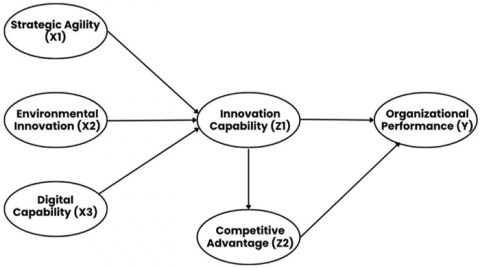
Figure 1. Conceptual framework
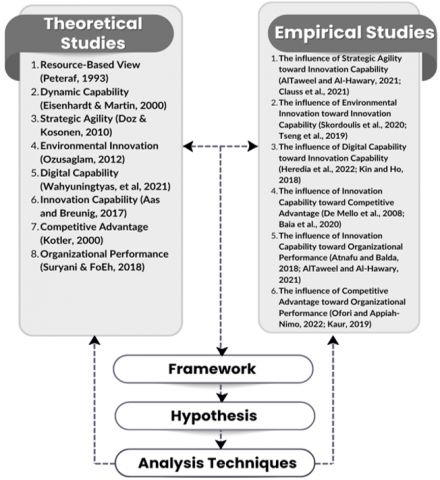
Synthesizing this literature (see Figure 1), the present study posits a capability-driven model in which strategic agility, environmental innovation, and digital capability operate as upstream enablers of innovation capability; innovation capability then enhances competitive advantage and, alongside competitive advantage, improves organizational performance [1-6, 22]. The model was evaluated among BUMK in Berau, East Kalimantan, using interview data analyzed via structural equation modeling (SEM). This context allows a direct test of whether agility, sustainability-oriented innovation, and digital capability accumulate into innovation capability, translate into competitive advantage, and ultimately manifest in superior organizational performance, consistent with prior evidence across industries and regions [7, 9, 11].
This study employs a quantitative causal–explanatory design to position the focal constructs and estimate their directional effects. A quantitative design is appropriate because the proposal, field procedures, hypothesis testing, analysis, and conclusions rely on measurements and numerical inferences. This study adopts a quantitative approach in which the proposal, process, hypotheses, fieldwork, data analysis, and write-up use measurement, calculation, and numerical certainty.
3.1 Population, sample, and sampling technique
The population comprises all 65 BUMK in Berau Regency, East Kalimantan, that meet three criteria: established for more than two years, active in 2023, and submitted the 2022 accountability report. Given the finite frame, the study applies saturated (census) sampling; thus, all 65 BUMK units constitute the sample.
3.2 Data types and data collection
Primary data were collected directly from BUMK respondents using a structured questionnaire capturing Strategic Agility (X1), Environmental Innovation (X2), Digital Capability (X3), Innovation Capability (Z1), Competitive Advantage (Z2), and Organizational Performance (Y) [48]. Secondary data were obtained from organizational documents, relevant websites, and journals [48]. Primary collection was complemented by direct observation of BUMK settings [49] and documentation (e.g., photographs during questionnaire distribution and observation). Data were gathered primarily through a structured questionnaire administered as self-completion or researcher-assisted interviews, supported by observation and documentation. All items were rated on a five-point Likert scale: 1 = strongly disagree, 2 = disagree, 3 = neutral, 4 = agree, and 5 = strongly agree. The resulting dataset enables hypothesis testing on the direct and mediated effects among constructs using multivariate techniques consistent with the causal–explanatory aims.
3.3 Conceptual and operational definitions
The following section describes the conceptual and operational definitions of variables used in the study. Figure 2 shows the relationship of the variables based on the conceptual framework.
Figure 2. The relationship of variables
3.3.1 Strategic agility (X1)
Conceptually, strategic agility is an organization’s capacity to act swiftly, decisively, and effectively, anticipating and exploiting change [20, 23, 50]. Operationally, four dimensions guide the measurement. Strategic sensitivity reflects opportunity sensing and is indicated by anticipating resource implications, experimenting with the market to strengthen services, abstracting strategic issues into business-model development, and building partnership networks for model expansion. Leadership unity concerns bold, politics-light top-team decision-making, indicated by open dialogue, habitual transparency, integrative decision-making, alignment of shared interests, and mutual respect for roles. Resource fluidity denotes rapid reconfiguration and redeployment, indicated by flexible work to accommodate customers, unconstrained time deployment for model configuration, dissociation of resource ownership when needed, switching among parallel model scenarios, and grafting models after acquisition. Intelligence systems/communities of practice are indicated by the development of strategic technologies and routine performance reporting.
3.3.2 Environmental innovation (X2)
Environmental innovation refers to green processes and products embedded in operations, including energy saving, pollution prevention, waste recycling and environmental management [3]. Two dimensions were used. Environmental process innovation encompasses formal environmental procedures and instructions, consideration of natural environmental aspects in administration, periodic environmental audits, residue recycling programs, executive environmental seminars, and ISO-based quality and environmental certifications. Environmental product innovation encompasses pollution reduction, sponsorship of environmental events, environmental claims in marketing, ecological criteria in procurement, life cycle analysis, reduction of toxic substances, use of eco-friendly materials, improvements in energy efficiency, and adoption of renewable energy.
3.3.3 Digital capability (X3)
Grounded in dynamic capability theory, digital capability is the organizational capacity to create new products and processes and respond to market shifts by integrating and exploiting digital data and information technologies across products, services, processes, and organizational systems [4]. The indicators adapted from Hulla et al. [51] included value creation from digitalization, interaction with modern interfaces, data processing and analytics, decision-making skills, general technology knowledge, ICT competence, implementation in production, innovative thinking, problem solving, and team collaboration.
3.3.4 Innovation capability (Z1)
Innovation capability is the creative renewal of ideas, processes, or methods that drive performance [52]. Following Zhang et al. [53], four indicators are used: product innovation (novelty and market success of offerings), market innovation (novel approaches to identify and enter opportunities), process innovation (reconfiguration and exploitation of resources for efficient, creative production), and strategic innovation (development of competitive strategies that creatively bridge ambition–resource gaps).
3.3.5 Competitive advantage (Z2)
Competitive advantage is superior value delivery relative to rivals through lower prices or greater benefits at acceptable premiums [54]. The indicators include price, quality, delivery dependability, product innovation, and time-to-market.
3.3.6 Organizational performance (Y)
Organizational performance is the outcome of the planned processes enacted by organizational members [37]. Financial indicators include the target return on sales, profit attainment, sales growth, productivity, and planned or lower production costs. Operational indicators include target market share, timely new product introductions, perceived product–customer fit, minimal resource use, and fulfillment of customer needs.
4.1 Respondent’s characteristics
The respondents comprise all 65 BUMK in Berau Regency, East Kalimantan, meeting three criteria: each enterprise has operated for more than two years, is active in 2023, and submitted its accountability report in 2022. Descriptive statistics are presented to profile the respondent pool and illuminate patterns relevant to the relationships among the study variables. These summaries provide contextual information that aids in the interpretation of the empirical results. The respondent profiles are presented in Table 1.
Table 1. Respondent characteristics
|
Category |
Level |
Count |
Percent |
|
Gender |
Female |
23 |
35.4 |
|
|
Male |
42 |
64.6 |
|
Age Group |
21–30 |
11 |
16.9 |
|
|
31–40 |
24 |
36.9 |
|
|
41–50 |
23 |
35.4 |
|
|
51+ |
7 |
10.8 |
|
Education |
Bachelor’s degree |
53 |
81.5 |
|
|
Diploma |
1 |
1.5 |
|
|
Middle school (junior high) |
6 |
9.2 |
|
|
Primary school (elementary) |
5 |
7.7 |
|
Role |
Chair/Head |
29 |
44.6 |
|
|
Director |
3 |
4.6 |
|
|
Secretary |
15 |
23.1 |
|
|
Staff member |
1 |
1.5 |
|
|
Treasurer |
17 |
26.2 |
Across the 65 BUMK personnel, the sample was predominantly male (42; 64.6%), with females comprising 23 (35.4%). Age is concentrated in mid-career cohorts: 31–40 years accounts for 24 (36.9%) and 41–50 years for 23 (35.4%), whereas younger respondents aged 21–30 number 11 (16.9%) and those aged 51+ number 7 (10.8%). Educational attainment is high: bachelor’s degree holders total 53 (81.5%), with smaller shares at diploma level (1; 1.5%), middle school (6; 9.2%), and primary school (5; 7.7%). Roles are concentrated in leadership and administrative posts: Chair/Head is the most common position (29; 44.6%), followed by Treasurer (17; 26.2%) and Secretary (15; 23.1%), while Director is less frequent (3; 4.6%) and general staff are rare (1; 1.5%). Aggregating positions indicates near-equal representation of leadership (Chair/Head + Director = 32; ≈ 49%) and administrative roles (Secretary + Treasurer = 32; ≈ 49%), with minimal general staff representation. Overall, the workforce reflects a largely male, mid-career, and well-educated managerial and administrative profile.
4.2 Descriptive statistics
Table 2 reports the descriptive statistics of the study constructs. Innovation Capability (Z1) has a mean of 4.1562 (min 3.00, max 5.00, SD 0.5400). Strategic Agility (X1) averages 4.3154 (min 3.25, max 5.00, SD 0.44448). Environmental Innovation (X2) records a mean of 4.1672 (min 3.00, max 5.00, SD 0.49443). Digital Capability (X3) averages 4.3277 (min 3.30, max 5.00, SD 0.47779). Competitive Advantage (Z2) showed a mean of 4.9825 (min 3.00, max 5.00, SD 0.52512). Organizational Performance (Y) had a mean of 4.1569 (min 3.00, max 5.00, SD 0.50497). Overall, the central tendencies clustered toward the upper end of the scale with moderate dispersion, indicating generally favorable assessments across constructs. Variability was lowest for Strategic Agility.
Table 2. Descriptive statistics of respondent response
|
Variable |
N |
Minimum |
Maximum |
Mean |
Std. Deviation |
|
Z1 |
65 |
3 |
5 |
4.1562 |
0.54000 |
|
X1 |
65 |
3.25 |
5 |
4.3154 |
0.44448 |
|
X2 |
65 |
3 |
5 |
4.1672 |
0.49443 |
|
X3 |
65 |
3.3 |
5 |
4.3277 |
0.47779 |
|
Z2 |
65 |
3 |
5 |
4.0825 |
0.52512 |
|
Y1 |
65 |
3 |
5 |
4.1569 |
0.50497 |
4.3 Model testing and analysis
4.3.1 Outer model testing
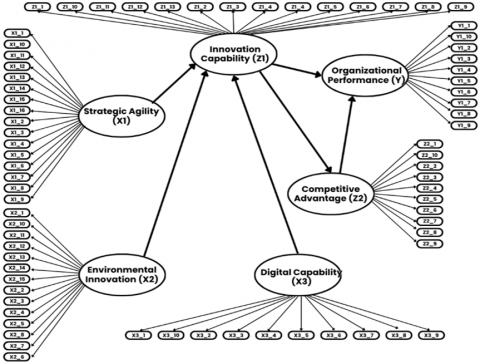
The measurement model was evaluated using convergent validity, discriminant validity, and composite reliability. In PLS-SEM, hypothesis testing is appropriate only after all indicators have satisfied these criteria. Convergent validity was assessed via outer loadings; for confirmatory studies, the threshold is 0.70 (0.60 for exploratory and 0.50 for developmental designs). Because this was a confirmatory study, a loading ≥ 0.70 was required. The estimated PLS model showed that all indicators loaded above 0.70, indicating adequate convergent validity (Figure 3).
Figure 3. PLS model testing
Convergent validity was further corroborated by the Average Variance Extracted (AVE), with the criterion AVE > 0.50 met for every construct. The detailed loadings and AVE values are reported in Table 3. All constructs met the standard confirmatory thresholds (outer loadings ≥ 0.70 in practice, α ≥ 0.70, CR ≥ 0.70, AVE > 0.50), indicating satisfactory convergent validity and reliability.
Table 3. Validity and reliability test
|
Chapter 1 Variable |
Chapter 2 Items (k) |
Chapter 3 Outer loading range |
Chapter 4 Cronbach’s α |
Chapter 5 Composite reliability |
Chapter 6 AVE |
|
Chapter 7 Strategic Agility (X1) |
Chapter 8 16 |
Chapter 9 0.708–0.853 |
Chapter 10 0.951 |
Chapter 11 0.956 |
Chapter 12 0.575 |
|
Chapter 13 Environmental Innovation (X2) |
Chapter 14 15 |
Chapter 15 0.737–0.852 |
Chapter 16 0.962 |
Chapter 17 0.966 |
Chapter 18 0.656 |
|
Chapter 19 Digital Capability (X3) |
Chapter 20 10 |
Chapter 21 0.708–0.820 |
Chapter 22 0.929 |
Chapter 23 0.94 |
Chapter 24 0.61 |
|
Chapter 25 Organizational Performance (Y1) |
Chapter 26 10 |
Chapter 27 0.730–0.904 |
Chapter 28 0.941 |
Chapter 29 0.95 |
Chapter 30 0.656 |
|
Chapter 31 Innovation Capability (Z1) |
Chapter 32 13 |
Chapter 33 0.802–0.893 |
Chapter 34 0.97 |
Chapter 35 0.973 |
Chapter 36 0.737 |
|
Chapter 37 Competitive Advantage (Z2) |
Chapter 38 11 |
Chapter 39 0.722–0.868 |
Chapter 40 0.941 |
Chapter 41 0.949 |
Chapter 42 0.631 |
After establishing construct validity and reliability in the outer model, we assessed the overall model fit using the SRMR (see Table 4). A PLS model is considered acceptable when SRMR < 0.10 (and “perfect fit” when < 0.08).
Table 4. Model fit (PLS)
|
Metric |
Saturated Model |
Estimated Model |
|
SRMR |
0.082 |
0.086 |
|
d_ULS |
19.184 |
21.18 |
|
d_G |
n/a |
n/a |
|
Chi-Square |
n/a |
n/a |
|
NFI |
n/a |
n/a |
The saturated model yielded an SRMR of 0.082, and the estimated model yielded an SRMR of 0.086. Both values were below 0.10, indicating that the PLS model attained an acceptable fit and was suitable for hypothesis testing.
4.3.2 Inner model testing
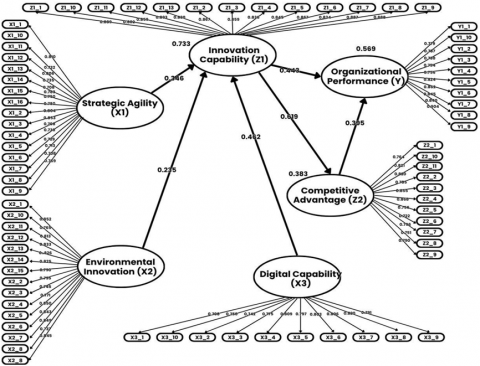
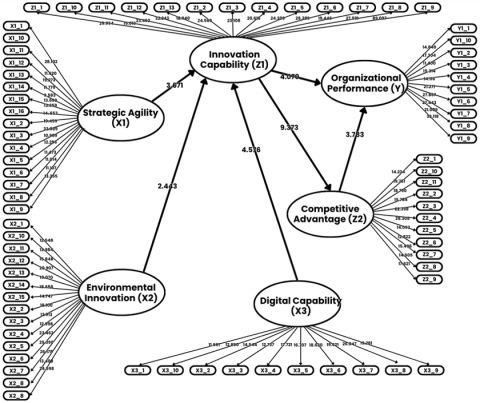
The inner model evaluates the direct and indirect effects and the magnitude of each exogenous variable’s influence on endogenous variables to test the study hypotheses. The significance of direct paths is assessed using p-values and t-statistics: if p < 0.05 and t > 1.96, the null hypothesis (no effect) is rejected, and the exogenous variable is deemed to have a significant effect; if p ≥ 0.05, the null is not rejected. The direction of each relationship was inferred from the sign of the path (original sample) coefficient: a positive sign indicated a positive (aligned) effect, whereas a negative sign indicated an inverse relationship. The path estimates from the PLS model provided the basis for hypothesis testing (Figure 4).
Figure 4. PLS model estimation
Structural path estimates indicate that strategic agility positively affects innovation capability among BUMK in Berau (p < 0.001; t = 3.671), implying that more agile organizations exhibit a stronger innovation capacity. Environmental innovation also shows a positive and significant association with innovation capability (p = 0.015; t = 2.443), as does digital capability (p < 0.001; t = 4.576), underscoring the complementary roles of sustainability-oriented practices and digital readiness in building innovation capability. The downstream effects are robust: innovation capability strongly enhances competitive advantage (p < 0.001; t = 9.373) and, independently, improves organizational performance (p < 0.001; t = 4.070). Competitive advantage also positively contributes to organizational performance (p < 0.001; t = 3.783). Taken together, the results support a capability-driven pathway in which agility, environmental innovation, and digital capability accumulate into innovation capability, which then translates into competitive advantage and, ultimately, higher organizational performance.
4.3.3 Mediation variable’s influence testing
We assessed indirect (mediated) effects using bootstrapped PLS path estimates, and the results are summarized in Table 5.
Table 5. Test Results of mediating variable’s influence
|
|
Original Sample (O) |
Sample Mean (M) |
Standard Deviation (STDEV) |
T Statistics (|O/STDEV|) |
Note |
|
Strategic_Agility → Innovation_Capability → Organizational_Performance |
0.238 |
0.239 |
0.069 |
3.460 |
Positive and significant |
|
Environmental_Innovation → Innovation_Capability → Competitive_Advantage |
0.146 |
0.150 |
0.063 |
2.326 |
Positive and significant |
|
Digital_Capability → Innovation_Capability → Competitive_Advantage |
0.286 |
0.290 |
0.069 |
4.153 |
Positive and significant |
|
Innovation_Capability → Competitive_Advantage → Organizational_Performance |
0.244 |
0.248 |
0.073 |
3.365 |
Positive and significant |
To situate the results, Figure 5 maps the structural relations among the constructs, showing how Strategic Agility (X1), Environmental Innovation (X2), and Digital Capability (X3) feed into Innovation Capability (Z1) and Competitive Advantage (Z2), which in turn drive Organizational Performance (Y).
Figure 5. Test results of the influence of mediating variables
Innovation capability mediates the effect of strategic agility on organizational performance among BUMK in Berau, Indonesia. The indirect path from strategic agility (X1) to performance (Y) via innovation capability (Z1) is positive and significant (p = 0.001, t = 3.460, coefficient = 0.238), indicating that more agile organizations translate agility into higher performance primarily by strengthening their ability to generate and embed innovations in their strategy and operations.
Innovation capability also mediates the relationship between environmental innovation and a firm’s performance. The indirect effect of environmental innovation (X2) on performance (Y) through Z1 is positive and significant (p = 0.012, t = 2.527, coefficient = 0.146). This suggests that environmentally oriented practices enhance performance to the extent that they are converted into organizational routines and offerings through innovation capability.
A similar pattern was observed for digital capabilities. The indirect pathway from digital capability (X3) to performance (Y) through Z1 is positive and statistically strong (p < 0.001, t = 3.891, coefficient = 0.318), implying that digital readiness improves performance chiefly when it enhances the firm’s capacity to create, adopt, and integrate innovations.
Finally, competitive advantage functions as a complementary mediator between innovation capability and firm performance. The indirect effect from Z1 to Y via competitive advantage (Z2) is positive and significant (p = 0.001, t = 3.365, coefficient = 0.244), indicating that innovation capability raises performance in part by building distinctive advantages that convert novel ideas into market and operational gains for the firm. Together, the results delineate a capability-driven chain in which agility, environmental, and digital capacities bolster innovation capability, which then enhances competitive advantage and culminates in higher organizational performance.
4.3.4 Discussion
The findings map cleanly onto the RBV and dynamic capability logic embedded in our conceptual model, showing how capability endowments accumulate into distinctive routines that competitors struggle to copy and how these routines translate into advantage and, ultimately, performance. In BUMK, strategic agility is the primary upstream enabler of innovation capability. This is consistent with evidence that agile organizations sense shifts, make fast and unified leadership choices, and fluidly redeploy resources so that insights become concrete offerings and process changes [20, 23, 24]. Practically, agility compresses the distance between recognizing village-level needs and piloting services or adjusting business models. The same mechanism is precisely the path by which agility has been shown to lift downstream outcomes via innovation capability [1].
Environmental innovation reinforces the innovation engine rather than standing apart from mere compliance. Where BUMK codifies eco-process and eco-product practices—recycling, pollution prevention, lifecycle thinking, and ISO-based routines—it institutionalizes cross-functional problem solving, measurement discipline, and partner engagement. Prior work links these practices to stronger competitive stances [3], and our pattern indicates why: eco-initiatives require the same sensing, integration, and reconfiguration that underpin ongoing innovations. In RBV terms, these routines are valuable, locally rare, socially complex, and hard to substitute; therefore, they qualify as VRIN resources that feed a broader innovation capability rather than acting as isolated programs.
Digital capability amplifies these effects by increasing the rate and extent of implementation. Studies have shown that digital orientation and capabilities catalyze digital innovation and carry their performance effects through technological routines and absorptive mechanisms [4, 5]. In the BUMK context, basic enterprise tools, data visibility, and digitally enabled workflows allow faster experimentation, tighter feedback loops, and more reliable scaling from pilot to practice. In dynamic capability language, digital modules make recombination cheaper and timelier, increasing the throughput of the innovation system. Together, strategic agility, environmental innovation, and digital capability function as mutually reinforcing inputs that accumulate in innovation capability, the construct that orchestrates idea generation, selection, trial, and routinization.
Downstream, the evidence aligns with the proposition that innovation capability is a proximate driver of competitive advantage and performance. Organizations that reliably generate and embed novelty—new products and services, refreshed processes, and market-approach innovations—create positions that rivals find difficult to match [47]. Complementing this, resource characteristics such as rareness and non-substitutability have been shown to mediate superior competitive positions and performance [40], which is exactly what we observe as BUMK converts innovation routines into recognizable edges in service quality, relevance, and local access. The translation from advantage to organizational performance is also consistent with prior results showing that competitiveness is a direct antecedent of operational and financial outcomes [11, 45]. In our setting, the strongest expressions of advantage are customer-facing—responsiveness, service experience, and fit to local need—while the more operational facets, such as exact-on-quantity delivery, remain the next frontier for locking in that edge [55].
The mediation structure anticipated by the model was confirmed, innovation capability carries the effects of strategic agility on organizational performance, mirroring the mechanism reported in industrial settings, where agility works primarily by enabling idea pipelines and reconfiguration rather than acting directly on outcomes [1]. It also mediates the effect of environmental innovation on performance, consistent with the view that eco-initiatives sharpen the routines—process mapping, learning-by-doing, and cross-boundary collaboration—through which organizations innovate more broadly [3]. Likewise, digital capability improves performance through innovation capability, in line with the findings that digital investments yield returns when they are absorbed into new offerings and process designs rather than remaining as standalone infrastructure [4, 5]. Finally, competitive advantage partially transmits the effect of innovation capability on performance, emphasizing that the value of innovation is fully realized when it is converted into distinctive, market-facing positions with operational reliability [11, 40, 45, 47].
Two implications follow for capability building in community-owned enterprises. First, sequencing is important. Agility, eco-innovation routines, and digital readiness are most productive when channeled through deliberate innovation systems that govern ideation, experimentation, and scaling. This sequencing explains why investments that look similar on paper deliver uneven results in practice: without the orchestration that innovation capability provides, inputs do not propagate to the advantage. Second, conversion is important. Competitive advantage is the pathway by which innovation becomes performance; thus, customer experience and operational exactitude must be developed in tandem so that differentiation is matched by dependable fulfillment. The literature we draw on points to concrete levers for each stage: leadership unity and resource fluidity for agility [20]; ISO-based environmental management and life cycle analysis for eco-innovation [3]; and basic enterprise digitization for data visibility and cycle-time compression [4, 5]. Our evidence shows that these levers function in BUMK just as they do in corporate settings, extending external validity to a resource-constrained, community-embedded context.
Positioned within the RBV, the pattern is intuitive. BUMK that cultivate VRIN-like routines—agile sensing and redeployment, codified environmental practices, and modular digital assets—accumulate an innovation capability that is path-dependent and socially complex. This capability then yields competitive advantage through offerings and delivery models tuned to local needs, and it sustains performance by reinforcing customer retention, market access, and process productivity [11, 40, 45, 47]. The dynamic capability lens clarifies the underlying motion: sensing, seizing, and reconfiguring remain the operative verbs; environmental and digital programs are the scaffolding that make those verbs cheaper and faster; innovation capability is the integrator; and competitive advantage is the bridge to outcomes.
Therefore, the prescription for managers and policymakers is capability-centric. Institutionalize strategic agility through routine scanning and fast-cycle top-team forums, treat environmental initiatives as platforms for learning and cross-functional integration rather than as compliance overhead, and invest in foundational digital capabilities that speed up experimentation and diffusion. Then, professionalize the innovation system—lightweight funnels, test–learn–iterate cadences, and after-action reviews—so that ideas reliably become improvements. Finally, tighten the “last mile” of execution, because the advantage pays off when the customer experience is matched by delivery precision. The literature we reference provides the theoretical warrant for these steps, and the BUMK evidence shows that they work in context.
This study demonstrates a coherent capability–advantage–performance chain in the BUMK context. Strategic agility, environmental innovation, and digital capability exert positive and significant effects on innovation capability. In turn, innovation capability strengthens competitive advantage and directly enhances organizational performance, while competitive advantage further translates capability gains into superior performance. Mediation tests clarify the mechanism: innovation capability carries the effects of strategic agility, environmental innovation, and digital capability to performance; competitive advantage then transmits part of innovation capability’s impact on outcomes. Taken together, the evidence supports a sequenced pathway in which sensing and reconfiguring (agility), eco-oriented routines, and digital readiness accumulate into robust innovation routines, which are then converted into market-facing advantages and measurable performance improvements that can be quantified.
Substantively, the findings imply that BUMK should prioritize building strategic agility, institutionalizing environmental innovation practices, and upgrading foundational digital capabilities, but only as inputs for a deliberate innovation system that governs ideation, experimentation, and scaling. Performance gains materialize when innovation routines are translated into distinctive value propositions and reliable delivery—that is, competitive advantage. The results extend capability-based reasoning to community-owned enterprises, indicating that even under resource constraints, capability orchestration rather than isolated initiatives is the proximate driver of sustained performance.
[1] AlTaweel, I., Al-Hawary, S. (2021). The mediating role of innovation capability on the relationship between strategic agility and organizational performance. Sustainability, 13(14): 7564. https://doi.org/10.3390/su13147564
[2] Brand, M., Tiberius, V., Bican, P.M., Brem, A. (2021). Agility as an innovation driver: Towards an agile front end of innovation framework. Review of Managerial Science, 15(1): 157-187. https://doi.org/10.1007/s11846-019-00373-0
[3] Skordoulis, M., Ntanos, S., Kyriakopoulos, G.L., Arabatzis, G., Galatsidas, S., Chalikias, M. (2020). Environmental innovation, open innovation dynamics and competitive advantage of medium and large-sized firms. Journal of Open Innovation: Technology, Market, and Complexity, 6(4): 195. https://doi.org/10.3390/joitmc6040195
[4] Khin, S., Ho, T.C. (2019). Digital technology, digital capability and organizational performance: A mediating role of digital innovation. International Journal of Innovation Science, 11(2): 177-195. https://doi.org/10.1108/IJIS-08-2018-0083
[5] Heredia, J., Castillo-Vergara, M., Geldes, C., Carbajal Gamarra, F.M., Flores, A., Heredia, W. (2022). How do digital capabilities affect firm performance? The mediating role of technological capabilities in the “new normal.” Journal of Innovation & Knowledge, 7(2): 100171. https://doi.org/10.1016/j.jik.2022.100171
[6] Atnafu, D., Balda, A. (2018). The impact of inventory management practice on firms’ competitiveness and organizational performance: Empirical evidence from micro and small enterprises in Ethiopia. Cogent Business & Management, 5(1): 1503219. https://doi.org/10.1080/23311975.2018.1503219
[7] Migdadi, M.M. (2022). Knowledge management processes, innovation capability and organizational performance. International Journal of Productivity and Performance Management, 71(1): 182-210. https://doi.org/10.1108/IJPPM-04-2020-0154
[8] Dasuki, R.E. (2021). Manajemen strategi: Kajian Teori resource based view. Coopetition: Jurnal Ilmiah Manajemen, 12(3): 447-454. https://doi.org/10.32670/coopetition.v12i3.710
[9] Ferreira, J., Coelho, A., Moutinho, L. (2020). Dynamic capabilities, creativity and innovation capability and their impact on competitive advantage and firm performance: The moderating role of entrepreneurial orientation. Technovation, 92-93: 102061. https://doi.org/10.1016/j.technovation.2018.11.004
[10] Alam, S., Munizu, M., Jillbert, J. (2019). Effect of use of information technology on innovation capability, competitiveness, and firm performance: Case of manufacturing industry in South Sulawesi. IOP Conference Series: Earth and Environmental Science, 235: 012008. https://doi.org/10.1088/1755-1315/235/1/012008
[11] Kaur, R., Sharma, R.K., Goyal, S. (2019). Improving organizational performance through competitive advantage: An empirical analysis with reference to Indian IT industry. Journal of Asia-Pacific Business, 20(4): 281-301. https://doi.org/10.1080/10599231.2019.1684169
[12] Asyhari, A., Pudjihastuti, S.H., Kurdaningsih, D.M. (2018). Peran mediasi keunggulan kompetitif pada faktor determinan kinerja bisnis UKM di sentra tenun batik di Jawa Tengah. Jurnal Siasat Bisnis, 22(2): 111-131. https://doi.org/10.20885/jsb.vol22.iss2.art1
[13] Nguyen, N.X., Tran, K., Nguyen, T.A. (2021). Impact of service quality on in-patients’ satisfaction, perceived value, and customer loyalty: A mixed-methods study from a developing country. Patient Preference and Adherence, 15: 2523-2538. https://doi.org/10.2147/PPA.S333586
[14] Nofrizal, N., Aznuryandi, A.N.A., Affandi, A., Juju, U. (2021). Pengaruh keunggulan bersaing terhadap kinerja pemasaran pengrajin rotan Pekanbaru. Journal of Business and Banking, 10(2): 279. https://doi.org/10.14414/jbb.v10i2.2487
[15] Peteraf, M.A. (1993). The cornerstones of competitive advantage: A resource-based view. Strategic Management Journal, 14(3): 179-191. https://doi.org/10.1002/smj.4250140303
[16] Amit, R., Schoemaker, P.J.H. (1993). Strategic assets and organizational rent. Strategic Management Journal, 14(1): 33-46. https://doi.org/10.1002/smj.4250140105
[17] Eisenhardt, K.M., Martin, J.A. (2017). Dynamic capabilities: What are they? The SMS Blackwell Handbook of Organizational Capabilities, pp. 341-363. https://doi.org/10.1002/9781405164054.ch21
[18] Samsudin, Z.B., Ismail, M.D. (2019). The concept of theory of dynamic capabilities in changing environment. International Journal of Academic Research in Business and Social Sciences, 9(6): 1071-1078. https://doi.org/10.6007/IJARBSS/v9-i6/6068
[19] Wang, Z.Y., Zhang, X., Ma, L. (2022). How to maintain a sustainable doctor-patient relationship in healthcare in China: A structural equation modeling approach. Journal of Healthcare Engineering, 2022(1): 8251220. https://doi.org/10.1155/2022/8251220
[20] Doz, Y.L., Kosonen, M. (2010). Embedding strategic agility. Long Range Planning, 43(2-3): 370-382. https://doi.org/10.1016/j.lrp.2009.07.006
[21] Gerald, E., Obianuju, A., Chukwunonso, N. (2020). Strategic agility and performance of small and medium enterprises in the phase of COVID-19 pandemic. International Journal of Financial, Accounting, and Management, 2(1): 41-50. https://doi.org/10.35912/ijfam.v2i1.163
[22] Elali, W. (2021). The importance of strategic agility to business survival during corona crisis and beyond. International Journal of Business Ethics and Governance, 4(2): 1-8. https://doi.org/10.51325/ijbeg.v4i2.64
[23] Weber, Y., Tarba, S.Y. (2014). Strategic agility: A state of the art introduction to the special section on strategic agility. California Management Review, 56(3): 5-12. https://doi.org/10.1525/cmr.2014.56.3.5
[24] Clauss, T., Abebe, M., Tangpong, C., Hock, M. (2021). Strategic agility, business model innovation, and firm performance: An empirical investigation. IEEE Transactions on Engineering Management, 68(3): 767-784. https://doi.org/10.1109/TEM.2019.2910381
[25] Permana, E., Purnomo, M., Santoso, R., Syamsurizal, S. (2021). The influence of strategic agility on sustainability competitive advantage through business competitive action of sicepat express. AdBispreneur: Jurnal Pemikiran dan Penelitian Administrasi Bisnis dan Kewirausahaan, 6(1): 79-92. https://doi.org/10.24198/adbispreneur.v6i1.32584
[26] Ozusaglam, S. (2012). Environmental innovation: A concise review of the literature. Vie & Sciences de L'entreprise, 191192(2): 15-38. https://doi.org/10.3917/vse.191.0015
[27] Tseng, C.H., Chang, K.H., Chen, H.W. (2019). Strategic orientation, environmental innovation capability, and environmental sustainability performance: The case of Taiwanese suppliers. Sustainability, 11(4): 1127. https://doi.org/10.3390/su11041127
[28] Wahyuningtyas, R., Disastra, G.M., Rismayani, R. (2021). Digital innovation and capability to create competitiveness model of cooperatives in Bandung, Indonesia. Jurnal Manajemen Indonesia, 21(2): 171-182. https://doi.org/10.25124/jmi.v21i2.3633
[29] Xu, G., Hou, G., Zhang, J. (2022). Digital sustainable entrepreneurship: A digital capability perspective through digital innovation orientation for social and environmental value creation. Sustainability, 14(18): 11222. https://doi.org/10.3390/su141811222
[30] Andersson, M., Moen, O., Brett, P.O. (2020). The organizational climate for psychological safety: Associations with SMEs’ innovation capabilities and innovation performance. Journal of Engineering and Technology Management, 55: 101554. https://doi.org/10.1016/j.jengtecman.2020.101554
[31] Hair, J., Hult, G.T.M., Ringle, C., Sarstedt, M. (2016). A Primer on Partial Least Squares Structural Equation Modeling (PLS-SEM). SAGE Publications.
[32] Shin, H., Lee, J.N., Kim, D., Rhim, H. (2015). Strategic agility of Korean small and medium enterprises and its influence on operational and firm performance. International Journal of Production Economics, 168: 181-196. https://doi.org/10.1016/j.ijpe.2015.06.015
[33] Aas, T.H., Breunig, K.J. (2017). Conceptualizing innovation capabilities: A contingency perspective. Journal of Entrepreneurship, Management and Innovation, 13(1): 7-24. https://doi.org/10.7341/20171311
[34] Mahfud, I., Zakaria. (2021). The effect of organizational culture transformation and talent management on organizational effectiveness mediated by job satisfaction. Journal of Economics and Business Letters, 1(4): 1-10. https://doi.org/10.55942/jebl.v1i4.126
[35] Nainggolan, A. (2018). Competitive advantage dan upaya meningkatkan laba perusahaan. Jurnal Manajemen, 4(1): 1-14.
[36] Purnama, N., Setiawan, H. (2003). Analisis pengaruh sumber-sumber keunggulan bersaing bidang pemasaran terhadap kinerja perusahaan manufaktur di Indonesia. Jurnal Siasat Bisnis, 2(8): 105-130. https://doi.org/10.20885/jsb.vol2.iss8.art1
[37] Suryani, N.K., FoEh, J.E.H.J. (2018). Kinerja Organisasi. Deepublish (CV Budi Utama). https://www.researchgate.net/profile/Ni-Suryani/publication/329139732_Kinerja_Organisasi/links/5bf77239299bf1a0202c39b0/Kinerja-Organisasi.pdf.
[38] Makhloufi, L., Laghouag, A.A., Ali Sahli, A., Belaid, F. (2021). Impact of entrepreneurial orientation on innovation capability: The mediating role of absorptive capability and organizational learning capabilities. Sustainability, 13(10): 5399. https://doi.org/10.3390/su13105399
[39] Ahammad, M.F., Basu, S., Munjal, S., Clegg, J., Shoham, O.B. (2021). Strategic agility, environmental uncertainties and international performance: The perspective of Indian firms. Journal of World Business, 56(4): 101218. https://doi.org/10.1016/j.jwb.2021.101218
[40] Baia, E., Ferreira, J.J., Rodrigues, R. (2020). Value and rareness of resources and capabilities as sources of competitive advantage and superior performance. Knowledge Management Research & Practice, 18(3): 249-262. https://doi.org/10.1080/14778238.2019.1599308
[41] Rupeika-Apoga, R., Petrovska, K., Bule, L. (2022). The effect of digital orientation and digital capability on digital transformation of SMEs during the COVID-19 pandemic. Journal of Theoretical and Applied Electronic Commerce Research, 17(2): 669-685. https://doi.org/10.3390/jtaer17020035
[42] Ong, T.S., Lee, A.S., Teh, B.H., Magsi, H.B., Ng, S.H. (2020). Environmental capabilities and environmental innovations of manufacturing firms in Malaysia. Indonesian Journal of Sustainability Accounting and Management, 1(1): 1-14. https://doi.org/10.28992/ijsam.v4i1.248
[43] Najafi-Tavani, S., Najafi-Tavani, Z., Naudé, P., Oghazi, P., Zeynaloo, E. (2018). How collaborative innovation networks affect new product performance: Product innovation capability, process innovation capability, and absorptive capacity. Industrial Marketing Management, 73: 193-205. https://doi.org/10.1016/j.indmarman.2018.02.009
[44] Rajapathirana, R.P.J., Hui, Y. (2018). Relationship between innovation capability, innovation type, and firm performance. Journal of Innovation & Knowledge, 3(1): 44-55. https://doi.org/10.1016/j.jik.2017.06.002
[45] Ofori, D., Appiah-Nimo, C. (2022). Relationship management, competitive advantage and performance of hotels: A resource-based view. Journal of African Business, 23(3): 712-730. https://doi.org/10.1080/15228916.2021.1924573
[46] Rafi, M., Murwaningsari, E. (2022). Pengaruh environmental leadership dan environmental capability terhadap firm performance dimoderasi dengan size. Owner, 6(4): 3870-3880. https://doi.org/10.33395/owner.v6i4.1130
[47] de Mello, A.M., de Lima, W.D., Boas, E.V., Sbragia, R., Marx, R. (2008). Innovation capability and competitive advantage: A case study of two Brazilian Firms. In PICMET'08-2008 Portland International Conference on Management of Engineering & Technology, Cape Town, South Africa, pp. 606-617. https://doi.org/10.1109/PICMET.2008.4599670
[48] Manambing, A., Mandey, S., Tielung, M.V. (2018). Analysis of the effect of market orientation and competitive advantage on marketing performance (Study case UMKM culinary tinutuan in Manado). Jurnal EMBA: Jurnal Riset Ekonomi, Manajemen, Bisnis Dan Akuntansi, 6(4): 3803-3812. https://doi.org/10.35794/emba.v6i4.21906
[49] Heriswanto, H., Membaka, R. (2022). Analisis elastisitas permintaan produk tempe di kelurahan sendang mulyasari kecamatan tongauna kabupaten konawe. Jurnal GeoEkonomi, 13(1): 27-39. https://doi.org/10.36277/geoekonomi.v13i1.174
[50] Roth, A.V. (1996). Achieving strategic agility through economies of knowledge. Planning Review, 24(2): 30-36. https://doi.org/10.1108/eb054550
[51] Hulla, M., Hammer, M., Karre, H., Ramsauer, C. (2019). A case study based digitalization training for learning factories. Procedia Manufacturing, 31: 169-174. https://doi.org/10.1016/j.promfg.2019.03.027
[52] Wirarahman, G. (2021). The influence of learning orientation-based innovation capability at PT PLN UP3 bandengan. Master's thesis, Sultan Agung Islamic University (Indonesia). https://repository.unissula.ac.id/id/eprint/24657.
[53] Zhang, J., Jiang, Y., Shabbir, R., Du, M. (2015). Building industrial brand equity by leveraging firm capabilities and co-creating value with customers. Industrial Marketing Management, 51: 47-58. https://doi.org/10.1016/j.indmarman.2015.05.016
[54] Kotler, P. (2000). Manajemen Pemasaran, Edisi Milenium. PT Prenhallindo.
[55] Hidayat, N., Rismawati, R., Ikromi, Z.A. (2025). Organizational climate, social support predictors of work life balance in employees. Priviet Social Sciences Journal, 5(8): 199-210. https://doi.org/10.55942/pssj.v5i8.499