Yatimin* | Andry Priharta | Luqman Hakim
© 2025 The authors. This article is published by IIETA and is licensed under the CC BY 4.0 license (http://creativecommons.org/licenses/by/4.0/).
OPEN ACCESS
This study aims to examine the influence of environmental, social, and governance (ESG) performance on corporate investment and financial decisions using a systematic literature review (SLR) approach. Through an analysis of relevant scholarly publications in the last two decades, the study evaluates how each ESG component influences investment behaviour and corporate financial stability and performance. The results show that companies with good ESG performance are generally better able to attract investors, have lower risk perceptions, and demonstrate stronger financial stability and sustainability. Governance dimensions, such as board effectiveness, transparency and managerial oversight, have the most significant influence on investment decisions. These aspects reflect corporate accountability and are key indicators for institutional investors in assessing long-term credibility. On the other hand, social dimensions, such as labour rights protection, community relations, and diversity, become more important during times of crisis as they reflect a company's social resilience. Meanwhile, the environmental dimension is increasingly relevant in the context of the transition to a green economy and increasing regulatory pressure on emissions management and resource sustainability. The study concludes that the integration of ESG into corporate strategy not only creates financial value but also enhances legitimacy and competitiveness in the global market. The findings provide important insights for corporate management, investors and policymakers in designing policies that are adaptive to the demands of sustainability and social value.
sustainability, ESG, investment, financial decisions
For several years, sustainability companies have garnered significant attention from a business, regulatory, and public perspective. Aspects of sustainability are often measured using environmental, social, and governance (ESG) indicators, which describe a company's performance in three main pillars: environmental, social, and governance [1]. Environmental issues encompass the management of resources, energy, carbon emission reduction, and efforts to conserve the natural environment. At the same time, this aspect is socially related to management's connection with workers, customers, and the public, as it involves governance that emphasizes transparency, integrity, and accountability in decision-making and supervision [2].
Good ESG performance is believed to have a positive impact on the company in both the short and long term [3]. Companies that manage ESG with Good tend to have a reputation, are capable of reducing risk, and are more interesting for investors who are now more considerate of sustainability in making investment decisions. Additionally, solid ESG performance can also help the company access financing at lower costs and increase stability in the long term. Therefore, the bigger companies that start to incorporate ESG into their financial strategy, the more holistic their efforts to create sustainability become [4].
However, although the influence of ESG on investment decisions and those of finance companies are discussed in the literature, some gaps still need to be addressed [5]. Most studies have previously focused on the impact of ESG performance on financial companies' performance without explicitly examining how each ESG component (environmental, social, and governance) influences investment and economic decisions. Furthermore, existing research is often limited to companies listed on the stock market, which is insufficient to cover sectors or emerging markets that present both challenges and opportunities. Further research into the interaction between ESG and policy finance strategies, such as capital structure management, planning, and financing, or policy dividends, is still relatively limited [6].
Study: This fills the gap with a literature review that focuses on how ESG performance influences investment and financial decisions in the context of sustainability companies [7]. New from the study. This approach focuses on the overall positive impact of ESG and seeks to identify and differentiate the influence of each ESG component on decision-making. Thus, research provides more insight into how a company can integrate ESG aspects more effectively in its policy, investment, and financial strategy to support sustainability [8].
Objective study: To explore how ESG performance impacts investment decisions and financial decisions in the company, as well as to dig into the influence of each ESG component on the factors mentioned. Research also aims to better understand how ESG integration can contribute to a company's sustainability and exemplary performance in financial and social matters. To summarize existing findings in the literature, research can provide valuable recommendations for practitioners, businesses, investors, and policymakers on leveraging ESG as a tool to enhance a company’s overall performance and sustainability.
This research uses a systematic literature review (SLR) approach to explore, analyse and synthesize relevant literature on the influence of Environmental, Social and Governance (ESG) performance on investment and financial decisions in the context of sustainable companies [9]. This approach was chosen because it allows for systematic and comprehensive data collection through article searches in reputable databases (Scopus and Web of Science) with inclusion criteria such as English language articles, peer-reviewed, published in the period 2018-2023, and relevant to the topic of ESG and investment or financial decisions. Articles were screened and further reviewed in full.
2.1 Sources and search article
The number of pages for the manuscript must be no more than ten, including all the sections. Please ensure that the entire text ends on an even page. Please do not insert page numbers. Please do not use the Headers or footers, as they are reserved for technical editing by editors.
Data used in the study. This is taken from Scopus, a leading scientific database provider of peer-reviewed articles with wide coverage in social and business knowledge. Search articles with relevant keyword combinations using AND and OR logic to cover various variation-related topics with ESG. Some combination of keywords used in search, among others:
TITLE-ABS-KEY (("environmental" OR "ecological" OR "sustainability" OR "green") AND ("social" OR "societal" OR "community" OR "stakeholder") AND ("governance" OR "management" OR "oversight" OR "regulation") AND ("performance" OR "evaluation" OR "assessment" OR "metrics") AND ("corporate" OR "business" OR "organizational" OR "enterprise") AND ("sustainability" OR "development" OR "responsibility" OR "practices")) AND PUBYEAR>2019 AND PUBYEAR<2026
This aims to identify an article that discusses the connection between ESG performance, investment decisions, and the financial and sustainability aspects of companies overall [10]. Search limited to published articles in the last 5 years to ensure that the data taken is relevant to the latest trends and developments in ESG research.
2.2 Data filtering
The filtering process is conducted using PRISMA (Preferred Reporting Items for Systematic Reviews and Meta-Analyses) to ensure a transparent and structured selection [11]. The first step is identification, namely gathering all relevant articles based on a search. Next, the screening stage is carried out using a filter article based on the title and abstract to ensure conformity with the research topic [12]. At the eligibility stage, the suitability of the article is evaluated based on its whole text to ensure it fulfills the criteria for inclusion and exclusion. Articles that passed selection will be entered at the included stage and carried out in the analysis.
2.3 Data analysis and visualization
To enrich the analysis and understanding of existing literature, researchers will use VOS Viewer and Biblioshiny as tools for data visualization. The VOS Viewer will be used to analyze keyword co-occurrence in filtered articles, resulting in a map network that describes the connections between themes in ESG research [13]. This helps identify the dominant themes and extensive research areas discussed. Meanwhile, Biblioshiny will be used to analyze the distribution of publications, citations, and temporal trends in the ESG literature [13].
2.4 Synthesis of results
After data analysis and visualization are complete, the researcher will synthesize the findings, which comprise the main elements identified in the filtered literature. This synthesis aims to better understand how ESG performance influences investment decisions and the operations of finance companies [14]. The researcher will discuss the impact of each ESG component, specifically the environmental, social, and governance aspects, on these decisions, as well as how ESG integration into financial strategy can support the long-term sustainability of a company.
3.1 Result
Search results from the Scopus database primarily display information related to published research in relevant literature, specifically the Topic research. This data covers various important aspects like the sources used, types of published documents, and information-related collaboration between writers. With this information, we can better understand the good trends and patterns in existing publications in the study. Table 1 presents information regarding the data found:
Table 1. Main information
|
Description |
Results |
|
Sources (Journals, Books, Etc.) |
2353.0 |
|
Documents |
7731.0 |
|
Annual Growth Rate % |
-12.74 |
|
Document Average Age |
2.33 |
|
Average Citations Per Doc |
14.16 |
|
Keywords Plus (Id) |
13414.0 |
|
Author's Keywords (De) |
16908.0 |
|
Authors |
19859.0 |
|
Authors Of Single-Authored Docs |
749.0 |
|
Single Authored Docs |
903.0 |
|
Co-Authors Per Doc |
3.47 |
|
International Co-Authorships % |
29.98 |
|
Article |
5858.0 |
|
Book |
107.0 |
|
Conference Paper |
658.0 |
|
Conference Review |
74.0 |
|
Reviews |
391.0 |
Based on the data search results from the Scopus database, the information found shows a comprehensive overview of the research publication topic. There are 2,353 sources, including journals, books, and other materials, with a total of 7,731 registered documents. This figure indicates an annual negative growth rate of -12.74%, suggesting a recent decline in publication volume. The average age of the documents found is 2.33 years, with an average of 14.16 citations per document, indicating relevance and influence from existing literature.
Additionally, 13,414 "Keywords Plus" and 16,908 keywords in the author’s description option cover diverse topics discussed in the publication. The number of authors involved in the publication reached 19,859, with 749 authors writing documents individually. The number of papers written by one writer is 903, with an average number of colleague authors per document of as much as 3.47. The percentage of international collaboration in writing documents reached 29.98%, indicating global involvement in the study.
The most prevalent type of document is articles, with 5,858 publications, along with 107 books and 658 conference papers. The number of review conferences is 74, while the total number of published review documents has reached 391. Findings: This section describes publication patterns, which are primarily articles and conference papers, typically focusing more on research and development.
3.2 Co-occurrence network
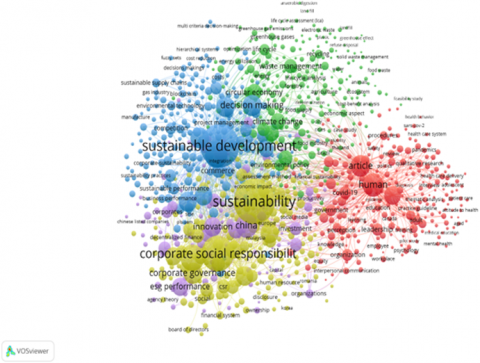
This diagram illustrates the connections between various Frequently Asked Topics that appear simultaneously in related literature, including sustainability, responsibility, social company, and associated aspects. Visualization. This shows multiple cluster thematic forms based on keyword relationships in the' research articles. Each group colour represents interrelated themes, such as sustainability, ESG performance, climate change, health, and social aspects. This image provides a comprehensive view of the connectivity between Topics and how closely they are related to existing literature. Figure 1 presents a visualisation of the keyword co-occurrence network showing the interrelationships between terms that frequently co-occur in the analysed articles.
Figure 1. Co-occurrence
The uploaded image illustrates the Co-occurrence Network, which represents the connections between various keywords that frequently appear together in publications about sustainability, ESG performance, and corporate social responsibility (CSR). Analysis from visualization. This indicates that several themes are interrelated. First, the blue and green colors describe themes related to "sustainable development" and "sustainability." Topics covered include various necessary drafts, such as "sustainable supply chains" and "circular economy," which highlight the importance of implementing sustainability in multiple sectors of the industry and economy.
Next, there is a color cluster, yellow, which depicts the connection between topics related to "corporate social responsibility" (CSR) and "corporate governance." Keywords such as "CSR," "corporate governance," and "ESG performance" suggest that ESG performance is highly relevant to implementation principles; however, it is insufficient to address the needs of social companies, which are increasingly becoming a focus in recent developments. Additionally, the red cluster in the middle part of the picture illustrates the connection between human health and social aspects, with keywords such as "human," "healthcare system," "mental health," and "pandemic." This highlights increasing attention to health issues within the context of sustainability and responsibility, particularly in addressing global challenges such as pandemics.
Strong interconnections are also evident between social, environmental, and economic themes, with terms such as "decision making," "climate change," and "waste management" linking various fields. This demonstrates that making informed decisions related to sustainability requires integrating multiple social, environmental, and economic factors. In addition, keywords such as "China" and "Europe" highlight the critical dimensions in the implementation principles of sustainability and CSR, which show global involvement in discourse. Overall, this co-occurrence network provides a clear picture of how various aspects of sustainability, ESG performance, and social issues are related in research focused on a specific topic.
3.3 Selection of article
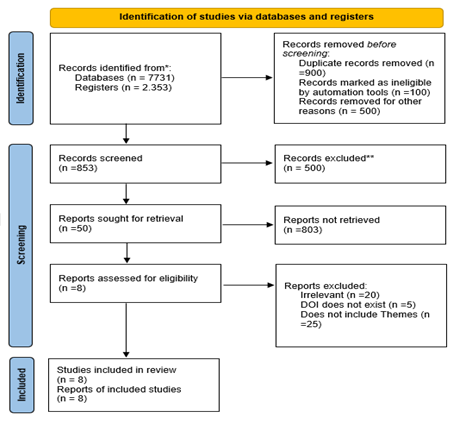
Figure 2 describes the systematic selection process from articles found through the database and registry. This process started with identifying articles from two primary sources: 7,731 articles from the database and 2,353 articles from the registry. Before filtering was performed, articles that did not meet the conditions were deleted, including 900 duplicate articles, 100 articles flagged as not fulfilling the criteria by an automated tool, and 500 articles removed for other reasons.
Figure 2. Selection with PRISMA
Next, the article that has been filtered, totaling 853, and checked further. According to the number, 500 articles were excluded because they did not meet the research criteria. Of the 353 articles requested for taking, only 50 articles were assessed as continuing. However, only eight articles met the eligibility requirements after assessment. In comparison, 20 articles were considered Irrelevant, five articles did not have a DOI, and 17 did not cover a specified theme in the criteria.
A total of eight articles were selected, as listed in Table 2, and further analysed in a systematic review process. This process reflected a rigorous and systematic selection to ensure that only relevant articles that met the inclusion criteria were further analysed.
Table 2. Green campus management: Concept, strategies and activities
|
No. |
Title |
Author |
Year |
Publisher |
Abstract Conclusion |
|
1 |
“Do companies with lower environmental, social, and governance (ESG) ratings have a higher systemic impact? [15]” |
Bax, K., Bonaccolto, G., Paterlini, S. |
2022 |
Corporate Social Responsibility and Environmental Management |
Study This shows that companies with low ESG ratings tend to risk systemic, which has an impact on investment and finance. More ESG is related to performance, which makes financial good because it reduces systemic risk and improves transparency. |
|
2 |
“Embedding sustainability in risk management: The impact of environmental, social, and governance ratings on corporate financial risk [17]” |
Landi, G., Iandolo, F., Renzi, A., Rey, A. |
2022 |
Study This finds that companies with high ESG scores tend to reduce financial risk and improve decisions to be more sustainable for investment. Strong ESG can reduce associated risks with the finance companies and improve the ability to attract investors. |
|
|
3 |
“Sustainability in the pharmaceutical industry—An assessment of sustainability maturity and effects of sustainability measure implementation on supply chain security [18]” |
Bade, C., Olsacher, A., Boehme, P., Truebel, H., Bürger, L., Fehring, L. |
2023 |
Study This shows that ESG maturity in industry pharmacy can influence decision finance and investment by mitigating risk supply disturbance and increasing financial stability over a long period. Companies with more ESG initiatives and Good own Power pull more investment tall. |
|
|
4 |
“What do we know about ESG and risk? A systematic and bibliometric review [19]” |
De Giuli, M.E., Grechi, D., Tanda, A. |
2023 |
This study shows that even though ESG is increasingly relevant in investment, there is not yet a consensus about the method to measure ESG risks in general in detail. Research shows the importance of ESG in investment and its influence on the company's financial strategy. |
|
|
5 |
“Effect of mandatory sustainability performance disclosures on firm value: Evidence from listed European firms [20]” |
Vishnu Nampoothiri, M., Entrop, O., Annamalai, T. R. |
2024 |
Study This discloses that disclosure performance sustainability can influence decision investment with increased transparency and minimizing asymmetry information, which in turn can repair mark companies and decisions finance in a way overall. |
|
|
6 |
“Cross-ownership and corporate ESG investment: Promotion or suppression? [21]” |
Zhou, M., Niu, Y. |
2024 |
Study This shows that ownership cross can push decisions more towards ESG investing, with reduced constraint funding and improved governance of the company, which in turn impacts positive decisions. |
|
|
7 |
“Stakeholder engagement as a sustainable development strategy: Managerial entrenchment for cross-shareholdings [22]” |
Yoshida, K., Kurita, K., Managi, S. |
2023 |
Study This discloses that companies with ratio of ownership more cross tall tend to involve stakeholders more interests well, which affects CSR and ESG decisions, and this, in turn, can increase financial performance and attract more investment. |
|
|
8 |
“Corporate social responsibility corporate innovation: A cross-country study of developing countries [23]” |
Ullah, S., Sun, D. |
2021 |
This study finds that in developing countries, CSR decisions and innovation, as well as a company that focuses on social and environmental issues, can influence investment. In contrast, companies with better CSR performance tend to be more interested in sustainability-focused investments. |
3.3.1 Do lower environmental, social, and governance rated companies have higher systemic impact?
Bax et al. [15], in an article entitled "Do lower environmental, social, and governance (ESG) rated companies have a higher systemic impact?" disclosed that ESG performance plays a vital role in influencing investment and financial company decisions. Companies with high ESG scores tend to exhibit stability, improved economic performance, and reduced systemic risk. This makes companies with high ESG scores more attractive to investors seeking low-risk, long-term investments. Research also shows that companies with high ESG ratings contribute little to systemic risk, especially in situations like the COVID-19 pandemic. During a crisis, a company with reasonable management risk, as reflected in strong ESG performance, is better equipped to manage externally and maintain financial stability. Each ESG component, namely, environmental, social, and governance, influences investment decisions in different ways. Good governance plays a crucial role in reducing financial risk, particularly during times of crisis [16].
Integration of ESG factors into corporate strategy also contributes to sustainability. The company is good in both financial and social aspects. Companies with high ESG scores exhibit greater financial resilience to market shocks and crises because they have a management strategy that is more reasonable in terms of risk and less exposed to risk litigation or regulatory impact. Additionally, companies with strong ESG performance tend to have a positive reputation in the eyes of the public and stakeholders, which in turn increases support for social causes. Focus on the well-being of workers and transparency in governance, and participate in supporting sustainable social companies, which consumers and investors increasingly appreciate. By integrating ESG effectively, the company not only supports sustainability financially but also positively impacts social aspects, ultimately strengthening its long-term market position.
3.3.2 Embedding sustainability in risk management: The impact of environmental, social, and governance ratings on corporate financial risk
Giovanni Catello Landi et al. [17], in an article entitled "Embedding sustainability in risk management: The impact of environmental, social, and governance ratings on corporate financial risk", reveal that ESG (Environmental, Social, Governance) performance has a significant influence to decision investment and decisions finance in the company. Research shows that companies with high ESG scores are generally more attractive to investors seeking stability, longer-term investment opportunities, and management with lower risk [24]. However, the impact of every ESG component on investment decisions varies. Factors such as the environment, although necessary, can increase risk for a systematic company because of uncertainty about the associated costs with initiative sustainability, such as reducing emissions or using more power-efficient sources. Social and governance contribute positively to investment decisions because both play a role in increasing the company's reputation and reducing related uncertainty associated with litigation or strict regulations [5].
Additionally, ESG integration into corporate strategy can significantly contribute to the company's sustainability, both financially and socially. Companies that adopt ESG principles will demonstrate greater resilience in a crisis economy and market volatility. With a focus on sustainability and social responsibility, the company can reduce financial risk and lower the cost of capital. From a social perspective, a commitment to social aspects and good governance increases the connection between the company and stakeholders' interests, including society, which in turn strengthens the company's image in the eyes of the public and investors. Therefore, ESG integration not only contributes to the stability of the financial company but also enhances its social impact, fostering a good reputation and opening up investment opportunities.
3.3.3 Sustainability in the pharmaceutical industry: An assessment of sustainability maturity and effects of sustainability measure implementation on supply chain security
Bade et al. [18], in an article entitled "Sustainability in the Pharmaceutical Industry an Assessment of Sustainability Maturity and Effects of Sustainability Measure Implementation on Supply Chain Security" revealed that ESG performance has a significant influence on decision investment and finance companies, particularly in the pharmaceutical industry. Companies with good ESG performance, especially those listed on the stock market, are generally more attractive to investors because they are considered more stable and have lower risk [25]. High ESG performance can reduce the cost of capital, increase access to financing with ethnic groups more favorably, and attract investor attention that prioritizes sustainability terms. Although the third ESG (environmental, social, and governance) component impacts decision-making, each element has distinct effects. For example, environmental factors can increase risk perception due to the costs associated with managing emissions and the sustainability of power sources. In contrast, social and governance factors focus more on reducing risk, enhancing reputation, and mitigating associated uncertainties related to compliance, social responsibility, and transparency [8].
Additionally, this article demonstrates how ESG integration contributes to sustainability in both financial and social aspects. In the pharmacy industry, although the challenge in ESG implementation is significant, successful companies that apply ESG policies tend to make their performance more financially stable and sustainable. Focusing on aspects of the environment, such as the reduction of greenhouse gas emissions, glass and waste management, can increase operational efficiency and reduce long-term costs, while repairing social issues, such as welfare for workers and involvement with the community, can strengthen the reputation of the company as well as increase customer loyalty. Aspects of good governance, such as transparency and risk management, are primary factors in ensuring long-term sustainability, which positively impacts both financial and social stability of the company. Thus, effective ESG implementation benefits both social and reputational aspects and supports performance in terms of finances and standing up to global market challenges.
3.3.4 What do we know about ESG and risk? A systematic and bibliometric review
De Giuli et al. [19], in an article entitled "What do we know about ESG and risk? A systematic and bibliometric review", revealed that ESG performance plays a vital role in influencing investment decisions and financial decisions in the company. Companies with better ESG performance tend to attract investors' attention because they are considered more stable and have a lower risk, which makes them safer choices for investment in terms of longevity. ESG components, such as a good management environment, effective policies, social support for welfare workers, and transparent and efficient governance, can reduce systemic risk and improve the performance of a financial company. In a study, it was found that companies with high ESG scores tend to have easier access to financing at lower costs and are more resilient to unexpected market shocks. Although every ESG component has different influences, overall, good ESG performance is essential in reducing uncertainty and increasing Power pull companies in the eyes of investors.
Additionally, the article provides a deeper understanding of how ESG integration in corporate strategy can contribute to a company's sustainability in terms of performance, finances, and social impact. The integration of ESG factors enables the company to manage risk more effectively, enhances transparency, and fosters investor confidence, ultimately leading to improved performance. The reduction of emissions and the management of waste, such as the subtraction of emissions and waste management, can lead to long-term cost savings. At the same time, policy social support, welfare workers, and community involvement can strengthen the company's connection with stakeholders' interests and improve its reputation. Thus, companies that integrate ESG with Good Practices have a positive impact on their financial performance and also contribute to sustainability in a more social sense, which ultimately strengthens the competitiveness and reputation of companies in the global market.
3.3.5 Effect of mandatory sustainability performance disclosures on firm value: Evidence from listed European firms
Vishnu Nampoothiri et al. [20], in an article entitled "Effect of mandatory sustainability performance disclosures on firm value: Evidence from listed European firms", discuss the influence of mandatory sustainability performance disclosures on the value of companies listed in Europe. Research shows that although disclosure performance sustainability under the European Union Non-Financial Reporting Directive (NFRD) has a significant impact on the value of companies in an aggregate way, there is a difference in the effects that can be seen based on the sector industry. Generally, the manufacturing and transportation sectors showed an improvement in the company after implementing mandatory disclosure, while the service sector did not experience significant changes. This indicates that more sectors are exposed to issues of environmental or social. It is Possible to benefit more from the disclosure of more sustainability and transparency [26].
Additionally, the findings revealed that ESG governance components have a greater influence on the performance of financial companies than environmental and social components. This suggests that effective management and transparency in governance matters can, in a way, directly enhance investor confidence and mitigate risk. In the context of a sustainability company, articles also emphasize the importance of ESG integration into corporate strategy. Although disclosure of performance sustainability does not always directly increase the market value of the company, it can enhance the company's reputation, reduce the cost of capital, and improve the attractiveness of the company to investors focused on sustainability terms in the long term. Therefore, more in-depth ESG disclosure, especially in areas significantly affected by social and environmental issues, can contribute to a company's sustainability in both financial and social terms.
3.3.6 Cross-ownership and corporate ESG investment: Promotion or suppression?
Zhou and Niu [21], in an article titled "Cross-ownership and corporate ESG investment: Promotion or suppression?" discuss how ESG (Environmental, Social, Governance) performance affects investment decisions and financial decisions in the company, as well as how ESG integration can contribute to the sustainability of the company. Research reveals that ownership cross, which becomes one of the key participants in the capital market, generally has a positive influence on corporate ESG investments. This happens because ownership cross can reduce uncertainty information and cope with funding obstacles, allowing the company to invest more easily in initiative sustainability. Third, environmental, social, and governance ESG components significantly influence the investment decisions and performance of a financial company. Research shows that ownership crossplays a role in increasing ESG investing through effective governance mechanisms in companies, which in turn enhances transparency and facilitates more informed decision-making. It is good in matters of sustainability, finance, and society.
Additionally, the article offers a deeper understanding of how ESG integration can contribute to a sustainable business. With integrated ESG principles, companies can ensure that they operate in a manner that is responsible for both the environment and society, while also enhancing their financial performance. Better governance, achieved through ownership cross, enables the company to manage risk more effectively, improve economic performance, and be more responsive to the needs and interests of stakeholders. ESG integration also strengthens the company's connection with society and enhances its reputation, which in turn contributes to sustainable growth and a competitive advantage in the long term. Thus, the implementation of an effective ESG strategy not only supports sustainability but also has a positive impact on a sustainable financial company.
3.3.7 Stakeholder engagement as a sustainable development strategy: Managerial entrenchment for cross-shareholdings
Yoshida et al. [22], in an article entitled "Stakeholder engagement as a sustainable development strategy: Managerial entrenchment for cross-shareholdings", examine how ESG performance impacts investment decisions and financial decisions of companies by researching the impact of cross-shareholdings on the stability of shareholder ownership and the company's CSR activities. Research results indicate that an improvement in the ratio of ownership cross and stable stock ownership tends to reduce the company's CSR activities, which are part of its ESG performance, especially in the social aspect. This aligns with the view that CSR activities are often considered an expensive investment for the company. With the existence of stable stock ownership, the company tends to reduce expenditures for social and environmental purposes, which are regarded as costs rather than profitable investments in the long term [7].
Thus, the article also provides an understanding of how ESG integration can contribute to sustainability in financial and social aspects. Good CSR activities, which include a strong social and governance transparent company, can increase the company's reputation, strengthen the connection with stakeholders' interests, and help the company manage risk more effectively. Although ownership cross can reduce focus on ESG investments, companies committed to sustainability tend to be more capable of attracting investors who prioritize sustainability and managing risk better. Thus, ESG integration remains essential in ensuring the sustainability of a company, not only in matters of performance but also in creating a positive social impact, fostering support, promoting growth, and enhancing competitiveness.
The article conducted by Yoshida et al. [22] also examines the influence of managers on corporate social responsibility (CSR) activities of the company, with a focus on the role of cross-shareholdings and the stability of share ratios. Research suggests that the second factor can negatively impact related CSR activities about ESG (Environmental, Social, Governance) performance. Ownership cross and stable stock tend to be considered expensive investments by managers. Hence, companies reduce expenditure on social and environmental initiatives rather than invest in CSR activities. Decrease this CSR activity, mainly focusing on social factors, which suggests that the company prioritizes stability in the short term over long-term sustainability in social and environmental aspects [6].
However, even though ownership cross-reduces focus on CSR, the integration of ESG principles in corporate strategy still contributes significantly to the sustainability of a company, which is good in terms of performance, financial, and social aspects. Companies that integrate ESG with Good Practices tend to have a reputation, are more capable of managing risk, and are more attractive to investors who prioritize sustainability. Besides that, good CSR activities, especially in transparent social and governance, strengthen the connection with stakeholders' interests and improve Power competition in long-term companies. However, even though there are obstacles caused by structure and stable ownership, the implementation of ESG principles contributes to the overall sustainability of the company in financial and social aspects.
3.3.8 Corporate social responsibility corporate innovation: A cross-country study of developing countries
Ullah and Sun's article [23] entitled "Corporate social responsibility corporate innovation: A cross-country study of developing countries" examines the connection between insufficient corporate social responsibility (CSR), innovation, and performance in developing countries. Research shows that, in a developing country context, there is no significant relationship between CSR and innovation in companies or financial performance. Although companies focusing on CSR can repair their reputations and build stronger relationships with stakeholders' interests, they also influence ESG, particularly social components, directly, especially in investment decisions and financial considerations for companies. This indicates that companies in developing countries often prioritize the short term and focus more on profit directly, without considering the impact of social or environmental decisions on investment. On the other hand, the findings also underscore that, although CSR is often regarded as an expensive investment, ESG integration in corporate strategy can still contribute positively to enhancing the connection between social and financial performance of companies in the global market [23].
This article also highlights how ESG integration, particularly in social and governance aspects, can contribute to sustainability for companies. Companies that manage CSR with good can strengthen their connection with the community and improve their public image, which in turn supports sustainability in the long term. However, in developing countries, the challenges in connecting CSR with innovation or financial performance indicate that companies often struggle to optimize the positive impact of ESG on the economic aspect. Thus, a company that is more transparent in its governance and prioritizes social sustainability tends to be more capable of attracting investors who also prioritize sustainability. However, despite the additional obstacles in developing countries, effective ESG integration still offers long-term benefits in terms of both financial and social performance for companies [18].
3.4 Word cloud
The influence of ESG on business strategy is growing, alongside increasing global awareness of environmental, social, and governance (ESG) issues. As an overview, a word cloud is provided below. This displays frequently used keywords in discussions about sustainability and CSR in various related articles. Visible words are clear inside the picture. The draft primarily focuses on ESG integration in decision-making, as well as its impact on the company's performance in both social and financial aspects.
Figure 3. Word cloud
Of the eight articles analyzed, the most prominent words in the word cloud visualization (Figure 3) include terms such as "sustainable development," "sustainability," "corporate social responsibility," and "environmental management. These words reflect the theme center that focuses on the importance of sustainability in business decisions and investment. In addition, words like "economic development," "climate change," "decision making," "innovation," and "risk assessment" indicate that the company not only considers social and environmental factors in its strategy but also how these elements relate to economic development and innovation. The focus on the "governance approach" and "performance assessment" highlights the role of good governance in managing performance and decisions for investment companies [4]. At the same time, "supply chain management" and "waste management" reflect that sustainability is also closely related to the management of an operationally more efficient and friendly environment. Overall, the words that stand out describe how integration of ESG (environmental, social, and governance) principles can contribute to the sustainability of a company, good financial performance, and also social, with increased efficiency, reduced risk, and building strong relationships with stakeholders' interests, which in turn strengthen Power competitiveness and sustainability long term.
In terms of the influence of each ESG component, research shows that the governance component has a greater impact on investment decisions and financial performance than the environmental and social components. The findings of Landi et al. [17] demonstrate that effective governance practices, including transparent and accountable leadership structures, foster investor confidence, aligning with the role of governance in establishing corporate legitimacy.
Meanwhile, social aspects influence investment decisions, especially during times of crisis. This can be seen in the study of Bax et al. [15], which shows that companies with social policies that are inclusive and responsive to societal issues tend to be more resilient to external challenges. This focus confirms that the social dimension of ESG plays an important role in building social resilience and strong relationships with stakeholders.
On the other hand, the environmental component plays a vital role in a company's long-term sustainability strategy. As demonstrated in the study by Bade et al. [18], companies in the pharmaceutical sector that adopt proactive environmental policies, such as energy efficiency and waste reduction, can enhance operational stability and mitigate supply chain risks.
The integration of ESG into corporate strategy also significantly contributes to the sustainability and exemplary performance of companies, both financially and socially. As seen in the research by Bade et al. [18], the implementation of mature ESG principles in the pharmaceutical industry can increase the stability of financing companies and reduce supply risks. This aligns with the resource-based view, which states that internal resources such as reputation, social capabilities, and good governance are sustainable competitive advantages. This suggests that companies adopting more sustainable strategies demonstrate greater resilience in facing market disruptions and potentially riskier environments. Additionally, more socially responsible implementation policies, as discussed by Yoshida et al. [22], can also enhance a company's reputation in the eyes of stakeholders, aligning with stakeholder theory, where a company's response to social expectations plays a crucial role in maintaining legitimacy and long-term sustainability.
However, despite the many benefits gained from ESG integration, the main challenge faced by companies is determining and managing ESG risks in detail, as noted by De Giuli et al. [19]. Effective risk management requires a more systematic approach to ESG implementation, especially in sectors that are more complex and vulnerable to social and environmental impacts. Therefore, companies need to enhance transparency and develop stronger policies in ESG management to maintain social legitimacy and meet stakeholder expectations sustainably.
Although there are differences in the direct influence of ESG on investment and financial decisions in developing and developed countries, effective ESG integration has been proven to provide significant benefits for companies, both as a strategic resource (from a resource-based view perspective) and as a mechanism for building social trust (from a legitimacy theory perspective). With increasing awareness of sustainability issues, companies that neglect ESG aspects in their strategies risk losing strength, competitiveness, and relevance in a global market that increasingly demands accountability and sustainability.
Based on the results of the search and analysis from existing literature, environmental, social, and governance (ESG) performance significantly impacts decision-making and finance in the context of sustainability companies. Companies with good ESG performance tend to be more interested in investing because they can manage risk more effectively, achieving stability and better financial performance. Findings are supported by various research studies that show companies with high ESG scores attract more investment from investors because they are considered more stable and able to systematically reduce risk. Management governance factors play a role in attracting investors, followed by social and environmental factors, which, although important, have varying influences depending on the sector and market conditions.
However, research also shows differences in the influence of ESG in developing countries. In these countries, although CSR integration in corporate strategy can increase reputation and social relationships with stakeholders' interests, its direct impact on investment and finance decisions tends to be more limited. This is caused by the focus companies in developing countries, which are more likely to profit in the short term and manage risk directly, without considering the social and environmental impact of their investment decisions.
ESG integration into corporate strategy contributes to financial stability and strengthens social sustainability. For example, in the pharmaceutical sector, companies implementing ESG will demonstrate improvements in power pull investment and management, which is a greater risk but beneficial, mainly concerning environmental problems and the sustainability of the supply chain. Here, ESG plays a crucial role in reducing operational costs and enhancing long-term efficiency.
In general, although there are challenges to measuring and managing ESG risks, effective ESG integration has been proven to benefit both financially and socially. Therefore, a company that ignores ESG aspects in its strategy risks losing its competitive edge in the increasingly global market while prioritizing sustainability. Effective integration of ESG principles not only helps the company achieve long-term sustainability goals but also strengthens its reputation and competitive edge in the eyes of investors and stakeholders.
The findings of this study provide opportunities for further research to deepen the understanding of ESG integration into corporate business strategies more contextually and practically. Future research could focus on exploring the mechanisms of ESG integration into core corporate strategy, including how ESG plays a role in creating competitive advantage and building long-term connections with stakeholders, particularly in sectors that are highly sensitive to sustainability issues. Additionally, practical governance aspects can be further studied, particularly regarding the influence of transparency and accountability practices on investment decisions across various jurisdictions and ownership structures.
Further research is also recommended to investigate corporate social and environmental policies in developing countries, with a focus on the relationship between corporate social responsibility, reputation, and long-term financial stability. Given the distinct characteristics and challenges of ESG in each industry sector, comparative research across sectors is crucial for developing ESG policies that are more contextually relevant and tailored to industry-specific risks.
Furthermore, international collaboration and the role of global alliances in strengthening ESG implementation can be an essential focus, particularly in addressing global challenges such as climate change and social inequality. Ultimately, there is a need to develop ESG measurement and reporting models that are more standardized and adaptable to local dynamics, thereby facilitating easier evaluation of ESG achievements and enhancing accountability in the eyes of investors and global stakeholders.
[1] Ye, J., Sotiriadis, M., Dimou, I., Shen, S., Koufopoulos, D. (2025). Suggesting a tourism industry-specific environmental, social and corporate governance (ESG) reporting framework. Tourism Management, 109: 105156. https://doi.org/10.1016/j.tourman.2025.105156
[2] Azizah, W., Wahyoeni, S.I. (2025). Bridging the gap: Assessing Indonesian companies' compliance with national regulatory standards and IIRF in the context of SDGs. Journal of Lifestyle and SDGs Review, 5(1): e03474-e03474. https://doi.org/10.47172/2965-730X.SDGsReview.v5.n01.pe03474
[3] Abbas, J., Bresciani, S., Subhani, G., De Bernardi, P. (2025). Nexus of ambidexterity and frugal innovation for enhanced ESG performance of entrepreneurial firms. The role of organizational capabilities. International Entrepreneurship and Management Journal, 21(1): 47. https://doi.org/10.1007/s11365-024-01062-5
[4] Castro-Lopez, A., Entrialgo, M., Liao, C.T., Santos-Vijande, M.L. (2025). Towards circular economy through innovation: The role of entrepreneurial orientation and human resource management. International Entrepreneurship and Management Journal, 21(1): 36. https://doi.org/10.1007/s11365-024-01032-x
[5] Junias, D.T.S., Suharto, R.S.B. (2025). Investing in tomorrow: How Indonesian firms allocate free cash flow for sustainability development strategy. Journal of Lifestyle and SDGs Review, 5(2): e02972-e02972. https://doi.org/10.47172/2965-730X.SDGsReview.v5.n02.pe02972
[6] Muku, I.D.M.K., Sudiarta, I.G.P., Nitiasih, P.K., Warpala, I.W.S. (2025). Entrepreneurship training model based on Sad Kerthi Loka Bali perspective. Journal of Ecohumanism, 4(1): 940-951. https://doi.org/10.62754/joe.v4i1.5899
[7] Che, Y. (2025). Utilizing ESG frameworks to improve environmental performance in digital economy entrepreneurial firms: Using digital technologies for green development. International Entrepreneurship and Management Journal, 21(1): 1-32. https://doi.org/10.1007/s11365-025-01073-w
[8] Lizarzaburu, E., Chavez, M., Garcia, C., Noriegac, E., Tinoco, D. (2025). ISO 31000 guide: Steps used in all types of organizations in Latin American Countries. Multidisciplinary Reviews, 8(7): 2025212-2025212. https://doi.org/10.31893/multirev.2025212
[9] Adnan, K., Akbar, R., Wang, K.S. (2021). Development of usability enhancement model for unstructured big data using SLR. IEEE Access, 9: 87391-87409. https://doi.org/10.1109/ACCESS.2021.3089100
[10] Soebiartika, R., Rindaningsih, I. (2023). Systematic literature review (SLR): Implementation of compensation and reward system for teacher performance at Muhammadiyah Elementary School, Sidoarjo. MAMEN: Jurnal Manajemen, 2(1): 171-185. https://doi.org/10.55123/mamen.v2i1.1630
[11] Haddaway, N.R., Page, M.J., Pritchard, C.C., McGuinness, L.A. (2022). PRISMA2020: An R package and Shiny app for producing PRISMA 2020-compliant flow diagrams, with interactivity for optimised digital transparency and open synthesis. Campbell Systematic Reviews, 18(2): e1230. https://doi.org/10.1002/cl2.1230
[12] Harie, Y., Gautam, B.P., Wasaki, K. (2023). Computer vision techniques for growth prediction: A prisma-based systematic literature review. Applied Sciences, 13(9): 5335. https://doi.org/10.3390/app13095335
[13] Aziz, F., Li, C., Khan, A.U., Khan, A. (2024). Emerging trends and insights in sustainable innovation performance: A two decade literature review (2002-2022). Journal of Cleaner Production, 467: 142805. https://doi.org/10.1016/j.jclepro.2024.142805
[14] Alfarizi, M., Widiastuti, T., Ngatindriatun. (2024). Exploration of technological challenges and public economic trends phenomenon in the sustainable performance of Indonesian digital MSMEs on industrial era 4.0. Journal of Industrial Integration and Management, 9(1): 65-96. https://doi.org/10.1142/S2424862223500045
[15] Bax, K., Bonaccolto, G., Paterlini, S. (2022). Do lower environmental, social, and governance (ESG) rated companies have higher systemic impact? Empirical evidence from Europe and the United States. Corporate Social Responsibility and Environmental Management, 30(3): 1406-1420. https://doi.org/10.1002/csr.2427
[16] Pranata, S.P., Sinaga, A. (2023). Analysis of brand awareness and brand image strategies on lake toba tourists’ interest through the F1H20 power boat digital marketing strategy in Balige, North Tapanuli. Journal of Business Management and Economic Development, 1(2): 240-249. https://doi.org/10.59653/jbmed.v1i02.137
[17] Landi, G.C., Iandolo, F., Renzi, A., Rey, A. (2022). Embedding sustainability in risk management: The impact of environmental, social, and governance ratings on corporate financial risk. Corporate Social Responsibility and Environmental Management, 29(4): 1096-1107. https://doi.org/10.1002/csr.2256
[18] Bade, C., Olsacher, A., Boehme, P., Truebel, H., Bürger, L., Fehring, L. (2023). Sustainability in the pharmaceutical industry-An assessment of sustainability maturity and effects of sustainability measure implementation on supply chain security. Corporate Social Responsibility and Environmental Management, 31(1): 224-242. https://doi.org/10.1002/csr.2564
[19] De Giuli, M.E., Grechi, D., Tanda, A. (2024). What do we know about ESG and risk? A systematic and bibliometric review. Corporate Social Responsibility and Environmental Management, 31(2): 1096-1108. https://doi.org/10.1002/csr.2624
[20] Vishnu Nampoothiri, M., Entrop, O., Annamalai, T.R. (2024). Effect of mandatory sustainability performance disclosures on firm value: Evidence from listed European firms. Corporate Social Responsibility and Environmental Management, 31(6): 5220-5235. https://doi.org/10.1002/csr.2860
[21] Zhou, M., Niu, Y. (2024). Cross-ownership and corporate ESG investment: Promotion or suppression? Corporate Social Responsibility and Environmental Management, 31(5): 4612-4629. https://doi.org/10.1002/csr.2821
[22] Yoshida, K., Kurita, K., Managi, S. (2023). Stakeholder engagement as a sustainable development strategy: Managerial entrenchment for cross-shareholdings. Corporate Social Responsibility and Environmental Management, 30(1): 402-418. https://doi.org/10.1002/csr.2362.
[23] Ullah, S., Sun, D. (2021). Corporate social responsibility corporate innovation: A cross-country study of developing countries. Corporate Social Responsibility and Environmental Management, 28(3): 1066-1077. https://doi.org/10.1002/csr.2106
[24] Kalbuana, N., Kusiyah, K., Supriatiningsih, S., Budiharjo, R., Budyastuti, T., Rusdiyanto, R. (2022). Effect of profitability, audit committee, company size, activity, and board of directors on sustainability. Cogent Business & Management, 9(1): 2129354. https://doi.org/10.1080/23311975.2022.2129354
[25] Yazid, H., Ismail, T., Uzliawati, L., Taqi, M., Muchlish, M., Kalbuana, N. (2024). The effect of profitability, corporate social responsibility, corporate governance mechanisms, and firm size on debt policy. Financial & Credit Activity: Problems of Theory & Practice, 6(59): 446-459. https://doi.org/10.55643/fcaptp.6.59.2024.4536
[26] Pranata, S.P. (2024). Digital literacy, skills, and security: Impact on digital leadership in higher education. Al-Tanzim: Jurnal Manajemen Pendidikan Islam, 8(3): 775-791. https://doi.org/10.33650/al-tanzim.v8i3.8538