Manuela Piga* | Andrea Frattolillo | Giuseppe Desogus | Emanuela Quaquero | Francesca Poggi | Eusebio Loira
© 2025 The authors. This article is published by IIETA and is licensed under the CC BY 4.0 license (http://creativecommons.org/licenses/by/4.0/).
OPEN ACCESS
This research was aimed at the implementation of an Urban Building Energy Model, based on an open GIS digital platform, acting as a support for the definition of energy efficiency strategies and recovery of the urban building heritage, specifically for medium-sized contexts with a Mediterranean climate. To guarantee its maximum replicability, the model involves the use of all data commonly available at the regional/municipal level (topographic bases, Urban and Detailed Plans, ISTAT data, architectural constraints, etc.), focusing on the public and private buildings of the Municipality of Carbonia. The basic calculation methodology is the one regulated by the technical standards of the sector (UNI TS 11300 and UNI EN ISO 52016). The substantial differences compared to the UBEM models already present in the literature are both the inclusion of other parts of the energy systems (generation and distribution systems) and the use of internal comfort data obtainable from the monitoring system. Another intrinsic peculiarity of the model is its hierarchical structure coded in Python language, capable of displaying and comparing data coming from sensors with standard threshold values, allowing stakeholders and/or individual owners, at the level of the single building, a more informed choice of the advantages connected to the possible intervention scenarios.
UBEM, energy efficiency strategies, GIS, internal comfort
In recent years, the growing focus on energy efficiency and environmental sustainability has led to the development of advanced digital tools for the management and redevelopment of existing buildings. The building sector is responsible for a significant share of global energy consumption and CO₂ emissions, and to achieve European decarbonisation targets, action is needed on a large proportion of the existing building stock. However, one of the main obstacles is the lack of detailed data on the energy performance and environmental conditions of buildings, which makes it difficult to plan effective retrofit interventions. To overcome this barrier, research has developed new tools based on the integration of technologies such as Building Information Modeling (BIM), Internet of Things (IoT) and Web-GIS systems [1-4], which with the help of “IoT sensors” enable remote monitoring of energy consumption and indoor environmental conditions.
The BIM is now also recognised at legislative level (European Directive 2014/24/EU) [5] as the key tool for the creation of the digital model of the building and the accurate collection of the information necessary for the simulation of possible intervention scenarios and the prediction of associated energy consumption [6-8]. The digital building model can be leveraged for advanced analysis and simulations, leveraging Web-GIS platforms to collect, visualize and share information with public and private stakeholders and directly engaging building users through interactive web interfaces and participatory systems [9].
In this regard, the most recent literary contributions [10-12] have proposed new methodological approaches based on BIM and IoT integration, confirming the key role that these technologies are playing in the digital transformation of the architecture, engineering, construction, and management (AEC/O) sector.
This article presents the research activities carried out under the collaboration agreement between the University of Cagliari, Sotacarbo and ENEA and included in the activities of the Three-Year Implementation Plan 2019-2021, Theme 1.5 “Technologies, techniques and materials for energy efficiency and energy saving in the electrical end uses of new and existing buildings” – WP1 “Energy-efficient buildings”. The research was aimed at the development and subsequent implementation of an open-source portal, AUREE - “Abaco URbano Energetico degli Edifici” [13] as a support tool for the definition of energy efficiency strategies and recovery of the urban building heritage, specifically developed for medium – small size contexts with a Mediterranean climate [13].
The tool, specifically designed for the Municipality of Carbonia, is structured as a WebGIS portal for the geographical representation of the current state of the public and private building heritage, primarily focused on energy efficiency issues. The innovative research approach is represented by the integration of Web-GIS, BIM and IoT systems on existing buildings, since the combined use of BIM models and IoT sensors [2, 14] allows for to collection of real-time data on environmental parameters such as temperature, humidity and air quality, improving the accuracy of energy diagnosis results. This system allows you to simulate redevelopment scenarios using a simplified Urban Building Energy Modeling (UBEM) model [9, 15], involving citizens through participatory interfaces where they can enter data on their homes and receive suggestions for retrofit interventions and compare the energy performance of buildings, identifying the best redevelopment strategies.
Recent studies demonstrate how this methodology can also be successfully applied to historic buildings, as demonstrated by the application case of the municipality of Carbonia, whose main building dates back largely to the years of its foundation (late years ‘30 of the last century). The methodology, designed for small and medium-sized cities with a Mediterranean climate, for which there is a chronic lack of spatially detailed data on the energy consumption of the building stock, is based on information sources commonly available throughout the country, such as geographic OPEN data, documentation related to local urban planning, and thematic disciplinary references (technical regulations, scientific studies).
Urban energy service networks do not often serve this type of city, and autonomous heating systems, which are characterized by a wide variety of energy technologies and carriers, are much more widespread than centralized ones. Furthermore, the incidence of real estate units without a real heating system but based on traditional systems such as fireplaces, electric and gas stoves, continues to be non-negligible.
The building stock is represented within a geographical abacus to collect and organize knowledge on recurring elements on a WEB GIS framework, promoting its diffusion among construction industry operators, but also to a non-technical audience. The framework is organized separately for public and private buildings.
For public buildings, the protocol is based on data obtained from energy audit and sensor monitoring procedures aimed at energy management, and is aimed at representing and sharing energy data in full transparency.
For residential, lacking real-time data for privacy reasons, the protocol is based on the study of building typologies and their recurring elements (Abacus) and is structured to represent their energy performance on a WEB GIS platform. It is a spatial database that contains the typological information of the building heritage linked to the geographical reference element (the building footprint).
Occupants are still involved in sharing their data (structures, systems, consumption) through questionnaires aimed at possible energy efficiency interventions. All the information obtained is fed into the urban-scale model (Urban Building Energy Modelling - UBEM), which is useful for the preliminary assessment of the retrofit potential of the building stock.
The energy performance of individual buildings is obtained according to the standard approach of technical regulations (UNI TS 11300), using the geometries obtainable for each building from the topographic base (dispersion surfaces, volumes ...) through GIS procedures and the typological characteristics of the building envelope and the most common plant systems on the local heritage obtained from the Detailed Plan of the Municipality of Carbonia [16, 17].
For buildings consisting of multiple apartments on different floors, the model calculates a specific energy requirement of the envelope for real estate units located on the top floor, ground floor, or on an intermediate floor. The calculation results were aggregated with ISTAT data, allowing the cataloguing of the various buildings for different construction ages.
The different profiles obtained for the public were partially tested through specific monitoring campaigns also conducted with the aid of indoor comfort equipment to evaluate the different internal contributions due to people.
For residential buildings, a key role is managed by citizens and by the information shared on specific questionnaires regarding the data: of the building envelope (dispersing surfaces, renovation interventions, windowed elements…), of the systems (heating, cooling, ACS, FER, obsolescence), of the use profile (on times, set point temperatures) and of a more general nature (energy consumption, occupant profile, propensity to invest and general satisfaction with the property).
2.1 IoT sensor
The IoT sensor system, designed to monitor temperature, humidity, air quality, energy consumption, lighting, and occupant presence, was implemented in two public buildings (the SOTACARBO research center and the Sebastiano Satta Comprehensive Institute in Carbonia), for which the related BIM digital information models were also created.
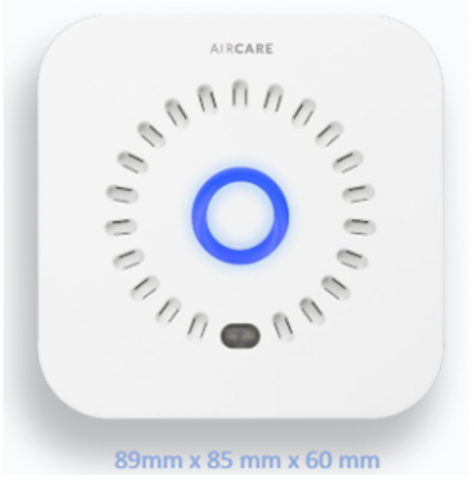
The sensors used are from Aircare Mini (Figure 1) and are aimed at monitoring air quality (TVOC, CO2, PM2.5, PM10) and environmental comfort (Acoustic pressure, Brightness, Temperature, Humidity, and Atmospheric pressure).
Figure 1. Aircare Mini Sensor
The sensors are connected to a dedicated Cloud platform, allowing:
- Real-time monitoring of measured parameters
- diagnostics of monitored devices
- Creating and downloading custom reports
- Sending notifications to exceed the detected threshold levels
Specially created information models, as mentioned, integrate sensors by representing them as three-dimensional virtual objects and assigning them specific descriptors, such as the type of quantity monitored, the units of measurement, the detection range and a unique identification code. An algorithm, written in Python, compares sensor data with threshold values defined by the relevant regulations and ensures the subsequent visualization of the data itself within BIM models in the form of HTML reports.
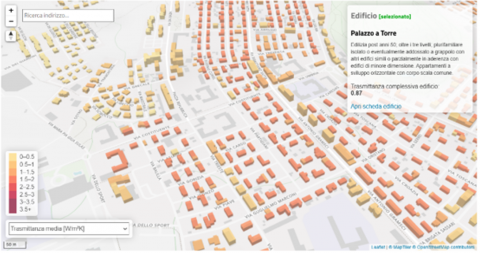
The AUREE methodology aims to create a tool dedicated to homeowners (not a technical audience), which, by requesting some basic data on the property's characteristics, can provide specific suggestions for retrofit interventions (Figure 2).
Figure 2. GIS Web representation, residential buildings auree portal
These recommendations are based on a specially developed study of local building typologies and building geometries, derived from topographic data. Inside the portal, it is possible to enter, for each building, the type of heating, cooling, and domestic hot water systems, thus obtaining a further specific characterization of the individual building and obtaining an estimate of the energy class to which it belongs. For users interested in further refining the results, you can register on the portal and complete a specific audit.
3.1 Effect of different exposures and shading.
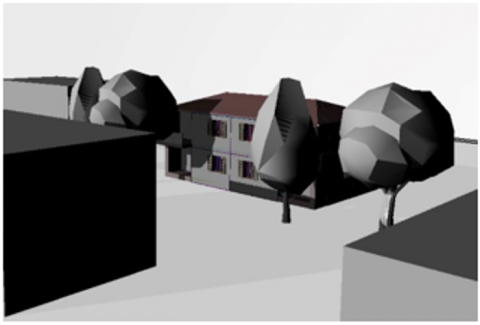
The use of energy modelling software allowed us to quantify and calculate significant differences in thermal energy requirements for the same type of residential building, but with different exposure and shading conditions (Figure 3).
Regarding the influence of orientation and shading, the results showed almost negligible variations (< 1%) during the winter period, while differences relevant to summer air conditioning emerged. Deviations greater than 45% were found for diverging main facade orientations up to 90°, and greater than 30% in the presence of shading. When these two effects (orientation and shading) are present simultaneously, they tend to compensate each other. This is due to the use of the UNI TS 11300 series of standards [18, 19] and the studies [20, 21] followed to model the various buildings.
For these parameters, the model was refined in line with the technical regulations of the sector, applying it to all the architectural typologies analyzed.
3.2 New typological dictionary
In addition to the existing mapping, a new GIS file has been produced for public buildings with the localization of those identified for Bacu Abis and Cortoghiana. Once identified, they were catalogued, classified and simulated; this involved the creation of a specific dictionary for the inclusion of information sets consisting of: general data (destination of use; construction period; volume; number of floors; air-conditioned surface); envelope data (external walls, roof closure, base closure, windows, transmittance of construction elements envelope); performance per service (useful energy requirement, unit useful energy requirement, thermal efficiency generation, energy carrier, non-renewable primary energy, annual cost, annual CO2 emissions); global performance (non-renewable primary energy, annual cost, annual CO2 emissions); real consumption.
At this stage, the typological study of the residential building heritage of the city of Carbonia was further refined and expanded. During the 2019-2021 three-year program, an initial segmentation of the heritage was carried out, subsequently extended to almost the entire urban core. In this new study, the areas of the municipal territory not yet considered were also analyzed, including the hamlets of Bacu Abis and Cortoghiana.
The building typologies already identified in the previous planning have proven insufficient to describe the new portions of heritage, making their integration necessary. The same approach was applied to the public buildings present in the new areas, which were catalogued and analyzed following the model adopted previously. For the latter, the information sets already developed have been updated and expanded.
In parallel with the updating of the information sets, the GIS tool has been integrated through the creation of new dictionaries, which can be uploaded and consulted directly on the AUREE portal.
In particular:
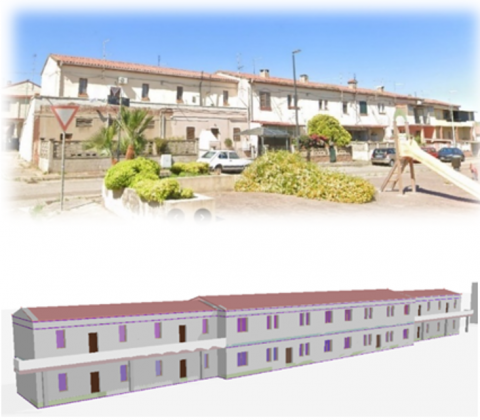
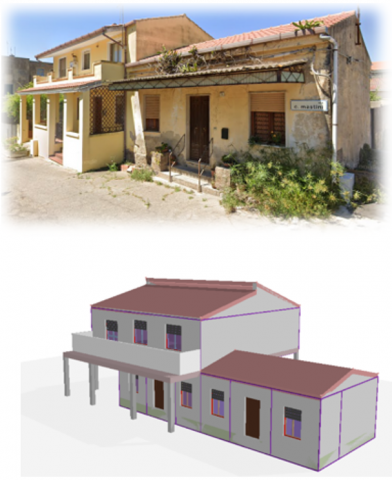
- gen_fon_lin: two-level construction of the “Fondazione Lineare” (Figure 4).
- gen_fon_S: vertical extension (additional storey) of single-storey "Fondazione" buildings (Figure 5).
Figure 4. Typology “Fondazione Lineare” real building and model
Figure 5. Typology “Fondazione Sopraelevato” real building and model
Added to this integration is a chronological update for a limited number of buildings located on Liberty Avenue in Bacu Abis. These buildings, falling within the gen_fon2_4f archetype, were demolished and rebuilt in recent times. Although they retain the same geometry as the original Foundation buildings, the construction techniques used are modern, such as the use of XLAM panels or Poroton blocks.
This difference necessitated further chronological diversification for the gen_fon2_4f archetype, as the energy performance of the envelope is significantly improved compared to the original buildings, requiring specific classification to ensure accurate energy assessment.
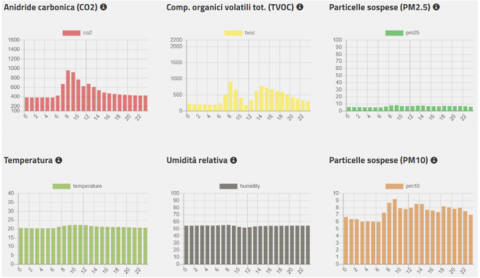
Sensor data can be consulted on the AUREE portal through an easy-to-use interface. Within the portal, you can select the sensor-equipped environment you intend to monitor, the month, year, and whether the days on which measurements are taken are weekdays or holidays.
The data returned are average data relating to environmental monitoring, and as can be seen from the following image (Figure 6), they are easy to read even for those who are not experts in the field. The time scale indicated for monitoring is 24h.
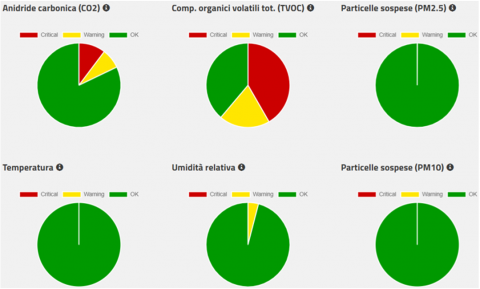
The pie chart allows for an intuitive understanding of the percentage of time during which the measured values - compared to reference thresholds - fall within the categories of good, acceptable, or unacceptable. (Figure 7).
The experiment showed that it is possible to:
- Collect detailed data on energy consumed and internal environmental conditions.
- Improve building management, optimizing system use, and reducing energy waste.
- Engage users, who can access data through intuitive interfaces and participate in building energy management.
Figure 6. Environmental monitoring, various parameters
Figure 7. Percentage good (green), acceptable (yellow), and not acceptable (red) parameters monitored
It was interesting to study the deviations obtained between the steady-state primary energy calculations and the dynamic-state primary energy calculations. The current UNI TS 11300s require steady-state calculations, which are simplified because they consider constant external conditions coinciding with the average monthly conditions attributable to the winter season and constant internal conditions. This calculation obviously deviates from reality, and it was therefore decided to use the hourly dynamic regime.
The dynamic regime is more precise and representative because it considers the hourly fluctuations in external temperatures attributed to the intervention location for the calculation and allows for the modification of data that interfere with the building's behaviour and energy balance, such as occupant behaviour, room ventilation, and, importantly, system usage times. The calculation is therefore hourly. Within the Termolog software, it is possible to intervene on all input data.
During the studies carried out, a questionnaire was administered to a sample of the population residing in the Municipality of Carbonia. Summer air conditioning, when present, is achieved using PdC a/a (single split). As regards winter air conditioning, however, the interviews highlighted a widespread use of PdC systems (65%), followed by diesel or LPG boilers (22%) and biomass systems, typically with an open (3%) or closed (10%) chamber. These values were used as weight coefficients in the calculation of the average primary energy consumed EPi (in kWh/m2) for the ith architectural typology:
$E P i=0,65 * E P i, p d c+0,22 * E P i, \mathrm{cal}+0,13 * E P i$, bio
Furthermore, the interviewees indicated the hours of use for each system, allowing them to draw the average system use profile to be entered into the software.
Comparing the data obtained in the steady state with those obtained in the dynamic state, it is possible to note a substantial difference regarding the primary energy of the various archetypes analyzed.
The integration of advanced digital tools such as Building Information Modeling (BIM), IoT sensors, and Web-GIS represents a significant step forward in the management and redevelopment of the building stock. The AUREE project demonstrated that the combined use of these technologies allows for real-time data collection and analysis, improving knowledge of building energy performance and optimizing retrofit interventions.
Another relevant aspect was the active involvement of users in building management. Through the AUREE Web-GIS portal, citizens, administrators, and technicians can easily access data, compare energy performance, and identify the best efficiency strategies. This participatory approach represents a replicable model for other urban realities, facilitating the diffusion of sustainable redevelopment practices.
Despite the positive results, the project highlighted some challenges and room for improvement.
Within the portal, it would be appropriate to integrate a list of local enterprises specializing in the energy sector, which is currently lacking. This section is essential to support energy efficiency and retrofit processes, ensuring homeowners have direct access to qualified professionals.
It is important to update the programming language of the GIS Web portal so that, in addition to calculating the useful surface area from the polygon, key information such as the exposure of the building and the presence of any shading, for example, caused by nearby buildings, is considered. These data are essential, as seen previously, they modify the thermal requirement and are therefore useful for optimizing the proposed interventions and improving the effectiveness of retrofit solutions.
It is good to have greater data standardization to ensure interoperability between different systems, improve the accessibility of digital platforms for non-expert users, and optimize energy analysis algorithms in a dynamic regime to provide increasingly accurate forecasts.
Looking ahead, further developments of the AUREE project could include integration with artificial intelligence and machine learning technologies to improve the predictive capability of energy models.
This work has been developed within the framework of the project e.INS- Ecosystem of Innovation for Next Generation Sardinia (cod. ECS 00000038) funded by the Italian Ministry for Research and Education (MUR) under the National Recovery and Resilience Plan (NRRP) - MISSION 4 COMPONENT 2, "From research to business" INVESTMENT 1.5, "Creation and strengthening of Ecosystems of innovation" and construction of "Territorial R&D Leaders.
|
EPi |
Energia primaria i-esima tipologia |
|
EPi,pdc |
Energia primaria soluzione pdc i-esima tipologia |
|
EPi,cal |
Energia primaria soluzione caldaia i-esima tipologia |
|
EPi,bio |
Energia primaria soluzione biomassa i-esima tipologia |
[1] Desogus, G., Quaquero, E., Rubiu, G., Gatto, G., Perra, C. (2021). BIM and IoT sensors integration: A framework for consumption and indoor conditions data monitoring of existing buildings. Sustainability, 13(8): 4496. https://doi.org/10.3390/su13084496
[2] Congiu, E., Quaquero, E., Rubiu, G., Vacca, G. (2023). BIM-GIS integrated framework in support of Facility Management (FM). https://doi.org/10.20944/preprints202311.1499.v1
[3] Congiu, E., Desogus, G., Frau, C., Gatto, G., Pili, S. (2023). Web-based management of public buildings: A workflow based on integration of BIM and IoT sensors with a Web–GIS portal. Buildings, 13(5): 1327. https://doi.org/10.3390/buildings13051327
[4] Johari, F., Peronato, G., Sadeghian, P., Zhao, X., Widén, J. (2020). Urban building energy modeling: State of the art and future prospects. Renewable and Sustainable Energy Reviews, 128: 109902. https://doi.org/10.1016/j.rser.2020.109902
[5] EU. (2014). Directive 2014/24/EU of the European Parliament and of the Council of 26 February 2014 on public procurement and repealing Directive 2004/18/EC Text with EEA relevance. https://eur-lex.europa.eu/eli/dir/2014/24/oj/eng.
[6] Muta, L.F., Melo, A.P., Lamberts, R. (2025). Enhancing energy performance assessment and labeling in buildings: A review of BIM-based approaches. Journal of Building Engineering, 103: 112089. https://doi.org/10.1016/j.jobe.2025.112089
[7] Nguyen, N.M., Wiratama, F., Sulalah, A. (2025). Enhancing energy intelligence in Taiwanese office buildings: Utilizing a novel BIM-derived dataset for AI-driven energy consumption prediction. Energy and Buildings, 333: 115420. https://doi.org/10.1016/j.enbuild.2025.115420
[8] Marini, M., Mastino, C.C., Baccoli, R., Frattolillo, A. (2018). BIM and plant systems: A specific assessment. Energy Procedia, 148: 623-630. https://doi.org/10.1016/j.egypro.2018.08.150
[9] Pili, S., Poggi, F., Frau, C. (2021). A methodological approach for a home occupants centred web tool to support buildings energy retrofitting process. E3S Web of Conferences, 312: 02001. https://doi.org/10.1051/e3sconf/202131202001
[10] Tagliabue, L.C., Ciribini, A.L.C., Quaquero, E., Villa, V., Di Giuda, G.M., Sanna, A., Desogus, G. (2018). Towards the cognitive building: information modeling for the energy audit. TEMA, 4(2): 13-24. https://doi.org/10.17410/tema.v4i2.195
[11] Tzortzopoulos, P., Ma, L., Soliman Junior, J., Koskela, L. (2019). Evaluating social housing retrofit options to support clients’ decision making—SIMPLER BIM protocol. Sustainability, 11(9): 2507. https://doi.org/10.3390/su11092507
[12] Panteli, C., Kylili, A., Fokaides, P.A. (2020). Building information modelling applications in smart buildings: From design to commissioning and beyond a critical review. Journal of Cleaner Production, 265: 121766. https://doi.org/10.1016/j.jclepro.2020.121766
[13] Sanna, A., Ciribini, A.L.C., Di Giuda, G.M., Gatto, G., Villa, V., QUAQUERO, E., Tagliabue, L.C., Desogus, G. (2018). Mapping energy consumption and comfort data of an existing building through information modeling. https://iris.unito.it/handle/2318/1771316.
[14] Rogage, K., Clear, A., Alwan, Z., Lawrence, T., Kelly, G. (2019). Assessing building performance in residential buildings using BIM and sensor data. International Journal of Building Pathology and Adaptation, 38(1): 176-191. https://doi.org/10.1108/IJBPA-01-2019-0012
[15] Ang, Y.Q., Berzolla, Z.M., Reinhart, C.F. (2020). From concept to application: A review of use cases in urban building energy modeling. Applied Energy, 279: 115738. https://doi.org/10.1016/j.apenergy.2020.115738
[16] Ufficio Tecnico Comunale Area Urbanistica. (2009). Dossier di Bacu Abis. Comune di Carbonia. https://www.comune.carbonia.su.it/wp-content/uploads/2024/06/3_Dossier_Bacu_Abis.pdf.
[17] Ufficio Tecnico Comunale Area Urbanistica. (2009). Dossier di Cortoghiana. Comune di Carbonia. https://www.comune.carbonia.su.it/wp-content/uploads/2024/06/2_Dossier_Cortoghiana.pdf.
[18] UNI. (2014). Energy performance of buildings - Part 1: Evaluation of energy need for space heating and cooling. https://store.uni.com/en/uni-ts-11300-1-2014.
[19] UNI. (2014). Energy performance of buildings - Part 2: Evaluation of primary energy need and of system efficiencies for space heating, domestic hot water production, ventilation and lighting for non-residential buildings. https://store.uni.com/en/uni-ts-11300-2-2019.
[20] UNI. (2018). Energy performance of buildings - Energy needs for heating and cooling, internal temperatures and sensible and latent heat loads - Part 1: Calculation procedures. https://store.uni.com/en/uni-en-iso-52016-1-2018.
[21] UNI. (2019). Energy performance of buildings - Ventilation for buildings - Part 1: Indoor environmental input parameters for design and assessment of energy performance of buildings addressing indoor air quality, thermal environment, lighting and acoustics - Module M1-6. https://store.uni.com/en/uni-en-16798-1-2019.