Forijati* | Marista Dwi Rahmayantis | Mumun Nurmilawati | Susi Damayanti
© 2025 The authors. This article is published by IIETA and is licensed under the CC BY 4.0 license (http://creativecommons.org/licenses/by/4.0/).
OPEN ACCESS
This study aims to analyze the role of the blue economy and government support in strengthening the economic resilience of coastal communities in southern Java through the mediation of a Business Continuity Plan (BCP). The research methodology uses a quantitative approach with surveys in four coastal districts, analyzed through a structural equation model. The results indicate that the blue economy does not directly influence economic resilience but significantly contributes through the BCP, with its effectiveness depending on community awareness and capacity to develop adaptive and sustainable business planning. Conversely, government support is proven to have both direct and indirect impacts, through policies, training, infrastructure, and technical assistance that strengthen the local economic foundation while promoting the implementation of the BCP. These findings emphasize that BCP serves as a strategic mechanism linking the blue economy and government support to enhance the economic resilience of coastal communities. This study provides theoretical implications for the development of coastal-based economic resilience literature, as well as practical implications for the formulation of sustainable development policies, emphasizing the integration of adaptive planning and government community collaboration to create a resilient coastal business ecosystem.
Business Continuity Plan (BCP), government support, blue economy, economic resilience, coastal communities, sustainable development
Economic development in coastal areas often faces a double challenge: they have great marine resource potential, but are also vulnerable to natural disasters and climate change [1, 2]. The southern coastal region of Java Island, particularly Blitar, Tulungagung, Trenggalek, and Pacitan, serves as a concrete example of this situation. This area holds vast marine economic potential, ranging from fisheries, marine products, marine tourism, to processing industries [3, 4]. However, this great potential is often hampered by limited infrastructure and market access [5, 6].
Communities along the Southern Cross Route who rely on marine resources for their livelihoods are highly exposed to global economic fluctuations, natural disasters, such as storms and large swells, as well as the consequences of climate change. This vulnerability creates ecological and structural economic challenges that require specialized strategies to enhance economic resilience while ensuring the responsible utilization of resources [7, 8]. In this context, the concept of the ocean-based economy emerges as a development approach emphasizing the sustainable, efficient, and equitable management of oceanic resources. The blue economy concept has emerged as a development strategy that highlights the fair and responsible utilization of oceanic resources [9, 10].
However, the utilization of the blue economy has not yet fully addressed the aspect of risk mitigation for community businesses, particularly coastal SMEs that lack a business continuity planning system when facing disruptions such as disasters or economic crises [11, 12]. Therefore, the integration of the blue economy with the Business Continuity Plan (BCP) framework is important to create a more resilient and adaptive local economic system in the southern coastal areas of Java. In the context of coastal communities that are geographically located in disaster-prone areas and regions affected by climate change, business sustainability depends not only on the ability to utilize natural resources but also on preparedness to cope with sudden and destructive disruptions [13]. Without proper planning, small businesses such as fishing, seafood processing, or beach tourism risk being paralyzed during a crisis [14]. This is where the role of the BCP becomes very relevant, as it provides a strategic framework for businesses to survive, adapt, and even recover after a disaster or other disruption [15, 16].
Business Continuity Plan (BCP) is a systematic approach designed to ensure business continuity in the event of disruptions, whether caused by natural or non-natural [17]. The implementation of BCP in the context of coastal SMEs includes identifying key risks, developing mitigation measures, establishing backup production or distribution systems, and formulating post-disaster recovery strategies [18]. With BCP, coastal communities are no longer merely reactive to disasters but can develop planned and measured responses [19, 20]. Suppose this framework is synergized with blue economy principles such as sustainability, resource conservation, and social inclusion. In that case, communities will not only become more economically resilient but also contribute to the long-term protection of coastal ecosystems. This integrative approach is believed to be a model for coastal development that is not only adaptive to risk but also competitive and sustainable [21, 22].
Based on a survey of 385 respondents in four coastal districts on the southern coast of Java, Indonesia, it appears that most communities are highly dependent on the sea, but do not yet have systematic business plans to deal with economic risks. This raises an essential question: in what ways can the blue economy and government support shape business planning knowledge to bolster the economic robustness of seaside communities? Accordingly, the research question focuses on how the blue economy and governmental assistance are connected to the resilience of coastal communities, with business planning awareness serving as an intervening variable within this relationship.
This research aims to empirically examine the impact of the blue economy and government support on the economic resilience of coastal communities in southern Java, considering the mediating role of community awareness in designing sustainable business plans. This work endeavors not only to establish the scope concerning the effects of each factor but also to formulate a model framework that can guide policy formulation on coastal economic development, emphasizing resilience and sustainability.
Although many studies have discussed the blue economy and disaster risk mitigation in coastal areas, most research still addresses the two topics separately [23-25]. Studies that directly link the concept of the blue economy with BCP-based business planning models in the context of coastal communities along the southern Java corridor are scarce. The present study endeavors to bridge this gap by proposing an integrative model that merges environmental sustainability perspectives with community economic resilience, reinforced by improved business planning awareness. The novelty of this research lies in developing a conceptual and empirical framework that integrates the blue economy and BCP as adaptive strategies for coastal communities in facing economic and environmental disruptions.
2.1 Blue economy and its impact on coastal communities' economic resilience awareness
The Sustainable Economy Approach emphasizes the importance of efficient, fair, and environmentally friendly use of natural resources to ensure long-term economic sustainability [26]. Within this framework, economic development is not only focused on growth but also on ecosystem sustainability and social inclusivity. This principle is particularly relevant for coastal communities, which rely directly on natural conditions to sustain their livelihoods [27]. Therefore, development strategies that consider environmental carrying capacity are key to strengthening the resilience of local economic systems [28].
The application of the blue economy within coastal communities can diminish reliance on a singular resource, diversify alternative livelihoods, and establish a balance between economic and ecological aspects [29, 30]. With a more diverse and sustainable economic foundation, communities have greater capacity to cope with environmental pressures and external shocks [24]. Therefore, this study proposes hypothesis 1: The blue economy has a positive effect on the economic resilience of coastal communities.
2.2 Government support and its influence on the economic resilience of coastal communities
In the context of the Institutional Support and Community Resilience Theory, the economic resilience of local communities cannot be separated from the support of local and central governments, as well as disaster management and community empowerment agencies that play a crucial role in providing a structural foundation for communities to survive and thrive amid various pressures [31]. Such support includes the development of basic infrastructure, emergency assistance during crises, entrepreneurship training, and the provision of relevant information on risk mitigation and climate change adaptation. All these forms of support strengthen the adaptive capacity of communities to maintain local economic sustainability [32].
For coastal communities vulnerable to various natural disasters and changes in marine ecosystems, the presence of the government through policies, programs, and direct interventions is crucial in creating a sense of security and productive economic space. When communities feel supported, they tend to be more prepared and better able to develop economic systems that not only survive under normal conditions but can also recover quickly after a crisis. Therefore, this study proposes hypothesis 2: Government support has a significant influence on the economic resilience of coastal communities.
2.3 The blue economy and its influence on awareness in developing BCP for coastal communities
The Sustainable Livelihoods Framework (SLF) theory states that the sustainability of communities depends heavily on wise, participatory resource management that is capable of maintaining an equilibrium of economic needs alongside environmental considerations [33]. In coastal areas, the blue economy reflects a development approach that emphasizes the prudent use of sea-based resources, with attention to lasting ecological protection in tandem with strengthening local capacity instead of only seeking immediate financial returns [9]. Implementing blue economy principles motivates coastal communities to move beyond dependence on natural resource exploitation and to adopt business management strategies that integrate risk considerations and long-term sustainability [34].
In line with the SLF framework, a strong understanding of the blue economy can increase public awareness of the importance of business continuity planning through a Business Continuity Plan. Integrating environmental sustainability principles with risk mitigation strategies can foster an adaptive mindset, whereby coastal businesses proactively prepare anticipatory measures against disruptions that could threaten their business continuity. Based on the theoretical foundation and empirical findings, this study proposes hypothesis 3: The blue economy has a positive influence on coastal communities' awareness in developing a BCP as part of a long-term economic resilience strategy.
2.4 Government support and its influence on coastal communities BCP
An important aspect in building the economic resilience of coastal communities is structured and responsive government support. In this context, the theory of Good Governance serves as a relevant theoretical framework for explaining how the government's role can influence community adaptive behaviour, particularly in fostering awareness of the importance of sustainable business planning [35]. This theory emphasizes that the functions of Good Governance are not only about regulation but also act as facilitators, public servants, and sources of social legitimacy in participatory and inclusive development processes. Through accountable, transparent, and responsive governance that addresses community needs, the government can encourage communities to adopt sustainable and adaptive development practices [36].
For coastal communities in southern Java, which face various ecological risks every year, such as tidal flooding, abrasion, tropical storms, and the threat of earthquakes and tsunamis, the role of the government is crucial. Local and central governments are not only expected to be present during the emergency response phase, but also in the pre-disaster phase through the provision of business protection policies, facilitation of preparedness training, and dissemination of information on risk management. When coastal communities receive training on risk mitigation and are given access to disaster-related information, they gradually develop an awareness of the importance of having a business system or plan that can withstand crises. In this regard, forms of support such as technical assistance, strengthening regulations for micro and small businesses, and post-disaster assistance contribute significantly to improving business continuity planning literacy among grassroots communities [37].
Community awareness in developing BCP does not grow naturally but needs to be triggered through a systematic, structured approach. Government support is one of the main drivers capable of creating a conducive ecosystem for the growth of such awareness [38]. Coastal businesses that receive information about the importance of developing business protocols during disasters, or that participate in training on post-crisis recovery, are more likely to recognize that the sustainability of their businesses depends heavily on preparedness for uncertainty. Over the long term, this form of awareness can evolve into a resilient community culture, where every business unit, no matter how small, has risk mapping, recovery plans, and diversification strategies [39]. Thus, it can be hypothesised that governmental assistance exerts a favorable effect upon the awareness of coastal communities in designing adaptive business plans. Targeted government intervention not only improves the technical capacity of the community but also shapes collective awareness of the importance of systematically planning business continuity.
2.5 BCP and its impact on the economic resilience of coastal communities
Within the framework of Resilience Thinking theory, the resilience of a socioeconomic system depends heavily on the extent to which individuals and communities can respond, adapt, and recover from external shocks [40, 41]. In this context, awareness and preparedness to design business plans before a crisis occurs are key elements of a community's adaptive capacity. BCP not only reflects preparedness for risks but also creates a systematic decision-making structure when facing uncertain conditions. Coastal communities that understand risks, can develop alternative strategies, and establish recovery procedures tend to be more resilient in maintaining the continuity of their economic activities when crises occur [20].
In coastal areas of southern Java that face recurring threats such as high waves, erosion, tidal flooding, and the potential for tsunamis, the existence of BCP becomes increasingly crucial. When communities have business plans that anticipate various disaster scenarios, they can reduce economic losses, accelerate post-crisis recovery, and maintain livelihood stability [42]. BCP also helps coastal businesses prioritise the distribution of limited resources during crises and ensure the continuity of essential goods and services. Thus, BCP not only strengthens the technical dimension of economic resilience but also enhances social-communal capacity through collective planning and cross-actor coordination [17, 43]. Based on this theoretical foundation and empirical reality, hypothesis 5 can be proposed: BCP has a positive impact on the economic resilience of coastal communities.
2.6 The awareness of business planning mediates the influence of the blue economy on the economic resilience of coastal towns
The influence of the blue economy on the economic resiliency of coastal communities is indirect. According to the Theory of Planned Behaviour, environmental stimuli such as marine policies and sustainable practices first shape people's attitudes and beliefs toward adaptive economic actions [30, 44]. This aligns with the Stimulus-Organism-Response (SOR) framework, wherein the principles of the blue economy serve as an external stimulus that is internally processed through entrepreneurial planning awareness, ultimately encouraging the community towards economic resilience behaviour [45, 46]. Therefore, entrepreneurial planning awareness functions as a cognitive mediator linking blue economy values with the community's capacity to sustain and develop sustainable businesses [47]. Additionally, this approach is reinforced by Cognitive Mediation Theory, which states that the influence of information and values on actions is only effective if it goes through a process of knowledge internalization that forms readiness to act. Thus, hypothesis 6 is that the Business Continuity Plan can mediate the impact of the blue economy on the economic resilience of coastal communities.
2.7 Business planning awareness mediates the effect of government support upon the economic resilience within coastal communities
The role of government in local economic development, particularly in vulnerable areas such as coastal communities, is crucial in building community preparedness and resilience to risks. Within the framework of Public Support Theory and Governance Theory, public policies, training programs, technical assistance, and the participation of state institutions in community empowerment serve as structural stimuli that strengthen the adaptive capacity of communities [48, 49]. However, the success of such support does not always directly correlate with increased economic resilience; this depends heavily on the community's conscious and planned understanding, acceptance, and utilisation of the support [50].
The Stimulus-Organism-Response (SOR) theory by Mehrabian and Russell in 1974 provides a relevant framework for explaining this relationship. In this model, government support functions as an external stimulus. At the same time, community awareness of business continuity planning is an internal response (organism) in the form of cognitive processes shaped by experience, information, and training [51]. Furthermore, the actual response or adaptive behaviour in this context of economic resilience will only form after the internalization of values through such awareness.
In line with this, Ajzen's Theory of Planned Behaviour also emphasizes the significance of psychological variables between stimulus and response. In this context, awareness of business planning reflects perceived behavioural control, which is the belief of individuals or communities in their ability to manage and sustain business continuity [52]. When government support can enhance perceived control through education, facilitation, or mitigation programs, individuals will be encouraged to develop more resilient economic behaviour. Without this awareness, external support tends not to be optimally transformed into substantial resilience [53]. Therefore, it can be concluded that business planning awareness functions as an intermediary variable linking the impact of government policies and structural interventions on expected economic outcomes. The economic resilience of coastal communities arises not solely from the availability of assistance but mainly from the community's preparedness to anticipate risks and manage their enterprises sustainably. Hypothesis 7: Business Continuity Plans can mediate the influence of government support on the economic resilience of coastal communities.
3.1 Research design
This study uses a quantitative approach by experimental method to examine the relationship between variables, namely blue economy, government support, BCP and the economic resilience of coastal communities. This study also uses explanatory causal analysis to distinguish the direct and indirect influences between variables in the model using SEM-PLS (Structural Equation Modeling-Partial Least Squares). The conceptual model in this study is built on the theoretical foundation and also the findings in previous research, so that it can be formulated into a structural model to test hypotheses through SEM PLS. The use of this method is based on its ability to handle complex relationships between latent variables and its resistance to data that is not normally distributed [54].
The number of respondents in this study (n = 385) met the requirements for sample size in a study using covariance-based SEM. The use of SEM PLS is because it considers theoretical and practical reasons. This research model includes a number of latent constructs, mediation relationships, and formative indicators so that in this analysis technique it is more suitable for predictive and exploratory purposes. Initial normality testing showed that some indicators were not normally distributed, further strengthening the rationale for using SEM PLS, which does not require strict multivariate normality assumptions. In addition, SEM PLS allows simultaneous analysis of measurement and structural models and also provides greater flexibility in theoretical development in new research areas such as blue economy and coastal community resilience.
Figure 1 presents the conceptual framework used in this study, illustrating the hypothesized relationships among blue economy, government support, business continuity planning (BCP), and the economic resilience of coastal communities. This framework serves as the foundation for developing the structural model and testing the proposed hypotheses using SEM-PLS.
It is important to acknowledge that this research applies a cross-sectional survey approach, in which data were obtained at one point in time. Given that the data were collected only once within a defined period, this study adopts a cross-sectional perspective. Consequently, any linkages identified among constructs represent correlational patterns rather than established cause-effect relationships.
Control variables such as firm size, business sector, and education level were not included in the SEM model to maintain simplicity and focus on the theoretical relationships among the main constructs. Nonetheless, these contextual factors are recognized as potentially influential and should be considered in future studies.
3.2 Research location and population
This research was conducted in the southern coastal region of East Java, Indonesia, covering four districts: Blitar, Tulungagung, Trenggalek, and Pacitan. These four areas were selected because they are located along the southern cross-island highway and share similar geographical, social, and economic characteristics of coastal areas, and are vulnerable to natural disasters and economic fluctuations. The population in this study consists of communities residing and engaged in economic activities in the coastal areas of the three regencies, particularly Micro, Small, and Medium Enterprises (MSMEs).
3.3 Sampling technique
The study employed purposive sampling as the technique, with the following criteria for respondents: 1) residing in the coastal area for at least the past two years, 2) owning or managing a business based on marine resources or coastal economic activities, and 3) willing to fully participate in the survey. The sample selection in this study employed a non-probability strategy, wherein not all individuals in the population possess an equal likelihood of being chosen as a sample [55]. Based on these criteria, a total of 385 respondents were obtained, distributed proportionally across the four regions.
Although purposive sampling enables the selection of respondents with substantial experience in coastal economic activities, this approach may also lead to potential selection bias. As a result, the sample might not fully capture the demographic and occupational diversity of the broader coastal population across the four districts. Future studies are therefore advised to consider stratified or random sampling methods to improve representativeness and strengthen the generalizability of the results.
3.4 Data collection techniques
Data was collected using a closed-ended questionnaire based on a 1-5 Likert scale, which was developed based on the indicators of each variable. The questionnaire was distributed directly and also through online forms with the assistance of local facilitators to ensure the validity of the responses. Before being widely distributed, the questionnaire underwent content validation by experts and was pilot-tested on 30 respondents to measure the reliability and clarity of the items. The variables in this study consist of: 1) Blue economy (X1): knowledge, perceptions, and experiences of the community regarding the principles of sustainable marine-based economy. 2) Government support (X2): policy assistance, training, and business protection from the government or related institutions. 3) BCP (M): the level of readiness and understanding of the community in planning business sustainability in the face of risks. 4) Economic resilience (Y): the ability of individuals and communities to maintain business stability and income in uncertain conditions. Each variable is measured using several indicators described in the form of statements in the questionnaire.
To ensure conceptual consistency, this study defines Business Continuity Plan (BCP) as the preparation level that integrates awareness and specific planned measures executed by coastal entrepreneurs to maintain their business operations during disruptions. The BCP indicators in the questionnaire represent cognitive understanding (awareness) and operational preparedness (activities), which include risk identification, business operational strategies, backup plans, personnel training, plan updates, and stakeholder collaboration.
Each construct was measured using multiple indicators adapted from relevant literature and refined to reflect the coastal community context. Specifically, the blue economy construct was measured using 5 items, government support with 5 items, Business Continuity Planning with 6 items, and economic resilience with 4 items. A summary of these indicators is presented conceptually in this section, while the complete list of survey items is available from the corresponding author upon request for replication or further academic use.
3.5 Data analysis techniques
Data processing in this study was conducted using an SEM PLS approach. The analytical technique was conducted in two primary phases. The initial phase entailed evaluating the measurement model (outer model). This study aimed to evaluate the validity and reliability of latent constructs based on the indicators used to measure them. Convergent validity was analysed using outer loading values and Average Variance Extracted (AVE), with criteria that loadings must exceed 0.70 and AVE must be at least 0.50 to be considered valid [54]. To test reliability, Composite Reliability and Cronbach's Alpha values were used, with minimum thresholds of 0.70 and 0.60, respectively.
In the second stage, the structural model (inner model) was tested to identify the significance of direct and mediated relationships among latent constructs. The evaluation employed path coefficient values, t-statistics, and p-values generated through bootstrapping with at least 5,000 resamples. A variable relationship was considered significant if the t-statistic was greater than 1.96 at a 5% significance level (p < 0.05). With this approach, the study is expected to comprehensively map how the blue economy and government support, both directly and indirectly through business planning awareness, affect the economic resilience of coastal communities in southern Java.
To assess potential common-method bias, the full collinearity test was conducted using SmartPLS. The results show that all Variance Inflation Factor (VIF) values were below the recommended threshold of 3.3, indicating that common-method bias is unlikely to distort the results.
The analytical findings are demonstrated through an outer model assessment to examine construct validity and reliability. In contrast, the inner model evaluates the magnitude of associations among latent variables, as well as hypothesis testing covering both direct and indirect effects. The findings were critically analysed in terms of the theoretical framework underlying the research and compared with findings from previous studies to identify consistency, differences, and new contributions in the context of strengthening the economic resilience of coastal communities. The measuring model in Smart-PLS software is analysed using two ways. The first is the exterior model, while the second is the interior model. The external model is evaluated using convergent and discriminant validity tests [56].
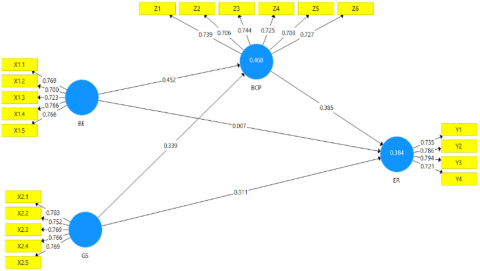
As shown in Figure 2, the measurement model displays the initial loadings prior to conducting the bootstrapping procedure. According to discriminant validity, the variables should not exhibit correlation, even if the constructs belong to separate factors. To assess discriminant validity, three distinct tests were conducted: Average Variance Extracted (AVE), which must exceed 0.5; Cronbach's alpha, which must also surpass 0.5; and Composite Reliability (CR), which must be better than 0.7. In the present investigation, all results are statistically significant, and the AVE exceeds 0.5, indicating that all dimensions are validated and fulfil the criteria for discriminant validity. Cronbach's alpha and Composite Reliability (CR) tests are employed to assess the dependability of the construct. If the Cronbach's alpha is below 0.5, the composite dependability can be assessed for the construct's dependability [56]. The current research demonstrates that Cronbach's alpha exceeds 0.5, signifying that the constructs are reliably significant. Regarding the Composite Reliability (CR), the current analysis demonstrates that all values exceed the requisite minimum threshold of 0.7, as indicated in Table 1.
Table 1. Outer model evaluation
|
Variable |
Cronbach's Alpha |
Composite Reliability |
rho_A |
AVE |
|
BE |
0.801 |
0.862 |
0.809 |
0.555 |
|
GS |
0.826 |
0.878 |
0.829 |
0.589 |
|
BCP |
0.819 |
0.869 |
0.822 |
0.524 |
|
ER |
0.764 |
0.849 |
0.763 |
0.584 |
Source: Data processing results from SmartPLS 4. Note: BE: Blue economy, GS: Government support, BCP: Business Continuity Plan, ER: Economic resilience
Table 2. Outer loading
|
Item |
BE |
GS |
BCP |
ER |
|
BE1 |
0.769 |
|
|
|
|
BE2 |
0.700 |
|
|
|
|
BE3 |
0.723 |
|
|
|
|
BE4 |
0.766 |
|
|
|
|
BE5 |
0.766 |
|
|
|
|
GS1 |
|
0.783 |
|
|
|
GS2 |
|
0.752 |
|
|
|
GS3 |
|
0.769 |
|
|
|
GS4 |
|
0.766 |
|
|
|
GS5 |
|
0.769 |
|
|
|
BCP1 |
|
|
0.739 |
|
|
BCP2 |
|
|
0.706 |
|
|
BCP3 |
|
|
0.744 |
|
|
BCP4 |
|
|
0.725 |
|
|
BCP5 |
|
|
0.703 |
|
|
BCP6 |
|
|
0.727 |
|
|
ER1 |
|
|
|
0.755 |
|
ER2 |
|
|
|
0.786 |
|
ER3 |
|
|
|
0.784 |
|
ER4 |
|
|
|
0.721 |
Source: Data processing results from SmartPLS 4
Table 1 shows the results of the outer model evaluation for all research variables. Based on these results, the Cronbach's Alpha values for the four primary constructs, namely blue economy (BE), government support (GS), Business Continuity Plan (BCP), and economic resilience (ER), are all above the threshold value of 0.70. This indicates that each construct has a good level of internal reliability. Furthermore, the Composite Reliability and rho_A values for all variables also exceed 0.70, indicating that the indicators within each construct consistently reflect the construct being measured. Meanwhile, the Average Variance Extracted (AVE) values are all above 0.50, which indicates that each construct has met the convergent validity criteria, so that the indicators used can adequately explain the variance of the construct.
Based on the results of the outer loading analysis presented in Table 2, all indicators in the blue economy, government support, Business Continuity Plan, and Coastal Community Economic Resilience constructs show loading values above 0.60. This indicates that each indicator has sufficient strength in its relationship with the construct it represents, thereby theoretically qualifying it as valid and suitable for retention in the model [57]. If any indicator has a loading value below 0.60, it may be considered for removal from the analysis model due to its weak contribution. All indicators meet the minimum criteria for indicator validity, so the model can proceed to the next stage of evaluation without removing any indicators.
Figure 3. Smart-PLS 4 output with bootstrapping
Source: Author
As shown in Figure 3, the bootstrapping results provide statistical evidence for the significance of the structural relationships among the constructs. The results of the testing indicate that the blue economy has a significant influence on the Business Continuity Plan, with a t-statistic value of 9.032. This finding suggests that the application of blue economy principles in coastal communities positively contributes to strengthening the capacity for sustainable business planning at the community level. In other words, the higher the integration of the blue economy in coastal economic activities, the stronger the community's readiness to anticipate economic risks and uncertainties through BCP.
Conversely, the direct impact of the blue economy on the economic resilience of coastal communities is not statistically significant, as indicated by a t-statistic of 0.116 and a p-value exceeding the significance threshold of 0.05. This suggests that blue economy initiatives do not directly strengthen economic resilience but require intermediary support, particularly in the form of sustainable business planning.
Meanwhile, government support was found to have a significant influence on both BCP and ER. The relationship between GS and BCP showed a t-statistic of 6.249, while GS on ER had a t-statistic of 4.927. These findings underscore the government's crucial role in strengthening community economic resilience, both directly through policy support and resource allocation, and indirectly through facilitating the development of effective BCP.
Furthermore, testing the relationship between BCP and economic resilience also yielded a t-statistic of 5.512, indicating that the presence of BCP significantly strengthens the economic resilience of coastal communities. This suggests that preparedness to address risks through contingency plans is a key determinant in building the economic resilience of coastal communities against external disturbances.
Each construct in the model is measured using several reflective indicators displayed in the model visualisation. All indicators show high t-statistics (between 17.889 and 31.259), confirming that these indicators significantly reflect the latent constructs being measured. This supports the fulfilment of convergent validity and reliability criteria in the measurement model.
Overall, this structural model provides strong empirical support for the mediating role of BCP in bridging the influence of strategic interventions, namely the blue economy and government support, on the economic resilience of coastal communities. Government support demonstrates both direct and indirect impacts on economic resilience, whereas the blue economy exerts its influence through BCP. These findings underscore the importance of integrating macroeconomic development strategies with community planning mechanisms to achieve sustainable economic resilience in coastal areas.
Table 3. Path coefficient results
|
Variable |
Path Coefficient |
T-statistic |
P-value |
|
BE -> ER |
0.007 |
0.116 |
0.907 |
|
GS -> ER |
0.311 |
4.927 |
0.000 |
|
BE -> BCP |
0.452 |
9.032 |
0.000 |
|
GS -> BCP |
0.339 |
6.249 |
0.000 |
|
BCP -> ER |
0.385 |
5.512 |
0.000 |
Data processing results from SmartPLS 4
The results of structural model analysis using the Partial Least Squares Structural Equation Modelling (PLS-SEM) method show various significant and insignificant relationships between the research variables. The direct relationship between the blue economy and the economic resilience of coastal communities was not proven to be significant. The path coefficient value was only 0.007, with a t-statistic of 0.116 and a p-value of 0.907, which is far above the significance threshold of 0.05 (see Table 3). This means that the direct application of the blue economy has not yet been able to enhance the economic resilience of coastal communities significantly. In line with this research, the findings indicate that macroeconomic interventions such as the blue economy require additional approaches to ensure that their benefits are felt directly at the community level, for example, through the facilitation of sustainable business planning [44, 46].
However, government support has a significant influence on both BCP and the economic resilience of coastal communities. Government support significantly influences the resilience of coastal communities, evidenced by a path coefficient of 0.311, a t-statistic of 4.927, and a p-value of 0.000, demonstrating that such support directly enhances the economic resilience of communities via policies, technical assistance, and infrastructure provision. Similarly, the influence of government support on BCP is indicated by a path coefficient of 0.339, a t-statistic of 6.249, and a p-value of 0.000, meaning that government support plays a crucial role in enhancing the community's capacity to develop business continuity plan.
Table 4. VIF
|
Indicator |
VIF |
|
X1.1 |
1.785 |
|
X1.2 |
1.453 |
|
X1.3 |
1.553 |
|
X1.4 |
1.610 |
|
X1.5 |
1.541 |
|
X2.1 |
1.637 |
|
X2.2 |
1.584 |
|
X2.3 |
1.637 |
|
X2.4 |
1.717 |
|
X2.5 |
1.783 |
|
Y1 |
1.428 |
|
Y2 |
1.699 |
|
Y3 |
1.758 |
|
Y4 |
1.307 |
|
Z1 |
1.628 |
|
Z2 |
1.743 |
|
Z3 |
1.697 |
|
Z4 |
1.581 |
|
Z5 |
1.517 |
|
Z6 |
1.583 |
The correlation between blue economy (BE) and Business Continuity Plan (BCP) was determined to be statistically significant, exhibiting a path coefficient of 0.452, a t-statistic of 9.032, and a p-value of 0.000. These results indicate that the better the implementation of blue economy principles in coastal areas, the higher the community's readiness to design business sustainability plans as a risk mitigation strategy. This finding underscores that blue economy strategies play a crucial role in enhancing coastal communities' adaptive capacity to business uncertainties [24].
The impact of BCP on the economic resiliency of coastal towns is demonstrably substantial. With a path coefficient of 0.385, a t-statistic of 5.512, and a p-value of 0.000, this result shows that the stronger the implementation of BCP, the higher the level of economic resilience of communities in facing external challenges, such as disasters, economic crises, or climate change. Thus, BCP plays a strategic role as a bridge between economic initiatives such as the blue economy and the outcome of community economic resilience.
Overall, the results of this study indicate that strengthening the economic resilience of coastal communities is more effectively achieved through enhancing BCP, which can be influenced by both the implementation of the blue economy and government support. This finding also indicates the mediating role of BCP in the relationship between the blue economy and economic resilience, considering that the direct relationship between the blue economy and economic resilience is not significant. However, the relationship between the blue economy and Business Continuity Plan, as well as between Business Continuity Plan and economic resilience, is significant [58].
The collinearity diagnostic results indicate that all Variance Inflation Factor (VIF) values are below the conservative threshold of 3.3 and well below the upper limit of 10, suggesting that multicollinearity is not a concern in the measurement model (see Table 4). Thus, the collinearity assumptions were met, supporting the robustness and stability of the model estimation [54].
Table 5. F-Square
|
|
BCP (Z) |
ER (Y) |
|
BE (X1) |
0.307 |
0.000 |
|
GS (X2) |
0.166 |
0.103 |
|
BCP (Z) |
|
0.126 |
The F² analysis (Table 5) indicates that BE has the strongest influence on BCP (F² = 0.307), reflecting a medium-to-large effect, while GS also shows a meaningful medium effect (F² = 0.166). Conversely, BE has no significant effect on ER (F² = 0.000), and GS exerts only a small effect (F² = 0.103). The path from BCP to ER yields a small-to-medium effect (F² = 0.126). Overall, these results suggest that BE and GS are the main drivers of behavioral change and environmental responsibility, confirming the model’s explanatory robustness [54].
Table 6. R2 and Q2
|
Endogenous Construct |
R2 |
Q2 |
|
BCP (Z) |
0.473 |
0.237 |
|
ER (Y) |
0.384 |
0.212 |
The coefficient of determination (R²) results indicate that the structural model demonstrates an acceptable level of explanatory power (see Table 6). Specifically, the R² value for BCP (Behavioral Change Process) is 0.473, suggesting that 47.3% of its variance can be explained by its predictor variables. Meanwhile, ER (Environmental Responsibility) has an R² of 0.384, meaning that 38.4% of its variance is accounted for by the exogenous constructs. According to Hair et al. [54], these values fall within the moderate range of explanatory power, implying that the proposed model adequately captures the relationships among the studied variables and provides meaningful insights into the behavioral mechanisms examined.
In addition, the predictive relevance (Q²) results confirm that the model possesses sufficient predictive capability, as all Q² values are greater than zero. The Q² value for BCP (0.237) reflects moderate predictive relevance, while ER (0.212) also demonstrates a comparable level of predictive accuracy. These findings suggest that the structural model not only explains the observed relationships effectively but also exhibits satisfactory predictive validity. Thus, the model can be considered robust in explaining and predicting the endogenous constructs within the research framework.
Table 7. Indirect effects
|
Variable |
Upsilon (v) |
T-statistic |
P-value |
|
BE-> BCP -> ER |
0.174 |
4.510 |
0.000 |
|
GS-> BCP -> ER |
0.131 |
4.172 |
0.000 |
Source: Data processing results from SmartPLS 4
From Table 7, the results of the indirect effect analysis in the structural model reveal a significant mediating role of the Business Continuity Plan (BCP) variable in bridging the relationship between the blue economy (BE) and government support (GS) variables on the economic resilience of coastal communities (ER).
The mediation analysis in this study was conducted using the bootstrapping technique with 5,000 resamples to test the indirect effects between variables. The research indicates that the indirect influence of the blue economy on Coastal Community Economic Resilience via the Business Continuity Plan (BCP) has a coefficient of 0.174, a t-statistic of 4.510, and a p-value of 0.000. This value indicates a significant relationship at the 99% confidence level, meaning that the blue economy contributes to enhancing economic resilience indirectly through strengthening the BCP. Consequently, it can be inferred that the blue economy bolsters the economic resilience of coastal areas via fortifying the BCP, rather than through a direct mechanism. This conclusion underscores that the use of blue economy concepts will yield a significant impact only if coastal communities have the necessary skills to formulate and execute sustainable business plans. Therefore, there is complete mediation in the relationship between the blue economy and economic resilience [59, 60].
Furthermore, the indirect influence of government support on economic resilience through BCP is also proven to be significant, with a coefficient value of 0.131, a t-statistic of 4.172, and a p-value of 0.000. These results indicate that government support not only directly influences economic resilience but also strengthens it through increased BCP, resulting in partial mediation [61, 62]. In this context, government support can take the form of providing training, technical assistance, and access to information or facilities, which ultimately encourages coastal communities to develop BCP effectively.
These findings collectively indicate that BCP serves as a strategic mechanism linking blue economy policies and government support with enhanced economic resilience among coastal communities [60]. This means that without a strong BCP, blue economy initiatives and government support will not be entirely successful in improving the economic resilience of communities. Thus, strengthening business sustainability planning capacity is a key component in a sustainable coastal economic development strategy.
Based on Table 8, the results of hypothesis testing obtained from the data analysis process conducted previously can be seen. The results highlight that both the awareness and action aspects of business continuity planning are vital in turning blue economy principles into tangible improvements in community resilience. This finding suggests that resilience depends not only on understanding potential risks but also on taking concrete steps to prepare for and respond to them.
Table 8. Hypothesis testing summary
|
Hypothesis |
Analysis |
|
H1: The blue economy has a significant impact on the economic resilience of coastal communities. |
Rejected |
|
H2: Government support has a significant influence on the economic resilience of coastal communities. |
Accepted |
|
H3: The blue economy has a significant impact on Business Continuity Plan. |
|
|
H4: Government support has a significant influence on Business Continuity Plan. |
|
|
H5: Business Continuity Plan has a significant impact on the economic resilience of coastal communities. |
|
|
H6: Business Continuity Plan can mediate the impact of the blue economy on the economic resilience of coastal communities. |
|
|
H7: Business Continuity Plan can mediate the influence of government support on the economic resilience of coastal communities. |
H1: The blue economy has a significant effect on the economic resilience of coastal communities. This hypothesis is rejected because the analysis results show that the blue economy does not have a significant direct effect on the economic resilience of coastal communities. This finding indicates that the application of blue economy principles in communities, such as sustainable management of marine resources, has not yet had a direct, significant impact on strengthening the economic resilience of coastal communities. In the context of the southern coastal region of Java, these results reflect the potential for optimal utilisation of marine resources that has not yet been fully realised. In line with research by Mohanty and Dash [47], which states that the blue economy acts as a catalyst for shifting the economic paradigm from exploitative to sustainable, coastal development policies need to be encouraged to facilitate investment in productive and environmentally friendly marine sectors.
Although there is no direct relationship, this analysis shows that the blue economy still has a significant influence on BCP, and BCP also significantly influences the economic resilience of coastal communities. This indicates the potential for indirect influence (complete mediation) through BCP, meaning that the economic impact of the blue economy can only be felt in terms of economic resilience if supported by community readiness in developing and implementing BCP [16, 63]. The development and implementation of BCP can help communities manage risks, strengthen the adaptation of coastal businesses, and maintain income continuity during natural or economic disruptions.
H2: Government support has a significant influence on the economic resilience of coastal communities. The analysis results indicate that this hypothesis can be empirically accepted. This confirms that the government's role, whether in the form of regulations, subsidies, training, or post-disaster infrastructure assistance, has a significant impact on the economic stability of coastal communities. According to Dakey et al. [64], government intervention also serves as a crucial driver of development in strengthening the economic resilience of coastal communities vulnerable to climate change, natural disasters, and economic fluctuations. The forms of support include providing regulations that favour coastal communities, facilitating access to entrepreneurship training, empowering micro-enterprises, and developing basic infrastructure that supports economic activities [65]. Through these interventions, the government acts not only as a provider of resources but also as a strategic actor in creating an adaptive and sustainable economic environment [66].
Government support also contributes to increasing the capacity of coastal communities to cope with economic risks and expand local economic opportunities [64, 67]. With policies and programs that are responsive to community needs, communities have the space to develop productive economic activities and manage resources efficiently. This is in line with the perspective of inclusive development, which positions the government as a strategic partner in strengthening local economic resilience [68]. Therefore, targeted and sustainable government intervention is a crucial factor in supporting the economic stability of coastal communities, especially in the face of increasingly complex external pressures.
H3: The blue economy has a significant influence on Business Continuity Plan (BCP). The results of the study show that the blue economy has a significant influence on the development of Business Continuity Plan by coastal communities, which means that this hypothesis is statistically supported. This finding suggests that the blue economy approach, with its emphasis on the sustainable, inclusive, and efficient use of marine resources, has encouraged coastal communities to enhance their awareness of the importance of adaptive business planning [59]. The integration of blue economy principles into local economic practices is not only growth-oriented but also promotes community readiness to respond to environmental and economic risks through the systematic development of BCP [69].
Furthermore, the implementation of the blue economy creates a need for long-term planning that can maintain business continuity in uncertain conditions. BCP serve as a strategic response to this need, which includes identifying potential disruptions, adaptive resource management, and formulating business recovery measures [70, 71]. This relationship underscores that the success of blue economy initiatives depends on community readiness to translate economic opportunities into sustainable business strategies. Thus, the blue economy not only promotes efficient use of the sea but also strengthens community business resilience through BCP as a planned risk management tool.
H4: The results of this study indicate that government support has a significant influence on the development of Business Continuity Plan by coastal communities, thus supporting this hypothesis. This finding suggests that government interventions in the form of regulations, training, information provision, and technical assistance play a crucial role in enhancing community awareness of the importance of business sustainability planning. Research of Haraguchi [61] mentions that active government involvement not only strengthens the technical capacity of communities in developing BCP but also encourages a shift in community mindset from reactive to proactive in addressing economic and environmental risks. With such support, coastal communities are better prepared to respond to business disruptions and develop structured adaptation strategies.
Furthermore, the government's role in building business resilience in coastal areas is crucial given the community's vulnerability to natural disasters, climate change, and global economic pressures [48]. The development of BCP requires information resources and guidance that are often not available independently at the community level, making the government's presence as a facilitator essential [72]. Consistent and sustained support from the government enables communities to develop effective contingency plans, including risk mitigation, business recovery strategies, and local economic sustainability. Therefore, government support not only acts as a stimulus for development but also as a catalyst for strengthening economic resilience through BCP.
H5: Business Continuity Plan has a significant impact on the economic resilience of coastal communities, so this hypothesis is accepted. This finding confirms that the existence of a BCP makes a real contribution to enhancing the capacity of coastal communities to withstand economic disruptions, natural disasters, and environmental uncertainty [17]. A BCP serves as a strategic instrument that enables communities to plan anticipatory and responsive measures against various forms of risk that could threaten the sustainability of their businesses and income. Research by Zare et al. [73] states that with a good contingency plan, communities have clear guidelines for managing crises and accelerating recovery after disruptions.
Additionally, BCP plays a role in reducing the economic vulnerability of communities by strengthening adaptive and sustainable business structures. In the context of coastal communities that tend to depend on natural resources and are vulnerable to climate change, BCP enables business diversification, risk management, and better resource efficiency. The success of BCP implementation reflects the level of economic preparedness of communities in maintaining socioeconomic stability amid external pressures [17, 74]. Therefore, BCP is an important element in building long-term economic resilience, especially in high-risk coastal areas that require a business management approach oriented towards sustainability and resilience.
H6: The analysis results indicate that the Business Continuity Plan (BCP) significantly mediates the influence of the blue economy on the economic resilience of coastal communities, thus accepting this hypothesis. This finding indicates that applying blue economy principles does not directly reinforce the economic robustness of shoreline populations, yet it necessitates an intermediary through sustainable business planning. According to Akbari and Gurning [75], the positive impact of the blue economy on economic resilience can only be realised if the community has the capacity and readiness to develop a BCP effectively. This shows that the BCP acts as a transformative mechanism that channels macroeconomic benefits into strengthening the local economy. The results of this research align with the study conducted by Agarwal [26], which shows that mediation based on local institutions can optimise the effectiveness of macro interventions on micro outcomes. Therefore, blue economy policies and government programs must strengthen the BCP dimension to make it more contextual, participatory, and adaptive [76].
Moreover, the presence of BCP enhances the ability of coastal towns to harness the economic opportunities created by the blue economy through more flexible and sustainable business practices [44]. Through BCP, communities can identify business risks, develop post-disruption recovery procedures, and maintain long-term income stability. Thus, BCP serve as a strategic channel connecting blue economy policies with the achievement of economic resilience within local communities, thereby guaranteeing that the advantages of sustainable marine resource management are truly realized by those on the front lines of coastal areas [77].
H7: This hypothesis is accepted because the Business Continuity Plan also significantly mediates the influence of government support on Economic Resilience. This shows that in addition to having a direct impact, government support also strengthens economic resilience through improved community business continuity planning. With the BCP in place, government intervention becomes more effective in promoting sustainable economic resilience. The BCP acts as a mechanism for translating economic policies and strategies into concrete actions by the community to survive and thrive.
The findings of this research reveal that BCP significantly mediates the effect of government support upon the economic resilience within coastal communities, indicating that the hypothesis is acceptable. While state assistance exerts a direct effect upon economic robustness, this finding also reveals that part of this influence is channelled through the enhanced effectiveness of the BCP developed by the community. According to Shahzad et al. [78] the role of the government is not limited to providing policies or resources but also includes facilitating the development of sustainable business planning capacity. BCP serves as a platform for communities to internalise government interventions into resilient and risk-responsive business strategies [79].
Furthermore, the success of government support in enhancing economic resilience is greatly influenced by the extent to which communities can translate that support into concrete managerial practices, such as business contingency planning. When BCP are effectively integrated, communities have a clear framework for dealing with economic disruptions, maintaining income continuity, and sustaining business activities amid crises [80]. Therefore, BCP acts as a partial mediator, reinforcing the positive influence of government support while ensuring that such interventions have a long-term impact on the economic stability of coastal communities.
5.1 Conclusion
This study shows that the integration of the blue economy and Business Continuity Plan (BCP) is key to strengthening the economic resilience of coastal communities in southern Java. The analysis confirms that the blue economy does not directly influence economic resilience, but contributes significantly through the mediation of BCP, so its successful implementation depends heavily on community awareness and the capacity to develop adaptive and sustainable business plans. Conversely, government support has proven to have both direct and indirect impacts through policy interventions, training, infrastructure, and technical assistance that encourage community awareness to adopt BCP as a risk mitigation tool. Thus, BCP serves as a strategic mechanism linking blue economy policies and government support with the strengthening of local economic resilience, ensuring the sustainability and competitiveness of coastal communities amid environmental and economic challenges. This study did not include control variables such as firm size, sector, or education level, which could also affect the resilience of coastal communities. Future research should integrate these variables to enrich the model and provide a more comprehensive understanding of the factors shaping economic resilience.
5.2 Policy implication
Research findings indicate that the economic resilience of coastal communities can only be optimally achieved when blue economy policies are integrated with the implementation of BCP and structural support from the government. Therefore, the policy implication is the need to mainstream BCP in coastal development programs through training, technical guidelines, and business mentoring, while ensuring that every blue economy initiative is connected to risk mitigation strategies and adaptive planning. The government’s role extends beyond resource provision to include acting as a facilitator of sustainability through regulatory policies, access to adaptive financing, infrastructure, and risk literacy. Moreover, raising community awareness should be prioritized through systematic education so that BCP becomes internalized as a collective culture. Collaboration among government, private sector, academia, and coastal communities is also crucial to strengthening innovation in financing and technology, thereby fostering a resilient, competitive, and sustainable coastal business ecosystem.
5.3 Limitations of the study
This study has several limitations that must be recognized, namely the use of cross sectional survey design that limits the ability to draw causal conclusions between blue economy variables, BCP, government support and economic resilience. Therefore, the relationships identified should be interpreted as statistical associations rather than causal effects. In addition, the purposive sampling technique used allows the characteristics of the respondents in this study to not fully represent the entire population of coastal communities in Indonesia. Besides, all variables were measured through self-reported questionnaires, which may raise concerns about response bias, despite the statistical test (VIF < 3.3) indicating that common method bias was not a major issue. The model did not include control variables such as firm size, business sector, or education level, which could also influence economic resilience. Incorporating these factors in future studies could provide a more comprehensive understanding of the determinants of resilience.
Lastly, although PLS-SEM was appropriate for the model’s complexity and the non-normal data distribution, the approach primarily emphasizes prediction rather than overall model fit. Future validation using covariance-based SEM or multi-group analysis could strengthen the confirmatory evidence.
5.4 Recommendations for future research
Based on the above limitations, several directions for future research are proposed. First, future studies could adopt longitudinal or panel data designs to examine the temporal dynamics of resilience building and to establish stronger causal relationships among the blue economy, BCP, and economic resilience. Second, using sampling techniques with probabilities or graded sampling techniques in various coastal areas that will be able to increase the external representativeness and validity of the research findings. Third, combine quantitative and qualitative data collection methods through interviews or focus group discussions so that it can enrich the understanding of how BCP is carried out in the context of coastal communities. Fourth, incorporating control or moderating variables such as firm size, education, gender, or business type may reveal heterogeneous effects across groups. Finally, comparative studies across provinces or countries could broaden the theoretical and policy insights into sustainable coastal economic development, providing evidence-based recommendations for integrating blue economy initiatives with adaptive planning and resilience strategies.
This research was funded by the Research and Community Service Program (DPPM), under the Ministry of Higher Education, Science, and Technology (Kemendiktisaintek), Indonesia, for the fiscal year 2025. The authors gratefully acknowledge the support provided by the institution, which significantly contributed to the completion of this research.
[1] Motta Zanin, G., Bruno, M.F., Saponieri, A. (2021). Understanding the importance of risk perception in coastal socio-ecological systems management: A case study in Southern Italy. In Lecture Notes in Civil Engineering, pp. 235-243. https://doi.org/10.1007/978-3-030-68824-0_26
[2] Arifin, M., Wunas, S., Mushar, P. (2022). Characteristics of the settlement and coastal disasters threat on the economic development conditions of Lero local residents. AIP Conference Proceedings, 2543: 020004. https://doi.org/10.1063/5.0095806
[3] Kurniawati, E., Aliman, M. (2020). Community based tourism (CBT) to establish blue economy and improve public welfare for fishing tourism development in Klatak beach, Tulungagung, Indonesia. GeoJournal of Tourism & Geosites, 31(3): 979-986. https://doi.org/10.30892/gtg.31307-530
[4] Sukandar, Dewi, C.S.U., Capriati, A., Prabuning, D., Maududi, A., Harsindhi, C.J. (2021). Current status of coral reef ecosystems in Brumbun Bay, Tulungagung. IOP Conference Series: Earth and Environmental Science, 744(1): 012082. https://doi.org/10.1088/1755-1315/744/1/012082
[5] He, J., Mai, T.H.T. (2021). The circular economy: A study on the use of Airbnb for sustainable coastal development in the Vietnam Mekong Delta. Sustainability, 13(13): 7493. https://doi.org/10.3390/su13137493
[6] Roy, J., Datta, S., Kapuria, P., Guha, I., Banerji, R., Miah, M.G., Islam, M.R., Rainasiri, J., Terney Pradeep Kumara, P.B., Lokuhetti, C.S., Vidanage, S.P. (2021). Coastal ecosystems and changing economic activities: Challenges for sustainability transition. In Disaster Resilience and Sustainability, pp. 397-424. https://doi.org/10.1016/b978-0-323-85195-4.00020-2
[7] Päuna, C.B., Jula, D., Ciucu, A.N., Vargas, V. (2024). Sustainable and resilient development of regions in times of economic crisis. In Springer Proceedings in Business and Economics, pp. 431-457. https://doi.org/10.1007/978-3-031-71329-3_26
[8] Paul, K. (2024). The impact of climate change on economic stability. In Advances in Finance, Accounting, and Economics, pp. 601-612. https://doi.org/10.4018/979-8-3693-7570-9.ch035
[9] Underwood, J., Stempel, N. (2022). Open innovation and achieving balance for a sustainable blue economy. In OCEANS 2022, Hampton Roads, Hampton Roads, VA, USA, pp. 1-4. https://doi.org/10.1109/oceans47191.2022.9977111
[10] Cisneros-Montemayor, A.M. (2023). Measuring progress toward a blue economy. In Oceans and Society, pp. 260-277. https://doi.org/10.4324/9781003058151-19
[11] Yoshida, K., Deyle, R.E. (2005). Determinants of small business hazard mitigation. Natural Hazards Review, 6(1): 1-12. https://doi.org/10.1061/(asce)1527-6988(2005)6:1(1)
[12] Gireesh, Y.M., Hiremath, N.V., Manjunath, K.V., Nagaraj, B.V., Hiremath, S.K.R. (2024). Multi-dimensional assessment of risk to business continuity plans of Indian SMEs in the wake of pandemic induced business risks. International Journal of Business and Systems Research, 18(4): 360-377. https://doi.org/10.1504/ijbsr.2024.139523
[13] Spiteri, D., Gauci, R. (2022). Coastal flood risks and the business community: Stakeholders' perception in Malta. Climate, 10(9): 132. https://doi.org/10.3390/cli10090132
[14] Kato, M., Charoenrat, T. (2018). Business continuity management of small and medium sized enterprises: Evidence from Thailand. International Journal of Disaster Risk Reduction, 27: 577-587. https://doi.org/10.1016/j.ijdrr.2017.10.002
[15] Imai, K., Inazumi, T., Emoto, K., Horie, T., Suzuki, A., Kudo, K., Ogawa, M., Noji, M., Mizuto, K., Sasaki, T. (2019). Tsunami vulnerability criteria for fishery port facilities in Japan. Geosciences, 9(10): 410. https://doi.org/10.3390/geosciences9100410
[16] Hatton, T., Brown, C. (2021). Building adaptive business continuity plans: Practical tips on how to inject adaptiveness into continuity planning processes. Journal of Business Continuity & Emergency Planning, 15(1): 44. https://doi.org/10.69554/tbex7099
[17] Hollcroft, B., Lyon, B. (2021). Business continuity plan. In Risk Assessment: A Practical Guide to Assessing Operational Risks, pp. 431-443. https://doi.org/10.1002/9781119798323.ch19
[18] Okabe, S., Nagahira, A. (2014). Organizational promoting factors for SME BCP. Journal of Disaster Research, 9(5): 849-857. https://doi.org/10.20965/jdr.2014.p0849
[19] Hughes, W., Zhang, W., Ding, Z., Li, X. (2022). Integrated structural and socioeconomic hurricane resilience assessment of residential buildings in coastal communities. Natural Hazards Review, 23(3): 04022017. https://doi.org/10.1061/(asce)nh.1527-6996.0000564
[20] Chen, Y., Su, X. (2024). Study on factors affecting resilience behaviours of residents in coastal rural community management in response to typhoons. Ocean & Coastal Management, 258: 107400. https://doi.org/10.1016/j.ocecoaman.2024.107400
[21] Cisneros-Montemayor, A.M. (2019). A blue economy: Equitable, sustainable, and viable development in the world's oceans. In Predicting Future Oceans, pp. 395-404. https://doi.org/10.1016/b978-0-12-817945-1.00034-4
[22] Kyriazi, Z., de Almeida, L.R., Marhadour, A., Kelly, C., Flannery, W., Murillas-Maza, A., Kalaydjian, R., Farrell, D., Carr, L.M., Norton, D., Hynes, S. (2023). Conceptualising marine biodiversity mainstreaming as an enabler of regional sustainable blue growth: The case of the European Atlantic Area. Sustainability, 15(24): 16762. https://doi.org/10.3390/su152416762
[23] Figueroa-Medina, A.M., Pagán-Trinidad, I., López-Del Puerto, C., Dieppa-Ortiz, J.A., Alicea-Hernández, J. (2024). Fostering transportation workforce development for the blue economy. In 2024 IEEE Frontiers in Education Conference (FIE), Washington, DC, USA, pp. 1-6,. https://doi.org/10.1109/fie61694.2024.10893413
[24] Ding, Y., Tabeta, S. (2024). A comprehensive index for assessing the sustainable blue economy: A Japanese application. Ocean & Coastal Management, 258: 107401. https://doi.org/10.1016/j.ocecoaman.2024.107401
[25] Gazi, M.A.I., Al Masud, A., Rahman, M.K.H., Amin, M.B., Emon, M., bin S Senathirajah, A.R., Abdullah, M. (2025). Sustainable embankment contribute to a sustainable economy: The impact of climate change on the economic disaster in coastal area. Environmental Development, 55: 101208. https://doi.org/10.1016/j.envdev.2025.101208
[26] Agarwal, A. (2024). Understanding green economy. In Advances in Business Strategy and Competitive Advantage, pp. 1-22. https://doi.org/10.4018/979-8-3693-1297-1.ch001
[27] Vasseur, L. (2021). How ecosystem-based adaptation to climate change can help coastal communities through a participatory approach. Sustainability, 13(4): 2344. https://doi.org/10.3390/su13042344
[28] Niu, F., Yang, X., Zhang, X. (2020). Application of an evaluation method of resource and environment carrying capacity in the adjustment of industrial structure in Tibet. Journal of Geographical Sciences, 30(2): 319-332. https://doi.org/10.1007/s11442-020-1730-y
[29] Phelan, A., Ruhanen, L., Mair, J. (2020). Ecosystem services approach for community-based ecotourism: Towards an equitable and sustainable blue economy. Journal of Sustainable Tourism, 28(10): 1665-1685. https://doi.org/10.1080/09669582.2020.1747475
[30] Wasik, Z., Gunawan, S., Handriana, T. (2024). Blue economy and the impact of industrialisation on sustainable livelihoods: A case study of fisheries in the north coastal region of Java. Journal of Ecohumanism, 3(8): 2729-2744. https://doi.org/10.62754/joe.v3i8.4925
[31] Zarghami, S., Kaleji, L.K., Abhari, M. (2023). Resilience analysis of the local communities from a political economy perspective in Zanjan, Iran. Scientific Reports, 13(1): 19433. https://doi.org/10.1038/s41598-023-46838-x
[32] Subarsono, A., Rahmawati, I.Z., Laksana, L.U.A., Prabawati, V.D.N., Wessiani, N.A., Sulistiono, B. (2025). Poverty alleviation for coastal communities through tourism development: A case study of Kulon Progo Regency. Journal of Policy Research in Tourism, Leisure and Events. https://doi.org/10.1080/19407963.2025.2465323
[33] Nef, D.P., Nef, S., Kruetli, P. (2023). Putting people back at the center of livelihood vulnerability analysis. SN Social Sciences, 3(11): 184. https://doi.org/10.1007/s43545-023-00775-8
[34] Doerr, A.N., Anderson, L., Scorse, J. (2023). Marine entrepreneurship. In Oceans and Society, pp. 244-259. https://doi.org/10.4324/9781003058151-18
[35] Turner, J.R. (2025). How good governance leads to better project performance through improved decision-making. International Journal of Managing Projects in Business, 18(2): 434-452. https://doi.org/10.1108/ijmpb-10-2024-0258
[36] Naskar, K., Das, S.K., Chatterjee, T. (2023). Effectiveness of good governance on human development. In Social Sector Spending, Governance and Economic Development, pp. 58-73. https://doi.org/10.4324/9781003245797-5
[37] Pradhananga, P., Elawady, A., ElZomor, M. (2022). Leveraging informal learning pedagogies to empower coastal communities for disaster preparedness. Frontiers in Built Environment, 8: 883198. https://doi.org/10.3389/fbuil.2022.883198
[38] Branham, J., Salvesen, D., Kaza, N., BenDor, T.K. (2022). A wrench in the machine. Journal of the American Planning Association, 90(1): 18-29. https://doi.org/10.1080/01944363.2022.2119156
[39] Gonibeed, A., Kah, S., Wanjiru, R. (2023). How small organisations develop sustainability-oriented strategies: Evidence from northwest Himalayas. International Journal of Entrepreneurial Behavior & Research, 29(6): 1269-1289. https://doi.org/10.1108/ijebr-08-2022-0716
[40] Kwok, A.H., Doyle, E.E.H., Becker, J., Johnston, D., Paton, D. (2016). What is ‘social resilience’? Perspectives of disaster researchers, emergency management practitioners, and policymakers in New Zealand. International Journal of Disaster Risk Reduction, 19: 197-211. https://doi.org/10.1016/j.ijdrr.2016.08.013
[41] Kendra, J., Clay, L., Gill, K., Trivedi, J., Marlowe, V., Aguirre, B., Nigg, J., Trainor, J., Carbone, E., Links, J. (2021). Community resilience: Toward a framework for an integrated, interdisciplinary model of disaster. Natural Hazards Review, 22(4): 04021049. https://doi.org/10.1061/(asce)nh.1527-6996.0000495
[42] Xiao, Y., Peacock, W.G. (2014). Do hazard mitigation and preparedness reduce physical damage to businesses in disasters? Critical role of business disaster planning. Natural Hazards Review, 15(3): 04014007. https://doi.org/10.1061/(asce)nh.1527-6996.0000137
[43] Amara, O.B., Kamissoko, D., Fijalkow, Y., Benaben, F. (2022). Assessing the business continuity of a healthcare organization through a data-gathering modality approach. In 2022 IEEE International Conference on Systems, Man, and Cybernetics (SMC), Prague, Czech Republic, pp. 2215-2222. https://doi.org/10.1109/smc53654.2022.9945437
[44] Chen, S., De Bruyne, C., Bollempalli, M. (2020). Blue economy: Community case studies addressing the poverty-environment nexus in ocean and coastal management. Sustainability, 12(11): 4654. https://doi.org/10.3390/su12114654
[45] Zsifkovits, M., Barbeito, G., Pickl, S., Pauli, G. (2016). System dynamics modeling for analyzing business model innovation. In 2016 5th IIAI International Congress on Advanced Applied Informatics (IIAI-AAI), Kumamoto, Japan, pp. 749-754. https://doi.org/10.1109/iiai-aai.2016.89
[46] Morrissey, J. (2021). Coastal communities, blue economy and the climate crisis: Framing just disruptions. The Geographical Journal, 189(2): 283-299. https://doi.org/10.1111/geoj.12419
[47] Mohanty, S.K., Dash, P. (2020). Economic opportunities in blue economy in Africa. In Asia-Africa Growth Corridor, pp. 89-110. https://doi.org/10.1007/978-981-15-5550-3_6
[48] Flannery, W., Lynch, K., Ó Cinnéide, M. (2015). Consideration of coastal risk in the Irish spatial planning process. Land Use Policy, 43: 161-169. https://doi.org/10.1016/j.landusepol.2014.11.001
[49] Singh-Peterson, L., Kassulke, A., Raj, N. (2024). From conceptualization to practice: Enhancing economic resilience at the local government level in Australia. Journal of Environmental Policy & Planning, 26(3): 295-310. https://doi.org/10.1080/1523908x.2024.2334709
[50] Lin, J., Wang, S., Zhao, Y., Xue, X. (2024). The inequality of economic development increases the direct economic loss of storm surge disaster in China. Ocean & Coastal Management, 258: 107427. https://doi.org/10.1016/j.ocecoaman.2024.107427
[51] Mkpojiogu, E.O.C., Okeke-Uzodike, O.E., Abdullahi, M.J. (2024). Explaining the applicability of the stimuli-organism-response (SOR) framework in UX processes for static and dynamic contexts. In 2024 IEEE International Conference on Interdisciplinary Approaches in Technology and Management for Social Innovation (IATMSI), Gwalior, India, pp. 1-6. https://doi.org/10.1109/iatmsi60426.2024.10502743
[52] Ajzen, I. (2020). The theory of planned behavior: Frequently asked questions. Human Behavior and Emerging Technologies, 2(4): 314-324. https://doi.org/10.1002/hbe2.195
[53] Lustrilanang, P., Suwarno, S., Amyar, F., Friska, R. (2023). The mediating role of financial management skills: Examining the impact of e-government adoption and social support on financial resilience. Decision Science Letters, 12(4): 711-720. https://doi.org/10.5267/j.dsl.2023.7.005
[54] Hair, J.F., Jr., Hult, G.T.M., Ringle, C.M., Sarstedt, M., Danks, N.P., Ray, S. (2021). Partial Least Squares Structural Equation Modeling (PLS-SEM) Using R: A Workbook. Springer Nature.
[55] Ahmed, S.K. (2024). How to choose a sampling technique and determine sample size for research: A simplified guide for researchers. Oral Oncology Reports, 12: 100662. https://doi.org/10.1016/j.oor.2024.100662
[56] Aburumman, O.J., Omar, K., Al Shbail, M., Aldoghan, M. (2022). How to deal with the results of PLS-SEM?. In Explore Business, Technology Opportunities and Challenges After the Covid-19 Pandemic, Manama, Bahrain, pp. 1196-1206. https://doi.org/10.1007/978-3-031-08954-1_101
[57] Byon, K.K., Jang, W. (William). (2024). Partial least squares sem. In Encyclopedia of Sport Management, pp. 702-704. https://doi.org/10.4337/9781035317189.ch408
[58] Majid, M.A., Saimy, I.S. (2024). Strategic marketing of blue financing for advancing blue economy activities: A comprehensive review. In Proceedings of the International Conference on Business and Technology (ICBT2024), Oxford, United Kingdom, pp. 219-229. https://doi.org/10.1007/978-3-031-67431-0_21
[59] Evans, L.S., Buchan, P.M., Fortnam, M., Honig, M., Heaps, L. (2023). Putting coastal communities at the center of a sustainable blue economy: A review of risks, opportunities, and strategies. Frontiers in Political Science, 4: 1032204. https://doi.org/10.3389/fpos.2022.1032204
[60] Alfiandri, A., Abdul Malik, J., Adianto, A. (2024). Innovative governance of blue economy in coastal community empowerment Bintan Regency. BIO Web of Conferences, 134: 03008. https://doi.org/10.1051/bioconf/202413403008
[61] Haraguchi, M. (2020). How can a municipal government continue operations during megadisasters? An analysis of preparedness using complex adaptive systems. Disaster Prevention and Management: An International Journal, 29(5): 779-792. https://doi.org/10.1108/dpm-04-2020-0114
[62] Gao, Y., Yang, X., Li, S. (2022). Government supports, digital capability, and organizational resilience capacity during COVID-19: The moderation role of organizational unlearning. Sustainability, 14(15): 9520. https://doi.org/10.3390/su14159520
[63] Phillips, B.D., Landahl, M. (2020). Business Continuity Planning: Increasing Workplace Resilience to Disasters. Butterworth-Heinemann.
[64] Dakey, S., Joshi, S., Sukhwani, V., Deshkar, S. (2022). A community-based approach to mainstream human-nature interactions into coastal risk governance: A case of Katrenikona, India. Geographica Pannonica, 26(1): 65-78. https://doi.org/10.5937/gp26-35582
[65] Birchall, S.J., Bonnett, N., Kehler, S. (2023). The influence of governance structure on local resilience: Enabling and constraining factors for climate change adaptation in practice. Urban Climate, 47: 101348. https://doi.org/10.1016/j.uclim.2022.101348
[66] Dilip, P.K., Sudam, K.S. (2025). Government support and policies. In Technopreneurship and Sustainability, pp. 142-158. https://doi.org/10.1201/9781003537335-8
[67] Prihatin, P.S., Rusadi, S., Riyanto, S. (2025). Governmentality in management of coastal and border areas based on blue economy in Riau Province. International Journal of Sustainable Development and Planning, 20(3): 1309-1316. https://doi.org/10.18280/ijsdp.200336
[68] Masik, G., Grabkowska, M. (2020). Practical dimension of urban and regional resilience concepts: A proposal of resilience strategy model. Miscellanea Geographica, 24(1): 30-34. https://doi.org/10.2478/mgrsd-2019-0028
[69] Ovchynnykova, O., Martinkiene, J., Navickas, V. (2024). Enhancing global sustainability: The role of the blue economy in preserving natural capital. Challenges in Sustainability, 12(1): 65-79. https://doi.org/10.56578/cis120105
[70] Voyer, M., Benzaken, D., Rambourg, C. (2022). Institutionalizing the blue economy: An examination of variations and consistencies among Commonwealth countries. Philosophical Transactions of the Royal Society B: Biological Sciences, 377: 20210125. https://doi.org/10.1098/rstb.2021.0125
[71] Vaca Cabrero, J., Gómez Garach, C.P., Camarero Orive, A., González-Cancelas, N. (2024). Evaluation of the implementation of the dimensions of the blue economy in Spanish ports. Journal of Marine Science and Engineering, 12(2): 222. https://doi.org/10.3390/jmse12020222
[72] Yet, M., Manuel, P., DeVidi, M., MacDonald, B.H. (2022). Learning from experience: Lessons from community-based engagement for improving participatory marine spatial planning. Planning Practice & Research, 37(2): 189-212. https://doi.org/10.1080/02697459.2021.2017101
[73] Zare, H., Wang, P., Zare, M.J., Azadi, M., Olsen, P. (2020). Business continuity plan and risk assessment analysis in case of a cyber attack disaster in healthcare organizations. In 17th International Conference on Information Technology–New Generations (ITNG 2020), Las Vegas, USA, 137–144. https://doi.org/10.1007/978-3-030-43020-7_19
[74] Cann, K., Leichenko, R., Solecki, W., Madajewicz, M., Clemens, M., Howell, N., Kaplan, M., Herb, J. (2025). Business as usual? Small business responses to compound disasters in coastal New York city and New Jersey. International Journal of Disaster Risk Reduction, 119: 105288. https://doi.org/10.1016/j.ijdrr.2025.105288
[75] Akbari, D.R., Gurning, R.O.S. (2020). Development of risk based business continuity plan using house of risk method on container terminal. IOP Conference Series: Earth and Environmental Science, 557(1): 012024. https://doi.org/10.1088/1755-1315/557/1/012024
[76] Oostdijk, M., Elsler, L.G., Ramírez-Monsalve, P., Orach, K., Wisz, M.S. (2022). Governing open ocean and fish carbon: Perspectives and opportunities. Frontiers in Marine Science, 9: 764609. https://doi.org/10.3389/fmars.2022.764609
[77] Wijaya, M., Tambunan, S.B., Habibie, M. (2025). Building economic resilience and addressing poverty through the blue economy model in the Nias Islands. International Journal of Innovative Research and Scientific Studies, 8(3): 3750-3756. https://doi.org/10.53894/ijirss.v8i3.7384
[78] Shahzad, F., Xiu, G.Y., Shahbaz, M. (2017). Organizational culture and innovation performance in Pakistan’s software industry. Technology in Society, 51: 66-73. https://doi.org/10.1016/j.techsoc.2017.08.002
[79] Gan, J.E., Lim, J.P.S., Trupp, A., Poon, W.C. (2024). State intervention and tourism business resilience: Exploring firm-level crisis responses. Annals of Tourism Research Empirical Insights, 5(2): 100142. https://doi.org/10.1016/j.annale.2024.100142
[80] Zhou, W., Song, Y., Xu, D., Zhang, Y. (2025). Government subsidies and industrial chain resilience: Evidence from Chinese resource-based enterprises. Resources Policy, 102: 105525. https://doi.org/10.1016/j.resourpol.2025.105525