Ria Eka Sabellah | Muafi Muafi* | Anjar Priyono
© 2025 The authors. This article is published by IIETA and is licensed under the CC BY 4.0 license (http://creativecommons.org/licenses/by/4.0/).
OPEN ACCESS
This study examines the effect of Green Training (GTR), Green Compensation (GCO), Green Inclusive Leadership (GIL), and Pro-environmental Behaviors (PB) on Green Performance (GP), with Green Commitment (GC) as a mediating variable, in the hotel industry in Palembang, Indonesia. A quantitative approach with an explanatory research design was employed. Data were collected through questionnaires distributed to 268 respondents selected using purposive sampling technique. Data analysis was analyzed using Partial Least Squares-Structural Equation Modeling (PLS-SEM) through the SmartPLS application. The results demonstrate that GTR, GCO, and GIL have a significant effect on GP, both directly and through the mediation of GC. In contrast, PB did not show a significant effect on either GC or GP. This finding reinforces the strategic role of Green Human Resource Management in building employee environmental commitment which has an impact on improving organizational environmental performance. This research is based on the perspectives of Ecocentrism Theory and Triple Bottom Line that emphasize the importance of alignment between ecological values and organizational sustainability. The findings offer theoretical and practical implications for the development of environmentally oriented HR management policies in the hospitality industry.
green HR practices, Green Commitment, Green Performance, hospitality industry
The hospitality industry is a strategic sector that makes a significant contribution to economic development, but also generates adverse environmental impacts on the environment, such as high energy consumption, excessive water use, and significant waste production [1-3]. Pressure from stakeholders and global demands for sustainability encourage companies to improve environmental performance (green performance) [4, 5]. Unfortunately, the implementation of green initiatives in the hospitality sector, especially in developing countries such as Indonesia, is still minimal and inconsistent [6, 7].
A number of studies show that Green Human Resource Management (GHRM) plays an important role in creating a pro-environmental organizational culture through training, compensation, and employee engagement [8, 9]. However, most GHRM research is focused on the manufacturing sector overseas, such as in India, China, and Europe. Studies on the service sector-particularly hospitality-are remain limited, even though service characteristics differ significantly from the production sector in terms of service processes, labor intensity, and customer interactions [10, 11].
Meanwhile, Green Inclusive Leadership (GIL) offers strategic approach to encourage employee engagement in achieving sustainability goals [12, 13]. However, this leadership role has rarely been comprehensively studied in the context of environmental performance, especially in the service sector. In addition, the integration between GHRM practices and inclusive leadership in influencing Green Performance (GP) has not been widely explored in one complete conceptual model.
Based on these conditions, this study aims to fill the literature gap by developing a model that integrates GHRM practices and GIL in improving GP, especially in the hospitality sector in Palembang city, Indonesia. Palembang, as one of the major tourism and industrial cities in Sumatra, faces increasing environmental challenges such as waste management issues, high energy consumption in hotels, and limited public awareness of sustainable practices. Therefore, examining green management initiatives in this context becomes essential to encourage environmentally responsible behavior within the hotel industry. This research contributes to the theoretical understanding by expanding the scope of GHRM and GIL studies into the service sector, while offering practical implications for industry players to cope with sustainability challenges.
The Theory of Ecocentrism, particularly through the deep ecology approach [14, 15], asserts that all living things and environmental elements have intrinsic value worthy of respect, not merely as objects of exploitation. Therefore, organizations should create a symbiotic and responsible relationship with the environment, reflected in both workplace culture and employee behavior. On the other hand, the Triple Bottom Line Theory [16] emphasizes the importance of balance between economic (profit), social (people), and environmental (planet) aspects in creating a sustainable business. In this context, GHRM serves as a bridge to transform ecocentric values and sustainability principles into concrete managerial practices, thus strengthening employees' green commitment as a key to better environmental performance. Empirical studies in Indonesia also support the relevance of these variables and their relationships. For example, research in Indonesian hotels shows that green training and green compensation significantly enhance employees’ pro-environmental attitudes and organizational GP [17, 18]. Other studies similarly find that green leadership and GHRM practices increase employees’ green commitment, which subsequently improves environmental performance in service-sector organizations [19, 20]. These local empirical findings reinforce the theoretical foundation of this study and justify the selection of variables and their hypothesized relationships.
2.1 Green Training, Green Compensation, GIL and Proenvironmental Behaviors → Green Commitment
Green commitment (GC) is a form of psychological and emotional attachment of employees to organizational sustainability values [21, 22]. To develop this commitment, organizations need to develop GHRM strategies, one of which is through Green Training (GTR). GTR provides knowledge and skills in environmentally friendly practices, enhances their awareness, and reinforces their belief that the organization is commited to environmental issues [23, 24]. Structured and consistent training shapes positive perceptions of organizational values, therby encouraging employees to be more committed to supporting sustainability goals [25].
In addition to training, green compensation (GCO) also plays a pivotal role in shaping GC. A compensation system that integrates rewards for green behavior can strengthen intrinsic motivation and clarify the organization's expectations of environmental contributions from employees [26]. When pro-environmental behaviors (PB) are rewarded - either financially or symbolically - employees feel that their efforts are recognized and appreciated, which in turn strengthens their commitment to sustainability goals [27, 28]. In addition, GIL practices also shape GC [12, 29]. Leaders who encourage participation, model environmentally friendly behavior, and show concern for sustainability values foster a work climate conducive to the growth of GC [13, 30].
Furthermore, Proenvironmental Behaviors (PB) of employees contribute directly to GC. These behaviors reflect the internalization of sustainability values in daily actions, both in work and personal contexts [31, 32]. When organizations support these behaviors through fair systems, inspiring leadership, and a supportive culture, employees’ engagement in green practices, and therby strengthening their commitment to the organization's environmental goals [33, 34]. Thus, these four factors collectively become an important foundation in building GC as a prerequisite for achieving sustainable GP.
H1. GTR has a positive effect on GC.
H2. GCO has a positive effect on GC.
H3. GIL has a positive effect on GC.
H4. PB has a positive effect on GC.
2.2 GTR, GCO, GIL, and PB → GP
GTR plays a crucial role in enhancing an organization’s GP by equipping employees with knowledge, skills, and awareness necessary for environmentally friendly work practices [24, 35]. The training enables employees to understand the importance of energy conservation, waste management, and resource efficiency. From the perspective of Ecocentrism Theory, GTR is a medium for internalizing ecological moral values, where humans are no longer perceived as the center of nature exploitation, but part of an ecological community that must live in harmony [36, 37]. Meanwhile, within the Triple Bottom Line framework, GTR is aligned with the planetary dimension, as it increases employees' contribution to environmental sustainability, which in turn boosts the company's GP.
GCO serves as a motivational tool that promotes pro-environmental behavior through a GP-based reward system [27]. When companies provide incentives or rewards for contributions toward achieving environmental targets, employees are motivated to actively participate in environmentally friendly practices, such as waste reduction and energy efficiency [38, 39]. Based on the Theory of Ecocentrism, this approach reflects recognition of humanity’s role as part of a responsible ecosystem. According to the Triple Bottom Line, GCO integrates profit and planet aspects, demonstrating that investments in green incentives can simultaneously yield business and environmental benefits—both leading to improved GP. GIL emphasizes leadership that supports the involvement of all organizational members in achieving environmental goals. Inclusive leaders encourage open communication, collaboration, and participation in decision-making related to green policies [40, 41]. Within the framework of Ecocentrism Theory, this leadership style reflects equitable and collective ecological relationships, where each individual plays a role in maintaining environmental balance [42, 43]. In the context of the Triple Bottom Line, GIL strengthens the people dimension by fostering a workplace culture that supports sustainability, which indirectly impacts the improvement of an organization’s GP [3, 44].
PB refer to concrete actions taken by individuals at the workplace that support environmental sustainability, such as conserving electricity, sorting waste, or avoiding the use of hazardous materials [45, 46]. These behaviors are an internal reflection of ecological values instilled through training, leadership, and incentives. In Ecocentrism Theory, PB demonstrate human awareness as part of an interdependent natural system. Within the Triple Bottom Line framework, these behaviors strengthen the planetary dimension by directly contributing to the achievement of corporate environmental goals, such as resource efficiency and emissions reduction, which are key indicators of GP.
H5. GTR has a positive effect on GP.
H6. GCO has a positive effect on GP.
H7. GIL has a positive effect on GP.
H8. PB has a positive effect on GP.
2.3 GC → GP
GC describes an organization's determination to support and implement environmentally friendly practices in a sustainable manner. In the hospitality industry, this commitment is reflected in operational policies that prioritize energy efficiency, waste management, carbon footprint reduction, and the use of environmentally friendly resources [47, 48]. Previous research shows that hotels with high GC tend to show better GP, including superior regulatory compliance, operational efficiency, and image enhancement among environmentally conscious consumers [49, 50].
From the perspective of Ecocentrism Theory, GC is a form of moral awareness of hotel organizations as part of the ecological community, while according to Triple Bottom Line Theory, such commitment strengthens the planetary dimension in achieving sustainability. Therefore, GC in the hospitality sector is not just a matter of environmental compliance, but an important strategy to improve environmental performance while strengthening competitiveness amid the increasing demand for environmentally friendly services.
H9. GC has a positive effect on GP.
2.4 GTR, GCO, GIL, and PB → GP through GC
GTR, GCO, GIL, and PB are important factors that can encourage the improvement of GP in the hospitality industry [51, 52]. GTR equips employees with the understanding and skills to carry out sustainable practices, while GCO incentivizes pro-environmental contributions [53, 54]. Both play a role in strengthening GC-an employee's psychological commitment to the company's environmental goals-which in turn drives consistency in green work behaviors and has a direct impact on energy efficiency, waste reduction, and resource conservation. In addition, inclusive leadership that cares about the environment and individual PB also strengthen employees' commitment to sustainability values [55, 56]. When employees feel involved, valued and supported by the organization in green practices, they are more motivated to support environmental goals internally [57, 58]. This commitment is an important pathway in linking various managerial strategies to improved GP. This is in line with the ecocentrism and Triple Bottom Line approaches, which emphasize the importance of balance between economic, social, and environmental aspects in organizational sustainability.
H10. GTR has a positive effect on GP.
H11. GCO has a positive effect on GP.
H12. GIL has a positive effect on GP.
H13. PB has a positive effect on GP.
This study uses a quantitative approach with an explanatory research design. This is because this study aims to test and explain the direct and indirect effects of GTR, GCO, GIL, and PB on GP, with GC as a mediating variable. The research location is focused on the star hotel industry in Palembang, as star-rated hotels generally have a more formalized human resource management system and documented environmental policies compared to non-star accommodations. This allows for a more reliable examination of GHRM practices, ensuring that the study captures structured environmental initiatives and their integration into organizational policies and employee behavior. The population in this study were all employees of star hotels in Palembang, totaling around 812 people. A sample of 268 respondents was determined using the Slovin formula (5% error) and purposive sampling technique. The criteria for respondents are employees who have worked for at least one year, because employees with a minimum of one year of tenure are considered to have sufficient exposure to organizational policies, daily operational routines, and environmental management practices implemented by the hotel. This ensures that respondents have a stable understanding of GHRM practices, leadership styles, and environmental initiatives, allowing them to provide more accurate and reliable assessments related to the variables examined in this study. Primary data was obtained through distributing 1-5 Likert scale questionnaires to respondents directly and through Google Forms.
The research instrument is compiled based on indicators of each variable. GP variables are measured by nine indicators [59], GTR variables are measured by seven indicators [60, 61], GCO variables are measured by five indicators [60, 61], the GIL variable is measured by nine indicators [62-64], the PB variable is measured by six indicators [65, 66], and the GC variable is measured by eight indicators [67]. The data analysis technique was carried out with a quantitative approach using Structural Equation Modeling (SEM) based on Partial Least Squares (PLS) through SmartPLS software, to test direct and mediation relationships between variables in the research model.
Based on the data on the characteristics of respondents in this study (Table 1), the majority of respondents were male as many as 142 people (53%), while women were 168 people (47%). In terms of age, most respondents are in the range of 25-30 years (93 people or 35%) and less than 25 years (82 people or 31%), which shows that the majority of respondents come from young productive age groups. For education level, most respondents were S1 graduates as many as 108 people (40%) and SMA / SMK as many as 103 people (38%), reflecting the diversity of educational backgrounds with the dominance of secondary and higher education. In terms of marital status, most respondents were unmarried (142 people or 53%), while 122 people (46%) were married. Based on tenure, most respondents have a tenure of 1-5 years (187 people or 70%), indicating that the majority of respondents are a workforce with early to medium work experience. Finally, the distribution of respondents based on hotel origin showed that 84 people (31%) came from other hotels outside the 10 big hotel names mentioned, while the rest were spread across various hotels such as Swarna Dwipa (17%), Sumsel Gemilang (12%), and others, showing the diversity of workplaces in the hospitality industry in Palembang represented in this study.
Table 1. Respondent characteristics
|
Respondent |
Frequency |
Percentage (%) |
|
Gender |
|
|
|
Male |
142 |
53 |
|
Female |
168 |
47 |
|
Age |
|
|
|
Less than 25 Years |
82 |
31 |
|
25 - 30 Years |
93 |
35 |
|
31 - 36 Years |
49 |
18 |
|
37 - 42 Years |
28 |
10 |
|
More than 42 Years |
16 |
6 |
|
Education |
|
|
|
SMA/SMK |
103 |
39 |
|
Diploma |
49 |
18 |
|
S1 |
108 |
40 |
|
S2 |
6 |
2 |
|
S3 |
2 |
1 |
|
Marriage Status |
|
|
|
Unmarried |
142 |
53 |
|
Married |
122 |
46 |
|
Previously Married |
4 |
1 |
|
Period of Employment |
|
|
|
Less than 1 Year |
3 |
1 |
|
1 - 5 Years |
187 |
70 |
|
5 - 10 Years |
40 |
15 |
|
More than 10 Years |
38 |
14 |
|
Hotel Origin |
|
|
|
Swarna Dwipa Sumsel Gemilang Hotel |
46 |
17 |
|
Beston Palembang |
32 |
13 |
|
Hotel 101 Rajawali Palembang |
17 |
6 |
|
Amaris Hotel Palembang |
17 |
6 |
|
Aston Hotel Palembang |
14 |
5 |
|
Santika Radial Palembang |
13 |
5 |
|
Algorithm Hotel |
12 |
5 |
|
Excelton Hotel |
11 |
4 |
|
Hotel Rio |
11 |
4 |
|
Royal Asia Hotel |
11 |
4 |
|
Others |
84 |
31 |
Based on the results of the convergent validity test (Table 2), all constructs in this study have met the criteria for adequate validity. All indicators have a loading factor value above 0.60, which indicates that these indicators have sufficient contribution to the measured construct. Referring to Hair et al. [68], a loading factor value of ≥ 0.60 is considered to meet the requirements of convergent validity, especially in research with a complex number of indicators. In addition, the Average Variance Extracted (AVE) value for all constructs is above 0.50, in accordance with the provisions of Fornell and Larcker [69] which state that AVE ≥ 0.50 indicates that more than 50% of the indicator variance can be explained by latent constructs. The Cronbach's Alpha (α) and Composite Reliability (CR) values are also above 0.70 each, indicating that each construct has good internal consistency. Therefore, the instruments used in this study are declared valid and reliable to measure the constructs of GTR, GCO, GIL, PB, GC, and GP.
Table 2. Convergent validity test
|
Construct |
Items |
Loading Factor |
α |
C.R |
AVE |
|
GC |
GC1 |
0.805 |
0.911 |
0.928 |
0.617 |
|
GC2 |
0.743 |
||||
|
GC3 |
0.877 |
||||
|
GC4 |
0.787 |
||||
|
GC5 |
0.696 |
||||
|
GC6 |
0.784 |
||||
|
GC7 |
0.841 |
||||
|
GC8 |
0.735 |
||||
|
GCO |
GCO1 |
0.809 |
0.834 |
0.883 |
0.601 |
|
GCO2 |
0.767 |
||||
|
GCO3 |
0.789 |
||||
|
GCO4 |
0.791 |
||||
|
GCO5 |
0.717 |
||||
|
GIL |
GIL1 |
0.743 |
0.899 |
0.918 |
0.554 |
|
GIL2 |
0.774 |
||||
|
GIL3 |
0.775 |
||||
|
GIL4 |
0.786 |
||||
|
GIL5 |
0.728 |
||||
|
GIL6 |
0.749 |
||||
|
GIL7 |
0.722 |
||||
|
GIL8 |
0.683 |
||||
|
GIL9 |
0.736 |
||||
|
GP |
GP1 |
0.785 |
0.934 |
0.945 |
0.655 |
|
GP2 |
0.823 |
||||
|
GP3 |
0.817 |
||||
|
GP4 |
0.807 |
||||
|
GP5 |
0.716 |
||||
|
GP6 |
0.845 |
||||
|
GP7 |
0.846 |
||||
|
GP8 |
0.829 |
||||
|
GP9 |
0.807 |
||||
|
GTR |
GTR1 |
0.725 |
0.869 |
0.899 |
0.561 |
|
GTR2 |
0.743 |
||||
|
GTR3 |
0.843 |
||||
|
GTR4 |
0.729 |
||||
|
GTR5 |
0.713 |
||||
|
GTR6 |
0.707 |
||||
|
GTR7 |
0.773 |
||||
|
PB |
PB1 |
0.626 |
0.837 |
0.879 |
0.550 |
|
PB2 |
0.727 |
||||
|
PB3 |
0.799 |
||||
|
PB4 |
0.753 |
||||
|
PB5 |
0.741 |
||||
|
PB6 |
0.791 |
Note. Variable abbreviations: Green Commitment (GC), Green Compensation (GCO), Green Inclusive Leadership (GIL), Green Performance (GP), Green Training (GTR), Pro-environmental Behaviors (PB).
Discriminant validity is tested using two approaches (Table 3), namely the Fornell-Larcker Criterion and the HTMT Ratio. Based on the Fornell-Larcker principle, discriminant validity is met if the square root value of AVE (diagonal value) is greater than the correlation between constructs. The results show that all constructs (GC, GCO, GIL, GP, GTR, PB) meet this criterion, because the diagonal value is higher than the correlation value with other constructs. The HTMT (Heterotrait-Monotrait Ratio) test also showed satisfactory results. All HTMT values were below the threshold of 0.85 [70], such as GC-GIL (0.794) and GTR-GIL (0.722), indicating no discrimination issues between constructs. Thus, both approaches confirm that the constructs in this model have good discriminant validity.
Table 3. Fornell-Larcker criterion & HTMT discriminant validity test
|
Fornell-Larcker Criterion |
||||||
|
|
GC |
GCO |
GIL |
GP |
GTR |
PB |
|
GC |
0.785 |
|
|
|
|
|
|
GCO |
0.653 |
0.775 |
|
|
|
|
|
GIL |
0.731 |
0.605 |
0.745 |
|
|
|
|
GP |
0.550 |
0.468 |
0.553 |
0.809 |
|
|
|
GTR |
0.641 |
0.535 |
0.641 |
0.538 |
0.749 |
|
|
PB |
0.586 |
0.542 |
0.602 |
0.371 |
0.565 |
0.742 |
|
HTMT Ratio |
||||||
|
|
GC |
GCO |
GIL |
GP |
GTR |
PB |
|
GC |
|
|
|
|
|
|
|
GCO |
0.735 |
|
|
|
|
|
|
GIL |
0.794 |
0.694 |
|
|
|
|
|
GP |
0.581 |
0.524 |
0.599 |
|
|
|
|
GTR |
0.709 |
0.623 |
0.722 |
0.588 |
|
|
|
PB |
0.659 |
0.637 |
0.680 |
0.392 |
0.642 |
|
Note. Variable abbreviations: Green Commitment (GC), Green Compensation (GCO), Green Inclusive Leadership (GIL), Green Performance (GP), Green Training (GTR), Pro-environmental Behaviors (PB).
Continuing from the results of the Fornell-Larcker and HTMT Ratio tests which have shown the fulfillment of discriminant validity, the cross loading test results also support these findings (Table 4). The principle of this test states that discriminant validity is achieved if the loading value of the indicator on its own construct is higher than its loading on other constructs. In Table 4, each item from constructs such as GC, GCO, GIL, GP, GTR, and PB has the highest loading value on its original construct. For example, item GC3 has a loading of 0.877 on GC and lower on other constructs, while GTR3 has a loading of 0.843 on GTR, which is also higher than its correlation with other constructs. Thus, all indicators are declared to have good discriminant validity, because they are able to clearly distinguish their respective constructs and do not show overlapping meanings between constructs in the measurement model.
Table 4. Cross loading discriminant validity test
|
|
GC |
GCO |
GIL |
GP |
GTR |
PB |
|
GC1 |
0.805 |
0.534 |
0.621 |
0.425 |
0.480 |
0.439 |
|
GC2 |
0.743 |
0.492 |
0.503 |
0.349 |
0.452 |
0.436 |
|
GC3 |
0.877 |
0.540 |
0.626 |
0.467 |
0.537 |
0.529 |
|
GC4 |
0.787 |
0.553 |
0.628 |
0.512 |
0.571 |
0.454 |
|
GC5 |
0.696 |
0.493 |
0.380 |
0.304 |
0.367 |
0.425 |
|
GC6 |
0.784 |
0.496 |
0.565 |
0.503 |
0.559 |
0.462 |
|
GC7 |
0.841 |
0.564 |
0.693 |
0.477 |
0.581 |
0.532 |
|
GC8 |
0.735 |
0.418 |
0.504 |
0.359 |
0.426 |
0.387 |
|
GCO1 |
0.612 |
0.809 |
0.541 |
0.375 |
0.426 |
0.408 |
|
GCO2 |
0.375 |
0.767 |
0.412 |
0.318 |
0.355 |
0.341 |
|
GCO3 |
0.529 |
0.789 |
0.442 |
0.362 |
0.421 |
0.415 |
|
GCO4 |
0.513 |
0.791 |
0.439 |
0.397 |
0.440 |
0.466 |
|
GCO5 |
0.459 |
0.717 |
0.499 |
0.353 |
0.420 |
0.459 |
|
GIL1 |
0.646 |
0.506 |
0.743 |
0.305 |
0.480 |
0.513 |
|
GIL2 |
0.520 |
0.458 |
0.774 |
0.396 |
0.458 |
0.538 |
|
GIL3 |
0.593 |
0.491 |
0.775 |
0.406 |
0.441 |
0.445 |
|
GIL4 |
0.571 |
0.515 |
0.786 |
0.424 |
0.502 |
0.466 |
|
GIL5 |
0.476 |
0.463 |
0.728 |
0.433 |
0.445 |
0.496 |
|
GIL6 |
0.559 |
0.409 |
0.749 |
0.480 |
0.504 |
0.413 |
|
GIL7 |
0.525 |
0.389 |
0.722 |
0.381 |
0.478 |
0.364 |
|
GIL8 |
0.476 |
0.407 |
0.683 |
0.400 |
0.474 |
0.441 |
|
GIL9 |
0.514 |
0.414 |
0.736 |
0.479 |
0.511 |
0.369 |
|
GP1 |
0.503 |
0.431 |
0.446 |
0.785 |
0.407 |
0.340 |
|
GP2 |
0.348 |
0.309 |
0.389 |
0.823 |
0.380 |
0.228 |
|
GP3 |
0.520 |
0.442 |
0.498 |
0.817 |
0.416 |
0.286 |
|
GP4 |
0.496 |
0.439 |
0.456 |
0.807 |
0.461 |
0.385 |
|
GP5 |
0.402 |
0.402 |
0.384 |
0.716 |
0.376 |
0.315 |
|
GP6 |
0.502 |
0.356 |
0.520 |
0.845 |
0.467 |
0.269 |
|
GP7 |
0.376 |
0.292 |
0.407 |
0.846 |
0.450 |
0.269 |
|
GP8 |
0.434 |
0.392 |
0.477 |
0.829 |
0.529 |
0.347 |
|
GP9 |
0.374 |
0.319 |
0.418 |
0.807 |
0.411 |
0.243 |
|
GTR1 |
0.536 |
0.506 |
0.592 |
0.289 |
0.725 |
0.591 |
|
GTR2 |
0.483 |
0.437 |
0.506 |
0.423 |
0.743 |
0.469 |
|
GTR3 |
0.544 |
0.409 |
0.572 |
0.390 |
0.843 |
0.476 |
|
GTR4 |
0.438 |
0.310 |
0.427 |
0.545 |
0.729 |
0.322 |
|
GTR5 |
0.413 |
0.351 |
0.400 |
0.416 |
0.713 |
0.366 |
|
GTR6 |
0.398 |
0.317 |
0.371 |
0.306 |
0.707 |
0.290 |
|
GTR7 |
0.532 |
0.466 |
0.475 |
0.422 |
0.773 |
0.435 |
|
PB1 |
0.344 |
0.314 |
0.321 |
0.037 |
0.259 |
0.626 |
|
PB2 |
0.439 |
0.313 |
0.451 |
0.308 |
0.403 |
0.727 |
|
PB3 |
0.375 |
0.419 |
0.359 |
0.245 |
0.397 |
0.799 |
|
PB4 |
0.462 |
0.467 |
0.500 |
0.253 |
0.432 |
0.753 |
|
PB5 |
0.464 |
0.424 |
0.474 |
0.296 |
0.421 |
0.741 |
|
PB6 |
0.485 |
0.449 |
0.517 |
0.399 |
0.533 |
0.791 |
|
GC1 |
0.805 |
0.534 |
0.621 |
0.425 |
0.480 |
0.439 |
|
GC2 |
0.743 |
0.492 |
0.503 |
0.349 |
0.452 |
0.436 |
Note. Variable abbreviations: Green Commitment (GC), Green Compensation (GCO), Green Inclusive Leadership (GIL), Green Performance (GP), Green Training (GTR), Pro-environmental Behaviors (PB).
The multicollinearity test results (Table 5) show that all variables in the model have Variance Inflation Factor (VIF) values below the common threshold of 5, with the highest values recorded for GC at 2.756 and GIL at 2.614. These values are within the tolerance limits, indicating that there is no serious multicollinearity problem among the predictor variables. This means that each independent variable can stand alone without experiencing a high correlation that could interfere with the model estimation results. In addition, the VIF value can also be used to detect potential common method bias (CMB) when all constructs are measured from the same data source (e.g. same respondent and same time). According to Kock [71], if the VIF value between latent constructs is below 3.3, then common method bias is not a significant issue. In this study, all VIF values both in the structural model and between the main constructs are below this value, so it can be concluded that there is no indication of common method bias that threatens the validity of the research results.
Table 5. Multicollinearity test & common method bias
|
|
GC |
GCO |
GIL |
GP |
GTR |
PB |
|
GC |
|
|
|
2.756 |
|
|
|
GCO |
1.764 |
|
|
1.948 |
|
|
|
GIL |
2.203 |
|
|
2.614 |
|
|
|
GP |
|
|
|
|
|
|
|
GTR |
1.913 |
|
|
2.021 |
|
|
|
PB |
1.806 |
|
|
1.835 |
|
|
Note. Variable abbreviations: Green Commitment (GC), Green Compensation (GCO), Green Inclusive Leadership (GIL), Green Performance (GP), Green Training (GTR), Pro-environmental Behaviors (PB).
The results of the predictive relevance (Q²) test using the Stone-Geisser method (Table 6) show that the two endogenous variables in the model, namely GC and GP, have Q² values of 0.373 and 0.249 respectively. The Q² value is obtained from the formula Q² = 1 - (SSE / SSO), where values above 0 indicate that the model has good predictive ability (predictive relevance). Interpretatively, the Q² value of 0.373 on GC indicates that the model is able to predict about 37.3% of the variance of this construct relevantly. Similarly, the Q² value of 0.249 on GP indicates a predictive ability of 24.9%, which is also still in the relevant category according to the criteria of Hair et al. [72], which states that Q² > 0 indicates predictive relevance, with categories of 0.02 (low), 0.15 (medium), and 0.35 (high). Meanwhile, other variables such as GCO, GIL, GTR, and PB do not have Q² values because they are exogenous (independent) variables in the model, so they are not tested for their predictive power. Thus, the structural model in this study has a fairly good predictive ability of the endogenous variables.
Table 6. Predictive relevance (Q2)
|
|
SSO |
SSE |
Q² (= 1 - SSE/SSO) |
|
GC |
2144.000 |
1344.043 |
0.373 |
|
GCO |
1340.000 |
1340.000 |
|
|
GIL |
2412.000 |
2412.000 |
|
|
GP |
2412.000 |
1811.363 |
0.249 |
|
GTR |
1876.000 |
1876.000 |
|
|
PB |
1608.000 |
1608.000 |
|
Note. Variable abbreviations: Green Commitment (GC), Green Compensation (GCO), Green Inclusive Leadership (GIL), Green Performance (GP), Green Training (GTR), Pro-environmental Behaviors (PB).
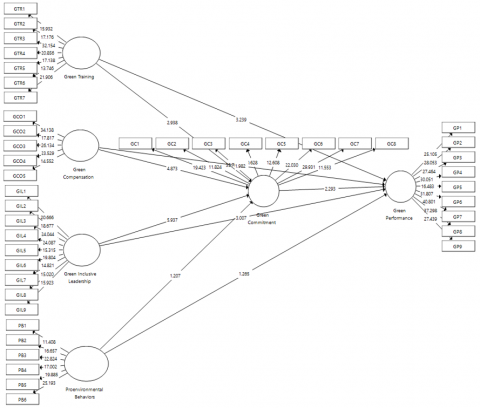
Hypothesis testing results for direct effects (Table 7) show that most of the influence paths in this model are statistically significant. GTR (H1), GCO (H2), and GIL (H3) are proven to have a positive and significant effect on GC, with p values < 0.05 and t values > 1.96. However, PB (H4) has no significant effect on GC (p = 0.228), so the hypothesis is rejected. Furthermore, GTR (H5), GCO (H6), GIL (H7), and GC (H9) have a significant direct influence on GP, as indicated by the p-value <0.05. In contrast, PB (H8) again showed no significant influence on GP (p = 0.206), so this hypothesis was also rejected. Thus, these results confirm the important role of training, compensation, inclusive leadership, and GC in improving environmental performance in the hospitality industry.
Table 7. Path coefficients direct effects test
|
|
$\beta$ |
STDEV |
T Statistics |
P Values |
|
GTR → GC (H1) |
0.198 |
0.067 |
2.938 |
0.003 |
|
GCO → GC (H2) |
0.258 |
0.053 |
4.873 |
0.000 |
|
GIL → GC (H3) |
0.386 |
0.065 |
5.937 |
0.000 |
|
PB → GC (H4) |
0.102 |
0.084 |
1.207 |
0.228 |
|
GTR → GP (H5) |
0.254 |
0.078 |
3.239 |
0.001 |
|
GCO → GP (H6) |
0.111 |
0.056 |
1.982 |
0.048 |
|
GIL → GP (H7) |
0.233 |
0.078 |
3.007 |
0.003 |
|
PB → GP (H8) |
0.087 |
0.069 |
1.265 |
0.206 |
|
GC → GP (H9) |
0.195 |
0.085 |
2.293 |
0.022 |
Note. Variable abbreviations: Green Commitment (GC), Green Compensation (GCO), Green Inclusive Leadership (GIL), Green Performance (GP), Green Training (GTR), Pro-environmental Behaviors (PB). The corresponding t-statistics values can be clearly observed in Figure 1.
Figure 1. Inner model of the transformation of environment-Based HR practices
The results of the indirect effect hypothesis test (Table 8) show that not all mediation paths through GC have a significant effect on GP. The GCO → GC → GP (H11) and GIL → GC → GP (H12) pathways proved significant, with p values = 0.038 and 0.032, respectively, and t values > 1.96. This means that GC successfully mediates significantly the influence of the two variables on GP. However, the paths GTR → GC → GP (H10) and PB → GC → GP (H13) are not significant because the p value > 0.05 and t value < 1.96, namely p = 0.070 and 0.283. This indicates that GC has not strongly bridged the influence of GTR and PB on GP. Overall, these results highlight the important role of GC as an effective mediating mechanism especially for green leadership and compensation aspects in improving environmental performance in the hospitality industry.
Table 8. Path coefficients indirect effects-sobel test
|
|
T Statistics |
STDEV |
P Values |
|
GTR → GC → GP (H10) |
1.812 |
0.021 |
0.070 |
|
GCO → GC → GP (H11) |
2.075 |
0.024 |
0.038 |
|
GIL → GC → GP (H12) |
2.140 |
0.035 |
0.032 |
|
PB → GC → GP (H13) |
1.073 |
0.019 |
0.283 |
Note. Variable abbreviations: Green Commitment (GC), Green Compensation (GCO), Green Inclusive Leadership (GIL), Green Performance (GP), Green Training (GTR), Pro-environmental Behaviors (PB).
The results showed that GTR, GCO and GIL have a significant influence on GP, both directly and through GC. This supports the theory and previous research from several experts. GTR is proven to increase one’s knowledge and skills. Employees are increasingly aware and believe in the importance of caring for the environment so that they can increase their commitment to the organization [24], especially in supporting the achievement of sustainable environmental performance as well [25]. Apart from training, GCO also plays a crucial role in increasing GC. Employees who are compensated can contribute and pay attention to environmental aspects [27].
This finding confirms that organizational success in achieving sustainable performance depends not only on technical systems, but also on the strategic role of human resources and leadership. Theoretically, this finding reinforces the Triple Bottom Line [16] which requires a balance between the aspects of profit, people, and planet. When organizations empower their employees through GTR, compensation for environmental contributions, and the proactive role of inclusive leaders who care about the environment, sustainability values should not only be a slogan but also be implemented in real actions.
Environmentally-oriented inclusive leadership practices can also increase GC [12, 29]. This is because leaders can encourage participation and model environmentally friendly behavior and create a conducive work climate [13, 30]. Furthermore, the significant effect of GIL on GC and GP embodies the importance of the values and care approach in leadership. Leaders who adopt ecocentric principles - that nature is not just a resource but an entity worthy of respect - are likely to encourage employees to engage more in environmentally friendly practices. This is in line with deep ecology [14, 15] which teaches the importance of harmonious relations between humans and the environment. In the context of hospitality, this appears in the form of active encouragement to employees to minimize waste, save energy, and maintain the ecosystem around the workplace. GCO also shows a significant influence, both directly on GP and indirectly through GC. This shows that when organizations provide fair rewards for employee contributions to environmental goals, employee loyalty and performance also increase. Compensation becomes a tool to translate the value of ecocentrism into an incentive system that supports sustainability. In line with the Triple Bottom Line view, compensation is not only judged by financial contributions, but also by social and ecological contributions.
Another interesting finding is the significant influence of GTR on GP, although the indirect influence through GC is not proven. This shows that the training provided to employees has equipped them with technical skills in carrying out environmentally friendly practices, but has not fully touched the aspects of values and deep commitment. From the perspective of deep ecology, this reflects that organizations still need to strengthen the spiritual and ethical dimensions of GTR in order to foster ecological attachment, not just technical skills.
In contrast, insignificant results were found in the effect of PB on GC and GP, both directly and indirectly. This finding is quite surprising, as theoretically, individual PB are expected to be the foundation for cultivating a green work culture. However, in practice, these behaviors tend to remain personal and are not yet institutionalized or structurally supported by the organization. This indicates a gap between employees’ ecological awareness and the organizational system—a gap that requires integration through a more comprehensive GHRM framework. From the lens of ecocentrism, the intrinsic value of individual environmental behavior cannot flourish unless ecological consciousness is embedded collectively at the organizational level. In addition, within the context of the hospitality industry in developing countries such as Indonesia, environmental behavior is often constrained by operational pressures, limited resources, and the absence of formal incentives. Without a supportive institutional framework, individual efforts become fragmented and fail to transform into organizational outcomes. This underscores the necessity of embedding planetary values within the “people” and “profit” dimensions of the Triple Bottom Line, ensuring that green behavior is not only encouraged but also rewarded and sustained structurally.
Indeed, comparable findings in the ASEAN hospitality context support and nuance these results. For instance, a Malaysian hotel-industry study found that green HRM practices such as GTR and compensation significantly impacted environmental performance in 3-, 4- and 5-star hotels [73, 74]. Similarly, a Thai hospitality investigation reported barriers to green HRM and green culture adoption that moderated the relationship between leadership, employee behavior, and GP [75]. These regional studies reinforce that while green HRM and leadership are effective levers, contextual constraints and structural enablers vary by region and organizational maturity.
Overall, the results of this study show that an organization’s success in achieving GP is highly dependent on how far it is able to translate sustainability principles and ecocentrism values into the human resource management system. GHRM in this case becomes the main instrument to transform values into practices, and GC becomes an important node that connects values and actions. Therefore, future organizational strategies need to strengthen the value dimensions and systems that support sustainability as a whole, not only at a technical level, but also at an ethical and spiritual level. Even reinforced the finding that having GC can increase organizational sustainability [22].
This study analyzed the effect of GHRM—comprising GTR, GCO, and GIL—along with PB on GP, mediated by GC. The findings demonstrate that GTR, GCO, and GIL significantly enhance GC and GP, both directly and indirectly, thereby confirming the strategic role of GHRM in embedding sustainability values within organizational practices. Conversely, PB were found to have no significant impact, suggesting that individual efforts alone are insufficient without structural support and a supportive organizational culture. These results reaffirm the relevance of Ecocentrism Theory and the Triple Bottom Line in hospitality management, highlighting that consistent integration of sustainability values into HR policies is essential for strengthening employee commitment and improving environmental performance.
Despite these contributions, the study has limitations that warrant consideration. The cross-sectional design restricts the ability to capture the dynamic nature of the relationships over time. Furthermore, the research scope was limited to the hotel industry in Palembang, which may constrain the generalizability of findings across different sectors and regions. Additionally, other contextual drivers—such as organizational culture, regulatory pressures, or digital transformation—were not examined. Future research should therefore employ longitudinal or mixed-method approaches, extend the scope to diverse industries and geographical contexts, and integrate additional variables such as environmental leadership or digital green HRM. Such efforts will provide a deeper and more comprehensive understanding of how GHRM can sustainably enhance organizational GP.
The authors would like to thank the Directorate of Research, Technology, and Community Service (DRTPM) of the Ministry of Education, Culture, Research, and Technology of the Republic of Indonesia for funding through the Doctoral Dissertation Research scheme for Fiscal Year 2025. This research is supported by master contract Number 126/C3/DT.05.00/PL/2025 dated May 28, 2025, and derivative contract Number 0498.01/LL5-INT/AL.04/2025 dated June 4, 2025. Gratitude is also expressed to DPPM UII for facility support and to the reviewers for constructive input contributions.
|
Abbreviation |
|
|
GP |
Green Performance |
|
GC |
Green Commitment |
|
PB |
Pro-environmental Behaviors |
|
GIL |
Green Inclusive Leadership |
|
GTR |
Green Training |
|
GCO |
Green Compensation |
[1] Azam, M., Alam, M.M., Hafeez, M.H. (2018). Effect of tourism on environmental pollution: Further evidence from Malaysia, Singapore and Thailand. Journal of Cleaner Production, 190: 330-338. https://doi.org/10.1016/j.jclepro.2018.04.168
[2] Arimany-Serrat, N., Gomez-Guillen, J.J. (2023). Sustainability and environmental impact of the tourism sector: Analysis applied to swimming pools in the hotel industry on the Costa Brava. Environmental Processes, 10: 55. https://doi.org/10.1007/s40710-023-00665-4
[3] Makoondlall-Chadee, T., Bokhoree, C. (2024). Environmental sustainability in hotels: A review of the relevance and contributions of assessment tools and techniques. Administrative Sciences, 14(12): 320. https://doi.org/10.3390/admsci14120320
[4] Seroka-Stolka, O. (2023). Enhancing environmental sustainability: Stakeholder pressure and corporate CO2-related performance—An examination of the mediating and moderating effects of corporate decarbonization strategies. Sustainability, 15(19): 14257. https://doi.org/10.3390/su151914257
[5] Yunus, S., Elijido-Ten, E.O., Abhayawansa, S. (2020). Impact of stakeholder pressure on the adoption of carbon management strategies: Evidence from Australia. Sustainability Accounting, Management and Policy Journal, 11(7): 1189-1212. https://doi.org/10.1108/SAMPJ-04-2019-0135
[6] Alkotdriyah, P.P. (2024). Green hotel implementation in Indonesia: A focus on Java and Bali. NHI Hospitality International Journal, 2(1): 1-7. https://doi.org/10.34013/nhij.v2i1.1384
[7] Jaya, L.A., Rahmanita, M. (2024). Implementation of green hotels in supporting sustainable tourism in the hospitality industry. European Modern Studies Journal, 8(6): 272-280. https://doi.org/10.59573/emsj.8(6).2024.20
[8] Muisyo, P.K., Qin, S. (2021). Enhancing the FIRM’S green performance through green HRM: The moderating role of green innovation culture. Journal of Cleaner Production, 289: 125720. https://doi.org/10.1016/j.jclepro.2020.125720
[9] Ercantan, O., Eyupoglu, S. (2022). How do green human resource management practices encourage employees to engage in green behavior? Perceptions of university students as prospective employees. Sustainability, 14(3): 1718. https://doi.org/10.3390/su14031718
[10] Alreahi, M., Bujdosó, Z., Kabil, M., Akaak, A., Benkó, K.F., Setioningtyas, W.P., Dávid, L.D. (2023). Green human resources management in the hotel industry: A systematic review. Sustainability, 15(1): 99. https://doi.org/10.3390/su15010099
[11] Benevene, P., Buonomo, I. (2020). Green human resource management: An evidence-based systematic literature review. Sustainability, 12(15): 5974. https://doi.org/10.3390/su12155974
[12] Abdou, A.H., Al Abdulathim, M.A., Hasan, N.R.H., Salah, M.H.A., Ali, H.S.A.M., Kamel, N.J. (2023). From green inclusive leadership to green organizational citizenship: Exploring the mediating role of green work engagement and green organizational identification in the hotel industry context. Sustainability, 15(20): 14979. https://doi.org/10.3390/su152014979
[13] Boutmaghzoute, H., Jebli, F., Aboramadan, M., Cabral, C. (2025). Effect of green inclusive leadership on employees’ CSR performance: A serial mediation analysis. Journal of Global Responsibility, 16(4): 815-831. https://doi.org/10.1108/JGR-04-2024-0078
[14] Naess, A. (1973). The shallow and the deep, long-range ecology movement. A summary. Inquiry, 16(1-4): 95-100. https://doi.org/10.1080/00201747308601682
[15] Devall, B. (1980). The deep ecology movement. Natural Resources Journal, 20(2): 299.
[16] Elkington, J. (2007). Partnerships from cannibals with forks: The triple bottom line of 21st-century business. Environmental Quality Management, 8(1): 37-51. https://doi.org/10.1002/tqem.3310080106
[17] Tobing, R., Nugroho, D.S. (2024). Green human resource management on sustainable performance: The mediating role of digital innovation. Iqtishaduna, 13(2): 313-332. https://doi.org/10.46367/iqtishaduna.v13i2.2150
[18] Aditya, I.P.Y.C., Hidayat, A.M., Widodo, A., Rubiyanti, N. (2025). The effect of green human resource management on environmental performance mediated by organizational commitment: A study on hotels in Bali. Formosa Journal of Applied Sciences, 4(5): 1445-1458.
[19] Yunaningsih, A., Johan, A., Rahmayanti, R. (2024). Fostering innovation through green HRM: The mediating role of organizational support and green commitment. Asian Management and Business Review, 4(2): 293-307. https://doi.org/10.20885/AMBR.vol4.iss2.art8
[20] Mochklas, M., Situngkir, T.L., Abidin, Z., Judijanto, L., Susilawati, M., Purnomo, H. (2024). The impact of green human capital on hotel performance: The mediating role of innovation activity in Yogyakarta, Indonesia. Journal of Logistics, Informatics and Service Science, 11(10): 383-395. https://doi.org/10.33168/JLISS.2024.1022
[21] Li, J., Gao, Z.Y., Li, X.L., Xing, B.Y. (2025). Effect of green organizational culture on employee green organizational commitment: A moderated—mediated model of employee green self-efficacy and organizational identity. Discover Sustainability, 6: 223. https://doi.org/10.1007/s43621-025-00875-w
[22] Akbaba, M., Kara, E., Özel, G., Yakut, E., Avcı, M., Çetinel, M.H. (2025). Green organisational identity and employees’ green behaviour: The mediating role of environmental commitment in tourism enterprises. Sustainability, 17(7): 2837. https://doi.org/10.3390/su17072837
[23] Sumiati, Yasri, Helia, S., Andria, Y., Afriyeni, A., Aryadi, D., Hasymi, E. (2024). The impact of green human resource management on the economic and environmental performance of small and medium enterprises (SMEs) in West Sumatra, Indonesia. International Journal of Sustainable Development and Planning, 19(8): 3225-3234. https://doi.org/10.18280/ijsdp.190834
[24] Bataineh, M.A.J., Ghasemi, M., Nejad, M.G. (2023). The role of green training in the ministry of education’s corporate environmental performance: A mediation analysis of organizational citizenship behavior towards the environment and moderation role of perceived organizational support. Sustainability, 15(10): 8398. https://doi.org/10.3390/su15108398
[25] Pham, N.T., Tučková, Z., Phan, Q.P.T. (2019). Greening human resource management and employee commitment towards the environment: An interaction model. Journal of Business Economics and Management, 20(3): 446-465. https://doi.org/10.3846/jbem.2019.9659
[26] Hadi, H.K., Kautsar, A., Fazlurrahman, H., Rahman, M.F.W. (2023). Green HRM: The link between environmental and employee performance, moderated by green work climate perception. International Journal of Sustainable Development and Planning, 18(5): 1573-1580. https://doi.org/10.18280/ijsdp.180528
[27] Yin, Y.S., Wang, Y., Lu, Y. (2024). How to design green compensation to promote managers’ pro-environmental behavior? A goal-framing perspective. Journal of Business Ethics, 197: 341-353. https://doi.org/10.1007/s10551-024-05762-4
[28] Yang, Z.X., He, L.L., Huang, T.J. (2024). Powering pro-environment behavior: The impact of unlocking reward strategy on pro-environmental behavior. Sustainability, 16(21): 9561. https://doi.org/10.3390/su16219561
[29] Yin, C.Q., Tan, J., Deng, Y. (2025). Corporate social responsibility motive attributions and green behaviors: Moderating effect of green intrinsic motivation. Sustainability, 17(4): 1651. https://doi.org/10.3390/su17041651
[30] Thabet, W.M., Badar, K., Aboramadan, M., Abualigah, A. (2022). Does green inclusive leadership promote hospitality employees’ pro-environmental behaviors? The mediating role of climate for green initiative. The Service Industries Journal, 43(1-2): 43-63. https://doi.org/10.1080/02642069.2022.2120982
[31] Omarova, L., Jo, S.J. (2022). Employee pro-environmental behavior: The impact of environmental transformational leadership and GHRM. Sustainability, 14(4): 2046. https://doi.org/10.3390/su14042046
[32] Perez, J.A.E., Ejaz, F., Ejaz, S. (2023). Green transformational leadership, GHRM, and proenvironmental behavior: An effectual drive to environmental performances of small- and medium-sized enterprises. Sustainability, 15(5): 4537. https://doi.org/10.3390/su15054537
[33] Uslu, F., Keles, A., Aytekin, A., Yayla, O., Keles, H., Ergun, G.S., Tarinc, A. (2023). Effect of green human resource management on green psychological climate and environmental green behavior of hotel employees: The moderator roles of environmental sensitivity and altruism. Sustainability, 15(7): 6017. https://doi.org/10.3390/su15076017
[34] Farrukh, M., Ansari, N., Raza, A., Wu, Y.H., Wang, H. (2022). Fostering employee’s pro-environmental behavior through green transformational leadership, green human resource management and environmental knowledge. Technological Forecasting and Social Change, 179: 121643. https://doi.org/10.1016/j.techfore.2022.121643
[35] Sun, H.P., Bahizire, G.M., Pea-Assounga, J.B.B., Chen, T.T. (2024). Enhancing employee green performance through green training: The mediating influence of organizational green culture and work ethic in the mining sector. Journal of Cleaner Production, 449: 141105. https://doi.org/10.1016/j.jclepro.2024.141105
[36] Yoo, D.Y. (2024). Eco-leadership in action: Integrating green HRM and the new ecological paradigm to foster organizational commitment and environmental citizenship in the hospitality industry. Sustainability, 16(20): 9044. https://doi.org/10.3390/su16209044
[37] Al-Romeedy, B.S., Alharethi, T. (2025). Leveraging green human resource management for sustainable tourism and hospitality: A mediation model for enhancing green reputation. Discover Sustainability, 6: 67. https://doi.org/10.1007/s43621-025-00829-2
[38] Jo, H.J., Lee, S.G., Kim, K.T. (2019). The effects of organizational virtues of hotel industry on innovation behavior of employees: Focused on examining mediation effect of affective organizational commitment. Journal of Tourism and Leisure Research, 31(11): 195-213. https://doi.org/10.31336/jtlr.2019.11.31.11.195
[39] Pham, N.T., Jabbour, C.J.C., Vo-Thanh, T., Huynh, T.L.D., Santos, C. (2023). Greening hotels: Does motivating hotel employees promote in-role green performance? The role of culture. Journal of Sustainable Tourism, 31(4): 951-970. https://doi.org/10.1080/09669582.2020.1863972
[40] Patwary, A.K., Yusof, M.F.M., Simpong, D.B., Ghaffar, S.F.A., Rahman, M.K. (2023). Examining proactive pro-environmental behaviour through green inclusive leadership and green human resource management: An empirical investigation among Malaysian hotel employees. Journal of Hospitality and Tourism Insights, 6(5): 2012-2029. https://doi.org/10.1108/JHTI-06-2022-0213
[41] Asghar, M., Ullah, I., Bangash, A.H. (2025). Green inclusive leadership and green creativity in the manufacturing industry: Do green human capital and employee voice matter? International Journal of Innovation Science, 17(2): 419-437. https://doi.org/10.1108/IJIS-04-2023-0087
[42] Jang, Y.J. (2024). Charting a course for sustainable hospitality by exploring leadership theories and their implications. Sustainability, 16(8): 3203. https://doi.org/10.3390/su16083203
[43] Kim, W.G., McGinley, S., Choi, H.M., Agmapisarn, C. (2020). Hotels’ environmental leadership and employees’ organizational citizenship behavior. International Journal of Hospitality Management, 87: 102375. https://doi.org/10.1016/j.ijhm.2019.102375
[44] Abraham, K.T. (2024). Responsible leadership and triple bottom line performance: Imperatives for corporate sustainability. Journal of Global Responsibility, 15(4): 485-500. https://doi.org/10.1108/JGR-06-2023-0111
[45] Fatoki, O. (2019). Hotel employees’ pro-environmental behaviour: Effect of leadership behaviour, institutional support and workplace spirituality. Sustainability, 11(15): 4135. https://doi.org/10.3390/su11154135
[46] Adeel, H.B., Sabir, R.I., Shahnawaz, M., Zafran, M. (2024). Adoption of environmental technologies in the hotel industry: Development of sustainable intelligence and pro-environmental behavior. Discover Sustainability, 5: 79. https://doi.org/10.1007/s43621-024-00270-x
[47] Li, L., Patwary, A.K., Mengxiang, L. (2024). Measuring green performance in hotel industry through management environmental concern: Mediated by green product and process innovation. Sage Open, 14(4). https://doi.org/10.1177/21582440241255278
[48] Kim, J.Y., Hlee, S., Joun, Y. (2016). Green practices of the hotel industry: Analysis through the windows of smart tourism system. International Journal of Information Management, 36(6): 1340-1349. https://doi.org/10.1016/j.ijinfomgt.2016.05.001
[49] Duric, Z., Topler, J.P. (2021). The role of performance and environmental sustainability indicators in hotel competitiveness. Sustainability, 13(12): 6574. https://doi.org/10.3390/su13126574
[50] Xin, C., Wang, Y.S. (2023). Green intellectual capital and green competitive advantage in hotels: The role of environmental product innovation and green transformational leadership. Journal of Hospitality and Tourism Management, 57: 148-157. https://doi.org/10.1016/j.jhtm.2023.10.001
[51] Cabral, C., Jabbour, C.J.C. (2020). Understanding the human side of green hospitality management. International Journal of Hospitality Management, 88: 102389. https://doi.org/10.1016/j.ijhm.2019.102389
[52] Ahmed, M., Guo, Q., Qureshi, M.A., Raza, S.A., Khan, K.A., Salam, J. (2021). Do green HR practices enhance green motivation and proactive environmental management maturity in hotel industry? International Journal of Hospitality Management, 94: 102852. https://doi.org/10.1016/j.ijhm.2020.102852
[53] Mustafa, K., Hossain, M.B., Ahmad, F., Ejaz, F., Khan, H.G.A., Dunay, A. (2023). Green human resource management practices to accomplish green competitive advantage: A moderated mediation model. Heliyon, 9(11): e21830. https://doi.org/10.1016/j.heliyon.2023.e21830
[54] Hameed, R., Rehaman, N., Shoaib, M., Ibtsam, M. (2023). Promoting pro-environmental behavior among one belt one road firms’ employees through the lens of green human resource practices. WORK: A Journal of Prevention, Assessment & Rehabilitation, 76(4): 1373-1384. https://doi.org/10.3233/WOR-211442
[55] Afridi, S.A., Shahjehan, A., Zaheer, S., Khan, W., Gohar, A. (2023). Bridging generative leadership and green creativity: Unpacking the role of psychological green climate and green commitment in the hospitality industry. Sage Open, 13(3). https://doi.org/10.1177/21582440231185759
[56] Mankgele, K., Fatoki, O. (2024). Green empowering leadership and organisational citizenship behaviour toward the environment of employees in hospitality firms in South Africa. International Journal of Business Ecosystem & Strategy, 6(5): 57-67. https://doi.org/10.36096/ijbes.v6i5.588
[57] Wang, Y., Ummar, R., Qureshi, T.M., Ul Haq, J., Bonn, M.A. (2025). Employee sustainability: How green practices drive employee well-being and citizenship behavior. Sustainability, 17(3): 936. https://doi.org/10.3390/su17030936
[58] Abualigah, A., Koburtay, T., Bourini, I., Badar, K., Gerged, A.M. (2023). Towards sustainable development in the hospitality sector: Does green human resource management stimulate green creativity? A moderated mediation model. Business Strategy and the Environment, 32(6): 3217-3232. https://doi.org/10.1002/bse.3296
[59] Alipour, H., Safaeimanesh, F., Soosan, A. (2019). Investigating sustainable practices in hotel industry-from employees’ perspective: Evidence from a Mediterranean Island. Sustainability, 11(23): 6556. https://doi.org/10.3390/su11236556
[60] Jabbour, C.J.C. (2011). How green are HRM practices, organizational culture, learning and teamwork? A Brazilian study. Industrial and Commercial Training, 43(2): 98-105. https://doi.org/10.1108/00197851111108926
[61] Renwick, D.W.S., Redman, T., Maguire, S. (2012). Green human resource management: A Review and research agenda. International Journal of Management Reviews, 15(1): 1-14. https://doi.org/10.1111/j.1468-2370.2011.00328.x
[62] Carmeli, A., Reiter-Palmon, R., Ziv, E. (2010). Inclusive leadership and employee involvement in creative tasks in the workplace: The mediating role of psychological safety. Creativity Research Journal, 22(3): 250-260. https://doi.org/10.1080/10400419.2010.504654
[63] Aboramadan, M., Crawford, J., Turkmenoglu, M.A., Farao, C. (2022). Green inclusive leadership and employee green behaviors in the hotel industry: Does perceived green organizational support matter? International Journal of Hospitality Management, 107: 103330. https://doi.org/10.1016/j.ijhm.2022.103330
[64] Badar, K., Siddiquei, A.N. (2025). Unleashing green innovation: Navigating the path with green inclusive leadership, green knowledge management and internal CSR communication. Journal of Business & Industrial Marketing, 40(2): 298-312. https://doi.org/10.1108/JBIM-12-2023-0723
[65] Frese, M., Fay, D., Hilburger, T., Leng, K., Tag, A. (2011). The concept of personal initiative: Operationalization, reliability and validity in two German samples. Journal of Occupational and Organizational Psychology, 70(2): 139-161. https://doi.org/10.1111/j.2044-8325.1997.tb00639.x
[66] Trivedi, R.H., Patel, J.D., Savalia, J.R. (2015). Pro-environmental behaviour, locus of control and willingness to pay for environmental friendly products. Marketing Intelligence & Planning, 33(1): 67-89. https://doi.org/10.1108/MIP-03-2012-0028
[67] Raineri, N., Paillé, P. (2016). Linking corporate policy and supervisory support with environmental citizenship behaviors: The role of employee environmental beliefs and commitment. Journal of Business Ethics, 137: 129-148. https://doi.org/10.1007/s10551-015-2548-x
[68] Hair, J.F., Ringle, C.M., Sarstedt, M. (2011). PLS-SEM: Indeed a silver bullet. Journal of Marketing Theory and Practice, 19(2): 139-152. https://doi.org/10.2753/mtp1069-6679190202
[69] Fornell, C., Larcker, D.F. (1981). Evaluating structural equation models with unobservable variables and measurement error. Journal of Marketing Research, 18(1): 39. https://doi.org/10.2307/3151312
[70] Henseler, J., Hubona, G., Ray, P.A. (2016). Using PLS path modeling in new technology research: Updated guidelines. Industrial Management & Data Systems, 116(1): 2-20. https://doi.org/10.1108/imds-09-2015-0382
[71] Kock, N. (2015). Common method bias in PLS-SEM. International Journal of e-Collaboration, 11(4): 1-10. https://doi.org/10.4018/ijec.2015100101
[72] Hair, J., Page, M., Brunsveld, N. (2019). Essentials of Business Research Methods. Routledge. https://doi.org/10.4324/9780429203374
[73] Nisar, Q.A., Hussain, K., Sohail, S., Yaghmour, S., Nasir, N., Haider, S. (2023). Green HRM and sustainable performance in Malaysian hotels: The role of employees’ pro-environmental attitudes and green behaviors. Tourism: An International Interdisciplinary Journal, 71(2): 367-387. https://doi.org/10.37741/t.71.2.9
[74] Yusoff, Y.M., Nejati, M., Kee, D.M.H., Amran, A. (2018). Linking green human resource management practices to environmental performance in hotel industry. Global Business Review, 21(3): 663-680. https://doi.org/10.1177/0972150918779294
[75] Loedphacharakamon, N., Worakittikul, W. (2025). TQM and sustainable hospitality: Unpacking the link between green culture, employee behavior, and hotel performance. Cogent Business & Management, 12(1). https://doi.org/10.1080/23311975.2025.2499948