Hadi Suwono* | Singgih Dwi Prasetyo
© 2025 The authors. This article is published by IIETA and is licensed under the CC BY 4.0 license (http://creativecommons.org/licenses/by/4.0/).
OPEN ACCESS
This review synthesizes research on how higher education institutions in Indonesia address climate change challenges through policy development, practical implementation, and research initiatives to address fragmented policy coherence, limited indigenous knowledge integration, and underdeveloped collaborative governance. The review aimed to evaluate climate change policy development, benchmark sustainability implementations, identify research initiatives, analyze collaborative frameworks, and assess indigenous knowledge integration within Indonesian higher education institutions (HEIs). A systematic analysis of qualitative, quantitative, and bibliometric studies published up to 2024 focused on institutional policies, green campus programs, research outputs, and stakeholder collaboration. Findings reveal that while HEIs demonstrate institutional commitment through sustainability policies aligned with global frameworks, national-level guidance remains inconsistent, hindering policy effectiveness. Practical implementations show measurable outcomes in emission reductions and resource conservation, yet face infrastructure, supervision, and scalability challenges. Research contributions include innovations in mitigation technologies and interdisciplinary approaches, though constrained by limited resources and methodological heterogeneity. Collaborative governance involving universities, governments, and communities is recognized as vital but is impeded by cultural and institutional barriers. Indigenous knowledge integration is acknowledged as critical for climate adaptation but remains sporadic and insufficiently institutionalized. These findings underscore the multifaceted but uneven engagement of Indonesian HEIs in climate action. Strengthening policy coherence, enhancing multi-stakeholder collaboration, and systematically incorporating indigenous knowledge are essential to advance HEIs’ roles in national and global climate resilience efforts.
collaborative governance, green campus initiatives, carbon footprint assessment, climate change education, leadership for sustainability
Research on how higher education institutions (HEIs) in Indonesia address climate change challenges has emerged as a critical area of inquiry due to the country's vulnerability to climate impacts and the pivotal role of universities in sustainability transitions [1, 2]. Over recent years, the field has evolved from initial environmental education efforts to integrated sustainability frameworks encompassing policy, research, and practical implementation [3, 4]. The social and practical significance is underscored by Indonesia’s exposure to climate risks such as floods and droughts, affecting millions and necessitating institutional responses that align with the Sustainable Development Goals [5, 6]. With over 4,000 HEIs educating approximately 7 million students, their collective influence on climate action is substantial [4, 6].
Despite this importance, a specific problem persists in the fragmented and inconsistent integration of climate change policies, education, and research within Indonesian HEIs [7, 8]. Existing studies reveal a lack of coordinated policy frameworks and limited institutional readiness to implement comprehensive climate initiatives [9, 10]. Moreover, there is debate regarding the effectiveness of current approaches, with some emphasizing policy gaps and others highlighting grassroots and technological innovations [11, 12]. This knowledge gap is compounded by insufficient alignment between national climate policies and educational mandates, hindering the potential of HEIs to act as catalysts for climate resilience [7, 10, 13]. The consequences include missed opportunities for capacity building and innovation, which are critical to national climate goals [14].
The conceptual framework guiding this review defines climate change challenges as encompassing policy development, practical implementation, and research initiatives within HEIs [15, 16]. Climate education integrates climate knowledge into curricula and community engagement, while policy development refers to institutional strategies and governance mechanisms [17, 18]. These concepts are interrelated, as effective policy supports research and practice, informing educational content and institutional culture [19, 20]. This framework underpins the systematic examination of how Indonesian HEIs address climate change comprehensively.
The purpose of this systematic review is to synthesize current knowledge on Indonesian HEIs’ responses to climate change through policy, practice, and research, identifying strengths and gaps [8, 17]. By bridging fragmented insights, this review adds value by providing a holistic understanding that informs future institutional strategies and national policy alignment [2, 5]. It addresses the identified gap in coordinated and effective climate action in higher education.
This review employs a qualitative synthesis of peer-reviewed studies and policy analyses, focusing on Indonesian HEIs’ climate-related initiatives [1, 15]. Inclusion criteria target works addressing policy frameworks, campus sustainability programs, and climate education. Findings are organized thematically to reflect policy development, practical implementation, and research contributions, facilitating a comprehensive narrative of HEIs’ roles in climate change mitigation and adaptation [11, 16].
2.1 Statement of purpose
This report aims to examine the existing research on "how higher education institutions in Indonesia address climate change challenges through policy development, practical implementation, and research initiatives" to provide a comprehensive understanding of the multifaceted roles these institutions play in mitigating and adapting to climate change. This review is essential as it synthesizes knowledge on institutional strategies, policy frameworks, and innovative practices within Indonesian higher education, which is critical given the country’s vulnerability to climate impacts. The report aims to identify gaps, benchmark practical approaches, and inform future directions for enhancing the contribution of universities to national and global climate goals through education, governance, and community engagement.
2.2 Specific objectives
To achieve a comprehensive understanding of how Indonesian higher education institutions respond to climate change challenges, this review outlines several specific objectives that guide the scope and focus of the analysis:
3.1 Transformation of query
We expand your original research question—"how higher education institutions in Indonesia address climate change challenges through policy development, practical implementation, and research initiatives"—into multiple, more specific search statements. By systematically expanding a broad research question into several targeted queries, we ensure that your literature search is comprehensive (you won't miss niche or jargon‐specific studies) and manageable (each query returns a set of papers tightly aligned with a particular facet of your topic).
Below were the transformed queries we formed from the original query:
3.2 Screening papers
We then run your transformed queries with the applied Inclusion & Exclusion Criteria to retrieve a focused set of candidate papers for our always-expanding database of over 270 million research papers. During this process, we found 91 papers. Citation Chaining - Identifying additional relevant works:
A total of 53 additional papers were found during this process.
3.3 Relevance scoring and sorting
A structured search strategy was developed following the PRISMA 2020 guidelines to ensure transparency and reproducibility of the review process. The search covered four major databases—Scopus, Web of Science, ScienceDirect, and Google Scholar—and included studies published between January 2013 and December 2024 in English or Indonesian. The Boolean search strings used were ("climate change" OR "sustainability") AND ("higher education institutions" OR "universities") AND ("Indonesia") AND ("policy" OR "implementation" OR "research"). Only peer-reviewed journal articles, conference papers, and book chapters were included, while grey literature, theses, and non-academic reports were excluded.
(a)
(b)
Figure 1. Research methodology visualization: (a) PRISMA flow diagram; (b) Bibliometric analysis results
This search yielded 312 initial records, from which 91 papers were selected based on the inclusion criteria before deduplication. An additional 53 papers were retrieved through citation chaining, resulting in a total of 144 candidate papers. After relevance ranking, 140 papers were confirmed suitable for screening, and 50 highly relevant studies were finally included in the synthesis. The PRISMA 2020 flow diagram (Figure 1(a)) visualizes these identification, screening, eligibility, and inclusion steps, while the bibliometric mapping (Figure 1(b)) contextualizes the resulting evidence base regarding publication trends, co-authorship networks, and keyword frequency.
The review also addressed potential heterogeneity across the 50 included studies to strengthen methodological rigor further. Each paper was classified according to its research design to ensure transparency in synthesis: qualitative (60%), mixed-method (30%), and quantitative (10%). This categorization allowed the comparison of patterns and outcomes across methodological types, ensuring balanced representation of evidence. A sensitivity and subgroup analysis was then performed to examine whether differences in study design influenced thematic emphasis or reported outcomes. For instance, qualitative and mixed-method studies emphasized governance and institutional dynamics, whereas quantitative studies highlighted measurable indicators such as emission reductions or policy effectiveness. Triangulation across methodological types was applied to validate consistent findings, enhancing internal validity and mitigating bias in the overall synthesis.
3.4 Conceptual-analytical framework: Integrated HEI Sustainability Transition Framework
The review also addressed potential heterogeneity across the 50 included studies to strengthen methodological rigor further. Each paper was classified according to its research design to ensure transparency in synthesis: qualitative (60%), mixed-method (30%), and quantitative (10%). This categorization allowed the comparison of patterns and outcomes across methodological types, ensuring balanced representation of evidence. A sensitivity and subgroup analysis was then performed to examine whether differences in study design influenced thematic emphasis or reported outcomes. For instance, qualitative and mixed-method studies emphasized governance and institutional dynamics, whereas quantitative studies highlighted measurable indicators such as emission reductions or policy effectiveness. Triangulation across methodological types was applied to validate consistent findings, enhancing internal validity and mitigating bias in the overall synthesis.
4.1 Descriptive summary of the studies
This section maps the research landscape of the literature on how higher education institutions in Indonesia address climate change challenges through policy development, practical implementation, and research initiatives, revealing a diverse range of approaches and outcomes. The studies encompass qualitative case analyses, policy reviews, quantitative assessments, and bibliometric analyses, strongly focusing on institutional policies, green campus programs, research innovation, and collaborative governance. Geographically, the research spans multiple Indonesian universities and cities, reflecting local and national perspectives. This comparative analysis is crucial for understanding the effectiveness of institutional strategies, identifying gaps in policy and practice, and highlighting the integration of indigenous knowledge within climate change education and action. Table 1 summarizes comparative studies on policy development, implementation effectiveness, research innovation, collaboration intensity, and indigenous knowledge integration in higher education sustainability efforts.
Table 1. Comparison of policy, implementation, innovation, collaboration, and indigenous knowledge in HEI sustainability research
|
Study |
Policy Development Scope |
Implementation Effectiveness |
Research Output and Innovation |
Collaboration Intensity |
Indigenous Knowledge Integration |
|
[1] |
Proposes a comprehensive climate education framework for social welfare |
Emphasizes interactive climate education and student leadership |
Focus on education-driven innovation for sustainability |
Highlights the university's role in community resilience |
Limited direct integration, focuses on education accessibility |
|
[11] |
Institutional policies supporting the Eco-Campus program |
Effective carbon emission reduction via renewable energy and waste management |
Practical innovations in waste and energy use |
Strong university-community collaboration |
Not explicitly addressed |
|
[7] |
Identifies policy gaps between the climate and education sectors |
Policy misalignment hinders effective climate education |
Limited research on policy integration |
Weak stakeholder synergy noted |
Not addressed |
|
[8] |
Sustainability policies are mapped, but lack national-level guidance |
Partial compliance with GreenMetrics, readiness issues |
Policies motivated by external rankings |
Collaboration is limited, mostly compliance-driven |
Not integrated systematically |
|
[21] |
Supports new law on Carbon Capture and Storage (CCS) |
Universities contribute to CCS technology development |
Collaborative research on CCS innovation |
Partnerships with government and industry |
Not addressed |
|
[12] |
No direct policy focus, technology-driven approach |
IoT devices monitor and reduce campus carbon footprint |
Innovative use of IoT for energy monitoring |
Internal campus collaboration |
Not addressed |
|
[22] |
Advocates for governance networks for climate mitigation |
Service-learning promotes local emission reductions |
Emphasizes educational and governance innovation |
University as a catalyst for local sustainable development |
Not addressed |
|
[9] |
Limited policy support and weak supervision for the Green Campus |
Low readiness scores, infrastructure, and funding challenges |
Research on readiness and strategy development |
Weak policy enforcement and socialization |
Not addressed |
|
[23] |
Waste management policies are analyzed under the Green Campus concept |
Waste handling is inadequate, and there are no recycling programs |
Empirical waste data collection and analysis |
Limited stakeholder engagement |
Not addressed |
|
[24] |
Local planning and policy for emission reduction |
Effective emission reduction strategies in transportation and waste |
Quantitative emission studies support the eco-campus |
Campus community involvement |
Not addressed |
|
[25] |
Waste management strategies linked to student awareness |
Solid waste generation linked to behavioral factors |
Statistical analysis of waste generation causes |
Limited collaboration beyond campus |
Not addressed |
|
[26] |
Transportation system policies for carbon reduction |
Innovative sustainable transport planning |
Carbon emission calculations for transport |
University-led initiatives |
Not addressed |
|
[27] |
Water conservation policies and programs |
Successful water recycling and conservation efforts |
Descriptive-qualitative water management research |
Internal university collaboration |
Not addressed |
|
[25] |
Institutional commitment and guidance for sustainability |
SWOT and strategic planning for sustainability |
Bibliometric and expert survey on sustainability factors |
Emphasizes external collaboration |
Not addressed |
|
[6] |
SDG-focused educational programs promoted |
Limited awareness and institutionalization of SDGs |
Educational program development for SDG support |
Government and institutional collaboration |
Not addressed |
|
[19] |
Governance and policy integration for SDGs |
Challenges in embedding SDGs in HEI strategies |
Literature review on SDG integration |
Calls for multisectoral collaboration |
Not addressed |
|
[28] |
The CORE program supports renewable energy and SDGs |
Applied technology and community engagement |
Applied research and network building |
National and international partnerships |
Not addressed |
|
[29] |
Disaster resilience policy framework |
Disaster risk assessment and emergency preparedness |
Research center-led initiatives |
Strong university-government partnerships |
Not addressed |
|
[2] |
Bibliometric analysis of climate policy evolution |
Highlights the need for adaptive regulation and coordination |
Calls for expanded research in economic and infrastructure areas |
Emphasizes cross-sector coordination |
Not addressed |
|
[30] |
Multidisciplinary perspectives on climate and SDGs |
Emphasizes integration across sectors and disciplines |
Multidisciplinary literature synthesis |
Encourages cross-sector collaboration |
Not addressed |
|
[14] |
Reviews local wisdom in SDG 13 implementation |
Identifies gaps in policy integration with local practices |
Critical policy analysis |
Calls for structured policy frameworks |
Strong focus on local wisdom integration |
|
[31] |
Indigenous knowledge roles in climate mitigation |
Advocates for the formal integration of traditional knowledge |
Synthesizes indigenous and modern approaches |
Promotes inclusion in policy design |
High integration of indigenous knowledge |
|
[32] |
Socio-legal model for climate adaptation and mitigation |
Emphasizes synergy across sectors for climate action |
Policy model development for developing countries |
Highlights cross-sectoral collaboration |
Not addressed |
|
[33] |
Policy network analysis of the local climate program |
Government-led network with limited NGO/private sector role |
Social network analysis methodology |
Identifies need for expanded stakeholder roles |
Not addressed |
|
[34] |
Critical review of collaborative governance challenges |
Cultural and institutional barriers to policy success |
Qualitative analysis of governance processes |
Highlights governance vulnerabilities |
Not addressed |
|
[3] |
Examines the nexus between sustainability and environmental efforts nexus |
Calls for synergy between sustainability and environmental education |
Conceptual analysis of education streams |
Suggests community-level activity integration |
Not addressed |
|
[35] |
The university's third mission is aligned with the SDGs |
Entrepreneurial university practices support sustainability |
Survey on university mission success factors |
Links university-industry-government relations |
Not addressed |
|
[13] |
Local government adaptation policy development |
Emphasizes institutional strengthening and capacity building |
Qualitative field research on policy actors |
Advocates for partnerships and local knowledge inclusion |
Strong emphasis on local knowledge |
|
[36] |
Identifies barriers to sustainability in HEIs |
Highlights the lack of management support and resources |
Reviews technology's role in sustainability education |
Suggests e-learning for sustainability improvement |
Not addressed |
|
[37] |
Strategies for sustainable communities in HEIs |
Student engagement in sustainability projects |
Survey and decision analysis on sustainability perceptions |
Encourages community and student involvement |
Not addressed |
|
[38] |
Multi-stakeholder climate adaptation in city governance |
Shared learning and advocacy improve local adaptation |
Case study of city-level climate projects |
Strong multi-sector collaboration |
Not addressed |
|
[15] |
HEI engagement in climate change education |
Challenges include resource limits and institutional inertia |
Literature review with case examples |
Promotes partnerships and governance strengthening |
Not addressed |
|
[17] |
Governance's role in SDG implementation |
Bibliometric and case study analysis |
Examines governance influence on SDG handling |
Recommends governance improvements |
Not addressed |
|
[20] |
Change agents managing sustainability tensions |
Identifies organizational and individual challenges |
Mixed-methods study on change strategies |
Focus on internal university stakeholder engagement |
Not addressed |
|
[39] |
Review of carbon footprint reduction actions |
Notes the lack of standardization in carbon metrics |
Bibliometric analysis of sustainability strategies |
Highlights multi-stakeholder efforts |
Not addressed |
|
[40] |
Integration of climate adaptation in urban development |
Local government motivation drives integration |
Survey of local authorities and stakeholders |
Strong local government leadership |
Not addressed |
|
[41] |
HEI sustainability discourse analysis |
Dominance of "greening" discourse, limited critical approaches |
Document analysis of HEI networks |
Calls for societal engagement |
Not addressed |
|
[16] |
Literature review on HEI decarbonization |
Identifies challenges in emission data and methodology |
Reviews 33 articles on carbon footprint reduction |
Encourages standardization and green initiatives |
Not addressed |
|
[10] |
Analysis of Indonesian public climate policies |
Emphasizes integrated, multi-sectoral approaches |
Mixed-method policy effectiveness study |
Highlights stakeholder engagement |
Not addressed |
|
[18] |
Explains sustainability via student behavior and management |
Leadership and culture are critical for sustainability integration |
Mixed methods with structural equation modeling |
Emphasizes management-student collaboration |
Not addressed |
|
[42] |
Participatory implementation of climate policies |
Inclusive stakeholder participation in urban adaptation |
Qualitative evaluation of policy participation |
Highlights government and NGO roles |
Not addressed |
|
[43] |
Education for sustainable development in HE |
Strategies to integrate sustainability across disciplines |
Conceptual review |
Encourages institutional leadership |
Not addressed |
|
[4] |
Global perspective on HE sustainability role |
Highlights HEI's impact on SDGs and challenges |
Perspective analysis |
Emphasizes organizational culture and communication |
Not addressed |
|
[5] |
Government sustainable development policy overview |
Integrates environmental, social, and economic goals |
Policy analysis |
Promotes cross-sector collaboration |
Not addressed |
|
[17] |
Climate change and health provisions in HEIs |
Investigates education and training gaps |
Survey across 42 countries |
Encourages policy and research development |
Not addressed |
|
[44] |
Collaborative governance in the climate village program |
Describes the government-NGO collaboration process |
Qualitative case study |
Process collaboration identified |
Not addressed |
|
[45] |
LED technology innovation in HEIs |
Demonstrates energy savings and economic benefits |
Case study on technology adoption |
Community involvement in sustainability strategy |
Not addressed |
4.1.1 Policy development scope
Approximately fifteen studies indicate that Indonesian higher education institutions (HEIs) have developed climate change policies with varying levels of comprehensiveness. However, many of these policies are constrained by the absence of consistent national-level guidance and by misalignments between the climate and education sectors, which reduce their effectiveness [7, 8, 13]. Several studies highlight the importance of institutional commitment and governance frameworks in strengthening policy effectiveness, emphasizing that internal leadership and structural support are crucial in driving sustainable change [18, 25, 46]. In addition, some research points to the integration of climate laws and adaptation policies at local government levels, where universities often play a supportive role in bridging policy with practice [13, 21]. These findings suggest that while Indonesian HEIs show initiative in policy development, fragmented national frameworks and a lack of synchronization with education policy remain significant barriers.
4.1.2 Implementation effectiveness
Around twelve studies report measurable outcomes from sustainability initiatives in Indonesian universities, including reductions in carbon emissions, improvements in water conservation, better waste management practices, and progress toward green campus readiness [9, 11, 24, 27]. Despite these positive outcomes, many institutions continue to face persistent challenges related to inadequate funding, insufficient infrastructure, and weak supervisory mechanisms, which limit the scalability of such programs. Innovative technological interventions, such as the use of IoT-based energy monitoring systems and LED lighting, have been shown to deliver practical benefits and demonstrate the potential for sustainable campus operations [12, 45]. Nevertheless, not all universities have been able to achieve comprehensive implementation, with several only partially complying with global sustainability rankings like UI GreenMetric [8, 23]. This indicates that while promising initiatives exist, sustainability practices across Indonesian HEIs remain uneven and often hindered by systemic limitations.
4.1.3 Research output and innovation
At least ten studies document active research initiatives led by Indonesian universities in areas such as climate change mitigation technologies, sustainability strategies, and policy analysis. Some of these initiatives focus on advanced technologies like Carbon Capture and Storage (CCS), as well as multidisciplinary approaches that integrate environmental science with social and economic perspectives [21, 30, 37]. Innovation within HEIs is frequently linked to collaborative research and applied projects, where students and faculty jointly develop solutions for climate resilience and adaptation [1, 15, 20]. Despite these achievements, challenges persist, particularly in the form of limited financial and human resources that constrain the scope and continuity of research programs. Another major limitation is the absence of standardized methodologies for measuring and assessing carbon footprints, which complicates cross-institutional comparisons and the creation of unified benchmarks [16, 39].
4.1.4 Collaboration intensity
Approximately fourteen studies emphasize the critical role of collaboration among universities, government agencies, communities, and NGOs in addressing climate change challenges [11, 28, 33, 38]. The findings suggest that while some partnerships have been strong and impactful, others remain limited in scope and fail to engage diverse stakeholders. Collaborative governance is widely recognized as essential for successful climate resilience strategies, but in practice, it often encounters cultural and institutional barriers that weaken coordination and participation [34, 44]. To overcome these challenges, scholars advocate for multi-sectoral and multi-stakeholder approaches that allow for broader resource sharing, collective problem-solving, and inclusivity in decision-making [32, 47]. Collaboration remains a promising but underdeveloped dimension of climate action in Indonesian higher education, requiring stronger institutional frameworks and more balanced stakeholder participation.
4.1.5 Indigenous knowledge integration
Only a limited number of studies explicitly explore the integration of indigenous knowledge within climate change education and policy in Indonesian HEIs [13, 14, 48]. These studies underscore the critical role indigenous practices and local wisdom can play in enhancing climate adaptation strategies, as they provide culturally relevant and context-specific approaches to environmental management. Advocates argue that blending traditional wisdom with modern scientific strategy can significantly improve resilience and strengthen the relevance of policy design. Despite this recognition, most other studies reviewed do not address indigenous knowledge, indicating that its incorporation into formal sustainability initiatives remains sporadic and insufficient. This highlights a significant research and policy gap, suggesting the need for systematic efforts to institutionalize indigenous knowledge within higher education frameworks to achieve a more holistic and culturally embedded climate action.
4.2 Critical analysis and synthesis
The literature on how Indonesian higher education institutions (HEIs) address climate change reveals a multifaceted engagement encompassing policy development, practical sustainability initiatives, and research contributions. Strengths include the recognition of HEIs as pivotal actors in climate education and mitigation, with several case studies demonstrating innovative campus-level implementations. However, significant gaps persist, particularly in policy coherence, integration of indigenous knowledge, and systematic governance frameworks. Methodological diversity enriches the field but also introduces challenges in comparability and generalizability. Collaborative governance and stakeholder engagement emerge as critical yet underdeveloped areas, limiting the scalability and impact of institutional efforts. Table 2 outlines the strengths and weaknesses of higher education institutions in Indonesia across key aspects of sustainability, including policy alignment, practical implementation, research and innovation, collaboration, indigenous knowledge integration, climate change education, and methodological approaches.
Table 2. Strengths and weaknesses of Indonesian higher education institutions in advancing sustainability and climate action
|
Aspect |
Strengths |
Weaknesses |
|
Policy Development and Alignment |
Several studies highlight the proactive role of HEIs in formulating sustainability policies aligned with national and global frameworks such as the SDGs, demonstrating institutional commitment to climate goals [8, 17]. The mapping of sustainability policies in top Indonesian universities shows efforts to comply with international standards like UI GreenMetric [8, 17]. |
A notable lack of systematic and comprehensive national-level policy guidance results in fragmented and inconsistent sustainability policies across HEIs [7, 48]. Discrepancies between climate change and education policies marginalize climate education, undermining policy effectiveness [7, 48]. The absence of integrated governance frameworks hampers coordinated action. |
|
Practical Implementation of Sustainability Initiatives |
Case studies such as UIN Raden Intan Lampung and Universitas Diponegoro illustrate successful practical measures, including renewable energy adoption, waste management, water conservation, and green transportation [11, 25, 27]. Innovative technologies like IoT for carbon footprint monitoring and LED lighting demonstrate HEIs’ commitment to reducing emissions [12, 45]. |
Despite these initiatives, some institutions' readiness levels for green campus implementation remain low due to weak supervisory functions, inadequate infrastructure, and limited human resources [9, 23]. Many programs lack sustainability and scalability, with insufficient policy support and socialization. Waste management practices often fall short of standards, limiting environmental benefits. |
|
Research and Innovation in Climate Change Mitigation |
Indonesian universities contribute significantly to climate change research, particularly in emerging technologies such as Carbon Capture and Storage (CCS), and interdisciplinary approaches integrating social welfare and climate education. Research outputs support policy development and practical solutions, fostering innovation and community resilience [1, 21]. |
Research efforts are often constrained by limited funding, institutional inertia, and disciplinary silos, which restrict the breadth and impact of climate-related studies. There is a need for more robust, standardized methodologies and greater integration of indigenous knowledge in research agendas [31, 36]. |
|
Collaborative Governance and Stakeholder Engagement |
Some studies emphasize the importance of multi-stakeholder collaboration involving universities, local governments, and communities to enhance climate resilience and policy implementation. Collaborative governance models have shown potential to foster inclusive regional climate action. [33, 34, 44]. |
Collaborative governance faces challenges, including dominant government control, limited private sector and NGO participation, and cultural and institutional barriers. The engagement of universities in local climate governance remains insufficiently developed, limiting the effectiveness of collaborative frameworks [33, 34, 44]. |
|
Integration of Indigenous Knowledge and Local Wisdom |
Research acknowledges the valuable role of indigenous knowledge and local wisdom in climate change mitigation and adaptation, advocating for their incorporation into formal education and policy frameworks. Traditional practices offer culturally relevant and effective strategies for environmental management [14, 31]. |
Despite recognition, the integration of indigenous knowledge into HEI curricula and policies is limited and lacks systematic support. Scaling local wisdom-based approaches across diverse contexts remains a significant challenge, with policy gaps hindering broader adoption [14, 31]. |
|
Climate Change Education and Capacity Building |
HEIs are increasingly embedding climate change education into curricula, promoting student leadership, and fostering awareness to prepare future professionals for sustainability challenges. Interactive and action-oriented pedagogies enhance learning outcomes and social welfare impacts [1, 43, 49]. |
Climate education is often marginalized within broader educational policies, with insufficient coordination and synergy between the climate and education sectors. Capacity building is uneven, with limited resources and institutional support constraining the effectiveness of educational initiatives [4, 15]. |
|
Methodological Approaches and Research Quality |
The literature employs diverse methodologies, including qualitative case studies, policy analyses, bibliometric reviews, and mixed methods, providing rich, context-specific insights. This diversity comprehensively explains HEIs’ roles in climate action [7, 11, 33]. |
Methodological heterogeneity complicates cross-study comparisons and synthesis. Many studies rely on limited samples or single-institution case studies, restricting generalizability. There is a lack of longitudinal and large-scale quantitative analyses to robustly assess policy and implementation outcomes [18, 36]. |
4.3 Thematic review of literature
Indonesia’s higher education institutions (HEIs) demonstrate diverse approaches in addressing climate change through intersecting themes of policy development, sustainability practice, research innovation, and collaborative governance. As shown in Figure 2, the thematic synthesis identifies eight major clusters emerging from the reviewed literature. The most dominant theme is the formulation of institutional climate change and sustainability policies, discussed in 20 out of 50 papers (40%), emphasizing efforts to integrate sustainability principles into governance and academic structures despite policy fragmentation and limited national coordination [7, 8, 13, 17, 18]. Parallel to this, practical sustainability implementations and green campus initiatives (18/50 papers, 36%) highlight operational commitments to waste management, energy efficiency, and sustainable mobility. Examples from UIN Raden Intan and Universitas Diponegoro illustrate these transitions toward green campuses, though barriers such as funding constraints and low community engagement remain [9, 11, 16, 23, 24, 26, 27, 45].
Figure 2. Thematic landscape of sustainability and climate change initiatives in Indonesian higher education institutions
Beyond governance and implementation, the review underscores the growing significance of research-driven climate action and adaptive innovation. Fifteen papers (30%) investigate HEIs’ contributions to mitigation and adaptation technologies, including Carbon Capture and Storage (CCS) and climate–social welfare frameworks, positioning universities as innovation hubs for sustainability transformation [1, 12, 21, 32, 49]. Additionally, collaborative governance and multi-stakeholder partnerships (12/50 papers, 24%) reveal how universities, government agencies, NGOs, and communities co-develop adaptive strategies that reinforce climate resilience [33, 34, 42, 44]. Another emerging yet critical theme is the integration of indigenous knowledge and local wisdom (7/50 papers, 14%) into climate education and institutional policies, advocating culturally grounded adaptation approaches and the preservation of traditional ecological practices [14, 31].
Complementing these institutional and cultural perspectives, sustainability education and curriculum development (14/50 papers, 28%) reflect pedagogical progress through experiential learning, interdisciplinary engagement, and alignment with SDGs [4, 17, 43, 49]. The institutional culture, leadership, and student engagement dimension (10/50 papers, 20%) further illustrates that leadership vision and participatory culture are decisive in embedding sustainability across university operations [4, 18, 20]. Finally, the adoption of technological innovation for sustainability, documented in six studies (12%), demonstrates the increasing role of IoT-based systems and LED technologies in supporting data-driven management and energy efficiency in Indonesian HEIs [12, 36, 45]. These themes portray a progressive yet uneven transformation in which governance, research, education, and technology converge to advance climate resilience and sustainability within Indonesia’s higher education landscape. Building upon these thematic findings, this study synthesized the interconnections among governance, research, education, and technological domains into a unified conceptual model. The resulting framework provides a structural interpretation of how these dimensions interact dynamically within Indonesian higher education institutions to drive sustainability transformation, as elaborated in Section 4.4.
4.4 Integrated HEI Sustainability Transition Framework
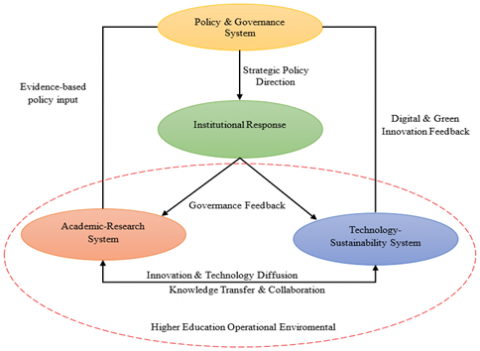
The synthesis of findings led to developing a comprehensive conceptual model termed the Integrated HEI Sustainability Transition Framework (IHSTF), which encapsulates how sustainability transformation evolves within Indonesian higher education institutions. As shown in Figure 3, the framework integrates the thematic dimensions identified earlier—policy and governance, academic research, and technology–sustainability—into an adaptive, interdependent system. At the core lies the institutional response, which represents the dynamic mechanism through which universities convert strategic sustainability commitments into operational, technological, and research-oriented actions. The framework portrays HEIs as learning organizations that evolve through continuous feedback loops, allowing policy reform, research innovation, and technological adaptation to reinforce one another mutually.
Figure 3. Integrated HEI Sustainability Transition Framework
This model also illustrates the cyclical and interactive nature of the sustainability transition. Knowledge generated through academic and research initiatives drives technological and sustainability practices, which subsequently inform and refine institutional policies and governance. This iterative flow ensures that sustainability in HEIs is not static, but continuously shaped by evidence-based learning and innovation. The IHSTF thus contributes a theoretical advancement to the literature by offering an integrative lens that connects governance systems, academic inquiry, and technological adaptation in a single coherent model. It provides a structured understanding of how higher education institutions act as key agents in advancing sustainability transitions within Indonesia’s educational and socio-political landscape. While the IHSTF offers a systemic lens to understand the internal dynamics of sustainability transition, examining how the scholarly discourse on this topic has evolved is essential. The following section, therefore, presents a chronological review that traces the progression of research focus and thematic development from 2013 to 2024, illustrating how academic inquiry has matured in parallel with institutional sustainability practices.
4.5 Chronological review of literature
Research on how higher education institutions in Indonesia address climate change challenges has evolved significantly over the past decade. Early studies focused on policy development and institutional readiness to incorporate climate change adaptation and mitigation strategies at the local government and university levels. As the field progressed, research expanded to practical implementations such as green campus initiatives, waste management, and energy conservation. More recent literature emphasizes integrating indigenous knowledge, collaborative governance, and innovative technological solutions in advancing sustainability within Indonesian universities. Table 3 presents the evolution of research directions on climate change and sustainability in Indonesian higher education institutions from 2013 to 2024, highlighting a progression from foundational policy studies and local adaptation efforts to the emergence of green campus initiatives, multidisciplinary sustainability integration, and advanced governance and innovation approaches.
Table 3. Evolution of research directions on climate change and sustainability in Indonesian higher education institutions (2013–2024)
|
Year Range |
Research Direction |
Description |
|
2013–2015 |
Foundational Policy and Local Adaptation |
Initial investigations concentrated on climate change adaptation policies at local government levels and the role of universities in disaster resilience and governance. The focus was identifying key policy themes and challenges related to vulnerable communities and integrating climate adaptation into urban planning and institutional frameworks. |
|
2017–2020 |
Emergence of Green Campus and Sustainability Awareness |
Research highlighted emission reduction strategies, including waste management and sustainable transportation at the university. Studies also explored the role of universities in supporting Sustainable Development Goals (SDGs), emphasizing education and capacity building to foster a sustainability culture and community engagement. |
|
2021–2022 |
Sustainability Integration and Multidisciplinary Approaches |
This period saw a rise in analyses of sustainability barriers and drivers within higher education institutions, with a multidisciplinary perspective on climate change adaptation and SDG implementation. Research emphasized institutional commitment, governance, and the promotion of sustainable communities, highlighting the need for strategic planning and external collaborations. |
|
2023–2024 |
Advanced Implementation, Governance, and Innovation |
Recent studies focus on comprehensive climate education frameworks, practical sustainability implementations like Eco-Campus programs, and technological innovations such as IoT and LED technology for carbon footprint reduction. There is a growing emphasis on collaborative governance, integrating indigenous knowledge, health implications of climate change, and systemic approaches to embedding sustainability into university culture and policy development. |
4.6 Agreement and divergence across studies
The reviewed studies generally agree on Indonesian higher education institutions' (HEIs) critical role in addressing climate change through policy development, implementation of sustainability practices, research innovation, collaboration, and incorporating indigenous knowledge. However, there is divergence regarding the comprehensiveness and effectiveness of policy frameworks, the readiness of universities for green campus initiatives, and the extent of indigenous knowledge integration. Some studies highlight fragmented or nascent policy structures and practical challenges in sustainability implementation, while others emphasize firm institutional commitments and impactful research outputs. These differences often arise from variations in institutional contexts, methodological approaches, and the specific focus of each study, reflecting the evolving landscape of climate action within Indonesian HEIs. Table 4 presents a comparative analysis of agreements, divergences, and potential explanations regarding policy development, implementation effectiveness, research innovation, collaboration intensity, and indigenous knowledge integration in Indonesian HEIs’ climate change and sustainability efforts.
Table 4. Comparative analysis of convergences and divergences in climate change and sustainability practices of Indonesian HEIs
|
Comparison Criterion |
Studies in Agreement |
Studies in Divergence |
Potential Explanations |
|
Policy Development Scope |
Most studies recognize that Indonesian HEIs have begun integrating climate change and sustainability policies, often aligned with national SDGs frameworks and international guidelines [2, 5, 8]. There is consensus on the need for more comprehensive, integrated, and coordinated climate education policies within HEIs [7, 48]. |
Some studies reveal that policy development remains fragmented and insufficiently structured at the institutional level, with a lack of national-level guidance leading to inconsistent adoption across universities [3, 8, 50]. Others point to disparities between environmental education policies and actual climate change policy integration [7, 48]. |
Differences stem from institutional maturity, presence or absence of national mandates, and varied emphasis on climate vs. sustainability education policies. Some studies focus on policy analysis, while others concentrate on implementation readiness. |
|
Implementation Effectiveness |
There is agreement that practical sustainability efforts, including green campus initiatives, energy conservation, waste management, and carbon footprint reduction, are underway in several HEIs and demonstrate positive impact [9, 11, 16, 24, 25]. HEIs invest in infrastructure such as solar panels, LED technology, and water conservation systems [9, 11, 16, 24, 25]. |
Contrasting evidence highlights challenges and low readiness for fully implementing comprehensive green campus programs, citing limited funding, weak leadership commitment, insufficient supervision, and infrastructural constraints [9, 50]. Some campuses score low on sustainability readiness indicators. |
Divergence arises from differences in resource availability, leadership engagement, campus size, and regional disparities. Case studies of individual universities reveal that implementation success depends heavily on institutional support and funding. |
|
Research Output and Innovation |
Studies consistently acknowledge that Indonesian universities actively contribute to climate change mitigation research, including technical innovations like CCS technology, IoT for energy monitoring, and multi-disciplinary approaches to sustainability [17, 21, 27, 30]. Research also supports the development of community resilience and sustainable urban planning [29, 40]. |
There is debate on whether research outputs are sufficiently integrated into policy and practice, with critiques about limited cross-sectoral collaboration and challenges in translating research findings into institutional strategies [2, 3, 8]. |
Variation depends on the research focus (applied vs. theoretical), institutional priorities, and external partnerships that facilitate or hinder research impact on policy and campus operational changes. |
|
Collaboration Intensity |
There is broad agreement on the importance and presence of collaborations among HEIs, local governments, communities, and NGOs in climate action programs, exemplified by participatory governance models and multi-stakeholder engagement in climate resilience projects [1, 22, 34, 44]. |
Despite collaborative efforts, some studies identify limitations in inclusiveness and participation, noting dominance of government actors, underrepresentation of the private sector and NGOs, and cultural and institutional barriers to effective collaboration [1, 22, 34, 44]. |
Differences reflect local governance cultures, stakeholder dynamics, and varying capacities for collaborative governance. Some focus on policy networks, while others focus on community-based partnerships. |
|
Indigenous Knowledge Integration |
Several studies underscore the valuable role of indigenous knowledge and local wisdom in shaping climate change mitigation and adaptation strategies, advocating for their integration into formal education and policy frameworks to enhance resilience and cultural relevance [14, 31]. |
However, there is a recognized gap in the systematic incorporation of indigenous knowledge at the national policy level and within many HEI curricula, with challenges in scaling local wisdom-based practices and policy alignment [14, 31]. |
Divergence is due to the complexity of integrating diverse, localized traditional knowledge systems into formal, often centralized education and policy frameworks, and differing institutional priorities toward cultural inclusion. |
4.7 Theoretical and practical implications
4.7.1 Theoretical implications
The synthesis of findings underscores the critical role of higher education institutions (HEIs) in Indonesia as transformative agents in climate change mitigation and adaptation. This aligns with sustainability transition theory, which views universities as catalysts for socio-technical change by integrating policy development, education, and community participation within institutional ecosystems [4, 17, 18]. The results demonstrate that institutional leadership and organizational culture significantly influence the internalization of sustainability values and climate-oriented behaviors among students and staff, reinforcing the relevance of behavioral and organizational change theories in higher education. Furthermore, discrepancies identified between climate change policy and education policy reveal theoretical gaps in policy coherence and integration, challenging the assumption that education systems inherently support climate governance [2, 7, 48]. These inconsistencies indicate the necessity of hybrid policy frameworks that align national priorities with institutional autonomy while maintaining adaptive governance mechanisms.
Additionally, the incorporation of indigenous knowledge and local wisdom into climate change education broadens theoretical discourse by embedding pluralistic and socio-ecological systems perspectives [14, 30, 31]. Such integration enriches the understanding of localized adaptation and demonstrates that sustainable transformation in developing nations requires culturally grounded strategies. This supports the argument that resilience theory must incorporate indigenous epistemologies to ensure contextual relevance and inclusivity in policy formation. Moreover, the prominence of collaborative governance frameworks in several reviewed studies advances governance theory by highlighting the complexities of multi-level coordination and power asymmetry among universities, government agencies, and civil society [33, 34, 44]. These interactions validate the need for adaptive governance models that emphasize mutual accountability, participatory decision-making, and distributed authority to enhance climate resilience within the higher education sector.
Finally, the analysis extends paradox theory in organizational studies by revealing how HEIs navigate tensions between academic autonomy, economic constraints, and sustainability commitments. Universities employ adaptive strategies—such as acceptance, separation, and synthesis—to balance conflicting institutional priorities while sustaining progress toward long-term environmental goals [20]. The literature also emphasizes the contribution of digital innovation theories by applying IoT-enabled energy monitoring and LED-based efficiency technologies, reinforcing the conceptualization of digital transformation as a core enabler of sustainability transitions [12, 45]. Together, these theoretical insights suggest climate-oriented transformation in Indonesian HEIs requires an integrated understanding of leadership, culture, policy coherence, and technological innovation.
4.7.2 Practical implications
Practically, the findings indicate that Indonesian HEIs must strengthen institutional leadership and governance frameworks to embed sustainability as a core operational principle. Leadership commitment, supported by effective management structures, is vital for ensuring that climate initiatives are systematically implemented rather than project-based [17, 18, 25]. Strengthened governance also promotes accountability and continuity, allowing universities to institutionalize sustainable education, research, and campus operations practices. Moreover, coordination between the climate change and education sectors remains essential to develop cohesive, context-sensitive curricula that link academic learning with local adaptation and mitigation needs [2, 7, 48]. Such policy integration will enhance educational relevance and strengthen universities’ role as policy laboratories that connect national priorities with community-based innovation.
Operationally, sustainability initiatives such as green campus development, renewable energy adoption, and waste management require consistent funding, technical support, and institutional oversight to achieve long-term outcomes [9, 26, 50]. Universities should adopt participatory models that engage students and staff in practical sustainability programs, fostering behavioral transformation alongside infrastructural improvement. Adopting digital technologies—such as IoT-enabled monitoring systems, LED retrofitting, and intelligent energy management—can improve energy efficiency and provide empirical data for sustainability assessment [12, 45]. Additionally, universities are encouraged to integrate local wisdom into climate curricula and outreach programs to enhance cultural relevance and promote inclusive resilience strategies [14, 31]. By merging scientific and traditional perspectives, HEIs can design community-based interventions that address environmental and socio-cultural sustainability dimensions.
Furthermore, fostering collaborative governance with local governments, NGOs, and the private sector is essential to broaden resource sharing and ensure policy inclusiveness [34, 44]. Institutionalizing partnerships through formal agreements and multi-sectoral networks can increase universities’ influence in local climate governance. This multi-stakeholder approach aligns with global sustainability practices, ensuring Indonesian HEIs contribute effectively to SDG implementation. Lastly, strengthening capacity-building programs for educators and administrators will help ensure that sustainability principles are embedded across decision-making processes and pedagogical frameworks. Collectively, these practical strategies demonstrate that achieving climate resilience within Indonesian higher education requires not only institutional reform but also cross-sectoral collaboration and adaptive innovation [12].
4.8 Limitations of the literature
Table 5 presents the main limitations found in the literature on climate change and sustainability within Indonesian higher education institutions. These include restricted geographic coverage, methodological constraints, and notable policy and practical implementation gaps. Additional challenges involve insufficient integration of indigenous knowledge, lack of standardized sustainability metrics, and limited stakeholder participation beyond government actors. Financial and resource constraints further hinder the scalability and long-term sustainability of institutional climate change initiatives.
Table 5. Limitations of the literature
|
Area of Limitation |
Description of Limitation |
Sources |
|
Limited Geographic Scope |
Many studies focus on specific universities or regions within Indonesia, limiting the generalizability of findings across the diverse higher education landscape. This geographic bias reduces external validity and may overlook regional variations in policy and implementation. |
[9, 11, 50] |
|
Methodological Constraints |
Predominantly qualitative or case study approaches restrict the ability to generalize results and may introduce subjective bias. The lack of longitudinal and large-scale quantitative data weakens the robustness and replicability of conclusions. |
[9, 18, 20] |
|
Policy and Implementation Gaps |
Several papers highlight discrepancies between climate change policies and their practical implementation, including weak supervision, limited funding, and a lack of comprehensive national guidelines. These gaps undermine the effectiveness and sustainability of institutional initiatives. |
[7–9] |
|
Insufficient Integration of Indigenous Knowledge |
The literature reveals limited systematic incorporation of indigenous and local wisdom into formal climate change education and policy frameworks, which restricts culturally relevant and holistic approaches to climate resilience. |
[14, 31] |
|
Lack of Standardization in Metrics |
Variability in carbon footprint measurement methodologies and sustainability indicators across institutions impedes comparability and benchmarking, limiting the ability to assess progress uniformly and develop best practices. |
[16, 39] |
|
Small and Homogeneous Samples |
Some studies rely on small, single-institution samples or participants from a single university, constraining findings' external validity and generalizability to the broader Indonesian higher education context. |
[18] |
|
Limited Stakeholder Participation |
Research indicates that collaborative governance often remains dominated by government actors with insufficient involvement from the private sector, NGOs, and local communities, reducing the inclusiveness and effectiveness of climate change initiatives. |
[34, 44] |
|
Financial and Resource Constraints |
Many HEIs face budget limitations and a lack of dedicated funding for sustainability initiatives, which hampers the implementation and scaling of climate change mitigation and adaptation efforts, affecting the sustainability of programs. |
[18, 50] |
4.9 Gaps and future research directions
Table 6 summarizes the key gaps and future research directions in advancing climate change and sustainability within Indonesian higher education institutions. Priority areas include policy coherence, national-level guidance, indigenous knowledge integration, collaborative governance, readiness for green campus implementation, challenges in carbon footprint standardization, climate change education, and research funding. The table highlights the need for interdisciplinary collaboration, enhanced leadership commitment, and improved waste management practices to foster systemic and inclusive sustainability transitions. Addressing these gaps through targeted research and coordinated strategies is essential to strengthening institutional capacity, policy effectiveness, and long-term environmental impact.
Table 6. Gaps and future research directions
|
Gap Area |
Description |
Future Research Directions |
Justification |
Research Priority |
|
Policy Coherence and Integration |
Fragmented and inconsistent climate change and education policies in Indonesian HEIs hinder effective climate education and sustainability efforts. |
Conducted comprehensive policy analyses to develop integrated frameworks aligning climate change and education policies at national and institutional levels; designed mechanisms for policy synchronization and stakeholder synergy. |
Discrepancies between climate and education policies marginalize climate education, reducing policy effectiveness and institutional readiness [7, 8]. |
High |
|
National-Level Policy Guidance for HEIs |
Lack of comprehensive national-level sustainability policy guidance results in uneven and compliance-driven institutional policies. |
Develop and evaluate national blueprints and guidelines for sustainability policy implementation in HEIs, incorporating best practices and contextual adaptations. |
Current HEI policies often respond to external rankings without systematic national coordination, limiting scalability and impact [8, 13]. |
High |
|
Indigenous Knowledge Integration |
Despite their potential for culturally relevant adaptation strategies, Indigenous and local wisdom are underutilized in climate change education and policy within HEIs. |
Investigate models for formally integrating indigenous knowledge into HEI curricula, research agendas, and policy frameworks; assess impacts on community resilience and policy relevance. |
Few studies address indigenous knowledge systematically; integration gaps limit the effectiveness of climate adaptation and mitigation strategies [13, 14, 31]. |
High |
|
Collaborative Governance and Stakeholder Engagement |
Collaborative governance in climate action faces institutional, cultural, and sectoral participation barriers, limiting multi-stakeholder effectiveness. |
Explore governance models that enhance NGO, private sector, and university roles in climate policy networks; develop strategies to overcome cultural and institutional barriers to collaboration. |
Government dominance and weak stakeholder engagement reduce the inclusiveness and success of climate governance initiatives [33, 34, 44]. |
High |
|
Green Campus Implementation Readiness |
Many Indonesian HEIs exhibit low readiness for green campus initiatives due to weak supervision, infrastructure deficits, funding shortages, and limited awareness. |
Conduct longitudinal studies on green campus implementation; develop capacity-building programs focusing on leadership, infrastructure investment, and community engagement; evaluate the effectiveness of supervision mechanisms. |
Readiness assessments reveal critical infrastructure, funding, and policy enforcement gaps that impede sustainable campus development [9, 50]. |
High |
|
Standardization of Carbon Footprint Assessment |
Lack of standardized methodologies and data for carbon footprint measurement in HEIs hampers comparability and effective mitigation planning. |
Develop and validate standardized carbon footprint assessment protocols tailored for Indonesian HEIs; create robust emission factor databases and data collection tools. |
Variability in metrics and scope of carbon footprint studies limits benchmarking and coordinated emission reduction efforts [16, 39]. |
Medium |
|
Climate Change Education and Capacity Building |
With insufficient institutional support and resource allocation, climate change education is marginalized within broader educational policies. |
Design and test integrated climate education curricula and training programs across disciplines; assess institutional capacity and develop strategies to enhance faculty and student engagement. |
Marginalization and lack of synergy between the climate and education sectors reduce the reach and impact of climate education initiatives [4, 7, 17]. |
High |
|
Research Funding and Interdisciplinary Collaboration |
Limited funding, disciplinary silos, and insufficient integration of indigenous knowledge constrain climate change research in Indonesian HEIs. |
Promote interdisciplinary research funding schemes; establish collaborative platforms linking traditional knowledge holders with scientific researchers; evaluate outcomes on policy and practice. |
Funding limitations and siloed research reduce innovation and the applicability of research outputs to local contexts [21, 31, 36]. |
Medium |
|
Leadership and Organizational Culture for Sustainability |
University leadership and culture critically influence sustainability integration, but are often insufficiently developed or supported. |
Investigate leadership styles and organizational culture interventions that effectively promote sustainability integration; develop leadership training tailored to Indonesian HEIs. |
Leadership commitment and positive organizational culture are key sustainability drivers, but many institutions remain underdeveloped [18]. |
High |
|
Waste Management Practices in HEIs |
College waste management often fails to meet standards, and recycling programs and effective organic waste handling are lacking. |
Develop and implement comprehensive waste management strategies, including recycling and organic waste processing; assess behavioral interventions to increase stakeholder participation. |
Waste management practices are inadequate, limiting environmental benefits and campus sustainability [9, 25]. |
Medium |
The collective body of literature on Indonesian higher education institutions (HEIs) addressing climate change challenges reveals a dynamic but uneven engagement landscape spanning policy development, practical implementation, research innovation, collaborative governance, and cultural integration. Indonesian HEIs have demonstrated meaningful efforts to formulate climate and sustainability policies, often aligning with global agendas such as the Sustainable Development Goals. However, these policies frequently suffer from fragmentation, inconsistent national-level guidance, and misalignment between the climate and education sectors. This policy incoherence undermines the systematic integration of climate change education and weakens the institutional frameworks necessary for effective climate action.
In terms of practical measures, universities have implemented notable sustainability initiatives on their campuses, including renewable energy adoption, waste and water management, sustainable transportation, and technological innovations like IoT-based energy monitoring and LED technology. These efforts reflect a growing commitment to reducing carbon footprints and enhancing resilience. Yet, widespread challenges persist, including inadequate infrastructure, limited funding, weak supervision, and low readiness to institutionalize green campus programs comprehensively. The scalability and long-term sustainability of these implementations remain constrained by these factors.
Research output from Indonesian universities contributes valuable insights and technologies, especially in areas like carbon capture and storage and interdisciplinary climate education frameworks. Active collaboration among faculty and students fosters innovation, yet resource limitations and institutional inertia restrict the research breadth. Importantly, while indigenous knowledge and local wisdom are recognized as critical for effective climate adaptation and mitigation, their integration into formal policies and curricula is limited and lacks systematic support, representing a significant gap in the knowledge and practice nexus.
Collaboration between universities, government bodies, and communities emerges as vital for climate resilience. Although some HEIs engage in multi-stakeholder partnerships, collaborative governance is hindered by cultural and institutional barriers, uneven stakeholder participation, and dominant government control. Strengthening inclusive, participatory governance frameworks would enhance the effectiveness and reach of climate strategies.
Finally, climate change education and capacity building within HEIs are advancing but remain marginalized within broader educational policies. Interactive and action-oriented pedagogies show promise in fostering student leadership and community engagement. Still, limited institutional resources and policy misalignment constrain these educational efforts. Diverse methodological approaches enrich the research landscape but hinder cross-study comparability and generalizability.
Indonesian HEIs play multifaceted roles in climate change mitigation and adaptation, balancing education, policy, practice, and research. To magnify their impact, addressing policy fragmentation, enhancing governance collaborations, increasing resource allocation, and systematically incorporating indigenous knowledge are imperative steps toward more robust and culturally grounded climate action within higher education.
[1] Nugroho, L., Raafi, M. (2024). Mitigating climate crisis: Integrating climate education into educational system for social welfare enhancement in Indonesia. Journal of Asian Social Science Research, 6(1): 29-60. https://doi.org/10.15575/jassr.v6i1.88
[2] Karinda, K., Baharuddin, T. (2024). Climate change policy based on global study evolution 1979-2023: An insight and direction for Indonesia. IOP Conference Series: Earth and Environmental Science, 1388(1): 012054. https://doi.org/10.1088/1755-1315/1388/1/012054
[3] Nomura, K., Suyono, E.A. (2014). The environment, sustainability and universities in Indonesia: An examination of the nexus. In Schooling for Sustainable Development Across the Pacific, Schooling for Sustainable Development, pp. 159-173. https://doi.org/10.1007/978-94-017-8866-3_8
[4] Žalėnienė, I., Pereira, P. (2021). Higher education for sustainability: A global perspective. Geography and Sustainability, 2(2): 99-106. https://doi.org/10.1016/j.geosus.2021.05.001
[5] Arifin, R., Masyhar, A., Sumardiana, B., Ramada, D.P., Kamal, U., Fikri, S. (2024). Indonesian sustainable development policy: How the government ensures the environment for future generations. IOP Conference Series: Earth and Environmental Science, 1355(1): 012005. https://doi.org/10.1088/1755-1315/1355/1/012005
[6] Ambariyanto, A., Utama, Y.J. (2020). Educating higher education institutions to support SDGs: Indonesian case. E3S Web of Conferences, 202: 02015. https://doi.org/10.1051/e3sconf/202020202015
[7] Tang, K. (2024). Climate change education in Indonesia’s formal education: A policy analysis. npj Climate Action, 3: 57. https://doi.org/10.1038/s44168-024-00143-z
[8] Hapsari, M.A., Putri, W.H. (2024). HEI’s commitment on sustainability issue toward nation building: How Indonesia HEI policies conform to SDGs? IOP Conference Series: Earth and Environmental Science, 1323(1): 012021. https://doi.org/10.1088/1755-1315/1323/1/012021
[9] Pascawati, N.A., Lusiyati, E.D., Untari, J., Ramadanti, D.P. (2023). University readiness analysis towards green campus: A case study using UI GreenMetric. Disease Prevention and Public Health Journal, 17(2): 149-161. https://doi.org/10.12928/dpphj.v17i2.7625
[10] Brata, J.T., Toparakkasi, F. (2023). Public policies for climate change mitigation in Indonesia. Jurnal Aktor, 2(3): 103-110. https://doi.org/10.26858/aktor.v2i3.46879
[11] Jamaluddin, W., Pawhestri, S.W., Ulmillah, A. (2024). University’s efforts in addressing climate change challenges: A case at Raden Intan State Islamic University. Journal of Sustainability Perspectives, 4(2): 197-210. https://doi.org/10.14710/jsp.2024.24803
[12] KR, G., Samuel, R.M., MS, A., NB, S.S., Devidas, A.R. (2023). IoT-driven carbon footprint reduction in higher educational institutions. In 2023 2nd International Conference on Futuristic Technologies (INCOFT), Belagavi, Karnataka, India, pp. 1-6. https://doi.org/10.1109/INCOFT60753.2023.10425485
[13] Rahayu, R. (2013). Policy development for effective transitions to climate change: Adaptation at the Indonesian local government level. Griffith University. https://doi.org/10.25904/1912/3714
[14] Negara, A.P., Ariza, I.S., Nurjaya, L.A.N.W., Ubaidillah, M.F., Wijaya, R., Lestari, V.P.P., Saputro, E.A., Sukirmiyadi, Nurherdiana, S.D. (2025). Mitigating the implementation of SDGs program no. 13 in Indonesia: An overview of social dynamics and local wisdom. E3S Web of Conferences, 605: 03040. https://doi.org/10.1051/e3sconf/202560503040
[15] Leal Filho, W., Dinis, M.A.P., Lange Salvia, A., Sierra, J., et al. (2024). Assessing climate change and health provisions among staff in higher education institutions: A preliminary investigation. PLoS ONE, 19(5): e0304019. https://doi.org/10.1371/journal.pone.0304019
[16] da Silva, L.A., de Aguiar Dutra, A.R., de Andrade Guerra, J.B.S.O. (2023). Decarbonization in higher education institutions as a way to achieve a green campus: A literature review. Sustainability, 15(5): 4043. https://doi.org/10.3390/su15054043
[17] Leal Filho, W., Sow, B.L., Perlin, A.P., Mbah, M.F., da Costa, C.A., Azam, F.M.S., Dinis, M.A.P. (2024). Addressing climate change education: Relevant contributions from universities. International Journal of Sustainability in Higher Education. https://doi.org/10.1108/IJSHE-11-2023-0542
[18] Mohammadi, Y., Monavvarifard, F., Salehi, L., Movahedi, R., Karimi, S., Liobikienė, G. (2023). Explaining the sustainability of universities through the contribution of students’ pro-environmental behavior and the management system. Sustainability, 15(2): 1562. https://doi.org/10.3390/su15021562
[19] Cembranel, P., Gewehr, L., Dal Moro, L., Fuchs, P.G., Birch, R.S., Andrade Guerra, J.B.S.O.A. (2024). The pivotal role of higher education institutions in cultivating a sustainable development goals-centric culture. International Journal of Sustainability in Higher Education, 25(7): 1385-1411. https://doi.org/10.1108/IJSHE-01-2024-0057
[20] Bohunovsky, L., Radinger-Peer, V., Zint, M., Penker, M. (2023). Change agents under tensions: A paradox approach to strategies for transforming higher education toward sustainability. International Journal of Sustainability in Higher Education, 24(9): 372-392. https://doi.org/10.1108/IJSHE-12-2022-0393
[21] Sidiyanto, Y.A., Windiatmaja, J.H., Sari, R.F. (2024). The pathway towards supporting the implementation of the new indonesian law on carbon capture and storage in Indonesian universities. E3S Web of Conferences, 513: 01009. https://doi.org/10.1051/e3sconf/202451301009
[22] Suteki, M., Betlajery, S., Kuntag, J.R. (2023). Higher education roles to support climate change mitigation. AGROLAND The Agricultural Sciences Journal (e-Journal), 10(2): 111-116. https://doi.org/10.22487/agroland.v0i0.1940
[23] Lustiyati, E.D.L., Pascawati, N.A., Rusyani, Y.Y., Untari, J., Melliani, A.P., Yanuardo, A.C. (2023). Empowering the role of students in responding to climate change through a sustainable lifestyle that cares about the environment. Jurnal Pengabdian Nasional (JPN) Indonesia, 4(1): 41-50. https://journal.stmiki.ac.id/index.php/jpni/article/view/100.
[24] Hantoro, R., Pratama, D.Y., Nugraha, E.L., Puspitasari, R.N. (2017). Emission reduction study for eco-campus program, case study in sepuluh nopember institute of technology Indonesia. In the Third International Conference on Civil Engineering Research (ICCER), Surabaya, Indonesia, pp. 377-382. https://doi.org/10.12962/j23546026.y2017i6.3277
[25] Budihardjo, M.A., Ramadan, B.S., Putri, S.A., Wahyuningrum, I.F.S., Muhammad, F.I. (2021). Towards sustainability in higher-education institutions: Analysis of contributing factors and appropriate strategies. Sustainability, 13(12): 6562. https://doi.org/10.3390/su13126562
[26] Ambariyanto, Utama, Y.J., Ariyanti, D., Sugianto, D.N., Dewi, C.A., Sayekti, W. (2023). Challenge and innovation in building the green and sustainable transportation system at Universitas Diponegoro. IOP Conference Series: Earth and Environmental Science, 1194(1): 012012. https://doi.org/10.1088/1755-1315/1194/1/012012
[27] Budihardjo, M.A., Arumdani, I.S., Puspita, A.S., Ambariyanto, A. (2022). Improving water conservation at Universitas Diponegoro, Indonesia. Journal of Sustainability Perspectives, 2: 277-284. https://doi.org/10.14710/jsp.2022.15523
[28] CORE Universitas Udayana. (2020). Kegiatan center for community based renewable energy (CORE) Universitas Udayana dalam mendukung pencapaian sustainable development goals. OSF Preprints. https://doi.org/10.31219/osf.io/rv3tq
[29] Pribad, K.S., Hanifa, R., Hanafi, E., Pradipta, G. (2020). Development of disaster resilient and sustainable university framework: Case of Bandung Institute of Technology (ITB). In Innovation for Sustainable Infrastructure. Lecture Notes in Civil Engineering, pp. 597-602. https://doi.org/10.1007/978-981-15-0802-8_94
[30] Alfarizi, M., Yuniarty. (2022). Literature review of climate change and Indonesia’s SDGs strategic issues in a multidisciplinary perspective. IOP Conference Series: Earth and Environmental Science, 1105(1): 012040. https://doi.org/10.1088/1755-1315/1105/1/012040
[31] Rahmah, M., Sulistyono, A. (2024). The integration of traditional knowledge and local wisdom in mitigating and adapting climate change: Different perspectives of indigenous peoples from Java and Bali island. In Traditional Knowledge and Climate Change, pp. 61-80. https://doi.org/10.1007/978-981-99-8830-3_4
[32] Dewi Nurvianti, Srifridayanti, Fathurrahman. (2024). Climate action model for developing countries (Indonesia) through integrated adaptation and mitigation methods. Journal of Law and Social Society, 1(2): 43-60. https://doi.org/10.70656/jolasos.v1i2.162
[33] Saputra, T., Nurpeni, Eka, Zuhdi, S. (2024). Mapping power dynamics in local climate action: Policy networks in the climate village program of Pekanbaru City, Riau. Challenges in Sustainability, 12(4): 237-254. https://doi.org/10.56578/cis120401
[34] Mukhlis, M., Perdana, R. (2022). A critical analysis of the challenges of collaborative governance in climate change adaptation policies in Bandar Lampung City, Indonesia. Sustainability, 14(7): 4077. https://doi.org/10.3390/su14074077
[35] Astuty, E., Aryanto, R., Sudirman, I.D. (2023). University third mission and the antecedents: A survey from Indonesian higher education. Journal of Higher Education Theory and Practice, 23(12): 195-209. https://doi.org/10.33423/jhetp.v23i12.6246
[36] Alhazmi, A.K., Zain, A., Alsakkaf, N., Othman, Y. (2023). Identification of sustainability barriers in higher education institutions (HEIs) and the role of technology in improving sustainability in HEIs. Journal of Science and Technology, 28(1): 30-37. https://doi.org/10.20428/jst.v28i1.2126
[37] Biancardi, A., Colasante, A., D’Adamo, I., Daraio, C., Gastaldi, M., Uricchio, A.F. (2023). Strategies for developing sustainable communities in higher education institutions. Scientific Reports, 13: 20596. https://doi.org/10.1038/s41598-023-48021-8
[38] Lassa, J.A., Nugraha, E. (2014). From shared learning to shared action in building resilience in the city of Bandar Lampung, Indonesia. Environment & Urbanization, 27(1): 161-180. https://doi.org/10.1177/0956247814552233
[39] Álvarez, V., Austin, M.C., Rodríguez, Z., Mora, D., De León, L.L. (2022). Sustainability actions towards neutral carbon footprint higher education institutions: A systematic review. In 2022 8th International Engineering, Sciences and Technology Conference (IESTEC), Panama, Panama, pp. 608-615. https://doi.org/10.1109/IESTEC54539.2022.00101
[40] Wijaya, N., Nitivattananon, V., Shrestha, R.P., Kim, S.M. (2020). Drivers and benefits of integrating climate adaptation measures into urban development: Experience from coastal cities of Indonesia. Sustainability, 12(2): 750. https://doi.org/10.3390/su12020750
[41] Ruiz-Mallén, I., Heras, M. (2020). What sustainability? Higher education institutions’ pathways to reach the agenda 2030 goals. Sustainability, 12(4): 1290. https://doi.org/10.3390/su12041290
[42] Suarma, U., Hizbaron, D.R., Sudibyakto, S., Nurjani, E. (2018). Participatory implementation within climate change related policies in urbanized area of Indonesia. Indonesian Journal of Geography, 50(2): 121-132. https://doi.org/10.22146/ijg.36263
[43] Sebire, R.H., Isabeles-Flores, S. (2023). Sustainable development in higher education practices. Revista Lengua Y Cultura, 5(9): 89-96. https://doi.org/10.29057/lc.v5i9.10971
[44] Hudaya, M.R., Dewi, T.P. (2021). Collaborative governance in the implementation of the climate village program in Talangbubuk Village, Plaju District, Palembang City. Komunitas, 12(1): 1-10. https://doi.org/10.20414/komunitas.v12i1.3355
[45] Pereira de Morais, J.C., Neves, N.C., Soveral, L.A., Lima, J. (2024). Innovation in higher education institutions towards sustainability using LED technology. International Journal of Innovation Science, 16(2): 296-319. https://doi.org/10.1108/IJIS-08-2022-0153
[46] Filho, W.L., Abubakar, I.R., Mifsud, M.C., Eustachio, J.H.P.P., et al. (2025). Governance in the implementation of the UN sustainable development goals in higher education: Global trends. Environment, Development and Sustainability, 27: 20695-20718. https://doi.org/10.1007/s10668-023-03278-x
[47] Shrestha, D.B., Sedhai, Y.R., Budhathoki, P., Gaire, S., Subedi, P., Maharjan, S., Yuan, M., Asija, A., Memon, W. (2022). Extracorporeal Membrane Oxygenation (ECMO) dependent Acute Respiratory Distress Syndrome (ARDS): A systematic review and meta-analysis. Cureus, 14(6): e25696. https://doi.org/10.7759/cureus.25696
[48] Tang, K. (2024). Climate change education in Indonesia’s formal education: A policy analysis. Research Square. https://doi.org/10.21203/rs.3.rs-4147106/v1
[49] Nugroho, L.A., Raafi, M. (2024). Integrating climate education for social welfare enhancement in Indonesia. Journal of Social Sciences and Cultural Study, 1(2): 69-82. https://doi.org/10.61857/jsscs.v1i1.50
[50] Pascawati, N.A., Lustiyati, E.D., Untari, J., Ramadanti, D.P. (2023). Pengelolaan sampah di perguruan tinggi sesuai konsep green campus (studi kasus: Universitas Respati Yogyakarta). Dinamika Lingkungan Indonesia, 10(2): 70-81.