Mohammed Sultan Alsubaie* | Haider Mahmood
© 2025 The authors. This article is published by IIETA and is licensed under the CC BY 4.0 license (http://creativecommons.org/licenses/by/4.0/).
OPEN ACCESS
Women's Labor Participation (WLP) and urbanization are rising in Saudi Arabia nowadays, which can shape the Energy Intensity (EI) as well. Thus, this research examines the effects of WLP and urbanization on EI in the Environmental Kuznets Curve (EKC) framework in Saudi Arabia by using the period 1990-2023. The long-run results validate the EKC with coefficients of 29.8311 and -1.4769 for income per capita and its square term, respectively. Moreover, a 1% increase in urbanization raises EI by 0.6097%. WLP has a positive asymmetrical effect on EI in the long run. A 1% rise in WLP increases EI by 0.1682%, and a 1% fall in WLP decreases EI by 0.3127%. Thus, the magnitude of the effect of falling WLP is found to be significantly higher than rising WLP, which validates the asymmetrical effects of WLP on EI. These asymmetrical effects are further validated with a high Wald test value of 541.3240. The same effects of urbanization and WLP on EI are also observed in the short run. However, the EKC is not substantiated in the short run. Moreover, the lag effect of EI on the current EI is found to be positive. The findings suggest controlling WLP and urbanization to reduce EI in Saudi Arabia.
energy intensity, urbanization, women labor participation, the environmental Kuznets curve
Saudi women have good participation in educational attainment [1]. Moreover, Women's Labor Participation (WLP) has suddenly jumped in the recent decade due to an agenda of increasing women's empowerment as per national social goals. In this regard, a series of legal reforms has been introduced recently to raise women's empowerment in both social and economic spheres. For instance, a significant reform is to grant women the right to women to drive and travel without the need for male accompaniment [2]. These reforms reflect a broader commitment to improving women's autonomy and participation in public and private life, which can give rise to WLP as well. Arora-Jonsson [3] argued that women faced a combination of limited resources and high cultural expectations, which created barriers to adopting sustainable practices. Thus, societal expectations hindered women's ability to engage in climate change mitigation efforts. However, addressing these challenges could significantly enhance women's participation in such initiatives to achieve environmental goals. Consequently, WLP can shape Energy Intensity (EI).
In the industrial and manufacturing sectors, greater WLP can raise energy demand due to expanding economic activities, which can increase EI. WLP in industries like heavy manufacturing, mining, and construction may increase the production activities in these sectors and may contribute to higher energy consumption levels. Thus, policies encouraging gender diversity and WLP in these sectors can lead to increased production and raise EI. Moreover, increasing women's leadership in such industries can raise investment in energy-intensive industries and projects [4], which can further increase energy usage and the EI. In another dimension, WLP can increase household income, which can raise the demand for energy-intensive products at the household level, which can increase EI consequently. Thus, policies to support women’s economic empowerment and WLP can lead to an increase in overall energy demand and the EI.
On the positive environmental debate of WLP, women would also reduce EI and improve energy efficiency. For instance, by entering WLP in the industrial and manufacturing sectors, women can help reduce EI by advocating for energy-efficient production methods and technologies [5, 6]. Particularly, it is true in the Saudi case, where women’s participation in educational achievements has significantly increased. In this case, women are in a better position to suggest energy-efficient technologies [7], which can reduce the EI. Moreover, by promoting lean manufacturing techniques in the manufacturing sector, waste reduction strategies, and energy-efficient technologies [8], women can significantly reduce energy consumption per unit of output (EI). Moreover, increasing WLP would transform the economy toward a more service sector as WLP can better serve in service sector compared to the industrial sector [9]. This expected economic transition can produce more income with less use of energy, which could reduce EI.
WLP can also increase economic growth and accelerate urbanization in Saudi Arabia. Thus, urbanization is another issue, along with WLP, which can significantly contribute to EI. For instance, urbanization can increase EI due to rising demand for electricity, transportation, and industrial activities in urban areas [10]. Urbanization is also responsible for the construction of residential, commercial, and industrial infrastructure, which requires significant energy for construction and maintenance. This is particularly true in Saudi Arabia, where air conditioning, lighting, and water desalination are energy-intensive activities in urban areas due to the hot climatic conditions. The increasing energy demand in urban areas can mostly be fulfilled from fossil fuels in Saudi Arabia, as this economy has more than 99% energy dependence on fossil fuels [11]. Thus, this reliance on fossil fuels exacerbates more energy usage compared to economic output in any economic activity, which could have a net increasing EI effect. Urbanization also fosters economic growth [12], and consequent higher income can lead to increased industrial output to meet the demand from the household sector in urban areas. Moreover, Saudi Arabia has limited facilities for the urban transport system in most cities [13]. So, increasing urbanization can increase the dependence on private vehicles due to limited public transportation, which can increase EI by increasing gasoline and diesel consumption.
Considering the importance of urbanization, economic growth, and WLP in determining EI and the environment, some Saudi studies have probed the association between urbanization and EI [14] and economic growth and EI [15]. However, a research gap still exists in the Saudi literature to investigate the effects of WLP on EI. Thus, this research aims to investigate the effect of WLP on EI by controlling urbanization and economic growth in the EKC framework in Saudi Arabia. To increase the novelty of the research, the asymmetrical effects of WLP are tested on EI, as both increasing and decreasing WLP do not necessarily have the same effects on EI.
A growing body of literature has emphasized the nexus between gender and pollution. For instance, Ergas and York [5] examined the link between gender equality and environmental sustainability and concluded that countries with greater female political representation reduced their CO2 emissions. This finding was aligned with feminist theories in favor of women's traditional roles in resource management and subsistence production, which can foster a stronger commitment to environmental protection. Davidson and Haan [6] explored Alberta, which is an energy-intensive region with high emissions. The authors revealed that women exhibited greater awareness and perceived vulnerability to climate change than men, which helped to reduce environmental problems stemming from political ideology. Laws et al. [16] explored Boston and found that men were found to be less careful about air pollution than women. Sagaris and Tiznado-Aitken [17] explored Santiago and examined the role of gender in influencing transport choices and accessibility. The author found that women faced mobility barriers due to unsafe public transport systems, which led to higher rates of walking trips and environmental sustainability.
McKinney and Fulkerson [18] expanded the gender-environment nexus by incorporating ecofeminist perspectives into their analysis and demonstrated that nations with higher levels of female political representation reduced carbon footprints. This effect was found to be consistent even caring urbanization and global economic integration in the analysis. Thus, the potential for increasing women's political influence was a means to mitigate climate change, which emphasized the role of women's status in favor of environmental benefits. Muttarak and Chankrajang [7] investigated gender disparities in climate concern and indicated that women with higher education were more concerned about climate change and adopted climate-friendly behaviors. This behavior was translated by the conservation of resources such as electricity and water, and also with technical and behavioral modifications to mitigate emissions. Higher education levels were also found to be correlated with resource conservation efforts by economic considerations rather than environmental concerns.
Slini and Pavlidou [19] analyzed gender differences in environmental behavior in Europe and found that women had lower carbon footprints than men due to their consumption habits. This energy-saving behavior was observed from greater reliance on public transport and support for sustainability policies. Thus, women were found to be more active in environmental advocacy and voluntary actions, which fostered more inclusive and effective environmental policies. Sileem [20] examined the EKC between gender and climate dynamics in 18 MENA economies from 1990-2015 and found that greater female participation contributed to reversing the region's vulnerability to climate change. Thus, gender equality was a crucial factor in climate adaptation and mitigation, which highlighted that sustainable growth was not achieved without integrating half of the population into decision-making processes. Ravindra et al. [21] explored clean energy transitions in developing countries to investigate the socio-economic and behavioral barriers to adopting clean cooking fuels in these economies. The authors found that women were affected by household air pollution, and the promotion of clean energy access improved women's health and air quality, which was possible due to empowering women.
Hassaballa [22] investigated the nexus between women and environmental quality in poor nations and found that women caused the environment. Thus, women contributed positively to environmental quality. However, foreign investments adversely impacted the environment. Martinez et al. [23] assessed the nitrogen footprint in Spain from food consumption and found that women exhibited a slightly lower footprint than men. Thus, gender-based differences in diet positively impacted the environment. Ogisi and Begho [24] investigated Sub-Saharan Africa (SSA) and found that gender-based barriers hindered women’s participation, and addressing these barriers could enhance the adoption of sustainable practices to improve the environment. Marfo et al. [25] investigated the effects of females on CO2 emissions in Ghana and concluded that urbanization increased CO2 emissions. However, trade openness and the female population had negative effects on emissions, which underscored the importance of women's empowerment in achieving Ghana’s environmental goals.
Wu [26] examined the effect of female governors on state-level emissions in the US and found that states with female governors experienced lower CO2 emissions. Somoye and Akinwande [27] analyzed Nigeria and concluded a long-run negative association between female participation and emissions. Toro et al. [28] assessed gender differences in Greenhouse Gas (GHG) emissions in Spanish households and found that female-driven households exhibited significantly lower emissions due to reduced reliance on private transportation. Ndour and Asongu [29] investigated SSA and found that fixed broadband subscriptions reduced CO2 emissions, integrated with gender economic inclusion. By establishing technology synergy effects and policy thresholds, sustainable development could be achieved through digital inclusion. Duflo [30] found that increasing WLP enabled women to engage in environmental projects, which helped in achieving a sustainable environment. Raggad [31] examined and identified that income and energy usage accelerated emissions. Moreover, urbanization had a mitigating effect on emissions in Saudi Arabia.
Literature also worked on firm-level studies on women’s roles in the environment. For instance, Fernández-Torres et al. [32] analyzed 120 listed firms from 2002-2019 in the tourism sector and concluded that greater female representation on boards was connected with weaker environmental performance and condensed execution of sustainability policies. Nevertheless, board gender diversity positively impacted environmental innovation, which suggested that women fostered long-term sustainability improvements through innovation. Kim [33] examined the effect of females on emissions using 9,406 observations in South Korea from 2014-2020 and concluded that female executives and employees were correlated with increased voluntary disclosure of emissions. Martínez et al. [34] explored the role of female representation on corporate boards in influencing emissions in rich and emerging economies from 2010-19 and found that a higher ratio of women on boards was inversely related to emissions. Furthermore, cultural diversity on boards negatively influenced emissions, which showed that diverse perspectives contributed to stronger environmental governance in the investigated firms.
Du et al. [35] analyzed women's autonomy in environmental decision-making in China from 1975-2019 and found that women demonstrated political wisdom in managing corporate sustainability affairs and environmental responsibility, which was found helpful in reinforcing their potential to drive sustainable business outcomes. Marchini et al. [36] examined Italian-listed firms from 2010-2018 and found that the unique resources brought by female directors contributed to improved environmental performance in the firms. Thus, increased female representation reduced firms' emissions and enhanced waste recycling efforts, which helped to minimize environmental violations and litigation risks. Al-Najjar and Salama [37] investigated gender diversity in the high-tech sector and concluded a positive correlation between gender diversity and environmental performance. Thus, female leaders exhibited greater sensitivity to environmental issues.
Toukabri and Jilani [38] examined US firms and found that female board members enhanced carbon performance. Moreover, institutional investors positively moderated this relationship. Harakati et al. [39] explored gender's influence on climate change and revealed that women's commitment to ecological responsibility was mediated by their perception of environmental regulations. Waheduzzaman et al. [40] examined gender’s role in corporate carbon emissions in Australian firms and indicated that female leadership alone was insufficient in reducing emissions. Thus, female leadership combined with environmental management training mitigated carbon emissions. Wasan et al. [41] scrutinized the nexus between board gender diversity and corporate outcomes and found that female board directorships enhanced environmental protection. However, the positive environmental effects diminished with increasing firm size.
The reviewed literature elaborates that WLP could have both positive and negative environmental effects. Thus, it looks pertinent to investigate the WLP-environment nexus in a particular economy, which is missed in the case of Saudi Arabia. Thus, the present research fills this gap in the Saudi literature. Moreover, the global literature has investigated the WLP-environment nexus in a symmetrical analysis. The increasing and decreasing WLP could have different effects on EI. Therefore, this research adds novelty to this relationship by investigating the asymmetrical relationship between WLP and EI, controlling for urbanization and income in the EKC framework.
In estimating the determinants of EI, we cannot ignore economic growth. With rising growth, nations first focus on increasing production by using intensive fossil fuels [42], which intensifies the EI. However, renewable sources of energy can be adopted later to reduce the ecological consequences. Thus, Gross Domestic Product (GDP) above a threshold would lead to renewable energy consumption and could reduce EI. This phenomenon is called the EKC hypothesis [43]. In the early stages, rising output tends to escalate energy consumption due to the scale effect. However, structural shifts toward less energy-intensive industries may emerge with technological advancements and improved environmental regulations, which may promote composition and technique effects and can reduce EI [44, 45]. In addition, existing literature discusses the effect of women in shaping EI [3]. On the production side, greater WLP may lead to increased industrial and economic activities [4-6], which could increase energy consumption compared to economic outcomes and thus lead to increased EI. Moreover, higher household incomes associated with greater WLP could stimulate aggregate demand, which leads to increased energy consumption and EI. Moreover, WLP can also result in increased urbanization. Urbanization can further increase EI due to the construction of buildings and infrastructure in urban areas. Moreover, urbanization also results in increasing transportation [10], which consumes mostly fossil fuels and contributes to increasing EI. Based on the above theoretical insights, the following model is proposed to empirically evaluate the relationship between WLP, economic growth, urbanization, and EI.
EIt = f(Yt, Yt2, Wt, URBt) (1)
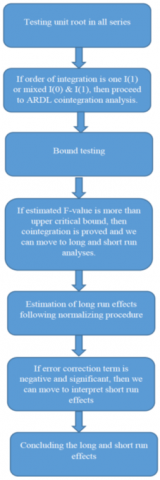
EIt represents the natural logarithm of energy intensity, which is a ratio of primary energy usage [measured in exajoules (EJ)] to GDP (adjusted for constant 2015 US dollars) in Eq. (1). The primary energy usage data (measured in EJ) is sourced from the Energy Institute [46], and the GDP data is obtained from the World Bank [47]. In Eq. (1), Yt denotes the natural logarithm of GDP per capita (adjusted for constant 2015 US dollars). Yt2 refers to the squared value of Yt, which is included in the model to test the EKC hypothesis. In Eq. (1), URBt is the natural logarithm of the percentage of the urban population in the total population. Wt is the natural logarithm of the percentage of the female labor force in the female population (ages 15 and more). t represents annual data from 1990-2023. All variables, except primary energy consumption, are sourced from the World Bank [47]. After presenting the model, all estimation procedures are provided in Figure 1.
Figure 1. Estimation proceduure
To ensure the robustness of the results, a unit root test is performed using the methodology proposed by Ng and Perron [48]. The Ng-Perron test is chosen as this test has better size and power properties compared to ADF and PP unit root tests in accepting or rejecting the null hypothesis of a unit root, especially in small samples. The Ng-Perron test used GLS detrending and modified statistics to reduce the mentioned problems. Thus, the Ng-Perron test provides more robust and efficient results compared to the ADF and PP tests. In addition, the Ng-Perron test utilized four test statistics, which is a more comprehensive way of testing unit root compared to other unit root tests. These four test statistics are presented as follows:
$M Z_a^d=\left[\frac{X_T^d}{T}\right]^2 . \frac{1}{2 k}-\frac{f_0}{2 k}$ (2)
$M S B^d=\sqrt{\frac{k}{f_0}}$ (3)
$M Z_t^d=M Z_a^d . M S B^d$ (4)
$M P T_T^d=\left[K c^2+(1-c) / T\right] \frac{X_T^d}{f_0}$ (5)
After conducting the unit root tests, the cointegration test proposed by Pesaran et al. [49] is employed to further assess the long-run relationships between the variables, which is based on the following Autoregressive Distributed Lag (ARDL) model:
$\begin{gathered}\Delta E I_t=a_0+a_1 E I_{t-1}+a_2 Y_{t-1}+a_3 Y_{t-1}^2+a_4 W P_{t-1}+a_5 W N_{t-1}+a_6 U R B_{t-1}+ \\ \sum_{i=1}^j a_{7 i} \Delta E I_{t-i}+\sum_{i=0}^j a_{8 i} \Delta Y_{t-i}+\sum_{i=0}^j a_{9 i} Y_{t-1}^2+\sum_{i=0}^j a_{10 i} \Delta W P_{t-i}+ \\ \sum_{i=0}^j a_{11 i} \Delta W N_{t-i}+\sum_{i=0}^j a_{12 i} \Delta U R B_{t-i}+e_{1 t}\end{gathered}$ (6)
$\begin{gathered}\Delta E I_t=b_0 E C T_{t-1}+\sum_{i=1}^j b_{1 i} \Delta E I_{t-i}+\sum_{i=0}^j b_{2 i} \Delta Y_{t-i}+\sum_{i=0}^j b_{3 i} Y_{t-1}^2+ \\ \sum_{i=0}^j b_{4 i} \Delta W P_{t-i}+\sum_{i=0}^j b_{5 i} \Delta W N_{t-i}+\sum_{i=0}^j b_{6 i} \Delta U R B_{t-i}+e_{2 t}\end{gathered}$ (7)
The ARDL framework offers greater dynamics by controlling endogeneity in the model, by taking lagged differenced variables, and by accounting for potential omitted variable bias. By utilizing the stationary series in this model, the ARDL framework ensures that the results are non-spurious and provide robust and reliable findings. The Wt variable is converted into WPt and WNt variables by using the Shin et al. [50] methodology. WPt is calculated by taking the partial sum of positive changes in the Wt variable. On the other hand, WNt is calculated by taking the partial sum of negative changes in the Wt variable. Thus, WPt describes the increasing trend of Wt over time, and WNt depicts the decreasing trend of Wt over time. In Eq. (6), the null hypothesis (a1 = a2 = a3 = a4 = a5 a6 = 0) is tested using the bounds test to confirm cointegration in the model. After confirmation of cointegration, coefficients (a2, a3, a4, a5, and a6) are normalized with a1. From Eq. (7), a short-run relationship can be verified by the negative sign of b0, which also indicates the speed of adjustment towards long-run equilibrium from any short-term disequilibrium. The coefficients 'b' show the short-run effects of the independent variables on EI.
Multicollinearity with highly correlated explanatory variables can distort coefficient estimates and generate biased results. Thus, the Variance Inflation Factor (VIF) analysis is conducted and presented in Table 1. If the estimated VIF is less than 5, then we can claim of no multicollinearity in the model. The estimated values of VIF for all pairs of explanatory variables are less than 5. Thus, the results of the VIF test strongly validate the multicollinearity in the model. Thus, the estimated coefficients will be stable and interpretable.
Table 1. VIF results
|
Variables |
EIt |
Yt |
Wt |
|
Yt |
2.1613 |
– |
– |
|
Wt |
1.0769 |
1.1105 |
– |
|
URBt |
1.3197 |
1.3200 |
1.0331 |
Table 2. Unit root test
|
Series |
MZa |
MZt |
MSB |
MPT |
|
EIt |
-8.7741 |
-2.0633 |
0.2293 |
9.8995 |
|
Yt2 |
-10.7276 |
-2.2659 |
0.2057 |
8.1725 |
|
Yt |
-10.5734 |
-2.2370 |
0.2072 |
8.3611 |
|
WPt |
-10.5013 |
-2.2307 |
0.2070 |
2.3300 |
|
WNt |
-12.1322 |
-2.4361 |
0.1938 |
2.2902 |
|
URBt |
-2.5412 |
-1.9654 |
0.2354 |
9.9412 |
|
ΔEIt |
-23.7671*** |
-3.3901*** |
0.1394** |
3.7184*** |
|
ΔYt |
-18.2597** |
-2.9835** |
0.1585** |
4.7319** |
|
ΔYt2 |
-18.5094** |
-3.0159** |
0.1583** |
4.6926** |
|
ΔWPt |
-22.5561** |
-3.2956** |
0.1415** |
1.1202*** |
|
ΔWNt |
-21.8680** |
-3.3175** |
0.1391** |
3.9442** |
|
ΔURBt |
-25.4125*** |
-4.4125*** |
0.1135** |
3.6951*** |
Note: ** and *** show stationarity at the 5% and 1% level of significance, respectively.
Table 3. Cointegration test
|
Explained Series |
F-Value |
Heteroscedasticity |
Serial Correlation |
Normality |
Functional Form |
|
∆EIt |
6.5241*** |
1.1952 (0.3124) |
0.9851 (0.4721) |
1.7932 (0.3962) |
1.4952 (0.1932) |
|
Critical bounds |
At 10% |
At 5% |
At 1% |
||
|
I(0) |
2.396 |
2.798 |
3.904 |
||
|
I(1) |
3.354 |
3.892 |
5.201 |
||
Note: *** denotes statistical significance level at 1%.
After VIF analysis, it is also equally important to test the unit roots in the variables of the model, which are tested and presented in Table 2. For this purpose, the Ng-Perron test is utilized, including both the intercept and trend of the series in the analyses. As per Ng-Perron methodology, the estimated values of MZa, MZt, MSB, and MPT should be less than their respective critical values to validate the stationarity of a time series. All estimated values of MZa, MZt, MSB, and MPT are higher than critical values at leveled variables, which turn out to be stationary after first differencing with MZa, MZt, MSB, and MPT values lower than critical values. Thus, the order of integration is one, which is suitable for further cointegration analysis.
Table 3 shows the bound test results, and the estimated F-value is more than 5.201, which corroborates the cointegration at a 1% level of significance. Thus, a long-run relationship between EI and its explanatory variables is substantiated. The heteroscedasticity test yielded a test statistic of 1.1952, which shows that the variance of the residuals remains constant. Moreover, the serial correlation test resulted in a statistic of 0.9851, which confirms that the residuals are uncorrelated over time. The normality test, with a statistic of 1.7932, suggests that the residuals follow a normal distribution. The functional form test statistic of 1.4952 indicates that the model is correctly specified.
The ARDL estimations in Table 4 provide insights into the long-run and short-run dynamics of energy intensity (EIt) concerning its explanatory variables. The results indicate the existence of significant relationships, which confirms the robustness of the model. In the long run, Yt and its squared term (Yt2) have coefficients of 29.8311 and -1.4769, respectively. Thus, initial levels of economic growth increase EI. Later, EI decreases with rising growth after a threshold point, which corroborates the EKC hypothesis in the connection between EI and economic growth. Moreover, urbanization has a positive coefficient of 0.6097, which indicates that a 1% increase in urbanization is associated with a 0.6097% rise in EI. Similarly, the increasing WLF (WPt) has a significant positive impact on EI with a coefficient = 0.1682. Thus, a 1% increase in WLP raises EI by 0.1682%. Likewise, the decreasing WLF (WNt) also has a significant positive impact on EI, with a coefficient = 0.3127, and a 1% decrease in WLP reduces EI by 0.3127%. Thus, both WPt and WNt have positive effects on EI with different magnitudes. Therefore, the Wald test was applied, which has a value of 541.324 and suggests that there are asymmetric effects of WLP on EI in terms of the magnitudes of the positive effects.
Table 4. Regression estimates
|
Series |
Parameter |
S.E. |
t-Statistics |
p-Value |
|
Long-Term Estimates |
||||
|
Yt2 |
29.8311*** |
9.4230 |
2.8151 |
0.0058 |
|
Yt |
-1.4769*** |
0.4689 |
-2.8032 |
0.0061 |
|
URBt |
0.6097*** |
0.1706 |
3.1806 |
0.0000 |
|
WPt |
0.1682** |
0.0618 |
2.4241 |
0.0152 |
|
WNt |
0.3127** |
0.1309 |
2.1242 |
0.0364 |
|
Asymmetry |
541.3240*** |
|
|
0.0000 |
|
Intercept |
-149.9701*** |
47.1129 |
-2.8325 |
0.0037 |
|
Short-Term Estimates |
||||
|
∆EIt-1 |
0.3132*** |
0.1069 |
2.6092 |
0.0092 |
|
∆Yt |
3.9173 |
6.0599 |
0.5756 |
0.6324 |
|
∆Yt2 |
-0.1542 |
0.3035 |
-0.4522 |
0.6154 |
|
∆URBt |
0.5087*** |
0.1490 |
3.0374 |
0.0000 |
|
∆WPt |
0.1263** |
0.0500 |
2.2453 |
0.0279 |
|
∆WPt-1 |
0.0477 |
0.1275 |
0.3332 |
0.7541 |
|
∆WNt |
0.3448** |
0.1315 |
2.3317 |
0.0241 |
|
∆WNt-1 |
0.2529* |
0.1313 |
1.7132 |
0.0874 |
|
Asymmetry |
324.4197*** |
|
|
0.0000 |
|
ECTt-1 |
-0.6678*** |
0.1109 |
-5.3578 |
0.0000 |
Note: *, **, and *** show statistical significance at 10%, 5% and 1%, respectively.
In the short run, the lagged term of EI has a positive effect on current EI. However, both ∆Yt and ∆Yt2 have statistically insignificant effects. Thus, the EKC is not found in the short run. ∆URBt has a positive effect on EI with a coefficient of 0.5087. Thus, a 1% increase in urbanization is responsible for a 0.5087 rise in EI. Moreover, both ∆WPt, ∆WNt, and their one-year lag terms have positive effects on EI. However, the Wald test validates the asymmetrical effect of WLP on EI in the short run with a 324.4197 test statistic. The coefficient of ECTt-1 is negative (-0.6678), which validates the short-run relationship. It also shows that any short-run fluctuation would adjust to long-run equilibrium with a speed of 0.6678% in a year.
The results validate the EKC in the connection between EI and economic growth in the long run. Thus, rising GDP per capita elevated EI at first due to increasing energy consumption from industrial production and household consumption activities in Saudi Arabia, which is a scale effect. Consequently, increasing energy consumption is found to be more than rising economic growth, which is corroborated by a rising EI. However, the EI declines with rising GDP per capita after a threshold point. Thus, it shows an increasing energy efficiency by increasing GDP more than increasing energy consumption. It shows the technological effect on the economy, which helps to produce more output with fewer units of energy consumption. Moreover, it is also expected that the Saudi economy achieves a composition effect with economic diversification policies, which generate greater income compared to energy usage for such economic activities. For instance, Saudi Arabia has increased its tourism sector, which has more energy efficiency compared to other operating industries in the Kingdom.
The impact of urbanization on EI is found to be positive in both the long and short runs. As per the long-run results, a 1% increase in urbanization may raise EI by 0.6097%. This result could help to implement an energy policy. For instance, a 1% reduction in urbanization could help to reduce EI by 0.6097%. Urbanization is responsible for infrastructure development and changing lifestyle patterns, which significantly enhance energy consumption. Rapidly increasing urbanization is a result of increasing population growth, economic diversification efforts, and large-scale infrastructure projects in Saudi Arabia, which need a lot of energy that is fueled by fossil fuels in the Kingdom. Thus, this urban expansion has led to a substantial rise in EI. For instance, Saudi Arabia is working on the construction of megacities like NEOM, Red Sea Project, and Qiddiya [51], which require vast amounts of energy for construction, operations, and maintenance. Moreover, the construction of residential and commercial buildings and industrial zones increases demand for cement, steel, and glass manufacturing in Saudi Arabia [52], which are highly energy-intensive industries. Moreover, urbanization could increase the demand for products, which increases economic activities in manufacturing, petrochemical processing, and heavy industries. All these activities are energy-intensive and could raise EI. Moreover, Saudi Arabia has limited freshwater reserves and increasing urbanization needs desalination plants to supply water to urban centers [53]. The desalination process is highly energy-consuming, which contributes to rising EI. Urbanization is also responsible for increased transportation demand and fuel consumption. For instance, in Saudi Arabia, urban expansion has resulted in higher car ownership rates, traffic congestion, and the increased reliance on fossil fuels for mobility [54]. Lastly, increasing urbanization is increasing demand for air conditioning in the hot climate of Saudi Arabia. All the above-mentioned reasons are responsible for increasing EI due to increasing urbanization in the Kingdom.
The WLP also has a positive and asymmetrical effect on EI in both long and short runs. The effect of decreasing WLP on reducing EI is found to be significantly greater than the effect of increasing WLP on accelerating EI. As per long-run results, a 1 % rise in WLP could increase EI by 0.1682%, and a 1% fall in WLP might decrease EI by 0.3127%. These results could help to design an energy policy to reduce EI in the Kingdom by controlling WLP. The increasing WLP is increasing EI majorly due to the transport sector, as Saudi Arabia has a limited network of public transport [55]. Thus, increasing WLP accelerates the dependence on private vehicles, which leads to higher gasoline and diesel consumption. In this way, energy consumption would increase more than increasing GDP. To meet these challenges, the government of Saudi Arabia is working on mega public transport projects such as trains, buses, and metro systems [55], which are highly energy-intensive in terms of their construction and operation. Moreover, increasing WLP would reduce the reliance on homemade food, which can increase reliance on delivery services, food takeout, and other convenience-based industries [56]. Furthermore, increasing WLP translates into higher industrial and commercial activities, which lead to greater energy consumption across sectors and would increase EI as most industries require manufacturing, transportation, and large-scale operations. Particularly, the oil and petrochemical industry is dominant in Saudi Arabia, which is highly energy-intensive [57]. Thus, increasing WLP in these sectors would contribute to EI. Moreover, rising women's income can raise the demand for household energy-intensive products, including microwaves, dishwashers, washing machines, dryers, and vacuum cleaners to manage household tasks efficiently. Lastly, WLP is also linked with rising urbanization as employment opportunities in cities attract more women from rural areas. Thus, urbanization due to rising WLP could increase EI as discussed in the last paragraph in detail.
WLP and urbanization are rapidly rising nowadays in Saudi Arabia, which could also affect the EI. Thus, this research investigates the effect of WLP, urbanization, and income on EI in Saudi Arabia from 1990-2023 by applying the nonlinear cointegration technique. The findings suggest that GDP per capita has a quadratic effect on EI, which confirms the EKC. Moreover, urbanization significantly increases EI in Saudi Arabia, which is due to rapid infrastructure expansion, industrial growth, higher transportation demands, and increased residential and commercial energy consumption. These all reasons contribute to energy consumption more than GDP, which resultantly an increases in EI in the Kingdom. Furthermore, the increasing and decreasing WLP have a positive effect on EI with different sizes of magnitude. Thus, the asymmetrical effect of WLP is corroborated, and the effect of decreasing WLP on EI is found to be greater than the effect of increasing WLP.
The findings expose that urbanization increases EI in Saudi Arabia. To reduce the effect of urbanization on EI, the government should invest in energy-efficient urban buildings and infrastructure, smart grids, and sustainable urban planning. In the same way, policymakers should implement strict regulations to promote energy-efficient construction and maintenance of urban buildings. For this purpose, the government should subsidize energy-efficient construction materials and put taxes on energy-intensive construction materials. Moreover, the government should enhance the energy-efficient and cost-effective public transport system to reduce the pressure on private transportation in the cities. Furthermore, urban energy demand should be met with a greater share of renewable energy sources. For this purpose, the government should provide solar panels at subsidized rates. The findings also suggest that increasing WLP contributes to higher EI in Saudi Arabia. The increasing WLP increases the use of private vehicles due to limited public transport facilities and cultural barriers for women in using public transport. Thus, the government should introduce an energy-efficient and cheap public transport system for females, which can reduce the pressure on private transportation due to increasing WLP. The increasing income from WLP can raise energy-intensive household appliances. Thus, the government should apply heavy taxes on such energy-intensive household appliances and should subsidize energy-efficient household appliances. Energy use in commercial buildings can increase with WLP. Thus, authorities should encourage green certifications for offices to promote smart lighting and automation. Lastly, the government should introduce energy literacy and training programs to increase public awareness to improve energy efficiency in households and commercial places. So, increasing EI due to WLP could be reduced with public awareness programs.
This research faces the constraint of the limited time sample in terms of data availability on women's labor participation. Moreover, the study limits its analysis to aggregated energy intensity. These limitations reduce the generalization power of the results. However, a future study may find alternative proxies of women's labor participation to increase the time sample. In addition, sectoral energy intensity analysis can also increase the scope of the study.
The authors extend their appreciation to Prince Sattam bin Abdulaziz University for funding this research work through the project number 2023/02/27688.
[1] Okonofua, F., Omonkhua, A. (2021). Women empowerment: A new agenda for socio-economic development in Saudi Arabia. African Journal of Reproductive Health, 25(1): 9-12. https://doi.org/10.29063/ajrh2021/v25i1s.1
[2] El-Bakr, F. (2022). Empowering Saudi women under vision 2030: Opportunities and challenges. International Journal of Childhood and Women’s Studies, 2(4): 1-12. https://doi.org/10.21608/ijcws.2022.270720
[3] Arora-Jonsson, S. (2011). Virtue and vulnerability: Discourses on women, gender and climate change. Global Environmental Change, 21(2): 744-751. https://doi.org/10.1016/j.gloenvcha.2011.01.005
[4] Gad, D., Leone, P. (2024). Productive use of energy of women-owned micro-, small-, and medium-sized enterprises: Insights from food and textile businesses in selected African countries. Heliyon, 10(11): 32313. https://doi.org/10.1016/j.heliyon.2024.e32313
[5] Ergas, C., York, R. (2012). Women’s status and carbon dioxide emissions: A quantitative cross-national analysis. Social Science Research, 41(4): 965-976. https://doi.org/10.1016/j.ssresearch.2012.03.008
[6] Davidson, D.J., Haan, M. (2012). Gender, political ideology, and climate change beliefs in an extractive industry community. Population and Environment, 34(2): 217-234. https://doi.org/10.1007/s11111-011-0156-y
[7] Muttarak, R., Chankrajang, T. (2015). Who is concerned about and takes action on climate change? Gender and education divides among Thais. Vienna Yearbook of Population Research, 13: 193-220. https://www.jstor.org/stable/24770030
[8] Salah, S.A., Mustafa, A. (2021). Integration of energy saving with lean production in a food processing company. Journal of Machine Engineering, 21(4): 118-133. https://doi.org/10.36897/jme/142394
[9] Ngai, L.R., Petrongolo, B. (2017). Gender gaps and the rise of the service economy. American Economic Journal: Macroeconomics, 9(4): 1-44. https://doi.org/10.1257/mac.20150253
[10] Madlener, R., Sunak, Y. (2011). Impacts of urbanization on urban structures and energy demand: What can we learn for urban energy planning and urbanization management? Sustainable Cities and Society, 1(1): 45-53. https://doi.org/10.1016/j.scs.2010.08.006
[11] Al-Douri, Y., Waheeb, S.A., Voon, C.H. (2019). Review of the renewable energy outlook in Saudi Arabia. Journal of Renewable and Sustainable Energy, 11(1): 15906. https://doi.org/10.1063/1.5058184
[12] Henderson, J.V. (2003). Urbanization and economic development. Annals of Economics and Finance, 4: 275-342.
[13] Almatar, K.M., Almulhim, A.I. (2021). The issue of urban transport planning in Saudi Arabia: Concepts and future challenges. International Journal of Sustainable Development & Planning, 16(7): 1317-1327. https://doi.org/10.18280/ijsdp.160712
[14] Belloumi, M., Alshehry, A.S. (2016). The impact of urbanization on energy intensity in Saudi Arabia. Sustainability, 8(4): 375. https://doi.org/10.3390/su8040375
[15] Sarwar, S. (2022). Impact of energy intensity, green economy and blue economy to achieve sustainable economic growth in GCC countries: Does Saudi Vision 2030 matters to GCC countries? Renewable Energy, 191: 30-46. https://doi.org/10.1016/j.renene.2022.03.122
[16] Laws, M.B., Yeh, Y., Reisner, E., Stone, K., Wang, T., Brugge, D. (2015). Gender, ethnicity and environmental risk perception revisited: The importance of residential location. Journal of Community Health, 40: 948-955. https://doi.org/10.1007/s10900-015-0017-1
[17] Sagaris, L., Tiznado-Aitken, I. (2020). Sustainable transport and gender equity: Insights from Santiago, Chile. In Urban Mobility and Social Equity in Latin America: Evidence, Concepts, Methods, pp. 103-134. Emerald Publishing Limited. https://doi.org/10.1108/S2044-994120200000012009
[18] McKinney, L.A., Fulkerson, G.M. (2015). Gender equality and climate justice: A cross-national analysis. Social Justice Research, 28: 293-317. https://doi.org/10.1007/s11211-015-0241-y
[19] Slini, T., Pavlidou, F.N. (2016). Assessing air quality in the urban environment: The gender gap. In Energy, Transportation and Global Warming, pp. 51-59. Cham: Springer International Publishing. https://doi.org/10.1007/978-3-319-30127-3_5
[20] Sileem, H.H.M. (2020). The existence of modified environmental Kuznets curve for gender inequality in the MENA economies: Panel data model. In Sustainable Development and Social Responsibility—Volume 1: Proceedings of the 2nd American University in the Emirates International Research Conference, AUEIRC'18–Dubai, UAE 2018, pp. 239-245. Springer International Publishing. https://doi.org/10.1007/978-3-030-32922-8_23
[21] Ravindra, K., Kaur-Sidhu, M., Mor, S. (2021). Transition to clean household energy through an application of integrated model: Ensuring sustainability for better health, climate and environment. Science of the Total Environment, 775: 145657. https://doi.org/10.1016/j.scitotenv.2021.145657
[22] Hassaballa, H. (2022). Studying the relationship between women and the environment in developing countries. Journal of Chinese Economic and Foreign Trade Studies, 15(3): 298-315. https://doi.org/10.1108/JCEFTS-09-2021-0056
[23] Martinez, S., San-Juan-Heras, R., Gabriel, J. L., Álvarez, S., del Mar Delgado, M. (2023). Insights into the Nitrogen Footprint of food consumption in Spain: Age and gender impacts on product choices and sustainability. Science of the Total Environment, 900: 165792. https://doi.org/10.1016/j.scitotenv.2023.165792
[24] Ogisi, O.D., Begho, T. (2023). Adoption of climate-smart agricultural practices in sub-Saharan Africa: A review of the progress, barriers, gender differences and recommendations. Farming System, 1(2): 100019. https://doi.org/10.1016/j.farsys.2023.100019
[25] Marfo, E.O., Kwakwa, P.A., Aboagye, S., Ansu-Mensah, P. (2023). The role of female population, urbanization and trade openness in sustainable environment: The case of carbon dioxide emissions in Ghana. Cogent Economics & Finance, 11(2): 2246318. https://doi.org/10.1080/23322039.2023.2246318
[26] Wu, A. (2024). Do female political leaders make the environment greener? Evidence from the United States. Kybernetes. https://doi.org/10.1108/K-09-2023-1932
[27] Somoye, O.A., Akinwande, T.S. (2024). Exploring the association between the female gender, education expenditure, renewable energy consumption and CO2 emissions: Empirical evidence from Nigeria. OPEC Energy Review, 48(4): 216-228. https://doi.org/10.1111/opec.12305
[28] Toro, F., Fernández-Vázquez, E., Serrano, M. (2024). Who brings emissions home? Comparing female and male breadwinner households by matching techniques. Energy Policy, 190: 114144. https://doi.org/10.1016/j.enpol.2024.114144
[29] Ndour, C.T., Asongu, S. (2024). Information technology, gender economic inclusion and environment sustainability in Sub-Saharan Africa. Management of Environmental Quality: An International Journal, 35(5): 1137-1156. https://doi.org/10.1108/MEQ-12-2023-0427
[30] Duflo, E. (2012). Women’s Empowerment and Economic Development. Journal of Economic Literature, 50(4): 1051-1079. https://doi.org/10.1257/jel.50.4.1051
[31] Raggad, B. (2018). Carbon dioxide emissions, economic growth, energy use, and urbanization in Saudi Arabia: evidence from the ARDL approach and impulse saturation break tests. Environmental Science and Pollution Research, 25(15): 14882–14898. https://doi.org/10.1007/s11356-018-1698-7
[32] Fernández-Torres, Y., Gutiérrez-Fernández, M., Gallego-Sosa, C. (2021). Environmental performance of the tourism sector from a gender diversity perspective. International Journal of Environmental Research and Public Health, 18(16): 8834. https://doi.org/10.3390/ijerph18168834
[33] Kim, E. (2022). The effect of female personnel on the voluntary disclosure of carbon emissions information. International Journal of Environmental Research and Public Health, 19(20): 13247. https://doi.org/10.3390/ijerph192013247
[34] Martínez, M.D.C.V., Santos-Jaén, J.M., Román, R.S., Martín-Cervantes, P.A. (2022). Are gender and cultural diversities on board related to corporate CO2 emissions? Journal of Cleaner Production, 363: 132638. https://doi.org/10.1016/j.jclepro.2022.132638
[35] Du, C., Anser, M.K., Peng, M.Y.P., Askar, S.E., Nassani, A.A., Zaman, K., Abro, M.M.Q. (2022). Women’s autonomy and its impact on environmental sustainability agenda. Journal of Environmental Planning and Management, 65(10): 1893-1913. https://doi.org/10.1080/09640568.2021.1952168
[36] Marchini, P.L., Tibiletti, V., Mazza, T., Gabrielli, G. (2022). Gender quotas and the environment: Environmental performance and enforcement. Corporate Social Responsibility and Environmental Management, 29(1): 256-272. https://doi.org/10.1002/csr.2200
[37] Al-Najjar, B., Salama, A. (2022). Mind the gap: Are female directors and executives more sensitive to the environment in high-tech US firms? Technological Forecasting and Social Change, 184: 122024. https://doi.org/10.1016/j.techfore.2022.122024
[38] Toukabri, M., Jilani, F. (2023). The power of critical mass to make a difference: How gender diversity in board affect US corporate carbon performance. Society and Business Review, 18(4): 592-617. https://doi.org/10.1108/SBR-11-2021-0224
[39] Harakati, R., Ghazouani, I., Hlioui, Z. (2024). CEO gender and climate change commitment: The mediating effect of environmental regulation perception. Corporate Social Responsibility and Environmental Management, 31(5): 4630-4650. https://doi.org/10.1002/csr.2809
[40] Waheduzzaman, W., Pathiranage, N.W., Jubb, C. (2024). Women in the workforce and climate change performance: the moderating role of environmental management training. Australasian Journal of Environmental Management, 31(4): 470-491. https://doi.org/10.1080/14486563.2024.2416659
[41] Wasan, P., Luthra, S., Mulchandani, K., Vishnani, S. (2025). Interplay between financial markets, environmental stewardship, gender diversity, and firm size in emission-intensive sectors of emerging Asian economies: A board-level perspective. Business Strategy and the Environment, 34(2): 2139-2166. https://doi.org/10.1002/bse.4086
[42] Grossman, G.M., Krueger, A.B. (1991). Environmental impacts of the North American Free Trade Agreement. NBER, Cambridge Working Paper 3914. https://doi.org/10.3386/w3914
[43] Panayotou, T. (1993). Empirical tests and policy analysis of environmental degradation at different stages of economic development. Technology and Employment Programme, International Labour Organization. https://econpapers.repec.org/paper/iloilowps/992927783402676.htm.
[44] Costanza, R. (1995). Economic growth, carrying capacity, and the environment. Ecological Economics, 15(2): 89-90. https://doi.org/10.1016/0921-8009(95)00074-7
[45] Komen, M.H., Gerking, S., Folmer, H. (1997). Income and environmental R&D: empirical evidence from OECD countries. Environment and Development Economics, 2(4): 505-515. https://doi.org/10.1017/s1355770x97000272
[46] Energy Institute. (2024). Statistical Review of World Energy 2024, Energy Institute, London. Available online at: https://www.energyinst.org/statistical-review/home
[47] World Bank. (2025). World Development Indicators. The World Bank, Washington, D.C. https://databank.worldbank.org/source/world-development-indicators#, accessed 09 Dec., 2023.
[48] Ng, S., Perron, P. (2001). LAG length selection and the construction of unit root tests with good size and power. Econometrica, 69(6): 1519-1554. https://doi.org/10.1111/1468-0262.00256
[49] Pesaran, M.H., Shin, Y., Smith, R.J. (2001). Bounds testing approaches to the analysis of level relationships. Journal of Applied Econometrics, 16(3): 289-326. https://doi.org/10.1002/jae.616
[50] Shin, Y., Yu, B., Greenwood-Nimmo, M. (2014). Modelling asymmetric cointegration and dynamic multipliers in a nonlinear ARDL framework. In Festschrift in Honor of Peter Schmidt. Springer, New York, NY. https://doi.org/10.1007/978-1-4899-8008-3_9
[51] Arif, M., Aldosary, A.S. (2023). Urban spatial strategies of the Gulf Cooperation Council: A comparative analysis and lessons learned. Sustainability, 15(18): 13344. ttps://doi.org/10.3390/su151813344
[52] Mohammed, A., AlSufyani, A., Ghaithan, A., Alshibani, A. (2024). Dynamic material flow analysis of construction materials in Saudi Arabia: Strategies for sustainability of residential buildings. Building and Environment, 265: 111972. https://doi.org/10.1016/j.buildenv.2024.111972
[53] Ouda, O.K. (2015). Domestic water demand in Saudi Arabia: Assessment of desalinated water as strategic supply source. Desalination and Water Treatment, 56(11): 2824-2834. https://doi.org/10.1080/19443994.2014.964332
[54] Aljoufie, M., Zuidgeest, M., Brussel, M., van Maarseveen, M. (2013). Spatial–temporal analysis of urban growth and transportation in Jeddah City, Saudi Arabia. Cities, 31: 57-68. https://doi.org/10.1016/j.cities.2012.04.008
[55] Alotaibi, O., Potoglou, D. (2018). Introducing public transport and relevant strategies in Riyadh City, Saudi Arabia: A stakeholders’ perspective. Urban, Planning and Transport Research, 6(1): 35-53. https://doi.org/10.1080/21650020.2018.1463867
[56] Oka, R. (2021). Introducing an anthropology of convenience. Economic Anthropology, 8(2): 188-207. https://doi.org/10.1002/sea2.12219
[57] Barahona, I., Fallatah, M., Alkhars, M. (2024). Barriers to sustainable supply chain initiatives in the petrochemical industry: A case study from the Saudi Arabian petrochemical sector. LogForum, 20(3): 373. https://doi.org/10.17270/J.LOG.001075