Dwi Putranto Riau | Amud Sunarya* | Bambang Agus Diana
© 2025 The authors. This article is published by IIETA and is licensed under the CC BY 4.0 license (http://creativecommons.org/licenses/by/4.0/).
OPEN ACCESS
Buildings that operate by Government Regulation Number 16 of 2021 must have a Certificate of Functional Worthiness (SLF) as a condition for utilization in terms of safety, health, convenience, and comfort so that they can be occupied. The current condition is that many buildings do not have SLF because the public still needs to be made aware of it, and the bureaucracy has not often conducted socialization and has limited service capacity in implementing SLF. This study aims to describe and analyze the problem of limited capacity of technical services in overcoming the large number of buildings that still need to have a certificate of building function worthiness as a condition for utilization and the lack of public participation of building owners in managing SLF. The method used in this study combines research; the first step is quantitative, which is by giving questionnaires to respondents, and the second is qualitative descriptive—primary data collection through questionnaires and focus group discussions (FGD). Secondary data is taken from websites, mass media, journals, books, etc. The first is quantitative data analysis by processing the questionnaire results using SMART PLS, and the second is qualitative analysis of the FGD results by reducing data, presenting data, and drawing conclusions or verification. The results of the study show that optimizing the capacity of technical services can be done by structuring institutional structures, coordination, and increasing the competence of human resources of technical service personnel in encouraging public participation with socialization, dissemination, assistance, and technical facilitation to the community that does not yet have SLF and financial support. The implication for buildings having SLF is that occupants become comfortable and safe, offering a hopeful future for building safety.
optimization, capacity, public participation, certificate of functional feasibility
In constructing buildings at the utilization stage for occupancy, every city in Indonesia urgently faces the problem of many buildings still needing a certificate of functional feasibility. The current reality is based on the latest developments in legislation, namely Law Number 11 of 2020 concerning Job Creation, Government Regulation Number 16 of 2021 concerning Buildings, and Law Number 1 of 2013 concerning SLF flats and current business conditions. SLF has become a credit guarantee for business function buildings such as hotels, hospitals, factories, housing, and others [1]. The large number of buildings in big cities that do not yet have SLF is a pressing concern for the central government and district/city governments to find immediate solutions so that building owners comply with the provisions of building regulations while providing security and safety for building owners and occupants. Building users in Indonesia, according to data from the Ministry of Public Works and Public Housing of the Republic of Indonesia in June 2022 who submitted SLF applications were 16,108, and 3,827 or 11.47% had been issued, while in the city of Surabaya, there were 3000 buildings with details of 2,740 not having SLF, 138 in the application process and 800 buildings in the warning [2].
Improving bureaucratic performance is greatly influenced by organizational capacity. Ansoff [3] states:" Organization capacity is the capacity of the organization to function effectively. It is about the ability to guarantee high levels of performance, achieve the purpose (a sustained competitive advantage in a commercial business), deliver results, and, importantly, meet the needs of stakeholders" [4]. Chatzoglou and Chatzoudes [5] define organizational capacity as a unity of organizational elements that involve: a) structure; b) work mechanisms or coordination between units involved in implementation; c) human resources in the organization; and d) financial support and resources needed by the organization to work [6]. Previous research examining SLF examined the issue of building feasibility certificates [7], where the study aimed to determine the problems faced by various parties in fulfilling SLF requirements in South Tangerang City, Indonesia. The study's results showed that the significant problem in the SLF process was the building safety requirements in the form of fire protection system inspections. These problems occurred for several reasons, including changes in regulations, the presence of the Building Expert Team (TABG) as a reviewer who was more observant in checking the completeness of the building, and the same understanding between the designer and the developer as the building owner [8]. The research conducted by Jennings [4] determined the urgency of implementing the SLF commitment to buildings in Denpasar City, Indonesia.
Consistency of professional implementation is needed based on justice, certainty, and legal benefits by the government to create economic growth through ideal and sustainable tourism. The benchmark for implementing the SLF commitment is considering various legal factors and the efficiency of government policies in-depth, structured, and systematically [3]. Research by Kuncorowati and Winarni [9] show that: a) the efforts made by the Sleman Regency Government, Indonesia, in issuing SLF are divided into two, namely preventive efforts, namely socialization, cooperation, and technical guidance to improve the capabilities and quality of employees of the Public Works, Housing and Settlement Areas Service (DPUPKP) of Sleman Regency, Indonesia and repressive efforts, namely giving direct warnings to building owners who do not yet have SLF to register immediately; b) the obstacles faced by the DPUPKP of Sleman Regency, Indonesia in issuing SLF come from internal and external factors. Internal factors include a need for more human resources and limited funds. The external factors are the need for more communication between applicants for SLF issuance and officers from the DPUPKP office and the assumption or negative stigma that the licensing service procedures are complicated [5]. Previous research aimed to overcome the problems faced by various parties in fulfilling SLF requirements. The second study was to determine the urgency of implementing the SLF building commitment in Denpasar City, Indonesia. It is necessary to have a consistent professional implementation based on justice, certainty, and legal benefits by the government to create economic growth through ideal and sustainable tourism. The third study is the efforts made by the Sleman Regency Government, Indonesia, in issuing SLF, which is divided into preventive efforts, socialization, cooperation, and technical guidance to improve the capability and quality of employees and internal and external factors. Internal factors are the need for more human resources and limited funds. At the same time, the external factors are the need for more communication between the applicant for the issuance of SLF and officers from the DPUPKP office and the assumption or negative stigma that the licensing service procedure is complicated.
This study addresses research gaps by focusing on optimizing technical service capacity to enhance public participation in SLF issuance. Previous research highlights regulatory and technical challenges but lacks strategies for improving efficiency through better coordination, socialization, and digital integration. Low public participation significantly impacts SLF issuance, as seen in Surabaya, where out of 3,000 buildings requiring SLF, only 138 applications were submitted, and 800 buildings received warnings for non-compliance. This lack of certification increases risks, including structural failures, fires, and safety hazards for occupants. By comparing SLF implementation in Surabaya and Malang, this study bridges the gap in understanding regional challenges. While prior research identified bureaucratic barriers, concrete simplification strategies were lacking. This study offers an integrative approach combining digital solutions, human resource development, and public engagement to streamline SLF services, ensuring safer, legally compliant buildings.
The large number of buildings that do not have SLF and the lack of public participation marked by the small number of SLF applications has become a concern for the Surabaya and Malang City Governments. However, by increasing the number of buildings that have SLF, we can unlock a host of benefits for our cities. This can be achieved by empowering public participation and expanding the capacity of the City Government. This study focuses on optimizing the capacity of technical services to increase public participation in managing building structures that still need SLF because the problem of optimizing the capacity of technical services and public participation in managing SLF has not been studied in previous studies [7]. Based on the description above, the problem formulation can be stated, namely, how to optimize technical services' capacity to increase public participation in managing building function certificates. This study aims to study and analyze the capacity of technical services to increase public participation in managing building function certificates.
This research uses a mixed design method with quantitative and qualitative descriptive methods and a case study on implementing SIMBG in Malang and Surabaya. The mixed research method was chosen because there are two stages: quantitative methods through questionnaires to the community that have submitted SLF through SIMBG and qualitative methods through the results of the Discussion Group Forum. The sample size is adjusted to the submission of SLF applications in the SIMBG Application for the Quantitative Method in Malang City; the total respondents are 80, and in Surabaya City, the Total Respondents are 120, and the qualitative method with the Discussion Group Forum (FGD) with SLF stakeholders in Surabaya City and Malang City through discussions on the implementation of SLF and public participation in submitting SLF.
The primary data were collected through group discussion forums (FGD) with the Head of the Division and SLF coordinator of the Building Technical Service and the One-Stop Integrated Investment and Service Office (DPMPTSP) and stakeholders in the business world, namely the Indonesian Chamber of Commerce (Kadin), the Indonesian Hotel and Restaurant Association (PHRI), and the Association of Indonesian Technical Review Experts (PAPTI) of Surabaya City and Malang City. In contrast, secondary data were taken from online news and related documents. Data analysis refers to Sugiyono's theory and uses interactive analysis [10], which includes data reduction, presentation, and conclusion [10, 11]. The phenomenon studied is technical services' capacity to increase public participation in managing SLF during the transition period of building regulations. Data was collected using questionnaires, group discussion forums (FGD), observations, and structured interviews. To analyze quantitative data, SMART PLS software was used [9], while qualitative data was analyzed using an interactive approach. The results of this analysis were then arranged in a matrix and presented in the form of structured information, and conclusions were drawn based on the findings obtained during the study.
The mixed-method design is appropriate for addressing the research problem as it allows for a comprehensive understanding of the factors affecting SLF issuance and public participation. The quantitative approach, through surveys and SMART PLS analysis, provides statistical evidence on the impact of variables like public participation, human resources, and digital applications (SIMBG) on SLF service quality. For example, data revealed that only 11.47% of buildings in Indonesia have obtained SLF, indicating low public participation and potential safety risks. The qualitative approach, through focus group discussions (FGD) and interviews, offers deeper insights into the challenges faced by stakeholders, such as bureaucratic complexities and public unawareness. By integrating these methods, the study captures both the measurable impacts and contextual factors influencing SLF issuance, enabling the development of targeted strategies for improving technical service capacity, enhancing public engagement, and ensuring building safety. This holistic approach is essential for formulating effective policies and interventions to streamline SLF processes and safeguard public welfare.
This study addresses research gaps by optimizing technical service capacity to enhance public participation in SLF issuance. Low public engagement significantly impacts compliance, as seen in Surabaya, where only 138 of 3,000 required SLF applications were submitted, leading to 800 warnings and increased safety risks. The mixed-method design ensures a comprehensive analysis, with surveys quantifying the issue and FGDs providing deeper insights. Respondents were selected through purposive sampling, targeting individuals involved in SLF applications via the SIMBG system in Malang and Surabaya, including building owners, business operators, and government officials. Questionnaires were distributed online and in person to 80 respondents in Malang and 120 in Surabaya, focusing on their experiences with SLF applications, technical service capacity, and public participation barriers. The FGDs involved key stakeholders, including officials from DPMPTSP, public works departments, business associations, and technical service professionals. Discussions focused on challenges in SLF processing, the effectiveness of digital systems, and strategies for increasing compliance. While the sample may not fully generalize to other regions, the study provides practical recommendations for improving SLF issuance through digital integration, human resource development, and enhanced public outreach.
This study also examines the problems faced in the implementation of SIMBG, primarily related to technical services' capacity to respond to regulatory changes and improve the performance of SLF issuance for building structures. Open observation techniques were conducted at DPMPTSP and the PUPR Office of Malang and Surabaya cities, as well as structured interviews and Group Discussion Forums (FGD) to obtain relevant data. Source triangulation was used to ensure data accuracy by comparing the results of interviews between subjects and related documents. In data analysis, SMART PLS software was used for quantitative analysis. In contrast, qualitative analysis followed the Miles and Huberman model, which included data reduction, presentation, and conclusion. The data were presented in a matrix that reflected information about SIMBG policy issues in Malang and Surabaya cities. In the final stage, the researcher verified the results and compiled recommendations based on logical principles from the analysis. This study aims to provide practical input for improving SIMBG policies and increasing the capacity of technical services to implement public services related to building management.
This study looks at the variables of Public Participation, HR, Communication, and SIMBG applications as constructs based on previous literature. The formulated hypothesis research, namely:
Hypothesis 1 (H1): Public participation has a positive influence on the Quality of SLF Service Licensing Service;
Hypothesis 2 (H2): Public participation has a positive influence on the SIMBG application;
Hypothesis 3 (H3): Communication influences the SIMBG application;
Hypothesis 4 (H4): Communication influences public participation;
Hypothesis 5 (H5): Human Resources influences the SIMBG application;
Hypothesis 6 (H6): Human resources influence the Quality of SLF Service Licensing Service;
Hypothesis 7 (H7): Human Resources influences Communication;
Hypothesis 8 (H8): SIMBG application influences the Quality of SLF Service Licensing Service.
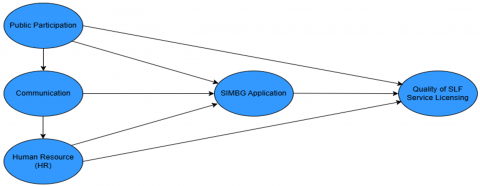
Figure 1. Factors influencing the quality of SLF service licensing through the SIMBG application
Figure 1 illustrates the interconnected factors influencing the Quality of SLF Service Licensing, with Public Participation, Communication, and Human Resources (HR) playing key roles in enhancing the SIMBG Application as a mediating variable. Public Participation directly impacts the adoption and efficiency of SIMBG, which improves licensing quality. Communication serves a dual function by directly influencing the SIMBG Application and acting as a bridge between Public Participation and HR, ensuring better coordination and understanding. HR (Human Resources) also plays a crucial role in improving both the SIMBG Application and the overall Quality of SLF Service Licensing, emphasizing the need for skilled personnel to facilitate digital processes. The SIMBG Application acts as a central mechanism that integrates these factors, streamlining licensing procedures and ensuring regulatory compliance. This model highlights that enhancing public engagement, strengthening communication, and investing in HR development can significantly optimize digital applications like SIMBG, ultimately leading to a more efficient and effective SLF licensing system.
The constructs and hypotheses regarding their interactions are illustrated in the conceptual model of Figure 2.
Figure 2. Operational research variables "optimizing local government capacity in SLF management in east Java" in 2024
The basic ethical principle in this research is honesty. This research uses honesty in collecting, analyzing, and presenting data. Not committing academic violations such as data manipulation, plagiarism, and falsifying research results are considered serious. The image is a Building Function Map of Surabaya City created by the Indonesian Open University, displaying different land-use functions. The legend categorizes buildings into residential, religious, business, social/cultural, and special functions, each represented by different colors. The map also outlines administrative boundaries, including district and subdistrict divisions. The inset map provides a broader geographic context of Surabaya’s location. This visualization helps urban planners, policymakers, and stakeholders understand the spatial distribution of building functions, supporting urban development, zoning regulations, and infrastructure planning.
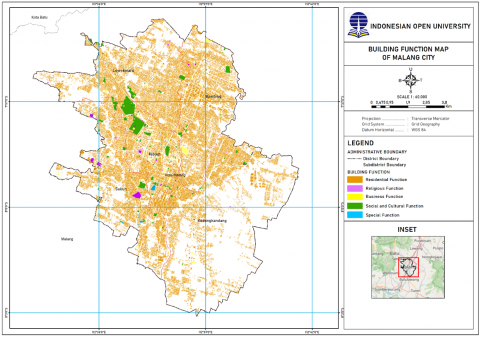
Figure 3 is a building function map of Malang City created by Universitas Terbuka, showing different land-use functions. The legend categorizes buildings into residential, religious, business, social/cultural, and special functions, each represented by distinct colors. The map also delineates district and subdistrict boundaries, providing an administrative overview. The inset map places Malang in a broader geographic context. This map serves as a valuable tool for urban planning, zoning regulations, and infrastructure development, helping policymakers and stakeholders make informed decisions regarding land use and city expansion.
Figure 3. Building function of Surabaya City and Malang City
This study optimizes technical service capacity to enhance public participation in SLF issuance. Low engagement affects compliance, as seen in Surabaya, where only 138 of 3,000 required SLF applications were submitted, leading to 800 warnings and safety risks. A mixed-method approach was used, with purposive sampling selecting 80 respondents in Malang and 120 in Surabaya. Questionnaires were distributed online and in person, while FGDs involved government officials, business associations, and technical experts discussing SLF challenges and solutions. Findings reveal that bureaucratic inefficiencies, lack of awareness, and digital system limitations hinder SLF compliance, supporting [1], who found similar regulatory obstacles in Sleman. However, this study contrasts with studies which focused on technical building safety issues rather than public participation barriers [2]. Jennings [4] emphasized policy enforcement for tourism buildings, this study highlights digital transformation and service capacity as key factors for improving compliance. These findings contribute to the broader discourse on e-governance and public service efficiency, suggesting that adaptive policies integrating digital solutions and stakeholder engagement can bridge regulatory gaps. Ethical standards were upheld through informed consent, confidentiality, and academic integrity, ensuring valid and unbiased conclusions.
This study directly aligns with its objective of optimizing technical service capacity to enhance SLF issuance. Findings show that bureaucratic inefficiencies, low public awareness, and digital system limitations hinder compliance, emphasizing the need for structured coordination, HR training, and improved digital integration. Public participation is crucial, yet remains low, reinforcing the importance of targeted outreach and simplified procedures. The results confirm that strengthening technical service capacity through policy adjustments, stakeholder engagement, and digital tools can significantly improve SLF processes, ensuring safer and legally compliant buildings.
The development of SLF Implementation in Indonesian Regencies and Cities shows that the enthusiasm of the community/public who own buildings is still open. This underscores the importance of community engagement in the development of Building Approval Submissions (PBG). Community participation is a crucial aspect of development policies, as it provides the community with more significant opportunities and authority to resolve issues [11]. From the analysis and calculation of the number of buildings based on the functions of Residence, Religious, Business, Social, Cultural, and Special amount according to the Google Maps map in Figure 3, the results of the building function are obtained in Table 1. The following is a map of the distribution of buildings and other buildings in the city of Surabaya and Malang as a target that is required to have a Certificate of Functioning (SLF), we can see the impact of this engagement, as shown in Table 1 and Figure 2.
Table 1. The number of existing buildings in Indonesian cities
|
No. |
Building Function |
Number of Buildings in Surabaya City |
Number of Buildings in Malang City |
|
1. |
Residence |
1,047,934 |
398,405 |
|
2. |
Religious |
2,538 |
2,052 |
|
3. |
Business |
4,209 |
1,346 |
|
4. |
Social and Cultural |
5,246 |
711 |
|
5. |
Special |
87 |
15 |
|
|
amount |
1,060,014 |
402,529 |
According to data from the Ministry of PUPR based on data from SIMBG, it shows that 66,293 people have applied for PBG, with 20,370 buildings that have been issued, while 16,108 buildings have applied for SLF and 3,827 have been issued/submitted. Buildings that apply for SLF compared to PBG are only 24.30%. PBG and SLF Utilization Status Data can be seen in Tables 2 and 3.
Capacity is very influential in achieving organizational goals; one aspect is the bureaucratic structure, a formal relationship system between tasks and authorities that control and coordinate resources to achieve goals. Scholars have identified several dimensions of organizational structure that influence the strategic decision-making process. For instance, March and Simon have argued that an organization's structure can impose "bounds of rationality" that help overcome the cognitive limitations of its members, thereby facilitating more effective decision-making [10].
Table 2. PBG utilization status
|
PBG Application |
Technical Service Process |
Licensing Service Process |
Reject |
|
Rejected |
||
|
The completeness of the document |
Consultation |
Retribution |
Payment |
Payment Validation |
Rise |
|
|
|
27.770 (Jan 22) |
17.633 |
4.224 |
612 |
1.107 |
2 |
4.133 |
59 |
|
66.293 (Jun 22) |
41.392 |
- |
- |
3640 |
- |
20.370 |
531 |
|
41.88 % |
42.60 % |
- |
- |
30.41% |
- |
20.29% |
11.11% |
Table 3. SLF utilization status
|
SLF Application |
Verification of Completeness |
BG Technical Service |
DPMPTSP |
Submitted |
|
6.324 (Jan 22) |
2.041 |
3.204 |
580 |
439 |
|
16,108 (June 22) |
- |
11.167 |
915 |
3.827 |
|
30.25 % |
- |
29.23 % |
63.39 % |
11.47% |
This was also conveyed by Hodge et al. [1] in their book: "Structure refers to the total of how an organization divides its labors into distinct tasks and then coordinates among them". "Organizational Behavior" defines organizational structure: "an organizational structure defines how job tasks are formally divided grouped and coordinated" [12]. The Bureaucratic Structure of the Building Technical Service in Indonesia follows a functional structure by dividing work according to the functional organization of building construction, starting from planning or design, construction implementation, control, and utilization because the SLF follows the building affairs under the Building Section. Currently, the section equivalent to echelon IV in the Service Structure no longer exists, and the Technical Service sub-coordinator has replaced it. According to the sub-coordinator of Public Works and Spatial Planning Buildings of Madiun City, "PBG and SLF management are handled by two Sectors, namely PBG in the Spatial Planning Sector and SLF in the Building Construction Sector." While the number of human resources in the building construction sector is only a few, on average, they serve in the tasks and functions of implementing building construction, many of which take care of local government projects. With the implementation of SLF permits in Regencies/Cities, some follow the settlement sector with PBG permits, some follow the building construction section. Like in Malang City, SLF management is in the building construction section, while PBG management is in the spatial planning sector. However, in the Malang City Government, PBG and SLF management are in the Cipta Karya sector. Meanwhile, in the city of Surabaya, the management of PBG and SLF is one at the One-Stop Integrated Investment and Licensing Service (DPMPTSP). Organizational Structure in two cities in East Java are shown in Table 4.
Table 4. SLF organizational structure and number of human resources
|
No. |
Regency/ City |
SLF Organizational Structure |
One in the Field of Creative Works |
|
1. |
Surabaya City |
Separately, SLF Services at DPMPTSP and Recommendations at the Housing and Settlement Service |
8 |
|
2. |
Malang City |
One in the Field of Creative Works |
11 |
Public involvement in a program is something that cannot be separated from the public interest in the application submitted, namely the SLF to the Regency/City Government through SIMBG, also concerning government programs for public services, so it cannot be separated from legislative supervision or members of the Regency/City DPRD in supervising the implementation of the executive. Moreover, there is a public report regarding the obligation of building structures to have SLF, especially for business function buildings such as hotels. The involvement of the public in government programs is a critical aspect of ensuring that these initiatives serve the public interest. This is particularly true in the case of the SLF submission process to the Regency/City Government through SIMBG, which concerns government programs for public services [13].
Public participation in such processes cannot be separated from legislative supervision or the involvement of members of the Regency/City DPRD in overseeing the implementation of these executive programs. Moreover, there are public reports regarding the obligation of building structures to have SLF, especially for business function buildings such as hotels [13, 14]. Therefore, the issuance of SLF is not only for single buildings but also for multi-story buildings such as apartments, office buildings, hotels, and shopping centers [15]. In that case, DPRD members will hold a hearing with the Regional Government and the community to find common ground in implementing SLF. Lincoln and Woodhouse stated: "The actions of policy implementers are considered to be political because they have the possibility of altering and influencing political decisions the basis of their knowledge, insights and interest" [2]. It is also said that there is political bargaining in the policy implementation process. Political bargaining is a reality that cannot be avoided when the implementation process occurs in the public domain, which contains heterogeneous interests. The interaction of actors from both government and non-government circles creates political dynamics that accompany the policy implementation process and will give rise to government actions supported by two things, namely, government resources and the goals achieved.
Non-government actors, as Kiviniemi [16], are pivotal environmental factors in the implementation process. The success of SLF policies hinges on a conducive policy environment, while a poor one can impede or even thwart the implementation of SLF policies. The influence of environmental factors, or public support, is a significant determinant in the policy process.
Interaction in the implementation process with its environment produces four categories or typologies of implementation, namely cooperation, conformity, counteraction, and detachment; the four typologies of implementation are the meeting of two main variables, namely first - stakeholder agreement on the contents of the policy, and second - resources owned by the stakeholders [16]. The results of the search for buildings that have SLF in the city of Surabaya are by the Jawa Pos news (https://surabaya.go.id/id/berita/67832/belum-memiliki-slf-dprkpp-surabaya-beri-peringatan-2740-pemilik-gedung). As stated by the Head of the Surabaya DRKP Service, Head of the Surabaya City Public Housing, Settlement Area, Public Works, and Spatial Planning Service (DPRKPCKTR), Irvan Wahyudrajad, said that of the 2,740 buildings, 138 buildings were still in the process of submitting SLF. "Meanwhile, we have reprimanded around 800 buildings until today (30/6)," said Irvan Wahyudrajad as reported by Antara. Irvan also emphasized that his party had never advised building owners or appointed a consultant to manage the SLF. According to Irvan, the SLF serves as a crucial benchmark for determining whether a building meets the technical eligibility requirements based on its function. Non-compliance, he stressed, could lead to potential future problems such as building collapse, fire, and other safety hazards.
The Chairperson of Commission A of the Surabaya City DPRD, Pertiwi Ayu Krishna, has previously raised concerns about the SLF implementation. Out of the 3,000 buildings, 2,700 still require SLF. Ayu suggested that multiple consultants should be involved due to the time-consuming nature of the task. Each building presents unique challenges, and it's not feasible to assign the responsibility to a single entity. The number of Buildings (BG) that are already operating and do not yet have an SLF is detailed in Table 5.
Table 5. Number of BGs that are already operating but do not yet have an SLF
|
No. |
BG Amount Not Yet SLF |
Submission Process |
Warning |
|
1. |
2740 |
138 |
800 |
Dozens of high-rise buildings in Surabaya City, East Java, do not have a Certificate of Functional Suitability (SLF) as a benchmark to determine whether a building has met the technical suitability requirements according to the function of the building. Member of Commission A of the Surabaya DPRD Imam Syafi'i in Surabaya, Wednesday (20/4/2022), said that 51 buildings in Surabaya did not have an SLF and had received a warning from the Surabaya City Government. "Some have expired permits, and some do not have habitable permits," he said.
Meanwhile, news on Surabaya. go.id: The Surabaya City Government (Pemkot), through the Public Housing and Settlement Area and Land Agency (DPRKPP), has issued a warning to 2,740 building owners in the City of Heroes. This warning was issued because the building owners still needed a Certificate of Functional Suitability (SLF).
"So, we are reprimanding the mandatory SLF, which we have recorded as many as 2,740 and reprimanded all of them. Because indeed many of them do not know what SLF is," said the Head of the Surabaya City Public and Settlement Areas and Land Agency (DPRKPP), Irvan Wahyudrajat, Monday (4/7/2022).
Irvan stated that the DPRKPP concentrates on tall buildings above eight floors, such as apartments, hotels, and malls. With the height of the buildings, he considered them to be more prone to structural damage.
"Because the residences are the highest and vulnerable if there is a fire, structural damage, and so on," he said.
Moreover, the issuance of SLF, a document that attests to The Local Government's proper building function, is not a mere formality. It is a meticulous process, involving thorough examination and measurement, to ensure that the building in question is truly worthy of its function and the SLF can be fully accounted for.
The determination of a building's eligibility for SLF issuance is a comprehensive process. It involves the measurement of its function based on a range of parameters [17, 18].
a. The building's safety level for residents and the environment is of utmost importance. The building must meet stringent safety requirements, including the ability to support the load and protection against hazards of fire and lightning, to ensure the well-being of its occupants;
b. The building has a Health level for residents and the environment. The health level of the building, in this case, includes a system of clean water, sanitation, and setting;
c. The building has a comfort level for residents and the environment. The functioning of the setting Air, room motion, and temperature can judge the comfort level of the building;
d. The building provides facilities for all users, including elderly and disabled groups. This includes setting to and from the functions of space support activities in the building.
Therefore, Irvan appealed to building owners in Surabaya to immediately take care of the SLF. This is regulated in Government Regulation Number 16 of 2021 concerning the Implementing Regulations of Law Number 28 of 2002 concerning Buildings.
"We have also made it easier by having desks in the office (DPRKPP) daily. Then, speed up the process through the Mayoral Regulation, which was previously 25 days for non-simple; it can be only 12 days," explained by Irvan.
In addition, he also ensured that the signature or person in charge of managing the SLF does not have to be through a consultant. It can be done directly by the building owner or the contractor.
"The signature does not have to be a consultant; it can also be the owner/owner or contractor. If they are willing to be responsible, whether in terms of structure or fire and waste protection, please sign," he said.
The former Head of the Surabaya City Transportation Agency (Dishub) stated that building owners could be subject to sanctions if they do not have an SLF. However, the DPRKPP will give warnings in stages before being given sanctions.
"So, after the third warning or warning, there is bantib (control assistance). If it is not ignored, we will seal it first, then close it," he added.
Therefore, Irvan again appealed to building owners in Surabaya to immediately take care of the SLF. Moreover, SLF management is now faster after the issuance of Surabaya Mayor Regulation Number 51 of 2022 concerning amendments to Perwali Number 14 of 2018 concerning the Certificate of Building Functionality.
"So, if you don't use a consultant, just fill in the checklist. Then the signature of the owner or person in charge is enough," he said.
As is known, the Certificate of Functionality (SLF) is a certificate issued by the regional government or central government to state the functional suitability of a building before the building is used (https://surabaya.go.id/id/berita?page=1&q=SLF). From the news above, there are only 138 applicants for SLF permits, while 800 buildings have been warned, while other buildings have not, even though.
The current SLF management through SIMBG does not require any human resources; it is sufficient with the number of existing human resources and often conducts socialization about SLF as well as assistance for the community and consultations on technical provisions for safety, health, convenience, and comfort aspects and is assisted by the Expert Professional Team (TPA) from the Stakeholder element for non-simple buildings. Technically, the implementation of SLF can be immediately recommended and issued by DPMPTSP. Technical equipment for construction is also an obstacle for applicants if SLF Management does not have to be carried out by one consultant. Many consultants already have SKA AR 103 for building maintenance and care according to Presidential Regulation Number 12 of 2021 concerning the Procurement of Goods/Services. If there is one consultant, the cost becomes a monopoly for the consultant; if there is more than one consultant, the building owner can choose an affordable cost for completing the technical provisions or Simak list in the SLF. DPRD supervision has been carried out on the performance of the Surabaya City Government DPRKPP regarding Buildings that do not yet have SLF. Head of Spatial Planning of Surabaya DPRKPP Reinhard Oliver revealed that until yesterday, his party had continued visiting all building and hotel managers. As a PHRI representative, Pugh stated that his party was trying to comply with the regulations. He ensured that all hotels were trying to take care of the SLF. "We are processing everything; we ask for time", he spoke [19]. According to the Metropolis Jawa Pos news on August 31, 2022. The Certificate of Functional Worthiness (SLF) application has been accelerated. Building owners only need to wait two days to get the document. The application for SLF is centralized at DPMPTSP. Through Perwali number 82 of 2022 concerning SLF, the Surabaya City Government has simplified the administration process. The City Government treats SLF conditionally. The application for SLF permits is intended for buildings to obtain SLF before all the requirements are met. Conditional SLF is issued two days after submission. Head of the Surabaya Public Housing, Settlement Areas and Land Agency (DPRKPP) Irvan Wahyudrajad said that "buildings that are already operating but do not yet have an SLF can obtain a conditional SLF, but the document is only valid for one year. Because, during that period, other requirements must be met by the building owner," he said. Another convenience is the fulfillment of the technical aspects of the SLF. To fulfill the health aspect of the building, the building owner can submit the documents to something other than the Health Office because the papers from the DPMPTSP are sent directly online to the Health Office. The Mayoral Regulation also regulates supervision and guidance. This is important to ensure that every building in Surabaya meets the SLF. For example, maximum supervision must be carried out by those involved in monitoring conditions in the field, such as technical studies and others. If there are deficiencies in the submission, the DPMPTSP will submit the results as technical recommendations that the building owner must fix. The maximum limit is 1 year until the SLF validity period is issued.
With the breakthrough in convenience for building owners, it is not simple to manage the SLF in the city of Surabaya; this is an example for other cities/regencies in Indonesia in managing the SLF because meeting the technical requirements takes a long time for building owners, especially for existing buildings. Although submitting a permit before the SLF is issued takes 3 days, this requirement is met if the files are complete. Usually, the applicant must complete the application first; this stage takes a long time for building owners, especially for existing buildings, because it requires files that must be fulfilled.
The number of human resources owned by an organization mandated to implement a policy will affect its capacity to carry out its mission to realize its goals [5]. With information technology through SIMBG, it is easier for the Technical Service and DPMPTSP bureaucratic apparatus to process SLF, starting from the technical aspect and ending with the issuance of SLF by DPMPTSP.
Commitment (motivation) and competence (expertise) are two essential requirements (two sides of the same coin) that must be possessed by personnel who are mandated to achieve policy objectives in the implementation of SLF. Commitment refers to the seriousness of personnel in carrying out the tasks given seriously. Commitment will contribute to producing maximum output if personnel have the expertise and competency to carry out the tasks [20].
In running the wheels of the organization, structure, and coordination are needed between those who carry out the tasks to achieve the goals achieved. Moreover, the implementation of SLF is carried out by two agencies, namely the Building Technical Service and the Investment and One-Stop Licensing Service (DPMPTSP). Coordination is integrating the goals and activities of separate work units to achieve organizational goals. Ansoff [3] said: "If the implementation is essentially a problem of cooperation, one might ask what inducements are available to bestir individuals, whether in one or multiple agencies, to work together toward a common police product" so that coordination and cooperation are carried out properly, Ansoff [3] put forward three supporting factors for reasonable coordination, namely: authority, common interest, and exchange. The three factors help unify various activities from different work units. It should be noted that the success of coordination is inversely proportional to the number of work units involved in implementing the SLF policy. Jennings [4] noted that coordination will be more difficult if more work is involved in implementing a policy.
3.1 Descriptive information
Based on Table 6, it can be concluded that 200 applicants for Building Function Certificates who were respondents in this study were from Surabaya City 60% and Malang City 40% with the most female gender 63% and males 37% in the 25–30-year category amounting to 32% and the type of SLF application in Surabaya City 60% and Malang City 40%.
Table 6. Demographic statistics of respondents
|
Demographic Statistic |
City |
Frequency |
Presentation |
|
City/District of origin |
Surabaya City Malang City |
120 80 |
60% 40% |
|
Gender |
Male Female |
74 126 |
37% 63% |
|
Age (years) |
18-24 25-30 31-35 36-40 41-45 46-50 51-55 |
56 63 36 23 13 5 4 |
28% 32% 18% 12% 7% 3% 2% |
|
Submission Type |
SLF |
200 |
100% |
|
SLF Management |
Consultant Others Others Myself |
61 3 31 105 |
31% 2% 16% 53% |
|
Building Function |
Office Building Residential Religious Special Socio-Cultural Business |
1 95 3 3 3 95 |
1% 48% 2% 2% 2% 48% |
3.2 Model analysis
The measurement model is assessed to ensure the quality of SLF service delivery using the standard operating procedure (SOP). The assessment is in the form of factor analysis, indicator reliability measurement, and discriminant validity. Each assessment has a minimum value recommendation. For outer loading items, the minimum is 0.7, Cronbach's Alpha (CA) internal consistency is 0.7, and the Average Variance Extracted (AVE) is at least 0.5. The study results showed that each construct's outer loading items and active CA were higher than the minimum value. The quality-of-service delivery in the SLF is an essential aspect of organizational success. To ensure the quality of SLF service delivery, the measurement model is assessed using the standard operating procedure. The assessment involves three key components: factor analysis, indicator reliability measurement, and discriminant validity [21, 22].
Furthermore, The AVE results for each construct exceeded the minimum threshold, confirming that validity was achieved. The complete results of the measurement construct are presented in Table 7. After evaluating the measurement model and analyzing the results, the data analysis proceeded with a structural assessment model to examine the hypothetical relationship between the constructs and the predictions of the conceptual model, which still contained six indicators.
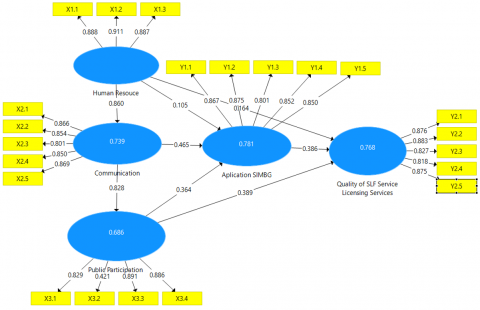
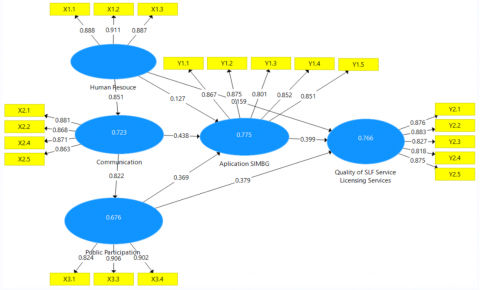
In the calculation using Smart PLS, the Independent Public Participation Indicator (X3.2) variable for indirect SLF services has a value of 0.421, which is below the required threshold of 0.8. As it does not meet the criteria, the calculation of Model 1 in Figure 4 is not used. Instead, Model 2 in Figure 5 is applied in the model analysis.
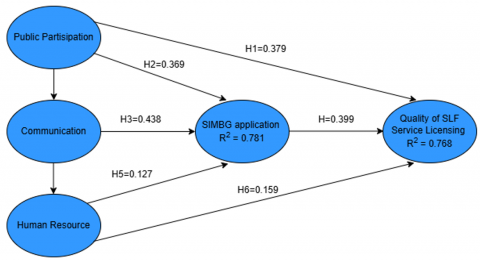
The figure represents a structural equation model (SEM) illustrating the relationships between Human Resources, Communication, and Public Participation in influencing the SIMBG Application, which ultimately affects the Quality of SLF Service Licensing Services. Human Resources directly impact Communication and SIMBG Application, indicating that skilled personnel enhance system efficiency. Communication acts as a bridge, connecting Public Participation and Human Resources to the SIMBG Application, showing that better engagement improves system adoption. Public Participation influences both Communication and SIMBG Application, emphasizing the importance of stakeholder involvement in regulatory compliance. SIMBG Application serves as a key mediator, demonstrating that a well-implemented digital system significantly enhances the Quality of SLF Service Licensing Services. The numerical values represent path coefficients, with higher values indicating stronger relationships. This model highlights that optimizing human resources, improving communication strategies, and increasing public engagement can enhance the efficiency and effectiveness of SLF licensing services through digital transformation.
Figure 4. Model 1 optimization of SLF technical service capacity (pls algorithm)
Figure 5. Model 2 optimization of SLF technical service capacity
Table 7. Measurement construct (pls algorithm)
|
Constructs and Items |
Outer Loadings |
Cronbach’s Alpha |
Composite Reliability (CR) |
Average Variant Extracted (AVE) |
|
X.1 Human Resource |
|
0.876 |
0.924 |
0.802 |
|
X.1.1 Number of Staff |
0.888 |
|
|
|
|
X.1.2 Skilled |
0.911 |
|
|
|
|
X.1.3 SIMBG Knowledge |
0.887 |
|
|
|
|
X.2 Communication |
|
0.894 |
0.926 |
0.758 |
|
X.2.1 Clarity |
0.881 |
|
|
|
|
X.2.2 Transmission |
0.868 |
|
|
|
|
X.2.4 SLF Information Transformation |
0,871 |
|
|
|
|
X.2.5 Effect |
0.863 |
|
|
|
|
X.3 Public Participation |
|
0.850 |
0.910 |
0.771 |
|
X.3.1 Directly |
0.824 |
|
|
|
|
X.3.3 Aspiration Needs |
0.906 |
|
|
|
|
X.3.4 Public Expectations |
0.902 |
|
|
|
|
Y.1 Application SIMBG |
|
0.903 |
0,928 |
0,722 |
|
Y.1.1 Perceived Usefulness |
0.867 |
|
|
|
|
Y.1.2 Application Requirements. Perceived Ease of Use |
0.875 |
|
|
|
|
Y.1.3 Attitude Toward Using Technology |
0.801 |
|
|
|
|
Y.1.4 Behavior Intention to Use |
- |
|
|
|
|
Y.1.5 Actual Technology Use |
- |
|
|
|
|
Y.2 Quality of SLF Service Licensing Services |
|
0.909 |
0.932 |
0.733 |
|
Y.2.1 Tangible |
0.874 |
|
|
|
|
Y.2.2 Reliability |
0.856 |
|
|
|
|
Y.2.3 Responsivities |
0.947 |
|
|
|
|
Y.2.4 Assurance |
0.916 |
|
|
|
|
Y.2.5 Empathy |
0.850 |
|
|
|
The table presents a reliability and validity assessment table commonly used in structural equation modeling (SEM) to evaluate measurement model quality. It includes five key components: Constructs and Items, which represent the latent variables and their indicators; Outer Loadings, indicating the correlation between each item and its respective construct; Cronbach’s Alpha, measuring internal consistency reliability; Composite Reliability (CR), assessing overall construct reliability; and Average Variance Extracted (AVE), determining the level of variance captured by a construct relative to measurement error. High values for Outer Loadings (>0.7), Cronbach’s Alpha (>0.7), CR (>0.7), and AVE (>0.5) indicate strong reliability and convergent validity, ensuring robust measurement quality.
3.3 Evaluation of measurement model
After running the PLS-SEM algorithm, the hypothetical relationship and path coefficients between constructs were evaluated. This study uses several criteria to assess the hypothesis, including coefficients, t-statistics, and p-values. The coefficient value indicates the relationship between variables; if the coefficient value is positive, the relationship between variables is positive. In this study, the significance level used was 5%, so it has a 95% confidence level, and the t-statistic value is 1.97. If the t-statistic value shows a value> 1.97, then the influence between variables is significant. P-values aim to test the significance of a research result; the p-value that must be obtained for the hypothesis to be accepted is <0.5% or <0.005. If the three criteria are met, the previously formulated hypothesis can be accepted, and vice versa; if one is not met, it means the previously formulated hypothesis is not accepted. Partial Least Squares Structural Equation Modelling has become an increasingly popular method for testing theorized relationships between latent variables [16]. Researchers often use PLS-SEM to evaluate hypothetical models and assess the significance of the paths connecting the constructs. When running PLS-SEM, scholars must consider several key criteria to determine whether the hypothesized relationships are supported by the data.
One crucial aspect is the examination of the path coefficients, which indicate the strength and direction of the relationships between the constructs [23, 24]. Figure 4 shows the positive effects of the three constructs on the adoption of Public Participation, Communication Human Resources, and SIMBG Application, as well as Quality of Service Liceng Servicing. Overall, the relationship hypothesis in H1-H3 is supported by data that emphasizes public participation, communication factors, and human resource factors as significant predictors of adopting SIMBG applications. In this case, all path coefficients in the constructs in the structural model meet this criterion. This result implies the importance of public participation factors, communication and human resources, and SIMBG Application for Quality Services buildings. The results indicate the importance of developing human resources, communication, internal SIMBG application, and SIMBG application development as factors affecting service building quality. To further test the model hypothesis, t-statistics were evaluated. The results shown by all constructs were significant. This result differs from several other studies where factors are insufficient to encourage the Quality of Building Permit Services to use e-business [5, 6]. In this study, the Quality of Building Permit Services is running well, with communication support, HR, and SIMBG applications through dispositions to improve the quality of building permits.
According to Hair et al. [7], the minimum value range used for the R2 value is 0.25, 0.5, and 0.75. These values are described as weak, moderate, and substantial, respectively. Based on the PLS-SEM algorithm, the value shows that the R2 for adopting the SIMBG Application is 0.781. This value shows that the three TOE factors explain 78.1% of the variance of the e-SIMBG Application. These results indicate that the conceptual Model has a sufficient predictive capacity to explain SIMBG, which plays a role in public application, communication, and human resources regarding the quality of SLF service licensing. In addition, adopting the SIMBG application can lead to an increase in the value chain indicated by the R2 value chain of 0.768. As the results show, adopting Public Participation and Communication through the SIMBG application dramatically affects the Model. The results generally describe the factors influencing the adoption priority, starting from public service factors, communication, and human resources factors. On the other hand, from the participation perspective, the SIMBG Application's good adoption in Service Capacity will provide added value to the SIMBg Application, especially in the value chain. The findings of this study are expected to contribute to the literature to improve participation and the quality of SLF services (Table 8 and Figure 6).
Table 8. Results of the measurement model hypothesis
|
Hypothesis |
Path |
Coefficient |
T-Statistic |
P-Value |
|
H1 |
Public Participation > Quality of SLF Service Licensing Service |
0.379 |
6.001 |
0.000 |
|
H2 |
Public Participation > application SIMBG |
0.369 |
3.973 |
0.000 |
|
H3 |
Communication > Application SIMBG |
0.438 |
4.106 |
0.000 |
|
H4 |
Communication > Public Participation |
0.822 |
28.822 |
0.000 |
|
H5 |
Human analysis > Application SIMBG |
0.127 |
1.051 |
0.294 |
|
H6 |
Human analysis > Quality of SLF Service Licensing Service |
0.159 |
2.271 |
0.024 |
|
H7 |
Human analysis > Communication |
0.851 |
32.202 |
0.000 |
|
H8 |
Application SIMBG > Quality of SLF Service Licensing Service |
0.399 |
5.604 |
0.000 |
Figure 6. Hypothesis results of the research model of local government capacity in managing SLF 2024
3.4 Qualitative results
The results of the discussion group forum held at the Investment and One-Stop Licensing Service Office (DPMPTSP) of Surabaya City and Malang City and the Public Works, Housing and Settlement Office of Surabaya City and Malang City that many obstacles occurred in the implementation of the SIMBG application as stated by the Head of the BG DPUPRKP Malang City Division said "The important thing is how to improve services to the community. If capacity is only increased or optimized, capacity and competence increase, but the service remains reasonable. This is only because of the output seen by the community so far. However, what is more important is improving services to the community, which may be simplification. From the rules of PP 16 of 2021, maybe you can research it and link it, and the center can provide input [22]."
"If the government's desire is still our company, it is simplification, acceleration, and cheaper licensing financing. It should be up to the ministry or near the government; there should also be a debureaucratization for governments and ministries."
"If that is not a standard that the agency must make but following the technical standards that have been taught, for example, the structural drawing is divided into anything, not just for a simple house, it is possible that there are drawings that do not need to be attached."
The Coordinator of the Building DPUPRKP Malang City said, "Yes. We have a service system. Service, sir. Service system for integration and contract conditions. Service system but not technical. For example, administrative acoustics are unique, not unique like that."
"Including spatial planning, which has been integrated. Then again, some elements of spatial planning are quite influential, and according to the community, the first five checklists are complicated. Because we do not still need an RDTR. The current RDTRK is already integrated with KBLI. So, when entering a plan for a company activity, the KBLI must be clear."
From the HR aspect, "there were four people, then one retired, so three, and now only two are holding the functional building and housing layout, while our DPT does not have any functional either but not building and housing layout, so it is as it is and previously we were here not only purely working on PBG/SLF so actually PBG/SLF was initially an additional task so there were already main tasks such as projects there was also planning then the moment of the activity was also there then entered PBG/SLF as an additional task, so the personnel who are HR who are here are not purely working."
In PBG/SLF services through SIMBG, "Many have been completed, but with the note that everything is complete, so, for example, we simulate from the application submitted by the applicant, entered the operator, we check everything is complete, we verify everything is correct, we calculate the retribution, we upload, we take care of the administration and sign all sorts of things, we upload it again it can be completed within 4 hours, but yes, the requirements are all complete and correct."
In PBG/SLF services for the community, the BG coordinator for Malang City said, "Because there are always simulations on how to upload applications. However, that is what I said earlier; sometimes, it is still difficult for individuals. Sometimes, when they go home from socialization, they forget. However, our invitations are from businesses such as hotels and the administrative affairs department. So, they understand better, and they are also quicker for us to continue. Because maybe it has already been needed from above. If it is for extending business permits, that is the difference, sir. For example, for acquisitions only, for households, sometimes the response is slow because there is no need for anything else. However, for businesses, it is for extending business permits."
The Coordinator of the DPMPTSP City of Malang Licensing Service said, "Our socialization is every year; the SIM-BG will be active in early 2022, we will start socialization in 2023-2023, there will also be 2024, and we plan to hold it in 2024, the first one was in February, the second one, God willing if the budget has been released in PHK, we will hold it.”
The Coordinator of the DPMPTSP City of Malang Licensing Service also said, "This has been provided about community participation in their research. They are in Malang City because the number of applicants in the queue is quite large, so we give it to the community to make their applications. They are also active, so when there are notes there, sometimes the applicant cannot follow up quickly."
We have been doing socialization for a year, coincidentally for this year, because the obstacles are many that stop at the applicant, so when there are notes from us, they take too long to respond to follow up on what must be fulfilled according to the notes. The following main issues can be identified from the FGD forum results in Malang City:
SLF context and licensing challenges: SLF management is becoming increasingly important in public services, especially after the enactment of new regulations. However, the challenges often faced are the licensing complexity and minimal public participation. Therefore, efforts are needed to simplify the process and improve digital systems such as SIMBG [8] to support smooth licensing.
Public participation and communication: Public participation in managing licensing, both independently and through consultants, is one of the critical factors in the success of the service. However, there still needs to be a greater public understanding of the licensing digitalization process, such as using SIMBG, which is often more complicated than the manual method.
SIMBG digital system: The use of the SIMBG application for managing SLF and building permits aims to make it easier for the public. However, several technical obstacles, such as system errors and slow applicant responses to corrections, must be overcome immediately. The Malang City Government is trying to improve this system to make it more effective.
The role of human resources and professional associations: The availability of competent human resources (HR) in handling permits is also essential. On the other hand, collaboration with professional associations such as IAI (Indonesian Architects Association) can help applicants meet the technical requirements for SLF management, especially for people who have difficulty accessing professional services.
Service improvement efforts: The Malang City Government plans to continue to hold socialization and technical consultations related to SIMBG and collaborate with various parties to accelerate licensing services. In addition, technological solutions and HR development will focus on improving the quality of services in the future.
Conclusion: Increasing the capacity of the apparatus and optimizing the digital system are essential steps in improving the quality of public services in Malang City. With support from various parties and simplifying the process, licensing services, especially SLF management, can run more efficiently and transparently.
Meanwhile, the results of the FGD in the city of Surabaya, the results obtained were Head of the Licensing Service Division of the Surabaya City DPMPTSP said, "We have had a guardian for SLF since 2018, so actually before there was PP no. 16 of 2021, Surabaya already had a guardian for SLF, guardian regulation 14 of 2018. Only after 2021 did people take care of SLF; it was a new thing, maybe even though it was a building law, but maybe it was socialization or something, and people might rarely take care of it. However, since PP 5 of 2021, SLF has been one of the basic requirements for a business license; finally, people have started to wonder, what is this SLF? What is the story like that? Finally, they took care of it; then we made a guardian regulation 84 of 2022; in other words, we provide convenience for SLFs whose buildings have been built first and already have a Building Permit but do not have an SLF. We are to win commitment; the term is 1 year after the SLF is issued. Finally, many responded that they would comply with the terms to take care of the SLF. In 2022, how many applications? If in 2022, according to the conditional SLF, the total is around 80. In 2022. In 2023, there are 100 applicants. Until this year, around 50? Now 50. Are there any standards, for example, what kind of building requires SLF? Yes, so if the simple SLF is 500 meters and above."
"Mandatory SLF, the first is a simple building above 2500 square meters, a simple building like that. As for residential houses, we, Surabaya, have not made SLF mandatory. So, the building capacity is 500 to 2500. Below that is not yet covered, it is mandatory." "So, we do; as I said earlier, the use is still regional, but we provide convenience for companies through ease of preparation, which is mandatory for SLF and not for SLF. The policy that was regulated earlier. Changes from Perwali 18 of 2014-2018. Perwali 16, 2018. So, if we are regulated in the Perwali, we follow PP 16 of 2021; we already have PP that also implements the Perwali, which focuses on PP, which is our rule. The policies taken by the city of Surabaya are the history of PP, 16 of 2021. We also include why we still use SSW; we have Perwali number 52 of 2023. So, if we do not use SSW, we can still use it. For SLF itself, sir, most of them are published in SSW. However, for the BBG application, we open two portals, SSW and SSW. Why do we open SSW? We provide easy requirements in SSW. So many people run to SSW. In BBG, they must follow the BBG application; only then can they enter. So why do we still practice SSW? It is difficult, sir; we innovate and provide easy requirements because they have to follow the application; that is the story."
The head of DPMPTSP Surabaya City said, "Since the first socialization, until 2023, in other words, we provide socialization about SLF related, there are company facilities in SLF. Hotel associations and industry associations are invited after the hotel association. Gas stations also take care of SLF. Moreover, hospitals. This hospital happens to be from the Health Office; this is also socializing, as all hospitals are required to take care of SLFs. So, if we do not use associations, maybe this company's awareness is lacking."
"HR in PTSP. It is just that these personnel are included in PTSP, but the budget still goes to their respective technical services. So, the term from Cipta Karya, the technical team is part of Cipta Karya, and then Damkar is also part of Damkar, but their work is responsible to us at PTSP. Because they may be there in terms of personnel, but their performance is below us. So, the budget for this PTSP team is charged to ABBD. Then, the TABG or source budget goes to Cipta Karya, sir. If I make technical recommendations later, the point is like that."
From the results of the Surabaya City Group Discussion Forum (FGD), the city of Surabaya has developed digital innovations in various public services to facilitate public access and efficiency. One example is the implementation of the SLF, which began to be regulated by a mayoral regulation in 2018, long before PP 16 of 2021. The main points are as follows:
The importance of SLF: The SLF is now an essential requirement for business permits, especially since BP 5 of 2021 issuance. Although the initial socialization could have been more optimal, since SLF became the main requirement, many business actors have begun to comply with this provision.
Increase in the number of SLFs: In 2022, the number of SLF issuances in Surabaya increased, with more than 100 SLFs issued, indicating public awareness of the importance of this certification.
Limitations and obligations of SLF: Buildings with an area of between 500 and 2500 square meters are required to have an SLF, while residential houses are not yet mandatory.
Ease of digital licensing: The Surabaya City Government provides convenience for the public in managing SLF through the Single Window System (SSW). Although sometimes there are technical obstacles, solutions, and improvements are made in less than 24 hours.
Challenges and obstacles: Although progress has been made, several obstacles still occur, especially related to administrative completion commitments, such as technical recommendations and the legality of long-standing buildings.
Socialization and collaboration: Continuous socialization through business associations, hotels, hospitals, and industries expands the reach of public awareness of SLF obligations.
Resource management: Human resources and the licensing budget are centralized in the Investment and PTSP Office, with technical support from related agencies such as Cipta Karya and Damkar, which facilitates coordination between parties.
Conclusion: Digital innovations implemented in Surabaya, such as SSW and the integration of various licensing systems, have increased the efficiency and transparency of public services. In the future, efforts to improve and simplify the process will continue to ensure the best service for the community.
From the SLF service problems in Malang City and Surabaya, there are five problems, namely HR, Communication, SIMBG Application, Disposition, and Quality, which are the applications with the most problems. Therefore, some previous research shows that the city of Surabaya was previously more familiar with the Building Management Information System (SIMBG) rather than SLF (certificate of functional eligibility). Before 2022, there were still many who still needed SLF, around 2,740 building owners in Surabaya. Still, after doing digital innovation, the Surabaya government can provide services effectively and efficiently in its service, especially in the function-worthy certificate, meaning that previous studies gave an idea that the city of Surabaya still leaves work in the management of function-worthy certificates. By the end of 2023, about 800 buildings will be in the government's attention for immediate follow-up.
The people of Surabaya who previously asked questions related to the function-worthy certificate, which was previously SIMBG, have now begun to recognize the change, which means that the people of Surabaya are now starting to realize the name of the function-worthy certificate (SLF) as a substitute for SIMBG because through changes in the Information System, little by little, there is an intensity of the community in applying for the function-worthy certificate.
In contrast to the city of Malang, people are more familiar with SLF because the socialization conducted by the government is the introduction of the function-worthy certificate (SLF) directly with the name of the function-worthy certificate. SIMBG and SLF have the same purpose, meaning that both systems serve the rights and obligations in managing land and building ownership to meet the standards and standard regulations set by the government, while the difference is only in the system and naming.
This study emphasizes the optimization of technical service capacity as crucial for increasing public participation in SLF issuance, where low awareness and bureaucratic complexity remain major obstacles, as seen in Surabaya, where only 138 out of 3,000 buildings applied for SLF, heightening safety risks. To address this, bureaucratic reform is needed by streamlining SLF application procedures and implementing conditional SLF for already operational buildings. Additionally, enhancing human resource capacity through technical training and increasing the number of experts is essential for a more responsive service. Optimizing digital technology (SIMBG) should include developing a real-time monitoring dashboard and improving the system's user interface for greater accessibility. A stronger public awareness strategy through social media campaigns, webinars, and free consultation services is also necessary to boost compliance. Furthermore, collaboration with the private sector and the community, such as engaging business associations and property developers, can accelerate compliance and introduce incentives for SLF-certified buildings, including easier credit access or tax reductions. Implementing these recommendations will promote a more efficient, transparent, and digital-based SLF licensing system, increase public compliance, and ensure higher building safety standards.
The authors thanked Universitas Terbuka, Indonesia for giving support to accomplish this research.
[1] Hodge, B.J., Anthony, W.P., Gales, L.M. (1996). Organization Theory: A Strategic Approach (5th ed.). Prentice Hall.
[2] Lindblom, C.E. (1993). The Policy-Making Process. Englewood Cliffs, NJ: Prentice Hall.
[3] Ansoff, H. (1992). Welcome to the journal of strategic change. Strategic Change, 1(1): 7-9. https://doi.org/10.1002/jsc.4240010104
[4] Jennings, J. (1999). Race and politics. Capital & Class, 23(3): 185-187. https://doi.org/10.1177/030981689906900121
[5] Chatzoglou, P., Chatzoudes, D. (2016). Factors affecting e-business adoption in SMEs: An empirical research. Journal of Enterprise Information Management, 29(3): 327-358. https://doi.org/10.1108/JEIM-03-2014-0033
[6] Putra, P.O.H., Santoso, H.B. (2020). Contextual factors and performance impact of e-business use in Indonesian small and medium enterprises (SMEs). Heliyon, 6(3): e03568. https://doi.org/10.1016/j.heliyon.2020.e03568
[7] Hair, J.F., Ringle, C.M., Sarstedt, M. (2011). PLS-SEM: Indeed a silver bullet. Journal of Marketing Theory and Practice, 19(2): 139-152. https://doi.org/10.2753/MTP1069-6679190202
[8] Heidrich, O., Kamara, J., Maltese, S., Re Cecconi, F., Dejaco, M. (2017). A critical review of the developments in building adaptability. International Journal of Building Pathology and Adaptation, 35(4): 284-303. https://doi.org/10.1108/IJBPA-03-2017-0018
[9] Kuncorowati, R.M., Winarni, A.T. (2021). Implementation of solo one data as a basis for regional development planning in the city of Surakarta. Jurnal Media Administrasi, 3(1): 58-65.
[10] Andini, A.D., Mustika, S., Arsya, R.H., Rahmi, U., Mustafa, N., Anjelina, R., Nindrea, R.D. (2019). Factors related to polycystic ovary syndrome among women in Asia population: A systematic. International Journal of Research and Review, 6(12): 300-305.
[11] Armstrong, M. (2009). Armstrong's Handbook of Performance Management: An Evidence-Based Guide to Delivering High Performance. Kogan Page Publishers.
[12] Goggin, M.L., Bowman, A., Lester, J. (1990). Implementation Theory and Practice: Toward a Third Generation. Scott Foresman & Co.
[13] Riau, D.P. (2021). Improving building permits through building management information systems in East Java Province: Case study of Madiun city and Gresik regency. Journal of Lifestyle and SDGs Review, 5(2): e03344. https://doi.org/10.47172/2965-730X.SDGsReview.v5.n02.pe03344
[14] Andini, D., Sahid. (2019). Problems in fulfilling the requirements for a certificate of suitability for vertical housing in the South Tangerang area. Seminar Nasional Komunitas dan Kota Berkelanjutan, 1(1): 279-287.
[15] Riau, D.P., Rulinawaty, Siswahyudi, D., Muhtarom. (2024). Strategies for implementing building operability certificate to improve performance of building management: A case study in Probolinggo City, Indonesia. The Scientific World Journal, 2024(1): 8749628. https://doi.org/10.1155/2024/8749628
[16] Miles, M.B., Huberman, A.M. (1984). Qualitative Data Analysis. Beverly Hills.
[17] Sugiyono, P.D. (2017). Business Research Methods: Quantitative, Qualitative, Combination, and R&D Approaches. Bandung: CV. Alfabeta.
[18] Ghozali, I. (2021). Partial Least Square Using SmartPLS 3.2. 9 Program for Empirical Research. Semarang (ID): Diponegoro University Publishing Agency.
[19] Sebayang, S., Nasution, A.P. (2020). The role of the community in establishing coastal area infrastructure in the village of Pahlawan, Tanjung Tiram subdistrict, Batubara regency, north Sumatra. In 4th Padang International Conference on Education, Economics, Business and Accounting (PICEEBA-2 2019), pp. 407-413. https://doi.org/10.2991/aebmr.k.200305.097
[20] Fredrickson, J.W. (1984). The effect of structure on the strategic decision process. In Academy of Management Proceedings, pp. 12-16. https://doi.org/10.5465/ambpp.1984.4978163
[21] Abdulkasan, M.A., Arguillas, D.J., Espinosa, F.Y.A., Pardillo, J.S. (2021). The extent of public participation in disaster risk reduction and management of Cotabato City, Mindanao.
[22] Setiawati, A. (2020). The urgency of a certificate of functional suitability (SLF) as protection of human rights for users/occupants of buildings. terAs Law Review: Jurnal Hukum Humaniter dan HAM, 2(1): 203-218. https://doi.org/10.25105/teras-lrev.v1i2.7104
[23] Abdulkasan, M.A., Arguillas, D.J., Espinosa, F.Y.A., Pardillo, J.S. (2021). The extent of public participation in disaster risk reduction and management of Cotabato city, Mindanao, Philippines. International Journal of Humanities Social Sciences and Education, 8(12): 8-22. https://doi.org/10.20431/2349-0381.0812002
[24] Grossardt, T., Bailey, K. (2018). Transportation Planning and Public Participation: Theory, Process, and Practice. Elsevier.