Marziya Daniyarova* | Gulnara Kurmanova | Agnieszka Wendland
© 2025 The authors. This article is published by IIETA and is licensed under the CC BY 4.0 license (http://creativecommons.org/licenses/by/4.0/).
OPEN ACCESS
After transitioning to a market economy, Kazakhstan has not managed to restore the former Soviet levels of agricultural production. Among the reasons for this are the decline of rural areas and the shortage of arable land for agriculture across the country. In response to these issues, this article examines the specifics of land share usage in Kazakhstan, which represent a transitional form of joint land ownership. The legal and economic nature of land shares is analyzed, as well as their role in reforming land relations under market economy conditions. Particular attention is paid to issues of effective land resource management, optimizing the use of land shares, and ensuring their legal protection. The goal of the study is to evaluate the mechanism of land share distribution and identify vulnerable regions. Key problems associated with the distribution, use, and transfer of land shares are identified, along with proposed solutions to address them. The research is based on the analysis of legal and regulatory frameworks, statistical data, and practical case studies, allowing for an assessment of the current state and prospects of the land share system in Kazakhstan. To identify issues within the mechanism, the study employed a survey method. Based on the survey results of land shareholders, it was concluded that the most fertile lands are being used highly inefficiently due to the concentration of land shares in the hands of unscrupulous land users. Spatial-temporal analysis and mapping methods were applied to study land usage in the most problematic region. To address the situation, examples of the successful utilization of the land share mechanism both within the country and abroad are provided. The importance of enhancing land management efficiency under changing climate conditions is emphasized.
agribusiness, agriculture, agricultural lands, Kazakhstan, land reform, land use, land use policy, shared land use
In the structure of Kazakhstan's land fund, agricultural land accounts for 44.3%, equivalent to 116.5 million hectares [1]. As of November 1, 2023, almost all of this land is state-owned (98.7%), with only 1.3% held in private ownership by citizens and legal entities. Privately owned agricultural land is predominantly used for peasant and farming operations (71.5%), commercial agricultural production (27.1%), and gardening or dacha construction (1.4%). For the first two objectives, privately held agricultural land is managed by peasant and farm enterprises (64.1%), partnerships and joint-stock companies (31.8%), agricultural production cooperatives (2.3%), state agrarian organizations (0.5%), and other non-state entities (1.3%). Consequently, the average land size is 334.3 hectares for farm enterprises, 3,962.4 hectares for partnerships and joint-stock companies, and 1,412.4 hectares for agricultural production cooperatives. In northern Kazakhstan, partnerships and joint-stock companies dominate, with large enterprises primarily managing agrarian activities. Conversely, peasant and farm enterprises, typically structured as individual entrepreneurial ventures, are predominant in the South.
The emergence of land shares accompanied the formation of this agricultural management structure during the transitional economy period following the collapse of the Soviet Union. These land shares represent a specific legal regime of shared ownership for agricultural land. While the term "land share" no longer appears in the country's legislative acts, the concept of a "conditional land share" persists. In this article, the authors use both terms interchangeably.
In 1991, to facilitate the redistribution of assets from former collective and state farms established during the collectivization of the 1930s, the government of the young republic adopted the Law of the Republic of Kazakhstan (RK) on Land Reform. This law laid the foundation for the privatization of agricultural land associated with these agro-formations [2]. According to the law, agricultural land was transferred into private ownership, with the allocation of land shares determined by the total area of agricultural land in a region and the rural population size [3]. The certificate of entitlement to a land share specifies the value of the share, the total area, and the composition of the land types.
Consequently, between 1993 and 2001, 2.3 million individuals were issued certificates for land shares [4]. Later, in 2005, the government adopted a resolution on transferring land share rights. By the end of 2004, land share owners were required to decide whether to lease their shares to a limited liability partnership (LLP), peasant farm, or cooperative, directly engage in farming on the land, or purchase their share outright [5].
As a result of the reform, 264,000 farming enterprises and over 20,000 agricultural organizations were established. Nearly two decades have passed since the reforms [6], yet the transition mechanisms for land shares remain problematic: more than 80,000 land shareholders are linked to 169 problematic enterprises, encompassing 4.1 million hectares of agricultural land. Furthermore, 868,000 hectares - spanning 2,661 land plots have been illegally pledged - as collateral to various financial organizations [7]. In response, the Amanat political party established the Zher Amanaty (Land Legacy) commission in the summer of 2022 to oversee the return of such lands [8].
Within a month of the commission's operation, approximately 1,000 applications were submitted by citizens, with nearly 30% related to reclaiming land and pastures in remote areas [9]. Media outlets frequently report on land disputes between shareholders and entrepreneurs, with headlines focusing on northern regions of the country [10]. Based on a media analysis conducted by the authors, numerous violations of the rights of shared land users across the country were identified. Shareholders facing challenges in managing their land assets can be categorized into five groups: (1) land rights illegally pledged as collateral to banks without their consent; (2) no receipt of dividends or other payments; (3) land rights transferred to third parties without their knowledge; (4) inability to withdraw from LLPs or cooperatives; and (5) difficulty in formalizing inheritance rights for land shares. Common shared land use in Kazakhstan is regulated by five legislative acts: the Civil Code of the Republic of Kazakhstan (RK), the Land Code of the RK, the Entrepreneurial Code of the RK, the Law of the RK "On Consumer Cooperatives," and the Law of the RK "On Limited and Additional Liability Partnerships." Article 98 of the Civil Code of the RK establishes the basis for dividing common property into shares, whereby shares are proportional to the contributions of cooperative members. Generated income is distributed among members, and in the event of liquidation, each member has the right to withdraw their share. Withdrawal of shares is only possible after the financial reporting period of the entity concludes, meaning that shareholders can exit a limited liability partnership (LLP) or cooperative only after the harvest and sowing are completed, predominantly during the winter period (Article 100 of the Civil Code of the RK). Upon the death of a cooperative member, heirs may continue their membership, but if they decline, they are entitled to a monetary equivalent of the deceased's share, a proportional net income, and monetary compensation for labor [11].
Foreign heirs, however, are unable to formalize ownership of the share due to a moratorium on the sale of agricultural land. This moratorium, enacted by Presidential Decree No. 248 on May 6, 2016, was extended until the end of 2026 [12]. According to Paragraph 1 of Article 33 of the Land Code of the RK, the sale of conditional land shares requires the purchase of the right to temporary compensated land use (lease). Formalizing lease rights in the shareholder's name requires the allocation of a share from the common property, with the procedure for allocation determined by the founding documents of the agro-formation to which these shares belong [13].
Despite the significant legal shortcomings in land relations, Kazakhstan ranks 10th in the world in terms of arable land area, with 35 million hectares [14]. However, the country has yet to regain the agricultural performance levels achieved during the Soviet Union era. Between 1990 and 2010, approximately 15-31 million hectares of land were abandoned and left unused [15]. For Kazakhstan, it is critical to avoid further mismanagement of land resources to prevent economic decline amid major challenges, such as rapid inflation, the global geopolitical crisis, climate change, and fragile socio-economic conditions [16]. Rational land use, in turn, should focus on increasing agricultural output and labor productivity [17].
Overall, the transition to a market economy has had a profound and painful impact on land relations in Kazakhstan, particularly on the functioning of agricultural enterprises [18]. The concentration of resources in the hands of large landowners has led to several social consequences, including a lack of motivation among citizens to engage in agriculture, accelerated urbanization due to the lack of rural employment opportunities [19, 20], and the underdevelopment of land ownership structures [21].
A potential solution to the issue of land shares could be the consolidation of these lands into cooperatives under the supervision of a state authority. The formation of cooperatives would ensure democratic governance of land resources, create new employment opportunities, and, through collective efforts and shared resources, contribute to mitigating the impacts of climate change [22].
To assess the state of the legal framework for land shares, the authors created a survey for land shareholders using Google Forms. The survey access link was shared via social media platforms, including Instagram, YouTube, WhatsApp, and Telegram. The survey consisted of 16 questions and was completed by 62 respondents from various regions of the country. The questionnaire was prepared in the two official languages of Kazakhstan. Respondents were selected based on their possession of land shares and their experience managing such lands. Of the 62 completed surveys, 57 were deemed valid, while five were excluded due to unreliable information. The unreliability of the responses was evident in answers to questions regarding the location of the land share (some respondents mentioned a city or a house plot) or the year the share was received. Many respondents had to be reminded of a land share before recalling its existence. The survey did not collect personal data, and to ensure data reliability, a single-response option linked to one Google account was implemented.
This study has limitations associated with the small sample size and the unequal distribution of respondents across the country's regions, which may pose challenges to reproducibility. These issues are attributed to the public's distrust of surveys and fears of fraudulent schemes. Questions about property ownership and its availability often raise skepticism about the motives of the researchers. As a result, the authors were unable to attract a larger number of participants. Regional limitations were influenced by the authors' location and the concentration of arable land in northern Kazakhstan, where a higher proportion of land shareholders is found.
Based on the survey results, regions with the most vulnerable legal regimes for land shares were identified. In studying these regions, the authors employed methods of spatiotemporal analysis and land use analysis. Data collection involved statistical methods and a monographic approach for the discussion and introduction sections. Statistical information was sourced from the National Bureau of Statistics of the Republic of Kazakhstan, while cartographic materials were obtained from the public cadastral map of the Unified State Real Estate Cadastre. Additionally, the authors conducted a field visit to a problematic region to compare the well-being of local settlements.
3.1 Identification of issues related to land shares
The survey results varied across regions and identified key issues in land share management.
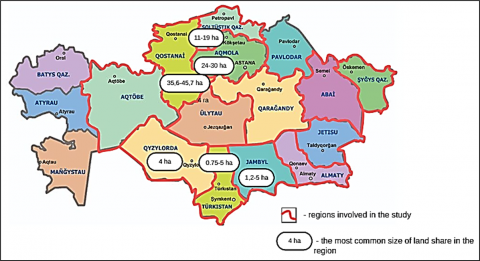
Regional distribution of respondents. Among the respondents, 22 individuals (38.6%) held land shares in Akmola Region, 16 respondents (28%) in North Kazakhstan Region, 7 (12.4%) in Turkestan region, 2 each in Zhambyl (3.5%), Kostanay (3.5%), and Aktobe Regions (3.5%), while one respondent each owned land shares in Kyzylorda, Abai, Zhetysu, Almaty, Karaganda, and East Kazakhstan regions (10.5%) (Figure 1). The regions that participated in the survey are highlighted in Figure 1. The urbanization level among respondents was 44%, with an increased trend of urbanization predominantly observed among individuals from the northern regions of Kazakhstan.
Period of acquisition. The land shares were predominantly acquired during the following years: 1996 (4 respondents), 1997 (4 respondents), 1994 (4 respondents), 1993 (3 respondents), and 1998 (1 respondent), comprising 28% of the total. An additional 11 respondents (19.3%) provided inaccurate acquisition dates, while 30 (52.6%) could not recall the exact acquisition period.
Land share sizes. The size of land shares varied significantly by region. The largest shares were reported in Kostanay Region (35.6-45.7 ha), Akmola Region (24-30 ha), and North Kazakhstan Region (11-19 ha). Common land share sizes are depicted in Figure 1. Ten respondents provided generalized family-based land sizes, with the largest family holdings reported in Aktobe (152-239 ha), Zhetysu (201.7 ha), Akmola (120-123 ha), and North Kazakhstan Regions (120 ha). The smallest land shares were in southern regions: Zhambyl (1.2-5 ha), Turkestan (0.75-5 ha), and Kyzylorda Regions (4 ha). Relatively small 6-8 ha shares were noted in some districts of Akmola and North Kazakhstan Regions. Additionally, 10 respondents could not specify their land share sizes.
Regional differences in the size of land shares were determined by the Resolution of the Government of the Republic of Kazakhstan No. 1232 dated August 7, 1997, titled "On the approval of the procedure for determining land shares and the sizes of land plots transferred free of charge for permanent land use to economic entities formed as a result of the reorganization or liquidation of agricultural organizations" [23]. According to this document, the size of a land share (in hectares) depended on the total area of agricultural land in the collective farm (kolkhoz) or state farm (sovkhoz) being divided and the number of individuals entitled to shares. The calculation involved dividing the total land area by the number of eligible citizens. Land quality was expressed in hectare points. Northern regions, possessing more arable land suitable for agriculture than other regions, were allocated larger land shares. In contrast, high population density and limited arable land in southern regions resulted in greater fragmentation of land shares. Contaminated lands, lands within settlements, and plots from special land funds (such as lands with legal status violations) were excluded from the calculation of land shares.
Changes in share sizes. When asked about changes in land share sizes, 25 respondents (43.8%) could not provide a clear answer, 26 (45.6%) reported no changes, and 6 (10.5%) confirmed alterations in share sizes.
Figure 1. Land shares size by region
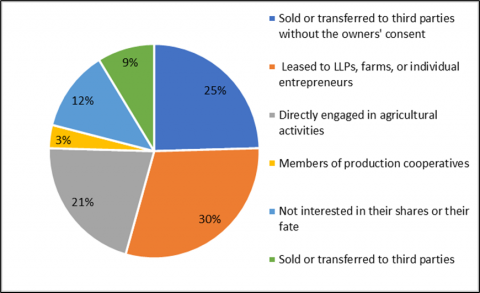
Current use of land shares. Regarding the current use of land shares, 14 respondents (24.6%) reported that their shares had been sold or transferred to third parties without their consent, with the majority being from North Kazakhstan Region (71.4%), followed by Akmola (2 respondents), East Kazakhstan (1 respondent), and Turkestan Regions (1 respondent). Seventeen respondents (29.8%) leased their land shares to agricultural enterprises such as LLPs, peasant farms, or individual entrepreneurs, primarily in Akmola (58.8%) and Aktobe Regions (2 respondents). Among those leasing their shares, 5 respondents regularly received dividends or other income, while 7 received payments in kind (livestock feed or flour). Occasionally, income was received through negotiation efforts by 3 respondents.
Twelve respondents (21%) actively engaged in farming on their land shares, primarily in Akmola (4 respondents), Turkestan (3 respondents), Almaty (1 respondent), Kostanay (1 respondent), North Kazakhstan (1 respondent), and Abai regions (1 respondent). Additionally, in Akmola region, 2 respondents (3.5%) indicated that their shares were part of a production cooperative. However, 7 respondents (12.2%) showed no interest in their land shares or their status, with shares located in North Kazakhstan, Akmola, Turkestan, and Karaganda regions. Four respondents (7%) sold or transferred their shares to third parties, with half of these transactions occurring in the Akmola region (Figure 2a).
(a) The current state of land shares
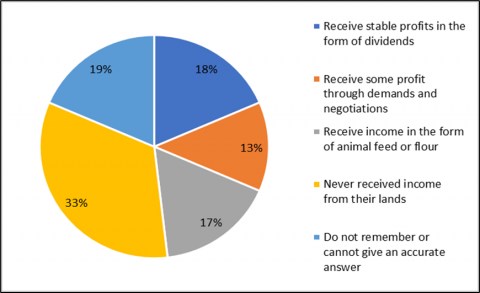
(b) Land shares profit assessment
Figure 2. Assessment of the current state and profitability of land shares
Profitability of land shares. Stable profits in the form of dividends were reported by 10 respondents (17.5%), half of whom held shares in the Akmola region, while 2 were from the Aktobe Region. Seven respondents (12.2%) occasionally received income through negotiations, while nine (15.8%) earned income from livestock feed or flour. However, the majority - 18 respondents (31.6%) reported no income from their land shares during their ownership. Ten respondents (17.5%) could not recall or provide accurate information about their income (Figure 2b).
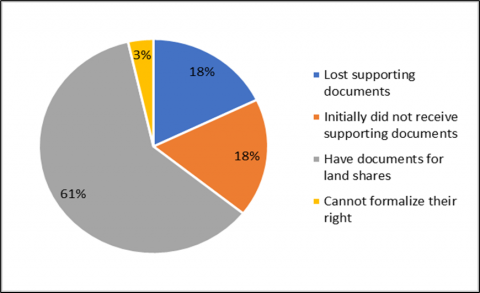
Availability of legal documents. Not all respondents retained legal documents for their land shares since the time of issuance. Among the 57 surveyed participants, 10 (17.5%) lost their documents, while another 10 (17.5%) were never issued such documents by local executive authorities. However, the majority, 34 respondents (59.6%), still possess the necessary documentation, while 2 (3.5%) reported being unable to formalize their ownership rights. Among those who never received documents, most were from the Akmola region (5 respondents) and North Kazakhstan Region (3 respondents) (Figure 3a).
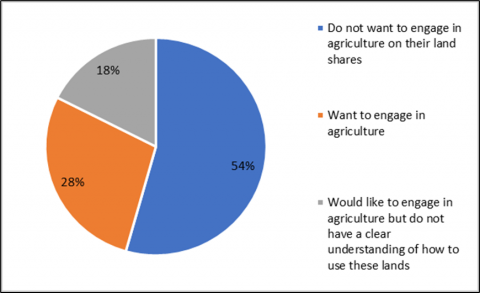
Desire to engage in agriculture. When asked about their willingness to engage in agriculture, most land shareholders - 31 respondents (54.4%) - expressed no interest in farming. Sixteen respondents (28.1%) indicated a desire to pursue agricultural activities, while 10 respondents (17.5%) expressed interest but lacked a clear understanding of how to utilize the land effectively (Figure 3b).
(a) Land shares documents availability
(b) Desire to engage in agriculture
Figure 3. Land shares documents availability and desire of survey participants to engage in agriculture
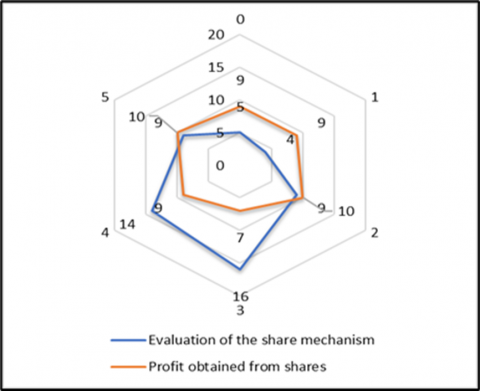
Evaluation of the land share mechanism. Respondents assessed the efficiency of the land share mechanism and its usage on a scale from 0 to 5. High ratings: 9 respondents (15.8%) rated the mechanism as excellent (5 points), and 14 (24.6%) as good (4 points). Moderate ratings: 16 respondents (28.1%) provided an average rating (3 points). Low ratings: 9 respondents (15.8%) rated it poorly (2 points), and 4 (7%) rated it as very poor (1 point), often citing negative experiences such as legal disputes. No confidence: 5 respondents (8.8%) assigned a zero rating. For comparative purposes, these ratings were matched with respondents' reported income levels from land shares (Figure 4a).
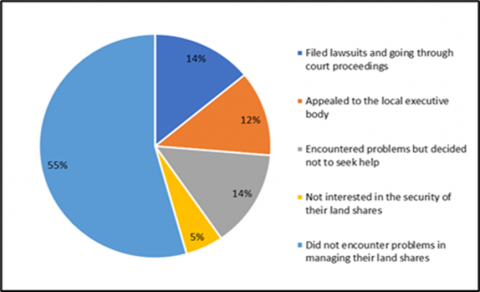
Challenges in property rights. Fifteen respondents (26.3%) reported disputes regarding their land share ownership. Among them, 7 (12.2%) sought assistance from local executive authorities, while 8 (14%) pursued legal claims and underwent court proceedings, primarily involving residents of North Kazakhstan Region (Akzhar district). Eight respondents encountered challenges but chose not to act, while 3 expressed no interest in protecting their land rights. Most respondents (31, or 54.4%) did not face any management issues, with half of them having sold, leased, or transferred their land shares (Figure 4b).
(a) Comparison of the levels of satisfaction and income from land shares
(b) Challenging property rights
Figure 4. Assessment of the legal and income aspects of land shares
Land productivity assessment. The profitability of land shares, including dividends, largely depends on land productivity. Among the respondents: unknown productivity: 21 (36.8%) did not know the productivity of their land. High productivity: 9 respondents (15.8%) reported high productivity, with 5 from northern regions. Sufficient productivity: 7 respondents (12.3%) noted sufficient productivity for regional needs (3 from Akmola region, 2 from Aktobe Region). Potential for improvement: 13 respondents (22.8%) believed productivity could be increased through improved methods. Low priority: 3 respondents (5.3%) did not consider productivity to be a significant factor (Figure 5a). The country's annual domestic grain demand is estimated at 8 million tons [24]. With an average yield of 10 centners per hectare, this is sufficient to meet the nation's internal grain requirements. Therefore, this yield level can be considered adequate to fulfill regional needs [25].
Future prospects of agricultural land. Based on their experience, 24 respondents (42.1%) believed that the future of agricultural land lies in enhancing state support for small farmers. Twenty-one respondents (36.8%) were unable to provide an assessment, while 7 (12.2%) identified interference from local latifundists and executive authorities as a barrier to realizing the land's potential. Five respondents (8.8%) had a positive outlook, expressing satisfaction with the current situation (Figure 5b).
(a) Land productivity assessment
(b) Assessment of the future of the lands
Figure 5. Assessment of land shares productivity and their future
Impact on food security. The respondents highlighted the connection between challenges with land shares and food security:
Urbanization and rural decline. Participants evaluated the role of the land share mechanism in rural decline caused by urbanization:
Impact on land quality. Regarding the influence of land share usage on agricultural land quality:
It can be concluded that the majority of respondents agree on the impact of the land share mechanism on food security, the decline in rural welfare, and the quality of agricultural lands.
3.2 Analysis of land use in the most challenging region
Based on the survey results, it can be concluded that North Kazakhstan and Akmola Regions are the most vulnerable in terms of compliance with joint land ownership rights among the participating regions. In the North Kazakhstan Region, seven land shareowners reported non-payment of dividends, while in the Akmola Region, six shareowners faced the same issue.
As evidenced by the number of shareowners who filed lawsuits and the number of legal proceedings, local entrepreneurs in the Akzhar district of North Kazakhstan Region failed to fulfill their obligations to eight land shareowners.
Meanwhile, the land productivity in the aforementioned region can reach up to 1.7 tons per hectare, according to the 2023 yield forecast (Figure 6) [26-28]. However, due to climate change, the productivity of these lands is expected to decline, which will consequently affect the region's well-being [29].
Figure 6. The forecasted yield of the North Kazakhstan Region, 2023 [27]
The payment of dividends to shareholders is directly dependent on the productivity of the land. It is noteworthy that in the neighboring Akmola Region, the average land productivity is lower compared to that in the North Kazakhstan Region; however, dividends there amount to 10% of the total gross grain harvest. In contrast, in the North Kazakhstan Region, dividends are twice as low, constituting only 5% of the total harvest. This trend has emerged as a result of agreements among agribusiness stakeholders and the consent of local residents to these terms. However, due to ongoing climatic changes, the productivity of these lands is expected to decline, which will consequently negatively impact the region's economic well-being [29].
Based on the survey results, special attention was drawn to the Akzhar district, specifically the Kenaschi rural district, due to the number of legal disputes reported. The district is located in the northeastern part of the North Kazakhstan Region and, owing to its location on southern and typical chernozem soils, specializes in grain cultivation. This is further confirmed by the significant proportion of arable land in the region [30].
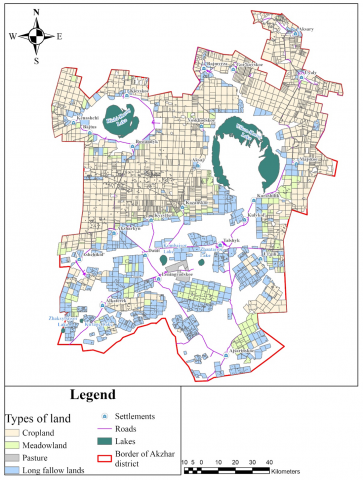
To the north, the district borders the Russian Federation. According to the Unified State Real Estate Cadastre, the total land area of the district is 804,317 hectares, of which 335,023.9 hectares (41.6%) are pastures, 125,581.2 hectares (15.6%) are fallow lands, 301,631.3 hectares (37.5%) are arable lands, and 42,080.6 hectares (5.2%) are hayfields. Notably, only 12 pastureland parcels (4,006.22 hectares) are registered to land users. The registered land areas of the district are shown in Figure 7, and almost all unallocated lands, officially categorized as "reserve lands," are designated as pastures [31]. On the map, the unallocated lands are highlighted in white.
The disputed land shares in the Kenaschi rural district are currently leased to four entrepreneurs: LLP "Satti Zher," LLP "Bestarau," "Anar" farm, and "Darkhan" farm. The land users are highlighted in Figure 8. According to Table 1, the largest entrepreneur among them is LLP "Satti Zher," which cultivates 7,906 hectares of land for wheat production. LLP "Bestarau" processes 2,183 hectares of land for the same purpose. "Anar" farm and "Darkhan" farm manage 548 hectares and 1,299 hectares, respectively, for the operation of crop farming enterprises. The total land fund of the rural district is 33,100 hectares; however, as indicated on the map, a significant portion of unallocated land, categorized as reserve land, remains available.
Figure 7. Agricultural lands of Akzhar district of North Kazakhstan Region
Figure 8. Land users utilizing land shares in the village of Kenaschi
Table 1. Information on land use in Kenaschi's shared lands
|
Land User |
Area, ha |
Type of Right |
Purpose of Use |
Type of Land |
Management Structures |
|
“Satti Zher” LLP |
7906 |
Temporary paid long-term common shared land use |
For agricultural production |
Arable land |
Limited Liability Partnership (LLP) - a legal entity classified as a medium or large enterprise, established based on the charter capital contributed by its participants. Taxes are paid depending on the organization's turnover. |
|
“Bestarau” LLP |
2183 |
Temporary paid long-term common shared land use |
Conducting commercial agricultural production |
Arable land |
|
|
“Anar” Farm |
548 |
Temporary paid long-term common shared land use |
Farming |
Arable land |
Farm Enterprise - not a legal entity, it can be registered as an individual entrepreneur. Typically classified as a small enterprise, formed based on family ties. It operates under a simplified taxation system. |
|
“Darkhan” Farm |
1299 |
Temporary paid long-term common shared land use |
Farming |
Arable land |
As shown in Figure 8, the lands previously owned by individual citizens have now become concentrated in the hands of large landowners, represented by the aforementioned land users. Consequently, the average size of landholdings is significantly large.
Through direct communication with survey participants, the authors determined that LLP "Satti Zher" currently controls the land shares of 616 shareholders. In the early 2000s, during the land reform, residents were required to transfer their land shares to agricultural producers under contractual agreements. At that time, LLP "Bogvi" was established and began cultivating wheat on these lands. Initially, village residents received dividends, flour, and animal feed. However, the situation deteriorated following the bankruptcy of the previous land user: dividends ceased, and neither flour nor animal feed was distributed. Employment opportunities in the village were always limited, and the LLP primarily hired external workers, failing to provide jobs for residents [32].
After 16 years, it was revealed that the shareholders' lands had been transferred to LLP "Satti Zher" through unlawful means. The previous LLP first mortgaged the lands to a bank and then declared bankruptcy. Subsequently, the shareholders' lands were auctioned off by the bank as the bankrupt entity's assets. Shareholders were neither informed of the mortgage nor the bankruptcy, nor did they consent to these actions [33]. Despite prolonged legal battles, the shareholders were unable to reclaim their rights. According to the appellate court's decision, the lands were declared the property of LLP "Satti Zher." Table 1 reflects the legal status of these lands under the Unified State Real Estate Cadastre (USREC), which lists them as "temporary compensated long-term shared land use." However, the court's recognition of lease rights as ownership raises legal concerns. The affected shareholders remain determined and continue to fight for their rights.
The unequal partnership between the aforementioned legal entities and the shareholders of the Kenaschi rural district has led to the complete decline of the village. The village has never had a fully functioning hospital, and its roads have always been rudimentary, as shown on the land-use map. Due to the lack of infrastructure, job opportunities, and an overall future, the working-age population has migrated to urban areas. In 2009, the village had 613 residents, but by 2024, this number had dropped to 288, with only 77 households remaining as of July 1 [34, 35]. According to official information from local authorities, the village's main specialization is livestock farming. However, due to violations of land share agreements, residents must purchase animal feed from neighboring villages.
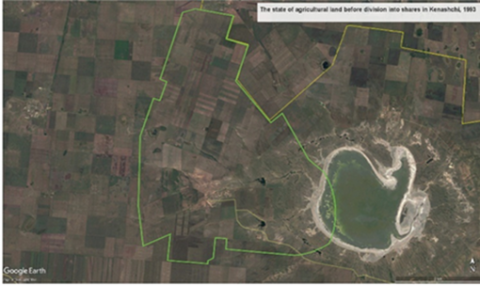
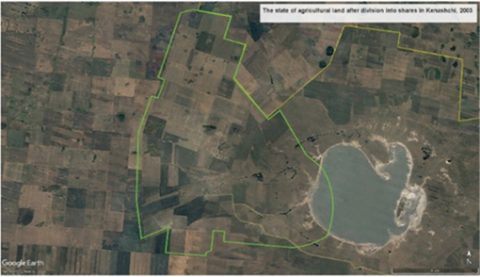
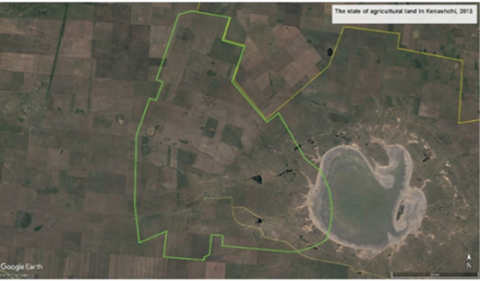
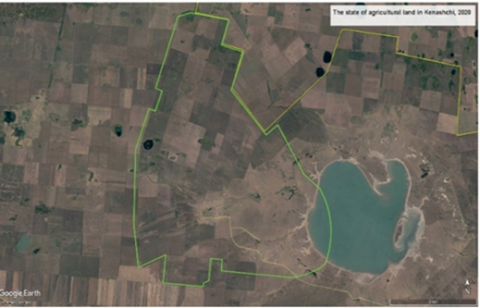
Changes in land relations have directly impacted the quality and condition of agricultural lands in the study area. These changes can be assessed through a spatial-temporal analysis from 1993 to 2020 (Figure 9).
(a)The state of agricultural land before division into land shares in Kenaschi, 1993
(b)The state of agricultural land after division into land shares in Kenaschi, 2003
(c)The state of agricultural land in Kenaschi, 2013
(d)The state of agricultural land in Kenaschi, 2020
Figure 9. The state of agricultural land in Kenaschi from 1993 to 2020
In 1993, before the distribution of agricultural lands into shares, land plots had clear but minimal boundaries, with a predominantly large-block structure of land distribution. The land was utilized uniformly, indicative of a centralized management approach. At this stage, agricultural lands demonstrated characteristics of intensive farming practices.
By 2003, during the final stage of the land reform - privatization of agricultural lands - the landscape had become fragmented and heterogeneous, with unclear plot boundaries. This reflects the underutilization of land during this period and the emergence of small-scale farming practices.
In 2013, the density of land use declined further. Many plots remained uncultivated, with blurred field boundaries and visible signs of abandonment.
By 2020, during the pandemic, most fields showed widespread neglect. Field boundaries were almost completely erased, and signs of shrub encroachment were evident. These observations suggest that land-use control was at a low level, with many plots falling out of agricultural circulation.
An analysis of the land dispute involving shares in Kenashy reveals that the primary causes of inequity were informal relationships rooted in kinship ties, both among the residents of Kenashy and the management of the LLP. The legal aspects of share ownership were largely overlooked by the shareholders due to their trust in the village administration and the cooperative, which was based on familial and friendly connections among the small number of families residing in the village.
3.3 Comparison of joint land management practices
A contrasting example of the effective and positive use of the mechanism of land shares can be observed in the village of Novonikolskoe in the Kyzylzhar district of the North Kazakhstan Region. This village offers everything a rural resident might desire: well-furnished new houses with sewage systems and water supply, a well-equipped school, a sports complex, and even wind energy utilization. Notably, the village has high-quality, smooth asphalt roads both within its boundaries and in its surrounding areas [36].
The village's prosperous future is attributed to the efforts of a dedicated local entrepreneur, who previously served as the director of the local collective farm. In 1997, he established the limited partnership "Zenchenko and Company," focusing on dairy farming, grain cultivation, and growing potatoes and onions [37]. Presently, the village has a population of over 2,000, with numbers steadily increasing due to positive migration - a rare phenomenon in rural areas of the northern region. All village residents are employed in enterprises under the partnership, including a dairy farm, a feed mill, a bakery, two peasant farms, and one farming enterprise.
The dairy products from "Zenchenko" are widely available in grocery stores and enjoy high demand across the country [38]. According to residents, many have sold or leased their land shares to the partnership. In turn, the partnership provides loans at preferential rates for various purposes and ensures the community's welfare through income derived from agricultural lands.
The success of Zenchenko can be attributed to its unique management structure in the form of a limited partnership. In this type of arrangement, general partners bear unlimited liability for the partnership's obligations with all their assets and manage its operations, while limited partners—in this case, the holders of land shares, who are the village residents—bear limited liability, meaning they are protected from risks and do not participate in management [39]. The dissolution of a limited partnership is possible if all general partners withdraw, unless otherwise stipulated in the agreement. Moreover, such a partnership is an association of individuals and not a legal entity. In the case of Kenashy, land shares were managed by an LLP (Limited Liability Partnership), where all participants have equal rights, participate in management, and bear risks with their assets. All decisions are made either by the director or through collective agreement among participants. The termination of an LLP's activities is decided by its participants, or it may be liquidated due to bankruptcy. The bankruptcy of the LLP "Menzhinskoye" led to the loss of land share rights by the residents of Kenashy.
The conscientious and efficient land management of the limited partnership "Zenchenko" has positioned the Kyzylzhar district as a leader in agricultural production: the gross output of agricultural products in the district amounted to 84,309.5 million tenge, whereas the opaque land management practices in Kenashy did not contribute to increasing the gross agricultural output of the Akzhar district (23,934.0 million tenge) [40]. Thanks to the taxes paid by the limited partnership "Zenchenko," the budget of the village of Novonikolskoye has been optimized - out of 76,099 thousand tenge, 67,744 thousand tenge is allocated from the district budget. In comparison, the budget of the village of Kenashy amounts to 63,328.4 thousand tenge, of which 62,725 thousand tenge is allocated from the district budget [41]. This indicates that Kenashy is operating at a deficit and requires improved land management efficiency [42].
Examining the challenges faced by other citizens in managing their land shares, it can be concluded that a centralized approach to managing agricultural lands offers several advantages. A prime example of such an approach is the formation of cooperatives by uniting individual farmers. Cooperatives, created from pooled land shares, can motivate small farms to enter the market while ensuring sufficient protection of participants' rights [43, 44].
Community-based agriculture has a positive impact on food security, particularly by fostering the development of local production and distribution chains based on fairness [45-47]. However, co-management of land has its downsides: these systems prioritize crop yields, which can negatively affect biodiversity [48-52]. Achieving a balance between biodiversity conservation and shared land ownership is possible when sufficient land is allocated for these purposes [53, 54].
Owing to the advantages of cooperatives, such as ensuring food security, providing access to markets, and reducing production costs [55], they have become the predominant form of agricultural organization globally, with their numbers reaching 1.2 million associations worldwide [56]. Despite their success, cooperatives face market pressures and are compelled to adapt to demand for survival, lest they be absorbed by larger enterprises [57]. As with any form of joint ownership, large cooperatives often encounter management challenges rooted in mistrust among members [58].
In Kazakhstan, cooperatives as a form of joint land management are not sufficiently popular. The most engaged region in cooperatives is Turkestan Oblast, located in southern Kazakhstan, where cooperatives account for nearly 15% of land use. In other regions, their share does not exceed 5%, and in the studied North Kazakhstan Region, the share of cooperatives is less than 1%. Cooperation has positively impacted agricultural efficiency in Zhambyl Oblast: gross output increased by 34%, dairy processing rose by 79%, and meat processing grew by 58% [59]. The high proportion of small farms with limited access to markets and resources underscores the need for cooperation in the country's agriculture [60].
Forms of land management have undergone changes driven by political decisions and technological advancements. Joint ownership of agricultural land existed in many countries long before socialism. However, countries that transitioned to socialist regimes in the last century primarily experienced mass collectivization. Post-Soviet countries share a similar transitional mechanism to a market economy, resulting in unresolved issues of joint land ownership [61, 62].
A situation similar to Kazakhstan's emerged in Hungary following the end of the socialist regime and subsequent land reforms: land was distributed based on value shares without specifying particular plots and became highly fragmented due to unregulated inheritance rights (less than 2 hectares per person). This mechanism only facilitated collective land management and hindered agricultural development in Hungary [63]. In 2012, 170,000 owners submitted applications to terminate joint indivisible land ownership concerning 53,500 plots. Consequently, in 2013, the state implemented legislative measures to combat land fragmentation, capping the maximum farm size at 300 hectares [64]. In 2021, legislation on terminating joint indivisible land ownership came into effect, allowing land division based on agreements among co-owners according to their shares, with a minimum farm plot size set at 10,000 square meters. This innovation prevented further fragmentation, eliminated existing fragmentation, and limited state intervention in land management [65].
Following collectivization in the second half of the 20th century, collective land ownership based on villages emerged in China. Although collective farms, as a management form, faced criticism due to increased state control, they have since adapted to the market economy [66]. Common lands are leased to farmers for 30 years under contracts, with village councils serving as the governing body. As before, most decisions within collective ownership are subject to state oversight. The need for land share redistribution arose due to shrinking family sizes caused by urbanization and state policies [67]. The impact of rural collective economy policies on residents' living standards is viewed positively: this mechanism reduces production costs by 19% and increases agricultural efficiency by 10% [68]. Collective land management in China meets social needs and utilizes natural resources rationally [69].
The state played a central role in managing fragmented agricultural land in Japan. After World War II, the state purchased agricultural land from absentee landowners and sold it to tenant farmers, allocating 1 hectare per farmer [70]. So-called "land improvement projects," led by land committees, assisted farmers in automating field processes and reducing production costs through land consolidation [71]. These measures helped Japan rebuild its agricultural sector.
The most successful model of joint land use emerged in Denmark: farmer cooperatives dominate the processing and marketing of agricultural products, jointly owning land and machinery. Cooperatives account for over 90% of the market, with a 94% share in the dairy market [72]. More than half of the turnover in Denmark's agri-food industry is attributed to cooperatives. Between 2003 and 2018, the income of farmer cooperatives doubled that of companies in other sectors [73].
Based on the analysis of these countries' experiences, it can be concluded that Kazakhstan should establish a dedicated state body for managing land shares, whose primary task would be consolidating and integrating land shares into cooperatives, as well as developing specific legislative norms for managing land shares and joint land use. The absence of such legislation reflects weak state attention to land relations issues.
The formation of a sustainable agricultural land management model is particularly relevant in the context of climate change. Increasing aridity caused by rising temperatures negatively impacts rainfed wheat production in the northern regions of the country [74]. For instance, a 1°C temperature increase leads to a 6% reduction in wheat yield [75]. Soon, the combined effects of reduced precipitation and rising temperatures could potentially shift Kazakhstan's position in the grain market [76]. Overall, Kazakhstan's agriculture is characterized by unpreparedness for climate change, particularly in terms of water availability and the resource limitations of small farms [77]. Adapting to climate change impacts requires significant resources from landowners, but it is essential to first address the primary legal obstacles to agricultural development at the state level and emphasize the consolidation of farmers' resources.
Like the country's Constitution, the Land Code of the Republic of Kazakhstan guarantees the preservation of land rights and land shares. However, due to reforms and transformations, land shares have significantly suffered as a transitional form between the old and new economic regimes. This has profoundly impacted the welfare of rural residents and the overall attractiveness of agriculture, even in regions with high yields. Climate change, land degradation, and global economic instability are the primary drivers necessitating more rational management of agricultural lands. Kazakhstan should develop specific legislative norms to regulate issues related to joint land use. This research can serve as a foundation for further exploration of the consequences of transitioning to a market economy and the causes of instability in Kazakhstan's agricultural sector.
[1] Ministry of Agriculture of the Republic of Kazakhstan, Committee for Land Resources Management. (2023). Consolidated analytical report on the state and use of the Republic of Kazakhstan lands for 2023. Astana.
[2] Supreme Council of the Republic of Kazakhstan. (1991). On the protection and use of historical and cultural heritage objects. Adilet. https://adilet.zan.kz/rus/docs/Z910001400/, accessed on Jul. 5, 2024.
[3] Abuov, K.K., Kulmaganbetova, A.S. (2017). Development of land ownership relations in the Republic of Kazakhstan. Problems of the Agro Market, (4): 157-162. https://www.jpra-kazniiapk.kz/jour/article/view/1419/828.
[4] Kulmaganbetova, A.S., Abuyov, K.K., Akhmetova, N.Z. (2018). Development of the land market in the Republic of Kazakhstan. European Research Studies, 21(4): 545-556. https://doi.org/10.35808/ERSJ/1142
[5] Spector, M.D., Garkushina, V.V. (2022). Thirty years of land reform (1991-2021). Land Management, Cadastre, and Land Monitoring. https://doi.org/10.33920/sel-04-2205-02
[6] Liberal land reform in Kazakhstan? The effect on land rental and credit markets. (2021). World Development, 138: 105285. https://doi.org/10.1016/j.worlddev.2020.105285
[7] Eldala, the main agrarian site of Kazakhstan. (2023). 868 thousand hectares of agricultural land illegally mortgaged in Kazakhstan. https://eldala.kz/novosti/kazahstan/14647-v-kazahstane-868-tys-ga-selhozugodiy-nezakonno-peredany-v-zalog, accessed on Jul. 7, 2024.
[8] Amanat Party. Official website. https://amanatpartiasy.kz/?lang=ru/, accessed on Jul. 8, 2024.
[9] Egemen Kazakhstan newspaper. (2023). Rapid response results of the “Zher Amanaty” commission. https://egemen.kz/article/320517-zher-amanaty-komissiyasynynh-dgedel-dgelisine-mynhgha-dguyq-otinish-tusti, accessed on Jul. 9, 2024.
[10] Aikyn newspaper. (2023). Land disputes remain unresolved. https://aikyn.kz/250456/zher-dauy-azaymay-tu-r, accessed on Jul. 10, 2024.
[11] Civil code of the Republic of Kazakhstan. (2024). https://online.zakon.kz/Document/?doc_id=1013880, accessed on Jul. 11, 2024.
[12] Land use decree. (2016). https://adilet.zan.kz/rus/docs/U1600000248#z0.
[13] Land Code of the Republic of Kazakhstan. (2003). https://adilet.zan.kz/rus/docs/K030000442_/, accessed on Jul. 12, 2024.
[14] Halyk Finance. (2023). Agriculture development in Kazakhstan. https://halykfinance.kz/download/files/analytics/AC_agriculture_development.pdf/, accessed on Jul. 12, 2024.
[15] Lesiv, M., Schepaschenko, D., Moltchanova, E., Bun, R., et al. (2018). Spatial distribution of arable and abandoned land across former Soviet Union countries. Scientific Data, 5: 180056. https://doi.org/10.1038/sdata.2018.56
[16] Zhou, Y., Zhang, L., Fensholt, R., Wang, K., Vitkovskaya, I., Tian, F. (2015). Climate contributions to vegetation variations in Central Asian drylands: Pre- and post-USSR collapse. Remote Sensing, 7: 2449-2470. https://doi.org/10.3390/rs70302449
[17] Yelemessov, S., Zhildikbayeva, A. (2022). Rational use of agricultural land in Kazakhstan. Baltic Surveying, 17. https://doi.org/10.22616/j.balticsurveying.2022.17.006
[18] Garcia, R.J., Lins, D.A., Lattz, D.H. (1996). The process and progress of agricultural sector privatization in Kazakhstan. Journal of Euromarketing, 5(4): 81-98. https://doi.org/10.1300/J037v05n04_05
[19] Nurzhanova, G.I., Tleubayeva, A.T., Niyazbekova, S.U., Ilyas, A.A., Maisigova, L.А. (2023). Improvement of agricultural policy in Kazakhstan for rural labor potential. In Digital Agriculture for Food Security and Sustainable Development of the Agro-Industrial Complex, pp. 1-19. https://doi.org/10.1007/978-3-031-27911-9_8
[20] Turashbekov, N., Kalykova, B., Ordabayeva, G. (2023). Development of rural areas in agricultural policy implementation. Problems of AgriMarket, (4): 66-74. https://doi.org/10.46666/2023-4.2708-9991.06
[21] Pyagay, A.A., Zhekeyeva, K.K., Tatikova, A.U., Tulegenova, Z.U. (2019). Development of agro-industrial complex of Kazakhstan: Problems and solutions. Bulletin of "Turan" University, (1): 193-200. https://vestnik.turan-edu.kz/jour/article/view/687?locale=ru_RU.
[22] Zhu, J., Wang, S. (2022). Research progress on agricultural land stock cooperative. BCP Business & Management, 27(1): 363-368. https://doi.org/10.54691/bcpbm.v27i.1983
[23] Ministry of Justice of the Republic of Kazakhstan. (1995). Law of the Republic of Kazakhstan on State Registration of Rights to Real Estate (No. 2723, December 20, 1995). https://adilet.zan.kz/rus/docs/P970001232_/, accessed on July 16, 2024.
[24] APK-Inform. (2023). Kazakhstan's domestic grain needs are fully met - Smailov. https://www.apk-inform.com/ru/news/1527436/, accessed on Jul. 17, 2024.
[25] Prime Minister of the Republic of Kazakhstan. (2023). New harvest will fully meet Kazakhstan's needs for bread and flour. https://primeminister.kz/ru/news/novyy-urozhay-pozvolit-polnostyu-obespechit-potrebnosti-kazakhstana-v-khlebe-i-muke-26177/, accessed on Jul. 17, 2024.
[26] Committee on Statistics. (2023). Regional spreadsheets and productivity data. https://stat.gov.kz/ru/region/sko/spreadsheets/, accessed on Jul. 18, 2024.
[27] Kazhydromet. (2023). Wheat yield forecast by district. https://margin.kz/news/11685/ot-4-9-ts-ga-kazgidromet-opyblikoval-prognoziryemyu-yrozhainost-pshenitsy-v-razreze-raionov/, accessed on Jul. 17, 2024.
[28] Kazhydromet. (2024). Drought and productivity forecasts. https://agrodata.kazhydromet.kz/#/forecasts/drought-productivity/, accessed on Jul. 20, 2024.
[29] Teleubay, Z., Yermekov, F., Rustembayev, A., Topayev, S., Zhabayev, A., Tokbergenov, I., Garkushina, V., Igilmanov, A., Shelia, V., Hoogenboom, G. (2024). Comparison of climate change effects on wheat production under different representative concentration pathway scenarios in north Kazakhstan. Sustainability, 16(1): 293. https://doi.org/10.3390/su16010293
[30] U.S. Department of Commerce. (2022). Kazakhstan agricultural sector overview. https://www.trade.gov/country-commercial-guides/kazakhstan-agricultural-sector/, accessed on Jul. 21, 2024.
[31] Unified state real estate cadastre. Public cadastre map. https://map.gov4c.kz/egkn/, accessed on Jul. 18, 2024.
[32] Agroblog_KZ YouTube channel (2023). Kenashchi and the legacy of LLP "Bogvi" [Video]. https://www.youtube.com/watch?v=dkJfHIWbapA&list=UULFRcTwsDQy9I49WMnkmqLXYw&index=44/, accessed on Jul. 23, 2024.
[33] Agroblog_KZ YouTube channel (2024). Residents and landowners of the Kenashy village attempt to reclaim seized lands [Video]. https://www.youtube.com/watch?v=NRy1O-scR6A&list=UULFRcTwsDQy9I49WMnkmqLXYw&index=19/, accessed on Jul. 25, 2024.
[34] Committee on Statistics. (2023). Spreadsheets on socio-economic indicators. https://stat.gov.kz/ru/region/sko/spreadsheets/?industry=1517&year=&name=&period=&type=/, accessed on Jul. 27, 2024.
[35] Akzhar Regional Administration. (2022). Development updates on agricultural lands. https://www.gov.kz/memleket/entities/sko-akzhar/press/article/details/92475?directionId=_18055&lang=ru/, accessed on Jul. 22, 2024.
[36] Petropavlovsk News. (2023). Novonikolskoe: An ideal village in Northern Kazakhstan. https://pkzsk.info/novonikolskoe-idealnoe-selo-na-severe-kazakhstana/, accessed on Jul. 28, 2024.
[37] Zenchenko & Co. (2023). Partnership news. https://www.zenchenko.kz/novosti/62-kommanditnoe-tovarishchestvo-zenchenko-i-kompaniya/, accessed on Jul. 28, 2024.
[38] Administration of the Novonikolskoe Rural District, Kyzylzhar District, North Kazakhstan Region. (2023). Socio-economic passport of the rural district. https://www.gov.kz/memleket/entities/kzh-novonikolsk/documents/details/524317?lang=kk/, accessed on Jul. 29, 2024.
[39] Republic of Kazakhstan. (1995). On business partnerships: Law of the Republic of Kazakhstan No. 2255 of May 2, 1995. https://adilet.zan.kz/rus/docs/U950002255_#z50/, accessed on Jul. 29, 2024.
[40] Government of the Republic of Kazakhstan. Information on resettlement within Kazakhstan. https://www.enbek.kz/ru/resettlement/48001/1761/, accessed on Jul. 30, 2024.
[41] Government of the Republic of Kazakhstan. (2022). On approval of the budget of the Kenashinsky rural district of the Akzhar district for 2023-2025: Resolution of the Government of the Republic of Kazakhstan. https://adilet.zan.kz/rus/docs/G22SD00295M/, accessed on Jul. 30, 2024.
[42] Government of the Republic of Kazakhstan. (2022). On approval of the budget of the Novonikolsky rural district of the Kyzylzhar district for 2023-2025: Resolution of the Government of the Republic of Kazakhstan. https://adilet.zan.kz/rus/docs/G22SH01917M/, accessed on Jul. 31, 2024.
[43] Francesconi, G.N., Wouterse, F. (2022). The potential of land shareholding cooperatives for inclusive agribusiness development in Africa. Annals of Public and Cooperative Economics, 93(1): 161-176. https://doi.org/10.1111/APCE.12314
[44] Geng, L., Yan, S., Lu, Q., Liang, X., Li, Y., Xue, Y. (2023). A rural land share cooperative system for alleviating the small, scattered, and weak dilemma in agricultural development: The cases of Tangyue, Zhouchong, and Chongzhou. Agriculture, 13(9): 1675. https://doi.org/10.3390/agriculture13091675
[45] Fieldhouse, P. (1996). Community shared agriculture. Agriculture and Human Values, 13: 43-47. https://doi.org/10.1007/BF01538226
[46] Wittman, H., Dennis, J., Pritchard, H. (2017). Beyond the market? New agrarianism and cooperative farmland access in North America. Journal of Rural Studies, 53: 303-316. https://doi.org/10.1016/J.JRURSTUD.2017.03.007
[47] Evtushkova, E. (2020). Use of land shares in common ownership of agricultural land (based on the materials of Sibir LLC in Yalutorovsky District of Tyumen Region). Bioconferences, 17: 00252. https://doi.org/10.1051/bioconf/20201700252
[48] Gilroy, J., Edwards, F., Uribe, C., Haugaasen, T., Edwards, D. (2014). Surrounding habitats mediate the trade‐off between land‐sharing and land‐sparing agriculture in the tropics. Journal of Applied Ecology, 51: 1337-1346. https://doi.org/10.1111/1365-2664.12284
[49] Cannon, P., Gilroy, J., Tobias, J., Anderson, A., Haugaasen, T., Edwards, D. (2019). Land‐sparing agriculture sustains higher levels of avian functional diversity than land sharing. Global Change Biology, 25: 1576-1590. https://doi.org/10.1111/gcb.14601
[50] Baudron, F., Govaerts, B., Verhulst, N., McDonald, A., Gérard, B. (2021). Sparing or sharing land? Views from agricultural scientists. Biological Conservation, 259: 109167. https://doi.org/10.1016/J.BIOCON.2021.109167
[51] Birch, B., Mills, S., Socolar, J., Martínez-Revelo, D., Haugaasen, T., Edwards, D. (2024). Land sparing outperforms land sharing for Amazonian bird communities regardless of surrounding landscape context. Journal of Applied Ecology, 61(5): 940-950. https://doi.org/10.1111/1365-2664.14596
[52] Edwards, D., Gilroy, J., Thomas, G., Uribe, C., Haugaasen, T. (2015). Land-sparing agriculture best protects avian phylogenetic diversity. Current Biology, 25: 2384-2391. https://doi.org/10.1016/j.cub.2015.07.063
[53] Rey Benayas, J.M., Bullock, J.M. (2012). Restoration of biodiversity and ecosystem services on agricultural land. Ecosystems, 15: 883-899. https://doi.org/10.1007/s10021-012-9552-0
[54] Kremen, C. (2015). Reframing the land‐sparing/land‐sharing debate for biodiversity conservation. Annals of the New York Academy of Sciences, 1355: 52-76. https://doi.org/10.1111/nyas.12845
[55] Guyalo, A.K., Ifa, L.T. (2023). Impact of agricultural cooperatives on the food security status of households in Oromia regional state, Ethiopia: The case of Halu Woreda. Cogent Economics & Finance, 11(2): 2237716. https://doi.org/10.1080/23322039.2023.2237716
[56] EOS Data Analytics. Agricultural cooperatives: Importance, types, pros & cons. https://eos.com/blog/agricultural-cooperatives/, accessed on Aug. 3, 2024.
[57] Ajates, R. (2020). Agricultural cooperatives remaining competitive in a globalised food system: At what cost to members, the cooperative movement and food sustainability? Organization, 27(2): 337-355. https://doi.org/10.1177/1350508419888900
[58] Qorri, D., Felföldi, J. (2024). Research trends in agricultural marketing cooperatives: A bibliometric review. Agriculture, 14(2): 199. https://doi.org/10.3390/agriculture14020199
[59] Akimbekova, G.U., Baymukhanov, A.B., Kaskabaev, U.R. (2023). Creation of agricultural cooperatives: Implementation of activities in the framework of the pilot project aimed to increase the incomes of the rural population in the Zhambyl region of the Republic of Kazakhstan. Problems of AgriMarket, 1: 181-189. https://doi.org/10.46666/2023-1.2708-9991.20
[60] Egizbayeva, G.K., Egizbayev, B.K., Karibayev, M.B., Zharylkassyn, Z.K. (2022). Theoretical aspects of cooperation and the state of agricultural collaboration in Kazakhstan. Bulletin of Turan University, (2): 117-124. https://doi.org/10.46914/1562-2959-2022-1-2-117-124
[61] Lipski, S. (2019). Joint shared ownership of land as a condition and factor of the agricultural sector in post-soviet Russia. Studies on Russian Economic Development, 30: 74-78. https://doi.org/10.1134/S107570071901012X.
[62] Piras, S., Botnarenco, S. (2018). Problems of farm succession in the post-Soviet space: Insights from the Republic of Moldova. Journal of Land Use Science, 13(6): 631-644. https://doi.org/10.1080/1747423X.2019.1603332
[63] Food and Agriculture Organization of the United Nations. Chapter 5: Land tenure and rural development. In Land Tenure and Rural Development. https://www.fao.org/4/ad878e/AD878E05.htm#TopOfPage, accessed on Aug. 4, 2024.
[64] Csák, C. (2017). The regulation of agricultural land ownership in Hungary after land moratorium. Zbornik Radova, 51: 1125-1135. https://doi.org/10.5937/ZRPFNS51-14099
[65] Árvai, G. (2023). The liquidation of undivided common land ownership in Hungary. Journal of Agricultural and Environmental Law = Agrár- és Környezetjog. https://doi.org/10.21029/jael.2023.35.7
[66] Nolan, P. (1988). The Political Economy of collective Farms: An Analysis of China's Post-Mao Rural Reforms (1st ed.). Routledge. https://doi.org/10.4324/9780429313639
[67] Huang, Z. (2018). Social obligations of land rights on Chinese collective-owned land. Journal of Civil Law Studies, 10: 6. https://digitalcommons.law.lsu.edu/jcls/vol10/iss1/6/.
[68] Zheng, Y., Zheng, L., Zheng, Y. (2022). The configuration path of the new rural collective economy to promote the common prosperity of farmers: Based on qualitative comparative analysis method and the rural cases in Zhejiang, China. Systems, 12(256): 1-19. https://doi.org/10.3390/systems12060256
[69] Jiang, F., Jiang, Y., Peng, J., Lv, Y., Wang, W., Zhou, Z. (2023). Effects of rural collective economy policy on the common prosperity in China: Based on the mediating effect of farmland transfer. Frontiers in Environmental Science, 11: 1302545. https://doi.org/10.3389/fenvs.2023.1302545
[70] Kawagoe, T. (1999). Agricultural land reform in postwar Japan: Experiences and issues. World Bank Policy Research Working Paper 2111. https://doi.org/10.1596/1813-9450-2111
[71] Arimoto, Y. (2011). The impact of farmland readjustment and consolidation on structural adjustment: The case of Niigata, Japan. Institute of Economic Research, Hitotsubashi University, CEI Working Paper No. 2011-3. https://www.researchgate.net/publication/254420444.
[72] Amherst Global Education Blog. (2020). Historical and experiential analysis of the sustainability of the Danish food system. https://amherstglobaleducationblog.sites.amherst.edu/2020/historical-and-experiential-analysis-of-the-sustainability-of-danish-food-system/, accessed on Aug. 6, 2024.
[73] Hansen. H.O. (2020). Danish farmer cooperatives: Development, importance and lessons. Cooperativismo & Desarrollo, 29(119): 1-34. https://doi.org/10.16925/2382-4220.2021.01.03
[74] German Society for International Cooperation (GIZ) GmbH. (2021). Economy-wide effects of adaptation in agriculture: Sectoral policy brief. GIZ. https://www.giz.de, accessed on Aug. 8, 2024.
[75] Shmelev, S., Salnikov, V., Turulina, G., Polyakova, S., Tazhibayeva, T., Schnitzler, T., Shmeleva, I. (2021). Climate change and food security: The impact of some key variables on wheat yield in Kazakhstan. Sustainability, 13(15): 8583. https://doi.org/10.3390/su13158583
[76] Yu, X., Luo, H., Wang, H., Feil, J. (2020). Climate change and agricultural trade in central Asia: Evidence from Kazakhstan. Ecosystem Health and Sustainability, 6: 1766380. https://doi.org/10.1080/20964129.2020.1766380
[77] Barrett, T., Feola, G., Khusnitdinova, M., Krylova, V. (2017). Adapting agricultural water use to climate change in a post-soviet context: Challenges and opportunities in southeast Kazakhstan. Human Ecology, 45: 747-762. https://doi.org/10.1007/s10745-017-9947-9