Suci Megawati* | Muhammad Alfarizi | Muhammad Rezky Syamsul
© 2024 The authors. This article is published by IIETA and is licensed under the CC BY 4.0 license (http://creativecommons.org/licenses/by/4.0/).
OPEN ACCESS
Economic development faces global challenges including economic inequality, financial crises, and environmental damage. The SDGs 2016-2030 provide a framework for sustainable development. Indonesia, while experiencing rapid economic growth, grapples with significant environmental issues. The green government aims for ecological sustainability but faces uneven implementation at district and city levels. This study examines the impact of green service design, sustainability governance, and information analysis on public service performance and local SDGs. Utilizing quantitative surveys, the study explores how green government models affect public service performance and local SDG achievement, testing six variables and eight hypotheses with a Likert scale. Data collected from civil servants in Sidoarjo Regency was analyzed using PLS-SEM to assess complex variable relationships. Findings highlight the role of green service design in enhancing green government service excellence. Investing in environmentally friendly services improves government quality, efficiency, and transparency. Sustainability governance and information analysis facilitate data-driven decision-making and operational efficiency. Effective green government services boost public service performance and support local SDGs, such as energy efficiency and waste management. The study underscores the significance of sustainable policies, information management, and innovation in achieving local sustainable development goals.
green government, green service design, information analysis, public service performance, sustainability orientation
Economic development is experiencing global challenges, including economic growth gaps, financial crises, and environmental damage that have the potential to endanger future life. In 2015, the United Nations implemented the Sustainable Development Goals (SDGs), which are valid from 2016 to 2030. The SDGs consist of 17 foundations of sustainable development and are a continuation of the Millennium Development Goals (MDGs) that were in effect from 2000 to 2015 [1]. The SDGs combine the agreement in the MDGs with sustainable development goals for future generations.
Indonesia is experiencing rapid economic growth but faces serious challenges in high energy consumption, rising greenhouse gas emissions, and severe air and water pollution [2]. Industrial growth and urbanization exacerbate environmental damage, including deforestation and land degradation. Sustainable development efforts must be strengthened to address these negative impacts. To meet people's expectations for a better life, environmentally friendly development is an inevitable choice in sustainable development efforts. Green development is essential for advancing Indonesia's ecological civilization and ensuring economic sustainability and social welfare [3].
The Indonesian government is responsible for the command of sustainable development, and all government officials need to be more environmentally aware so that the policies and actions carried out are always pro-green and pro-sustainable development [4]. Therefore, the intended role is to maintain regional sustainability and preserve the country's territory through two fundamental concepts: pro-green government and pro-sustainable development [5]. This is further strengthened by Indonesia's National Medium-Term Development Plan 2020-2020, which encourages governance strategies to maintain environmental quality, including actions to reduce greenhouse gas emissions, preserve biodiversity, sustainable waste management, and reforestation of urban areas [6]. Community participation and cooperation between the government, the private sector, and non-governmental organizations are essential to achieve a healthy and sustainable environment for future generations.
Green government is a government concept that integrates the principles of sustainability and environmental protection in all aspects of its policies and operations [7]. This includes reducing carbon emissions, using renewable energy, effective waste management, and preserving biodiversity [8]. Governments that adopt this approach are committed to sustainable development, improving the quality of life of their citizens, and safeguarding ecosystems for future generations. Indonesia is committed to implementing green government practices through various policies and programs, including greening state institutions, energy consumption management, environmentally friendly transportation, renewable energy for office consumption, and 3R-based waste management [9]. However, it seems that the application of green government on the local government scale is still uneven. This is evidenced by the lack of publication of successful green government practices that should be part of the Regency/City SDGs Action Plan. Adiyanta [10] stated that Local Governments of Regencies/Cities in Indonesia still do not understand green government practices, including the key to service design standards. This means that the local government lacks a definite environmental sustainability strategy. In addition, the lack of attention to collecting and analyzing information data about the environment can be a barrier [11]. Without solid data, it is difficult for governments to make the right decisions to protect the environment. Solid planning and greater emphasis on information and analysis are needed to guide effective green policies.
Research on green government has evolved from the early 1990s to now. Marron [12] highlighted the role of government procurement as an environmental policy instrument, while Geng and Doberstein [13] show efforts to build capacity in government procurement in developing countries such as China. Owen et al. [14] focus on government policies to support green innovation at an early stage, while Lin et al. [15] explore the influence of government publicity on people's pro-environmental behavior. Finally, Chen et al. [16] examined the relationship between government environmental concerns and corporate green innovation, particularly in companies that contribute significantly to pollution in China.
Evidence from the latest study finds resonance in the concept of green government with service design, data-driven decisions, and government orientation on sustainability [17, 18]. Service management researchers develop service design as a sustainable community-centered approach to developing new services [19]. Service design is a multidisciplinary concept that includes logistics and information technology perspectives. There is quite a lot of evidence in the service innovation literature that uses service design as an assessment of the company's ability to respond to market needs and business competition [20-22]. However, few understand service design as an organizational capability. Service design synergy helps decision-making in developing a green government-based governance strategy. On the other hand, information and analysis are another critical factor in data-driven decision-making strategies [23]. The more information you have, the higher the performance and the higher the competition. However, information alone is insufficient if it is not accompanied by careful analysis to convey its meaning [24, 25]. Therefore, the government's information analysis ability is needed to improve learning for the government sector in decision-making, including the design of green government services. Sustainability governance orientation is crucial because it ensures that government services are efficient and considers long-term environmental, social, and economic impacts to realize quality and sustainable services [26, 27].
The research gap that emerges is the lack of understanding of service design as a capability of public service organizations in the context of green government. Although much of the literature discusses service design as a tool to assess a company's ability to respond to markets and competition, studies examining the synergy of service design with governance strategies are limited. In addition, although information and analysis are recognized as critical factors in data-driven decision-making, there have not been many studies that have explored integrating information analysis in the design of green government services to improve the efficiency and sustainability of government services. Another critical gap is the lack of green government modeling studies on local Regency/City/District governance in Indonesia and other countries.
To address these challenges, this study aims to explore key factors that drive green government service excellence at the local level in Indonesia, with a focus on service design, sustainability governance orientation, and data-driven information analysis. Specifically, this research investigates two primary questions:
RQ1: What are the essential elements of green service design, sustainability governance orientation, and information analysis that enhance green government service excellence?
RQ2: How does green government service excellence impact local public service performance and the achievement of SDGs at the district/city level?
The study's objectives include identifying effective strategies for implementing green government across diverse local contexts and providing actionable insights to strengthen environmentally sustainable policies. By addressing gaps in the current literature, this study contributes to public policy management by offering a framework that links green government practices with improved public service performance, supporting Indonesia's commitment to the SDGs and fostering socio-economic and environmental resilience at the local level.
2.1 Green government
The term green government is often associated with lush trees or beautiful expanses of green grass, giving the impression of being calm and pleasant. According to Lin et al. [15], green government refers to the efforts of authorities, in this case, governments at the national and local levels, who work to build sustainable communities. In other words, green government refers to government institutions that strive to create a green and sustainable environment.
In the context of sustainable development, green government has the primary function of building a sustainable society [28]. This process is complex and requires a complete and comprehensive design so it does not sacrifice environmental sustainability [29]. This is important so that the environment's carrying capacity does not decrease and the availability of natural resources is maintained. The term "green" is often associated with fertility, as in the term green city, which has various designations such as garden city, sustainable city, ecocity, and others [30].
A literature review shows that green government policies are effective in promoting sustainability. According to research by Shao and Chen [31], implementing green policies in major cities has significantly reduced CO2 emissions and improved air quality. In addition, a study by Naruetharadhol et al. [32] highlights the importance of economic incentives in encouraging the private sector to invest in green technologies. In addition, the green government encourages the private sector to invest in green technologies and sustainable business practices [33]. Governments can facilitate innovation in the green economy through regulations and incentives, create jobs, and advance inclusive and sustainable economic development. Thus, the green government plays a crucial role in achieving the SDGs, ensuring environmental and social well-being for future generations.
2.2 New Public Service Management theory
New Public Service Management (NPSM) emerged in the 1980s as a critique of the traditional public administration model that was considered bureaucratic, rigid, and inefficient [34]. The private sector's ideas inspire NPSM and emphasize Customer Orientation, performance management, decentralization, collaborative competition, and employee empowerment [35]. NPSM emphasizes the values of democracy, citizen participation, and public services oriented to the public interest [36]. In contrast to NPM, which adopts a business and efficiency approach, NPSM emphasizes the importance of transparency, accountability, and collaboration between the government and the community.
In its implementation, NPSM invites the government to be more open in the decision-making process, encourage active participation from the community, and ensure that public policies are formulated based on the public interest [37]. NPSM also emphasizes the importance of cross-sector collaboration and information technology to increase transparency and citizen participation [38]. Thus, NPSM offers a more humane and democratic approach to public sector management, which is expected to increase public trust in the government.
The correlation between New Public Service Management (NPSM) and the SDGs is very close, considering the similarity of the basic principles they adhere to. NPSM emphasizes the values of democracy, public participation, and public-interest-oriented service, which are aligned with the SDGs' goals, including social inclusion, environmental sustainability, and good governance [39]. NPSM contributes to the achievement of the SDGs by prioritizing citizen involvement in the decision-making process, ensuring public policies are based on the needs and aspirations of the community, and promoting government accountability and transparency.
As part of its efforts to achieve the SDGs, green government focuses on sustainable environmental management and reducing carbon footprint in government operations [5]. This approach is in line with NPSM, which encourages cross-sector collaboration and the use of technology to improve efficiency and transparency [36]. By adopting NPSM principles, the green government can ensure that implemented environmental policies are responsive to local needs, involve public participation, and promote sustainability.
2.3 Green service design
Service design is a cross-disciplinary approach developed by service marketing researchers, emphasizing a customer-centric iterative approach to developing new services [40]. Service design includes a perspective from the field of logistics and information technology to create and optimize services to be more effective, efficient, and satisfactory for users [40-42]. This process involves customer journey mapping, touchpoint identification, and service prototype development [43]. Based on research on service innovation, Service design is considered a capability that allows companies to respond to changing market dynamics and remain competitive [44, 45]. Service design has become a rapidly growing market trend and has attracted the interest of many researchers [46-48]. However, understanding Service design as an organizational capability is still limited [49]. Service design theory integrates graphic design, interaction design, business design, and user research principles to create a holistic and integrated service [50]. However, the impact of service design on organizational performance, company culture, structure, and work processes is still poorly recognized and often overlooked in project-based industries. The main goal is to create inclusive, user-centric services responsive to market changes, thereby increasing business value and customer satisfaction.
Green service design is an approach that combines the principles of service design with environmental sustainability goals [51]. Feng et al. [52] and Idoko et al. [53] mentioned that green service design includes the development of services that aim to reduce environmental impacts and encourage sustainability practices. In the context of green government, green service design is crucial to developing public services that are not only efficient and effective but also environmentally friendly [54]. This approach involves mapping the customer journey, identifying touchpoints, and developing service prototypes focusing on reducing carbon footprints, better resource management, and minimizing waste [55]. Various studies have examined the design of environmentally friendly services across multiple service sectors. Pigott [56] and Liyanaarachchi et al. [57] stated that service design networks and digital transformation, including technologies such as IoT and AI, play a crucial role in advancing service design for green and digital transformation, thus enabling more sustainable practices. On the other hand, Deslatte and Swann [58], in a study on household water services, pointed out the importance of monitoring infrastructure and strengthening environmentally friendly design to achieve ecological, economic, and social benefits. Consumers' perception of eco-friendly services directly affects their perception of service quality and overall environmental satisfaction, influencing their intention to purchase a product or service [59].
With the importance of green service design in green government practice, this study proposes the following hypothesis:
H1. Green service design has a significant positive effect on green government service excellence.
2.4 Sustainability Government Orientation
Sustainability Government Orientation is an approach in which the government is committed to integrating sustainability principles into its policies, programs, and practices [60]. Dincă et al. [61] stated that Sustainability Government Orientation is a paradigm that places environmental sustainability as a top priority in government policies, programs, and practices. This approach encourages the government to adopt sustainable strategies in resource management, infrastructure development, and decision-making. Its primary focus is reducing greenhouse gas emissions, conserving natural resources, and empowering local communities [62, 63]. Today, all municipalities face the challenge of integrating sustainability into administrative actions, with a series of sustainability orientations identified from a literature review [64, 65].
The urgency of the Sustainability Government Orientation lies in the government's responsibility to protect the planet and support the well-being of future generations [66]. Governments can play a crucial role in promoting green and sustainable development by adopting a sustainable approach in all aspects of policy and action. The Sustainability Government Orientation considers community needs, economic potential, and environmental impact [67]. Implementing this orientation involves cross-sector cooperation, the use of green technology, and advocacy for pro-environmental policies. The main goal is to balance economic growth, social justice, and environmental sustainability [68].
Several studies have found the importance of sustainability orientation in public administration and leadership. Liu and Yuan [69] stated a positive relationship between sustainability orientation and performance with business environmental responsibility. Kalinina et al. [70] stated that followers in public administration organizations value leaders with a strong sustainability orientation, demonstrating the importance of sustainability-oriented leadership in the government sector. However, no study has empirically examined the role of sustainability government orientation in government practice. Therefore, the following hypothesis is proposed.
H2. Sustainability government orientation has a significant positive effect on green government service excellence.
2.5 Information and Analysis
Information and Analysis (IA) is a critical element in business management that involves collecting, analyzing, and interpreting data to support effective decision-making [71]. IA includes the technology, processes, and human expertise necessary to manage information well [72]. In the context of Total Quality Management (TQM), IA is essential in facilitating an in-depth understanding of an organization's performance, identifying areas for improvement, and tracking progress against set goals [25]. A study by Alketbi et al. [73] emphasizes that IA is directly related to TQM success and organizational performance.
In the digital era and increasingly intense global competition, IA has become increasingly important for organizations to respond quickly and appropriately to market changes [74]. Using the latest technologies, such as big data analytics and artificial intelligence, further strengthens IA's role in helping organizations make more innovative and proactive decisions [75]. Thus, IA is a tool for understanding current performance and a foundation for long-term growth and sustainability.
Information and Analysis (IA) is vital in city governance as the foundation for effective and transparent decision-making. IA includes collecting, processing, and interpreting data related to city needs and the performance of government programs [76]. Through IA, city governments can monitor city development, identify problems, and plan appropriate solutions [77]. A study by Chan et al. [78] show that the role of government administration technology acceleration is directly related to the success of government programs, including efforts to improve the quality of public services. By utilizing sophisticated information technology and data analysis, city governments can respond effectively to changing community needs and evaluate the effectiveness of programs that have been implemented. Li et al. [79] stated that the application of technology in the official administration system increases accountability and transparency because the data and information collected can be accessed by the public. Thus, this study builds the assumption that IA can drive the success of green government.
H3. Information and analysis berpengaruh signifikan positif terhadap green government service excellence.
2.6 Green government service excellent
Government service excellence (GSE) is the government's effort to provide the best public service by applying superior management and operational principles [80]. GSE focuses on community satisfaction, efficiency, and service effectiveness by considering core values such as focus on results, strong leadership, clear goals, and reality-based management [81]. In addition, GSE emphasizes employee development and participation, continuous learning, innovation, and social responsibility [82, 83].
Superior government service performance requires policies that maintain operational sustainability by the dynamics of the external and internal environment [84]. This includes keeping the method of delivering initiatives as well as making changes through total quality control, performance improvement, and organizational learning [85]. As such, GSE reflects the government's commitment to efficiency, effectiveness, and responsiveness in meeting public needs, ultimately increasing public trust and satisfaction.
In the demand for more sustainability, GSE must integrate environmentally friendly principles, giving birth to green government Service Excellence (GGSE). GGSE emphasizes public services that are efficient, effective, and ecologically friendly [86]. This includes the use of green technologies, carbon footprint reduction, good waste management, and promoting green practices across government operations [87]. In some studies, green-based service practices increase public satisfaction and trust and contribute to environmental sustainability, making public services more holistic and responsible for the future [88].
A literature review shows that environmentally friendly government practices positively correlate with public service satisfaction. Leavesley et al. [89], in a study of green policies in Scandinavia, which prioritizes renewable energy and environmentally friendly transportation, succeeded in increasing citizens' satisfaction with public services. Leonidas et al. [90] noted that countries implementing ecologically friendly policies tend to have higher public satisfaction because citizens feel the government is responsible for the environment. In addition, Promsaka Na Sakolankorn [91] stated that implementing green practices in government supports sustainable development targets, such as reducing carbon emissions and improving the quality of life. In the context of green government service excellence as a mediator, Alosani and Al-Dhaafri [92] revealed that organizational excellence is a mechanism that connects human resource management with organizational performance. They argue that implementing new strategies and practices can improve organizational performance.
Thus, this study needs empirical proof of green government service excellence in improving public service performance and achieving the Local SDGs. In addition, this study needs to test the mediation of green government service excellence with the following hypothesis.
H4. Green government service has a significant positive effect on local public service performance.
H5. Green government service has a significant positive effect on local SDG performance.
H6a. Green government service excellent mediating the relationship between green service design and local public service performance.
H6b. Green government service mediates the relationship between green service design and local SDG performance.
H7a. Green government service mediates the relationship between sustainability governance orientation and local public service performance.
H7b. Green government service mediates the relationship between sustainability governance orientation and local SDG performance.
H8a. Green government service excellent mediating the relationship between information and analysis and local public service performance.
H8b. Green government service mediates the relationship between information and analysis and local SDG performance.
A hypothetical model describing the critical proposals for green government practices is shown in Figure 1 below.
Figure 1. Research model
3.1 Research design
This study investigates the impact of green government practices on public service performance and local SDGs outcomes through a quantitative, survey-based approach. The study utilizes a cross-sectional design to capture the perceptions of civil servants and stakeholders within Sidoarjo Regency on various dimensions of green government. The research model includes six main variables—green service design, sustainability governance orientation, information and analysis, green government service excellence, local public service performance, and local SDGs performance—each of which is hypothesized to play a critical role in influencing overall government service quality and sustainability outcomes. Eight specific hypotheses address the interrelationships between these variables, examining both direct and mediated effects on local public service and SDGs performance.
3.2 Survey design and measures
The survey instrument was structured into three parts to ensure clarity and facilitate comprehensive data collection:
The proposed research model developed the research questionnaire instrument with three parts. The first part contains preliminary information explaining the purpose of the research, filling instructions, and ensuring the confidentiality of respondent data. This section also includes the identity of the respondents, such as age, gender, and educational background. The second part consists of the main questions directly related to the research variables, which are arranged in the form of a Likert scale to facilitate the measurement of respondents' perceptions and attitudes. The last section contains additional questions that allow respondents to provide suggestions or comments related to the research topic to provide further insights for data analysis. The overall item was measured on a Likert scale from strongly disagreeing (5) to strongly agreeing (5). Details of the question indicator items based on variables are shown in Appendix A.
3.3 Data and sample
The Sidoarjo City Government was chosen as the object of study by collecting research data from the Regional Secretariat of Sidoarjo Regency and the Population and Civil Registration Office of Sidoarjo Regency. The selection of Sidoarjo City is based on the clarity of the vision as a prosperous, advanced, intelligent, characterful, and sustainable Regency according to the legal products of its establishment. However, Sidoarjo Regency has not succeeded in becoming a green city; one of the reasons is the lack of a straightforward green government service design. The middle and lower management of the Sidoarjo Regency Secretariat are selected based on governance knowledge. The selection of the Saerah Secretariat as the center for determining the policies of regional heads and the Population and Civil Registration Office as the center for population administration services.
The population in this study is represented by civil servants (PNS) at the Environmental Service and the Regional Secretariat of Sidoarjo Regency. The sample of civil servant research was selected with a purposive sampling technique for the government's criteria to be civil servants with a minimum service period of 5 years. Community research samples use convenience sampling. The research process was carried out from March 2023 to December 2023 with a cross-sectional data collection process. The data was collected directly through an enumerator visit to the Office of the Environment Office and the Regional Secretariat of Sidoarjo Regency.
Minimum sample testing using GPower is essential in research to determine the sample size required for the results to be reliable and have sufficient statistical strength [94]. The minimum sample size was determined using G*Power software version 3.0.10 with the statistical method "linear multiple regression: Fixed model, R2 deviation from zero". The settings used include an effect size of 0.15 (medium), an alpha error probability of 0.05, a power of 0.8, and two dependent variables. The results showed that the minimum sample required was 68 respondents. This study successfully involved 210 respondents who worked as civil servants in Sidoarjo Regency and were placed in the Regional Secretariat and the Civil Registration Population Office (Table 1).
Table 1. Respondent characteristics
|
Characteristic |
Total |
Percentage |
|
Origin Agency |
||
|
Regional Secretariat of Sidoarjo Regency |
42 |
20% |
|
Environment and Hygiene Office of Sidoarjo Regency |
138 |
66% |
|
Etc |
30 |
14% |
|
Functional Position |
||
|
Expertise |
157 |
75% |
|
Skills |
53 |
25% |
|
Working Period |
||
|
5-10 Years |
69 |
33% |
|
11-15 Years |
84 |
40% |
|
16-20 Years |
31 |
15% |
|
>20 Years |
26 |
12% |
3.4 PLS-SEM analysis
This study chose the Partial Least Square-Structural Equation Modelling (PLS-SEM) analysis technique with SmartPLS Version 3 tools. PLS-SEM is a statistical technique for analyzing complex relationships between latent variables [93]. PLS-SEM is often used in social and management research due to its ability to handle complex models and small to medium sample sizes [95]. This method combines regression and factor analysis, allowing researchers to evaluate causal relationships between variables and simultaneously estimate measurement and structural models.
According to Hair et al. [96], PLS-SEM is suitable for use in situations where the primary purpose of research is prediction and theory development. PLS-SEM is particularly effective when average distribution assumptions are unmet, or the data has high multicollinearity [97]. Memon et al. [98] emphasized the importance of PLS-SEM in exploratory research, where theoretical models are immature and require initial validation. Tenenhaus et al. [99] also underline the advantages of PLS-SEM in overcoming unbalanced data and small samples. PLS-SEM has gained popularity in various fields in the past decade, including marketing, management, and information science.
4.1 Measurement model evaluation
The Measurement Outer Model in PLS-SEM analysis aims to evaluate the relationship between indicators and latent constructs. This evaluation involves measuring validity and reliability. Validity measures the extent to which an indicator represents a latent construct, while reliability measures the consistency of an indicator. The validity of convergence was tested through a loading factor test of variable indicators of more than 0.7 and AVE of each variable of 0.5 [94]. Reliability is assessed using Composite Reliability (CR) and Cronbach's Alpha, which must be greater than 0.7 [100].
The convergence validity and reliability test results show that all variables have a Loading Factor value above 0.7, which indicates good convergence validity. The Average Variance Extracted (AVE) for all variables was also above 0.5, confirming the convergence's validity. For reliability, Cronbach's Alpha (CA) and Composite Reliability (CR) values of all variables exceed 0.7; the fulfillment of the CA-CR reliability limit in Table 2 indicates high reliability.
The multicoloriality test aims to determine whether there is a significant relationship between independent variables in a statistical model. Methods such as the VIF (Variance Inflation Factor) test are used to detect a high level of correlation between these variables [101]. The outer model multicollinearity test results show that all variables have a Variance Inflation Factor (VIF) value below 5, which indicates the absence of severe multicollinearity problems.
The Convergent Validity Test is used to evaluate the validity of the construct in the measurement model. Fornell-Larcker compares the root square of the reliability of a construct to the correlation of the construct with other constructs in the model, with higher values indicating better validity [101]. The test results in Table 3 show that the main diagonal (the main diagonal over the table) is the square root of the reliability of the construct, which is a measure of internal validity. Values outside the main diagonal are correlations between different constructs. Generally, the values in the main diagonal (0.850, 0.748, 0.772, 0.855, 0.849, 0.859) are higher than the correlation between different constructs, indicating good convergent validity. However, paying attention to some correlations between constructs that are pretty high (for example, between LPSP and GGSE) is necessary.
The Heterotrait-Monotraite (HTMT) Ratio calculates the mean correlation between the same variable and the mean correlation between different variables, with values below the threshold of 0.85 [102]. The test results in Table 4 show that the value below the threshold indicates that the validity of the dissent is adequate.
Table 2. Measurement outer result: Convergent validity, reliability and multicollinearity
|
Variable |
Loadings Factor |
AVE |
CA |
CR |
VIF |
|
Green Service Design |
|||||
|
GSD1 |
0.743 |
0.559 |
0.842 |
0.883 |
1.941 |
|
GSD2 |
0.780 |
1.543 |
|||
|
GSD3 |
0.866 |
2.970 |
|||
|
GSD4 |
0.785 |
1.640 |
|||
|
GSD5 |
0.771 |
1.750 |
|||
|
GSD6 |
0.723 |
1.764 |
|||
|
Sustainability Governance Orientation |
|||||
|
SGO1 |
0.847 |
0.738 |
0.911 |
0.934 |
2.363 |
|
SGO2 |
0.858 |
2.604 |
|||
|
SGO3 |
0.869 |
2.602 |
|||
|
SGO4 |
0.879 |
2.910 |
|||
|
SGO5 |
0.842 |
2.459 |
|||
|
Information and Analysis |
|||||
|
IA1 |
0.837 |
0.596 |
0.902 |
0.922 |
2.006 |
|
IA2 |
0.761 |
2.284 |
|||
|
IA3 |
0.734 |
2.591 |
|||
|
IA4 |
0.791 |
3.158 |
|||
|
IA5 |
0.756 |
2.187 |
|||
|
IA6 |
0.759 |
2.622 |
|||
|
IA7 |
0.858 |
2.879 |
|||
|
IA8 |
0.763 |
1.996 |
|||
|
Green Government Service Excellent |
|||||
|
GGSE1 |
0.781 |
0.722 |
0.944 |
0.954 |
1.762 |
|
GGSE2 |
0.876 |
4.967 |
|||
|
GGSE3 |
0.897 |
2.036 |
|||
|
GGSE4 |
0.805 |
2.557 |
|||
|
GGSE5 |
0.863 |
2.951 |
|||
|
GGSE6 |
0.915 |
2.922 |
|||
|
GGSE7 |
0.886 |
1.852 |
|||
|
GGSE8 |
0.852 |
2.150 |
|||
|
Local Public Service Performance |
|||||
|
LPSP1 |
0.782 |
0.732 |
0.816 |
0.891 |
1.648 |
|
LPSP2 |
0.913 |
2.781 |
|||
|
LPSP3 |
0.867 |
2.092 |
|||
|
Local SDGs Performance |
|||||
|
SDGs1 |
0.827 |
0.721 |
0.903 |
0.928 |
2.230 |
|
SDGs2 |
0.824 |
2.448 |
|||
|
SDGs3 |
0.879 |
2.007 |
|||
|
SDGs4 |
0.855 |
2.735 |
|||
|
SDGs5 |
0.860 |
2.817 |
|||
Table 3. Discriminant validity: Fornell-Larcker
|
GGSE |
GSD |
IA |
LPSP |
SDGs |
SGO |
|
|
GGSE |
0.850 |
|||||
|
GSD |
0.716 |
0.748 |
||||
|
IA |
0.779 |
0.785 |
0.772 |
|||
|
LPSP |
0.748 |
0.615 |
0.793 |
0.855 |
||
|
SDGs |
0.779 |
0.587 |
0.711 |
0.740 |
0.849 |
|
|
SGO |
0.848 |
0.656 |
0.718 |
0.640 |
0.786 |
0.859 |
Table 4. Discriminant validity: HTMT
|
GGSE |
GSD |
IA |
LPSM |
SDGs |
SGO |
|
|
GGSE |
||||||
|
GSD |
0.731 |
|||||
|
IA |
0.728 |
0.791 |
||||
|
LPSM |
0.644 |
0.725 |
0.816 |
|||
|
SDGs |
0.641 |
0.672 |
0.771 |
0.758 |
||
|
SGO |
0.811 |
0.719 |
0.779 |
0.723 |
0.760 |
4.2 Structural model evaluation
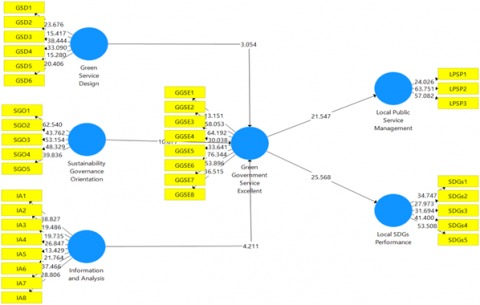
The Inner Model Structural stage in PLS-SEM involves testing the relationships between variables in the conceptual model. This stage is done through a random replication bootstrapping procedure of sample data with up to 5000 bootstraps [103]. Figure 2 shows the structural model analysis results, including total descriptive strength and significant path coefficients. Table 5 describes the regression estimation results of latent construction in the proposed model.
Figure 2. Output bootstrapping
Table 5. Hypothesis and R-square result
|
H |
Relationship |
Path Coeff |
t-value |
p-value |
Decision |
R2 |
|
H1 |
Green Service Design $\rightarrow$ Green Government Service Excellent |
0.136 |
3,054 |
0.002 |
Accepted |
0.785 |
|
H2 |
Sustainability Governance Orientation $\rightarrow$ Green Government Service Excellent |
0.570 |
10,677 |
0.000 |
Accepted |
|
|
H3 |
Information and Analysis $\rightarrow$ Green Government Service Excellent |
0.263 |
4,211 |
0.000 |
Accepted |
|
|
H4 |
Green Government Service Excellent $\rightarrow$ Local Public Service Performance |
0.748 |
21,547 |
0.000 |
Accepted |
0.659 |
|
H5 |
Green Government Service Excellent $\rightarrow$ Local SDGs Performance |
0.779 |
25,568 |
0.000 |
Accepted |
0.706 |
|
H6a |
Green Service Design $\rightarrow$ Green Government Service Excellent $\rightarrow$ Local Public Service Performance |
0.102 |
3,016 |
0.003 |
Accepted |
|
|
H6b |
Green Service Design $\rightarrow$ Green Government Service Excellent $\rightarrow$ Local SDGs Performance |
0.106 |
3,061 |
0.002 |
Accepted |
|
|
H7a |
Sustainability Governance Orientation $\rightarrow$ Green Government Service Excellent $\rightarrow$ Local Public Service Performance |
0.426 |
11,692 |
0.000 |
Accepted |
|
|
H7b |
Sustainability Governance Orientation $\rightarrow$ Green Government Service Excellent $\rightarrow$ Local SDGs Performance |
0.443 |
9,386 |
0.000 |
Accepted |
|
|
H8a |
Information and Analysis $\rightarrow$ Green Government Service Excellent $\rightarrow$ Local Public Service Performance |
0.197 |
3,819 |
0.000 |
Accepted |
|
|
H8b |
Information and Analysis $\rightarrow$ Green Government Service Excellent $\rightarrow$ Local SDGs Performance |
0.205 |
4,109 |
0.000 |
Accepted |
The results of the hypothesis test showed that all proposed hypotheses were accepted with positive path coefficient values, t-test (>1.96), and significant p-values (p < 0.05) [103]. H1 states that green service design positively influences green government service excellence (β1 = 0.136 at p < 0.05); H1 is supported. H2 shows that the orientation of sustainability governance significantly affects green government service excellence (β2 = 0.570 at p < 0.05); through this, H2 is enforced. H3 regarding information and analysis also showed a significant favorable influence on green government service excellence (β3 = 0.263 at p < 0.05), thus maintaining H3. H4 and H5 show that green government service excellence has a significant effect on local public service performance (β4 = 0.748 at p < 0.05) and local SDGs performance (β5 = 0.779 at p < 0.05). The sixth hypothesis (H6a and H6b) and the seventh hypothesis (H7a and H7b) show the mediating effect of green government service excellence in the relationship between green service design and sustainability governance orientation on local public service performance and local SDGs performance. The eighth hypothesis (H8a and H8b) shows a similar mediating effect of information and analysis. All paths show significant t-values.
The R-Square (R²) test is used in regression analysis to measure the proportion of variability in dependent variables that independent variables can explain. The R² value ranges from 0 to 1; The closer to 1, the better the regression model describes the data [103]. Green government service excellence can be estimated at 78.5% by green service design, sustainability governance, and information and analysis. Furthermore, green government service can predict local public service performance of 65.9% and local SDG performance of 70.6%. This high result shows the strong and relevant influence of the proposed model on public service performance and local SDG achievement.
4.3 Discussion
This paper explores the critical role of green service design, sustainability governance orientation, and information analysis on the encouragement of local green government service excellence and its influence on public service performance and the achievement of SDGs at the regional level of Indonesian Regencies/Cities. While distributing the field questionnaire based on the questions in Appendix A, responses were obtained to the statement of the overall variables.
A more in-depth analysis of the quantitative results using the PLS-SEM approach confirms that green service design significantly affects green government service excellence. These findings align with research showing that transformational service network design impacts sustainable service practices [56-58]. This indicates that investments and initiatives in developing green public services can provide tangible results in improving the excellence of green government services. It also supports the view that sustainable development strategies benefit the environment and the efficiency and quality of services provided to the community. Green service design is essential in improving the quality of green government services. Local governments must consider this a primary concern when designing and implementing public services.
The examination of the results of the PLS-SEM analysis, as evidenced in Table 4, proves that the sustainability governance orientation influences green government service excellence. Thus, H2 is accepted. These findings reinforce previous studies on the importance of sustainability orientation in public administration and leadership [69, 70]. This result indicates that Local Government is experiencing a paradigm shift in governance, where sustainability is the primary consideration in decision-making. Environmentally friendly government administration practices and environmental program initiatives for the community can improve government service standards regarding sustainability. Applying sustainable governance principles and practices can be considered a potential strategy to improve the quality of public services at the local level that focuses on environmental sustainability. It also highlights the importance of capacity building in sustainable management and policy at the local government level. It reinforces the urgency to strengthen support for sustainable government decision-making efforts.
The results of the hypothesis test show that Information and Analysis significantly impact the excellence of green government services, supporting H3 and previous literature that emphasizes the role of government administration technology in the impact of efficiency and systematic policymaking. These findings underscore the importance of systematic information collection and analysis in effective green governance practices [76, 79]. Technology involvement accelerates data processing and information dissemination, enables rapid responses to environmental challenges, and supports green policy innovation. This process promotes data-driven decision-making, increases transparency and accountability, and increases public trust and community participation in local sustainable development policies.
Green government service excellence was found to play a role in encouraging local public service performance and SDGs performance, so H4-H5 was accepted. These results support previous literature that found a positive correlation between green government practices and public service satisfaction and support for SDGs targets [89-91]. These results confirm that improving the quality of environmentally friendly government services (Green government service excellence) can increase the effectiveness of public services. More efficient, responsive, and environmentally friendly services increase community satisfaction and support more sustainable resource management. On the other hand, the positive impact on the achievement of local SDGs shows that the government's efforts in adopting green practices can contribute directly to sustainable development goals. This includes improving environmental quality, energy efficiency, better waste management, and protecting natural resources, all of which are integral to the SDGs. Green government practices in local government can contribute significantly to several SDGs. For example, SDG 7 (Clean and Affordable Energy) through the use of renewable energy, SDG 11 (Sustainable Cities and Communities) with improved green transportation and urban governance sustainability, as well as SDG 13 (Climate Change Management) through government building emission reduction policies. In addition, SDG 6 (Clean Water and Sanitation) can be achieved through better water management, and SDG 12 (Responsible Consumption and Production) through the promotion of recycling and waste reduction in the public sector. This implementation also supports SDG 15 (Terrestrial Ecosystems) by protecting and restoring natural habitats.
This study examines the mediation of green government service between its determinants and local government performance in services and SDGs. The results show that green government service excellence mediates the relationship between green service design, sustainability governance orientation, information analysis, and local public service performance. Thus, H6a, H7a, and H8a have been verified for their proposals. Green service design involves designing services that pay attention to environmental aspects to minimize negative impacts on nature. With excellent green government service, these green design principles can be applied effectively, improving public service performance through resource efficiency and reducing carbon footprint. The sustainability governance orientation emphasizes the importance of leadership and policies that support sustainability. GGSE acts as a mechanism that ensures that sustainability policies and practices are implemented correctly in the day-to-day operations of public services. It improves public service performance by integrating sustainability goals into broader strategies and operations. Information analysis concerns collecting, analyzing, and using data for better decision-making. GGSE enables the more effective use of data to support green and sustainability service practices, which can ultimately improve public service performance through more informed and evidence-based decisions.
On the other hand, green government service excellence mediates the relationship between green service design, sustainability governance orientation, information analysis, and local SDG performance. Therefore, H6b, H7b and H8b proposals are acceptable. Green government service is a bridge that increases the effectiveness of implementing green service design, sustainability governance orientation, and information analysis. Effective green service design produces environmentally friendly and efficient services, while a strong sustainability governance orientation ensures policies that support sustainability. Information-Analysis provides a solid data basis for decision-making. Green government ensures these efforts translate into high-quality public services, improving local SDGs' performance. Green government allows for resource optimization through better management and more efficient services. This means that the funds and resources allocated to the three determinants can be used more efficiently and effectively, increasing the positive impact on local SDG performance.
This study can conclude the significance of green service design on green government service excellence, emphasizing that investment in environmentally friendly public services improves the quality of government services. Sustainability governance orientation and information analysis also play an essential role in the excellence of green government services, supporting data-driven decision-making and increasing efficiency and transparency. Green government service excellence improves public service performance and achieves local SDGs, including energy efficiency and waste management. Green government service excellence mediates the relationship between green service design, sustainable governance, and information analysis with public service performance and the achievement of local SDGs. Thus, capacity-building efforts in sustainable management and policies are essential to improving public service performance and supporting sustainable development goals.
The study highlights that green service design and sustainable governance are crucial for enhancing government service quality. Investments in eco-friendly public services boost efficiency, transparency, and data-driven decision-making. Sustainable governance strategies and information analysis are key mediators that strengthen the link between green service design and public service performance, aiding the achievement of local SDGs. Urban governance theories should integrate sustainable policies, information management, and innovation at local levels to meet development goals.
Practically, the study recommends accelerating district and city governments' green initiatives through sustainable policies and robust information analysis. Local governments should embed sustainability principles in all public services, such as energy efficiency, green buildings, and waste management. Clear policies and strategies for green government, starting at the village level, are essential. Civil servants' role is pivotal in implementing pro-environmental policies, supported by intensive training in green service design. Cooperation with civil society and the private sector, and involving academics, can further enhance green government initiatives.
The study acknowledges limitations, including a focus on short-term green government service excellence without assessing long-term impacts. Future research should explore longitudinal studies and comparative analyses across different contexts, combining qualitative and quantitative methods to provide a comprehensive view of green service design's role in sustainable public services. Additionally, while this study primarily utilized a quantitative survey approach with a set sample size, future research could benefit from employing mixed methods, such as interviews or focus groups, alongside surveys. These methods could offer richer, in-depth insights into participants' perspectives. Increasing the sample size, if feasible, would also enhance the generalizability of findings across broader contexts and populations.
This study was funded by the Competitive Grant from the Institute for Research and Community Service (LPPM) of Universitas Negeri Surabaya under Contract Number B/116397/UN38.III.1/LK.04.00/2024. We extend our sincere gratitude to Universitas Negeri Surabaya for their invaluable support.
Appendix A. Questionnaire
Green Service Design (Code: GSD)
Sustainability Governance Orientation (Code: SGO)
Information and Analysis (Code: IA)
Green Government Service Excellent (Code: GGSE)
Local Public Service Performance (LPSP)
Local SDGs Performance (SDGs)
[1] Campagnolo, L., Davide, M. (2019). Can the Paris deal boost SDGs achievement? An assessment of climate mitigation co-benefits or side-effects on poverty and inequality. World Development, 122: 96-109. https://doi.org/10.1016/j.worlddev.2019.05.015
[2] Caraka, R.E., Lee, Y., Kurniawan, R., Herliansyah, R., Kaban, P.A., et al. (2020). Impact of COVID-19 large scale restriction on environment and economy in Indonesia. Global Journal of Environmental Science and Management, 6: 65-84. https://doi.org/10.22034/GJESM.2019.06.SI.07
[3] Laage-Thomsen, J., Blok, A. (2020). Civic modes of greening the city? Urban natures in-between familiar engagement and green critique. Local Environment, 25(2): 162-178. https://doi.org/10.1080/13549839.2020.1714568
[4] Suparjo, S., Darma, S., Kurniadin, N., Kasuma, J., Priyagus, P., Darma, D.C., Haryadi, H. (2021). Indonesia's new SDGs agenda for green growth: Emphasis in the energy sector. International Journal of Energy Economics and Policy, 11(3): 395-402. https://doi.org/10.32479/ijeep.11091
[5] Röth, L., Schwander, H. (2020). Greens in government: The distributive policies of a culturally progressive force. West European Politics, 44(3): 661-689. https://doi.org/10.1080/01402382.2019.1702792
[6] Setiawan, S., Ismalina, P., Nurhidajat, R., Tjahjaprijadi, C., Munandar, Y. (2021). Green finance in Indonesia's low carbon sustainable development. International Journal of Energy Economics and Policy, 11(5): 191-203. https://doi.org/10.32479/ijeep.11447
[7] Zhou, D., Yin, X., Xie, D. (2023). Local governments’ environmental targets and green total factor productivity in Chinese cities. Economic Modelling, 120: 106189. https://doi.org/10.1016/j.econmod.2023.106189
[8] Yang, S., Lu, J., Feng, D., Liu, F. (2023). Can government-led civilized city construction promote green innovation? Evidence from China. Environmental Science and Pollution Research, 30(34): 81783-81800. https://doi.org/10.1007/s11356-022-20487-5
[9] Anggraeni, V., Achsanta, A.F., Purnomowati, N.H. (2023). Measuring opportunities: Transforming Indonesia’s economy through utilizing natural resources for sustainable development through green economy indicators. In IOP Conference Series: Earth and Environmental Science, 1180(1): 012011. https://doi.org/10.1088/1755-1315/1180/1/012011
[10] Adiyanta, F.C. (2020). Urban space governance and sustainable green development in Indonesia. International Journal of Energy Economics and Policy, 10(1): 1-6. https://doi.org/10.32479/ijeep.8065
[11] Rohmy, A.M., Nihayaty, A.I. (2023). Green economy policies in the digital transformation of forest management in Indonesia. Environmental Policy and Law, (Preprint): 1-13. https://doi.org/10.3233/EPL-230026
[12] Marron, D.B. (1997). Buying green: Government procurement as an instrument of environmental policy. Public Finance Review, 25(3): 285-305. https://doi.org/10.1177/109114219702500302
[13] Geng, Y., Doberstein, B. (2008). Greening government procurement in developing countries: Building capacity in China. Journal of Environmental Management, 88(4): 932-938. https://doi.org/10.1016/j.jenvman.2007.04.016
[14] Owen, R., Brennan, G., Lyon, F. (2018). Enabling investment for the transition to a low carbon economy: Government policy to finance early stage green innovation. Current opinion in Environmental Sustainability, 31: 137-145. https://doi.org/10.1016/j.cosust.2018.03.004
[15] Lin, Y., Li, J., Xiang, L. (2022). Exploring the role of green government publicity influencing people’s pro-environmental behaviors. Frontiers in Psychology, 13: 973160. https://doi.org/10.3389/fpsyg.2022.973160
[16] Chen, J., Zhu, D., Ding, S., Qu, J. (2024). Government environmental concerns and corporate green innovation: Evidence from heavy‐polluting enterprises in China. Business Strategy and the Environment, 33(3): 1920-1936. https://doi.org/10.1002/bse.3583
[17] Xu, Y., Zhang, X., Hong, Y. (2016). The game model between government subsidies act and green supply chain. International Journal of U-and E-Service, Science and Technology, 9(11): 121-130. https://doi.org/10.14257/ijunesst.2016.9.11.11
[18] Fallahi, N., Hafezalkotob, A., Raissi, S., Ghezavati, V. (2024). A game theoretic approach to sustainable freight transportation: Competition between green, non-green and semi-green transportation networks under government sustainable policies. Environment, Development and Sustainability, 26(4): 9711-9758. https://doi.org/10.1007/s10668-023-03115-1
[19] Villari, B. (2022). Designing sustainable services for cities: Adopting a systemic perspective in service design experiments. Sustainability, 14(20): 13237. https://doi.org/10.3390/su142013237
[20] Sierra-Pérez, J., Teixeira, J.G., Romero-Piqueras, C., Patrício, L. (2021). Designing sustainable services with the ECO-service design method: Bridging user experience with environmental performance. Journal of Cleaner Production, 305: 127228. https://doi.org/10.1016/j.jclepro.2021.127228
[21] Turetken, O., Grefen, P., Gilsing, R., Adali, O.E. (2019). Service-dominant business model design for digital innovation in smart mobility. Business & Information Systems Engineering, 61: 9-29. https://doi.org/10.1007/s12599-018-0565-x
[22] Blaschke, M., Riss, U., Haki, K., Aier, S. (2019). Design principles for digital value co-creation networks: A service-dominant logic perspective. Electronic Markets, 29(3): 443-472. https://doi.org/10.1007/s12525-019-00356-9
[23] Huo, C., Lu, X., Yang, G., Huo, F. (2022). The method framework for data-driven information analysis towards industrial technology. Documentation, Information and Knowledge, 39(1): 73-83. https://doi.org/10.13366/j.dik.2022.01.073
[24] Yeganegi, S., Laplume, A.O., Dass, P. (2021). The role of information availability: A longitudinal analysis of technology entrepreneurship. Technological Forecasting and Social Change, 170: 120910. https://doi.org/10.1016/j.techfore.2021.120910
[25] Jia, M., Zhao, L. (2023). Evolutionary analysis of information-based construction management promotion using a government-enterprise evolutionary game model. Engineering, Construction and Architectural Management. https://doi.org/10.1108/ECAM-12-2022-1152
[26] Shim, J.M., Shin, E. (2020). Drivers of ratification rates in global biodiversity governance: Local environmentalism, orientation toward global governance, and peer pressure. Environmental Politics, 29(5): 845-865. https://doi.org/10.1080/09644016.2019.1630070
[27] Husted, B.W., de Sousa-Filho, J.M. (2017). The impact of sustainability governance, country stakeholder orientation, and country risk on environmental, social, and governance performance. Journal of Cleaner Production, 155: 93-102. https://doi.org/10.1016/j.jclepro.2016.10.025
[28] de Oliveira, J.A.P., Doll, C.N., Balaban, O., Jiang, P., Dreyfus, M., Suwa, A., Moreno-Peñaranda, R., Dirgahayani, P. (2013). Green economy and governance in cities: Assessing good governance in key urban economic processes. Journal of Cleaner Production, 58: 138-152. https://doi.org/10.1016/j.jclepro.2013.07.043
[29] Yang, X., Xu, Y., Razzaq, A., Wu, D., Cao, J., Ran, Q. (2024). Roadmap to achieving sustainable development: Does digital economy matter in industrial green transformation. Sustainable Development, 32(3): 2583-2599. https://doi.org/10.1002/sd.2781
[30] Li, Q., Lu, Y., Zhou, Y. (2022). Achieving the green economy transition: The role of digital economy and government policy. Environmental Science and Pollution Research, 29: 1849-1865. https://doi.org/10.1007/s11356-021-16794-x
[31] Shao, Y., Chen, Z. (2022). Can government subsidies promote the green technology innovation transformation? Evidence from Chinese listed companies. Economic Analysis and Policy, 74: 716-727. https://doi.org/10.1016/j.eap.2022.03.020
[32] Naruetharadhol, P., ConwayLenihan, A., McGuirk, H. (2024). Assessing the role of public policy in fostering global eco-innovation. Journal of Open Innovation: Technology, Market, and Complexity, 10(2): 100294. https://doi.org/10.1016/j.joitmc.2024.100294
[33] Yang, H., Umair, M. (2024). Polluting industries: Does green industrial policy encourage green innovation? Chinese perspective evidence. Heliyon, 10(17): e36634. https://doi.org/10.1016/j.heliyon.2024.e36634
[34] Shashyna, M., Lepeyko, T., Shevchuk, N., Gaidutskyi, A., Tomanek, M. (2023). Features of providing sustainable regional development in the conditions of globalization challenges. International Journal of Sustainable Development & Planning, 18(12): 3713-3723. https://doi.org/10.18280/ijsdp.181203
[35] Joo, H.Y., Min, H. (2023). Assessing the impacts of government environmental policies on the small and medium-sized firm's performances in Korea and China. Benchmarking: An International Journal, 30(7): 2275-2302. https://doi.org/10.1108/BIJ-12-2021-0754
[36] He, L., Chen, L. (2021). The incentive effects of different government subsidy policies on green buildings. Renewable and Sustainable Energy Reviews, 135: 110123. https://doi.org/10.1016/j.rser.2020.110123
[37] Feng, Z., Zeng, B., Ming, Q. (2018). Environmental regulation, two-way foreign direct investment, and green innovation efficiency in China’s manufacturing industry. International Journal of Environmental Research and Public Health, 15(10): 2292. https://doi.org/10.3390/ijerph15102292
[38] Nugrahani, T.S., Kusuma, H., Arifin, J., Muhammad, R. (2023). Determinants of sustainability report quality in Indonesian public companies: An isomorphism theory approach. International Journal of Sustainable Development & Planning, 18(12): 3909-3921. https://doi.org/10.18280/ijsdp.181222
[39] Mulaessa, N., Lin, L. (2021). How do proactive environmental strategies affect green innovation? The moderating role of environmental regulations and firm performance. International Journal of Environmental Research and Public Health, 18(17): 9083. https://doi.org/10.3390/ijerph18179083
[40] Eghbali, M.A., Rasti-Barzoki, M., Safarzadeh, S. (2022). A hybrid evolutionary game-theoretic and system dynamics approach for analysis of implementation strategies of green technological innovation under government intervention. Technology in Society, 70: 102039. https://doi.org/10.1016/j.techsoc.2022.102039
[41] Fan, R., Wang, Y., Chen, F., Du, K., Wang, Y. (2022). How do government policies affect the diffusion of green innovation among peer enterprises? An evolutionary-game model in complex networks. Journal of Cleaner Production, 364: 132711. https://doi.org/10.1016/j.jclepro.2022.132711
[42] Pernici, B., Ardagna, D., Cappiello, C. (2008). Business process design: Towards service-based green information systems. In E-Government Ict Professionalism and Competences Service Science, 280: 195-203. Boston, MA: Springer US. https://doi.org/10.1007/978-0-387-09712-1_22
[43] Moon, S.K., Shu, J., Simpson, T.W., Kumara, S.R. (2010). A module-based service model for mass customization: Service family design. Iie Transactions, 43(3): 153-163. https://doi.org/10.1080/07408171003705383
[44] Nusir, M., Tariq, U., Ahanger, T.A. (2021). Engaging diverse stakeholders in interdisciplinary co-design project for better service design. Journal of Cases on Information Technology (JCIT), 23(4): 1-29. https://doi.org/10.4018/JCIT.296253
[45] Zhang, L., Deal, B. (2020). Ecosystem services, smart technologies, planning support systems, and landscape design: A framework for optimizing the benefits of urban green space using smart technologies. Journal of Digital Landscape Architecture, 5: 208-216. https://doi.org/10.14627/537690022
[46] Smith, A.A., Offodile, O.F. (2014). Green corporate initiatives: A case study of goods and service design. International Journal of Logistics Systems and Management, 19(4): 417-443. https://doi.org/10.1504/IJLSM.2014.065664
[47] Muranganwa, I., Naidoo, R. (2023). Assessing organisations’ readiness to adopt green information technology: The case of a South African information technology services vendor. South African Journal of Industrial Engineering, 34(2): 79-91. https://doi.org/10.7166/34-2-2881
[48] Tseng, S.M., Octavyaputri, S. (2024). Enhancing green service innovation behavior through green involvement: The role of information technology adoption. Aslib Journal of Information Management. https://doi.org/10.1108/AJIM-11-2023-0497
[49] Sharma, S.K., Seetharaman, A., Maddulety, K. (2021). Framework for sustainable urban water management in context of governance, infrastructure, technology and economics. Water Resources Management, 35(12): 3903-3913. https://doi.org/10.1007/s11269-021-02916-1
[50] Hightower, R. (2013). Investigating the green leadership in energy and environmental design (LEED) servicescape scale in Brazil. Construction Innovation, 13(3): 242-265. https://doi.org/10.1108/CI-Oct-2011-0045
[51] Alpenberg, J., Wnuk-Pel, T., Henebäck, A. (2018). Environmental orientation in Swedish local governments. Sustainability, 10(2): 459. https://doi.org/10.3390/su10020459
[52] Feng, G., Hao, S., Li, X. (2022). Project sustainability and public-private partnership: The role of government relation orientation and project governance. Sustainability, 14(8): 4724. https://doi.org/10.3390/su14084724
[53] Idoko, E.C., Nkamnebe, A.D., Amobi, D.S. (2013). Public policy and SMEs' adoption of environmental sustainability orientation in Enugu, Nigeria. African Journal of Business and Economic Research, 8(1): 11-31.
[54] Cheng, S., Ali, S. (2023). A tiered pathway toward sustainability: The role of public administrators in advancing social equity in US local governments. Public Administration Review, 83(4): 878-894. https://doi.org/10.1111/puar.13617
[55] Bamgbade, J.A., Kamaruddeen, A.M., Nawi, M.N.M. (2017). Malaysian construction firms' social sustainability via organizational innovativeness and government support: The mediating role of market culture. Journal of Cleaner Production, 154: 114-124. https://doi.org/10.1016/j.jclepro.2017.03.187
[56] Pigott, A. (2018). Imagining socioecological transformation: An analysis of the Welsh government’s policy innovations and orientations to the future. Elem Sci Anth, 6: 60. https://doi.org/10.1525/elementa.315
[57] Liyanaarachchi, G., Deshpande, S., Weaven, S., Sangroya, D., Jebarajakirthy, C., Bodle, K., Roemer, C. (2021). Strengthening sustainability initiatives: A case for repositioning Australian Indigenous communities as dominant stakeholders in managing bushfire risks. Journal of Strategic Marketing, 1-25. https://doi.org/10.1080/0965254X.2021.1874491
[58] Deslatte, A., Swann, W.L. (2020). Elucidating the linkages between entrepreneurial orientation and local government sustainability performance. The American Review of Public Administration, 50(1): 92-109. https://doi.org/10.1177/0275074019869376
[59] Bogner, K., Dahlke, J. (2022). Born to transform? German bioeconomy policy and research projects for transformations towards sustainability. Ecological Economics, 195: 107366. https://doi.org/10.1016/j.ecolecon.2022.107366
[60] Jacob, K., Paulick-Thiel, C., Teebken, J., Veit, S., Singer-Brodowski, M. (2021). Change from within: Exploring transformative literacy in public administrations to foster sustainability transitions. Sustainability, 13(9): 4698. https://doi.org/10.3390/su13094698
[61] Dincă, D.V., Nicolescu, C.E., Dumitrică, C.D. (2023). The impact of the Ukrainian war on the resilience and sustainability of the local public administration in Romania: An exploratory study. Romanian Journal of European Affairs, 23(2): 64-83.
[62] Relyea, H.C. (2008). Federal government information policy and public policy analysis: A brief overview. Library & Information Science Research, 30(1): 2-21. https://doi.org/10.1016/j.lisr.2007.11.004
[63] Zhang, Y. (2021). A niche analysis of two channels of open government information: Online and offline. Chinese Journal of Communication, 14(4): 353-368. https://doi.org/10.1080/17544750.2021.1884109
[64] Choi, W.C., Na, J.Y. (2016). Relative importance for security systems of crime-zero zone based on spatial information: Focusing on AHP analysis targeting local governments, research institutes and private companies. Spatial Information Research, 24: 1-10. https://doi.org/10.1007/s41324-016-0004-3
[65] Scholl, H.J., Kubicek, H., Cimander, R., Klischewski, R. (2012). Process integration, information sharing, and system interoperation in government: A comparative case analysis. Government Information Quarterly, 29(3): 313-323. https://doi.org/10.1016/j.giq.2012.02.009
[66] Gong, Y., Yang, J., Shi, X. (2020). Towards a comprehensive understanding of digital transformation in government: Analysis of flexibility and enterprise architecture. Government Information Quarterly, 37(3): 101487. https://doi.org/10.1016/j.giq.2020.101487
[67] Viale Pereira, G., Cunha, M.A., Lampoltshammer, T.J., Parycek, P., Testa, M.G. (2017). Increasing collaboration and participation in smart city governance: A cross-case analysis of smart city initiatives. Information Technology for Development, 23(3): 526-553. https://doi.org/10.1080/02681102.2017.1353946
[68] Roreng, P.P., Bandhaso, M., Tandirerung, C.J. (2021). Competency analysis of human resources and the use of information technology on the quality of financial reports in the local government of the city of makassar. WSEAS Transactions on Business and Economics, 18: 1218-1222. https://doi.org/10.37394/23207.2021.18.113
[69] Liu, S.M., Yuan, Q. (2015). The evolution of information and communication technology in public administration. Public Administration and Development, 35(2): 140-151. https://doi.org/10.1002/pad.1717
[70] Kalinina, A., Borisova, A., Barakova, A. (2017). Development efficiency analysis of public administration informatization. Integration and Clustering for Sustainable Economic Growth, 481-493. https://doi.org/10.1007/978-3-319-45462-7_47
[71] Ahrens, T. (2013). Assembling the Dubai government excellence program: A motivational approach to improving public service governance in a monarchical context. International Journal of Public Sector Management, 26(7): 576-592. https://doi.org/10.1108/IJPSM-06-2012-0079
[72] Subires, M.D.L., Muñoz, L.A., Galera, A.N., Bolívar, M.P.R. (2019). The influence of socio-demographic factors on financial sustainability of public services: A comparative analysis in regional governments and local governments. Sustainability, 11(21): 1-18. https://doi.org/10.3390/su11216008
[73] Alketbi, A., Nasir, Q., Abu Talib, M. (2020). Novel blockchain reference model for government services: Dubai government case study. International Journal of System Assurance Engineering and Management, 11(6): 1170-1191. https://doi.org/10.1007/s13198-020-00971-2
[74] Desmal, A.J., Othman, M.K., Hamid, S., Zolait, A. (2022). Exploring the information quality of mobile government services: A literature review. PeerJ Computer Science, 8: e1028. https://doi.org/10.7717/peerj-cs.1028
[75] Sofyani, H., Riyadh, H.A., Fahlevi, H. (2020). Improving service quality, accountability and transparency of local government: The intervening role of information technology governance. Cogent Business & Management, 7(1): 1735690. https://doi.org/10.1080/23311975.2020.1735690
[76] Wang, Z., Liu, Q., Hou, B. (2022). How does government information service quality influence public environmental awareness? International Journal of Environmental Research and Public Health, 20(1): 177. https://doi.org/10.3390/ijerph20010177
[77] Chakraborty, S., Kalepu, R. (2019). IT and green practices as enablers of service-oriented capabilities and patient-focused care in healthcare industry. International Journal of Innovation and Sustainable Development, 13(2): 220-244. https://doi.org/10.1504/IJISD.2019.098997
[78] Chan, T.Y., Wong, C.W., Lai, K.H., Lun, V.Y., Ng, C.T., Ngai, E.W. (2016). Green service: Construct development and measurement validation. Production and Operations Management, 25(3): 432-457. https://doi.org/10.1111/poms.12407
[79] Li, Z., Hou, Y., Cao, J., Ding, Y., Yuan, X. (2022). What drives green development in China: Public pressure or the willingness of local government? Environmental Science and Pollution Research, 29: 5454-5468. https://doi.org/10.1007/s11356-021-16059-8
[80] Bush, J. (2020). The role of local government greening policies in the transition towards nature-based cities. Environmental Innovation and Societal Transitions, 35: 35-44. https://doi.org/10.1016/j.eist.2020.01.015
[81] Anthony Jnr, B., Abdul Majid, M., Romli, A. (2019). Green information technology adoption towards a sustainability policy agenda for government-based institutions: An administrative perspective. Journal of Science and Technology Policy Management, 10(2): 274-300. https://doi.org/10.1108/JSTPM-11-2017-0056
[82] Sakolnakorn, T.P.N. (2018). Moving from policy to the implementation and management of government organizations for clean and green city concepts in Malaysia. The International Journal of Sustainability Policy and Practice, 14(3): 17. https://doi.org/10.18848/2325-1166/CGP/v14i03/17-32
[83] Al-Dhaafri, H., Alosani, M.S. (2022). Role of leadership, strategic planning and entrepreneurial organizational culture towards achieving organizational excellence: Evidence from public sector using SEM. Measuring Business Excellence, 26(3): 378-396. https://doi.org/10.1108/MBE-02-2021-0021
[84] Gil-Garcia, J.R., Chun, S.A., Janssen, M. (2009). Government information sharing and integration: Combining the social and the technical. Information Polity, 14(1-2): 1-10. https://doi.org/10.3233/IP-2009-0176
[85] Dincă, M.S., Dincă, G., Andronic, M.L. (2016). Efficiency and sustainability of local public goods and services. Case study for Romania. Sustainability, 8(8): 760. https://doi.org/10.3390/su8080760
[86] Domingues, A.R., Pires, S.M., Caeiro, S., Ramos, T.B. (2015). Defining criteria and indicators for a sustainability label of local public services. Ecological indicators, 57: 452-464. https://doi.org/10.1016/j.ecolind.2015.05.016
[87] Perry, B., Diprose, K., Taylor Buck, N., Simon, D. (2021). Localizing the SDGs in England: Challenges and value propositions for local government. Frontiers in Sustainable Cities, 3: 746337. https://doi.org/10.3389/frsc.2021.746337
[88] Nagati, O., Gad, H., El-Didi, A.A., Kihila, J.M., Mbuya, E., Njavike, E. (2023). Towards a bottom-up approach for localising SDGs in African cities. Africa Development/Afrique et Développement, 48(1): 79-112. https://doi.org/10.57054/ad.v48i1.3033
[89] Leavesley, A., Trundle, A., Oke, C. (2022). Cities and the SDGs: Realities and possibilities of local engagement in global frameworks. Ambio, 51(6): 1416-1432. https://doi.org/10.1007/s13280-022-01714-2
[90] Leonidou, L.C., Leonidou, C.N., Kvasova, O. (2010). Antecedents and outcomes of consumer environmentally friendly attitudes and behaviour. Journal of Marketing Management, 26(13-14): 1319-1344. https://doi.org/10.1080/0267257X.2010.523710
[91] Promsaka Na Sakolankorn, T. (2018). Moving from policy to the implementation and the management of government organizations for clean and green city concepts in Malaysia. The International Journal of Sustainability Policy and Practice, 14(3): 17-32. http://doi.org/10.18848/2325-1166/CGP/v14i03/17-32
[92] Alosani, M.S., Al-Dhaafri, H.S. (2023). Service innovation in government: Evidence from the UAE. Management & Sustainability: An Arab Review, 2(3): 239-254. https://doi.org/10.1108/MSAR-11-2022-0057
[93] Becker, J.M., Cheah, J.H., Gholamzade, R., Ringle, C.M., Sarstedt, M. (2023). PLS-SEM’s most wanted guidance. International Journal of Contemporary Hospitality Management, 35(1): 321-346. https://doi.org/10.1108/IJCHM-04-2022-0474
[94] Sarstedt, M., Radomir, L., Moisescu, O.I., Ringle, C.M. (2022). Latent class analysis in PLS-SEM: A review and recommendations for future applications. Journal of Business Research, 138: 398-407. https://doi.org/10.1016/j.jbusres.2021.08.051
[95] Hair, J.F., Risher, J.J., Sarstedt, M., Ringle, C.M. (2019). When to use and how to report the results of PLS-SEM. European Business Review, 31(1): 2-24. https://doi.org/10.1108/EBR-11-2018-0203
[96] Hair, J., Hollingsworth, C.L., Randolph, A.B., Chong, A.Y.L. (2017). An updated and expanded assessment of PLS-SEM in information systems research. Industrial Management & Data Systems, 117(3): 442-458. https://doi.org/10.1108/IMDS-04-2016-0130
[97] Niemelä-Nyrhinen, J., Leskinen, E. (2014). Multicollinearity in marketing models: Notes on the application of ridge trace estimation in structural equation modelling. Electronic Journal of Business Research Methods, 12(1): 3-15.
[98] Memon, M.A., Ramayah, T., Cheah, J.H., Ting, H., Chuah, F., Cham, T.H. (2021). PLS-SEM statistical programs: A review. Journal of Applied Structural Equation Modeling, 5(1): 1-14. https://doi.org/10.47263/JASEM.5(1)06
[99] Tenenhaus, M., Vinzi, V.E., Chatelin, Y.M., Lauro, C. (2005). PLS path modeling. Computational Statistics & Data Analysis, 48(1): 159-205. https://doi.org/10.1016/j.csda.2004.03.005
[100] Chan, S.H., Lay, Y.F. (2018). Examining the reliability and validity of research instruments using partial least squares structural equation modeling (PLS-SEM). Journal of Baltic Science Education, 17(2): 239-251.
[101] Henseler, J., Ringle, C.M., Sarstedt, M. (2015). A new criterion for assessing discriminant validity in variance-based structural equation modeling. Journal of the Academy of Marketing Science, 43: 115-135. https://doi.org/10.1007/s11747-014-0403-8
[102] Roemer, E., Schuberth, F., Henseler, J. (2021). HTMT2–An improved criterion for assessing discriminant validity in structural equation modeling. Industrial Management & Data Systems, 121(12): 2637-2650. https://doi.org/10.1108/IMDS-02-2021-0082
[103] Streukens, S., Leroi-Werelds, S. (2016). Bootstrapping and PLS-SEM: A step-by-step guide to get more out of your bootstrap results. European Management Journal, 34(6): 618-632. https://doi.org/10.1016/j.emj.2016.06.003