Samalgul Nassanbekova* | Gaukhar Yeshenkulova | Assel Nurguzhina | Nurkhat Ibadildin
© 2024 The authors. This article is published by IIETA and is licensed under the CC BY 4.0 license (http://creativecommons.org/licenses/by/4.0/).
OPEN ACCESS
The purpose of this study is to explore the factors influencing Kazakhstani young consumers' attitudes and intentions towards green products by extending the Theory of Planned Behavior framework. Specifically, it examines the role of multidimensional perceived value (functional, emotional, and social) and environmental knowledge in shaping these attitudes and intentions. A quantitative research approach was used using a structured online survey to collect data from 308 young urban consumers in Kazakhstan aged between 18-35 who were knowledgeable or interested in green products. The survey included items measured on a seven-point Likert scale adapted from established literature. Partial Least Squares Structural Equation Modeling (PLS-SEM) was used to analyze relationships among key variables and test the proposed hypotheses. The results show that environmental knowledge and emotional values are the strongest predictors of young consumers' green purchase intentions, while social value has a negative impact. Their attitudes towards green products are also influenced by environmental knowledge, emotional and functional value. The study highlights the importance of these additional constructs in influencing young consumers' attitudes and purchase intentions towards green products, providing a foundation for future research and practical applications in promoting sustainable consumption patterns in developing markets.
environmental knowledge, green perceived value, green products, developing countries, purchase intention, theory of planned behavior, young customers
Green products, designed to minimize environmental impact through environmentally friendly methods and materials, are a growing sector in consumer markets. Understanding the factors influencing green product purchase intention is critical for businesses seeking to serve environmentally conscious consumers and promote sustainable consumption patterns.
While much research on green consumer behavior has focused on developed countries, this study provides valuable insights into the attitudes and purchase intentions of young consumers in developing countries, particularly Kazakhstan, a demographic that is critical for the promotion of sustainable consumption. The Kazakhstani market is the biggest in Central Asia and intensive development brings environmental issues to the forefront.
The Theory of Planned Behavior (TPB), introduced by Ajzen in 1991, provides a strong framework for predicting consumer behavior by considering attitudes, subjective norms, and perceived behavioral control (PBC). Despite the widespread use of TPB in understanding consumer behavior, there is a need to examine the influence of additional variables that reflect the evolving consumer environment, especially in the context of green products. Recent research suggests that its traditional components may not fully capture the complexities of buying organic products [1]. To address these limitations, this study includes additional constructs such as multidimensional perceived value (functional, emotional, and social) and environmental knowledge to extend the TPB framework. The inclusion of functional value is essential as it captures the practical benefits that consumers seek from green products, such as efficiency and sustainability. Emotional value is incorporated to account for the affective responses that green products evoke, such as the pride or satisfaction associated with making environmentally conscious choices. Social value is included to reflect the influence of social norms and the desire for social approval on consumer behavior. Environmental knowledge is a critical addition to the model as it captures the awareness and understanding consumers have of environmental issues, which directly influences their ability to make informed purchasing decisions. This expanded model aims to provide a more comprehensive understanding of the factors influencing young consumers' intentions to purchase green products.
The main research question guiding this study is: how do functional, emotional and social values and environmental knowledge influence developing countries’ young consumers' attitudes and purchase intentions towards green products?
This question aims to uncover the complexities underlying young consumers' green product decision-making processes by expanding on the traditional TPB framework.
This study will contribute to the literature on environmental consumer behavior by integrating the concepts of perceived value and environmental knowledge into the TPB framework.
By incorporating functional, emotional, and social values, this study provides a more nuanced understanding of what drives young consumers from developing countries to prefer green products, increasing the predictive power of the TPB model.
In practice, the findings from this study can help marketers develop more effective strategies for promoting green products. By emphasizing aspects of perceived value and the importance of environmental knowledge, companies can tailor their marketing efforts to match the values and knowledge levels of their target audience.
The results can inform policymakers and educators on how to increase environmental awareness and promote sustainable consumption among youth. Understanding the role of environmental knowledge can guide educational initiatives aimed at increasing consumer awareness and interest in environmentally friendly products.
By encouraging the purchase of environmentally friendly products, this research supports broader sustainability goals. Promoting green products is consistent with global efforts to reduce environmental impact and promote sustainable development.
This study is structured as follows: The following section presents a literature review and hypotheses development, focusing on the expanded TPB model and the roles of functional, emotional, and social values, as well as environmental knowledge. The following sections detail the methodology, data collection and analysis procedures. The results and discussions are then presented, as well as implications, conclusions, and recommendations for future research.
2.1 Theory of planned behavior and extensions
2.1.1 Attitudes, subjective norms and perceived behavioral control
Theory of planned behavioral (TPB) proposed by Ajzen [2] is commonly used framework to explain consumers’ behavior. In this framework behavioral intention is influenced by three main factors: attitudes towards the behavior, subjective norm and perceived behavior control. Attitude towards behavior reflects a person's positive or negative assessment of performing a given behavior. It involves beliefs about the consequences of behavior and evaluations of these results. Subjective norm refers to the perceived social pressure to perform or not perform a certain action. It is opinion of people who is important for individual and can affect his decision. perceived behavioral control (PBC) refers to perception of ability to perform a particular behavior. It includes factors that can either facilitate or hinder the performance of a particular behavior and reflects past experiences as well as expected barriers [3]. Behavioral intention is formed based on a combination of these three factors. This intention indicates how hard people are willing to try and how much effort they plan to put into performing a particular behavior [2].
In recent studies TPB, its extension and modifications were successfully employed to predict pro-environmental behavior [4, 5]. However, some studies find that influence PBC on intention to use green products are not so significant as Attitudes and Subjective norms [6, 7] and the studies modified the framework by adding other variables [1, 8, 9]. Based on findings of previous studies about pro-environmental behavior we propose the following hypothesizes:
H1. Young customers’ attitudes towards green products positively influence purchase intention
H2. Subjective norms positively impact young customers' intention to buy green products
2.2 Multi-dimensions of customer perceived value
Perceived consumption value (PCV) refers to the assessment of the benefits that a customer perceives relative to the costs of acquiring and using a product or service [10]. PCV is a critical determinant of consumer behavior, reflecting the overall assessment of product benefits relative to costs [11]. Previous research has demonstrated the multidimensional nature of PCV, encompassing functional, emotional, and social dimensions [10]. PCV has been studied in green consumer research [1, 12-14], therefore we argue that PCV has an important role in the context of green products. In the context of green products, consumers may derive value from product performance (functional), emotional satisfaction, and social image enhancement. By incorporating these dimensions, this study extends the TPB model to provide a more comprehensive understanding of the factors influencing young consumers' green product purchase intentions.
Perceived value covers multiple dimensions, including functional, emotional and social value, which collectively influence consumer behavior [10].
2.2.1 Functional value
Functional value is the perceived usefulness derived from the practical properties and characteristics of a product and includes the efficiency, quality, price, reliability and sustainability of the product [10]. Empirical studies have consistently shown that functional value is a significant predictor of consumer attitudes towards green products. For example, Sweeney et al. [10] found that when consumers perceive a product to be useful and efficient, they are more likely to develop positive attitudes toward it. This is particularly relevant for green products, where consumers expect not only standard functional benefits but also added environmental advantages, such as reduced carbon footprints or energy efficiency [15]. Therefore, when green products meet or exceed functional expectations, they enhance consumer attitudes, which in turn positively influence purchase intentions. Consumers evaluate functional value by comparing a product's capabilities to their expectations and needs, high functional value increases product attractiveness and influences both attitudes and purchase intentions. Ruiz-Molina et al. [16] found that consumers are mindful of their spending and that the practical benefits of green products significantly influence their decision to return or repurchase. Essentially, a product’s functional attributes, such as ease of use and tangible advantages, primarily contribute to consumer satisfaction. Functional value, including price, has a significant influence on customers intention towards green products [1, 12, 14, 15]. Functional value with other PCV dimensions predicts green product value [17]. Thus, we propose the following hypothesizes:
H3. Functional value positively influences young customers’ attitudes to green products
H4. Functional value positively influences young customers’ green products purchase intention
2.2.2 Emotional value
Emotional value refers to the feelings or affective states evoked by a product, including joy, excitement, pride or satisfaction. Emotional value influences consumer decisions by enhancing the emotional connection with a product. Positive emotions associated with a product can lead to stronger purchase intention and brand loyalty [10]. Products that generate positive emotions, such as pride or satisfaction, are more likely to be favored by consumers. This effect is amplified in the context of green products, where emotional benefits often stem from the moral satisfaction of making an environmentally responsible choice [1]. Emotional value not only strengthens positive attitudes toward green products but also directly impacts purchase intentions by creating an emotional bond between the consumer and the product [18]. This connection leads to stronger brand loyalty and a higher likelihood of repeated purchases. According to recent studies, emotional value has a positive direct and indirect influence on customer intention to buy green products and services [1, 15, 19]. And emotional value among the strongest predictors of green product purchase intention [18] and green product value [17]. Therefore, the following hypothesizes were proposed:
H5. Emotional value significantly influences youth attitudes towards green products
H6. Emotional value positively influences young customers’ green products purchase intention
2.2.3 Social value
Social value refers to the perceived benefits of a product in terms of social approval, status, or recognition and involves the influence of social norms and the desire for social recognition [10]. Social value can drive purchasing behavior by tapping into the consumer's need for social identity and belonging [14]. The influence of social value on consumer behavior is well-documented, particularly in markets where social identity and belonging are significant factors. For green products, the social value may derive from being perceived as environmentally conscious or socially responsible [15]. Studies have shown that when consumers believe that purchasing green products will enhance their social image or meet the approval of important social groups, they are more likely to develop favorable attitudes toward these products [1]. However, it is essential to note that while social value can enhance attitudes, its impact on purchase intentions can be complex, as it might sometimes lead to pressure or resistance depending on the social context [10]. Recent study highlights importance of social value in adoption new green products [20]. Products that are perceived as socially desirable can improve social image and acceptance and impact consumer behavior including towards green products [1, 15].
According to the above discussion in this study, we propose these hypothesizes:
H7. Social value significantly influences young customers’ attitudes towards green products
H8. Social value positively influences young customers’ green products purchase intention
2.3 Environmental knowledge
Environmental knowledge refers to awareness and understanding of environmental issues and the impact of human activities on the environment. Environmental knowledge is essential for making informed consumption decisions. Recent studies indicate that consumers’ attitude towards purchasing green products can be significantly influensed by environmental knowledge [6]. Individuals with higher levels of environmental knowledge are more likely to be aware of the environmental impacts of their choices and to perceive the benefits of green products [21, 22].
Environmental knowledge involves the consumer's ability to recognize and understand various environmental symbols, concepts and attitudes [15]. Yadav et al. [4] found that young customers intention to buy green products could be predicted by their environmental knowledge. Experimental study of Prieto-Sandoval et al. [23] shows strong relationship between environmental education and young customers sustainable consumption. Environmental knowledge positively affects customers green attitudes [6] and purchase intention [4, 8, 9]. Environmental knowledge is critical in shaping consumer attitudes and purchase intentions, especially in the context of green products. Research by Yadav et al. [4] and others has shown that when consumers possess a high level of environmental knowledge, they are more likely to recognize the importance of green products and, consequently, develop positive attitudes toward them. Environmental knowledge empowers consumers to make informed decisions, aligning their purchasing behavior with their environmental values [6]. This knowledge not only influences attitudes but also directly impacts purchase intentions, as consumers who are aware of environmental issues are more motivated to engage in eco-friendly purchasing behaviors [9]. And research has shown a direct correlation between consumers' understanding of sustainable packaging and their likelihood of purchasing green products [24]. Therefore, increasing environmental knowledge among consumers, particularly young consumers, is crucial for promoting sustainable consumption patterns. Thus, environmental knowledge can significantly shape consumer attitudes and behaviors, especially among youth who are increasingly exposed to environmental education and activism. This study integrates environmental knowledge into the TPB framework to examine its influence on attitudes and perceived behavioral control, thereby enhancing the model's explanatory power.
H9. Environmental knowledge among youth positively influences their attitudes towards green products
H10. Environmental knowledge among youth positively influences their intention to buy green products
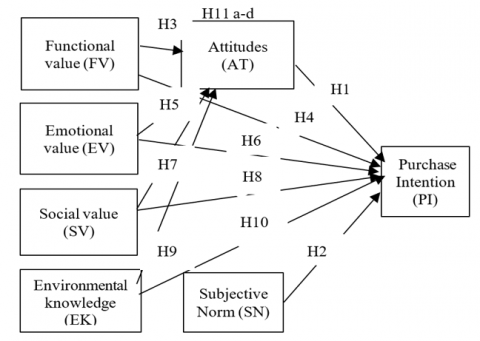
Based on the discussion above the theoretical model for this study is illustrated in Figure 1.
Figure 1. The research framework
2.4 Attitudes as mediator
Since consumer attitudes toward green products are influenced by dimensions of perceived value and environmental knowledge, attitudes mediate association between above factors and green products purchase intention. Recent studies demonstrated that attitude positively influence interaction between environmental knowledge, perceived values and green purchase intention [6, 25]. We suggest that individuals’ attitudes positively mediate relationship between environmental knowledge and purchase intention. Moreover, attitudes can intensify interaction between perceived values and green products purchase intention.
H11. Attitudes mediate the association between (a) functional value, (b) emotional value, (c) social value, and (d) environmental knowledge on purchase intention of green products
This study employs a quantitative research approach to investigate the influence of perceived values and environmental knowledge on the attitudes and purchase intentions of young consumers regarding green products. A structured survey was designed to collect data from a sample of young consumers, enabling the empirical testing of the proposed hypotheses. The survey integrates measures from established scales to ensure reliability and validity.
3.1 Questionnaire design and data collection
The questionnaire was structured to collect quantitative data, utilizing items adapted from previous research studies that explored similar issues (Table 1). Contractions of TPB framework Attitudes, Subjective norms and Purchase intention are taken from previous studies of Yadav et al. [4] and Wu et al. [1]. Perceived value items Functional value, Emotional value and Social value used from Wu et al. [1] and Demir et al. [15] studies. Responses were predominantly measured on a seven-point Likert scale, ranging from 7, signifying “strongly agree,” to 1, indicating “strongly disagree.” The questionnaire has two sections, the first main section consists of questions about studying items and the second part demographic characteristics of respondents. The original English questionnaire was translated into Russian using a forward-backward translation process conducted by authors, who are bilingual researchers with expertise in both languages and the research topic. A pilot test was administered to 7 students to assess the clarity and comprehensiveness of the translated items. According to the students’ recommendations, little phrase adjustments were produced.
The target population for this study consisted of young consumers aged 18-35 residing in urban areas of Kazakhstan. A non-probability purposive sampling technique was employed to select participants who were knowledgeable or interested in green products. This demographic is chosen due to their increasing concern for environmental issues and their role as key drivers in the adoption of sustainable consumption behaviors.
Table 1. Measurement items
|
Variables |
Item |
Source |
|
Attitudes |
For me buying green product is AT1 Extremely bad (1)/ extremely good (7) AT2 Extremely undesirable (1)/ extremely desirable (7) AT3 Extremely unenjoyable (1)/ Extremely enjoyable (7) AT4 Extremely foolish (1)/ extremely wise (7) AT5 Extremely unfavorable (1)/ extremely favorable (7) |
[1, 4] |
|
Subjective Norm |
SN1 Most people who are important to me would want me to purchase eco-friendly products for personal use SN2 Most people who are important to me would think I should purchase green products for personal use |
[1, 4] |
|
Functional value |
FV1 It is worth paying for the quality of green products FV2 I think green products offer value for money FV3 It is worthwhile choosing green products FV4 I think it is economical to buy green products FV5 I think green products have consistent quality FV6 I think green products are well made FV7 I think green products have an acceptable standard of quality |
[1, 15] |
|
Emotional value |
EV1 I think buying green products instead of conventional would feel like making a good personal contribution to something better EV2 I think buying green products instead of conventional would feel like the morally right thing to do EV3 I think buying green products instead of conventional would make me feel like a better person |
[1, 15] |
|
Social value |
SV1 I think buying green products helps me feel accepted by others SV2 I think buying green products would improve the way I am perceived by others SV3 I think visiting green hotels makes a good impression on other people SV4 I think visiting green hotels gives me social approval |
[1, 15] |
|
Environmental Knowledge |
EK1 I know more about recycling than the average person EK2 I am very knowledgeable about environmental issues EK3 I understand the various phrases and symbols related to environment on product package EK4 I know how to select products and packages that reduce the amount of waste dumping |
[4, 15] |
|
Purchase Intention |
PI1 I will purchase green products for personal use PI2 I am willing to purchase green products for personal use PI3 I will make an effort to purchase green products |
[1, 4] |
A non-probability sampling method, specifically purposive sampling, is used to select participants. This technique is appropriate as it allows for the selection of respondents who are knowledgeable about or interested in green products, ensuring that the sample reflects the study's focus on attitudes and behaviors towards these products.
Primary data is collected through an online questionnaire on Google Forms, administered via email and social media platforms. The online survey format is suitable for reaching a diverse and geographically dispersed sample of young consumers and takes into account their familiarity with digital tools. Data were collected between June 3, 2024 and July 10, 2024 among university students of Kazakhstan with message about the goal of survey target population (knowledgeable or interested in green products). The response rate for the survey was 38%. While this response rate is considered acceptable, it is important to acknowledge that non-respondents might differ from respondents in terms of their attitudes and behaviors towards green products. There was not any missing data because in Google forms all testing items were indicated as compulsory and incomplete forms were not counted.
The sample size was 308 respondents, which provided sufficient statistical power for the analysis. While a formal power analysis was not conducted due to time constraints, this size was chosen based on previous research on consumer behavior and green products [4], and it allows for meaningful statistical testing while allowing for data collection. Moreover, it was suggested by Kline [26] that there should be a minimum of 10 cases per parameter/items. So, a minimum of 290 samples was required as the study has 29 items. Therefore, the final sample of 309 considered in the present study satisfied this prior condition.
3.2 Data analysis
The Structural Equation Modeling (SEM) approach is utilized to test the hypotheses within the research model. The Partial Least Squares Structural Equation Modeling (PLS-SEM) is an extension of the general linear model, allowing researchers to explore multiple regression equations to understand complex model relationships. PLS-SEM is primarily used for prediction and theory development. Given our focus on understanding the factors influencing purchase intentions, PLS-SEM aligns well with the research objectives. PLS-SEM is generally more robust to smaller sample sizes, and previous studies about green products also utilized this method [27]. Moreover, PLS-SEM is more flexible in identifying the relationship between measurement items and the constructs, compared with CB-SEM [28, 29]. We used Smart-PLS 4 software [30] after filtering, validating, coding, and inputting data. The original sample was bootstrapping to 5000 sample size as recommended by Henseler et al. [31].
The sample for this study consisted of a total of 308 respondents, predominantly young consumers aged between 18-30. Age distribution: 18-25 - 78% (n = 244), 26-30 - 2% (n = 6) and 30 and above - 19% (n = 58). Educational Attainment: the largest segment of the sample held a bachelor's degree, with 240 respondents (78%), master’s - 38 respondents (12%) and doctorate degree - 30 respondents (10%).
The demographic profile indicates a predominantly young and well-educated sample, providing a relevant context for exploring attitudes and purchase intentions towards green products within this demographic.
4.1 Reliability and validity
The result from the table shows that the loadings were significant as none of the loadings has a value that is less that threshold of 0.70 [32]. To assess the validity of the construct, to ensure the multi-dimensionality of the factors, a characteristic that is being examined through convergent validity. The dominant measure of convergent validity is the average variance extracted (AVE), the result as presented in Table 2 reveals that AT, FV, EV, SV, EK, SN and PI has a AVE value of 0.745, 0.845, 0.947, 0.903, 0.892, 0.966, and 0.954 respectively. It is clear from the result presented that none of the value is less than 0.5 which is regarded as the acceptable minimum threshold [31]. Table 2 shows that the composite reliability (CR) values for all the variables are greater than 0.80, which means that the latent variables have a reliable internal consistency. In Table 2 Cronbach’s Alpha for all variables is greater than 0.7 and indicates reliability.
Table 2. Validity and reliability
|
Variables |
Outer Loading |
AVE |
CR |
Cronbach’s Alpha |
|
Attitudes |
|
0.745 |
0.928 |
0.915 |
|
AT1 |
0.860 |
|
|
|
|
AT2 |
0.790 |
|
|
|
|
AT3 |
0.918 |
|
|
|
|
AT4 |
0.880 |
|
|
|
|
AT5 |
0.864 |
|
|
|
|
Functional Value |
|
0.845 |
0.971 |
0.969 |
|
FV1 |
0.871 |
|
|
|
|
FV2 |
0.887 |
|
|
|
|
FV3 |
0.945 |
|
|
|
|
FV4 |
0.925 |
|
|
|
|
FV5 |
0.893 |
|
|
|
|
FV6 |
0.953 |
|
|
|
|
FV7 |
0.956 |
|
|
|
|
Emotional Value |
|
0.947 |
0.972 |
0.972 |
|
EV1 |
0.984 |
|
|
|
|
EV2 |
0.970 |
|
|
|
|
EV3 |
0.965 |
|
|
|
|
Social Value |
|
0.903 |
0.964 |
0.964 |
|
SV1 |
0.938 |
|
|
|
|
SV2 |
0.970 |
|
|
|
|
SV3 |
0.967 |
|
|
|
|
SV4 |
0.925 |
|
|
|
|
Environmental Knowledge |
|
0.892 |
0.961 |
0.959 |
|
EK1 |
0.950 |
|
|
|
|
EK2 |
0.959 |
|
|
|
|
EK3 |
0.902 |
|
|
|
|
EK4 |
0.966 |
|
|
|
|
Subjective Norm |
|
0.966 |
0.965 |
0.965 |
|
SN1 |
0.983 |
|
|
|
|
SN2 |
0.983 |
|
|
|
|
Purchase Intention |
|
0.954 |
0.976 |
0.976 |
|
PI1 |
0.975 |
|
|
|
|
PI2 |
0.978 |
|
|
|
|
PI3 |
0.977 |
|
|
|
|
Model fit statistics: SRMR = 0.046, NFI = 0.811 |
||||
To check the discriminant validity of the variables, Heterotrait-Monotrait Ratio (HTMT) by Henseler et al. [33] was employed.
Henseler et al. [33] suggest that the HTMT ratio should be significantly smaller than one. The HTMT ratio as presented in Table 3 indicates that none of the latent variable has a ratio that is greater than 1.
Table 3. Heterotrait-Monotrait Ratio (HTMT)
|
|
AT |
FV |
EV |
SV |
EK |
SN |
PI |
|
AT |
|
|
|
|
|
|
|
|
FV |
0.53 |
|
|
|
|
|
|
|
EV |
0.53 |
0.94 |
|
|
|
|
|
|
SV |
0.44 |
0.89 |
0.87 |
|
|
|
|
|
EK |
0.49 |
0.87 |
0.82 |
0.85 |
|
|
|
|
SN |
0.43 |
0.81 |
0.72 |
0.84 |
0.75 |
|
|
|
PI |
0.56 |
0.91 |
0.90 |
0.84 |
0.93 |
0.77 |
|
Table 4 presents f2 that measure the significant effects of the latent variable. According to Henseler et al. [31], it makes sense to quantify how substantial they are by assessing their size. Henseler et al. [33] suggest f2 values above 0.35, 0.15 and 0.02 can be regarded as strong, moderate and weak respectively. Our results in Table 4 show effect of Environmental Knowledge on Purchase Intention is strong, Emotional Value on Purchase Intention is moderate, and other effects are weak.
Table 4. Effect size (F2)
|
Original Sample |
|
|
Attitudes -> Purchase Intention |
0.026 |
|
Emotional _Value -> Attitudes |
0.019 |
|
Emotional _Value -> Purchase Intention |
0.163 |
|
Environmental_Knowledge -> Attitudes |
0.012 |
|
Environmental_Knowledge -> Purchase Intention |
0.599 |
|
Functional _Value -> Attitudes |
0.010 |
|
Functional _Value -> Purchase Intention |
0.017 |
|
Social _Norm -> Purchase Intention |
0.032 |
|
Social _Value -> Attitudes |
0.011 |
|
Social _Value -> Purchase Intention |
0.021 |
4.2 Structural model testing
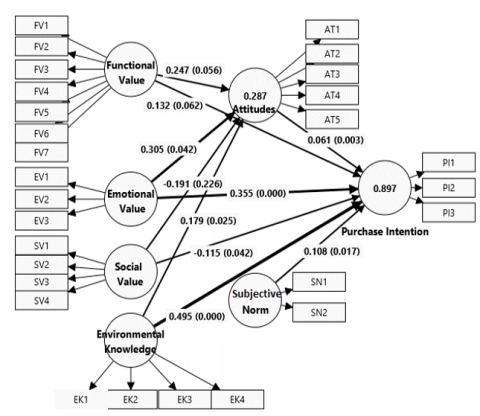
The result of structural model and hypotheses testing is presented and illustrated in Table 4 and Figure 2 respectively. The adjusted R-squared value in Figure 2 reflects the explanatory power of the predictor variable(s) on the corresponding construct. Attitudes, perceived values and subjective norms predict about 89% (R2 = 0.897) of purchase intention. While perceived customer multi-dimensional value and environmental knowledge explains only 28% (R2 = 0.287) of young people attitudes towards green products.
The path shown by the t-statistics is more than 1.96 or p-value less 0.05 and 0.1 except H7, other hypothesizes (H1, H2, H3, H4, H5, H6, H8, H9 and H10) are supported (Table 5).
Table 5. Evaluation structural model
|
|
Beta |
T statistics |
P values |
Decision |
|
|
H1 |
Attitudes -> Purchase Intention |
0.061 |
2,979 |
0.003 |
Supported |
|
H2 |
Subjective Norm -> Purchase Intention |
0.108 |
2,388 |
0.017 |
Supported |
|
H3 |
Functional Value -> Attitudes |
0.247 |
1,915 |
0.056 |
Supported |
|
H4 |
Functional Value -> Purchase Intention |
0.132 |
1,867 |
0.062 |
Supported |
|
H5 |
Emotional Value -> Attitudes |
0.305 |
2,032 |
0.042 |
Supported |
|
H6 |
Emotional Value -> Purchase Intention |
0.355 |
5,470 |
0.000 |
Supported |
|
H7 |
Social Value -> Attitudes |
-0.191 |
1,211 |
0.226 |
Not supported |
|
H8 |
Social Value -> Purchase Intention |
-0.115 |
2,036 |
0.042 |
Supported |
|
H9 |
Environmental Knowledge -> Attitudes |
0.179 |
2,249 |
0.025 |
Supported |
|
H10 |
Environmental Knowledge -> Purchase Intention |
0.495 |
8,814 |
0.000 |
Supported |
|
H11a |
Emotional Value > Attitudes > Purchase Intention |
0.019 |
1,586 |
0.113 |
Not supported |
|
H11b |
Environmental_Knowledge > Attitudes-> Purchase Intention |
0.011 |
1,816 |
0.069 |
Supported |
|
H11c |
Functional Value > Attitudes > Purchase Intention |
0.015 |
1,446 |
0.148 |
Not supported |
|
H11d |
Social Value > Attitudes > Purchase Intention |
-0.012 |
1,056 |
0.291 |
Not supported |
Although the impact is weak young’s attitudes towards green products positively influence purchase intention from H1 is supported (p = 0.003; β = 0.061). This finding is in line with the studies indicating that customer attitudes positively influence intention [1, 28, 34, 35].
Relationship between subjective norm and purchase intention (H2) is supported (p = 0.017; β = 0.10). This is also in line with findings of studies relating to green behavior [1, 4, 35].
Moreover, functional value influence on attitudes (p = 0.056; β = 0.24) to purchase intention (p = 0.062; β = 0.132) both were found to be statistically significant; it means H3 and H4 are supported. This result is in line with findings of previous studies, where functional value positively influence customers’ intention, and Wu et al. [1] found positive influence of functional value in shaping attitudes towards green product [1, 15].
The finding suggests that emotional value has positive direct influence on attitudes towards green products (p = 0.042; β = 0.305) and on purchase intention (p = 0.000; β = 0.355), therefore H5 and H6 are supported. This is in line with findings of Demir et al. [15] and Wu et al. [1], in their study, emotional value has related with customer intention and attitudes toward product.
However, H7 was not supported, influence of social value on attitudes was not statistically significant (p = 0.226, β = -0.191). This result is also in the line with findings of Wu et al. [1], indicated the correlation between social value and attitude is weak and exhibits a negative relationship.
Our finding shows that social value has negative direct influence on purchase intention (p = 0.042; β = -0.115). While in the studies of Demir et al. [15] and Wu et al. [1] social value had not significant impact on intention.
H9 and H10 were accepted since environmental knowledge has positive and direct influence on attitudes (p = 0.025; β = 0.179) and on purchase intention (p = 0.000; β = 0.495). This findings support the results of the studies highlighting positive significant influence of environmental knowledge on attitudes and intention [4, 22].
Figure 2. Structural model results
The mediating influence of the attitudes were analyzed and presented in Table 4. The findings show partial mediating relationship influence for Environmental Knowledge - Attitudes - Purchase Intention (indirect effect = 0.011, p = 0.065). Thus, hypothesis H11b was supported, while other hypotheses (H11a, H11c, H11d) relating to mediating role of attitudes were rejected due to non-significance of coefficients.
This study investigates the relationship between customers multi-dimensional perceived value, environmental knowledge and purchase intention of young people from developing country with mediating role of attitudes towards green products. A framework was created, based on TPB theoretical framework by incorporating multi-dimensional green perceived value and environmental knowledge. Results show that environmental knowledge and emotional value have the greatest impact on purchase intention of young customers from Kazakhstan, while the role of subjective norm, attitudes, functional value and social value is weak even negative. In the shaping of attitudes emotional value and functional value followed by environmental knowledge have positive significant influence, while social value has not significant impact. While attitudes mediate interaction between environmental knowledge and purchase intention of green products, it does not mediate the relationship between PCV and purchase intention.
The positive and significant impact of environmental knowledge on both attitudes and purchase intentions aligns with the findings of previous studies relating to green behavior in developing countries [6, 8, 28]. However, the stronger influence of emotional value compared to functional value in shaping attitudes is a unique finding, suggesting potential cultural or contextual differences in consumer preferences This suggests that emotional appeals might be more effective in promoting green products in these markets.
Negative effects of social value on purchase intention and weak relation with attitudes we explained by the fact that the young consumers in Kazakhstan adopting a countercultural identity that rejects mainstream consumerism. Green products might be perceived as part of this countercultural image, and social pressure to conform to traditional consumer norms could negatively influence purchase intention. And the pursuit of materialistic values and status symbols might be prevalent among young consumers. If green products are not perceived as status symbols or aligned with materialistic aspirations, social value could have a negative impact on purchase intention.
Theoretical implications. This study extends the traditional TPB framework by including multidimensional perceived value (functional, emotional, and social) and environmental knowledge. The inclusion of these constructs provides a more comprehensive understanding of the factors influencing green food purchase intentions among young consumers. This is consistent with previous studies [1, 4, 15] highlighting the importance of PCV in green product purchase intention and green behavior. The results confirm that these additional variables significantly influence attitudes and intentions, thereby increasing the predictive power of the TPB model.
The results highlight the critical role of environmental knowledge in shaping young consumers' attitudes and intentions towards green products. This is consistent with findings [4, 22] and proves the statement that environmental knowledge is one of the strongest determinant of green product purchase intention. In addition, it was proved that attitudes mediate interaction between environmental knowledge and purchase intention in context of green products. These suggest that increased awareness and understanding of environmental issues may lead to more favorable attitudes and stronger intentions to purchase green products.
Practical implications. Marketers can leverage the findings by emphasizing the emotional and functional values of green products in their marketing strategies and campaigns. By emphasizing practical benefits such as positive feelings associated with environmentally friendly choices (emotional value), and quality and reliability (functional value), can effectively increase purchase intentions of young consumers. As emotional value significantly influences purchase intentions, marketers should create campaigns that evoke positive emotions associated with green consumption. This could involve storytelling, using visuals that resonate with Kazakh culture, or highlighting the personal benefits of adopting a greener lifestyle. While emotional appeals are crucial, emphasizing the practical benefits of green products is equally important. Marketers can highlight how green products can save money, improve health, or enhance convenience. Marketers should focus on redefining green products as desirable and status-enhancing. Emphasizing the social benefits of green consumption, such as contributing to a better environment for future generations, could be effective.
Collaborating with influential figures who embody a countercultural or environmentally conscious image can help to shift social norms and make green products more appealing to young consumers.
The positive impact of environmental knowledge on attitudes and purchase intentions suggests that educational initiatives aimed at increasing environmental awareness can be quite effective. Schools, universities and environmental organizations can develop programs that educate young people about the environmental impact of their consumer choices and the benefits of green products. Raising awareness about the environmental impact of consumer choices and the benefits of green products can help to dispel misconceptions and create a more positive social image for green consumption.
Policymakers can use these ideas to promote sustainable consumer behavior among young people. By supporting campaigns that educate the public about environmental issues and the importance of green products, they can help create a more environmentally conscious society. Policymakers could launch campaigns to raise awareness about the environmental benefits of green consumption and dispel misconceptions about green products.
Both marketers and policymakers should be mindful of Kazakh culture and values when developing strategies. Incorporating traditional elements or aligning with existing social norms can enhance the effectiveness of campaigns and policies.
This study aimed to explore the factors influencing young consumers' attitudes and intentions to purchase green products by extending the TPB framework. By integrating multidimensional perceived value (functional, emotional, and social) and environmental knowledge into the traditional TPB model, the study provides a comprehensive understanding of the determinants of green product purchasing behavior among youth.
The study offers in-depth insight into the willingness of young consumers in developing countries to buy green products, addressing both theoretical and practical aspects. It is vital for green product developers to prioritize improving the emotional experience and functionality of their offerings to meet the preferences of younger consumers. Product developers should also expand collaboration with government and environmental organizations to address uncertainty through technological innovation and service diversification. The government has a key role to play in promoting green consumption; it should raise environmental awareness among the younger generation through educational initiatives and advertising campaigns and support the growth of environmentally friendly products through financial incentives.
The study’s findings may be influenced by the geographic and cultural context in which the data was collected. Consumer attitudes and behaviors towards green products can vary significantly across different age groups, regions and cultures, limiting the generalizability of the results.
Future research should examine these relationships in different cultural contexts and among different age groups to increase the generalizability of the findings. Additionally, longitudinal studies can provide insight into how attitudes and intentions to purchase green products change over time.
Secondly, this study is limited to green product purchase intention influenced by PCV and environmental knowledge, future research may include other variables such as green consumption.
The current research employed a cross-sectional approach, which limits the ability to establish definitive cause-and-effect relationships. To strengthen the evidence supporting the environmentally conscious Theory of Planned Behavior, future studies should consider experimental designs.
In conclusion, this study contributes to the literature on green consumer behavior by demonstrating the importance of perceived value and environmental knowledge in influencing young consumers' attitudes and purchase intentions toward green products. The findings provide valuable information for promoting sustainable consumption patterns and increasing understanding of green consumer behavior.
This research is funded by the Science Committee of the Ministry of Science and Higher Education of the Republic of Kazakhstan (Grant No.: AP13268872).
[1] Wu, H., Wang, W., Tao, Y., Shao, M., Yu, C. (2024). Understand the Chinese Z generation consumers’ green hotel visit intention: An extended theory of planned behavior model. Heliyon, 10(3): e25067. https://doi.org/10.1016/j.heliyon.2024.e25067
[2] Ajzen, I. (1991). The theory of planned behavior. Organizational Behavior and Human Decision Processes, 50: 179-211. https://doi.org/10.1016/0749-5978(91)90020-T
[3] Ajzen, I. (2002). Perceived behavioral control, self-efficacy, locus of control, and the theory of planned behavior. Journal of Applied Social Psychology, 32: 665-683. https://doi.org/10.1111/j.1559-1816.2002.tb00236.x
[4] Yadav, R., Pathak, G.S. (2016). Young consumers’ intention towards buying green products in a developing nation: Extending the theory of planned behavior. Journal of Cleaner Production, 135: 732-739. https://doi.org/10.1016/j.jclepro.2016.06.120
[5] Prabhakar, G., Luo, X., Tseng, H.T. (2024). Exploring generation Z consumers’ purchase intention towards green products during the COVID-19 pandemic in China. e-Prime-Advances in Electrical Engineering, Electronics and Energy, 8: 100552. https://doi.org/10.1016/j.prime.2024.100552
[6] Laheri, V.K., Lim, W.M., Arya, P.K., Kumar, S. (2024). A multidimensional lens of environmental consciousness: Towards an environmentally conscious theory of planned behavior. Journal of Consumer Marketing, 41: 281-297. https://doi.org/10.1108/JCM-03-2023-5875
[7] Suryavanshi, A.K.S., Bhatt, P., Singh, S. (2023). Predicting the buying intention of organic food with the association of theory of planned behaviour. Materials Today: Proceedings. https://doi.org/10.1016/j.matpr.2023.03.359
[8] Rasheed, N., Sabir, R.I., Mahmood, H., Rauf, A., Ibrahim, A.M., Naseem, W. (2024). Impact of pro-environmental values on sustainable green apparel buying behavior in Pakistan. Cleaner and Responsible Consumption, 12: 100180. https://doi.org/10.1016/j.clrc.2024.100180
[9] Soomro, R.B., Mirani, I.A., Sajid Ali, M., Marvi, S. (2020). Exploring the green purchasing behavior of young generation in Pakistan: Opportunities for green entrepreneurship. Asia Pacific Journal of Innovation and Entrepreneurship, 14: 289-302. https://doi.org/10.1108/apjie-12-2019-0093
[10] Sweeney, J.C., Soutar, G.N. (2001). Consumer perceived value: The development of a multiple item scale. Journal of Retailing, 77: 203-220. https://doi.org/https://doi.org/10.1016/S0022-4359(01)00041-0
[11] Oliver, R.L. (1997). Satisfaction: A Behavioral Perspective on the Consumer. Irwin/ McGraw-Hill, New York, NY, USA.
[12] Wu, S.I., Chen, Y.J. (2014). The impact of green marketing and perceived innovation on purchase intention for green products. International Journal of Marketing Studies, 6: 81-100. https://doi.org/10.5539/ijms.v6n5p81
[13] Lopes, J.M.M., Gomes, S., Trancoso, T. (2024). Navigating the green maze: Insights for businesses on consumer decision-making and the mediating role of their environmental concerns. Sustainability Accounting, Management and Policy Journal. https://doi.org/10.1108/SAMPJ-07-2023-0492
[14] Sangroya, D., Nayak, J.K. (2017). Factors influencing buying behaviour of green energy consumer. Journal of Cleaner Production, 151: 393-405. https://doi.org/10.1016/j.jclepro.2017.03.010
[15] Demir, M., Rjoub, H., Yesiltas, M. (2021). Environmental awareness and guests’ intention to visit green hotels: The mediation role of consumption values. PLoS ONE, 16: 1-22. https://doi.org/10.1371/journal.pone.0248815
[16] Ruiz-Molina, M.E., Gil-Saura, I., Moise, M.S., Marín-García, A. (2023). ‘Green’ practices and value co-creation: Does guest culture make a difference? Economic Research-Ekonomska Istraživanja, 36: 2106274. https://doi.org/10.1080/1331677X.2022.2106274
[17] Ng, P.M., Cheung, C.T., Lit, K.K., Wan, C., Choy, E.T. (2024). Green consumption and sustainable development: The effects of perceived values and motivation types on green purchase intention. Business Strategy and the Environment, 33(2): 1024-1039. https://doi.org/10.1002/bse.3535
[18] Joshi, Y., Uniyal, D., Sangroya, D. (2021). Investigating consumers’ green purchase intention: Examining the role of economic value, emotional value and perceived marketplace influence. Journal of Cleaner Production, 328: 129638. https://doi.org/10.1016/j.jclepro.2021.129638
[19] Choudhury, N., Mukherjee, R., Yadav, R., Liu, Y., Wang, W. (2024). Can machine learning approaches predict green purchase intention?-A study from Indian consumer perspective. Journal of Cleaner Production, 456: 142218. https://doi.org/10.1016/j.jclepro.2024.142218
[20] Higueras-Castillo, E., Liébana-Cabanillas, F., Santos, M.A.D., Zulauf, K., Wagner, R. (2024). Do you believe it? Green advertising skepticism and perceived value in buying electric vehicles. Sustainable Development, 1-15. https://doi.org/10.1002/sd.2932
[21] Steg, L., Vlek, C. (2009). Encouraging pro-environmental behaviour: An integrative review and research agenda. Journal of Environmental Psychology, 29(3): 309-317. https://doi.org/10.1016/j.jenvp.2008.10.004
[22] Lavuri, R. (2022). Extending the theory of planned behavior: Factors fostering millennials’ intention to purchase eco-sustainable products in an emerging market. Journal of Environmental Planning and Management, 65: 1507-1529. https://doi.org/10.1080/09640568.2021.1933925
[23] Prieto-Sandoval, V., Torres-Guevara, L.E., García-Díaz, C. (2022). Green marketing innovation: Opportunities from an environmental education analysis in young consumers. Journal of Cleaner Production, 363: 132509. https://doi.org/10.1016/j.jclepro.2022.132509
[24] Moorthy, K., Kamarudin, A.A., Xin, L., Hui, L.M., Way, L.T., Fang, P.S., Carmen, W. (2021). Green packaging purchase behaviour: A study on Malaysian consumers. Environment, Development and Sustainability, 23: 15391-15412. https://doi.org/10.1007/s10668-021-01302-6
[25] Roh, T., Seok, J., Kim, Y. (2022). Unveiling ways to reach organic purchase: Green perceived value, perceived knowledge, attitude, subjective norm, and trust. Journal of Retailing and Consumer Services, 67: 102988. https://doi.org/10.1016/j.jretconser.2022.102988
[26] Kline, R.B. (2011). Principles and Practice of Structural Equation Modeling. Guilford Publications.
[27] Cam, L.N.T. (2023) A rising trend in eco-friendly products: A health-conscious approach to green buying. Heliyon, 9: e19845. https://doi.org/10.1016/j.heliyon.2023.e19845
[28] Kamalanon, P., Chen, J.S., Le, T.T.Y. (2022). “Why do we buy green products?” An extended theory of the planned behavior model for green product purchase behavior. Sustainability (Switzerland), 14: 1-28. https://doi.org/10.3390/su14020689
[29] Sarstedt, M., Ringle, C.M., Cheah, J.H., Ting, H., Moisescu, O.I., Radomir, L. (2020). Structural model robustness checks in PLS-SEM. Tourism Economics, 26(4): 531-554. https://doi.org/10.1177/1354816618823921
[30] Ringle, C.M., Wende, S., Becker, J. (2024). SmartPLS 4.
[31] Henseler, J., Hubona, G., Ray, P.A. (2016). Using PLS path modeling in new technology research: Updated guidelines. Industrial Management and Data Systems, 116: 2-20. https://doi.org/10.1108/IMDS-09-2015-0382
[32] Sarstedt, M., Henseler, J., Ringle, C.M. (2011). Multigroup analysis in partial least squares (PLS) path modeling: Alternative methods and empirical results. In Measurement and research methods in International Marketing, pp. 195-218. https://doi.org/10.1108/S1474-7979(2011)0000022012
[33] Henseler, J., Ringle, C.M., Sarstedt, M. (2015). A new criterion for assessing discriminant validity in variance-based structural equation modeling. Journal of the Academy of Marketing Science, 43: 115-135. https://doi.org/10.1007/s11747-014-0403-8
[34] Vu, D.M., Ha, N.T., Ngo, T.V.N., Pham, H.T., Duong, C.D. (2022). Environmental corporate social responsibility initiatives and green purchase intention: An application of the extended theory of planned behavior. Social Responsibility Journal, 18(8): 1627-1645. https://doi.org/10.1108/SRJ-06-2021-0220
[35] Ahmed, N., Li, C., Khan, A., Qalati, S.A., Naz, S., Rana, F. (2021). Purchase intention toward organic food among young consumers using theory of planned behavior: Role of environmental concerns and environmental awareness. Journal of Environmental Planning and Management, 64(5): 796-822. https://doi.org/10.1080/09640568.2020.1785404