Serap Çağla Öztürk* | Esin Özlem Aktuğlu Aktan
© 2024 The authors. This article is published by IIETA and is licensed under the CC BY 4.0 license (http://creativecommons.org/licenses/by/4.0/).
OPEN ACCESS
This study explores the increasing global interest in the preservation and management of cultural heritage, emphasizing the need for innovative tools in urban planning and design to address this critical issue. As cultural heritage gains international attention, particularly through the concept of cultural routes, there is a growing demand for urban planning strategies that are both flexible and forward-thinking. The shift from traditional planning approaches to advanced digital systems, particularly those driven by artificial intelligence, marks a significant transformation in the field. This study aims to introduce an innovative application recommendation, designed to optimize urban environments by leveraging the dynamic potential of cultural routes. Central to this approach is the Ant Colony Optimization (ACO) technique, enhanced with the 2-Opt algorithm based on the Traveling Salesman Problem (TSP), a highly effective method widely used for solving complex routing problems. By integrating this improved ACO, the recommendation not only generates optimal routes tailored to user preferences but also enhances efficiency in both time and budget management. Beyond its technical merits, this optimization-based solution offers a holistic approach to urban planning by integrating cultural heritage management with contemporary technological advancements. By doing so, the recommendation is expected to contribute to the sustainable development of cities, ensuring that cultural heritage is preserved while also addressing the practical needs of urban environments. This research presents a forward-thinking proposal that aligns with global trends in cultural preservation, offering a functional and adaptable tool for the challenges faced by the user. The findings of this study show that the proposed cultural route planning and design model can create specific routes according to individual interests, thus helping to personalize travel experiences and determine the most appropriate routes.
cultural heritage, urban planning, cultural routes, optimization techniques
1.1 Background
In response to the significant social impacts of ongoing global changes, new planning and design principles are emerging as critical components in shaping physical spaces. These changes have led to a growing emphasis on developing strategies that support evolving consumption models, particularly in urban environments. Traditional approaches to urban planning and design are increasingly being supplemented by innovative tools and methodologies that reflect the needs of contemporary society.
In today's rapidly evolving landscape, there is a clear demand for new application tools within urban planning and design. These tools are required to cater to the specific needs of smaller, more personalized groups, such as families or friends, as well as individuals—moving away from the standardized models of mass tourism like package tours. This shift reflects a broader trend towards customization and personalization in tourism experiences, driven by the increasing integration of advanced technologies into everyday life.
The growing incorporation of artificial intelligence (AI) technologies into daily practices is gradually leading to the obsolescence of traditional tourism methods. The technological advancements of recent years have given rise to modern and universal products that challenge conventional tourism paradigms. In this innovative and competitive environment, it is essential that cultural tourism evolves in tandem with these ongoing changes. By doing so, access to cultural heritage assets can be significantly enhanced, and information about these assets can be more effectively disseminated through digital platforms.
The convergence of technology and cultural tourism presents new opportunities for improving how cultural heritage is experienced and preserved. Electronic platforms, powered by AI and other cutting-edge technologies, not only facilitate easier access to heritage sites but also provide enriched, interactive experiences for users. As a result, cultural tourism is increasingly becoming a dynamic sector that must adapt to the rapidly changing technological landscape while continuing to promote the understanding and appreciation of cultural heritage.
1.2 Objective and scope
In the era of evolving traveler profiles, changing demands, and new planning and design approaches, participants can now access the cultural values they plan to visit using modern information and communication tools. In response to these evolving needs, this study is conducted to explore the role of cultural routes in heritage preservation. The aim of the study is to emphasize the importance of cultural routes in the management of cultural heritage and to propose a model that provides users with the most suitable route between the points they specify in urban spaces. The hypothesis derived from these evaluations is as follows; advancements in digital technology systems related to urban planning offer users alternative gains in time and budget management. The proposed model, developed using optimization techniques, is designed with the user's needs and preferences at its core.
Route selection on urban scale is a multidimensional problem. Especially for the road generation and navigation systems/tools, achieving maximum benefit with minimum consumption of time, space, and cost is crucial. In this study, the identification of points determined at the urban scale and the determination of the most suitable route have been considered as the main problem. In this context, an optimization-based application recommendation using the ant colony algorithm has been developed. In addition to international sources such as regulations and articles related to the subject, sample surveys and adaptable inferences, a cultural inventory study has also been conducted.
In this context, the study is structured around six main sections. Section 1 introduces the subject, aims, and scope of the research to establish a foundational understanding. Section 2 provides a comprehensive literature review on cultural routes, discussing their definition, development, and significance in the context of local and cultural objectives, along with an analysis of international regulations and scholarly articles, synthesizing various disciplinary perspectives to inform the content preparation. It also delves into optimization techniques across different scientific domains, highlighting swarm intelligence and fundamental principles of various optimization methods, with a specific focus on the improved Ant Colony Optimization Algorithm as a suitable choice for solving complex optimization problems. Section 3 includes the parameter settings of the ACO algorithm, the implementation process, and the evaluation of the obtained results, thus revealing the effectiveness of ACO in solving complex problems such as cultural route planning. Section 4 specifically proposes a model using 2-Opt modified Ant Colony Optimization Algorithm based on Travelling Salesman Problem. Section 5 synthesize an evaluation of the problem addressed in the study, its role and importance in the relevant field, its fundamental contribution to the literature, its innovation, its difference from existing studies, and its contribution to future studies. The study is completed in Section 6 including the findings of the study and suggestions regarding the subject.
2.1 Cultural routes: Definition and development
Every product that emerges as a reflection of the ever-changing cultural balance and belonging between humans and the environment represents cultural heritage. Cultural heritage assets are the totality of values possessed with identity, culture, history. It acts as a substratum of identity and evidence of civilization's development, connecting the present with the past. Throughout the process of reproducing space (tangible and intangible) elements of cultural heritage, which are proof of former periods, can be preserved in some cases and in some aspects, while not in others; mainly due to the changing demands of the past and present [1]. The modern concept of cultural heritage is represented by material and immaterial values, and dynamically develops with global trends, constantly absorbing new aspects [2].
Discussions on the protection of cultural assets and the changing social and economic balances after the World Wars have become more prominent. Current heritage management practices are often retrospective, and there is a need for methodologies that incorporate strategic foresight to ensure the preservation of contemporary heritage [3, 4].
The issue of preserving and managing cultural heritage has been a focal point in various international meetings and workshops organized by prominent organizations. Key contributors to this global dialogue include the Council of Europe (COE), International Council on Monuments and Sites (ICOMOS), International Centre for the Study of the Preservation and Restoration of Cultural Property (ICCROM), and the United Nations Educational, Scientific and Cultural Organization (UNESCO). Notable reports and discussions from COE have significantly contributed to the discourse on cultural heritage preservation and management. Similarly, ICOMOS’s 2008 meeting and ICCROM’s initiatives are crucial for understanding heritage preservation practices. UNESCO has played a pivotal role with its influential documents, which outline global standards and best practices for cultural heritage.
All heritage sites, whether tangible or intangible, possess intrinsic cultural characteristics that are essential to their value and significance. In contemporary tourism, culture is increasingly recognized as a valuable resource. Modern tourism trends leverage culture and cultural heritage sites to enhance visitor attraction and engagement. When tourism and cultural heritage management work in concert, focusing on authenticity, accessibility, and stakeholder consultation, cultural tourism can be both sustainable and profitable. Sustainable cultural tourism is closely linked to the sustainable use, conservation, and management of cultural heritage, underlining the importance of preserving cultural authenticity and integrity in tourism experiences [5].
Cultural routes have emerged as a means to integrate various cultural components within a cohesive framework. These routes serve as new communication and transportation corridors, creating opportunities to connect diverse cultural elements and enrich the overall tourism experience. By combining different cultural elements into a unified structure, cultural routes facilitate a deeper understanding and appreciation of cultural heritage, contributing to both its preservation and promotion.
The origins of cultural routes can be traced back to ancient times. Trade routes, pilgrimage paths, and military roads have been regarded as regions of intense cultural interaction and exchange. The Council of Europe’s 'European Cultural Routes Programme' was initiated in 1987 to highlight the contributions of different cultures to a shared heritage. This program aims to strengthen the cultural ties within Europe and between Europe and other regions of the world. The Cultural Routes of the Council of Europe bring together people who share a common history and heritage, offering a model for international cultural and tourism management while inviting the exploration of Europe’s rich cultural heritage. The program was launched with the Santiago de Compostela Declaration [6], which reflects the Council of Europe’s commitment to intercultural exchange, heritage preservation, and sustainable tourism.
The Santiago de Compostela Declaration, proposed by the Council of Europe, emphasized the revitalization of this route and its symbolic significance in the formation of the European Union [7]. The Santiago de Compostela Pilgrimage Route has become a significant symbol of European cultural heritage and was declared the first European cultural route. The European Cultural Routes, exemplified by the Camino de Santiago, have been recognized as valuable assets that contribute to the preservation and promotion of cultural heritage [8, 9]. The Council of Europe's cultural route projects focus on education, developing and publicizing tourist routes that promote understanding and respect for European values [10].
The importance given to cultural routes has noticeably increased in recent years. It continues to evolve as it finds its place in areas related to heritage preservation. The concept is now being addressed more comprehensively due to evaluations made by various fields of expertise. Following the session titled Routes as Part of Our Cultural Heritage, Report on the Meeting of Experts [11] the approach to the concept was expressed as tangible elements of cultural significance resulting from exchanges and multidimensional dialogues between countries or regions, demonstrating the interaction of movement over time and space along the route.
Culture Routes, highlighted in the publication Intangible Heritage and Cultural Routes in a Universal Context prepared by CIIC in 2001 [12], are emphasized as a concept representing "a set of values that is more comprehensive and meaningful than the sum of its parts, representing mutual exchange and dialogue between countries and regions, enriching its core function with diversity."
The significance attributed to the concept in the Charter on Cultural Routes [13] and carrying qualified document value regarding cultural routes is expressed as a new concept or class does not conflict or overlap with other types of cultural assets (monuments, cities, cultural landscapes, industrial heritage, etc.) within the scope of the route's influence area. The route integrates all these assets in a common system to enhance their importance." Cultural Routes emphasize the value of cultural properties as a resource for sustainable social and economic development, requiring joint efforts across national borders.
The National Scientific Committee [14] of ICOMOS, which facilitates national and international connections among local authorities, institutions, and individuals for all areas of cultural significance in Australia, has commented on cultural routes: "They constitute a network connecting regions, countries, and global cultures. They result from travelers exchanging ideas over long distances and many years."
The concept of cultural routes, increasingly addressed in cultural heritage platforms, gains new meanings daily from different disciplines. Although not under the same name, discussions on cultural routes have been initiated since the early 1960s. In 1960, the Cultural Routes Program of the Council of Europe, which played a significant role in rediscovering common European heritage, was implemented with a report focusing on experiencing cultural heritage through travel prepared by an expert group of the Council of Europe in 1987. In the late 1980s and early 1990s, cultural routes with various characteristics such as religious, commercial, military, architectural, natural, and symbolic continued to be established throughout Europe. As of 2024, 48 cultural routes of the Council of Europe reflect different contents of common European heritage.
The ICOMOS Cultural Routes Charter, one of the most common sources regarding cultural routes, was published in 2008 following a series of meetings organized by CIIC, the scientific committee of ICOMOS on cultural routes. The comprehensive declaration outlines the purpose, scope, and development of cultural routes, defining fundamental principles and methods for their preservation and management. In the declaration, the approach to the concept of cultural routes is expressed as follows: "Considering Cultural Routes as a new concept or category does not conflict or overlap with existing other cultural features - monuments, cities, cultural landscapes, industrial heritage, etc. All categories or types found within the orbit of a Cultural Route are included in a common system that only enhances their importance."
Cultural routes based on cultural and social principles are seen as a resource for innovation, creativity, small business formation, and cultural tourism products/services. By contributing to the interaction between tourism and heritage, they offer new perspectives for preservation and management approaches. By encompassing these components at all levels, cultural routes add new meanings to intercultural interactions.
Cultural routes offer many opportunities within the scope of changing tourism strategies. UNWTO [15] states that one of the opportunities created by cultural routes in this context is to produce new tourism products by preserving the dynamics created by new tourism trends. Developed to enhance and sustain cultural and natural heritage, cultural routes offer guidance opportunities for cultural tourism their unique appeal and functions. Therefore, cultural routes are a concept that needs to be understood more comprehensively with national or universal characteristics.
Cultural routes are essential for the revitalization and sustainable development of historical areas and regions rich in cultural heritage. These routes act as pathways connecting geographically dispersed villages that share common cultural values and historical significance [16]. By identifying and preserving tangible and intangible resources along these routes, cultural routes contribute significantly to the conservation of crucial historical and cultural elements, promoting heritage conservation and regional development [17]. Cultural routes also have the potential to boost cultural tourism, thereby supporting the sustainable development of historical areas by attracting visitors and fostering economic growth [18]. These routes act as tools for capitalizing on the cultural heritage of regions, stimulating tourism, and establishing sustainable development practices [19].
The concept of cultural routes has evolved over time, emphasizing the integration of cultural heritage with tourism to drive local development. Preserving cultural routes is crucial not only for the protection of historical and cultural values but also for societal sustainability. Cultural routes contribute to sustainable development by revitalizing local economies and raising societal awareness.
Studies have underscored the importance of cultural routes in conserving cultural landscape values, promoting local tourism, and enhancing the overall visitor experience [20]. Developing cultural routes requires a systematic approach that considers the historical and cultural significance of sites along the route, as well as the active engagement of local communities in the planning and management processes [21]. The development of cultural routes is crucial for promoting cultural participation and heritage preservation, offering visitors a new way to engage with diverse cultural experiences [22]. Successful cultural route development necessitates collaboration with the tourism industry and the active involvement of stakeholders to ensure effective promotion and protection of the routes [23].
Today, cultural routes have expanded beyond historical and religious pathways to include routes themed around gastronomy, art, architecture, and natural beauty. These modern cultural routes are characterized by networks of sites that share a common theme, offering travelers unique experiences and insights into the heritage and cultural identity of different regions [23]. Cultural routes are not confined to historical areas but can also encompass various themes such as wine routes, providing unique travel experiences for visitors [24]. Additionally, repurposing abandoned railways into tourist routes has been proposed as a model for revitalizing marginal rural areas, showcasing the potential of cultural routes in transforming underutilized spaces into tourist attractions [25]. Furthermore, musical routes have been instrumental in fostering cultural exchange, preserving musical traditions, and promoting intercultural dialogue, thereby enriching the global cultural landscape and enhancing social identities [26].
2.2 Optimization techniques
Optimization utilizes mathematical programming techniques to minimize or maximize a real function. This involves determining solution paths for a problem and attempting to find the best outcome among possible options. Optimization is a tool design and manufacturing engineers use to find the best possible solution from alternatives, improving product performance, functionality, and cost-effectiveness [27]. Different computational techniques are used in optimization applications, and an optimization problem can be defined to achieve the best result in the shortest time possible.
These problems often involve finding the best solution from a set of feasible solutions, subject to certain constraints. The complexity of optimization problems can vary significantly, ranging from simple linear problems to highly complex non-convex and multi-objective problems. Mathematical optimization has become an important tool in many fields; it is used in construction, chemistry, mechanical and aerospace engineering, finance, supply chain management, and many other areas. In these application areas, optimization problems assist decision-makers, system designers, or system operators.
Different optimization criteria and measures are utilized to guide the optimization process towards achieving the set objectives. Optimization techniques are crucial in applications like system engineering, compiler design, and robotic arm behavior optimization [28-30]. These techniques include deterministic and stochastic methods, offering a wide array of tools for optimization tasks [31]. For example, it has been employed for optimal capacitor allocation in distribution networks [32]. Furthermore, optimization techniques enhance the performance of systems such as power systems, wireless communications, and network routing protocols [33-35]. These various techniques contribute to improving energy efficiency, control mechanisms, and overall system optimization.
Various techniques have been proposed in literature to solve the fundamental optimization problems. Some of these techniques include algorithms inspired by behaviors observed in nature and are widely used in various sectors with different capacities and speeds. These nature-inspired algorithms have been employed in a diverse array of optimization tasks, ranging from engineering optimization [36] to healthcare systems [37], materials science [38], and Alzheimer's detection [39]. Additionally, these algorithms aim to reduce energy consumption, processing time, and prevent route loops, thereby enhancing the overall efficiency of routing protocols [40]. They contribute to sensor network longevity [41]. They have proven to be potent tools for resolving intricate optimization problems by capitalizing on principles derived from natural systems like evolution, swarm intelligence, and physical phenomena [42].
In the realm of urban logistics and aerial transportation, Yi [43] explored an operational capacity assessment method for urban low-altitude unmanned aerial vehicle logistics route networks, highlighting the impact of operation time on optimal operational capacity and algorithm convergence speed. Yi [43] also investigated an air route network planning model for logistics UAV terminal distribution, showcasing improved efficiency in route optimization and safety enhancement through experimental results [44].
A swarm represents a community of organisms with different lifestyles, and the limited and simple activities of individuals within the swarm enable the resolution of complex problems within the community. Swarm intelligence defines the functional structure created by these communities and develops a common behavioral mechanism. Thus, individuals within the swarm respond to common threats and adapt to the natural cycle by acting together.
Controlled and interactive behaviors exist among individuals within the swarm, which ensures the continual structuring of various behavior systems to adapt to the natural cycle. These systems include division of labor, communication methods, and instinctive movement. Swarm intelligence establishes the structural order within the swarm while also meeting basic needs, including security, shelter, nutrition, and reproduction.
Optimization problems based on swarm intelligence are developed by observing the movements of organisms within the community. These problems are among many solution methods developed and inspired by nature. Swarm intelligence algorithms have been widely applied to solve various optimization problems across different fields. These algorithms are being developed for use in the field of artificial intelligence. Various swarm intelligence algorithms such as Ant Colony Optimization (ACO), Particle Swarm Optimization (PSO), Artificial Fish Swarm (AFS), Bacterial Foraging Optimization (BFO), and Artificial Bee Colony (ABC) have been developed and successfully applied to solve optimization problems in engineering and other fields [45]. Comparative studies have underscored the effectiveness of various swarm intelligence algorithms in solving complex problems. For example, analyses of the Traveling Salesman Problem using ACO, PSO, and other SI methods have demonstrated their capability to yield high-quality solutions efficiently [46].
Optimization problems can be evaluated as easy or hard depending on the solution methods, and different algorithms can be used for their solutions. Different methods may be required for each problem class, and heuristic methods can be employed for difficult problems. Heuristic methods focus on obtaining solutions close to the best rather than directly finding the best solution and can increase efficiency in large optimization problems. Metaheuristic algorithms used to solve difficult optimization problems are specially developed to improve solution quality and can be adapted to many problems. Metaheuristic algorithms introduce randomization techniques with deterministic approaches to provide near-optimal solutions for NP (nondeterministic polynomial) problems [47]. Such algorithms are developed by drawing inspiration from different scientific disciplines and can be called artificial intelligence approaches. Ant colony optimization is a successful swarm intelligence technique that uses pheromones to guide other ants towards a favorable path, with numerous successful applications [48].
2.3 Ant colony optimization
By leveraging behaviors observed in nature as a part of metaheuristic algorithms, researchers address complex routing challenges and improve overall system performance. These studies underscore the broad applicability and effectiveness of nature-inspired routing algorithms in enhancing routing solutions across various sectors. As these algorithms continue to evolve, they offer valuable tools for optimizing routing protocols and advancing network efficiency, energy conservation, and performance across different domains [49-51]. The ant colony optimization falls into the nature-inspired population-based metaheuristic group.
The nature-inspired algorithms based on ant colony behavior, have shown significant promise in optimizing routing efficiency and performance. Different types of ant colony optimization algorithms have been developed to date. The foundation of these algorithms is based on the first technique, the Ant System. All ant colony algorithms can find and implement the best solution. Ant Colony Optimization has advanced significantly since its initial proposal, with high-performing variants, a generic framework, and successful applications on various computationally hard problems [52].
Ants stand out among social organisms developing survival strategies, particularly as colonies. These creatures are known for their advanced defense techniques, construction abilities, navigation and communication skills, environmental adaptability, and colony life. Ant System is an algorithm proposed by Marco Dorigo in 1992, based on ant behaviors, was initially applied in numerical models on the Traveling Salesman Problem (TSP). In this study, ant optimization techniques are incorporated, considering the success of ants as colonies. This technique relies on the search for optimal results.
In practice, ACO has been successfully applied to various routing problems, including vehicle routing, multicast routing, and mobile multicast routing, due to its powerful optimization heuristic for combinatorial optimization problems. The ACO algorithm imitates the foraging behavior of ants to discover the route to the destination, making it suitable for adaptive routing and guaranteed packet delivery in wireless sensor networks [53, 54].
The ACO algorithm has been employed in vehicle routing with soft time windows, where a simulated annealing ant colony algorithm (SAACO) was designed for path planning [55]. It has also been utilized to optimize mutation testing challenges, indicating its applicability in diverse problem domains [56]. Furthermore, ACO has been used in the context of Internet of Things routing algorithms, where developed versions of ACO algorithms are employed to find the shortest paths, demonstrating its relevance in modern routing systems [57].
The Ant System is shaped on a mathematical system that includes ants' intuitive behaviors within the colony and access to environmental resources. Ant colony optimization is a computational intelligence technique that uses artificial ants to solve optimization problems and exchange information on their quality, based on real ant foraging behavior [58]. The ACO algorithm differs from the original system (Ant System) in three main aspects: a) the node selection rule (the state transition rule) provides a direct path to balance between the discovery of new edges, probable selections, and information about the problem; b) the global pheromone update rule is applied only to the edges of the best ant tour; c) local update rule is applied as ants construct a solution.
The main ant optimization methods developed after the Ant System include; Elitist Ant System, Ant Q, Max-Min Ant System, Rank-Based Ant System, Ant-Cycle, Ant-Density, Ant-Quantity, and Ant Colony System. These algorithms are derived models from the Ant System and are frequently preferred due to their success in complex optimization problems and adaptability.
Ant Colony Optimization is an optimization algorithm initially developed for the Traveling Salesman Problem. TSP is a problem of finding a tour that visits each node exactly once by combining a series of nodes with the shortest path. It is fundamentally based on the Hamiltonian Path. The Hamiltonian Path is a tour that returns to the starting point by passing through each point on the route only once. In TSP, the goal is to find the minimum length route on the graph of these points when the distances between them are known. Depending on the nodes to be visited, constraints, tools used, and other variables, this problem can exhibit various forms of complexity.
In recent years, many researchers have proposed various methods/applications for solving the Traveling Salesman Problem using the Ant Colony Optimization algorithm. Ant colony optimization algorithms can effectively solve dynamic problems like the traveling salesperson problem, with evaporation-based and population-based frameworks showing promising performance [58, 59].
Improved versions of ACO, such as those enhancing local search ability and improving task scheduling quality in distributed cyber-physical systems, with good effectiveness, stability, and adaptability [60]. The improved Ant Colony Algorithm can effectively simulate ant behavior and improve AI training platforms for solving practical problems in various industries [61].
2.4 Overview of 2-Opt algorithm as a local search
Local search is a heuristic method used to solve complex optimization problems. These algorithms try to find the best solution by applying local changes among candidate solutions. Problems are usually defined as a solution space and the goal of finding the best solution in this space. Local search algorithms make local changes while moving in the solution space and continue until the solution is found to be optimal or until a certain amount of time has passed. Local search algorithms work by moving to the nearest neighbor solution to an existing solution. Each candidate solution can be replaced by a neighbor solution and new neighborhood relationships are defined. Applied problems include Vertex Cover Problem, Traveling Salesman Problem, Boolean Satisfiability Problem, k-Medoid Clustering Problem.
2-Opt is a local search method for minimizing the length of a route by swapping two edges on a sequential tour path. It was first proposed by Croes [62]. This method tries to find shorter paths by targeting improvements in the current solution, especially in route planning problems. 2-Opt evaluates whether a new path is shorter after swapping both edges and updates the route if an improvement is achieved. This technique can improve the overall solution quality by focusing on local optimal solutions of the route.
The 2-Opt algorithm has been integrated into various optimization frameworks to boost their performance. For instance, in addressing the Vehicle Routing Problem (VRP), the 2-Opt operator has been amalgamated with other metaheuristic algorithms like Ant Colony Optimization to handle dynamic routing issues [63-65]. This combination demonstrates the adaptability and versatility of the 2-Opt algorithm in diverse optimization scenarios. This strategy aims to enhance the efficiency of local search methods by optimizing the time allocated to evaluating potential solutions, thereby improving the overall algorithm performance.
3.1 Research design
The study employs experimental research to explore optimization techniques in cultural route planning. The experimental setup involves the development of an ACO-based algorithm with TSP and its implementation in a simulated urban environment.
3.2 Experimental setup
3.2.1 Experimental settings
The success of the ACO depends significantly on the proper tuning and selection of its parameters as given in Table 1. Proper tuning of these parameters ensures that the algorithm can efficiently explore the solution space, avoid premature convergence, and ultimately find high-quality solutions. As such, parameter tuning is often considered a crucial step in the application of ACO to any specific problem.
Table 1. Ant colony algorithm parameters
|
Symbol |
Definition |
|
n |
Number of nodes |
|
m |
Number of ants |
|
α |
Parameter controlling the pheromone trail between edges i, j; α≥0 |
|
β |
Parameter controlling the visibility value between edges i, j; β≥0 |
|
ρ |
Coefficient specifying the amount of pheromone evaporation; 0≤ρ<1 |
|
Q |
A constant value related to the left pheromone |
|
τij |
Pheromone amount on edges i, j |
|
ηij |
Visibility value between edges i, j; 1/dij expression |
|
ak |
Allowed node sequence (tabu list) |
|
Lk |
Tour length of ant k |
In problems where the Ant System is used, the measure between points is often the straight-line distance called the Euclidean distance measure. According to this measure, the distance between nodes i and j is calculated according to the following equation:
$d_{i j}=\left[(\mathrm{x} i-\mathrm{x} j)^2+(\mathrm{y} i-\mathrm{y} j)^2\right]^{1 / 2}$ (1)
A graph is given with N nodes and E edges (N, E). Number of ants at node i at time t (2):
$b_i(t)(i=1, \ldots, n)$ (2)
Total number of ants (3):
$m=\sum_{i=1}^n b_i(t)$ (3)
Pheromone intensity on edge (i, j) at time t (4):
$\tau_{i j}(t)$ (4)
Each ant, while at time t, selects the node it will reach at time ( t + 1). In each iteration of the algorithm, m movements are performed by m ants in the (t, t + 1) range. At the end of n iterations of the algorithm, each ant completes one tour, and the pheromone intensity is updated (5):
$\tau_{i j}(t+n)=\rho \cdot \tau_{i j}(t)+\Delta \tau_{i j}$ (5)
The amount of pheromone left by ant k on edges (i, j) between times x and y is (6):
$\Delta \tau_{i j}=\sum_{k=1}^m \Delta \tau_{i j}^k$ (6)
It is calculated according to the following formula (7):
$\Delta \tau_{i j}^{\mathrm{k}}=\left\{\begin{array}{lr}\frac{\mathrm{Q}}{\mathrm{L}_{\mathrm{K}}} & \text { if k. ant used the }(i, j) \text { edge } \\ 0 & \text { otherwise }\end{array}\right.$ (7)
Probability of ant k transitioning from node i to node j in the algorithm (8):
$\mathrm{p}_{i j}^{\mathrm{k}}(\mathrm{t})=\left\{\begin{array}{lr}\frac{\left[\tau_{i j}(\mathrm{t})\right]^\alpha \cdot\left[\eta_{i j}\right]^\beta}{\sum_{\mathrm{k} \in \mathrm{a}_{\mathrm{k}}}\left[\tau_{\mathrm{ik}}(\mathrm{t})\right]^\alpha \cdot\left[\eta_{\mathrm{ik}}\right]^\beta} & j \in \mathrm{a}_{\mathrm{k}} \\ 0 & \text { otherwise }\end{array}\right.$ (8)
Ant Colony Optimization is a technique developed inspired by the movements of natural ant colonies between food sources and nests, used to produce solutions to optimization problems. Ants move randomly in search of food sources. During this process, they leave a chemical secretion called pheromone, marking their paths. Other colony members communicate by following these pheromone trails. Pheromone is a widely used tool for communication among ants. Additionally, pheromone helps ants find the shortest path between food sources and the nest. The pheromone trail becomes denser and more pronounced where ants pass. This information is shared with other ants through pheromones.
Each ant forms its solution and determines its routes using pheromone trails. The levels of pheromones on the routes change with repeated movements; the amount of pheromones on unused paths decreases or resets. Therefore, pheromone updating and evaporation processes are applied. In ACO, the updating process is a fundamental part of the algorithm and occurs after ants complete their tour. This allows ants to work for similar results in the next round.
To elaborate further, after completing their tours, ants artificially evaporate the pheromone. Therefore, the pheromone level is increased after each round as called local pheromone update (9):
$\begin{aligned} & \Delta \tau_{i j}^{\mathrm{k}}(t+1) =\left\{\begin{array}{l}\frac{1}{\mathrm{~L}^{\mathrm{k}}(\mathrm{t}+1)} \text { If the } \mathrm{k}-\mathrm{th} \text { ant used the }(i, j) \text { path } \\ 0 \quad \text { otherwise }\end{array}\right.\end{aligned}$ (9)
Lk (t+1), represents the total distance traveled by the k-th ant in the current iteration.
This process is performed after all ants have completed their tours. The total path lengths taken by each ant are determined, and the ant that follows the shortest path is found. The best solution obtained is transferred to the next iteration. The amount of pheromone on the path taken by this ant is increased according to the following formula as called global pheromone update (10):
$\begin{aligned} & \Delta \tau_{i j}(\mathrm{t}+1) =\left\{\begin{array}{lr}\frac{1}{\mathrm{~L}_{\text {best }}(\mathrm{t}+1)} & \text { if }(i, j) \text { belongs to the best tour, } \\ 0 \quad \text { otherwise }\end{array}\right.\end{aligned}$ (10)
Lbest (t+1) represents the optimum path length found in the current iteration.
In line with the information given about the Ant Colony System, the steps regarding the operation of the system are listed as Table 2.
Table 2. Ant colony optimization algorithm steps
|
Ant Colony Optimization Algorithm Steps |
|
(1) Initialize Ants (m) and nodes (n) are generally considered equal. Ants are placed randomly on nodes. The intensity of pheromones is defined as '0'. (2) Loop iteration When ants move to the next node, the intensity of pheromones is used as a guide. Tabu is used to represent the nodes. (3) Update pheromone intensity As ants traverse all nodes, the intensity of pheromones decreases over time due to evaporation; updating is crucial. (4) End The user typically determines the number of iterations in the application. The loop ends when the maximum number of iterations is reached. After each loop, obtained routes are compared, and the optimal route is found. Otherwise, the tabu list is cleared, and Step 2 is repeated. |
3.2.2 Experimental results and analysis
This section provides the experimental findings and analysis from the implemented application of Ant Colony Optimization. The ACO application in this study utilizes a JavaScript interface, chosen for its widespread use and compatibility with web technologies. JavaScript is integral to the functionality of the World Wide Web, enabling the creation of dynamic and interactive web pages. As a modern programming language, JavaScript is supported by all major websites. In this study, a web-based interface has been developed to prepare routes using the ACO algorithm parameters. The interface basically works with two different panels; (a) ant colony algorithm control panel, (b) modify tools control panel.
The ACO algorithm, employed to address the Traveling Salesman Problem, explores the optimal route in a simulated environment where artificial ants mimic real measurements. These routes are designed to traverse each of the N nodes exactly once before returning to the starting point. By listing all permutations of N node points and calculating their respective total path lengths, the algorithm aims to identify the route with the shortest distance among the multiple possibilities. The operation of the application is delineated into three steps, representing the route planning process:
(1) Identification of all node points to be included in route planning.
(2) Assignment of suitable values to algorithm parameters, followed by determination of distances between selected points.
(3) Generation of the optimal route.
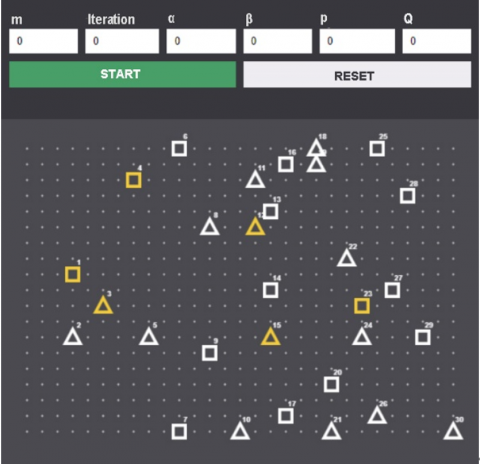
The functionality of the Ant Colony Optimization system has been analyzed within an urban area comprising 30 heritage sites, each with cultural or service significance. These heritage sites serve as individual nodes within the system. The study specifically investigates the application of the ACO algorithm to address the TSP providing insights into the system's performance when tackling complex issues. The algorithm parameters suggested by Dorigo [66] have been employed in the sample problem as given in Figure 1.
For the given experimental problem 'o' signifies nodes with cultural content, '$\Delta$' indicates nodes with service content, and the yellow nodes represent those are not part of the system.
Figure 1. Location of nodes
The application of ACO necessitates specific parameters, which can vary depending on the characteristics of the problem and the objectives of the solution. The parameters, which model the behavior of ants, play a crucial role in determining the algorithm's success. Therefore, it is vital to ascertain the correct parameter values to achieve optimal results with ACO. These values may be informed by prior experiences or recommendations found in the literature.
The parameter values utilized in this application were determined through the evaluation of information sourced from various references. The accurate determination of these values significantly impacts the operation and effectiveness of the algorithm, ensuring the generation of the most efficient outcomes. In this application, the number of ants (m) is set to 30. Within the algorithm, ants construct the shortest distance route by visiting each selected node. In the initial implementation, the number of iterations remained constant, while different combinations of α and β values are applied, and the results for the optimal solution are displayed in Table 3.
Table 3. Result list for α and β parameter combinations in the sample problem
|
No |
Iteration Count |
α |
β |
⍴ |
Total Length |
|
1 |
100 |
1 |
1 |
0,1 |
2323.55 |
|
2 |
100 |
1 |
2 |
0,1 |
2119.54 |
|
3 |
100 |
1 |
5 |
0,1 |
2061.80 |
In the experimental problem, the α parameter is kept constant at 1, while the β parameter is assigned values of 1, 2, and 5. As noted [66], setting α to 1, results in very good solutions. Increasing the β value in the algorithm enhances the likelihood of intuitive selection. In other words, the choice of the next node depends on the β parameter. Different combinations of the α and β parameters in the problem resulted in optimal routes with total lengths and route steps measured at close values. The best solution is achieved with the α, β (1, 5) combination.
Iteration, a crucial parameter within the algorithm, signifies how many times the algorithm undergoes repetition. As the number of iterations escalates, more favorable outcomes are attained. Problem-solving endeavors persist until the stipulated number of iterations is reached, impacting the response times to issues. To assess the impact of varying the iteration parameter, α and β parameters are held constant, while iterations of 50, 100, and 250 are explored. The results reveal varieties in total distance and route steps as seen in Table 4.
Table 4. Result list for number of iteration parameter in the sample problem
|
No |
Iteration Count |
α |
β |
⍴ |
Total Length |
Route Steps |
|
1 |
50 |
1 |
2 |
0,1 |
2492.61 |
21-26-29-27-24-20-17-10-7-2-5-9-22-28-25-19-18-16-11-13-8-6-14-30-21 |
|
2 |
100 |
1 |
2 |
0,1 |
2138.79 |
21-30-26-20-24-29-27-22-28-25-19-18-16-11-13-8-6-14-9-5-2-7-10-17-21 |
|
3 |
250 |
1 |
2 |
0,1 |
2042.54 |
21-26-30-29-24-27-22-28-25-18-19-16-13-11-6-8-14-9-5-2-7-10-17-20-21 |
The graph illustrating the impact of (α, β, ρ) combinations on iteration count and total length reveals significant trends in the optimization process. As the values of α (influence of heuristic information) and β (influence of pheromone concentration) are varied, their interplay significantly affects the number of iterations required to converge towards an optimal solution. In Figure 2 graph underscores the delicate balance needed in parameter selection for effective algorithm performance in urban route optimization.
Figure 2. Impact of (α, β, ρ) Combinations in Determining Iteration Count and Total Length Obtained from Table 3 & Table 4
Note: The graph shows how the total distance decreases with increasing β and the number of iterations, highlighting the impact of (α, β, ρ) combinations and iteration count on optimization results.
3.3 Improved algorithm: Integration of 2-Opt into ACO
The 2-Opt algorithm is a local search heuristic used to improve an existing tour by iteratively swapping two edges and rejoining the tour in a different way to reduce the overall travel distance. The basic idea is to select two non-adjacent edges in the tour, remove them, and reconnect the resulting segments to form a new, potentially shorter tour. This process continues until no further improvements can be made (11):
1. Two points are selected on a route: i and j (ki i<j).
2. The connections between these two points are reversed: (i, i+1) and (j, j+1).
3. The new route checks whether the distance between i and j is shorter.
$\begin{aligned} \Delta L=d(i, i+1) & +d(j, j+1)-[d(i j)+d(i+1, j+1)]\end{aligned}$ (11)
where, ΔL: change in route length, d (x, y): distance between points x, y.
If ΔL<0, a route change is made because the new route is shorter.
In this work, local search operators are introduced as a technique used to improve the results of the ACO algorithm. They try to obtain shorter routes by changing certain parts of the routes found by the ant. The integration of the 2-Opt method with ACO increases the local search capacity of ACO, resulting in better results. When the global search capability of traditional ACO is supported by 2-Opt, the algorithm can perform both global and local optimizations more effectively. It can improve the accuracy and efficiency of the optimization process. Table 5 details this integration:
Table 5. Integration of 2-Opt into ACO algorithm steps based on TSP
|
Integration of 2-Opt into ACO Algorithm steps based on TSP |
|
Step 1: Initialization Set the number of ants (m), evaporation rate (ρ), pheromone influence (α), and heuristic influence (β). Step 2: Constructing Tours Each ant constructs a tour by moving from one site to another based on the pheromone trails and heuristic information. The probability of moving from site i to site j is determined by the following equation: $\mathrm{p}_{i j}^{\mathrm{k}}=\frac{\left[\mathrm{\tau}_{i j}(\mathrm{t})\right]^\alpha \cdot\left[\eta_{\mathrm{ij}}\right]^\beta}{\sum_{\mathrm{k} \in \text { allowed }_{\mathrm{k}}}\left[\tau_{\mathrm{ik}}(\mathrm{t})\right]^\alpha \cdot\left[\eta_{\mathrm{ik}}\right]^\beta}$ Step 3: Applying to Local Search with 2-Opt After each ant has constructed a tour, apply the 2-Opt heuristic to improve the tour by iteratively removing and reconnecting two edges to reduce the tour length. The steps include:
Step 4: Pheromone Updating Adjust pheromone levels on the edges according to the paths found by the ants, with emphasis on paths improved by 2-Opt; $\tau_{i j}(t+1)=(1-\rho) \cdot \tau_{i j}(t)+\Delta \tau_{i j}(t)$ where, $\Delta \tau_{i j}(t)$ is the pheromone deposit based on the best tour found in the current iteration. Apply evaporation to reduce pheromone levels over time, preventing the algorithm from getting stuck in local. Step 5: Iteration Repeat the solution construction, local optimization, and pheromone update steps for the defined number of iterations or until end step is reached (e.g., no significant improvement over several iterations). Step 6: Output the Optimal Route Once the algorithm has converged, apply a final 2-Opt procedure to the best tour found to ensure it is locally optimal. The result is an optimized tour that connects the selected tourist sites in the most efficient manner, ensuring minimal travel distance and time. |
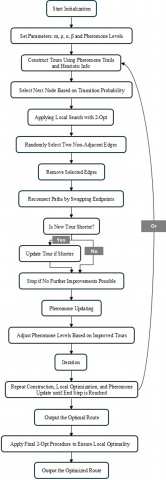
By integrating 2-Opt into the Ant Colony Optimization framework, the algorithm benefits from a refined search process that reduces the likelihood of stagnation in suboptimal solutions. The 2-Opt heuristic serves as a local search method that systematically improves individual tours by focusing on edge pair exchanges, thereby enhancing the overall performance of the improved Ant Colony Algorithm (Figure 3). This combination is particularly suited for tourism path planning, where the goal is to find not just any feasible route, but the most efficient and enjoyable path for travelers.
The proposed approach offers a robust solution to tourism path planning, balancing exploration and exploitation, and is capable of handling the complex requirements of tourism logistics. The final optimized routes provide not only minimal travel distances but also improved accessibility and connectivity among cultural and service content nodes, ensuring a better travel experience.
Figure 3. Flowchart of 2-Opt algorithm-improved ant colony optimization
Organizing cultural route activities involves planning by selecting relevant elements according to the demands and constraints of travelers to maximize the benefits derived from this experience. Route planning in tourism can vary depending on the characteristics of the destination. In a settlement, there may be numerous points of interest. Accordingly, points with different functions and contents can be included in route planning.
In the study, defining the intermediate points when transitioning from one node to another, finding the most suitable path connecting the nodes, and determining this network model have been considered a problem. Various models have been used in solving fundamental routing problems in literature. In the scope of the study, a proposal based on ant colonies, one of these solution methods, has been prepared. The proposed optimization model benefits from the strategy determined through the traces used within ant colonies. The recommendation model is developed by applying an ant colony algorithm enhanced with the 2-Opt algorithm, based on the Traveling Salesman Problem. In this context, using the Ant Colony Optimization technique, the most suitable route between the starting (source) and destination points is drawn.
In the optimization example developed for the Traveling Salesman Problem, routes are created that pass through each of the N nodes only once and offer the possibility of returning to the starting point. In doing so, possible scenarios are generated, and the shortest route is preferred. In the algorithm aiming to find the shortest route, the total lengths of the routes are calculated by listing all permutations for the given N number of node points. The optimization proposal works towards finding the route with the smallest value among multiple tour possibilities.
A comprehensive approach is needed in the planning and design of cultural routes. A dynamic cultural route is shaped by dominant variables. For routes to gain cultural distinctiveness, planning variables need to be clearly defined and organized. The location within the region where the city is located, its unique characteristics, and the presentation of tourism dynamics, as well as the relationship of the specified criteria with the city, help decide the direction in which the route will develop. Urban-scale cultural routes define site-specific tourism corridors by utilizing traditional settlements and attraction points in the city center for relevant objectives. Those directly associated with cultural heritage ensure the establishment of appropriate routes between targeted points. All components constituting the route infrastructure form the spatial model of the system by the specified priorities.
Travelers start their movements by determining a specific destination point. There may be multiple routes leading to the selected destination within the urban space. Individual orientations affecting the choice of destination also influence route selection. Points of attraction on the routes and complementary activities are dominant variables in route selection.
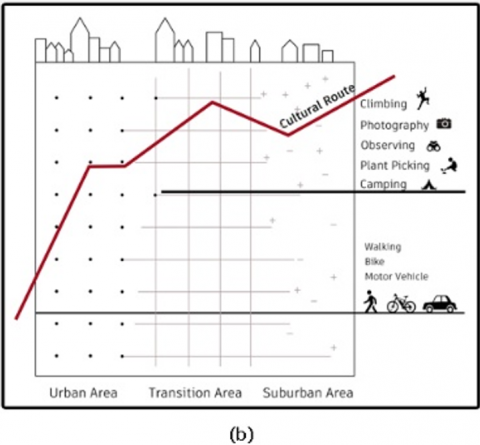
In urban areas, cultural routes have special attraction points between the starting and destination points (Figure 4). Factors reflecting the city's identity and establish the main route by forming relationships. The main routes are then fed by secondary routes. Every alternative connection on the routes interacts with supporting focal points. Each level of hierarchy in route systems has a spatial counterpart. Therefore, in a comprehensive urban route system, a prioritized spatial approach focusing on natural and cultural heritage is applied.
Figure 4. Spatial model of cultural route in urban space
The ant colony algorithm used for TSP can solve complex problems similarly, but this process varies in route planning problems. The applicability of the ACO algorithm to urban spaces is based on minimizing the total travel distance, cost, and time between spaces to find the most suitable route, which includes a) visiting each location once, b) allowing the possibility to return to the starting point, c) minimizing cost, d) minimizing time. In this study, the optimization recommendation for cultural routes is prepared using the variables involved in three effective planning variables. The contents of these variables can be listed as follows: i. cultural content (cultural heritage, natural areas, mixed heritage), ii. service content (food and beverage, accommodation, facilities, serving a specific purpose, etc.), iii. activities (complementary activities). In this study, the scenario developed for the urban cultural route application recommendation is given as follows and supported by related visuals (Figure 5):
a) The cultural route optimization application has a plane consisting of interdependent/independent cultural, service, and node points (Figure 5a),
b) Alternative cultural route activities take place within the scope of attraction points located in the city and its surroundings (Figure 5b),
c) Participants could create a route by only visiting the selected fixed points (Figure 5c).
The three fundamental points listed above reflect the place of planning variables in the algorithm applied for the cultural route in the interface environment. In the interface based on the ant colony algorithm applied in the TSP solution, the most optimal cultural route is prepared by providing values that optimize the algorithm result. After the algorithm produces the optimum result, the participant completes a process that includes the following steps:
(1) The traveler starts from a designated point (which may not necessarily be one of the variables determined in the application).
(2) They move to the nearest point within the prepared route among the designated points; this loop continues along the route.
(3) During the movement between points, they may encounter some activities tailored to the current conditions (site-specific or route-specific complementary activities); the route can be modified if necessary.
(4) They can exit the route before visiting all points or continue along the route.
(5) Following the steps outlined above for the prepared scenario, a cultural route minimizing distance, cost, and time is completed.
Examples of alternative routes prepared according to the preferences are provided in Figure 6. These examples are prepared based on N designated nodes within the same settlement. According to the scenario, routes that can be followed by the user among N points with different contents are listed as (a), (b), (c), (d), (e), and (f). As indicated in Figure 6, a person starting from point 1 travels to point N by visiting the selected points among cultural, service, and activity contents. The route choice between points 1 and N is arranged according to the user's preference as follows; (a) only cultural heritage points, (b) only natural areas, (c) both cultural and natural heritage points, (d) cultural heritage and service points, (e) natural areas and service points, (f) cultural & natural heritage and service points.
Figure 6. Alternative routes on optimization recommendation
Due to threats such as neglect, overuse, political crises and rapid urbanization, the protection and sustainable management of cultural and natural heritage have become increasingly important. Such threats often lead to uncontrolled tourism activities, affecting the protection and management of heritage. The rapid change of conditions in the tourism sector has been an important factor in the emergence of new practices. Despite the increasing interest in cultural tours, current research often examines these routes only from a tourism sector perspective, viewing them primarily as tools to support mass tourism and investment in previously neglected heritage sites. This perspective has led to potential damage to cultural heritage and threats to the environment and human rights.
Integration of cultural routes into tourism in urban environments often encounters various problems. Cultural tours often visit specific points in cities without contributing to broader economic or development goals. Urban-scale routes are expected to not only generate economic benefits, but also to increase the recognition of local communities and the discovery of cultural assets. Therefore, the spatial attractiveness of cultural routes is important and requires the preservation, improvement and functional transformation of physical features. Addressing these challenges requires comprehensive planning, design and management systems for cultural route events. The need for new planning and design systems is particularly evident in urban environments where adapting to changing conditions and supporting individual consumption and access through innovative solutions is crucial.
This article discusses the role of cultural routes as representatives of new approaches to the preservation and management of cultural heritage. The main contribution of the study is to highlight how cultural routes; by connecting relevant components, help ensure the correct understanding and accessibility of heritage sites, thereby contributing to cultural balance.
The findings of this study demonstrate that there are several challenges in the relationship between urban or settlement-scale planned cultural routes and tourism. Cultural tours often visit specific points in cities but may end without contributing to the targeted sectoral revitalization. From the short review above, key findings emerge that comprehensive planning and design studies are necessary for cultural route activities in urban areas, especially those managed using cultural heritage sites as an investment tool for tourism activities.
Selecting the right route offers the opportunity to see and experience more places during time-constrained travels. The Improved ACO can enhance this interaction by better planning cultural routes. It has the ability to optimize multiple criteria simultaneously. Thus, it can provide more flexible responses to dynamic variables compared to many other static algorithms, such as user preferences and urban conditions.
The developed algorithm not only works faster but also offers higher-quality solutions. In short, the proposed algorithm not only increases the likelihood of finding the lowest-cost or shortest-distance route but also enables users to visit more points by saving time and cost, especially thanks to local improvement techniques like 2-Opt.
Despite its advantages, the proposed application of the improved ACO may face potential challenges in practice. To list these: 1. Dynamic variables, such as traffic conditions in cities, weather conditions, or sudden road closures, may require the algorithm to update the proposed routes in real time. Responding instantly to such changes can challenge the algorithm's real-time performance. 2. Large cities have numerous cultural points, transportation networks, and user profiles. Continuously updating and processing this data can affect the algorithm's efficiency. Particularly, dealing with large datasets can strain computation time and system resources. 3. Different users may have unique interests and preferences. The algorithm will need to offer personalized and optimized routes while considering this diversity. However, determining the most suitable route for each user can impact user satisfaction. 4. Implementing advanced algorithms requires a strong technological infrastructure, necessitating servers with high processing power and fast data transmission. Additionally, ensuring that the algorithm works seamlessly across different devices and platforms presents another technical challenge. 5. Users' location data, interests, and other personal information are collected and analyzed. This situation may raise concerns regarding privacy and data security. Safeguarding and processing users' data securely is critical for the success of the application.
The findings emphasize the growing importance of information and communication technology in strengthening relationships and the need for access to digital technology in all areas. The results support the hypothesis that innovative planning and design tools, which are continually being developed and expanded, can ensure access to all components of a society's values in digital environments. The findings suggest that local and international organizations can play a significant role in the preservation, improvement, or functional transformation of cultural and natural heritage through these tools.
Compared to previous studies, the results have shown that travelers often plan their trips using printed or digital guides, personal blogs, and various platforms, but organizing a complete itinerary and identifying cultural heritage sites can be time-consuming. The implications of this study highlight the necessity for a cultural route planning model that maximizes the tourist experience by considering preferences, time constraints, and budgets. The study indicates the limitations of current cultural route approaches at international, regional and local levels, pointing to a gap that requires further research and evaluation.
From these findings, this study suggests that the proposed model for cultural route planning and design can create routes tailored to individual needs and interests, helping to personalize travel experiences and assist in determining the most suitable routes. The increasing importance of digital application tools offers opportunities to facilitate travel planning. The proposed model can enhance travelers' experiences by promoting the effective use of these digital tools. The findings suggest that increasing international cooperation is crucial for further developing and disseminating research and practices in cultural route planning and design.
The findings highlight the importance of international collaboration in advancing research and practice in cultural route planning and design. Future work should focus on exploring advanced technologies such as virtual reality, augmented reality and artificial intelligence to create more engaging and informative experiences for tourists. In addition, it should also address how cultural route planning aligns with local economic development goals, ensuring that tourism benefits host communities and preserves the integrity of cultural sites.
[1] Seçilmişler, T., Özügül, M.D., Yerliyurt, B. (2015). An essay on reading the change of cultural heritage components through semantic literature: Historical mesires in istanbul. Megaron, 10(2): 251-259. https://doi.org/10.5505/MEGARON.2015.07108
[2] Gorbul, T. (2023). Evolution of the concept of "cultural heritage": Theoretical and methodological aspect. The Culturology Ideas, 23(1): 178-187. https://doi.org/10.37627/2311-9489-23-2023-1.178-187
[3] Spennemann, D. (2023). Conceptualizing a methodology for cultural heritage futures: Using futurist hindsight to make ‘Known Unknowns’ knowable. Heritage, 6(1): 548-566. https://doi.org/10.3390/heritage6010029
[4] Piñar, G., Sterflinger, K. (2021). Natural sciences at the service of art and cultural heritage: An interdisciplinary area in development and important challenges. Microbial Biotechnology, 14: 806-809. https://doi.org/10.1111/1751-7915.13766
[5] Liu, S., Shu, H. (2020). Sustainable cultural tourism and heritage conservation in China: Case studies of the ancient waterfront towns in the south of the Yangtze river. WIT Transactions on Ecology and the Environment. https://doi.org/10.2495/sdp200021
[6] COE. (2002). The cultural routes programme of the council of Europe. https://rm.coe.int/09000016809dfb4f.
[7] COE. (1987). The santiago de compostela declaration.
[8] Severo, M. (2017). European cultural routes: Building a multi-actor approach. Museum International, 69(1-2): 136-145. https://doi.org/10.1111/muse.12157
[9] Lunde, H. (2023). Local pasts and international inspirations: The heritagisation and caminoisation of pilgrimage landscapes in Norway. Religions, 14(7): 834. https://doi.org/10.3390/rel14070834
[10] Baleviciene, L., Navickiene, R. (2024). Preservation of cultural heritage based on the napoleon cultural route of the council of Europe narrative: The case of Lithuania. Humanities Studies, 95(18): 144-149. https://doi.org/10.32782/hst-2024-18-95-14
[11] UNESCO. (1994). Report on the expert meeting on routes as part of our cultural heritage. Madrid: Unesco. http://whc.unesco.org/archive/routes94.htm.
[12] CIIC. (2001). Intangible heritage and cultural routes in a universal context.
[13] CIIC. (2008). ICOMOS charter on cultural routes. Ratified by the 16th General Assembly of ICOMOS, Québec (Canada), on 4 October 2008. International Journal of Cultural Property, 15: 385-392. https://doi.org/10.1017/S0940739108080429
[14] The Australia ICOMOS National Scientific Committee (NSC). (2015). Understanding cultural routes.
[15] UNWTO. (2015). Affiliate members global report: Volume twelve–cultural routes and itineraries. Madrid.
[16] Zhou, Z., Zheng, X. (2022). A cultural route perspective on rural revitalization of traditional villages: A case study from Chishui, China. Sustainability, 14(4): 2468. https://doi.org/10.3390/su14042468
[17] Lin, X. (2024). Cultural routes as cultural tourism products for heritage conservation and regional development: A systematic review. Heritage, 7(5): 2399-2425. https://doi.org/10.3390/heritage7050114
[18] Al-Jaberi, Z., Hasan, S. (2022). Reviving the cultural route and its role in the sustainability of historical areas - Kerbala as a case study. International Journal of Sustainable Development and Planning, 17(6): 1737-1746. https://doi.org/10.18280/ijsdp.170607
[19] Dayoub, B., Dayoub, A., Omran, S., Li, H. (2020). The role of cultural routes in sustainable tourism development: A case study of Syria’s spiritual route. International Journal of Sustainable Development and Planning, 15(6): 865-874. https://doi.org/10.18280/ijsdp.150610
[20] Günden, Y., Günden, B. (2022). Proposta de rota cultural inovadora na gestão de destino da região da capadócia. Revista Rosa Dos Ventos - Turismo E Hospitalidade, 14(3): 912-937. https://doi.org/10.18226/21789061.v14i3p937
[21] Bogacz-Wojtanowska, E., Góral, A., Bugdol, M. (2019). The role of trust in sustainable heritage management networks. Case study of selected cultural routes in Poland. Sustainability, 11(10): 2844. https://doi.org/10.3390/su11102844
[22] Marjanović, M., Marković, R., Tomić, N., Golubović, N., Langović, Z., Radivojević, A. (2023). The possibility of promoting the cultural heritage of Serbia through a cultural route of fortified towns. TEME: Casopis za Društvene Nauke, 47(1): 125. https://doi.org/10.22190/teme220303001m
[23] Martens, D. (2022). The experience of common European heritage: A critical discourse analysis of tourism practices at cultural routes of the Council of Europe. Journal of European Landscapes, 3(3): 45-59. https://doi.org/10.5117/jel.2022.3.82504
[24] Trišić, I., Štetić, S., Privitera, D., Nedelcu, A. (2019). Wine routes in Vojvodina province, northern Serbia: A tool for sustainable tourism development. Sustainability, 12(1): 82. https://doi.org/10.3390/su12010082
[25] Ristić, D., Vukoičić, D., Ivanović, M., Nikolić, M., Milentijević, N., Mihajlović, L., Petrović, D. (2024). Transformation of abandoned railways into tourist itineraries/routes: Model of revitalization of marginal rural areas. Land, 13(3): 321. https://doi.org/10.3390/land13030321
[26] Gómez-Ullate, M., Saraiva, S.S. (2024). Festivals and youth: An educational cultural route to festivals. Youth, 4(1): 369-381. https://doi.org/10.3390/youth4010026
[27] Csanády, E., Kovács, Z., Magoss, E., Ratnasingam, J. (2019). Principles of optimization. Optimum Design and Manufacture of Wood Products. https://doi.org/10.1007/978-3-030-16688-5_3
[28] Dehghani, M., Montazeri, Z., Givi, H., Guerrero, J., Dhiman, G. (2020). Darts game optimizer: A new optimization technique based on darts game. International Journal of Intelligent Engineering and Systems, 13(5): 286-294. https://doi.org/10.22266/ijies2020.1031.26
[29] Maruthamuthu, R. (2023). Advancements in compiler design and optimization techniques. E3s Web of Conferences, 399: 04047. https://doi.org/10.1051/e3sconf/202339904047
[30] Azizi, A. (2020). Applications of artificial intelligence techniques to enhance sustainability of industry 4.0: Design of an artificial neural network model as dynamic behavior optimizer of robotic arms. Complexity, 2020: 1-10. https://doi.org/10.1155/2020/8564140
[31] Adeyeye, O. (2024). Optimization in systems engineering: A review of how data analytics and optimization algorithms are applied. Computer Science & It Research Journal, 5(4): 809-823. https://doi.org/10.51594/csitrj.v5i4.1027
[32] Sampangi, S., Jayabarathi, T. (2020). Optimal capacitor allocation in distribution networks for minimization of power loss and overall cost using water cycle algorithm and grey wolf optimizer. International Transactions on Electrical Energy Systems, 30(5): e12320. https://doi.org/10.1002/2050-7038.12320
[33] Sahu, R., Gorripotu, T., Panda, S. (2016). Automatic generation control of multi-area power systems with diverse energy sources using teaching learning based optimization algorithm. Engineering Science and Technology an International Journal, 19(1): 113-134. https://doi.org/10.1016/j.jestch.2015.07.011
[34] Kaur, D., Singh, S.J., Mansoor, W., Kumar, Y., Verma, S., Dash, S., Koul, A. (2022). Computational intelligence and metaheuristic techniques for brain tumor detection through iomt-enabled MRI devices. Wireless Communications and Mobile Computing, 2022: 1-20. https://doi.org/10.1155/2022/1519198
[35] Shalika, S., Meena, U., Agarwal, A. (2023). Optimized routing protocol using metaheuristic techniques for improving energy efficiency in WSN. https://doi.org/10.21203/rs.3.rs-3228905/v1
[36] Yang, X., Gandomi, A.H. (2012). Bat algorithm: A novel approach for global engineering optimization. Engineering Computations, 29(5): 464-483. https://doi.org/10.1108/02644401211235834
[37] Qureshi, K.N., Alhudhaif, A., Qureshi, M.A., Jeon, G. (2021). Nature-inspired solution for coronavirus disease detection and its impact on existing healthcare systems. Computers and Electrical Engineering, 95: 107411. https://doi.org/10.1016/j.compeleceng.2021.107411
[38] Şimşek, D., Özyürek, D., İleri, E., Karaoğlan, A.D. (2022). Optimizing tribological performance in elevated temperature of tic reinforced a 356 matrix composites designed as automotive friction materials using dragonfly algorithm. Proceedings of the Institution of Mechanical Engineers, Part C: Journal of Mechanical Engineering Science, 237(4): 973-984. https://doi.org/10.1177/09544062221123999
[39] Sharma, M.K., Kaiser, M.S., Ray, K. (2024). Deep convolutional neural network framework with multi-modal fusion for Alzheimer’s detection. International Journal of Reconfigurable and Embedded Systems (IJRES), 13(1): 179. https://doi.org/10.11591/ijres.v13.i1.pp179-191
[40] Sharma, A., Kim, D.S. (2019). Robust bio-inspired routing protocol in manets using ant approach. In Proceedings of the 13th International Conference on Ubiquitous Information Management and Communication (IMCOM) 2019 13, pp. 97-110. https://doi.org/10.1007/978-3-030-19063-7_9
[41] Basaligheh, P. (2022). Optimal coverage in wireless sensor network using augmented nature-inspired algorithm. International Journal on Future Revolution in Computer Science & Communication Engineering, 8(2): 71-78. https://doi.org/10.17762/ijfrcsce.v8i2.2082
[42] Sabery, G.A., Danishyar, G.H., Mubarez, G.S. (2023). A comparative study of metaheuristic optimization algorithms for solving engineering design problems. Journal of Mathematics and Statistics Studies, 4(4): 56-69. https://doi.org/10.32996/jmss.2023.4.4.6
[43] Yi, J. (2023). An operational capacity assessment method for an urban low-altitude unmanned aerial vehicle logistics route network. Drones, 7(9): 582. https://doi.org/10.3390/drones7090582
[44] Li, S., Zhang, H., Li, Z., Líu, H. (2021). An air route network planning model of logistics UAV terminal distribution in urban low altitude airspace. Sustainability, 13(23): 13079. https://doi.org/10.3390/su132313079
[45] Tang, J., Liu, G., Pan, Q. (2021). A review on representative swarm intelligence algorithms for solving optimization problems: Applications and trends. IEEE/CAA Journal of Automatica Sinica, 8: 1627-1643. https://doi.org/10.1109/JAS.2021.1004129
[46] Shaban, A.A., Fuente, J.A.D., Salih, M.S., Ali, R. (2023). Review of swarm intelligence for solving symmetric traveling salesman problem. Qubahan Academic Journal, 3(2): 10-27. https://doi.org/10.48161/qaj.v3n2a141
[47] Sunaina, S., Shivahare, B., Kumar, V., Gupta, S., Singh, P., Diwakar, M. (2023). Metaheuristic Optimization Algorithms and recent applications: A comprehensive survey. 2023 International Conference on Computational Intelligence, Communication Technology and Networking (CICTN), pp. 506-511. https://doi.org/10.1109/cictn57981.2023.10140511
[48] Dorigo, M., Birattari, M., Stützle, T. (2006). Ant colony optimization: Artificial ants as a computational intelligence technique. IEEE Computational Intelligence Magazine, 1: 28-39. https://doi.org/10.1109/CI-M.2006.248054
[49] Ali, M. (2023). Nature inspired data dissimination routing protocol for wireless sensor networks. https://doi.org/10.21203/rs.3.rs-3481326/v1
[50] Tahir, M.A., Khan, H.F., Khan, M.M. (2020). Comparative study of nature-inspired algorithms. In Re-imagining Diffusion and Adoption of Information Technology and Systems: A Continuing Conversation: IFIP WG 8.6 International Conference on Transfer and Diffusion of IT, TDIT 2020, Tiruchirappalli, India, pp. 353-361. https://doi.org/10.1007/978-3-030-64849-7_32
[51] Sharma, S., Kaushik, B. (2021). A survey on nature‐inspired algorithms and its applications in the internet of vehicles. International Journal of Communication Systems, 34(12): e4895. https://doi.org/10.1002/dac.4895
[52] Dorigo, M., Stützle, T. (2018). Ant colony optimization: Overview and recent advances. In Handbook of Metaheuristics. https://doi.org/10.1007/978-1-4419-1665-5_8
[53] Chavan, S., Kulkarni, A. (2018). Event based clustering localized energy efficient ant colony optimization (ebc_lee-aco) for performance enhancement of wireless sensor network. Engineering Technology & Applied Science Research, 8(4): 3177-3183. https://doi.org/10.48084/etasr.2121
[54] Li, X., Keegan, B., Mtenzi, F. (2018). Energy efficient hybrid routing protocol based on the artificial fish swarm algorithm and ant colony optimisation for wsns. Sensors, 18(10): 3351. https://doi.org/10.3390/s18103351
[55] Wu, L., He, Z., Chen, Y., Wu, D., Cui, J. (2019). Brainstorming-based ant colony optimization for vehicle routing with soft time windows. IEEE Access, 7: 19643-19652. https://doi.org/10.1109/access.2019.2894681
[56] Arnomo, S., Ibrahim, N., Putri, A., Hutabri, E. (2022). Optimization of mutation testing challenges to fixing faults. International Journal on Advanced Science Engineering and Information Technology, 12(6): 2438-2442. https://doi.org/10.18517/ijaseit.12.6.14522
[57] Said, O. (2016). Analysis, design and simulation of Internet of Things routing algorithm based on ant colony optimization. International Journal of Communication Systems, 30(8): e3174. https://doi.org/10.1002/dac.3174
[58] Mavrovouniotis, M., Yang, S., Van, M., Li, C., Polycarpou, M. (2020). Ant colony optimization algorithms for dynamic optimization: A case study of the dynamic travelling salesperson problem [Research Frontier]. IEEE Computational Intelligence Magazine, 15: 52-63. https://doi.org/10.1109/MCI.2019.2954644
[59] Chen, A., Tan, H., Zhu, Y. (2022). Ant colony optimization algorithm and its application. In Proceedings Volume 12259, 2nd International Conference on Applied Mathematics, Modelling, and Intelligent Computing (CAMMIC 2022), pp. 122595O. https://doi.org/10.1117/12.2639584
[60] Yi, N., Xu, J., Yan, L., Huang, L. (2020). Task optimization and scheduling of distributed cyber-physical system based on improved ant colony algorithm. Future Generation Computer Systems, 109: 134-148. https://doi.org/10.1016/j.future.2020.03.051
[61] Li, F. (2021). Research and design of artificial intelligence training platform based on improved ant colony algorithm. In 2021 International Conference on Aviation Safety and Information Technology, pp. 860-863. https://doi.org/10.1145/3510858.3511408
[62] Croes, G.A. (1958), A method for solving traveling salesman problems. Operational Research, 6(6): 791-812. https://doi.org/10.1287/opre.6.6.791
[63] Gao, W., Nallaperuma, S., Neumann, F. (2021). Feature-based diversity optimization for problem instance classification. Evolutionary Computation, 29(1): 107-128. https://doi.org/10.1162/evco_a_00274
[64] Liu, M., Song, Q., Zhao, Q., Li, L., Yang, Z., Zhang, Y. (2022). A hybrid bso-aco for dynamic vehicle routing problem on real-world road networks. IEEE Access, 10: 118302-118312. https://doi.org/10.1109/access.2022.3221191
[65] Ren, C.Y. (2013). Improved heuristic search algorithm for capacitated vehicle routing problem. Applied Mechanics and Materials, 361-363: 2079-2082. https://doi.org/10.4028/www.scientific.net/amm.361-363.2079
[66] Dorigo, M., Maniezzo, V., Coloni, A. (1996). Ant system: Optimization by a colony of cooperating agents. IEEE Transactions on Systems, Man and Cybernetics Part-B, 26(1): 29-41. https://doi.org/10.1109/3477.484436