Paúl Carrión-Mero | Jenifer Malavé-Hernández* | Joselyne Solórzano | Jorge Martínez-Angulo | Fernando Morante-Carballo
© 2024 The authors. This article is published by IIETA and is licensed under the CC BY 4.0 license (http://creativecommons.org/licenses/by/4.0/).
OPEN ACCESS
Groundwater is a key resource, and its management is vital to rural communities' development. However, inappropriate actions can affect its sustainability. This study aims to analyse the scientific literature on groundwater management in rural communities, using the Scopus database for bibliometric research analysis and a systematic literature review for identifying sustainable groundwater management strategies. The methodology comprised i) selection, processing and classification of data, ii) application of bibliometrics, and iii) a systematic review for identifying sustainable water management strategies. The bibliometric analysis contemplated 1,247 scientific documents. An exponential growth of publications in the study field since its inception (1936) is evident, highlighting scientific collaborations between China, the United States, India, Australia and France. Seven study areas stood out: agriculture and climate change, water management and geographic information systems, water quality, remote sensing, hydrochemistry in arid regions, and nitrate and hydrogeochemical pollution. Research trends in recent years include the Analytical Hierarchy Process (AHP), recharge, sustainability, drainage, and land subsidence. The systematic review of 67 documents allowed the identification of social, political, economic, environmental, and academic/technical strategies for sustainable groundwater management, highlighting four central cores to be worked on: strengthening top-level design, establishing groundwater monitoring and early warning, innovating agricultural water-saving technologies, and carrying out public education on science and technology. This research provides a vision of the strategies for the sustainability of groundwater resources in aquifer-dependent areas and highlights the key areas to develop for groundwater sustainability in a rural context, in alignment with 1, 2, 6 and 15 Sustainable Development Goals.
groundwater, aquifers, rural development, water management, water sustainability, bibliometric analysis, PRISMA, water management strategies
Water is an essential resource for the development of life [1]. However, despite its apparent abundance on the planet, less than 3% represents fresh water, of which 68.7% is frozen in glaciers and polar caps [2]. The remaining 31.3% is liquid fresh water, and around 98% of this resource is stored as groundwater [3, 4].
At a global level, groundwater represents the most extracted raw material, with extraction rates estimated at 982 km3/year, contributing a significant share of water-induced well-being [5]. Approximately 2.5 billion people rely exclusively on groundwater to meet their water needs [6]. Groundwater provides around half of the world's domestic supply. Besides, corresponding water use is 40% in industry and 25% to 43% in the agricultural sector, improving food security, economic growth, job creation and adapting communities to climate change [7-9]. Furthermore, groundwater underlies many rivers and aquatic ecosystems.
The most significant reserves in the world stand in various aquifers distributed in different regions. Some of the largest and most essential aquifers are the Guaraní Aquifer (Brazil, Argentina, Uruguay and Paraguay) [10], the Nubian Sandstone Aquifer (Libya, Egypt, Chad and Sudan) [11] and the Great Artesian Basin (covers 23% of all of Australia) [12]. The management of these aquifers represents a critical factor in developing communities and the mitigation of the effects of climate change [13, 14].
Groundwater is one of the most widespread options for supplying rural communities and is often the most economical way to guarantee a safe water supply to towns [9]. Its use in agriculture helps rural household incomes and reduces poverty [15]. Factors such as access to water, land, and capital allow farmers' livelihood [16]. In rural communities significantly affected by drought, groundwater is important for domestic, agricultural and livestock use. For example, in Mali (Africa), there are more than 170,000 traditional private wells for family use, and it is estimated that in countries such as Ethiopia, Malawi and Zambia, more than 85% of households depend on groundwater [17].
Concern regarding the management of groundwater resources has been growing in recent years due to factors such as low rainfall, overexploitation, inadequate agricultural practices, anthropogenic contamination and saline intrusion, which affect the availability of groundwater [18]. Furthermore, the lack of water quality control programs and the high costs associated with remediation methods affect rural communities with health risks and impediments to its use [19]. Jasechko et al. [20] demonstrated a widespread decline in groundwater levels >0.5 m/year during the 21st century and an accelerated decline in 30% of the world's regional aquifers over the past four decades. These problems raise uncertainties about their availability and replenishment rates, causing uncertainties in their management.
Climate change effects are another significant factor. Alterations in rainfall regimes and increased extreme droughts can reduce aquifer recharge, decreasing water availability and quality [21]. In addition, rising sea levels and changes in the water cycle can modify groundwater flow patterns and exacerbate the salinisation of coastal aquifers [22].
The management of underground water resources worldwide demands a monitoring system, which includes data such as quantity, quality, use and hydrogeology [23]. Coordination, joint work and contribution of the public and private sectors are fundamental for strategic planning that allows access to quality water [9, 24]. Appropriate policies and institutional agreements (community-university) with community members' active and joint participation are essential for efficient groundwater management [25, 26].
Sustainable groundwater management is a decisive factor in the development of rural communities, considering its role in life and agriculture, its impact on human development and the challenges posed by climate change [27]. More research and practical strategies are required to prevent overexploitation and ensure groundwater quality [28]. Under this idea, the 6th Sustainable Development Goal and campaigns such as UNESCO's "Making the invisible visible" highlight the importance of groundwater and promote global awareness of the need for sustainable management to ensure its long-term availability [9, 29].
Bibliometric studies offer an extensive view of an area of study of interest by analysing scientific production using quantitative techniques, which allows for an increased understanding of its characteristics, evolution, and trends [30-32]. Similarly, systematic literature reviews use a strict and precise methodological process to minimise bias in information management and provide valuable contributions to the topic [33, 34].
In this context, it is essential to understand the evolution of studies in groundwater and rural development. Systematic reviews related to groundwater to date have focused on responding to inadequate quality and management of the resource at a global level [35], local understanding of this resource in dependence approaches in Southeast Asia and the Pacific [36], its management in rural communities in developed countries [37], water quality in India [38], or supply [39] and water governance in Sub-Saharan Africa [40].
Given the magnitude of the challenges facing groundwater, from overexploitation, pollution, and climatic effects and considering the vital role this resource plays in the lives of millions of people, it is evident that an analysis of the intellectual framework about groundwater in the development of rural communities is needed, as well as a systematic review to acquire knowledge and experiences that help address the sustainability of groundwater resources in these areas. This study asks the following research questions: What are the research trends regarding groundwater in rural communities? What strategies do experts use for sustainable groundwater management in rural communities?
This work aims to analyse the scientific literature on groundwater management in rural development by examining the Scopus database with bibliometric techniques and a systematic review to identify research trends and water management strategies in a sustainability context.
This study conducted a statistical analysis based on scientific production, collaboration between countries, study clusters, research trends, distribution of journals, key authors and research evolution associated with groundwater and rural development, using the Scopus scientific database as a reference. In addition, a systematic literature review was carried out by applying the Preferred Reporting Items for Systematic Reviews and Meta-Analyses (PRISMA) method [41] to understand the best practices of sustainable groundwater management in rural communities globally.
A three-stage methodological process composed the study: (i) selection, processing, and classification of data, ii) application of bibliometrics, and iii) systematic review using the PRISMA Method (Figure 1).
Figure 1. Methodological scheme of the study
2.1 Phase I: Selection, processing, and classification of data
This study used the Scopus database due to its accessibility, high number of high-quality scientific publications, extensive coverage in various fields of knowledge [42], and frequent use in systematic review and bibliometric studies [43]. In addition, Scopus is the source of information for the QS World University Rankings, used by Latin American universities to determine their position at a regional and global level [44, 45].
The search strategy considered the selection terms "groundwater" and "rural development" and their equivalents or synonyms, according to the equation: (("Agricultural develop*") OR ("Develop the countryside*") OR ("Rural develop*") OR ("Rustic develop*") OR ("Suburban develop*") OR ("Agrarian develop*") OR ("Agriculture develop*") OR ("Developing rural area*") OR ("Development in rural area*") OR ("Farming develop*")) AND (("Groundwater*") OR ("Aquifer*") OR ("Porewater*") OR ("Subsurface water*") OR ("Subterranean water*") OR ("Underground water*") OR ("Well water*") OR ("Phreatic water*")) AND PUBYEAR>1935 AND PUBYEAR<2024. This search considered the appearance of the criteria in titles, abstracts, and keywords, excluding documents from 2024 to avoid including data from the current year. The search considered all languages and all types of literature, including articles, books, chapter books, conference papers, editorials, notes, and reviews, returning 1,258 documents.
The database with the established criteria was downloaded in Comma-Separated Values (CSV) format, considering the fields Title, Year, Cited by, DOI, Link, Affiliations, Authors with affiliations, Abstract, Author keywords, References, Language of the original document, and Type of document. Subsequently, data cleaning allowed the elimination of eleven documents without author registration. The final database was reduced to 1,247 documents, from which visualisations were generated, and the behaviour of the parameters of interest in the second phase was analysed.
2.2 Phase II: Application of bibliometrics
This phase included seven analyses of the intellectual structure around groundwater and rural development:
Microsoft Excel was used to analyse scientific production over time. Meanwhile, VOSviewer 1.6.19 and Bibliometrix programs allowed the preparation of the bibliometric graphs of the other analyses.
2.3 Phase III: Systematic review
The systematic review used the PRISMA method [41] to select documents for complete analysis. This phase applied several inclusion and exclusion criteria to select the papers to be analysed in this study (Figure 2). The initial screening process excluded all documents that were not articles or conference papers, that were not whole in English, that were out of the period of interest (≥2001 considering the greatest impact of citations from this year), and that did not include terms related to “management” or “sustainability” in the title, abstract or keywords. Abstract papers that qualified after the initial screening process were examined to verify the eligibility of papers for inclusion. This second screening stage eliminated papers unrelated to Groundwater Management Strategies. The final included papers were reviewed in detail to identify the main strategies for sustainable groundwater management in rural environments.
Figure 2. Systematic review protocol
3.1 Scientific development and citation analysis
The scientific production showed records from 1936 to 2023, resulting in 1247 documents from the Scopus database. Research related to the topic began with the study by Ebert [46], where the great dependence on groundwater for communal and agricultural development in the United States is exposed, as well as the importance of well-monitoring systems. The exponential growth of publications is recognised and validated with the exponential trend model (y = e0.0838x; R2 = 0.9178) according to Price's law [47]. Likewise, there is a constant growth in citations, showing a growing interest in the field of scientific research (Figure 3).
2001 and 2010 stand out as those with the highest number of citations. The first is associated with increased interest in environmental problems caused by human activity, such as water degradation [48-50]. The second is related to the interest in the sustainability and management of water resources, highlighting the need for sustainable practices, adaptation to climate change, and the development of policies that ensure the availability and quality of resources [51-53].
For the analysis, the graph was divided into two periods, considering the first peak related to the increase in citations in 2001. Period A is associated with an introduction period in scientific development (1936-2000), and Period B with its growth (2001-2023).
Figure 3. Scientific development and trend adjustment for the number of publications
Period A (1936-2000): (195 documents and 2,565 citations) topics addressed include agreements to achieve peaceful, optimal, and joint management of transboundary aquifers [54], groundwater quality studies [55], the influence of water stress and saline water tables in crops [56, 57], the development of models for water balance studies [58], and adverse effects due to overexploitation of groundwater and urban expansion [59].
Period B (2001-2023): (1052 documents and 19,468 citations) During this period, interest in topics such as climate change, sustainable agriculture, agriculture's impact on surface water and groundwater pollution [18, 48, 50, 60], quantification and mitigation of contamination of aquifers and surface waters, and the development of efficient methods to reduce anthropogenic pollution increased significantly [61-63].
3.2 Research collaboration between countries
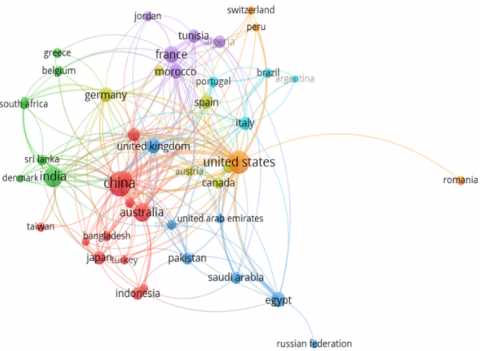
In total, 102 countries contributed publications related to the topic. The analysis of collaboration by country considered those countries with at least five documents referring to the topic of study, resulting in 47 countries, 45 of which reveal research relations (Figure 4). The five countries that stand out in scientific collaboration are China, the United States, India, Australia and France (Table 1).
Table 2 shows the top 5 countries by scientific collaboration and the central countries with which they collaborate.
Figure 4. Bibliometric map of collaboration between countries
Table1. Ranking of countries by collaboration
|
Rank |
Country |
Documents |
Citations |
Total Link Strength |
|
1 |
China |
246 |
4685 |
66 |
|
2 |
United States |
185 |
4689 |
111 |
|
3 |
India |
128 |
2133 |
42 |
|
4 |
Australia |
87 |
2242 |
48 |
|
5 |
France |
61 |
1015 |
64 |
3.3 Author’s keywords co-occurrence and research clusters
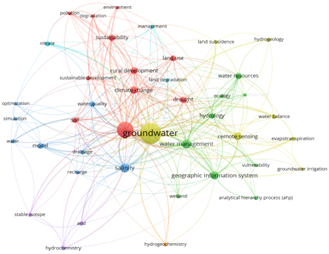
The bibliometric map of the co-occurrence of the author's keywords was carried out for the database, considering at least seven occurrences (Figure 5). Fifty-two keywords were obtained, 5 of which stand out: groundwater, irrigation, geographic information system, agriculture and water resources, as seen in Table 3. In addition, keywords were grouped into seven clusters representing the research areas (Table 4).
Figure 5. Bibliometric map of keyword co-occurrence by author
Table 2. Main collaborations between countries
| Country | Countries in Collaboration | Topics |
| China | United States | Agricultural development [64-66]. |
| Soil salinity [64, 67, 68]. | ||
| Australia | Agricultural development [64, 69, 70]. | |
| Japan | Groundwater quality and renewal [71, 72]. | |
| United States | Egypt | Agricultural development and climate change [73-79]. |
| Australia | Climate change [79], Irrigation automation and water quality simulation models [64, 80, 81]. | |
| United Kingdom | Phytoremediation of soil and groundwater through agroforestry [82]. | |
| Groundwater management at international borders [83]. | ||
| Solutions to salinity in aquifers [84]. | ||
| India | United States | Reduction of wetlands and lack of agricultural management [85, 86]. |
| Promotion of sustainable agriculture [87]. | ||
| Sri Lanka | Agricultural development [88, 89]. | |
| Community monitoring and groundwater management [90]. | ||
| Australia | Bangladesh | Crop adjustments to save water [91]. |
| France | Morocco | Management, sustainability and environmental impact [92-94]. |
| Algeria | Sustainability, management and mitigation of water pollution [93-95]. | |
| Tunisia | Anthropogenic hydrological changes and groundwater quality [93, 96, 97]. |
Table 3. Author’s keywords ranking
|
Rank |
Keyword |
Occurrences |
Total Link Strength |
|
1 |
groundwater |
293 |
300 |
|
2 |
agriculture |
173 |
215 |
|
3 |
water management |
55 |
68 |
|
4 |
salinity |
54 |
68 |
|
5 |
geographic information system |
43 |
56 |
|
6 |
remote sensing |
42 |
51 |
|
7 |
climate change |
36 |
55 |
|
8 |
rural development |
31 |
31 |
|
9 |
drought |
29 |
35 |
|
10 |
sustainability |
28 |
30 |
Table 4. Strategies for the sustainable management of groundwater in rural development
| Research Clusters | Description |
| Cluster 1 (red): “Agriculture, climate change and rural development” | Impact of intensive agricultural practices on soil degradation and pollution. Mitigation measures include water saving for irrigation system improvement and training on water use and climate change [98-101]. |
| Cluster 2 (green): | Use of hydrogeological data and geographic information systems to improve the use and management of water resources [102, 103]. |
| “Water management and geographic information systems” | |
| Cluster 3 (blue): | Risks of saline intrusion in coastal aquifers due to overexploitation for irrigation [104]. Development of analytical models to identify vegetation areas at risk [105]. Sustainable management based on multi-criteria analysis models and water quality evaluation [106]. Controlled drainage, together with simulation models, reduce pollution and ensure crop production [107]. |
| “Water quality and salinity mitigation in aquifers” | |
| Cluster 4 (yellow): “Groundwater and remote sensing” | Use of remote sensing and geographic information systems for identifying recharge zones [108], explaining observed changes in groundwater levels and salinity [109], and delineating new areas for groundwater development and specific sites for drilling productive water wells [110]. |
| Cluster 5 (violet): “Hydrochemistry in arid regions” | Hydrochemical and isotopic studies are key to identifying and characterizing the physicochemical evolution of groundwater and its quality [111, 112]. |
| Cluster 6 (sky blue): “Nitrate contamination in groundwater” | The increase in food demand has led to the intensive use of fertilizers and pesticides in agriculture, contaminating groundwater [63]. Undisturbed watersheds can effectively remove nitrate after it passes below the rooting zone [113]. Mitigation measures against agricultural soil and water degradation impacts [114]. |
| Cluster 7 (orange): “Hidrogeochemistry” | Hydrogeochemical evaluation and characterisation studies to determine the origin and quality of groundwater [115-117]. |
3.4 Research trends
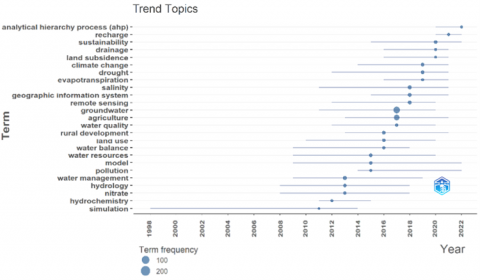
Figure 6 presents the analysis of research trends, including the frequency of the main terms that determined the evolution of the topic around groundwater and rural development as the selected study field. The analysis threshold considered that the keywords have a frequency greater than or equal to three and appear at least three times a year.
Figure 6. Trends in groundwater and rural development between the years 1998 and 2023
The longer study periods include the following topics: water resources (2009-2020), models (2009-2022), and simulation (1998-2014). The most frequent terms were groundwater (293), agriculture (174), water management (55), salinity (54), and geographic information systems (43).
Future research trends based on the most studied topics in the last five years are analytical hierarchy process (AHP), recharge, sustainability, drainage, and land subsidence.
3.5 Distribution of journals
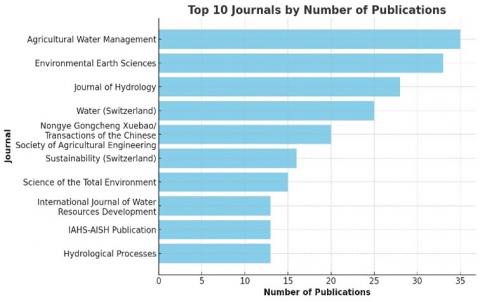
The study contains 1,247 documents published in 649 journals. Figure 7 shows the ten journals with more groundwater and rural development production over time. The Agricultural Water Management Journal is the most productive journal with 35 published documents, followed by the Environmental Earth Science Journal, Journal of Hydrology, Transactions of the Chinese Society of Agricultural Engineering, and Water (Switzerland) Journal with 33, 28, 25 and 22 published documents, respectively.
Figure 7. Top ten journals according to the distribution of publications
3.6 Key authors
A total of 4,270 authors contributed 1,247 documents to our database. Figure 8 shows the authors who contributed to five or more documents. Kuper is the most productive author regarding the number of documents and contributed to nine documents that received 115 citations. The three most cited works of the nine documents by Kuper are “New Reading of Saharan Agricultural Transformation: Continuities of Ancient Oases and their Extensions (Algeria)”, “A Crop Needs More than a Drop: Towards a New Praxis in irrigation management in North Africa”, and “Paving the way for Groundwater Management: Transforming Information for Crafting Management Rules”, with 29, 22, and 20 citations, respectively. Furthermore, just 0.54% of the 4,270 authors contributed to a single study.
Figure 8. Top ten key authors in groundwater and rural development field
3.7 Research evolution
Cluster analysis by period allows us to identify the evolution of the research focus topics. In Period A (1936-2001; Figure 9a), 150 keywords have at least two occurrences consisting of five clusters. In Period B (2001-2023; Figure 9b), 3,141 keywords have at least nine occurrences consisting of five clusters. During Period A, research addressed crop management under drought, integration of hydrology with nutrient management, and water and environmental resource sustainability [56-59]. In Period B, the focus shifted to groundwater management, with increasing concern for water quality and hydrogeology. In addition, advanced technologies such as GIS and remote sensing were introduced to improve resource monitoring and management, and issues such as saline water intrusion and water balance were explored, reflecting an evolution toward more specialised and technologically advanced topics [18, 48, 50, 60-63].
Figure 9. Map by periods of the evolution of research. (a) Period I; (b) Period II
3.8 Systematic review on sustainable groundwater management strategies
The review included the analysis of sixty-seven documents identifying sustainable water management strategies in rural development (Table 5).
Table 5. Strategies for the sustainable management of groundwater in rural development
| Social Strategies | References (DOI) |
| Educate farmers on environmental protection and water management, promote micro-irrigation systems (MIS) such as drip and sprinkler, develop capacity-building programs to support managed aquifer recharge and alternative practices to reduce soil evaporation (straw mulching), promote water monitoring for aquifer understanding and exploitation planning, promote saving water propaganda, and establish a water-saving society. | 10.3390/w6041043 |
| 10.2166/wp.2010.042 | |
| 10.1007/s40899-018-0228-6 | |
| 10.1002/hyp.5667 | |
| Political Strategies | References (DOI) |
| Water use restrictions by authorities, banning agriculture expansion, establishing water policies, water utilization efficiency, and land reclamation will improve the government's management role, state support for groundwater development (credit facilities, subsidies for electricity and digging wells), permits in overexploited areas will be regulated, geoethical approach in water use, and participatory water governance. | 10.3390/w6041043 |
| 10.1007/s11269-006-9067-6 | |
| 10.4028/www.scientific.net/AMR.113-116.565 | |
| 10.2166/wp.2010.042 | |
| 10.1007/s40899-022-00609-0 | |
| Economic Strategies | References (DOI) |
| Incentives for adopting sustainable practices and public-private financing to support investments in seawater desalination. | 10.3390/agronomy12010154 |
| Environmental Strategies | References (DOI) |
| Monitoring the use of fertilizers and pesticides, promoting groundwater artificial recharge, wastewater treatment for reuse, bio drainage, use of environmentally friendly fertilizers, policies and practices to decrease nitrate pollution, water-saving agriculture, gradual reduction in groundwater extraction, formal recognition of the environment as a water user, and water rights. | 10.1177/1070496508320532 |
| 10.3390/w6041043 | |
| 10.1111/gwat.13047 | |
| 10.1130/2009.2454(5.3) | |
| 10.1016/j.agwat.2016.12.008 | |
| Academic/Technical Strategies | References (DOI) |
| Implementation of good agricultural practices, crop diversification, opt for cropping systems that can potentially achieve groundwater use balance, rainwater harvesting, roof water harvesting, floodwater harvesting, dikes, water gates, strength groundwater baseline scientific data generation (groundwater potential zones, level and quality of water, vulnerability, water interaction, research drilling, groundwater simulation models, isotopic investigation, infiltration evaluation, pollution risk evaluation), use of simulation models (scenarios, policies, hydrological, ecological, and economical) and other decision-support tools for groundwater irrigation planning, conjunctive use of surface water and groundwater to increase the groundwater-level depth, implementing Integrated Water Resources Management (IWRM), use of geo-spatial tools for planning and monitoring of groundwater resources, Internet of Things (IoT)-based appropriate technological solutions to address rapid depletion of groundwater, strengthening coastal studies for aquifer management, proper exploitation of freshwater and unconventional water resources (brackish water and alkaline water). | 10.1023/A:1021198721003 |
| 10.1080/07900627.2018.1443059 | |
| 10.2166/wp.2010.042 | |
| 10.3390/w11122492 | |
| 10.3390/w15122183 | |
| 10.4314/wsa.v34i6.183672 | |
| 10.1016/j.jhydrol.2019.06.017 | |
| 10.1007/s11269-006-9067-6 | |
| 10.7537/marslsj13041607 | |
| 10.1016/j.jhydrol.2012.08.007 | |
| 10.1007/s11356-022-24505-4 | |
| 10.1016/j.agee.2011.10.015 | |
| 10.1007/s10661-009-0873-1 |
This research offers a bibliometric analysis of the scientific literature on groundwater and rural development and exposes strategies for sustainable groundwater management in the 21st century. In general, the analysis based on Scopus of 1,427 documents related to the topic shows the beginning of this field of study more than 85 years ago (1936), with an exponential growth trend in the advancement of publications. The year 2023 is recorded as the year with the greatest scientific production (97 documents), and the years 2001 and 2011 are the years with the greatest number of citations, with 1753 and 1888 citations, respectively.
China, the United States, India, Australia and France stand out as the five countries with a close scientific collaboration (Tables 1-2), highlighting cooperation in agricultural development issues [64-67], climate change [73-79], simulation models [64, 80, 81], groundwater management [83, 84], community management and sustainability of water resources [90, 93-95].
Within the trends of the field of study (Figure 6), the AHP stands out as one of the most relevant tools for multicriteria decision-making [118], highlighting the need for strengthening robust methodologies that enable the integration of multiple data for water management. The Aquifer Recharge has become a central theme, given the decrease in groundwater levels in many regions, so research emphasises the natural and artificial recharge of aquifers to ensure the continuous availability of water [90], being the Nature-based Solutions (NbS) one of the most promising and environmentally friendly options [119]. Sustainability is one of the transverse issues in current research, especially promoted by the 2030 Sustainable Development Agenda, reflecting the need for a balance between environmental development and conservation, which in the context of groundwater implies the implementation of practices that ensure the vital liquid in the long term [120]. In drainage issues, research seeks to improve systems to promote recharge through integrated water resources [121]. A recurring problem is land subsidence because of overexploitation [122], which has become a generalised problem affecting ecosystems and communities' security.
The systematic review revealed that, in rural development, one of the main problems is the overexploitation and degradation of aquifers because of agriculture. However, this can be addressed through education in environmental protection and the implementation of good agricultural practices [90, 119], such as environmentally friend fertilizers and pesticides [123], micro-irrigation systems for water saving [15] and the use of alternative water sources [124]. Studies such as Misra [125] highlight developing sustainable agricultural practices and adopting mitigation and adaptation strategies to guarantee water sustainability and long-term food security. In addition, the government's role is a crucial strategy in sustainable water management [126], which must be promoted through water management and use policies, land reclamation, and state regulation related to support in groundwater facilities [127]. Another essential strategy is the managed aquifer recharge, which uses techniques such as sowing rainwater and dikes construction in rivers [102, 128, 129].
In issues of planning in groundwater management, the generation of a scientific basis that contemplates potentiality, quantity, quality and simulation models that decision-makers can use, the joint use of surface water and groundwater integrated management are essential for water resources [130-133]. Geospatial tools and technologies (Geographic Information Systems and Remote Sensing) are key to these issues, facilitating planning and decision-making based on geospatial data and contributing to the efficient management of water resources [118]. Geographic information systems are widely used in identifying Groundwater Potential Zones by map algebra [134]. Remote sensing tools based on satellite images, Lidar data, interferometric measures or Airborne Electromagnetic Systems offer indirect information about groundwater, helping create maps and models for water management [135, 136]. IoT is also helpful for monitoring levels and water quality in real time, allowing more controlled groundwater [137].
In the coastal field, the appropriate exploitation of water resources is essential to avoid water salinisation, a growing problem due to saline intrusion caused by overexploitation of aquifers [109]. This research area is essential for the development of management methods that prevent the degradation of coastal aquifers (e.g., dams), ensuring the availability of freshwater for communities and agriculture [138, 139]. Likewise, seawater desalination should be considered an alternative for fresh water supply [140].
The management of groundwater must contemplate the right of the environment as a water user [141, 142], a geoethic approach in its use that considers responsibility and respect [143], the construction of a water-saving society [144], as well as participatory governance systems with the direct involvement of the interested parties (community, local and regional government, institutions and environmental organisations) [145].
Groundwater will continue to be the leading water supply for domestic use in rural areas of developing countries [146]. Furthermore, approaches such as the Water-Energy-Food Nexus highlight the critical interdependence between groundwater, food production and energy, underlining their essential role in community-based sustainable development [147]. This synergy can also be understood through the human-Earth relationship theory that explains the close link between human communities and their ecological systems [148]. Therefore, sustainable groundwater management is crucial for water security and maintaining an ecological balance that prevents depletion and pollution, thus protecting rural areas' economic and social stability.
This research confirms the continuous growth of the study in groundwater and rural development, evidencing the advance of research in a field of great interest, such as water. The study highlights four main strategic areas that must be worked on for sustainability in groundwater management: strengthening top-level design, establishing groundwater monitoring and early warning, innovating agricultural water-saving technologies, and carrying out public education on science and technology.
The database's cleaning prior to bibliometric analysis was crucial to ensure its integrity and reliability. The Scopus database provided a large set of records (1,427) aligned with the subject, which allowed obtaining representative studies on groundwater and rural development. This process facilitated the generation of precise visual models using tools such as VOSviewer and Bibliometrix, which are widely used in these kinds of studies [31, 32, 44], faithfully reflecting the data and allowing more accurate interpretations of the points of interest. The wide range of strategic approaches identified also suggests a low bias in the search, which reinforces the results' validity.
One of the study's limitations is using a single database (Scopus). Although Scopus covers a wide range of articles compared to other databases, it may not contain journals rich in the subject, thus missing valuable data. Another aspect to consider is the search equation, which may not capture all relevant studies due to variations in terminology within the field or indexing errors due to how authors have described their studies.
For future studies, it is recommended that research integrate multiple databases, such as the Web of Science and Dimensions, which will allow for broader and more representative coverage. In addition, it would be beneficial to conduct a comprehensive study that also examines domestic and ecological water use, highlighting its impact and sustainability in diverse contexts.
This study used bibliometric applications to examine 1,247 records from the Scopus literature on groundwater and rural development. Furthermore, a systematic review using the PRISMA method included 67 articles to identify a framework for sustainable groundwater management strategies. Publications on groundwater and rural development have been recorded since 1936. The countries with the greatest collaboration are China, the United States, India, Australia and France. Initially, publications focused on simulation, hydrochemistry and nitrates. Currently, they are focused on issues of sustainability, recharge and AHP. This last one becomes important due to aquifers' growing depletion and degradation and the need for multiple synergistic criteria for better management, strengthened with the applications of geographic information systems.
Regarding the systematic review of sustainable groundwater management were identified social, political, economic, environmental, and academic/technical strategies, highlighting four central cores to be worked on: strengthening top-level design, establishing groundwater monitoring and early warning, innovating agricultural water-saving technologies, and carrying out public education on science and technology.
This study contributes to the scientific evolution of the study of groundwater in rural communities. Theoretically, it contributes to understanding the dynamics between water resources and rural development and allows for the recognition of advances in the sustainable management of groundwater in rural environments. Practically, it can offer valuable recommendations for policies and management practices to be implemented by decision-makers or stakeholders concerning groundwater. Innovative, it provides a vision of the strategies for the sustainability of groundwater resources in aquifer-dependent areas and highlights the key areas to develop for groundwater sustainability in a rural context.
Groundwater management is indispensable in the Sustainable Development Goals (SDGs) framework. This research reflects its contribution to this framework, aligning and contributing to mainly SDG 1: end of poverty, linked to limited access to water as a basis for the development of economic activities in many rural areas; SDG 2: zero hunger, where water is considered essential to guarantee agricultural production and food security; SDG 6: clean water and sanitation and, SDG 15: life on land, focusing on controlling groundwater extraction to avoid the degradation of natural habitats and the preservation of biodiversity.
The study's limitations include using a single database and search terms that may not capture all related research. Future research should broaden the search range by using multiple databases, updating the study period, and more detailed analysis of search terms to avoid possible biases in the statistical analysis.
This work is supported by ESPOL Polytechnic University research project "Gestión y Evaluación de la Investigación Científica en Ciencias de la Tierra, Economía, Administración y sus vínculos con la Sociedad" (Grant No.: CIPAT-7-2022).
[1] Tahir, M.S., Sagir, M., Tahir, M.B. (2023). Contamination: Nature and origin of wastewater. In Advances in Water and Wastewater Treatment Technology, pp. 1-14. https://doi.org/10.1007/978-981-99-1187-5_1
[2] United Nations. (2023). The united nations world water development report 2023: Partnerships and cooperation for water. In UNESCO. https://unesdoc.unesco.org/ark:/48223/pf0000384655, accessed on Jan. 15, 2024.
[3] Chandnani, G., Gandhi, P., Kanpariya, D., Parikh, D., Shah, M. (2022). A comprehensive analysis of contaminated groundwater: Special emphasis on nature-ecosystem and socio-economic impacts. Groundwater for Sustainable Development, 19: 100813. https://doi.org/10.1016/j.gsd.2022.100813
[4] Shiklomanov, I.A., Rodda, J.C. (2003). World water resources at the beginning of the twenty-first century. Cambridge University Press. https://catdir.loc.gov/catdir/samples/cam034/2002031201.pdf.
[5] Margat, J., van der Gun, J. (2013). Groundwater around the world: A geographic synopsis. CRC Press Taylor & Francis Group. https://www.un-igrac.org/sites/default/files/resources/files/Groundwater_around_world.pdf.
[6] Zektser, I., Everett, L. (2004). Groundwaters of the world and their use. UNESCO Publishing. https://unesdoc.unesco.org/ark:/48223/pf0000134433
[7] FAO. (2024). Water. https://www.fao.org/water/en/, accessed on Oct. 18, 2023.
[8] Islam, M.S. (2023). Groundwater: Sources, functions, and quality. In Hydrogeochemical Evaluation and Groundwater Quality, pp. 17-36. https://doi.org/10.1007/978-3-031-44304-6_2
[9] United Nations. (2022). The united nations world water development report 2022. Groundwater: Making the Invisible Visible. Paris: UNESCO. https://unesdoc.unesco.org/ark:/48223/pf0000380721, accessed on Jun. 5, 2023.
[10] de Almeida Leite, M.L.T., Villar, P.C. (2023). Managing the guarani aquifer system. In New Perspectives on Transboundary Water Governance, pp. 180-196. https://doi.org/10.4324/9781003333678-14
[11] Salah, M.K., Salama, I.M., Salem, Z.E., Al Temamy, A.M., Osta, M.M.El. (2022). Petrophysical characterization of the Bahariya Oasis Nubian Sandstone Aquifer using geophysical well logging. Bulletin of Engineering Geology and the Environment, 81(7): 296. https://doi.org/10.1007/s10064-022-02793-x
[12] Ordens, C.M., McIntyre, N., Underschultz, J.R., Ransley, T., Moore, C., Mallants, D. (2020). Preface: Advances in hydrogeologic understanding of Australia’s Great Artesian Basin. Hydrogeology Journal, 28(1): 1-11. https://doi.org/10.1007/s10040-019-02107-8
[13] Soula, R., Chebil, A., Majdoub, R., Crespo, D., Albiac, J., Kahil, T. (2023). Evaluation of the impact of groundwater management policies under climate and economic changes in Tunisia. Water Economics and Policy, 9(1): 1. https://doi.org/10.1142/S2382624X23400052
[14] Carrión-Mero, P., Olaya, P., Sanango-Ochoa, L., Cano-Alvarado, F., Bravo-Montero, Lady, Solórzano, J., Morante-Carballo, F. (2023). Hydrogeological characterization of a coastal area for the groundwater exploitation. Hondo river micro-watershed, santa elena-ecuador. International Journal of Sustainable Development and Planning, 18(2): 401-410. https://doi.org/10.18280/ijsdp.180208
[15] Narayanamoorthy, A. (2022). Poverty-reducing role of groundwater irrigation in India: Evidence from a Cross-Sectional Analysis. In The Irrigation Future of India: Development, Resource and Policy, pp. 115-137. https://doi.org/10.1007/978-3-030-89613-3_6
[16] Suhardiman, D., Pavelic, P., Keovilignavong, O., Giordano, M. (2020). Putting farmers’ strategies in the centre of agricultural groundwater use in the Vientiane Plain, Laos. International Journal of Water Resources Development, 36(1): 149-169. https://doi.org/10.1080/07900627.2018.1543116
[17] Sutton, S., Butterworth, J. (2021). Self Supply. Practical Action Publishing. https://doi.org/10.3362/9781780448190
[18] Kumar, R., Singh, V.P., Maryam, M. (2023). Laboratory manual for groundwater, wells, and pumps. CRC Press. https://doi.org/10.1201/9781003319757
[19] May, S.Y., Khaing, K.K., Ward, J.S.T. (2022). The role of groundwater in rural water supply. In Groundwater for Sustainable Livelihoods and Equitable Growth, pp. 315-335. https://doi.org/10.1201/9781003024101-17
[20] Jasechko, S., Seybold, H., Perrone, D., Fan, Y., Shamsudduha, M., Taylor, R.G., Fallatah, O., Kirchner, J.W. (2024). Rapid groundwater decline and some cases of recovery in aquifers globally. Nature, 625(7996): 715-721. https://doi.org/10.1038/s41586-023-06879-8
[21] Stigter, T.Y., Miller, J., Chen, J., Re, V. (2023). Groundwater and climate change: Threats and opportunities. Hydrogeology Journal, 31(1): 7-10. https://doi.org/10.1007/s10040-022-02554-w
[22] Dao, P.U., Heuzard, A.G., Le, T.X.H., Zhao, J., Yin, R., Shang, C., Fan, C. (2024). The impacts of climate change on groundwater quality: A review. Science of The Total Environment, 912: 169241. https://doi.org/10.1016/j.scitotenv.2023.169241
[23] Irfeey, A.M.M., Najim, M.M.M., Alotaibi, B.A., Traore, A. (2023). Groundwater pollution impact on food security. Sustainability, 15(5): 4202. https://doi.org/10.3390/su15054202
[24] United Nations Environment Programme. (2021). Progress on ambient water quality. Tracking SDG 6 series: Global indicator 6.3.2 updates and acceleration needs. https://www.unwater.org/publications/progress-ambient-water-quality-2021-update, accessed on Oct. 24, 2023.
[25] Carrión-Mero, P., Morante-Carballo, F., Herrera-Franco, G., Jaya-Montalvo, M., Rodríguez, D., Loor-Flores de Valgas, C., Berrezueta, E. (2021). Community-university partnership in water education and linkage process. Study case: Manglaralto, Santa Elena, Ecuador. Water, 13(15): 25. https://doi.org/10.3390/w13151998
[26] Madramootoo, C.A. (2012). Sustainable groundwater use in agriculture. Irrigation and Drainage, 61(S1): 26-33. https://doi.org/10.1002/ird.1658
[27] Kedir, E.G. (2023). Ground water potential assessment and sustainable management. Environmental Monitoring and Assessment, 195(7): 891. https://doi.org/10.1007/s10661-023-11521-1
[28] Massuel, S., Riaux, J. (2017). Groundwater overexploitation: why is the red flag waved? Case study on the Kairouan plain aquifer (central Tunisia). Hydrogeology Journal, 25(6): 1607-1620. https://doi.org/10.1007/s10040-017-1568-2
[29] MacDonald, A.M., Davies, J. (2000). A brief review of groundwater for rural water supply in sub-Saharan Africa. British Geological Survey.
[30] Ma, R., Ho, Y.S. (2016). Comparison of environmental laws publications in science citation index expanded and social science index: A bibliometric analysis. Scientometrics, 109(1): 227-239. https://doi.org/10.1007/s11192-016-2010-6
[31] Morante-Carballo, F., Bravo-Montero, L., Montalván-Burbano, N., Carrión-Mero, P. (2023). Bibliometric Analysis of earthquake research in America: A comparative study using Web of Science and Scopus databases. International Journal of Safety and Security Engineering, 13(5): 965-973. https://doi.org/10.18280/ijsse.130520
[32] Herrera-Franco, G., Narváez C., R.A., Constante, J., Mora-Frank, C., Aguilar-Aguilar, M., Morante-Carballo, F., Carrión-Mero, P. (2023). Bibliometric analysis and review of low and medium enthalpy geothermal energy: Environmental, economic, and strategic insights. International Journal of Energy Production and Management, 8(3): 187-199. https://doi.org/10.18280/ijepm.080307
[33] Fahimnia, B., Sarkis, J., Davarzani, H. (2015). Green supply chain management: A review and bibliometric analysis. International Journal of Production Economics, 162: 101-114. https://doi.org/10.1016/j.ijpe.2015.01.003
[34] Solórzano, J., Morante-Carballo, F., Montalván-Burbano, N., Briones-Bitar, J., Carrión-Mero, P. (2022). A systematic review of the relationship between geotechnics and disasters. Sustainability, 14(19): 12835. https://doi.org/10.3390/su141912835
[35] Foster, S., Chilton, J., Nijsten, G.J., Richts, A. (2013). Groundwater—A global focus on the ‘local resource.’ Current Opinion in Environmental Sustainability, 5(6): 685-695. https://doi.org/10.1016/j.cosust.2013.10.010
[36] Carrard, N., Foster, T., Willetts, J. (2019a). Groundwater as a source of drinking water in southeast Asia and the pacific: A multi-country review of current reliance and resource concerns. Water, 11(8): 1605. https://doi.org/10.3390/w11081605
[37] Chaminé, H.I., Carvalho, J.M., Freitas, L. (2021). Sustainable groundwater management in rural communities in developed countries: Some thoughts and outlook. Mediterranean Geoscience Reviews, 3(3): 389-398. https://doi.org/10.1007/s42990-021-00064-7
[38] Ravish, S., Setia, B., Deswal, S. (2021). Groundwater quality in urban and rural areas of north-eastern Haryana (India): A review. ISH Journal of Hydraulic Engineering, 27(2): 224-234. https://doi.org/10.1080/09715010.2018.1531070
[39] MacDonald, A.M., Davies, J. (2000). A brief review of groundwater for rural water supply in sub-Saharan Africa. British Geological Survey.
[40] De Bont, C., Börjeson, L. (2024). Policy over practice: A review of groundwater governance research in sub-Saharan Africa. International Journal of the Commons, 18(1): 82-93. https://doi.org/10.5334/ijc.1313
[41] Page, M.J., McKenzie, J.E., Bossuyt, P.M., et al. (2021). The PRISMA 2020 statement: An updated guideline for reporting systematic reviews. International Journal of Surgery, 88: 105906. https://doi.org/10.1016/j.ijsu.2021.105906
[42] Visser, M., van Eck, N.J., Waltman, L. (2021). Large-scale comparison of bibliographic data sources: Scopus, Web of Science, Dimensions, Crossref, and Microsoft Academic. Quantitative Science Studies, 2(1): 20-41. https://doi.org/10.1162/qss_a_00112
[43] Pico-Saltos, R., Carrión-Mero, P., Montalván-Burbano, N., Garzás, J., Redchuk, A. (2021). Research trends in career success: A bibliometric review. Sustainability, 13(9): 4625. https://doi.org/10.3390/su13094625
[44] Herrera-Franco, G., Montalván-Burbano, N., Mora-Frank, C., Bravo-Montero, L. (2021). Scientific research in Ecuador: A bibliometric analysis. Publications, 9(4): 55. https://doi.org/10.3390/publications9040055
[45] Moed, H.F. (2017). A critical comparative analysis of five world university rankings. Scientometrics, 110(2): 967-990. https://doi.org/10.1007/s11192-016-2212-y
[46] Ebert, F. (1936). An interpretation of water‐table fluctuations at four wells in Southern California. Eos, Transactions American Geophysical Union, 17(2): 371-378. https://doi.org/10.1029/TR017i002p00371
[47] Price, D.D.S. (1976). A general theory of bibliometric and other cumulative advantage processes. Journal of the American Society for Information Science, 27(5): 292-306. https://doi.org/10.1002/asi.4630270505
[48] Boesch, D.F., Brinsfield, R.B., Magnien, R.E. (2001). Chesapeake Bay Eutrophication: Scientific Understanding, Ecosystem Restoration, and Challenges for Agriculture. Journal of Environmental Quality, 30(2): 303-320. https://doi.org/10.2134/jeq2001.302303x
[49] Saysel, A.K., Barlas, Y. (2001). A dynamic model of salinization on irrigated lands. Ecological Modelling, 139(2-3): 177-199. https://doi.org/10.1016/S0304-3800(01)00242-3
[50] Stoate, C., Boatman, N., Borralho, R., Carvalho, C.R., De Snoo, G.R., Eden, P. (2001). Ecological impacts of arable intensification in Europe. Journal of Environmental Management, 63(4): 337-365. https://doi.org/10.1006/jema.2001.0473
[51] Diacono, M., Montemurro, F. (2010). Long-term effects of organic amendments on soil fertility. A review. Agronomy for Sustainable Development, 30(2): 401-422. https://doi.org/10.1051/agro/2009040
[52] Turral, H., Svendsen, M., Faures, J.M. (2010). Investing in irrigation: Reviewing the past and looking to the future. Agricultural Water Management, 97(4): 551-560. https://doi.org/10.1016/j.agwat.2009.07.012
[53] Xu, X., Huang, G., Qu, Z., Pereira, L.S. (2010). Assessing the groundwater dynamics and impacts of water saving in the Hetao Irrigation District, Yellow River basin. Agricultural Water Management, 98(2): 301-313. https://doi.org/10.1016/j.agwat.2010.08.025
[54] Hayton, R., Utton, A. (1989). Transboundary groundwaters: the Bellagio draft treaty. Natural Resources Journal, 29(3): 663-722.
[55] Ehrenfeld, J.G., Schneider, J.P. (1991). Chamaecyparis thyoides wetlands and suburbanization: Effects on hydrology, water quality and plant community composition. The Journal of Applied Ecology, 28(2): 467. https://doi.org/10.2307/2404562
[56] Gerik, T.J., Faver, K.L., Thaxton, P.M., El‐Zik, K.M. (1996). Late season water stress in cotton: I. plant growth, water use, and yield. Crop Science, 36(4): 914-921. https://doi.org/10.2135/cropsci1996.0011183X003600040017x
[57] Zhang, L., Dawes, W.R., Slavich, P.G., Meyer, W.S., Thorburn, P.J., Smith, D.J., Walker, G.R. (1999). Growth and ground water uptake responses of lucerne to changes in groundwater levels and salinity: Lysimeter, isotope and modelling studies. Agricultural Water Management, 39(2-3): 265-282. https://doi.org/10.1016/S0378-3774(98)00082-1
[58] Xu, C.Y., Seibert, J., Halldin, S. (1996). Regional water balance modelling in the NOPEX area: Development and application of monthly water balance models. Journal of Hydrology, 180(1-4): 211-236. https://doi.org/10.1016/0022-1694(95)02888-9
[59] Soto-Galera, E., Díaz-Pardo, E., López-López, E., Lyons, J. (1998). Fish as indicators of environmental quality in the Río Lerma Basin, México. Aquatic Ecosystem Health & Management, 1(3-4): 267-276. https://doi.org/10.1080/14634989808656923
[60] Xu, X., Huang, G., Qu, Z., Pereira, L.S. (2011). Using MODFLOW and GIS to assess changes in groundwater dynamics in response to water saving measures in irrigation districts of the upper yellow river basin. Water Resources Management, 25(8): 2035-2059. https://doi.org/10.1007/s11269-011-9793-2
[61] Thakur, J.K., Thakur, R.K., Ramanathan, A., Kumar, M., Singh, S.K. (2010). Arsenic contamination of groundwater in Nepal—An overview. Water, 3(1): 1-20. https://doi.org/10.3390/w3010001
[62] Liu, Y., Wang, P., Gojenko, B., Yu, J., Wei, L., Luo, D., Xiao, T. (2021). A review of water pollution arising from agriculture and mining activities in Central Asia: Facts, causes and effects. Environmental Pollution, 291: 118209. https://doi.org/10.1016/j.envpol.2021.118209
[63] Bera, A., Mukhopadhyay, B.P., Chowdhury, P., Ghosh, A., Biswas, S. (2021). Groundwater vulnerability assessment using GIS-based DRASTIC model in Nangasai River Basin, India with special emphasis on agricultural contamination. Ecotoxicology and Environmental Safety, 214: 112085. https://doi.org/10.1016/j.ecoenv.2021.112085
[64] Han, D., Song, X., Currell, M.J., Cao, G., Zhang, Y., Kang, Y. (2011b). A survey of groundwater levels and hydrogeochemistry in irrigated fields in the Karamay Agricultural Development Area, northwest China: Implications for soil and groundwater salinity resulting from surface water transfer for irrigation. Journal of Hydrology, 405(3-4): 217-234. https://doi.org/10.1016/j.jhydrol.2011.03.052
[65] Maghrebi, M., Noori, R., Bhattarai, R., Mundher Yaseen, Z., Tang, Q., Al‐Ansari, N., Danandeh Mehr, A., Karbassi, A., Omidvar, J., Farnoush, H., Torabi Haghighi, A., Kløve, B., Madani, K. (2020). Iran’s Agriculture in the Anthropocene. Earth’s Future, 8(9): e2020EF001547. https://doi.org/10.1029/2020EF001547
[66] Veeck, G., Veeck, A., Yu, H. (2020). Challenges of agriculture and food systems issues in China and the United States. Geography and Sustainability, 1(2): 109-117. https://doi.org/10.1016/j.geosus.2020.05.002
[67] Wang, D., Zhao, C., Zheng, J., Zhu, J., Gui, Z., Yu, Z. (2021). Evolution of soil salinity and the critical ratio of drainage to irrigation (CRDI) in the Weigan Oasis in the Tarim Basin. CATENA, 201: 105210. https://doi.org/10.1016/j.catena.2021.105210
[68] Kong, X., Wang, S., Shen, Y., Sheng, Z., Liu, X., Ding, F. (2021). Quantification of surface water and groundwater salinity sources in irrigated lowland area of North China Plain. Hydrological Processes, 35(4): 14037. https://doi.org/10.1002/hyp.14037
[69] Zhao, Z., Qin, X., Zang, H., Chen, C., Zhang, Y., Wang, Z. (2017). Value of groundwater used for producing extra grain in North China Plain. Field Crops Research, 210: 47-51. https://doi.org/10.1016/j.fcr.2017.05.022
[70] Mu, J., Khan, S., Hanjra, M.A., Wang, H. (2009). A food security approach to analyse irrigation efficiency improvement demands at the country level. Irrigation and Drainage, 58(1): 1-16. https://doi.org/10.1002/ird.456
[71] Lu, Y., Tang, C., Chen, J., Sakura, Y. (2008). Impact of septic tank systems on local groundwater quality and water supply in the Pearl River Delta, China: Case study. Hydrological Processes, 22(3): 443-450. https://doi.org/10.1002/hyp.6617
[72] Zhang, B., Song, X., Zhang, Y., Hah, D., Tang, C., Yang, L., Wang, Z. (2017). The renewability and quality of shallow groundwater in Sanjiang and Songnen Plain, Northeast China. Journal of Integrative Agriculture, 16(1): 229-238. https://doi.org/10.1016/S2095-3119(16)61349-7
[73] Lamoreaux, P.E., Memon, B.A., Idris, H. (1985). Groundwater development, Kharga Oases, Western Desert of Egypt: A long-term environmental concern. Environmental Geology and Water Sciences, 7(3): 129-149. https://doi.org/10.1007/BF02528797
[74] Ahmed, A.A., Fogg, G.E. (2014). The impact of groundwater and agricultural expansion on the archaeological sites at Luxor, Egypt. Journal of African Earth Sciences, 95: 93-104. https://doi.org/10.1016/j.jafrearsci.2014.02.007
[75] Moghazy, N.H., Kaluarachchi, J.J. (2020). Sustainable agriculture development in the western desert of Egypt: A case study on crop production, profit, and uncertainty in the Siwa region. Sustainability, 12(16): 6568. https://doi.org/10.3390/su12166568
[76] Rabeh, T., Ali, K., Bedair, S., Sadik, M.A., Ismail, A. (2019). Exploration and evaluation of potential groundwater aquifers and subsurface structures at Beni Suef area in southern Egypt. Journal of African Earth Sciences, 151: 9-17. https://doi.org/10.1016/j.jafrearsci.2018.11.025
[77] Moghazy, N.H., Kaluarachchi, J.J. (2021). Impact of climate change on agricultural development in a closed groundwater-driven basin: A case study of the Siwa Region, Western Desert of Egypt. Sustainability, 13(3): 1578. https://doi.org/10.3390/su13031578
[78] Selim, T., Moghazy, N.H., Elasbah, R., Elkiki, M., Eltarabily, M.G. (2023). Sustainable agricultural development under different climate change scenarios for El Moghra region, Western Desert of Egypt. Environment, Development and Sustainability, 26(6): 14957-14979. https://doi.org/10.1007/s10668-023-03230-z
[79] Blöschl, G., Ardoin‐Bardin, S., Bonell, M., Dorninger, M., Goodrich, D., Gutknecht, D., Matamoros, D., Merz, B., Shand, P., Szolgay, J. (2007). At what scales do climate variability and land cover change impact on flooding and low flows? Hydrological Processes, 21(9): 1241-1247. https://doi.org/10.1002/hyp.6669
[80] Osroosh, Y., Troy Peters, R., Campbell, C.S., Zhang, Q. (2015). Automatic irrigation scheduling of apple trees using theoretical crop water stress index with an innovative dynamic threshold. Computers and Electronics in Agriculture, 118: 193-203. https://doi.org/10.1016/j.compag.2015.09.006
[81] Yeo, I.Y., Lee, S., Sadeghi, A.M., Beeson, P.C., Hively, W.D., McCarty, G.W., Lang, M.W. (2014). Assessing winter cover crop nutrient uptake efficiency using a water quality simulation model. Hydrology and Earth System Sciences, 18(12): 5239-5253. https://doi.org/10.5194/hess-18-5239-2014
[82] Rockwood, D.L., Naidu, C.V., Carter, D.R., Rahmani, M., Spriggs, T.A., Lin, C., Alker, G.R., Isebrands, J.G., Segrest, S.A. (2004). Short-rotation woody crops and phytoremediation: Opportunities for agroforestry? Agroforestry Systems, 61-62(1-3): 51-63. https://doi.org/10.1023/B:AGFO.0000028989.72186.e6
[83] Jarvis, T., Giordano, M., Puri, S., Matsumoto, K., Wolf, A. (2005). International borders, ground water flow, and hydroschizophrenia. Groundwater, 43(5): 764-770. https://doi.org/10.1111/j.1745-6584.2005.00069.x
[84] Rivett, M.O., Budimir, L., Mannix, N., Miller, A.V.M., Addison, M.J., Moyo, P., Wanangwa, G.J., Phiri, O.L., Songola, C.E., Nhlema, M., Thomas, M.A.S., Polmanteer, R.T., Borge, A., Kalin, R.M. (2019). Responding to salinity in a rural African alluvial valley aquifer system: To boldly go beyond the world of hand-pumped groundwater supply? Science of the Total Environment, 653: 1005-1024. https://doi.org/10.1016/j.scitotenv.2018.10.337
[85] Song, K., Wang, Z., Li, L., Tedesco, L., Li, F., Jin, C., Du, J. (2012). Wetlands shrinkage, fragmentation and their links to agriculture in the Muleng-Xingkai Plain, China. Journal of Environmental Management, 111: 120-132. https://doi.org/10.1016/j.jenvman.2012.06.038
[86] Fang, C., Wen, Z., Li, L., Du, J., Liu, G., Wang, X., Song, K. (2019). Agricultural development and implication for wetlands sustainability: A case from Baoqing County, Northeast China. Chinese Geographical Science, 29(2): 231-244. https://doi.org/10.1007/s11769-019-1019-1
[87] Chaudhuri, S., Roy, M., McDonald, L.M., Emendack, Y. (2021). Reflections on farmers’ social networks: A means for sustainable agricultural development? Environment, Development and Sustainability, 23(3): 2973-3008. https://doi.org/10.1007/s10668-020-00762-6
[88] Shah, T., Gulati, A., Hemant, P., Shreedhar, G., Jain, R.C. (2009). Secret of Gujarat’s agrarian miracle after 2000. Economic and Political Weekly, 44(52): 45-55.
[89] Bhattarai, M., Narayanamoorthy, A. (2003). Impact of irrigation on rural poverty in India: An aggregate panel-data analysis. Water Policy, 5(5-6): 443-458. https://doi.org/10.2166/wp.2003.0028
[90] Jadeja, Y., Maheshwari, B., Packham, R., et al. (2018). Managing aquifer recharge and sustaining groundwater use: Developing a capacity building program for creating local groundwater champions. Sustainable Water Resources Management, 4(2): 317-329. https://doi.org/10.1007/s40899-018-0228-6
[91] Uddin, S., Parvin, S., Löw, M., Fitzgerald, G.J., Tausz-Posch, S., Armstrong, R., Tausz, M. (2018). The water use dynamics of canola cultivars grown under elevated CO2 are linked to their leaf area development. Journal of Plant Physiology, 229: 164-169. https://doi.org/10.1016/j.jplph.2018.08.001
[92] Hammani, A., Hartani, T., Kuper, M., Imache, A. (2009). Paving the way for groundwater management: Transforming information for crafting management rules. Irrigation and Drainage, 58(S3): 521. https://doi.org/10.1002/ird.521
[93] Kuper, M., Bouarfa, S., Errahj, M., Faysse, N., Hammani, A., Hartani, T., Marlet, S., Zairi, A., Bahri, A., Debbarh, A., Garin, P., Jamin, J.Y., Vincent, B. (2009). A crop needs more than a drop: Towards a new praxis in irrigation management in North Africa. Irrigation and Drainage, 58(S3): 533. https://doi.org/10.1002/ird.533
[94] Hamamouche, M.F., Kuper, M., Amichi, H., Lejars, C., Ghodbani, T. (2018). New reading of Saharan agricultural transformation: Continuities of ancient oases and their extensions (Algeria). World Development, 107: 210-223. https://doi.org/10.1016/j.worlddev.2018.02.026
[95] Abdesselam, S., Halitim, A., Jan, A., Trolard, F., Bourrié, G. (2013). Anthropogenic contamination of groundwater with nitrate in arid region: Case study of southern Hodna (Algeria). Environmental Earth Sciences, 70(5): 2129-2141. https://doi.org/10.1007/s12665-012-1834-5
[96] Leduc, C., Ammar, S., Ben, Favreau, G., Beji, R., Virrion, R., Lacombe, G., Tarhouni, J., Aouadi, C., Chelli, B.Z., Jebnoun, N., Oi, M., Michelot, J.L., Zouari, K. (2007). Impacts of hydrological changes in the Mediterranean zone: Environmental modifications and rural development in the Merguellil catchment, central Tunisia /Un exemple d’évolution hydrologique en Méditerranée: Impacts des modifications environnementales et. Hydrological Sciences Journal, 52(6): 1162-1178. https://doi.org/10.1623/hysj.52.6.1162
[97] Saidi, S., Bouri, S., Ben Dhia, H., Anselme, B. (2009). A GIS-based susceptibility indexing method for irrigation and drinking water management planning: Application to Chebba-Mellouleche Aquifer, Tunisia. Agricultural Water Management, 96(12): 1683-1690. https://doi.org/10.1016/j.agwat.2009.07.005
[98] Baig, M.B., Straquadine, G.S. (2014). Sustainable agriculture and rural development in the kingdom of Saudi Arabia: Implications for agricultural extension and education. In Vulnerability of Agriculture, Water and Fisheries to Climate Change, pp. 101-116. https://doi.org/10.1007/978-94-017-8962-2_7
[99] Benabdelkader, M., Saifi, R., Saifi, H. (2021). Sustainable agriculture in some Arab Maghreb countries (Morocco, Algeria, Tunisia). In Agro-Environmental Sustainability in MENA Regions, pp. 233-261. https://doi.org/10.1007/978-3-030-78574-1_10
[100] Hadid, A.F.A. (2013). Climate change and food security in the Nile valley and red sea. In Climate Change and Food Security in West Asia and North Africa, pp. 193-206. https://doi.org/10.1007/978-94-007-6751-5_11
[101] Sowmithri, V.R., Radhapriya, P., Ahal, R., Purohit, J. K., Nagarajan, R., Rengalakshmi, R. (2023). Composite water resources management: A decentralized approach for climate change adaptation. In Climate Change Strategies: Handling the Challenges of Adapting to a Changing Climate, pp. 307-343. https://doi.org/10.1007/978-3-031-28728-2_15
[102] Ghosh, P.K., Jana, N.C. (2018). Groundwater potentiality of the Kumari River Basin in drought-prone Purulia upland, Eastern India: A combined approach using quantitative geomorphology and GIS. Sustainable Water Resources Management, 4(3): 583-599. https://doi.org/10.1007/s40899-017-0142-3
[103] Ghosh, P.K., Bandyopadhyay, S., Jana, N.C. (2016). Mapping of groundwater potential zones in hard rock terrain using geoinformatics: A case of Kumari watershed in western part of West Bengal. Modeling Earth Systems and Environment, 2(1): 1. https://doi.org/10.1007/s40808-015-0044-z
[104] Zaghlool, E., Ali, M.E.A. (2019). Groundwater quality management in coastal aquifer and its implications on agricultural development in arid regions. In Drylands: Biodiversity, Management and Conservation.
[105] Holland, K.L., Jolly, I.D., Overton, I.C., Walker, G.R. (2009). Analytical model of salinity risk from groundwater discharge in semi‐arid, lowland floodplains. Hydrological Processes, 23(24): 3428-3439. https://doi.org/10.1002/hyp.7447
[106] Ben Brahim, F., Boughariou, E., Hajji, S., Bouri, S. (2022). Assessment of groundwater quality with analytic hierarchy process, Boolean logic and clustering analysis using GIS platform in the Kebili’s complex terminal groundwater, SW Tunisia. Environmental Earth Sciences, 81(17): 419. https://doi.org/10.1007/s12665-022-10541-3
[107] Luo, W., Li, S., Jia, Z., Liu, W., Pan, Y., Wu, D. (2013). Advances in research of controlled drainage for crop production and environmental protection. Nongye Gongcheng Xuebao/Transactions of the Chinese Society of Agricultural Engineering, 29(16): 1-6. https://doi.org/10.3969/j.issn.1002-6819.2013.16.001
[108] Bhunia, G.S. (2020). An approach to demarcate groundwater recharge potential zone using geospatial technology. Applied Water Science, 10(6): 138. https://doi.org/10.1007/s13201-020-01231-1
[109] Odeh, T., Mohammad, A.H., Hussein, H., Ismail, M., Almomani, T. (2019). Over-pumping of groundwater in Irbid governorate, northern Jordan: A conceptual model to analyze the effects of urbanization and agricultural activities on groundwater levels and salinity. Environmental Earth Sciences, 78(1): 40. https://doi.org/10.1007/s12665-018-8031-0
[110] Rangzan, K., Charchi, A., Abshirini, E., Dinger, J. (2008). Remote sensing and GIS approach for water-well site selection, southwest Iran. Environmental and Engineering Geoscience, 14(4): 315-326. https://doi.org/10.2113/gseegeosci.14.4.315
[111] Kabour, A., Chebbah, L. (2017). Hydrochemical characterization and bring out of groundwater salinity in the arid region: Case study from carboniferous sandstone aquifer in Kénadsa (Southwestern Algeria). Geo-Eco-Trop, 41(1): 99-106.
[112] Mohammed, N., Celle-Jeanton, H., Huneau, F., Le Coustumer, P., Lavastre, V., Bertrand, G., Charrier, G., Clauzet, M.L. (2014). Isotopic and geochemical identification of main groundwater supply sources to an alluvial aquifer, the Allier River valley (France). Journal of Hydrology, 508: 181-196. https://doi.org/10.1016/j.jhydrol.2013.10.051
[113] Sudduth, E.B., Perakis, S.S., Bernhardt, E.S. (2013). Nitrate in watersheds: Straight from soils to streams? Journal of Geophysical Research: Biogeosciences, 118(1): 291-302. https://doi.org/10.1002/jgrg.20030
[114] Bilgili, A.V., Yeşilnacar, İ., Akihiko, K., Nagano, T., Aydemir, A., Hızlı, H.S., Bilgili, A. (2018). Post-irrigation degradation of land and environmental resources in the Harran plain, southeastern Turkey. Environmental Monitoring and Assessment, 190(11): 660. https://doi.org/10.1007/s10661-018-7019-2
[115] Ibrahim Hussein, H.A., Ricka, A., Kuchovsky, T., El Osta, M.M. (2017). Groundwater hydrochemistry and origin in the south-eastern part of Wadi El Natrun, Egypt. Arabian Journal of Geosciences, 10(7): 170. https://doi.org/10.1007/s12517-017-2960-x
[116] Purushothaman, P., Someshwar Rao, M., Rawat, Y.S., Kumar, C.P., Krishan, G., Parveen, T. (2014). Evaluation of hydrogeochemistry and water quality in Bist-Doab region, Punjab, India. Environmental Earth Sciences, 72(3): 693-706. https://doi.org/10.1007/s12665-013-2992-9
[117] Xu, P., Feng, W., Qian, H., Zhang, Q. (2019). Hydrogeochemical characterization and irrigation quality assessment of shallow groundwater in the central-western Guanzhong Basin, China. International Journal of Environmental Research and Public Health, 16(9): 1492. https://doi.org/10.3390/ijerph16091492
[118] Doke, A.B., Zolekar, R.B., Patel, H., Das, S. (2021). Geospatial mapping of groundwater potential zones using multi-criteria decision-making AHP approach in a hardrock basaltic terrain in India. Ecological Indicators, 127: 107685. https://doi.org/10.1016/j.ecolind.2021.107685
[119] Carrión-Mero, P., Tiviano, I., Hervas, E., Jaya-Montalvo, M., Malavé-Hernández, J., Solórzano, J., Berrezueta, E., Morante-Carballo, F. (2023). Water Sowing and harvesting application for water management on the slopes of a volcano. Heliyon, 9(5): e16029. https://doi.org/10.1016/j.heliyon.2023.e16029
[120] Gain, A.K., Giupponi, C., Wada, Y. (2016). Measuring global water security towards sustainable development goals. Environmental Research Letters, 11(12): 124015. https://doi.org/10.1088/1748-9326/11/12/124015
[121] Al Radif, A. (1999). Integrated water resources management (IWRM): An approach to face the challenges of the next century and to avert future crises. Desalination, 124(1-3): 145-153. https://doi.org/10.1016/S0011-9164(99)00099-5
[122] Dinar, A., Esteban, E., Calvo, E., Herrera, G., Teatini, P., Tomás, R., Li, Y., Ezquerro, P., Albiac, J. (2021). We lose ground: Global assessment of land subsidence impact extent. Science of the Total Environment, 786: 147415. https://doi.org/10.1016/j.scitotenv.2021.147415
[123] Yang, L., Zheng, C., Andrews, C.B., Wang, C. (2021). Applying a regional transport modeling framework to manage nitrate contamination of groundwater. Groundwater, 59(2): 292-307. https://doi.org/10.1111/gwat.13047
[124] Penny, J., Ordens, C.M., Barnett, S., Djordjević, S., Chen, A.S. (2023). Vineyards, vegetables or business-as-usual? Stakeholder-informed land use change modelling to predict the future of a groundwater-dependent prime-wine region under climate change. Agricultural Water Management, 287: 108417. https://doi.org/10.1016/j.agwat.2023.108417
[125] Misra, A.K. (2014). Climate change and challenges of water and food security. International Journal of Sustainable Built Environment, 3(1): 153-165. https://doi.org/10.1016/j.ijsbe.2014.04.006
[126] Wang, Z.H., He, X.L., Yang, G., Li, S. (2010). Sustainable strategies and status of unconventional water resources development and utilization in manas river basin. Advanced Materials Research, 113-116: 565-570. https://doi.org/10.4028/www.scientific.net/AMR.113-116.565
[127] Narayanamoorthy, A. (2010). India’s groundwater irrigation boom: Can it be sustained? Water Policy, 12(4): 543-563. https://doi.org/10.2166/wp.2010.042
[128] Setyandito, O., Wijayanti, Y., Anda, M., Purwadi, Budihardjo, K. (2018). Understanding and quantifying water balance for sustainable city and agriculture of Yogyakarta Province. IOP Conference Series: Earth and Environmental Science, 195: 012013. https://doi.org/10.1088/1755-1315/195/1/012013
[129] Liu, Y., Chen, Y. (2007). Saving the “Green Corridor”: Recharging groundwater to restore riparian forest along the lower tarim river, China. Ecological Restoration, 25(2): 112-117. https://doi.org/10.3368/er.25.2.112
[130] Li, P., Qian, H., Wu, J. (2018). Conjunctive use of groundwater and surface water to reduce soil salinization in the Yinchuan Plain, North-West China. International Journal of Water Resources Development, 34(3): 337-353. https://doi.org/10.1080/07900627.2018.1443059
[131] Hanson, R.T., Izbicki, J.A., Reichard, E.G., Edwards, B.D., Land, M., Martin, P. (2009). Comparison of groundwater flow in Southern California coastal aquifers. In Earth Science in the Urban Ocean: The Southern California Continental Borderland. Geological Society of America. https://doi.org/10.1130/2009.2454(5.3)
[132] Braune, E., Xu, Y. (2019). Groundwater management issues in Southern Africa - An IWRM perspective. Water SA, 34(6): 699. https://doi.org/10.4314/wsa.v34i6.183672
[133] Carrión-Mero, P., Morante-Carballo, F., Briones-Bitar, J., Jaya-Montalvo, M., Sánchez-Zambrano, E., Solórzano, J., Malavé-Hernández, J., Montalván Toala, F.J., Proaño, J., Flor-Pineda, Á., Espinel, R. (2024). Water quality from natural sources for sustainable agricultural development strategies: Galapagos, Ecuador. Water, 16(11): 1516. https://doi.org/10.3390/w16111516
[134] Shlash, M.A., Obead, I.H. (2023). Supervised classification of groundwater potential mapping using integrated machine learning and GIS-based techniques. Mathematical Modelling of Engineering Problems, 10(3): 829-842. https://doi.org/10.18280/mmep.100313
[135] Shrestha, N., Mittelstet, A.R., Young, A.R., Gilmore, T.E., Gosselin, D.C., Qi, Y., Zeyrek, C. (2021). Groundwater level assessment and prediction in the Nebraska Sand Hills using LIDAR-derived lake water level. Journal of Hydrology, 600: 126582. https://doi.org/10.1016/j.jhydrol.2021.126582
[136] Castellazzi, P., Doody, T., Peeters, L. (2019). Towards monitoring groundwater‐dependent ecosystems using synthetic aperture radar imagery. Hydrological Processes, 33(25): 3239-3250. https://doi.org/10.1002/hyp.13570
[137] Abhinav Reddy, K., Sanjana Reddy, D., Ranjani, Y., Palivela, S., Sagar, B., Soumya, M. (2022). Assessing appropriate technologies for sustainable irrigation practices in Muljipura Village, India. In Lecture Notes in Networks and Systems, pp. 345-355. https://doi.org/10.1007/978-981-16-4016-2_33
[138] Abd-Elaty, I., Zelenakova, M. (2022). Saltwater intrusion management in shallow and deep coastal aquifers for high aridity regions. Journal of Hydrology: Regional Studies, 40: 101026. https://doi.org/10.1016/j.ejrh.2022.101026
[139] Carrión-Mero, P., Morante-Carballo, F., Varas, M., Herrera-Franco, G., Briones-Bitar, J., Malavé-Hernández, J., Fajardo-González, I., Campoverde-Cabrera, J. (2020). Applied geology to the design of handcrafted dikes (Tapes) and its impact in the recharge of the Manglaralto coastal aquifer, Santa Elena, Ecuador. 18 Th LACCEI International Multi-Conference for Engineering, Education, and Technology, pp. 1-11. http://dx.doi.org/10.18687/LACCEI2020.1.1.307
[140] Ochoa-Noriega, C., Velasco-Muñoz, J.F., Aznar-Sánchez, J.A., López-Felices, B. (2022). Analysis of the acceptance of sustainable practices in water management for the intensive agriculture of the Costa de Hermosillo (Mexico). Agronomy, 12(1): 154. https://doi.org/10.3390/agronomy12010154.
[141] Venot, J.P., Sharma, B.R., Rao, K.V.G.K. (2008). Krishna basin development. The Journal of Environment & Development, 17(3): 269-291. https://doi.org/10.1177/1070496508320532
[142] Zou, Y., Duan, X., Xue, Z., E, M., Sun, M., Lu, X., Jiang, M., Yu, X. (2018). Water use conflict between wetland and agriculture. Journal of Environmental Management, 224(3): 140-146. https://doi.org/10.1016/j.jenvman.2018.07.052
[143] El Mountassir, O., Bahir, M., Ouazar, D., Chehbouni, A., Carreira, P.M. (2022). Evaluation of nitrate source and its distribution in the groundwater of Essaouira basin. Sustainable Water Resources Management, 8(1): 28. https://doi.org/10.1007/s40899-022-00609-0
[144] Wu, Y.Z., Zhu, Q.Y., Liu, N., Lu, G.F., Dai, M.Z., Xia, J. (2012). Simulation and evaluation of groundwater seepage in contaminated sites: Case study of TuoCheng County. Acta Ecologica Sinica, 32(4): 1283-1292. https://doi.org/10.5846/stxb201012271852
[145] Laraichi, S., Hammani, A. (2018). How can information and communication effects on small farmers’ engagement in groundwater management: Case of SAISS Aquifers, Morocco. Groundwater for Sustainable Development, 7: 109-120. https://doi.org/10.1016/j.gsd.2018.03.007
[146] Foster, S., Chilton, J., Moench, M., Cardy, F., Schiffler, M. (2008). Groundwater in rural development: Facing the challenges of supply and resource sustainability. Water P-Notes. http://openknowledge.worldbank.org/handle/10986/11749.
[147] Herrera-Franco, G., Bravo-Montero, Lady, Caicedo-Potosí, J., Carrión-Mero, P. (2024). A sustainability approach between the water-energy-food nexus and clean energy. Water, 16(7): 1017. https://doi.org/10.3390/w16071017
[148] Ellen, R., Fukui, K. (1996). Redefining Nature: Ecology, Culture and Domestication. Bergs Publisher.