Dekeng Setyo Budiarto* | Rizki Dwi Septiani | Yennisa | Tutut Herawan
© 2024 The authors. This article is published by IIETA and is licensed under the CC BY 4.0 license (http://creativecommons.org/licenses/by/4.0/).
OPEN ACCESS
Business competition forces companies, especially SMEs, to choose strategies to keep a competitive advantage and business sustainability. This study aims to test whether digitalization and creativity affect competitive advantage. In addition, this study also examines whether competitive advantage affects business sustainability. This research used a questionnaire given to 162 SME owners via Google Forms. The results of the study show that digitalization and creativity affect competitive advantage. SMEs that use digital technology and make products or services more creative will quickly achieve a competitive advantage. In addition, competitive advantage affects sustainability because an efficient business will easily compete and survive for a long time. The COVID-19 pandemic, which is starting to improve, requires SMEs owners to use the right strategy to keep their businesses running. The managerial capabilities of SMEs owners must improve with the rapid changes in the environment to maintain excellence.
business sustainability, competitive advantage, creativity, digitalization
SMEs have a considerable contribution to the economy because they generate employment and are agents of change for a nation, so the competitiveness of SMEs must be maintained [1]. In Indonesia, SMEs have a significant role because they absorb more than 90% of the workforce and contribute > 60% of the Gross Domestic Product [2-4]. The COVID pandemic, which is starting to decline, requires SME owners to use the right strategy to keep their businesses running. The owner's ability to adapt to environmental changes is the key to maintaining excellence and sustainability [5].
Recently, the amount of environmental damage caused by business operations has made the company become oriented toward sustainability, which has become a critical strategic goal for them [6-8]. The COVID pandemic has made SMEs conscious of their ability to adapt quickly and develop new strategies, especially to create long-term business sustainability [9]. Therefore, it is essential for SMEs not only to increase short-term profitability but also to keep sustainability.
Competitive advantage is significant for SMEs because it reflects the ability to provide better value to consumers by offering lower prices or providing optimal benefits and services [10]. Sustainable competitive advantage plays an essential role in SMEs' long-term resilience and success [11]. Many organizations have attempted to maintain competitiveness by utilizing their capital and potential as valuable resources [12]. Company resources and the ability to coordinate and combine all assets owned will provide a competitive advantage and affect business performance [13].
A competitive advantage for sustainability that is not easily duplicated by other businesses will impact the growth of SMEs, which are increasingly superior in the longer term [14]. Therefore, the growth of SMEs is highly dependent on their ability to implement viable competitive strategies [15].
SMEs owners must have new ideas since creativity significantly contributes to supporting organizational goals to achieve excellence [10]. Small and medium-sized companies must develop new products to enter the global market to generate long-term prosperity [16]. Creativity has an increasingly significant role in organizations, given today's international forces, and the level of competition is very competitive [17]. Apart from having creativity, the owner must have a good understanding of technology because technology will drive a digitalization strategy which is an area of competitive advantage for SMEs [5, 10]. In this sense, digital innovation can be conceptualized as innovative information technology solutions that integrate digital technology to support business digitization in various sectors [18]. Organizations, especially SMEs, must be able to face the challenge of carrying out rapid technological transformation through cost-effective business models [19].
Several researchers have examined competitive advantage and sustainability [20] but still interesting because, firstly, research results still find evidence that SMEs cannot compete due to low competitive advantage [3, 11]. Second, even though the government has provided excellent support, they still need help, especially with limited services for financial and investment loans [21, 22]. Third, previous findings regarding competitive advantage and sustainability are still diverse [10, 13, 16, 23-25]. Several studies have attempted to link competitive advantage variables, for example, with performance [3], intellectual capital [4], green advertising [20] business-specific conditions [14]; furthermore, between sustainability and financial performance [15], government support [22], competitive advantage [10], however, research examining the influence of creativity and digitalization on competitive advantage and sustainability in the Indonesian context is still limited.
2.1 Resource base view theory
The theory used in this study is the resource-based view (RBV) theory. The RBV theory explains various potential resources to increase competitiveness and business performance [26]. The implementation of this theory explains that business owners will assume that a company's competitiveness does not depend on external factors, such as market and industry conditions, but instead relies on the effectiveness of managing company resources [2]. In this RBV theory, to increase success, organizations must have the potential to provide added value and competitive advantage for the company [6]. From the theoretical perspective of RBV, competitive advantage depends on the accumulation of resources and strategic capabilities in processing so that competitors cannot easily imitate them [27]. RBV theory is also helpful for conceptualizing technology orientation toward new digital technology trends as an essential asset for organizations because they will lose if they don't start using digital [18].
2.2 Sustainability
SMEs have better flexibility and adaptability than large companies due to their compact organizational structure. Even though they are flexible, they are still vulnerable to environmental changes, so they need the right strategy to have sustainability [2]. Sustainability in SMEs reflects the balance between the resources they own (human, financial, and material resources) and the social, economic, and environmental impacts where the company operates [28]. Sustainability is challenging for SMEs because resources are limited, but managing resources effectively can improve performance and sustainability [15]. Not only that, but operational business efficiency also allows SMEs to gain profits and be able to compete, thereby accelerating their path to sustainability [22]. Therefore, the available resources will impact MSMEs' ability to deliver more sustainable results [6].
2.3 Digitalization
SMEs need to have dynamic capabilities in their business to guarantee their long-term performance. One of the capabilities that SMEs must have is to utilize digital platforms or transformations that can help them survive, be flexible and achieve competitive advantage [25]. Findings in Pakistan show that digital orientation for companies can help achieve company growth [19]. Findings in Indonesia show that digitization combined with human resources will result in the ability of SMEs to adapt to environmental changes that ensure business continuity [5] In digital innovation, digital capabilities are needed to integrate digital technology with professional talent [18]. Research in Malaysia states that SMEs with technological capabilities can support innovation processes to produce better products and services [23]. Studies in China state that digital strategy is a new opportunity to create value for companies in today's era. Digitalization strategies must be supported by the resources they have to maintain a competitive advantage [29]. Based on several previous findings, the hypothesis is:
H1: Digitalization affects competitive advantage
2.4 Creativity
SMEs can consider a powerful method to generate new ideas through a collaborative process to develop new opportunities and creativity in their business [30]. In addition to creativity to produce products, connecting new ideas and identifying problems has been proven to provide organizational benefits [10]. Findings in South Korea explain that the strategic role played by SMEs in developing and creating innovative new products will create a competitive advantage that leads to increased performance [16]. The concept of creativity presents opportunities for entrepreneurs to collaborate and connect with others to create new works, generate new ideas, and increase productivity and competitiveness [24]. Findings in Portugal state that creative culture in an organization will provide innovative solutions in the face of competitive competitiveness [31]. Based on several previous findings, the hypothesis is:
H2: Creativity affects competitive advantage
2.5 Competitive advantage
Companies can generate two competitive advantages, namely short-term and long-term. Short-term advantages will create greater profits than competitors, while long-term advantages will create better corporate value [12]. Business continuity is meeting the company's competitive needs by increasing organizational capabilities to meet the needs of future business competition [4]. Given the immense economic contribution, the competitiveness of SMEs must be maintained from time to time to achieve excellence because the performance of a business can be seen when the company can gain a competitive advantage in the market [1, 13]. Research in Thailand states that in the face of an uncertain and challenging environment, sustainable competitive advantage is significant in ensuring the survival of SMEs [32]. Competitive advantage is the ability of a business to generate more profits and returns than its competitors in the market [20]. Organizations that can create a competitive advantage will have the strength to compete with other organizations because their products will still be in demand by customers, which will affect better SME performance [21]. Therefore, we propose the following hypothesis:
H3: Competitive advantage affects sustainability
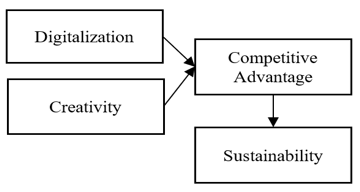
Based on a review of several previous research, this research will build a new model that has never been done, especially in Indonesia. This research will test the variables of digitalization and creativity and their impact on competitive advantage. Moreover, competitive advantage will push the sustainability of SMEs. Several previous findings state that implementing technology will increase the company's strength to become more competitive. At the same time, new ideas in producing products and services will also increase the company's ability to compete in the market. Therefore, this research proposes a new model that examines the relationship between digitalization, creativity, competitive advantage, and sustainability of SMEs. Based on this explanation, we propose the following research model (Figure 1).
Figure 1. Research model
This quantitative research uses a questionnaire to obtain data from respondents. Questionnaires were obtained from several indicators used by previous research and then developed into questions according to the research variables. Several questions were modified and refined after receiving advice from research students, SMEs owners, and experts. This study used a questionnaire with a Likert scale of 1-5, namely strongly disagree, disagree, neutral, agree, and strongly agree. This research expands the object of study throughout Indonesia because it is impossible to send it directly, so this questionnaire is distributed using Google Forms. The questionnaire consists of 3 sections; the first is an introduction, which explains that respondent data are confidential and only used for research purposes. The second is the respondent's identity, which asks whether the respondent uses social media. If they do, they can continue to section three. The third section contains several questions about creativity, digitalization, competitive advantage, and sustainability variables. Based on the time and research plan, as many as 194 respondents have participated. Then an analysis was carried out on the completeness of the respondents' answers, and only 162 questionnaires could be used.
This study uses purposive sampling with the criteria of SMEs using digital media to promote their business. Furthermore, the criteria for SMEs refer to Law No. 20 of 2008; for example, the number of employees is 1-100. In this study, hypothesis testing uses the SmartPLS. Methodologically, this research is different from previous research because previous researchers only analyzed one region in Indonesia, namely Madiun [4], Makassar [26], Bandung [13]. This study expands the research object to make the results more easily generalizable (Table 1).
Table 1. Variable measurement
|
Variable |
Indicators |
|
Digitalization [19] |
|
|
Creativity [16] |
|
|
Competitive Advantage [26] |
|
|
Sustainability [6] |
|
This research uses research objects on MSME owners throughout Indonesia, which consists of several islands. Researchers distributed questionnaires from October 2022 to December 2022. Researchers collected 194 questionnaires, but only 162 samples could be tested.
Table 2 shows the analysis results on the description of the respondents divided into six major islands in Indonesia. The analysis results show that the data distribution is on Java, Kalimantan, and Sumatra islands. The results of Table 2 are not surprising because the island of Java is a trading center. Then what is interesting is that most business actors are women, with a total of 95; this is interesting to be tested in more depth because some previous research has explained that the involvement of women is very limited. Furthermore, the type of business with the highest percentage is the culinary category, which is 40%.
After analyzing the next respondent's description, test the instrument's validity and reliability; the first validity test uses the AVE value (Table 3) with a cutoff > 0.5, then the outer loading value (Table 4) with a cutoff > 0.7. The next validity test uses the cross-loading value (Table 5); the question is valid if the cross-loading value on the target variable is greater than the other variables. Furthermore, reliability testing with Cronbach's alpha & composite reliability (Table 3) with a cutoff of >0.7.
The structural model test uses the R square on the competitive advantage and business sustainability variables (Table 6). The test results show the R square value in the competitive advantage equation (0.476) and the business sustainability equation (0.550). The next test is to use a VIF value with a cutoff <3 (Table 7).
The next test is hypothesis testing (Table 8 and Figure 2) using the bootstrapping technique with a p-value of 5%. The test results for hypothesis 1 prove that digitalization affects business continuity. Digitalization is a helpful strategy for SMEs because through digital innovation, it will be easy to achieve business growth [19]. Digitalization will provide convenience in managing a business because, with digital innovation, companies can save time and be more efficient. However, organizations need resources with digitalization capabilities to avoid mistakes that result in operational failures, thereby slowing down decision-making. The efficient use of resources can strongly impact maintaining a competitive advantage in a business [29]. Not only that, competent resources will make it easier for organizations to accelerate digitization so that it will have an impact on business [19]. This result is in line with findings in China which say that digital strategy is a new opportunity in the digital economy era that can create corporate value to maintain a competitive advantage [29]. Companies must also adapt to the digital environment, taking advantage of new technologies to gain an edge over their competitors [18].
Table 2. Respondent description
|
Java |
Sumatera |
Kalimantan |
Sulawesi |
Nusa Tenggara |
Bali |
Total |
|
|
Gender: |
|||||||
|
Male |
53 |
2 |
2 |
- |
- |
- |
57 |
|
Female |
88 |
2 |
5 |
6 |
2 |
2 |
95 |
|
Education: |
|
|
|
|
|
|
|
|
High school |
67 |
2 |
3 |
1 |
2 |
2 |
77 |
|
Bachelor |
76 |
1 |
4 |
4 |
- |
- |
85 |
|
Using of e commerce: |
|||||||
|
≤ 1 year |
46 |
3 |
3 |
4 |
2 |
1 |
59 |
|
1 – 3 year |
49 |
1 |
1 |
- |
- |
1 |
52 |
|
3 – 5 tahun |
8 |
- |
- |
- |
- |
- |
8 |
|
≥ 5 year |
43 |
- |
- |
- |
- |
- |
43 |
|
Running of business: |
|||||||
|
<3 year |
87 |
2 |
6 |
5 |
1 |
1 |
102 |
|
3 – 5 year |
34 |
1 |
- |
- |
- |
1 |
36 |
|
> 5 year |
23 |
- |
- |
- |
1 |
- |
24 |
|
Type of business: |
|||||||
|
Culinary |
60 |
2 |
2 |
- |
1 |
- |
65 |
|
Agriculture |
5 |
- |
- |
- |
- |
- |
5 |
|
Fashion |
25 |
- |
2 |
- |
- |
- |
27 |
|
Art |
1 |
- |
- |
- |
- |
1 |
2 |
|
Farm |
5 |
1 |
- |
- |
- |
- |
6 |
|
Furniture |
2 |
- |
- |
1 |
- |
- |
3 |
|
Event organizer |
1 |
- |
- |
1 |
- |
- |
2 |
|
Tours & travels |
2 |
- |
- |
- |
- |
- |
2 |
|
Craft |
8 |
- |
2 |
- |
- |
- |
10 |
|
Beauty |
6 |
- |
- |
- |
1 |
- |
7 |
|
Other |
30 |
- |
1 |
1 |
- |
1 |
33 |
Table 3. Construct reliability and validity
|
|
Cronbach’s Alpha |
Rho-A |
Composite Reliability |
Average Variance Extracted (AVE) |
|
Digitalization (X1) |
0.800 |
0.806 |
0.870 |
0.625 |
|
Creativity (X2) |
0.899 |
0.901 |
0.920 |
0.622 |
|
Sustainability (Y) |
0.903 |
0.906 |
0.923 |
0.599 |
|
Competitive Advantage (Z) |
0.783 |
0.783 |
0.860 |
0.606 |
Table 4. Outer loading
|
Digitalization (X1) |
Creativity (X2) |
Competitive Advantage (Y) |
Sustainability (Z) |
|
X1.1: 0.775 X1.2: 0.751 X1.3: 0.814 X1.4: 0.820 |
X2.1: 0.772 X2.2: 0.809 X2.3: 0.765 X2.4: 0.858 X2.5: 0.814 X2.6: 0.735 X2.7: 0.760 |
Y.1: 0.755 Y.2: 0.800 Y.3: 0.792 Y.4: 0.765 |
Z.1: 0.771 Z.2: 0.792 Z.3: 0.729 Z.4: 0.796 Z.5: 0.770 Z.6: 0.718 Z.7: 0.846 Z.8: 0.760 |
Table 5. Cross loading
|
Indicators |
Digitalization (X1) |
Creativity (X2) |
Competitive Advantage (Y) |
Sustainability (Z) |
|
X1.1 |
0.775 |
0.553 |
0.528 |
0.529 |
|
X1.2 |
0.751 |
0.432 |
0.400 |
0.354 |
|
X1.3 |
0.814 |
0.524 |
0.469 |
0.459 |
|
X1.4 |
0.820 |
0.603 |
0.511 |
0.446 |
|
X2.1 |
0.510 |
0.772 |
0.467 |
0.429 |
|
X2.2 |
0.516 |
0.809 |
0.531 |
0.473 |
|
X2.3 |
0.534 |
0.765 |
0.429 |
0.362 |
|
X2.4 |
0.563 |
0.858 |
0.531 |
0.461 |
|
X2.5 |
0.527 |
0.814 |
0.516 |
0.509 |
|
X2.6 |
0.548 |
0.735 |
0.519 |
0.461 |
|
X2.7 |
0.522 |
0.760 |
0.569 |
0.539 |
|
Y.1 |
0.509 |
0.526 |
0.755 |
0.557 |
|
Y.2 |
0.477 |
0.482 |
0.800 |
0.621 |
|
Y.3 |
0.492 |
0.539 |
0.792 |
0.553 |
|
Y.4 |
0.415 |
0.477 |
0.765 |
0.577 |
|
Z.1 |
0.412 |
0.395 |
0.527 |
0.771 |
|
Z.2 |
0.403 |
0.406 |
0.539 |
0.792 |
|
Z.3 |
0.436 |
0.379 |
0.585 |
0.729 |
|
Z.4 |
0.398 |
0.380 |
0.546 |
0.796 |
|
Z.5 |
0.470 |
0.537 |
0.613 |
0.770 |
|
Z.6 |
0.426 |
0.441 |
0.524 |
0.718 |
|
Z.7 |
0.472 |
0.503 |
0.646 |
0.846 |
|
Z.8 |
0.511 |
0.594 |
0.589 |
0.760 |
Table 6. R square
|
|
R square |
Adj. R square |
|
Competitive Advantage (Y) |
0.476 |
0.469 |
|
Sustainability (Z) |
0.550 |
0.547 |
Table 7. VIF testing
|
|
Competitive Advantage (Y) |
Sustainability (Z) |
|
Digitalization → Competitive Advantage |
1.835 |
|
|
Kreativitas → Competitive Advantage |
1.835 |
|
|
Competitive Advantage → Sustainability |
|
1.000 |
Table 8. Hypotheses testing
|
|
Beta |
Mean |
SD |
T Statistics |
P Value |
|
Digitalization → Competitive Advantage |
0.313 |
0.320 |
0.081 |
3.844 |
0.000** |
|
Creativity → Competitive Advantage |
0.439 |
0.438 |
0.086 |
5.083 |
0.000** |
|
Competitive Advantage → Sustainability |
0.742 |
0.746 |
0.044 |
16.698 |
0.000** |
**Sig <1%
Figure 2. Hypotheses testing
The test results of the second hypothesis state that creativity has a significant effect on competitive advantage. These results are consistent with Portugal's findings, which state that an organization's creative culture will provide innovative solutions in the face of competitive competitiveness [31]. In business, creativity is a strategic key in encouraging companies to develop. To increase business growth, organizations must explore strategies that lead to competitive advantage to improve business continuity. SMEs owners must be able to follow changes in consumer demand quickly and optimize expenses so that the cost of creating new ideas is more petite than income to maintain a competitive advantage [3]. Several organizations carried out an exploratory plan by redesigning work to make it more efficient to encourage better performance and positively impact the company [17].
Finally, the third hypothesis states that competitive advantage significantly affects business continuity. This is supported by previous research, which explains that in the face of an uncertain environment, competitive advantage is significant in ensuring the survival of SMEs [32]. Therefore, by facing this uncertain environment, competitive advantage will impact MSMEs' long-term resilience and success [11]. Companies can choose various strategies to have more value than their competitors, such as improving after-sales service and providing guarantees on product quality. The technique applied must follow the needs of consumers so that they feel confident that what is obtained is as expected.
The study results show that digitalization and creativity impact increased competitive advantage, which can ultimately create long-term business sustainability. This reinforces that digital strategy implementation can help companies find new opportunities to maintain excellence [29, 31]. In addition, the role of resources in the organization is significant for creating creativity and making new products, which supports the organization in winning the competition. Creativity within the organization will provide solutions for environmental uncertainties and increase competitiveness [16]. Finally, that competitive advantage significantly impacts the sustainability of SMEs. By maintaining product quality and maintaining a good image in front of customers, companies will be able to keep business so that SMEs sustainability will be achieved [4].
This study has several limitations; namely, first, SMEs owners need to be differentiated based on the type of leadership. This is a challenge for further research to test the type of leadership because, in large companies, the type of leadership is related to the ability of the organization to achieve competitive advantage. Second, this research needs to take into account the dimensions of digitization. Suggestions for future research can examine four dimensions of digitization: organizational digitization strategy, digital processes and governance, digital technology, and employees' digital capabilities . The implications of this research can provide new insights into the SMEs governance literature because it can be used to understand various strategies and sustainability to achieve long-term strategic goals [28].
The results of this research can provide suggestions for two entities, namely SME owners and the government. SME owners must increase their creativity and capabilities in technology to maintain business continuity. Furthermore, the government can provide support through policies, for example, free software that SMEs can use to digitize their businesses.
[1] Mahmutaj, L.R., Krasniqi, B. (2020). Innovation types and sales growth in small firms: Evidence from Kosovo. South East European Journal of Economics and Business, 15(1): 27-43. https://doi.org/10.2478/jeb-2020-0003
[2] Budiarto, D.S., Prabowo, M.A., Uyob, S., Diansari, R.E. (2022). Diversification strategy and its impact on sustainability: Research on Indonesian SMEs. International Journal of Applied Economics, Finance and Accounting, 13(1): 40-49. https://doi.org/10.33094/ijaefa.v13i1.612
[3] GS, A., Kurniasih, N., Reni, A., Istanti, E., Zuhroh, D., Qomariah, N. (2019). The effect of business sphere on competitive advantage and business performance of SMEs. Management Science Letters, 9(8): 1153-1160. https://doi.org/10.5267/j.msl.2019.4.025
[4] Styaningrum, F., Soetjipto, B.E., Wulandari, D. (2020). The determinants of SMEs’ sustainability. Humanities & Social Sciences Reviews, 8(4): 422-430. https://doi.org/10.18510/hssr.2020.8441
[5] Rozak, H.A., Adhiatma, A., Fachrunnisa, O., Rahayu, T. (2021). Social media engagement, organizational agility and digitalization strategic plan to improve SMEs’ performance. IEEE Transactions on Engineering Management, 70(11): 3766-3775. https://doi.org/10.1109/TEM.2021.3085977
[6] Jin, Z., Navare, J., Lynch, R. (2019). The relationship between innovation culture and innovation outcomes: Exploring the effects of sustainability orientation and firm size. R&D Management, 49(4): 607-623. https://doi.org/10.1111/radm.12351
[7] Amjad, F., Abbas, W., Zia-Ur-Rehman, M., Baig, S.A., Hashim, M., Khan, A., Rehman, H.U. (2021). Effect of green human resource management practices on organizational sustainability: The mediating role of environmental and employee performance. Environmental Science and Pollution Research, 28: 28191-28206. https://doi.org/10.1007/s11356-020-11307-9
[8] Munaf, E., Amar, S. (2024). Infrastructure, investment, and environmental degradation: A study of economic development in West Sumatra. International Journal of Sustainable Development & Planning, 19(1): 309-316. https://doi.org/10.18280/ijsdp.190129
[9] Del Baldo, M., Sitnikov, C., Vasilescu, L., Mandache, L., Ogarcă, R., Băndoi, A., Ganea, E. (2022). Funding, turnover, sustainability and digital technologies: A multicriteria research model for SMEs facing a challenging context. Sustainability, 14(7): 3953. https://doi.org/10.3390/su14073953
[10] Srikalimah, S., Wardana, L.W., Ambarwati, D., Sholihin, U., Shobirin, R.A., Fajariah, N., Wibowo, A. (2020). Do creativity and intellectual capital matter for SMEs sustainability? The role of competitive advantage. The Journal of Asian Finance, Economics and Business, 7(12): 397-408. 10.13106/JAFEB.2020.VOL7.NO12.397
[11] Arsawan, I.W.E., Koval, V., Rajiani, I., Rustiarini, N.W., Supartha, W.G., Suryantini, N.P.S. (2020). Leveraging knowledge sharing and innovation culture into SMEs sustainable competitive advantage. International Journal of Productivity and Performance Management, 71(2): 405-428. https://doi.org/10.1108/IJPPM-04-2020-0192
[12] Amoako, G.K. (2020). A conceptual framework: Corporate environmental management activities and sustainable competitive advantage. Management of Environmental Quality: An International Journal, 31(2): 331-347. https://doi.org/10.1108/MEQ-09-2019-0187
[13] Tresna, P.W., Raharja, S.U.J. (2019). Effect of entrepreneurial orientation, product innovation and competitive advantage on business performance in creative industries in Bandung City, Indonesia. Review of Integrative Business and Economics Research, 8: 51-60.
[14] Toaha, M., Maupa, H., Brasit, N., Taba, I., Aswan, A. (2019). Competitive sustainability of food and beverage SMEs in South Sulawesi. In 3rd International Conference on Accounting, Management and Economics 2018 (ICAME 2018), pp. 608-615. https://doi.org/10.2991/icame-18.2019.64
[15] Danso, A., Adomako, S., Amankwah-Amoah, J., Owusu-Agyei, S., Konadu, R. (2019). Environmental sustainability orientation, competitive strategy and financial performance. Business Strategy and the Environment, 28(5): 885-895. https://doi.org/10.1002/bse.2291
[16] Yi, H.T., Amenuvor, F.E., Boateng, H. (2021). The impact of entrepreneurial orientation on new product creativity, competitive advantage and new product performance in SMEs: The moderating role of corporate life cycle. Sustainability, 13(6): 3586. https://doi.org/10.3390/su13063586
[17] Ismail, A., Majid, A.H.A., Rahman, M.A., Jamaluddin, N.A., Susantiy, A.I., Setiawati, C.I. (2021). Aligning Malaysian SMEs with the megatrends: The roles of HPWPs and employee creativity in enhancing Malaysian SME performance. Global Business Review, 22(2): 364-380. https://doi.org/10.1177/0972150918811236
[18] Khin, S., Ho, T.C. (2018). Digital technology, digital capability and organizational performance: A mediating role of digital innovation. International Journal of Innovation Science, 11(2): 177-195. https://doi.org/10.1108/IJIS-08-2018-0083
[19] Yousaf, Z., Radulescu, M., Sinisi, C.I., Serbanescu, L., Păunescu, L.M. (2021). Towards sustainable digital innovation of SMEs from the developing countries in the context of the digital economy and frugal environment. Sustainability, 13(10): 5715. https://doi.org/10.3390/su13105715
[20] Maziriri, E.T. (2020). Green packaging and green advertising as precursors of competitive advantage and business performance among manufacturing small and medium enterprises in South Africa. Cogent Business & Management, 7(1): 1719586. https://doi.org/10.1080/23311975.2020.1719586
[21] Hutahayan, B. (2019). Factors affecting the performance of Indonesian special food SMEs in entrepreneurial orientation in East Java. Asia Pacific Journal of Innovation and Entrepreneurship, 13(2): 231-246. https://doi.org/10.1108/apjie-09-2018-0053
[22] Pu, G., Qamruzzaman, M.D., Mehta, A.M., Naqvi, F.N., Karim, S. (2021). Innovative finance, technological adaptation and SMEs sustainability: The mediating role of government support during COVID-19 pandemic. Sustainability, 13(16): 9218. https://doi.org/10.3390/su13169218
[23] Lee, Y.Y., Falahat, M. (2019). The impact of digitalization and resources on gaining competitive advantage in international markets: Mediating role of marketing, innovation and learning capabilities. Technology Innovation Management Review, 9(11): 26–38. https://doi.org/10.22215/TIMREVIEW/1281
[24] Kathiravan, C., Bhagavatham, P., Palanisamy, V., Rajasekar, A. (2019). Influence of entrepreneurial creativity on competitive advantage in automobile engineering and technologies industries. International Journal of Advanced Science and Technology, 27(1): 166-172.
[25] Guo, H., Yang, Z., Huang, R., Guo, A. (2020). The digitalization and public crisis responses of small and medium enterprises: Implications from a COVID-19 survey. Frontiers of Business Research in China, 14: 1-25. https://doi.org/10.1186/s11782-020-00087-1
[26] Lestari, S.D., Leon, F.M., Widyastuti, S., Brabo, N.A., Putra, A.H.P.K. (2020). Antecedents and consequences of innovation and business strategy on performance and competitive advantage of SMEs. The Journal of Asian Finance, Economics and Business, 7(6): 365-378. https://doi.org/10.13106/JAFEB.2020.VOL7.NO6.365
[27] Muñoz-Pascual, L., Galende, J., Curado, C. (2021). Contributions to sustainability in SMEs: Human resources, sustainable product innovation performance and the mediating role of employee creativity. Sustainability, 13(4): 2008. https://doi.org/10.3390/su13042008
[28] Burlea-Schiopoiu, A., Mihai, L.S. (2019). An integrated framework on the sustainability of SMEs. Sustainability, 11(21): 6026. https://doi.org/10.3390/su11216026
[29] Wang, H., Feng, J., Zhang, H., Li, X. (2020). The effect of digital transformation strategy on performance: The moderating role of cognitive conflict. International Journal of Conflict Management, 31(3): 441-462. https://doi.org/10.1108/IJCMA-09-2019-0166
[30] Nguyen, P.V., Huynh, H.T.N., Lam, L.N.H., Le, T.B., Nguyen, N.H.X. (2021). The impact of entrepreneurial leadership on SMEs’ performance: The mediating effects of organizational factors. Heliyon, 7(6): e07326. https://doi.org/10.1016/j.heliyon.2021.e07326
[31] Ferreira, J., Coelho, A., Moutinho, L. (2020). Dynamic capabilities, creativity and innovation capability and their impact on competitive advantage and firm performance: The moderating role of entrepreneurial orientation. Technovation, 92: 102061. https://doi.org/10.1016/j.technovation.2018.11.004
[32] Banmairuroy, W., Kritjaroen, T., Homsombat, W. (2022). The effect of knowledge-oriented leadership and human resource development on sustainable competitive advantage through organizational innovation's component factors: Evidence from Thailand’s new S-curve industries. Asia Pacific Management Review, 27(3): 200-209. https://doi.org/10.1016/j.apmrv.2021.09.001