Mohamed Jama Mohamed* | Abukar Mukhtar Omar | Abdul Walusansa
© 2024 The authors. This article is published by IIETA and is licensed under the CC BY 4.0 license (http://creativecommons.org/licenses/by/4.0/).
OPEN ACCESS
This study aimed to determine the status of higher education students’ awareness about Climate Change and Environmental Conservation. The research was quantitative and used survey questionnaire for data collection. The participants were 350 higher education students selected purposively from 5 universities in Mogadishu, Somalia. The study employed a correlational design and found that there is a positive moderate relationship (r = 0.567) between students’ Status of Awareness (SAW) and Climate Change and Environmental Conservation (CCaEC). The work also used regression analysis to determine how the independent variable affects the dependent variable, and the output was R2 = 0.322. The hypothesis testing revealed that Students’ Awareness of climate change significantly impacted environmental conservation (p-value = 0.000). The Commission for Higher Education in Somalia should therefore develop an environmental protection plan, according to the researchers' recommendations. This approach will not be implemented until people's awareness in the field of education is raised. By implementing the research's suggestions, it is hoped that the findings of this study will increase higher education institutions' involvement in environmental preservation to protect the Somalia’s fragile degraded environmental resources. The findings will also offer a policy direction.
awareness, environment, conservation, climate change
Climate change is the long-term alteration of the world’s weather patterns. One of the key drivers of climate change is the emission of heat-trapping greenhouse gases from human activities, along with the decline in natural gas-absorbing trees, leading to serious environmental issues such as climate change, the greenhouse effect, energy shortages, resource depletion, biodiversity loss, deforestation and pollution, all of which are historically unprecedented [1]. This, in turn, will raise support for taking an action to address climate change [2]. The climate change burden is now one of the greatest threats to the planet, particularly in developing countries where the rate of garbage output is anticipated to hinder human existence and livelihoods [3]. Over the past three decades, vast evidence has emerged ascertaining the worrisome extent to which anthropogenic influences, such as the Industrial Revolution, alter the global climate systems, endangering the conservation of the environment. An unprecedented picture of the Earth's surface is provided through satellite imaging, which provides essential information for environmental monitoring [1].
Much as there are regional variations in the extent of climate disruption, there is now a collective perception and agreement that the world is facing upward trends in the central ocean and surface climatic factors such as temperature, variability in precipitation, and the intensity of tropical cyclones [4, 5]. Effective redress to overpower the global escalation of undesired climate change and adapt to its already pressing effects will necessitate the involvement of all societal actors. There is still more that could be done today to lessen the effects of natural hazards before they happen, as evidenced by several recent catastrophic events, including the 2010 Haiti earthquake, the 2004 Indian Ocean tsunami, the 2005 Hurricane Katrina, and the typhoon Haiyan that struck the Philippines in 2013 [6].
Since academic institutions are essential in shaping the attitudes and behaviors of future generations, the empowerment of the youths to address climate change impacts in their communities should be a priority of the global education system [7]. According to Boca and Saraçli [8], young people are crucial in promoting environmental conservation as they can act as change agents and influence their peers, families, and communities to adopt more sustainable practices. Consequently, the students in Higher Education Institutions (HEIs) should not be ignorant of Climate Change and Environmental Conservation; instead, they should critically and creatively think about strategies for coping with and adapting to climate change [8, 9]. Given the scarce and scanty number of contemporary studies tailored to measure the HEIs students’ knowledge and concern about the climate change threat and its mitigation through environmental conservation in most parts of the world, it is not easy to constitute global patterns in the data. Nevertheless, the recurrent theme in the few available studies is that a large proportion of the global students’ community believes that punctures in the atmospheric ozone layer facilitate the greenhouse gas effects and the subsequent global warming [10]. Indeed, this is a misconception because climate change and global warming are disintegrable and are caused by different factors [11]. However, it has been demonstrated that HEIs can facilitate learning for students to acquire optimum awareness about global importance, including Climate Change and Environmental Conservation [12]. Around the world, higher education research is regarded as one of the most effective tools for environmental development, particularly in the promotion of a healthy environment, the sustainability of renewable resources, and the conservation of non-renewable resources for the benefit of society and humankind [13]. Community resilience is increased through catastrophe risk reduction education using a methodical approach to detecting, assessing, and lowering risk [14].
Historically, environmental education (EE) in Africa has inadequate programs in academic institutions [15]. For example, in the 1970s, in a workshop to assess the progress of EE and the problems impeding the achievement of its objectives in African countries, the United Nations Environmental Program (UNEP) reported that 50% of the participating countries possessed no formal program of environmental education [16, 17]. Knowing that other sources of environmental knowledge, especially those that are informal, can also have a bearing on the students’ environmental awareness, uncertainties still exist as to whether the absence of EE programs since the 1970s is a significant predictor of low knowledge levels about dynamic environmental issues such as climate change among the students’ communities in African. The lack of adequate EE programs in HEIs, with the potential to limit students’ awareness of Climate Change and Environmental Conservation in African countries like Somalia, has been partly attributed to the fact that educational planners are majorly preoccupied with the desire to expand the educational enterprise. Hence, the educational planners mainly focus on issues like the number of schools, teachers, and infrastructure, with minimal or no attention to the quality of the environment and EE [16].
In Somalia, like in most other African settings, research information is scarce about the status of Climate Change and Environmental Conservation knowledge among HEI students. Most of the literatures that the study covered emphasize the importance of environmental conservation. This creates discrepancies between the current theory about environmental protection and the actual situation exits in most developing countries like Somalia. This shows how majority African are lagging behind in the actual engagement of tackling environmental issues. In these settings, natural resources have been depleted due to natural calamities, anthropogenic influences such as pollution and associated consequences like global warming and climate change [18]. The quality and accessibility of environmental data are critical to environmental conservation [1]. The leading cause of the escalation of these problems has been reported as the low level of knowledge and awareness about environmental issues [19]. Formal education's responsibility to implement environmental education depends on environmental education programs to prepare the next generation for a green society [8]. In the formal education system, though teachers are the critical factors who inculcate environmental knowledge and skills in the young generation, the students constitute an enormous human resource that should preserve and use the acquired knowledge to avert environmental threats. The current research examined the status of students’ awareness about Climate Change and Environmental Conservation and the priority given to it in HEIs in Mogadishu city. The researcher developed hypothesis that says: There is a considerable relation between and students' level of awareness of Climate Change and Environmental Conservation.
The majority of the existing literature about higher education and environmental conservation covers extracurricular activities, the role of policy-makers and environmental activists. But this focused on the awareness of small important portion of the society that can lead essential change in environmental conservation. Evidence-based research typically tracks student knowledge changes after introducing a specific educational program or module [20]. Preserving natural resources, environmental awareness is crucial. Raising public awareness can cut down on the use of plastics and water waste, while encouraging recycling will cut down on waste ending up in landfills. Thus, the results have the potential to inform and support the effective design of coping strategies and solution-oriented environment education activities in HEIs in Somalia and similar settings, to support climate change mitigation and adaptation.
The study's primary goal is to examine the status of higher education students about Climate Change and Environmental Conservation. According to the researchers' hypothesis, there is a considerable connection between the status of students' awareness towards Climate Change and Environmental Conservation.
2.1 Research design
The correlative survey design determined how students’ awareness of Climate Change and Environmental Conservation are related. The researchers used regression analysis and correlation to measure the linear relationship between variables and provide a thorough examination of the data, which may aid in future projections, early detection and remediation of environmental issues. As Oshagbemi [21] argued, quantitative research aims to test hypotheses, ascertain facts, show correlations between variables, and forecast results. As a correlative survey is part of descriptive statistics, it condenses, summarizes, and describes quantitative data collected from observed evidence. This descriptive study aimed to shed light on the current scenario regarding how college students view environmental conservation. The existing state of affairs is investigated through descriptive research [22].
2.2 Study population and sampling procedure
The target population was Mogadishu higher education students. The study's goals make clear to which group the research results can be applied or for which group the findings can be generalized [23]. People who are grouped and have similar traits are referred to as a population. Due to the time, expense, and effort required to investigate every unit in the population, it is practically impossible to do so in regular research. By examining a population sample, survey research can quantify that population's attitudes, opinions, or trends [24]. Non-probability sampling (purposive sampling) was used to acquire data for the study [25]. Non-probability sampling techniques adopt a strategy in which the sample is chosen based on the researcher's judgment rather than through random selection [26]. Non-probability sampling methods rely on judgment because participants are chosen as they are convenient to reach [27]. To make sure representativeness of the sample, the researchers included students of different years at the five selected universities.
The study participants are only from five universities in Mogadishu city, and the sample size is 350, as indicated by the demographic characteristics of the students.
2.3 Data collection and analysis
Researchers used an online questionnaire for data collection sent to the students of the five universities selected purposively. A Likert-scale-style questionnaire ranging from 1 to 5 ('Strongly disagree' to 'Strongly agree') assessed the students' awareness of Climate Change and Environmental Conservation. The Likert scale was created in 1932 by Rensis Likert, and it is extensively used in social science research to gather response information. The instruments for data collection were divided into two sections. The first section was demographic information of the respondents in terms of gender, age, and the year of the student. The second part is the respondents’ awareness towards environmental conservation. By examining a population sample, survey research can quantify that population's attitudes, opinions, or trends [24]. Data was analyzed using jamovi and SPSS 26 tools. Both offer tools for correlation and regression analysis to perform in-depth critical evaluation of the research variables.
Table 1. Demographic information of the participants
|
Gender |
Counts |
% of Total |
|
Male |
171 |
48.9 |
|
Female |
179 |
51.1 |
|
Total |
350 |
100 |
|
Age |
|
|
|
18-20 |
189 |
54.0 |
|
21-23 |
108 |
30.9 |
|
24 and above |
53 |
15.1 |
|
Total |
350 |
100 |
|
Study Year |
|
|
|
First Year |
54 |
15.4 |
|
Second Year |
98 |
28.0 |
|
Third Year |
78 |
22.3 |
|
Fourth Year |
94 |
26.9 |
|
Fifth Year |
17 |
4.9 |
|
Sixth Year |
9 |
2.6 |
|
Total |
350 |
100 |
Table 1 contains demograhic informaion of the respondents who participated the study in terms of gender, age and the years thay are at the university.
3.1 Reliability test
To get accurate measurements, it is essential to make sure the device is reliable. In Table 2, researchers use Cronbach’s alpha to measure the reliability. Reliability is concerned with repetition to ensure that the analysis will yield a consistent result, whereas validity is focused on how well a measure reflects the specified study objectives [28]. The most popular method for determining internal consistency is Cronbach's alpha and composite reliability, which gauges trustworthiness based on how the variables in the observed items interact [29]. Cronbach's Alpha measures the internal consistency of things not graded as correct or incorrect, such as in some essay tests with multiple alternative answers [23]. A value of Alpha Cronbach greater than 0.6 is regarded as having strong reliability and an acceptable index, whereas a value of Alpha Cronbach less than 0.6 is considered low reliability [30].
Table 2. Cronbach's Alpha
|
Constructs |
Items |
Cronbach's Alpha |
|
Status of Awareness (SAW) |
10 |
0.632 |
|
Climate Change and Environmental Conservation (CCaEC) |
8 |
0.684 |
SAW = Status of Awareness, CcaEC = Climate Change and Environmental Conservation
Some scientists are concerned that the sample value of Cronbach's alpha for a response variable or a predictor variable in a statistical analysis might be too low, but there is no acceptable global minimum reliablity value [31].
3.2 Correlation analysis
The correlation is a statistical tool for measuring the relationship between two variables. In the following table, researchers want to examine how higher education students’ awareness about climate change is related to environmental conservation. The goal of conducting a correlation analysis is essentially the same in every study, and it is typically helpful to examine the association between variables [32]. These variables can be two independent variables or dependent and independent variables. Although correlations can be used to determine how strongly and in what direction two variables co-vary in an environment, they do not prove causation and are not utilized to make predictions [33].
Table 3. Correlation
|
|
SAW |
CCaEC |
|
SAW |
1 |
.567** |
|
EC |
.567** |
1 |
*Correlation is significant at the 0.01 level (2-tailed).
SAW = Status of Awareness, CcaEC = Climate Change and Environmental Conservation
In Table 3, the Pearson correlation product shows that the Status of Awareness (SAW) about Climate Change and Environmental Conservation (CCaEC) were moderately positive and statistically significant (r = 0.567, p < 0.01). Researchers employ correlation to determine the relationship or association between the research variables in quantitative studies [33, 34]. This kind of correlation is bivariant because only two variables are involved.
3.3 Regression analysis
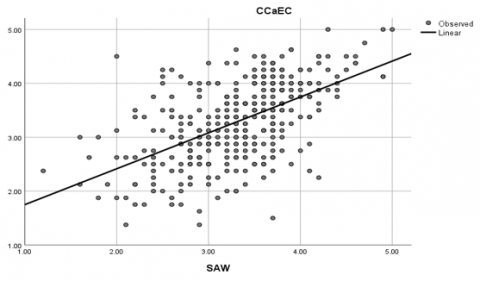
Regression analysis examined how higher education students’ awareness affects the perspectives of Climate Change and Environmental Conservation. The following is a curve estimation for regression analysis. In this type of analysis, the response or dependent variable is the variable researchers attempt to explain or predict because it depends on another variable. Explanatory variables are used to predict or explain the response variable. Due to its independence from the other variable, it is also occasionally called the independent variable [35].
Figure 1. SAW = Status of Awareness, CcaEC = Climate Change and Environmental Conservation
Figure 1 differs from the above tables since it establishes how the prediction and explanation of one variable affect the other. This kind of analysis is known as regression analysis. The result of the curve estimation revealed that higher education students’ awareness has an impact on environmental conservation.
Secially, regression analysis aids researchers in determining how changes in one variable are associated with changes in another.
3.4 Hypothesis testing
Table 4. Significance of the hypothesis
|
1 |
|
Sum of Squares |
Df |
Mean Square |
F |
Sig. |
|
|
Regression |
60.543 |
1 |
60.543 |
164.927 |
.000b |
|
|
Residual |
127.747 |
348 |
.367 |
|
|
|
|
Total |
188.290 |
349 |
|
|
|
a. Dependent Variable: Climate Change and Environmental Conservation (CCaEC)
b. Predictors: (Constant), Status of Awareness (SAW)
The study examined the Status of Awareness (SAW) about Climate Change and Environmental Conservation (CCaEC). The ratio of the two mean squares (F-164.927) and the (P-0.000) indicated that the null hypothesis was rejected. The results in Table 4 indicated that the Students’ Awareness (SAW) significantly impacts their understanding of Climate Change and Environmental Conservation (CCaEC).
Coefficients
Table 5. P - value
|
Model |
Unstandardized Coefficients |
Standardized Coefficients |
|||
|
|
B |
Std. Error |
Beta |
T |
Sig. |
|
Constant |
1.083 |
.174 |
|
6.210 |
.000 |
|
SAW |
.666 |
.052 |
.567 |
12.842 |
.000 |
a. Dependent Variable: EC
SAW= Status of Awareness, CCaEC= Climate Change and Environmental Conservation (t= 12.852), (p=0.000)
As in the Table 5, there are high t-statistics and low p-values, which shows that the null hypothesis was rejected.
3.5 Model summary
Table 6. R squared
|
R |
R Square |
Adjusted R Square |
Std. Error of the Estimate |
|
.567a |
.322 |
.320 |
.60588 |
SAW= Status of Awareness, CCaEC= Climate Change and Environmental Conservation
R (0.567) in Table 6 indicates that there is a moderate positive relationship between Status of Awareness (SAW) and Climate Change and Environmental Conservation (CCaEC) among higher education students. In the same table, we have R2 (0.322), which shows how much the independent variable, students’ awareness, affects the dependent variable (environmental conservation). R2 is typically regarded as the proportion of variation in the independent variables that can be accounted for by variation in the dependent variable [36]. The R-squared and adjusted R-squared statistics are derived from general linear model analyses (e.g., regression, ANOVA), and they show the percentage of variance in the outcome variable that can be accounted for by the predictor variables in the sample (R-squared) and an estimate of the population (adjusted R-squared) [37]. According to the data in the model summary table above, the "R square" is 0.322, which, when multiplied by 100, yielded the result of 32.2%. This meant that 32.2% of the DV variation was due to the IV. The R2 indicates both the amount that can be inferred from the regression and the amount that is subject to outside influence. Finding out how much you don't know could be just as crucial as finding out how much you do, as it will allow you and other researchers to look for more information elsewhere. The Standard Error of the Estimate (0.60588) measures the accuracy of predictions made by the regression model.
The study intended to examine the status of higher education students’ awareness about Climate Change and Environmental Conservation. The result of regression analysis revealed that higher education students’ awareness of environmental problems significantly impacts environmental conservation (p< 0.05). This fundamental approach frequently assures the researchers that the model's explanatory variables are reliable predictors of the dependent variable [37]. Promoting responsibility for environmental conservation and raising local understanding of national environmental issues are crucial [38]. Understanding climate change as a complex social and scientific issue characterized by ambiguous and context-specific information is essential [14]. The results also revealed a moderate positive relationship (r = 0.567) between the variables. This means that the student’s awareness and environmental conservation always go in identical directions. But compared to more established areas of study like environmental education, science education, and education for sustainability, climate change education is still a relatively new and undertheorized topic of study [39].
Increasing the students’ awareness of environmental conservation will help mitigate local environmental improvement. A study conducted by Rabha and Singh [40] showed that students need to be knowledgeable about the subject matter and the numerous approaches they can take to deal with any associated difficulties. Therefore, there are two subcategories of environmental knowledge: (1) knowledge about how humans affect the environment and (2) knowledge about how to lessen human impact. As a result, environmental knowledge raises awareness, encouraging positive attitudes toward nature [41]. To accurately estimate the effects and risks of climate change at both the local and global levels, knowledge and comprehension of the issue are crucial. As a result, the local populace will be involved in both the reforestation efforts and the biodiversity and forest preservation projects.
The other important point in the analysis was that students' awareness impacted climate change understunding and environmental protection. Students can be inspired to maintain their viewpoints, respond to environmental issues daily, openly express their opinions and personal ideas, get involved in important issues, and develop solutions in constrained circumstances [8]. Additionally, raising educational standards can equip people with the knowledge and abilities they need to properly prepare for and recover from natural disasters [42]. In response to global warming, nations have adopted a variety of treaties pledging to reduce behaviors that worsen the issue. Politicians and decision-makers can adopt sustainable policies with significant public support thanks to the population's increased awareness, even if they come at a higher cost. The findings of the study showed how higher education students’ awareness is crucial to environmental protection. Consequently, policy-makers, educators, environmental activists and organizations are launching numerous pro-environment campaigns in an effort to increase awareness and encourage behavior change [40].
The study examined higher education students’ awareness of Climate Change and Environmental Conservation. The findings showed a positive relationship between the two variables and that awareness of higher education students’ awareness significantly impacts environmental conservation. This is important for students’ attitudes towards Climate Change and Environmental Conservation. The issue of environmental problems is worldwide, and the contribution of every group in society is inevitable. Environmental conservation is a collective responsibility, and each member of the society should have this mindset. The intention is for the students to participate in the intervention and be aware of it.
As with any other study conducted by researchers, the work has limitations. The study is confined only to higher education institutions in Mogadishu, so it cannot be generalized to the Somali cities outside the capital. The study used purposive sampling which always tends to be subjective. In non-probability sampling meeting the representativeness of the sample to a large population is so challenging. The limitations of the research include that it invited only higher education students, who constitute only a tiny portion of society. For data collection and analysis, researchers also used the quantitative research methodology. This can make acquiring more data from the study participants more difficult. Because the researchers have made certain selections, the respondents in a quantitative research method have fewer options for responding.
However, researchers anticipate that the study will help increase higher education students' knowledge of climate change, environmental conservation's importance, and policymakers' consideration of it. There are some implications of this study. The study's primary implications include establishing a plan and public policy for the participation of every community member Higher education commissions in Somalia are anticipated to formulate an environmental conservation policy employed by higher education institutions. Since environmental issues can impact many aspects of our lives, raising awareness is the first step in getting students involved in solving them, so higher education administrators to plan campaigns in favor of environmental preservation.
It is anticipated that this will also alter the perception that environmental preservation and personal care are unrelated. The ramifications of this study include campaigns for mitigation, the development of sustainability policies, and the use of environmentally friendly energy sources. Reusing and recycling waste products, resorting to renewable sources of energy, planting more trees. To start achieving this, it is crucial to teach society at large about the environment and how to conserve it, everywhere in the country. This is the initial stage of taking significant and long-lasting action.
The authors express their sincere gratitude to SIMAD University for providing encouragement and funding to carry out this research project. Additionally, we want to thank everyone assisted us in collecting precise data from higher education institutions in Mogadishu city.
[1] Rayhan, A. (2023). AI and the environment: Toward sustainable development and conservation. https://doi.org/10.13140/RG.2.2.12024.42245
[2] Bayes, R., Bolsen, T., Druckman, J.N. (2023). A research agenda for climate change communication and public opinion: The role of scientific consensus messaging and beyond. Environmental Communication, 17(1): 16-34. https://doi.org/10.1080/17524032.2020.1805343
[3] Kirea, E.M., Omwenga, J.Q. (2023). Determinants of waste management programmes on sustainable environmental conservation in mukuru slums in Kenya. International Journal of Social Science and Human Research, 1(1): 137-150. https://doi.org/10.61108/ijsshr.v1i1.18
[4] Wachholz, S. (2013). ‘At risk’: Climate change and its bearing on women’s vulnerability to male violence. In Issues in Green Criminology. Willan.
[5] Change, C. (2001). United Nations Intergovernmental Panel on Climate Change. Cambridge: Cambridge University Press.
[6] Muttarak, R., Lutz, W. (2014). Is education a key to reducing vulnerability to natural disasters and hence unavoidable climate change? Ecology and Society, 19(1): 42. https://doi.org/10.5751/ES-06476-190142
[7] Narksompong, J., Limjirakan, S. (2015). Youth participation in climate change for sustainable engagement. Review of European, Comparative & International Environmental Law, 24(2): 171-181. http://doi.org/10.1111/reel.12121
[8] Boca, G.D., Saraçli, S. (2019). Environmental education and student's perception, for sustainability. Sustainability, 11(6): 1-18. https://doi.org/10.3390/su11061553
[9] Nath, H.K. (2009). Trade, foreign direct investment, and growth: Evidence from transition economies. Comparative Economic Studies, 51: 20-50. https://doi.org/10.1057/ces.2008.20
[10] Cordero, E.C., Todd, A.M., Abellera, D. (2008). Climate change education and the ecological footprint. Bulletin of the American Meteorological Society, 89(6): 865-872. https://doi.org/10.1175/2007BAMS2432.1
[11] Mitchell, G.R. (2017). Climate change and manufacturing. International Conference on Sustainable and Intelligent Manufacturing, 12: 298-306. https://doi.org/10.1016/j.promfg.2017.08.033
[12] Ratinen, I. (2021). Students' knowledge of climate change, mitigation and adaptation in the context of constructive hope. Education Sciences, 11(3): 103. https://doi.org/10.3390/educsci11030103
[13] Jadhav, A.S., Jadhav, V.V., Raut, P. (2014). Role of higher education institutions in environmental conservation and sustainable development: A case study of Shivaji University, Maharashtra, India. Journal of Environmental Earth Sciences, 4(5): 30-34.
[14] Stevenson, R.B., Nicholls, J., Whitehouse, H. (2017). What is climate change education? Curriculum Perspectives, 37(1): 67-71. https://doi.org/10.1007/s41297-017-0015-9
[15] Damoah, B., Omodan, B.I. (2023). Tracing the footprints of environmental education in teacher education: A review of pre-service teachers' training in universities. Journal for Educators, Teachers and Trainers, 14(5): 184-196. https://doi.org/10.47750/jett.2023.14.05.020
[16] Nantumbwe, E. (2014). Assessment of students' practices and awareness of environmental issues in secondary schools in Makindye Division Kampala District. In Bachelor of Science in Environmental Management. Kampala International University, Uganda.
[17] Jarso, B. (2016). The effects of climate change among the rural pastoral women and children in southern Ethiopia: A case study from lowland woreda of Borana zone. St. Mary’s University.
[18] Abbass, K., Qasim, M.Z., Song, H., Murshed, M., Mahmood, H., Younis, I. (2022). A review of the global climate change impacts, adaptation, and sustainable mitigation measures. Environmental Science and Pollution Research, 29(28): 42539-42559. https://doi.org/10.1007/s11356-022-19718-6
[19] Dhiman, V., Pant, D., Sharma, S.D. (2022). Single-use plastics: An escalating global environmental problem. In Economics and Policy of Energy and Environmental Sustainability. Springer.
[20] Anderson, A. (2012). Climate change education for mitigation and adaptation. Journal of Education for Sustainable Development, 6(2): 191-206. https://doi.org/10.1177/0973408212475199
[21] Oshagbemi, T. (2017). Chapter 4. Research design and methodology. Leadership and Management University, 2003: 67-95. https://doi.org/10.1515/9783110853681-006
[22] Islamia, J.M. (2016). Research design. In Research in Social Science: Interdisciplinary Perspectives.
[23] Shukla, S. (2020). Concept of population and sample. In How to Write a Research Paper.
[24] Bostley, M.A. (2019). Basics of research design: A guide to selecting appropriate research design. International Journal of Contemporary Applied Researches, 6(5): 76-89.
[25] Ahmed, Y.A., Mohamed, M.M., Ali, A.F., Alasso, M.M., Ahmad, A.D.S.M.N. (2021). Evaluating students’ perspectives on ICT readiness in Somali higher education towards teaching-learning acceptance. arXiv, arXiv:2108.11455. https://doi.org/10.48550/arXiv.2108.11455
[26] Karadeniz, Ş. (2012). School administrators, ICT coordinators and teachers’ metaphorical conceptualizations of technology. Education, 2(5): 101-111. https://doi.org/10.5923/j.edu.20120205.01
[27] Showkat, N., Parveen, H. (2017). Quadrant-I (e-Text). https://www.researchgate.net/publication/319066480_NonProbability_and_Probability_Sampling.
[28] Mat Nawi, F.A., Tambi, A.M., Samat, M.F., Mustapha, W.M.W. (2020). A review on the internal consistency of a scale: The empirical example of the influence of human capital investment on Malcolm Baldrige quality principles in TVET institutions. Asian People Journal, 3(1): 19-29. https://doi.org/10.37231/apj.2020.3.1.121
[29] Ab Hamid, M.R., Sami, W., Mohmad Sidek, M.H. (2017). Discriminant validity assessment: Use of Fornell & Larcker criterion versus HTMT criterion. Journal of Physics: Conference Series, 890(1): 012163. https://doi.org/10.1088/1742-6596/890/1/012163
[30] Khidzir, K.A.M., Ismail, N.Z., Abdullah, A.R. (2018). Validity and reliability of instrument to measure social using Cronbach’s alpha. International Journal of Development and Sustainability, 7(3): 1026-1037.
[31] Bonett, D.G., Wright, T.A. (2015). Cronbach’s alpha reliability: Interval estimation, hypothesis testing, and sample size planning. Journal of Organizational Behavior, 36(1): 3-15. https://doi.org/10.1002/job.1960
[32] Senthilnathan, S. (2019). Usefulness of correlation analysis. SSRN Electronic Journal.
[33] Lyman-Ott, R. (2010). Correlation|What is it? How does it work? http://www.epa.gov/bioindicators/statprimer/index.html.
[34] Alenezi, S. (2021). Investigating saudi EFL students’ knowledge and beliefs related to English reading comprehension. Arab World English Journal, 12(1): 339-356. https://doi.org/10.24093/awej/vol12no1.23
[35] Mindrila, D., Balentyne, P. (2013). Regression. In the Basic Practice of Statistics (6th ed.)
[36] Figueiredo Filho, D.B., Silva Júnior, J.A., Rocha, E.C. (2011). What is R2 all about? Leviathan (São Paulo), 3: 60. https://doi.org/10.11606/issn.2237-4485.lev.2011.132282
[37] Ozili, P.K. (2023). The acceptable R-square in empirical modelling for social science research. In Social Research Methodology and Publishing Results: A Guide to Non-Native English Speakers. https://doi.org/10.4018/978-1-6684-6859-3.ch009
[38] Shemdoe, R. (2015). Towards integration of sustainable environmental and biodiversity conservation in secondary schools students extra-curricular in Tanzania: Where do we start? International Journal of African Asian Studies, 16: 35-42.
[39] Rousell, D., Cutter-Mackenzie-Knowles, A. (2020). A systematic review of climate change education: Giving children and young people a ‘voice’ and a ‘hand’ in redressing climate change. Children's Geographies, 18(2): 191-208. https://doi.org/10.1080/14733285.2019.1614532
[40] Rabha, F.H., Singh, D.N.R. (2022). Facebook as an agent to tackle climate change with reference to university students in Assam. Indian Journal of Social Science Literature, 2(1): 11-23. https://doi.org/10.54105/ijssl.e1025.091522
[41] Akhtar, S., Khan, K.U., Atlas, F., Irfan, M. (2022). Stimulating student’s pro-environmental behavior in higher education institutions: An ability-motivation-opportunity perspective. Environment, Development and Sustainability, 24(3): 4128-4149. https://doi.org/10.1007/s10668-021-01609-4
[42] Barreda, A.B. (2018). Assessing the level of awareness on climate change and sustainable development among students of Partido State University, Camarines Sur, Philippines. Journal of Sustainability Education. https://doi.org/10.5281/zenodo.8216394