Rahmawati Rahmawati | Gunawan Prayitno* | Nailah Firdausiyah | Dian Dinanti | Dimas Wisnu Adrianto
© 2024 The authors. This article is published by IIETA and is licensed under the CC BY 4.0 license (http://creativecommons.org/licenses/by/4.0/).
OPEN ACCESS
Optimal quality of life (QoL) requires support from various forms of capital, including social capital. Although social capital is considered a relevant non-physical asset, its influence on meeting QoL needs has not been fully clarified. This research aims to fill this knowledge gap by examining the relationship between social capital and QoL in the Sidomulyo Tourism Village, a tourism village based on ornamental plant cultivation in Indonesia. This research is important because research related to social capital and QoL is still limited. Apart from that, this research also understands how social capital can be implemented to improve community QoL. Data was collected through distributing questionnaires to 307 respondents (Head of Household). Data analysis was carried out using SEM-PLS analysis with two stages, namely outer model and inner model analysis. Research findings show that social capital as a whole has a significant influence on the QoL of the Sidomulyo Tourism Village community. Furthermore, elements of social capital, especially trust, have the strongest impact on QoL elements, especially material aspects of well-being. The implications of these findings provide valuable insights in developing policies and intervention programs to improve QoL in rural communities, especially those related to strengthening social capital.
social capital, quality of life (QoL), tourism, economy, rural development
Over the last few years, research in the tourism sector has mainly focused on development strategies aimed at optimizing tourist visits and supporting economic growth in tourism destinations [1-3]. However, as the tourism industry develops, researchers are increasingly realizing that its impact is not only positive but can also have significant negative consequences on economic, socio-cultural and environmental aspects in tourist destinations [1, 2, 4]. Local communities, as one of the main stakeholders, are a group that is greatly affected by the dynamics of tourism development [5, 6]. Increased awareness of these impacts has changed the tourism development policy agenda, where the focus is no longer only on economic growth, but also on community welfare, which includes Quality of Life (QoL) [7, 8].
When a community becomes a tourist destination, the daily lives of its people cannot be avoided from the influence of tourism [9]. Community support is a key factor in the success of tourism development, and therefore, community QoL must be a primary concern in every tourism development effort [10, 11]. The impact of tourism development can affect QoL, especially in communities that support tourism activities because of better economic prospects. Meanwhile, people who are not involved in tourism development can still have an impact on their QoL as a result of tourism [12].
In the place-dependent tourism sector, tourist villages are considered suitable places for recreation, spending free time, production and consumption of blood-specific foods, and so on. Village tourism provides a unique opportunity to attract tourists by building connections between rural areas and their culture, history, and ethnicity [2, 13, 14]. While many tourist villages in Indonesia offer unique potential, the Sidomulyo Tourism Village, which is famous for cultivating ornamental flowers, has attracted attention. This village has succeeded in integrating the concept of Flower Tourism and Agroindustry based on local wisdom, creating new opportunities such as employment opportunities and economic support for its residents. To date, more than 60% of the residents of Sidomulyo Tourism Village work as flower farmers (Sidomulyo Tourism Village Profile, 2020).
Although the Sidomulyo Tourism Village has provided positive impacts, such as business opportunities and economic growth, there are also negative impacts such as competition, changes in lifestyle, unequal distribution of benefits. In its development stage, this village still faces challenges in achieving a level of independence in tourism development [15]. The life satisfaction of people in tourism areas is influenced by the stages of tourism development and its impacts [10, 16]. Tourism development plays an important role in shaping people's perceptions of development and their QoL. In this case, the relationship between the economic impact of tourism and satisfaction with material well-being has the strongest influence compared to other factors [17, 18].
QoL includes standards of living, environment, independence, health and safety of individuals or groups [19]. Community QoL is understood through subjective perceptions of objective conditions [20, 21]. The definition of QoL includes an individual's happiness with their life and environment [22]. At the community level, QoL is related to social conditions, economic activities, and institutions that reflect community values. QoL elements involve Material Well-Being, Emotional Well-Being, Safety and Health Well-being, and Community Well-being [10], Communities that can rely on various forms of capital are needed to achieve good QoL [23].
Social capital is an important capital in meeting QoL-related needs and is recognized as an asset that brings positive consequences for the welfare of society [24-26] According to [27], there is a mutual dependence between social capital and QoL, while other opinions state that QoL can condition social capital [28]. Several views emphasize that the effectiveness of the use of social capital influences QoL [29, 30]. There is a relationship found between social capital and QoL, as indicated by several studies [19, 31, 32]. Some views consider social capital as the main determinant of QoL [33]. Trust was identified as the most important element of social capital, and this is in line with the view that trust influences QoL. The higher the social capital value, the higher the QoL value, reflecting the level of life satisfaction [34].
Previous research suggests that economic benefits can improve QoL [35, 36], although there is emphasis that factors other than economics also have an important role. The social dimension, according to research [13, 37], also influences people's QoL, and this view is supported by study [8], which emphasizes that economic, environmental and social conditions have a direct influence on QoL. Some studies only focus on analyzing social capital or QoL only. Meanwhile, research that focuses on the relationship between the two is still limited [13, 27, 28, 35-37]. According to study [19], studies on social capital with QoL are complicated to assess the influence of both.
Although social capital is considered a relevant non-physical asset, its influence on meeting QoL needs has not been fully clarified. This research aims to fill this knowledge gap by examining the relationship between social capital and QoL in the Sidomulyo Tourism Village. This research is important because research related to social capital and QoL is still limited. Apart from that, this research also understands how social capital can be implemented to improve community QoL. The contribution of the findings is expected to provide valuable insights in developing policies and intervention programs to improve QoL in rural communities, especially those related to strengthening social capital.
The use of a quantitative approach in this research was carried out based on the research objective, namely testing the relationship between social capital variables and QoL variables using SEM-PLS (Structural Equation Modeling-Partial Least Squares) analysis. SEM-PLS analysis is a quantitative analysis method used to test and measure complex relationships or influences between variables in a conceptual model. In this case, the conceptual model tested is the relationship between social capital and the QoL of the Sidomulyo Tourism Village community. The stages in this analysis consist of two stages, namely analysis of the outer model/measurement model (PLS algorithm) and inner model/structural model (Bootstrapping and Blindfolding).
The variables used are social capital and its three elements and variables QoL and its four elements (Table 1). The population determination in this study is based on the social capital variable showing the ties between people who have similarities in the same situation, such as close family, close friends and neighbors [38, 39].
Then according to studies [40, 41], social capital is a bond that refers to the relationships that people have in internal community ties, such as family, friends and neighbors, or groups that have the same goals. This explanation is further strengthened by study [42], which states that social capital itself is built and formed starting from within a family, which will later develop in the surrounding environment. And according to study [43], which states that there is no consensus among social scientists regarding whether social capital operates at the individual level, collective level, or both.
Furthermore, according to study [10], the scope of measurement QoL can be done with units of analysis at the individual, family, community, and even country levels. Then according to study [22], when QoL Individuals are at the community level, so they have a relationship with social conditions, economic activities, institutions that reflect community values and norms. Based on this explanation, the population determined in this study is the number of Heads of Household (HoH) who live in the Sidomulyo Tourism Village. This is because the people of Sidomulyo Tourism Village are people who have the same conditions, namely residing in an area developed by tourism with the same goal, namely to develop tourism.
The sampling technique uses Proportional Random Sampling to obtain a proportional sample size that can represent the entire community of Sidomulyo Tourism Village evenly because the tourist attractions are spread across three hamlets, namely Tinjumoyo Hamlet, Tonggolari Hamlet, and Sukorembug Hamlet. Sample calculations using the Isaac and Michael Table, from a population of 2,690 (HoH) obtained a sample of 307 (HoH). Then the sample was proportional to each hamlet in the Sidomulyo Tourism Village, including Tinjumoyo Hamlet (144 HoH), Tonggolari Hamlet (71 HoH), and Sukorembug Hamlet (92 HoH).
The survey was conducted within one month, with the main survey instrument used being a questionnaire. Initially, a preliminary survey was carried out for the purpose of testing the questionnaire and a large survey after the questionnaire was declared valid and reliable to measure social capital and QoL in the Sidomulyo Tourism Village. Apart from that, interviews and agency surveys were also conducted to increase the completeness of the data. The questionnaire contains a total of 22 indicator statement items with answer choices ranging on a Likert scale of 1-5, with the details "Strongly Agree/Very Satisfied (SA)" (5); “Agree/Satisfied (A)” (4); “Fairly Agree/Fairly Satisfied (FA)” (3); “Disagree/Dissatisfied (D)” (2); “Strongly Disagree/Very Dissatisfied (SD)” (1).
In the answer choices, each indicator contains a different parameter design (for example, indicator NW3, in the answer choices (a) Strongly disagree, unwilling because they don't care/be indifferent and answer choices, while answer choices (e) Strongly agree, willing because they want to involved to achieve common goals and success). Therefore, a preliminary survey was carried out so that the questionnaire parameters were in accordance with the conditions of the community at the research location and were clearly structured. In this research, a preliminary survey was conducted to test the questionnaire distributed to 30 respondents. The results of the preliminary survey questionnaire were analyzed using SPSS to test the validity and reliability of the questionnaire. The results show that the questionnaire used in this study is valid and reliable and can be used for subsequent large surveys.
Table 1. Research variable
|
Latent Variable |
Latent Variable Elements |
Manifest Variable/Reflective Model |
|
Social Capital |
Trust (T) |
Trust in Fellow Communities (T1) |
|
Trust in Newcomers/Tourists (T2) |
||
|
Trust in the Honesty of Tourism Managers (T3) |
||
|
Trust in the Honesty of the Village Government (T4) |
||
|
Norm (N) |
Contribution to Conflict/Problem Resolution in the Village (N1) |
|
|
Willingness to Help Fellow Communities (N2) |
||
|
Network (NW) |
Willingness to Cooperate with Communities (NW1) |
|
|
Willingness to Participate in Social Activities in the Village (NW2) |
||
|
Participation Join Groups in the Village (NW3) |
||
|
Willingness to Give Opinion at Meetings/Gatherings in the Village (NW3) |
||
|
Quality of Life (QoL) |
Material Well-being/ Material WB (M) |
Satisfaction with Availability of Employment in the Village (M1) |
|
Satisfaction with Work Opportunities Related to Tourism (M2) |
||
|
Satisfaction with Current Income (M3) |
||
|
Satisfaction with the Cost of Living in the Village (M4) |
||
|
Emotional Well-being/ Emotional WB (E) |
Satisfaction with Tourism Activities/Events in the Village (E1) |
|
|
Satisfaction with Social Activities/Events in the Village (E2) |
||
|
Safety and Health Well-being/ Safety and Health WB (S) |
Satisfaction with the Security of Living in the Village (S1) |
|
|
Satisfaction with the Comfort of Living in the Village (S2) |
||
|
Satisfaction with Environmental Conditions in the Village (S3) |
||
|
Community Well-being/ Community WB (C) |
Satisfaction with Public Facilities in the Village (C1) |
|
|
Satisfaction with Community Relations in the Village (C2) |
||
|
Satisfaction with Village Ownership Owned by Every Resident (C3) |
3.1 Overview of Sidomulyo tourism village
Sidomulyo Tourism Village, which is located in Batu District, Batu City, East Java Province, Indonesia, the majority of residents depend on their livelihoods as ornamental plant farmers (see Figure 1). Known as the Flower Tourism Village or flower agrotourism, this village was initially recognized as a tourism destination because of its potential for cultivating ornamental plants. However, tourism development in Sidomulyo Village is not only focused on ornamental plants, but also continues to explore other potential, such as local wisdom such as hand-written batik, as well as the development of adventure and educational tourism. This village offers natural beauty with views of the hills, fresh air and a cool atmosphere, making it an attractive place for tourists. Apart from that, Sidomulyo Tourism Village provides a learning experience about ornamental plants, where tourists can gain knowledge about plant care, pruning techniques, correct fertilization, and other aspects related to ornamental plants. Thus, Sidomulyo Tourism Village is an ideal destination for ornamental plant lovers who want to enjoy the beauty of plants, learn more, and experience the peace of nature.
Figure 1. Plant farmers in Sidomulyo tourism village
Source: Secondary Data from Sidomulyo Tourism Village Government
3.2 Characteristics of respondents
The characteristics of respondents in this study were reviewed based on age, education level, type of work, and income level (Table 2). Characteristics of respondents based on age showed that the majority of respondents were of productive age with an age range of 15-64 years with 259 respondents (96%). Productive age shows that a person is capable of carrying out a job or activity [44]. This means that the people of Sidomulyo Tourism Village who are of productive age can be involved in work or activities that support tourism activities which can improve QoL. Apart from that, the majority of respondents also have an education level that is in accordance with the 9-year Compulsory Education Program (Indonesian Government Regulation No. 47 of 2008) with 182 respondents (59%). Even though the majority of people have a minimum level of education, this still needs to be improved. Because the higher the level of education pursued, the higher the ability to receive information, apply innovation and find solutions to the problems faced [45].
Table 2. Characteristics of respondents
|
Characteristics |
Category |
(%; n=307HoH) |
|
Age |
15-64 |
91 |
|
>64 |
9 |
|
|
Education |
Elementary School |
41 |
|
Junior High School |
26 |
|
|
Senior High School |
25 |
|
|
Diploma |
1 |
|
|
Masters |
8 |
|
|
Job |
Agricultural Labor |
23 |
|
Farmer |
45 |
|
|
State Officer |
1 |
|
|
Private sector employee |
7 |
|
|
Self-employed |
23 |
|
|
Village Equipment |
1 |
|
|
Income |
<Rp3,030,367 |
24 |
|
Rp3,030,367 |
66 |
|
|
>Rp3,030,367 |
10 |
Source: Survey Results, 2023
Sidomulyo Tourism Village, which is known as an ornamental plant-based tourism village, reflects the majority of respondents who work as ornamental plant farmers, namely 137 respondents (45%). Even though most work as farmers, they have an income at least equivalent to the Batu City Regional Minimum Wage (UMR), which is IDR 3,030,367, out of a total of 202 respondents (66%). According to study [46], income can be considered as a determinant of QoL, especially in material or economic aspects. The higher the income level, the higher a person's QoL. A high income not only meets daily needs, but also provides greater access to education and health services. Although not the main determinant, income has a significant influence on a person's QoL.
3.3 Conditions of social capital and QoL
Based on the questionnaire distributed to 307 respondents, the distribution of answers to statements given to respondents regarding the condition of social capital and QoL of the Sidomulyo Tourism Village community was obtained. The results of the distribution of respondents' answers were analyzed using descriptive statistical analysis, so that an overview and conclusion of the distribution of respondents' answers was obtained. The results show that the social capital and QoL conditions of the community in the Sidomulyo Tourism Village are in good condition. This is reflected in the distribution of respondents' answers (Table 3), which shows that the majority of respondents chose the answer option "Strongly Agree/Very Satisfied (5)” in each statement for each indicator measuring social capital and QoL.
These findings indicate that residents of the Sidomulyo Tourism Village tend to view the condition of social capital in their community positively, involving elements such as trust, norms and social networks. In addition, the community's QoL condition was also evaluated positively, reflecting a high level of satisfaction with QoL. However, it is important to note that this interpretation of the positivity rate needs to be further detailed and confirmed. Therefore, this research supports its findings by conducting outer model analysis to strengthen the results obtained.
Table 3. Conditions of social capital and QoL
|
Indicator/Manifest |
SD (1) |
D (2) |
FA(3) |
A (4) |
SA (5) |
|
T1 |
0% |
0% |
8% |
31% |
62% |
|
T2 |
1% |
5% |
15% |
38% |
41% |
|
T3 |
1% |
4% |
9% |
43% |
43% |
|
T4 |
0% |
3% |
11% |
37% |
48% |
|
N1 |
0% |
0% |
4% |
29% |
66% |
|
N2 |
0% |
0% |
7% |
36% |
57% |
|
NW1 |
0% |
0% |
7% |
33% |
60% |
|
NW2 |
0% |
0% |
7% |
40% |
53% |
|
NW3 |
0% |
0% |
6% |
37% |
57% |
|
NW4 |
2% |
3% |
15% |
37% |
44% |
|
M1 |
0% |
0% |
15% |
34% |
52% |
|
M2 |
0% |
3% |
20% |
36% |
41% |
|
M3 |
2% |
5% |
21% |
34% |
38% |
|
M4 |
3% |
5% |
24% |
33% |
36% |
|
E1 |
0% |
0% |
8% |
32% |
60% |
|
E2 |
0% |
0% |
4% |
35% |
62% |
|
S1 |
0% |
2% |
9% |
42% |
48% |
|
S2 |
0% |
0% |
9% |
41% |
50% |
|
S3 |
0% |
1% |
7% |
36% |
56% |
|
C1 |
0% |
3% |
17% |
36% |
45% |
|
C2 |
0% |
0% |
11% |
35% |
54% |
|
C3 |
0% |
0% |
9% |
34% |
57% |
Source: Analysis Results, 2023
3.4 Evaluation of the outer model/model for measuring social capital and QoL
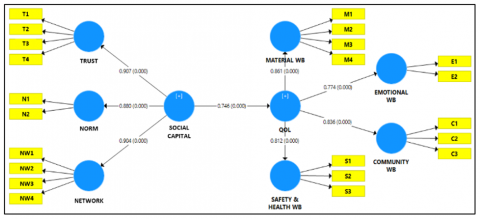
The SEM-PLS evaluation has an outer model evaluation and inner model evaluation stage. At this outer model evaluation stage, all manifest variables/indicators of the social capital reflective model and QoL variables are linked to their respective latent variables, namely the social capital latent variable and the QoL latent variable. In the outer part of the model, all manifest/indicator variables are associated with their latent variables. Manifest variables can only be associated with one latent variable. In this study, the latent variable social capital along with 10 manifest variables and QoL along with 12 manifest variables (Figure 2).
Figure 2. Outer model social capital and QoL
Source: Analysis Results, 2023
Evaluation of the outer model is carried out by evaluating the results of running the PLS algorithm outer model of social capital and QoL, with predetermined validity and reliability test standards.
3.4.1 Convergent validity test
(1) Outer loading
The results of testing the outer loading model values show that all social capital and QoL manifest variables are declared valid because they meet the outer loading standard (>0.7). Manifest variables that meet the standards are declared valid, meaning that there is an influence/contribution of the latent variable to the manifest variable.
(2) Average Variance Extracted (AVE)
This test aims to evaluate whether the latent variables of social capital and QoL are able to explain more than half (50%) of the variance in indicators/manifest variables, so that they can be declared ideal. Because the AVE value of each latent variable must be (>0.5).
The AVE model test results show that all latent variables of social capital and QoL are declared valid because they meet the AVE standards (Table 4). It can be seen that all latent variables including social capital, trust, norms, networks, QoL, material WB, emotional WB, safety & health WB, and community WB have met the AVE standard, which means that all latent variables are able to meet the AVE standard to explain/represent the variables. the manifest.
Table 4. Results of average variance extracted (AVE) social capital and QoL
|
Variable |
AVE (>0.5) |
Note |
|
Social Capital |
0.697 |
Valid |
|
Trust |
0.873 |
Valid |
|
Norma |
0.887 |
Valid |
|
Network |
0.838 |
Valid |
|
QoL |
0.584 |
Valid |
|
Material WB |
0.867 |
Valid |
|
Emotional WB |
0.940 |
Valid |
|
Safety & Health WB |
0.808 |
Valid |
|
Community WB |
0.818 |
Valid |
Source: Analysis Results, 2023
3.4.2 Discriminant validity test
This test aims to evaluate by comparing if the correlation value between the manifest variable and the latent variable is more than (>0.7) the correlation between the manifest variable and the external latent variable, then the manifest variable is declared valid. Therefore, the cross loading value for each manifest variable must be (>0.7). The test results of the cross loading model values show that all manifest variables in this study are declared valid because they meet cross loading standards, which means that all manifest variables can explain/reflect each latent variable.
3.4.3 Reliability test
This test aims to evaluate how well the manifest variable can measure the latent variable which is evaluated based on Cronbach's alpha and Composite Reliability values. Latent variables in this research include latent variables of social capital, trust, norms, networks, QoL, WB material, WB emotional, WB safety & health, and WB community. To evaluate reliability, in order to be declared reliable, the Cronbach's alpha and Composite Reliability values for each latent variable must be (>0.7). The reliability test results of the Cronbach's alpha and composite models show that all latent variables are declared reliable/the model has good reliability because it meets Cronbach's alpha and composite reliability standards.
3.5 Evaluation of the inner model/structural model of social capital and QoL
In the inner model, all latent variables are associated with other latent variables. In this study, the latent variables of social capital consist of trust, norms, and networks. Then the QoL latent variables consist of the material variables WB, emotional WB, safety & health WB, and community WB.
3.5.1 R-square (R2)
This test aims to evaluate how many endogenous variables can be explained by exogenous variables. In this research, the endogenous variable is QoL, and the exogenous variable is social capital. The R-Square value must be in the range of values between 0 and 1. The standard for measuring the R-Square value is divided into three categories, if the R-Square value (0.75) is included in the strong model, R-Square (0.50) is included in the moderate model, and R-Square (0.25) is included in the weak model.
The results of the model's R-Square test show that the latent variables of social capital and QoL are included in the strong and moderate model categories (Table 5). The range of R-Square values ranges from (0.556-0.823). The higher the R-Square value and close to 1, the model is included in the strong model category.
Table 5. Result of R-Square social capital dan QoL
|
Variable |
R-Square |
Note |
|
Trust |
0.823 |
Strong |
|
Norma |
0.774 |
Strong |
|
Network |
0.817 |
Strong |
|
QoL |
0.556 |
Moderate |
|
Material WB |
0.741 |
Strong |
|
Emotional WB |
0.599 |
Moderate |
|
Safety & Health WB |
0.660 |
Moderate |
|
Community WB |
0.699 |
Strong |
Source: Analysis Results, 2023
3.5.2 f-square (f2)
This test is to assess whether or not there is a significant relationship between latent variables which are evaluated based on the f-Square value. If the f-Square value is (0.02)/weak effect of exogenous latent variables/predictor variables on structural arrangements; f-Square value (0.15)/sufficient influence of exogenous latent variables/predictor variables on structural arrangements; f-Square value (0.35) strong influence of exogenous latent variables/predictor variables on structural arrangements. The results of the f-Square test show that all latent variables have f-Square values (> 0.35). So the variables of social capital and QoL of the Sidomulyo Tourism Village community are stated to have a strong influence on the structural order.
3.5.3 Q-square (Q2)
This test is to prove how the predictive relevance of the model/validate the model based on the Construct Cross validated Redundancy (Q2), which was performed by running blindfolding. The model is declared to have accurate predictive relevance if the Q-Square (>0). Meanwhile, the model is stated to have no accurate predictive relevance if the Q-Square (<0). The results of the Q-Square test show that all latent variables in the model are declared to have accurate predictive relevance. This means that the social capital model and QoL of the Sidomulyo Tourism Village community are declared to have accurate predictive relevance.
3.5.4 Hypothesis testing
Hypothesis testing is done by evaluating the effect of exogenous variables on endogenous variables, which is done by running bootstrapping. As for the hypothesis test consists of evaluating the path coefficient. Then evaluation of significance (T-Statictics>T-Table 1. 96 (5% significance); and evaluation of significance (P-Values <0.05), means that H0 is rejected (research hypothesis accepted).
Before entering into hypothesis testing, it can be seen that the value of the influence of latent variables is obtained from the path coefficient value or the Original Sample (O) value. The results show that all the influence values between the latent variables obtained from the path coefficient values are positive. The effect of social capital on QoL is 74.6%. Then there is the greatest influence between the latent variables of social capital, namely the influence of social capital variables on the trust variable of 90.7%. then the greatest effect of the QoL variable is the effect of the QoL variable on the material well-being variable of 86.1% (Figure 3). However, this result has not yet been stated whether the effect is significant or not. So to determine whether the influence of latent variables is significant or not, a hypothesis test is carried out based on T-Statictics and P-Values (Figure 4).
Overall, the results of hypothesis testing show that the research hypothesis is accepted, which means that there is a positive and significant influence of social capital on the QoL of the Sidomulyo Tourism Village community of 74.6% (Table 6). More specifically, there is the greatest influence from the social capital latent variable, namely the trust dimension/variable (T=90.7%), while the greatest influence from the QoL variable is the material welfare dimension/variable (M=86.1%) (Figure 3).
Table 6. Results of the Direct Influence of Social Capital and QoL
|
Path |
Original Sample (O) |
T-Statistics |
P-Values |
|
Social Capital->QoL |
0.746 |
23.567 |
0.000 |
Source: Analysis Results, 2023
Figure 3. Social capital and QoL model path coefficients
Source: Analysis Results, 2023
Figure 4. Inner model of social capital and QoL
Source: Analysis Results, 2023
The condition of social capital and community QoL is in good condition. This is reflected in Table 3, this is also supported by the results of the outer model evaluation, it is concluded that all latent variables and manifest variables are declared valid and have good reliability. For each latent variable, there is a manifest variable with the highest outer loading value, which indicates that the manifest variable contributes the most and best reflects the condition of social capital and QoL in the Sidomulyo Tourism Village. These manifest variables include (T3) from the Trust Variable; (N2) from the Norm Variable; (NW2) from Network Variables; (M3) from the Material Welfare Variable; (E2) Emotional Well-Being Variable; (S2) Safety & Healthy Welfare Variables; (C3) Community Welfare Variable.
This research achieved significant findings by highlighting that social capital has a positive influence and can be implemented as a strategy to improve the QoL of the Sidomulyo Tourism Village community. The results of the inner model evaluation show that the contribution of the social capital latent variable to the QoL latent variable is in the moderate category, with an R-Square value of 0.556. These findings confirm that, apart from social capital, there are other factors not examined in this study that also contribute to QoL. Several other factors include the source of food consumed, daily activities, stress levels, health conditions, physical conditions, mental conditions, and socio-economic status [47, 48].
The results of the hypothesis test show that Social Capital has a positive and significant effect on the QoL of the Sidomulyo Tourism Village community by 74.6%. Social capital consists of three variables, namely trust, norms, and networks. Then QoL consists of four variables, namely material well-being, emotional well-being, safety and health well-being, and community well-being. Overall, the social capital variable influences QoL, this means that the higher the social capital the community has, the more it can be implemented to improve the QoL of the Sidomulyo Tourism Village community. The overall analysis results show that trust is the variable that most influences and contributes to reflecting the condition of social capital at 90.7%. The results of the QoL analysis show that material well-being is the variable that most influences and contributes to reflecting QoL conditions at 86.1%.
Trust is a dimension/latent variable of the social capital latent variable, consisting of four manifest variables (T1, T2, T3, and T4), of these four variables (T3) is the variable that contributes most to and reflects the condition of social capital. The current condition is that most of the people of Sidomulyo Tourism Village believe in the honesty of tourism managers. This is because tourism managers manage village potential well and mostly involve the community. Well-managed potential makes tourist villages more advanced and developed. This research is supported by study [49], that trust makes society open and it is easier to make development programs in the village successful. This is because trust shows that the people in an area have unity and a willingness to build cooperation in a relationship.
Trust increases networks in the community which encourages increased community participation in tourist villages [50]. Increased participation can ultimately improve community QoL through involvement in profitable partnerships. Trust is the basis for people's desire to take action, especially trust in leaders in their area [51]. If people don't believe it, it will be difficult to carry out social activities in the village and get community support for development [52].
Trust is the basis for taking action with the community in developing a tourist village [53]. When people have trust, they can work together to achieve certain goals. Overall social capital can strengthen the functioning of society. So that society has the opportunity not only to improve in material aspects but also in mutually beneficial social relationships. On the other hand, if public trust is lacking, it will affect the community's enthusiasm and the community's desire to contribute to cooperation. This will hinder and later become a problem in improving community QoL [54].
The importance of mutual trust in rural communities that have close kinship relationships is very necessary, because people who make their living as farmers who trust each other, will willingly provide assistance such as labor, money, advice and agricultural needs to fellow farmers. This also indicates that the role of trust is very necessary to facilitate solving problems and getting solutions related to agriculture [55, 56].
The results of this research as a whole reveal that social capital plays a very important role in the lives of people in rural areas, especially with the addition of tourism activities in the area requiring the support and cooperation of the entire community. In particular, trust is the main element of social capital needed to establish cooperation and utilize trust in establishing relationships within the Sidomulyo Tourism Village community.
Furthermore, material well-being becomes a dimension/latent variable of the QoL latent variable, consisting of four manifest variables (M1, M2, M3, and M4), of these four variables (M3) is the variable that most contributes to and reflects QoL conditions. The current conditions are that most of the people of Sidomulyo Tourism Village are satisfied with their current income. This is because the income that people have is able to meet family needs and can be saved. So it can be concluded that the higher the honesty of the tourist village manager, the higher the satisfaction with the income currently obtained by the community. In this case, the honesty of tourism managers makes tourist villages more advanced and developed, which will provide benefits to the community. Such as new job opportunities (motorbike taxis, flower couriers, counter attendants, tour guides, and so on) as well as the economy in the field of selling flowers and goods and services businesses will increase. The existence of these benefits will increase income and even additional income for the community, thereby providing community satisfaction with the income obtained.
This is in line with research [57], that tourism provides economic benefits in the form of increasing people's income in the areas it develops. This increase can be marked by an increase in sales and value of local products as well as an increase in the income of village workers.
This increase in income can ultimately influence the increase in QoL of the Sidomulyo Tourism Village community. This is in line with research [58-60], that tourism provides benefits by improving the standard of living, meaning that better tourism management will improve the standard of living of the community which will also increase comfort in the village. Apart from that, increasing the QoL of the community in the tourist village area will make the community feel happy and will move the community to support tourism activities in their area. This is in line with research [61-64], that with positive public perceptions of tourism it will enable local communities to provide support for sustainable tourism development.
Overall, the main finding highlighted is that social capital has an influence and can be implemented to improve the QoL of the Sidomulyo Tourism Village community. The implications of these findings are very important in the context of rural development, because they show that increasing social capital can be a basis for designing more effective development policies and programs. By strengthening social networks, trust, and norms among communities, it can be expected that not only individual aspects of QoL, but also the sustainability and harmony of the community as a whole will improve. In addition, this research provides insight into the positive role of local communities, especially in the context of tourist villages, as active agents in improving their own QoL and building an inclusive and sustainable environment. The practical implications of these findings can be the basis for the government and stakeholders to design more holistic village development programs, which do not only focus on economic aspects but also take into account social and cultural dimensions through strengthening social capital.
The aim of this research is to examine the relationship between social capital and QoL in the Sidomulyo Tourism Village. The research results show that social capital has an influence and can be implemented to improve community QoL by 64.2%. Social capital can be utilized to achieve mutual goals and benefits, especially rural-based tourism which involves many people. These results provide important insights for the development of development policies and programs in the Sidomulyo Tourism Village, emphasizing the importance of strengthening social capital as a strategy to improve the QoL of rural communities.
Recommendations for future researchers could be to conduct a comparative study by comparing tourist villages that have the same characteristics as Sidomulyo Tourism Village, where most of the people are involved in tourist villages. So, the comparison can be seen from comparative studies, whether with the same characteristics, many people involved in the tourism sector have good social capital and QoL. Apart from that, the scope of this research examines capital and QoL as a whole in one village, so that further research is recommended to study the scope of the hamlet or a special sample aimed at communities involved and communities not involved in tourism village activities, of course this will produce different results. different and is expected to provide new findings in the future.
This research was funded by Penelitian Thesis Magister (PTM) DRTPM DIKTI with LPPM Universitas Brawijaya (Grant No.: 119/E5/PG.020.00.PL/2023).
[1] Nopiyani, N.M.S., Wirawan, I.M.A. (2021). The impact of tourism on the quality of life of communities in tourist destination areas: A systematic review. Open Access Macedonian Journal of Medical Sciences (OAMJMS), 9(F): 129-136. https://doi.org/10.3889/oamjms.2021.5966
[2] Uysal, M., Sirgy, M.J., Woo, E., Kim, H.L. (2016). Quality of life (QOL) and well-being research in tourism. Tourism Management, 53: 244-261. https://doi.org/10.1016/j.tourman.2015.07.013
[3] Yu, C.P., Cole, S.T., Chancellor, C. (2016). Assessing community quality of life in the context of tourism development. Applied Research in Quality of Life, 11: 147-162. https://doi.org/10.1007/s11482-014-9359-6
[4] Su LuJun, S.L., Huang SongShan, H.S., Huang Jue, H.J. (2018). Effects of destination social responsibility and tourism impacts on residents' support for tourism and perceived quality of life. Journal of Hospitality and Tourism Research, 42(7): 2018. https://doi.org10.1177/1096348016671395
[5] Usman, F., Hariyani, S., Kurniawan, E.B., Sari, I.C. (2023). Measuring resilience of a tourism village against flash flood disaster. Journal of Regional and Rural Studies, 1(1): 15-21. https://doi.org/10.21776/rrs.v1i1.4
[6] Yu, C.P., Cole, S.T., Chancellor, C. (2018). Resident support for tourism development in rural midwestern (USA) communities: Perceived tourism impacts and community quality of life perspective. Sustainability, 10(3): 802. https://doi.org/10.3390/su10030802
[7] Mathew, P.V., Sreejesh, S. (2017). Impact of responsible tourism on destination sustainability and quality of life of community in tourism destinations. Journal of Hospitality and Tourism Management, 31: 83-89. https://doi.org/10.1016/j.jhtm.2016.10.001
[8] Hanafiah, M.H., Azman, I., Jamaluddin, M.R., Aminuddin, N. (2016). Responsible tourism practices and quality of life: Perspective of Langkawi Island communities. Procedia-Social and Behavioral Sciences, 222: 406-413. https://doi.org/10.1016/j.sbspro.2016.05.194
[9] Tiku, O., Shimizu, T., Hartono, D. (2022). Tourism's income distribution in West Papua Province. Annals of Tourism Research Empirical Insights, 3(1): 100038. https://doi.org/10.1016/j.annale.2022.100038
[10] Kim, K., Uysal, M., Sirgy, M.J. (2013). How does tourism in a community impact the quality of life of community residents? Tourism Management, 36: 527-540. https://doi.org/10.1016/j.tourman.2012.09.005
[11] Choi, H.S.C., Sirakaya, E. (2005). Measuring residents’ attitude toward sustainable tourism: Development of sustainable tourism attitude scale. Journal of Travel Research, 43(4): 380-394. https://doi.org/10.1177/0047287505274651
[12] Benckendorff, P., Moscardo, G., Pendergast, D. (2009). Tourism and Generation Y. Cabi. https://doi.org/10.1079/9781845936013.0000
[13] Karimi, M., Darban Astane, A. (2022). The role of responsible tourism on quality of life in rural areas of Gorgan, Iran. Journal of Quality Assurance in Hospitality & Tourism, 23(4): 882-912. https://doi.org/10.1080/1528008X.2021.1920548
[14] Ibrahim, M.S.N., Abdul-Halim, S., Ishak, M.Y., Hassan, S. (2021). The local community awareness on Langkawi UNESCO global geopark status: Case of Kampung Padang Puteh, Langkawi, Malaysia. International Journal of Geoheritage and Parks, 9(2): 233-241. https://doi.org/10.1016/j.ijgeop.2021.02.009
[15] Augusty, W.R., Subagiyo, A., Wijayanti, W.P., Prayitno, G. (2022). Mapping of tourism potential and assessment of development stages in Sidomulyo Tourism Village, Batu City. Civil and Environmental Science Journal, 5(1): 096-106. https://doi.org/10.21776/ub.civense.2022.00501.10.
[16] Sari, H.R., Yusran, Y.A., Wulandari, L.D., Santoso, J.T., Nordin, J. (2023). Sustainability evaluation of the'batu into green'village based on the united nation sustainable development goals (SDGs). Civil and Environmental Science Journal (CIVENSE), 7(1): 1-7. https://doi.org10.21776/civense.v7i1.409
[17] Yang, J., Yang, R., Chen, M.H., Su, C.H.J., Zhi, Y., Xi, J. (2021). Effects of rural revitalization on rural tourism. Journal of Hospitality and Tourism Management, 47: 35-45. https://doi.org/10.1016/j.jhtm.2021.02.008
[18] Akranavičiūtė, D., Ruževičius, J. (2007). Quality of life and its components’ measurement. Engineering Economics, 52(2): 44-49. https://inzeko.ktu.lt/index.php/EE/article/view/11473.
[19] Sarkiunaite, I., Bartkute, R., Jasinskas, E., Dilys, M. (2012). Link between social capital and quality of life. Transformations in Business & Economics, 11(1). https://www.researchgate.net/publication/287569318_Link_between_social_capital_and_quality_of_life.
[20] Massam, B.H. (2002). Quality of life: Public planning and private living. Progress in Planning, 58(3): 141-227. https://doi.org/10.1016/S0305-9006(02)00023-5
[21] Petrosillo, I., Costanza, R., Aretano, R., Zaccarelli, N., Zurlini, G. (2013). The use of subjective indicators to assess how natural and social capital support residents’ quality of life in a small volcanic island. Ecological Indicators, 24: 609-620. https://doi.org/10.1016/j.ecolind.2012.08.021
[22] Marans, R.W., Stimson, R. (2011). An overview of quality of urban life. Investigating Quality of Urban Life: Theory, Methods, and Empirical Research, 1-29. https://doi.org/10.1007/978-94-007-1742-8_1
[23] De Groot, R.S., Alkemade, R., Braat, L., Hein, L., Willemen, L. (2010). Challenges in integrating the concept of ecosystem services and values in landscape planning, management and decision making. Ecological Complexity, 7(3): 260-272. https://doi.org/10.1016/j.ecocom.2009.10.006
[24] Costanza, R., Daly, H.E. (1992). Natural capital and sustainable development. Conservation Biology, 6(1): 37-46. https://doi.org/10.1046/j.1523-1739.1992.610037.x
[25] Ekins, P., Simon, S., Deutsch, L., Folke, C., De Groot, R. (2003). A framework for the practical application of the concepts of critical natural capital and strong sustainability. Ecological Economics, 44(2-3): 165-185. https://doi.org/10.1016/S0921-8009(02)00272-0
[26] Vemuri, A.W., Costanza, R. (2006). The role of human, social, built, and natural capital in explaining life satisfaction at the country level: Toward a national well-being index (NWI). Ecological Economics, 58(1): 119-133. https://doi.org/10.1016/j.ecolecon.2005.02.008
[27] Matonytė, I. (2004). Socialinis kapitalas: nuo mokslinių tyrimo perspektyvų prie empirinių pastebėjimų. Gero valdymo klausimas. Sociologija. Mintis ir Veiksmas, 1(13): 22-37. https://doi.org/10.15388/socmintvei.2004.1.5946
[28] Onyx, J., Bullen, P. (2000). Measuring social capital in five communities. The Journal of Applied Behavioral Science, 36(1): 23-42. https://doi.org/10.1177/0021886300361002
[29] Carey, S., Lawson, B., Krause, D.R. (2011). Social capital configuration, legal bonds and performance in buyer-supplier relationships. Journal of Operations Management, 29(4): 277-288. https://doi.org/10.1016/j.jom.2010.08.003
[30] Ferri, P.J., Deakins, D., Whittam, G. (2009). The measurement of social capital in the entrepreneurial context. Journal of Enterprising Communities: People and Places in the Global Economy, 3(2): 138-151. https://doi.org/10.1108/17506200910960842
[31] Bartolini, S., Sarracino, F. (2014). Happy for how long? How social capital and economic growth relate to happiness over time. Ecological Economics, 108: 242-256. https://doi.org/10.1016/j.ecolecon.2014.10.004
[32] Jakubcová, A., Grežo, H., Hrešková, A., Petrovič, F. (2016). Impacts of flooding on the quality of life in rural regions of Southern Slovakia. Applied Research in Quality of Life, 11: 221-237. https://doi.org/10.1007/s11482-014-9363-x
[33] RezaeiNiaraki, M., Roosta, S., Alimoradi, Z., Allen, K.A., Pakpour, A.H. (2019). The association between social capital and quality of life among a sample of Iranian pregnant women. BMC Public Health, 19: 1-8. https://doi.org/10.1186/s12889-019-7848-0
[34] Murgaš, F., Petrovič, F., Tirpáková, A. (2022). Social capital as a predictor of quality of life: the Czech experience. International Journal of Environmental Research and Public Health, 19(10): 6185. https://doi.org/10.3390/ijerph19106185
[35] Chancellor, C., Yu, C.P.S., Cole, S.T. (2011). Exploring quality of life perceptions in rural midwestern (USA) communities: An application of the core-periphery concept in a tourism development context. International Journal of Tourism Research, 13(5): 496-507. https://doi.org/10.1002/jtr.823
[36] Wang, R., Dai, M., Ou, Y., Ma, X. (2021). Residents’ happiness of life in rural tourism development. Journal of Destination Marketing & Management, 20: 100612. https://doi.org/10.1016/j.jdmm.2021.100612
[37] Prayitno, G., Hayat, A., Efendi, A., Tarno, H., Fikriyah, Fauziah, S.H. (2022). Structural model of social capital and quality of life of farmers in supporting sustainable agriculture (Evidence: Sedayulawas village, Lamongan regency-Indonesia). Sustainability, 14(19): 12487. https://doi.org/10.3390/su141912487
[38] Putnam, R.D. (2000). Bowling Alone: The Collapse and Revival of American Community. New York: Touchstone Books by Simon Schuster. https://doi.org/10.1145/358916.361990
[39] Woolcock, M. (1998). Social capital and economic development: Toward a theoretical synthesis and policy framework. Theory and Society, 27(2): 151-208. https://doi.org/10.1023/A:1006884930135.
[40] Okazaki, E. (2008). A community-based tourism model: Its conception and use. Journal of Sustainable Tourism, 16(5): 511-529. https://doi.org/10.1080/09669580802159594.
[41] Aprilia, E., Prayitno, G., Usman, F., Biloshkurska, N.V., Siankwilimba, E., Simamba, H. (2023). Social capital and community participation in the development of the aquaculture center in Soko Village-Indonesia. Journal of Regional and Rural Studies, 1(1): 6-14. https://doi.org/10.21776/rrs.v1i1.3
[42] Rossi, G. (2007). Family, social capital and family associations. International Review of Sociology, 17 (2): 279-292. https://doi.org/10.1080/03906700701357075.
[43] Chappell, N.L., Funk, M.L. (2010). Social capital: Does it add to the health inequalities debate? Social Indicators Research, 99(3): 357-373. https://doi.org/10.1007/sl 1205-010-9597-4
[44] Li, J., Ridderstaat, J., Yost, E. (2022). Tourism development and quality of life interdependence with evolving age-cohort-based population. Tourism Management, 93: 104621. https://doi.org/10.1016/j.tourman.2022.104621
[45] Ahmad, N., Youjin, L., Hdia, M. (2022). The role of innovation and tourism in sustainability: Why is environment-friendly tourism necessary for entrepreneurship? Journal of Cleaner Production, 379: 134799. https://doi.org/10.1016/j.jclepro.2022.134799
[46] Liu, Z., Xie, A. (2022). Poverty reduction effects of integrating high-quality development and cultural tourism in China. Chinese Journal of Population, Resources and Environment, 20(4): 383-391. https://doi.org/10.1016/j.cjpre.2022.11.008
[47] Nutakor, J.A., Zhou, L., Larnyo, E., Addai-Danso, S., Tripura, D. (2023). Socioeconomic status and quality of life: An assessment of the mediating effect of social capital. Healthcare, 11(5): 749. https://doi.org/10.3390/healthcare11050749
[48] Daengthern, L., Thojampa, S., Kumpeera, K., Wannapornsiri, C., Boonpracom, R. (2020). Factors affecting quality of life and longevity in the elderly people in Phrae city, Thailand. Asian/Pacific Island Nursing Journal, 5(2): 48. https://doi.org/10.31372%2F20200502.1081
[49] Rahmawati, R., Prayitno, G., Firdausiyah, N., Dinanti, D., Hayat, A., Efendi, A., Roskruge, M. (2023). Harnessing social capital for fostering non-tourism actor involvement in sustainable tourism: A case study of an Indonesian village. Journal of Urban Development and Management, 2(2): 69-83. https://doi.org/10.56578/judm020202
[50] Farisa, B.M.R., Prayitno, G., Dinanti, D. (2019). Social capital and community participation on infrastructure development in Pajaran village, Malang regency Indonesia. In IOP Conference Series: Earth and Environmental Science, 239(1): 012046. https://doi.org/110.1088/1755-1315/239/1/012046
[51] Prayitno, G., Dinanti, D., Efendi, A., Hayat, A., Dewi, P.P. (2022). Social capital of Pujon Kidul communities in supporting the development of the COVID-19 resilience village. International Journal of Sustainable Development and Planning, 17(1): 251-257. https://doi.org/10.18280/ijsdp.170125
[52] Prayitno, G., Dinanti, D., Rahmawati, R., Wardhani, L.E., Auliah, A. (2022). Community decision making based on social capital during COVID-19 pandemic: Evidence from Bangelan Village tourism, Indonesia. Journal of Socioeconomics and Development, 5(1): 127-139. https://doi.org/10.31328/jsed.v5i1.3477
[53] Nugraha, A.T., Prayitno, G., Hasyim, A.W., Roziqin, F. (2021). Social capital, collective action, and the development of agritourism for sustainable agriculture in rural Indonesia. Evergreen, 8(1): 1-12. https://doi.org/10.5109/4372255.
[54] Nugraha, A.T., Rahmawati, R., Auliah, A., Prayitno, G. (2022). Farmers' social capital in supporting sustainable agriculture: The case of Pujon Kidul tourism village, Indonesia. Civil and Environmental Science Journal, 05(02): 235-249. https://doi.org/10.21776/ub.civense.2022.00502.12
[55] Putra, S.G., Wicaksono, A.D., Prayitno, G., Hiep, N.T. (2023). Improving the quality of toll Road services to increase satisfaction level of Pekanbaru-Dumai toll road. Civil and Environmental Science Journal (CIVENSE), 6(1): 24-32. https://doi.org/10.21776/ub.civense.2023.00601.4
[56] Baral, R., Rijal, D.P. (2022). Visitors' impacts on remote destinations: An evaluation of a Nepalese mountainous village with intense tourism activity. Heliyon, 8(8). https://doi.org/10.1016/j.heliyon.2022.e10395
[57] Lei, W.S.C., Suntikul, W., Chen, Z. (2023). Tourism development induced social change. Annals of Tourism Research Empirical Insights, 4(1): 100088. https://doi.org/10.1016/j.annale.2023.100088
[58] Alamineh, G.A., Hussein, J.W., Endaweke, Y., Taddesse, B. (2023). The local communities’ perceptions on the social impact of tourism and its implication for sustainable development in Amhara regional state. Heliyon, 9(6): e17088. https://doi.org/10.1016/j.heliyon.2023.e17088
[59] Prayogo, T.B., Wahyuni, S., Iqbal, M. (2021). A study of irrigation performance index and real cost value of irrigation operations and maintenance in Surak irrigation area. Civil and Environmental Science Journal (Civense), 4(1): 30-42. https://doi.org/10.21776/ub.civense.2021.00401.4
[60] Prayitno, G., Dinanti, D., Adrianto, D.W., Rahmawati, R., Auliah, A., Wardhani, L.E. (2023). The influence of social capital in improving the quality of life of the community in Sidomulyo tourism village, Indonesia. GeoJournal of Tourism and Geosites, 56(1): 208-217. https://doi.org/10.30892/gtg.46123-1017
[61] Prayitno, G., Auliah, A., Rini, I.A., Effendi, D., Delisa, A., Siankwilimba, E., Hiddlestone, J. (2024). Social capital for sustainable tourism development in Indonesia Social capital for sustainable tourism development in Indonesia. Cogent Social Sciences, 10(1): 2293310. https://doi.org/10.1080/23311886.2023.2293310
[62] Nugraha, A., Prayitno, G., Azizi, F., Sari, N., Hidayana, I., Auliah, A., Siankwilimba, E. (2023). Structural equation model (SEM) of social capital with landowner intention. Economies, 11(4): 127. https://doi.org/10.3390/economies11040127
[63] Dewi, P.P., Prayitno, G., and Dinanti, D. (2021). Social capital of the pujon kidul tourism village community in facing the COVID-19 pandemic. GeoJournal of Tourism and Geosites, 38(4): 1239-1246. https://doi.org/10.30892/gtg.38431-765
[64] Prayitno, G., Matsushima, K., Kobayashi, K. (2017). Social ties and the migration decision of temporal migrant workers. Journal of Regional and City Planning, 28(2): 151-160. https://doi.org/10.5614/jrcp.2017.28.2.6