Bachtar Bakrie | Enti Sirnawati | Eni Siti Rohaeni | Lintje Hutahaean | Arif Dwi Santoso* | Wasito Wasito | Chandra Indrawanto
© 2023 IIETA. This article is published by IIETA and is licensed under the CC BY 4.0 license (http://creativecommons.org/licenses/by/4.0/).
OPEN ACCESS
This study aimed to calculate a sustainability index of duck farming. Data was collected through a questionnaire by a scientific judgment of expert researchers in duck farming. Data were grouped using the multidimensional scaling (MDS and MICMAC and analyzed using) comprising social, economic, ecological, technological, and human resources dimensions with a total of 38 attributes in Rapfish software. The sustainability index was calculated as 44.13%, which indicates that farming has a less sustainable category with consideration of some leverage factors. These findings indicate that the high feed price, fluctuations in the price of duck products, diseases, and an extensive maintenance system warrant further attention to improve sustainability. MICMAC's analysis showed that the intensity of counseling, knowledge of livestock health, and livestock waste management are the main driving variables and prerequisites in determining the sustainability of a duck business. The prospective analysis identified several strategies to improve sustainability that can be carried out, including increasing the capacity of human resources through training/counseling/comparative studies, increasing the capacity of existing institutions, and advocating and socializing intensive duck business cultivation.
duck, intensive farming, multidimensional scaling (MDS), MicMac analysis, index, sustainability
The duck farming industry significantly contributes to providing animal protein sources in Indonesia [1]. Ducks have long been known as producers of food sources of protein, such as meat and eggs. Ducks have several advantages, including a relatively high tolerance for various diseases, finding food well even in wet places, and living in groups [2]. The highest population of ducks in Indonesia is in West Java Province, at 9,770,338 heads [3]. One of the sources that contribute to the provision of animal protein in Indonesia is duck farming. The largest duck population is found in West Java Province, where Indramayu Regency has the highest duck population, around 27.9% [4]. However, because the pattern of the duck farming system needs to pay attention to environmental and technological aspects, it is feared that egg and meat production will not be optimal.
The pattern of rearing ducks in Indramayu is about 90% extensive through shepherds in rice fields moving around following the rice harvest location [5-8]. Extensive livestock rearing has several obstacles that cause the production of eggs and meat to be less than optimal. The egg production will not be optimal due to stress as the effect of moving from one place to the others [9]; ducks are susceptible to exposure to hazardous materials from agricultural activities [9, 10]; the threat of reduced availability of fallow paddy fields due to the increase in intensive rice cultivation, so that the distance between harvesting and planting becomes shorter. On the other hand, the results of intensive duck-rearing studies showed an increase in the weight of the duck, duck egg production, egg weight, thickness of the egg skin, and the colour of the yolk [6].
According to Widiyaningrum et al. [11] that the maintenance system affects duck production, namely egg production in semi-intensive maintenance is 12.3% higher than extensive. However, the rearing system does not affect duck eggs' average weight, fertility, or hatchability. Another study related to the duck-rearing system was reported by Shoimah et al. [12] that intensively raised ducks produce better egg quality than those raised semi-intensively and extensively. Another study reported by Abo Ghanima et al. [13] found that intensive duck-rearing systems equipped with yards and pools for swimming ducks can increase growth and feed conversion rates, in addition to reducing meat fat and serum, cholesterol, and triacylglycerol, and increase immunity in meat ducks.
Under these circumstances, duck farmers in Indramayu need to understand the value of the duck farming sustainability index. What factors influence it? Additionally, what recommendations can be made to increase the efficiency of duck farming? Based on the above description regarding an extensive maintenance system, it is necessary to make changes in the future through the introduction of technology. The introduction of technology aims to improve productivity, and the role of duck farming for the community is a must, including in Indramayu as one of Indonesia's potential duck production centres.
Sustainable agriculture is defined as an agricultural business that can meet human needs in the present and future by maintaining environmental quality, conserving natural resources, and being oriented towards technological and institutional changes [14]. The concept of sustainable agriculture is based on the triangle of sustainable development presented by Munasinghe from the World Bank, namely, action-oriented toward three dimensions of sustainability, including the economic, social, and ecological dimensions [15]. Furthermore, other studies add several dimensions, such as technology, institutions, and human resources [8, 16-20].
The novelty of this study is to determine the sustainability index of duck farming with the MDS approach followed by the MICMAC approach to identify factors that affect sustainability and get priority for handling. Furthermore, recommendations for improving the duck business system were obtained by considering 6 dimensions: environment, human resources, social, economic, technological, and institutional. This is intended for sustainable duck farming to support food security.
This research aimed to determine the sustainability status of the duck farming system, identify attributes that influence the sustainability of duck farming, and recommend determining variables as critical points in the development of intensive duck farming in a sustainable manner in Indramayu, one of the duck centres in Indonesia.
2.1 Location and data collection
The study was conducted from April to December 2021 in Sliyeg District, Indramayu Regency, West Java Province; the research location is shown in Figure 1. Data collection was carried out through a Focus Group Discussion (FGD) and filling out questionnaires to eleven experts, consisting of Livestock Service Staff, Researchers, Extension Workers, Agricultural Economic Institutions, and business actors. The qualifications of the experts involved in filling out the questionnaire are those who have at least 5 years experience in duck farming management. The FGD was conducted to identify the existing conditions of business actors and support for duck farming resources at the research site as material for preparing dimensions and sustainability attributes. It is known that there are six dimensions, including environment/ecology, economics, socio-culture, technology, institutions, and human resources (HR). The number of attributes used in this study was 38.
2.2 Research stage
The study was conducted from April to December 2021 in Sliyeg District, Indramayu Regency, West Java Province; the location of the study is shown in Figure 1. The stages of research include:
2.3 Data analysis
The process of data collection from eleven experts through FGD was administered. The FGD by filling out questionnaires was conducted to identify the existing conditions of business actors and support for duck farming resources at the study site as material for preparing dimensions and sustainability attributes. Furthermore, these dimensions and leverage attributes are then outlined in a questionnaire with answer choices using a likert scale. Leverage attribute is a variable from several dimensions that has a strong influence on the sustainability of an object of research. The questionnaire used four dimensions with several attributes, and the expert respondents answered the questions in the questionnaire with a score of 0, 1, and 2 for bad, moderate, and good. In addition, MDS analysis was used to process and evaluate the data. MDS is a statistical analysis tool that describes patterns of closeness in the form of similarity or resemblance. MDS can transform consumer judgments of similarity or preference (e.g., preference for a store or brand) into distances represented in a multidimensional space [21]. Rapid appraisal for fisheries (Rapfish) software was used to conduct an MDS analysis [22].
Rapfish is a quick technique for evaluating the sustainability status of fisheries in a particular locus in a multidimensional manner [23, 24]. In this study, Rapfish adjusted to the object of research to be Rapduck. The value of sustainability status and leverage attributes of the introduction of intensive duck farming technology in Sliyeg District through RapDuckwhich is a modification of Rapfish. Analysis has several steps according to Kavanagh and Pitcher [25] and Pitcher and Preikshot [26], namely a) selection of attributes for the assessment of sustainability status and leveraged attributes of the introduction of intensive duck rearing technology that refer to good intensive duck farming benchmarks; b) assessing attributes on an ordinal scale referring to each dimension sustainability criteria, c) compile an index of sustainability status and leverage attributes of duck farming technology introduction. Furthermore, the analysis results will show a) the status or index of each dimension in introducing intensive duck farming and b) the leverage/sensitive attribute, which is an attribute that affects the sustainability status of intensive duck farming technology introduction.
The position of the sustainability status point will be described in two dimensions, namely vertical and horizontal ordinates, and represented by a flat line. The lousy extreme has an index value of 0%, and the excellent extreme has an index value of 100%. The scale of value in the sustainability status index of intensive duck-rearing technology ranges between 0-100%. The interval of sustainability status is divided into four categories, namely <25 poor sustainability status, 25<X<50 poor sustainability status, 50<X<75 sufficient sustainability status and 75<X<100 good sustainability status [27].
The sustainability status ordination is an overview of the sustainability status of each dimension, referring to the score of each attribute. The index value point on the axis (x) reflects the sustainability status of intensive duck farming technology, and the ordinate (y) shows the variation in scores on each attribute studied. It will supplement the ordination analysis by testing the normalization of the model's (stress value (S) and coefficient of determination (R2). If the S<0.25% value and R2 are close to 1, then the model is rated good. The value of S-stress and the coefficient of determination (R2) also determine the need to add attributes and simultaneously reflect the accuracy of the dimensions studied with the actual state [23].
Figure 1. Site location at Sliyeg sub-district Indramayu Regency, West Java, Indonesia
Furthermore, leverage analysis is used to determine attributes sensitive to sustainability. This analysis aims to select the attributes that have the highest role in each dimension as leverage factors that affect the value of sustainability. The most sensitive indicators are indicated by the highest Root Mean Square (RMS) values [26]. Meanwhile, Monte Carlo Analysis helps examine: a) the Influence of attribute scoring errors, b) the Influence of variations in scoring due to differences in opinions or assessments by researchers, and c) the stability of the MDS analysis process that is repeated, d) data entry errors or the presence of missing data, and e) the high-stress value of MDS analysis results. If the difference between the MDS and Monte Carlo calculation results is less than one, then the system under study is excellent or corresponds to actual conditions [25, 26]. The MDS ordination will be represented by a circle with variable values (index quantity), references, and anchors (limit value). The x-axis for Good has a maximum value of 100, and Bad has a minimum value of 0, while the y-axis for up is half the top attribute score (50), and down is half the minimum attribute score (-50).
Once sensitive attributes are known in RapDuck analysis, the next step is to group and determine the hierarchy of strategic variables using the MICMAC analysis (Cross Impact Matrix Multiplication Applied to Classification). This analysis is helpful for policy-making and avoids irrelevant variables resulting in failures [28].
Further analysis of sensitive variables using MICMAC will result in a) Identification of the main variables that are influential (affecting) and dependent (influenced) that are essential to the system, b) Decrypting the relationship between variables in the group of influences (Y) and dependencies (X) and the relevance of these variables in explaining a system, c) Determining the key variables that affect, d) Disclosing the chain of the effect of the system [29, 30]. These variables will later be grouped into four quadrants based on dependence and Influence.
In the MICMAC analysis, there are four quadrants, where Quadrant I is an input or driving variable with a strong influence characteristic (Figure 2). Quadrant II is a key, control, or relay variable with a strong influence and dependence. Quadrant III is the region of the output variable, characterised by high interdependence but has little Influence [30]. Quadrant IV is an "excluded variable" or independent variable marked by minimal influences and dependencies. The variables in this Quadrant will be removed directly from the system because it will not stop its work [28].
3.1 Determining of sustainability dimension and attributes
FGD with stakeholders is carried out to identify the dimensions and attributes to be carried out in this study. Based on the results of the FGD, 6 dimensions were obtained to be studied, namely ecological, economic, social, technological, institutional, and human resource dimensions, along with 38 attributes. All dimensions and attributes used have the potential to support or hinder the implementation of intensive duck cultivation technology.
Information collection starts with how the existing livestock farming system includes the types of feed used and the availability of paddy fields and other feed resources. Indramayu has considerable potential in the availability of feed ingredients for livestock because as a rice farming area that produces bran and groats. In addition, Indramayu is also a coastal area rich in animal protein sources such as fish, shrimp, and snails. The widely available feed ingredients are bran, dried rice, and fresh fish. Although Indramayu is a food barn, the rice bran produced already has a contract between the mill and the buyer.
Paddy fields in Tugu Village cover an area of 603 ha with a Planting Index of 2 times/year, the number of rice milling units is seven pieces, and rice production is 7.8 tons/ha. The scale of the rice business carried out by farmers in Tugu Village is between 0.14-20 ha/household with an average of 0.35 ha; the rice varieties cultivated are Ciherang and Mekongga. The yield obtained in the Wet season is 1 ton of dry harvested grain (DHG), while in the Dry season, it is 0.85 tons of DHG. From this rice field area, grain is produced as much as 4,703.4 tons/season or 9,406.8 tons/year. With a duck population in Tugu Village of 8,500 heads, it is assumed that consumption of 50 g/head/day, 155,125 tons of bran is needed/year, or excess bran production. The duck commodities cultivated are generally Rambon and Peking types with an average business scale of 20-50 heads/household.
The rearing of ducks is still largely traditional, grazed in rice fields after the rice harvest. This maintenance method is important as employment for people with limited ability and capital. In addition, the rice 300 planting index (PI) program, which increases the frequency of rice planting from twice (PI rice 200) to three times rice (PI rice 300) per year, will also affect duck grazing patterns.
The mutual advantage of PI 300 rice fields is that they can reduce pests and diseases of rice plants. Ducks that prey on grasshoppers, snails, caterpillars, javelins, and leafhoppers can directly control plant disease pests. In addition, the integration of rice and ducks, according to Li et al. [31], can improve land quality, which improves crop productivity so that farmers' income increases. The duck egg production of the shepherding system in the PI 300 rice field is more fluctuating than the intensive and semi-intensive system (a small part of which is done by farmers) due to the influence of duck movement and feed availability in the fields.
When viewed from an economic dimension, information collection is focused on how far the development of the number of ownerships of duck farming businesses and their contribution to the community's economy, including access to sales and distribution of business profits. It was agreed that seven attributes would be used to analyse its sustainability status in this economic dimension. As for the cultural aspect, it is focused on the dynamics of breeders and the breeder's communication with the surrounding environment, including with fellow breeders and local governments.
Meanwhile, from the dimension of technology, information on opportunities and technological needs will be explored, and what technology will be applied at the location of the activity. Based on the identification of problems for the duck farming business, it is known that the main issues in raising ducks are the high price of feed, fluctuations in the price of duck products, and duck diseases. Feed used by farmers is generally purchased and imported from outside the region because of the unavailability of technology for the manufacture of feed ingredients using feed ingredients available at the location. This causes the price of feed to be more expensive. Ducks are livestock that are sensitive to aflatoxins, while food contamination by aflatoxins is difficult to avoid, this can cause large economic losses due to ducks being poisoned by aflatoxins. Research reported by Sumantri et al. [32] conducted in South Kalimantan, it was observed that duck feed samples contained aflatoxins exceeding the SNI limit (20 ppb), except for sago stems (2 ppb). The high prevalence of aflatoxin contamination in duck products requires efforts to reduce aflatoxin contamination in feed in duck farming centers [32].
For the institutional dimension, the focus is on agreeing on what institutions need to exist. As for the HR, the size is more towards the capacity of existing breeders and the conditions required. As explained above, the total number of attributes used to conduct sustainability analysis was 38 (Table 1).
Table 1. Dimensions and attributes result of the FGD
|
Dimensions |
No. |
Attributes |
|
Ecological dimensions |
1 |
The level of paddy land use |
|
2 |
The system of rearing ducks |
|
|
|
3 |
Types of animal feed |
|
|
4 |
The distance between the location of the duck farm and the residential area |
|
|
5 |
The intensity of the smell of manure |
|
|
6 |
Utilization of livestock waste for organic fertilizer |
|
|
7 |
The incidence of outbreaks of dangerous livestock diseases |
|
Economic dimensions |
1 |
Changes in the scale of livestock ownership |
|
2 |
The contribution of the duck business to the family's income |
|
|
|
3 |
Business feasibility |
|
|
4 |
Where to sell livestock, |
|
|
5 |
Input-output market access |
|
|
6 |
Profit sharing of duck livestock business |
|
|
7 |
Marketing reach |
|
Cultural dimensions |
1 |
Communication relationships with other farmer groups |
|
2 |
Communication relationship with the extension officer |
|
|
|
3 |
Communication relationship with livestock health workers |
|
|
4 |
Communication relations with livestock traders |
|
|
5 |
Communication relationship with the Livestock Service officer |
|
|
6 |
Livestock farming business pattern |
|
Technological dimensions |
1 |
The use of vitamins, drugs, and probiotics for spurring livestock growth |
|
|
2 |
Technological knowledge of seedling selection |
|
|
3 |
Knowledge of livestock health |
|
|
4 |
The use of feed technology |
|
|
5 |
The use of livestock waste treatment technology |
|
|
6 |
The use of processing technology for the livestock products |
|
|
7 |
Mastery of ration technology |
|
Institutional dimensions |
1 |
The activeness of farmer organizations |
|
2 |
Institutional input-output means of production |
|
|
|
3 |
Implementation of training |
|
|
4 |
Intensity of counselling |
|
|
5 |
Sources of technological information |
|
|
6 |
The role of the existence of technical implementation units for counselling |
|
Human resource dimensions |
1 |
Availability of human resources for farming workers in the family |
|
2 |
Education level |
|
|
|
3 |
Business experience |
|
|
4 |
Technology mastery skills |
|
|
5 |
Working age group |
3.2 Rap-duck analysis results
Based on the results of RapDuck's analysis, the sustainability status of intensive duck farming for all six Dimensions of Research has an index value of 44.13%, with a less sustainable category. The results of the sustainability status analysis for five dimensions (ecology, socio-culture, technology, institutions, and human resources) were less sustainable, and one entirely sustainable measurement, namely the economic dimension (Table 2). These research results are similar to those reported by Rohaeni et al. [8] that duck farming businesses integrated with rice in swampland have a rice and duck farming sustainability index of 47.54%, which is less sustainable, with the social dimension being in a fairly sustainable status, while other dimensions are less sustainable. However, other research reported by Vipriyanti et al. [33] that the integration of rice and ducks is one innovation that can increase the efficiency and sustainability of land use in rice fields. This integration shows an increase in rice production and tends to use fewer input factors. This shows that the sustainability of a farming business will be different for each condition and place.
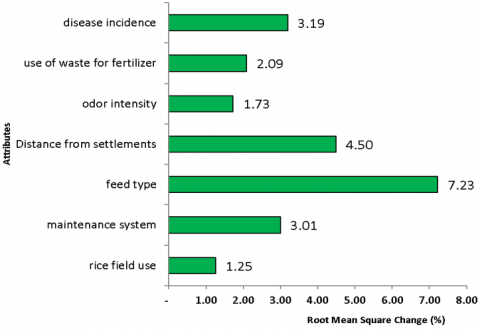
The following is presented in Figures 2-7, the results of the analysis of determining leverage from the environmental, economical, social-cultural, technological, institutional and human resources dimension.
Table 2. Sustainability value and model feasibility in duck research activities, Indramayu
|
No. |
Dimensions |
Sustainability Value |
Status |
Statistics |
Model Feasibility |
||
|
MDS |
Monte Carlo |
|
Stress value (S) |
Determination (R2) |
|
||
|
1 |
Ecological |
43.71 |
43.39 |
Less |
0.14 |
94.77 |
Good |
|
2 |
Economical |
70.15 |
68.22 |
Fair |
0.13 |
94.76 |
Good |
|
3 |
Social-cultural |
37.82 |
37.67 |
Less |
0.16 |
93.89 |
Good |
|
4 |
Technological |
43.62 |
43.62 |
Less |
0.17 |
93.42 |
Good |
|
5 |
Institutional |
31.17 |
31.90 |
Less |
0.15 |
94.54 |
Good |
|
6 |
Human resources |
42.54 |
42.64 |
Less |
0.17 |
93.38 |
Good |
|
|
Average |
44.13 |
|
Less |
|
|
|
Figure 2. Leverage of ecological attributes
Figure 3. Leverage of economical attributes
Figure 4. Leverage of social-cultural attributes
Figure 5. Leverage of technological attributes
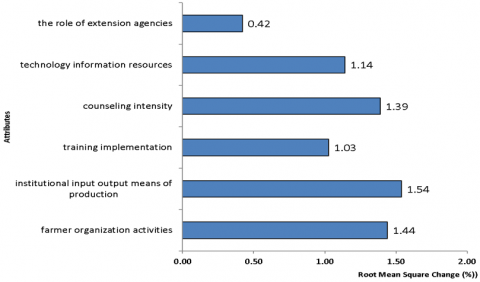
Figure 6. Leverage of institutional attributes
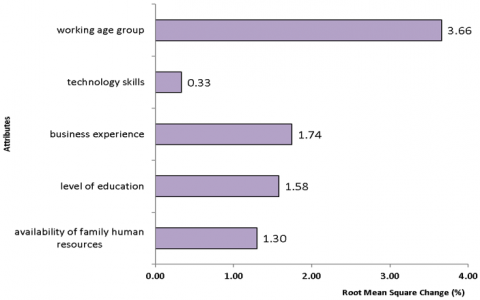
Figure 7. Leverage of human resource attributes
RapDuck analysis is also supported by model feasibility analysis, namely by using a normalisation test, referring to the amount of stress value (S) and coefficient of determination (R2). The calculation results show that the S and R2 for all dimensions are in the range of Stress (S) values of 0.13-0.17 and the value of the coefficient of determination (R2) 93-94. Because in the rules of feasibility analysis, a good model is to have an S value < 0.25 and R2 close to 1, the model (variables/attributes) used in this study is good or reflects the purpose of the study.
Furthermore, based on the results of the leverage analysis carried out on each dimension. The results of the leverage analysis are known to have 20 sensitive attributes with a high RMS value which means that these attributes affect the sustainability of the duck business. A recapitulation of attributes that are sensitive to the sustainability of duck farming is shown in Table 3. These attributes that influence sustainability should get attention and priority to improve.
Table 3. Attributes determine the sustainability implementation of intensive duck farming technology
|
Dimensions |
Attributes |
Leverage (% RMS) |
|
Ecology |
1. Feed type |
7.23 |
|
|
2. Distance from settlements |
4.50 |
|
Economic |
3. Market access input output |
10.01 |
|
|
4. A place to sell ducks and their products |
6.69 |
|
|
5. Business feasibility |
6.18 |
|
|
6. Marketing reach |
5.87 |
|
|
7. Profit sharing |
5.08 |
|
Social-culture |
8. Communication with other farmers' group |
3.71 |
|
|
9. Business pattern |
3.70 |
|
Technology |
10. Waste treatment technology |
4.47 |
|
|
11. Product processing technology |
3.92 |
|
|
12. Animal health knowledge |
2.74 |
|
|
13. Knowledge of feed technology |
2.68 |
|
|
14. Knowledge of breed selection |
2.60 |
|
Institutional |
15. Institutional input-output means of production |
1.54 |
|
|
16. Farmers institutional activity |
1.44 |
|
|
17. Extension Intensity |
1.39 |
|
|
18. Sources of technological information |
1.14 |
|
|
19. Implementation of training |
1.03 |
|
Human resources |
20. Working age group |
3.66 |
From the ecological dimension, feed is one of the essential factors in business sustainability because feed affects product ability. Quality feed with a sufficient amount will be able to produce good products for livestock. In addition, cheap feed is also needed; therefore, feed demands should be in quality, quantity, and price. The costs incurred for feed are between 60-70% of production costs [33], so feed technology must be mastered by farmers to support the sustainability of the duck business. In addition, the distance between the location of farms and settlements is the second attribute that affects business sustainability in terms of ecological dimensions. If the distance between the location of the farm and the settlement is far away, this is fine with residents’ environmental health. The farm’s location integrated with the settlement can disturb in the form of odors, noise, and flies [34].
Judging from the ecological dimension, feed is one of the important factors in business continuity because feed affects the ability of products. A quality feed with sufficient quantities will be able to produce good products for livestock. In addition, cheap feed is also needed; Therefore, the demand for feed should be in quality, quantity, and price. The costs incurred for feed are between 60-70% of production costs [33, 35], so farmers must master feed technology to support the sustainability of the duck business.
Although the economic dimension is in a fairly sustainable status with an index of 70.15%, five attributes affect the sustainability of the economic dimension (Table 3). The input-output market is very influential and serves as a place to provide livestock production facilities and market the products produced. This is in accordance with Grafton et al. [36] that synergistic cooperation between input and output markets is one of the factors needed for sustainable farming.
Added that markets have significance in agri-food systems to achieve sustainable development; this is demonstrated in the 2030 Agenda for Sustainable Development [37]. Markets influence food security and determine producers' access to markets and consumers' access to food [38]. This attribute must be considered because the marketing system is one of the problems smallholder farmers face [39]. Regarding marketing, farmers prefer a multi-channel approach, whereas specialty farmers and agricultural diversification focus on one specific channel [40].
Farm feasibility, market reach, and profit sharing are other attributes of the economic dimension that influence sustainability. Farming that provides benefits and feasibility will be cultivated continuously and sustainably [41], increasing business scale and market reach. A business that benefits various business actors will also be carried out; for example, duck farming produces seeds, meat, and eggs. The farm will be sustainable if market demand is high with a wide reach. In addition, other business branches will emerge, including providing feed, processing livestock products, and marketing in various commercial channels, ranging from traders, collectors, wholesalers, small traders, and others. Meanwhile, research reported by Hashem et al. [42] states that what affects the sustainability of livestock businesses during the pandemic are social distancing (30.0%), labour shortage (17.7%), maintaining precision farm management (14.8%), product marketing (14.2%), access to production inputs (7.2%), and others (16.1%).
Attributes of the socio-cultural dimension that affect the sustainability of duck farming are communication with other farmers' groups and business patterns. Communication and establishing good relationships with various parties, according to Prihtanti [43] and Hashem et al. [42], can support the sustainability of farming. Farming generally experiences ups and downs related to seasons, prices, production, and disease attacks. Good efforts are focused on production efficiency, cost reduction, and appropriate economies of scale, according to Barth et al. [44], one alternative to building a sustainable business is to develop innovative solutions, such as combining technological and social possibilities, to create new business opportunities.
There are 6 attributes of the technological dimension that affect business sustainability (Table 3). Regarding technological dimensions, livestock waste generated in cages is a problem faced in the development of the livestock business. Livestock waste produced, if not appropriately managed, will disturb the environment. Due to the presence of greenhouse gases created by animal waste, which are currently a problem for the world, will impact global warming [45, 46]. Still, on the contrary, if managed, it will get added value in the form of the availability of organic fertilizers and have a selling value and provide profits and reduce expenses for the purchase of chemical fertilizers, increases production, helps maintain public health and environmental cleanliness so that it can support sustainable development [47-50].
Calculating odor levels in livestock barns using computational fluid dynamics (CFD) revealed that the odor dispersion distance at 1 OU m-3 ranged from 78.9 to 1,488.1 m. The odor dispersion ranged from 147.8 to 1,488.1 m when an exhaust fan on the sidewall was used, depending on the simulated environmental conditions. On the other hand, the roof chimney fan ranges from 78.1 to 900.6 m. At 0.5 m s-1 wind speed, the average odor dispersion distance was 511.3 m, computed as 247.4 m at 1.5 m s-1 and 195.6 m at 2.5 m s-1. The distance of dispersion of scents issued from the cage decreases as wind speed increases; the larger the wind speed, the greater the width of the horizontal dispersion (left and right) of the outflow. When the wind speed surrounding the coop increases, the distribution of scents in a horizontal direction decreases. Wind directions (north, east, south, and west) had average dispersion distances of 369.0, 197.8, 470.5, and 235.1 m, respectively [51].
Organic fertilizers are useful for increasing food production and soil fertility and minimising environmental damage [52]. In addition, using organic fertilizers will reduce the effects of groundwater contamination and can help in the bioremediation of soil contaminated with pesticides and hydrocarbons [53]. Farmers generally have not treated livestock waste because they need to learn how to process it. Therefore, it is essential to introduce waste treatment technology through training on processing livestock waste into fertilizer. However, efforts to treat livestock waste must pay attention to the characteristics of farmers, the features of livestock waste management innovations, and environmental conditions [54, 55].
The technological attributes of product processing have a significant influence on sustainable livestock enterprises. Changes in the price of duck meat, eggs, and other by-products are responsible for this. The processing of duck products is also expected to improve their quality and competitiveness to overcome the low quality and competitiveness of egg and duck meat products produced [56]. However, the required technology for processing livestock products is quite simple so people can process directly with the equipment available on a household scale [57]. According to Biswas et al. [58], the demand for processed duck food will increase steadily over the next few years, reaching a value of roughly \$11.23 billion. It is a perfect example of the importance and potential of duck farming in the agricultural sector. The development and diversification of duck products are expected to increase consumption levels.
Another attribute of the technological dimension that has a vital role in sustainability is feed technology. Ducks raised semi-intensively or intensively face problems, one of which is feed due to the high price of feed and its availability which depends on the season. Utilizing local feed ingredients is the right solution to maintain egg production in quantity and quality. Feed costs incurred are between 60-70% of the total cost of production [59, 60]. One solution to overcome this is to introduce feed preparation independently by farmers from local feed ingredients [61, 62].
Furthermore, livestock health is another attribute of the technological dimension that plays a significant role in sustainability. According to Gebze et al. [63], disease prevention is one of the factors that must be considered so that ducks are healthy and their productivity increases. The livestock of ducks is inseparable from the attack of the disease; therefore, the breeder needs to know the type of disease that is essential, especially the means of its prevention and treatment. According to Syamsuryadi et al. [62], the handling of livestock health is generally not scheduled, causing deaths, especially during the winter season.
The results of the effectiveness test of the bivalent inactivated vaccine of H5N1 subtypes H5N1 clade 2.1.3 and 2.3.2 in duck groups in Sliyeg and Anjatan villages (Indramayu) by Indriani et al. [64], showed a fairly good response (average AI H5N1 antibody titer 5-6 log2), 4 weeks after booster vaccination (the average AI antibody titer is good, namely; 7-8 log2), and was able to protect against exposure to the AI H5N1 virus circulating in the field. While at the time of pre-vaccination is negative (0 log2) and cannot protect against exposure to the AI H5N1 virus.
Aflatoxin contamination of feed and poultry products greatly affects the health of livestock. The test results on feed samples and duck feed ingredients collected at farms and poultry shops or traditional markets in Indramayu Regency showed aflatoxin contamination in all samples tested, where 39.3% exceeded the maximum limit. The highest concentrations of aflatoxin were found in mixed feed (52.2 ppb) and dry rice (46.2 ppb) samples [32].
The selection of seeds is also one of the essential attributes and plays a role from the technological dimension to the sustainability of the duck business. Quality seeds guarantee production and business sustainability if balanced with good feed and management. Gebze et al. [63] advise carrying out a selection and a cross between several types of ducks to get good seedlings. The quality and quantity of superior duck breeds, among other things, are determined by the nature of reproductive efficiency. In the process of reproduction, the condition of the brood significantly affects the successful reproduction and the offspring's health [65, 66].
The results of the leverage analysis are known attributes that affect business sustainability from the institutional dimension consisting of institutional inputs, farmers' institutional activities, extension intensity, sources of information, technology, and implementation of training—influential institutional attributes in accordance with the results of previous research. According to Genovese et al. [67] that strong and good institutions or in this case livestock groups are very influential and support sustainable agricultural development. This condition is in line with the results of this research in that livestock groups are a lever for developing duck livestock. His group has a very important and strategic role, especially in improving the bargaining power status of farmers with various parties. In addition, around 60% of farmers in Tugu Village actively participate in activities carried out by farmer groups, especially rice plants. Through technical guidance and technology display, institutional assistance in Tugu Village, Sliyeg District, effectively improves farmers' knowledge, attitudes, and skills. Technical guidance, accompanied by practice, is more effective in improving the knowledge and skills of duck breeders. The perception of duck breeders towards all introduced technologies is classified as medium category (accepted and has the potential to be applied and developed). Information technology and media development are recommended to connect farmers with the sources of information needed to increase yields and profits and reduce risk to farming communities and the environment [68].
Implementing the sustainable agriculture model will be realized by efficiently functioning institutions [69]. Farmers can go far to buy to save time and costs. The activeness of farmer organizations can affect the sustainability of the duck livestock business because an active organization shows the existence of activities and the amount of information obtained. The extension institution is the closest institution to farmers. The higher the intensity of counselling, the better the sustainability of the duck business. More sources of information that reach farmers accompanied by training will increase their knowledge and skill.
The results of Schut et al. [70] research show that economic and institutional factors are the obstacles faced to the intensification of agricultural systems sustainably. It is a result of the underwhelming performance of institutions like policies and markets, the availability of insufficient financial resources, and the ineffective interaction and cooperation amongst stakeholders. In terms of institutional dimensions, input-output institutions are needed in carrying out an effort to facilitate livestock business activities. The implementation of the sustainable agriculture model will be realised by efficiently functioning institutions [69]. Farmers can go far to buy to save time and costs. The activeness of farmer organisations can affect the sustainability of the duck livestock business because an active organisation shows the existence of activities and the amount of information obtained. The extension institution is the closest institution to farmers. The higher the intensity of counselling, the better the sustainability of the duck business. More sources of information that reach farmers accompanied by training will increase their knowledge and skills.
Meanwhile, conditions on the ground show that the intensity of counselling for the livestock sub-sector is considered very low, which needs to be improved soon. Counselling today is more focused on food crop commodities but not ducks. Farmers need to be fostered and accompanied because technology is developing faster; if the current technical information is not conveyed, it will interfere with the sustainability of the duck business. The material that must deliver in counselling is livestock health and waste treatment. It has been stated in the previous discussion that knowledge about livestock health is considered necessary so that farmers know the prevention of diseases and their handling. This finding is similar to Mustapit et al. [71], who found that one goal of the agricultural extension system is to give farmers more access to resources that will help them become more capable. Generally, agricultural extension activities have been ignored by government counselling with a personal, group, and mass approach. Furthermore, strengthening the agricultural extension system is one way to realise sustainable agriculture. Synchronise stakeholders from agricultural extension and build strong institutions to disseminate innovation, knowledge, and experience to farmers quickly, precisely, effectively, and efficiently.
Based on the analysis results, duck farming in production centers must be improved from the economic and five other dimensions, namely environmental, social, technological, institutional, and human resources. Duck farming can be improved in sustainability status if it pays attention to and improves the dimensions and attributes that affect the sustainability of the duck business. Improvement of the maintenance system from the shepherding system (extensive) to semi or intensive maintenance is the best recommendation to generate sustainable efforts given some of the problems and barriers faced, including increasingly limited agricultural land, fewer natural food sources, the influence of pesticides on health, and duck production.
The results of this study are supported by Hutahaean et al. [72] that duck farming in production centres can develop and be sustainable if supported by government support. Government support can be focused on institutional strengthening, technology development through training, and counselling on technological innovation in intensive duck farming businesses.
3.3 Results of the MICMAC analysis
Based on 19 attributes that affect the sustainability of intensive duck introduction, it was agreed by expert respondents that the MICMAC Advanced analysis carried out only 19 attributes. Attributes of the working age group are not included in the Advanced analysis (Table 3) as they do not affect the field or the existing conditions. Based on MICMAC analysis, there are three attributes in Quadrant I (=influence variables), three attributes in Quadrant II (=relay variables), five attributes in Quadrant IV (=excluded variables), and one attribute in Quadrant III (=depending variables). Quadrants I and II greatly influence the sustainability of intensive duck technology introduction, while quadrants III and IV have little or little effect. The quadrants and their attributes as shown in Figure 8.
Attributes in Quadrant I are determinant attributes: critical attributes with a strong direct influence and a very low degree of dependence on other attributes. The attributes in Quadrant I are the intensity of counselling, knowledge of livestock health, and processing of livestock waste. Furthermore, the attributes contained in quadrant II are sensitive and are very unstable in the sustainability of intensive duck farming. There are ten attributes in Quadrant II, namely: type of feed, feed technology, cultivation patterns, implementation of training, the feasibility of agriculture, activeness of farmer organisations, institutional input-output, information technology systems, selection of seeds, and communication with other duck owners or farmer’s groups.
Quadrant III is an output attribute characterised by a minimal influence but a very high dependence on the influential variables. The attributes in this Quadrant are input-output market access. Market access is essential regarding the availability of inputs and marketing of output products, namely livestock products. In comparison, the attributes in quadrant IV are processing livestock products, marketing range, profit sharing, distance from settlements, and places of sale of ducks and their products.
Figure 8. Direct influence/independence attributes for sustainability introduction technology inintensive duck farming in Indramayu Regency
Based on MICMAC'S analysis, the attributes in Quadrant I are the intensity of counselling, knowledge of livestock health, and processing of livestock waste. These three factors are the main driving variables and are prerequisites in determining the sustainability of the duck business in Indramayu Regency. Counselling is an essential factor in encouraging business sustainability because farmers mostly do duck farming business only based on hereditary habits. Extension workers play a role in mentoring and fostering technological innovations that can be carried out intensively because they are officers at the forefront of dealing directly with breeders. This is supported by research by Dhehibi et al. [73] that technology transfer carried out by extension workers is essential for farmers to adopt the technology. Farmers should know about livestock health; at least they know if the livestock is sick and recognizes its features. This must be followed by efforts to prevent the transmission of the disease to other healthy livestock and immediately treat or can be consulted with health workers. The attributes of livestock waste treatment are a determining factor in the sustainability of the livestock business in Indramayu. This can be explained by the fact that a large livestock population will produce much livestock waste. Livestock waste that is not handled correctly can pollute the environment, while this waste, if appropriately managed, provides significant benefits, including improving the quality of the land.
Furthermore, the results of the MICMAC analysis show that the attributes contained in quadrant II are sensitive and very unstable in the sustainability of the intensive duck business. If there is an intervention in the attributes in Quadrant II, it will affect the sustainability of the duck business. The attributes in Quadrant II are feed type, feed technology, cultivation patterns, training implementation, farm feasibility, active farmer organizations, input-output institutions, technological information systems, selection of seedlings, and communication with other breeders/farmers’ groups. If farmers make changes or improvements to these attributes, the sustainability of the duck business is expected to increase. For example, the type of feed used is quality ingredients by paying attention to the quantity, price, and availability. This must be supported by better feed technology, cultivation or livestock rearing system, and the selection of quality livestock seeds. This effort can be made by providing intensive training/counselling supported by increasing the role of farmer institutions and information/communication systems.
The analysis results found that the attributes in Quadrant III are output attributes characterized by minimal influences but very high dependence on influential variables. Attributes in this Quadrant are sensitive if there is a change in the variables in quadrants I and II [28], namely: input-output market access. Market access is essential regarding the availability of inputs and marketing of output products, namely livestock products. Meanwhile, quadrant IV describes excluding variables characterised by their small Influence and dependence on dominant attributes because they will not stop the work of a system or utilise the system itself. The attributes in quadrant IV are processing livestock products, marketing range, profit sharing, distance from settlements, points of sale of ducks, and their products.
The intensive introduction of duck farming technology in Sliyeg District could have been more sustainable, particularly for the five dimensions: ecology, sociocultural, institutional, technological, and human resources. It was only the economic dimension that was in a reasonably sustainable condition. The development of intensive duck farming needs attention to 20 attributes that have a significant effect. Three attributes have been obtained that act as the main driving variables and become prerequisites in determining the sustainability of the duck business in the Indramayu Regency. Furthermore, ten sensitive attributes need to be encouraged because they will affect the overall sustainability of the duck business. Strategies to improve the sustainability of the introduction of intensive livestock technology that can carry out include increasing the capacity of human resources through the implementation of training/counselling/ comparative studies, increasing the capacity of existing institutions, providing assistance, coaching, and strengthening institutions, advocating and socialising intensive duck business cultivation to increase the productivity of livestock products, as well as providing socialisation and introduction of intensive duck business cultivation technology.
The authors are grateful to the Head of Research Center for Animal Husbandry, Research Organization for Agriculture, Food, Head of Research Centre for Veterinary Science, and Head of Research Centre for Veterinary Science, and Head of Research Center for Sustainable Production System and Life Cycle Assessment, National Research and Innovation Agency, Indonesia for administrative and technical support in this research. The authors would like to thank the editors and anonymous reviewers for their constructive comments.
The authors declare no potential conflict of interest regarding the publication of this work. The authors confirm that the present study is free of plagiarism, non-informed consent, misconduct, data fabrication or falsification, double publication or submission, and redundancy.
Abbreviations |
|
|
Mic.Mac |
cross impact matrix multiplication applied to classification |
|
MDS |
multidimensional scalling |
|
% |
percent |
|
DGLHA |
directorate general of livestock and animal health services. |
|
CBS |
centre bureau statistic |
|
FGD |
focus group discussion |
| DHG | dry harvested grain |
|
HR |
human resources |
|
Rapfish |
rapid appraisal for fisheries |
|
RapDuck |
rapid appraisal for duck |
|
S |
stress value |
|
RMS |
root mean square |
|
SQR |
structured query reporter |
|
R2 |
coefficient of determination |
|
Y |
influences |
|
X |
dependencies |
|
Quadrant I |
influence variables |
|
Quadrant II |
relay variables |
|
Quadrant III |
depending variables |
|
Quadrant IV |
excluded variables |
[1] Susanti, R., Yuniastuti, A., Iswari, R.S. (2019). Genetic evaluation of Central Javanese local duck based on the ovalbumin gene. Journal of Physics: Conference Series, 1321(3): 032036. https://doi.org/10.1088/1742-6596/1321/3/032036
[2] Churchil, R.R., Jalaludeen, A. (2022). Duck Production and Management Strategies. Duck Farming: Oppor tunities, Constraints and Policy Recommendations. Springer Singapore. https://doi.org/10.1007/978-981-16-6100-6
[3] DGLHA. (2021). Livestock and Animal Health Statistics 2021. Direktorat Jenderal Peternakan dan Kesehatan Hewan Kementerian Pertanian RI. https://ditjenpkh.-pertanian.go.id/, accessed on Jan. 17, 2023.
[4] BPS. (2020). Provinsi Jawa Barat Dalam Angka, vol. 21, no. 1. BPS-Statistics of Jawa Barat Province. https://jabar.bps.go.id/, accessed on Jan. 5, 2023.
[5] Adi, A.P., Sunarti, D., Muryani, R. (2019). Female Tegal duck performance with intensive and semi intensive rearing system in KTT Bulusari Pemalang. Jurnal Sain Peternakan Indonesia, 14(3): 12-26. https://doi.org/10.31186/jspi.id.14.3.237-245
[6] Rahayu, T.P., Waldi, L., Sonia, M., Pradipta, I. (2019). Kualitas ransum itik magelang pada pemeliharaan intensif dan semi intensif terhadap bobot badan dan produksi telur. Bulletin of Applied Animal Research, 1(1): 8-14. https://doi.org/10.36423/baar.v1i1.164
[7] Sunarno, S., Budiraharjo, K., Solikhin, S. (2021). Analysis of the effect of intensive and extensive rearing system on the productivity and quality of Tegal duck eggs. Jurnal Peternakan Indonesia, 23(2): 83-92. https://doi.org/10.25077/jpi.23.2.83-93.2021
[8] Rohaeni, E.S., Mailena, L., Lesmayati, S., Ermuna, S.S. (2021). Sustainability analysis for rice and duck farming in swampy land, Hulu Sungai Utara Regency, South Kalimantan. IOP Conference Series: Earth and Environmental Science, 648(1): 012134. https://doi.org/10.1088/1755-1315/648/1/012134
[9] Pangemanan, M., Lumenta, S.P., Moningkey, I.D.R., Rundengan, S.A.E. (2021). Kontribusi usaha itik petelur terhadap pendapatan rumah tangga petani/peternak pada masa pandemi Covid 19 di Kabupaten Minahasa Provinsi Sulawesi Utara. Prosiding Seminar Teknologi dan Agribisnis Peternakan VIII, 3(1): 634-643.
[10] Sunarno, S., Budiraharjo, K., Solikhin, S. (2020). Pengaruh sistem budidaya intensif dan ekstensif terhadap produktivitas kualitas telur itik Tegal. Media Bina Ilmu, 14(8): 3091-3100. https://doi.org/10.33758/mbi.v14i8.508
[11] Widiyaningrum, P., Lisdiana, Utami, N.R. (2016). Egg production and hatchability of local ducks under semi intensive vs extensive managements. Jurnal Indonesia Tropical Animal Agriculture, 41(2): 77-82. http://doi.org/10.14710/jitaa.41.2.77-82
[12] Shoimah, O., Irfan, D., Djunaidi, H., Sjofjan, I.H. (2019). Quality of duck eggs maintained using a different maintenance system in the Malang Raya Area. International Research Journal of Advanced Engineering and Science, 4(4): 273-277.
[13] Abo Ghanima, M.M., Ashour, E.A., Othman, S.I., Alwaili, M.A., Allam, A.A., Khafaga, A.F. (2020). The influences of various housing systems on growth, carcass traits, meat quality, immunity and oxidative stress of meat-type ducks. Animals, 10(3): 410. https://doi.org/10.3390/ani10030410
[14] Incamilla, A., Arifin, B., Nugraha, A. (2016). Sustainability of coffee agroforestry farming in Pulau Panggung Sub District of Tanggamus Regency. Journal Agribussines Science, 3(3): 260-267.
[15] Mockshell, J., Kamanda, J. (2018). Beyond the agroecological and sustainable agricultural intensification debate: Is blended sustainability the way forward?. International Journal Agriculture Sustainability, 16(2): 127-149. https://doi.org/10.1080/14735903.2018.1448047
[16] Amam, A., Harsita, P.A. (2019). Business development of fairy cattle: Evaluation of vulnerability context and group dynamics. Jurnal-Jurnal Ilmu Peternakan, 22(1): 23-34. http://doi.org/10.22437/jiiip.v22i1.7831
[17] Amam, A., Fanani, Z., Hartono, B., Nugroho, B.A. (2019). The power of resources in independent livestock farming business in Malang District, Indonesia. IOP Conference Series: Earth and Environmental Science, 372: 012055. https://doi.org/10.1088/1755-1315/372/1/012055
[18] Arham, I., Sjaf, S., Darusman, D. (2019). Strategi pembangunan pertanian berkelanjutan di pedesaan berbasis citra drone: Studi Kasus Desa Sukadamai Kabupaten Bogor. Jurnal Ilmu Lingkungan, 17(2): 245-255. http://doi.org/10.14710/jil.17.2.245-255
[19] Rohaeni, E.S., Santoso, A.D., Ariningsih, E., Widaningsih, N., Hutahaean, L., Priyanto, D., Ilham, N., Suharyon, S., Herdis, H., Widiawati Y., Hadiatry, M.C., Ermuna, S.S., Mardiharini, M., Sugandi, D., Bakrie, B., Wasito, W. (2023). Analysing the sustainability of swamp buffalo (Bubalus bubalis carabauesis) farming as a protein source and germplasm. Open Agriculture, 8: 20220224. https://doi.org/10.1515/opag-2022-0224
[20] Widaningsih, N., Hartono, B., Utami, H.D., Rohaeni, E.S., Gunawan, E. (2023). Indicators of swamp buffalo business sustainability using partial least squares structural equation modelling. Open Agriculture, 8: 2022021. https://doi.org/10.1515/opag-2022-0216
[21] Borg, I., Groenen, P.J.F., Mair, P. (2018). Applied Multidimensional Scaling and Unfolding, 2nd ed. Springer Cham.
[22] Lloyd Chrispin, C., Ananthan, P.S., Ramasubramanian, V., Sugunan, V.V., Panikkar, P., Landge, A.T. (2022). Rapid reservoir fisheries appraisal (r-RAPFISH): Indicator based framework for sustainable fish production in Indian reservoirs. Journal of Cleaner Production, 379: 134435. https://doi.org/10.1016/j.jclepro.2022.134435
[23] Anna, S., Fauzi, A. (2005). Pemodelan Sumberdaya Perikanan dan Kelautan. Jakarta. Gramedia Pustaka Utama.
[24] Janker, J., Mann, S., Rist, S. (2018). What is sustainable agriculture? Critical analysis of the international political discourse. Sustainability, 10(12): 4707. https://doi.org/10.3390/su10124707
[25] Kavanagh, P., Pitcher, T.J. (2004). Implementing Microsoft excel software for Rapfish: A technique for the rapid appraisal of fisheries status. Fisheries Centre Research Reports, 12(2). https://doi.org/10.14288/1.0074801
[26] Pitcher, T.J., Preikshot, D. (2001). Rapfish: A rapid appraisal technique to evaluate the sustainability status of fisheries. Fisheries Resources, 49(3): 255-270. https://doi.org/10.1016/S0165-7836(00)00205-8
[27] Hidayah, Z., Nuzula, N.I., Wiyanto, D.B. (2020). Analisa keberlanjutan pengelolaan sumber daya perikanan di Perairan Selat Madura Jawa Timur. Jurnal Perikanan Universitas Gadjah Mada, 22(2): 101-113. https://doi.org/10.22146/jfs.53099
[28] Hindayani, P., Pratama, A.R., Anna, Z. (2021). Strategi prospektif pengembangan dalam ekowisata waduk Cirata yang berkelanjutan, Jurnal Ilmu Lingkungan, 19(3): 620-629. https://doi.org/10.14710/jil.19.3.620-629
[29] de Almeida, M.F.L., de Morae, C.A.C. (2021). Diffusion of emerging technologies for sustainable development: Prospective assessment for public policies, Journal of Technology Management & Innovation, 8(1). http://dx.doi.org/10.4067/S0718-27242013000300021
[30] Fauzi, A. (2019). Teknik Analisis Keberlanjutan. Gramedia Pustaka Utama, Jakarta.
[31] Li, M., Li, R., Zhang, J., Wu, T., Liu, S., Hei, Z., Qiu, S. (2020). Effects of the integration of mixed-cropping and rice-duck co-culture on rice yield and soil nutrients in southern China. Journal of the Science of Food and Agriculture, 100(1): 277-286. https://doi.org/10.1002/jsfa.10035
[32] Sumantri, I., Agus, A., Irawan, B., Habibah, Faizah, N., Wulandar, K.J. (2017). Cemaran aflatoksin dalam pakan dan produk itik Alabio (Anas platyrinchos borneo) di Kalimantan Selatan. Buletin Peternakan, 41(2): 163-168. https://doi.org/10.21059/buletinpeternak.v41i2.15514
[33] Vipriyanti, N.U., Yulianti, P.L.S., Puspawati, D.A., Handayani, M.E., Tariningsih, D., Malung, Y.U. (2021). The efficiency of duck rice integrated system for sustainable farming. In ICANaRD 2021 IOP Conference Series: Earth and Environmental Science, 892(2021): 012008. https://doi.org/10.1088/1755-1315/892/1/012008
[34] Pepliński, B. (2020). Location of cows and pigs in suburban areas of Polish metropolitan centers. Sustainability, 12(7): 2619. https://doi.org/10.3390/su12072619
[35] Popp, J., Harangi-Rákos, M., Gabnai, Z., Balogh, P., Antal, G., Bai, A. (2016). Biofuels and their co-products as livestock feed: Global economic and environmental implications. Molecules, 21(3): 285. https://doi.org/10.3390/molecules21030285
[36] Grafton, R.Q., Daugbjerg, C., Qureshi, M.E. (2015). Towards food security by 2050. Food Security, 7: 179-183. https://doi.org/10.1007/s12571-015-0445-x
[37] United Nations. (2015). Transforming Our World: The 2030 Agenda for Sustainable Development.
[38] Borsellino, V., Schimmenti, E., El Bilali, H. (2020). Agri-food markets towards sustainable patterns. Sustainability, 12(6): 2193. https://doi.org/10.3390/su12062193
[39] Asikin, Z., Baker, D., Villano, R., Daryanto, A. (2020). Business models and innovation in the Indonesian smallholder beef value chain. Sustainability, 12(17): 7020. https://doi.org/10.3390/su12177020
[40] Pölling, B. (2016). Comparison of farm structures, success factors, obstacles, clients’ expectations and policy wishes of urban farming’s main business models in North Rhine-Westphalia, Germany. Sustainability, 8(5): 446. https://doi.org/10.3390/su8050446
[41] Jukka, L., Miika, M., Lauri, L., Mirja, M., Ville, U., Lassi, L. (2022). A financial and environmental sustainability of circular bioeconomy: A case study of short rotation coppice, biochar and greenhouse production in southern Finland. Biomass and Bioenergy, 163: 106524. https://doi.org/10.1016/j.biombioe.2022.106524
[42] Hashem, K.A., Hassanein, N.M., Hocquette, E.M., Gonzalez-Bulnes, J., Ahmed, A., Attia, F.A., Asiry. (2021). COVID-19 era: A cross-sectional study on the role of information and communication technologies. Sustainability, 13(12): 6521. https://doi.org/10.1007/s11250-022-03256-x
[43] Prihtanti, T.M. (2022). Evaluasi respon kelompok tani dalam kegiatan introduksi budidaya gandum. Warta LPM, 25(1): 21-32. https://doi.org/10.23917/warta.v25i1.594
[44] Barth, M., Ulvenblad, H., Ulvenblad, P., Hoveskog, P. (2021). Unpacking sustainable business models in the Swedish agricultural sector–the challenges of technological, social and organisational innovation. Journal Cleaner Production, 304: 127004. https://doi.org/10.1016/j.jclepro.2021.127004
[45] Abdeshahian, P., Lim, J.S., Ho, W.S., Hashim, H., Lee, C.T. (2016). Potential of biogas production from farm animal waste in Malaysia. Renewable and Sustainable Energy Reviews, 60: 714-723. https://doi.org/10.1016/j.rser.2016.01.117
[46] Chowdhury, T., Chowdhury, H., Hossain, N., Ahmed, A., Hossen, M.S., Chowdhury, P., Thirugnanasambandam, M., Saidur, R. (2020). Latest advancements on livestock waste management and biogas production: Bangladesh’s perspective. Journal of Cleaner Production, 272: 122818. https://doi.org/10.1016/j.jclepro.2020.122818
[47] Hua, X., Yang, Y.C., Zhou, K., Tiana, G., Liua, B., Hea, H., Zhang, L., Cao, Y., Biana, B. (2022). Verification of agricultural cleaner production through rice-duck farming system and two-stage aerobic composting of typical organic waste. Journal of Cleaner Production, 337: 130576. https://doi.org/10.1016/j.jclepro.2022.130576
[48] Su, J.J., Huang, J.F., Wang, Y.L., Hong, Y.Y. (2018). Treatment of duck house wastewater by a pilot-scale sequencing batch reactor system for sustainable duck production. Poultry Science, 97(11): 3870-3877. https://doi.org/10.3382/ps/pey251
[49] Soobhany, N. (2019). Insight into the recovery of nutrients from organic solid waste through biochemical conversion processes for fertilizer production: A review. Journal of Cleaner Production, 241: 118413. https://doi.org/10.1016/j.jclepro.2019.118413
[50] Chew, K.W., Chia, S.R., Yen, H.W., Nomanbhay, S., Ho, Y.C., Show, P.L. (2019). Transformation of biomass waste into sustainable organic fertilizers. Sustainability, 11: 2266. https://doi.org/10.3390/su11082266
[51] Yeo, U.H., Decano-Valentin, C., Ha, T., Lee I.B., Kim, R.W., Lee, S.Y., Kim, J.G. (2020). Impact analysis of environmental conditions on odour dispersion emitted from pig house with complex terrain using CFD. Agronomy, 10(11): 1828. https://doi.org/10.3390/agronomy10111828
[52] Silva, W.O., Stamford, N.P., Silva, E.V.N., Santos, C.E.R.S., Freitas, A.D.S., Silva, M.V. (2016). The impact of biofertilizers with diazotrophic bacteria and fungi chitosan on melon characteristics and nutrient uptake as an alternative for conventional fertilizers. Scientia Horticulturae, 209: 236-240. https://doi.org/10.1016/j.scienta.2016.06.027
[53] Guo, Z., Zhang, J., Fan, J., Yang, X., Yi, Y., Han, X., Wang, D., Zhu, P., Peng, X. (2019). Does animal manure application improve soil aggregation? Insights from nine long-term fertilization experiments,Science of The Total Environment, 660: 1029-1037. https://doi.org/10.1016/j.scitotenv.2019.01.051
[54] Linggotu, L.O., Paputungan, U., Polii, B. (2016). Animal waste product managemnat for prevention of Kotamobagu. Zootec, 35(2): 226-232. https://doi.org/10.35792/zot.36.1.2016.10535
[55] Santoso, A.D., Hariyanti, J., Pinardi, D., Kusretuwardani, K., Widyastuti, N., Djarot, I.N., Handayani, T., Sitomurni, A.I., Apriyanto, H. (2023). Sustainability index analysis of microalgae cultivation from biorefinery palm oil mill effluent. Global Journal Environmental Science Management, 9(3): 559-576. https://doi.org/10.22035/gjesm.2023.03.13
[56] Barbut, S., Leishman, E.M. (2022). Quality and processability of modern poultry meat. Animals, 12: 2766. https://doi.org/10.3390/ani12202766
[57] Kusmayadi, A., Sundari, R.S. (2019). Program diversifikasi dan uji organoleptik produk olahan daging dan telur itik cihateup di Dusun Cihateup Kabupaten Tasikmalaya, 10(2): 131-136. https://doi.org/10.26877/e-dimas.v10i2.3313
[58] Biswas, S., Banerjee, R., Bhattacharyya, D., Patra, G., Das, A.K., Das, S.K. (2019). Technological investigation into duck meat and its products: A potential alternative to chicken. Worlds Poultry Science, 75(4): 609-620. https://doi.org/10.1017/S004393391900062X
[59] Gustin, B., Tumanggor, S.S., Suci, D.M., Suharti, S. (2017). The study of duck feeding management kept under intensive and semi intensive systems by smallholder farmer. Bulletin Makanan Ternak, 104(1): 21-29.
[60] Ismoyowati, I., Pratama, B.C., Innayah, M.N. (2020). Performative and economic analysis on local duck farming in Central Java - Indonesia. Journal of the Indonesian Tropical Animal Agriculture, 45(3): 234-242. https://doi.org/10.14710/jitaa.45.3.234-242
[61] Biyatmoko, D., Juhairiyah, Prasetio, B., Santoso, U., Rostini, T. (2021). The phytobiotic effect of herbs as a growth promoter on the performance and digestibility of alabio meat ducks. Livestock Research for Rural Development, 33(5): 2-7.
[62] Syamsuryadi, B., Faridah, R., Armayanti, A.K. (2021). Application of ducks feed processing technology from agricultural waste. Abdimas Galuh, 3: 535-541. http://dx.doi.org/10.25157/ag.v3i2.6242.
[63] Gebze, Y., Ismoyowati, I., Tugiyani, E. (2020). Faktor-faktor yang mempengaruhi produksi telur itik dan strategi pengembangan usaha ternak itik di kabupaten Merauke. Musamus Journal of Livestock Science, 3(1): 1-12.
[64] Indriani, H.N., Susanti, R., Maryono, Dharmayanti, N.L.P., Nurjanah, D., Damayanti, R., Wiyono, A. (2022). Riset pengembangan program vaksinasi avian influenza inovasi balitbangtan pada peternakan itik. Pusat Penelitian dan Pengembangan Peternakan, 2022.
[65] Sheng, G., Foley, A.C. (2012). Diversification and conservation of the extraembryonic tissues in mediating nutrient uptake during amniote development. Annals of the New York Academy of Sciences, 1271(1): 97-103. https://doi.org/10.1111/j.1749-6632.2012.06726.x
[66] Garnier, R., Ramos, R., Staszewski, V., Militao, T., Lobato, E., González-Solís, J., Boulinier, T. (2012). Maternal antibody persistence: A neglected life-history trait with implications from albatross conservation to comparative immunology. Proceedings of the Royal Society B: Biological Sciences, 279(1735): 2033-2041. https://doi.org/10.1098/rspb.2011.2277
[67] Genovese, D., Culasso, F., Giacosa, E., Battaglini, L.M. (2021). Can livestock farming and tourism coexist in mountain regions? A new business model for sustainability. Sustainability, 9(11). https://doi.org/10.3390/su9112021
[68] Bottrell, D.G., Schoenly, K.G. (2018). Integrated pest management for resource-limited farmers: Challenges for achieving ecological, social and economic sustainability. The Journal of Agricultural Science, 156(3): 408-426. https://doi.org/10.1017/S0021859618000473
[69] Stępień, S., Czyżewski, B., Sapa, A., Borychowski, M., Poczta, W., Poczta-Wajda, A. (2021). Eco-efficiency of small-scale farming in Poland and its institutional drivers. Journal of Cleaner Production, 279: 123721. https://doi.org/10.1016/j.jclepro.2020.123721
[70] Schut, M., van Asten, P., Okafor, C., Hicintuka, C., Mapatano, S., Nabahungu, N.L., Kagabo, D., Muchunguzi, P., Njukwe, E., Dontsop-Nguezet, P.M., Sartas, M., Vanlauwe, B. (2016). Sustainable intensification of agricultural systems in the Central African Highlands: The need for institutional innovation. Agricultural Systems, 145: 165-176. https://doi.org/10.1016/j.agsy.2016.03.005
[71] Mustapit, S. Subekti, A.F., Sunartomo, Rokhani. (2019). Achieving sustainable agriculture through enhancing agricultural extension institution. IOP Conference Series: Earth and Environmental Science, 250(1): 012011. https://doi.org/10.1088/1755-1315/250/1/012011
[72] Hutahaean, L., Sirnawati, E., Rohaeni, E.S., Bakrie, B. (2022). Duck business development strategy in duck farming center area of Indramayu Regency, West Java Province of Indonesia. In E3S Web of Conferences, 361: 01014. https://doi.org/10.1051/e3sconf/202236101014
[73] Dhehibi, B., Rudiger, U., Moyo, H.P., Dhraief, M.Z. (2020). Agricultural technology transfer preferences of smallholder farmers in Tunisia’s arid regions. Sustainability, 12(1): 421. https://doi.org/10.3390/su12010421