Hongxia Li
© 2026 The author. This article is published by IIETA and is licensed under the CC BY 4.0 license (http://creativecommons.org/licenses/by/4.0/).
OPEN ACCESS
Dimethyl carbonate (DMC) is widely used in lithium-ion battery electrolytes and is typically synthesized via the reaction of ethanol (EtOH) with DMC. However, the two components form a minimum-boiling azeotrope at atmospheric pressure, making separation and purification challenging. Based on thermodynamic analysis, this study selected furfural, chlorobenzene, and p-xylene as candidate entrainers. The UNIversal Functional-group Activity Coefficients (UNIFAC) group contribution method was employed to predict their separation efficiencies, identifying furfural as the optimal solvent. Isobaric apor-liquid equilibrium (VLE) data for the EtOH–DMC–furfural ternary system at 101.3 kPa were measured using an Othmer equilibrium still. Binary interaction parameters were regressed using the UNIversal QUAsi-Chemical (UNIQUAC) activity coefficient model, providing a reliable foundation for the thermodynamic framework. Subsequently, a dual-column extractive distillation process was established in Aspen Plus. Aiming to minimize the Total Annual Cost (TAC), a sequential iterative optimization was conducted on key parameters, including the number of theoretical stages, feed locations, and solvent flow rate. After optimization, the purities of both EtOH and DMC products exceeded 99.9 mol%, with the solvent furfural being recovered at high purity. The findings of this study provide systematic thermodynamic data and a process design basis for the energy-efficient separation of this azeotropic system.
extractive distillation, Dimethyl carbonate, EtOH, vapor-liquid equilibrium, thermodynamic model, process simulation, energy optimization, Aspen Plus
Dimethyl carbonate (DMC) is known as a green chemical raw material because its molecule contains no halogens and no sulfur, and its degradation pathway is relatively clean. It can replace highly toxic or carcinogenic reagents such as phosgene, dimethyl sulfate, and chloromethane to participate in reactions such as carbonylation, methylation, and transesterification. It has extended value in fields including pesticides, pharmaceutical intermediates, polycarbonate, lithium-ion battery electrolytes, coatings and adhesives, and fuel additives. Through transesterification starting from DMC, high-end carbonates such as ethyl methyl carbonate (EMC) and diethyl carbonate (DEC) can be obtained. Among them, DEC is not only an intermediate for pharmaceuticals and dyes but also an important component of electrolyte solvents in the new energy industry chain [1, 2].
During the production of DMC, in the reaction equilibrium mixture of the transesterification method for producing DEC/EMC, unreacted DMC and excess ethanol (EtOH) inevitably coexist. In lithium battery electrolytes or waste liquids, EtOH coexists with DMC in a miscible state as an impurity or component. Affected by intermolecular interactions, EtOH and dimethyl carbonate form a minimum-boiling azeotrope, making it difficult to obtain high-purity products through conventional distillation. To achieve effective separation, it is necessary to rely on extraction to adjust the relative volatility of various substances, so as to break through the separation bottleneck. Therefore, systematically investigating the phase equilibrium characteristics of EtOH-DMC has undeniable practical significance for its purification and separation, optimization of production processes, and improvement of product quality [1-4].
The vapor-liquid equilibrium characteristics of azeotropes determine that they cannot be completely separated by conventional distillation. In engineering, separation strategies can be classified into the following categories based on whether a third component is introduced and whether the operating pressure is changed. Pressure-swing distillation utilizes the characteristic that azeotropic composition varies with pressure, and achieves efficient separation of azeotropes through the series operation of a high-pressure column and a low-pressure column without introducing additional components. Extractive distillation continuously adds a high-boiling entrainer to the upper part of the distillation column, selectively changing the relative volatility between the components to be separated, and realizing the recycling of the entrainer with the aid of a solvent recovery column, which is particularly suitable for the separation of minimum-boiling azeotropic systems. Azeotropic distillation introduces an entrainer to form a new low-boiling azeotrope, thereby carrying the target component out from the top of the column. For systems where entrainer recovery is difficult, thermal sensitivity is strong, or azeotropic compositions are relatively close, alternative technologies such as liquid-liquid extraction, membrane separation, adsorption, and reaction-assisted separation are also widely adopted [5-12].
In recent years, the development of green separation agents such as ionic liquids and deep eutectic solvents, as well as energy-saving optimization of separation processes, have become research hotspots in this field. Yang et al. [2] coupled extractive distillation with pressure-swing distillation to achieve energy-saving separation of the dimethyl carbonate–ethanol minimum azeotrope; Wang et al. [4] used imidazole-based ionic liquids to improve the liquid-liquid distribution behavior of this system; Liu et al. [8] designed a complete extractive distillation process based on vapor-liquid equilibrium data and entrainer screening; another Liu et al. [8] used choline chloride-based deep eutectic solvents to achieve efficient liquid-liquid separation of the same system.
Among the above methods, adding an entrainer to the azeotropic system can change the relative volatility between key components, which is due to the different interactions between the entrainer and the components in the original system, thereby achieving the separation of the azeotrope. This method is applicable to systems where the relative volatility is close to 1 or azeotropes are formed, and requires high selectivity, good stability, appropriate boiling point, and strong miscibility with the system. The selection of the entrainer is crucial. Extractive distillation is relatively flexible in operation and can be carried out under relatively mild conditions. It is widely used in the separation of azeotropic systems such as aromatics and non-aromatics, alkanes and alkenes in petrochemical and fine chemical industries.
The selection of a suitable entrainer is the key to extractive distillation, and the performance of the entrainer directly affects the overall efficiency of the distillation process. Currently, there are three major types of entrainers used in extractive distillation: solid salts, liquid solvents, and ionic liquids. In industrial production, liquid entrainers are preferred. Liquid entrainers have excellent dissolution performance and can fully miscible with the system to be separated to form a homogeneous phase. In addition, the entrainer recovery process is simple, and a solvent recovery column can be added after the extractive distillation column to achieve recycling. Ionic liquid entrainers, with their significant advantages such as excellent solubility, extremely low saturated vapor pressure, and compliance with green environmental protection concepts, have become a highly promising entrainer option [13-16].
The UNIFAC group contribution method is an effective means to accurately calculate activity coefficients by analyzing the group characteristics of mixture components. Its core idea is to decompose molecules into functional groups and calculate the activity coefficient through the summation of interaction parameters between groups. The interactions between different functional groups can be calibrated by experimental data, thereby improving the accuracy and application range of the model [8-10, 17, 18].
Based on previous studies and the principle of like dissolves like for ethanol, DMC, and solvents, furfural, chlorobenzene, and p-xylene were preliminarily selected as entrainers for alcohol and ester separation. The UNIFAC group contribution method was used to conduct in-depth quantitative analysis work, aiming to identify the most suitable entrainer type (Table 1) [19, 20].
Table 1. Molecular formulas and groups of substances
|
Substance Name |
Molecular Formula |
Groups |
|
Ethanol |
C2H6O |
1CH3, 1CH2, 1OH |
|
Dimethyl carbonate |
C3H6O3 |
1CH3, 1CH3O, 1CCOO |
|
Furfural |
C5H4O2 |
1C5H4O2 |
|
Chlorobenzene |
C6H5Cl |
5ACH, 1ACCl |
|
p-Xylene |
C8H10 |
4ACH, 2ACCH3 |
Table 2. Rk, Qk of substances
|
Main Group |
Subgroup |
Rk |
Qk |
|
CH2 |
CH2 |
0.6744 |
0.54 |
|
CH2 |
CH3 |
0.9011 |
0.848 |
|
OH |
OH |
1.0000 |
1.200 |
|
CH2CO |
CH2CO |
1.4457 |
1.180 |
|
ACH |
ACH |
0.5313 |
0.400 |
|
CCH2 |
ACCH3 |
1.2663 |
0.968 |
|
ACCL |
ACCL |
1.1562 |
0.844 |
|
CCOO |
CH3COO |
1.9031 |
1.728 |
|
CH2O |
CH3O |
1.1450 |
1.088 |
|
C5H4O2 |
C5H4O2 |
3.1680 |
2.481 |
Before calculating the activity coefficients using the UNIFAC group contribution method, the Rk, Qk of each group, and the binary interaction parameters amn of different functional groups need to be known. The parameter values of Rk, Qk, and amn required for the calculation are shown in Table 2 and Table 3.
Table 3. Binary interaction parameters of functional groups
|
m n |
CH2 |
OH |
CH2CO |
ACH |
ACCH2 |
ACCl |
CCOO |
CH2O |
C5H4O2 |
|
CH2 |
0 |
986.5 |
476.4 |
61.13 |
76.5 |
321.5 |
232.1 |
251.5 |
354.6 |
|
OH |
156.4 |
0 |
84 |
89.6 |
25.82 |
287.8 |
101.1 |
28.06 |
-120.5 |
|
CH2CO |
26.76 |
164.5 |
0 |
140.1 |
365.8 |
174.5 |
-213.7 |
-103.6 |
- |
|
ACH |
-11.12 |
636.1 |
25.77 |
0 |
167 |
538.2 |
5.994 |
32.14 |
- |
|
ACCH2 |
-69.7 |
803.2 |
-52.1 |
-146.8 |
0 |
-126.9 |
5688 |
213.1 |
- |
|
ACCl |
-141.3 |
246.9 |
128.1 |
-237.7 |
375.5 |
0 |
-246.3 |
95.5 |
- |
|
CCOO |
114.8 |
245.4 |
372.2 |
85.84 |
106 |
629 |
0 |
-235.9 |
-64.28 |
|
CH2O |
83.36 |
237.7 |
191.1 |
52.13 |
65.69 |
66.15 |
461.3 |
0 |
170.1 |
|
C5H4O2 |
-25.31 |
521.6 |
- |
- |
- |
- |
43.37 |
-87.31 |
0 |
Table 4. Antoine equation coefficients of substances
|
Component |
Antoine Equation Parameters |
Temperature Range |
|||
|
Ai |
Bi |
Ci |
Tmin/K |
Tmax/K |
|
|
Ethanol |
7.2335 |
1591.3 |
-47.056 |
292 |
367 |
|
Dimethyl carbonate |
6.4338 |
1413 |
-44.25 |
273.15 |
548 |
When calculating the saturated vapor pressure of EtOH and DMC, the Antoine equation was selected to perform the coefficient calculation. The values of parameters A, B, and C are detailed in Table 4.
$\ln P_i^{\mathrm{s}}=A-\frac{B}{T+C}$ (1)
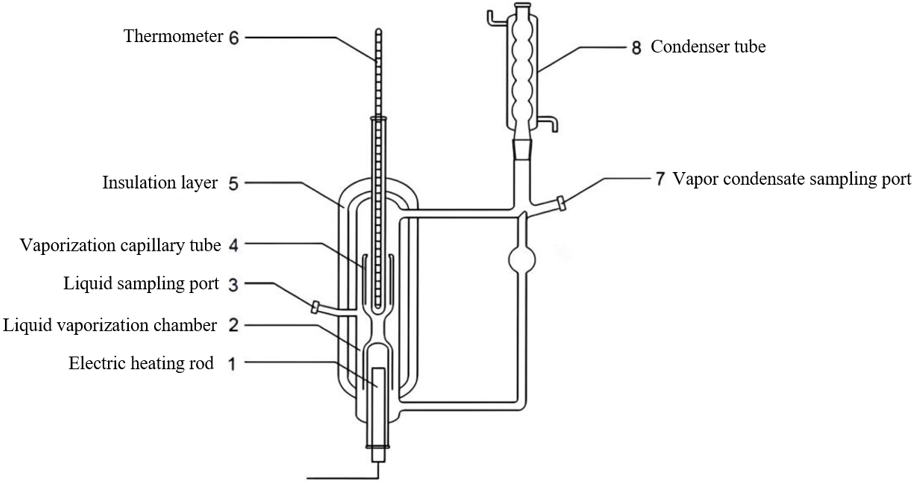
Furfural was selected as the entrainer. With the aid of an Othmer vapor-liquid equilibrium still (Figure 1), the vapor-liquid equilibrium (VLE) data of the EtOH-DMC binary system at a pressure of 101.3 kPa were obtained to estimate the VLE data of the EtOH-DMC-furfural ternary system.
Figure 1. Vapor-liquid equilibrium still
The experimental equipment consists of a heating module, a vapor-liquid equilibrium device, and a condensation reflux module, equipped with a Proportional-Integral-Derivative (PID) temperature control system. The core experimental instrument is the Othmer equilibrium still. The complete experimental setup offers advantages such as simple operation procedures, precise and stable temperature control, and high reliability of measured data.
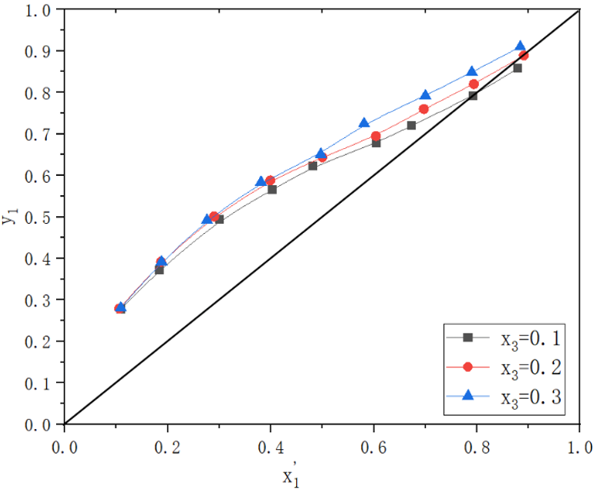
Based on the data in the tables above, the separation of ethanol and dimethyl carbonate at different concentrations for this system was plotted under a pressure of 101.3 kPa. As can be seen from the figure, after adding furfural as the entrainer, the y1-$x_1^{\prime}$ behavior of the ethanol-dimethyl carbonate system changes.
As the amount of furfural added increases, the azeotropic point of the system gradually shifts and eventually disappears. As can be seen from the figure, when x3 = 0.3, the azeotropic point of EtOH-DMC disappears. In addition, from the observation results of Figure 2, it can be seen that when the ethanol content in the mixture is high, the entrainer exhibits stronger extraction capacity; whereas in the region where ethanol content is low, the extraction effect is relatively limited. Experimental data indicate that the introduction of the entrainer furfural can effectively break the azeotropic phenomenon of the EtOH-DMC binary system, and as the amount of entrainer added increases, its effect on breaking the azeotrope of the system shows an enhancing trend.
Figure 2. x-y phase diagram of the ethanol (EtOH)-Dimethyl carbonate (DMC)-furfural system at atmospheric pressure
Simulation was performed using Aspen Plus. Taking x3 = 0.1 as an example, the vapor-liquid equilibrium data were regressed, and the binary interaction parameters were calculated via the UNIQUAC equation. The results are shown in Table 5.
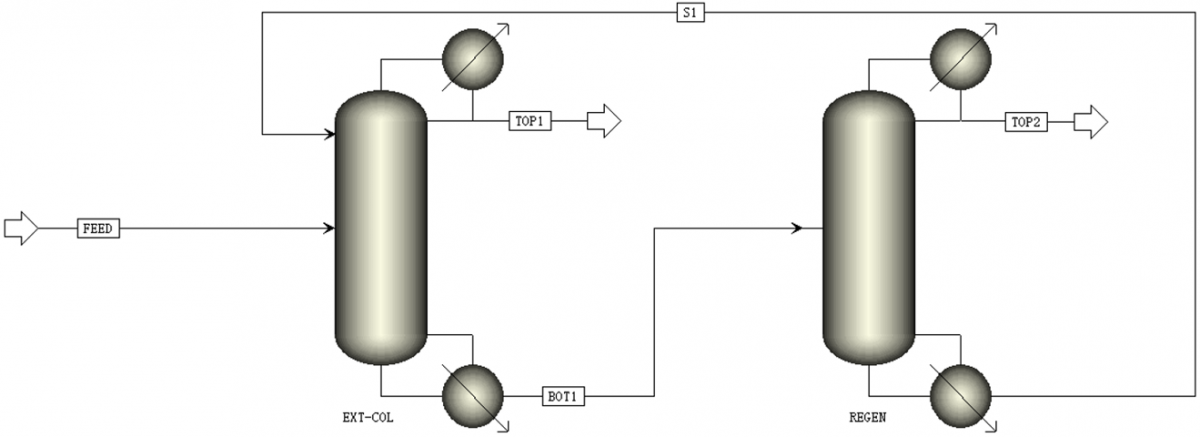
To achieve the industrial separation of the EtOH-DMC system, a dual-column extractive distillation process was set up as shown in Figure 3, consisting of an extractive distillation column (EXT-COL) and a solvent recovery column (REGEN) operating in tandem to complete the separation task. The simulation conditions were defined as follows: the total feed of the EtOH-DMC mixture was 100 kmol/h, with ethanol and dimethyl carbonate each accounting for 50 mol%. Corresponding separation indicators were also set, namely that the ethanol product purity must be greater than 99.9 mol% and the DMC product purity must also be greater than 99.9 mol%.
Table 5. Vapor-liquid equilibrium (VLE) data for the Ethanol (1)–Dimethyl carbonate (2)–Furfural (3) system at x3 = 0.1
|
Temperature (K) |
Pressure (kPa) |
x1 |
x2 |
x3 |
y1 |
y2 |
y3 |
|
351.69 |
101.3 |
0.791 |
0.109 |
0.1 |
0.858 |
0.142 |
0 |
|
351.51 |
101.3 |
0.714 |
0.186 |
0.1 |
0.792 |
0.208 |
0 |
|
351.37 |
101.3 |
0.606 |
0.294 |
0.1 |
0.72 |
0.28 |
0 |
|
351.48 |
101.3 |
0.544 |
0.356 |
0.1 |
0.678 |
0.322 |
0 |
|
352.04 |
101.3 |
0.434 |
0.466 |
0.1 |
0.622 |
0.378 |
0 |
|
352.77 |
101.3 |
0.362 |
0.538 |
0.1 |
0.565 |
0.435 |
0 |
|
354.18 |
101.3 |
0.271 |
0.629 |
0.1 |
0.494 |
0.506 |
0 |
|
356.81 |
101.3 |
0.165 |
0.735 |
0.1 |
0.372 |
0.628 |
0 |
|
359.92 |
101.3 |
0.098 |
0.802 |
0.1 |
0.278 |
0.722 |
0 |
Figure 3. Dual-column extractive distillation process flow
The simulation of the EtOH-DMC extractive distillation process was carried out, and a multi-parameter optimization of the simulation flow was performed. By systematically adjusting the operating parameters (such as entrainer type/amount, reflux ratio, number of theoretical stages, feed location, etc.) and equipment parameters of the extractive distillation, the optimal balance point among separation efficiency, energy consumption, stability, and economy was found, ultimately realizing the high efficiency, energy saving, and industrial application of the process.
This paper aims to minimize the Total Annual Cost (TAC). Using the sequential iterative optimization method built into Aspen, economic optimization was performed on a total of 7 parameters, including the number of theoretical stages (NT1, NT2), feed stages (NFS1, NFT2), entrainer amount (S1), and column internals, thereby obtaining the operating parameters of the distillation columns when the TAC is minimized (Table 6).
The entrainer amount S1 was placed in the outermost loop of the cyclic iteration. This is based on its significant impact on the key parameters of the system. When S1 is small, the relative volatility of EtOH-DMC decreases, causing the reflux ratio of the extractive distillation column to increase and energy consumption to rise. Conversely, when S1 is too large, although the reflux ratio of the extractive distillation column decreases, the bottom liquid amount of the solvent recovery column increases, which raises the reboiler duty of that column and the load of the entrainer circulation cooler, ultimately driving up the TAC. Setting S1 in the outermost loop for iteration can significantly reduce the number of calculations, lower the probability of program errors, and improve optimization efficiency.
Table 6. Optimized model parameters
|
Name |
Column EXT-COL |
Column REGEN |
|
Entrainer flow rate kmol/h |
100 |
- |
|
NT |
58 |
23 |
|
NF |
45 |
10 |
|
NFS |
8 |
- |
|
R |
1 |
2 |
In industry, as the number of feed stages gradually increases, the reboiler duty of the column bottom first shows a decreasing trend and then begins to climb again. When QR reaches its minimum value, NFT1 is 45, NFS1 is 8, and NFT2 is 10. This trend stems from the synergistic effect of mass transfer thermodynamics and fluid mechanics: at the optimal feed stage location, the composition distribution of the material inside the column highly matches that of the feed stream, effectively suppressing the axial back-mixing phenomenon caused by the feed. However, when the feed stage deviates from the optimum, the compositional difference between the two leads to a significant concentration gradient, intensifying the degree of material back-mixing and consequently disrupting the stable vapor-liquid mass transfer process within the column, causing the separation efficiency of the distillation column to drop. To compensate for the loss in mass transfer efficiency and achieve the desired separation accuracy, the reflux ratio must be increased to enhance the separation effect, ultimately leading to an increase in reboiler heat duty and system energy consumption. Therefore, the core of feed stage optimization lies in determining the optimal feed location for each column through theoretical calculations and simulation analysis, minimizing the interference of non-ideal flow on the mass transfer process, and ensuring the distillation system operates at its thermodynamically optimal efficiency. Regarding the number of theoretical stages, the trend for both the extractive distillation column and the solvent recovery column is basically the same. As the number of theoretical stages increases, the TAC shows a trend of first decreasing and then increasing. When NT1 is 58 and NT2 is 23, the TAC reaches its minimum value.
This paper mainly studied the separation of EtOH and DMC azeotrope. By comprehensively using methods such as experimental research, model correlation, and process simulation optimization, the following results were obtained:
(1) In the entrainer selection stage, referring to the classification system and selection criteria of entrainers, the UNIFAC group contribution method was used to conduct quantitative analysis and testing on various organic solvents. Experiments showed that furfural was the entrainer for this study. When furfural was added at a solvent ratio of 0.5, the azeotropic characteristic disappeared immediately.
(2) Under a constant pressure of 101.3 kPa, an Othmer vapor-liquid equilibrium still was used to accurately measure the vapor-liquid equilibrium data of the EtOH-DMC binary system and the EtOH-DMC-furfural ternary system. The UNIQUAC activity coefficient model was used to regress the experimental data, and the corresponding activity coefficient model parameters were obtained.
(3) Aspen Plus software was used to construct a dual-column extractive distillation simulation process. Through the study of the separation characteristics of the EtOH-DMC binary system, reasonable feed conditions and separation indicators were set. At the same time, key parameters such as the number of theoretical stages, feed stage location, and entrainer amount were optimized. The purities of both ethanol and DMC products were achieved to be greater than 99.9 mol%, and high-purity recovery of furfural from the bottom of the solvent recovery column was realized.
[1] Keller, T., Holtbruegge, J., Niesbach, A., Górak, A. (2011). Transesterification of dimethyl carbonate with ethanol to form ethyl methyl carbonate and diethyl carbonate: A comprehensive study on chemical equilibrium and reaction kinetics. Industrial & Engineering Chemistry Research, 50(19): 11073-11086. https://doi.org/10.1021/ie2014982
[2] Yang, A., Sun, S., Shi, T., Xu, D., Ren, J., Shen, W. (2019). Energy-efficient extractive pressure-swing distillation for separating binary minimum azeotropic mixture dimethyl carbonate and ethanol. Separation and Purification Technology, 229: 115817. https://doi.org/10.1016/j.seppur.2019.115817
[3] Liu, K., Wang, Z., Zhang, Y., et al. (2019). Vapour-liquid equilibrium measurements and extractive distillation process design for separation of azeotropic mixture (dimethyl carbonate+ ethanol). The Journal of Chemical Thermodynamics, 133: 10-18. https://doi.org/10.1016/j.jct.2019.01.027
[4] Wang, P., Yan, P., Reyes-Labarta, J.A., et al. (2019). Liquid-liquid measurement and correlation for separation of azeotrope (dimethyl carbonate and ethanol) with different imidazolium-based ionic liquids. Fluid Phase Equilibria, 485: 183-189. https://doi.org/10.1016/j.fluid.2018.12.034
[5] Zhang, Z., Lu, R., Wang, C., Zhang, Q., Chen, J., Li, W. (2020). Separation of the dimethyl carbonate+ ethanol mixture using imidazolium-based ionic liquids as entrainers. Journal of Chemical & Engineering Data, 65(4): 1705-1714. https://doi.org/10.1021/acs.jced.9b01021
[6] Qiao, R., Yue, K., Luo, C., Jin, J., Ren, Z., Li, Q. (2018). Effect of bis (trifluoromethylsulfonyl) imide-based ionic liquids on the isobaric vapor-liquid equilibrium behavior of ethanol+ dimethyl carbonate at 101.3 kPa. Fluid Phase Equilibria, 472: 212-217. https://doi.org/10.1016/j.fluid.2018.05.024
[7] Pereiro, A.B., Araújo, J.M.M., Esperança, J.M.S.S., Marrucho, I.M., Rebelo, L.P.N. (2012). Ionic liquids in separations of azeotropic systems–A review. The Journal of Chemical Thermodynamics, 46: 2-28. https://doi.org/10.1016/j.jct.2011.05.026
[8] Liu, X., Xu, D., Diao, B., et al. (2019). Choline chloride based deep eutectic solvents selection and liquid-liquid equilibrium for separation of dimethyl carbonate and ethanol. Journal of Molecular Liquids, 275: 347-353. https://doi.org/10.1016/j.molliq.2018.11.047
[9] Lei, Z., Dai, C., Zhu, J., Chen, B. (2014). Extractive distillation with ionic liquids: A review. AIChE Journal, 60(9): 3312-3329. https://doi.org/10.1002/aic.14537
[10] Sun, C., Zhang, Y., Qu, Y., et al. (2022). Liquid–liquid equilibrium experiment and mechanism study on the system of dimethyl carbonate+ n-propanol+ ionic liquids. Journal of Chemical & Engineering Data, 67(10): 3165-3176. https://doi.org/10.1021/acs.jced.2c00497
[11] Qi, J., Qu, Y., Zhou, M., et al. (2023). Phase behavior and molecular insights on the separation of dimethyl carbonate and methanol azeotrope by extractive distillation using deep eutectic solvents. Separation and Purification Technology, 305: 122489. https://doi.org/10.1016/j.seppur.2022.122489
[12] Song, Y., Wang, Y., Zhang, X., Cai, W. (2021). Isobaric vapor–liquid equilibrium measurements of binary systems of dimethyl carbonate with dimethyl sulfoxide, anisole, and diethyl oxalate at 101.3 kPa. Journal of Chemical & Engineering Data, 66(3): 1367-1375. https://doi.org/10.1021/acs.jced.0c00998
[13] Sun, X., Yang, A., Zhang, J., Lei, Z., Pan, C. (2026). Efficient separation of acetonitrile/ethanol/water using ionic liquid: Molecular thermodynamic and process intensification. Industrial & Engineering Chemistry Research, 65(31): 16803-16817. https://doi.org/10.1021/acs.iecr.6c02274
[14] Sanap, P.P., Devale, R.R., Mahajan, Y.S. (2026). Simulation and experimental validation of separation of dimethyl carbonate-ethyl alcohol azeotropic mixture using extractive distillation. Sādhanā, 51(4): 279. https://doi.org/10.1007/s12046-026-03264-9
[15] Marcilla, A., Oliver, I., Moncur, L., Carbonell-Hermida, P., Olaya, M.D.M. (2024). Analysis of vapor–liquid equilibrium in ternary systems for an adequate planning of their experimental determination and correlation. Journal of Chemical & Engineering Data, 69(10): 3462-3471. https://doi.org/10.1021/acs.jced.3c00712
[16] Du Plessis, S.H., Latsky-Galloway, C., Schwarz, C.E. (2022). Experimental measurement and PSRK and NRTL modeling of binary 1-Alcohol (C m)+ n-Alkane (C m+ 3) Vapor–liquid equilibrium data. Journal of Chemical & Engineering Data, 67(8): 1915-1931. https://doi.org/10.1021/acs.jced.1c00915
[17] Seyf, J.Y., Flasafi, S.M., Babaei, A.H. (2021). Development of the NRTL functional activity coefficient (NRTL-FAC) model using high quality and critically evaluated phase equilibria data. 1. Fluid Phase Equilibria, 541: 113088. https://doi.org/10.1016/j.fluid.2021.113088
[18] Souza, G.A., Silva, L.Y., Martinez, P.F. (2021). Vapour-liquid equilibria of systems containing deep eutectic solvent based on choline chloride and glycerol. The Journal of Chemical Thermodynamics, 158: 106444. https://doi.org/10.1016/j.jct.2021.106444
[19] Parsana, V.M., Parekh, U., Dabke, S.P., et al. (2020). Isobaric vapor–liquid equilibrium data of binary systems containing 2-ethoxyethanol, 2-ethoxyethyl acetate, and toluene. Journal of Chemical & Engineering Data, 65(10): 4798-4804. https://doi.org/10.1021/acs.jced.0c00291
[20] Xu, J., Li, S., Zeng, Z., Xue, W. (2020). Isobaric vapor–liquid equilibrium for binary system of isoamyl dl-lactate and isoamyl alcohol at 25.0, 50.0, and 101.3 kPa. Journal of Chemical & Engineering Data, 65(1): 81-87. https://doi.org/10.1021/acs.jced.9b00757