Hussain Saad Abd | Salah H. Abid Aun | Sundus S. Al-Azawiey | Ameer Abed Jaddoa | Issa Omle* | Jafaar Mohammed Daif Alkhasraji
© 2025 The authors. This article is published by IIETA and is licensed under the CC BY 4.0 license (http://creativecommons.org/licenses/by/4.0/).
OPEN ACCESS
Improved system performance is always welcome. Most simple solar water heaters (SWH) have a thermal efficiency of 50% to 60%. This study analyses how inserts like twisted tapes improve flat plate collector efficiency in a modified SWH under natural convection. Experiments were done in Baghdad, Iraq, at 33.34ºN and 44.43ºE to evaluate the effectiveness of a flat plate collector in a modified SWH with various inserts. The use of convoluted tapes in all-glass evacuated tube SWHs to increase system performance. Different twist configurations of tape were used for investigation. Standard, evenly spaced, triangular-cut, rectangular-cut, and semicircular-cut, drilled and twisted components, 1.2 m long and 50 mm wide. Twisted copper tapes. A passive flow SWH was tested in six modes under different solar isolation and ambient circumstances. All-glass evacuated tube SWH efficiency increased 9.7%, 8.6%, 6.3%, 5.4%, 4.9%, and 4.3%.
SWH system, evacuated tube, twist tape, solar energy, thermal efficiency
Solar water heating is a significant method for decreasing electrical energy usage and pollution. The substantial initial expense of the SWH system is regarded as a major obstacle to its extensive adoption. The SWH system typically consists of a solar collector, water tank, pipelines, control valve, and pump. They may be categorised into two types: free flow collectors and forced flow collectors. In the free type, water will circulate multiple times daily, with each cycle resulting in a minor increase in temperature [1, 2]. Consequently, this technique does not facilitate the preparation of hot water at a specified temperature in the early morning and necessitates an extended duration to achieve the desired temperature. Howe Nevertheless, a pump regulates the forced type, augmenting the fluid flow to get a higher number of cycles. By choosing an appropriate pump flow rate, this system can attain the necessary temperature more rapidly than the unrestricted system. Various strategies are employed to enhance the efficiency of SWH systems by minimising surface area and material expenses, as well as decreasing the thermal transfer differential. This diminishes external irreversibility. The vortex flow generated by twisted tape affects fluid dynamics within the pipe, enhancing mixing and increasing the heat transfer (HT) coefficient. Consequently, the optimal outcome is contingent upon the quantity of twists along the tape, as the pipe's efficiency enhances with an increase in the number of twists [3, 4]. Nonetheless, the incorporation of twisted tapes presents advantages, yet it also results in elevated material and manufacturing costs, along with increased flow resistance. It is essential to ascertain the appropriate number of twists to meet the objective without elevating costs or obstructing flow. Twisted tape heat exchangers surpassed conventional tube heat exchangers in the study of Tikhe and Andhare [5]. Twisted tapes elevated HT. As tape width diminished, Nusselt numbers (Nn) declined. Thinner tapes can conserve 15% of material at elevated Reynolds numbers (Rn). An empirical study analysed experimental outcomes of a variable header SWH system [6, 7]. Results indicate that a variable header maintained uniform speed across all lift tubes. The thermal performance is enhanced with a moveable header. Experimental results indicated that twisted tape, whether at full width or 75% width, enhanced thermal efficiency by 4.5 to 8%, with the 75% width tape demonstrating greater improvement [8]. In the study designated by Piriyarungrod et al. [9], the authors examined heat transfer (HT), friction factor (FF), and thermal performance of heat exchanger (HE) tubes employing twisted tapes as swirl generators in turbulent flow, with Reynolds numbers ranging from 7500 to 13000, while sustaining a constant wall heat flux. Five permissible width ratios were established with a defined twist. The statistics indicated a rise in the ratio of the twisted tape's breadth. As Nn and Rn were augmented, the tape width ratio diminished, resulting in a fall in FF. Numerical simulations in the studies of Prasanna et al. [10] and Mahdi et al. [11] assessed the heat transfer and flow performance of solar water heaters fitted with twist tape at various initial temperatures during the experiment. The application of twist tape inserts decreased velocity and standardised temperature. The twisted tape enhanced heat transfer even at elevated temperatures. Nn was influenced by the width of the twist. Numerical analyses of fluid flow dynamics in turbulent forced convection were conducted by the previous studies within three-dimensional tubes including twisted tape [12, 13]. The finite volume approach employs the RNG k-ε turbulence model. Parametric simulations need the use of diverse free-space ratios for Rn, ranging from 5000 to 15000. The tube featuring uniformly spaced overlap duple twisted tape and a minimal free space ratio of 0.2 demonstrated a high temperature (HT) rate that exceeded the typical tube by 180%. Furthermore, it surpassed tubes equipped with twin twisted tapes, which were appropriately spaced with space ratios of 0.3 and 0.4, by margins of 3.1% and 4.0%, respectively. The previous studies indicate that the heat transfer rate is influenced by tapered twisted tapes, including their taper angle in relation to the twist ratio, the thermal performance factor, and the pressure drop [14, 15]. The study employed four taper angles and three twist ratios, utilising tapered and twisted tapes. Enhancing heat transmission and reducing friction loss were accomplished by lowering the twist ratio and taper angle. A reduction in the tape twist ratio and an elevation in the taper angle both led to an enhancement in the thermal performance factor. Left-right twisted tape was employed in a V-V trough thermosyphon solar water heater, with researchers assessing its average beneficial heat gain, thermal efficiency, and Rn [16. 17]. The researchers compared these metrics with those of a conventional collector. The data indicates that thermal efficiency, heat gain, and Rn increased by 1.5, 3.5, and 1.6, respectively, above V, consistent with the trough collector. An investigation was conducted on a pipe equipped with a single twist tape using a parabolic trough collector (PTC) [18, 19]. A fundamental absorber incorporating twisted tape was evaluated for Nn across varying solar light intensities. Both associations exhibited errors below 20%. In the case of parabolic trough collectors, the correlation utilised is more pertinent than the Nn correlations based on uniform heat flux. Construct an evacuated tube solar water heater. The thermal performance was evaluated both with and without the presence of twisted tape. Research indicates that evacuated tubes equipped with twisted tape exhibit elevated outlet temperatures. Analysis of thermal-hydraulic performance and flow dynamics in circular pipes incorporating various cut shapes of twisted tapes under turbulent flow conditions [20]. Single and double cuts employed rectangular slices with varying cut ratios. Analyse the impact of core and wall effects on heat transfer and pressure loss. The rectangular-cut twisted tape enhances fluid mixing and centrifugal force along the wall, influencing FF and HT. The research indicated that the cutting ratio influences both pressure drop and heat transfer (HT). Investigated the impact of twisted tape pitch and height on the efficiency of evacuated tube solar water heaters. Reduced water retention durations marginally improve flow rate and temperature. The short pitch tape exhibited greater turbulence compared to the long pitch tape. This increases temperatures, enhancing SWH efficiency. Arun et al. [21] evaluated the thermal efficacy of twisted tape inserts through the application of vortex kinematics. An experimental SCO₂-water-cooled opposite-flow pipe-in-pipe heat exchanger was designed featuring three distinct rotation ratios. This study simulated the convective heat transfer of supercritical CO2 in a three-dimensional hydrodynamic environment utilising twisted tape inserts and ANSYS CFX. This study examines the influence of input pressure, wall heat flux, mass flow, and twisted ratio on the performance of helium. The findings demonstrated that twisted tape inserts enhanced heat transmission efficacy by a factor of two to three compared to water or airflow. Nevertheless, the enhancement significantly decreased on both sides of the measurement point. The study determined that, although the optimal twist ratio is contingent upon the SCO2 operating conditions, a ratio of 3.78 was effective in the majority of instances. This study investigates the effects of a novel twisted tape arrangement in heat exchanger tubes. The twisted tape serves as a turbulator in turbulent flow conditions, while hybrid nanofluids composed of Al2O3 and CuO mixed with distilled water function as the working fluid. The application of twisted tape enhanced heat transfer, with double v-cut twisted tape demonstrating superior performance compared to standard twisted tape. The incorporation of twisted tape into the SWH and its effects on the Nusselt number and Reynolds number were examined by Malec et al. [22]. The results indicated that both the Nusselt number and Rn increased with the application of twisted tape, with the most significant increase observed at a twisted tape ratio of 5. This phenomenon can be attributed to the enhanced input velocity and the improved efficiency of the system. Twisted tapes come in a wide variety of shapes and constructions, and their use is widespread. Here, the most often used twisted tape geometries will be covered. Twisted tapes that are full length are the same length as the test segment. Many papers dealt with the solar tube, such as full-length twisted tape that has been used in solar water heaters, spirally grooved tubes, corrugated pipes, horizontal circular tubes with ethylene glycol as media, horizontal double pipes with water, full-length twisted tape with Al2O3 nanofluid, and full-length twisted tape in combination with conical rings [23]. Full-length twisted tapes were also utilised in studies by other researchers. These are different from regular twisted tape in that they are shorter than the test section's length, such as 1/4, 1/2, or 3/4 of the test section's length, specifically to minimise pressure drop [24]. Short-length twisted tapes were employed by the researcher [25] in a circular tube filled with heated air. These are short tapes with varying pitches that relate to the appropriate spacer rods. Twisted tapes that are regularly spaced have been employed in solar water heaters [26], double pipe heat exchangers with hot water, and with spacers at the trailing edge of left-right twisted tape. To accomplish further amplification, baffles are occasionally affixed to the twisted tape. Straight delta winglet twisted tapes were employed with water [27], and twisted tape with baffles in a rectangular channel with air [28]. Slotted tapes, tapes with holes, and tapes with perforations. The twisted tape is manufactured with slots and holes of the right size to increase turbulence. Perforated tape with air has also been tested [24], as has trapezoidal sliced twisted tape in a circular tube with water as the medium. To prevent the fin effect, some insulating material is included on tapes. Sometimes tape is made from material with a dimpled surface. Twisted tapes in a circular tube that are broken [29]. The study of Al-Mamun et al. [30] shows twisted tapes that have been sliced on the periphery and have an alternate axis in a twin pipe heat exchanger. The primary causes of insert-induced heat transfer amplification in a tube flow are flow obstruction, flow partitioning, and secondary flow. As a result of a decreased free flow area, flow obstruction raises the pressure drop and intensifies viscous effects. Additionally, blockage raises secondary flow and flow velocity. Furthermore, secondary flow improves the thermal contact between the fluid and the surface by generating swirl and improving the temperature gradient through fluid mixing, which in turn results in a high heat transfer coefficient. Inserts of twisted tape create a radial pressure gradient and swirl. As radial swirl and pressure increase, the boundary layer along the tube wall becomes thinner, increasing the amount of heat that passes through the fluid. The swirl creates turbulence in the flow, which improves convection heat transfer even further. The heat transfer rate goes up because of the sideways movement of the fluid, the smaller area for the flow, and the mixing of the fluid near the wall and in the centre, all caused by the centrifugal force. When placed within tubes, twisted tapes tend to increase turbulence and the mixing of the hot and cold fluids. This in turn improves the heat transfer process, but it may also significantly increase the pumping power required, leading to higher costs. When a twisted tape is inserted into a circular tube, the flow field changes in a number of ways. First, the blockage and decrease in net free cross-sectional area cause the axial velocity and wetted perimeter to increase, which reduces the hydraulic diameter. Second, the helically twisting partitioned duct has a longer effective flow length. Finally, the secondary fluid circulation or swirl is caused by the tape's helical curvature. The most prevalent process is swirl production, which promotes increased fluid mixing and higher heat transfer coefficients by affecting transverse fluid movement over the tape-partitioned duct. Computational simulations and experimental flow visualisation have been used to characterise the growth and structure of this tape-induced swirl in the laminar flow domain. The better heat transfer from flow blockage and the longer path, along with the growing boundary layer and additional flow caused by free convection, and the swirl effects are not significant in the laminar area where the Reynolds number is very low. The axial flow is layered with swirl flow as the Re rises. The centrifugal forces counter the fluctuations that define the transition region. As a result, the friction factor–Reynolds number curve discontinuity that was typical of plain tubes is no longer present. However, when there is fully developed turbulent swirl flow, which happens at a Reynolds number greater than 10,000, the mixing caused by the swirls greatly improves heat transfer. Because of the different vorticity distributions in the vortex core, the continuous twisted tape insert in a tube creates swirls that alter the near-wall velocity profile. The pair of swirls in the tube with a twisted tape insert for turbulent flow is marked by a very even flow speed in the shape of vortexes that can be found in any cross-section of the tube. The mixing of the fluid between the centre of the duct and the area close to the walls gets better because of the sideways flow created by the swirls. The fin effect, the lengthened twisted flow path, and the partitioning and obstruction of ducted flow all contribute to the additional heat transfer advantages obtained by putting the twisted tape in a tube. In a tube with a twisted tape insert, the shear stress and pressure drag increase in tandem with the swirl-induced heat transfer augmentation.
This study aims to evaluate the impact of six twisted tapes on the performance of SWH pipes. Twisted tape enhances SWH performance; however, it simultaneously increases costs and obstructs fluid flow, which diminishes overall performance and elevates energy consumption. Therefore, the optimal twist count should be established to achieve maximum performance, cost efficiency, and fluid flow. Six tape types—normal, regularly spaced, triangular-cut, rectangular-cut, semicircular-cut, and drilling twisted—were measured at 1.2 m in length and 50 mm in width to examine the changes resulting from increased twisting. Tapes were placed within SWH copper pipes. Analyse the results from various pipes to evaluate the impact of twisted tapes on the water temperature and SWH efficiency. The research was conducted over a four-month period in Baghdad, Iraq, from September to December. Out of the 120 days, nine experienced continuous sunlight without any power disruptions.
2.1 Experimental set-up
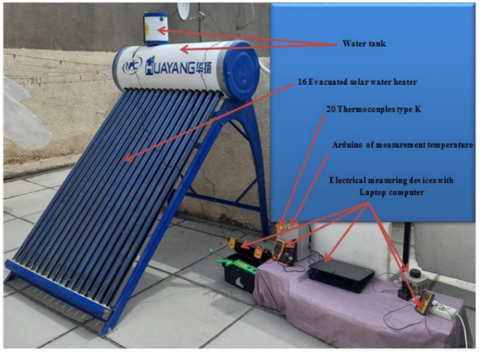
Integrates solar energy with a I possess a 200-litre storage tank and sixteen standard evacuated tubes. The SWH's stainless steel tank was constructed from a 0.9 mm thick sheet, while the evacuated tubes measured 6 cm in diameter, 4 cm in internal diameter, and 200 cm in length, all sourced from the local market. The double-layered cylindrical tank contains sixteen circular openings for the insertion of evacuated tubes. The SWH was equipped with the requisite instruments to collect the essential data, as depicted in Figure 1. Twenty K-type thermocouples were employed to measure temperature at designated sites, with an accuracy of ±0.1℃. To obtain an average temperature measurement, six thermocouples were immersed in the tank's water. The air temperature was assessed via a solitary thermocouple. The KHLMN1256 type, a precise solar radiation meter, was installed, capable of measuring solar radiation to within 2 W/m2. The digital measurements were acquired by combining a multipoint indication with the thermocouples. The Arduino Mega 2560 board incorporates an ATmega 2560 CPU. A total of 54 digital output/input pins are available, comprising 14 pins that generate PWM signals and 16 analogue inputs. All components on the board support the CPU. An external power supply or a USB port may be automatically selected to power the Arduino Mega. Alternative power sources to USB comprise batteries and adapters. Arduino may operate within a voltage range of 6 to V. The ATmega 2560 can store 256 KB of data. The 54 digital pins function as inputs or outputs, enabled by the pin mode capabilities of digital read and digital write. They operate at a voltage of five volts. Each port can provide or receive a maximum of 40 milliamperes, attributed to its integrated pull-up resistor. Furthermore, specific connectors fulfil distinct roles: The serial communication protocol functions to transmit (TX) and receive (RX) serial data. The USB connection is linked to port 0, while the serial chip is connected to port 1. These ports can be configured to initiate an external interrupt in response to a low-value situation, a falling or rising edge, or a change in value. Employ pulse width modulation (PWM) to produce an 8-bit output. The ports enable SPI communication. Digital pin 13 features an integrated LED. "I2C" denotes "communication using the Wire Library". The Mega2560 can accommodate 124,000 potential values through its sixteen analogue inputs, each featuring a ten-bit resolution. Analogue input reference voltage, abbreviated as AREF. Prior to resetting the microcontroller, the line must be configured to a low state. The Arduino Mega 2560 has many communication techniques with other Arduinos, PCs, or microcontrollers. Arduino features four UARTs for TTL serial communication. Arduino programming includes a serial monitor that enables the transfer of fundamental printed data to a PC. When information is transmitted from the PC using the ATmega8U2 chip and USB, the RX and TX LEDs on the board will light up and turn off. It is compatible with SPI and I2C protocols. The MAX6675 serves both as a cold-junction compensation device and as a converter that transforms the output signal of a K-type thermocouple into a digital format. The data is presented in a format compatible with SPI and is designated as read-only. The format's precision is 12 bits. This converter accommodates temperatures ranging from 0.25 degrees Celsius to 1024 degrees Celsius. The MAX6675 incorporates cold-junction correction, accounting for variations in the surrounding environmental temperature. The circuit converts ambient temperature data into voltage by utilising a temperature sensor diode. The MAX6675 determines the precise temperature of the thermocouple by analysing the voltage between its output and the sensor diode. The thermocouple detects voltage, reflecting the measured temperature, and subsequently converts this voltage through the ADC's conversion function. The following paragraphs will demonstrate that the calculations were conducted in accordance with the recommendations.
Figure 1. Installed evacuated tube type SWH
The available stored energy is expressed as:
$\begin{aligned} & Q_{ {useful\ stored\ energy }}=m_{ {mass\ of\ water }} \times C_{{specificheat }} T_{{final\ temperature\ of\ water }} \times C_{ {specificheat }} T_{{initial\ temperature\ of\ water }}\end{aligned}$ (1)
Energy efficiency can be computed as follows:
$\begin{aligned} & Q_{ {Input\ energy }}=A_{{collector\ area }} \times H_{ {hourly\ incident\ solar\ insolation }}\end{aligned}$ (2)
Energy efficiency can be computed as follows:
$\eta=Q_{ {useful\ stored\ energy }} / Q_{ {Input\ energy }}$ (3)
2.2 Fabrication of twisted tapes
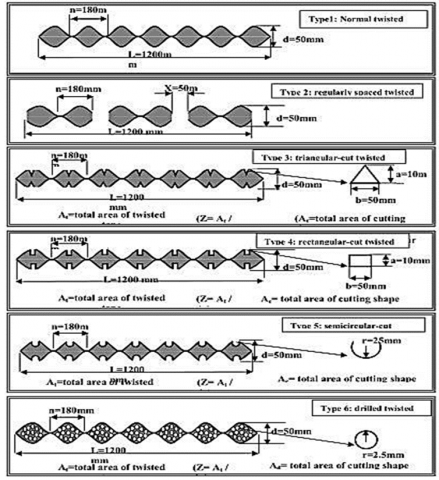
Figure 2 illustrates, through measurements and drawings, the six distinct types of twisted tape utilised in the test section tube of the current study: regular, regularly spaced, triangular-cut, rectangular-cut, semicircular-cut, and drilled twisted tape. The aluminium strips utilised for the fabrication of these twisted tapes have dimensions of 50 mm in width and 2 mm in thickness. The twist ratio (TR) is defined as the pitch length (s) divided by the inner diameter (d) of a tube. To enhance fluid mixing along the test area wall, the upper and lower sections of the tape were alternately covered with triangular, rectangular, and semicircular shapes. The input and output bulk temperatures were averaged to determine the fluid properties. The experiment was conducted under continuous heat flux conditions for both the implanted and non-implanted groups.
Figure 2. Categories of twisted tape utilised in the current study
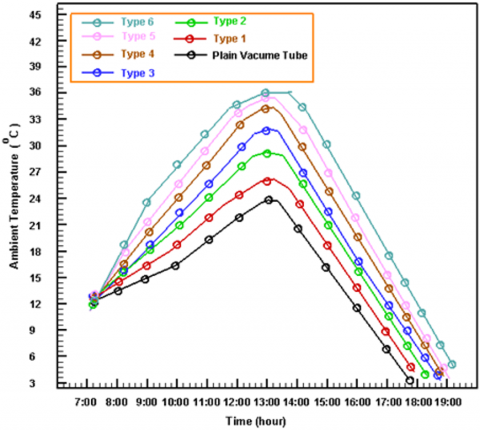
The experimental trials were conducted from September 2023 to December 2023, between 7:00 a.m. and 7:00 p.m. Measurements were recorded every 60 minutes for subsequent analysis. One series of seven trials employed untwisted tapes, whereas the second series utilised six twisted cassettes. The obtained data were verified for accuracy and repeatability by doing each experimental set for a minimum of seven days. Subsequently, days with similar levels of solar radiation and environmental conditions were selected for additional investigation. The external temperature fluctuated during the experiment, as illustrated in Figure 3. The testing days featured an average ambient temperature of around 30.8℃. The maximum recorded temperature was almost 37.3℃, while the minimum was roughly 12℃. The temperature remained pleasant during the entire three-month period.
Figure 3. Ambient temperature during the different twisted tapes
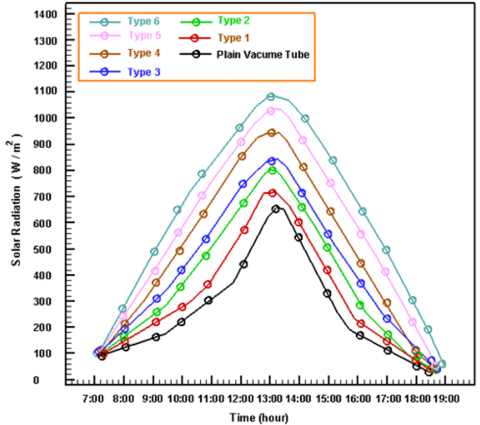
Figure 4 presents an instance of the solar insolation pattern observed during the investigations. During all experiments, the mean solar radiation was recorded at 780 W/m2. Throughout the studies, the maximum recorded sun radiation was roughly 1100 W/m2, seen at one of the hours in the afternoon. Concerning solar thermal energy, the total energy available throughout the trial days was around 29,000 kJ per day.
Figure 4. Solar insolation during the different twisted tapes
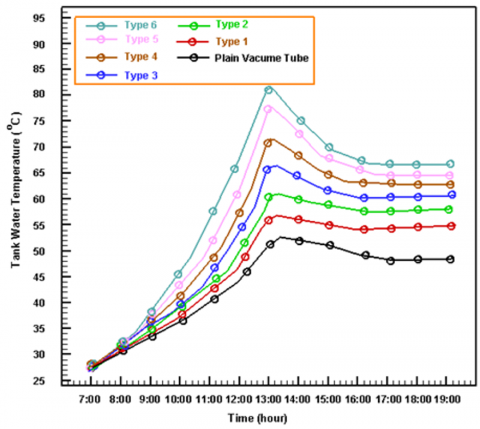
The water temperature in the tank exhibits a consistent slope across all operational modes, including both the absence of twisted tapes and the presence of twisted tapes with six different twist ratios, as illustrated in Figure 5. The of the hot water achieved for the plain vacuum tube and six distinct configurations of twisted maximum temperatures tapes at the end of the days are 53.6℃, 56.7℃, 60.4℃, 66.4℃, 71.6℃, 77.8℃, and 82.4℃, respectively. Twisted him vacuum tubes, facilitating the mixing of tube water to optimize solar energy tapes clearly induce turbulent flow wit conversion into heat. The twisted tape with twist type 6 produced superior results compared to other twisted tape turbulence generated by the twisted tape. The increase in configurations. The geometry of the twist shape influences the twist and geometric shape type may lead to a reduction in turbine efficiency, thereby affecting the overall performance geometric configuration are advisable for of the system. Therefore, twisted tapes exhibiting minimal twist and a circular enhanced HT.
Figure 5. Ambient temperature during the different twisted tapes
Figure 6 illustrates the quantity of sensible heat energy retained in the water tank of the evacuated SWH system. The accumulated energy reached its zenith around 1:00 p.m. following a slow ascent throughout the morning. By 7:00 a.m., solar insolation reached its nadir, resulting in minimal energy storage. All operational modes attained optimal energy recovery by 1:00 p.m. The results indicate that twisted tapes exhibit a superior energy recovery rate. Moreover, variety 6 twisted tape provided a greater contribution than any other variety.
Figure 6. Solar insolation during the different twisted tapes
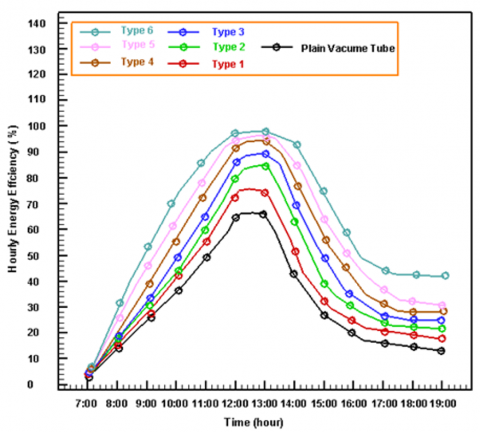
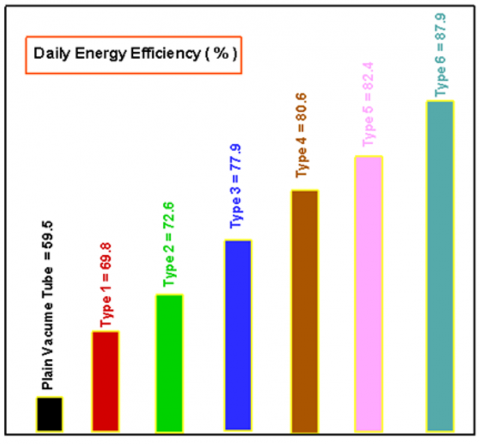
Figure 7 presents the hourly energy efficiency across the six distinct modes of operation. The peak efficiency was measured between 12:00 and 3:00. This occurred because solar insolation levels were at their peak during this period. All situations attained their peak efficiency at one of the clock in the afternoon. The twisted type 6 exhibited a greater variation compared to the other options. Furthermore, Figure 8 illustrates the daily energy efficiency. The evacuated SWHs equipped with twisted tapes exhibited the highest efficiency, with twisted type 6 outperforming the other types. The implementation of twisted tapes resulted in efficiency enhancements of 9.7%, 8.6%, 6.3%, 5.4%, 4.9%, and 4.3% for an evacuated solar water heater, respectively. This was achieved by enhancing the efficiency of the installation. The introduction of twisted tapes generates turbulence within the tubes, thereby enhancing the performance of evacuated stainless steel water heaters (SWHs). The evacuated SWH employing twisted tape type 6 exhibited a 9.7% increase in efficiency relative to the alternative configuration utilising twisted tape. The employed compact circular geometry contributed significantly to the turbulence observed within the tubes, resulting in the mixing of water. To achieve improved outcomes, it is advisable to utilise twisted tapes with a smaller circular geometry.
Figure7. Hourly energy efficiency across various modes of twisted tapes
Figure 8. Daily energy efficiency across various modes of twisted tapes
With a tank capacity of 200 litres, the SWH was built utilising six standard, ten-tube evacuated systems. Copper strips measuring 50 mm thick and 1.2 m wide were used to make the twisted tapes. Normal, ordinarily spaced, triangular-cut, rectangular-cut, semicircular-cut, and drilling twisted tapes were the six varieties that were manufactured. An evacuated SWH with no twisted tapes and an evacuated SWH with six distinct twisted tape geometries were the seven operational modes that were used in the experimental trials. What follows is a list of the major accomplishments:
1. With twisted tapes geometry, the temperature of the water in the tank was raised by 8.6 degrees Celsius, 7.5 degrees Celsius, 6.3 degrees Celsius, 5.5 degrees Celsius, 4.2 degrees Celsius, and 3.1 degrees Celsius, respectively.
2. Twisted tapes were incorporated into the evacuated SWHs, which resulted in a considerable improvement in the performance of the solar energy recovery system.
3. There was an increase in the daily energy efficiency of 9.7%, 8.6%, 6.3%, 5.4%, 4.9%, and 4.3%, respectively.
4. Furthermore, it is evident that the geometry of the twisted tap has a significant influence in enhancing the heat transfer properties of the twisted tapes. This is a strong demonstration of the importance of this. When it comes to improving the efficiency of SWHs, the use of twisted tapes that have a minimum twist and a twist geometry circular shape would produce a more favourable outcome.
The authors express their gratitude to the University of Technology in Baghdad, Iraq, for its support of this effort.
[1] Naga Sarada, S., Sita Rama Raju, A.V., Kalyani Radha, K., Shyam Sunder, L. (2010). Enhancement of heat transfer using varying width twisted tape inserts. International Journal of Engineering, Science and Technology, 2(6): 107-118. https://doi.org/10.4314/ijest.v2i6.63702
[2] Subramanian, J., Tamilkozhndu, S., Selvam, T. (2012). Experimental studies on variable header solar water heating system. In Proceedings of the 2nd International Conference on Mechanical, Production and Automobile Engineering (ICMPAE'2012), Singapore, pp. 258-261.
[3] Sharma, C., Karwa, R. (2014). Experimental study on an enhanced performance solar water heater. International Journal of Computer Applications, 2015: 20-25.
[4] Jaddoa, A.A. (2021). Convection heat transfer analysis with flow resistance for mini-helically coiled tubes at supercritical pressures experimentally. International Journal of Heat and Technology, 39(3): 817-824. https://doi.org/10.18280/ijht.390315
[5] Tikhe, P., Andhare, A.M. (2015). Heat transfer enhancement in circular tube using twisted tape inserts of different width ratio under constant wall heat flux condition. International Journal of Engineering Research & Technology (IJERT), 4(6): 593-599.
[6] Yao, K.G., Li, T., Tao, H.Z., Wei, J.J., Feng, K. (2015). Performance evaluation of all-glass evacuated tube solar water heater with twist tape inserts using CFD. Energy Procedia, 70: 332-339. https://doi.org/10.1016/j.egypro.2015.02.131
[7] Jaddoa, A.A. (2021). Convection heat transfer performance for the SCF-CO₂ media in a mini-tube with fins experimentally. Journal of Engineering Science and Technology, 16(4): 3407-3420.
[8] Changcharoen, W., Somravysin, P., Promthaisong, P., Elamsa-ard, P., Nanan, K., Elamsa-ard, S. (2015). Investigation of turbulent heat transfer in round tubes fitted with regularly spaced overlap dual twisted tape elements. Journal of Research and Applications in Mechanical Engineering, 3(2): 64-74. https://doi.org/10.14456/jrame.2015.7
[9] Piriyarungrod, N., Eiamsa-ard, S., Thianpong, C., Pimsarn, M., Nanan, K. (2015). Heat transfer enhancement by tapered twisted tape inserts. Chemical Engineering and Processing: Process Intensification, 96: 62-71. https://doi.org/10.1016/j.cep.2015.08.002
[10] Prasanna, A., Mukesh, J., Karthick, N., Karthick, R., Santhosh Kumar, P.C., Jaisankar, S. (2017). Performance analysis of V-through solar water heater fitted with left-right twisted tape inserts. International Journal of Engineering Research & Technology, 5(14): 1-7. https://doi.org/10.17577/IJERTCONV5IS14005
[11] Mahdi, M.M., Jaddoa, A.A., Al Ezzi, A. (2022). Impact of pumping head on a solar pumping system with an optimal PV array configuration: Solar water heater application. Journal of Engineering Science and Technology, 17(3): 2035-2048.
[12] Elton, D.N., Arunachala, U.C. (2018). Twisted tape-based heat transfer enhancement in parabolic trough concentrator – An experimental study. Material Science and Engineering, 376: 012034. https://doi.org/10.1088/1757-899X/376/1/012034
[13] Keen, V.I., Prijapati, S. (2018). Experimental analysis of evacuated tube solar water heater using twisted tape. Journal of Emerging Technologies and Innovative Research (JETIR), 5(12): 181-187.
[14] Nakhchi, M.E., Esfahani, J.A. (2019). Numerical investigation of rectangular-cut twisted tape insert on performance improvement of heat exchangers. International Journal of Thermal Sciences, 138: 75-83. https://doi.org/10.1016/j.ijthermalsci.2018.12.039
[15] Mahdi, M.M., Jaddoa, A.A., Kadhim, I.F., Asmet, W. (2020). Outdoor testing of an evacuated tube closed two-phase thermosyphon solar water heater charged with nano-fluid. IOP Conference Series: Materials Science and Engineering, 765: 012032. https://doi.org/10.1088/1757-899X/765/1/012032
[16] Chaudhary, H.D., Namjosho, S.A. (2021). Experimental investigation of inserted twisted tape pitch effect in evacuated solar water heater. International Journal of Innovative Research in Engineering & Multidisciplinary Physical Sciences (IJIRMPS), 9(SI): 33-36. https://doi.org/10.37082/IJIRMPS.2021.v09si05.008
[17] Jaddoa, A.A., Abd, H.S. (2023). Heat transfer performance through obstacles tube based on SC-CO2. Frontiers in Heat and Mass Transfer (FHMT), 20(6): 1-12. https://doi.org/10.5098/hmt.20.6
[18] Li, W.G., Yu, Z.B., Wang, Y., Li, Y.L. (2022). Heat transfer enhancement of twisted tape inserts in supercritical carbon dioxide flow conditions based on CFD and vortex kinematics. Thermal Science and Engineering Progress, 31: 101285. https://doi.org/10.1016/j.tsep.2022.101285
[19] Jaddoa, A.A. (2024). An empirical study of the electric solar refrigerator based on Iraqi’s environment. AIP Conference Proceedings, 3002: 070045. https://doi.org/10.1063/5.0205774
[20] Hamza, N.F.A., Aljabair, S. (2022). Evaluation of thermal performance factor by hybrid nanofluid and twisted tape inserts in heat exchanger. Heliyon, 8(12): e11950. https://doi.org/10.1016/j.heliyon.2022.e11950
[21] Okba, S.K., Ridwan, R., Setyawan, I. (2022). CFD simulation with ansys effect of twisted tape ratio on nusselt number and reynold number solar collector. EKSERGI Journal Teknik Energi, 18(3): 186-189. https://doi.org/10.32497/eksergi.v18i3.3855
[22] Erdemir, D., Atesoglu, H., Altuntop, N. (2019). Experimental investigation on enhancement of thermal performance with obstacle placing in the horizontal hot water tank used in solar domestic hot water system. Renewable Energy, 138: 187-197. https://doi.org/10.1016/j.renene.2019.01.075
[23] Khargotra, R., Kumar, R., Sharma, A., Singh, T. (2023). Design and performance optimization of solar water heating system with perforated obstacle using hybrid multi-criteria decision-making approach. Journal of Energy Storage, 63: 107099. https://doi.org/10.1016/j.est.2023.107099
[24] Marmoush, M.M., Rezk, H., Shehata, N., Henry, J., Gomaa, M.R. (2018). A novel merging tubular daylight device with solar water heater – experimental study. Renewable Energy, 125: 947-961. https://doi.org/10.1016/j.renene.2018.03.031
[25] Jaddoa, A.A. (2023) Experimental investigation of heat transfer of supercritical fluid flowing in a tube with twisted tape. Jurnal Teknologi (Sciences & Engineering), 85(2): 69-82. https://doi.org/10.11113/jurnalteknologi.v85.18850
[26] Al-Mamun, M.R., Roy, H., Islam, M.S., Ali, M.R., et al. (2023). State-of-the-art in solar water heating (SWH) systems for sustainable solar energy utilization: A comprehensive review. Solar Energy, 264(1): 111998. https://doi.org/10.1016/j.solener.2023.111998
[27] Arun, M., Barik, D., Sharma, P., Gürel, A.E., Ağbulut, Ü., Medhi, B.J., Bora, B.J. (2024). Experimental and CFD analysis of dimple tube parabolic trough solar water heater with various nanofluids. Nanosci, 14: 291-337. https://doi.org/10.1007/s13204-023-02977-1
[28] El-Said, E.M.S., Dahab, M.A., Al-Nagdy, A.A., Omara, M.A., Ali, A., Mohamed, A., Abdelaziz, G.B. (2023). An experimental study on carbon-metal composite tablets as solar absorbers for water distiller performance improvement. Journal of Cleaner Production, 414: 137431. https://doi.org/10.1016/j.jclepro.2023.137431
[29] Malec, A., Cholewa, T., Siuta-Olcha, A. (2021). Influence of cold water inlets and obstacles on the energy efficiency of the hot water production process in a hot water storage tank. Energies, 14(20): 6509. https://doi.org/10.3390/en14206509
[30] Shafieian, A., Osman, J.J., Khiadani, M., Nosrati, A. (2019). Enhancing heat pipe solar water heating systems performance using a novel variable mass flow rate technique and different solar working fluids. Solar Energy, 186: 191-203. https://doi.org/10.1016/j.solener.2019.05.016