Huifang Hou
© 2024 The author. This article is published by IIETA and is licensed under the CC BY 4.0 license (http://creativecommons.org/licenses/by/4.0/).
OPEN ACCESS
Concrete, as the most widely used construction material in civil engineering, plays a crucial role in the durability and safety of structures. In recent years, with the deepening understanding of concrete's microstructure, researchers have begun to explore the intrinsic relationship between its microfeatures and mechanical properties. However, existing characterization methods largely focus on analyzing the mechanical behavior of concrete from a macroscopic perspective, lacking a comprehensive and quantitative description of its microstructure. Traditional experimental techniques such as Scanning Electron Microscopy (SEM) and X-ray Diffraction (XRD) can reveal the microscopic morphology of concrete but are still unable to precisely analyze the quantitative relationship between the pore structure of concrete and its mechanical performance. Thermodynamic analysis, as a tool capable of effectively revealing the internal physical properties and mechanical behavior of materials, provides a new approach for the characterization of concrete's microstructure. This study primarily explores the relationship between concrete's microstructure and mechanical properties based on thermodynamic principles. Firstly, a thermodynamics-based fractal model for civil engineering concrete is proposed, where the pore structure and fractal features of concrete are analyzed from a thermodynamic perspective to further uncover the regularities of its mechanical behavior. Secondly, the study investigates the relationship between compressive strength and pore structure of concrete under high-temperature conditions, analyzing the effects of high temperatures on the evolution of concrete's pore structure and its mechanical performance. Through these studies, this paper not only introduces new analytical methods for the microstructural characterization of concrete materials but also provides a theoretical foundation for the performance prediction and optimized design of concrete in high-temperature environments.
concrete, thermodynamic analysis, microstructure, fractal model, high temperature, compressive strength, pore structure
With the continuous development of civil engineering technology, concrete, as the most widely used construction material, has become an indispensable component in construction projects [1, 2]. The performance of concrete directly impacts the durability, stability, and safety of structures [3-5], thus, gaining an in-depth understanding of the relationship between the microstructure of concrete and its macroscopic mechanical properties is of great significance for improving engineering quality and optimizing design. In recent years, researchers have gradually realized that the microstructure of concrete not only determines its mechanical properties but also greatly influences its long-term durability [6-9]. The use of thermodynamic analysis methods to characterize the microstructure of concrete provides a new approach to reveal its mechanical properties.
Despite the many advancements in concrete research, there are still some challenges in studying the relationship between the microstructure of concrete and its mechanical properties [10-12]. Traditional material characterization methods, such as SEM and XRD, can reveal the microstructure of concrete, but they still fall short in quantitatively revealing the relationship between its macroscopic mechanical properties and microstructure [13-15]. Thermodynamic analysis methods, as a powerful tool that links the thermodynamic properties of materials with their structural characteristics, provide new directions for understanding the physical properties and mechanical behavior of concrete. Thermodynamic-based microstructure characterization methods help to more accurately depict the pore structure, fractal characteristics, and the intrinsic relationship between these features and the mechanical properties of concrete.
Although existing research methods have provided many valuable insights into the microstructure and mechanical properties of concrete, there are still certain limitations [16-21]. Most existing models focus on studying the mechanical properties of materials from a macroscopic perspective, lacking in-depth characterization and quantitative analysis of the material's microstructure, especially under high-temperature conditions. The laws of change in concrete's pore structure and compressive strength under high temperatures are still not fully understood. Traditional thermodynamic analysis methods have not been fully applied in the quantitative characterization of the microstructure of concrete and in predicting its mechanical properties. Furthermore, most existing research methods overlook the complex behavior of concrete materials under high-temperature conditions and fail to accurately predict the performance change under such environments, thus requiring further exploration of more precise analytical tools.
This paper focuses on two aspects: on one hand, it proposes a thermodynamics-based fractal model for civil engineering concrete, using a thermodynamic perspective to explore the self-similar characteristics of the concrete microstructure and its relationship with mechanical properties; on the other hand, it investigates the relationship between compressive strength and pore structure of concrete under high-temperature conditions, revealing the impact mechanism of high temperatures on the evolution of concrete's pore structure and its mechanical properties. Through these studies, this paper aims to provide a new idea and tool for the field of civil engineering, to more accurately predict the mechanical performance of concrete under complex conditions, and to provide a theoretical basis for the optimization design and engineering application of concrete materials.
The high strength and excellent durability of concrete make it indispensable in engineering projects that require high structural load-bearing capacity. Due to its high compressive strength, concrete can withstand huge loads and maintain the stability and safety of structures during long-term use. Whether in high-rise buildings, large bridges, tunnels, or major infrastructure projects such as water conservancy and dams, concrete always plays a crucial role in supporting structures. The plasticity of concrete allows it to be freely shaped under different construction conditions, adapting to various complex architectural design requirements. Whether in straight shapes or curved structures, concrete can be precisely formed through different pouring and molding techniques. This high degree of plasticity enables concrete to adapt to various structural designs and even find effective application in some innovative architectural designs.
As the most important foundational material in civil engineering, the mechanical properties and durability of concrete are directly influenced by its microstructure, especially the pore structure. Initially, research mainly focused on the porosity of concrete, with the belief that porosity had a direct relationship with the macroscopic mechanical properties of concrete. However, with the continuous deepening of research, scholars gradually realized that the mechanical properties of concrete are not only related to porosity but also closely linked to other key parameters of the pore structure, such as pore size distribution, pore morphology, and pore connectivity. These parameters determine the performance of concrete under stress, its durability, and its high-temperature resistance. As an important component of the concrete microstructure, the complexity of the pore structure makes traditional single-porosity models insufficient to fully reflect the mechanical behavior of concrete. The fractal characteristics of the pore structure are considered an effective way to describe the complexity and heterogeneity of the concrete pore structure, which is one of the reasons why many studies have attempted to establish concrete pore structure models using fractal theory in recent years.
Currently, fractal models based on pore structure testing are widely used in the analysis of concrete's microstructure, especially with the combination of mercury intrusion and optical methods. Although idealized geometric models, such as the Menger sponge model, space-filling models, and pore-axis fractal models, provide a rough description of the pore structure to some extent, the simplifying assumptions of these models lead to certain differences with the actual pore structure, thus affecting the accuracy and reliability of the models. Particularly in porous and irregular materials like concrete, idealized geometric assumptions often fail to adequately reflect the complex pore morphology and distribution characteristics. Therefore, establishing a fractal model that more closely aligns with the actual pore structure is crucial.
Thermodynamics-based methods for characterizing the microstructure of civil engineering materials provide a new approach for studying the pore structure of concrete. Through thermodynamic analysis, the pore structure of concrete can be combined with its thermodynamic properties, revealing the influence mechanism of the pore structure on the macroscopic mechanical properties of concrete. As a mathematical tool capable of quantitatively describing complex structures, the fractal model can effectively capture the self-similarity and multi-scale features of concrete's pores, thus more precisely simulating the microstructure of concrete. Thermodynamics-based fractal models not only consider the geometric features of concrete's pores but also integrate thermodynamic theory to further reveal the relationship between pore structure and the mechanical properties of concrete. Using this model, we can more accurately predict the mechanical behavior of concrete under different environmental conditions, particularly under high temperature or other extreme conditions.
Below, this paper provides a detailed introduction to the construction steps of the thermodynamics-based fractal model for concrete in civil engineering:
Step 1: The first step in constructing the thermodynamics-based fractal model is to measure the relationship between the pore volume and pore diameter of concrete using the mercury intrusion method. Mercury intrusion is a classic porosity testing method, the principle of which involves applying different pressures to gradually push mercury into the pores. Since mercury does not wet concrete, only sufficiently large pores can be completely filled by mercury. Therefore, by controlling the applied pressure and monitoring the amount of mercury intrusion N, multi-dimensional data about the concrete's pores can be obtained. These data are reflected in the pressure-intrusion curves, indicating the pore size distribution. In this process, the relationship between the applied pressure on mercury o and the mercury intrusion amount N is influenced by the pore structure, and the change in surface energy generated by the mercury entering the pores can be quantitatively described through thermodynamic analysis. Specifically, the applied pressure on the mercury is equal to the increase in the surface energy of the mercury inside the pores. Assuming the surface force of the mercury meniscus is represented by δ, the contact angle between the concrete surface and mercury is represented by ϕ, and the surface area of the concrete pores is represented by T, the equation is as follows:
$\int_0^N o d N=-\int_0^t \delta{COS} \varphi d T$ (1)
Through this thermodynamic relationship, we can obtain the structural information of the concrete pores, further revealing the geometric shape of the pores and their impact on the macro-mechanical properties of concrete.
Step 2: After obtaining the pore structure data from the mercury intrusion test, dimensional analysis is used to reveal the geometric characteristics of the pore structure and correlate them with the intrusion volume N, pore diameter e, and other physical quantities. Dimensional analysis is a mathematical method that reveals the inherent relationships of physical quantities by deriving their dimensions. For porous materials like concrete, there is a complex dependency between the pore surface area T, pore diameter e, and the intrusion volume V. Through dimensional analysis, these physical quantities can be normalized to obtain a series of dimensionless quantities, which can then be used to derive their quantitative relationships. Let the average pressure during the u-th intrusion be denoted as o-u, the intrusion volume during the u-th intrusion be denoted as ΔNu, the number of pressure intervals during intrusion be denoted as v, the pore diameter during the v-th intrusion be denoted as ev, and the cumulative intrusion volume be denoted as Nv. The coefficient is denoted as Z, and the fractal dimension calculated is denoted as Ft. For the intrusion operation, the relationship between o and N can be discretized as follows:
$\sum_{u=1}^v \overline{o_u} \Delta N_u=Z e_v^{2-F_t} N_v^{F_t / 3}$ (2)
This fractal model quantitatively describes the complexity of the concrete pore structure through the fractal dimension Ft. The fractal dimension is a dimensionless parameter that represents the self-similarity and complexity of the pore surface or volume. Specifically, the larger the fractal dimension, the higher the complexity of the pore structure, and the ratio of pore surface area to pore volume also increases. Further, the above equation can be reorganized as:
$\sum_{u=1}^v \overline{o_u} \Delta N_u=Z e_v^2\left(\frac{N_v^{1 / 3}}{e_v}\right)^{F_t}$ (3)
Let $Q_v=\sum^v{ }_{u=1} O_u^{-} \Delta N_u, W_v=N^{1 / 3} v / e_v$, then:
$\lg \left(\frac{Q_v}{e_v^2}\right)=F_t \lg W_v+\lg C$ (4)
The above steps quantify the complexity of the pore structure and describe its scale self-similarity through mathematical formulas. By analyzing the relationship between the applied pressure and the intrusion volume during the mercury intrusion process, a series of parameters related to the pore structure can be derived. These parameters not only reflect the pore diameter distribution characteristics but also reveal the morphology and distribution patterns of concrete pores.
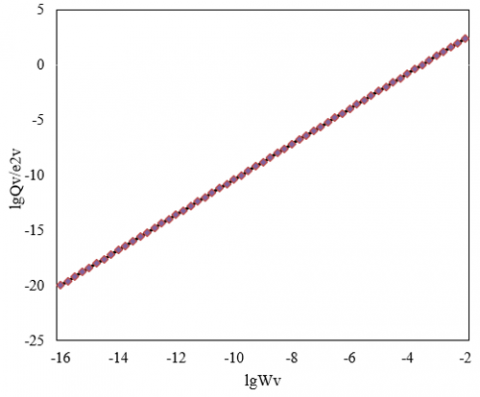
Step 3: Based on the dimensional analysis and fractal model established, further calculate key physical quantities such as Qv/e2v and Wv, and plot them as curves. Qv represents the surface area of the pores, while e2v and Wv reflect the geometric shape and distribution characteristics of the pores, respectively. By calculating these physical quantities and fitting the curves, the fractal dimension of the concrete pores can be further determined. The slope of the curve is directly related to the fractal dimension, and the shape of the curve reflects the distribution pattern and variation law of the pore structure. Through this process, we can quantitatively analyze the self-similarity of concrete pores and reveal the evolution characteristics of its microstructure, especially under environmental factors like carbonation and freeze-thaw, where the changes in pore structure directly affect its mechanical properties and durability.
Step 4: Finally, by verifying the pore structure data of actual concrete samples, the fractal model based on the thermodynamic relationship can be further optimized. When processing the pore data of concrete after 0 days of carbonation, a scatter plot of lgQv/e2v-lgWv can be drawn, and the fractal dimension can be determined through regression analysis. Figure 1 shows an example of the scatter plot of the thermodynamic relationship lgQv/e2v-lgWv. The data points in the scatter plot present a certain linear relationship, and its slope is the fractal dimension of the concrete pore structure. Through the analysis of the scatter plot, the accuracy and effectiveness of the established fractal model can be further validated.
Figure 1. Example of the scatter plot of the thermodynamic relationship lgQv/e2v-lgWv
In concrete research, the traditional view is that the compressive strength of concrete is directly related to porosity. However, with further research, scholars have found that the macro-performance of concrete is not only influenced by porosity but also closely related to microscopic structural factors such as pore distribution characteristics, pore size distribution, and others. Particularly, the performance of concrete under different environmental conditions is more accurately reflected by factors such as pore size distribution, pore morphology, and pore connectivity, rather than just porosity. According to the results of gray entropy method research, the main factors affecting the compressive strength of concrete are often related to the heterogeneity and distribution pattern of pores, and these factors are closely linked to pore size distribution and the geometry of pores. Therefore, combining thermodynamic fractal dimensions and the complexity of pore structure to establish a comprehensive model to reveal the relationship between pore structure and compressive strength of concrete will help to more accurately predict the mechanical performance of concrete under different conditions.
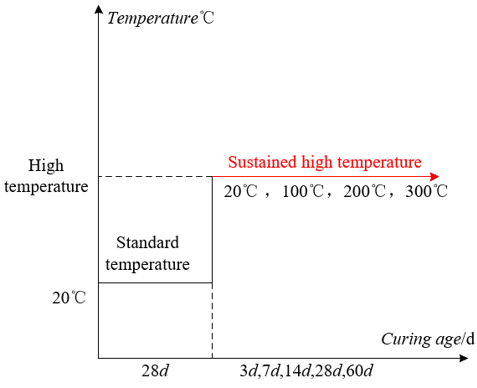
Particularly under high-temperature conditions, the pore structure of concrete undergoes significant changes, which have an important impact on its compressive strength. Under high-temperature effects, factors such as moisture evaporation, pore changes, and internal crack formation all lead to the degradation of the pore structure, which in turn affects the mechanical performance of concrete. Because the pore structure of concrete becomes more complex and difficult to predict under high temperatures, the traditional relationship between porosity and compressive strength is no longer fully applicable. Therefore, this paper aims to establish a model for the relationship between the compressive strength of concrete and its pore structure under high-temperature conditions, primarily hoping to capture the changes in the pore structure of concrete under high temperature through the thermodynamic fractal dimension. Figure 2 shows the temperature history of the civil engineering concrete specimens used in the experiment.
Figure 2. Concrete specimen subjected to temperature history for civil engineering use
Under the effect of high temperatures, the internal pore structure of concrete undergoes significant changes, directly affecting its mechanical performance, particularly compressive strength. As the temperature increases, the moisture in cement-based materials gradually evaporates, and hydration products decompose, causing changes in the pore morphology and the proportion of pores in the concrete. Different types of pores have different impacts on the mechanical performance of concrete, especially under high-temperature conditions. The types, sizes, and distribution of pores determine the compressive strength of concrete. Through the classification of the pore structure of concrete, studies have shown that harmless pores, slightly harmful pores, and harmful pores are the key factors affecting compressive strength. Harmless pores are usually relatively uniform and small, and their presence has little effect on the mechanical performance of concrete. Slightly harmful pores are pores of medium size, which have some impact on compressive strength but are relatively stable. Harmful pores are typically larger pores or cracks, which may increase under high temperatures, significantly reducing the strength of the concrete. To more accurately describe the impact of concrete pore structure on compressive strength, this study introduces a composite pore parameter O, which comprehensively considers the proportion of harmless and slightly harmful pores in the pore size distribution of concrete. Assuming harmless pores are represented by E1, slightly harmful pores by O2, and regression coefficients by s and j, the composite pore parameter O is defined by the following formula:
$O=s O_1+j O_2$ (5)
Under high temperatures, as the temperature increases, the evaporation of moisture and chemical changes in cement-based materials cause the pore structure to gradually increase. Especially under high temperatures, the formation of cracks and large pores is inevitable. Although the increase in total pore area T usually means an increase in pore volume, a reasonable pore distribution within a certain range can improve the microstructure of concrete and thus enhance its compressive strength. The mechanism of this phenomenon can be analyzed from two aspects: on the one hand, within a proper temperature range, a moderate increase in pore area can promote the uniform distribution of internal stresses, thereby reducing the occurrence of localized stress concentration and improving the overall stability of concrete. On the other hand, when the pore distribution is relatively uniform and the pore size is moderate, the existence of these pores will not significantly reduce the bearing capacity of concrete, and may even help reduce crack propagation and improve compressive strength.
To further quantify the relationship between the compressive strength of concrete under high-temperature conditions and its pore structure, this study proposes a theoretical framework that considers both the composite pore parameter O and total pore area T. In this framework, the composite pore parameter O primarily reflects the types and distribution ratio of pores, while total pore area T directly affects the total amount and distribution density of pores. The combination of these two parameters can more comprehensively describe the pore evolution process of concrete under high-temperature effects and its impact on compressive strength. Assuming pore parameters are represented by Q, the following formula holds:
$Q=O \times T$ (6)
Under high temperatures, the pore structure of concrete exhibits a high degree of complexity. Changes in temperature not only lead to moisture evaporation but may also cause pore expansion, crack propagation, and changes in pore morphology. These factors interact and significantly affect the mechanical performance of concrete. Although the composite pore parameter O and total pore area T can describe certain pore characteristics, they often cannot fully reflect the complexity of the pore structure and the interaction between pores. The thermodynamic fractal dimension F is closely related to the scale non-uniformity of pores, pore size distribution, and interactions between pores. Under high temperatures, the expansion and rupture of concrete pores are often non-uniform, and this non-uniformity leads to a distribution of pores that exhibits self-similarity, showing pore structure characteristics at different scales. Therefore, the introduction of fractal dimension can help more accurately describe this scale variation and further improve the predictive accuracy of the model. This paper combines the composite pore parameter O, total pore area T, and thermodynamic fractal dimension F, among other pore structure parameters. Assuming the compressive strength of concrete after carbonation at high temperature is represented by d, and the fractal dimension calculated from the thermodynamic relationship model is represented by F, and O×T is represented by Q, with regression coefficients represented by j, the following multi-factor pore structure model can be established:
$d=j_0+j_1 F^2+j_2 Q^2+j_3 F Q+j_4 F+j_5 Q$ (7)
Through regression analysis of experimental data, an accurate mathematical model can be derived, helping to predict and optimize the compressive strength of concrete in engineering practice. Under high-temperature conditions, the pore structure of concrete changes, leading to significant fluctuations in compressive strength. Therefore, by establishing this relationship model, a more reliable theoretical basis can be provided for the use of concrete under high-temperature environments, especially in civil engineering, offering strong support for the study of concrete's fire resistance and long-term durability.
This study primarily focuses on the relationship between the microstructure and mechanical properties of concrete, especially the evolution of pore structure under high-temperature conditions and its effect on mechanical properties. Table 1 shows the experimental data for three different concrete mix proportions, where the control group concrete and the concretes with fly ash or slag replacing cement were compared for their effects on the performance of concrete. Table 2 lists the chemical composition of various concrete raw materials, showing the major chemical components of control cement, fly ash, and slag. In the cement, components like CaO, SiO₂, and Fe₂O₃ dominate, while fly ash and slag contain higher amounts of SiO₂, Al₂O₃, and MgO. This chemical composition combination is closely related to the mechanical properties and pore structure of concrete, providing support for predicting the mechanical properties of concrete under high-temperature conditions in thermodynamic models.
Table 3 provides detailed data on the fractal dimension of concrete as temperature changes under high-temperature conditions. As the temperature rises from room temperature (20℃) to 200℃, 400℃, 600℃, and 800℃, the fractal dimension of concrete changes. For example, at 20℃, the fractal dimension is generally higher, around 1.856. As the temperature increases, the fractal dimension slightly decreases. At 200℃, the fractal dimension drops to 1.8125, at 400℃ and 600℃, it decreases to 1.8124 and 1.7985, and at 800℃, it slightly rebounds to 1.7954. Moreover, some data show fluctuations at high temperatures, demonstrating a certain nonlinear change. For instance, at 400℃, the fractal dimension rises to 1.8562, while at 800℃, there is a slight decrease. These changes suggest that high temperatures affect the self-similarity characteristics of the microstructure of concrete, particularly at higher temperatures, where the fractal dimension slightly decreases. This is related to the impact of high temperatures on the pore structure and material strength.
Table 1. Concrete mix proportions for civil engineering/kg/m3
|
Serial No. |
Code |
Cement |
Water |
Sand |
Gravel |
Fly Ash |
Slag |
|
1 |
Control Group Concrete (Pure Cement) |
456 |
175 |
612 |
1245 |
- |
- |
|
2 |
Concrete with Fly Ash Replacing Cement in Equal Amount |
278 |
156 |
635 |
1230 |
198 |
- |
|
3 |
Concrete with Slag Replacing Cement in Equal Amount |
263 |
189 |
642 |
1245 |
- |
177 |
Table 2. Chemical composition of raw materials for civil engineering concrete (%)
|
Raw Materials |
Control Cement |
Fly Ash |
Slag |
|
CaO |
62.35 |
4.256 |
51.245 |
|
MgO |
2.56 |
0.62 |
5.268 |
|
SiO2 |
21.48 |
52.312 |
24.263 |
|
FeO3 |
3.21 |
4.568 |
0.321 |
|
AI2O3 |
4.25 |
28.324 |
11.256 |
|
SO3 |
2.31 |
0.66 |
1.895 |
|
K2O |
0.69 |
2.458 |
0.445 |
|
TiO2 |
0.61 |
2.623 |
1.362 |
|
MuO |
- |
0.061 |
0.612 |
|
CI- |
0.04 |
0.03 |
0.0044 |
|
Loss |
2.25 |
3.25 |
0.578 |
Table 3. Fractal dimension of concrete under high-temperature conditions
|
Temperature History (Days) |
Fractal Dimension |
||||
|
20℃ |
200℃ |
400℃ |
600℃ |
800℃ |
|
|
3 |
1.8562 |
1.8125 |
1.8124 |
1.7985 |
1.7954 |
|
7 |
1.8354 |
1.8456 |
1.8562 |
1.7652 |
1.7758 |
|
14 |
1.8265 |
1.8326 |
1.8451 |
1.8216 |
1.7562 |
|
28 |
1.8659 |
1.8579 |
1.8795 |
1.8896 |
1.7885 |
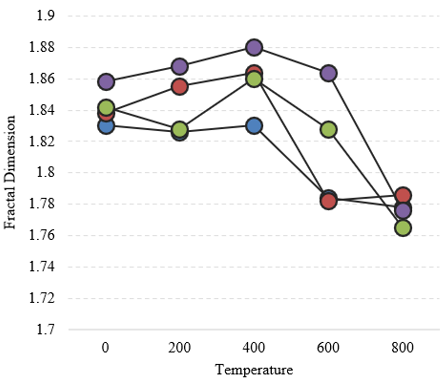
Figure 3 displays the change in the fractal dimension of concrete over time at different high temperatures. From the data in the table, it can be observed that the fractal dimension of concrete fluctuates with time at different temperatures. Under normal temperature conditions, the fractal dimension remains stable, with values of 1.838 at 7 days, 1.842 at 14 days, and 1.858 at 28 days, indicating that the microstructure of the concrete undergoes minimal changes and maintains a relatively consistent self-similarity feature at normal temperature. As the temperature rises, the impact of temperature on the fractal dimension of concrete gradually becomes evident. At 200℃, the fractal dimension slightly increases, reaching 1.868 at 28 days; however, when the temperature rises to 400℃, 600℃, and 800℃, the fractal dimension generally decreases. Especially at 600℃ and 800℃, the fractal dimension significantly decreases, reaching 1.828 and 1.776, respectively, indicating that the self-similarity of the microstructure of concrete is significantly affected by high temperatures. It is important to note that at higher temperatures, the change in the fractal dimension is influenced not only by the direct effect of temperature but also by changes in the hydration reaction of the cement, an increase in porosity, and material degradation.
Figure 3. Relationship between fractal dimension of concrete and temperature
Table 4 shows the distribution of harmless and less harmful pore ratios in concrete under different temperature conditions. The proportion of harmless pores generally decreases as the temperature increases. At room temperature, the proportion of harmless pores is highest, particularly at 3 days, reaching 35.21%, and fluctuates slightly over time, decreasing to 37.85% at 28 days. However, when the temperature reaches 200℃, the proportion of harmless pores decreases to 31.44%, further reducing to 32.15% at 400℃. At 600℃, the proportion significantly increases to 43.21%, but drops sharply to only 5.14% at 800℃. The proportion of less harmful pores also changes significantly under high-temperature conditions, gradually decreasing as the temperature increases. At room temperature, the proportion of less harmful pores is 26.25% at 3 days, but under high-temperature conditions, particularly at 400℃ and 600℃, the proportion significantly decreases. For example, at 400℃, the proportion is 22.15%, while at 800℃, it decreases to 7.32%. This indicates that the evolution of the concrete's pore structure under high temperature has a significant impact on the distribution of harmless and less harmful pores, especially at high temperatures, where the pore structure of the concrete becomes rougher and more irregular.
Table 5 shows the variation trend of composite porosity of concrete under different temperature conditions over time. Composite porosity reflects the overall porosity of concrete, encompassing all types of pores. Under room temperature conditions, the composite porosity gradually decreases over time, from 58.265% at 3 days to 46.235% at 28 days, indicating that as the hydration reaction progresses, the porosity decreases and the structure becomes denser. As the temperature increases, the change in composite porosity exhibits significant fluctuations. At 200℃, the composite porosity decreases to 51.245%, and at 7 days, it drops to 42.361%. At 400℃, the composite porosity increases again to 48.124%, and remains high at 14 and 28 days. At 600℃, the composite porosity gradually increases to 54.147%, and then gradually decreases under higher temperatures. At 800℃, the composite porosity significantly increases, particularly at 7 days when it reaches 35.625%, and increases to 41.258% at 28 days. These changes indicate that the pore structure of concrete undergoes significant changes under high-temperature conditions. Especially at extremely high temperatures, the increase in porosity indicates significant internal damage to the concrete structure.
Table 4. Distribution of harmless and less harmful pore ratios of concrete used in civil engineering under high temperature conditions
|
Pore Structure Parameters |
Duration of Temperature Exposure (Days) |
Temperature |
||||
|
20℃ |
200℃ |
400℃ |
600℃ |
800℃ |
||
|
Harmless pores (%) |
3 |
35.21 |
31.44 |
32.15 |
43.21 |
5.14 |
|
7 |
42.13 |
32.16 |
22.45 |
24.56 |
4.23 |
|
|
14 |
42.56 |
38.25 |
37.25 |
35.69 |
3.89 |
|
|
28 |
37.85 |
18.55 |
28.26 |
31.25 |
5.62 |
|
|
Less harmful pores (%) |
3 |
26.25 |
25.13 |
22.15 |
15.26 |
7.32 |
|
7 |
14.69 |
13.21 |
4.62 |
13.21 |
12.54 |
|
|
14 |
12.87 |
12.54 |
15.32 |
12.56 |
15.23 |
|
|
28 |
14.26 |
14.56 |
13.26 |
11.27 |
11.25 |
|
Table 5. Composite porosity of concrete used in civil engineering under high-temperature conditions
|
Duration of Temperature Exposure (Days) |
Composite Porosity (%) |
||||
|
20℃ |
200℃ |
400℃ |
600℃ |
800℃ |
|
|
3 |
58.265 |
51.245 |
48.124 |
54.147 |
10.254 |
|
7 |
51.242 |
42.361 |
25.235 |
35.625 |
5.124 |
|
14 |
47.256 |
48.265 |
51.234 |
43.201 |
15.268 |
|
28 |
46.235 |
28.234 |
38.265 |
41.258 |
12.625 |
Table 6. Pore parameters of concrete used in civil engineering under high-temperature conditions
|
Duration of Temperature Exposure (Days) |
Pore Parameters |
||||
|
20℃ |
200℃ |
400℃ |
600℃ |
800℃ |
|
|
3 |
612.214 |
641.235 |
621.214 |
887.124 |
56.324 |
|
7 |
587.265 |
258.321 |
289.325 |
325.235 |
31.251 |
|
14 |
589.244 |
423.256 |
589.214 |
568.214 |
121.254 |
|
28 |
468.235 |
178.235 |
256.325 |
289.325 |
81.235 |
Table 6 shows the variation trend of pore parameters of concrete under different temperature conditions. The data in the table includes pore size, pore volume, and pore distribution. At room temperature, the pore parameters of concrete are relatively stable. At 3 days, the pore parameter is 612.214, at 7 days it is 587.265, at 14 days and 28 days it is 589.244 and 468.235, respectively, showing that as the hydration reaction progresses, the porosity gradually decreases, and the concrete pore structure becomes denser. However, as the temperature increases, the pore parameters show significant fluctuations. At 200℃ and 400℃, the pore parameters slightly increase. For example, at 200℃, the pore parameter at 3 days is 641.235, and at 7 days it is 423.256, showing that the volatilization of water and the formation of micro-cracks caused by high temperatures lead to an increase in pore volume. At 600℃ and 800℃, the pore parameters increase dramatically, especially at 800℃, where the pore parameter at 3 days reaches 887.124, indicating that under extremely high temperatures, the pore structure of concrete is severely damaged, and the pore volume and pore size increase significantly, causing the structure to loosen and leading to a significant decrease in overall performance.
(a) Differential thermal scanning curve
(b) Thermogravimetric curve
Figure 4. Differential thermal scanning curve (a) and thermogravimetric curve (b) of concrete used in civil engineering
The analysis results from the differential thermal scanning curve shown in Figure 4(a) can be used to investigate the thermodynamic behavior of concrete at high temperatures, exploring the relationship between the microstructure of concrete and its mechanical properties. In the differential thermal scanning curve analysis, as the temperature increases, the exothermic and endothermic characteristics of concrete change significantly. In the low-temperature range, concrete exhibits a relatively smooth exothermic phenomenon. This phase mainly involves the evaporation of moisture and a small amount of hydration reaction, indicating that the microstructure of concrete gradually densifies during the hydration process, with a decrease in porosity. However, when the temperature exceeds 200℃, especially in the range of 400℃ to 600℃, the curve shows a distinct endothermic peak, indicating that within this temperature range, hydration products begin to decompose, and the degradation of the microstructure becomes evident, with the pore volume rapidly increasing. Beyond 600℃, especially at 800℃, the differential thermal scanning curve shows a strong endothermic phenomenon, indicating the intense decomposition of hydration products and minerals in concrete, leading to a significant increase in porosity and severe physical and chemical degradation of the concrete structure.
Through the analysis of the thermogravimetric curve in Figure 4(b), the thermal stability and mass changes of concrete under high temperatures can be further explored, reflecting the physical and chemical changes of concrete under different temperature conditions. According to the content of this study, the thermogravimetric curve shows some mass loss in the low-temperature range from 20℃ to 200℃, mainly caused by the evaporation of free and combined water in concrete. As the temperature further increases to 200℃ to 400℃, the mass loss accelerates, indicating the dehydration of hydration products (such as calcium hydroxide) and the gradual decomposition of hydration reactions. Especially between 400℃ and 600℃, the thermogravimetric curve shows a significant mass loss, indicating further decomposition of hydration products and the phase transition of silicate minerals, resulting in an accelerated mass loss of concrete. When the temperature exceeds 600℃, especially at 800℃, the mass loss in the thermogravimetric curve increases significantly, exceeding 50%. This stage is mainly caused by the decomposition of calcium silicate hydrates and other minerals in the concrete, and the loss of the hydrated structure causes the internal pores to expand and further exacerbates the propagation of cracks.
Combined with the study's findings and the analysis of the thermogravimetric curve, it can be concluded that high temperatures significantly affect the thermal stability and microstructural evolution of concrete. In the low-temperature range, the mass loss in concrete is mainly due to the evaporation of moisture, which corresponds to the decreasing trend of porosity in concrete during this phase. As the temperature increases, especially between 200℃ and 400℃, the accelerated mass loss indicates the decomposition of hydration products and changes in hydration reactions, leading to an increase in porosity. In the 400℃ to 600℃ range, the mass loss rate of concrete further accelerates, and the decomposition of hydrates and phase transitions of minerals causes the microstructure of concrete to degrade, resulting in increased pore volume and a significant decrease in mechanical properties. Especially when the temperature exceeds 600℃, the thermogravimetric curve shows significant mass loss, indicating that the concrete's structure is severely damaged. This phenomenon directly leads to a significant loss in the compressive strength and durability of concrete.
This paper introduced a fractal model for concrete in civil engineering by incorporating thermodynamic relations, aiming to explore the self-similarity characteristics of concrete's microstructure and its correlation with mechanical properties. The model analyzed the changes in the pore structure of concrete under high-temperature conditions, revealing the mechanisms of high-temperature effects on the evolution of concrete's pore structure and its mechanical properties. Specifically, this paper modeled the microstructure of concrete from a thermodynamic perspective to help understand the structural degradation process at different temperatures. It also examined the relationship between compressive strength and pore structure of concrete under high-temperature conditions, finding that with increasing temperature, the porosity of concrete gradually increases, leading to a progressive decline in mechanical properties, especially after 600℃, where a significant reduction in compressive strength is observed. Supported by thermodynamic analysis and experimental data, this study shows that concrete undergoes a process from microstructural changes to macroscopic mechanical property degradation under high-temperature effects. During the low-temperature stage, the changes in the pore structure of concrete are relatively small, and the increase in pore density due to hydration reactions gradually improves its mechanical properties. As the temperature rises, especially between 200℃ and 400℃, the decomposition of hydration products and the evaporation of moisture lead to an increase in porosity and pore volume, resulting in a decrease in compressive strength. At higher temperatures, the porosity of concrete increases dramatically, especially at 800℃, where significant chemical degradation occurs inside the concrete, leading to a loose pore structure and a sharp decline in compressive strength. The analysis of thermogravimetric curves and differential thermal analysis further supports this conclusion, revealing the relationship between the physical and chemical changes of concrete and its microstructural evolution.
This study, from a thermodynamic perspective, proposes a fractal model for concrete in civil engineering and delved into the effects of high temperature on concrete's pore structure and mechanical properties. The study shows that the evolution of concrete's pore structure under high temperatures directly affects its mechanical properties, with compressive strength showing a significant decline as temperature increases, especially above 600℃. This finding provides theoretical basis and experimental data support for the performance evaluation of concrete in high-temperature environments, offering important engineering application value. By combining thermodynamics and the fractal model, this paper provides a new perspective on understanding the behavior of concrete under extreme conditions and offers a theoretical framework for further research in related fields.
This study has considerable practical value, particularly in the prediction and improvement of concrete's performance in high-temperature environments. By introducing thermodynamics and the fractal model, this paper provides a more systematic explanation of the relationship between concrete’s microstructure and mechanical properties. However, the study also has certain limitations, such as the fact that the experimental data are primarily focused on a specific temperature range and do not cover performance changes under different climatic conditions or long-term high-temperature exposure. Moreover, although a thermodynamic-based fractal model is proposed, the universality and applicability of this model still need further validation. Future research can focus on the following aspects: first, expanding the experimental range of high-temperature effects, including a broader temperature range and the impact of long-term high-temperature exposure on concrete performance, to improve the accuracy and applicability of the model. Second, further research into the dynamic evolution mechanism of the microstructure of concrete should be conducted, exploring more detailed thermodynamic models to better predict the long-term mechanical properties of concrete under different conditions. Finally, attempts can be made to develop concrete materials with better high-temperature performance, and combine the fractal model to optimize concrete mix proportions and structural designs, enhancing its service life and safety under extreme environments.
[1] Kreiger, E.L., Kreiger, M.A., Case, M.P. (2019). Development of the construction processes for reinforced additively constructed concrete. Additive Manufacturing, 28: 39-49. https://doi.org/10.1016/j.addma.2019.02.015
[2] Himasree, P.R., Korde, C., West, R.P., Ganesan, N. (2023). State of the art review of bamboo-reinforced concrete structural elements. Magazine of Concrete Research, 76(2): 55-68. https://doi.org/10.1680/jmacr.23.00050
[3] Kanyan, A.A., Jiun, L.H. (2024). Seismic performance of reinforced concrete bridge in Pan Borneo Highway Sarawak under the influence of seismic loadings. GeoStruct Innovations, 2(1): 32-41. https://doi.org/10.56578/gsi020104
[4] Wu, Q.L., Xu, S.C., Wu, S.Y., Cai, X., Bu, R.F., Sun, X.F. (2024). Anti-clogging performance of pervious concrete incorporating hydrophobic agent. Construction and Building Materials, 431: 136554. https://doi.org/10.1016/j.conbuildmat.2024.136554
[5] San Nicolas, R., Cyr, M., Escadeillas, G. (2014). Performance-based approach to durability of concrete containing flash-calcined metakaolin as cement replacement. Construction and Building Materials, 55: 313-322. https://doi.org/10.1016/j.conbuildmat.2014.01.063
[6] Zhang, L., Shi, Y.W., Liu, G.Y. (2023). Assessment of ultra-high performance concrete mechanical properties and damage under low-temperature curing conditions. Journal of Civil and Hydraulic Engineering, 1(1): 1-10. https://doi.org/10.56578/jche010101
[7] Yu, X.G., Wu, D., Hao, H., Zhang, Y., Xu, H.C., Rui, Y.N. (2014). Pore structure and microstructure of super light-weight foam concrete reinforced by inorganic fiber. Key Engineering Materials, 591: 50-53. https://doi.org/10.4028/www.scientific.net/KEM.591.50
[8] Qian, X.Q., Meng, T., Zhan, S.L., Qian, K.L. (2008). Effect of composite polymer on compressive strength and microstructure of concrete. Rare Metal Materials and Engineering, 37: 691-694. https://doi.org/10.3321/j.issn:1002-185X.2008.z2.181
[9] Lee, V.Z.T. Taip, A. (2024). Seismic performance comparison of reinforced concrete and steel frames with various bracing configurations. GeoStruct Innovations, 2(3): 161-171. https://doi.org/10.56578/gsi020305
[10] Zheng, X.H., Zhang, B.S., Jie, Y., Chi, X., Guo, Y.Z., Kong, L.J. (2005). Microstructure and mechanical properties of shale ceramsite concrete. Key Engineering Materials, 302: 371-375. https://doi.org/10.4028/www.scientific.net/KEM.302-303.371
[11] Li, Y.F. (2011). Microstructure and properties of high performance concrete with steel slag powder. In Materials Science Forum, 675: 503-506. https://doi.org/10.4028/www.scientific.net/MSF.675-677.503
[12] Paiva, H., Silva, A.S., Velosa, A., Cachim, P., Ferreira, V.M. (2017). Microstructure and hardened state properties on pozzolan-containing concrete. Construction and Building Materials, 140: 374-384. https://doi.org/10.1016/j.conbuildmat.2017.02.120
[13] Kim, Y.R., Haft-Javaherian, M., Castro, L.S. (2016). Two-dimensional virtual microstructure generation of particle-reinforced composites. Journal of Computing in Civil Engineering, 30(1): 04014112. https://doi.org/10.1061/(ASCE)CP.1943-5487.0000448
[14] Kim, H.T., Park, K. (2022). Computed tomography (CT) Image-based analysis of concrete microstructure using virtual element method. Composite Structures, 299: 115937. https://doi.org/10.1016/j.compstruct.2022.115937
[15] Hu, S.G., Li, Y. (1999). Research on the hydration, hardening mechanism, and microstructure of high performance expansive concrete. Cement and Concrete Research, 29(7): 1013-1017. https://doi.org/10.1016/S0008-8846(99)00084-8
[16] Wu, D., Wang, Z., Pan, Y., Huang, J., Fernández-Steeger, T.M., Xu, C., Tang, X., Long, Z., Tang, Y. (2023). Study on the constitutive relationship between ordinary concrete and nano-titanium dioxide-modified concrete at high temperature. Materials, 16(14): 4910. https://doi.org/10.3390/ma16144910
[17] Wang, Q., Wang, T., Zhou, X., Chen, Q. (2023). Bond performance between recycled concrete and steel bar after high temperature. Nonlinear Engineering, 12(1): 20220284. https://doi.org/10.1515/nleng-2022-0284
[18] Luo, L., Chen, Z., Tao, Q., Xie, L., Jin, D., Li, Z., Deng, D. (2022). Effects of high temperatures on the splitting tensile strength and gamma ray shielding performance of radiation shielding concrete. Construction and Building Materials, 343: 127953. https://doi.org/10.1016/j.conbuildmat.2022.127953
[19] Arel, H.S., Yazici, S. (2014). Effect of different parameters on concrete-bar bond under high temperature. ACI Materials Journal, 111(6): 633-640. https://doi.org/10.14359/51686992
[20] Lachemi, M., Aitcin, P.C. (1997). Influence of ambient and fresh concrete temperatures on the maximum temperature and thermal gradient in a high-performance concrete structure. ACI Materials Journal, 94(2): 102-110. https://doi.org/10.14359/290
[21] Zhang, D., Xu, J., Sun, F., Xu, Z. (2022). Study on high-temperature behavior of coal gangue-based geopolymer concrete beams. Advances in Civil Engineering, 2022(1): 1615271. https://doi.org/10.1155/2022/1615271