Karrar A. Al-Shibli* | Ahmed Kadhim Hussein
© 2024 The authors. This article is published by IIETA and is licensed under the CC BY 4.0 license (http://creativecommons.org/licenses/by/4.0/).
OPEN ACCESS
Common ordinary fluids including water, glycol, and oils are extensively employed in solar thermal applications. However, because of their poor thermal performance and limited thermal conductivity, these fluids limit heat transfer. Hybrid nanofluids have proven themselves as a new and highly useful alternative because of their enhanced thermophysical characteristics in solar thermal applications. Recently, the focus in studies on hybrid nanofluids have increased as a continuation of the study of mono nanofluids. An extensive analysis of hybrid nanofluids research is presented in this review. This review focuses on the methods by which hybrid nanofluids is prepared as well as techniques to improve stability. Numerous studies have examined how hybrid nanoparticles affect thermophysical characteristics as density, viscosity, specific heat, and thermal conductivity. In this review, hybrid nanofluids were investigated as operating fluid in flat plate solar collector by a thorough examination of numerous theoretical, computational, and experimental research. The main objective of HNF application is to increase thermal efficiency. Ultimately, issues and limitations were covered, and suggestions for further research were provided. The results of the studies showed that water is the most suitable base liquid for use compared to other types of base liquids. As for nanoparticles, MWCNT and h-BN when mixed with metal oxides such as TiO2 and Al2O3 are the most suitable for use.
FPSCs, nanotechnology, literature review, hybrid nanofluids, stability, thermophysical properties
With the high rate of population increase in the world and with the high demand for energy use in all areas of life. So, it became necessary to develop energy resources. The energy currently produced is (80%) of conventional fuels and this has adverse effects on the climate by increasing carbon in the atmosphere [1]. Since these sources are non-permanent and are expected to run out in the long term, it has become necessary to rely on clean energy sources and reduce the disadvantages of using fossil energy fuels [2]. To reduce the disadvantage of conventional fuels, it is advised to employ clean energy sources like solar-energy. Natural resource-based clean energy sources include solar, wind, tidal, and wave energy due to its greater availability and ease of use. Solar-energy is one of the most significant alternative energy sources. Solar-energy is currently in vogue for usage in daily life; the most popular application is for H2O heating. However, there are numerous obstacles to solar-energy, the most significant being heat storage [3]. Solar-energy, also known as solar radiation and heat, is one of the most important sources of pure, free, limitless, clean energy available today that has no environmental impact. About 1.8×10¹¹ MW of solar radiation is intercepted by the globe. There is enough energy produced by the sun every 20 minutes to sustain life on Earth, but only around 30% of that energy ever reaches the planet [4]. When it comes to both cost and environmental impact, solar thermal energy is among the best. Solar collector technology transforms thermal energy from solar radiation into thermal energy [5]. One of the most popular kinds of solar collectors is the FPSC, which gathers solar thermal energy and transforms it into operating fluid [6]. This type of solar collector distinguishes over other types is the cost of its production and its ability to collect solar radiation without the need for solar radiation tracking equipment [6]. The goal of researchers in the past years was to develop this technology by increasing its efficiency by improving the collector's performance, as well as quickening the flow of heat between operating fluids and pipelines. The collector's form, coating, absorber design, flow turbulences, porous media, and the use of nanofluids all work out efficient ways to increase the collector's performance [7].
The dispersion of nanofluids in the base liquid leads to an improvement in the thermal characteristics of the operating fluid [8]. An important thermal property that is greatly improved is the operating fluid's thermal conductivity due to many influencing factors [9]. An adverse factor in the addition of nanomaterials is increased viscosity, which requires high pumping energy as well as a reduction in the capacity to transmit heat [9]. To keep an appropriate heat transfer rate, nanofluids must be pumped slowly. Therefore, it is necessary to ascertain the optimal concentration of highly thermally conductible, low-viscosity NPs [9]. However, stability is one of the fundamental prerequisites for using nanofluids in applications of heat transfer. Since stability has a major impact on thermal conductivity, it is thought to be the most critical influencing element [10]. Agglomerations brought on by van der Waals forces are one of the elements affecting the stability of nanofluids, and as a result of these agglomerations, the thermal conductivity starts to decline. Many researchers are using nanofluids in solar collector heat transfer applications as a result of their improved thermal characteristics [9].
In this review, HNF preparation and characterization techniques were the main topics of a thorough assessment of literature pertaining to the subject. In addition to theoretical and experimental research, which was one of the primary justifications for using HNFs in FPSCs, the impact of incorporating hybrid nanomaterials on thermophysical characteristics, thermal conductivity, viscosity, specific heat, and density was examined. In the last part, challenges, conclusions and future recommendations were discussed, it is worth noting that (90%) of the articles reviewed were in the last six years.
Subsequently, a new type of fluid called HNFs was introduced. HNFs are the focus of multiple recent studies as an extension of nanofluids research. HNFs are produced by distributing two or more NPs in the base liquid in a composite or mixed form the study [11]. A number of methods were suggested for the production of hybrid NPs, including in situ, thermochemical, mechanical alloying, ball milling, wet chemical, solvothermal, and chemical vapor deposition [12]. The NPs most commonly used in flat solar collectors Al2O3, SiO2, CuO, TiO2, MWCNTs, GNPs, while H2O, EG, oil and molten salt are used as base liquids.
2.1 Hybrid nanofluid preparation
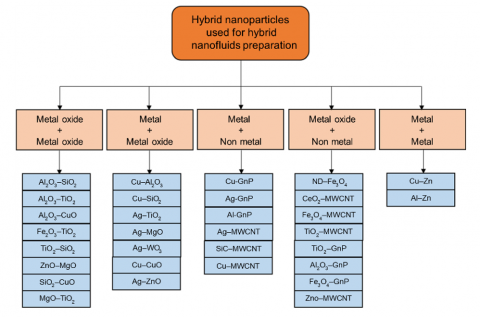
A HNF is produced when two or more different types of NPs are combined in a base liquid under the correct conditions. Figure 1 shows most of the NPs used in the preparation of a HNF. The agglomeration of NPs resulting from sinking due to gravity is a fundamental problem that may lead to a reduction in the improvement of properties as well as clogging of pipes and valves, and hence careful preparation of the nanofluid is necessary to prevent these agglomerates.
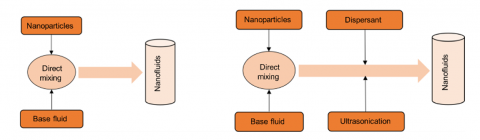
Preparation process for a HNF is usually done in one of two ways, both the 1-step and 2-step methods. In the 1-step method of producing and suspending NPs in the base fluid synchronously, this process stabilizes and inhibits the formation of oxides and assemblies more successfully [13]. The laborious procedures with this system, such as storage, drying and mixing processes are by passed. Both the 1-step and 2-step methods are shown in Figure 2. However, the most popular technique that researchers employ to prepare nanomaterials is the 2-step procedure, initially the NPs are prepared in the form of a dry powder that is done using chemical or mechanical procedures, then the dry powder is suspended using ultrasonic in either EG or H2O, the base liquid. The 2-step process is commonly used, yet it has the drawback of causing particles to aggregate due to high Van der Waals forces before they are distributed in the base liquid. This causes particles to deposit in the liquid, which lowers heat conductivity. Many physical and chemical methods have been used to solve this problem, including ultrasound, the use of surfactants, and pH modifications [14].
Figure 1. Categorization of NPs utilized in the production of HNFs [15]
Figure 2. 1-step and 2-step preparation procedure illustration [15]
The following section presents a taxonomy of hybrid NPs used in the synthesis and processing of HNFs.
2.1.1 Metal oxide + Metal oxide
The 2-step method of assembling and preparing a hybrid Al2O3-SiO2/H2O. The Al2O3 and SiO2 at (0.01%) were distributed in 1000 milliliters of H2O only, and the mixing-ratio between the particles was (50:50). The colloidal particles are first stirred for a duration of six hours at 50℃ in a magnetic stirring [16]. Then homogenization is done by a homogenizer to cause turbulence.
In a related study [17], Al2O3 NPs and SiO2 are prepared independently utilizing a volumetric proportion of (0.5%) distributed in the synthesis of (60:40), H2O/green bio-glycol as bases fluids. These processes are explored in the synthesis and preparation of Al2O3- SiO2 HNFs. Because of the fact that the Al2O3 NPs and SiO2 show distinctive physical phases, the method of their preparation was also distinct, three hours were spent sonicating the HNFs, which had four different mixing-ratios produced: 10:90, 30:70, 50:50, and 70:30. Preparation of HNFs of TiO2-Al2O3 with the use of H2O as the base fluid, and achieving this through a 2-step process, in this study, the different mixing ratios used for Al2O3 and TiO2 were (20:80), (40:60), (50:50), (60:40) and (80:20). First, the NPs were mechanically stirred for two hours while suspended in the H2O, after which ultrasound technology was used to maintain a volume concentration of 0.1% [18]. HNFs studied Al2O3-CuO, Al2O3-TiO2 based on H2O using the 2-step method [19]. The optimal ratio chosen in this study was (80:20) (Al2O3/TiO2 and Al2O3/CuO). Another study conducted for HNFs by Zhang et al. [20] where Al2O3-CuO were prepared and added to distilled H2O, and magnetic stirring was performed at 2000 rpm for one hour. The NPs were then suspended in the distilled H2O evenly as this led to the formation of HNF with different mass concentrations. Abbas et al. [21] studied Fe2O3 coated TiO2 NPs were created via hydrothermal reduction, and then HNFs were created utilizing the ultrasonic acoustic cavitation method. Synthesis and production of nanofluid from Fe2O3-TiO2/H2O. The HNF TiO2-SiO2/green bio-glycol was made using the 2-step process presented by Zainon and Azmi [22]. HNF was first prepared at volumetric fractions of (0.5-3%), then the NPs were mixed with a ratio of (20:80) (TiO2/SiO2) and then added to the green bio-glycol base liquid. Vidhya et al. [23] studied Synthesis and preparation of HNF MgO and ZnO to H2O and EG using combined and sol–gel method. Where the ratio of mixing of NPs was equal in a mixture of H2O and EG (60:40) to form HNF of MgO and ZnO. Akilu et al. [24] studied preparing HNF from SiO2-CuO/C HNF in two steps, where in the beginning CuO powder to carbon was created using solvothermal methods SiO2-CuO/C synthesis in a mixing-ratio of (80:20) (mass ratio) was investigated using the ultrasonic assisted wet mixing method, applying the methodology demonstrated in the study of Li et al. [25]. Subsequently, the NPs were suspended in EG and base glycerol at a mass ratio of 60:40 to generate HNF SiO2-CuO oxide to carbon.
2.1.2 Metal + Metal oxide
HNF Al2O3-Cu was produced in 2-step and added to H2O at varying volumetric concentrations (0.3-1.5%). Al2O3 NPs were used in sizes of 20, 30 and 50 nm, the mixing-ratio was (80:20) (Al2O3/Cu), and in the same way, the Al2O3-Cu HNF was prepared at a concentration of (0.1-2%) by dispersing the NPs in pure H2O [26]. Amiri et al. [27] studied Synthesis and preparation of SiO2-Cu in base liquids such as EG and H2O. Using the Stöber procedure, SiO2 particles were created by hydrolyzing and condensing tetraethyl orthosilicate (TEOS) over the course of around two hours. Additionally, stirring, filtration, ethanol washing, and drying procedures were used to the preparation reaction, which was kept at 100℃ for two hours. Then the SiO2 and Cu NPs were formed, and (25 ml) of SiO2 NPs were added to 100 milliliters of H2O in a stirring beaker. Next, for six hours, (11.74 milligrams) of ammonia and (11.16 milligrams) of CuCl2 were added. Following the ethanol's filtration and purification, the products were left to dry at room temperature for two hours. The last stage involved dispersing the SiO2 and Cu particles in EG and deionized H2O, then using a magnetic stirrer to agitate for three hours to create a HNF [28]. Using the same NPs [29], the HNF was prepared using a 2-step procedure to produce a more stable result. First, the SiO2 and Cu NPs were suspended directly in the base liquids. Next, a magnetic mixing process was carried out for one hour, followed by an ultrasonic process for two hours. This method produced a HNF that was mixed 50:50 between SiO2 and Cu in glycerin and H2O (30:70). Chawhan et al. [30] created Ag-doped TiO2 hybrid NPs by utilizing ultrasonic technology, then filtering and rinsing the particles with pure H2O and ethanol. TiO2 and Ag-doped NPs are then suspended in H2O to create HNFs, and they are dried at (80℃) for two hours prepared a HNF of Ag-MgO/H2O in a 50:50 ratio suspended the mixture in H2O to create a HNF with volumetric concentrations between (0-2%) [31]. Aberoumand and Jafarimoghaddam [32] utilized the electrical explosion of wire (EEW) method, also referred to as the 1-step method, to prepare a HNF consisting of tungsten (III) oxide (WO3), silver, and transformer oil. The advantage of this method is that it can create NPs from any substance that can form a thin wire.
2.1.3 Metal + Non-metal
The Cu-graphene/H2O HNF was prepared in 2-step using GnP NPs with a diameter of less than 2 μm, Cu NPs and Cu NPs having a diameter of (30-50 nm). The mixing-ratio of the NPs was (70:30) and (30:70) Cu to graphene. H2O was mixed with hybrid NPs to create a HNF of graphene and copper with volumetric fractions of 0.01-0.02 percent [33]. A HNF of GnP/Ag prepared with H2O by mixing Ag and graphene in a ratio of (1:1) and three mass concentrations of (0.001, 0.002 and 0.003%) and used magnetic stirring technology to suspend the NPs evenly in the base liquid [34]. Additionally, a GnP-Ag HNF in H2O was made using the 2-step method [35]. At the beginning of the preparation, the graphene nanoplates were functionalized because they are hydrophobic and unable to diffuse directly into the H2O. In the next step, the Ag NPs were mixed with graphene in a ratio (1:6) with limited amounts of H2O added to the composition to produce a HNF of different concentrations. Li et al. [36] developed HNF of SiC and MWCNTs for solar applications. The SiC and MWCNT powders were combined in the first step at a ratio of 8 to 2. Hexane was then added to the mixture and stirred for 20 minutes. The mixture was then subjected to an ultrasonic drying process, and the dry product was then dispersed in EG, which served as the base liquid for the creation of a HNF that would combine SiC and MWCNTs with glycol at different mass fractions (0.1-1%). Munkhbayar et al. [37] used the 1-step method to prepare Ag-MWCNTs HNF using the (PWE) method where the device uses four basic elements High voltage DC power supply, high voltage Gap switch, condenser bank, condensation/evaporation chamber. The 500 ml vial containing the MWCNTs nanofluid was subsequently placed into the PWE apparatus. Ag NPs were created using the PWE technique and added straight to the base liquid inside the chamber walls. In the end, a HNF comprising MWCNTs at various concentrations was produced.
2.1.4 Metal oxide + Non-metal
Applying the in situ growth method and chemical co-precipitation, the same materials with different mixing-ratios were studied in order to build synthesized nanodiamond (ND)/Fe3O4 NPs with mixing-ratios (72:28) mass ratios [38], and mass ratios of (28:72) [39]. Two base liquids used to suspend composite NPs, namely H2O and EG [40], many different ratios of (20:80, 40:60, 60:40) (mass ratios) of EG and H2O were employed. While in the study of Sundar et al. [39], a single mixing-ratio of (40:60) was used, the mass ratio of EG/H2O was used in both studies, different concentrations were (0.05, 0.1 and 0.2%) [39, 40]. The same investigation was carried out again from Saleh and Sundar [41] studied the preparation of HNFs consisting of nanodiamond-Fe3O4 with base fluids consisting of H2O//ethylene with mixing ratio (40:60 and 60:40) (H2O/ethylene). Tiwari et al. [42] utilized the 2-step procedure to create HNFs from MWCNT and CeO2 and the mixing-ratio was (80:20%) (mass ratio) CeO2/MWCNT of NPs and their dispersion in different base liquids H2O, EG, therminol VP-I and silicon oil with different volumetric concentrations (0.25-1.5%). In many recent studies, many different NPs have been used with MWCNT to prepare HNFs. In a study conducted [43], a HNF was prepared from MWCNT and Fe3O4 with H2O was used as the base liquid combining the chemical reduction approach using various volumetric concentrations (0.05, 0.1, 0.2, and 0.3%) in the situ growth method. In another study conducted [44], MWCNT NPs and Fe3O4 were prepared and mixed in equal proportions and then scattered in a base liquid of EG to create a HNF with varying volumetric fractions (0.1-2.3%). Alklaibi et al. [45] made a carboxyl (–COOH) connection between Fe3O4 and MWCNT and treated MWCNT with strong acids to form a HNF Fe3O4-F-MWCNT. This process involved the use of chemical reduction technology. H2O was used as the base liquid, and the NPs were combined in quantities ranging from 0.05 to 0.3% [46]. Describes the 2-step process for creating a HNF MWCNTs-TiO2, MWCNT prepared first, then the HNF MWCNT and TiO2 prepared, and then the dispersion of NPs by (40:60) (MWCNT/TiO2) in H2O as a base liquid with mass fractions ranging from (0.025-0.1%). A similar study was conducted by Safi et al. [47] to prepare a HNF from MWCNTs-TiO2. First, MWCNT was prepared and added TiO2 using Solvothermal technology. Different concentrations of TiO2 and MWCNT from (0.02-0.08%) of the mass, were used with the use of H2O as the base liquid, then the use of MWCNT NPs with TiO2 [48] Al2O3 [49] and Fe3O4 [50] to produce HNFs, and the 2-step method was used to prepare HNFs at concentrations from (0-1%).
2.1.5 Metal + Metal
Created and prepared a Cu–Zn HNF and using mechanical milling method to prepare Cu–Zn NPs. The mixing-ratio between the NPs was (50:50, 25:75 and 75:25), the particles were suspended in vegetable oil as a base liquid with volumetric concentrations of (0.1-0.3%) with the use of ultrasound for three hours [51]. Similar studies conducted [52, 53] in situ and the preparation of Cu–Zn NPs had an equal mixing-ratio between Cu–Zn and H2O used it as the base liquid for the production of HNFs. Al/Zn were prepared via mechanical alloys [54] and with EG being utilized as a base liquid and the use of ultrasonic technology to produce a HNF. Table 1 shows some techniques for preparing HNF for several researchers.
Table 1. An overview of HNF production techniques for different publications
|
Classification |
Method |
Base Liquid |
NPs |
Ref. |
|
Metal Oxide & Metal Oxide |
2-step |
H2O, H2O-bio-glycol |
Al2O3-SiO2 |
[16] |
|
2-step |
H2O |
TiO2-Al2O3 |
[18, 19] |
|
|
2-step |
H2O |
Al2O3-CuO |
[19, 20] |
|
|
2-step |
H2O |
Fe2O3-TiO2 |
[21] |
|
|
2-step |
H2O-bio-glycol |
TiO2-SiO2 |
[22] |
|
|
2-step |
H2O-bio-glycol |
MgO-ZnO |
[23] |
|
|
2-step |
Glycerol-EG |
CuO/C-SiO2 |
[24] |
|
|
2-step |
H2O |
MgO-TiO2 |
[55] |
|
|
Metal & Metal Oxide |
2-step |
H2O |
Al2O3-Cu |
[26, 28] |
|
2-step |
H2O-EG |
SiO2-Cu |
[27] |
|
|
2-step |
glycerin |
SiO2-Cu |
[29] |
|
|
2-step |
H2O |
TiO2-Ag-doped |
[30] |
|
|
2-step |
H2O |
MgO-Ag |
[31] |
|
|
1-step |
Transformer oil |
Ag-WO3 |
[32] |
|
|
Metal & Non-Metal |
2-step |
H2O |
Cu-GnP |
[33] |
|
2-step |
H2O |
Ag-GnP |
[34, 35] |
|
|
2-step |
EG |
SiC-MWCNTs |
[36] |
|
|
1-step |
H2O |
Ag-MWCNTs |
[37] |
|
|
Metal Oxide & Non-Metal |
2-step |
H2O/bio-glycol |
ND-Fe3O4 |
[38, 39, 41] |
|
2-step |
H2O, silicon oil, EG, and Therminol VP-I |
CeO2-MWCNT |
[42, 56] |
|
|
2-step |
H2O-EG |
Fe3O4-MWCNT |
[44, 45, 57] |
|
|
2-step |
H2O |
TiO2-MWCNTs |
[47] |
|
|
2-step |
H2O |
TiO2-GnP |
[48] |
|
|
2-step |
Therminol |
Al2O3-GnP |
[49] |
|
|
2-step |
Kerosene |
Fe3O4-GnP |
[50] |
|
|
Metal & Metal |
2-step |
Vegetable Oil |
Cu – Zn |
[51, 52] |
|
2-step |
H2O |
Al – Zn |
[58] |
The results of the preparation and preparation of HNFs showed that the 2-step method is the best way to prepare a HNF, despite its difficulty and complexity, to produce a stable HNF because the stability of HNFs is the most prominent challenge for the use of this technology, so many researchers have done different ways to improve the stability of these fluids, including adding surfactants, pH modifications and using different mixing techniques such as mechanical stirring, ultrasonic techniques, magnetic stirring method, and others. Also, the stability and efficiency of the HNFs depends on the concentration’s ratios used, as each type of molecule has a mixture with another type where there is an appropriate mixing-ratio. Because increasing the concentration of hybrid NPs in the base liquid has adverse impact on their stability and on the performance of the solar collector in general.
Improving the thermophysical characteristics of HNFs is one of the objectives of employing NPs. Among these properties, thermal conductivity, viscosity, density, and specific heat are the most significant. We'll talk about a number of variables that affect these characteristics, including the kind and size of the material, the form of the NPs, the temperature, and the particle size concentration.
3.1 Thermal conductivity
Achieving high thermal conductivity raises thermal efficiency and improves system performance. The kind of base liquid, the operating temperature, and the concentration of the NPs all have a significant impact on the thermal conductivity of HNFs [59]. To enhance the heat conductivity, some researchers have employed experimental data and thermal conductivity measuring tools like the KD2 Pro and thermal characteristics analyzer.
$\begin{gathered}k_{h n f}= \frac{\left(k_1+k_2\right)+2 k_f-2 \phi_1\left(k_f-k_1\right)-2 \phi_2\left(k_f-k_2\right)}{\left(k_1+k_2\right)+2 k_f+\phi_1\left(k_f-k_1\right)+\phi_2\left(k_f-k_2\right)}\end{gathered}$ (1)
3.2 Viscosity
An essential component for fluid-based thermal applications is viscosity. Numerous parameters, including pressure drop, pumping energy, and the convectional heat transfer coefficient, are impacted by the liquid's viscosity [30], so this property is very influential [60]. Before taking into consideration HNFs for usage in solar thermal applications, their viscosity in comparison to base liquids needs to be carefully investigated and assessed.
$\mu_{h n f}=\frac{\mu_f}{\left(\mu_f-\phi_{n p 1}-\phi_{n p 2}\right)^{2.5}}$ (2)
3.3 Specific heat and density
One important characteristic of HNFs is specific heat; as solids usually have lower specific temperatures than liquids, adding NPs to the base liquid causes the specific heat of the HNF to fall [60]. Another crucial characteristic of HNFs is density, which rises with increasing NP concentration and falls with rising temperature. The settling of the particles in the base liquid is caused by this important factor [51].
$\rho_{h n f}=\rho_1 \phi_1+\rho_2 \phi_2+\rho_f\left(1-\phi_1-\phi_2\right)$ (3)
$\left(C_p\right)_{h n f}=C_{p_1} \phi_1+C_{p_2} \phi_2+\left(C_p\right)_f\left(1-\phi_1-\phi_2\right)$ (4)
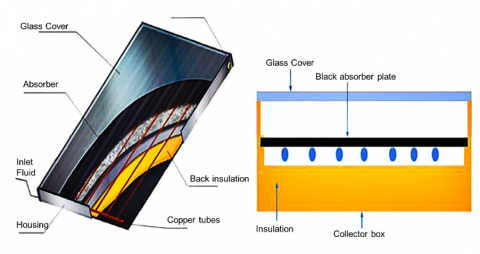
The most popular type of solar collector for low thermal applications (temperatures below 90℃) is the FPSC due to its exceptional capacity to generate heat energy from sunlight. These applications include space heating, swimming pool heating, domestic hot H2O production, and solar cooling systems [61, 62]. Figure 3 outlines the components of the FPSC, which are as follows:
1. One or more of sheet glass whose task is to reduce convection losses.
2. Heat transfer tubes can be enhanced using techniques to enhance heat transfer inside the tube: fins corrugation grooves [63].
3. The absorber, which is used to collect solar-energy and transport heat to the pipes and subsequently the operating fluids, has a large absorbability and low emission.
4. Heat losses from the sides and bottom of the solar collector to the environment are minimized via insulation.
5. The container, which is used to protect all parts from dust and moisture.
Figure 3. FPSC schematic [62, 63]
From the advantages of FPSCs is that they are inexpensive, combine both radial and diffuse radiation, be stationary, and do not need to track the sun [64]. In order to increase the efficiency of these collectors, HNFs are used. Many theoretical, computational, and experimental research have been done in an attempt to improve the thermal performance of these collectors by using HNFs.
The findings demonstrated that H2O is the ideal base liquid for creating HNFs for a number of reasons, chief among them being that it has a higher thermal conductivity than other types, which improves the thermal performance of the solar collector; additionally, H2O requires less pumping energy and has a less detrimental effect on the solar collector's components. Regarding the NPs, the outcomes demonstrated that combining materials like MWCNT with metal oxide enhances the solar collector's thermal efficiency. However, because of their propensity for rapid aggregation and sedimentation, these NPs have serious stability issues. Consequently, these NPs require many treatments to increase their stability, which raises the solar collector's thermal efficiency but has a detrimental effect on its performance. The extremely high cost of these NPs makes it challenging to use them in many applications, which is another drawback. When combined with MWCNT, other NPs, such as h-BN, demonstrated excellent efficiency. Table 2 shows several numerical, theoretical and experimental studies of the use of HNF in FPSC.
Table 2. An overview of analyzed some theoretical, numerical, and experimental papers of using HNFs in FPSCs
|
Inves. |
(Base Liquids) & NPs |
Result |
Ref. |
|
Theor. |
(H2O) Cu CuO Cu/CuO |
The findings showed that for HNF, the FPSC's thermal efficiency was 71.8%. |
[65] |
|
Theor. |
(H2O/EG) CuO Fe3O4 MWCNTs CuO/MWCNTs Fe3O4/MWCNTs |
The MWCNT-CuO HNF performed better in three solar collectors than the MWCNT-Fe3O4 HNF, with a 71% thermal efficiency. |
[66] |
|
Theor. |
(H2O) Fe2O4 Zn-Fe2O4 |
In comparison to single nanofluids and H2O, the HNFs' thermal efficiency was superior. 80.1% was the maximum efficiency. |
[67] |
|
Num. |
(H2O) TiO2-Ag |
A collector's maximum energy efficiency is roughly 71.92%. |
[7] |
|
Num. |
(H2O) Fly Ash-Cu |
Enhances the FPSC's thermal performance by 73%. |
[2] |
|
Num. |
(Therminol VP-1) MgO-MWCNT |
The findings showed that FPSC has a 55% thermal efficiency. |
[68] |
|
Exp. |
(H2O) CuO/MWCNTs MgO/MWCNTs |
For MgO and CuO, the energy efficiency of the HNF collector is 70.55% and 69.11%, respectively. |
[57] |
|
Exp. |
(H2O) MWCNT Al2O3 MWCNT/Al2O3 |
According to the findings, utilizing hybrid MWCNT-Al2O3 can boost efficiency to 74%. |
[69] |
|
Exp. |
(H2O) CF-GNPs/CF MWCNTs/h-BN |
The solar collector's thermal efficiency rose to 85% when HNF was used. |
[70] |
HNFs offer numerous advantages in terms of enhancing the thermal performance of solar collectors; nevertheless, in order to achieve the necessary efficiency, certain issues and constraints need to be resolved, as seen in Figure 4.
Figure 4. Limitations and challenges of HNFs [15]
HNFs enhance the efficiency of solar collectors’ heat but face several challenges that need to be addressed for optimal efficiency. Key issues include achieving good dispersion and long-term stability, as NPs tend to agglomerate due to Van der Waals forces. While surfactants can improve particle dispersion, they may reduce thermal conductivity over time. Additionally, HNFs have higher viscosity than base liquids, which can increase pumping energy requirements and clogging in tubes, which lead to reduce system performance. Another issue is surface corrosion when exposed to HNFs. Additionally, HNFs are more expensive than base liquids; additionally, although increasing the concentration of NPs can improve heat conductivity, doing so comes with a price increase.
The review examines the preparation and characterization of hybrid nanomaterials for use in FPSCs. Key findings include:
1. The 2-step method is preferred over the simpler 1-step technique for producing HNFs due to better control over fluid concentration.
2. Stability is crucial, especially at high NP concentrations, as gravity can cause clumping, adversely impacting thermophysical properties.
3. Techniques such as adding surfactants, adjusting pH, and using ultrasonic or magnetic agitation are necessary to enhance stability.
4. Increased hybrid NP concentration improves thermal conductivity but also raises viscosity.
5. Graphene NPs (GNP) and multiwalled carbon nanotubes (MWCNT) both show significant gains in heat conductivity.
6. Higher viscosity can lead to pipe blockages and increased pumping energy requirements.
7. As an alternative to theoretical models, artificial neural networks can accurately predict the thermophysical features of HNFs.
8. Research has demonstrated that the efficiency of solar collectors’ heat can be improved by HNFs when compared to base liquids and single nanofluids.
9. Techniques like disturbances in porous media can further enhance heat transmission by using HNFs.
The recommendations for improving HNFs in FPSCs include:
1. Investigating how various elements affect the stability of HNFs, as stability is crucial for their application.
2. Conducting studies to optimize NP mixing-ratios to achieve high thermal conductivity with lower viscosity.
3. Researching thermal conductivity behavior at high temperatures, relevant for solar collector operation.
4. Addressing corrosion issues in tubes caused by hybrid NPs in future studies.
5. Exploring new types of hybrids nanofluids to improve the solar collectors' thermal performance.
6. Considering the economic implications of using HNFs in solar thermal technologies due to their high costs.
7. Enhancing techniques like turbulator and porous media to further improve thermal performance.
8. Implementing hybrid secondary fluids in real-world systems on a large scale to monitor efficiency improvements.
|
FPSC |
FPSC |
|
Al2O3 |
Alumina |
|
SiO2 |
Silicon dioxide |
|
CuO |
Copper oxide |
|
TiO2 |
Titanium dioxide |
|
MWCNTs |
Multi-Walled Carbon Nanotube |
|
GNPs |
Global Natural Products Social |
|
Fe2O3 |
Iron Π trioxide |
|
EG |
EG |
|
CNT |
Carbon Nanotube |
|
Ag |
Silver |
|
ZnO |
Zinc oxide |
|
MgO |
Magnesium oxide |
|
C |
Carbon |
|
Fe2O4 |
Iron Π oxide |
|
TEOS |
Tetraethyl Orthosilicate |
|
Cu |
Copper |
|
CNC |
crystal nano-cellulose |
|
EEW |
electrical explosion of wire |
|
WO3 |
Tungsten trioxide |
|
SiC |
Silicon carbide |
|
PWE |
pulsed wire evaporation |
|
ND |
Nanodiamond |
|
Fe3O4 |
Iron ɪɪɪ oxide |
|
CeO2 |
Cerium oxide |
|
Zn |
Zinc |
|
Al |
Aluminum |
|
GO |
Gadolinium |
|
h-BN |
hexagonal boron nitride |
|
CP |
specific heat, J. kg-1. K-1 |
|
k |
thermal conductivity, W.m-1. K-1 |
|
NP |
Nanoparticles |
|
NF |
Nanofluids |
|
HNFs |
Hybrid Nanofluids |
|
Greek symbols |
|
|
ρ |
dynsity, kg. m-3 |
|
$\phi$ |
solid volume fraction |
|
µ |
dynamic viscosity, kg. m-1.s-1 |
|
Subscripts |
|
|
np |
Nanoparticles |
|
f |
fluid |
|
nf |
nanofluid |
|
hnf |
Hybrid Nanofluid |
[1] Ajeena, A.M., Farkas, I., Víg, P. (2023). Performance enhancement of flat plate solar collector using ZrO2-SiC/DW hybrid nanofluid: A comprehensive experimental study. Energy Conversion and Management: X, 20: 100458. https://doi.org/10.1016/j.ecmx.2023.100458
[2] Azimy, N., Saffarian, M.R. (2023). Investigation of thermal characteristics and entropy generation in a solar collector including fly Ash-Cu hybrid nanofluids: Numerical approach using mixture model. Engineering Analysis with Boundary Elements, 152: 169-184. https://doi.org/10.1016/j.enganabound.2023.04.002
[3] Al-Shiblia, K.A., Al-Akaishib, A.S. (2021). Improving the performance of evacuated tube of a solar collector with acetone-based heat pipe using the desert sand as thermal storage material. In 2021 4th International Iraqi Conference on Engineering Technology and Their Applications (IICETA), Najaf, Iraq, pp. 146-150. https://doi.org/10.1109/IICETA51758.2021.9717511
[4] Khudair, N.Y., Hussein, A.K. (2023). Enhancement of the performance of evacuated tube collector of solar by utilizing mono and hybrid nanofluids-An extended review. AIP Conference Proceedings, 2787(1): 030017. https://doi.org/10.1063/5.0148142.
[5] Mackay, M.E. (2015). Solar Energy: An Introduction. Oxford University Press, USA.
[6] Negeed, E.S.R., Alhazmy, M., Bokhary, A.Y., Abulkhair, H., Almas, M.A., Hedia, H.S. (2023). Numerical simulation of flat plate solar collector equipped with a turbulator containing water/copper-graphene hybrid nanofluid utilizing a two-phase model. Engineering Analysis with Boundary Elements, 156: 90-113. https://doi.org/10.1016/j.enganabound.2023.08.006
[7] Khan, A.I., Arasu, A.V. (2023). Numerical investigation on thermal performance enhancement of flat plate solar collector with titania-silver/water hybrid nanofluid. Energy Sources, Part A: Recovery, Utilization, and Environmental Effects, 45(2): 3654-3680. https://doi.org/10.1080/15567036.2023.2195826
[8] Subramanian, K.R.V., Rao, T.N., Balakrishnan, A. (2019). Nanofluids and Their Engineering Applications. CRC Press.
[9] Sawant, Y., Pathare, K., Patel, R., Choughule, P. (2021). Nanofluids with recent application & future trends. International Journal of Innovations in Engineering Research and Technology, 8(6): 458-468.
[10] Sheremet, M.A. (2021). Applications of nanofluids. Nanomaterials, 11(7): 1716. https://doi.org/10.3390/nano11071716
[11] Sarkar, J., Ghosh, P., Adil, A. (2015). A review on hybrid nanofluids: Recent research, development and applications. Renewable and Sustainable Energy Reviews, 43: 164-177. https://doi.org/10.1016/j.rser.2014.11.023
[12] Sajid, M.U., Ali, H.M. (2018). Thermal conductivity of hybrid nanofluids: A critical review. International Journal of Heat and Mass Transfer, 126: 211-234. https://doi.org/10.1016/j.ijheatmasstransfer.2018.05.021
[13] Babar, H., Ali, H.M. (2019). Towards hybrid nanofluids: Preparation, thermophysical properties, applications, and challenges. Journal of Molecular Liquids, 281: 598-633. https://doi.org/10.1016/j.molliq.2019.02.102
[14] Yang, L., Ji, W., Mao, M., Huang, J.N. (2020). An updated review on the properties, fabrication and application of hybrid-nanofluids along with their environmental effects. Journal of Cleaner Production, 257: 120408. https://doi.org/10.1016/j.jclepro.2020.120408
[15] Alfellag, M.A., Kamar, H.M., Sidik, N.A.C., Muhsan, A.S., Kazi, S.N., Alawi, O.A., Abidin, U. (2023). Rheological and thermophysical properties of hybrid nanofluids and their application in flat-plate solar collectors: A comprehensive review. Journal of Thermal Analysis and Calorimetry, 148(14): 6645-6686. https://doi.org/10.1007/s10973-023-12184-3
[16] Vahidinia, F., Khorasanizadeh, H., Aghaei, A. (2021). Comparative energy, exergy and CO2 emission evaluations of a LS-2 parabolic trough solar collector using Al2O3/SiO2-Syltherm 800 hybrid nanofluid. Energy Conversion and Management, 245: 114596. https://doi.org/10.1016/j.enconman.2021.114596
[17] Johari, M.N.I., Zakaria, I.A., Azmi, W.H., Mohamed, W.A.N.W. (2022). Green bio glycol Al2O3-SiO2 hybrid nanofluids for PEMFC: The thermal-electrical-hydraulic perspectives. International Communications in Heat and Mass Transfer, 131: 105870. https://doi.org/10.1016/j.icheatmasstransfer.2021.105870
[18] Wanatasanapan, V.V., Abdullah, M.Z., Gunnasegaran, P. (2020). Effect of TiO2-Al2O3 nanoparticle mixing ratio on the thermal conductivity, rheological properties, and dynamic viscosity of water-based hybrid nanofluid. Journal of Materials Research and Technology, 9(6): 13781-13792. https://doi.org/10.1016/j.jmrt.2020.09.127
[19] Ma, M., Zhai, Y., Yao, P., Li, Y., Wang, H. (2021). Effect of surfactant on the rheological behavior and thermophysical properties of hybrid nanofluids. Powder Technology, 379: 373-383. https://doi.org/10.1016/j.powtec.2020.10.089
[20] Zhang, S., Lu, L., Wen, T., Dong, C. (2021). Turbulent heat transfer and flow analysis of hybrid Al2O3-CuO/water nanofluid: An experiment and CFD simulation study. Applied Thermal Engineering, 188: 116589. https://doi.org/10.1016/j.applthermaleng.2021.116589
[21] Abbas, F., Ali, H.M., Shaban, M., Janjua, M.M., Shah, T.R., Doranehgard, M.H., Ahmadlouydarab, M., Farukh, F. (2021). Towards convective heat transfer optimization in aluminum tube automotive radiators: Potential assessment of novel Fe2O3-TiO2/water hybrid nanofluid. Journal of the Taiwan Institute of Chemical Engineers, 124: 424-436. https://doi.org/10.1016/j.jtice.2021.02.002
[22] Zainon, S.N.M., Azmi, W.H. (2021). Stability and thermo-physical properties of green bio-glycol based TiO2-SiO2 nanofluids. International Communications in Heat and Mass Transfer, 126: 105402. https://doi.org/10.1016/j.icheatmasstransfer.2021.105402
[23] Vidhya, R., Balakrishnan, T., Kumar, B.S. (2021). Investigation on thermophysical properties and heat transfer performance of heat pipe charged with binary mixture based ZnO-MgO hybrid nanofluids. Materials Today: Proceedings, 37: 3423-3433. https://doi.org/10.1016/j.matpr.2020.09.284
[24] Akilu, S., Baheta, A.T., Said, M.A.M., Minea, A.A., Sharma, K.V. (2018). Properties of glycerol and ethylene glycol mixture based SiO2-CuO/C hybrid nanofluid for enhanced solar energy transport. Solar Energy Materials and Solar Cells, 179: 118-128. https://doi.org/10.1016/j.solmat.2017.10.027
[25] Li, J., Liu, C.Y., Xie, Z. (2011). Synthesis and surface plasmon resonance properties of carbon-coated Cu and Co nanoparticles. Materials Research Bulletin, 46(5): 743-747. https://doi.org/10.1016/j.materresbull.2011.01.014
[26] Suresh, S., Venkitaraj, K.P., Selvakumar, P., Chandrasekar, M. (2011). Synthesis of Al2O3–Cu/water hybrid nanofluids using two step method and its thermo physical properties. Colloids and Surfaces A: Physicochemical and Engineering Aspects, 388(1-3): 41-48. https://doi.org/10.1016/j.colsurfa.2011.08.005
[27] Amiri, M., Movahedirad, S., Manteghi, F. (2016). Thermal conductivity of water and ethylene glycol nanofluids containing new modified surface SiO2-Cu nanoparticles: Experimental and modeling. Applied Thermal Engineering, 108: 48-53. https://doi.org/10.1016/j.applthermaleng.2016.07.091
[28] Ma, M.Y., Zhai, Y.L., Li, Z.H., Yao, P.T., Wang, H. (2021). Particle size-dependent rheological behavior and mechanism of Al2O3-Cu/W hybrid nanofluids. Journal of Molecular Liquids, 335: 116297. https://doi.org/10.1016/j.molliq.2021.116297
[29] Lahari, M.C., Sai, P.S.T., Sharma, K.V., Narayanaswamy, K.S. (2022). Thermal conductivity and viscosity of glycerine-water based Cu-SiO2 hybrid nanofluids. Materials Today: Proceedings, 66: 1823-1829. https://doi.org/10.1016/j.matpr.2022.05.284
[30] Chawhan, S.S., Barai, D.P., Bhanvase, B.A. (2021). Investigation on thermophysical properties, convective heat transfer and performance evaluation of ultrasonically synthesized Ag-doped TiO2 hybrid nanoparticles based highly stable nanofluid in a minichannel. Thermal Science and Engineering Progress, 25: 100928. https://doi.org/10.1016/j.tsep.2021.100928
[31] Esfe, M.H., Arani, A.A.A., Rezaie, M., Yan, W.M., Karimipour, A. (2015). Experimental determination of thermal conductivity and dynamic viscosity of Ag–MgO/water hybrid nanofluid. International Communications in Heat and Mass Transfer, 66: 189-195. https://doi.org/10.1016/j.icheatmasstransfer.2015.06.003
[32] Aberoumand, S., Jafarimoghaddam, A. (2018). Tungsten (III) oxide (WO3)–Silver/transformer oil hybrid nanofluid: Preparation, stability, thermal conductivity and dielectric strength. Alexandria Engineering Journal, 57(1): 169-174. https://doi.org/10.1016/j.aej.2016.11.003
[33] Kishore, P.S., Sireesha, V., Harsha, V.S., Rao, V.D., Solomon, A.B. (2020). Preparation, characterization and thermo-physical properties of Cu-graphene nanoplatelets hybrid nanofluids. Materials Today: Proceedings, 27: 610-614. https://doi.org/10.1016/j.matpr.2019.12.108
[34] Bahiraei, M., Heshmatian, S. (2018). Thermal performance and second law characteristics of two new microchannel heat sinks operated with hybrid nanofluid containing graphene–silver nanoparticles. Energy Conversion and Management, 168: 357-370. https://doi.org/10.1016/j.enconman.2018.05.020
[35] Yarmand, H., Gharehkhani, S., Ahmadi, G., Shirazi, S.F.S., Baradaran, S., Montazer, E., Zubir, M.N.M., Alehashem, M.S., Kazi, S.N., Dahari, M. (2015). Graphene nanoplatelets–silver hybrid nanofluids for enhanced heat transfer. Energy Conversion and Management, 100: 419-428. https://doi.org/10.1016/j.enconman.2015.05.023
[36] Li, X., Zeng, G., Lei, X. (2020). The stability, optical properties and solar-thermal conversion performance of SiC-MWCNTs hybrid nanofluids for the direct absorption solar collector (DASC) application. Solar Energy Materials and Solar Cells, 206: 110323. https://doi.org/10.1016/j.solmat.2019.110323
[37] Munkhbayar, B., Tanshen, M.R., Jeoun, J., Chung, H., Jeong, H. (2013). Surfactant-free dispersion of silver nanoparticles into MWCNT-aqueous nanofluids prepared by one-step technique and their thermal characteristics. Ceramics International, 39(6): 6415-6425. https://doi.org/10.1016/j.ceramint.2013.01.069
[38] Sundar, L.S., Mesfin, S., Ramana, E.V., Said, Z., Sousa, A.C. (2021). Experimental investigation of thermo-physical properties, heat transfer, pumping power, entropy generation, and exergy efficiency of nanodiamond+ Fe3O4/60: 40% water-ethylene glycol hybrid nanofluid flow in a tube. Thermal Science and Engineering Progress, 21: 100799. https://doi.org/10.1016/j.tsep.2020.100799
[39] Sundar, L.S., Ramana, E.V., Graça, M.P.F., Singh, M.K., Sousa, A.C. (2016). Nanodiamond-Fe3O4 nanofluids: preparation and measurement of viscosity, electrical and thermal conductivities. International Communications in Heat and Mass Transfer, 73: 62-74. https://doi.org/10.1016/j.icheatmasstransfer.2016.02.013
[40] Sundar, L.S., Singh, M.K., Sousa, A.C.M. (2014). Enhanced heat transfer and friction factor of MWCNT-Fe3O4/water hybrid nanofluids. International Communications in Heat and Mass Transfer, 52: 73-83. https://doi.org/10.1016/j.icheatmasstransfer.2014.01.012
[41] Saleh, B., Sundar, L.S. (2021). Entropy generation and exergy efficiency analysis of ethylene glycol-water based nanodiamond+ Fe3O4 hybrid nanofluids in a circular tube. Powder Technology, 380: 430-442. https://doi.org/10.1016/j.powtec.2020.12.006
[42] Tiwari, A.K., Pandya, N.S., Said, Z., Öztop, H.F., Abu-Hamdeh, N. (2021). 4S consideration (synthesis, sonication, surfactant, stability) for the thermal conductivity of CeO2 with MWCNT and water based hybrid nanofluid: An experimental assessment. Colloids and Surfaces A: Physicochemical and Engineering Aspects, 610: 125918. https://doi.org/10.1016/j.colsurfa.2020.125918
[43] Said, Z., Sharma, P., Sundar, L.S., Afzal, A., Li, C. (2021). Synthesis, stability, thermophysical properties and AI approach for predictive modelling of Fe3O4 coated MWCNT hybrid nanofluids. Journal of Molecular Liquids, 340: 117291. https://doi.org/10.1016/j.molliq.2021.117291
[44] Harandi, S.S., Karimipour, A., Afrand, M., Akbari, M., D'Orazio, A. (2016). An experimental study on thermal conductivity of F-MWCNTs–Fe3O4/EG hybrid nanofluid: Effects of temperature and concentration. International Communications in Heat and Mass Transfer, 76: 171-177. https://doi.org/10.1016/j.icheatmasstransfer.2016.05.029
[45] Alklaibi, A.M., Sundar, L.S., Mouli, K.V.C. (2022). Experimental investigation on the performance of hybrid Fe3O4 coated MWCNT/Water nanofluid as a coolant of a Plate heat exchanger. International Journal of Thermal Sciences, 171: 107249. https://doi.org/10.1016/j.ijthermalsci.2021.107249
[46] Alawi, O.A., Kamar, H.M., Hussein, O.A., Mallah, A.R., Mohammed, H.A., Khiadani, M., Roomi, A.B., Kazi, S.N., Yaseen, Z.M. (2022). Effects of binary hybrid nanofluid on heat transfer and fluid flow in a triangular-corrugated channel: An experimental and numerical study. Powder Technology, 395: 267-279. https://doi.org/10.1016/j.powtec.2021.09.046
[47] Safi, M.A., Ghozatloo, A., Shariaty, N.M., Hamidi, A.A. (2014). Preparation of MWNT/TiO2 nanofluids and study of its thermal conductivity and stability. Iranian Journal of Chemical Engineering, 11(4): 3-9.
[48] Bakhtiari, R., Kamkari, B., Afrand, M., Abdollahi, A. (2021). Preparation of stable TiO2-Graphene/Water hybrid nanofluids and development of a new correlation for thermal conductivity. Powder Technology, 385: 466-477. https://doi.org/10.1016/j.powtec.2021.03.010
[49] Dezfulizadeh, A., Aghaei, A., Joshaghani, A.H., Najafizadeh, M.M. (2021). An experimental study on dynamic viscosity and thermal conductivity of water-Cu-SiO2-MWCNT ternary hybrid nanofluid and the development of practical correlations. Powder Technology, 389: 215-234. https://doi.org/10.1016/j.powtec.2021.05.029
[50] Askari, S., Lotfi, R., Rashidi, A.M., Koolivand, H., Koolivand-Salooki, M. (2016). Rheological and thermophysical properties of ultra-stable kerosene-based Fe3O4/Graphene nanofluids for energy conservation. Energy Conversion and Management, 128: 134-144. https://doi.org/10.1016/j.enconman.2016.09.037
[51] Mechiri, S.K., Vasu, V., Venu Gopal, A. (2017). Investigation of thermal conductivity and rheological properties of vegetable oil based hybrid nanofluids containing Cu–Zn hybrid nanoparticles. Experimental Heat Transfer, 30(3): 205-217. https://doi.org/10.1080/08916152.2016.1233147
[52] Kumar, M.S., Vasu, V., Gopal, A.V. (2016). Thermal conductivity and rheological studies for Cu–Zn hybrid nanofluids with various basefluids. Journal of the Taiwan Institute of Chemical Engineers, 66: 321-327. https://doi.org/10.1016/j.jtice.2016.05.033
[53] Mechiri, S.K., Vasu, V., Babu, S. (2015). Thermal conductivity of Cu-Zn hybrid Newtonian nanofluids: experimental data and modeling using neural network. Procedia Engineering, 127: 561-567. https://doi.org/10.1016/j.proeng.2015.11.345
[54] Paul, G., Philip, J., Raj, B., Das, P.K., Manna, I. (2011). Synthesis, characterization, and thermal property measurement of nano-Al95Zn05 dispersed nanofluid prepared by a two-step process. International Journal of Heat and Mass Transfer, 54(15-16): 3783-3788. https://doi.org/10.1016/j.ijheatmasstransfer.2011.02.044
[55] Mousavi, S.M., Esmaeilzadeh, F., Wang, X.P. (2019). A detailed investigation on the thermo-physical and rheological behavior of MgO/TiO2 aqueous dual hybrid nanofluid. Journal of Molecular Liquids, 282: 323-339. https://doi.org/10.1016/j.molliq.2019.02.100
[56] Tiwari, A.K., Pandya, N.S., Said, Z., Chhatbar, S.H., Al-Turki, Y.A., Patel, A.R. (2021). 3S (Sonication, surfactant, stability) impact on the viscosity of hybrid nanofluid with different base fluids: An experimental study. Journal of Molecular Liquids, 329: 115455. https://doi.org/10.1016/j.molliq.2021.115455
[57] Verma, S.K., Tiwari, A.K., Tiwari, S., Chauhan, D.S. (2018). Performance analysis of hybrid nanofluids in flat plate solar collector as an advanced working fluid. Solar Energy, 167: 231-241. https://doi.org/10.1016/j.solener.2018.04.017
[58] Chandrasekar, M., Suresh, S., Senthilkumar, T. (2012). Mechanisms proposed through experimental investigations on thermophysical properties and forced convective heat transfer characteristics of various nanofluids–A review. Renewable and Sustainable Energy Reviews, 16(6): 3917-3938. https://doi.org/10.1016/j.rser.2012.03.013
[59] Asadi, M., Asadi, A. (2016). Dynamic viscosity of MWCNT/ZnO–engine oil hybrid nanofluid: An experimental investigation and new correlation in different temperatures and solid concentrations. International Communications in Heat and Mass Transfer, 76: 41-45. https://doi.org/10.1016/j.icheatmasstransfer.2016.05.019
[60] Xiong, Q., Altnji, S., Tayebi, T., Izadi, M., Hajjar, A., Sundén, B., Li, L.K. (2021). A comprehensive review on the application of hybrid nanofluids in solar energy collectors. Sustainable Energy Technologies and Assessments, 47: 101341. https://doi.org/10.1016/j.seta.2021.101341
[61] Mahian, O., Bellos, E., Markides, C.N., Taylor, R.A., Alagumalai, A., Yang, L., Qin, C., Lee, B.J., Ahmadi, G., Safaei, M.R., Wongwises, S. (2021). Recent advances in using nanofluids in renewable energy systems and the environmental implications of their uptake. Nano Energy, 86: 106069. https://doi.org/10.1016/j.nanoen.2021.106069
[62] Hawwash, A.A., Rahman, A.K.A., Nada, S.A., Ookawara, S. (2018). Numerical investigation and experimental verification of performance enhancement of flat plate solar collector using nanofluids. Applied Thermal Engineering, 130: 363-374. https://doi.org/10.1016/j.applthermaleng.2017.11.027
[63] Shamsul Azha, N.I., Hussin, H., Nasif, M.S., Hussain, T. (2020). Thermal performance enhancement in flat plate solar collector solar water heater: A review. Processes, 8(7): 756. https://doi.org/10.3390/PR8070756
[64] Azimy, N., Saffarian, M.R., Noghrehabadi, A. (2024). Thermal performance analysis of a flat-plate solar heater with zigzag-shaped pipe using fly ash-Cu hybrid nanofluid: CFD approach. Environmental Science and Pollution Research, 31(12): 18100-18118. https://doi.org/10.1007/s11356-022-24640-y
[65] J.A., R.B., K., K.K., S., S.S. (2018). Thermodynamic analysis of hybrid nanofluid based solar flat plate collector. World Journal of Engineering, 15(1): 27-39. https://doi.org/10.1108/WJE-03-2017-0048
[66] Lee, M., Shin, Y., Cho, H. (2021). Theoretical study on performance comparison of various solar collectors using binary nanofluids. Journal of Mechanical Science and Technology, 35: 1267-1278. https://doi.org/10.1007/s12206-021-0238-4
[67] Stalin, P.M.J., Arjunan, T.V., Almeshaal, M., Murugesan, P., Prabu, B., Kumar, P.M. (2022). Utilization of zinc-ferrite/water hybrid nanofluids on thermal performance of a flat plate solar collector—a thermal modeling approach. Environmental Science and Pollution Research, 29(52): 78848-78861. https://doi.org/10.1007/s11356-022-21261-3
[68] Alsarraf, J., Alnaqi, A.A., Al-Rashed, A.A. (2023). Simulation of two-phase hybrid nanofluid flow in a flat plate solar collector equipped with spiral absorber tube under the influence of magnetic field: Hydraulic-thermal, energy, and exergy analysis. Journal of Magnetism and Magnetic Materials, 585: 171120. https://doi.org/10.1016/j.jmmm.2023.171120
[69] Elshazly, E., Abdel-Rehim, A.A., El-Mahallawi, I. (2022). 4E study of experimental thermal performance enhancement of flat plate solar collectors using MWCNT, Al2O3, and hybrid MWCNT/Al2O3 nanofluids. Results in Engineering, 16: 100723. https://doi.org/10.1016/j.rineng.2022.100723
[70] Hussein, O.A., Habib, K., Muhsan, A.S., Saidur, R., Alawi, O.A., Ibrahim, T.K. (2020). Thermal performance enhancement of a flat plate solar collector using hybrid nanofluid. Solar Energy, 204: 208-222. https://doi.org/10.1016/j.solener.2020.04.034