
Zohra Toumi* | Aicha Boussoualim
© 2026 The authors. This article is published by IIETA and is licensed under the CC BY 4.0 license (http://creativecommons.org/licenses/by/4.0/).
OPEN ACCESS
This paper investigates how greenery in urban primary school grounds relates to children’s plant-related knowledge and opportunities for direct interaction with plants. It reports an exploratory case study conducted in a public primary school in southeastern Algiers, Algeria, involving 60 pupils aged 10 to 11 years. Data were collected through classroom-administered questionnaires completed by each child and analyzed using descriptive statistics and thematic coding. The article explores children’s perceptions of school-ground greenery, their plant-related knowledge, and the ways spatial accessibility shapes plant-related learning opportunities. The findings show a disconnect between children’s reported knowledge and their direct experience with greenery. Although many children recognized, valued, and emotionally appreciated the presence of greenery, their reported knowledge remained largely limited to abstract concepts acquired in the classroom rather than observational or species-level knowledge derived from direct contact with greenery. Reported restrictions on physical access to greenery coincided with limited opportunities for sensory engagement, close observation, and informal interaction. These findings suggest that school-ground greenery may remain pedagogically dormant: present and appreciated, yet not fully mobilized as an educational resource. The paper argues that stronger alignment between school ground design and access management is necessary to transform everyday greenery into active environments for plant-related learning.
plant-related knowledge, school-ground design, children’s perceptions, urban greenery, urban school grounds
Global urbanization has deeply affected children’s daily contact with nature [1, 2], causing an “extinction of experiences” [3] relevant to children’s relationships with plants. Studies have shown that children may have limited knowledge of common plant species in their surroundings [4, 5].
Children’s plant-related knowledge is acquired through formal learning, and experiential understanding is developed through repeated observation and interaction with living organisms [6, 7]. Children lacking regular access to biodiverse environments during formative developmental periods may fail to develop observational skills and ecological concepts [8, 9].
In urban environments, school grounds represent an important setting for children’s daily contact with greenery and living organisms [10, 11]. School ground greenery has been associated with enhanced physical activity [12], attention restoration [13], creative play [14], and overall well-being [15].
However, existing research predominantly focuses on greenery without attention to design characteristics and their educational implications [16]. Research on plant blindness highlighted that the tendency to overlook plants through aesthetic rather than biological characteristics leads to a knowledge-experience disconnect [17, 18].
Meaningful plant-related knowledge requires the capacity to observe and understand ecological phenomena in real context [19]. Place-based education theory [7] and experiential learning framework [20] indicate that local greenery could serve as an educational resource if children’s attention and interaction with plants are supported.
In school grounds, accessibility may therefore play an important role in determining whether greenery becomes an object of observation and exploration or remains a visual element of the environment. Visual access, physical proximity, and opportunities to interact with plants represent distinct dimensions of children’s experience that should not be considered equivalent [7, 20]. Greenery that is visible and appreciated by children may provide limited opportunities for direct engagement when access is constrained. This distinction is particularly relevant to the design of Algerian school grounds.
Understanding children’s perceptions of school-ground greenery and their reported access to greenery can provide useful insights for the design of educational outdoor environments [21]. The present article focuses on how children perceive school-ground greenery, what plant-related knowledge they report, and how accessibility shapes their plant-related learning.
1.1 Objectives
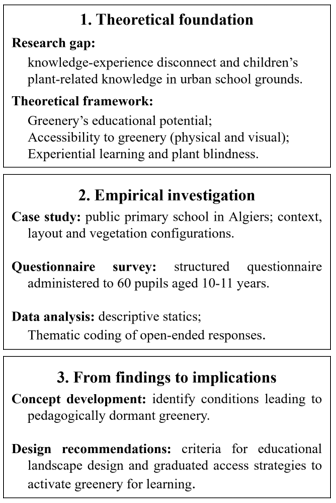
Through a case study of an urban primary school in Algiers, Algeria, this article aims to understand the conditions under which school-ground greenery remains pedagogically dormant despite children’s daily exposure to it. It investigates the aspects of greenery that children perceive and value, the plant-related knowledge they develop through everyday exposure, and the ways in which accessibility configurations enable or constrain informal plant-related learning. Subsequently, it provides design insights for effective outdoor learning environments in Algeria (Figure 1).
Figure 1. Conceptual and methodological workflow of the paper
2.1 School ground greenery as a learning resource
School-ground greenery can provide children with opportunities to observe, experience, and interact with living organisms. Its educational potential depends on the presence of different types of plants, and children’s ability to access and perceive their characteristics in studies [22-24]. For primary school children, functional and sensory characteristics may be particularly accessible because they can be perceived directly during everyday encounters with vegetation [20, 22].
Species richness, understood as the number of distinct plant species present, can provide a basis for comparison and classification [25]. However, the educational value of plant diversity may depend on children’s ability to perceive and distinguish differences between plants and to encounter them at a close distance [23]. Similarly, variation in growth forms and plant functions can make observable differences more meaningful, while sensory characteristics such as color, texture, and scent can attract children’s attention and encourage exploration [22, 26, 27]. Structural variation in plants can also create different spatial opportunities for movement and observation [28], while seasonal changes may provide repeated opportunities to notice biological processes over time [29, 30].
These characteristics do not operate independently. Their educational potential may depend on how easily children can notice, approach, and interact with them. Thus, the presence of varied greenery does not necessarily provide equivalent opportunities for plant-related learning when greenery remains physically distant or inaccessible [23, 31].
2.2 Observation, sensory engagement, and plant-related knowledge
Several mechanisms in the literature explain how contact with greenery may support children’s plant-related knowledge.
Comparative observation provides an important basis for pattern recognition and classification. Encountering plants with different forms, textures, leaf characteristics, or growth habits can encourage children to compare and distinguish observable features [32, 33]. Such comparisons may provide a basis for developing more refined observational understanding when supported by appropriate learning activities [7].
Sensory engagement: Experiences involving color, texture, scent, and other sensory characteristics engage multiple perceptual channels [34] and may strengthen attention and memory [27, 35]. These experiences stimulate curiosity and encourage children to examine plants more closely [9, 26].
Repeated encounters with familiar plants may further support children’s awareness of changes in plant appearance and seasonal patterns [36, 37].
These opportunities depend on children's ability to approach and observe vegetation rather than observing from a distance.
2.3 The role of accessibility in plant-related learning
Different forms of access may provide different opportunities for children’s interaction with greenery.
Visual access allows children to see vegetation from different locations and supports aesthetic appreciation, emotional responses, and awareness of large-scale characteristics [18, 23].
Physical access allows children to approach, examine, touch, and interact with plants under appropriate conditions, making sensory characteristics such as texture and surface properties more perceptible [20, 23]. Repeated interaction over time builds familiarity with plants and supports the development of observational competencies that single encounters cannot generate [37, 38], subsequently contributing to plant-related knowledge [20, 23].
In school environments, access to vegetation may nevertheless be restricted for reasons related to plant protection, safety, or maintenance [39, 40]. Restrictions on entering green areas, touching plants, or collecting plant materials can limit opportunities for direct experience.
This paper employs a case study approach to investigate children’s plant-related knowledge, perceptions of school ground greenery, and reported accessibility. Given the exploratory nature of this study, a descriptive mixed-method case study design was adopted to combine descriptive analysis of questionnaire responses with thematic coding of open-ended responses [41]. Children’s perspectives were prioritized as primary data sources, consistent with established methodological frameworks for research with children [42, 43].
3.1 Case study context
The Research was conducted in a public primary school in southeastern Algiers, Algeria; an urban context characterized by rapid urbanization pressures. The case study school follows a standardized Algerian public primary school design model governed by national ministry of education construction guidelines [44], making it relevant to the study of comparable school-ground environments in Algeria and other urban contexts facing similar spatial constraints. The school presents two distinct spatial configurations: an accessible zone (the main school yard) and an inaccessible natural zone (fenced green area), a distinction that guided the selection of the case study and enabled the comparison of children’s perceptions and interactions across different levels of accessibility.
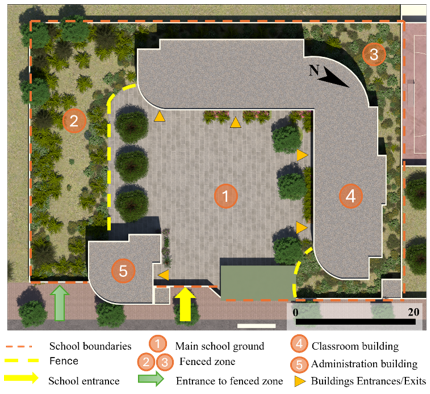
The school has one main entrance leading directly to the main school yard (1) and a second entrance, reserved for maintenance staff, providing direct access to the fenced green zone (2 and 3), which is off-limits to pupils. The classroom buildings (4) have multiple entrances opening onto the main school yard (Figure 2).
Figure 2. Spatial configuration and green areas of the case study
The school grounds were organized into two distinct zones with different levels of accessibility:
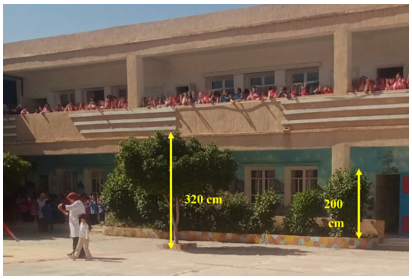
The main schoolyard (label 1 in Figure 2), covering approximately 800 m², consisted of a paved yard fully accessible to pupils. Vegetation within this area covers approximately 70 m² of horizontal projected area, corresponding to about 9% of the total main courtyard area. It included canopy trees of different sizes, ranging from approximately 3 to 5 m in height with an estimated canopy cover of 47 m² (Figures 3 and 4), as well as potted ornamental plants such as roses, shrubs, flowering plants, and climbing plants located near the classrooms (Figure 4).
The greenery was distributed across multiple small, fragmented zones with no physical barriers or protection (Figure 2). It is located directly adjacent to classroom exits and within an area used for pupil activities, making it part of the activity spaces rather than a separate green area located at a measurable distance from them (Figure 2, Figure 4). This area serves as the main space for recess, gathering before entering classrooms, physical education (PE), and occasional school events.
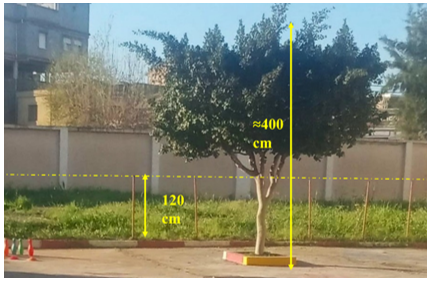
A fenced, non-accessible zone (labels 2 and 3 in Figure 2), adjacent to the main courtyard and covering the back of the classrooms building, covers approximately 610 m² of unpaved ground (Figure 2), separated from the main school ground by a fence 120 cm high supported with wooden stakes (Figure 3). Children had continuous visual access to these areas; they were not permitted to enter. The area contains mature trees planted near the school’s boundary wall, away from the fence delimiting the main school yard, as well as scattered shrubs and spontaneous seasonal plants with variable appearance. Access to this area was not permitted; therefore, the greenery within it could not be measured.
Figure 3. Heights of the fence separating the main school ground from the restricted green area
Overall, the school grounds included different vegetation configurations and levels of accessibility; the main school ground provided direct access to vegetation within the pupils’ daily activity areas (Figure 4), whereas the fenced zone was visually accessible but physically restricted (Table 1).
Figure 4. Greenery size near the classrooms (Children’s faces blurred for privacy)
Table 1. Spatial distribution, accessibility, and characteristics of greenery in the school ground
|
Zone |
Entry Status |
Entrance Number |
Greenery Area |
Greenery Type |
Location |
Visual Access |
Approach |
Interaction |
|
(1) Main Courtyard Area ≈ 800 m² |
Allowed (main activity area) |
1 main entrance from outside; 5 entrances/exits from school buildings to the main courtyard |
Total ≈ 70 m² Canopy cover ≈ 47 m² |
Trees Height ≈ 3 to 5 m |
Adjacent to classroom exits and distributed throughout the main courtyard |
Visible from the school grounds and from the classrooms |
Allowed |
Limited |
|
Shrubs Flowering plants Climbing plants |
Adjacent to classroom exits |
|||||||
|
(2) Fenced zone Area ≈ 610 m² |
Not allowed for pupils |
1 maintenance entrance from outside the school |
Not recorded (Access was not permitted) |
Trees |
Away from the fence |
Visible from the school grounds and facing classrooms |
Approach permitted up to the fence |
Restricted |
|
Shrubs Spontaneous seasonal plants |
Scattered throughout the area |
|||||||
|
(3) Back fenced Zone Area not recorded |
Trees, Shrubs, Spontaneous plants |
Not recorded |
Visible from Classrooms |
Not allowed |
Restricted |
The areas of the school grounds and the horizontal projected area of the greenery were estimated using Google Earth satellite imagery. Canopy cover was estimated from the visible horizontal projection of tree crowns in the satellite imagery.
3.2 Participants
The study involved 60 pupils aged 10 to 11 years from fifth grade, the final year of the Algerian primary education cycle. This age group was specifically selected as fifth-grade children have accumulated the longest period of exposure to the school grounds within the primary cycle, providing them with extensive experience of the outdoor environment. The Participants were recruited from 03 fifth-grade classes, with participation based on school administration authorization, parental consent, and children’s verbal assent prior to data collection.
3.3 Ethical considerations
The research was carried out in a public primary school with verbal permission from the Directorate of Education of Algiers East, the public authority responsible for administering and supervising primary schools, and the school administration.
An exemption from ethical review was granted by the Architecture and Environment Laboratory (LAE), Polytechnic School of Architecture and Urbanism of Algiers (EPAU), following a formal request submitted after data collection. The corresponding certificate was issued on 16 September 2026 (Reference No. 12/LAE/2026).
Verbal parental/guardian consent and children’s verbal assent were obtained through the school administration prior to participation. Participation was voluntary, and children could withdraw from the study at any time without providing a reason and without any consequences.
No personally identifying information was collected. Questionnaire data were anonymized, and photographs containing children were anonymized by blurring all identifiable facial features and other potentially recognizable details.
The anonymized research data are stored on a password-protected computer and are accessible only to the researcher.
The anonymized research data are stored on a password-protected computer accessible only to the researcher. They will be retained securely for five years after the doctoral defense associated with this research and will then be permanently deleted.
3.4 Data collection
3.4.1 Questionnaire design and content
The questionnaire was designed to examine children’s perceptions of school ground greenery, their plant-related knowledge and its sources, and their access to and interaction with vegetation. It included five sections addressing:
A- overall perception and emotional responses to the school ground.
B- perceptions of greenery and preferred places.
C- visual and physical access to greenery and permitted interactions.
D- plant-related knowledge and its sources, including classroom and outdoor learning.
E- formal and informal use of vegetation during school activities.
The questionnaire primarily consisted of closed-ended questions with three to five response options, together with a limited number of open-ended questions. The present article specifically analyzed the open-ended question concerning what children had learned about vegetation.
3.4.2 Language and cognitive adaptation
The questionnaire was written in Arabic, the children’s native language, and the wording was simplified to match the linguistic and cognitive abilities of the participants aged 10-11 years. Particular attention was given to question clarity and ease of comprehension. The English version of the questionnaire is provided in the Appendix (Table A1). A pilot version of the questionnaire was tested with a small group of children to assess question clarity and completion time, and minor adjustments were made before the main data collection.
3.4.3 Data collection procedure
Data collection took place in April 2025 during the spring season. The questionnaire was administered in class, after morning recess, by the pupil’s teacher, and each child completed the questionnaire individually. The administration procedure allowed the children to provide their responses independently while remaining within the regular school setting. The researchers were not present during the administration; therefore, the exact time required to complete the questionnaire was not recorded.
3.5 Data analysis
Given the exploratory nature of this paper and its single-case study design, data analysis relied on descriptive statistics (frequencies) and thematic coding of qualitative responses rather than inferential statistical testing. This approach was considered appropriate for identifying patterns in children’s experiences, perceptions, and plant-related knowledge [41, 45].
The coding of the open-ended responses employed a deductive coding framework distinguishing five levels of plant awareness (0–4): Level 0, no plant awareness; Level 1, aesthetic awareness, with greenery described in general positive terms such as “pretty” or “nice”; Level 2, sensory differentiation, including characteristics such as shade, color variety, and scent; Level 3, functional awareness, including recognition of plant function such as shade provision or oxygen production; and Level 4, ecological understanding, including recognition of relationships, adaptations, or ecological processes, rarely observed in this age group. The coding categories were defined a priori, based on the theoretical framework and the objectives of the study.
The coding decisions were subsequently compared, and no coding disagreements were recorded. Where a response contained distinct statements reflecting more than one level of plant awareness, all relevant levels were assigned. The operational definitions, coding rules, and illustrative examples for each level are provided in Table 2. The complete coding book is available in the Appendix (Table A2).
Table 2. Coding framework used to classify children’s plant awareness (Q14; N = 60)
|
Coding Level |
Operational Definition |
Examples of Responses |
|
Level 0 – No plant awareness |
No response or response that could not be meaningfully classified |
No response / unclear response |
|
Level 1 – Aesthetic awareness |
Greenery described using general positive or aesthetic terms without specific characteristics |
“pretty”, “nice” |
|
Level 2 – Sensory differentiation |
Identification of directly perceived sensory or perceptual characteristics of greenery |
“Shady”, “many colors”, “it smells” |
|
Level 3 – Functional awareness |
Recognition of functions or benefits provided by plants |
“Trees give shade”, “purifies air”, “gives oxygen” |
|
Level 4 – Ecological understanding |
Recognition of plant needs, adaptations, ecological relationships, or biological processes |
“Plants need water and sun to grow”, “plants need fertilizer”, “some plants have deep roots, others don’t”, “they do photosynthesis”, “some plants grow vertically, others horizontally” |
Descriptive cross-tabulations were performed to examine patterns between reported access to school ground greenery and children’s general perception of the school ground, as well as between reported access and levels of plant-related knowledge. Given the descriptive nature of the analysis and the uneven distribution of some response categories, these cross-tabulations were interpreted descriptively, and no inferential statistical tests were applied.
Results are organized around three themes: children’s perception of school-ground greenery, their reported plant-related knowledge and experiences, and their reported access to and interaction with greenery.
4.1 Children’s perception of school-ground greenery
4.1.1 Perceived variation
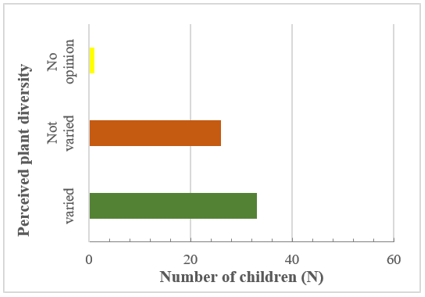
Children’s perceptions of school ground greenery were divided. When asked whether vegetation was varied, 33 of 60 children responded affirmatively, while 26 children perceived diversity as limited and one offered no opinion (Figure 5).
Qualitative analysis showed that children’s descriptions focused on characteristics that were directly observable and functionally relevant to children’s experience: color variation “the flowers have different colors: some red, some yellow and orange”, size differences “big trees and small plants”, and functional distinctions “trees give shade where we can sit, the flowers are for decoration”. No response explicitly referred to species identity, leaf morphology, or growth habits. The reported descriptions therefore primarily reflected sensory and functional characteristics of greenery.
Figure 5. Children’s perceptions of school ground greenery variation (Q6; N = 60)
Children also described the greenery as fragmented across the school ground, with 57 out of 60 reporting that plants were distributed across different areas of the school ground (Q8).
Children who perceived greenery as limited identified specific types of plants they considered absent, including grassy areas suitable for sitting and playing “there is no grass where we can sit or lie down”, edible or productive plants “no fruit trees” and “we don’t have a vegetable garden”, and other ground-level plants that could be approached more closely.
4.1.2 Favorite places, emotional responses and proximity to school ground greenery
Children’s preferred locations in the school ground frequently included green features. Shaded areas near classrooms were identified as favorite places, with children explicitly referring to shade as an attraction. The fenced area, despite being physically inaccessible, was mentioned by several children in relation to visual and olfactory characteristics, including “the wild plants that change colors” and “the small flowers that smell nice”.
Ornamental planting areas near classrooms were also described as “calm” and “peaceful”, suitable for conversation and rest.
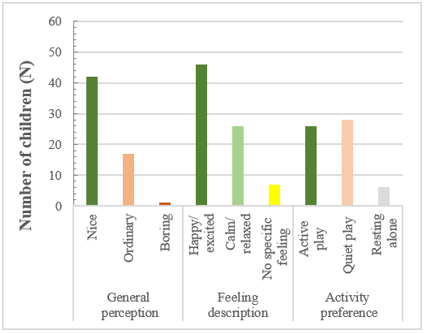
Children’s emotional responses to the school ground were predominantly positive: 46 of 60 reported feeling “happy” and “excited”, while 26 additionally described “calmness” and “relaxation” (Figure 6).
Figure 6. Children’s general perceptions, reported feelings, and experiences of the school grounds (Q1–Q3; N = 60)
Activity preferences also varied across the locations children described for different activities. 28 children reported preferring quiet activities, and 6 preferred resting alone, while 26 reported active play. Areas near greenery were mentioned in relation to quiet activities and resting, whereas open paved areas were more often mentioned for active play. Solitary trees were frequently described as landmarks, bases, or boundaries within children’s self-organized games, rather than as plants discussed in botanical terms (Figure 6).
4.2 Reported plant-related knowledge
4.2.1 Reported formal knowledge
Regarding what they had learned about plants at school, 47 of 60 children recalled specific plant-related lessons. Their responses included photosynthesis and oxygen production “plants make oxygen” and “it takes the carbon and make oxygen for us to breathe”, basic plant needs “plants need water and sunlight” and “they need soil and fertilizer”, and growth processes “plants grow from seeds”.
Several responses contained technical or biological terminology, including references to photosynthesis, oxygen, plant needs, and growth.
The open-ended responses to the question concerning what children had learned were coded using a five-level framework described in Table 3. Because a response could contain more than one type of plant-related knowledge, multiple coding was permitted (levels 1–4 are not mutually exclusive and their frequencies cannot be summed to obtain the total number of participants). 17 of 60 responses were classified as level 0: no interpretable plant-related knowledge (Table 3).
Table 3. Distribution of coded plant-related knowledge (Q12)
|
Coding Level |
Type of Knowledge |
N |
% |
|
Level 0 |
No plant-related knowledge |
17 of 60 |
28.3% |
|
Level 1 |
Aesthetic awareness |
19 of 60 |
31.7% |
|
Level 2 |
Sensory differentiation |
06 of 60 |
10% |
|
Level 3 |
Functional awareness |
16 of 60 |
26.7% |
|
Level 4 |
Ecological understanding |
18 of 60 |
30% |
4.2.2 Observational and species -level knowledge
Responses referring to direct school-ground experience mainly described sensory and functional characteristics with immediate experiential relevance, including shade provision, “that tree gives better shade than plants”; color variation, some flowers are red, some are orange”; and pleasant scent, some flowers smell really nice”. 05 children of 60 were able to name a specific plant species. Other responses used general category terms such as “trees”, “flowers”, or “wild plants”. No response combined a named plant with detailed description of its observable characteristics, growth habits, or ecological role.
4.3 Reported access to and interaction with school-ground greenery
4.3.1 Visual access
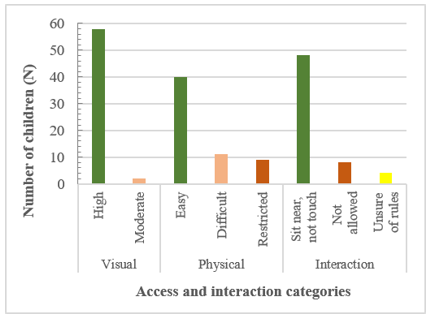
Nearly all children (58 of 60) reported high visual access to greenery, and indicated that vegetation could be seen from most school ground locations, including classrooms. The two remaining children reported moderate visual access. The high proportion of children reporting visual access did not allow a meaningful comparison between groups because only two children reported moderate access. The responses nevertheless indicate that greenery was generally visible to children during their daily school experience (Figure 7).
Figure 7. Children’ perception of greenery accessibility and interaction opportunities (Q9–Q10; N = 60)
4.3.2 Physical access and interaction
Physical access patterns were more differentiated. 40 children reported easy access to green areas, 11 reported difficulties, and 9 described explicit restrictions. These categories describe children’s reported ability to approach greenery and should be distinguished from their reported permission to interact directly with plants.
Regarding permitted interaction, 48 of 60 children reported that they could sit near plants but could not touch them, with responses such as “we are allowed to sit near but not touch the leaves” and “I can look at the flowers but not pick them”; 8 children reported that interaction was not allowed and 4 were unsure about the rules (Figure 7).
4.3.3 Restricted green areas
The fenced green area was described in relation to visible and sensory characteristics. Children referred to different colors, pleasant smells, and the presence of different plants, for example, “it smells nice” and “there are a lot of different plants”.
16 of the 60 children identified this area as their favorite area to observe. Although children could observe the greenery within this area and, in some cases, notice sensory characteristics such as color and smell, they reported that they could not enter. Consequently, their reported opportunities for close examination and direct physical interaction with this vegetation were limited.
Table 4. Cross-tabulation of reported physical access to greenery with general perception of the school ground
|
Reported Physical Access |
Nice |
Ordinary |
Boring |
Total |
|
Easy |
32 |
7 |
1 |
40 |
|
Difficult |
6 |
5 |
0 |
11 |
|
Restricted |
4 |
5 |
0 |
9 |
|
Total |
42 |
17 |
1 |
60 |
Table 5. Cross-tabulation of reported physical access to greenery with coded levels of plant-related knowledge
|
Reported Physical Access |
Level 0 |
Level 1 |
Level 2 |
Level 3 |
Level 4 |
|
Easy |
1 |
15 |
6 |
16 |
18 |
|
Difficult |
9 |
2 |
0 |
0 |
0 |
|
Restricted |
7 |
2 |
0 |
0 |
0 |
|
Total |
17/60 |
19/60 |
6/60 |
16/60 |
18/60 |
To describe how responses were distributed across reported physical access categories, two descriptive cross-tabulations were prepared. No inferential statistical tests were conducted. The first compared reported physical access with children’s general perception of the school ground (Table 4), while the second compared reported physical access to the coded levels of plant-related knowledge (Table 5).
4.4 Formal and informal experiences with vegetation
Outdoor educational experiences involving vegetation were reported by 47 of 60 children; they described experiences such as “observing plants during science lessons”. The concepts recalled from these experiences were generally similar to those reported in relation to classroom learning, including plant needs, photosynthesis, and oxygen production. During recess and unstructured periods, children more commonly described proximity to vegetation than active plant investigation. Examples included “we sit in the shade and talk” and “I like to rest near flowers”.
The findings reveal a contrast between children’s reported knowledge of plant-related concepts and their ability to recognize specific plants on the school grounds. While children expressed a generally positive perception of school-ground greenery and reported high visual access to it, opportunities for direct interaction with greenery were more restricted. The discussion therefore focuses on the relationship between formal and experience-based plant-related knowledge and the role of accessibility in shaping children’s opportunities to observe and interact with school ground greenery.
5.1 The knowledge-experience disconnect
The responses to the question about what children had learned in the school ground revealed a contrast between knowledge expressed through general plant-related concepts and responses referring to specific plants or directly observable characteristics. A total of 34 codes across Levels 3 and 4 reflected children’s recall of formal plant-related concepts like photosynthesis, oxygen production, and plant needs. By comparison, only 5 reported specific plant names; other responses referred to characteristics that could be directly noticed in the school grounds, including color, shade, and scent (Table 3). The plant-related knowledge reported by the children was generally abstract biological concepts, consistent with topics commonly addressed through formal science learning [6, 7]. Children's ability to recall such concepts suggests that formal science education functions effectively at the level of concept transmission as reported by children. By contrast, responses based on direct observation tended to refer to immediately perceptible characteristics of the greenery present in school grounds, such as differences in flower color, the shade provided by trees, or the presence of pleasant smells. This contrast suggests that the abstract knowledge expressed by children was not necessarily linked to direct, observational engagement with the specific greenery present in their own school grounds [18, 24].
Children spend recess outdoors regularly, pass plants multiple times daily, and reported high visual access overall (58 of 60 children). From an experiential learning perspective, these conditions would, in principle, be expected to support informal observational learning [20]. Yet in this case, greenery appeared to function primarily as environmental backdrop, present, pleasant, and emotionally supportive, rather than as an object of attention or investigation. Plants may have remained perceptually backgrounded despite physical prominence [18], becoming “experientially invisible” through familiarity without examination [2].
The occasional outdoor lessons children reported (47 of 60) represent a partial bridge between formal and experiential learning, but children’s descriptions suggested these sessions functioned primarily to illustrate predetermined concepts rather than facilitate discovery.
Place-based education theory distinguishes between “teaching outdoors” and “teaching from place” [7]: the first brings classroom content outside for illustration, while the second begins with local observable phenomena and builds concepts from observation. The outdoor lessons described by children appear to be closer to the first approach.
Genuine place-based learning would instead begin with children’s own observations, “Which plants change first in spring? Which flowers do insects visit?”, and introduce concepts such as photosynthesis as explanations for noticed patterns. This approach would connect abstract knowledge to observable reality rather than maintaining their parallel existence [37, 46, 47].
5.2 Accessibility and the “display-case” pattern
Descriptive findings indicated that most children reported high visual access to greenery, while direct physical interaction has been reported as limited. This combination is described here as a possible “display case” pattern: greenery that is visually available but offers limited opportunities for close, multisensory engagement [26, 27]. In this case study, the fenced wild zone illustrates the display case: a group of children described it as one of their most appreciated areas for visual and olfactory engagement, yet they could not enter to examine its vegetation closely.
Motivations for access restrictions discussed in the literature include protecting vegetation from damage, managing safety risks, and maintaining aesthetic standards [39, 40]. However, these restrictions may reduce opportunities for engagement with greenery [16, 39]. Table 5 presents the distribution of coded plant-related knowledge across reported physical access categories. In this sample, responses from children reporting easy access appeared across all five levels, whereas responses from children reporting difficult or restricted access appeared only at levels 0 and 1. Similarly, children reporting easy access were predominantly among those who described the school ground as nice, while more ordinary perceptions were relatively more frequent among those reporting more limited access (Table 4).
It should be noted that restrictions described above were reported exclusively from the children’s perspective.
5.3 Functional diversity, ground-level accessibility, and spatial distribution
Children demonstrate awareness of functional distinctions among plants, for example, “some plants give shade, others are for decoration”; reflecting a basic form of ecological categorization even without botanical precision [22, 24]. These propositions suggest that for young learners, functional and sensory characteristics (growth forms, sensory properties, seasonal patterns) may be more perceived and more relevant for learning than species richness as such. This is consistent with the theoretical proposition that the educational value of plant diversity depends on children’s ability to perceive, distinguish, and approach greenery rather than on the number of species present alone [23].
Children also explicitly articulated the absence of ground-level vegetation as a limitation: “no grass to sit in,” pointing to what may be one of the more educationally relevant gaps identified in this article. The existing canopy trees and potted ornamentals tend to position botanical features beyond children’s comfortable examination reach. Ground-level plants (grasses, herbs, low shrubs) would position leaves, flowers, textures, and associated insects closer for observation and tactile interaction that build observational competencies [28, 48].
The fragmented distribution of greenery, reported by 57 of the 60 children, was another notable feature of this case study. The presence of several small green zones appears to provide varied settings that children use differently across the school day, including shaded areas for rest and visually or sensorially distinctive areas for observation.
Children used multiple trees distributed in the school ground as a play structure, making them navigate between fragmented vegetated zones. Moving between these areas may increase the frequency of children’s encounters with vegetation, although the present study did not measure repeated contact or changes in familiarity over time.
Distributed patches also create natural comparison opportunities: noticing that the tree near the classroom differs from trees in the playground, observing that different zones bloom at different times.
These patterns, while requiring further verification, suggest that spatial fragmentation of greenery in school grounds, despite ecological restoration literature preference for habitat consolidation, might not necessarily work against its pedagogical function; educational and ecological objectives may both be optimized through distribution rather than concentration planting [12, 49].
5.4 Design implications
In this case study, children’s reports raise the possibility that greenery designed primarily for visual amenity, maintenance, or safety may offer fewer opportunities for direct plant engagement than greenery designed with educational interaction purposes.
Building on the patterns described above, together with the literature reviewed, several design directions can be proposed to help reconnect school-ground greenery with children’s opportunities for direct, observational learning. These are presented as proposals derived from the findings and the literature.
Graduated access. Rather than a uniform prohibition on touching plants, a tiered approach could be considered: full-interaction zones with robust, child-safe species explicitly selected for handling; guided-access areas for supervised investigation, for instance during science lessons; and protected zones reserved for plants that are genuinely fragile or hazardous. Such an approach could maintain stewardship objectives while creating more opportunities for plant diversity to function educationally [48, 50].
Plant selection criteria. educational landscape could select species according to multiple criteria beyond ornamental value and maintenance efficiency, including urban stress tolerance (e.g., drought, compaction, heat) combined with visibly adaptive traits; safe physical interaction (non-toxic, manageable, robust under handling); sensory distinctiveness (varied textures, scents, color across seasons); staggered flowering and fruiting to make seasonal cycles visible year-round; and accessible scale, favoring ground-level species enabling close examination without adult mediation [28, 48].
Learning infrastructure. Pedagogical activation of existing greenery could be supported through child-friendly plant labels providing species names and observable characteristics; seasonal observation actions directing children’s attention to current plant features; designated interaction zones with explicit permission to touch, smell, and collect; and teacher resources connecting school ground greenery to science curriculum content [47]. These additions could help transform passive vegetation into active curriculum.
Equally important are institutional changes: shifting from comprehensive touch prohibition to graduated access policies; accepting naturalistic rather than manicured maintenance standards in designed wild zones; and providing teachers with botanical training and outdoor illustration [38].
This article investigated how school grounds greenery relates to children's reported plant-related knowledge and their opportunities for direct interaction with greenery. Although children spend daily time in proximity to greenery, most reported plant-related knowledge remained abstract rather than grounded in observation of specific plants present in their school grounds. This outcome seems to result from the cumulative effects of spatial design, reported access restrictions, and pedagogical practices, which collectively may restrict meaningful engagement with school ground greenery.
In this article, “pedagogically dormant greenery” is used as an interpretive concept to describe greenery that is physically present, visually accessible, and emotionally valued by children yet not fully mobilized to support observational skills, species recognition, or ecological understanding. In this case study, this dormancy appeared to manifest through several interconnected forms of disconnections: between abstract knowledge and lived experience; between visual and physical access; between the presence of greenery and reported awareness of its characteristics; and between outdoor lessons and place-based investigations.
6.1 Implication for design and practice
Building on the design directions discussed above, three broad, mutually reinforcing shifts appear worth considering to help transform greenery from a passive background into a more active learning resource. In terms of design, plant selection and spatial layout could give greater weight to pedagogical criteria: observable traits, sensory distinctiveness, ground-level accessibility, and graduated access zones, alongside those that enable safe physical interaction, and integrating interpretive infrastructure that activates children’s attention and curiosity.
In terms of institutional policy, replacing uniform prohibitions on touching or entering green areas with differentiated access guidelines, and supporting teacher professional development in outdoor botanical pedagogy could support the practical use of such design changes.
In terms of pedagogy, shifting from outdoor illustration of classroom-taught content toward place-based inquiry where children ask questions from observation and construct ecological understanding through repeated examination of familiar school ground plants.
6.2 Limitations
Several limitations should be acknowledged when interpreting the findings of this paper. Access restrictions in the school setting prevented a formal botanical inventory; greenery was described through direct site observations and children’s perceptions rather than systematic species identification. The study was conducted in a single public primary school following a standardized national design model, which limits how far the findings can be generalized to other contexts. All data on children’s knowledge, perceptions, and reported access were self-reported through a classroom questionnaire, without independent verification; reported restrictions on access should be understood as children’s own account rather than confirmed institutional policy except for the fenced zone. Finally, given the descriptive, exploratory design and uneven distribution of responses across some categories, no inferential statistical tests were applied; the patterns reported in this article should be read descriptively rather than as statistically confirmed associations.
6.3 Future research
Future research could extend this line of inquiry into several orientations:
Comparative studies across schools with different vegetation patterns and spatial layouts would help clarify how environmental conditions relate to children’s reported plant-related knowledge and experiences. Longitudinal research following the same children across seasons would help clarify how seasonal change and phenological variation influence everyday encounters with school greenery.
Further studies could incorporate formal botanical inventories to examine, more precisely, which vegetation characteristics are associated with children’s attention and reported engagement. More attention should also be given to teachers’ practice, and the role of outdoor pedagogy would also help clarify how school-ground greenery is, or could be, connected to science learning. In addition, intervention-based studies could evaluate the educational effects of design strategies such as graduated access zones, ground-level planting, and simple interpretive features within school grounds.
Table A1. English translation, response formats, and analytical structure of the Arabic-administered questionnaire
|
Section |
Item Code |
Question Translated into English |
Responses Options |
Multiple Responses Permitted? |
Variable Analysed |
|
General perception and emotional response |
Q1 |
Overall, how do you feel about your school grounds? |
Nice; ordinary; boring |
No |
Overall perception of the school grounds |
|
Q2 |
How do you usually feel when you are in the school grounds? |
Happy; excited; calm/relaxed; other: __ |
Yes |
Reported emotional responses to the school grounds |
|
|
Q3 |
Which activities do you prefer during recess? |
Active play; Quiet activities; Resting alone; Talking with friends; Other: __ |
Yes |
Reported activity preferences |
|
|
Q4 |
Which place in school grounds do you prefer the most? |
Open responses |
Not applicable |
Favorite places and reported relationships with greenery |
|
|
Perception of greenery |
Q5 |
What types of plants do you see in the schoolyard? |
Trees; Potted plants; Shrubs; Grass or lawn; Other plants |
Yes |
Reported types of plants observed in the school ground |
|
Q6 |
Do you think that the vegetation in your school ground is varied? |
Yes, very diverse; Slightly diverse; I don’t know |
No |
Perceived variation in school ground greenery |
|
|
Q7 |
How would you describe the variation in the greenery? |
Different Colors Different Sizes Different Plant Types Other: __ |
Yes |
Children’s description of perceived greenery variation |
|
|
Q8 |
How would you describe the distribution of plants in your schoolyard? |
Plants are distributed throughout the schoolyard; The plants are only in one corner of the schoolyard; I don't know. |
No |
Perceived distribution of greenery on the school grounds |
|
|
Accessibility |
Q9 |
How would you describe access to the plants and trees in the schoolyard? |
Easy and direct; Somewhat easy; Access Prohibited/restricted; |
No |
Reported physical access to greenery |
|
Q10 |
What are you allowed to do near the plants and green areas? |
Allowed to play and sit; Sitting only; Playing and sitting not allowed; I don’t know/ pay attention. |
Yes |
Reported permitted interaction |
|
|
Q11 |
Plants distribution in the school ground allows you to see plants and trees from: |
Anywhere in the school ground; certain places of the school ground, from inside the classroom; I can’t see plants at all; I don’t know. |
Yes |
Reported visual access to greenery |
|
|
Plant-related knowledge |
Q12 |
Have you learned anything about plants in the school ground? |
I learned many things; I learned a few things; nothing; Not sure |
No |
Reported plant-related knowledge |
|
Q13 |
What have you learned about plants in the school ground? |
Open responses |
Not applicable |
Reported plant-related knowledge |
|
|
Q14 |
Have you taken part in an outdoor school activity involving greenery in the school ground? |
Yes; No; Not sure/ Do not remember |
No |
Reported outdoor educational experience |
Table A2. Variables and coding rules for closed-ended responses
|
Questionnaire Section |
Item/ Original Question Topic |
Analysis Variables |
Response Coding |
Variable Used in Current Article? |
|
Participant profile |
Gender |
Not recorded |
Retained in the original dataset only |
No |
|
General perception |
Q1. Overall perception of the school grounds |
Q1_Perception_Code |
1 = Nice; 2 = Ordinary; 3 = Boring; Blank = Missing |
Yes |
|
Emotional perception |
Q2. Feelings on the school grounds |
Q2_Happy; Q2_Excited; Q2_Calm; Q2_NoSpecefic Feeling |
Each variable: 1 = selected; 0 = not selected |
Yes |
|
Recess activity |
Q3. Preferred activity during recess |
Q3_Active_Play; Q3_Quiet Activities; Q3_Resting_Alone; Q3_Talking_Friends |
Each variable: 1 = selected; 0 = not selected |
Yes |
|
Places preferences |
Q4. Preferred place in the school grounds |
Not recorded |
Retained in the original dataset only |
Yes |
|
Plant types |
Q5. Types of plants observed in the school grounds |
Q5_Trees; Q5_Potted_Plants; Q5_Shrubs; Q5_Grass; Q5_Flowers; Q5_other plants |
Each variable: 1 = selected; 0 = not selected |
Yes |
|
Greenery diversity |
Q6. Perceived diversity of plants and trees |
Q6_Grreenery_Diversity_Code |
1 = very diverse; 2 = slightly diverse; 3 = does not know; blank = missing |
Yes |
|
Diversity description |
Q7. Description of perceived diversity |
Q7_Diffrent_Colors Q7_Diffrent_Sizes; Q7_Diffrent_Plant_Type |
Each variable: 1 = selected; 0 = not selected |
Yes |
|
Greenery distribution |
Q8. Distribution of plants in the school grounds |
Q8_Greenery_Distribution_Code |
1 = Plants distributed across different locations; 2 = Plant only in one corner; 3 = Does not know; blank = missing |
Yes |
|
Physical access |
Q9. Access to locations containing plants and trees |
Q9_Physical_Access_Code |
1 = Easy and direct; 2 = Somewhat easy; 3 = Access Prohibited/restricted; Blank = missing |
Yes |
|
Permitted interaction |
Q10. Ability to play and sit freely in locations containing plants and trees |
Q10_Greenery_Interaction_Code |
1 = allowed to play and sit; 2 = Sitting only; 3 = Playing and sitting not allowed; 4 = Does not know/does not pay attention; blank = missing |
Yes |
|
Visual access |
Q11. Visual access enabled by greenery distribution |
Q11_Visual_Access_Anywhere; Q11_Visual_Access_Some_Location; Q11_Visual_Access_From_Classroom Q11_No_Visual_Access Q11-Do_Not_Know |
Each variable: 1 = selected; 0 = not selected |
Yes |
|
Plant-related learning |
Q12. Learning about plants during recess on the school grounds |
Q12_Plant_Learning_Code |
1 = learned many things; 2 = learned a few things; 3learned nothing; 4 = not sure; blank = missing |
Yes |
|
Outdoor learning |
Q14. Use of plants in school activities with the teacher |
Q14_Outdoor_Learning_Activity_Code |
1 = Yes; 2 = No; 3 = does not remember; Blank = missing |
Yes |
[1] Miller, J.R. (2005). Biodiversity conservation and the extinction of experience. Trends in Ecology & Evolution, 20(8): 430-434. https://doi.org/10.1016/j.tree.2005.05.013
[2] Soga, M., Gaston, K.J. (2016). Extinction of experience: The loss of human–nature interactions. Frontiers in Ecology and the Environment, 14(2): 94-101. https://doi.org/10.1002/fee.1225
[3] Pyle, R.M. (1993). The Thunder Tree: Lessons from an Urban Wildland. Houghton Mifflin.
[4] Ballouard, J.M., Brischoux, F., Bonnet, X. (2011). Children prioritize virtual exotic biodiversity over local biodiversity. PloS One, 6(8): e23152. https://doi.org/10.1371/journal.pone.0023152
[5] Bebbington, A. (2005). The ability of A-level students to name plants. Journal of Biological Education, 39(2): 63-67. https://doi.org/10.1080/00219266.2005.9655963
[6] Orr, D.W. (1992). Ecological Literacy: Education and the Transition to a Postmodern World. State University of New York Press.
[7] Sobel, D. (2004). Place-Based Education: Connecting Classrooms and Communities. Orion Society.
[8] Chawla, L. (2015). Benefits of nature contact for children. Journal of Planning Literature, 30(4): 433-452. https://doi.org/10.1177/0885412215595441
[9] Wells, N.M., Lekies, K.S. (2006). Nature and the life course: Pathways from childhood nature experiences to adult environmentalism. Children, Youth and Environments, 16(1): 1-24. https://doi.org/10.1353/cye.2006.0031
[10] Tranter, P.J., Malone, K. (2004). Geographies of environmental learning: An exploration of children's use of school grounds. Children's Geographies, 2(1): 131-155. https://doi.org/10.1080/1473328032000168813
[11] Hafid, R., Hamouda, A. (2024). Evaluation of the quality of school spaces and identification of qualitative variables in primary schools. Geomatics, Landmanagement and Landscape, 3: 117-137. http://doi.org/10.15576/GLL/2024.3.08
[12] Mårtensson, F., Jansson, M., Johansson, M., Raustorp, A., Kylin, M., Boldemann, C. (2014). The role of greenery for physical activity play at school grounds. Urban Forestry & Urban Greening, 13(1): 103-113. https://doi.org/10.1016/j.ufug.2013.10.003
[13] Mårtensson, F., Boldemann, C., Söderström, M., Blennow, M., Englund, J.E., Grahn, P. (2009). Outdoor environmental assessment of attention promoting settings for preschool children. Health & Place, 15(4): 1149-1157. https://doi.org/10.1016/j.healthplace.2009.07.002
[14] Herrington, S., Studtmann, K. (1998). Landscape interventions: New directions for the design of children's outdoor play environments. Landscape and Urban Planning, 42(2-4): 191-205. https://doi.org/10.1016/S0169-2046(98)00087-5
[15] van Dijk-Wesselius, J.E., Maas, J., Hovinga, D., Van Vugt, M.V., van den Berg, A.E. (2018). The impact of greening schoolyards on the appreciation, and physical, cognitive and social-emotional well-being of schoolchildren: A prospective intervention study. Landscape and Urban Planning, 180: 15-26. https://doi.org/10.1016/j.landurbplan.2018.08.003
[16] Bell, A.C., Dyment, J.E. (2008). Grounds for health: The intersection of green school grounds and health‐promoting schools. Environmental Education Research, 14(1): 77-90. https://doi.org/10.1080/13504620701843426
[17] Adamkova, R., Kubiatko, M. (2025). Research studies about “Plant Blindness” from 1999 to 2024: A literature review study. Educational Point, 2(2): e135. https://doi.org/10.71176/edup/17630
[18] Wandersee, J.H., Schussler, E.E. (1999). Preventing plant blindness. The American Biology Teacher, 61(2): 82-86. https://doi.org/10.2307/4450624
[19] Berkowitz, A.R., Ford, M.E., Brewer, C.A. (2005). A framework for integrating ecological literacy, civics literacy, and environmental citizenship. In Environmental Education and Advocacy: Changing Perspectives of Ecology and Education, Cambridge University Press, pp. 227-266.
[20] Kolb, D.A. (1984). Experiential Learning: Experience as the Source of Learning and Development. Prentice Hall.
[21] Wünsche, T.U., Beery, T., Fridberg, M. (2025). Children’s perceptions of nature experiences from participating in a nature experience for nature connectedness intervention in Swedish school-age educare. Journal of Adventure Education and Outdoor Learning, 1-28. https://doi.org/10.1080/14729679.2025.2608939
[22] Lindemann‐Matthies, P. (2005). ‘Loveable’ mammals and ‘lifeless’ plants: How children's interest in common local organisms can be enhanced through observation of nature. International Journal of Science Education, 27(6): 655-677. https://doi.org/10.1080/09500690500038116
[23] Lindemann‐Matthies, P. (2006). Investigating nature on the way to school: Responses to an educational programme by teachers and their pupils. International Journal of Science Education, 28(8): 895-918. https://doi.org/10.1080/10670560500438396
[24] Tunnicliffe, S.D., Reiss, M.J. (2000). Building a model of the environment: How do children see plants? Journal of Biological Education, 34(4): 172-177. https://doi.org/10.1080/00219266.2000.9655714
[25] Cardinale, B.J., Duffy, J.E., Gonzalez, A., et al. (2012). Biodiversity loss and its impact on humanity. Nature, 486(7401): 59-67. https://doi.org/10.1038/nature11148
[26] Kellert, S.R. (2002). Experiencing nature: Affective, cognitive, and evaluative development in children. In Children and Nature: Psychological, Sociocultural, and Evolutionary Investigations, MIT Press, pp. 117151. https://doi.org/10.7551/mitpress/1807.001.0001
[27] Shams, L., Seitz, A.R. (2008). Benefits of multisensory learning. Trends in Cognitive Sciences, 12(11): 411-417. https://doi.org/10.1016/j.tics.2008.07.006
[28] Fjørtoft, I. (2004). Landscape as playscape: The effects of natural environments on children's play and motor development. Children Youth and Environments, 14(2): 21-44. https://doi.org/10.1353/cye.2004.0054
[29] Menzel, A. (2002). Phenology: Its importance to the global change community. Climatic Change, 54(4): 379-385. https://doi.org/10.1023/A:1016125215496
[30] Primack, R.B., Miller-Rushing, A.J. (2012). Uncovering, collecting, and analyzing records to investigate the ecological impacts of climate change: A template from Thoreau's Concord. BioScience, 62(2): 170-181. https://doi.org/10.1525/bio.2012.62.2.10
[31] Patrick, P., Tunnicliffe, S.D. (2011). What plants and animals do early childhood and primary students’ name? Where do they see them? Journal of Science Education and Technology, 20(5): 630-642. https://doi.org/10.1007/s10956-011-9290-7
[32] Gentner, D., Namy, L.L. (1999). Comparison in the development of categories. Cognitive Development, 14(4): 487-513. https://doi.org/10.1016/S0885-2014(99)00016-7
[33] Rosch, E. (1978). Principles of categorization. In Cognition and Categorization, Routledge, pp. 27-48.
[34] Amina, B. (2022). The multi-sensory experience of the child in their school environment – A new vision of schools in Algeria. Revue Urbanisme & Construction, 5(1): 91-102. https://asjp.cerist.dz/en/article/190538.
[35] Mayer, R.E. (2009). Multimedia Learning, 2nd ed. Cambridge University Press.
[36] Amprazis, A., Papadopoulou, P. (2026). Plant awareness: At the dawn of a new era. Journal of Biological Education, 60(1): 4-14. https://doi.org/10.1080/00219266.2024.2420018
[37] Ballantyne, R., Packer, J. (2009). Introducing a fifth pedagogy: Experience‐based strategies for facilitating learning in natural environments. Environmental Education Research, 15(2): 243-262. https://doi.org/10.1080/13504620802710377
[38] Fägerstam, E. (2014). High school teachers’ experience of the educational potential of outdoor teaching and learning. Journal of Adventure Education & Outdoor Learning, 14(1): 56-81. https://doi.org/10.1080/14729679.2013.769887
[39] Malone, K., Tranter, P.J. (2003). School grounds as sites for learning: Making the most of environmental opportunities. Environmental Education Research, 9(3): 283-303. https://doi.org/10.1080/13504620303459
[40] Titman, W. (1994). Special places, special people: The hidden curriculum of school grounds. Learning through landscapes. Godalming: WWF.
[41] Creswell, J.W. (2013). Research Design: Qualitative, Quantitative, and Mixed Methods Approaches, 4th ed. SAGE Publications.
[42] Christensen, P., James, A. (2008). Research with Children: Perspectives and Practices, 2nd ed. Routledge.
[43] Punch, S. (2002). Research with children: The same or different from research with adults? Childhood, 9(3): 321-341. https://doi.org/10.1177/0907568202009003005
[44] Order dated 24 Rabie Ethani 1442, corresponding to December 10, 2020, establishing the typology of school buildings. Official Gazette of the Algerian Republic. https://www.joradp.dz/FTP/jo-francais/2021/F2021033.pdf#page=23.44.
[45] Yin, R.K. (2014). Case Study Research: Design and Methods, 5th ed. SAGE Publications.
[46] Ayotte-Beaudet, J.P., Hasni, A., Vinuesa, V., et al. (2025). Impact of outdoor place-based learning on elementary school students’ ability to make unsolicited observations about living organisms over time. Journal of Biological Education, 59(2): 321-339. https://doi.org/10.1080/00219266.2024.2332741
[47] Rickinson, M., Dillon, J., Teamey, K., et al. (2004). A Review of Research on Outdoor Learning. Field Studies Council.
[48] Moore, R.C., Cosco, N.G. (2010). Using behaviour mapping to investigate healthy outdoor environments for children and families. In Innovative Approaches to Researching Landscape and Health, Routledge, pp. 33-73.
[49] Kaplan, R., Kaplan, S. (1989). The Experience of Nature: A Psychological Perspective. Cambridge University Press.
[50] Herrington, S., Brussoni, M. (2015). Beyond physical activity: The importance of play and nature-based play spaces for children’s health and development. Current Obesity Reports, 4(4): 477-483. https://doi.org/10.1007/s13679-015-0179-2