
Sabir Makhmadjanov* | Laura Tokhetova | Amandyk Kostakov | Djanibek Makhmadjanov | Amangeldy Aliev
© 2026 The authors. This article is published by IIETA and is licensed under the CC BY 4.0 license (http://creativecommons.org/licenses/by/4.0/).
OPEN ACCESS
The study aimed to analyse phenotypic diversity and agronomic variability of cotton germplasm in relation to collection, conservation and utilisation strategies, focusing on local and foreign varieties for sustainable agricultural development. The research combined a narrative review of scientific literature with an original evaluation of 180 cotton germplasm accessions, including 130 local and 50 introduced materials, based on economically valuable traits. Local genotypes demonstrated high adaptation to regional agro-climatic conditions, with seed-cotton yield exceeding the standard variety by up to 53.1% and fibre yield improvement ranging from 1.9 to 10.6%. Several local accessions showed favourable productivity characteristics, including yields of up to 5.2 t/ha and ginning outturn values up to 40.4%. Introduced genotypes contributed valuable fibre quality traits, with fibre lengths reaching up to 34.1 mm, exceeding the standard value and expanding the available genetic resources for breeding programmes. Several accessions with reduced maturity duration compared with standard varieties were identified as promising sources for early-maturity breeding. Multivariate analysis revealed distinct phenotypic groups among the evaluated materials, confirming the presence of diverse combinations of agronomic and fibre characteristics. The study highlighted the importance of field evaluation, expeditionary collection, and genetic resource conservation for maintaining valuable cotton diversity. The integration of local and foreign germplasm with modern breeding approaches may contribute to the development of productive and adaptable cotton varieties.
agricultural sector, fibre, phenotypic selection, cultivated plants, yield
Cotton (Gossypium spp.) is one of the most important crops in the world, used not only for fibre production but also as a source of oil and feed. According to the global surveys conducted by Khan et al. [1], global cotton production and consumption continue to grow due to the needs of the textile industry and the development of new technologies in fibre processing. However, the increased dependence on a limited number of commercially grown cotton varieties poses a risk of losing genetic diversity, which is the basis for agricultural sustainability.
The historical development of cotton, from its domestication to the current genetic transformations, emphasises its importance as a cultivated plant and research object. Aslam et al. [2] emphasise that the widespread use of genetic modification methods increases the yield and resistance of cotton varieties to abiotic and biotic stresses. However, the insufficiently studied availability of genetic material for these improvements is a significant problem.
The issue of conservation of cotton genetic diversity has become central to many scientific studies, particularly those based on the use of molecular markers to assess diversity among local and commercial varieties. For instance, Bukhari et al. [3] used random amplified polymorphic DNA-polymerase markers to demonstrate how differences in genetic composition can be used to select new varieties adapted to changing growing conditions. Similarly, Kuang et al. [4] used SSR markers to analyse early maturing cotton varieties, highlighting the need for further research to identify key genes responsible for yield and fibre quality.
Global and regional agricultural development strategies are increasingly focusing on integrative approaches to the study and conservation of genetic material [5, 6]. Kushanov et al. [7] addressed the combination of Quantitative Trait Loci mapping and marker-based selection technologies to create varieties with increased productivity and resistance. However, a review of the literature shows a gap in the study of local cotton varieties in many regions of the world, including Central Asia and Kazakhstan, where specific climatic conditions dictate unique selection requirements.
Sarwar et al. [8] studied in detail the diversity of cotton genotypes in terms of early maturity, yield, and fibre quality. The use of correlation analysis, principal components, and cluster analysis allowed them to identify varieties that can be used in selection to increase adaptability and yield. In turn, Hocaoglu-Ozyigit et al. [9] conducted a genetic and phylogenetic analysis of Turkish cotton lines using ISSR markers and chloroplast genome regions. The results of their research emphasised the importance of using molecular markers to optimise selection programmes and preserve genetic diversity in national collections.
In addition to the assessment of genetic resources, the study of cotton evolution is a substantial component of understanding the formation of its genetic base. Hu et al. [10] analysed the genomic structure of cotton, focusing on its evolutionary features. The study suggested an integrative approach to the development of new varieties focused on precise selection improvement, which was made possible by analysing huge amounts of genetic data.
In addition to genetic aspects, special attention is paid to cotton processing technologies that directly affect product quality. Wang and Memon [11] systematised scientific data on the physical properties and quality of cotton fibre, developing new technologies for its processing. This information is key to improving production processes and maintaining environmental sustainability. The impact of global climate change on cotton production is also attracting growing attention. Jans et al. [12] analysed how climate change affects yields and water consumption in cotton-growing regions. The study shows that the future sustainable development of the industry depends on crop adaptability and innovations in water use.
An analysis of scientific sources shows that most of the research on cotton genetic diversity is focused on major exporting countries such as India, China, Pakistan and the United States. Regions with lower production volumes remain understudied, but significant potential for increasing productivity through optimised selection and agroecosystem management. This approach limits the global view of the cotton genetic pool and the potential for exploiting under-researched resources.
The study aimed to analyse the methods of collection, conservation, and use of genetic resources of cotton grown in Kazakhstan, evaluating local and foreign varieties to ensure sustainable agricultural development. In addition, the integration of phenotypic evaluation and statistical analysis of economically valuable traits aims to provide new insights into cotton genetic resources.
The field evaluation was conducted during the 2024 growing season at the Agricultural Experimental Station of Cotton and Melon Growing LLP, located in the irrigated agricultural zone of the Turkestan region, southern Kazakhstan (approximately 43°25′N, 68°20′E). The experimental site is characterised by an arid continental climate, with hot and dry summers, high solar radiation, and limited precipitation during the cotton-growing period. The soil conditions of the experimental field correspond to typical irrigated sierozem soils of southern Kazakhstan. The experiment was established using a randomised complete block design with three replications. Each genotype was cultivated in experimental plots of 25 m² under uniform agronomic management conditions. Standard regional cultivation practices, including soil preparation, sowing, irrigation management, fertilisation, weed control and plant protection measures, were applied to all accessions. The standard varieties M-4005 and M-4011 were included as reference controls for comparative evaluation.
The study is based on the analysis of scientific sources and theoretical approaches related to cotton germplasm variability, phenotypic diversity, collection methods, and utilisation of varieties for sustainable agriculture. A narrative analysis of scientific sources and theoretical approaches was conducted to establish the current understanding of cotton genetic diversity, conservation strategies, and the utilisation of genetic resources in sustainable agriculture. The literature analysis was used to provide a theoretical framework for the original evaluation of local and foreign cotton varieties. To ensure the completeness and accuracy of the study, data from the Food and Agriculture Organisation [13] were also used. The Food and Agriculture Organisation information on global trends in the conservation of genetic resources was used to account for the international context.
The data obtained from the Agricultural Experimental Station of Cotton and Melon Growing Limited Liability Partnership was also used as part of the research work under the scientific and technical programme No. BR22885305 “Selection and genetic technology for the development of long-term storage, restoration, monitoring and rational use of agrobiodiversity as a basic basis for improving selection programmes in the Republic of Kazakhstan”.
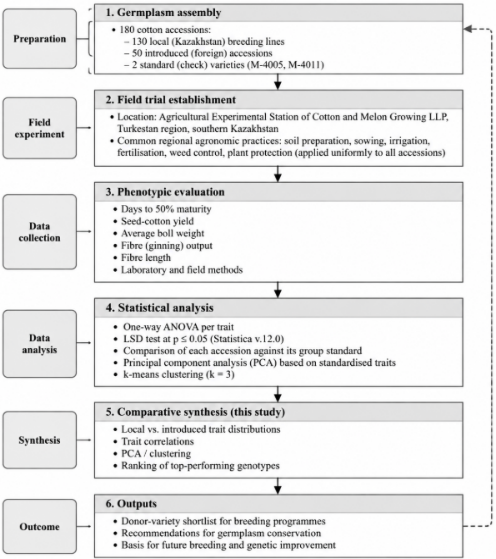
The study included 180 cotton germplasm accessions evaluated under field conditions, comprising 130 candidate cotton materials maintained within Kazakhstan breeding programmes and 50 introduced materials originating from foreign breeding programmes. Two standard check varieties, M-4005 and M-4011, were included separately as reference genotypes for comparative evaluation and were not counted among the candidate accessions. The field evaluation was conducted following the standard methodology applied at the research station for cotton variety assessment (Figure 1).
Figure 1. Study workflow
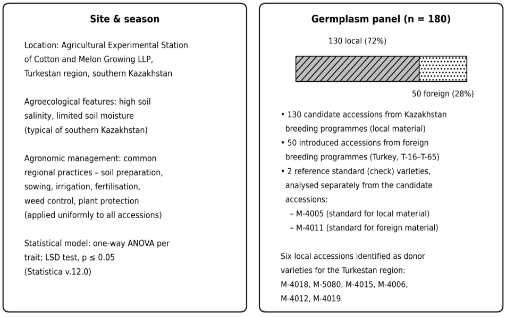
The tested accessions were cultivated under common regional agronomic practices, including soil preparation, sowing, irrigation management, fertilisation, weed control and plant protection measures (Figure 2). Standard varieties M-4005 and M-4011 were used exclusively as reference controls for comparison of economically valuable traits. They were analysed separately from the candidate accessions and were not included in the accession count.
Figure 2. Trial design and site information
Phenotypic assessment was performed based on the main agronomic and technological characteristics used in cotton breeding programmes. The evaluated traits included the number of days from sowing to 50% maturity, seed cotton yield, average boll weight, fibre yield and fibre length. Seed cotton yield was determined based on the harvested production of each accession and recalculated per hectare. Average boll weight was assessed using representative mature bolls collected from plants of each genotype. Fibre yield and fibre length were determined using laboratory methods applied for cotton fibre quality evaluation.
The obtained data were statistically analysed using analysis of variance (ANOVA) to determine the variability among cotton accessions. The significance of differences between genotypes was evaluated using the least significant difference (LSD) test at a 5% probability level. The results obtained from phenotypic evaluation were used to identify promising local and foreign germplasm sources with high productivity, fibre quality, and adaptability potential for further breeding programmes.
Statistical analysis was performed separately for each economically valuable trait using ANOVA. The significance of differences among genotypes was evaluated at the 5% probability level using the LSD test calculated independently for each trait. Trait-specific LSD values were determined for days from sowing to 50% maturity, seed cotton yield, average boll weight, fibre yield, and fibre length, considering their different measurement scales and experimental variability. The calculations were performed using Statistica software (version 12.0).
The study examined the main methods of collecting cotton genetic resources, particularly those aimed at identifying and preserving local genotypes and breeding materials adapted to specific agro-climatic conditions. The approaches considered include conducting expeditions to different agroclimatic zones to identify varieties with high resistance to stress factors such as drought, high temperatures, and soil salinity. The use of genetic banks and research institutions to preserve and access unique samples for further selection was also explored.
The conservation and rational use of local cotton varieties, which have demonstrated high adaptability to the specific agricultural-ecological conditions of southern Kazakhstan, such as high soil salinity and insufficient moisture, was also emphasised.
The characteristics of local cotton genotypes demonstrating high adaptability to the specific environmental conditions of southern Kazakhstan (Turkestan region) (M-4018, M-5080, M-4015, M-4006, M-4012 and M-4019) were studied in detail. Their genetic potential for integration into selection programmes was assessed.
The standard variety M-4005 was used as a reference genotype in different comparative evaluations of cotton germplasm. These experiments involved different sets of plant materials and trial conditions. Accordingly, the measurements for M-4005 were treated as experiment-specific reference values, and comparisons were made within each experiment rather than across experiments.
3.1 Genetic diversity as a basis for adaptation and improvement of cotton varieties
The phenotypic diversity of cotton (Gossypium spp.) reflects the variation in morphological, agronomic, and economically valuable traits among varieties and breeding lines. This diversity is the basis for the improvement and adaptation of cotton to different agricultural-climatic conditions and is a necessary element for the sustainable production of high-quality products on the global market.
Genetic diversity not only provides resistance to various adverse conditions but also increases yields and plant resilience to biotic (diseases, pests) and abiotic (climate change, drought) stresses [14-16]. Rising global temperatures, changing precipitation patterns, and an increase in the frequency of droughts are real challenges faced by cotton growers. To maintain cotton productivity under changing climate conditions, genetic diversity represents an indispensable resource for developing improved genotypes with enhanced resistance to environmental stresses.
The diversity of genetic characteristics of cotton is largely due to the large number of species, subspecies, and variants that exist in the natural environment. Four species are the most common: Gossypium hirsutum (American cotton), Gossypium barbadense (Peruvian cotton), Gossypium arboreum (Indian cotton), and Gossypium herbaceum (African cotton). Each has unique properties that are used in selection to create varieties with high productivity and improved characteristics.
Genetic diversity is a key factor in selection programmes [17, 18]. The artificial or natural crossing of different varieties and species allows for the combination of positive characteristics, which in turn leads to the development of new varieties with optimal parameters for specific growing conditions. An in-depth study of genetic characteristics assessed the diversity of cotton at the molecular level. Advances in molecular biology and genetics identified numerous genes responsible for important traits such as yield, disease, and stress resistance, allowing for more targeted selection methods.
One of the main factors determining the success of cotton selection is the use of genetic traits that ensure high productivity while adapting to different climatic conditions [19-21]. In particular, the beneficial properties of resistance to drought, high temperatures, and tolerance to diseases and pests are largely dependent on genetic variation in plants.
To increase the drought tolerance of cotton, for example, genes are used to ensure more efficient use of water at the cellular level or the ability of the plant to store moisture in the roots. Disease-resistant varieties include genes that provide a higher level of natural resistance, which can block pathogens or reduce their negative impact [22-24]. Given the wide variety in fibre colour and quality, it is necessary to use cotton varieties with optimal properties for textiles. As an example, most varieties of Gossypium barbadense have high-quality fibres that are suitable for producing luxury fabrics.
The availability of cotton genetic diversity is directly related to the successful development of improved genotypes and breeding materials that meet the requirements of modern agro-industries. Technologies such as genome editing and genetic engineering are significantly speeding up the process of developing varieties with the required characteristics. The latest biotechnological developments make it possible to introduce new genes to improve characteristics such as the length of the growing season, resistance to pathogens, and adaptation to higher temperatures and reduced water use.
3.2 The main economically valuable traits as components of genetic diversity
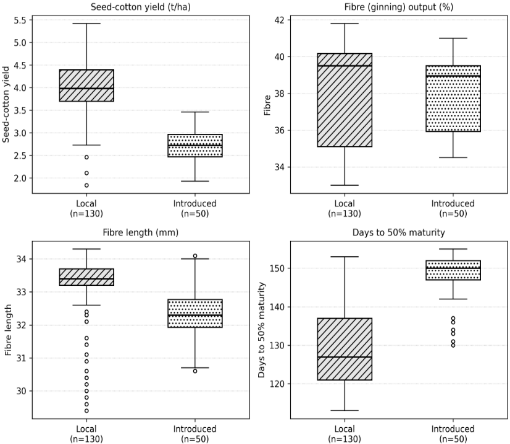
Economically valuable traits of cotton are an integral part of its genetic diversity. These characteristics are not only economically significant but also serve as indicators of the genetic potential of cotton genotypes and breeding materials that can be used in further selection programmes. These traits include yield, average boll weight, fibre yield, fibre length, and growing season. The analysis of economically valuable traits was used to assess phenotypic diversity and agronomic variability among local and foreign varieties and to identify samples with high selection potential (Figure 3).
Figure 3. Distribution of key agronomic traits
Cotton materials maintained and evaluated within Kazakhstan breeding programmes demonstrate a high degree of adaptation to the agricultural-climatic conditions of the target region, being highly beneficial as sources for selection programmes. Data on yield, boll weight, and other parameters of local varieties reflect their ability to deliver consistent results in the face of regional stressors such as drought or high humidity.
Table A1 presents the quantitative characteristics of cotton germplasm materials maintained and evaluated within Kazakhstan breeding programmes, which constitute a basis for further selection research and practical application. It shows how genetic variation affects productivity within a region. The data demonstrate the variability of local varieties in key traits such as average yield and fibre quality, which can be used to form conclusions on their sustainability in the region.
Assessing the yield of local varieties against the standard variety M-4005 (3.54 t/ha), 102 entries with higher yields were identified in the current Table A1, showing increases of 0.3–53.1% compared with the standard. The maximum increase of 53.1% was observed in an individual accession. In terms of average boll weight (6.2 g for M-4005), 7 entries showed an advantage, with values of 6.3 g, while 16 entries were at the standard level. In terms of fibre output, 72 entries exceeded the standard by 0.5–10.6%. Fibre length exceeded the M-4005 value (32.7 mm) in 105 entries, with increases ranging from 0.3 to 4.9%. These data demonstrate substantial variability among the local cotton materials and their potential value for further breeding programmes.
Foreign varieties developed in different agricultural-climatic conditions often have unique characteristics that complement the local gene pool. Comparison of their characteristics with local varieties can identify both the strengths and weaknesses of each cotton variety and determine which genetic traits should be used to improve local varieties.
Table A2 contains an analysis of quantitative indicators of foreign varieties, particularly those used for experimental selection programmes that account for not only the economic but also the adaptive qualities of plants. Studies of boll weight demonstrated that the standard variety M-4011 had a value of 6.0 g. The remaining 39 samples had a boll weight in the range of 4.8–5.9 g, which is lower than the standard. Fibre length analysis showed that three introduced accessions exceeded the standard M-4011, four accessions had fibre length values equal to the standard, and 47 accessions showed lower values. In terms of fibre yield, 32 samples exceeded the M-4011 standard by 0.5–8.5%, while 18 samples performed below the standard.
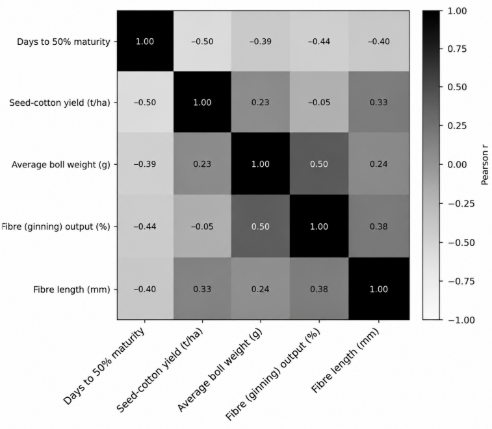
Figure 4. Correlation among agronomic and fibre traits
The study of ripening periods showed considerable diversity among the evaluated varieties. The maturity duration varied among the studied accessions, indicating differences in earliness characteristics. Several genotypes demonstrated shorter maturity periods compared with the standard variety and may be considered promising sources for early-maturity breeding. Other accessions belonged to mid- and late-maturing groups, with longer maturity periods, which confirms the possibility of selecting genotypes according to specific climatic conditions and agricultural requirements (Figure 4).
Correlation analysis showed that maturity duration was negatively associated with seed-cotton yield (r = -0.50), indicating that earlier maturity may be combined with improved productivity in selected genotypes. Fibre-related traits demonstrated moderate positive associations, particularly between boll weight and fibre output (r = 0.50), suggesting coordinated improvement of these characteristics during selection.
In terms of yield, the samples showed competitive results, exceeding the standard variety M-4011. The highest yields were recorded in 9 varieties, which showed values ranging from 3.11 to 3.46 t/ha, which are at the same level or higher than the standard. Among the introduced materials, only accessions that demonstrated favourable yield and fibre-related characteristics compared with the standard variety were considered promising for further breeding use. The evaluation showed variability among the introduced genotypes, allowing the selection of specific materials with desirable combinations of productivity and fibre quality traits.
The analysis of boll weight among foreign cotton breeding materials showed variation from 4.8 to 6.2 g. The standard variety M-4011 had an average boll weight of 6.0 g. Several samples, including T-34 and T-35 (6.1 and 6.2 g, respectively), exceeded the standard value, while T-29 and T-30 demonstrated lower boll weights of 5.2 and 5.3 g, respectively. These results indicate variability among foreign genotypes and confirm their potential value for selecting specific economically important traits. The study demonstrated that most samples showed good fibre yields, exceeding the standard by 0.5–8.5%. This confirms the effectiveness of collecting material adapted to different agronomic conditions.
Fibre length is a critical indicator for determining the quality of a variety. According to the research, some grades, such as T-31, T-47, and T-63, and others, had fibre lengths of ranging from 33.8 to 34.1 mm, which is competitive with industry leaders such as M-4011, which has 32.5 mm. Other grades had values that were several millimetres behind the standard grade.
The laboratory parameters of germination energy, germination rate, and fibre length were also analysed. The results of these analyses showed high germination energy (89–92%) and excellent germination (92–96%); therefore, the samples can be further used in the selection process. Fibre output analysis demonstrated considerable variation among the evaluated germplasm materials. Some accessions showed higher fibre output values than the standard, indicating their potential value as sources of improved fibre-related traits in breeding programmes.
The analysis of local and foreign cotton varieties demonstrated their respective advantages and limitations. In terms of boll weight, 7 local entries exceeded the standard M-4005 value of 6.2 g, whereas only several foreign varieties exceeded the corresponding M-4011 standard. Fibre output exceeded the local standard in 72 entries, with improvements of up to 10.6%, while 32 foreign samples exceeded the M-4011 standard, with a maximum improvement of 8.5%. However, fibre length in several foreign samples reached 34.1 mm, indicating the potential value of introduced germplasm as a source of favourable fibre-quality traits.
The fibre yields significantly exceeded the standard in 72 local samples (up to 10.6%), while among foreign varieties only 32 samples showed similar results, with a maximum of 8.5%. However, the fibre length in foreign samples in several cases exceeded that of the local varieties, reaching 34.1 mm compared to 32.7 mm in the local standard. This indicates the potential of foreign samples to provide high-quality fibre, although they are inferior in terms of yield stability.
Both groups of varieties demonstrated competitiveness in terms of yields, exceeding the standards of their respective groups. The maximum yield increase reached 53.1% above the standard for local varieties and up to 3.46 t/ha for foreign varieties. Thus, local genotypes demonstrated higher performance for several evaluated traits under the studied conditions.
The combination of local and foreign genotypes in selection programmes creates opportunities for developing improved cotton materials that meet the requirements of sustainable agriculture. Thus, the study of economically valuable traits not only reveals the genetic diversity of cotton but also lays the groundwork for future research and practical application.
Table 1. Agronomic and fibre quality characteristics of selected cotton genotypes
|
Rank |
Genotype |
Yield (t/ha) |
Improvement vs. Control (%) |
Boll Weight (g) |
Fibre Output (%) |
Fibre Length (mm) |
Statistical Significance (LSD Test, p ≤ 0.05) |
|
1 |
M-5080 |
5.20 |
+25.6 |
6.0 |
39.1 |
32.8 |
Significantly higher than standard (*) |
|
2 |
M-4018 |
4.74 |
+14.5 |
6.1 |
38.7 |
33.4 |
Significantly higher than standard (*) |
|
3 |
M-4015 |
4.70 |
+13.5 |
6.1 |
40.1 |
33.2 |
Significantly higher for yield and fibre output (*) |
|
4 |
M-4006 |
4.50 |
+8.7 |
5.9 |
39.4 |
33.7 |
Significantly higher for fibre traits (*) |
|
5 |
M-4012 |
4.65 |
+12.3 |
6.2 |
39.5 |
33.5 |
Significantly superior for boll weight (*) |
|
6 |
M-4019 |
4.30 |
+3.9 |
6.2 |
40.4 |
33.4 |
Significantly higher for fibre output (*) |
Note: Statistical significance was evaluated using the least significant difference (LSD) test at p ≤ 0.05. Genotypes marked with (*) showed significant superiority compared with the corresponding standard variety.
Based on the comparative evaluation of economically valuable traits, the highest-performing cotton genotypes were ranked according to their combined breeding value. The ranking considered maturity duration, seed-cotton yield, boll weight, fibre output and fibre length, together with the percentage improvement compared with the standard variety (Table 1).
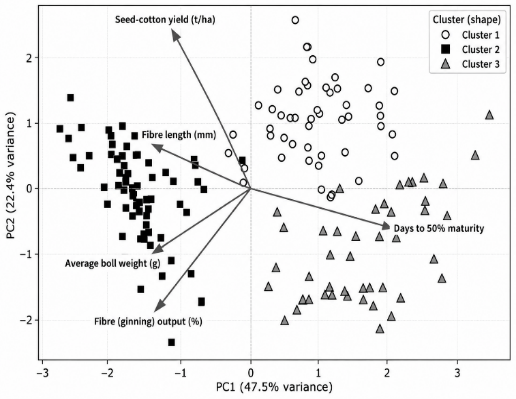
To further evaluate the overall phenotypic structure of the studied cotton germplasm, principal component analysis (PCA) combined with k-means clustering was performed using five standardised agronomic and fibre traits. The first two principal components explained 69.9% of the total variation, allowing differentiation of accessions according to their combined productivity, maturity and fibre quality profiles (Figure 5).
Figure 5. Principal component analysis (PCA) with k-means clustering
Multivariate analysis was performed using PCA based on standardised agronomic and fibre traits. Accessions were additionally grouped using k-means clustering (k = 3) to identify phenotypic similarity patterns among genotypes.
3.3 The process of collecting cotton genetic resources and using donor varieties
The main approaches to collecting cotton genetic resources are aimed at identifying and preserving local genotypes and breeding materials that are well adapted to specific environmental conditions. These varieties have significant potential to improve crop characteristics, including resistance to negative environmental factors. Local cotton varieties, which have evolved in specific agricultural-climatic zones, have unique adaptive properties that allow them to effectively withstand stresses such as drought, high humidity, salinity, and greater resistance to pests and diseases. Therefore, cotton genetic resources are substantial for the development of new varieties that can withstand climate change.
One of the main methods of collecting genetic resources is through expeditions to different agricultural-climatic zones. These studies can systematically explore areas that may contain potentially valuable varieties adapted to local conditions. During the expeditions, samples are selected that demonstrate high levels of resistance to climatic and agricultural-cultural stresses, including drought and high temperatures. Varieties that can grow well on saline soils are also important, as trends in the agricultural sector lead to changes in the chemical composition of soils. In addition, genetic resources are also collected through genetic banks and other institutions that preserve unique samples and provide access to them for further use in selection programmes.
The collected samples were evaluated both in the field and in the laboratory. In field trials, a variety of cotton genotypes are grown to obtain data on their productivity, resistance to stress and fibre quality [25]. An important aspect is the evaluation of boll weight, which is one of the indicators of plant yield. Various growing conditions are tested, such as water shortages or high temperatures, to assess how certain varieties adapt to such stressors. Productivity was also measured in terms of boll count and boll weight, which gives a clear indication of the efficiency of a particular variety. To assess fibre quality, the most important criteria are length, yield and strength. The qualitative characteristics of fibre directly affect its use in the textile industry; therefore this parameter is key when selecting varieties for further use in agricultural production. In particular, the length of the fibre and its yield can determine the level of productivity of the sample.
Approaches to selecting harvested cotton genetic resources for further work are expanding the possibilities of traditional methods due to the development of molecular genetics, bioinformatics and high-throughput genotyping technologies. Marker-assisted selection enables precise identification of key genetic loci responsible for important economic traits such as stress resistance, productivity or fibre quality, which significantly increases the efficiency and speed of selection programmes. CRISPR/Cas9 technology enables precise genome editing, enabling the development of new promising cotton lines with increased resistance to adverse conditions, improved fibre quality or other specified traits. Next-generation sequencing provides access to in-depth genome analysis, identifying rare genetic variants and unique mutations that are important for developing varieties that can be successfully grown in different agricultural-climatic conditions.
The integrated use of these approaches contributes to the development of new cotton varieties that meet the requirements of agriculture: increased productivity, optimum fibre quality, high resistance to biotic and abiotic stresses, and environmental sustainability. This symbiosis of traditional and new methods was used to accelerate the development of the industry and maintain a high level of genetic diversity necessary to preserve the crop's adaptive potential in the face of global climate change.
The use of donor varieties for major economic traits: a brief overview of the most productive varieties. In cotton selection practice, donor varieties with significant economically valuable traits are the basis for improving such characteristics as yield, fibre quality, resistance to diseases, pests and stress conditions, as well as adaptation to different climatic conditions. The selection of donor varieties is aimed at creating new varieties with improved productive characteristics that reflect current requirements for sustainable agriculture.
In the process of studying cotton collection genetic resources, six donor genotypes were selected for use in selection programmes: M-4018, M-5080, M-4015, M-4006, M-4012, and M-4019 (Table 2). The selection of these varieties is based on their high performance in terms of key economically valuable traits, such as adaptation to growing conditions, soil salinity, early maturity, disease and pest resistance, drought tolerance, productivity, and fibre quality. These varieties show excellent results in terms of the number of bolls per bush, weight per boll, weight per 1000 seeds, length and fibre yield, making them important candidates for the selection process in the Turkestan region.
Table 2. Donor varieties of the main economically valuable traits
|
Trait |
M-4005 |
M-4018 |
M-5080 |
M-4015 |
M-4006 |
M-4012 |
M-4019 |
LSD (p ≤ 0.05) |
|
Country |
KAZ |
KAZ |
KAZ |
KAZ |
KAZ |
KAZ |
KAZ |
– |
|
Days from sowing to 50% maturity |
122 |
120 |
115 |
110 |
118 |
120 |
122 |
2.5 |
|
Difference from standard (days) |
0 |
-2 |
-7 |
-12 |
-4 |
-2 |
0 |
– |
|
Yield (t/ha) |
4.14 |
4.74 |
5.20 |
4.70 |
4.50 |
4.65 |
4.30 |
0.25 |
|
Relative to standard (%) |
100 |
114.5 |
125.6 |
113.5 |
108.7 |
112.3 |
103.9 |
– |
|
Mean boll weight (g) |
5.9 |
6.1 |
6.0 |
6.1 |
5.9 |
6.2 |
6.2 |
0.3 |
|
Relative to standard (%) |
100 |
103.4 |
101.7 |
103.4 |
100.0 |
105.1 |
105.1 |
– |
|
Lint percentage (%) |
37.7 |
38.7 |
39.1 |
40.1 |
39.4 |
39.5 |
40.4 |
1.2 |
|
Relative to standard (%) |
100 |
102.7 |
103.7 |
106.4 |
104.5 |
104.8 |
107.2 |
– |
|
Fibre length (mm) |
33.3 |
33.4 |
32.8 |
33.2 |
33.7 |
33.5 |
33.4 |
0.8 |
|
Relative to standard (%) |
100 |
100.3 |
98.5 |
99.7 |
101.2 |
100.6 |
100.3 |
– |
The selected donor varieties, including M-4018, M-5080, M-4015, M-4006, M-4012, and M-4019, are the main materials for further selection in the Turkestan region. Due to their proven characteristics, these varieties significantly increase the possibilities of selection programmes and contribute to the development of new high-yielding varieties with improved fibre quality, stress tolerance and yield.
These varieties have already proven to be resistant in the field and have performed well in selection tests, making them strong candidates for use in the development of future cotton genotypes for different agricultural-climatic zones.
3.4 Methods of storing cotton genetic resources
The conservation of cotton genetic resources is a critical step in ensuring the sustainability of the selection process and maintaining biodiversity, especially when developing new varieties with high economic value traits such as yield, fibre quality, resistance to stress factors, and adaptation to different climatic conditions.
The following main methods are used for storage. Seed conservation is the main method of long-term storage of seeds at low temperatures (from -18 ℃ to -20 ℃) in specialised storage facilities. This ensures that seeds remain viable for decades, minimising the loss of genetic potential. The method requires moisture and temperature control, as high humidity or high temperatures can reduce the shelf life of seeds.
Seed storage in genetic resource banks involves cryptobiosis-like seed storage, where seeds are “frozen” in dry and refrigerated conditions. Some international seed banking systems, such as the Food and Agriculture Organisation [13] and International Atomic Energy Agency [26], specialise in long-term storage, contributing to the conservation of important cotton varieties with environmental and economic benefits for specific geographical regions.
Conservation of biological materials (vegetative methods) is used for varieties that are difficult to store as seeds (e.g., due to low germination), and organic culture methods are used: conservation through cuttings, microclonal propagation, or biotechnological cloning (in vitro), which guarantees that the genetic characteristics of plants remain unchanged over the years.
As one of the most important tasks is to maintain valuable genetic characteristics (such as early maturity, drought and disease resistance, and fibre length and quality), there are several important aspects of storage. The use of molecular markers (e.g., microsatellites and single-nucleotide polymorphism markers) allows for the timely detection of genetic changes in stored samples. Tracking such markers preserves not only phenotypic traits but also identifies important genetic loci responsible for disease or drought resistance.
Biochemical and physiological monitoring is conducted to control the quality of fibre and other biological materials. These indicators include chlorophyll level, fibre content, and fibre tissue characteristics, which assess the preservation of original biological qualities even after long-term storage.
Temperature and humidity conditions are substantial factors for maintaining growth intensity and preserving environmental sustainability, which is realised through optimising the temperature regime. For this purpose, optimal temperature regimes are used for conservation through hibernation methods or based on the principles of variation physiology.
3.5 Assessment of the durability and sustainability of genetic resources
When assessing the durability and storage stability of cotton genetic resources, disease and pest resistance is an important factor. One of the main diseases that reduces cotton yields is wilt, which can negatively affect plant health. Previous studies have reported resistance-related characteristics of some cotton genotypes, including M-4018; however, disease resistance was not directly evaluated in the present study. Compared to controls such as Bereke-07, M-4018 shows high promise for use in selection programmes where maintaining resistance to such diseases is critical to maintaining productivity.
Another important aspect of the durability assessment is to check the performance and quality of the fibre. For this purpose, tests are regularly conducted on the amount of fibre produced, and characteristics such as boll weight and fibre length are analysed. For long-term storage and use, varieties that show stability in these characteristics are more promising. For instance, varieties M-5080 and M-4019 showed high results – up to 5.2 t/ha of yield and 40.4% fibre yield. These results indicate favourable agronomic performance under the evaluated field conditions but do not establish long-term storage stability or the maintenance of fibre quality after storage.
Assessment of the adaptation of varieties to stressful conditions is equally important. In the context of climate change and soil salinity, it is necessary to consider how varieties withstand stresses such as drought or salinity. Determining the severity of stress responses helps to understand how resistant plants are to yield reductions under adverse conditions. Evaluation based on phenotypic criteria helps to preserve the potential of whole populations of varieties that can adapt to different environmental conditions and ensure stable productivity even in the presence of stressors. These studies are an important step in selecting varieties that are most resistant to external factors.
Effective storage of cotton genetic resources requires careful attention to every aspect of storage, from environmental conditions to regular monitoring of molecular and phenotypic characteristics. Factoring in these factors ensures a long-term perspective for selection processes, contributing to the development of new varieties that meet the requirements of sustainable agriculture.
In sustainable agriculture, the use of cotton varieties is key to ensuring consistent and high yields with minimal environmental interventions. The choice of varieties depends on agricultural-climatic conditions such as temperature, humidity, soil composition, and stress factors such as drought or salinity. For instance, the M-4018 variety, which is adapted to dry conditions, has demonstrated a high level of productivity, maintaining yields of 4.74 t/ha with fibre yields of up to 38.7%. This adaptability to specific climatic conditions indicates the potential value of M-4018 for cultivation in regions with limited water availability, which should be further evaluated under controlled water-stress conditions. M-5080 and M-4019 demonstrated favourable fibre characteristics under the evaluated field conditions and may represent promising materials for further testing under water-limited environments.
3.6 Using cotton genotypes for sustainable agriculture
In sustainable agriculture, the use of cotton varieties is the basis for achieving stable and high yields with minimal environmental interventions. The choice of varieties depends not only on general agricultural-climatic conditions, such as temperature, humidity, and soil composition, but also on specific stressors that can significantly affect the yield, such as drought, salinity, and other environmental stressors. For regions with an arid climate, M-4018 represents a promising genotype for further evaluation due to its favourable yield performance under the studied conditions. Its response to different irrigation regimes requires additional investigation. It has a yield of 4.74 t/ha and a fibre yield of up to 38.7%, which is one of the highest among varieties grown in such conditions. This makes it possible to obtain high yields with limited use of water resources and supports environmental sustainability in the context of climate change. The use of this genotype may contribute to more efficient cotton production under water-limited conditions; however, its response to different irrigation regimes requires further evaluation.
The varieties M-5080 and M-4019 are also important candidates for cultivation in conditions where water availability is limited. Both varieties have a high fibre yield (up to 40.4%), even under conditions of insufficient moisture, making them promising materials for further evaluation under water-limited conditions. For example, M-5080, in addition to its high fibre yield, can adapt to a changing climate, which reduces the impact of negative factors on yields. This is especially relevant for maintaining productivity in areas where the use of large amounts of water is impractical or physically impossible and requires the introduction of drought-resistant varieties that can ensure cost-effective production.
This adaptability of varieties to local agricultural-climatic conditions not only helps to reduce the need for water resources but also has a major impact on the sustainability of agriculture in the face of climate change. The right choice of cotton varieties, depending on growing conditions, can significantly increase yields while maintaining or even reducing the environmental impact on land and water. In addition, it helps farmers achieve sustainability and economic efficiency in the use of natural resources.
The integration of selected donor varieties into breeding programmes represents an important approach for improving fibre quality and maintaining high productivity. The introduction of promising cotton genotypes into breeding programmes was aimed at achieving an optimal combination of traits, including resistance to diseases, pests and abiotic stresses, while improving productivity under challenging climatic conditions. Donor genotypes such as M-5080 have demonstrated promising performance, combining high productivity and favourable fibre characteristics. This performance is beneficial for use in selection programmes to create new high-intensity varieties that can meet the growing demands of global markets.
The integration of diverse cotton genotypes into breeding programmes is particularly relevant in regions characterised by considerable variation in microclimatic and environmental conditions [27-29]. Thanks to their ability to adapt to various stressors, such as drought, high temperatures, or salinity, they can be used to consistently grow high-quality cotton even under adverse conditions. This is especially useful in regions where standard varieties do not provide the desired level of yield and resistance to environmental challenges. In addition, the use of cotton genotypes with favourable fibre characteristics contributes to improving fibre quality in breeding programmes. Cotton genotypes, such as M-5080, provide not only high yields but also improved fibre quality, which is crucial for global cotton markets.
The integration of such cotton genotypes into breeding programmes can provide both quantitative and qualitative advantages in cotton production, contributing to the sustainable development of agriculture. The use of adapted cotton genotypes also opens new opportunities for improving production efficiency, as materials selected for different agricultural-climatic conditions can contribute to the competitiveness of cotton production in the global market [30, 31].
To optimise cotton production, the characteristics that directly determine the effectiveness of selection programmes are substantial. The selection of varieties that can demonstrate high performance in key agronomic parameters is the basis for sustainable and efficient production. Some of the most important criteria for selecting varieties are the number of days to maturity, boll weight and fibre yield, and fibre length.
For instance, varieties M-4018 and M-4019 have high yields of up to 4.74 t/ha and 4.30 t/ha, respectively, with boll weights ranging from 6 to 6.2 g, which is a significant achievement among the varieties. They provide a fibre yield of 38.7% and 40.4% under optimal growing conditions, which indicates high productivity and fibre quality. The number of days to maturity is also an important factor. The M-4018 and M-4019 varieties ripen in 120–122 days, making them ideal for medium and late sowing in various agroclimatic zones. This speed of maturation avoids significant losses from diseases, pests, and adverse weather conditions, such as early autumn frosts or excessive moisture, which can lead to a deterioration in the quality and quantity of the crop. As a result, it contributes to stable production that can effectively adapt to changing climatic conditions.
Fibre yield is another important criterion in assessing the prospects of a variety. For instance, 72 samples of local varieties exceeded the fibre yield of the standard variety by 1.9–10.6%, which indicates the huge potential of these varieties to improve selection characteristics due to their high fibre yield, which has a positive impact on the technological characteristics of cotton processing.
Fibre length is also an important characteristic, especially in global markets. In 58 samples of local varieties, the fibre length exceeded that of M-4005 (32.7 mm) by 0.3–4.6%, which indicates the presence of varieties that are not only highly productive but also have optimal quality characteristics necessary to improve the quality of finished products. Foreign varieties, such as T-31 and T-33 from Turkey, demonstrated favourable yield performance, with T-33 exceeding the standard yield value, while their fibre-related characteristics require separate evaluation.
However, foreign varieties have significant potential for adaptation to different climatic conditions, which allows for an increase in the adaptive qualities of varieties in the face of changing climatic conditions. Varieties from Turkey, such as T-16, T-17 and T-18, are characterised by medium to late ripening (147 to 151 days), which can be used in different agricultural-climatic zones. This flexibility in variety selection allows producers to adjust their sowing strategies, which is important to minimise the risks associated with adverse weather conditions in certain regions.
Thus, the integration of local and foreign varieties into the updated selection programmes makes it possible to combine the best characteristics of these varieties to increase yields, fibre quality and adaptability to new agricultural-climatic conditions, which in turn is important for sustainable agricultural development and the competitiveness of cotton products on global markets.
The results of the study emphasise the importance of an integrated approach to the study of cotton genetic diversity. The analysed methods of collecting and evaluating cotton genotypes determined the prospects for improving cotton adaptation to climate change and optimising agronomic practices. The data obtained are consistent with the results of Vitale et al. [32], who in their systematic review note that the implementation of sustainable agronomic strategies can significantly increase the productivity and environmental sustainability of cotton production. Their study emphasises the importance of integrating knowledge of genetic diversity into improved crop rotations and resource management.
The results of the study also confirm the findings of Abbas [33], who analysed the impact of climate change on cotton production in Pakistan. The selection of drought-adapted genotypes may help reduce risks associated with extreme weather conditions, although their performance under different environmental scenarios requires further evaluation. The current findings support this thesis, demonstrating that the selection of resilient cotton genotypes is critical for maintaining sustainable production in water-stressed areas.
Innovations in the use of technology are also reflected in the studies of Chen et al. [34]. They have shown the effectiveness of deep learning in identifying weed species in cotton growing systems, which facilitates control of plant competition and reduces the need for chemical protection products. This study emphasises the need to implement such technologies in the context of environmental sustainability. In addition, the results of this study are consistent with the findings of Ahmad et al. [35], who emphasise the need to optimise methods of crop protection and post-harvest processing of cotton. Their study emphasises the importance of finding new agronomic solutions to ensure high product quality and competitiveness of the industry in the global market.
A significant contribution to the understanding of sustainable cotton production was also made by Radhakrishnan [36], who stressed that the environmental sustainability of this industry directly depends on the optimal use of resources and minimisation of negative environmental impact. The current results confirm the feasibility of applying this approach to increase the profitability of cotton products. At the same time, a comparison with traditional studies, such as by Chaudhry [37], can trace a gradual transition from traditional production methods to innovative practices. This demonstrates the prospects of using the latest technologies in the harvesting and processing of products.
Similar conclusions were reached by Chapagain et al. [38], who analysed the critical role of water in the context of cotton cultivation. Their conclusions emphasise that genetic adaptation can reduce the water requirements of the crop, which is relevant considering increasing climate change. This study confirms the results, pointing to the potential for developing varieties with increased resistance to water stress.
The study is also consistent with the research of Mollaee et al. [39], who noted that cotton production faces numerous challenges, including climate instability, soil degradation, and increased input costs. The comparative analysis in this study shows that local varieties are similar to foreign varieties in terms of their ability to withstand stressful conditions, but local varieties have additional advantages in terms of adaptability.
The development of models for predicting cotton growth and yield depending on genetic and environmental factors is becoming increasingly important. The study by Thorp et al. [40] discussed updated approaches to modelling cotton production processes. Their conclusions confirm that the integration of data on the genetic structure of varieties with simulation models allows for a more accurate prediction of the effectiveness of agronomic measures. The results obtained are consistent with these findings and emphasise the importance of using models for the rational use of resources.
The analysis of sustainable cotton production practices by Grose [41] demonstrates that the integration of biological methods into production processes helps to reduce environmental impact and preserve soil fertility. The data obtained indicate that the introduction of sustainable production practices in combination with genetic innovations can create a significant environmental and economic effect. Similarly, the review by Zeleke et al. [42] highlighted the marketing aspects of cotton production in Ethiopia, which allows for support to farmers who adopt sustainable practices. These findings point to the need to develop strategies to support local producers by incorporating new varieties that are resistant to environmental change.
Bradow and Davidonis [43] quantified fibre quality and its impact on cotton processing and ginning. The study also found that fibre quality is significantly correlated with the genotypic characteristics of varieties, which confirms the importance of preserving genetic diversity. While the authors suggest the introduction of technologies to improve processing, the current study highlights the need to breed adaptive varieties with high-fibre quality to reduce dependence on technological modifications. The findings suggest that the drought tolerance of local varieties may be key to ensuring stable yields in the face of climate variability. The study by Bange et al. [44] on the impact of climate change on cotton production in farming systems conducted a detailed analysis of climate challenges, while the current study suggests solutions in the form of genetically adapted varieties that can reduce the impact of such changes.
Boopathi and Hoffmann [45] highlighted the issues of genetic diversity, erosion, and population structure in cotton genetic resources. The study determined that local varieties, despite their reduced productivity compared to foreign varieties, retain important adaptive traits such as disease and drought resistance. According to the authors, there is an urgent need to preserve and expand the genetic base to minimise the risks of genetic erosion, an aspect that was also supported by the data.
The study by Campbell et al. [46] emphasised the importance of global genetic diversity resources for sustainable production. The study proved that local cotton genotypes can be a promising source of genetic resources for selection. At the same time, these results reinforce the need for international cooperation in the exchange of genetic material. The findings confirm the possibility of using such tools to accelerate selection processes, which is consistent with the study by Muminov et al. [47], which conducted a cluster analysis of economically important traits in amphidiploid cotton genotypes, which allowed them to reveal the potential of new selection materials.
The results concerning the genetic diversity and potential of local and foreign cotton varieties have shown that adaptation to different environmental conditions is a critical factor in ensuring the stability of yield and quality. May [48] highlighted the genetic variation in fibre quality. The author described in detail how genetic heterogeneity affects the stability of this indicator. Comparison with the results obtained shows that local varieties are characterised by lower-quality stability, but they are more adapted to stressful conditions, which emphasises the need to expand the genetic base through interspecific crossing.
The methods of genetic variability analysis used by Surgun et al. [49], in particular RAPD-PCR, have proven to be effective for studying variations among genotypes of Turkish cotton varieties. The current study confirms the authors' conclusions that this method allows to identification of genotypes with high potential, even if their characteristics look similar. The local varieties studied in this work have several unique genotypes with promising traits, which pave the way for selection progress.
A unique resource for future research is the wild gene pool, which, according to Saleem et al. [50], is an “untouched treasure” for selection. The inclusion of these genotypes in selection programmes could compensate for the limitations of local varieties in terms of drought and disease resistance. This study also noted that certain traits specific to local varieties could be enhanced through integration with wild genes, as suggested by the authors. In terms of sustainable agriculture, the study by Malik and Singh [51] emphasises the need to conserve genetic resources to ensure sustainable production. This approach is consistent with their findings that local cotton varieties were found to be better adapted to local conditions, and further improvement of these varieties could increase productivity while reducing external costs.
Thus, the results not only complement existing research in this area but also highlight promising areas for further research, including the development of new varieties using local genetic resources and the introduction of sustainable production technologies. In summary, the study contributes to a better understanding of the role of genetic diversity in optimising cotton production, which is important for maintaining global food and economic security.
The analysis of economically valuable traits of cotton germplasm revealed significant phenotypic diversity and agronomic potential of local and foreign varieties for further breeding programmes. The study determined that local varieties demonstrate high adaptation to regional agroclimatic conditions, which is manifested in stable yields (up to 53.1% higher than the standard), average boll weight (6.3 g), and fibre yield (up to 10.6%). Despite less stable performance, foreign varieties have unique characteristics, such as fibre lengths of up to 34.1 mm and potential fibre quality that complements the local gene pool. Particular attention was drawn to genotypes with shorter maturity duration compared with the standard varieties, which may represent valuable sources for early-maturity breeding and adaptation to changing climatic conditions. Samples that exceed the standard indicators are recommended for inclusion in selection programmes as valuable genetic resources for developing resistant cotton genotypes with high fibre yield and adaptability. Comparison of local and foreign varieties revealed the strengths and weaknesses of each group, indicating the need for their integration in selection.
The process of collecting cotton genetic resources is a substantial stage of selection, as local varieties possess adaptive traits that may contribute to improved performance under regional environmental stresses; however, their drought and salinity tolerance requires further experimental validation. Resources are collected through expeditions and the use of genetic banks, which was used to create new varieties that can adapt to climate change. Materials are evaluated in the field and the laboratory, with a focus on productivity and fibre quality. The integration of molecular technologies such as marker-assisted selection and CRISPR/Cas9 significantly improves the efficiency of selection programmes. The selection of donor genotypes with high yield, stress tolerance, and improved fibre quality will provide valuable genetic resources for the development of improved cotton materials adapted to different agricultural-climatic conditions and supporting the sustainable development of the agricultural sector.
The conservation of cotton genetic resources requires the implementation of scientifically sound methods to ensure their stability and effective use in selection. The most common method is seed preservation at low temperatures, which allows for the long-term viability of varieties without significant changes in their genetic properties. These methods can preserve not only the basic characteristics of plants but also important adaptive traits such as resistance to disease or drought. Biochemical monitoring, which was used to check the preservation of fibre quality, and molecular markers, which help to track genetic changes in samples, also play an important role in this.
Evaluation of productivity, resistance to stress factors, and fibre quality was used to formulate strategies for the long-term conservation of the gene pool. Genotypes such as M-4018 and M-5080 demonstrated stable productivity and favourable agronomic characteristics under the evaluated conditions, making them promising materials for further breeding programmes. Adapting varieties to different climatic conditions is an important step to ensure sustainable cotton production in a changing climate.
A limitation of the study is the insufficient exploration of the interaction between genetic traits and environmental factors in the long term, which creates challenges for predicting the effectiveness of introduced varieties in different conditions. Prospects for further research include clarifying the mechanisms of interaction between different genetic traits under changing climate conditions, as well as long-term monitoring of the effects of modern molecular methods on the stability and productivity of cotton genotypes under field conditions.
Within the framework of programmatically targeted financing of the Ministry of Agriculture BR22885305 Esimbekova Minura Akhmetovna in carrying out the programme “Selection and genetic technology for the development of long-term storage, restoration, monitoring and rational use of agrobiodiversity as a basic basis for improving selection programmes in the Republic of Kazakhstan”.
Table A1. Indicators of economically valuable traits of local cotton selection material
|
Variety |
Country of Origin |
Number of Days from Sowing to 50% Maturity |
Yields (t/ha) |
Average Weight of One Box |
Output Fibres |
Length Fibres |
|||||
|
Value |
Relative to the Standard (%) |
t/ha |
Relative to the Standard (%) |
g |
Relative to the Standard (%) |
% |
Relative to the Standard (%) |
mm |
Relative to the Standard (%) |
||
|
М-4005 |
KАZ |
129 |
100 |
3.54 |
100 |
6.2 |
100 |
37.8 |
100 |
32.7 |
100 |
|
М-4014 |
KАZ |
131 |
101.6 |
4.46 |
126 |
5.8 |
93.5 |
35 |
92.6 |
30.2 |
92.4 |
|
М-4014-1 |
KАZ |
137 |
106.2 |
3.71 |
104.8 |
6.2 |
100 |
34.8 |
92.1 |
29.8 |
91.1 |
|
М-4014-2 |
KАZ |
133 |
103.1 |
3.96 |
111.9 |
6.3 |
101.6 |
35.6 |
94.2 |
32.1 |
98.2 |
|
М-4014-3 |
KАZ |
131 |
101.6 |
4.41 |
124.6 |
6.1 |
98.4 |
38.5 |
101.9 |
32.6 |
99.7 |
|
М-4014-4 |
KАZ |
135 |
104.7 |
3.45 |
97.5 |
5.8 |
93.5 |
34.3 |
90.7 |
30.4 |
93 |
|
М-4014-5 |
KАZ |
138 |
107 |
3.88 |
109.6 |
5.8 |
93.5 |
39.1 |
103.4 |
32.8 |
100.3 |
|
М-4014-6 |
KАZ |
137 |
106.2 |
4.15 |
117.2 |
5.9 |
95.2 |
34.6 |
91.5 |
29.4 |
89.9 |
|
М-4014-7 |
KАZ |
134 |
103.9 |
3.3 |
93.2 |
6.1 |
98.4 |
35.1 |
92.9 |
31.4 |
96 |
|
М-4014-8 |
KАZ |
136 |
105.4 |
3.62 |
102.3 |
6 |
96.8 |
34.3 |
90.7 |
32.4 |
99.1 |
|
М-4014-9 |
KАZ |
140 |
108.5 |
3.56 |
100.6 |
6.2 |
100 |
35.4 |
93.7 |
30.9 |
94.5 |
|
М-4014-10 |
KАZ |
139 |
107.8 |
3.86 |
109 |
5.9 |
95.2 |
35.5 |
93.9 |
32.8 |
100.3 |
|
М-4014-11 |
KАZ |
142 |
110.1 |
3.9 |
110.2 |
6.1 |
98.4 |
37.3 |
98.7 |
33.2 |
101.5 |
|
М-4040 |
KАZ |
146 |
113.2 |
4.21 |
118.9 |
6.1 |
98.4 |
35.1 |
92.9 |
33.3 |
101.8 |
|
М-4040-1 |
KАZ |
153 |
118.6 |
3.88 |
109.6 |
5.9 |
95.2 |
35.6 |
94.2 |
33.2 |
101.5 |
|
М-4040-2 |
KАZ |
142 |
110.1 |
3.6 |
101.7 |
6 |
96.8 |
35.1 |
92.9 |
33.5 |
102.4 |
|
М-4040-3 |
KАZ |
143 |
110.9 |
3.96 |
111.9 |
5.7 |
91.9 |
34.7 |
91.8 |
33.3 |
101.8 |
|
М-4040-4 |
KАZ |
143 |
110.9 |
4.56 |
128.8 |
5.9 |
95.2 |
33.8 |
89.4 |
32.1 |
98.2 |
|
М-4040-5 |
KАZ |
146 |
113.2 |
3.45 |
97.5 |
5.5 |
88.7 |
33.6 |
88.9 |
33.3 |
101.8 |
|
М-4040-6 |
KАZ |
141 |
109.3 |
3.83 |
108.2 |
5.7 |
91.9 |
34.2 |
90.5 |
33.5 |
102.4 |
|
М-4040-7 |
KАZ |
143 |
110.9 |
3.61 |
102 |
5.7 |
91.9 |
33.8 |
89.4 |
33.3 |
101.8 |
|
М-4040-8 |
UZB |
145 |
112.4 |
4.05 |
114.4 |
5.9 |
95.2 |
34.5 |
91.3 |
33.7 |
103.1 |
|
М-4040-9 |
KАZ |
139 |
107.8 |
3.41 |
96.3 |
5.7 |
91.9 |
33 |
87.3 |
33.2 |
101.5 |
|
М-4040-10 |
KАZ |
140 |
108.5 |
4.68 |
132.2 |
5.6 |
90.3 |
33.6 |
88.9 |
33.4 |
102.1 |
|
М-4027 |
KАZ |
146 |
113.2 |
3.7 |
104.5 |
5.3 |
85.5 |
33.7 |
89.2 |
33.3 |
101.8 |
|
М-4027-1 |
KАZ |
143 |
110.9 |
3.9 |
110.2 |
5.9 |
95.2 |
33.9 |
89.7 |
33.2 |
101.5 |
|
М-4027-2 |
KАZ |
139 |
107.8 |
4.7 |
132.8 |
5.6 |
90.3 |
33.7 |
89.2 |
33.3 |
101.8 |
|
М-4027-3 |
KАZ |
146 |
113.2 |
3.99 |
112.7 |
6 |
96.8 |
35 |
92.6 |
33.5 |
102.4 |
|
М-4027-4 |
KАZ |
139 |
107.8 |
3.81 |
107.6 |
6.2 |
100 |
37.3 |
98.7 |
33.8 |
103.4 |
|
М-4055 |
KАZ |
122 |
94.6 |
2.79 |
78.8 |
6.3 |
101.6 |
40.1 |
106.1 |
33.9 |
103.7 |
|
М-4055-1 |
KАZ |
118 |
91.5 |
4.65 |
131.4 |
6.2 |
100 |
39.9 |
105.6 |
34 |
104 |
|
М-4055-2 |
KАZ |
125 |
96.9 |
3.88 |
109.6 |
6.1 |
98.4 |
39.7 |
105 |
33.8 |
103.4 |
|
М-4055-3 |
KАZ |
121 |
93.8 |
3.59 |
101.4 |
6.2 |
100 |
39.6 |
104.8 |
33.2 |
101.5 |
|
М-4055-4 |
KАZ |
125 |
96.9 |
4.65 |
131.4 |
6.1 |
98.4 |
39.4 |
104.2 |
33.2 |
101.5 |
|
М-4055-5 |
KАZ |
119 |
92.2 |
3.75 |
105.9 |
6.1 |
98.4 |
40.2 |
106.3 |
33.4 |
102.1 |
|
М-4055-6 |
KАZ |
128 |
99.2 |
3.72 |
105.1 |
6 |
96.8 |
39.7 |
105 |
33.1 |
101.2 |
|
М-4055-7 |
KАZ |
120 |
93 |
3.24 |
91.5 |
6 |
96.8 |
40.2 |
106.3 |
33.5 |
102.4 |
|
М-4035 |
KАZ |
122 |
94.6 |
1.84 |
52.0 |
6.1 |
98.4 |
41.4 |
109.5 |
33.9 |
103.7 |
|
М-4035-1 |
TUR |
123 |
95.3 |
3.11 |
87.9 |
6.2 |
100 |
40.5 |
107.1 |
33.2 |
101.5 |
|
М-4035-2 |
KАZ |
124 |
96.1 |
4.41 |
124.6 |
6.1 |
98.4 |
40.6 |
107.4 |
33.1 |
101.2 |
|
М-4035-3 |
KАZ |
125 |
96.9 |
4.62 |
130.5 |
6.1 |
98.4 |
40 |
105.8 |
33.4 |
102.1 |
|
М-4035-4 |
KАZ |
121 |
93.8 |
3.71 |
104.8 |
6.1 |
98.4 |
39.8 |
105.3 |
33.6 |
102.8 |
|
М-4035-5 |
KАZ |
120 |
93 |
3.92 |
110.7 |
6 |
96.8 |
39.6 |
104.8 |
33.8 |
103.4 |
|
М-4035-6 |
KАZ |
127 |
98.4 |
3.88 |
109.6 |
6.1 |
98.4 |
41.3 |
109.3 |
33.1 |
101.2 |
|
М-4035-7 |
KАZ |
125 |
96.9 |
3.48 |
98.3 |
6.3 |
101.6 |
39.5 |
104.5 |
33.6 |
102.8 |
|
М-4035-8 |
KАZ |
121 |
93.8 |
4.39 |
124 |
6.1 |
98.4 |
39.1 |
103.4 |
33.7 |
103.1 |
|
М-4035-9 |
KАZ |
124 |
96.1 |
4.84 |
136.7 |
6.3 |
101.6 |
40.3 |
106.6 |
33.6 |
102.8 |
|
М-4016 |
KАZ |
121 |
93.8 |
5.15 |
145.5 |
6.1 |
98.4 |
40 |
105.8 |
33.8 |
103.4 |
|
М-4016-1 |
KАZ |
123 |
95.3 |
3.15 |
89 |
6.2 |
100 |
40 |
105.8 |
33.2 |
101.5 |
|
М-4016-2 |
KАZ |
126 |
97.7 |
3.66 |
103.4 |
6 |
96.8 |
39.2 |
103.7 |
33.4 |
102.1 |
|
М-4016-3 |
KАZ |
125 |
96.9 |
4.28 |
120.9 |
6.2 |
100 |
39.9 |
105.6 |
34.1 |
104.3 |
|
М-4016-4 |
KАZ |
126 |
97.7 |
4.56 |
128.8 |
6.1 |
98.4 |
40.3 |
106.6 |
33.4 |
102.1 |
|
М-4016-5 |
KАZ |
127 |
98.4 |
2.46 |
69.5 |
6.2 |
100 |
39.8 |
105.3 |
33.2 |
101.5 |
|
М-4016-6 |
KАZ |
124 |
96.1 |
4.12 |
116.4 |
6.2 |
100 |
39.1 |
103.4 |
33.8 |
103.4 |
|
М-4016-7 |
KАZ |
127 |
98.4 |
3.64 |
102.8 |
6.2 |
100 |
40 |
105.8 |
33.5 |
102.4 |
|
М-4016-8 |
KАZ |
129 |
100 |
4.12 |
116.4 |
6.3 |
101.6 |
40.1 |
106.1 |
33.3 |
101.8 |
|
М-4013 |
KАZ |
122 |
94.6 |
3.88 |
109.6 |
6.3 |
101.6 |
40.7 |
107.7 |
33 |
100.9 |
|
М-4013-1 |
KАZ |
126 |
97.7 |
4.23 |
119.5 |
6.2 |
100 |
38 |
100.5 |
33.5 |
102.4 |
|
М-4013-2 |
KАZ |
124 |
96.1 |
3.28 |
92.7 |
6.2 |
100 |
39.6 |
104.8 |
33.4 |
102.1 |
|
М-4013-3 |
KАZ |
126 |
97.7 |
4.56 |
128.8 |
6.3 |
101.6 |
39.2 |
103.7 |
33.3 |
101.8 |
|
М-4013-4 |
KАZ |
128 |
99.2 |
4.3 |
121.5 |
6.2 |
100 |
38.9 |
102.9 |
33.2 |
101.5 |
|
М-4013-5 |
KАZ |
124 |
96.1 |
4.4 |
124.3 |
6.2 |
100 |
40.2 |
106.3 |
33.1 |
101.2 |
|
М-4013-6 |
KАZ |
125 |
96.9 |
3.7 |
104.5 |
6 |
96.8 |
41.4 |
109.5 |
33.6 |
102.8 |
|
М-4013-7 |
KАZ |
128 |
99.2 |
4.1 |
115.8 |
6.1 |
98.4 |
40.5 |
107.1 |
33.7 |
103.1 |
|
М-4013-8 |
KАZ |
127 |
98.4 |
4.1 |
115.8 |
6 |
96.8 |
40.6 |
107.4 |
33.6 |
102.8 |
|
М-4013-9 |
KАZ |
128 |
99.2 |
3.39 |
95.8 |
6.2 |
100 |
40 |
105.8 |
33.8 |
103.4 |
|
М-4013-10 |
KАZ |
129 |
100 |
4.81 |
135.9 |
6.1 |
98.4 |
39.8 |
105.3 |
33.2 |
101.5 |
|
М-4042 |
KАZ |
130 |
100.8 |
3.72 |
105.1 |
5.6 |
90.3 |
34.7 |
91.8 |
30.6 |
93.6 |
|
М-4042-1 |
KАZ |
133 |
103.1 |
4.15 |
117.2 |
5.6 |
90.3 |
39.5 |
104.5 |
33 |
100.9 |
|
М-4042-2 |
KАZ |
132 |
102.3 |
4.42 |
124.9 |
5.7 |
91.9 |
35 |
92.6 |
29.6 |
90.5 |
|
М-4042-3 |
KАZ |
129 |
100 |
3.57 |
100.8 |
5.9 |
95.2 |
35.5 |
93.9 |
31.6 |
96.6 |
|
М-4042-4 |
KАZ |
131 |
101.6 |
3.89 |
109.9 |
5.8 |
93.5 |
34.7 |
91.8 |
32.6 |
99.7 |
|
М-4042-5 |
KАZ |
135 |
104.7 |
3.83 |
108.2 |
6 |
96.8 |
35.8 |
94.7 |
31.1 |
95.1 |
|
М-4045 |
KАZ |
134 |
103.9 |
4.13 |
116.7 |
5.7 |
91.9 |
35.9 |
95 |
33 |
100.9 |
|
М-4045-1 |
KАZ |
137 |
106.2 |
4.17 |
117.8 |
5.9 |
95.2 |
37.7 |
99.7 |
33.4 |
102.1 |
|
М-4045-2 |
KАZ |
141 |
109.3 |
4.48 |
126.6 |
5.9 |
95.2 |
35.5 |
93.9 |
33.5 |
102.4 |
|
М-4045-3 |
KАZ |
148 |
114.7 |
4.15 |
117.2 |
5.7 |
91.9 |
36 |
95.2 |
33.4 |
102.1 |
|
М-4045-4 |
KАZ |
137 |
106.2 |
3.87 |
109.3 |
5.8 |
93.5 |
35.5 |
93.9 |
33.7 |
103.1 |
|
М-4045-5 |
KАZ |
138 |
107 |
4.23 |
119.5 |
5.5 |
88.7 |
35.1 |
92.9 |
33.5 |
102.4 |
|
М-4045-6 |
KАZ |
138 |
107 |
4.83 |
136.4 |
5.7 |
91.9 |
34.2 |
90.5 |
32.3 |
98.8 |
|
М-4053 |
KАZ |
141 |
109.3 |
3.72 |
105.1 |
5.3 |
85.5 |
34 |
89.9 |
33.5 |
102.4 |
|
М-4053-1 |
KАZ |
136 |
105.4 |
4.1 |
115.8 |
5.5 |
88.7 |
34.6 |
91.5 |
33.7 |
103.1 |
|
М-4053-2 |
KАZ |
138 |
107 |
3.88 |
109.6 |
5.5 |
88.7 |
34.2 |
90.5 |
33.5 |
102.4 |
|
М-4053-3 |
KАZ |
140 |
108.5 |
4.32 |
122 |
5.7 |
91.9 |
34.9 |
92.3 |
33.9 |
103.7 |
|
М-4053-4 |
KАZ |
134 |
103.9 |
3.68 |
104 |
5.5 |
88.7 |
33.4 |
88.4 |
33.4 |
102.1 |
|
М-4053-5 |
KАZ |
135 |
104.7 |
4.95 |
139.8 |
5.4 |
87.1 |
34 |
89.9 |
33.6 |
102.8 |
|
М-4053-6 |
KАZ |
141 |
109.3 |
3.97 |
112.1 |
5.1 |
82.3 |
34.1 |
90.2 |
33.5 |
102.4 |
|
М-4053-7 |
KАZ |
138 |
107 |
4.17 |
117.8 |
5.7 |
91.9 |
34.3 |
90.7 |
33.4 |
102.1 |
|
М-4045-7 |
KАZ |
134 |
103.9 |
4.97 |
140.4 |
5.4 |
87.1 |
34.1 |
90.2 |
33.5 |
102.4 |
|
М-4045-8 |
KАZ |
141 |
109.3 |
4.26 |
120.3 |
5.8 |
93.5 |
35.4 |
93.7 |
33.7 |
103.1 |
|
М-4045-9 |
KАZ |
134 |
103.9 |
4.08 |
115.3 |
6 |
96.8 |
37.7 |
99.7 |
34 |
104 |
|
М-4045-10 |
KАZ |
117 |
90.7 |
3.06 |
86.4 |
6.1 |
98.4 |
40.5 |
107.1 |
34.1 |
104.3 |
|
М-4045-11 |
KАZ |
113 |
87.6 |
4.92 |
139 |
6 |
96.8 |
40.3 |
106.6 |
34.2 |
104.6 |
|
М-4045-12 |
KАZ |
120 |
93 |
4.15 |
117.2 |
5.9 |
95.2 |
40.1 |
106.1 |
34 |
104 |
|
М-4045-13 |
KАZ |
116 |
89.9 |
3.86 |
109 |
6 |
96.8 |
40 |
105.8 |
33.4 |
102.1 |
|
М-4045-14 |
KАZ |
120 |
93 |
4.92 |
139 |
5.9 |
95.2 |
39.8 |
105.3 |
33.4 |
102.1 |
|
М-4045-15 |
KАZ |
114 |
88.4 |
4.02 |
113.6 |
5.9 |
95.2 |
40.6 |
107.4 |
33.6 |
102.8 |
|
М-4045-16 |
KАZ |
123 |
95.3 |
3.99 |
112.7 |
5.8 |
93.5 |
40.1 |
106.1 |
33.3 |
101.8 |
|
М-4045-17 |
KАZ |
115 |
89.1 |
3.51 |
99.2 |
5.8 |
93.5 |
40.6 |
107.4 |
33.7 |
103.1 |
|
М-4053-8 |
KАZ |
117 |
90.7 |
2.11 |
59.6 |
5.9 |
95.2 |
41.8 |
110.6 |
34.1 |
104.3 |
|
М-4053-9 |
KАZ |
118 |
91.5 |
3.38 |
95.5 |
6 |
96.8 |
40.9 |
108.2 |
33.4 |
102.1 |
|
М-4053-10 |
KАZ |
119 |
92.2 |
4.68 |
132.2 |
5.9 |
95.2 |
41 |
108.5 |
33.3 |
101.8 |
|
М-4053-11 |
KАZ |
120 |
93 |
4.89 |
138.1 |
5.9 |
95.2 |
40.4 |
106.9 |
33.6 |
102.8 |
|
М-4053-12 |
KАZ |
116 |
89.9 |
3.98 |
112.4 |
5.9 |
95.2 |
40.2 |
106.3 |
33.8 |
103.4 |
|
М-4053-13 |
KАZ |
115 |
89.1 |
4.19 |
118.4 |
5.8 |
93.5 |
40 |
105.8 |
34 |
104 |
|
М-4035-10 |
KАZ |
122 |
94.6 |
4.15 |
117.2 |
5.9 |
95.2 |
41.7 |
110.3 |
33.3 |
101.8 |
|
М-4035-11 |
KАZ |
120 |
93 |
3.75 |
105.9 |
6.1 |
98.4 |
39.9 |
105.6 |
33.8 |
103.4 |
|
М-4035-12 |
KАZ |
116 |
89.9 |
4.66 |
131.6 |
5.9 |
95.2 |
39.5 |
104.5 |
33.9 |
103.7 |
|
М-4035-13 |
KАZ |
119 |
92.2 |
5.11 |
144.4 |
6.1 |
98.4 |
40.7 |
107.7 |
33.8 |
103.4 |
|
М-4035-14 |
KАZ |
116 |
89.9 |
5.42 |
153.1 |
5.9 |
95.2 |
40.4 |
106.9 |
34 |
104 |
|
М-4035-15 |
KАZ |
118 |
91.5 |
3.42 |
96.6 |
6 |
96.8 |
40.4 |
106.9 |
33.4 |
102.1 |
|
М-4035-16 |
KАZ |
121 |
93.8 |
3.93 |
111 |
5.8 |
93.5 |
39.6 |
104.8 |
33.6 |
102.8 |
|
М-4035-17 |
KАZ |
120 |
93 |
4.55 |
128.5 |
6 |
96.8 |
40.3 |
106.6 |
34.3 |
104.9 |
|
М-4035-18 |
KАZ |
121 |
93.8 |
4.83 |
136.4 |
5.9 |
95.2 |
40.7 |
107.7 |
33.6 |
102.8 |
|
М-4088 |
KАZ |
122 |
94.6 |
2.73 |
77.1 |
6 |
96.8 |
40.2 |
106.3 |
33.4 |
102.1 |
|
М-4088-1 |
KАZ |
119 |
92.2 |
4.39 |
124 |
6 |
96.8 |
39.5 |
104.5 |
34 |
104 |
|
М-4088-2 |
KАZ |
122 |
94.6 |
3.91 |
110.5 |
6 |
96.8 |
40.4 |
106.9 |
33.7 |
103.1 |
|
М-4088-3 |
KАZ |
124 |
96.1 |
4.39 |
124 |
6.1 |
98.4 |
40.5 |
107.1 |
33.5 |
102.4 |
|
М-4088-4 |
KАZ |
117 |
90.7 |
4.15 |
117.2 |
6.1 |
98.4 |
41.1 |
108.7 |
33.2 |
101.5 |
|
М-4088-5 |
KАZ |
121 |
93.8 |
4.5 |
127.1 |
6 |
96.8 |
38.4 |
101.6 |
33.7 |
103.1 |
|
М-4088-6 |
KАZ |
119 |
92.2 |
3.55 |
100.3 |
6 |
96.8 |
40 |
105.8 |
33.6 |
102.8 |
|
М-4088-7 |
KАZ |
121 |
93.8 |
4.83 |
136 |
6.1 |
98.4 |
39.6 |
104.8 |
32.8 |
100.3 |
Table A2. Agronomic and fibre traits of foreign cotton breeding material and the standard cultivar M-4011
|
Variety |
Country of Origin |
Days to Maturity (d) |
Difference from the Standard (d) |
Yield (t/ha) |
Relative to the Standard (%) |
Average Weight of One Box (g) |
Difference from the Standard (g) |
Fibre Output (%) |
Relative to the Standard (%) |
Fibre Length (mm) |
Relative to the Standard (%) |
|
M-4011 |
KAZ |
129 |
0 |
3.11 |
100 |
6.0 |
0 |
37.8 |
100 |
33.7 |
100 |
|
T-16 |
TUR |
147 |
18 |
3.04 |
97.7 |
5.5 |
-0.5 |
39.4 |
104.2 |
32.3 |
95.8 |
|
T-17 |
TUR |
151 |
22 |
2.96 |
95.2 |
5.4 |
-0.6 |
39.2 |
103.7 |
32.5 |
96.4 |
|
T-18 |
TUR |
149 |
20 |
2.84 |
91.3 |
5.3 |
-0.7 |
39.2 |
103.7 |
32.3 |
95.8 |
|
T-19 |
TUR |
145 |
16 |
2.33 |
74.9 |
5.7 |
-0.3 |
38.9 |
102.9 |
31.9 |
94.7 |
|
T-20 |
TUR |
146 |
17 |
2.37 |
76.2 |
5.8 |
-0.2 |
38.7 |
102.4 |
30.6 |
90.8 |
|
T-21 |
TUR |
151 |
22 |
2.15 |
69.1 |
5.7 |
-0.3 |
39.5 |
104.5 |
31.7 |
94.1 |
|
T-22 |
TUR |
148 |
19 |
1.93 |
62.1 |
5.2 |
-0.8 |
39.0 |
103.2 |
32.1 |
95.3 |
|
T-23 |
TUR |
150 |
21 |
2.36 |
75.9 |
5.6 |
-0.4 |
39.5 |
104.5 |
32.7 |
97.0 |
|
T-24 |
TUR |
142 |
13 |
2.47 |
79.4 |
5.7 |
-0.3 |
40.7 |
107.7 |
32.9 |
97.6 |
|
T-25 |
TUR |
131 |
2 |
2.33 |
74.9 |
5.5 |
-0.5 |
35.8 |
94.7 |
31.8 |
94.4 |
|
T-26 |
TUR |
130 |
1 |
2.46 |
79.1 |
5.2 |
-0.8 |
35.9 |
95.0 |
32.0 |
95.0 |
|
T-27 |
TUR |
133 |
4 |
2.24 |
72.0 |
5.4 |
-0.6 |
35.7 |
94.4 |
30.7 |
91.1 |
|
T-28 |
TUR |
137 |
8 |
2.87 |
92.3 |
4.8 |
-1.2 |
34.5 |
91.3 |
31.8 |
94.4 |
|
T-29 |
TUR |
134 |
5 |
2.25 |
72.3 |
5.2 |
-0.8 |
35.0 |
92.6 |
32.0 |
95.0 |
|
T-30 |
TUR |
136 |
7 |
2.43 |
78.1 |
5.3 |
-0.7 |
35.5 |
93.9 |
32.8 |
97.3 |
|
Т-31 |
TUR |
150 |
21 |
3.46 |
111.3 |
5.9 |
-0.1 |
38.0 |
100.5 |
33.8 |
100.3 |
|
T-32 |
TUR |
153 |
24 |
3.23 |
103.9 |
5.8 |
-0.2 |
39.6 |
104.8 |
32.4 |
96.1 |
|
T-33 |
TUR |
150 |
21 |
3.38 |
108.7 |
5.7 |
-0.3 |
39.4 |
104.2 |
32.6 |
96.7 |
|
T-34 |
TUR |
149 |
20 |
2.72 |
87.5 |
6.1 |
0.1 |
39.4 |
104.2 |
32.4 |
96.1 |
|
T-35 |
TUR |
151 |
22 |
2.85 |
91.6 |
6.2 |
0.2 |
39.1 |
103.4 |
32.0 |
95.0 |
|
T-36 |
TUR |
154 |
25 |
2.80 |
90.0 |
6.1 |
0.1 |
38.9 |
102.9 |
30.7 |
91.1 |
|
T-37 |
TUR |
150 |
21 |
2.52 |
81.0 |
5.6 |
-0.4 |
39.7 |
105.0 |
31.8 |
94.4 |
|
T-38 |
TUR |
153 |
24 |
2.84 |
91.3 |
6.0 |
0 |
39.2 |
103.7 |
32.2 |
95.5 |
|
T-39 |
TUR |
146 |
17 |
2.94 |
94.5 |
6.1 |
0.1 |
39.7 |
105.0 |
32.8 |
97.3 |
|
T-40 |
TUR |
152 |
23 |
2.71 |
87.1 |
5.9 |
-0.1 |
40.9 |
108.2 |
33.0 |
97.9 |
|
T-41 |
TUR |
155 |
26 |
3.05 |
98.1 |
5.6 |
-0.4 |
36.0 |
95.2 |
31.9 |
94.7 |
|
T-42 |
TUR |
155 |
26 |
2.85 |
91.6 |
5.8 |
-0.2 |
36.1 |
95.5 |
32.1 |
95.3 |
|
T-43 |
TUR |
147 |
18 |
3.29 |
105.8 |
5.2 |
-0.8 |
35.9 |
95.0 |
30.8 |
91.4 |
|
T-44 |
TUR |
148 |
19 |
2.96 |
95.2 |
5.6 |
-0.4 |
34.7 |
91.8 |
31.9 |
94.7 |
|
T-45 |
TUR |
154 |
25 |
3.25 |
104.5 |
5.7 |
-0.3 |
35.2 |
93.1 |
32.1 |
95.3 |
|
T-46 |
TUR |
151 |
22 |
3.32 |
106.8 |
6.0 |
0 |
35.7 |
94.4 |
32.9 |
97.6 |
|
T-47 |
TUR |
152 |
23 |
3.23 |
103.9 |
5.9 |
-0.1 |
38.1 |
100.8 |
34.0 |
100.9 |
|
T-48 |
TUR |
144 |
15 |
3.10 |
99.7 |
6.0 |
0 |
39.7 |
105.0 |
32.6 |
96.7 |
|
T-49 |
TUR |
150 |
21 |
2.60 |
83.6 |
5.8 |
-0.2 |
39.5 |
104.5 |
32.8 |
97.3 |
|
T-50 |
TUR |
153 |
24 |
2.65 |
85.2 |
5.9 |
-0.1 |
39.5 |
104.5 |
32.6 |
96.7 |
|
T-51 |
TUR |
152 |
23 |
2.44 |
78.5 |
5.8 |
-0.2 |
39.2 |
103.7 |
32.2 |
95.5 |
|
T-52 |
TUR |
149 |
20 |
2.17 |
69.8 |
6.0 |
0 |
39.0 |
103.2 |
30.9 |
91.7 |
|
T-53 |
TUR |
149 |
20 |
2.61 |
83.9 |
5.8 |
-0.2 |
39.8 |
105.3 |
32.0 |
95.0 |
|
T-54 |
TUR |
155 |
26 |
2.73 |
87.8 |
5.9 |
-0.1 |
39.3 |
104.0 |
32.4 |
96.1 |
|
T-55 |
TUR |
151 |
22 |
2.54 |
81.7 |
5.8 |
-0.2 |
39.8 |
105.3 |
33.0 |
97.9 |
|
T-56 |
TUR |
154 |
25 |
2.68 |
86.2 |
6.0 |
0 |
41.0 |
108.5 |
33.2 |
98.5 |
|
T-57 |
TUR |
144 |
15 |
2.47 |
79.4 |
5.4 |
-0.6 |
36.1 |
95.5 |
32.1 |
95.3 |
|
T-58 |
TUR |
152 |
23 |
3.11 |
100 |
5.8 |
-0.2 |
36.2 |
95.8 |
32.3 |
95.8 |
|
T-59 |
TUR |
154 |
25 |
2.50 |
80.4 |
5.9 |
-0.1 |
36.0 |
95.2 |
31.0 |
92.0 |
|
T-60 |
TUR |
151 |
22 |
2.69 |
86.5 |
6.0 |
0 |
34.8 |
92.1 |
32.1 |
95.3 |
|
T-61 |
TUR |
149 |
20 |
2.91 |
93.6 |
5.8 |
-0.2 |
35.3 |
93.4 |
32.3 |
95.8 |
|
T-62 |
TUR |
149 |
20 |
2.71 |
87.1 |
6.0 |
0 |
35.8 |
94.7 |
33.1 |
98.2 |
|
T-63 |
TUR |
155 |
26 |
3.37 |
108.4 |
5.4 |
-0.6 |
38.3 |
101.3 |
34.1 |
101.2 |
|
T-64 |
TUR |
152 |
23 |
2.77 |
89.1 |
5.8 |
-0.2 |
38.1 |
100.8 |
32.7 |
97.0 |
|
T-65 |
TUR |
153 |
24 |
2.97 |
95.5 |
5.9 |
-0.1 |
39.7 |
105.0 |
32.9 |
97.6 |
[1] Khan, M.A., Wahid, A., Ahmad, M., Tahir, M.T., Ahmed, M., Ahmad, S., Hasanuzzaman, M. (2020). World cotton production and consumption: An overview. In Cotton Production and Uses, Springer, pp. 1-7. https://doi.org/10.1007/978-981-15-1472-2_1
[2] Aslam, S., Khan, S.H., Ahmed, A., Dandekar, A.M. (2020). The tale of cotton plant: From wild type to domestication, leading to its improvement by genetic transformation. American Journal of Molecular Biology, 10(2): 91-127. https://doi.org/10.4236/ajmb.2020.102008
[3] Bukhari, S.A., Iqbal, M.A., Naz, S., Rahman, M. (2014). Studies on genetic diversity of cotton using RAPD markers. Pure and Applied Biology, 3(3): 95-100. http://doi.org/10.19045/bspab.2014.33002
[4] Kuang, Z., Xiao, C., Ilyas, M.K., et al. (2022). Use of SSR markers for the exploration of genetic diversity and DNA fingerprinting in early-maturing upland cotton (Gossypium hirsutum L.) for future breeding program. Agronomy, 12(7): 1513. https://doi.org/10.3390/agronomy12071513
[5] Shahini, E., Shahini, E., Doda, S. (2025). Forestry and rural development in Albania: Integrating forestry and agricultural practices for a sustainable future in the economy. Ukrainian Journal of Forest and Wood Science, 16(1): 128-148. https://doi.org/10.31548/forest/1.2025.128
[6] Bilan, Y., Zos-Kior, M., Nitsenko, V., Sinelnikau, U., Ilin, V. (2017). Social component in sustainable management of land resources. Journal of Security and Sustainability Issues, 7(2): 107-120. https://doi.org/10.9770/jssi.2017.7.2(9)
[7] Kushanov, F.N., Turaev, O.S., Ernazarova, D.K., et al. (2021). Genetic diversity, QTL mapping, and marker-assisted selection technology in cotton (Gossypium spp.). Frontiers in Plant Science, 12: 779386. https://doi.org/10.3389/fpls.2021.779386
[8] Sarwar, G., Nazir, A., Rizwan, M., Shahzadi, E., Mahmood, A. (2021). Genetic diversity among cotton genotypes for earliness, yield and fiber quality traits using correlation, principal component and cluster analyses. Sarhad Journal of Agriculture, 37(1): 307-314. https://doi.org/10.17582/journal.sja/2021/37.1.307.314
[9] Hocaoglu-Ozyigit, A., Ucar, B., Altay, V., Ozyigit, I.I. (2022). Genetic diversity and phylogenetic analyses of Turkish cotton (Gossypium hirsutum L.) lines using ISSR markers and chloroplast trnL-F regions. Journal of Natural Fibers, 19(5): 1837-1850. https://doi.org/10.1080/15440478.2020.1788493
[10] Hu, G., Grover, C.E., Jareczek, J., et al. (2021). Evolution and diversity of the cotton genome. Cotton Precision Breeding, Cham: Springer, pp. 25-78. https://doi.org/10.1007/978-3-030-64504-5_18
[11] Wang, H., Memon, H. (2020). Cotton Science and Processing Technology: Gene, Ginning, Garment and Green Recycling. Singapore: Springer. https://doi.org/10.1007/978-981-15-9169-3
[12] Jans, Y., von Bloh, W., Schaphoff, S., Müller, C. (2021). Global cotton production under climate change – Implications for yield and water consumption. Hydrology and Earth System Sciences, 25(4): 2027-2044. https://doi.org/10.5194/hess-25-2027-2021
[13] Food and Agriculture Organization. Kazakhstan country profile. https://www.fao.org/countryprofiles/index/en/?iso3=KAZ.
[14] Safarova, F., Novruzova, E. (2021). Self-defense Mechanisms of Plants in Nature. Bulletin of Science and Practice, 7(8): 73-77. https://doi.org/10.33619/2414-2948/69/09
[15] Papale, M., Rizzo, C., Fani, R., et al. (2020). Exploring the diversity and metabolic profiles of bacterial communities associated with Antarctic sponges (Terra Nova Bay, Ross Sea). Frontiers in Ecology and Evolution, 8: 268. https://doi.org/10.3389/fevo.2020.00268
[16] Maharramova, S. (2023). Changes in the chemical composition of extracts of wild berries growing in the Republic of Azerbaijan due to enzimatic pretreatment of their pulp. Ukrainian Food Journal, 12(4): 542-555. https://doi.org/10.24263/2304-974X-2023-12-4-5
[17] Chortonbaev, T., Jolborsov, U., Isakova, Z., Bekturov, A. (2024). Features of the phenotypic and genetic structure of the Kyrgyz mountain merino breed in breeding plants of the Kyrgyz republic. Bulletin of the Kyrgyz National Agrarian University, 22(5): 202-213.
[18] Pravdziva, I., Khoroshko, N. (2025). Evaluation of winter bread wheat (Triticum aestivum L.) varieties based on grain quality indicators. Scientific Reports of the National University of Life and Environmental Sciences of Ukraine, 21(6): 9-21. https://doi.org/10.31548/dopovidi/6.2025.09
[19] Fedoniuk, T., Bog, M., Orlov, O., Appenroth, K.J. (2022). Lemna aequinoctialis migrates further into temperate continental Europe—A new alien aquatic plant for Ukraine. Feddes Repertorium, 133(4): 305-312. https://doi.org/10.1002/fedr.202200001
[20] Aitbayev, T., Nusupova, A., Ibragimova, G., Manabaeva, U. (2025). Role of breeding in the development of organic vegetable production in Kazakhstan. Bulletin of the Kyrgyz National Agrarian University, 23(2): 21-31. https://doi.org/10.63621/bknau./2.2025.21
[21] Nesterova, N., Ruban, Y., Pareniuk, O., Shavanova, K., Likar, S. (2022). Oscillating character of heat and cold shock protein content of oats plants in the conditions of stressful factors of the environment. Biological Systems: Theory and Innovation, 13(1): 5-13. https://doi.org/10.31548/biologiya13(1-2).2022.007
[22] Korotetsky, I.S., Bogoyavlensky, A.P., Prilipov, A.G., et al. (2010). Molecular genetic characteristics of the Newcastle disease virus velogenic strains isolated in Russia, Ukraine, Kazakhstan, and Kirghizia. Voprosy Virusologii, 55(4): 29-32.
[23] Maharramova, S., Mammadaliyeva, M., Yusifova, M., Nasrullayeva, G., Kolomiiets, Y. (2025). Comprehensive assessment of potato bacterial pathogens and development of resistance improvement methods. Scientific Horizons, 28(7): 34-47. https://doi.org/10.48077/scihor7.2025.34
[24] Babych, O., Khonenko, L., Gamajunova, V., Bulba, I., Salnikova, A. (2025). Assessment of heavy metal and pesticide contamination in organic crops using Allium cepa. Ecological Safety and Balanced Use of Resources, 16(2): 69-81. https://doi.org/10.63341/esbur/2.2025.69
[25] Shahini, E., Myalkovsky, R., Nebaba, K., Ivanyshyn, O., Liubytska, D. (2023). Economic and biological characteristics and productivity analysis of sunflower hybrids. Scientific Horizons, 26(8): 83-95. https://doi.org/10.48077/scihor8.2023.83
[26] International Atomic Energy Agency. (2014). Sowing the seeds of nuclear safety – Interview with Sujit Samaddar. Ahttps://www.iaea.org/ru/file/2014/sowing-seeds-nuclear-safety-%E2%80%93-interview-sujit-samaddar.
[27] Umbetbayeva, Z.B., Suleimenova, S.Z., Nurakhmetova, G.G., Saimova, S.A., Baitukayeva, D. (2023). The Vienna Convention for the protection of the ozone layer and its role in promoting environmental sustainability and implementation in the national legislations of participating states. Rivista di Studi sulla Sostenibilita, 13(1): 313-330. https://doi.org/10.3280/RISS2023-001-S1020
[28] Salyha, V., Arkhypova, L. (2025). Vegetation cover dynamics of the Dniester basin under climate change influence in the 21st century. Ecological Safety and Balanced Use of Resources, 16(2): 19-30. https://doi.org/10.63341/esbur/2.2025.19
[29] Spriazhka, R., Zhemoida, V. (2022). Environmental plasticity and stability of corn hybrids during selection for grain quality. Scientific Reports of the National University of Life and Environmental Sciences of Ukraine, 18(5). https://doi.org/10.31548/dopovidi2022.05.007
[30] Matyushenko, I.Y., Shtal, T.V., Piddubna, L.I., Piddubnyi, I.O., Kvitka, Y.M. (2018). Development prospects of Ukraine’s foreign trade in agricultural products in the context of European integration and global challenges. Journal of Advanced Research in Law and Economics, 9(4): 1343. https://doi.org/10.14505/jarle.v9.4(34).22
[31] Yermekova, Z., Romanenko, S., Zhanibekova, G., Aitzhanova, B., Apakhayev, N. (2024). Integration of digital technologies to improve the efficiency of small and medium-sized agricultural enterprises. Scientific Horizons, 27(12): 142-152. https://doi.org/10.48077/scihor12.2024.142
[32] Vitale, G.S., Scavo, A., Zingale, S., et al. (2024). Agronomic strategies for sustainable cotton production: A systematic literature review. Agriculture, 14(9): 1597. https://doi.org/10.3390/agriculture14091597
[33] Abbas, S. (2020). Climate change and cotton production: An empirical investigation of Pakistan. Environmental Science and Pollution Research, 27(23): 29580-29588. https://doi.org/10.1007/s11356-020-09222-0
[34] Chen, D., Lu, Y., Li, Z., Young, S. (2022). Performance evaluation of deep transfer learning on multi-class identification of common weed species in cotton production systems. Computers and Electronics in Agriculture, 198: 107091. https://doi.org/10.1016/j.compag.2022.107091
[35] Ahmad, S., Ahmad, I., Ahmad, B., et al. (2023). Regional integrated assessment of climate change impact on cotton production in a semi-arid environment. Climate Research, 89: 113-132. https://doi.org/10.3354/cr01710
[36] Radhakrishnan, S. (2017). Sustainable cotton production. Sustainable Fibres and Textiles: The Textile Institute Book Series, Sawston: Woodhead Publishing, pp. 21-67. https://doi.org/10.1016/B978-0-08-102041-8.00002-0
[37] Chaudhry, M.R. (2010). Cotton production and processing. In Industrial Applications of Natural Fibres: Structure, Properties and Technical Applications, John Wiley & Sons Ltd., pp. 219-220. https://doi.org/10.1002/9780470660324.ch10
[38] Chapagain, A.K., Hoekstra, A.Y., Savenije, H.H., Gautam, R. (2006). The water footprint of cotton consumption: An assessment of the impact of worldwide consumption of cotton products on the water resources in cotton producing countries. Ecological Economics, 60(1): 186-203. https://doi.org/10.1016/j.ecolecon.2005.11.027
[39] Mollaee, M., Mobli, A., Mutti, N.K., Manalil, S., Chauhan, B.S. (2019). Challenges and opportunities in cotton production. In Cotton Production, John Wiley & Sons Ltd., pp. 371-390. https://doi.org/10.1002/9781119385523.ch18
[40] Thorp, K.R., Ale, S., Bange, M.P., et al. (2014). Development and application of process-based simulation models for cotton production: A review of past, present, and future directions. Journal of Cotton Science, 18(1): 10-47. https://doi.org/10.56454/OOVC6073
[41] Grose, L. (2009). Sustainable cotton production. In Sustainable Textiles: Life Cycle and Environmental Impact, Woodhead Publishing, pp. 33-62. https://doi.org/10.1533/9781845696948.1.33
[42] Zeleke, M., Adem, M., Aynalem, M., Mossie, H., Yildiz, F. (2019). Cotton production and marketing trend in Ethiopia: A review. Cogent Food & Agriculture, 5(1): 1691812. https://doi.org/10.1080/23311932.2019.1691812
[43] Bradow, J.M., Davidonis, G.H. (2000). Quantitation of fiber quality and the cotton production-processing interface: A physiologist’s perspective. Journal of Cotton Science, 4(1): 34-64.
[44] Bange, M.P., Baker, J.T., Bauer, P.J., et al. (2016). Climate Change and Cotton Production in Modern Farming Systems. Wallingford: CABI. https://doi.org/10.1079/9781780648903.0000
[45] Boopathi, N.M., Hoffmann, L.V. (2015). Genetic diversity, erosion, and population structure in cotton genetic resources. In Genetic Diversity and Erosion in Plants, Springer, pp. 409-438. https://doi.org/10.1007/978-3-319-25954-3_12
[46] Campbell, B.T., Saha, S., Percy, R., et al. (2010). Status of the global cotton germplasm resources. Crop Science, 50(4): 1161-1179. https://doi.org/10.2135/cropsci2009.09.0551
[47] Muminov, K., Ernazarova, Z., Amanov, B. (2020). Cluster analysis of valuable economic traits in amphidiploid cotton hybrid plants. EurAsian Journal of BioSciences, 14(2): 4973-4981.
[48] May, O.L. (2000). Genetic variation in fiber quality. Cotton Fibers, London: CRC Press, pp. 183-229. https://doi.org/10.1201/9781003578437-8
[49] Surgun, Y., Çöl, B., Bürün, B. (2012). Genetic diversity and identification of some Turkish cotton genotypes (Gossypium hirsutum L.) by RAPD-PCR analysis. Turkish Journal of Biology, 36(2): 143-150. https://doi.org/10.3906/biy-1101-167
[50] Saleem, H., Chaudhary, M.T., Shakeel, A., Wani, S.H., Du, X., Azhar, M.T. (2021). Wild cotton genepool: An unopened treasure. In Wild Germplasm for Genetic Improvement in Crop Plants, Academic Press, pp. 19-53. https://doi.org/10.1016/B978-0-12-822137-2.00002-3
[51] Malik, S.S., Singh, S.P. (2006). Role of plant genetic resources in sustainable agriculture. Indian Journal of Crop Science, 1(1-2): 21-28.