Garay Mirzayev | Konul Majnunlu Musabayli* | Ramil Sadigov | Movlud Huseynov | Ayla Bilgin
© 2026 The authors. This article is published by IIETA and is licensed under the CC BY 4.0 license (http://creativecommons.org/licenses/by/4.0/).
OPEN ACCESS
This study investigated the seasonal biodiversity and quantitative dynamics of macrozoobenthos in the Northern Absheron Bay of the Caspian Sea during 2023–2025. A total of 21 species of macrozoobenthic organisms belonging to 9 systematic groups were recorded in the Northern Absheron Bay. The highest species diversity of macrozoobenthos was observed during the spring and summer seasons (14–21 species), whereas the lowest diversity was recorded in autumn (8–13 species). The average annual biomass of macrozoobenthic organisms ranged from 33.35 to 45.78 g m⁻², while their abundance varied between 361 and 565 ind. m⁻². In all study years, the maximum biomass and abundance of macrozoobenthic organisms were recorded during the summer season, ranging from 43.13 to 56.12 g m⁻² and from 505 to 719 ind. m⁻², respectively. In contrast, the lowest biomass and abundance were observed in autumn, ranging from 22.48 to 34.80 g m⁻² and from 217 to 410 ind. m⁻². These findings indicate clear seasonal patterns in the structure and quantitative development of macrozoobenthos in the study area.
Northern Absheron Bay, macrozoobenthic organisms, macrozoobenthos, species diversity, biomass
The Caspian Sea, the largest enclosed body of water in the world, represents a unique ecosystem distinguished by its specific hydrological regime and high degree of endemism. The coastal zones of this vast water body, particularly the waters surrounding the Absheron Peninsula, are situated at the intersection of natural evolutionary processes and intensive industrial activities. Located in the northern part of the peninsula, the Northern Absheron Bay constitutes a specific ecological niche for the development of benthic organisms due to its shallow-water characteristics and enclosed geomorphological structure [1-3].
The Northern Absheron Bay is one of the important fisheries areas of the Caspian Sea. The bay is located north of the coastal area connecting Pirallahi Island to the mainland. Its area is 24 km², its depth ranges from 4 to 10 m, and its average depth is 4.7 m.
Macrozoobenthos, a group of benthic invertebrates larger than 0.5 mm inhabiting the seabed, plays a crucial role in the trophic structure of this ecosystem. In addition to forming the basis of predator-detritivore food chains, these organisms serve as highly sensitive biological indicators for monitoring xenobiotic pollution and eutrophication processes occurring in the aquatic environment [4].
At present, the biodiversity of the Northern Absheron Bay is undergoing transformation under the influence of two major global threats. The first is the regression process associated with the significant decline in the water level of the Caspian Sea. In shallow-water areas, a decrease in water level directly leads to the reduction of benthic habitats (biotopes), alterations in salinity and temperature regimes, and, consequently, the disappearance of sensitive species groups. The second important factor is biological invasion. Alien species introduced into the Caspian Sea through anthropogenic activities, particularly certain mollusks and crustaceans, have competed with the native benthic fauna and substantially altered the community dominance structure. Quantitative and qualitative analyses of these changes are essential not only for the conservation of regional biodiversity but also for forecasting the status of the sea’s biological resources, particularly the food base supporting commercially important fish stocks [5-7].
The scientific significance of this study also lies in the fact that the Northern Absheron Bay has been subjected to the impacts of long-term oil and gas extraction and coastal urbanization processes. Hydrocarbons and heavy metals accumulated in bottom sediments directly affect the species composition and abundance of benthic organisms, leading to their degradation. Therefore, the taxonomic inventory and assessment of the current status and biomass characteristics of macrozoobenthos provide a fundamental basis for ecological forecasting and the development of sustainable management strategies for the area. The aim of this study was to assess the species composition, seasonal biodiversity, abundance, and biomass characteristics of macrozoobenthos in the Northern Absheron Bay during 2023–2025. Information on the macrofauna of the Northern Absheron Bay has been reported in the studies of several researchers [8-11].
2.1 Study area and environmental setting
The research was conducted in the Northern Absheron Bay of the Caspian Sea (24 km², average depth 4.7 m). Although the average depth of the bay is 4.7 m, several sectors reach depths of 8–10 m, which were included in the sampling programme.
This shallow-water ecosystem is characterized by its enclosed geomorphological structure and significant anthropogenic pressure from oil and gas extraction [12, 13].
2.2 Sampling design and field procedures
Benthic samples were collected seasonally (spring, summer, and autumn) during the 2023–2025 period.
Qualitative sampling of species richness was performed using hand nets, scrapers, and a Sigsbee dredge.
Quantitative assessment of the macrozoobenthic community was carried out using a Petersen grab sampler with a standardized sampling area of 0.025 m². Samples were taken at 9 biological stations. Three replicate Petersen grab samples were collected at each station during each sampling period. Sampling was conducted in April, June, and October, representing spring, summer, and autumn, respectively. Samples were taken at depths of 3, 5, and 8 meters. The 8 m sampling depth corresponded to the deeper sectors of the bay, where water depth reaches approximately 8–10 m. The main biotope of the bay was sand, gravel, and shells at a depth of 3 meters in the coastal zones. At a depth of 8–10 meters, it was a mixture of silt and silty sand.
2.3 Laboratory analysis and taxonomic identification
All collected samples were immediately fixed in a 4% formalin solution stained with Rose Bengal to facilitate the separation of organisms from sediment and detritus.
In the laboratory, samples were sieved and sorted, and individuals were identified to the lowest possible taxonomic level.
Taxonomic identification was performed using specialized regional keys, specifically the Atlas of Invertebrates of the Caspian Sea and the Identification Guide to the Fauna of the Black and Azov Seas.
Quantitative parameters, including abundance (individuals/m²) and biomass (g m⁻²), were calculated following established hydrobiological protocols by Kasymov.
Abundance (ind. m⁻²) was calculated by dividing the number of individuals collected in each Petersen grab sample by the grab sampling area (0.025 m²), using the following formula:
Abundance (ind. m⁻²) = N / 0.025
where, N is the number of individuals collected in a single grab sample.
Biomass (g m⁻²) was calculated by dividing the total wet weight of macrozoobenthic organisms collected in each grab sample by the grab sampling area (0.025 m²):
Biomass (g m⁻²) = W / 0.025
where, W is the total wet weight (g) of the collected organisms. Before weighing, the samples were rinsed with clean water to remove sediment particles, and excess surface water was allowed to drain. Biomass was expressed as wet weight (g m⁻²).
2.4 Diversity indices and statistical analysis
The Simpson dominance (D), Shannon-Wiener diversity (H′), and Pielou’s evenness (J′) indices were calculated separately for each sampling station using the corresponding species-abundance data. Samples from different stations were not pooled to calculate a single overall diversity index.
The Simpson dominance index was calculated as:
D = Σpᵢ²
where, pᵢ is the relative abundance of taxon i. Higher values of D indicate greater dominance and lower evenness within the community.
The Shannon-Wiener diversity index was calculated as:
H′ = −Σpᵢ ln(pᵢ)
where, pᵢ is the relative abundance of taxon i.
Pielou’s evenness index was calculated as:
J′ = H′ / ln(S)
where, S is the total number of taxa recorded.
The indices were calculated from the original species-abundance data using Microsoft Excel and were checked for consistency. The diversity indices were used primarily as descriptive measures of benthic community structure.
The relative contribution of each taxonomic group and species dominance structure were also assessed descriptively. No formal temporal trend analysis was applied to species richness or diversity indices, and the observed differences among stations were not interpreted as statistically tested temporal trends.
During the study conducted between 2023 and 2025, a total of 21 species belonging to nine systematic groups were recorded in the coastal waters of the Northern Absheron Bay. It should be noted that, of the species reported by these authors, 21 species were recorded during our investigations conducted in the coastal zones of the Northern Absheron Bay. Species richness varied seasonally and interannually, ranging from 14 to 16 species in spring, from 16 to 21 species in summer, and from 8 to 13 species in autumn. Throughout all seasons, mollusks and amphipod crustaceans were the principal groups contributing to species richness within the macrozoobenthic community. Mollusks accounted for 19%, 14%, and 20% of the total macrozoobenthic species diversity in spring, summer, and autumn, respectively, whereas amphipod crustaceans represented 18%, 19%, and 23% of the total species number during the same seasons. Among the organisms belonging to these groups, Mytilaster lineatus (M. lineatus), Abra ovata (A. ovata), Niphargoides robustoides (N. robustoides), and Niphargoides maeoticus (N. maeoticus) were among the most frequently recorded species throughout the study period (Table 1).
Table 1. Species composition of coastal zone macrozoobenthos in the Northern Absheron Bay during 2023–2025
|
No. |
Species |
Years |
||||||||
|
2023 |
2024 |
2025 |
||||||||
|
Seasons |
||||||||||
|
Spring |
Summer |
Autumn |
Spring |
Summer |
Autumn |
Spring |
Summer |
Autumn |
||
|
|
Polychaeta |
|
|
|
|
|
|
|
|
|
|
1 |
Hediste diversicolor (Muller, 1776) |
+ |
+ |
+ |
+ |
+ |
+ |
+ |
+ |
+ |
|
2 |
Hypania invalida (Grube, 1860) |
+ |
+ |
- |
+ |
+ |
- |
+ |
+ |
- |
|
|
Oligochaeta |
|
|
|
|
|
|
|
|
|
|
3 |
Psammoryctides deserticola (Grimm, 1877) |
+ |
+ |
- |
+ |
+ |
- |
- |
+ |
- |
|
|
Cirripedia |
|
|
|
|
|
|
|
|
|
|
4 |
Balanus improvisus (Darwin, 1854) |
+ |
+ |
+ |
+ |
+ |
+ |
+ |
+ |
+ |
|
5 |
B. eburneus (Gould, 1841) |
- |
+ |
- |
- |
- |
- |
+ |
- |
- |
|
|
Cumacea |
|
|
|
|
|
|
|
|
|
|
6 |
Schizorhamphus eudorellorides (Sars, 1894) |
- |
+ |
- |
- |
+ |
- |
- |
+ |
- |
|
7 |
Pterocuma pectinata (Sowinskyi, 1893) |
+ |
+ |
- |
- |
+ |
- |
- |
+ |
- |
|
8 |
P. kostrata (Sars, 1894) |
+ |
+ |
- |
- |
+ |
- |
+ |
- |
- |
|
|
Mysidacea |
|
|
|
|
|
|
|
|
|
|
9 |
Paramysis baeri (Czerni, 1893) |
+ |
+ |
+ |
+ |
+ |
- |
+ |
- |
- |
|
10 |
P. lacustris (Czerni, 1892) |
+ |
+ |
+ |
+ |
+ |
- |
+ |
+ |
- |
|
|
Amphipoda |
|
|
|
|
|
|
|
|
|
|
11 |
Dikerogammarus haemobaphes (Eichwald, 1841) |
+ |
+ |
+ |
+ |
+ |
+ |
+ |
+ |
- |
|
12 |
Niphargoides robustoides (Grimm, 1894) |
+ |
+ |
+ |
+ |
+ |
+ |
+ |
+ |
+ |
|
13 |
N. corpulentus (Sars, 1895) |
- |
+ |
- |
- |
+ |
- |
- |
- |
- |
|
14 |
N. maeoticus (Sowinski, 1894) |
+ |
+ |
+ |
+ |
+ |
+ |
+ |
+ |
+ |
|
|
Mollusca |
|
|
|
|
|
|
|
|
|
|
15 |
Mytilaster lineatus (Gmelin, 1789) |
+ |
+ |
+ |
+ |
+ |
+ |
+ |
+ |
+ |
|
16 |
Cerastoderma rhomboides (Lamarck, 1812) |
+ |
+ |
+ |
+ |
+ |
+ |
+ |
+ |
+ |
|
17 |
Abra ovata (Phillippi, 1836) |
+ |
+ |
+ |
+ |
+ |
+ |
+ |
+ |
+ |
|
|
Decapoda |
|
|
|
|
|
|
|
|
|
|
18 |
Palaemon elegans (Rathke, 1884) |
+ |
+ |
- |
+ |
- |
+ |
- |
+ |
+ |
|
19 |
P. adspersus (Rathke, 1884) |
- |
+ |
+ |
+ |
+ |
+ |
- |
- |
- |
|
20 |
Rhithropanopeus harrisii (Gould, 1841) |
+ |
+ |
+ |
+ |
+ |
+ |
+ |
+ |
- |
|
|
Insecta |
|
|
|
|
|
|
|
|
|
|
21 |
Clunio marinus (Haliday, 1855) |
- |
+ |
+ |
- |
+ |
- |
- |
+ |
- |
|
|
Total |
16 |
21 |
13 |
15 |
19 |
11 |
14 |
16 |
8 |
In 2023, the average annual biomass of macrozoobenthic organisms was 45.78 g m⁻², while their average abundance reached 565 ind. m⁻². The highest biomass and abundance values were recorded during the summer season. Biomass was 46.44 g m⁻² in spring and 56.12 g m⁻² in summer, while abundance was 567 and 719 ind. m⁻², respectively (Table 2).
Table 2. Seasonal dynamics of macrozoobenthos abundance and biomass in the Northern Absheron Bay in 2023
|
Groups |
Number of Species |
Seasons |
|||
|
Spring |
Summer |
Autumn |
Average |
||
|
Polychaeta |
2 |
63/0.85 |
70/0.98 |
56/0.75 |
63/0.86 |
|
Oligochaeta |
1 |
55/0.54 |
80/0.86 |
36/0.37 |
57/0.59 |
|
Cirripedia |
2 |
60/7.50 |
75/8.95 |
40/5.25 |
58/7.23 |
|
Cumacea |
3 |
70/1.05 |
80/1.15 |
60/0.93 |
70/1.04 |
|
Mysidacea |
2 |
61/1.5 |
88/1.60 |
52/0.98 |
67/1.36 |
|
Amphipoda |
4 |
140/1.95 |
165/2.05 |
88/0.98 |
131/1.66 |
|
Mollusca |
3 |
72/21.55 |
85/24.80 |
50/16.30 |
69/20.88 |
|
Decapoda |
3 |
28/11.20 |
46/15.25 |
16/8.95 |
30/11.80 |
|
Insecta |
1 |
18/0.30 |
30/0.48 |
12/0.29 |
20/0.36 |
|
Total |
21 |
567/46.44 |
719/56.12 |
410/34.80 |
565/45.78 |
Among taxonomic groups, Mollusca made the largest contribution to biomass throughout the study period, with values of 21.55 g m⁻² in spring, 24.80 g m⁻² in summer, and 16.30 g m⁻² in autumn. Decapoda was the second most important contributor, with biomass values of 11.20, 15.25, and 8.95 g m⁻² in spring, summer, and autumn, respectively. Cirripedia also contributed substantially, with biomass values of 7.50, 8.95, and 5.25 g m⁻² across the same seasons. However, in terms of abundance, amphipod crustaceans were the dominant organisms, represented by Dikerogammarus haemobaphes (D. haemobaphes) with 58 ind. m⁻², Niphargoides robustoides (N. robustoides) with 82 ind. m⁻², and Niphargoides maeoticus (N. maeoticus) with 86 ind. m⁻² (Based on species-level data not shown).
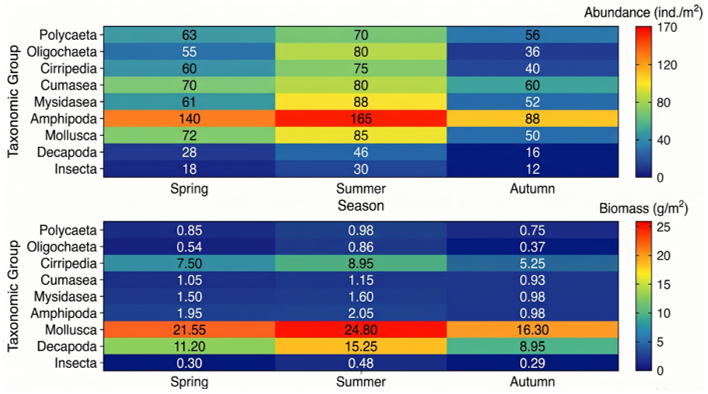
The analysis of the seasonal dynamics of macrozoobenthos quantitative development in 2023, as visualized in the heatmap (Figure 1), reveals distinct temporal patterns in the Northern Absheron Bay. The maximum values for both abundance and biomass were recorded during the summer season, reaching 719 ind. m⁻² and 56.12 g m⁻², respectively. Conversely, the minimum quantitative indicators were observed in autumn, with values declining to 410 ind. m⁻² and 34.80 g m⁻².
Figure 1. Heatmap of seasonal dynamics in macrozoobenthos quantitative development in Northern Absheron Bay (2023)
The heatmap clearly illustrates the absolute dominance of the Amphipoda group across all seasons. Specifically, their population density reached a peak of 165 ind. m⁻² during the summer, primarily driven by dominant species such as Niphargoides robustoides and Niphargoides maeoticus. Other groups, such as Insecta and Oligochaeta, exhibited significantly lower densities throughout the study period, represented by the lower-intensity color gradients in the visualization [14, 15].
In terms of biomass, the heatmap presents a different structural dominance. The Mollusca group emerged as the primary contributor to benthic productivity, with a seasonal peak of 24.80 g m⁻² in summer and an annual average of 20.88 g m⁻². Additionally, Decapoda (15.25 g m⁻²) and Cirripedia (8.95 g m⁻²) provided substantial contributions to the total biomass during the peak production period.
The results indicate a clear seasonal pattern, with maximum abundance and biomass recorded in summer and minimum values observed in autumn. These seasonal differences may reflect natural temporal variation in macrozoobenthic community structure.
In 2024, 19 species of macrozoobenthic organisms were recorded in the coastal waters of the Northern Absheron Bay. The number of species varied seasonally throughout the year, reflecting changes in environmental conditions and habitat suitability across different seasons.
Specifically, the highest number of macrozoobenthic species was recorded during the spring and summer seasons (15–19 species), whereas the lowest species richness was observed in autumn (11 species) (Table 1). Compared with 2023, the total number of species in the macrozoobenthic community of the bay decreased from 21 to 19 species in 2024.
Throughout all seasons, the increase in species richness of the macrozoobenthos was primarily attributed to amphipod crustaceans, which accounted for 21.0% of the total species number during the summer season. Mollusks ranked second, being represented by three species.
In 2024, the macrozoobenthic community was represented by 19 species belonging to nine systematic groups. The average annual biomass of macrozoobenthic organisms was 39.13 g m⁻², while their average abundance reached 449 ind. m⁻². Similar to the previous year, the highest biomass values were recorded during the summer season, whereas the lowest values were observed in autumn. Specifically, the biomass of macrozoobenthic organisms reached 48.71 ind. m⁻² with an abundance of 593 ind. m⁻² in summer, while in autumn the biomass decreased to 31.40 g m⁻² and the abundance to 302 ind. m⁻² (Table 3).
Table 3. Seasonal dynamics of macrozoobenthos abundance and biomass in the Northern Absheron Bay in 2024
|
Groups |
Number of Species |
Seasons |
|||
|
Spring |
Summer |
Autumn |
Average |
||
|
Polychaeta |
2 |
28/0.48 |
50/0.72 |
15/0.38 |
31/0.53 |
|
Oligochaeta |
1 |
42/0.42 |
60/0.65 |
28/0.27 |
43/0.45 |
|
Cirripedia |
1 |
48/5.95 |
65/7.98 |
35/3.85 |
50/5.93 |
|
Cumacea |
3 |
58/0.98 |
69/1.05 |
40/0.70 |
56/0.91 |
|
Mysidacea |
2 |
55/1.0 |
70/1.52 |
40/0.65 |
55/1.05 |
|
Amphipoda |
4 |
132/1.45 |
170/1.58 |
82/1.02 |
128/1.35 |
|
Mollusca |
3 |
55/18.52 |
62/21.15 |
40/12.17 |
52/17.27 |
|
Decapoda |
2 |
18/8.21 |
25/13.65 |
12/12.18 |
18/11.35 |
|
Insecta |
1 |
16/0.28 |
22/0.41 |
10/0.18 |
16/0.29 |
|
Total: |
19 |
452/37.29 |
593/48.71 |
302/31.40 |
449/39.13 |
Mollusks were the dominant group contributing to benthic biomass formation, accounting for 45.07% of the total biomass. In terms of abundance, however, amphipod crustaceans remained the dominant component of the macrozoobenthic community, representing 30.75% of the total number of individuals.
In 2025, the macrozoobenthic community of the Northern Absheron Bay was represented by 16 species belonging to nine systematic groups (Table 1). The number of recorded species and their frequency of occurrence were not constant and varied seasonally throughout the year. The highest species richness of macrozoobenthic organisms was observed in summer (16 species), whereas the lowest number of species was recorded in autumn (8 species) (Table 1).
As in previous years, the biodiversity of the bay’s macrozoobenthos was primarily shaped by species belonging to the Amphipoda (3 species) and Mollusca (3 species) groups. At the higher taxonomic level, Amphipoda and Mollusca constituted the dominant macrozoobenthic groups during the study period.
Similar to previous years, the quantitative development of the macrozoobenthic community in the Northern Absheron Bay was not stable and exhibited seasonal fluctuations. The highest biomass and abundance values were recorded in summer, followed by spring, whereas the lowest values occurred in autumn (Table 4).
Table 4. Seasonal dynamics of macrozoobenthos abundance and biomass in the Northern Absheron Bay in 2025
|
Groups |
Number of Species |
Seasons |
|||
|
Spring |
Summer |
Autumn |
Average |
||
|
Polychaeta |
2 |
51/0.70 |
65/0.98 |
32/0.48 |
49/0.72 |
|
Oligochaeta |
1 |
35/0.38 |
50/0.58 |
23/0.24 |
36/0.40 |
|
Cirripedia |
1 |
40/6.80 |
52/8.65 |
28/4.70 |
40/6.72 |
|
Cumacea |
2 |
31/0.42 |
45/0.50 |
20/0.30 |
32/0.41 |
|
Mysidacea |
1 |
18/0.25 |
30/0.30 |
10/0.12 |
19/0.22 |
|
Amphipoda |
3 |
115/1.30 |
148/1.42 |
70/0.95 |
111/1.22 |
|
Mollusca |
3 |
48/16.45 |
65/18.50 |
20/10.15 |
45/15.03 |
|
Decapoda |
2 |
12/7.95 |
30/11.90 |
6/5.42 |
16/8.42 |
|
Insecta |
1 |
12/0.20 |
20/0.30 |
8/0.12 |
13/0.21 |
|
Total: |
16 |
362/34.45 |
505/43.13 |
217/22.48 |
361/33.35 |
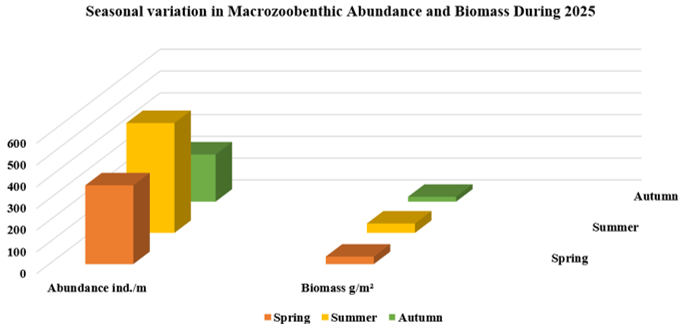
Figure 2 illustrates the seasonal variation in macrozoobenthic abundance and biomass during 2025. Both parameters reached their highest values in summer (505 ind. m⁻² and 43.13 g m⁻²), followed by spring (362 ind. m⁻² and 34.45 g m⁻²), while the lowest values were recorded in autumn (217 ind. m⁻² and 22.48 g m⁻²). These findings indicate that macrozoobenthic communities exhibited maximum development during the summer season and declined markedly towards autumn.
Figure 2. Seasonal trends in macrozoobenthic abundance and biomass during 2025
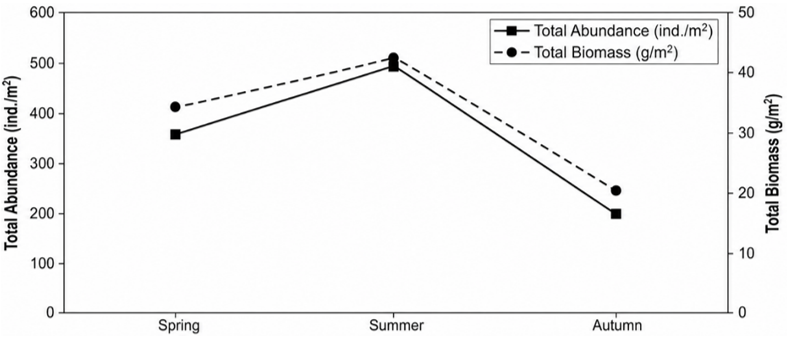
The provided graph illustrates the seasonal dynamics of Total Abundance (represented by the solid line with squares) and Total Biomass (represented by the dashed line with circles) across Spring, Summer, and Autumn (Figure 3). The analysis reveals that both indicators share a similar seasonal trend, peaking in the summer and sharply declining in the autumn:
Spring: During this season, the total abundance is approximately 360 ind. m⁻², while the total biomass is around 34 g m⁻² (based on the right axis).
Summer: Both metrics reach their peak levels. Total abundance increases to about 500 ind. m⁻², and total biomass rises to roughly 42 g m⁻².
Autumn: Following the summer peak, there is a sharp decline, bringing both indicators to their lowest observed points. Abundance drops to approximately 220 ind. m⁻², and biomass falls to about 22 g m⁻².
The parallel movement of the two lines on the graph indicates a strong relationship between the seasonal changes in the number of organisms (abundance) and their overall mass (biomass), with summer being the most active period.
Figure 3. The seasonal dynamics of total abundance and total biomass across spring, summer, and autumn
A total of seven species contributed to biomass formation throughout all seasons. Among these species, the dominant contributors to biomass were Mytilaster lineatus (M. lineatus) with 6.25 g m⁻², Cerastoderma rhomboides (C. rhomboides) with 18.30 g m⁻², and Balanus improvisus (B. improvisus) with 3.80 g m⁻². In terms of abundance, the most prominent species within the macrozoobenthic community were Niphargoides robustoides (N. robustoides) with 85 ind. m⁻², Niphargoides maeoticus (N. maeoticus) with 70 ind. m⁻², and Hediste diversicolor (H. diversicolor) with 68 ind. m⁻².
Thus, the comprehensive investigations conducted during 2023–2025 demonstrated that the macrozoobenthic community of the Northern Absheron Bay is currently undergoing substantial quantitative and qualitative transformations. Comparison with previous investigations conducted in the Northern Absheron Bay suggests a decreasing trend in macrozoobenthic species richness and biomass.
Comparison of the present results with data obtained from earlier investigations conducted in the Northern Absheron Bay during 1968-2001 demonstrated considerable changes in both the species composition and quantitative distribution of macrozoobenthic organisms.
The results demonstrate a gradual decrease in species richness, abundance, and biomass during the study period. However, the present study did not include direct measurements of environmental variables or sediment pollutants; therefore, the underlying causes of these changes require further investigation [16-19].
In conclusion, the loss of biomass observed in the macrozoobenthic community of the bay contributes to a decline in the biological productivity of the region and the degradation of the food resources supporting commercially important fish species. This situation necessitates the implementation of urgent monitoring and conservation measures aimed at restoring and maintaining the ecological status of the Northern Absheron Bay.
The results of the macrozoobenthic diversity analysis showed that the total abundance of benthic organisms ranged from 6 to 617 individuals m⁻², while the number of taxa varied between 7 and 33 across the sampling stations (Table 5). The mean Simpson dominance index was 0.80, with values ranging from 0.56 to 0.99 among the stations.
Table 5. Univariate statistical indices of the macrozoobenthic community in the Northern Absheron Bay during the spring season (April 2024)
|
Stations No. |
Number of Taxa |
Abundance (Individuals m⁻²) |
Biomass (g m⁻²) |
Simpson Dominance Index |
Shannon–Wiener Diversity Index |
Pielou Evenness Index |
|
1 |
11 |
39 |
0.40 |
0.6799 |
2.3643 |
0.7380 |
|
2 |
14 |
44 |
8.49 |
0.9837 |
2.898 |
0.8770 |
|
3 |
16 |
95 |
1.53 |
0.9071 |
2.189 |
0.7430 |
|
4 |
7 |
53 |
1.59 |
0.7834 |
2.3541 |
0.7380 |
|
5 |
13 |
57 |
1.04 |
0.6070 |
1.678 |
0.7437 |
|
6 |
21 |
296 |
59.34 |
0.8690 |
1.710 |
0.6030 |
|
7 |
17 |
6 |
0.16 |
0.5620 |
0.952 |
0.8652 |
|
8 |
7 |
22 |
14.13 |
0.8550 |
1.7649 |
0.7081 |
|
9 |
33 |
617 |
5.95 |
0.9890 |
2.298 |
0.7860 |
Table 6. Univariate statistics of the macrozoobenthic community in the Northern Absheron Bay during the summer season (June 2025)
|
Stations No. |
Number of Taxa |
Abundance (Individuals m⁻²) |
Biomass (g m⁻²) |
Simpson Dominance Index |
Shannon–Wiener Diversity Index |
Pielou Evenness Index |
|
1 |
14 |
80 |
0.86 |
0.7889 |
2.4854 |
0.8134 |
|
2 |
16 |
84 |
9.69 |
0.9887 |
2.9485 |
0.3938 |
|
3 |
18 |
208 |
2.66 |
0.9782 |
2.234 |
0.8132 |
|
4 |
19 |
114 |
2.59 |
0.8342 |
2.4739 |
0.7364 |
|
5 |
15 |
96 |
1.67 |
0.8741 |
1.9736 |
0.8342 |
|
6 |
31 |
806 |
8.19 |
0.9987 |
2.3131 |
0.8126 |
|
7 |
12 |
61 |
19.91 |
0.7849 |
1.989 |
0.8748 |
|
8 |
22 |
418 |
93.28 |
0.9962 |
2.9648 |
0.8734 |
|
9 |
7 |
16 |
0.29 |
0.6313 |
2.9485 |
0.8938 |
|
Total |
17 |
209 |
15.46 |
0.8750 |
2.4812 |
0.7839 |
Although the overall dominance index was relatively high, a low value (0.5620) was recorded at the seventh station, which may be associated with oil contamination of the bottom sediments. The mean values of the Shannon-Wiener diversity index and the Pielou evenness index were 2.02 and 0.76, respectively.
The distribution of macrozoobenthic diversity and evenness indices varied among the sampling stations, indicating spatial heterogeneity in community structure (Table 6).
High Simpson dominance values recorded at several stations (e.g., 0.984 at Station 2 and 0.989 at Station 9) indicate strong dominance of a limited number of taxa and reduced community evenness. Such patterns may reflect environmental stress and the replacement of sensitive species by more tolerant forms. Although petroleum contamination has previously been identified as an important ecological pressure in the Absheron coastal zone, the present study did not include direct measurements of sediment pollutants; therefore, the observed dominance patterns should be interpreted as a potential ecological signal rather than direct evidence of contamination.
Based on the present findings, a long-term monitoring programme is recommended for the Northern Absheron Bay. Seasonal surveys should be conducted in spring, summer, and autumn using fixed sampling stations. Monitoring should include species composition, abundance, and biomass of macrozoobenthos, with particular attention to dominant groups such as Mollusca and Amphipoda. Future studies should also include measurements of environmental variables (e.g., dissolved oxygen, salinity, temperature, and sediment characteristics) to improve understanding of the factors affecting macrozoobenthic community dynamics.
Based on the findings of the present study, the following conclusions can be drawn:
1. During 2023–2025, a total of 21 macrozoobenthic species belonging to nine systematic groups were recorded in the coastal waters of the Northern Absheron Bay. Species richness was highest during spring and summer (2023).
2. The average annual biomass of macrozoobenthic organisms ranged from 33.35 to 45.78 g m⁻², while abundance varied between 361 and 565 ind. m⁻². In all study years, the highest biomass and abundance values were recorded during summer, whereas the lowest values were observed during autumn.
3. Mollusca and Decapoda represented the principal contributors to macrozoobenthic biomass throughout the study period. Amphipoda remained the dominant group in terms of abundance and played a major role in shaping the structure of the macrozoobenthic community.
4. High Simpson dominance values recorded at several sampling stations indicate the prevalence of a limited number of taxa and reduced community evenness. These patterns may reflect environmental stress and changes in community structure; however, additional environmental and sediment-quality data are required to identify the underlying causes.
5. The results obtained during 2023–2025 provide an important baseline dataset for future ecological monitoring of the Northern Absheron Bay. Long-term monitoring based on fixed sampling stations, seasonal surveys, and measurements of environmental variables is recommended to improve understanding of macrozoobenthic community dynamics and support ecosystem conservation and management.
[1] Parr, T.D., Tait, R.D., Maxon, C.L., Newton, F.C., Hardin, J.L. (2007). A descriptive account of benthic macrofauna and sediment from an area of planned petroleum exploration in the southern Caspian Sea. Estuarine, Coastal and Shelf Science, 71(1-2): 170-180. https://doi.org/10.1016/j.ecss.2006.07.018
[2] Bozorgchenani, A., Seyfabadi, J., Shokri, M.R. (2018). Effects of thermal discharge from Neka power plant (southern Caspian Sea) on macrobenthic diversity and abundance. Journal of Thermal Biology, 75: 13-30. https://doi.org/10.1016/j.jtherbio.2018.05.002
[3] Malinovskaja, L.V., Filippov, A.A., Osadchikh, V.F., Aladin, N.V. (1998). Benthic macroinvertebrates of the northern Caspian Sea during recent rises in water-level. International Journal of Salt Lake Research, 7(3): 211-233. https://doi.org/10.1023/a:1009017518914
[4] Karpinsky, M.G. (2010). Review: The Caspian Sea benthos: Unique fauna and community formed under strong grazing pressure. Marine Pollution Bulletin, 61(4-6): 156-161. https://doi.org/10.1016/j.marpolbul.2010.02.009
[5] Bahrebar, S., Negarestan, H., Maghsoudlou, A., Danehkar, A. (2020). Macrobenthic assemblage structure and distribution at the Boojagh Marine National Park, Southern Caspian Sea, Iran. Iranian Journal of Fisheries Sciences, 19(2): 748-767. https://sid.ir/paper/743444/en.
[6] Javandel, N., Akhoundian, M. (2021). Temporal and spatial changes of macrobenthos communities in south east shores of the Caspian Sea. Nexo Revista Científica, 34(4): 1403-1412. https://doi.org/10.5377/nexo.v34i04.12687
[7] Ghasemi, A.F. (2015). Species composition of the benthic macroinvertebrates on the coastline vegetated rocky substrates of the Southern Caspian Sea. Transylvanian Review of Systematical and Ecological Research, 16(1): 57-64. https://doi.org/10.1515/trser-2015-0002
[8] Zhuniskankyky, K., Rustembayev, B.E. (2022). The state of pollution of bottom sediments of the Caspian Sea from oil production in Kazakhstan. Eurasian Agrotechnical Journal, 4: 55-64. https://doi.org/10.51452/kazatu.2022.4.1268
[9] Sayyadoghly, F., Mirzajani, A., Shabanipour, N., ten Hove, H.A. (2024). Resurgence of massive occurrence of the invasive polychaete Ficopomatus enigmaticus (Fauvel, 1923) in the Caspian Sea. Zoology in the Middle East, 70(3): 267-274. https://doi.org/10.1080/09397140.2024.2378519
[10] Yanina, T.A. (2022). Natural and anthropogenic impact on the biodiversity of malacofauna of the Caspian Sea. Limnology and Freshwater Biology, (4): 1610-1611.
[11] Copilaș-Ciocianu, D., Marin, I., Palatov, D. (2025). Evolution and biogeography of Litorogammarus (Amphipoda: Gammaridae) with description of two new Caspian endemic species. Systematics and Biodiversity, 23(1). https://doi.org/10.1080/14772000.2025.2454025
[12] Tkach, A.A. (2024). Recent near-shore ostracod fauna of the Caspian Sea. Limnology and Freshwater Biology, (3): 142-156.
[13] Mikhailova, A.V., Nikulina, L.V. (2025). Finding of previously extinct population of brackish water crustacean Calanipeda aquaedulcis (Copepoda, Calanoida) in the Middle Caspian. Inland Water Biology, 18(5): 1000-1004. https://doi.org/10.31857/S0320965225050215
[14] Bastami, K.D., Taheri, M., Raisi, H., et al. (2025). Spatial and temporal distribution of marine debris in coastal sediment of South Caspian Sea: Effect on coastal nematode communities. Science of the Total Environment, 1003: 180570. https://doi.org/10.1016/j.scitotenv.2025.180570
[15] Chevalier, S., Beauchard, O., Teacă, A., Soetaert, K., Grégoire, M. (2024). Partial recovery of macrozoobenthos on the northwestern shelf of the Black Sea. Marine Pollution Bulletin, 207: 116857. https://doi.org/10.1016/j.marpolbul.2024.116857
[16] Shiganova, T.A., Kamakin, A.M., Pautova, L.A., Kazmin, A.S., Roohi, A., Dumont, H.J. (2023). An impact of non-native species invasions on the Caspian Sea biota. Advances in Marine Biology, 94: 69-157. https://doi.org/10.1016/bs.amb.2023.01.002
[17] Berdnikova, A., Lysenko, E., Makshaev, R., Zenina, M., Yanina, T. (2023). Multidisciplinary study of the rybachya core in the North Caspian Sea during the Holocene. Diversity, 15(2): 150. https://doi.org/10.3390/d15020150
[18] Gebruk, A., Dgebuadze, P., Rogozhin, V., Ermilova, Y., Shabalin, N., Mokievsky, V. (2023). Macrozoobenthos of the Pechora Bay in 2020-2021 indicates a likely change of common bivalve molluscs in the Arctic estuary. Polar Biology, 46(5): 473-487. https://doi.org/10.1007/s00300-023-03138-4
[19] Lyubimov, I.V., Kolyuchkina, G.A., Simakova, U.V., Basin, A.B. (2023). Bottom biocenoses of Taman Bay (Sea of Azov). Oceanology, 63(6): 936-949. https://doi.org/10.31857/S0030157423060102