Tri Endar Suswatiningsih* | Arif Anshori | Sri Wahyuni Budiarti | Hermawati Cahyaningrum | Rajiman | Danik Nurjanah | Fransiska Renita Anon Basundari | Helena Lina Susilawati | Elisabeth Srihayu Harsanti | Yulis Hindarwati | Meinarti Norma Setiapermas | Heni Sulistyawati Purwaning Rahayu
© 2026 The authors. This article is published by IIETA and is licensed under the CC BY 4.0 license (http://creativecommons.org/licenses/by/4.0/).
OPEN ACCESS
The karst hills of Indonesia, especially in Gunungsewu, have shallow soil, steep elevations, and limited water availability, consequently inhibiting agricultural practices and increasing the risk of land degradation. Local farmers use pot cultivation (PC) to grow crops in soil-filled rock cavities while conserving soil and water resources. This research aimed to empirically formulate a model explaining environmental, economic, labor, and perception factors that influence farmers’ motivations and behavior in practicing PC and its potential to support the Sustainable Development Goals (SDGs). The research was conducted in the karst hills of Girisubo, Rongkop, Tepus, Semanu, Tanjungsari, Paliyan, and Saptosari districts. A purposive sampling method was used to select 41 farmers who had been practicing PC for more than five years. The factors studied included environment, economic, labor, perception, motivation, and behaviors using path analysis. The results showed that motivation fully mediated the influence of environmental, economic, labor, and farmer perception factors on farmer behavior in practicing PC. PC has the potential to support SDGs, namely SDGs 2 (zero hunger) and SDG 12 (responsible production and consumption), particularly target 2 (ensure sustainable management and efficient use of natural resources).
karst hill, motivation, pot cultivation, soil and water conservation, sustainable development goals
Environmental conditions create human behavior in managing land, water, and plants, as a form of adaptation. One form of adaptation carried out is pot cultivation (PC) in the Gunungsewu karst hill. PC is a term coined to refer to the practice of cultivating plants by farmers in a small volume of soil between rocks, like planting in a pot, on shallow soil in a karst hill. Rock functions like a pot filled with soil. The volume of soil between the rocks is very small, dominated by rocks. The soil is managed to fill the rock and is sufficient as a medium for growing plants. The volume of soil varies, adjusting the depth, width of the ‘pot,’ and the dominant rocks, which are influenced by the condition of the rock on the karst hill. The soil that fills the ‘pot’ can be native soil or soil that is collected and inserted so that it is sufficient as a medium for growing plants. PC is often found in the Gunungsewu karst hills, Gunungkidul, D.I. Yogyakarta, Indonesia [1].
In addition to being a form of plant cultivation practice, PC also functions as a form of soil and water conservation (SWC) technique on karst hills. According to the study [2], karst hills can have a slope of 60 to 70 degrees and are prone to land degradation, especially due to erosion processes, resulting in the formation of critical land. Land degradation and the formation of critical land will cause disruption to the nutrient cycle, carbon absorption, the hydrological cycle, the provision of food and energy sources, habitats for living things, and biodiversity, and further to flood and climate regulation [3]. SWC practices will depend heavily on the level of technological mastery to maintain and increase productivity, reduce degradation and rehabilitate land, and provide economic and environmental benefits [4].
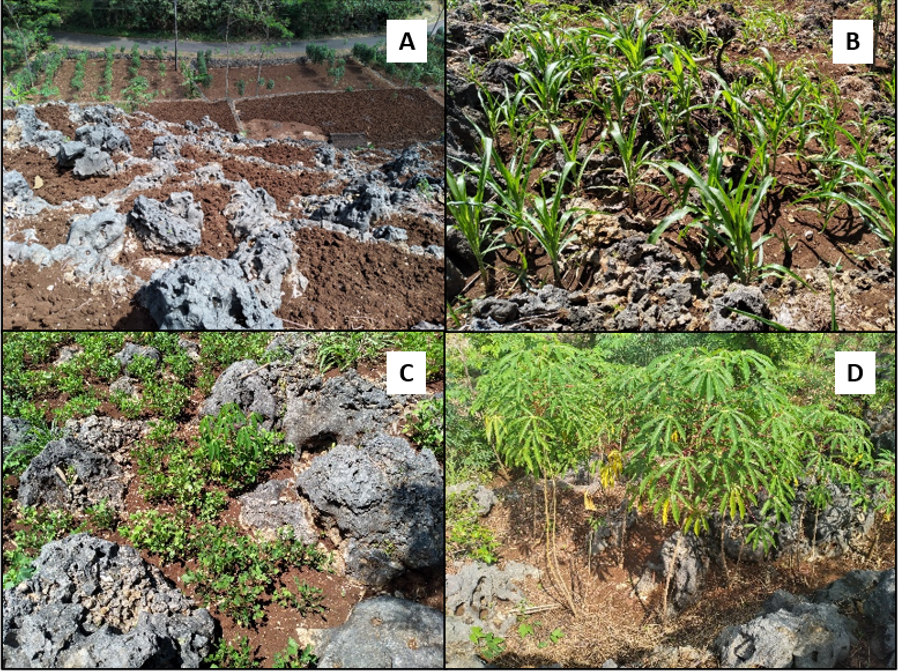
Increasing population density and rapid economic development mean that karst areas are inseparable from being development areas [5]. Gunungsewu Karst is classified as Kegel karst, characterized by sinusoidal hills interspersed with interconnected valleys, that covers an area of 1,300 km² and features more than 10,000 hills with a density of around 30 km⁻² and varied morphology. Shallow soil is found on karst hills [2]. PC is not implemented on all the Gunungsewu karst hills, but it has been successfully implemented in some locations. PC requires further study to identify the supporting factors and its environmental benefits. PC is illustrated in Figure 1.
Figure 1. (A) Land of PC in Dadapayu Semanu Gunungkidul, cultivated after harvesting groundnut, waiting the rainfall for the next crop, picture taken May 18, 2025; (B) PC in Sidoharjo Tepus Gunungkidul with corn at 32 days after planting, picture taken January 19, 2025; (C) PC in Jetis Saptosari Gunungkidul with groundnut at 48 days after planting, picture taken January 26, 2025; (D) PC in Balong Girisubo Gunungkidul with cassava at 117 days after planting, picture taken May 18, 2025
Indonesia focuses on achieving sustainable development goals (SDGs) as a global commitment. Land management plays a crucial role in meeting SDGs targets. It significantly contributes to food equity, poverty alleviation, food security, and environmental protection. Land management must be conducted appropriately, based on potential and carrying capacity, to enhance community welfare and promote the sustainability of natural resources and the environment [6]. PC is a form of land management practice that includes crop cultivation and SWC. Farmers practice PC on easily degraded karst hills, with shallow soil and steep slopes. Farmers have been practicing PC for a long time, over five years, and the karst hills remain sustainable. Farmers are able to maintain PC practices on karst hills. PC has potential to support the SDGs.
A previous study has identified PC as a method for SWC in karst landscapes. Anshori et al. [1] presented a qualitative analysis of the technical aspects of PC, including the mechanisms by which rocks retain soil and the methods employed by farmers to harvest rainfall for agricultural water needs. Anshori et al. [7] evaluated cassava production between PC and karst valleys, finding that productivity in PC is approximately half that of the valleys. However, these previously published studies failed to investigate the reasons farmers persist in using PC regardless of its low yield, nor did they identify the elements influencing farmer motivation and subsequent actions. No earlier research has introduced a comprehensive theoretical model connecting environmental, economic, labor, and perceptual factors to farmer motivation and behavior in PC, investigated the mediating effect of motivation between these external factors and behavioral outcomes empirically, and systematically aligned PC practices with specific SDGs targets based on farmer-level data. Thus, this study aimed to formulate and empirically evaluate a behavioral model explaining the influence of environmental, economic, labor, and perceptual factors on farmer motivation, therefore influencing behavior in PC practices, which has the potential to support the SDGs.
2.1 Theoretical framework
2.1.1 Pot cultivation in karst hills
Plant cultivation in the karst areas is specific and differs from other regions. Karst features specific characteristics, dominated by rock and limited water resources. Land use in the karst areas requires serious attention, from the planning and implementation stages to harvesting, to minimize environmental impact, as karst regions are susceptible to land damage from erosion and water source depletion. The utilization of karst areas prioritizes the welfare of the population and environmental sustainability. Development of karst areas considers aspects of resource management and utilization, disaster mitigation, and environmental preservation [8].
PC is implemented on some of the Gunungsewu karst hills. The productivity of the plant on PC is relatively low. For example, cassava productivity on PC is only about half that of the karst valley, and also results in lower profit [7]. Planting on PC relies on water from rainfall, with a seasonal pattern. Highest rainfall occurs in November-March, and the lowest in May-September [9]. Theoretically, rainwater is only sufficient for plant growth during the period November-March. The availability of water for plants on karst hills is limited, with low plant productivity, but farmers still carry out PC.
2.1.2 Research model and hypothesis
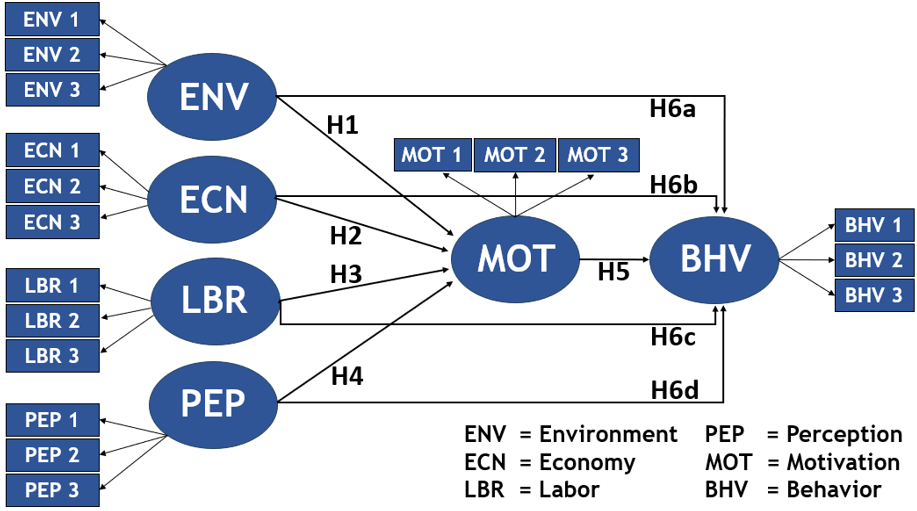
The concept of PC research on the Gunungsewu karst hills refers to the proposed model (Figure 2). Environment, economy, labor, and perception, with three items, play a role in determining farmer motivation, which then manifests in behavior. Previous studies have not explored the role of environmental, economic, labor, and perception factors on farmer behavior in PC practices on the karst hill, which adds to the novelty of this research. Environment, economy, labor, and perception are independent factors that influence motivation and then determine behavior in PC practices.
Figure 2. Proposed theoretical model
The conceptualization of the model describes the relationship between environmental, economic, labor, and farmer perception factors that shape motivation, which is then shown in the form of behavioral responses. All factors consist of three statement items. Environmental factors consist of PC reducing soil loss (ENV 1), increasing fertility (ENV 2), and sustainability (ENV 3). Economic factors include costs (ECN 1), income (ECN 2), and food sources (ECN 3). Labor factors include labor skill (LBR 1), the number of laborers (LBR 2), and female labor (LBR 3). Perceptions include soil sustainability in the PC (PEP 1), crop water requirement from rainfall (PEP 2), and government support (PEP 3). Motivation is related to the demands for survival (MOT 1), adaptation to the environmental pressures (MOT 2), and land as an ancestral heritage that must be protected (MOT 3). Behavior refers to the information farmers need (BHV 1), maintaining soil and rocks on the PC (BHV 2), and the application of crop cultivation technologies (BHV 3).
Environment
PC is formed by a rock filled with soil like a ‘pot’ with a plant in it. The rock-filled soil can be native soil or added soil. The rock holds the soil from erosion by water [1]. The provision of organic fertilizer improves nutrient status, soil microorganism status, soil fertility, soil quality, soil infiltration, and soil water retention status [10]. Organic fertilizers will also increase the sustainability of the farming system and the environment [11]. Land on karst hills that are not properly conserved with the PC has the potential to become unused or degraded land. However, excessive and inappropriate cultivation will also have the potential to damage the land on the karst hill. Hypothesis H1 states that the environment plays a role in shaping motivation in the practice of PC. Hypothesis H6a states that the environment influences farmers’ behavior in the practice of PC.
Economic
The practice of PC is carried out by utilizing limited land to produce biomass and food. Referring to the study [12], plant cultivation practices will require costs according to the type and scale of the business. More intensive efforts usually require higher costs [13]. The conservation action in agriculture will provide harvest results and, at the same time, income for the farming families [14]. Harvest also functions as a source of food for the farming families [15]. Hypothesis (H2) is economy plays a role in shaping motivation in the practice of PC. Hypothesis (H6b) is that economic influences farmers’ behavior in the practice of PC.
Labor
Small-scale or traditional farming requires minimal labor, typically provided by family members at a lower implicit cost. Family labor is generally not classified as skilled or trained labor and is not wage-based. This pattern provides higher yields [16]. Family labor in agriculture is a socio-economic-cultural way of life with the aim of meeting the needs of farming family members, not for profit [17]. Family-based food systems significantly contribute to food and nutrition security. Family farming also plays a role in maintaining nutritional diversity [18]. Women’s labor spans from land preparation to harvesting and marketing. Their contributions are often excluded from agriculture calculations, despite having a positive impact on the family [19]. Hypothesis (H3) is that labor plays a role in shaping motivation in the practice of PC. Hypothesis (H6c) is that labor influences farmers’ behavior in the practice of PC.
Perception
Perception about agricultural practice can vary between individuals and communities and can be influenced by environmental factors, economic and cultural values, and even health [20]. Farmers assume that with PC, the sustainability of the soil in the karst hill will be maintained, not lost, and will remain fertile. The water requirement of PC is met during the growing season in the rainy season, just from rainfall [1]. Policy support from the government is needed for the sustainability of agricultural practices [21]. Hypothesis (H4) is that perception plays a role in shaping motivation in the practice of PC. Hypothesis (H6d) is that farmers’ perception influences farmers’ behavior in the practice of PC.
Motivation
Motivation significantly influences agricultural practices. The need to motivate farmers to survive. The survival of farmers is a demand for farmers to meet the demands of their lives. Limitations trigger farmers to carry out survival strategy activities so that survive in life [22]. Every individual must be able to survive in all situations and conditions that befall them, including the environmental pressure [23]. Sustainable management requires comprehensive support related to the complexity of agroecology [24]. Land as a legacy and mandate must be managed properly according to its potential [25]. Hypothesis (H5) is that motivation plays a role in shaping behavior in the practice of PC.
Behavior
Information received by farmers will be responded to in the form of agricultural practice behavior. SWC practices take into account the technical, social, economic, and resource conditions [26]. Farmers’ behavior influences efforts to increase farmers' income through increasing agricultural productivity [27]. Farmers’ behavior in general will tend to imitate others. Behavior will be related to learning and sustainable practice. Increasing farmer awareness of sustainable practices will frame cost and benefit and increase the flexibility of agricultural-environmental practice [28].
Motivation as a mediating factor
The environment, economy, labor, and perceptions can directly influence farmer motivation (H1, H2, H3, H4) and behavior (H6a, H6b, H6c, H6d). Indirectly, motivation can act as a link between the environment, economy, labor, and perceptions of farmer behavior. Hypothesis (H7) states that motivation mediates the relationship between the environment, economy, labor, and perceptions of farmer behavior in the practice of PC.
2.2 Data collection and analysis
Research was conducted in the Gunungsewu karst area, Gunungkidul, D.I. Yogyakarta, Indonesia, from December 2024 to June 2025, in karst hills. Karst hills are found in 10 districts, and sample points were taken in 7 districts where PC practices are found, namely Girisubo, Rongkop, Tepus, Semanu, Tanjungsari, Paliyan, and Saptosari. Literature study, previous research, and direct observation at the location are the basis for compiling a questionnaire to develop an understanding of the various factors that influence farmers’ motivation to practice PC, which is then manifested in the form of behavior.
The questionnaire was developed according to the model construction (Figure 2) with six factors (environment, economy, labor, perception, motivation, and farmer behavior). Each factor consisted of three statement items. Environmental factor items consist of reducing soil loss (ENV 1), increasing fertility (ENV 2), and maintaining sustainability (ENV 3). Economic factor items consist of cost being relatively affordable (ECN 1), providing additional income (ECN 2), and family food availability (ECN 3). Labor factor items consist of no special skills required (LBR 1), a small number of workers (LBR 2), and providing employment opportunities for women (LBR 3). Farmers’ perception items regarding PC consist of maintaining the sustainability of karst hills (PEP 1), crop water requirements on karst hills are met (PEP 2), and requiring government support (PEP 3). Farmers’ motivation items consist of PC as a means of survival (MOT 1), PC as a way of adapting to environmental pressures (MOT 2), and PC as a way of protecting ancestral heritage (MOT 3). Farmers’ behavior items include seeking needed information about the PC (BHV 1), maintaining soil and rocks on the PC (BHV 2), and applying crop cultivation technologies, such as applying organic matter (BHV 3). Data on environment, economic, labor, perception, and motivation were captured based on a five-point Likert scale, scored from 1 to 5 (strongly disagree = 1, disagree = 2, undecided = 3, agree = 4, strongly agree = 5). Meanwhile, farmer behavior is given a score of 1 to 5 (never = 1, very rarely = 2, sometimes = 3, often = 4, very often = 5).
The study involved 41 farmers cultivating crops in the karst hill area. Given the absence of reliable population records, samples were selected based on field identification and accessibility. The sample was determined by non-probability sampling with a purposive sampling technique; namely, farmers who had been practicing PC for more than 5 years were selected. Interviews were conducted face-to-face. Implementation of the study refers to the study [29]. Data were analyzed to determine validity and reliability. Validity of the questionnaire items was tested using Pearson correlation and corrected item-total correlation (CITC), with a value limit of more than 0.3 as valid. Questionnaire reliability was tested using Cronbach’s alpha, with a value of more than 0.7 as reliable. The items test refers to the study [30]. Linear regression was utilized to simultaneously evaluate the direct effects of all explanatory variables on motivations and behaviors. Bootstrap-based simple mediation models using PROCESS macro v4.2 were employed to analyze the mediating function of motivations for each variable individually. Data analysis was performed using SPSS 22. Furthermore, the bootstrapping test was used to verify mediating variables using the PROCESS macro v4.2 as described by Hayes [31].
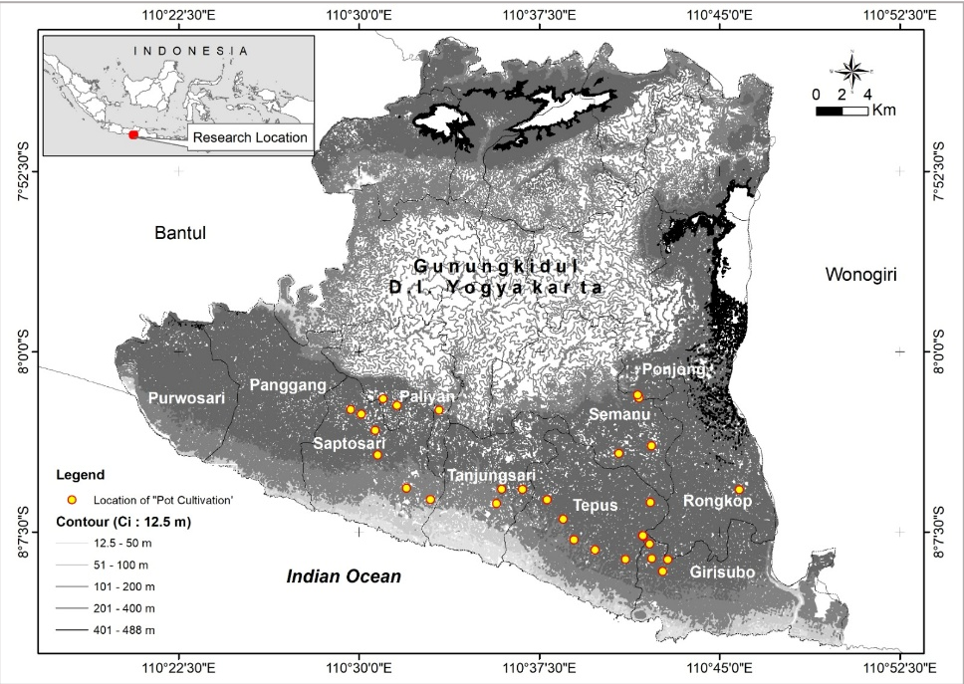
The Gunungsewu karst area of Gunungkidul, D.I. Yogyakarta, Indonesia, borders the Indian Ocean to the south. The elevation ranges from zero to 486 meters above sea level. The karst hills contain shallow soil between the dominant rocks, with steep slopes. The karst hills are found in the southern area of Gunungkidul, in the districts of Girisubo, Rongkop, Tepus, Semanu, Tanjungsari, Paliyan, Saptosari, Panggang, Purwosari, and Ponjong. The PC research focus was on 7 districts: Girisubo, Rongkop, Tepus, Semanu, Tanjungsari, Paliyan, and Saptosari (Figure 3). PC is carried out intensively by farmers on the karst hills. The exact number of PC farmers is unknown, and no accurate data exists.
Figure 3. Sample location of pot cultivation (PC)
The Gunungsewu karst area in Gunungkidul, D.I. Yogyakarta, exhibits a unique phenomenon. A distinct difference in characteristics is found between karst hills and valleys. Karst hills are characterized by steep slopes and shallow, rocky soils. Karst valleys are flatter and have deeper soils. The PC location is on a karst hill, stretching from the Girisubo district in the east to Saptosari in the west. The PC location is on a karst hill separated by a karst valley. However, not all karst hills are suitable for PC practices. Some karst hills consist of rocky areas with shrubs and trees. PC can only be done in conditions with sufficient soil to support plant growth. The water source for the karst hills comes from rainfall, without any additional irrigation water. Farmers practice PC only during the rainy season. They typically plant corn or groundnuts twice. Groundnuts are planted more frequently due to their shorter maturity. Cassava is eight months old, and as it approaches harvest, it doesn’t require much water, as the dry season has already begun.
The profile of a farmer who practices PC is listed in Table 1. The majority of farmers were male, 68.29%. The farmer that over 60 years old were 39.02%, and only 4.88% in under 40 years old. The majority of farmers, 90.24%, had only an elementary education. Additional education is needed, especially at a young age, for understanding karst hills, accelerating agricultural development, and furthering the sustainability of agricultural systems. Farmers join farmer groups as an effective means of gaining additional knowledge. Extension programs and field schools, emphasizing theory and practice, are conducted to improve and sustain PC.
Table 1. Characteristics of a farmer who practices pot cultivation (PC)
|
Profile |
Category |
Percentage (%) |
|
Age |
Less than 40 years |
4.88 |
|
40–60 years |
56.10 |
|
|
Above 60 years |
39.02 |
|
|
Gender |
Male |
68.29 |
|
Female |
31.71 |
|
|
Education level |
Elementary school |
90.24 |
|
Junior High School |
7.32 |
|
|
Senior High School |
2.44 |
|
|
University |
- |
The results of the validity and reliability tests for environmental, economic, labor, perception, motivation, and behavior factors are listed in Table 2. The hypothesis test for the direct influence of environmental, economic, labor, and perception factors on motivation and behavior is listed in Table 3. The hypothesis test for the indirect influence between these factors is listed in Table 4. Table 3 and Table 4 were generated from different analytical frameworks: regression and single-mediator models, respectively.
The validity test results showed that all questionnaire items had CITC values ranging from 0.367 to 0.781, which exceeded the recommended threshold of 0.30 [30]. Therefore, all items were considered valid and suitable for further analysis. The Cronbach’s Alpha value is in the range of 0.702-0.754, indicating that the questionnaire instrument used has good reliability because it exceeds the commonly used minimum limit of 0.70. The items in the questionnaire can be applied in research.
Table 2. Validity and reliability analysis
|
Attribute |
Pearson Correlation |
Corrected Item - Total Correlation (CITC) |
Cronbach’s Alpha |
Alpha if Item Deleted Values |
|
ENV 1 |
0.840*** |
0.631 |
0.731 |
0.554 |
|
ENV 2 |
0.865*** |
0.616 |
0.575 |
|
|
ENV 3 |
0.711*** |
0.444 |
0.763 |
|
|
ECN 1 |
0.861*** |
0.612 |
0.702 |
0.484 |
|
ECN 2 |
0.699*** |
0.367 |
0.787 |
|
|
ECN 3 |
0.819*** |
0.613 |
0.513 |
|
|
LBR 1 |
0.788*** |
0.554 |
0.754 |
0.706 |
|
LBR 2 |
0.826*** |
0.581 |
0.676 |
|
|
LBR 3 |
0.843*** |
0.619 |
0.629 |
|
|
PEP 1 |
0.813*** |
0.513 |
0.726 |
0.667 |
|
PEP 2 |
0.848*** |
0.652 |
0.519 |
|
|
PEP 3 |
0.755*** |
0.476 |
0.720 |
|
|
MOT 1 |
0.787*** |
0.476 |
0.726 |
0.738 |
|
MOT 2 |
0.826*** |
0.594 |
0.583 |
|
|
MOT 3 |
0.807*** |
0.589 |
0.599 |
|
|
BHV 1 |
0.854*** |
0.781 |
0.705 |
0.748 |
|
BHV 2 |
0.819*** |
0.691 |
0.772 |
|
|
BHV 3 |
0.700*** |
0.594 |
0.826 |
Table 3. Hypothesis analysis for the direct effect
|
Direct Effect |
Unstandardized ß |
SE |
p-Value |
Collinearity Tolerance |
VIF |
|
ENV à MOT |
0.354 |
0.696 |
0.587 |
0.010 |
103.248 |
|
ECN à MOT |
0.519 |
0.237 |
0.029 |
0.077 |
12.332 |
|
LBR à MOT |
-0.467 |
0.704 |
0.489 |
0.009 |
110.048 |
|
PEP à MOT |
0.577 |
0.091 |
< 0.001 |
0.429 |
2.332 |
|
F-test value |
52.788 (p < 0.001) |
|
|
|
|
|
R2 |
0.854 |
|
|
|
|
|
Adjusted R2 |
0.838 |
|
|
|
|
|
MOT à BHV |
1.001 |
0.085 |
0.000 |
0.146 |
6.865 |
|
ENV à BHV |
-0.265 |
0.354 |
0.464 |
0.010 |
104.108 |
|
ECN à BHV |
0.017 |
0.129 |
0.903 |
0.068 |
14.777 |
|
LBR à BHV |
0.198 |
0.360 |
0.598 |
0.009 |
111.542 |
|
PEP à BHV |
-0.092 |
0.065 |
0.229 |
0.217 |
4.616 |
|
F-test value |
155.198 (p < 0.001) |
|
|
|
|
|
R2 |
0.957 |
|
|
|
|
|
Adjusted R2 |
0.951 |
|
|
|
|
Table 4. Bootstrap mediation analysis of farmer motivations (MOT) on the relationship between explanatory factors and farmer behaviors (BHV)
|
Predictor X |
Path a (X → MOT) β |
p-Value |
Direct Effect (X → BHV) β |
p-Value |
Indirect Effect via MOT |
95% Bootstrap CI |
Mediation Type |
|
ENV |
0.868 |
< 0.001 |
-0.057 |
0.254 |
0.816 |
[0.612, 1.084] |
Full mediation |
|
ECN |
0.863 |
< 0.001 |
-0.035 |
0.467 |
0.798 |
[0.592, 1.065] |
Full mediation |
|
LBR |
0.839 |
< 0.001 |
-0.046 |
0.310 |
0.782 |
[0.592, 1.051] |
Full mediation |
|
PEP |
0.829 |
< 0.001 |
-0.089 |
0.189 |
0.814 |
[0.660, 0.986] |
Full mediation |
Notes: Indirect effects are significant when the 95% bootstrap confidence interval does not include zero. ENV: environmental factors; ECN: economic factors; LBR: labor factors; PEP: farmer perceptions of pot cultivation; MOT: farmer motivations; BHV: farmer behaviors; CI: confidence intervals. Each row represents a separate simple mediation model using bootstrapping, with only one predictor entered at a time
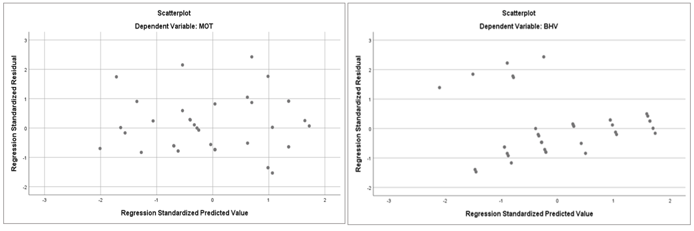
The direct effect analysis results of environmental, economic, labor, and perception factors on farmer motivation and behavior are presented in Table 3. Model fit testing was performed by displaying the R2 value, adjusted R2, and F-test. Multicollinearity testing was based on collinearity tolerance and VIF. Residual testing using a residual scatterplot can be seen in Figure 4.
Based on the multicollinearity test, high VIF values were obtained for environmental (ENV) and labor (LBR) factors. Although multicollinearity can increase the standard error of the regression coefficients, the models remain statistically significant and exhibit high explanatory power, with adjusted R² values of 0.838 for motivation and 0.951 for behavior. The low collinearity tolerance values for ENV and LBR indicate that these factors share a significant proportion of variance with other explanatory variables. The high collinearity between environmental, economic, and labor factors reflects their interconnectedness in farmer decisions. Farmers often view environmental, economic, and labor factors as inseparable parts of the agricultural production system, making them difficult to distinguish statistically. The residual scatterplot results (Figure 4) show that the points are randomly distributed without a clear pattern, indicating that the homoscedasticity assumption is met. The resulting regression model can be used for further analysis. Test results show that economic factors (H2: ß = 0.519, p < 0.05) and farmer perceptions (H4: ß = 0.577, p < 0.01) significantly influence farmer motivation in the practice of PC. Furthermore, farmer motivation (H5: ß = 1.001, p < 0.01) significantly influences farmer behavior. Hypotheses H2, H4, and H5 are proven to be supported. Hypotheses H6a, H6b, H6c, and H6d are proven to be unsupported.
Figure 4. The residual scatterplot results
The results of the indirect effect analysis of the environmental, economic, labor, and perception factors on farmer behavior with motivation as the mediator are presented in Table 4. Bootstrap mediation analysis was used because it provides a stronger estimate of the indirect effects, especially in studies with relatively small sample sizes. The bootstrap analyses estimated separate mediation models for each predictor variable individually.
Bootstrap mediation analysis showed that farmer motivation significantly mediated the relationship between environmental (ENV), economic (ECN), labor (LBR), and perception (PEP) factors on farmer behaviors (BHV). Based on the results of bootstrap analysis, all variables showed a significant positive effect on motivation (p < 0.001). The indirect effects via MOT of ENV (β = 0.816, 95% CI [0.612, 1.084]), ECN (β = 0.798, 95% CI [0.592, 1.065]), LBR (β = 0.782, 95% CI [0.592, 1.051]), and PEP (β = 0.814, 95% CI [0.660, 0.986]) were statistically significant because the bootstrap confidence interval did not include zero. In contrast, the direct influence of these variables on farmer behavior was not statistically significant (p > 0.05) (Table 4). Hypothesis (H7) stating that motivation mediates the relationship between environment, economy, labor, and perception on farmer behavior in PC practice was met. Although the direct effects of environmental, economic, labor, and perception factors were not statistically significant in the multiple regression model, mediation analysis revealed a significant indirect effect through motivation. This difference may be due to substantial collinearity among the explanatory variables, which may reduce the precision of the individual regression coefficients. This analysis result indicates that motivation fully mediates environmental, economic, labor, and farmer perception factors on behavioral responses. Therefore, optimizing environmental, economic, labor, and perception factors will not directly influence farmer behavior unless they first increase farmer motivation. The results of this test are the basis for understanding the phenomena that occur in the practice of PC in the karst hill of Gunungsewu, Gunungkidul, D.I. Yogyakarta, Indonesia.
3.1 Factors that influence pot cultivation
Economic factors significantly and positively influence farmers’ motivation. Economic factors encourage motivation to survive by adapting to limited land. There is a strong connection between economic factors and motivation. Economically, PC does not require high additional costs, provides family income, and increases food availability, thus fostering motivation and engaging in PC practices. This condition strengthens previous research indicating that costs align with the intensity of effort [12, 13], that agricultural practices provide additional income [14], and contribute to food security [15] for families.
Farmers’ perceptions directly have a significant influence on motivation. Farmers’ perceptions play a significant role in PC practices. Soil sustainability, crop water requirements [1], and government support for agricultural practices [21] are farmer perceptions that influence motivation.
The environment does not directly influence farmers’ motivation or behavior, but it does indirectly influence behavior through motivation. Several things related to environmental parameters, such as soil conservation by retaining rocks [1], the benefits of organic fertilizers [10], and agricultural sustainability [11], are understood by farmers, but they need to foster motivation to practice PC. When farmers believe that PC remains productive and beneficial despite environmental constraints, they tend to maintain their motivation to continue practicing PC.
Labor is not a factor that triggers farmer motivation in PC practices directly, but it has an indirect influence on farmer behavior through motivation. PC practices do not involve labor with special skills, not in large numbers, and often utilize female labor. PC practices are traditional and small-scale, which, according to research [16], require little labor, family labor [17], and the involvement of women's labor [19]. Increasing farmer motivation towards utilizing the family labor is expected to make PC practices more productive.
Environmental, economic, labor, and perception factors influence farmer behavior in PC practices by increasing motivation. Motivation specifically functions as a mediator between environmental, economic, labor, and perception factors on farmer behavior in practicing PC. This is the novelty of this research. Furthermore, efforts are needed to increase farmer motivation in PC practices in karst areas, not only focusing on environmental, economic, labor, and perception factors. Motivation can be enhanced through extension services, capacity-building programs such as farmer field schools, and farmer empowerment programs.
3.2 The potential of pot cultivation to support the selected sustainable development goals
Farmers of the Gunungsewu Karst Hills, Gunungkidul, practice terraces, cropping patterns, rainwater harvesting, and the use of organic fertilizers to cope with limited soil fertility and water availability in the karst landscape [32]. Besides being a crop cultivation practice, PC also functions as a form of SWC technique on karst hills. These activities improve land productivity, conserve natural resources, and support the sustainable management of the local environment. For agriculture to be considered sustainable, it must meet several criteria, including being economically viable, socially and technologically acceptable, and safe environmentally. PC technology meets these criteria; for instance, it has been proven to generate income for farmers. PC has been proven to produce food for the family and sustainable use of natural resources [1].
PC has been proven to be a food producer for families, such as corn, groundnut, and cassava. Karst areas with PC practices have the potential to be agricultural areas and a source of food reserves for families. According to the study [33], food availability prevents families from experiencing food insecurity. The key to eradicating hunger, food insecurity, and malnutrition is to increase productivity and sustainable food production. The results of the study [7] on cassava productivity in PC on karst hills are 11.24 tons ha-1, functioning as a source of food and nutrition for families. Furthermore, nutrition is a key factor in food security and is essential in reducing hunger. Agricultural practices, local food, and food diversity are solutions to reduce food scarcity and achieve food security in rural communities [34]. PC as a food source supports the production of food diversity and local food sources, which can also prevent food scarcity. PC supports the family's food sufficiency and food security. PC has the potential to support SDG 2 (zero hunger).
Agricultural environmental knowledge includes awareness of sustainable agricultural practices and the development of pro-environmental attitudes, so that behavior towards the environment is more responsible [35]. The ecological approach is effective in balancing food production and environmental sustainability. Food security and environmental sustainability require integration between traditional agriculture and scientific progress. Transformation of agricultural practices is useful for maintaining production and the sustainability of natural resources [36]. One of the clusters within the SDGs is environmental sustainability [37], which depends on land management [38], as found in PC. PC has proven to be long-lasting, more than five years, increasing agricultural production and achieving environmental sustainability. PC technology is an adaptation developed by farmers in response to natural resource conditions. PC is based on agroecology. Besides production, PC prioritizes the SWC principles, with the main goal of agricultural sustainability. PC produces food and farmers’ income, while maintaining the karst hill sustainability. PC generates food and income for farmers while maintaining the sustainability of the karst hills. PC is a form of responsible production, so it has the potential to support SDG 12, responsible production and consumption, specifically target 2, which ensures sustainable management and efficient use of natural resources.
This research investigated farmer motivation and behavior in PC as a SWC strategy in the Gunungsewu karst hills, Gunungkidul, D.I. Yogyakarta, Indonesia, and its potential to support the selected SDGs. The economic factors (costs, income, food sources) and farmer perceptions (soil sustainability, rainfall adequacy, government support) directly, significantly, and positively influenced motivation, which strongly determined farmer behavior in practicing PC. However, environmental and labor factors had no influence. Motivation, as a mediating factor between environmental, economic, labor, and perception factors, indirectly has a positive and significant influence on farmer behavior in practicing PC. Farmer motivation must be managed or enhanced through extension services, capacity building, and farmer empowerment. Motivation as a mediator is a novelty in this research.
The PC has proven to be a source of family food and a contributor to agricultural production (corn, groundnut, and cassava), while also maintaining the karst hill sustainability. This implies that PC has the potential to support the SDGs 2 (zero hunger) and the SDG 12 (responsible production and consumption), particularly target 2 (ensures sustainable management and efficient use of natural resources).
The constraints of this study include a limited sample size and the absence of field measurements (soil loss, moisture retention, and fertility). Future research should employ larger random samples, incorporate biophysical measurements (erosion pins, soil moisture sensors, and fertility analysis), implement longitudinal or quasi-experimental designs, perform comparative studies across karst regions, and utilize mixed-methods approaches to enhance the understanding of farmer decision-making.
The authors would like to thank Mr. Kustanto and Mr. Purwadi, field extension officers, and farmers who practice PC for supporting this research.
|
BHV |
farmer behaviors |
|
CI |
confidence intervals |
|
ENV |
environmental factors |
|
ECN |
economic factors |
|
MOT |
farmer motivations |
|
LBR |
labor factors |
|
PC |
pot cultivation |
|
PEP |
farmer perceptions of pot cultivation |
|
SDGs |
Sustainable Development Goals |
|
SE |
standard error |
|
Greek symbols |
|
|
β |
regression coefficient |
|
p |
probability |
|
H |
hypothesis |
[1] Anshori, A., Suswatiningsih, T.E., Mujiyo, Handoko, S., Susilawati, H.L. (2023). ‘Pot cultivation’ as a form of soil and water conservation technique for adaptation to soil condition and climate change in karst area. E3S Web of Conferences, 467: 01016. https://doi.org/10.1051/e3sconf/202346701016
[2] Haryono, E., Day, M. (2004). Landform differentiation within the Gunungkidul Kegelkarst, Java, Indonesia. Journal of Cave and Karst Studies, 66(2): 62-69. https://www.caves.org/wp-content/uploads/Publications/JCKS/v66/v66n2-Haryono.pdf.
[3] Field, J.P., Breshears, D.D., Law, D.J., Villegas, J.C., et al. (2015). Critical zone services: Expanding context, constraints, and currency beyond ecosystem services. Vadose Zone Journal, 14(1): 1-7. https://doi.org/10.2136/vzj2014.10.0142
[4] Abebe, Y., Bekele, A. (2014). The impact of soil and water conservation program on the income and productivity of farm households in Adama District, Ethiopia. Science, Technology and Arts Research Journal, 3(3): 198-203. http://doi.org/10.4314/star.v3i3.32
[5] Poetra, R.P., Adji, T.N., Haryono, E., Cahyadi, A., Agniy, R.F., Riyanto, I.A., Fatchurohman, H., Kholis, A.N., Tivianton, T.A., Febriarta, E. (2023). Discovering water relations using hydrochemistry, isotopic data, and mass-balance calculation approaches to reduce the risk of impacts from limestone mining. Groundwater for Sustainable Development, 21: 100949. https://doi.org/10.1016/j.gsd.2023.100949
[6] Alisjahbana, A.S., Murniningtyas, E. (2018). Sustainable Development Goals in Indonesia: Concept, Targets, and Implementation Strategy. Unpad Press, Bandung. https://sdgcenter.unpad.ac.id/wp-content/uploads/2020/04/Tujuan-Pembangunan-Berkelanjutan-SDGs-di-Indonesia_compressed.pdf.
[7] Anshori, A., Suswatiningsih, T.E., Purwadi. (2021). Cassava cultivation in the Gunungsewu karst area, Gunungkidul, Special Region of Yogyakarta. In Proceedings of the 5th National Seminar on Agribusiness Research Results, Faculty of Agriculture, Galuh University, Ciamis, Indonesia, pp. 231-235. https://repository.instiperjogja.ac.id/index.php?p = show_detail&id = 19500&keywords = .
[8] Soedwiwahjono, Pamardhi-Utomo, R. (2020). A strategy for the sustainable development of the karst area in Wonogiri. IOP Conference Series: Earth and Environmental Science, 447: 012057. https://doi.org/10.1088/1755-1315/447/1/012057
[9] Cahyadi, A., Haryono, E., Adji, T.N., Widyastuti, M., Riyanto, I.A., Muhammad, D.T.N., Tastian, N.F. (2021). Rainfall variability in Gunung Sewu Karst Area, Java Island, Indonesia. Indonesian Journal of Forestry Research, 8(1): 23-35. https://doi.org/10.59465/ijfr.2021.8.1.23-35
[10] Oliveira, E.M., Wittwer, R., Hartmann, M., Keller, T., Buchmann, N., van der Heijden, M.G.A. (2024). Effects of conventional, organic and conservation agriculture on soil physical properties, root growth and microbial habitats in a long-term field experiment. Geoderma, 447: 116927. https://doi.org/10.1016/j.geoderma.2024.116927
[11] Stupar, V., Zivkovic, Z., Stevanovic, A., Stojicevic, D., Sekulic, T., Boskovic, J.Z., Popovic, V.M. (2024). The effect of fertility control on soil conservation as a basic resource of sustainable agriculture. Notulae Botanicae Horti Agrobotanici Cluj-Napoca, 52(1): 13389. https://doi.org/10.15835/nbha52113389
[12] Herath, R.M. (2018). Cost of cultivation of agricultural crops. Agricultural Economic Study No. 105. Socio Economic and Planning Centre, Department of Agriculture, Peradeniya. https://doa.gov.lk/wp-content/uploads/2020/05/CostofCulti_08_26.pdf.
[13] Karaşahin, M., Dündar, O., Samanci, A. (2018). The way of yield increasing and cost reducing in agriculture: Smart irrigation and fertigation. Turkish Journal of Agriculture - Food Science and Technology, 6(10): 1370-1380. https://doi.org/10.24925/turjaf.v6i10.1370-1380.1985
[14] Prasai, H.K., Sah, S.K., Gautam, A.K., Regmi, A.P. (2018). Effect of conservation agriculture on grain yield and income of maize under maize based cropping system in far Western Nepal. Agricultural Science and Technology, 10(4): 320-332. https://doi.org/10.15547/ast.2018.04.060
[15] Stellmacher, T., Kelboro, G. (2019). Family farms, agricultural productivity, and the terrain of food (In)security in Ethiopia. Sustainability, 11(18): 4981. https://doi.org/10.3390/su11184981
[16] Ayaz, M., Mughal, M. (2024). Farm size and productivity: The role of family labor. Economic Development and Cultural Change, 72(2): 959-995. https://univ-pau.hal.science/hal-03669234v1.
[17] Zhuravleva, L., Zarubina, E., Ruchkin, A., Kruzhkova, T., Ruschitskaya, O. (2022). Farm labor: Problems and main directions of growth. BIO Web of Conferences, 51: 06001. https://doi.org/10.1051/bioconf/20225106001
[18] Herrero, M., Thornton, P.K., Power, B., Bogard, J.R., et al. (2017). Farming and the geography of nutrient production for human use: A transdisciplinary analysis. Lancet Planetary Health, 1(1): E33-E42. https://doi.org/10.1016/S2542-5196(17)30007-4
[19] Sabar, W., Rahim, A., Bato, A.R. (2023). The role of women’s agricultural workers and household economic resilience. Jurnal Ilmu Sosial dan Humaniora, 12(1): 52-59. https://doi.org/10.23887/jish.v12i1.51701
[20] Tandon, A., Dhir, A., Kaur, P., Kushwah, S., Salo, J. (2020). Why do people buy organic food? The moderating role of environmental concerns and trust. Journal of Retailing and Consumer Services, 57: 102247. https://doi.org/10.1016/j.jretconser.2020.102247
[21] Guo, X.D., Lung, P., Sui, J.L., Zhang, R.P., Wang, C. (2021) Agricultural support policies and China’S cyclical evolutionary path of agricultural economic growth. Sustainability, 13(11): 6134. https://doi.org/10.3390/su13116134
[22] Noviani, R., Setiawan, E. (2021). Strategy of farmer households to survive in the Gembong Watershed, Karanganyar Regency, Central Java, Indonesia. IOP Conference Series: Earth and Environmental Science, 683: 012132. https://doi.org/10.1088/1755-1315/683/1/012132
[23] Adger, N.W. (2000). Social and ecological resilience: Are they related? Progress in Human Geography, 24(3): 347-364. https://doi.org/10.1191/030913200701540465
[24] Pereponova, A., Grahmann, K., Lischeid, G., Bellingrath-Kimura, S.D., Ewert, F.A. (2023). Sustainable transformation of agriculture requires landscape experiments. Heliyon, 9(11): e21215. https://doi.org/10.1016/j.heliyon.2023.e21215
[25] Mutiara, V.I., Febriamansyah, R., Hariance, R., Utami, A.S. (2020). Farmers’ resilience towards land use change: Case study in Padang City, West Sumatra, Indonesia. IOP Conference Series: Earth and Environmental Science, 583: 012014. https://doi.org/10.1088/1755-1315/583/1/012014
[26] Sumaryanto, Susilowati, S.H., Nurfatriani, F., Tarigan, H., Erwidodo, Sudaryanto, T., Perkasa, H.W. (2022). Determinants of farmers’ behavior towards land conservation practices in the upper Citarum Watershed in West Java, Indonesia. Land, 11(10): 1827. https://doi.org/10.3390/land11101827
[27] Arifien, Y., Anggarawati, S., Wibaningwati, D.B. (2021). The influence of farmer behavior and motivation in land conservation on farmers’ income in the upper Ciliwung Watershed, Bogor Regency. IOP Conference Series: Earth and Environmental Science 686: 012015. https://doi.org/10.1088/1755-1315/686/1/012015
[28] Dessart, F.J., Barreiro-Hurlé, J., van Bavel, R. (2019). Behavioural factors affecting the adoption of sustainable farming practices: A policy oriented review. European Review of Agricultural Economics, 46(3): 417-471. https://doi.org/10.1093/erae/jbz019
[29] Creswell, J.W. (2010). Research Design: Qualitative, Quantitative and Mixed Methods Approaches. SAGE Publications, Inc. https://books.google.co.id/books?id = 4uB76IC_pOQC&printsec = copyright&hl = id#v = onepage&q&f = false.
[30] Pallant, J. (2020). SPSS Survival Manual (7th ed.). Routledge. https://www.perlego.com/book/2194248/spss-survival-manual-a-step-by-step-guide-to-data-analysis-using-ibm-spss-pdf.
[31] Hayes, A.F. (2022). Introduction to Mediation, Moderation, and Conditional Process Analysis: A Regression-Based Approach (3rd ed.). New York: Guilford Press.
[32] Anshori, A., Suswatiningsih, T.E., Mujiyo, Susilawati, H.L. (2023). Traditions of soil and water conservation based on farmer knowledge as an adaptation to climate condition in dry land. IOP Conference Series: Earth and Environmental Science, 1165: 012038. https://doi.org/10.1088/1755-1315/1165/1/012038
[33] Iskandar, A.H. (2024). Village SDGs: Methodology and Measurement. Yayasan Pustaka Obor Indonesia. Jakarta. https://books.google.co.id/books?id = 3db-EAAAQBAJ.
[34] Dionizi, B., Kërçini, D., Ljarja, N. (2025). Community-based agroecosystem management: Enhancing sustainability for food security through local initiatives. Journal of Lifestyle and SDGs Review, 5(3): e05045. https://doi.org/10.47172/2965-730X.SDGsReview.v5.n03.pe05045
[35] Long, H., Khan, M.S. (2025). The impact of coffee growers’ green production behavior in Yunnan Province on sustainable agriculture development goals: A conceptual paper. Journal of Lifestyle and SDGs Review, 5(2): e04186. https://doi.org/10.47172/2965-730X.SDGsReview.v5.n02.pe04186
[36] Ji, C.Y. (2025). Sustainable agriculture practices: Balancing food security and environmental health. Journal of Lifestyle and SDGs Review, 5(5): e06589. https://doi.org/10.47172/2965-730X.SDGsReview.v5.n05.pe06589
[37] Kumar, M., Manglani, H., Jadhav, J. (2024). Unveiling research trends on the sustainable development goals: A systematic bibliometric review. International Journal of Sustainable Development and Planning, 19(5): 1723-1733. https://doi.org/10.18280/ijsdp.190510
[38] Kuanbay, Z., Admanova, G., Bazargaliyeva, A., Kozhamzharova, L., Ishmuratova, M., Abiyev, S. (2025). Comparative floristic analysis for biodiversity conservation and sustainable land management in Central Asia’s arid zones. International Journal of Design & Nature and Ecodynamics, 20(4): 785-793. https://doi.org/10.18280/ijdne.200409