Nyoto Santoso* | Ricky Avenzora | Adam Rachmatullah | La Ode Muhammad Rabiali | Oktovianus | Reno Catelya Dira Oktavia | Yusuf Ramadhan
© 2025 The authors. This article is published by IIETA and is licensed under the CC BY 4.0 license (http://creativecommons.org/licenses/by/4.0/).
OPEN ACCESS
The Ujungpangkah Mangrove Essential Ecosystem Area (MEEA) has significant ecological and strategic value in maintaining the stability of the coastal ecoregion. However, this area faces complex socio-ecological pressures from abrasion, accretion, land conversion, and expanding coastal economic activities. This study aims to analyze the range of community perceptions and preferences in managing the Ujungpangkah MEEA, develop a participatory management model, and design a recreational opportunity spectrum (ROS) for ecotourism programs. The research was conducted over four months (June-September 2025) using an exploratory mixed-method approach, combining secondary and primary data analysis. Results show a complex transition between ecosystem degradation and recovery; with 2015-2025 data showing an increase in vegetated areas from 1,624 ha to 2,248 ha (+38.4%), and an increase in built-up areas from 1,648 ha to 2,418 ha (+46.7%). Socially, data reveal no polarization in community perceptions of MEEA management, although differences in attitude scores exist between groups influenced by motives, experiences, and local regulations. The study contributes theoretically by deepening the cognitive framework for community participation in MEEA governance. Practical recommendations emphasize three strategic directions: strengthening socio-ecological restoration and ecotourism programs, optimizing adaptive and participatory governance mechanisms, and aligning multi-level policies with strengthened local regulatory instruments.
mangrove management, Essential Ecosystem Areas, one score one indicator scoring system, community perceptions and preferences, Ujungpangkah, Gresik
The Ujungpangkah Mangrove Essential Ecosystem Area (MEEA) is one of the innovative conservation activities in Indonesia that should be emulated and fully supported. The Ujungpangkah Mangrove is part of the Essential Ecosystem Area (EEA), which has a strong legal basis through various regulations, including Government Regulation No. 108 of 2015 [1], Director General of Natural Resources and Ecosystem Conservation Regulation No. P.1/KSDAE/BPE2/KSA/4/2/ 2021 [2], and East Java Governor Decree No. 188/122/KPTS/ 013/2021 [3] concerning the Management of the Ujungpangkah MEEA, Gresik Regency. Uniquely, all these regulations were not established on the state-owned land, as is usually the case with conservation activities, but on land privately owned by the Ujungpangkah community. The awareness and agreement of the Ujungpangkah community to designate their land as a living space within the EEA-scheme is worthy of appreciation and support for its growth toward the sustainable welfare and prosperity of the Ujungpangkah community. The EEA Ujungpangkah also needs to be further developed into a national and global model for independent conservation activities.
The Ujungpangkah mangrove ecosystem, located at the mouth of the Bengawan Solo River, is part of an important ecological system on the north coast of East Java. This position makes the mangrove ecosystem in Ujungpangkah not only important locally but also plays an important role in the stability of the coastal ecoregion on a national scale. Ecologically, the Ujungpangkah mangroves play a vital role in protecting the coastline from abrasion, maintaining water quality, supporting biogeochemical cycles, and providing an important habitat for aquatic biota and migratory birds.
In addition to ecological dimensions, socio-economic factors also determine the sustainability of the EEA Ujungpangkah management. Coastal communities are highly dependent on fish, shellfish, and crab catches, whose life cycles are closely linked to mangrove ecosystems. However, economic pressures have led some communities to open new ponds or illegally cut mangrove trees. Furthermore, although there is a clear legal framework in place, there are still fundamental problems in terms of governance, particularly weak coordination between institutions, overlapping authorities, and limited capacity and funding at the local level. Policy implementation in the field is often ineffective due to weak law enforcement and a lack of synergy between management actors, both from the government and the community. Therefore, understanding the perceptions and preferences of local communities is a fundamental aspect of developing sustainable management strategies.
Unlike most conservation areas in Indonesia, which are established on state-owned land, the Ujungpangkah MEEA has a unique governance configuration because much of its territory lies on privately owned community land. As a result, all processes of protection, utilization, and access regulation rely on social initiatives, internal agreements, and collective community actions rather than top–down state instruments. This form of governance, rooted in private land ownership, creates a distinctive socio-ecological arena in which management dynamics evolve organically through a combination of cultural values, traditional resource-use practices, and community-driven innovations in responding to ecological changes, including the management of newly accreted land and fluctuations in mangrove conditions.
The selection of Ujungpangkah as the site for in-depth governance modeling is based on four strategic considerations. First, the private landownership structure provides a rare opportunity to examine how conservation regimes operate without strong state dominance. Second, the sustainability of the area is shaped by bottom-up community engagement, reflecting processes of adaptation, negotiation, and local knowledge-based management. Third, ecologically, Ujungpangkah’s position within the Bengawan Solo estuary makes it a key component in maintaining the stability of the coastal ecoregion of East Java, giving its ecological changes regional implications. Fourth, the combination of social, institutional, and ecological characteristics makes Ujungpangkah highly relevant as a demonstration model for managing EEA and as an example of community-based implementation of Other Effective Area-Based Conservation Measures (OECM).
Lessons learned from Ujungpangkah MEEA can be observed from various dynamics occurring in the estuary area. The results of the study [4] – remote sensing and field measurements – show that in 2003, the distribution of mangroves was dominated by very low canopy cover (75%), then in 2015 and 2020 it began to increase to medium canopy cover (32.75% and 46.24%). On the one hand, this indicates that the designation of the Ujungpangkah MEEA has brought improvements to environmental conditions. On the other hand, significant mangrove damage has occurred due to leaf caterpillar infestations, suggesting that pressures on the ecosystem do not always stem from physical changes or large-scale anthropogenic activities.
Research [5] emphasized that the loss of mangroves directly reduces coastal protection capacity and the potential for climate change mitigation through blue carbon sequestration. Thus, mangrove degradation in Ujungpangkah is not only a local threat but also has implications for Indonesia's commitment to global climate change mitigation. Study [6] showed that the failure of mangrove conservation in Southeast Asia is generally caused by policy fragmentation and weak local institutions. On the other hand, study [7] showed that coastal mangroves, if managed sustainably, will maintain their resilience to disturbances, while the common property resources model states that the involvement of local stakeholders is very important to prevent loss of access and over-exploitation. Therefore, efforts to empower the Ujungpangkah community in building sustainable local welfare are a necessity that must be started immediately.
According to Chambers and Conway [8], the vulnerability of coastal communities' livelihoods causes them to tend to choose short-term strategies even though these have a negative impact on ecosystem sustainability. Meanwhile, study [9] explains that community-based mangrove management can increase collective awareness, reduce land conversion, and improve resource management. Several studies also show that the pattern of utilization contributes to the structural degradation of mangrove forests, as the conversion of mangrove land and reclaimed land into ponds continues to increase [10]. In addition to abrasion that erodes the land, the accretion process around the Bengawan Solo estuary has formed new reclaimed land as a result of sedimentation, which is then exploited in an unplanned manner by the community for economic activities.
Currently, the socio-ecological dynamics in the Ujungpangkah still reflect tensions between local economic needs and the urgency of sustainable conservation. The threats to mangroves in Ujungpangkah are complex and multidimensional: in addition to pressure from land conversion, there is also pollution, coastal dynamics, and weaknesses in regulation and community participation. This complexity requires management evaluations that consider not only quantitative aspects (area, coverage), but also ecosystem quality, sensitivity to disturbance, and institutional sustainability. The Ujungpangkah MEEA management approach needs to consider specific indicators such as vegetation structure and diversity, physical habitat conditions, land cover, and community perception and participation. Therefore, it can be clearly stated that the management of the Ujungpangkah area in facing complex ecological pressures, resulting from coastal dynamics in the form of abrasion and accretion, changes in estuary hydrology, and the expansion of land-based economic activities such as the opening of ponds and intensive aquaculture, needs to be addressed.
Based on all of the reasons above, a study to establish a sustainable management model for the Ujungpangkah MEEA is considered necessary and should be carried out, with the following objectives: 1) To analyze the range of perceptions and preferences of the community in the management of the Ujungpangkah MEEA; 2) To elaborate an effective, adaptive, and sustainable participatory management model for the Ujungpangkah MEEA; and 3) To elaborate on a recreational opportunity spectrum (ROS) for ecotourism programs that can generate new economic activities for the Ujungpangkah community.
The research was conducted over a period of four months, from June 2025 to September 2025. It was exploratory in nature and used mixed methods to analyze secondary and primary data. Secondary data analysis was aimed at elaborating a deeper understanding of the ecological conditions in the Unjungpangkah Mangrove Conservation Area over the past 10 years, while social conditions were analyzed using primary data obtained during this study. Various ecological components analyzed from secondary data on the richness and abundance of vegetation and bird species were then supplemented with land cover analysis from Google Earth imagery in 2015, 2020, and 2025. Through this approach (Figure 1), it is hoped that the dynamics of the ecosystem conditions in Ujung Pangkah can be accurately and meaningfully depicted.
In the social context, primary data was collected using a survey method with a questionnaire and in-depth interviews. The questionnaire was designed using a closed-ended approach and applied the One Score One Criteria Scoring System method [11]. The required number of respondents in this study was 100 people across the three villages. The social survey was conducted in three villages, namely Pangkahkulon Village, Pangkahwetan Village, and Banyuurip Village; thus, in this study, the total number of respondents was 300 people. With this approach, the social conditions of each village and the three villages can be described in a valid and reliable manner. Respondents were selected purposively based on the research objectives and accessibility, as well as their knowledge of and interest in MEEA Ujungpangkah. In addition, to gain insight into gender issues, 30 women were also selected purposively from among the 100 respondents in each village.
Table 1. Keywords for governance criteria and indicators for Ujungpangkah MEEA
|
Aspect |
Criteria |
|
Essential Aspects of Vegetation |
a) Erosion control; b) Coastal water quality; c) Aquatic biota habitat; d) Terrestrial wildlife habitat; e) Arboreal wildlife habitat; f) Carbon sink; g) Coastal ecosystem regeneration |
|
Essential Aspects of Bird Fauna |
a) Presence of local birds (resident/common species); b) Presence of endemic birds; c) Presence of migratory birds; d) Presence of rare birds; e) Presence of protected birds; f) Presence of vulnerable and critically endangered birds; g) Presence of endangered birds |
|
Essential Aspects of Aanslibbing/ Emerged Land |
a) New mangrove growth space; b) Mangrove ecosystem regeneration; c) Barrier against seawater intrusion; d) Addition of natural coastal land; e) New habitat for coastal biota; f) Reduction of coastal abrasion; g) Potential agricultural resources |
|
Essential Socio-Cultural Aspects |
a) Community cooperation traditions; b) Historical and religious heritage; c) Local traditions; d) Mangrove tourism identity; e) Seafood culinary identity; f) Fish and shrimp pond area identity; g) Spiritual identity of the community |
The One Score One Criteria Scoring System approach was applied with a focus on identifying the range of perspectives among the population regarding the sustainability of MEEA in Ujungpangkah. The criteria aspects can be seen in Table 1. In-depth interviews were conducted with the aim of confirming the patterns of respondents' answers to various questions in the questionnaire, as well as exploring the views of community leaders on the patterns of respondents' answers to the questionnaire. The interview process was conducted using an informant approach and the saturation method. In Pangkahkulon Village, saturation was achieved with the 5th informant, while in Pangkahwetan Village and Banyuurip Village, saturation was achieved with the 7th and 11th informants, respectively.
The ROS was elaborated using a resource approach and expertise choices. The resources approach was based on the natural landscape and socio-cultural potential of Ujungpangkah. A long list of resource approaches was then reviewed to produce strategic options, which were illustrated in the form of a tentative site plan and tentative basic facilities designed using generative AI-Gemini. Substantively, the design direction was aimed at creating an attractive view that could eliminate the "barrenness" of the coastal area dominated by fish ponds.
Validity Test. The results of the validity test conducted using the IBM SPSS program show that the research questionnaire instrument used is appropriate and consistent in measuring the variables under study. The validity of the instrument was tested by calculating the correlation coefficient between the item scores and the total scores with a significance level ≤ α = 0.5 [12]. According to Henseler et al. [13], for validity testing through the product-moment correlation coefficient, the testing criteria are considered valid if the r value is ≥ 0.30 (cut-off point). Based on the results of the validity test of the research instrument presented in Table 2, it can be seen that each statement item used has a correlation value greater than 0.30 (> 0.30), indicating that all statement items in each variable indicator are valid.
Table 2. Validity test results in Pangkahkulon Village
|
No. |
Aspect |
Correlation Coefficient (r) |
Cut-off Point |
Description |
|
1 |
Perception of MEEA Knowledge |
0.797 |
0.3 |
Valid |
|
2 |
Perception of MEEA Management (Bottom-Up) |
0.905 |
0.3 |
Valid |
|
3 |
Perception of Management (Top-Down) MEEA |
0.904 |
0.3 |
Valid |
|
4 |
Positive Perception of Ecotourism |
0.827 |
0.3 |
Valid |
|
5 |
Negative Perceptions of Ecotourism |
0.898 |
0.3 |
Valid |
|
6 |
Perceptions of Bird Life |
0.910 |
0.3 |
Valid |
|
7 |
Perceptions of Bird Hunting |
0.836 |
0.3 |
Valid |
|
8 |
Perceptions of Facility and Infrastructure Conditions |
0.915 |
0.3 |
Valid |
|
9 |
Preferences for MEEA Development |
0.941 |
0.3 |
Valid |
|
10 |
Personal Motivation |
0.916 |
0.3 |
Valid |
|
11
|
Communal Motivation
|
0.942
|
0.3
|
Valid
|
Reliability Test. The reliability test results show that the Cronbach’s Alpha value was 9.951 for the knowledge aspect of MEEA; 0.986 for the bottom-up and top-down management approach; 0.958 for the ecotourism, bird, bird hunting, and infrastructure aspects; 0.991 for the preference aspect; and 0.981 for the motivation aspect. This value indicates a very high level of internal consistency, as it is well above the minimum reliability acceptance threshold of ≥ 0.60 as stated by Sekaran and Bougie [12]. This indicates that all statement items in the research instrument have a strong relationship with each other in measuring the same construct, so that the instrument can be trusted for its reliability. The higher the alpha value approaches 1.00, the higher the level of stability of respondents' answers to the statements given. Thus, the questionnaire used in this study can be said to have excellent reliability, making it suitable for measuring each variable indicator and serving as a strong basis for continuing the construct validity analysis and further statistical analysis.
3.1 Analysis of land cover dynamics Ujungpangkah MEEA
Analysis of Sentinel L2A imagery over the past 10 years (2015-2025; Figure 2) shows that there has been dynamic land change in the Ujungpangkah MEEA. There has been a decline in wetland/fishpond area from 4,232 ha (2015) to 3,360 ha (2020) and an increase back to 3,526 ha (2025). In the 2015-2020 period, the built-up area increased sharply from 1,648 ha to 2,640 ha, then decreased slightly to 2,418 ha in 2025; while the vegetated area showed a consistent growth trend from 1,624 ha to 1,831 ha and up to 2,248 ha. This pattern indicates a simultaneous transition in land use: some ponds or water areas were converted into settlements/infrastructure in the 2015-2020 phase, while in the subsequent 2021-2025 phase, there were efforts at reconversion and/or restoration that increased vegetation cover and some redistribution of pond areas.
Study [10] reported that two contradictory phenomena, accretion and abrasion, occurred in the coastal area of Ujungpangkah, causing changes in the shape of the coastline. They revealed that from 2006 to 2016, there had been 177.64 hectares of abrasion and 411.38 hectares of accretion. On the other hand, study [14] reported that a total of 6,500 hectares of land had been formed in the Ujungpangkah area. This land can be easily seen in the villages of Pangkah Wetan and Pangkah Kulon; it is estimated to be around 8-12 hectares per village per year. In the field, it can be seen that the emerging land then undergoes natural succession in the form of mangrove vegetation growth.
Theoretically, this phenomenon is consistent with the land-use change and coastal squeeze framework, in which land demand pressures (coastal development, urbanization, and pond expansion) interact with natural abrasion/accretion processes, triggering shifts in land cover categories [15]. Empirically, the conversion of mangroves to aquaculture ponds has been a major driver of mangrove cover loss in Southeast Asia and Indonesia, but when hydrological conditions are restored and there is local policy support, recent evidence shows that the effectiveness of restoration interventions and community-based/technology initiatives such as "Building with Nature" or hydrological restoration results in the regeneration of mangrove vegetation cover [15-17].
According to Zhou et al. [18], coastal areas are areas that experience changing ecological dynamics due to the reciprocal influence of land and sea. Sedimentation processes increase land area, either by attaching to the main landmass or creating small islands around estuaries. Therefore, the increase in vegetation area in UjungPangkah not only reflects the success of restoration/rehabilitation activities and natural accretion processes driven by new management practices under the MEEA-scheme, but also presents challenges, namely fluctuations in pond area and conversion of built-up land, which indicate vulnerability to anthropogenic pressures that certainly need to be continuously mitigated through integrated spatial planning and local policies.
3.2 Diversity of flora and fauna in the Ujungpangkah mangrove forest
Flora Diversity. Budiman et al. [19] explained that the flora found in EEA Ujungpangkah consists of mangrove plants that have undergone natural succession as well as those planted by the community. Field observations show that mangrove vegetation in the Ujung Pangkah area tends to grow in clusters and is not evenly distributed throughout the entire area of reclaimed land. This distribution pattern is influenced by the intensity of land use by the community, especially for aquaculture, agriculture, and other uses. As a result, most of the remaining mangrove vegetation is a remnant of the land conversion process that has been going on for decades. According to Zakiyah [20], this land use began in 1893, and the reclaimed land was opened up on a massive scale starting in 1984 for shrimp and fishponds. Similar findings were reported by Setyawan [21], who explained that the conversion of mangroves into ponds and agricultural land is the main cause of the decline in mangrove cover on the north coast of Java.
In this study, the results of vegetation inventory in the Banyuurip Mangrove Center (BMC) area show that there are no plant species classified as rare or endangered. From the list of existing species, no vegetation species are listed in the CITES Appendix or protected under Government Regulation No. 7 of 1999 [22] and Minister of Environment and Forestry Regulation No. P.106 of 2018 [23] was found. The dominant plants in this area are mostly pioneer species that are highly tolerant of extreme environmental conditions, such as high salinity and tidal fluctuations. The presence of these pioneer species indicates that the BMC area is still in the early stages of ecological succession and has not yet reached the climax stage of mangrove ecosystem development. These findings show that most plant species in the BMC area are still at a low risk level, but adaptive management is still needed to prevent habitat degradation that could reduce their conservation status in the future. A summary of vegetation diversity in the Ujung-pangkah MEEA can be seen in Table 3, while selected vegetation documentation is shown in Figure 3.
Fauna/Wildlife Diversity. The diversity of fauna in the Ujungpangkah MEEA shows a unique wildlife community structure and reflects the high ecological complexity of this coastal area. According to Sutopo [24], there are 90 species of birds, 1 species of mammal, and 1 species of herpetofauna in the Ujungpangkah area, occupying various types of habitats, ranging from primary mangroves, transitional pond areas, to muddy coastal edges. The richness of bird species present illustrates the ecological function of the Ujungpangkah Mangrove Ecosystem as an important bird area (IBA) and a crucial corridor for waterbirds and migrants traversing the East Asia-Australasia Flyway (EAA Flyway). The presence of species such as Numenius arquata, Mycteria cinerea, and Leptoptilos javanicus indicates high conservation value, as these species are globally listed as near threatened to endangered under the IUCN Red List, following BirdLife International assessments [25]. The presence of the Ardeidae, Laridae, and Scolopacidae families reinforces the indication of the role of mangrove ecosystems as foraging grounds and roosting sites for waterbirds, especially during the migration season. This condition is in line with the findings of study [26] that mangrove habitats in tropical regions serve as centers of coastal fauna diversity because they provide productive energy sources, protection, and high nutrients for various taxa. A summary of fauna diversity in the Ujungpangkah MEEA is presented in Table 4 and Figure 4.
Table 3. Flora diversity in the EEA Ujungpangkah
|
No. |
Family |
Latin Name |
CITIES |
IUCN Red List |
Regulation No. 7 of 1999 |
Regulation No. 106 of 2018 |
|
1 |
Casuarinaceae |
Casuarina equisetifolia |
- |
LC |
- |
- |
|
2 |
Cyperaceae |
Cyperus rotundus |
- |
LC |
- |
- |
|
3 |
Malvaceae |
Hibiscus tiliaceus |
- |
LC |
- |
- |
|
4 |
Meliaceae |
Xylocarpus granatum |
- |
LC |
- |
- |
|
5 |
Moraceae |
Ficus microcarpa |
- |
LC |
- |
- |
|
6 |
Acanthaceae |
Avicennia alba; Avicennia marina |
- |
LC |
- |
- |
|
7 |
Rhizophoraceae |
Bruguiera cylindrica; Rhizophora apiculate; Rhizophora mucronata; Rhizophora stylosa |
- |
LC |
- |
- |
|
8
|
Sonneratiaceae
|
Sonneratia caseolaris
|
-
|
LC
|
-
|
-
|
Table 4. Fauna diversity in the Ujungpangkah MEEA
|
No. |
Family |
Scientific Name Birds |
|
1 |
Acanthizidae |
Gerygone sulphurea |
|
2 |
Hawk |
Pernis ptilorhynchus |
|
3 |
Acrocephalidae |
Acrocephalus stentoreus |
|
4 |
Aegithinidae |
Aegithina tiphia |
|
5 |
Alcedinidae |
Todirampus sanctus; Todirampus chloris; Alcedo coerulescens; Halcyon cyanoventris |
|
6 |
Anatidae |
Anas gibberifrons; Apus nipalensis; Collocalia linchi |
|
7 |
Ardeidae |
Ixobrychus cinnamomeus; Ardeola speciosa; Ardea cinerea; Butorides striata; Casmerodius albus; Egretta eulophotes; Egretta garzetta; Egretta intermedia; Nycticorax nycticorax |
|
8 |
Artamidae |
Artamus leucoryn |
|
9 |
Campephagidae |
Lalage nigra; Lalage sueurii |
|
10 |
Charadriidae |
Javanese Plover; Golden Plover |
|
11 |
Ciconiidae |
Mycteria cinerea; Leptoptilos javanicus |
|
12 |
Cisticolidae |
Orthotomus sepium; Prinia inornata; Prinia familiaris |
|
13 |
Columbidae |
Streptopelia bitorquata; Geopelia striata; Stigmatopelia chinensis |
|
14 |
Cuculidae |
Centropus bengalensis; Centropus nigrorufus; Centropus sinensis; Cacomantis sepulcralis |
|
15 |
Dicaeidae |
Dicaeum trigonostigma; Dicrurus macrocercus |
|
16 |
Estrildidae |
White-bellied Munia; Spotted Munia |
|
17 |
Falconidae |
Microhierax fringillarius |
|
18 |
Hirundinidae |
Hirundo rustica; Hirundo tahitica; Cecropis striolata |
|
19 |
Laniidae |
Lanius schach |
|
20 |
Laridae |
Thalasseus bengalensis; Sterna hirundo; Sterna dougallii; Sterna bergii; Sterna albifrons; Chlidonias hybrida; Gygis alba; Sterna sumatrana; Gelochelidon nilotica |
|
21 |
Meropidae |
Ornate Bee-eater; Philippine Bee-eater; Leschenault's Bee-eater |
|
22 |
Nectariniidae |
Cinnyris jugularis; Anthreptes malacensis |
|
23 |
Passeridae |
Tree Sparrow |
|
24 |
Pelican family |
Pelecanus conspicillatus |
|
25 |
Phalacrocoracidae |
Phalacrocorax sulcirostris; Phalacrocorax niger |
|
26 |
Picidae |
Moluccan Pygmy Woodpecker; Macei Woodpecker |
|
27 |
Pycnonotidae |
Pycnonotus aurigaster; Pycnonotus goiavier |
|
28 |
Rallidae |
Amaurornis phoenicurus |
|
29 |
Recurvirostridae |
Black-headed stilt |
|
30 |
Rhipiduridae |
Rhipidura javanica |
|
31 |
Scolopacidae |
Limosa lapponica; Limosa limosa; Numenius arquata; Numenius minutus; Numenius phaeopus; Numenius madagascarensis; Calidris ferruginea; Calidris ruficollis; Xenus cinereus; Tringa nebularia; Tringa tetanus; Actitis hypoleucos; Tringa stagnatilis; Tringa glareola; Calidris alba; Arenaria interpres; Calidris pugnax; Limnodromus semipalmatus |
|
Mammals |
||
|
1 |
Cercopithecidae |
Macaca fascicularis |
|
Herpetofauna |
||
|
1 |
Varanidae |
Varanus salvator |
Avicennia alba
Avicennia marina
Rhizophora mucronata
Calotropis gigantea
Excoecaria agallocha
Sonneratia caseolaris
Pelecanus conspicillatus
Pelecanus conspicillatus
Ardea cinerea
Lalage nigra
Bubulcus ibis
Centropus nigrorufus
Alcedo coerulescens
Egretta garzetta
Chlidonias leucopterus
Numenius madagascariensis
Ardea alba
Nycticorax nycticorax
In terms of a landscape ecology perspective, the fauna composition in the Ujungpangkah MEEA shows the interconnectedness between the mosaic of mangrove, pond, and wetland habitats as a single interacting ecological system. The presence of Macaca fascicularis (long-tailed macaque) and Varanus salvator (Asian water monitor) is an important indicator that there are still relatively intact segments of mangrove forest with a natural food supply.
However, the high dominance of water birds compared to mammals and herpetofauna indicates that the mangrove habitat in Ujungpangkah is under serious anthropogenic pressure, such as the conversion of ponds and human activities that limit the range of terrestrial fauna. Based on the intermediate disturbance hypothesis [29], moderate levels of disturbance can increase species diversity, but excessive disturbance will reduce community stability. Therefore, the sustainability of fauna diversity in the Ujungpangkah MEEA is highly dependent on the balance between ecological functions and human activities, which requires adaptive management based on habitat zoning and community involvement in ecosystem-based conservation.
3.3 Range of local community perceptions and preferences regarding the management of the Ujungpangkah MEEA
Respondent Characteristics. Overall, the characteristics of the respondents show similarities in socioeconomic patterns in the three villages, namely a predominance of male respondents, productive age, married status, native residents, secondary education, and low to middle income. This reflects the economic structure of rural communities, which is still dominated by the informal sector and small and medium-sized businesses. The age distribution of respondents was fairly even, with the largest proportion in the productive age range of 26-45 years (around 50-60%), and most respondents were married (58-71%); while 89-98% of respondents were native residents. This fact shows that this age group is the main actor in social, economic, and environmental management activities in the study area; it also indicates social attachment and responsibility towards the household and the surrounding environment. The demographic composition, indicating strong social cohesion and local identity, coupled with high proportions of active age groups, can enhance collective participation in ecosystem management, as social capital has been shown to facilitate collective action and environmental governance in community settings [30].
In the context of education and economics, the majority of respondents had a secondary education (high school/ vocational school/ Islamic high school) of 61–63%, while college graduates were still relatively low (< 20%). This illustrates the limited access to higher education in coastal areas, but also shows the potential of community groups with fairly good environmental literacy. The employment structure is dominated by fishermen and pond farmers (up to 51% in Banyuurip Village), followed by entrepreneurs and informal sector workers, which shows the community's economic dependence on the coastal ecosystem.
In terms of income, the majority (66%) of respondents earned less than the district minimum wage (UMK), while 27% earned the UMK (Rp. 4.6 million/month) and 7% earned above the UMK. This indicates economic vulnerability that could influence preferences for conservation policies. This condition is in line with the findings of study [31] that socio-economic vulnerability is an important factor in the sustainability of natural resource management, where the welfare of local communities is a prerequisite for the effective management of essential ecosystems such as mangroves.
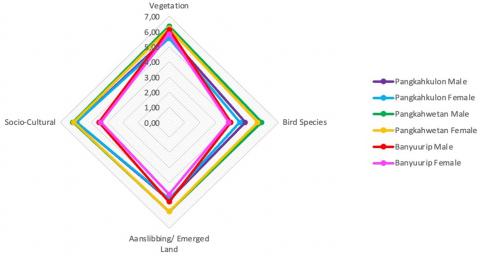
Aspects of Knowledge about MEEA. In general, the data (Figure 5) shows that there is no polarization among actors regarding aspects of MEEA knowledge. The high level of knowledge among the people of Pangkahwetan Village is evidenced by the existence of village regulations to protect Ujungpangkah MEEA, including a ban on the exploitation of various bird species. However, when viewed in more detail, the data show that there is polarization in attitude scores or differentiation in community knowledge about the Ujungpangkah MEEA, where the male and female groups from Pangkahwetan gave a score of 6 (meaning high), while the groups from Pangkahkulon and Banyuurip gave a score of 5. This is also confirmed by the Kruskal-Wallis test, where the H value = 9.818 and the p-value is 0.007 < α = 5%, meaning that there is a significant difference between those actors.
|
Information:
|
Figure 5. Aspects of knowledge about the MEEA
Although there are differences in knowledge, it can be said that this distribution shows that ecological awareness has grown throughout the village, even though a deep understanding of the function of mangroves is still uneven. However, several village officials and managers of Ujungpangkah MEEA recognize the role of mangroves as erosion barriers, carbon sinks, and habitats for coastal wildlife. This knowledge is rooted in the experience of living alongside the ecosystem and the fact that the majority of the community are fishermen. This phenomenon indicates the existence of organic ecological literacy, which is an important basis for community-based management. Studies [32, 33] explain that from the perspective of Other Effective Area-Based Conservation Measures (OECM), known as EEA in Indonesia, such local knowledge functions as social capital that strengthens the legitimacy of collaborative governance. Furthermore, Lovelock et al. [34] emphasized that ecological awareness that grows from these daily practices is an important indicator of the close relationship between local wisdom, social learning, and conservation sustainability.
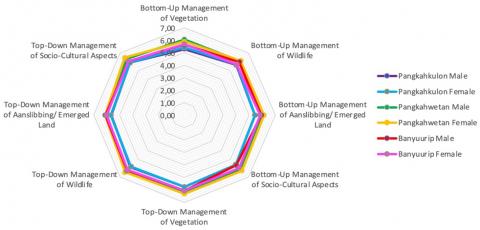
Bottom-Up Management Approach. In general, the analysis results (Figure 6) show that there is no polarization of direction among actors regarding the bottom-up management approach; however, there is polarization of attitude scores, where only the male group in Pangkahkulon gave a score of 5 (somewhat high), while the other five actors gave a score of 6 (highly significant). This data is reinforced by the Kruskal-Wallis test, where the H value = 9.200 and the p-value is 0.010 < α = 5%, meaning that there is a significant difference between actors.
|
Information:
|
Figure 6. Bottom-up and top-down management approach
Although each village has different policies in managing mangrove resources, wildlife, and reclaimed land, in principle, the communities of the three villages agree that the Ujungpangkah mangrove ecosystem and all its ecological elements must be protected and preserved to support human life and other creatures. This data also reflects the high level of community participation in mutual assistance activities, deliberative forums, and monitoring of wildlife and tidal flats.
Such social mechanisms show that governance is not only interpreted as administrative policy, but as a reflection of values in society and a sense of responsibility to preserve sustainability. These findings confirm that the success of community-based management does not depend on regulatory formalities, but on the sustainability of social relations and a sense of ownership of resources. Thus, Ujungpangkah demonstrates a form of adaptive governance in which the community is the main actor in conservation, not merely the recipient of policy. This is in line with what is explained by studies [35, 36] that co-management models rooted in social and cultural norms have been proven to strengthen compliance with and the effectiveness of conservation policies.
Top-Down Management Approach. The analysis results (Figure 6) show that there is no polarization of direction and polarization of attitude scores between the three village groups; both male and female groups gave a score of 6 or higher. This is also confirmed by the Kruskal-Wallis test, which concluded that there were no significant differences between actors (H value = 0.000 and p-value 1.000 > α = 5%). This indicates that there is a fairly good understanding among all elements of society regarding various local rules and policies in the management of the Ujungpangkah mangrove ecosystem. The implementation of regulations such as the Village Regulation (PERDES) prohibiting bird hunting and the establishment of mangrove utilization zoning have proven to reduce hunting activities and strengthen conservation discipline among the people of Ujungpangkah. This pattern reflects a shift from a control model to facilitative governance that enables collaboration between the government and residents in protecting coastal resources. These findings are in line with the views of studies [37, 38] that the effectiveness of conservation policies is largely determined by cross-level synergy and coordination between actors in area governance. Stable regulatory performance in Ujungpangkah confirms that top-down policies accompanied by social legitimacy can strengthen the socio-ecological resilience of coastal communities.
Positive Perceptions of Mangrove Ecotourism. In various indicators, the analysis results (Figure 7) show that men and women from the villages of Pangkahwetan and Banyuurip gave scores of 6.3 to 6.2, while men and women from Pangkahkulon gave scores of 5.5. The Kruskal-Wallis test shows that there is a significant difference (H value = 13.667 and p-value 0.001 < α = 5%). However, in the context of polarization, the data shows that the positive perception of the entire community towards mangrove ecotourism is in the high category, or a score of 6. This indicates the high enthusiasm of the communities in the three villages for the idea of developing mangrove ecotourism in the Ujungpangkah MEEA, as the villages of Banyuurip and Pangkahkulon have already developed mangrove trail facilities, observation towers, and educational tours on mangrove nurseries and creative economic products.
Negative Perceptions of Mangrove Ecotourism. In many ways, the data (Figure 7) shows that there is polarization in the community's attitude scores regarding negative perceptions of mangrove ecotourism, where the Banyuurip male group gave a score of 6, meaning they agreed, while the Pangkahkulon group gave a score of 4, and the Pangkahwetan group and the Banyuurip female group gave a score of 5. This differentiation in scores is also confirmed by the Kruskal-Wallis test, where the H value = 35.533 and p-value 0.000 < α = 5%, meaning that there is a significant difference between actors. This indicates a more objective understanding among the Banyuurip men's group that ecotourism activities can have negative impacts if not managed properly and correctly.
In addition, this critical attitude is also strongly suspected to be due to the existence of an economic integration area for fishermen, ecotourism, and mangrove conservation in Banyuurip Village, which is in a state of "suspended animation" and tends to be neglected. Rachmatullah et al. [37] stated that the polarization of negative perceptions of ecotourism occurs due to differences in experience, education, orientation, and motivation of individuals or groups in interpreting various ecotourism activities and patterns that they know and experience. Additionally, community vigilance and critical responses are forms of ecological vigilance, which is critical awareness of the risks of exploiting resources [39]. In ensuring the sustainability of ecotourism, Simkins et al. [40] reminded that without a visitor capacity control system, mangrove destinations are prone to ecological pressure. In this regard, negative public perceptions are not a form of rejection of tourism, but rather a reflection of awareness to maintain a balance between economic benefits and environmental sustainability; this issue presents the ecological maturity of the community, which has been formed through direct experience in managing the area.
Perceptions of Birds. The results of data analysis (Figure 8) show polarization of attitude scores among actors, with all actors giving a score of 6 (meaning agree), while the Pangkahkulon women group gave a score of 5, meaning somewhat agree, regarding their perceptions of birds. This is also evident in the Kruskal-Wallis test, where the H value = 15.737 and the p-value is 0.000 < α = 5%, meaning that there is a significant difference between actors. This one-point difference indicates a variation in the intensity of support, but not a divergence in attitude (no divergent attitudinal polarity)- where all groups remain inclined to support bird protection.
Similar findings were reported by Quevedo et al. [41] in a study of mangrove community perceptions in Eastern Samar, Philippines, where the majority of respondents recognized the ecological and cultural value of mangroves despite variations in demographics and levels of local involvement. This confirms that all elements of society in the three villages recognize the importance of birds in maintaining the balance of the mangrove ecosystem. This is evidenced by various appeals and village regulations to preserve the sustainability of the mangrove ecosystem and birds. The study by Qurniati et al. [42] found that the community's perception of mangroves is very positive, including aspects of biodiversity such as birds, despite varying levels of concern and participation between villages.
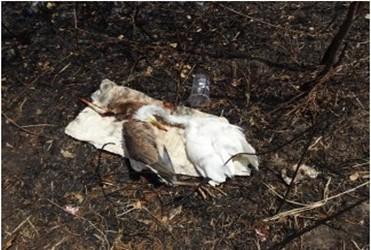
Perceptions of Bird Hunting. Data analysis (Figure 8) shows that there is polarization in attitude scores on the issue of bird hunting in EEA Ujungpangkah; the Pangkahwetan and Banyuurip villages gave higher scores (score 6) than Pangkahkulon village, which gave a score of 5. The Kruskal-Wallis test also proves that there are significant differences between actors (H value = 13.164 and p-value 0.001 < α = 5%). Although there were differences in attitude scores, overall, it can be said that there was no polarization of opinion among actors on the issue of bird hunting, with the community firmly rejecting the practice of bird hunting in the three villages. However, field observations found two young individuals from outside the village who were still hunting by shooting (Figure 9), indicating weak social control at the grassroots level. This phenomenon indicates that informal regulations by the local community are strong enough to control the behavior of their own citizens, but are not yet able to reach external actors. These findings are in line with the research [43, 44], which shows that the hunting and trade of wild birds in Indonesia is generally carried out by non-local actors who take advantage of weak community supervision and the high economic value of wildlife. In addition, the success of coastal communities in controlling hunting is highly dependent on the strength of local norms and village institutional support [45].
Therefore, a collaborative mechanism between the community, village government, and law enforcement agencies is needed to strengthen supervision and enforcement of regulations in the field, as well as to raise awareness across villages about the importance of maintaining bird populations as an indicator of mangrove ecosystem health. Empirically, study [46] in China and study [47] in Brazil on hunting dynamics and community attitudes have shown that social norms and cultural practices influence whether hunting occurs or is suppressed, and that community-based interventions (in the form of local regulations, exclusion zones, and community monitoring) consistently reduce hunting activity and increase bird abundance in community-protected sites.
Perceptions of Facility and Infrastructure Conditions. The results of data analysis (Figure 10) prove that there is polarization of attitude scores among actors, where the communities of Pangkahkulon and Banyuurip give fairly good ratings (score 5), while the community of Pangkahwetan gives higher scores (score 6) for the condition of facilities and infrastructure in the Ujungpangkah MEEA. The difference in attitude scores is also in line with the Kruskal-Wallis test, with a value of H = 20.582 and a p-value of 0.000 < α = 5%, meaning that there is a significant difference between actors. Although there is a differentiated attitude score, the data show that there is no polarization between actors. This indicates that the condition of facilities and infrastructure in the three villages is generally good to very good. There are several notes from the communities of Pangkahkulon and Banyuurip regarding routine maintenance of mangrove trails, observation towers, and the provision of trash bins in tourist areas, accompanied by active participation from all elements of society.
Studies of community perceptions in various mangrove areas have found similar patterns: demographic or location variations often result in differences in intensity scores, but the majority of communities still show a basic consensus on the importance of facilities that support conservation and local welfare [41, 48]. Research by Afifah et al. [49] explains that most communities have a positive perception of the development of mangrove tourism facilities (tourist trails, guides, souvenirs, parking), and support community involvement in maintaining these facilities so that they continue to function properly.
|
Information:
|
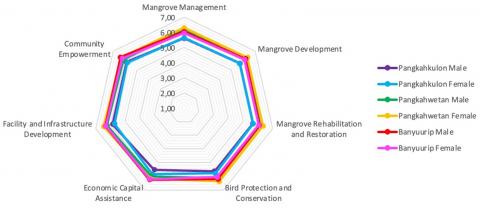
Figure 11. Preferences for the development of the Ujungpangkah MEEA
MEEA Development Preferences. Data analysis (Figure 11) shows that all three villages gave high average scores (score 6) for mangrove ecotourism development preferences. This is also confirmed by the Kruskal-Wallis descriptive statistics, where there are no significant differences between actors (H = 0.000 and p-value 1.000 > α = 5%). For the community, in addition to the development of road infrastructure, tourism facilities, and marketing aspects, the dimension of pro-conservation ecotourism human resource development is also very important to support long- term ecotourism development. In addition, the community tends to propose a development model that emphasizes conservation, education, and transparent governance through collaboration with various external collaborators such as universities, the private sector, and NGOs. This is also in line with studies [11, 37], where ecologically sustainable ecotourism must integrate concern for the environment, society, and economy, and be based on community-based principles so that the community obtains tangible benefits. This view is in line with study [32], which emphasizes that community-based management strengthens the social legitimacy and ecological sustainability of conservation areas.
Personal Motivation for MEEA. Data analysis (Figure 12) shows that all actors have high personal motivation (score of 6) for the existence of the Ujungpangkah MEEA. Furthermore, statistical tests also show that there are no significant differences between actors (H value = 4.100 and p-value 0.129 > α = 5%). This reflects the strong desire and motivation of the community to learn, acquire skills, and contribute to nature conservation (MEEA). This phenomenon indicates the existence of self-driven ecological commitment or intrinsic motivation that arises from a sense of responsibility towards the environment and pride in coastal identity. Blanton et al. [50] explain that pride in environmental contributions is a strong predictor of the sustainability of conservation behavior. In line with study [51], argue that communities with intrinsic motivation tend to have higher socio-ecological resilience to economic pressures. The high score indicates that conservation in Ujungpangkah is not merely instructional. Rather, it has evolved into an integral part of the community's ethical way of life.
Communal Motivation for MEEA. The results of data analysis (Figure 12) show no polarization of attitude scores among actors regarding communal motivation in the utilization of EEA. This data is also reinforced by the Kruskal-Wallis test, which concluded that there were no differences between village community groups (H value = 1.025 and p-value 0.599 > α = 5%). These high scores indicate a strong collective spirit in interpreting EEAs not merely as ecological areas, but also as symbols of togetherness and village social identity. The community places mangroves and birds as elements of living culture that strengthen social solidarity and a sense of belonging to a shared living space. This phenomenon is consistent with the results of research [52], which shows that the success of community-based ecotourism is determined by the community's ability to maintain a balance between ecological, social, and spiritual dimensions. Estradivari et al. [32] also emphasize that strong solidarity and social capital are the foundation for the success of conservation areas outside the formal state protection system. Therefore, the communal motivation of the Ujungpangkah community is not only a social force but also an ecological instrument that ensures the sustainability of the area through collective pride and a shared ecological identity.
The results of the study on the condition of the Ujungpangkah MEEA show that the management of this area faces multidimensional challenges, both from ecological, social, and institutional aspects. Ecologically, vegetation cover data shows an increase in canopy quality in the 2015-2020 period, but this increase is still far from the ideal condition of a resilient mangrove ecosystem. The findings of studies [4] show that, in addition to anthropogenic pressures such as pond conversion, biological threats in the form of leaf caterpillar infestations are also significant. This phenomenon supports the multiple stressors theory [53], which emphasizes that coastal ecosystems are often stressed by a combination of anthropogenic and natural factors, which synergistically accelerate ecosystem degradation.
From a social perspective, the dependence of coastal communities on ponds and catches illustrates the classic dilemma of the tragedy of the commons [54], where the use of shared resources often leads to overexploitation. Study [26] shows that a community-based management approach is effective in reducing mangrove conversion and increasing community participation in conservation. However, preliminary surveys in Ujungpangkah reveal a range of perceptions: some communities view mangroves as obstacles to fish ponds and economic activities, while others recognize their benefits for coastal protection and the fishing cycle. This variation in perceptions should be seen as an opportunity to build collective preferences, promoting adaptive participatory management models.
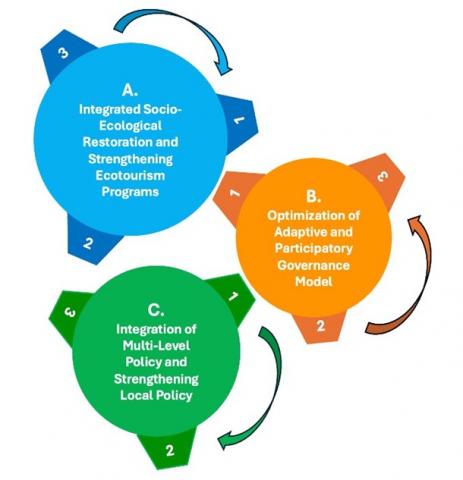
From an institutional perspective, Ujungpangkah MEEA management remains weak due to overlapping regulations, less inter-agency coordination, and limited funding. This situation is consistent with the findings of study [6] in the Philippines and Thailand, which indicate that the failure of mangrove conservation in Southeast Asia is largely influenced by governance fragmentation. For this reason, the concept of collaborative governance [55] is highly relevant, whereby local government, communities, academics, and the private sector sit together in a management forum. In addition, funding diversification, for example, through payment for ecosystem services (PES) schemes or blue carbon credit programs, can be an alternative in strengthening institutional sustainability. At least, there are several aspects (Figure 13) that need to be optimized in strengthening the management of the Ujungpangkah MEEA.
|
Information:
|
4.1 Integrated socio-ecological restoration and strengthening ecotourism programs
Integrated Socio-Ecological Restoration. The integrated socio-ecological restoration program aims to restore the balance between the ecological functions of mangroves and the socio-economic systems of the coastal communities of Ujungpangkah in an integrated manner. This approach focuses not only on the physical rehabilitation of ecosystems but also on restoring the relationship between humans and nature through strengthening social capacity, local institutions, and green economic diversification. Socio-ecological restoration emphasizes the importance of synergy between natural hydrological recovery, planting native mangrove species according to ecological zoning, and applying nature-based solutions to strengthen the area's resilience to abrasion and climate change. Thus, restoration at Ujungpangkah MEEA is not only oriented towards short-term ecological success, but also towards the social and economic sustainability of coastal communities.
Theoretically, this approach is based on Socio-Ecological Systems Theory [56], which views humans and ecosystems as an adaptive unit that influences each other. Therefore, the success of restoration greatly depends on the active participation of local communities in every stage of planning and implementation. The study [16] in Central Java showed that restoration projects involving community empowerment and social aspects tend to achieve higher success compared to approaches focusing solely on technical aspects. Similarly, Richards and Friess [15] emphasize that the sustainability of mangroves in Southeast Asia is largely determined by the extent to which coastal communities are directly involved in post-restoration management. In the context of Ujungpangkah, socio-ecological restoration is an important foundation for harmoniously restructuring the ecological relationship between fishponds, mangrove vegetation, and community economic activities.
Empirically, the implementation of this model has proven effective in various Southeast Asian countries. Study [6] reported that community-based restoration in the Philippines increased mangrove cover by 40% and raised fishermen's income by 25% in five years. Furthermore, Rahman et al. [57] stated that mangrove restoration efforts in Southeast Asia, which integrate ecological and social dimensions, have resulted in significant increases in mangrove coverage and carbon sequestration. Within the framework of Ujungpangkah MEEA, a similar model can be adapted through community-based monitoring, blue economy training, and ecosystem service-based incentive mechanisms such as payment for ecosystem services. With the support of collaborative cross-sector governance [55], this program has the potential to become a pilot model for mangrove restoration that not only restores coastal ecological functions but also builds resilient, adaptive, and economically independent communities.
Strengthening the Mangrove Ecotourism and Silvofishery Program. Strengthening the ecosystem-based economy emphasizes the diversification of coastal communities' livelihoods through the sustainable use of mangrove ecosystem services. Mangrove ecotourism, silvofishery, and the development of derivative products such as mangrove batik and mangrove honey not only increase community income but also strengthen socio-cultural ties to the ecosystem. The Ujungpangkah MEEA not only functions as a natural barrier against abrasion and seawater intrusion but also provides economically valuable environmental services through nature-based tourism activities. Strengthening mangrove ecotourism programs is crucial for implementation in the Ujungpangkah MEEA, given that the current condition of ecotourism is still far from optimal. Field observations show that the two main tourist sites, Banyuurip Mangrove Center in Banyuurip Village and the Mangrove Trail in Pangkah Wetan Village, have not yet functioned effectively as ecotourism destinations. Tourism facilities such as boardwalks, educational areas, information centers, gazebos, and mangrove viewing points are poorly maintained; several are even damaged or no longer usable (Figure 14).
From an institutional perspective, the ecotourism management groups lack a solid organizational structure, have no established standard operating procedures, and exhibit limited coordination between community groups and village authorities. Tourism activity remains very low, as reflected by the minimal number of visitors on both weekdays and weekends, coupled with the absence of attractive or scheduled tour packages. In addition, trained tour guides are unavailable, digital promotion is inadequate, and there is no integration with productive economic activities such as local culinary businesses, mangrove-based crafts, or cultural attractions. These conditions indicate that the mangrove ecotourism potential in Ujungpangkah has not yet been optimally utilized as a source of community income.
Therefore, strengthening local institutions, improving facilities, enhancing guide capacity, and developing tourism attractions and packages are key elements for positioning mangrove ecotourism as a pillar of the sustainable local economy and as an important medium for conservation education. The development of mangrove ecotourism can increase conservation awareness, open up new job opportunities, and create alternative sources of income for local communities. According to study [58], the mangrove ecosystem in Ujungpangkah, Gresik Regency, has significant potential for ecotourism development, provided that management strategies integrate ecological conservation with community participation to ensure environmental sustainability and local economic benefits.

Integrating the strengthening of ecotourism and silvofishery programs in the Ujungpangkah MEEA is essential because both sectors hold significant economic potential but remain underutilized. Community-based silvofishery has demonstrated relatively stable productivity, yet it is not connected to educational tourism activities or destination-based marketing; as a result, the distribution of socio-economic benefits remains limited and lacks substantial added value. By integrating mangrove tourism, sustainable aquaculture practices, and the development of local products, ecotourism and silvofishery can mutually reinforce one another, generating more equitable economic benefits while enhancing community awareness of conservation. The following presents the site design concept in the development of mangrove ecotourism (Figure 15).
An integrated mangrove ecotourism and silvo-fishery program can serve as a model for adaptive management that balances conservation and sustainable use. Silvo-fishery allows communities to continue economic activities such as fish, shrimp, and crab farming while maintaining a minimum of 50% mangrove cover [59]. Studies in Vietnam and the Philippines show that the application of silvo-fishery can increase pond productivity by 25-40% compared to conventional ponds, while maintaining mangrove cover [60]. Thus, ecosystem-based diversification strategies can minimize community dependence on extractive activities and, at the same time, increase the economic resilience of coastal households.
Strengthening the Blue Carbon Credit Program. In addition to diversification, the integration of blue carbon credit programs is a conservation funding innovation that is increasingly relevant in the context of the global carbon market. Mangroves are known as ecosystems with the highest carbon storage capacity, up to 1,023 MgC per hectare [61], thus having significant potential to be included in international carbon trading schemes. Global studies show that blue carbon projects have successfully attracted private investment and funded mangrove rehabilitation activities while providing economic incentives for local communities [9, 62].
In Indonesia, national regulatory frameworks such as Presidential Regulation No. 98/2021 [63], Ministry of Environment and Forestry Regulation No. 21/2022 [23], OJK Regulation No. 14/2023 [64], and Presidential Regulation No. 110/2025 [65] - offer a strong and operational legal foundation for implementing carbon economic value mechanisms, including carbon trading and the voluntary carbon market. This context positions community-owned ecological landscapes such as the Ujungpangkah Mangrove MEEA as ideal candidates for developing community-based blue carbon initiatives. Community engagement in supporting blue carbon efforts is reflected in the preference data on Mangrove Rehabilitation and Restoration (Figure 11), which aligns with key verification principles required by international standards such as Verra’s VCS and Plan Vivo, including additionality, permanence, leakage control, and community safeguards.
If implemented in Ujungpangkah, a blue carbon credit program has the potential to become a long-term and sustainable financing mechanism that complements public funding (APBD/APBN), private-sector CSR initiatives, and multi-stakeholder collaboration. Such an approach not only strengthens coastal ecosystem resilience and enhances community adaptive capacity but also opens opportunities to establish an inclusive, equitable, and community-based green economy governance model. Thus, blue carbon credit initiatives are not merely an additional conservation strategy; they constitute a critical component in reinforcing the integrated socio-ecological governance model of the Ujungpangkah MEEA at local, regional, and global scales.
4.2 Optimizing adaptive and participatory governance models
Establishment of a Multi-Stakeholder Forum. The implementation of adaptive-participatory governance in Ujungpangkah can be realized through the establishment of a multi-stakeholder forum involving the government, community, academics, NGOs, and the private sector as a space for deliberation and joint decision-making. Such forums have been proven to increase the effectiveness of conservation policies in various countries, for example, through the collaborative governance model in New Zealand's coastal wetlands [66] and on the coast of Tanzania [67], which showed increased community compliance and successful restoration. In Indonesia, a similar initiative in the mangrove ecosystem in Demak, Central Java, has succeeded in reducing the rate of abrasion while increasing community income through locally based silvo-fisheries [68]. By adopting similar mechanisms, the Ujungpangkah MEEA has the potential to become a national model for adaptive management-based essential ecosystem management, integrating ecological, social, economic, and institutional dimensions into a single sustainability framework.
Strengthening Social Capital and Local Leadership. Strengthening social capacity and local leadership is a crucial foundation for adaptive governance in coastal areas, particularly within mangrove ecosystems that exhibit complex socio-ecological dynamics. Empirical evidence shows that the success of community-based conservation programs is highly influenced by the presence of local champions and strong social capital at the community level [69]. Leadership and negotiation training for community figures and coastal youth has proven effective in enhancing their capacity as bridge leaders who can mediate interests between government, private sectors, and local communities [70]. In the context of mangrove governance, the enhancement of social capacity not only increases the legitimacy of participatory policies but also strengthens institutional sustainability through mechanisms of collective learning and adaptive co-management [66]. Studies across Southeast Asia indicate that communities with higher social leadership capacity are better able to maintain mangrove ecosystem integrity and develop sustainable blue economy models based on ecotourism and silvofishery [71, 72]. Therefore, investing in social capacity building and local leadership development is a vital long-term strategy for fostering resilient and equitable mangrove governance.
Adaptive Co-Management Integration. Adaptive and participatory governance models stem from the awareness that mangrove ecosystems are dynamic socio-ecological systems, where ecological changes (abrasion, accretion, vegetation degradation) always interact with social dynamics (land use, livelihoods, and community preferences). The theory of adaptive co-management [70] offers a framework for responding to this uncertainty by combining the flexibility of adaptive management and the inclusiveness of collaborative management. Efani et al. [73] emphasized that sustainable mangrove ecotourism requires a community-based collaborative model integrating environmental, social, economic, and institutional aspects to enhance ecological sustainability and social well-being. In the context of the Ujungpangkah MEEA, this approach is relevant because the area faces dual pressures from both pond conversion and natural factors such as pest attacks. Studies in the Philippines and Thailand show that multi-stakeholder collaboration can reduce the rate of mangrove conversion by 20-30% in a decade through the synergy of formal regulations, local agreements, and ecosystem-based economic innovations [6]. This proves that adaptive governance is not only a theoretical framework but has been empirically proven to strengthen ecosystem resilience and community welfare.
4.3 Integrating multi-level policies and strengthening local policies
Multi-Level Policy Integration. The findings in the field indicate that the dynamics and differences in community perceptions regarding rehabilitation, governance, and development priorities of the EEA Ujungpangkah do not emerge randomly, but are shaped by local power relations, varying levels of economic dependence on mangrove resources, and unequal access to information and decision-making processes. Community groups with greater involvement in aquaculture and fishing activities tend to prioritize resource-use aspects, whereas groups oriented toward conservation show stronger preferences for regulatory measures and ecological restoration. These differences suggest that the governance of the EEA Ujungpangkah is influenced not only by internal social dynamics but also by policy misalignment across sectors and administrative levels, which affects the distribution of authority, regulatory certainty, and the overall direction of area management.
Essential mangrove area management requires cross-sector and cross-level government policy integration to prevent fragmentation of governance. Synchronization between regional policies such as RTRW (Regional Spatial Plan) and local environmental regulations, with national policies related to EEA and global climate change commitments, is a key requirement for consistent and equitable development. According to the theory of policy coherence [74], policy overlap is a common cause of environmental management failure, as it results in conflicting policies and weakens the effectiveness of implementation in the field. This condition is evident in various regions of Indonesia, including the coast of Java, where conflicts between aquaculture permits and mangrove conservation areas often cause significant ecosystem degradation.
To overcome this policy fragmentation, the implementation of a policy mix as described by Howlett and Rayner [75] could be considered an effective solution. The policy mix approach allows for synergy between regulatory instruments, economic incentives, and institutional strengthening so that conservation policies can reinforce each other. Studies in Mexico show that the application of a policy mix in coastal governance can increase conservation effectiveness by up to 50% compared to a single sectoral approach [76]. By applying this principle, the management of the Ujungpangkah MEEA can be directed towards a consistent, fair, and adaptive governance framework that not only focuses on ecosystem protection but also integrates local economic development and improves the welfare of coastal communities.
Strengthening Local Policy and Community Agreements. At the site level, strengthening social legitimacy is key to the success of conservation policies through the formulation of community agreements. Community agreements play a role in creating a sense of ownership and shared responsibility for natural resources, while reducing the potential for conflict and local resistance to government policies. An example of good practice can be found in mangrove management in Vietnam, where local agreements have successfully reduced illegal logging by 40% in five years [77]. In the context of Ujungpangkah, the community agreement mechanism can strengthen collaborative governance by bridging the interests of the community, government, academics, and the private sector within a fair and sustainable framework.
In order to strengthen the effectiveness of community-based policies, their implementation requires an integrative methodological approach that combines quantitative and qualitative methods. The use of community perception surveys through Likert scores can measure the level of acceptance of ecotourism and conservation programs, while focus group discussions (FGDs) and in-depth interviews [78] can explore the socio-cultural meanings underlying community attitudes and behaviors. A study in the Philippines shows that the integration of these two approaches successfully increased community participation by up to 60% in coastal rehabilitation programs [79]. Thus, strengthening evidence-based community agreements and integrated multi-level policies are important foundations for adaptive, participatory, and sustainable essential ecosystem management in Ujungpangkah.
Developing a Mangrove Governance Dashboard. Developing a Mangrove Governance Dashboard based on spatial and social data represents a strategic step toward strengthening evidence-based decision-making in coastal ecosystem management. This platform functions as an integrated information system that connects biophysical, social, and institutional data from local governments, research institutions, and local communities, enabling policy synchronization across sectors and levels of governance. Mukherjee et al. [80] emphasize that effective decision-making in mangrove management strongly depends on the availability of reliable spatio-temporal information and the integration of ecological and socio-economic knowledge, so that the value of mangrove ecosystem services can be comprehensively understood and sustainably incorporated into planning and policy processes. The implementation of similar governance dashboards in the Philippines and Vietnam has proven to enhance monitoring efficiency, accelerate responses to degradation, and foster multi-actor collaboration in ecosystem-based management [6, 77]. Furthermore, integrating spatial and socio-economic data enhances policy transparency and accountability by reinforcing governance legitimacy and inclusiveness within sustainable blue economy frameworks [81]. Therefore, the establishment of a Mangrove Governance Dashboard in Ujungpangkah is not merely a technocratic instrument, but also a collaborative platform that strengthens legitimacy, inclusiveness, and the sustainability of mangrove governance at both local and regional levels.
The dynamics of land cover change in the Ujungpangkah MEEA during 2015–2025 show a complex transition between ecosystem degradation and recovery, where an increase in vegetation area indicates the initial success of restoration efforts and natural accretion. However, fluctuations in the area of ponds and built-up areas reflect the continuing high level of anthropogenic pressure, requiring the integration of spatial planning and ecosystem-based management policies to ensure the long-term sustainability of the area. Furthermore, in terms of social data, overall data on perceptions, preferences, and motivations show that there is no polarization among community groups regarding the management of the Ujungpangkah MEEA. Then, in the context of polarization of attitude scores, the data show that there is polarization of attitude scores between community groups (both men and women) in the three villages. The differentiation in perceptions is strongly suspected to originate from the motives and experiences of each actor, accompanied by differences in local policies on mangrove management based on the autonomy of each village. However, the community agrees that the existence of the Ujungpangkah MEEA is very important and crucial for the survival of the local community in the three villages. All elements of the community believe that, in addition to the Ujungpangkah being a protector of all living things, the Ujungpangkah MEEA has also made an important contribution in supporting the socio-economic and cultural dynamics of the community for decades. Furthermore, with the various dynamics that exist, it is necessary to introduce several ideas to strengthen the management of the EEA Ujungpangkah, including: A) Integrated Socio-Ecological Restoration and Strengthening Ecotourism Programs; B) Optimizing Adaptive and Participatory Governance Models through Adaptive Co-Management, Establishing Multi-Stakeholder Forums, and Strengthening Local Social and Leadership Capacity; C) Integrating Multi-Level Policies and Strengthening Local Policies.
This research was conducted independently without external funding or sponsorship. The author expresses sincere appreciation to all individuals and institutions who provided valuable insights, data access, and constructive discussions throughout the study. Special thanks are extended to local communities and field collaborators for their cooperation and contribution during data collection and verification.
[1] BPK Regulation Database. (2015). Government Regulation (PP) Number 108 of 2015 concerning the Amendment to Government Regulation Number 28 of 2011 on the Management of Nature Reserve Areas and Nature Conservation Areas. Jakarta: Indonesia. https://peraturan.bpk.go.id/Details/5687/pp-no-108-tahun-2015.
[2] Ministry of Environment and Forestry of the Republic of Indonesia. (2021). Regulation of the Director General of Natural Resources and Ecosystem Conservation Number: P.1/KSDAE/BPE2/KSA.4/2/2021 on Technical Guidelines for Assessing the Effectiveness of Management of Essential Ecosystem Areas. Jakarta: Ministry of Environment and Forestry. https://id.scribd.com/document/518073987/Perdirjen-P-1-KSDAE-BPE2-KSA-4-2-2021.
[3] Government of East Java Province. (2022). Decree of the Governor of East Java Number 188/122/KPTS/013/2021 on the Management of the Essential Mangrove Ecosystem Area of Ujungpangkah, Gresik Regency, East Java Province. Legal Documentation and Information Network of East Java Province. Surabaya: Indonesia. https://files.jdih.jatimprov.go.id/jdih-prod/uploads/topics/2021KEPGUBJATIM122.pdf.
[4] Kretarta, A., Santosa, L.W., Susilo, B. (2020). Assessment of environmental degradation in mangrove ecosystems in the coastal area of Ujung Pangkah, Gresik Regency (A study in Pangkah Kulon and Pangkah Wetan Villages, Ujung Pangkah District, Gresik Regency, East Java Province). Master’s thesis. Universitas Gadjah Mada. https://etd.repository.ugm.ac.id/penelitian/detail/194111.
[5] Spalding, M.D., Ruffo, S., Lacambra, C., Meliane, I., Hale, L.Z., Shepard, C.C., Beck, M.W. (2014). The role of ecosystems in coastal protection: Adapting to climate change and coastal hazards. Ocean & Coastal Management, 90: 50-57. https://doi.org/10.1016/j.ocecoaman.2013.09.007
[6] Primavera, J.H., Friess, D.A., Van Lavieren, H., Lee, S.Y. (2019). The mangrove ecosystem. In World Seas: An Environmental Evaluation, pp. 1-34. https://doi.org/10.1016/B978-0-12-805052-1.00001-2
[7] Bulan, R., Basuni, S., Santoso, N., Bismark, M. (2019). Illegal access to mangroves for mangrove charcoal by communities in Batu Ampar, West Kalimantan. Jurnal Hutan dan Masyarakat, 11(1): 20-32. https://doi.org/10.24259/jhm.v11i1.5993
[8] Chambers, R. Conway, G.R (1992). Sustainable rural livelihoods: Practical concepts for the 21st century. IDS Discussion Paper 296, Brighton: IDS. https://www.ids.ac.uk/publications/sustainable-rural-livelihoods-practical-concepts-for-the-21st-century/.
[9] Alongi, D.M. (2018). Blue Carbon Coastal Sequestration for Climate Change Mitigation. Springer Cham. https://doi.org/10.1007/978-3-319-91698-9
[10] Prasetyo, A., Santoso, N., Prasetyo, L.B. (2017). Environmental sensitivity of mangrove ecosystems to oil spills in Ujung Pangkah District, Gresik. Journal of Forest and Nature Conservation Research, 14(2): 91-98. https://ejournal.aptklhi.org/index.php/JPHKA/article/view/685.
[11] Avenzora, R., Rachmatullah, A., Munajat, M., Winarno, G.D., Oktovianus, Suprajanti, D.S., Putra, N.D., Putra, L.A., Kholil, R., Al-Ghifari, M. (2024). Dynamic patterns of primate responses to human actions on ecotourism activities in Gunung Gede Pangrango National Park, Indonesia. International Journal of Design & Nature and Ecodynamics, 19(4): 1425-1437. https://doi.org/10.18280/ijdne.190435
[12] Sekaran, U., Bougie, R. (2016). Research Methods for Business: A Skill-Building Approach, 6th Edition. Wiley, New York.
[13] Henseler, J., Ringle, C.M., Sarstedt, M. (2015). A new criterion for assessing discriminant validity in variance-based structural equation modeling. Journal of the Academy of Marketing Science, 43: 115-135. https://doi.org/10.1007/s11747-014-0403-8
[14] Muhibbin, M. (2015). The authority and ownership of muddy land (Aanslibbing) at North Coastal Area of Java Sea. International Journal of Social and Local Economic Governance, 1(1): 42-51. https://ijleg.ub.ac.id/index.php/ijleg/article/view/9/38.
[15] Richards, D.R., Friess, D.A. (2015). Rates and drivers of mangrove deforestation in Southeast Asia, 2000–2012. Proceedings of the National Academy of Sciences, 113(2): 344-349. https://doi.org/10.1073/pnas.1510272113
[16] Damastuti, E., van Wesenbeeck, B.K., Leemans, R., de Groot, R.S., Silvius, M.J. (2023). Effectiveness of community-based mangrove management for coastal protection: A case study from Central Java, Indonesia. Ocean & Coastal Management, 238: 106498. https://doi.org/10.1016/j.ocecoaman.2023.106498
[17] Wirabuana, P.Y.A.P., Baskorowati, L., Pamungkas, B., Mulyana, B., South, J., Purnobasuki, H., Andriyono, S., Hasan, V. (2025). Mangroves, fauna compositions and carbon sequestration after ten years restoration on Flores Island, Indonesia. Scientific Reports, 15: 4866. https://doi.org/10.1038/s41598-025-87307-x
[18] Zhou, Y.D., Wang, H., Yan, Y.R. (2023). Sediment transport trend and its influencing factors in coastal bedrock island sea areas-A case study of Chudao Island, China. Frontiers in Marine Science, 10, 1220331. https://doi.org/10.3389/fmars.2023.1220331
[19] Budiman, M.A.K., Fahrudin, A., Santoso, N. (2019). Management strategy for the Ujung Pangkah Area, Gresik Regency, East Java based on ecological, economic, and social aspects. Master’s thesis. Department of Pasca Sarjana, Institut Pertanian Bogor, Bogor, Indonesia. https://repository.ipb.ac.id/handle/123456789/100074.
[20] Zakiyah, D.M. (2014). Aquaculture development: The effectiveness of the Minapolitan program in sustainable aquaculture management in Gresik Regency. Jurnal Pembangunan Wilayah dan Kota, 10(4): 453-465. https://doi.org/10.14710/pwk.v10i4.8171
[21] Setyawan, W.B. (2012). Observations on Mangroves Planted on the North Coast of West Java Island. Ilmu Kelautan: Indonesian Journal of Marine Sciences, 15(2): 91-102. https://doi.org/10.14710/ik.ijms.15.2.91-102
[22] Government of the Republic of Indonesia. (1999). Government Regulation (PP) Number 7 of 1999 concerning the Preservation of Plant and Animal Species. https://peraturan.bpk.go.id/Details/54143/pp-no-7-tahun-1999.
[23] Ministry of Environment and Forestry of the Republic of Indonesia. (2022). Regulation of the Ministry of Environment and Forestry Number 21 of 2022 concerning Procedures for the Implementation of Carbon Economic Values. https://peraturan.bpk.go.id/Details/235421/permen-lhk-no-21-tahun-2022.
[24] Sutopo. (2017). Patterns of space and time use of waterbird groups in the mangrove ecosystem of Muara Bengawan Solo - Gresik Regency. Master's thesis. IPB University. https://repository.ipb.ac.id/handle/123456789/91103.
[25] Hoyo, J.D., Collar, N.J., Christie, D.A., Elliott, A., Fishpool, L.D., Allen, R. (2014). HBW and BirdLife International Illustrated Checklist of the Birds of the World. Lynx, Barcelona.
[26] Alongi, D.M. (2020). Carbon cycling in the world’s mangrove ecosystems revisited: Significance of non-steady state diagenesis and subsurface linkages between the forest floor and the coastal ocean. Forests, 11(9): 977. https://doi.org/10.3390/f11090977
[27] Sutopo, Santoso, N., Hernowo, J.B. (2017). Spatial and time pattern distribution of water birds community at mangrove ecosystem of Bengawan Solo Estuary - Gresik Regency. Media Konservasi, 22(2): 129-137. https://doi.org/10.29244/medkon.22.2.129-137
[28] Yuliani, A.R., Mufidah, F.F., Mulyana, D., Kamsari, Fitrianto, R., Afandy, A. (2023). Monitoring and evaluation of biodiversity in the mangrove ecosystem of Banyuurip Village, Ujungpangkah, Gresik Regency, East Java Province. Center for Coastal and Marine Resources Studies, Bogor Agricultural University. https://pkspl.ipb.ac.id/wp-content/uploads/2024/02/Vol-13-No.-1-Monev-Biodiversity-Saka-2.pdf.
[29] Connell, J.H. (1978). Diversity in tropical rain forests and coral reefs: High diversity of trees and corals is maintained only in a non-equilibrium state. Science, 199(4335): 1302-1310. https://doi.org/10.1126/science.199.4335.1302
[30] Pretty, J., Ward, H. (2001). Social capital and the environment. World Development, 29(2): 209-227. https://doi.org/10.1016/S0305-750X(00)00098-X
[31] Adger, W.N. (2000). Social and ecological resilience: Are they related? Progress in Human Geography, 24(3): 347-364. https://doi.org/10.1191/030913200701540465
[32] Estradivari, Agung, M.F., Adhuri, D.S., Ferse, S.C.A., et al. (2022). Marine conservation beyond MPAs: Towards the recognition of other effective area-based conservation measures (OECMs) in Indonesia. Marine Policy, 137: 104939. https://doi.org/10.1016/j.marpol.2021.104939
[33] Jonas, H.D., Bingham, H.C., Bennett, N.J., Woodley, S., et al. (2024). Global status and emerging contribution of other effective area-based conservation measures (OECMs) towards the ‘30×30’ biodiversity target 3. Frontiers in Conservation Science, 5: 1447434. https://doi.org/10.3389/fcosc.2024.1447434
[34] Lovelock, C.E., Bennion, V., de Oliveira, M., Hagger, V., Hill, J.W., Kwan, V., Pearse, A.L., Rossini, R.A., Twomey, A.J. (2024). Mangrove ecology guiding the use of mangroves as nature-based solutions. Journal of Ecology, 112(11): 2510-2521. https://doi.org/10.1111/1365-2745.14383
[35] Begum, F., de Bruyn, L.L., Kristiansen, P., Islam, M.A. (2023). Development pathways for co-management in the Sundarban mangrove forest: A multiple stakeholder perspective. Forest Policy and Economics, 148: 102918. https://doi.org/10.1016/j.forpol.2023.102918
[36] Gnansounou, S.C., Sagoe, A.A., Mattah, P.A.D., Salako, K.V., Aheto, D.W., Kakaï, R.G. (2022). The co-management approach has positive impacts on mangrove conservation: Evidence from the Mono Transboundary Biosphere Reserve (Togo–Benin), West Africa. Wetlands Ecology and Management, 30: 1245-1259. https://doi.org/10.1007/s11273-022-09894-0
[37] Rachmatullah, A., Avenzora, R., Sunarminto, T. (2023). The polarization of orientation amongst locals on cultural-land utilization for ecotourism development in Ranah Minang, Sumatera Barat. Journal of Regional and City Planning, 34(1): 1-15. https://doi.org/10.5614/jpwk.2023.34.1.1
[38] Brodie, J.F., Deith, M.C.M., Burns, P., Goetz, S., Cunningham, C., Hill, J.K., Reynolds, G., Mohd-Azlan, J. (2025). The contribution of other effective area-based conservation measures (OECMs) to protecting global biodiversity. Nature Communications, 16: 7886. https://doi.org/10.1038/s41467-025-63205-8
[39] Lansley, T.P., Crowe, O., Butchart, S.H.M., Edwards, D.P., Thomas, G.H. (2025). Effectiveness of key biodiversity areas in representing global avian diversity. Conservation Biology, 39(4): e70000. https://doi.org/10.1111/cobi.70000
[40] Simkins, A.T., Beresford, A.E., Buchanan, G.M., Crowe, O., Elliott, W., Izquierdo, P., Patterson, D.J., Butchart, S.H.M. (2023). A global assessment of the prevalence of current and potential future infrastructure in Key Biodiversity Areas. Biological Conservation, 281: 109953. https://doi.org/10.1016/j.biocon.2023.109953
[41] Quevedo, J.M.D., Uchiyama, Y., Kohsaka, R. (2020). Perceptions of local communities on mangrove forests, their services and management: Implications for Eco-DRR and blue carbon management for Eastern Samar, Philippines. Journal of Forest Research, 25(1): 1-11. https://doi.org/10.1080/13416979.2019.1696441
[42] Qurniati, R., Duryat, D., Darmawan, A., Inoue, M. (2024). Ecological perspective, perception, and attitude of local communities toward managing and utilizing the mangrove ecosystem in Lampung Province, Indonesia. Small-Scale Forestry, 23: 471-491. https://doi.org/10.1007/s11842-024-09572-4
[43] Chng, S.C.L., Eaton, J.A. (2016). In the market for extinction: Eastern and central Java. TRAFFIC Southeast Asia, Petaling Jaya, Malaysia. https://www.traffic.org/publications/reports/in-the-market-for-extinction/.
[44] Nijman, V., Nekaris, K.A.I., Ali Imron, M. (2019). Asian songbird crisis also affects unprotected species. Oryx, 53(1): 13-16. https://doi.org/10.1017/S0030605318001163
[45] Pattiselanno, F., Ziembicki, M., Nasi, R., Krockenberger, A. (2024). Target, tool, tenure and timing: The four T’s limiting the impact of traditional hunting in Indonesian Papua. Frontiers in Conservation Science, 4: 1266321. https://doi.org/10.3389/fcosc.2023.1266321
[46] Commerçon, F.A., Zhang, M., Solomon, J.N. (2021). Social norms shape wild bird hunting: A case study from southwest China. Global Ecology and Conservation, 32: e01882. https://doi.org/10.1016/j.gecco.2021.e01882
[47] Campos-Silva, J.V., Peres, C.A., Hawes, J.E., Abrahams, M.I., Andrade, P.C.M., Davenport, L. (2021). Community-based conservation with formal protection provides large collateral benefits to Amazonian migratory waterbirds. PLoS ONE, 16(4): e0250022. https://doi.org/10.1371/journal.pone.0250022
[48] Nyangoko, B.P., Berg, H., Mangora, M.M., Gullström, M., Shalli, M.S. (2021). Community perceptions of mangrove ecosystem services and their determinants in the Rufiji Delta, Tanzania. Sustainability, 13(1): 63. https://doi.org/10.3390/su13010063
[49] Afifah, R.N., Putri, A., Hartanti, A.N., Negari, S.I.T., et al. (2023). Ecotourism development as a community-based conservation effort in Ayah Mangrove Forest, Kebumen, Central Java, Indonesia. Asian Journal of Forestry, 7(1): 37-44. https://doi.org/10.13057/asianjfor/r070105
[50] Blanton, A., Ewane, E.B., McTavish, F., Watt, M.S., et al. (2024). Ecotourism and mangrove conservation in Southeast Asia: Current trends and perspectives. Journal of Environmental Management, 365: 121529. https://doi.org/10.1016/j.jenvman.2024.121529
[51] de Oliveira, M., Morrison, T., O’Brien, K.R., Lovelock, C.E. (2024). Governance of coastal wetlands: Beyond the community conservation paradigm. Ocean and Coastal Management, 255: 107253. https://doi.org/10.1016/j.ocecoaman.2024.107253
[52] Gantina, D., Rachmatullah, A., Asmaniaty, F. (2019). Study of stakeholders’ perception, motivation and preferences towards ecotourism development in Siberut National Park, Indonesia. Tourism Proceeding, 263-277. http://jurnalpariwisata.stptrisakti.ac.id/index.php/Proceeding/article/view/1288.
[53] Crain, C.M., Kroeker, K., Halpern, B.S. (2008). Interactive and cumulative effects of multiple human stressors in marine systems. Ecology Letters, 11(12): 1304-1315. https://doi.org/10.1111/j.1461-0248.2008.01253.x
[54] Hardin, G. (1968). The tragedy of the commons. Science, 162(3859): 1243-1248. https://pages.mtu.edu/~asmayer/rural_sustain/governance/Hardin%201968.pdf.
[55] Ansell, C., Gash, A. (2008). Collaborative governance in theory and practice. Journal of Public Administration Research and Theory, 18(4): 543-571. https://doi.org/10.1093/jopart/mum032
[56] Folke, C., Biggs, R., Norström, A.V., Reyers, B., Rockström, J. (2016). Social-ecological resilience and biosphere-based sustainability science. Ecology and Society, 21(3): 41. https://www.jstor.org/stable/26269981.
[57] Rahman, Ceanturi, A., Tuahatu, J.W., Lokollo, F.F., Supusepa, J., Hulopi, M., Permatahati, Y.I., Lewerissa, Y.A., Wardiatno, Y. (2024). Mangrove ecosystems in Southeast Asia region: Mangrove extent, blue carbon potential and CO₂ emissions in 1996-2020. Science of the Total Environment, 915: 170052. https://doi.org/10.1016/j.scitotenv.2024.170052
[58] Ali, M., Sulistiono, Imran, Z., Simanjuntak, C.P.H. (2021). The potential development of ecotourism based on mangrove ecosystem in Ujung Pangkah of Gresik Regency, East Java Province, Indonesia. IOP Conference Series: Earth and Environmental Science, 800: 012054. https://doi.org/10.1088/1755-1315/800/1/012054
[59] Food and Agriculture Organization (FAO). (2016). The State of World Fisheries and Aquaculture. Contributing to Food Security and Nutrition for All. Rome, Italy. https://openknowledge.fao.org/server/api/core/bitstreams/20e618b3-93a1-488a-9697-798f6b6c6b35/content.
[60] Walters, B.B., Rönnbäck, P., Kovacs, J.M., Crona, B., Hussain, S.A., Badola, R., Primavera, J.H., Barbier, E., Dahdouh-Guebas, F. (2008). Ethnobiology, socio-economics and management of mangrove forests: A review. Aquatic Botany, 89(2): 220-236. https://doi.org/10.1016/j.aquabot.2008.02.009
[61] Donato, D.C., Kauffman, J.B., Murdiyarso, D., Kurnianto, S., Stidham, M., Kanninen, M. (2011). Mangroves among the most carbon-rich forests in the tropics. Nature Geoscience, 4: 293-297. https://doi.org/10.1038/ngeo1123
[62] Lovelock, C.E., Reef, R. (2020). Variable impacts of climate change on blue carbon. One Earth, 3(2): 195-211. https://doi.org/10.1016/j.oneear.2020.07.010
[63] BPK Regulation Database. (2021). Presidential Regulation (Perpres) Number 98 of 2021 concerning the Implementation of Carbon Economic Values for the Achievement of Nationally Determined Contribution Targets and Control of Greenhouse Gas Emissions in National Development. Sekretariat Negara, Jakarta. https://peraturan.bpk.go.id/Details/187122/perpres-no-98-tahun-2021.
[64] Financial Services Authority (OJK). (2023). Regulation of the Financial Services Authority of the Republic of Indonesia Number 14 of 2023 concerning Carbon Trading through Carbon Exchanges. OJK, Jakarta. https://www.ojk.go.id/id/regulasi/Documents/Pages/Perdagangan-Karbon-Melalui-Bursa-Karbon/POJK%2014%20Tahun%202023%20-%20PERDAGANGAN%20KARBON%20MELALUI%20BURSA%20KARBON.pdf.
[65] Presiden Republik Indonesia. (2025). Presidential Regulation of the Republic of Indonesia Number 110 of 2025 concerning the Acceleration of Strengthening Carbon Economic Value and National Carbon Trading. State Secretariat, Jakarta. https://jdih.kehutanan.go.id/new2/home/open_indonesia_file/PERPRES_110_2025.pdf.
[66] Berkes, F. (2009). Evolution of co-management: Role of knowledge generation, bridging organisations and social learning. Journal of Environmental Management, 90(5): 1692-1702. https://doi.org/10.1016/j.jenvman.2008.12.001
[67] Katikiro, R., Deepananda, K.H.M.A., Macusi, E. (2015). Interplay between perceived changes in fishery and social structures in Tanzanian coastal fishing communities. Fisheries Research, 164: 249-253. https://doi.org/10.1016/j.fishres.2014.12.009
[68] Bosma, R.H., Debrot, D., Rejeki, S., Tonneijck, F., Yuniati, W., Sihombing, W. (2020). Associated mangrove aquaculture farms; Building with nature to restore eroding tropical muddy coasts. Wetlands International, Netherlands. https://www.wetlands.org/download/21858/.
[69] Bennett, N.J., Whitty, T.S., Finkbeiner, E., Pittman, J., Bassett, H., Gelcich, S., Allison, E.H. (2018). Environmental stewardship: A conceptual review and analytical framework. Environmental Management, 61: 597-614. https://doi.org/10.1007/s00267-017-0993-2
[70] Armitage, D.R., Plummer, R., Berkes, F., Arthur, R.I., et al. (2008). Adaptive co-management for social–ecological complexity. Frontiers in Ecology and the Environment, 7(2): 95-102. https://doi.org/10.1890/070089
[71] Sulistyorini, I.S., Poedjirahajoe, E., Faida, L.R.W., Purwanto, R.H. (2018). Social capital in mangrove utilization for silvofishery: Case study in Kutai National Park, Indonesia. Jurnal Manajemen Hutan Tropika, 24(2): 60-69. https://doi.org/10.7226/jtfm.24.2.60
[72] Govan, H., Lalavanua, W., Steenbergen, D.J. (2024). Coastal fisheries governance in the Pacific Islands: The evolution of policy and the progress of management-at-scale. In Implementation of the Small-Scale Fisheries Guidelines, pp 207-240. https://doi.org/10.1007/978-3-031-56716-2_11
[73] Efani, A., Tiarantika, R., Manzilati, A., Shadiqur Rahman, M., Soemarno, Koderi. (2024). Complex solutions collaborative-based mangrove ecosystem management model for development ecotourism in south coastal East Java Indonesia. International Journal of Sustainable Development and Planning, 19(10): 3821-3835. https://doi.org/10.18280/ijsdp.191011
[74] Nilsson, L.M., Winkvist, A., Eliasson, M., Jansson, J.H., Hallmans, G., Johansson, I., Lindahl, B., Lenner, P., Van Guelpen, B. (2012). Low-carbohydrate, high-protein score and mortality in a northern Swedish population-based cohort. European Journal of Clinical Nutrition, 66: 694-700. https://doi.org/10.1038/ejcn.2012.9
[75] Howlett, M., Rayner, J. (2007). Design principles for policy mixes: Cohesion and coherence in ‘new governance arrangements’. Policy and Society, 26(4): 1-18. https://doi.org/10.1016/S1449-4035(07)70118-2
[76] Lozano, A.V., Arroyo Moliner, L., Murillo, D., Buckland, H. (2019). Understanding the effects of social capital on social innovation ecosystems in Latin America through the lens of Social Network Approach. International Review of Sociology, 29(1): 1-35. https://doi.org/10.1080/03906701.2019.1609747
[77] Nguyen, T.T.N., Xu, C.Y., Tahmasbian, I., Che, R., Xu, Z., Zhou, X., Wallace, H.M., Bai, S.H. (2017). Effects of biochar on soil available inorganic nitrogen: A review and meta-analysis. Geoderma, 288: 79-96. https://doi.org/10.1016/j.geoderma.2016.11.004
[78] Bernard, H.R. (2017). Research Methods in Anthropology: Qualitative and Quantitative Approaches (6th ed.). Rowman & Littlefield, Lanham, Maryland, USA.
[79] Primavera, J.H., Savaris, J.P., Bajoyo, B.E., Coching, J.D., et al. (2012). Manual on community-based mangrove rehabilitation. Mangrove Manual Series 1. Zoological Society of London.
[80] Mukherjee, N., Sutherland, W.J., Dicks, L., Hugé, J., Koedam, N., Dahdouh-Guebas, F. (2014). Ecosystem service valuations of mangrove ecosystems to inform decision making and future valuation exercises. PLoS ONE, 9(9): e107706. https://doi.org/10.1371/journal.pone.0107706
[81] Bennett, N.J., Cisneros-Montemayor, A.M., Blythe, J., Silver, J.J., et al. (2019). Towards a sustainable and equitable blue economy. Nature Sustainability, 2: 991-993. https://doi.org/10.1038/s41893-019-0404-1