Biomass and Population Structure of the Introduced Banggai Cardinalfish (Pterapogon kauderni) in Soropia Waters, Indonesia

Subhan* | Slamet B. Prayitno | Aninditia Sabdaningsih | Asriyana | Ana Faricha
© 2025 The authors. This article is published by IIETA and is licensed under the CC BY 4.0 license (http://creativecommons.org/licenses/by/4.0/).
OPEN ACCESS
The Banggai cardinalfish (Pterapogon kauderni) is an endemic species from the Banggai Islands, introduced to several regions in Indonesia, including Southeast Sulawesi, through the marine aquarium trade. P. kauderni inhabits shallow waters and associates with microhabitats such as sea urchins. This study aims to describe the population condition of the fish from a biomass perspective. The study included underwater visual censuses at 11 stationary points (SP) in three villages of Soropia District, Konawe Regency, Southeast Sulawesi Province, to collect data for estimating Pterapogon kauderni biomass. Furthermore, fish density estimation was conducted using the snowball sampling method to obtain an overview of the distribution and number of individuals at each observation location. The total biomass of P. kauderni was estimated at 16.47 kg/ha, lower than in its original habitat, Banggai Islands, Central Sulawesi, which is 18-32 kg/ha. The body length distribution influences biomass value. P. kauderni microhabitats included sea urchins and fire corals, found at depths of 4-7.5 m. The concentration of P. kauderni fish in this study was observed around anemones, fire corals, and branch corals, with the highest number of individuals found in the sea urchin microhabitat. P. kauderni can live peacefully in the same microhabitat as other fish. There was a strong positive correlation between sea urchin density and adult P. kauderni, with most of the observed P. kauderni fish using sea urchins for shelter.
Banggai, biomass, cardinalfish, Pterapogon kauderni, Soropia
The Banggai cardinalfish (Pterapogon kauderni) belongs to the family Apogonidae and is an endemic marine ornamental fish of Indonesia, with a limited distribution in the Banggai Islands, Central Sulawesi [1]. Local fishermen recognize it as Capungan or Capungan Banggai, indicating that it originated from the Banggai Islands. Etymologically, the name of Pterapogon means “the long-finned Apogon,” which was given by an ichthyologist, Frederick Koumans, in 1933. The species name kauderni refers to the surname of a Swedish zoologist, Walter A. Kaudern, who first collected two specimens during his expedition to the Sulawesi Islands from 1917 to 1920 [2]. Therefore, the scientific name of the Banggai cardinalfish is written as “Pterapogon kauderni, Koumans 1933”. Additionally, the Banggai cardinalfish is often abbreviated as BCF in the marine aquarium trade [3].
The fish was listed under Appendix II of the Convention on International Trade in Endangered Species of Wild Fauna and Flora (CITES) in 2017. However, Banggai cardinalfish (BCF) is currently widely found outside its natural habitat as an introduced species due to the impacts of trade activities. The location of Banggai cardinalfish has been reported in locations such as the Lembeh strait, North Sulawesi [4], Bali [5], Ambon [6], Bitung, North Sulawesi and Kendari, Southeast Sulawesi [7], Makassar [8], and Bokori Island, Southeast Sulawesi [9], Buton [10], and several other areas in Indonesia that are trade routes for this fish. Moreover, the high demand for this ornamental fish in international trade has led to exploitation in both its natural and introduced habitats [11, 12].
The Banggai cardinalfish was introduced by local fishermen into the waters of Southeast Sulawesi and is now recorded in several locations, such as Tanjung Tiram, Tapulaga, Purirano, and Bokori Island [9]. Several previous studies have revealed the ecological aspects of this introduced population, including habitat preferences on Purirano Island and its population structure on Bokori Island [7, 9]. However, these studies have not yet addressed the aspect of biomass assessment and the ecological implications that may arise from the presence of the introduced population of P. kauderni. However, biomass assessment plays a crucial role in understanding habitat carrying capacity, population dynamics, and the potential impacts of the species on local fish communities and ecosystem processes [13]. According to the study by Andradi-Brown et al. [14], a variety of ecological interpretations can be derived from differences in fish community composition based on abundance and biomass, making the integration of biomass assessment essential for describing trophic structure more accurately. Based on this gap, this study aims to produce an estimate of the introduced population biomass of P. kauderni in Southeast Sulawesi and to provide an initial analysis of the potential ecological consequences of its spread.
Fish biomass is the total mass of all individuals in a population or aquatic community at a given time and is an important parameter in ecological studies, conservation, and fisheries management [13]. Furthermore, measuring fish biomass is crucial because it can provide a comprehensive picture of population productivity, habitat carrying capacity, and the stability of trophic structures within an ecosystem [15]. Various methods have been developed to assess fish biomass, including swept area [16], tagging [17], mark-recapture [18], hydroacoustics [19], remote sensing [20], and visual census [12, 21]. Each method has distinct advantages and limitations, so its selection needs to be tailored to the research objectives, species characteristics, and environmental conditions where the research is conducted. Understanding these method variations is an important foundation in determining the most effective approach to obtaining accurate biomass estimates.
According to information from local fishermen, the Banggai cardinalfish (Pterapogon kauderni) has been introduced to several coastal locations in the Soropia District, Konawe Regency, since around 2010. This species is generally found associated with sea urchins as its primary microhabitat, a pattern also reported in both native and introduced populations in other regions [22]. The individuals released in Soropia originated from Samarenggang Island, Morowali Regency, thus reflecting cross-regional population movements [9]. Ecologically, Soropia waters are characterized by shallow, sandy, and coral habitats influenced by coastal community activities, including small-scale fisheries, tourism, and increasing coastal space utilization [23]. These ecological pressures make Soropia an important location to study, particularly in the context of introduced populations that have the potential to influence local community dynamics. There is still a lack of scientific information regarding the conditions of the introduced population of P. kauderni in this region, making research on this species relevant and urgent. This study aims to measure the biomass and population structure of introduced P. kauderni in Soropia waters, as well as assess its relationship to the availability of associated microhabitats, thereby evaluating the success of the introduced population establishment and identifying potential ecological implications it may have on the local coastal ecosystem.
2.1 Study area
This research was conducted from October to December 2023, and data on the biomass and population structure of Banggai cardinalfish were collected at 11 fixed locations (SP) spread across three villages in Soropia District, Konawe Regency, Southeast Sulawesi Province. Water quality measurements, including temperature, salinity, and substrate type, were used as supporting data. The locations where data were collected for the biomass and population structure of Banggai cardinalfish are shown in Figure 1.

Figure 1. The map of the study area with 11 stationary points (SP)
2.2 Fish collection and biomass estimation
The density and biomass of the Banggai cardinalfish (Pterapogon kauderni) were determined through visual censuses at 11 fixed point transects with an observation radius of 3.5 m, resulting in a total observation area of 38.5 m² (L = π × r² = 3.14 × 3.5²) (Figure 2(a)). Observations were conducted with a diver at the center of the stationary point to record the number of individuals and estimate fish size based on fork length (FL) with an accuracy of approximately 1 cm [24]. Based on the fork length value, fish were grouped into three size classes, namely larvae (< 1.8 cm), juveniles (1.8–3.5 cm), and adults (> 3.5 cm) [25].
Fish collection was carried out in the subtidal zone at depths of 1–5 m in Soropia waters using a bunt fishing gear, a type of moving trap net commonly used in ornamental fish fisheries. Each fish was measured for its fork length (cm) and wet weight (g). Fish biomass estimation was carried out by converting the length–weight relationship using the following equation [21]:
W = a × Lᵇ (1)
where,
W: Fish weight (g)
L: Total length (cm)
a, b: Regression constants obtained from the FishBase database
The length-weight relationship of fish was analyzed using power regression with the help of the Trendline feature in Microsoft Excel 2019. Total biomass was then converted to biomass per hectare of reef (kg ha⁻¹) using the formula:
Biomass $\left(\mathrm{kg}~\mathrm{ha}^{-1}\right)=\frac{\mathrm{W}}{A} \times 10.000$ (2)
where,
W: Total weight of fish (kg)
A: Total area (m²)
Sea urchin data were collected on the same transect, as it serves as the primary microhabitat of P. kauderni (Figure 2(b)), and only sea urchins occupied by fish were included in the calculations. Spatial variations in the number of individuals, biomass, and size composition of P. kauderni were analyzed and visualized using the ggplot2 and dplyr packages.

Figure 2. (a) Illustration of a stationary point visual census transect with a 3.5 m radius, (b) Underwater visual census for the P. kauderni and microhabitat measurement
2.3 Density estimation methodology
The density of the Banggai cardinalfish (Pterapogon kauderni) was estimated using an underwater visual census method combined with a snowball sampling approach [26]. Observations were conducted by exploring a predetermined observation area and recording the number of P. kauderni individuals encountered, starting with the initial finding and then continuing to other individuals or groups that are spatially associated. The snowball sampling approach is a non-probability sampling technique applied due to limited initial information regarding the spatial distribution of P. kauderni at the study site, as well as the characteristics of the species which has an uneven distribution pattern, lives in small groups, and is closely associated with certain microhabitats, especially sea urchins, making it difficult to detect using a pure random sampling method. This combination of methods allows for more effective population data collection in relevant habitats, although it has the potential to produce higher density estimates due to its non-probability-based nature. Fish density is defined as the number of individuals per unit area and is calculated using the following equation [27]:
$\mathrm{D}=\frac{n}{A}$ (3)
where,
D: Fish density (individuals/m²)
n: Number of individuals observed
A: Observation area/transect area (m²)
2.4 Data analysis
The fish size distributions were assessed to understand fish conditions through size dominance. The densities of sea urchin microhabitats were analyzed to examine their relationship to the number of fish at each stage found in Soropia waters, using R 4.4.2 software for the analysis.
Water quality and substrate types at the 11 research locations showed significant variation. Water temperatures were relatively stable, ranging between 28.1–28.3℃, while salinity was uniform across all locations at 34. Sand was the dominant substrate at stations 1–10, while coral rubble was the most common substrate at station 11. Data on water quality parameters and substrate types at each location are presented in Table 1.
Table 1. Water quality and substrate types at 11 research locations
|
Stationary Point (SP) |
Temperature (℃) |
Salinity (‰) |
Substrate Type |
|
SP-1 |
28.1 |
34 |
Sand |
|
SP-2 |
28.3 |
34 |
Sand |
|
SP-3 |
28.2 |
34 |
Sand |
|
SP-4 |
28.3 |
34 |
Sand |
|
SP-5 |
28.1 |
34 |
Sand |
|
SP-6 |
28.3 |
34 |
Sand |
|
SP-7 |
28.3 |
34 |
Sand |
|
SP-8 |
28.2 |
34 |
Sand |
|
SP-9 |
28.3 |
34 |
Sand |
|
SP-10 |
28.1 |
34 |
Sand |
|
SP-11 |
28.2 |
34 |
Rubber |
This study found a total of 874 individuals of Banggai cardinalfish from 11 stationary points (SP) during sampling time in 2023. The spatial variations among all of the SPs showed that SP-03 had the highest number of individuals and biomass of fish (g), whereas the lowest was found in SP-01 (Table 1). However, the biomass of fish documented at other SPs had low values, even though the number of individuals was relatively high (Figure 3(A)). This condition suggests that there are differences in the size composition of the fish, wherein BCF are grouped into three stages, with most individuals at the stationary points falling within smaller size classes (Figure 3(B)). This was supported by the mean value of the fork length of the fish, which was 2.15 cm, with a proportion of over 20% indicating that the stationary points were dominated by the larval and juvenile stages (Figure 4). However, a different condition was found in SP-06, where fish were dominated by the juvenile stage, and fish with a dominant adult stage were only found in SP-03.
A total of 264 Banggai cardinalfish were captured at Soropia waters, wherein 132 transformed data pairs were used for the analysis within a Power Regression (W = 0.0473 L2.6894; R2 = 0.9626), as shown in Figure 5. The results also showed an increasing trend in fish weight as the observation area increased, with the cumulative fish weight totaling 697.51 g in an observation area of 423.5 m2 (Table 2). The biomass of fish can be simply described as the total weight of individual fish per area of observation. The calculation shows that fish biomass is 16.47 kg/ha. In comparison, the biomass of P. kauderni fish in its original habitat (Banggai Islands) is 18 to 32 kg/ha [28].
The results of the regression analysis showed that the density of sea urchin microhabitats had different relationships with the number of Banggai cardinalfish (Pterapogon kauderni) individuals at each life stage (Figure 6). The number of sea urchin microhabitats correlated significantly with the number of adult fish (p = 0.004) during the adult phase, indicating that an increase in sea urchin density led to an increase in adult fish numbers. A similar pattern was also shown in the juvenile phase, where the relationship between sea urchin microhabitat density and the number of individual fish was significant (p = 0.023), although with a higher level of data variation compared to the adult phase. Unlike the larval phase, in the larval phase, there was no significant relationship between the number of sea urchin microhabitats and the number of individual fish (p = 0.842), as indicated by the data distribution pattern and nearly flat regression line (see Figure 2). These results indicate that P. kauderni's dependence on sea urchin microhabitats is stronger in the juvenile and adult phases than in the larval phase.

Figure 3. Spatial variation of Banggai cardinalfish in Soropia water (A) Number of individuals and biomass of fish; (B) Size composition of fish by stages

Figure 4. Size distribution and proportion of fork length of Banggai cardinalfish in Soropia water

Figure 5. The power regression model of length-weight relation in Banggai cardinalfish, P. kauderni

Figure 6. The relationship between the number of microhabitat sea urchins and fish in each stage
Table 2. The density of fish Pterapogon kauderni and the microhabitat of the sea urchin in each stationary point
|
Stationary Point (SP) |
Coordinate |
nf |
nb |
d |
W |
Wcumulative |
Acumulative |
|
|
Latitude (S) |
Longitude (E) |
|||||||
|
SP-1 |
-3°55’32,359” |
122o39’1,214” |
32 |
25 |
0.83 |
43.80 |
43.80 |
38.5 |
|
SP-2 |
-3°55’33,268” |
122o39’2,340” |
51 |
44 |
1.32 |
64.04 |
107.83 |
77.0 |
|
SP-3 |
-3°55’34,346” |
122o39’5,169” |
112 |
93 |
2.91 |
85.31 |
193.14 |
115.5 |
|
SP-4 |
-3°55’36,812” |
122o39’6,240” |
88 |
87 |
2.29 |
89.34 |
282.48 |
154.0 |
|
SP-5 |
-3°55’35,801” |
122o39’8,437” |
90 |
89 |
2.34 |
65.40 |
347.88 |
192.5 |
|
SP-6 |
-3°55’36,705” |
122o39’10,23” |
91 |
80 |
2.36 |
73.43 |
421.31 |
231.0 |
|
SP-7 |
-3o55’38,088” |
122o39’12,06” |
74 |
55 |
1.92 |
50.74 |
472.05 |
269.5 |
|
SP-8 |
-3°55’38,030” |
122o39’13,95” |
72 |
44 |
1.87 |
47.48 |
519.54 |
308.0 |
|
SP-9 |
-3°55’37,871” |
122o39’15,49” |
78 |
33 |
2.03 |
45.71 |
565.25 |
346.5 |
|
SP-10 |
-3°55’36,734” |
122o39’16,87” |
97 |
82 |
2.52 |
68.66 |
633.91 |
385.0 |
|
SP-11 |
-3°55’35,548” |
122o39’17,97” |
89 |
66 |
2.31 |
63.60 |
697.51 |
423.5 |
The historical distribution of Pterapogon kauderni populations in Soropia waters was concentrated in three villages: Mekar, Samajaya, and Bokori. This distribution pattern is closely related to the activities of fishermen who introduced fish from the Banggai Islands. According to local fishermen, in 2011, approximately 7,000–10,000 Banggai cardinalfish were introduced to this area [9]. Some of these fish were intended for the ornamental fish trade, while those that did not meet export standards were released into Soropia waters and Bokori Island. Although there are no quantitative records of the number of fish released, fishermen estimate that hundreds of individuals were released in both locations. This introduction was not only driven by economic factors but also aimed at reducing the risk of shipping into the choppy Banda Sea, which is approximately 400 nautical miles from the Banggai Islands.
The results of the study showed that the density of P. kauderni in Soropia waters was relatively high, namely 84 ± 16 individuals per 38.5 m² or equivalent to 149–264 individuals per 100 m². This value is much higher than the natural density in the Banggai Islands, which ranges from 4–30 individuals per 4,800 m² [2], as well as the density in Ambon Bay of 5–42 individuals per 100 m² [6]. However, this high density is not accompanied by a high biomass, because the population structure in Soropia is dominated by juvenile and post-larval individuals. This pattern indicates that the P. kauderni population in Soropia waters is likely in the early population formation phase, where the recruitment process is active, but the survival rate of juveniles to adulthood is relatively low. The low biomass may also reflect the limited carrying capacity of the habitat, especially in supporting large individuals, even though the environmental conditions of the waters, such as temperature and salinity, are relatively stable [29].
The dominance of juvenile P. kauderni in the population size structure suggests a potential demographic imbalance characterized by the loss of older, sexually mature individuals [30]. This condition could be caused by high predation pressure on juveniles, limited microhabitat suitable for adult protection, or a combination of both [31]. In the long term, this population structure has the potential to hinder biomass accumulation and limit population sustainability if juvenile survival rates are not improved.
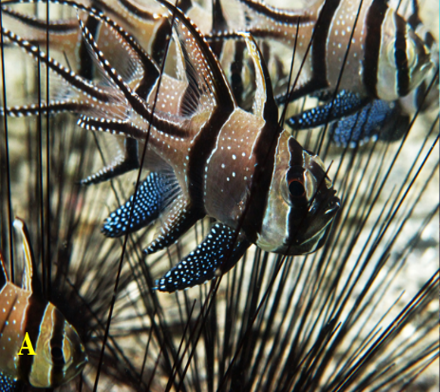
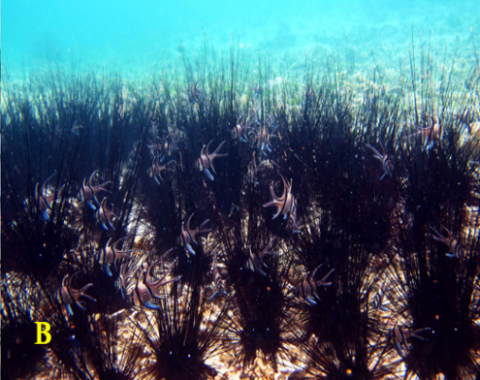
Ecologically, P. kauderni is known to have limited movement and low camouflage ability, so it is highly dependent on microhabitats as a refuge from predators [32]. This study shows that Banggai cardinalfish in Soropia waters have a significant relationship with sea urchin microhabitats, especially in the juvenile and adult stages (p < 0.05). The highest concentration of individuals was found in the microhabitats of sea urchins, anemones, and branching corals at a depth of 4–7.5 m with a substrate consisting of sand and coral rubble (Figure 7). These results are supported by the research [33] that P. kauderni fish tend to prefer microhabitats of sea urchins, sea anemones, and branching corals with a sandy substrate. Furthermore, Moore et al. [8] explained that the strong concentration of P. kauderni individuals in a microhabitat, especially sea urchins, is a major limiting factor for the abundance of adult individuals and the overall population biomass. In other words, even if fish densities are high, the limited number of protective microhabitats can limit the transition of juveniles to the adult phase, thereby limiting the potential for population expansion resulting from introductions.
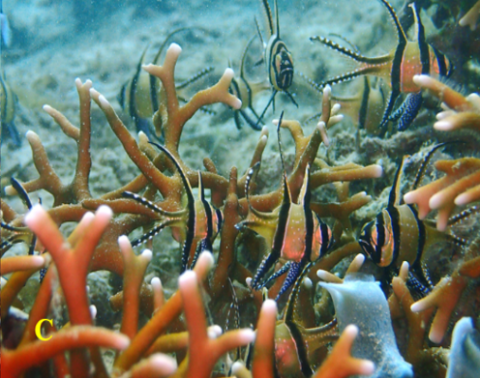
This ecological relationship also suggests that the expansion of P. kauderni populations beyond the initial introduction area is highly dependent on the distribution and abundance of suitable microhabitats. Microhabitats such as fire coral (Millepora sp.) are also utilized as refuges, although they must be shared with other fish species. However, sea urchin microhabitats remain the most important due to their effectiveness in reducing predation risk, particularly from predators such as Pterois volitans, Epinephelus coioides, and Plectropomus leopardus [7].
Figure 7. (A-B) The Pterapogon kauderni lives in shallow water and is associated with sea urchins as a microhabitat, (C) The Fire Coral (Millepora sp.) is another microhabitat for P. kauderni
The highest spatial variation in biomass and number of P. kauderni individuals was found in SP-03, where this location has a sandy substrate type with a relatively high abundance of sea urchin microhabitats compared to other locations. In the research [33] and Moore et al. [8], sandy microhabitats with high sea urchin populations are one of the most preferred places for P. kauderni fish. According to the result, the biomass of P. kauderni fish is not only influenced by the number of individuals, but also by the size structure and availability of support habitats. Fish biomass reflects the total body mass of live fish, which plays an important role in energy flow, ecosystem productivity, and the efficiency of food resource utilization [34, 35].
Based on these findings, practical implications for conservation and management are clear. First, management efforts for P. kauderni in introduced waters should focus on protecting and maintaining key microhabitats, particularly sea urchins and branching corals. Second, controlling fishing, particularly for mature individuals, is crucial to prevent further declines in biomass and ensure population sustainability. Third, regular monitoring of population size structure is necessary to detect changes in population dynamics and assess recruitment success. Finally, these results demonstrate that while introductions can result in high densities, the long-term success of populations is largely determined by the carrying capacity of the habitat and the availability of microhabitats, making an ecosystem-based management approach crucial for maintaining the ecological balance and sustainability of the Banggai cardinalfish resource [36-39].
The introduced Banggai cardinalfish (Pterapogon kauderni) population in Soropia waters showed lower biomass and density than its native habitat, with a total biomass of 16.47 kg/ha from 874 individuals dominated by larval and juvenile stages. Variation between stations was influenced by differences in size composition, with SP-03 having the highest number of individuals and biomass. The aquatic environmental conditions were relatively stable with a temperature of 28.1–28.3℃, a salinity of 34‰, and a substrate dominated by sand, except for SP-11, which consisted of coral rubble. The presence of sea urchins was shown to have a significant effect on the abundance of P. kauderni, especially in the juvenile and adult stages, making microhabitat a key factor in maintaining the introduced population and important to consider in habitat management efforts.
The author is greatly indebted to the following individuals for their invaluable assistance during fieldwork: Jupri (BPSPL-Makassar), Muhammad Randi (Universitas Halu Oleo), Risfandi (Anoa Dive Corps), and Bapak Rahul and family. The author gratefully acknowledges LPDP-BPI for financing the study and Stasiun Karantina Ikan Sulawesi Tenggara for sharing the fish trade document.
[1] Unok, A.R.P., Rasul, R., Hartina, H., Yuliana, Y., et al. (2024). Pengetahuan masyarakat mengenai keberadaan ikan capungan Banggai Pterapogon kauderni koumans, 1933 (Perciformes, Apogonidae) di teluk palu sulawesi tengah. Jurnal Perikanan Unram, 14(3): 1109-1117. http://doi.org/10.29303/jp.v14i3.864
[2] Vagelli, A.A. (2011). The Banggai Cardinalfish: Natural History, Conservation, and Culture of Pterapogon Kauderni. John Wiley & Sons.
[3] Jawad, L.A. (2012). The Banggai cardinalfish: Natural history, conservation and culture of pterapogon kauderni-edited by AA Vagelli. Journal of Fish Biology, 80(6): 2390-2392. https://doi.org/10.1111/j.1095-8649.2012.03297.x
[4] Mogontha, L., Bataragoa, N.E., Rondonuwu, A.B. (2022). Biology reproduction of Banggai cardinal fish Pterapogon kauderni Koumans, 1933 in Lembeh Strait. Jurnal Perikanan dan Kelautan Tropis, 11(1): 33-40. https://doi.org/10.35800/jpkt.11.1.2020.28734
[5] Putra, I.N.G., Putra, I.D.N.N. (2019). Recent invasion of the endemic Banggai cardinalfish, Pterapogon kauderni, at the Strait of Bali: Assessment of the habitat type and population structure. ILMU KELAUTAN: Indonesian Journal of Marine Sciences, 24(1): 15-22, https://doi.org/10.14710/ik.ijms.24.1.15-22
[6] Huwae, R., Patty, S.I., Arbi, U.Y., Hehuwat, J. (2019). Studi pendahuluan terhadap populasi ikan banggai cardinal (Pterapogon kauderni, Koumans 1933) di Perairan Teluk Ambon Dalam. Jurnal Ilmu Kelautan Kepulauan, 2(1): 22-31. https://doi.org/10.33387/jikk.v2i1.1192
[7] Kusumawardhani, N.R., Arbi, U.Y., Aunurohim. (2019). Analisis preferensi habitat ikan Capungan Banggai (Pterapogon kauderni) di lokasi introduksi perairan Kendari, Sulawesi Tenggara. In Proceeding of Seminar Nasional Kelautan XIV, Republic of Indonesian, pp. 47-59. https://prosidingseminakel.hangtuah.ac.id/index.php/jurnal/article/view/58.
[8] Moore, A.M., Yasir, I., Ambo-Rappe, R., Ndobe, S., Jompa, J. (2020). Microhabitat preference of the Banggai Cardinalfish (Pterapogon kauderni): A behavioural experimental approach. IOP Conference Series: Earth and Environmental Science, 564(1): 012019. https://doi.org/10.1088/1755-1315/564/1/012019
[9] Subhan, S., Rais, M., Pratikino, A.G., Erawan, M.T.F. (2022). Struktur populasi ikan endemik Banggai cardinalfish (Pterapogon kauderni) yang diintroduksi di perairan Pulau Bokori–Sulawesi Tenggara. Jurnal Kelautan: Indonesian Journal of Marine Science and Technology, 15(1): 15-22, https://doi.org/10.21107/jk.v15i1.13576
[10] Sitti, C.W., Hamar, B., Hamid, A. (2024). Studi pendahuluan karakteristik habitat ikan hias laut endemik banggai cardinal fish (Pterapogon kauderni) di Perairan Kota Baubau. Jurnal Ilmu dan Teknologi Kelautan Tropis, 16(2): 211-222. https://doi.org/10.29244/jitkt.v16i2.47828
[11] Ndobe, S., Handoko, K., Wahyudi, D., Yasir, M., Irawati, Y., Tanod, W.A., Moore, A.M. (2020). Monitoring the endemic ornamental fish Pterapogon kauderni in Bokan Kepulauan, Banggai marine protected area, Indonesia. Depik, 9(1): 18-31. https://doi.org/10.13170/depik.9.1.15363
[12] Arbi, U.Y., Ndobe, S., Dirhamsyah. (2021). Banggai Cardfish (Pterapogon kauderni): A Bioecological Note and Introduction. Balai Pustaka, Indonesia. http://www.balaipustaka.co.id/.
[13] Llopis-Belenguer, C., Blasco-Costa, I., Balbuena, J.A. (2018). Evaluation of three methods for biomass estimation in small invertebrates, using three large disparate parasite species as model organisms. Scientific reports, 8(1): 3897. https://doi.org/10.1038/s41598-018-22304-x
[14] Andradi-Brown, D.A., Gress, E., Wright, G., Exton, D.A., Rogers, A.D. (2016). Reef fish community biomass and trophic structure changes across shallow to upper-mesophotic reefs in the Mesoamerican Barrier Reef, Caribbean. PLoS One, 11(6): e0156641. https://doi.org/10.1371/journal.pone.0156641
[15] Li, D., Hao, Y., Duan, Y. (2020). Nonintrusive methods for biomass estimation in aquaculture with emphasis on fish: A review. Reviews in Aquaculture, 12(3): 1390-1411. https://doi.org/10.1111/raq.12388
[16] Barbeaux, S., Aydin, K., Fissel, B., Holsman, K., Laurel, B., Palsson, W., Shotwell, K., Qiong, Y., Stephani, Z. (2018). Chapter 2: Assessment of the Pacific cod stock in the Gulf of Alaska. Alaska Fisheries Science Center, Seatlle.
[17] Jepsen, N., Thorstad, E.B., Havn, T., Lucas, M.C. (2015). The use of external electronic tags on fish: An evaluation of tag retention and tagging effects. Animal Biotelemetry, 3(1): 49. https://doi.org/10.1186/s40317-015-0086-z
[18] Kanno, Y., Yui, N., Mamiya, W., Sakai, R., et al. (2020). A multistate mark–recapture approach to characterize stream fish movement at multiple spatial scales. Canadian Journal of Fisheries and Aquatic Sciences, 77(6): 1090-1100. https://doi.org/10.1139/cjfas-2019-0329
[19] Lubis, M.Z., Anurogo, W. (2016). Fish stock estimation in Sikka Regency Waters, Indonesia using Single Beam Echosounder (CruzPro fish finder PcFF-80) with hydroacoustic survey method. Aceh Journal of Animal Science, 1(2): 70-78. https://doi.org/10.13170/ajas.1.2.5463
[20] Knudby, A., LeDrew, E., Brenning, A. (2010). Predictive mapping of reef fish species richness, diversity, and biomass in Zanzibar using IKONOS imagery and machine-learning techniques. Remote Sensing of Environment, 114(6): 1230-1241. https://doi.org/10.1016/j.rse.2010.01.007
[21] Hill, J., Wilkinson, C. (2004). Methods for Ecological Monitoring of Coral Reefs: Version 1. Australian Institute of Marine Science, Townsville, 117.
[22] Padyawan, A.R., Ndobe, S., Herjayanto, M., Alapi, R., et al. (2025). Habitat development of the introduced Banggai cardinalfish (Pterapogon kauderni) population in Palu Bay, Central Sulawesi. JAGO TOLIS: Jurnal Agrokompleks Tolis, 5(3): 212-219. https://doi.org/10.56630/jago.v5i3.933
[23] Iksanuddin, M., Ishak, E. (2025). Density of peanut worm (Antillesoma antillarum) based on habitat characteristics in Toronipa waters, Soropia district, Konawe regency, Southeast Sulawesi Province. Jurnal Manajemen Sumber Daya Perairan, 2(2): 1-14. https://jmsp.uho.ac.id/index.php/jmsp/article/view/51.
[24] Schmitter-Soto, J.J., Aguilar-Perera, A., Cruz-Martínez, A., Herrera-Pavón, R.L., Morales-Aranda, A.A., Cobián-Rojas, D. (2018). Interdecadal trends in composition, density, size, and mean trophic level of fish species and guilds before and after coastal development in the Mexican Caribbean. Biodiversity and Conservation, 27(2): 459-474. https://doi.org/10.1007/s10531-017-1446-1
[25] Arbi, U.Y., Faricha, A. (2021). New host record of microhabitat preferences of the Banggai cardinalfish (Pterapogon kauderni) in the introduced habitat in Luwuk waters, Sulawesi. IOP Conference Series: Earth and Environmental Science, 944(1): 012018. https://doi.org/10.1088/1755-1315/944/1/012018
[26] Emerson, R.W. (2015). Convenience sampling, random sampling, and snowball sampling: How does sampling affect the validity of research? Journal of Visual Impairment and Blindness, 109(2): 164-168. https://doi.org/10.1177/0145482X15109002
[27] Carlos, N.S.T., Rondonuwu, A.B., Watung, V.N.R. (2014). Distribusi dan kelimpahan Pterapogon kauderni Koumans, 1933 (Apogonidae) di Selat Lembeh bagian timur, Kota Bitung. Jurnal Ilmiah Platax, 2(3): 121-126. https://doi.org/10.35800/jip.2.3.2014.9124
[28] Ndobe, S., Setyohadi, D., Herawati, E., Moore, A. (2018). Conservation management of the Banggai cardinalfish in the Banggai Kepulauan District MPA, a genetic approach. Journal of Indonesia Coral Reefs, 1(1): 15-29. https://doi.org/10.31230/osf.io/6cgva
[29] Liu, Z., Lu, W., Wang, T., Zhang, Y., He, L., Yang, L., Deng, L. (2025). The assessment of carrying capacity of marine fishery resources in China. Frontiers in Marine Science, 11: 1518235. https://doi.org/10.3389/fmars.2024.1518235
[30] Huang, X., Xu, Q., Zhang, B., Kong, C., et al. (2025). An assessment of the population structure and stock dynamics of megalobrama skolkovii during the early phase of the fishing ban in the Poyang Lake Basin. Fishes, 10(8): 378. https://doi.org/10.3390/fishes10080378
[31] Tamario, C., Sunde, J., Petersson, E., Tibblin, P., Forsman, A. (2019). Ecological and evolutionary consequences of environmental change and management actions for migrating fish. Frontiers in Ecology and Evolution, 7: 271. https://doi.org/10.3389/fevo.2019.00271
[32] Ndobe, S., Moore, A., Salanggon, A.I.M., Setyohadi, D., Herawati, E.Y. (2013). Banggai cardinalfish (Pterapogon kauderni) management an ecosystem-based approach. Marine Fisheries: Journal of Marine Fisheries Technology and Management, 4(2): 115-126. https://doi.org/10.29244/jmf.4.2.115-126
[33] Wahyudi, D., Masyahoro, A., Ndobe, S., Mubin, Syukri. (2026). Size Structure of Banggai Cardinalfish (Pterapogon kauderni) in Lalong Bay, Luwuk. JAGO TOLIS: Jurnal Agrokompleks Tolis, 6(1): 65-71. https://doi.org/10.56630/jago.v6i1.1495
[34] Wilson, S.K., Babcock, R.C., Fisher, R., Holmes, T.H., Moore, J.A.Y., Thomson, D.P. (2012). Relative and combined effects of habitat and fishing on reef fish communities across a limited fishing gradient at Ningaloo. Marine Environmental Research, 81: 1-11. https://doi.org/10.1016/j.marenvres.2012.08.002
[35] Longo, G.O., Ferreira, C.E.L., Floeter, S.R. (2014). Herbivory drives large-scale spatial variation in reef fish trophic interactions. Ecology and Evolution, 4(23): 4553-4566. https://doi.org/10.1002/ece3.1310
[36] Duffy, J.E., Lefcheck, J.S., Stuart-Smith, R.D., Navarrete, S.A., Edgar, G.J. (2016). Biodiversity enhances reef fish biomass and resistance to climate change. Proceedings of the National Academy of Sciences of the United States of America, 113(22): 6230-6235. https://doi.org/10.1073/pnas.1524465113
[37] McClanahan, T.R. (2015). Biogeography versus resource management: How do they compare when prioritizing the management of coral reef fish in the south-western Indian Ocean. Journal of Biogeography, 42(12): 2414-2426. https://doi.org/10.1111/jbi.12604
[38] Robinson, J.P.W., Williams, I.D., Edwards, A.M., McPherson, J., Yeager, L., Vigliola, L., Brainard, R.E., Baum, J.K. (2016). Fishing degrades size structure of coral reef fish communities. Global Change Biology, 23(3): 1009-1022. https://doi.org/10.1111/gcb.13482
[39] Russ, G.R., Rizzari, J.R., Abesamis, R.A., Alcala, A.C. (2021). Coral cover a stronger driver of reef fish trophic biomass than fishing. Ecological Applications, 31(1): e02224. https://doi.org/10.1002/eap.2224