Nabaa Mahdi Mohammed Ali Al-Saffar* | Alaa Hussein Al-Fatlawi
© 2024 The authors. This article is published by IIETA and is licensed under the CC BY 4.0 license (http://creativecommons.org/licenses/by/4.0/).
OPEN ACCESS
As demand for water grows and natural water supply becomes more uncertain, it's becoming increasingly difficult to maintain water quality and meet the demand for water resources, emphasizing the importance of good water governance and the adoption of the Integrated Water Resources Management approach. This approach aims to coordinate the development and management of water, land, and related resources to maximize economic and social benefits while maintaining the sustainability of ecosystems. While many countries support this approach, there are limited empirical studies on its impact, particularly in developing countries. In this paper, there is a study on integrated water management in the city of Karbala. Karbala governorate is in the middle of the Euphrates region of Iraq. Karbala governorate is surrounded by Babylon, Al-Ramadi, Baghdad, and AN-Najaf governorates. Ranked as the second-largest in terms of population, this governorate holds significant religious importance. Within its boundaries lie four bustling cities. The capital, Samawah, rests close to the ancient ruins of Uruk, an iconic vestige of antiquity. Nestled amidst the expansive plains sculpted by the Syrian Arab plateau and the meandering Euphrates River, Karbala governorate boasts a vast administrative expanse covering 51,740 square kilometers, equivalent to 11.9% of Iraq's territory. This study assesses the current water usage for supply, industrial, and agricultural purposes. The result indicate that the rural area of the city currently consumes 3.5 million cubic meters of water per year for domestic use and 0.174 million cubic meters per year for non-domestic purposes. Additionally, the estimated domestic water consumption in the towns of Karbala is 12.77 million cubic meters per year. The primary goals of this study aim to decrease dependence on drinkable water, promote the health of water bodies, wetlands, and valuable landscapes that are interconnected and easily accessible. To achieve these objectives, collaboration is essential among governmental bodies, industries, community organizations, and residents. The Integrated Water Management Plan comprises an action strategy designed to help the Council reach its goals and targets, facilitating the transition towards becoming a water-conscious city.
water management, irrigation, groundwater, water supply
Water is more than just a necessity; it's a fundamental aspect of society, crucial for survival, health, and economic prosperity, holding significant cultural and even religious importance [1]. Having access to clean, high-quality water not only enhances individual well-being but also enriches the entire community. In essence, water isn't just a communal asset but also a universal right, essential for everyone. However, the dynamics of water distribution can sometimes blur the line between social and private goods. Increasing water access for some could inadvertently reduce availability for others who rely on the same water sources [2].
Iraq is facing an increasingly dire water situation as both the quantity and quality of water continue to decline [3]. Since the 1980s, water flows from the Euphrates and Tigris rivers, which provide up to 98% of Iraq's water supply, have decreased by 30%. By 2025, water supply is expected to decrease by up to 60% compared to 2015. These declining water flows result from several combined factors, including intensive water usage by the oil and agricultural industries, the construction of dams, the impacts of conflict on water infrastructure, and climate change [4]. While available water resources are decreasing, the demand for water is increasing due to Iraq's expanding population, urbanization, and continued inefficient water usage by large industries. This also negatively impacts water quality. Reduced flows in the Euphrates and Tigris rivers allow salt water from the Shatt al-Arab to enter Iraq's waterways, making water increasingly saline. The discharge of untreated wastewater from cities, agricultural runoff, and industrial pollution into Iraq's rivers further undermines water quality [5].
In the 1980s, the growing demand for water services prompted the creation of the "Dublin Principles of Water." The Dublin declaration adopted four principles, one of which was the most controversial and confusing: "water has an economic value in all its competing uses and should be recognised as an economic good" [6]. This statement does not imply that water is a commercial commodity, but rather that it has different values in different competitive uses. Managing water is as an economic good means allocating it to competitive uses in a way that maximizes net social benefits [7]. These arguments led to the idea that "integrated water resources management is based on the perception of water as an integral part of the ecosystem, a natural resource, and a social and economic good" [8].
The primary objectives of this research were to: Prevent further degradation and safeguard the health of aquatic ecosystems, along with supporting the water requirements of connected terrestrial ecosystems and wetlands.
Help alleviate the impacts of floods and droughts. The rapid increase in population is leading to a concerning rise in the demand for freshwater resources like lakes and rivers globally [11]. Conflicts over shared water sources persist among people residing in different regions or even within the same area, often spanning decades without resolution.
1.1 Allocation
Water allocation planning and sustainable usage play a crucial role in advancing national efforts for efficient, fair, and optimal water resource management, essential for significant socioeconomic progress [1]. The current scenario underscores the urgent need for prudent water management, encompassing demand forecasting and allocation strategies. This study aims to establish a foundation for evaluating present water consumption using straightforward and dependable methods, particularly relevant for engineers involved in water supply and irrigation projects. Moreover, it offers insights for policymakers to grasp the dynamics of water resource systems. The primary objectives include estimating water usage across various sectors such as domestic, commercial, public, and institutional water supply, as well as in irrigated agriculture and livestock, catering to both smallholders and commercial ventures [12].
2.1 The study area description
The Karbala city is situated in northern Ethiopia, that extends across latitudes 38°38’ to 39°48’ east and 13°14’ to 14°16’ north (see Figure 1). Covering an area of roughly 5125 km2, Karbala experiences altitudes ranging from 3,300 meters above sea level to 930 m.a.s.l. The average elevation in the region is 2144 m, with a variation of 361 m, highlighting its rugged terrain.
Figure 1. The Geographic location of the study area (Karbala city)
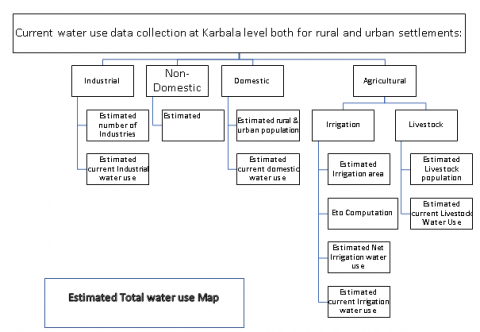
Figure 2. Mapping techniques for estimating current water usage
Figure 3. Flowchart of methodology used for water management development
2.2 Experimental work
To analyze current water usage accurately, we need specific datasets on water demand for water supply, irrigated agriculture, and livestock. The accuracy and reliability of our findings heavily rely on the quality and duration of the time series data. Hence, we dedicated significant effort to ensure the dataset's accuracy. The process for estimating current water usage is illustrated in Figure 2.
Figure 3 detailing the estimation of current water usage and mapping techniques was developed. This involved reviewing the national urban water supply design criteria, guidelines for drinking-water quality, and the sustainable development goals up to 2024 and beyond, to assess current water usage and project future demands. Karbala, situated in the middle of Iraq, is experiencing rapid socioeconomic growth. The city's population is rapidly expanding due to migration from other areas and the growth of industries, livestock, and modern irrigated agriculture. The increasing population is significantly straining water resources, sourced from rivers, runoff, deep wells, and shallow wells. Therefore, accurately calculating water demand under present and future conditions is crucial to estimate the overall water requirements for the water supply sector.
2.3 Hydrometeorology and socioeconomic data
The accuracy of the domestic water usage data gathered from the Karbala Water Department and local stakeholders is generally uncertain. To address this uncertainty, estimates for water consumption in urban and rural areas were calculated using per capita water usage guidelines from water supply authorities, along with population figures and adjusted by the reported water supply coverage rates in the region. As per the overall water directorate's strategy, rural areas in Karbala are expected to have a minimum of 250 liters per capita for domestic water use. This baseline figure is then combined with the documented water supply coverage to determine the actual domestic water consumption. Similarly, urban areas are required to meet specific water supply service standards based on town categorizations aligned with their population sizes (Table 1).
Table 1. Urban categories according to general water directorate
|
City Level |
Area |
Per Capita Water Use |
|
1 |
Rural |
250 |
|
2 |
urban |
370 |
In the city, a comprehensive survey uncovered numerous industries spanning various sectors. However, precise data regarding the water consumption rates of these industries remained somewhat uncertain. To mitigate this uncertainty, reliable data values were utilized and adjusted based on each industry's capacity. Additionally, the water usage of establishments like schools, hospitals, hotels, small businesses, and public service water facilities underwent evaluation. This assessment relies on the city's institutional and commercial landscape, which influences domestic water usage. Where specific water usage data wasn't available, estimates were made based on domestic water consumption patterns. Long-term meteorological data capturing the climatic conditions of the major agricultural areas in Karbala was gathered from the city's meteorological station. This data, including annual and monthly averages of rainfall, temperature, wind speed, sunshine hours, and relative humidity, was compiled. The assessment of agricultural water demand factored in the distribution of major agricultural zones, directly impacting irrigation practices and crop water needs [13].
2.4 Current irrigation area
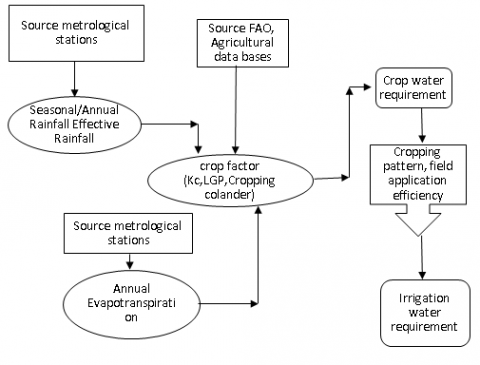
In Figure 4, a flowchart illustrating the steps involved in calculating the irrigation water needed. The data on the current irrigated areas in hectares (ha) were gathered from various stakeholders involved in the enhancement of irrigation systems in Karbala city, as presented in Table 2 and Table 3 [14].
Figure 4. A flowchart illustrating the steps involved in calculating the irrigation water needed
Table 2. Current water supply capacities of Karbala city [15]
|
No. |
Administrative Units |
Name of Supplying Project |
Population |
|
1 |
Center of city, Ain Al Tamir district, and Al Hur sub-district |
Karbala Unified Project 10000 m3/h Al Hussein City Project 8000 m3/h Haiy Al Hussein Project 4000 m3/h Al Safy Al Qadim Project 1350 m3/h and compounds of Al Hur sub-district |
784316 |
|
2 |
Al Hindiyah district |
Al Hindiyah Unified Project 2000 m3/h Al Hindiyah Unified Project 2000 m3/h Al Hindiyah Old project 350 m3/h and compounds of Al Hindiyah |
114425 |
|
3 |
Al Husayniyah sub-district |
A part of Karbala Unified Project 1000 m3/h Compounds of Al Husayniyah sub‐district 39400 m3/h |
147983 |
|
4 |
Al Juddul Al Gharby sub-district |
Compounds of Al Juddul Al Gharby sub‐district 2923 m3/h |
83369 |
|
5 |
Al Khirat sub-district |
Compounds of Al Khirat sub‐district 2303 m3/h |
46594 |
Table 3. Existing irrigation areas of administrative units in hectares (ha) in the city of Karbala
|
Province |
District |
Administrative Units |
Area (ha) |
Coverage % |
|
Karbala |
Karbala |
District Center |
59900 |
26% |
|
Al Husaniyah Sub-district |
33400 |
7% |
||
|
Al Hur Sub-district |
179700 |
20% |
||
|
Ain Al Tamir |
Ain Al Tamir District |
195600 |
3% |
|
|
Al Hindiyah |
Al Hindiyah District |
6700 |
4% |
|
|
Al Jiddul Al Gharby Sub-district |
16800 |
2% |
||
|
Al Khirat Sub-district |
12200 |
38% |
||
|
Total |
|
|
504300 |
100% |
Drinking water is a cornerstone of infrastructure and sustainable development cannot be achieved without it. The population adapts to meet its needs from the available amount of potable water for various purposes [16, 17]. Urban classifications based on population size and suggested service standards were gathered from Karbala along with the existing water supply.
Table 4 shows that the amount of production and sales of pure water in Karbala Governorate and the whole of Iraq. The achieved ratio of available energy to design reached 95% for both the governorate and the country, and in both of them, the amount of actual production to available energy reached 93%. But the quantity sold to the actual quantity produced is low in the governorate compared to the whole of Iraq.
Karbala Governorate suffers from a shortage of potable water. This deficit in the Karbala district center about 169 liters per person, and in Ain Al-Tamr, about 69 liters per person. There is also a discrepancy in the provision of water services between the administrative units of the governorate.
Table 4. The amount of production and sales of pure water in Karbala Governorate and the whole of Iraq [16]
|
Governorate |
Design Energy |
Available Energy |
Actual Production Quantity |
Quantity Distributed for Free |
The Amount of Losses |
Quantity Actually Sold |
|
Karbala |
350 |
333 |
311 |
16 |
31 |
264 |
|
Total Iraq |
5566 |
5294 |
4948 |
248 |
495 |
4205 |
3.1 Estimation of non-domestic and industrial water usage
Given that major industries in the city have data on water consumption, estimates for other water uses were derived indirectly using similar industrial water consumption data. To aid in planning, a dependable indicator for Industrial Water Demand was evaluated. It was discovered to exceed 100% of Domestic Water Demand in large and medium-sized towns, and range from 20% to 60% of Domestic Water Demand in small towns.
Table 5 lists the types of industrial facilities in the Karbala governorate for the year 2018.
Water usage is divided into two categories: domestic and nondomestic. Nondomestic use refers to all water consumption excluding domestic use in rural areas [18] estimation of nondomestic water use in rural areas is derived from domestic water consumption, estimated at 5%. Table 6 provides an overview of the current usage of water for commercial, public, and institutional purposes in both urban and rural regions of the city.
Table 5. Types of industrial facilities in Karbala governorate in 2018
|
No. |
Type of Industry |
Number of Industries |
|
1 |
Construction industries |
60 |
|
2 |
Dairy |
48 |
|
3 |
Fabric |
30 |
|
4 |
Carpentry |
26 |
|
5 |
Food industry |
74 |
|
6 |
Blacksmithing |
137 |
|
7 |
Manufacturing industries (gold) |
13 |
|
8 |
Aluminum factories |
90 |
|
9 |
Plumbing |
7 |
|
10 |
Service projects |
79 |
Table 6. Overview of current water usage for commercial, public, and institutional purposes in rural and urban areas of the city
|
No. |
District |
Use |
|
1 |
District Center |
170100 |
|
2 |
Al Husaniyah Sub-district |
21912 |
|
3 |
Al Hur Sub-district |
35200 |
|
4 |
Ain Al Tamir District |
35140 |
|
5 |
Al Hindiyah District |
49660 |
|
6 |
Al Jiddul Al Gharby Sub-district |
33824 |
|
7 |
Al Khirat Sub-district |
15632 |
|
Total |
|
361745 |
When calculating total water usage, we factor in water loss from existing supply systems. This loss can vary widely due to factors like the age and length of distribution pipes, operating pressure, number of connections, and how well the system is maintained. Because it's hard to pinpoint the exact amount lost, it's typically expressed as a percentage of the total demand, usually falling between 5% and 30%. In our recent research, we've used real-world water loss figures ranging from 10% to 30%, based on our own measurements. To estimate current water loss, we've leveraged data from water utility offices, considering factors like population size and time, aligning with both current assessments and past studies [19].
3.2 Agricultural water use estimate
3.2.1 Irrigation
The total irrigated area for the production year 2021 was mapped in GIS (Figure 5) from the GPS database and verified via Google Earth and physical measurements, and then estimated at around 10,254.8 ha [20].
Figure 5. Assessment of current irrigated land and population distribution in the city
The results indicate that the study area suffers from an annual water deficit and suffers from drought. Therefore, the amount of actual water needs for irrigation water is determined. The values of the needs vary according to the stages of plant growth, starting from the germination stage and then the emergence of seedlings [21]. Sufficient moisture must be provided in the soil through the results of the calculation.
Table 7 shows the amount of water required per month and the volumes of water in the lands of the Husseiniya irrigation project. The irrigation needs required for agricultural crops (winter and summer vegetables) were shown as follows:
Table 7. The amount of water required per month and the volumes of water in the lands of the Husseiniya irrigation project
|
Months |
Discharge (m3/s) |
Water Volumes (million/m3) |
|
October |
13.53 |
36.238 |
|
November |
2.07 |
5.365 |
|
December |
5.04 |
13.499 |
|
January |
5.01 |
13.418 |
|
February |
11.88 |
28.740 |
|
March |
18.75 |
45.36 |
|
April |
19.11 |
49.533 |
|
May |
5.07 |
13.579 |
|
Jun |
8.7 |
22.550 |
|
July |
13.23 |
35.435 |
|
August |
16.62 |
44.515 |
|
September |
14.61 |
37.869 |
The amount of water that the plant benefits from is equal to the amount of water distributed at the water outlet of the field it depends on the type of soil, agricultural operations such as plowing, leveling, and the quality of water used in irrigation, climate factors and the extent of their effects, agricultural crops and their growth stages [22].
The management of water resources in Iraq holds significant strategic importance, as it is intricately linked to numerous vital sectors and plays a crucial role in shaping future development plans [23]. The key challenges and obstacles in managing water resources in Iraq include:
To ensure a comprehensive and integrated vision, six main sectors were selected for study, all of which directly and vitally intersect with the water management file. These sectors are represented in the integrated water resources management system known as EES GMT. The six sectors are: Water and Environment, Water and Management, Water and Economy, Water and Socio-Cultural Sector, Water and Governance, and Water and Technology.
1- Water and the Environmental Sector
Current Situation: Due to policies by riparian countries and lack of coordination, water imports in the Tigris and Euphrates basins have been significantly reduced, impacting agriculture, livestock, vegetation, and forests. This has led to ecological imbalance, increased desertification by 100,000 dunums, reduced Euphrates River flow by 200-300 cubic meters per second, and higher salt and carbon dioxide emissions from various sectors [24].
Main Challenges: Significant environmental pollution in central Iraq disrupts ecological balance, exacerbated by climate change. Drying of marshes and water bodies, unregulated oil exploration and extraction, and unlicensed industrial activities contribute to the problem. Additionally, there is weak environmental awareness among citizens and institutions. The impact of large dams, both domestically and internationally, affects water quantity and quality, increasing risks from natural events like floods and earthquakes [25].
Recommendations: Revise and enforce environmental laws, including the Water and Wetlands Law. Foster cooperation among federal, regional, and local governments, civil society, and international organizations. Base water and environmental policies on scientific research and collaborative efforts. Monitor the oil and energy sectors for environmental impact, enforcing strict controls and encouraging eco-friendly legislation. Utilize modern technologies for water monitoring and treatment. Develop a national strategy based on comprehensive data and research on water management and ecosystem development.
2- Water and the Management Sector
Current Situation: Water administrations in Iraq is managed by the Ministry of Water Resources and the National Centre for Water Resources Management, distributing water through regional authorities. Effective management requires regular monitoring, cooperation with universities for ongoing research, and leveraging the Ministry's expertise and data. However, financial constraints and untreated sewage discharge into rivers highlight significant management issues.
Main Challenges: Iraq's fluctuating water returns, especially during dry seasons, severely impact water management. Insufficient funding delays crucial infrastructure projects and joint research, leading to numerous incomplete projects [26]. Water quota abuses and unregulated well drilling deplete water reservoirs. The absence of the Social Security Law and ongoing security issues result in a shortage of skilled personnel, highlighting the need for local capacity building. Additionally, there is a lack of transparency in sharing information with universities, hindering scientific research.
Recommendations: Press the upstream countries for a fair water quota agreement, using leverage like the 2016 World Heritage Convention on the Marshes. Allocate funds to complete strategic water projects and related research. Enforce laws to prevent water quota abuses and stop random well drilling. Activate water user associations for dialogue and experience sharing. Facilitate data access for research development. Promote rational water use and community awareness through campaigns. Regularly maintain irrigation projects and dredge the Tigris and Euphrates rivers. Ensure industrial and governmental projects, especially hospitals, do not discharge waste into rivers. Require the Ministry of Oil and oil companies to follow national and international water preservation standards.
3- Water and the Economic Sector
Current Situation: The water and economy sectors are plagued by uncertainty due to a lack of data on how they influence each other. There's no clear pricing system for agriculture, the largest water consumer, leading to perceptions of unfair water distribution. Additionally, there are no established priorities for water use across agriculture, industry, and households.
Main Challenges: The main challenges include fluctuating water supply hindering long-term economic planning, a lack of accurate statistics, unclear water tariffs and poor collection leading to government losses, legal ambiguities in water protection, and infrastructure-related wastage increasing costs.
Recommendations: The recommendations include improving regional cooperation, clarifying management roles, strengthening legal protections for water resources, accurately determining water needs for each sector to develop an economic model, and setting fair costs in agricultural projects to cover operational expenses.
4- Water and the Sociocultural Sector
Current Situation: Water is undervalued due to weak enforcement and low public awareness. Climate change and farmer displacement have caused social issues and infrastructure damage. Tribal conflicts over water and poor government communication worsen the situation, compounded by incompetent authorities.
Main Challenges: Desertification and displacement in central Iraq, worsened by water scarcity, have prevented the return of displaced families and increased poverty, unemployment, crime, and tribal conflicts. The lack of water also led to food insecurity, abandoned farmland, and distrust between citizens and the government.
Recommendations: Using modern irrigation methods can save 20% of water and enhance stability. Treating wastewater for agriculture can reduce desertification and provide 2-8 billion cubic meters of water annually. Groundwater harvesting can stabilize agriculture but needs careful management. Effective law enforcement, specialist management, academic cooperation, and support for farmers can also address water scarcity and improve food security.
5- Water and the Governmental Sector
Current Situation: Involving all stakeholders in water decision-making is crucial to avoid overlapping decisions. A higher water council within the Ministry of Water Resources, planned for over a decade, has not been effective due to lack of vision, administrative issues, and poor coordination.
Main Challenges: Corruption, high population growth, low water awareness, lack of accurate data, and weak legislative structures hinder effective water management and planning in Iraq.
Recommendations: Legislate the Supreme Water Council as an independent body with binding decisions, define roles for all stakeholders, treat water as a national security priority, cooperate with international organizations, address constitutional issues, include water quality in resource distribution, and adopt sustainable groundwater harvesting policies.
6- Water and the Technology Sector
Current Situation: Iraq has monitoring systems for surface and groundwater quality, but lacks home water harvesting, industrial feeding systems, and widespread desalination. There are 40 treatment plants for renewable groundwater, and while the country has ample dams and storage, smart technologies are missing in homes, factories, and agriculture. Hydroelectric power generation is minimal, and closed-pipe irrigation is used on a small scale, such as in Karbala.
Main Challenges: Weak water distribution infrastructure leads to waste, there's no system for harvesting rainwater, outdated data and technology hinder progress, and there's insufficient international cooperation and financial support for treatment and control plants.
Recommendations: Use modern irrigation techniques and wastewater treatment, allocate budgets for research, reduce surface water use through desalination, update water and agriculture infrastructure, apply water footprint concepts, enforce pollution control, promote technological awareness, and maintain dams with remote monitoring.
3.3 Assessment of overall water usage
After calculating the current water usage levels for various sectors within the urban area, the total estimated water usage for the city is 204.1 million cubic meters (Mm3). Additionally, there is a concerning trend of increasing population density in this region over time.
Water Directorate of Karbala delivers pure water to all the residents of the province that are widespread in all the administrative units of districts, sub‐districts, villages, and the countryside [27]. The total population of the province, according to the latest statistics of 2015 is 1185687 individuals, 521819 are in the district center. Also, the province is a host of 13687 registered internally displaced families, which are 68367 male and female individuals. Pure water delivery is done through the different departments in the directorate which has a total of 1415 staff divided upon 96 engineers, 166 technicians, 1208 labor force, and 844 daily contracts and cash payment. The directorate also provides, distributes, and delivers potable water to all the visitors of the city at the days of millions of visitors (tenth of Muharam, Al Sha’baniyah, and Al Muharam) in which visitors are estimated as millions.
Water consumption by the agricultural sector in the south of Iraq accounts for about 81% of the total water consumption, which is larger than the average figure for the country of about 72% (calculated from Table 8).
Table 8. Past, current, and future water demands and availability in Iraq
|
|
2000 |
2005 |
2010 |
2015 |
2020 |
|
Total Water Demand Billion m3 / yeara |
66 |
77.6 |
89.2 |
100.8 |
112.4 |
|
Domestic Demand Billion m3 / yeara |
4.3 |
5.81 |
7.32 |
8.83 |
10.34 |
|
Industrial Demand Billion m3 / yeara |
9.7 |
13.48 |
17.26 |
21.04 |
24.82 |
|
Irrigation Billion m3 / yeara |
52 |
58.31 |
64.62 |
70.93 |
77.24 |
|
Water Availability $\frac{m^3}{y e a r} /$ capitab |
3100 |
|
2400 |
|
1900 |
This result aligns with the fact that the region contains the majority of agricultural land in Iraq. While industry consumes about 20% of the total water demand in the country, it only represents 8% in the city of Karbala. Water demands in Karbala account for approximately 40% of the total water demand in southern Iraq, attributed to its highest agricultural production among the provinces. These findings can be utilized in managing available freshwater resources.
The water situation in Iraq is expected to deteriorate in the coming years due to increasing water demands and poor integrated water management. The rise in water demand is primarily attributed to population growth and industrial expansion driven by increased prosperity. Irrigation needs may also increase due to climate change in addition to the population growth effect. However, the impact of population growth on water demand is expected to be significantly greater than that of climate change. Despite the current and future water scarcity in Iraq, the annual water availability per capita in Iraq is the highest among other Arab countries.
Water management has significant implications for the environment by preserving ecosystems and biodiversity. It improves agricultural productivity and food security by optimizing water use. Public health benefits from clean water and reduced waterborne diseases. Economically, efficient water management supports various industries and reduces costs [30]. It enhances community well-being and reduces water-related conflicts. Additionally, it is crucial for adapting to climate change impacts, such as droughts and floods. Overall, water management is essential for sustainable development and ensuring the availability of this vital resource.
Water scarcity in southern Iraq poses a significant challenge expected to exacerbate due to population growth, increased water usage, poor management of available water resources, and climate change [31]. Utilizable water for consumption in southern Iraq was estimated at around 7043 million cubic meters per year compared to a demand of 7473 million cubic meters per year. Irrigation accounts for approximately 81% of water consumption in southern Iraq, with recent estimates indicating that rural areas of the city consume 3.5 million cubic meters per year for domestic purposes and 0.174 million cubic meters per year for non-domestic purposes. Meanwhile, domestic water usage in towns in Karbala is estimated at about 12.77 million cubic meters per year. Industrial water usage in urban areas is approximately 21.2 million cubic meters per year, with commercial, public, and institutional water usage at around 1.87 million cubic meters per year. The estimated water loss for all water supply uses is approximately 7.8 million cubic meters per year. The study also separately estimated irrigation water consumption for these users, considering water management efficiency and distribution [17].
There are several potential solutions to overcome water scarcity in southern Iraq, such as treating municipal wastewater, desalinating Arabian Gulf water, groundwater extraction, rainwater harvesting, and using modern irrigation techniques. There is no single solution to this problem, but considering a combination of various potential solutions will lead to sustainable water use. Groundwater can be an important water resource in the region; applying modern technologies that are more efficient and consume less energy is necessary to provide clean water for irrigation, industrial consumption, and other purposes. The interaction between water and energy should be considered when addressing water and energy management issues [32].
To strengthen the integrated approach in water management plans, several key strategies should be considered:
[1] Cosgrove, W.J., Loucks, D.P. (2015). Water management: Current and future challenges and research directions. Water Resources Research, 51(6): 4823-4839. https://doi.org/10.1002/2014WR016869
[2] Medema, W., McIntosh, B.S., Jeffrey, P.J. (2008). From premise to practice: A critical assessment of integrated water resources management and adaptive management approaches in the water sector. Ecology and Society, 13(2): 29.
[3] Abd-El-Mooty, M., Kansoh, R., Abdulhadi, A. (2017). Challenges of water resources in Iraq. Hydrology Current Research, 7(4): 1-8. https://doi.org/10.4172/2157-7587.1000260
[4] Schewe, J., Heinke, J., Gerten, D., Haddeland, I., et al. (2014). Multimodel assessment of water scarcity under climate change. In Proceedings of the National Academy of Sciences, 111(9): 3245-3250. https://doi.org/10.1073/pnas.1222460110
[5] Hussain, M.I., Muscolo, A., Farooq, M., Ahmad, W. (2019). Sustainable use and management of non-conventional water resources for rehabilitation of marginal lands in arid and semiarid environments. Agricultural Water Management, 221: 462-476. https://doi.org/10.1016/j.agwat.2019.04.014
[6] Ako, A.A., Eyong, G.E.T., Nkeng, G.E. (2010). Water resources management and integrated water resources management (IWRM) in Cameroon. Water Resources Management, 24: 871-888. https://doi.org/10.1007/s11269-009-9476-4
[7] Acheampong, E.N., Swilling, M., Urama, K. (2016). Developing a framework for supporting the implementation of integrated water resource management (IWRM) with a decoupling strategy. Water Policy, 18(6): 1317-1333. https://doi.org/10.2166/wp.2016.155
[8] André de la Porte, C. (2007). Integrated water resources management: limits and potential in the municipality of El Grullo, Mexico. EPFL.
[9] Cook, H.F. (2017). The Protection and Conservation of Water Resources. John Wiley & Sons.
[10] Syafiuddin, A., Boopathy, R., Hadibarata, T. (2020). Challenges and solutions for sustainable groundwater usage: Pollution control and integrated management. Current Pollution Reports, 6: 310-327. https://doi.org/10.1007/s40726-020-00167-z
[11] Mishra, R.K. (2023). Fresh water availability and its global challenge. British Journal of Multidisciplinary and Advanced Studies, 4(3): 1-78. https://doi.org/10.37745/bjmas.2022.0208
[12] Alegre, H., Baptista, J.M., Cabrera Jr, E., Cubillo, F., Duarte, P., Hirner, W., Merkel, W., Parena, R. (2016). Performance Indicators for Water Supply Services. IWA publishing.
[13] Jabal, Z.K., Khayyun, T.S., Alawn, I.A. (2022). Integrated approach for land surface temperature assessment in different topography of Iraq. Engineering and Technology Journal, 4(11): 1465-1486. http://doi.org/10.30684/etj.2022.134581.1241
[14] Muhaimeed, A.S. (2020). Monitoring and mapping of land threats in Iraq using remote sensing. In: Environmental Remote Sensing and GIS in Iraq, pp. 227-251. https://doi.org/10.1007/978-3-030-21344-2_10
[15] Mohammed, I., Nauman, A., Paul, P., et al. (2022). The efficacy and effectiveness of the COVID-19 vaccines in reducing infection, severity, hospitalization, and mortality: A systematic review. Human Vaccines & Immunotherapeutics, 18(1): 2027160. https://doi.org/10.1080/21645515.2022.2027160
[16] Chung, G., Lansey, K., Bayraksan, G. (2009). Reliable water supply system design under uncertainty. Environmental Modelling & Software, 24(4): 449-462. https://doi.org/10.1016/j.envsoft.2008.08.007
[17] Schuster-Wallace, C.J., Dickson, S.E. (2017). Pathways to a water secure community. In: The Human Face of Water Security, pp. 197-216. https://doi.org/10.1007/978-3-319-50161-1_10
[18] Crouch, M.L., Jacobs, H.E., Speight, V.L. (2021). Defining domestic water consumption based on personal water use activities. AQUA—Water Infrastructure, Ecosystems and Society, 70(7): 1002-1011. https://doi.org/10.2166/aqua.2021.056
[19] Kazimierczuk, K., Henderson, C., Duffy, K., Hanif, S., Bhattacharya, S., Biswas, S., Jacroux, E., Preziuso, D., Wu, D., Bhatnagar, D., Tarekegne, B. (2023). A socio-technical assessment of marine renewable energy potential in coastal communities. Energy Research & Social Science, 100: 103098. https://doi.org/10.1016/j.erss.2023.103098
[20] Hiben, M.G., Gebeyehu Awoke, A., Adugna Ashenafi, A. (2022). Estimation of current water use over the complex topography of the Nile Basin Headwaters: The case of Ghba Subbasin, Ethiopia. Advances in Civil Engineering, 2022(1): 7852100. https://doi.org/10.1155/2022/7852100
[21] Grossnickle, S.C., MacDonald, J.E. (2018). Why seedlings grow: Influence of plant attributes. New Forests, 49: 1-34. https://doi.org/10.1007/s11056-017-9606-4
[22] Unger, P.W. (2023). Common soil and water conservation practices. In: Soil Erosion, Conservation, and Rehabilitation, pp. 239-266.
[23] Mason, M. (2022). Infrastructure under pressure: Water management and state-making in southern Iraq. Geoforum, 132: 52-61. https://doi.org/10.1016/j.geoforum.2022.04.006
[24] Mueller, A., Detges, A., Pohl, B., Reuter, M.H., Rochowski, L., Volkholz, J., Woertz, E. (2021). Climate change, water and future cooperation and development in the Euphrates-Tigris basin. ResearchGate/Geoscience/Report, 38-53.
[25] Al-Mudaffar Fawzi, N., Mahdi, B.A. (2014). Iraq’s inland water quality and their impact on the North-Western Arabian Gulf. Marsh Bulletin, 9(1): 1-22.
[26] Nanekely, M., Scholz, M., Al-Faraj, F. (2016). Strategic framework for sustainable management of drainage systems in semi-arid cities: An Iraqi case study. Water, 8(9): 406. https://doi.org/10.3390/w8090406
[27] Hussein, H.A. (2021). Evaluation and analysis the effects of some parameters on the operation efficiency of the main water pipe in Karbala City using WaterCAD program. Baghdad: Ministry of Higher Education.
[28] FAO. FAO 2013 AQUASTAT database. http://www.fao.org/nr/water/aquastat/data/query/results.html, accessed on Oct. 22, 2024.
[29] Tolba, M.K., Saab, N. (2008). Arab Environment: Future Challenges. Beirut: Arab Forum for Environment and Development.
[30] Cissé, G. (2019). Food-borne and water-borne diseases under climate change in low-and middle-income countries: Further efforts needed for reducing environmental health exposure risks. Acta Tropica, 194: 181-188. https://doi.org/10.1016/j.actatropica.2019.03.012
[31] Price, R. (2018). Environmental risks in Iraq. K4D Helpdesk Report. Institute of Development Studies.
[32] Namany, S., Al-Ansari, T., Govindan, R. (2019). Sustainable energy, water and food nexus systems: A focused review of decision-making tools for efficient resource management and governance. Journal of Cleaner Production, 225: 610-626. https://doi.org/10.1016/j.jclepro.2019.03.304